PART2:A Stranger Posted a Video of an Exhausted Dog in the Woods—Then I Realized I Was Looking at the Labrador We Lost 18 Months Ago
PART2
I called his name before I even knew whether I could stand.
“Beckley!”
Nothing.
I climbed out through the driver’s side.
My left shoulder hurt.
Blood ran from somewhere near my eyebrow.
None of it mattered.
“Beckley!”
Alison came around the car.
Barely able to walk straight.
“Where is he?”
“I don’t know.”
“No.”
She looked at the open door.
“No, no, no.”
We started searching.
There was no decision.
No discussion.
We just moved.
Into the trees.
Down the ditch.
Across wet leaves.
“Beckley!”
The woods returned our voices without him.
A passing driver stopped.
Then another.
Police arrived.
Paramedics wanted to take us to a hospital.
I refused.
One deputy finally grabbed my arm.
“Sir, you may have a concussion.”
“My dog is out there.”
“We have people looking.”
“That’s my dog.”
“I understand.”
“No, you don’t.”
Alison touched my sleeve.
“David.”
She was shivering.
I looked at her face.
Blood at her hairline.
I hated myself for needing to choose.
We went to the hospital.
Two hours.
Twenty-three minutes.
I know because I watched every minute.
Mild concussion.
Eight stitches.
Shoulder strain.
Alison had bruised ribs.
We returned to the crash site before dark.
The car had already been towed.
The road looked smaller without the wreck.
Almost innocent.
We searched until after midnight.
Flashlights.
Deputies.
Volunteers.
Treat bags.
Beckley’s squeaky duck.
Alison called:
“Beck!”
Then:
“Baby!”
Then eventually:
“Please.”
That was the word that broke me.
Please.
As if the woods might hear the desperation and give him back.
Nothing.
The next morning, we returned.
Posters.
Shelters.
Animal control.
Veterinary clinics.
Facebook groups.
Community pages.
Missing-pet networks.
We left one of my shirts near the crash site.
His blanket.
Food.
Water.
A humane trap.
Trail cameras.
Every tip became a full emergency.
Yellow dog near Route 17?
Drive.
Dog seen at a gas station?
Drive.
Someone heard barking near a creek?
Drive.
A farmer found Labrador tracks?
Drive.
Three weeks after the accident, a woman called at eleven-thirty at night.
“I think your dog is behind my shed.”
We drove forty-two minutes.
Flashlights.
Treats.
Hope so powerful it physically hurt.
The dog stepped into the light.
Young.
Female.
No collar.
Not Beckley.
Alison knelt and cried.
We still helped the woman get that dog to a rescue.
Then drove home in silence.
Weeks became months.
Spring came.
Then summer.
I learned how many yellow dogs exist when you are searching for one specific yellow dog.
Every photograph made my heart stop.
Every road sighting.
Every bark behind a fence.
We printed five hundred posters.
Then five hundred more.
Rain ruined them.
We replaced them.
Someone tore down twenty-eight in one weekend.
I put them back.
Alison created a spreadsheet.
Date.
Location.
Description.
Distance from accident site.
Credibility.
Follow-up.
She was methodical because if she stopped organizing, she cried.
I became practical because if I stopped being practical, I had to admit I was losing hope.
We searched shelters every week.
Not just websites.
We drove.
Walked rows.
Looked into kennels.
Sometimes a dog would rush the gate and I would feel guilty for leaving without him.
There are too many lost animals in the world.
Searching for Beckley made that impossible to ignore.
Four months.
Six.
Nine.
People began speaking differently.
At first:
“You’ll find him.”
Then:
“Dogs can survive a long time.”
Then:
“Have you thought about maybe adopting another one?”
I hated that question.
Not because adopting another dog would be wrong.
Because people asked it as if animals were empty spaces.
Replaceable positions.
Labrador slot vacant.
Insert Labrador.
Beckley was not our dog in the abstract.
He was Beckley.
The dog who hated bananas but loved apple slices.
The dog who barked at delivery trucks but slept through thunderstorms.
The dog who had once sat beside Alison through every night after her mother died.
The dog who knew the sound of my pickup two blocks away.
Another dog could be loved.
But another dog could not be him.
On the first anniversary of the accident, Alison drove back to the woods.
I went with her.
Snow remained in small dirty patches beneath the trees.
She placed a new blanket near the old search area.
I did not ask why.
We sat on a fallen log.
Twenty minutes.
Maybe more.
Then she said:
“He’s alive.”
I looked at my hands.
“Ali.”
“He is.”
“You don’t know.”
“I do.”
“How?”
She turned toward me.
“I just do.”
I wanted to believe her.
Instead, I kissed her forehead.
That was the worst thing I could have done.
She pulled back.
“Don’t pity me.”
“I’m not.”
“Yes, you are.”
“I’m trying to protect you.”
“From what?”
I did not answer.
She did.
“From hoping?”
Her voice broke.
“Hope is the only part of him I still have.”
I never told her again that Beckley was probably gone.
I thought it.
But I kept it where it belonged.
Inside me.
Eighteen months after the accident, on September 3, I came home from work at 5:36.
I remember the exact time because Beckley used to hear my truck around then.
The house was quiet.
Alison stood in the kitchen.
Phone in one hand.
Her other hand covered her mouth.
“Ali?”
She did not answer.
“What happened?”
She turned the phone toward me.
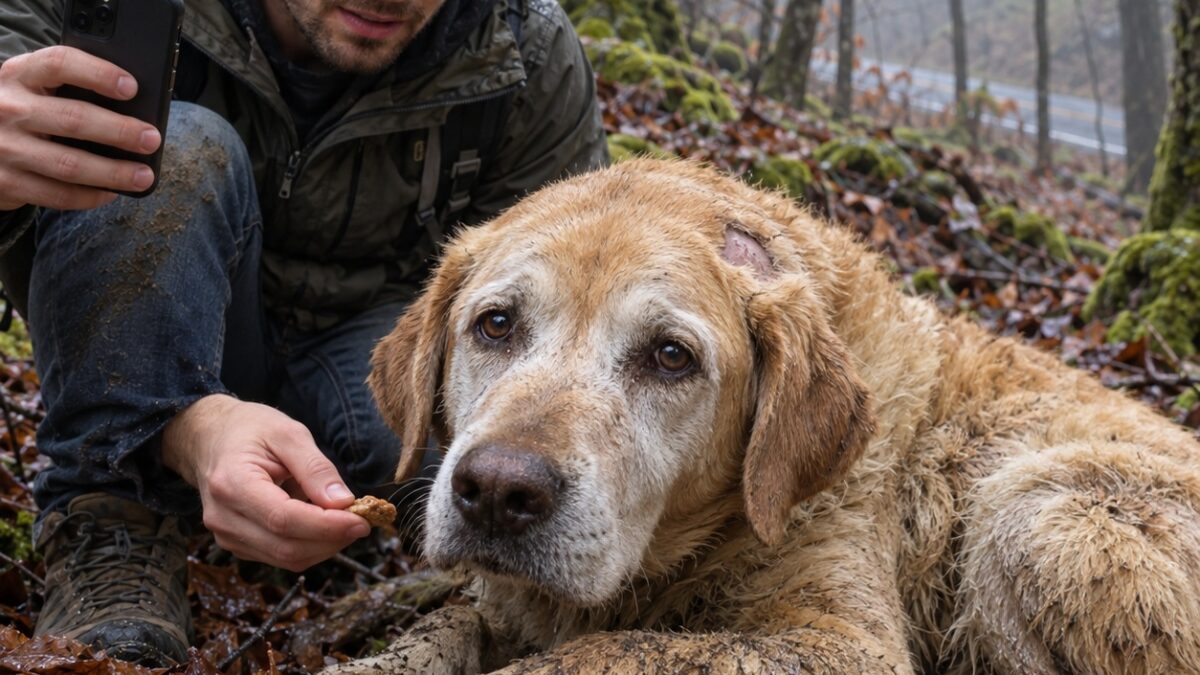
A social-media video.
A young man standing in a forest.
Camera shaking slightly.
Caption:
Found this exhausted old Lab alone near the trail. Anyone recognize him?
The video began.
The young man spoke softly.
“Hey, buddy.”
Leaves.
Breathing.
Then the camera tilted.
A Labrador lying beneath a tree.
Thin.
Filthy.
Gray muzzle.
My brain rejected it.
There are thousands of yellow Labradors.
Old dogs look similar.
Then the dog lifted his head.
My body knew before my mind did.
I stepped closer.
“Play that again.”
Alison already was.
The dog turned.
Left side visible.
There.
A small patch above the ear where fur grew strangely.
Scar from a fence accident when Beckley was four.
“David.”
“Wait.”
I grabbed the phone.
Replayed.
The young man moved closer.
The dog’s tail shifted once.
His right rear leg stretched in that awkward outward angle it always had since arthritis started.
My knees weakened.
“No.”
Alison began crying.
“That’s him.”
“No.”
“David.”
“Play it again.”
“That’s Beckley.”
“Play it.”
She did.
Again.
Again.
Again.
At one point, the young man said:
“Easy, buddy.”
The dog raised his head.
Same movement.
Slow first.
Then one ear before the other.
I knew that movement.
I had watched it for nine years.
I sat down hard at the kitchen table.
Alison crouched beside me.
“That’s our dog.”
I looked at her.
Eighteen months.
All her when.
All my if.
“I think it is.”
She slapped my arm.
“You think?”
Then laughed and cried at the same time.
“That’s Beckley.”
We found the account.
The young man’s name was Cole.
I sent a message.
Deleted it.
Sent another.
Too long.
Deleted that.
Finally:
Please call me. I believe the Labrador you found is our dog. He has been missing for 18 months. His name is Beckley.
My phone rang seven minutes later.
Unknown number.
I answered before the first full ring.
“Hello?”
“David?”
Young voice.
“Yes.”
“This is Cole.”
My heart pounded so hard I could hear it.
“The dog.”
“Yes.”
“He reacted when I said Beckley.”
I closed my eyes.
Across the kitchen, Alison froze.
“What?”
Cole continued.
“I saw your message.”
“So I went outside.”
“He’s lying behind my house.”
“I said Beckley.”
Pause.
“He looked right at me.”
Alison started sobbing.
I put the phone on speaker.
Cole said:
“Is that good?”
Alison laughed through tears.
“That’s very good.”
I asked:
“Where are you?”
He gave us the town.
Five hours.
Wooded hills.
We had searched near there early on, but never that far east.
“Can we come tonight?”
“Yes.”
“I’m not going anywhere.”
Then:
“He’s really tired.”
My stomach dropped.
“How bad?”
“Thin.”
“Very thin.”
“He’s been eating a little since I found him.”
“How long have you had him?”
“Three days.”
Three days.
“Why didn’t you take him to animal control?”
“I tried.”
Cole sounded embarrassed.
“He wouldn’t get in my truck.”
“I didn’t want to force him because he looked scared.”
“So I brought food.”
“Then water.”
“Then a blanket.”
“He started following me.”
Alison put both hands over her face.
I asked:
“Did you take him to a vet?”
“Not yet.”
“I called one.”
“They said if he’s drinking and alert, keep him quiet and bring him first thing tomorrow.”
“I was going to.”
“Then I made the video because…”
He paused.
“I don’t know.”
“He just didn’t look like a stray.”
“What do you mean?”
“He watches cars.”
That sentence destroyed me.
Cole continued:
“Every time one comes down the road, he lifts his head.”
“I thought he was waiting for somebody.”
I could not speak.
Alison did.
“He was.”
We left twenty-eight minutes later.
No packing beyond water, blankets, dog food and a leash we had kept in the hall closet for eighteen months.
I almost threw the leash away twice.
Never did.
We drove through the night.
Five hours.
Maybe slightly less.
I do not recommend discussing my speed.
Alison held the phone the entire way.
Watched the video repeatedly.
Every time Beckley lifted his head, she closed her eyes.
“It’s him.”
“I know.”
“He’s so thin.”
“I know.”
“What if he doesn’t remember us?”
I looked at her.
“He remembers us.”
“How do you know?”
“I just do.”
She laughed softly.
“Now you know things?”
“Apparently.”
Around midnight, traffic disappeared.
Roads narrowed.
Trees closed in.
Every mile felt impossible.
I kept thinking about eighteen months.
Where had he gone?
Had he stayed near the crash?
Followed a creek?
Found barns?
Been fed by strangers?
Been chased?
Was someone keeping him?
Had he spent winters outside?
Had he heard us when we searched?
Those questions still do not have answers.
Maybe they never will.
At three in the morning, Alison said:
“I keep thinking about the night we left.”
I knew which night.
Two days after the accident.
The day we finally drove home.
We had searched almost continuously.
The deputy said more searches would continue.
Shelters had our information.
Our bodies were exhausted.
We needed sleep.
I remember standing by the passenger door.
Alison looked toward the trees.
“I can’t leave him.”
“We’re coming back tomorrow.”
“That’s not what I mean.”
I had no answer.
She got into the car.
We drove home.
That was the heaviest drive of my life.
The empty back seat felt like accusation.
Now, eighteen months later, I looked at the same woman beside me.
Phone glowing in her hands.
“This drive is different.”
I said.
“I know.”
“We’re not searching.”
“No.”
“We’re going to get him.”
She turned toward me.
“We’re bringing him home.”
The sky began turning blue-gray around six.
By eight-thirty, we were less than thirty minutes away.
Alison stopped watching the video.
She could no longer sit still.
“What if we get there and it isn’t him?”
“It is.”
“What if—”
“Ali.”
“What?”
“Stop doing what I did for eighteen months.”
She stared.
“What?”
“Protecting yourself from hope.”
She looked out the window.
Then took my hand.
At nine o’clock, we turned onto a narrow road.
Small houses.
Trees.
Mailboxes.
A church.
Gas station.
Then Cole’s cottage.
Neat.
Green trim.
Big oak behind it.
A pickup parked beside the house.
Cole stood near the porch with his hands in his pockets.
He looked younger in person.
Twenty-four.
Maybe twenty-five.
Dark hair.
Tired face.
When we got out, he walked toward us carefully.
“You’re Beckley’s family?”
Alison nodded.
“Yes.”
Her voice broke on one syllable.
Cole looked at me.
Then back at her.
“I didn’t bring him around front.”
“Why?”
“I thought the cars might scare him.”
Good man.
“He’s behind the house.”
“He’s calm.”
“Very calm.”
Then quietly:
“Too calm, maybe.”
My stomach tightened.
We followed him.
The yard sloped gently toward trees.
Under the biggest one lay an old blue blanket.
On it:
A dog.
I stopped.
Completely.
The video had not shown how bad he looked.
Ribs visible.
Hips sharp.
Coat dull.
Gray face thinner than I remembered.
His eyes looked sunken.
For one terrible second, I saw only what eighteen months had done.
Then Beckley lifted his head.
His eyes found us.
Everything stopped.
He looked at Alison.
Then me.
One ear rose.
Then the other.
Exactly as before.
“Beck?”
Alison whispered.
His body changed.
Not dramatically.
A tension.
Recognition.
He tried to stand.
His front legs pushed.
Back legs slipped.
He fell onto one hip.
“Don’t.”
Alison started toward him.
Cole raised one hand.
“Let him.”
Beckley tried again.
I knelt.
“Hey, old man.”
His head snapped toward me.
I broke.
There are sounds adults make when grief and joy arrive at the same time.
Not crying exactly.
Something deeper.
“Come here.”
Beckley got up.
Legs trembling.
Took one step.
Then another.
Stumbled.
Recovered.
Alison was sobbing.
“Baby.”
“Come on.”
“He’s okay.”
“Come here.”
Beckley walked toward us.
Slow.
Unsteady.
Determined.
He did not bark.
Did not run.
Could not.
When he reached Alison, he stopped.
Looked up.
Then his tail moved.
Once.
Twice.
Slow.
Then faster.
His whole rear end started moving with it because he had always wagged inefficiently.
Alison dropped to her knees.
Beckley pushed his muzzle into her shoulder.
She wrapped her arms around him.
“Oh my God.”
She buried her face against his neck.
“Oh my God.”
“Beckley.”
“Our Beckley.”
I knelt beside them.
He turned.
Looked at me.
For half a second, I wondered whether recognition could disappear.
Then he licked my face.
One slow lick.
Then another.
I put my hand against his chest.
Heart racing.
Real.
Warm.
Alive.
“You stubborn old bastard.”
I whispered.
His tail hit the grass.
Thump.
Thump.
Thump.
I laughed.
Cried.
Pressed my forehead against his.
Eighteen months collapsed.
Not disappeared.
Collapsed.
All that distance suddenly reduced to the width between my hand and his fur.
Cole stood several feet away.
Wiping his eyes.
I looked at him.
He seemed embarrassed.
“I didn’t know.”
He said.
“When I found him, he was lying maybe forty yards off the trail.”
“I thought he was dead at first.”
“He didn’t move.”
“Then his eyes opened.”
Cole crouched.
“I gave him water.”
“He drank.”
“Wouldn’t follow me.”
“So I came back with food.”
“How long was he there?”
“I don’t know.”
“I found him three days ago.”
“The next morning, he followed me halfway to the truck.”
“But when I opened the door, he froze.”
“He started shaking.”
“So I stopped.”
I looked at Beckley.
Car.
Crash.
Open door.
Maybe fear.
Cole continued:
“I sat down.”
“Right there in the dirt.”
“He came and lay at my feet.”
“I just couldn’t take him somewhere he didn’t want to go after that.”
Alison looked at him.
“You saved him.”
Cole shook his head.
“I fed him.”
“No.”
I stood.
“You stopped.”
He looked confused.
I pointed toward the woods.
“Most people would have seen a dirty old dog and assumed someone else would handle it.”
“You stopped.”
“That’s why we’re standing here.”
Cole looked down.
“I just did what anybody would do.”
I shook my head.
“No.”
“Anybody could.”
“Not everybody does.”
We stayed in the yard for nearly an hour.
Beckley drank.
Ate a little.
Not much.
Cole had bought chicken-and-rice dog food after asking a veterinary clinic what might be gentle on his stomach.
He showed us the bag.
“His favorite.”
He smiled.
“At least for the last three days.”
Alison held Beckley’s face.
“You made friends fast, didn’t you?”
Beckley looked toward Cole when he heard his voice.
That mattered.
I felt something unexpected.
Not jealousy.
Gratitude with pain inside it.
In three days, Cole had become safety.
When an animal has been surviving alone for an unknown amount of time, safety is not a small gift.
We had no idea how Beckley reached those woods.
Five hours by car means little to a dog over eighteen months.
He may have traveled gradually.
Followed food.
Roads.
Creeks.
Farms.
Nobody knows.
Cole told us neighbors had seen a yellow dog occasionally over the previous weeks.
Never close enough to catch.
One woman left food near a shed.
Another thought he belonged to hunters.
Maybe Beckley had survived through dozens of small kindnesses we would never know about.
That thought still comforts me.
Before leaving, I shook Cole’s hand.
“If you ever need anything…”
He interrupted.
“One thing.”
“Anything.”
“When he gets better, send me a picture.”
He looked down at Beckley.
“I want to see him like he’s supposed to look.”
My throat tightened.
“You will.”
We made a bed across the back seat.
Beckley hesitated near the car.
I saw it immediately.
His body stiffened.
Ears back.
Alison stopped.
“No force.”
I agreed.
Cole brought the blue blanket.
Placed it across the seat.
Beckley sniffed.
Then looked at us.
I opened both rear doors.
Made it feel less enclosed.
Alison sat first.
“Come on, baby.”
Beckley took one step.
Stopped.
Then another.
Eventually, he climbed.
Not jumped.
Climbed.
He turned twice.
Lay down.
Head in Alison’s lap.
I closed the door gently.
Cole brought a big bowl of water.
Then the food bag.
“Take it.”
“We can buy more.”
“He knows this one.”
Good point.
I put it in the trunk.
Then looked at Cole.
There are debts money cannot improve.
So I did not insult him by trying to hand him cash.
I only said:
“Thank you.”
He nodded.
“Drive safe.”
Then:
“Hey.”
I looked back.
“Yeah?”
“I think he knew you were coming.”
I smiled.
“How?”
“He slept better last night.”
Maybe Cole was being kind.
Maybe not.
Either way, I kept it.
On the road home, Beckley barely moved.
Alison stroked his back.
Slowly.
Again and again.
Sometimes he sighed.
Long.
Deep.
The sound a body makes when it stops guarding itself for one second.
I watched through the rearview mirror.
Alison’s fingers moving over his fur.
Beckley’s eyes half shut.
I felt something I could not name.
Relief was too simple.
Joy too clean.
There was grief inside it too.
For every night he had been missing.
For how thin he was.
For the places he had slept.
For the fear he had apparently learned around cars.
For the fact that we would never know exactly what happened.
Reunion does not erase what came before it.
It changes what comes after.
Halfway home, we stopped at a quiet rest area.
No traffic.
Beckley drank.
Urinated.
Then stood beside the car.
He looked toward the woods.
My heart stopped.
“Beck.”
His head turned immediately.
I knelt.
He came to me.
No hesitation.
That was the first moment I truly believed he would stay.
Ridiculous maybe.
He had just reunited with us.
But loss changes your nervous system.
For months after he came home, part of me expected every open door to steal him.
At home, we did not take Beckley straight inside.
We sat with him in the driveway.
Let him smell.
The maple tree.
Fence.
Front walk.
He lifted his head.
Nose working.
Then started moving.
Slow.
He reached the porch.
Stopped.
Looked at the door.
Alison opened it.
Beckley walked inside.
Our house changed instantly.
Not because of noise.
Because of presence.
He stood in the hallway.
Sniffed the baseboard.
Living room.
Couch.
Kitchen.
Food bowl.
We had never removed it.
It had stayed beside the pantry for eighteen months.
Clean.
Empty.
Waiting.
Beckley sniffed it.
Looked at me.
I started crying again.
“I know.”
I whispered.
“I know.”
He continued.
Every room.
Every corner.
Like he was checking whether memory matched reality.
Alison followed a few feet behind.
Neither of us touched him unless he came to us.
At the bedroom door, Beckley stopped.
Looked inside.
Then at the bed.
His old habit.
Sleep between us.
But he was too weak to jump.
I knelt.
“Want help?”
He looked at the mattress.
Then me.
I lifted him carefully.
He weighed shockingly little.
I could feel every rib.
That hurt more than seeing them.
I placed him on the bed.
He walked to the exact center.
Turned once.
Lay down.
Alison started laughing.
“Of course.”
I climbed in beside him.
“So much for his orthopedic bed.”
“He remembers.”
“Yes.”
That night, we slept around him.
Or tried.
I kept waking.
Touching his side.
Checking breathing.
At three in the morning, Beckley shifted closer and put one paw across my wrist.
I lay perfectly still.
Did not want to lose the contact.
At five-thirty, something cold touched my cheek.
My eyes opened.
Beckley’s nose.
Weak.
But there.
I stared.
He stared back.
Then his tail tapped once.
I laughed so loudly Alison woke.
“What?”
“Nothing.”
“What happened?”
I wiped my face.
“He needs to go out.”
Alison smiled without opening her eyes.
“Then get up.”
For years, I had complained about that job.
That morning, I nearly thanked God for it.
We took him to our veterinarian as soon as the clinic opened.
Dr. Harmon had known Beckley since puppyhood.
The receptionist recognized us.
Then saw the dog.
Her hand went over her mouth.
“No.”
“Yes.”
“Oh my God.”
Within minutes, half the clinic knew.
Dr. Harmon entered the exam room.
Stopped.
“Beckley?”
His voice changed.
He knelt.
Beckley sniffed his hand.
Then leaned into him.
Dr. Harmon looked at us.
“How?”
“Internet.”
I said.
“A young guy found him.”
“That sentence is going to require more explanation later.”
He examined everything.
Weight.
Heart.
Lungs.
Teeth.
Joints.
Blood.
Parasites.
Hydration.
The good news surprised us.
Beckley was badly underweight.
Dehydrated.
Anemic.
Arthritis worse.
A few skin issues.
But no organ failure.
No major infection.
No cancer.
No catastrophic injury.
Dr. Harmon leaned against the counter.
“He is remarkably tough.”
“What does he need?”
Alison asked.
“Food.”
“Slowly.”
“Water.”
“Rest.”
“Bloodwork again in a week.”
“And security.”
He looked at Beckley.
“That may be the most important part.”
I asked:
“Do you think he was living wild the whole eighteen months?”
“No way to know.”
“He may have been fed by people.”
“Stayed in barns.”
“Moved around.”
“Been picked up and escaped.”
“Dogs can travel astonishing distances over time.”
Then:
“Do not make yourself crazy trying to reconstruct every day.”
Easier said than done.
“Focus on the dog in front of you.”
That became our rule.
The dog in front of us.
Not the imagined Beckley alone in winter.
Not the endless possible disasters.
The living dog.
Right now.
For the first week, he slept constantly.
Kitchen.
Living room.
Bed.
Sometimes outside in the sun.
We fed small meals four times a day.
He ate carefully at first.
As if food might disappear.
Then faster.
Dr. Harmon told us to slow him down.
We bought a special bowl.
Beckley looked offended.
Good.
Offended was healthy.
He did not like being alone.
If I left the room, he sometimes got up and followed.
Even when exhausted.
So we adjusted.
I worked from home whenever possible.
Alison moved her reading chair near his bed.
At night, he slept between us.
Every night.
No negotiations.
Sometimes he woke suddenly.
Head up.
Breathing fast.
We would speak softly.
“Home.”
“You’re home.”
“Easy.”
Then he would settle.
Cars were harder.
The first veterinary trip nearly broke him.
He froze beside the rear door.
Trembling.
So we stopped.
Sat.
Waited.
Used Cole’s blue blanket.
Eventually, Beckley climbed in.
Weeks later, he began jumping in on his own.
That small moment felt enormous.
Recovery is made of things nobody else would celebrate.
A full bowl eaten.
A normal stool.
One pound gained.
Three pounds.
A tail wag at the leash.
A bark at the mail carrier.
The first time Beckley barked, Alison ran from upstairs.
“What happened?”
I pointed outside.
Delivery van.
Beckley stood near the window.
Furious.
Normal.
Alison laughed.
“I missed that.”
“So did I.”
The driver looked confused.
We probably looked insane.
By week three, Beckley’s coat started changing.
Less dull.
Soft again.
His ribs still showed but not as sharply.
His eyes looked brighter.
He followed us into the kitchen and resumed standing exactly where one of us was likely to trip over him.
“Some habits survived.”
I said.
Alison stepped around him.
“He was perfect before.”
“He stole chicken off counters.”
“Perfect.”
“He ate a remote.”
“You left it accessible.”
“You blamed me for that nine years ago.”
“I was right then too.”
Beckley wagged.
House restored.
The backyard became his favorite place again.
At first, he only lay near the porch.
Then walked to the fence.
Then farther.
One morning, a squirrel ran along the top rail.
Beckley’s head came up.
I knew that look.
“Oh no.”
He took off.
Not fast.
Not elegant.
But absolutely convinced he could catch that squirrel.
“Beckley!”
Alison shouted.
He ignored her.
Same old dog.
The squirrel escaped by several feet and most of a lifetime.
Beckley stood beneath the tree looking insulted.
I laughed until my side hurt.
That afternoon, I realized I had gone several hours without thinking about the eighteen missing months.
That was new.
For a long time, every moment with Beckley contained two dogs.
The one in front of me.
And the one I imagined alone.
Slowly, the second dog faded.
Not entirely.
Enough.
We called Cole every few days at first.
He always asked:
“How’s the old man?”
“Eating.”
“Good.”
“Gained two pounds.”
“Seriously?”
“Yep.”
Then five.
Then seven.
Cole told us something we had not known.
On the second night at his cottage, he had gone outside at two in the morning because he heard movement.
Beckley was standing at the edge of the yard staring down the road.
“He did it for almost ten minutes.”
Cole said.
“Just stood there.”
“I wondered if he was thinking about leaving.”
My throat tightened.
“What did you do?”
“Nothing.”
“I sat on the porch.”
“Eventually he came back.”
Alison wiped her eyes.
Cole added:
“He chose to stay.”
Maybe.
Or maybe he was too tired.
We choose the kinder version.
A month after Beckley came home, Alison found the old search box in the garage.
Posters.
Extra leash.
Printed maps.
Shelter lists.
One of my shirts sealed in a plastic bag because we had used another copy for scent.
She sat on the garage floor.
I found her there.
“What are you doing?”
“I don’t know.”
She held up one poster.
Beckley’s younger face.
MISSING
Large red letters.
Reward.
Phone number.
She started crying.
“I hated these.”
“Me too.”
“I used to imagine strangers seeing them.”
“Thinking, ‘That dog is probably dead.’”
I sat beside her.
“I was one of those people.”
She looked at me.
“No.”
“Yes.”
“I stopped believing.”
“You kept searching.”
“Because you did.”
She leaned against my shoulder.
“Does that matter?”
“Yes.”
“Why?”
“Because you loved him even when you were afraid to hope.”
I had never thought of it that way.
Maybe hope is not a requirement for love.
Sometimes showing up is enough.
We kept one poster.
Put it in a folder.
Not as sadness.
Proof.
The others we recycled.
Alison hesitated before dropping them into the bin.
Then did.
Another small recovery.
By November, Beckley had regained most of his weight.
The vet stopped looking worried when he entered.
His bloodwork normalized.
Coat golden again.
Gray muzzle still there.
Of course.
He was older.
Missing eighteen months had not paused time.
That was important too.
We did not get the dog we lost back exactly as he had been.
We got Beckley older.
More cautious.
Arthritis worse.
A scar near his right paw we did not recognize.
A habit of checking doors.
A fear of sudden metal sounds.
Sometimes he ate as though another meal might not come.
Then gradually, slowly, he learned abundance again.
That is what safety does.
It teaches the body tomorrow may resemble today.
Food comes again.
Water stays.
Door opens.
Humans return.
Bed remains.
One morning in late November, I woke before Beckley.
That almost never happened.
Sun through curtains.
Alison asleep.
Beckley on his back between us.
Four paws in the air.
Mouth slightly open.
Completely ridiculous.
Completely vulnerable.
I watched his chest rise.
Fall.
Rise.
For eighteen months, I had imagined him sleeping curled tight beneath trees.
Now he occupied sixty percent of our king-size bed.
I whispered:
“You’re a terrible roommate.”
One eye opened.
Tail tapped.
Then he went back to sleep.
I stayed there another half hour.
No complaint.
Christmas came.
The previous Christmas had been miserable.
We had put Beckley’s stocking away.
Did not decorate much.
This year, Alison hung it before anything else.
Red felt.
His name stitched crookedly because she had made it when he was a puppy.
Beckley watched her.
“Remember this?”
She asked.
He sneezed.
“That means yes.”
I said.
We bought too many treats.
Of course.
Cole received a package too.
Coffee.
Gift card to an outdoor store.
A framed photograph of Beckley.
Cole called.
“You didn’t have to do this.”
“We know.”
“What am I supposed to do with all this?”
“Accept it.”
He laughed.
Then:
“The photo…”
His voice changed.
“He looks good.”
“He is.”
“Really good.”
“He still steals food.”
“Perfect.”
I realized how deeply Cole had cared about a dog he knew for only three days.
Time is not the only measure of attachment.
Sometimes responsibility arrives quickly.
He had found a creature depending on him.
He responded.
That was enough to matter forever.
The photograph we eventually sent him was not the Christmas picture.
It came later.
A quiet evening.
Late sunlight across the living room.
Beckley lying on the rug.
Head on paws.
Eyes half closed.
Coat bright.
Body full again.
Peace.
I took the picture without thinking.
Then looked at it.
There he was.
Not the dog in Cole’s forest video.
Not ribs.
Not exhaustion.
Not fear.
Beckley.
Our Beckley.
I texted Cole.
Here he is. The way he should be.
A few minutes later:
I knew he was waiting for somebody. Thank you for coming for him.
I read the message several times.
Then showed Alison.
She cried.
Of course.
We cried a lot that year.
Not all tears mean the same thing.
I sometimes wonder about the language we use.
Cole said:
“Thank you for coming for him.”
We said:
“Thank you for saving him.”
Both true.
Neither complete.
Beckley had survived something before either of us arrived.
Maybe dozens of people helped.
Maybe one farmer left scraps.
Maybe someone filled a water bowl.
Maybe he slept beneath porches.
Maybe he avoided every human until Cole.
Maybe not.
We do not know.
And I finally stopped needing to know.
The unanswered eighteen months belong to Beckley.
Not to me.
My responsibility began again when we found him.
So I focused on that.
Walks.
Medication.
Food.
Warmth.
Safety.
Love.
The important things are often boring after the miracle.
People love the reunion.
The tail wag.
The video.
The stranger.
But the real work came afterward.
Four meals.
Vet appointments.
Fear of cars.
Night waking.
Patience.
Weight gain.
Routine.
Learning each other again.
That was love too.
Maybe more.
One evening, around six months after Beckley returned, Alison and I were sitting on the porch.
Beckley lay between our chairs.
She said:
“I told you.”
“What?”
“He’d come back.”
I groaned.
“You waited six months for this?”
“Yes.”
“I admitted you were right.”
“No.”
“You said I was ‘apparently correct.’”
“That is admitting.”
“That is bureaucratic surrender.”
I smiled.
“Fine.”
I looked down at Beckley.
“You were right.”
Alison leaned back.
“Thank you.”
Then, quieter:
“I wasn’t actually sure.”
I turned.
“What?”
She watched the yard.
“I said I was.”
“But some days…”
Her eyes filled.
“I thought he was dead.”
That surprised me.
“Why didn’t you tell me?”
“Because you were already carrying that possibility for both of us.”
We sat quietly.
All those months, I thought Alison had hope and I had realism.
Turns out she had fear too.
She simply chose different words.
“When.”
Not because she knew.
Because she needed a place to put love.
I took her hand.
“We were both a mess.”
“Correct.”
Beckley sighed between us.
Neither of us had been right.
Neither wrong.
We survived uncertainty differently.
That was all.
Over time, Beckley’s story spread.
Friends shared Cole’s original video beside the reunion photo.
People commented.
Cried.
Asked questions.
Where had he been?
How did he travel so far?
Did someone steal him?
Had he lived in the wild?
We answered honestly.
We do not know.
One person insisted:
“Dogs always find their way home.”
I almost replied:
Not always.
Beckley did not find our house.
A human found Beckley.
That distinction matters.
Romantic stories about animals finding their way home can hide the role people play.
Cole stopped.
That is why the story changed.
He could have kept hiking.
He could have called animal control and left.
He could have decided the dog was too old.
Too dirty.
Too much trouble.
He did not.
He went back with water.
Food.
A blanket.
Then a camera.
That camera reached us.
Technology did what eighteen months of posters had failed to do.
But the video only existed because compassion came first.
That is the part I tell people.
Do not only share.
Stop first.
Look.
Offer water.
Check a tag.
Call someone.
A few minutes of inconvenience can be somebody else’s entire world.
Cole eventually came to visit.
About eight months after the reunion.
He was passing through our area and texted:
Would it be weird if I stopped by?
I answered:
Beckley votes yes.
He arrived Saturday afternoon.
When his truck pulled into the driveway, Beckley was in the backyard.
I wondered what would happen.
Would he remember?
Cole stepped through the gate.
“Hey, old man.”
Beckley froze.
Then ran.
Actually ran.
Not puppy speed.
Old Labrador speed.
Still impressive.
He went straight to Cole.
Tail everywhere.
Cole dropped to one knee.
“Look at you.”
Beckley pushed his head under Cole’s arm.
I looked at Alison.
She was crying.
Again.
Cole laughed.
“You remember me?”
Of course he did.
Safety is memorable too.
We grilled burgers.
Cole stayed for hours.
He told us more about finding Beckley.
He had gone hiking because his father had died the month before.
That detail stopped me.
“You never said.”
“Didn’t matter.”
“It matters.”
Cole looked toward Beckley.
“I wasn’t doing great.”
He admitted.
“I needed to get out of my apartment.”
“So I drove to the trail.”
He rubbed Beckley’s ear.
“Then this guy was there.”
Alison asked:
“Do you think finding him helped you?”
Cole smiled slightly.
“Yeah.”
“I think it did.”
There it was.
The story had another direction we had never seen.
We thought Cole entered Beckley’s life because the dog needed help.
Maybe Beckley entered Cole’s because Cole needed something too.
Not saving.
Purpose.
A reason to stop thinking about one grief for a few hours.
A living thing requiring water right now.
That can be powerful.
Cole said:
“My dad loved dogs.”
“What kind?”
“Black Lab.”
“Name?”
“Roscoe.”
“When I found Beckley, I kept thinking about him.”
“Your dad?”
“Both.”
He laughed.
“I guess.”
Later, Cole stood to leave.
Beckley followed him to the gate.
That hurt.
Not badly.
Just enough.
Cole knelt.
“You stay here.”
Beckley wagged.
Cole scratched his neck.
“You’ve got people.”
Then he looked at us.
“So do I.”
He drove away.
Beckley watched.
Then turned.
Walked back to us.
Home is not choosing one person over another.
Sometimes it is having more than one person worth remembering.
By the second year after Beckley’s return, strangers stopped seeing the dog who had been lost.
They saw an old Labrador.
Gray.
Happy.
Slow.
We saw both.
Sometimes when he slept, I would notice a scar.
Wonder.
Then stop.
The need to reconstruct his suffering had become less important than protecting his present.
Dr. Harmon once told me:
“Animals are better than humans at that.”
“At what?”
“Living where they are.”
I watched Beckley sniffing an exam-room trash can.
“Very spiritual.”
Dr. Harmon laughed.
“You know what I mean.”
I did.
Beckley did not wake each morning reviewing the tragedy.
He woke.
Wanted breakfast.
Wanted outside.
Wanted us.
That was enough.
Maybe healing is not forgetting.
Maybe it is allowing today to become larger than yesterday.
Beckley taught me that.
Not intentionally.
Dogs rarely lecture.
They demonstrate.
One ordinary morning, he woke me with his nose.
I opened my eyes.
“Five more minutes.”
Thump.
“No.”
Thump.
“Beck.”
More pressure.
I sat up.
“You know, there was a time when I prayed for this.”
He jumped off the bed.
I followed.
Alison mumbled:
“You still should.”
She was right.
We walked before sunrise.
Cool air.
Street quiet.
Beckley stopped at every mailbox as if personally responsible for neighborhood intelligence.
I stood beneath a streetlamp while he investigated grass.
I remembered the forest video.
Thin dog.
Head lifting.
The person watching that video felt like another version of me.
A man who had learned to live around a hole.
Now the hole had closed enough for ordinary irritation to return.
Beautiful.
We reached home.
Beckley went straight to his water.
Then kitchen.
Breakfast.
Same routine.
I poured coffee.
Alison came downstairs.
Two cups.
She placed one beside me.
Beckley moved from my feet to hers.
Traitor.
She smiled.
“You know what?”
“What?”
“I always believed he’d come back.”
I gave her a look.
“You admitted that wasn’t entirely true.”
“I am rewriting history.”
“Apparently.”
She sat beside me.
Beckley put his muzzle across her knees.
Sunlight moved through the window.
Everything was ordinary.
That is what I wanted most.
Not a dramatic miracle forever.
Ordinary life restored.
We had lost Beckley in one violent night.
We got him back because a stranger did one simple thing.
He stopped.
That still stays with me.
When I think about the world, I understand why people become cynical.
There is cruelty.
Neglect.
Abandonment.
Animals wandering roads.
People passing.
Bad things happen without deserving.
The accident taught me that.
But Beckley’s return taught me something else.
Goodness is often just as ordinary.
A young man on a trail.
A bottle of water.
A bag of food.
A blanket.
A phone camera.
A message answered.
No headlines required.
No hero speech.
Cole did not think he had done anything extraordinary.
Maybe that is why I trusted him.
He saw suffering.
He moved toward it.
That is all.
And sometimes that is everything.
Today, Beckley is beside me while I write this.
Older now.
Much older.
His face almost entirely white.
He sleeps more.
Arthritis medication with breakfast.
Shorter walks.
He still hates bananas.
Still loves apple slices.
Still tries to convince every delivery driver that our house is under attack.
At night, he still sleeps between Alison and me.
Some things do not improve with age.
I no longer complain.
Well.
Not seriously.
Sometimes his back feet push into my ribs.
I say:
“Move.”
He does not.
I say:
“This is my bed.”
He continues sleeping.
Alison says:
“You know he can’t hear you when he’s asleep.”
“I need him to understand the principle.”
She laughs.
I lie there listening to his breathing.
Deep.
Steady.
Real.
There was a time when I thought finding Beckley would repair the eighteen months.
It did not.
Those months still happened.
Alison and I still know what it is to drive home without him.
To look into an empty back seat.
To search a ditch.
To answer calls at midnight.
To walk shelters.
To mistake another dog for ours.
To stop expecting good news.
You cannot undo that.
But something does not have to be undone to stop owning you.
Beckley came home.
The grief changed shape.
That was enough.
Sometimes people ask:
“Do you think Beckley always knew he would find you?”
No.
I do not know what dogs understand about absence.
I do know he remembered us.
I know what happened in Cole’s backyard.
I know his head lifted.
I know his ears changed.
I know he pushed his exhausted body to its feet.
I know he stumbled.
I know he kept walking.
I know his tail moved before anything else did.
I know Alison said:
“Our Beckley.”
And I know his heart was beating beneath my hand.
That is enough truth for me.
I no longer need the story to become supernatural.
Love does not need magic to be astonishing.
Recognition after eighteen months is astonishing enough.
Survival is astonishing enough.
A stranger caring is astonishing enough.
The right video reaching the right phone at the right moment?
Call it luck.
Call it timing.
Call it algorithms.
Call it grace.
I do not care.
It brought our dog home.
Cole once told me:
“I knew he was waiting for somebody.”
I think about that sentence often.
Not because Beckley literally sat in the forest thinking:
David and Alison will arrive on Friday.
Maybe he did.
Maybe dogs think in smells, routines and faces more than future plans.
But he had not surrendered completely.
He still lifted his head when cars passed.
Still watched people.
Still allowed Cole close.
Still ate.
Still followed.
There was something in him moving toward life.
That was the part Cole noticed.
And when we arrived, Beckley tried to stand.
Weak legs.
Thin body.
Eighteen months of whatever he had survived.
He still tried.
That is how I remember him now.
Not lost.
Not abandoned.
Not even found.
Walking.
Toward us.
Slow.
Shaking.
Determined.
If you ask me what home looked like that morning, it was not the cottage.
Not our car.
Not our house five hours away.
Home was the moment Beckley looked at Alison, looked at me, and his tail started moving.
Everything after that was just distance.
And distance, finally, was something we knew how to cross.
Eighteen months earlier, the road had taken him from us in seconds.
On September 3, a young stranger gave us the road back.
Cole saw a tired old dog in the woods and chose not to say:
Someone else will help him.
He bent down.
Held out his hand.
And in the simplest possible way, he told Beckley:
“Hey, buddy. Easy. I’m here.”
Somewhere five hours away, we had spent eighteen months wishing we could say the same thing.
Because Cole stopped, we finally got the chance.
And when Beckley came home, climbed into the middle of our bed, sighed between us and fell asleep like he had only been gone for an afternoon, Alison reached across him and took my hand.
Neither of us spoke.
We did not need to.
For eighteen months, our house had been missing one breathing thing.
That night, in the dark, Beckley breathed.
Alison breathed.
I breathed.
And for the first time since the accident, the whole house felt alive at the same time.
We were home.
All three of us.
Finally.

