PART2:A Billionaire Shoved a 68-Year-Old Janitor Away From His Piano—Then Someone in the Ballroom Recognized His Hands
PART2
The Grand Monarch sat in the heart of Manhattan like a building convinced history had made it immortal.
A century old.
Limestone.
Brass.
Dark wood.
Tall windows.
Presidents had slept there.
Foreign ministers.
Oil men.
Movie stars.
Families who returned every Christmas because their parents had returned every Christmas.
The ballroom was the hotel’s crown.
White marble.
Gold trim.
Crystal chandeliers.
A Steinway grand at the center of the room.
Beautiful instrument.
Nine feet.
Gloss black.
Well maintained.
Not perfectly.
No piano ever is.
I knew that instrument intimately even though nobody at the hotel knew I did.
Cleaning crews develop relationships with objects.
You notice scratches others do not.
Loose hinges.
Carpet seams.
A chair leg that catches.
A key that sticks slightly when humidity changes.
The Steinway had a middle E with a shallow indentation along the ivory.
Not damage exactly.
Wear.
Years of touch.
The key returned properly, but the action had begun feeling slightly uneven.
I noticed because muscle memory does not ask permission before returning.
On the night of Victor Hale’s gala, I was assigned near the ballroom.
Large charity event.
Tech investors.
Senators.
Foundation heads.
Developers.
People who moved through money the way other people moved through weather.
My job was simple.
Stay invisible.
Keep the floor clean.
Remove small messes before important shoes noticed them.
Make sure the marble continued reflecting wealth back at itself.
That is what luxury service often is.
Invisible labor maintaining visible perfection.
I had been working since early afternoon.
The gala began after dark.
Cameras lined the entrance.
A gold donor display stood near the bar.
Victor Hale’s name sat prominently near the top.
Of course.
Victor loved his name.
He had built an enormous technology company and told the story constantly.
“From nothing.”
Those two words appeared in profiles.
Interviews.
Speeches.
From nothing.
Victor said them as though the world had contained no teachers, no employees, no early programmers, no investors, no cleaners, no assistants, no people carrying boxes while he talked about vision.
I had learned to be suspicious whenever anyone claimed to build something from nothing.
Nothing usually has names.
People simply stop saying them.
Still, Victor was undeniably successful.
Billionaire.
Donor.
Public figure.
His tuxedo fit perfectly.
He stood near the Steinway beneath the largest chandelier and held attention the way some people hold property.
His laughter traveled.
People repeated his jokes.
When he looked toward a table, somebody there became more animated.
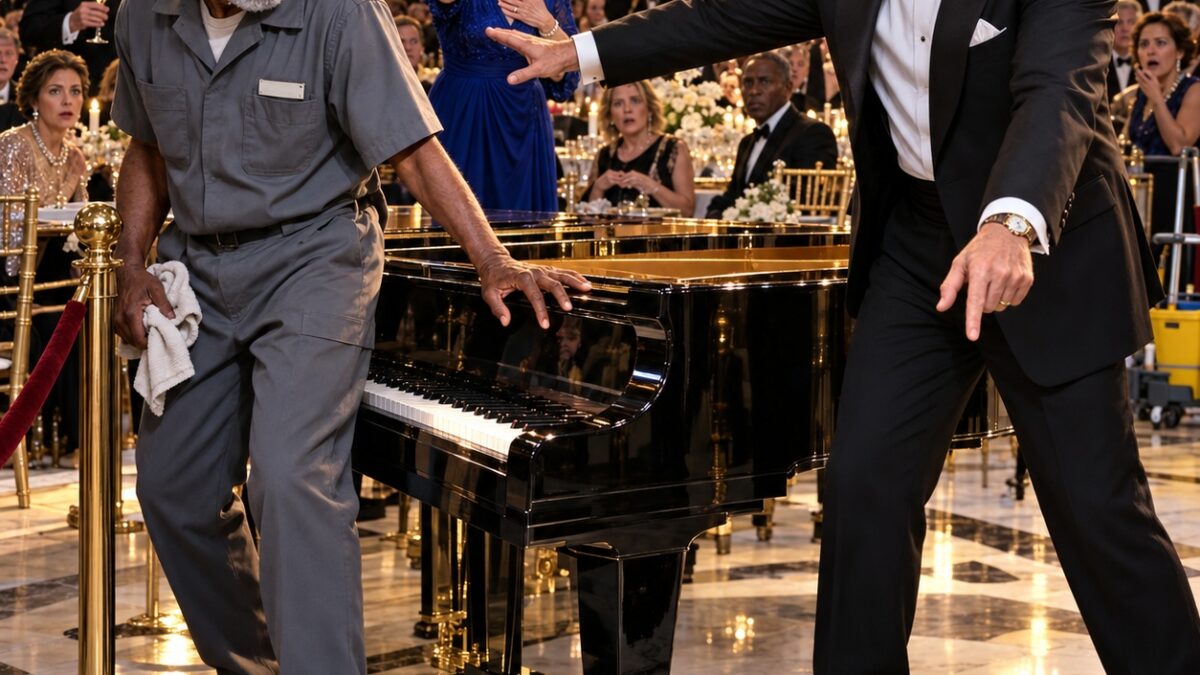
I was wiping the Steinway lid after a photographer had leaned against it.
My cloth moved slowly.
Circular pass.
Then another.
There was dust near the upper edge of the keyboard.
I opened the fallboard slightly.
Not enough to play.
Just enough to check.
My finger brushed middle E.
The key depressed.
The sound was soft.
One note.
Then another.
A small interval.
Almost absentmindedly, I played the opening shape of a Debussy phrase.
Barely audible.
A memory more than a performance.
My hands knew it before I decided.
That was when Victor turned.
“What the hell are you doing?”
The phrase died under my fingers.
I looked up.
He was maybe fifteen feet away.
Champagne in one hand.
Three donors beside him.
His expression was not curiosity.
It was outrage.
I lowered the fallboard.
“Just checking near the keys, sir.”
He came toward me.
“Checking?”
“Yes, sir.”
“For what?”
“Dust.”
He stared.
Then looked at the piano.
Then at my hands.
“Get your filthy hands off my piano.”
The words cracked across the ballroom.
Conversations nearest us stopped.
Not all at once.
Like lights going out in sections.
I removed my hands immediately.
“Of course, sir.”
That could have ended it.
It should have.
I had no interest in fighting over a piano that did not belong to either of us.
But Victor had an audience.
And people like Victor often become more themselves when enough people are watching.
He stepped closer.
“Do you have any idea what this instrument costs?”
“Yes.”
My answer surprised him.
He gave a short laugh.
“No, you don’t.”
I said nothing.
He moved toward the keyboard.
Pulled out a white silk handkerchief.
Began wiping the keys.
Slowly.
Exaggerated.
As if disinfecting them.
That hurt more than the insult.
He was not cleaning.
He was performing contamination.
The message was clear.
My hands had made the piano dirty simply by touching it.
A photographer raised a camera.
Flash.
I remember that.
The photographer probably thought Victor’s theatrical wiping was some charming host moment.
Maybe the photograph would show up beside a caption about attention to detail.
I stood there.
Gray uniform.
Cleaning cloth in my hand.
And for one strange second, I thought about the White House East Room.
My hands on polished keys.
A president sitting close enough that I could see him close his eyes during Debussy.
A room rising after the final chord.
Then Victor’s handkerchief moving over the same kind of ivory as though my skin had left something shameful behind.
I felt anger.
Of course.
I also felt something worse.
Small.
That is what humiliation does.
People think humiliation is anger.
Sometimes it is shrinking.
The room becomes larger.
Your own body feels suddenly misplaced inside it.
You become aware of sleeves.
Shoes.
Accent.
Skin.
Position.
Everything another person has decided to make evidence against you.
Victor turned toward the donors.
“At least staff should know better than to play with the equipment.”
A man near him smiled.
Another chuckled.
One woman looked uncomfortable.
Nobody said anything.
I adjusted my sleeve.
Kept my breathing even.
Victor noticed the discomfort and mistook it for permission.
That was the beginning of his real mistake.
He lifted his champagne glass.
Tapped it with a fork.
A clear, delicate chime moved through the ballroom.
More conversations stopped.
Victor smiled.
“Since we have everyone’s attention…”
I looked down.
I knew what was coming before he said it.
“Let’s make sure staff knows their place.”
A few people clapped.
That sound has stayed with me longer than Victor’s voice.
Polite applause.
Thin.
Reflexive.
Not everyone.
Maybe ten people.
Maybe fifteen.
Enough.
They did not clap because ordering a cleaner away from a piano was hilarious.
They clapped because Victor was powerful.
Because he was hosting.
Because people confuse social survival with agreement.
He looked back at me.
“Go on.”
Pause.
“Back to the mop.”
My face burned.
I wanted to tell him the first time I played Debussy publicly, I had been eighteen and terrified.
I wanted to tell him about Juilliard practice rooms where people slept against walls between lessons.
I wanted to tell him about a White House piano with slightly heavier action than the Grand Monarch’s Steinway.
I wanted to tell him I had played before people whose names would still be printed in history books after his company no longer existed.
I wanted to tell him none of that should matter.
That even if I had never touched a piano before tonight, he had no right to make me less human because my paycheck came from cleaning.
Instead, I nodded once.
“Yes, sir.”
I turned away.
Then somebody near the piano called:
“What were you playing anyway?”
I stopped.
The voice belonged to a donor.
Older man.
Maybe trying to make a joke.
Maybe genuinely asking.
“Debussy,” I said.
Victor barked a laugh.
“Doubt you could spell it.”
More laughter.
Softer.
Not as many people this time.
Something was changing.
Maybe they felt the cruelty becoming too obvious.
Maybe they simply wanted him to stop.
That is another thing about bystanders.
They often recognize the line only after the person being hurt has already crossed several.
I looked toward the doorway.
The hotel manager stood there.
Hands knotted together.
He knew me.
Not well.
He knew I showed up.
Knew I was reliable.
Knew there had never been a complaint against me.
Our eyes met.
For one second, I hoped.
One sentence.
“Mr. Hale, that’s enough.”
He said nothing.
That hurt.
I looked away.
The old reflex returned.
Do not make trouble.
I had lived long enough to know what happens to older workers who become “difficult.”
Hours get cut.
Schedules change.
People suddenly notice small mistakes.
I needed the work.
That mattered.
People with money like to imagine dignity is free.
Sometimes dignity carries rent.
Medicine.
Groceries.
You calculate what you can afford to defend.
So I started toward my mop.
That was when I heard her.
A woman.
Older.
Silver hair.
Formal voice.
“That can’t be.”
Not loud.
But the room had become quiet enough.
I stopped.
She moved between tables.
Slowly at first.
Then faster.
Her eyes stayed on my face.
Not my uniform.
My face.
I turned.
Something in her expression pulled at memory.
I did not place her immediately.
Thirty years changes people.
It certainly changed me.
She came closer.
Then said:
“Mr. Brooks?”
Victor’s smile faltered.
He looked at her.
“You know him?”
She ignored him.
“Leonard Brooks?”
I inclined my head.
“Yes, ma’am.”
She covered her mouth.
And suddenly I knew.
Not her name at first.
Context.
A White House dinner.
A younger woman seated near the front.
Her husband at the center of every conversation.
Years later she had silver hair.
But the eyes were the same.
She turned toward the room.
Her voice became stronger.
“This man played at my husband’s inauguration dinner.”
Silence.
Not uncomfortable now.
Electric.
Victor stopped moving.
She continued.
“He performed at the White House.”
Someone near the bar took out a phone.
“More than once.”
Another guest began searching.
“East Room.”
She looked at me.
“State events.”
My throat tightened.
I had not heard someone else describe that part of my life in years.
Not publicly.
Not like it still belonged to me.
A younger guest held up a phone.
“I found him.”
People moved closer.
On the screen was an old video.
Grainy.
I recognized the angle immediately.
East Room.
Presidential seal behind me.
My hair thick and dark.
My shoulders straighter.
Hands moving across keys.
Applause.
For several seconds, I was looking at a dead version of myself.
Not physically dead.
A life dead.
The young man who believed music would remain the shape of everything.
He had no idea what was coming.
No idea his wife would become ill.
No idea bills would hollow out savings.
No idea he would one day clean a hotel ballroom where someone would tell him he could not spell Debussy.
I felt my eyes burn.
The crowd began murmuring.
Victor’s smile did not disappear all at once.
It narrowed.
Then hardened.
Then failed.
The hotel manager rushed toward me.
“Mr. Brooks…”
Her voice shook.
“I am so sorry.”
Her hands hovered awkwardly.
She did not know whether to shake mine.
Touch my shoulder.
Do nothing.
I saved her.
“You didn’t push me.”
She winced.
Because we both knew that was not the entire measure of failure.
Victor stepped forward.
“Well.”
He forced a laugh.
“I didn’t know.”
There it was.
The sentence.
The sentence people say when the target turns out to have a résumé.
The sentence that reveals they still do not understand the problem.
I looked at him.
“You didn’t ask.”
The room changed.
Not because I said it sharply.
I did not.
I was tired.
Very tired.
“You didn’t ask.”
Victor looked around.
Phones were up now.
Not one.
Several.
Someone whispered:
“Did he say filthy hands?”
Another:
“This is live.”
Victor’s shoulders dropped slightly.
For the first time, he seemed to understand he was not controlling the room.
He reached for a different version of himself.
The apologetic host.
The reasonable businessman.
“Mr. Brooks, I think perhaps this got out of hand.”
I stared at him.
“You shoved me.”
“I was upset about the instrument.”
“You told me my hands were filthy.”
“I meant—”
“You told the room I needed to know my place.”
Silence.
He glanced toward the silver-haired woman.
Then back.
“I didn’t know your background.”
That sentence hurt worse than he understood.
Because it meant he still believed background could justify basic respect.
I said:
“If I had never played a note, would you have been right?”
He opened his mouth.
Nothing.
“If I had never been to Juilliard?”
Nothing.
“If I had never entered the White House?”
Nothing.
“If I had spent my whole life cleaning floors…”
My voice almost broke.
I steadied it.
“…would I have deserved what you did?”
No answer.
The room gave him nowhere to hide.
That was the real turning point.
Not recognition.
The question.
Because suddenly everyone understood that the impressive biography was emotionally satisfying but morally irrelevant.
Victor had been wrong before anybody knew who I was.
I turned toward the piano.
The Steinway sat beneath the chandelier.
Untouched.
Beautiful.
The middle E waiting.
Victor followed my eyes.
For one strange moment, I thought he might ask me to play.
He did not.
Good.
I would have refused.
I was not there to entertain people out of their shame.
I reached for my mop.
The hotel manager stopped me.
“Mr. Brooks, please.”
I looked at her.
“You don’t need to—”
“I’m working.”
Her face crumpled slightly.
That nearly made me angry again.
Not at her.
At the whole structure.
An hour earlier, my job made me invisible.
Now my old career made my job unacceptable to them.
“No.”
I held the mop.
“This work does not become shameful because you learned I used to do something else.”
She froze.
I continued.
“I clean here.”
“Yes.”
“That is honest work.”
“Yes.”
“Then don’t apologize for the uniform.”
Her eyes filled.
“I’m apologizing for us.”
That was better.
I nodded.
“Then start there.”
Victor left before the gala ended.
No one escorted him.
No dramatic expulsion.
He simply walked out while phones followed him.
The ballroom never recovered.
Conversation returned.
Too bright.
Too eager.
People approached me.
People who had not looked at me earlier.
“Mr. Brooks, I’m such an admirer.”
No, you are not.
You learned my name six minutes ago.
“I think I heard you once…”
Maybe.
“Would you consider playing something?”
No.
One donor—the same man who had asked what I was playing—came close.
“I owe you an apology.”
I looked at him.
“For laughing?”
His face reddened.
“Yes.”
“Why did you?”
He swallowed.
“Honestly?”
“Yes.”
“Because everyone else did.”
There it was.
He looked ashamed.
“I’m sorry.”
I believed him.
That did not erase it.
“I appreciate you saying it.”
He nodded.
Then did something meaningful.
He left.
No networking.
No attempt to make himself part of the redemption.
Just left.
Sometimes shame should remain uncomfortable.
The silver-haired woman stayed.
We sat near the side of the ballroom after the crowd thinned.
“You disappeared,” she said.
“I know.”
“We wondered.”
I looked toward the piano.
“My wife got sick.”
Her face softened.
“I’m sorry.”
“Thank you.”
“You stopped playing?”
“Yes.”
“Completely?”
“For a long time.”
She waited.
I could tell she wanted to ask why I never returned.
I saved her.
“Life continued.”
She nodded.
People sometimes try to turn sacrifice into tragedy.
It was not.
I would choose my wife again.
Every performance.
Every tour.
Every standing ovation.
All of it.
Again.
Without hesitation.
But I could hold two truths.
I did not regret choosing her.
And I missed the piano.
Pain does not require regret.
That took me years to understand.
The silver-haired woman looked at my hands.
“Do you still play?”
“Sometimes.”
“Where?”
I smiled.
“When nobody’s around.”
She looked toward the Steinway.
“Sounds like somebody should be.”
I laughed softly.
“Maybe.”
By midnight, I was home.
Small apartment.
Quiet.
My uniform hung over a chair.
My shoulder ached where I had struck the post.
I removed my shirt.
There was already a bruise forming.
Not dramatic.
Darkening.
Physical proof that the shove had been real.
I stood in the bathroom mirror.
Looked at my face.
Sixty-eight.
Lines.
Gray hair.
A tiredness the White House video did not know.
Then I looked at my hands.
Same hands.
Older.
Veins raised.
Knuckles thicker.
One finger slightly stiff in the morning.
I spread them over the sink.
For years, I had allowed myself to think the pianist’s hands were gone.
That cleaning had replaced music.
That the life before my wife’s illness belonged to another person.
But Victor’s cruelty had accidentally reopened a door.
Not because he insulted me.
Because hearing someone else remember me forced me to remember myself.
I sat at the tiny keyboard I kept near the window.
Not a Steinway.
Digital.
One pedal.
A few keys with uneven response.
I had bought it used.
Mostly touched it at night.
I switched it on.
Placed my hands down.
Middle E.
Then Debussy.
The same passage.
Softly.
I lasted less than two minutes.
Then cried so hard I had to stop.
Not elegant tears.
Not cinematic.
Shoulders shaking.
Hands over my face.
Because music had become tangled with everything I had lost.
My wife.
Youth.
Career.
Time.
And now humiliation.
For several minutes, I wished I had never touched the Steinway.
Then another thought came.
No.
Victor does not get that.
He does not get to turn piano keys into evidence against me.
I placed my hands down again.
Started from the beginning.
Played badly.
Then better.
Played until after one in the morning.
Forty-eight hours later, my phone started ringing.
News.
Friends.
People I had not spoken to in decades.
A former conductor.
A pianist from Juilliard.
Someone from one of the White House music offices long retired.
The ballroom video had spread.
The shove from two angles.
Victor saying “filthy hands.”
The silk handkerchief.
The applause.
My face.
The recognition.
You didn’t ask.
Morning news played the clip repeatedly.
I stopped watching after the second time.
Seeing your humiliation from outside yourself is strange.
You notice things memory missed.
A woman near the bar covering her mouth.
The photographer lowering his camera after realizing the scene was not funny.
The manager’s hands tightening.
My own body staggering harder than I remembered.
News captions called me:
FORMER WHITE HOUSE PIANIST
Accurate.
Incomplete.
They rarely led with:
68-YEAR-OLD PART-TIME JANITOR
That bothered me.
Because again, people seemed to believe the White House made the shove worse.
It did not.
The shove was wrong because a human being was shoved.
I accepted one local interview only long enough to say that.
The reporter asked:
“Do you think Victor Hale would have treated you differently if he knew your background?”
“Yes.”
“Does that make you angry?”
“Yes.”
“Why?”
“Because it means he knows how to behave.”
The reporter stopped.
That answer spread too.
Victor’s company board met.
Sponsors distanced themselves.
Old interview clips surfaced.
Statements about “polish.”
“Presentation.”
“Fit.”
Words that once sounded like executive preference now sounded different.
Sometimes one moment changes how old moments are heard.
His company announced an internal investigation into workplace culture complaints buried in HR files.
I knew nothing about those complaints.
I refused to pretend I did.
I had my incident.
Others had theirs.
Three days later, Victor stepped down as CEO pending review.
People called me to celebrate.
I did not.
I was satisfied consequences existed.
That is different.
A man losing a title does not restore another person’s dignity automatically.
And public humiliation in reverse is still humiliation.
I had no interest in becoming addicted to his fall.
The Grand Monarch sent me a written apology.
Formal.
Board-signed.
The first version was too polished.
The second was better.
They named what happened.
Shove.
Public degradation.
Failure to intervene.
They offered compensation.
I declined.
Not because I am above money.
I worked part-time at sixty-eight.
Money mattered.
But that particular money felt wrong for me.
I did accept one thing.
The invitation.
The hotel asked whether I would return for a benefit concert.
Fully paid.
Full orchestra available if I wanted.
Public apology before the performance.
Proceeds partly designated however I chose.
I told them:
“No public apology on stage.”
The organizer sounded confused.
“Mr. Brooks—”
“The concert is not a punishment ceremony.”
“Understood.”
“All proceeds go to music programs in underfunded public schools.”
Silence.
“All?”
“Yes.”
“But your compensation—”
“I’m not taking it.”
“Mr. Brooks, you are entitled—”
“I know.”
I had spent years watching children lose access to music because schools treated art like decoration.
No piano teacher.
No instruments.
No rooms.
No time.
My entire life had been shaped because somebody once put a piano in front of me and did not ask whether my family could afford the future it opened.
If the worst night I had experienced in years could put instruments into a few classrooms, that felt right.
The hotel agreed.
Then I panicked.
Because now I actually had to play.
Three weeks.
I had not performed publicly in decades.
Not seriously.
I had touched keyboards.
Practiced alone.
But concert performance is not simply playing correctly.
It is exposure.
Every mistake has witnesses.
Every hesitation.
At twenty-five, I had nerves and training.
At sixty-eight, I had training buried beneath years.
My fingers were slower.
My right hand fatigued earlier.
Memory remained, but memory can become treacherous under pressure.
I practiced in the hotel ballroom before dawn.
At first, alone.
Mr. Dio—wrong story, again my mind carrying images from elsewhere. No, this was my own ballroom, my own janitor’s cart, my own uniform. I laughed once at how many quiet workers in how many stories become invisible until somebody decides they matter.
I came in before shift.
Changed after practicing.
Or practiced after shift.
The Steinway welcomed me without judgment.
Middle E still worn.
The action had been serviced.
I asked them not to replace that key.
The technician looked confused.
“Why?”
“Memory.”
He understood musicians well enough not to ask more.
My old Debussy returned.
Not all at once.
Muscle memory is like an animal hiding under a porch.
You do not drag it out.
You sit nearby.
Let it smell your hand.
Eventually it comes.
The first week, I could not finish the piece cleanly.
The second week, I could.
The third week, I stopped trying to sound like the young man in the White House video.
That saved me.
For days, I had been competing with him.
His speed.
His control.
His wrists.
His effortless reach.
Impossible.
Then one morning, I realized:
He had not lived my life.
He had not sat beside my wife during treatment.
Had not watched savings disappear.
Had not cleaned hotel floors at sixty-eight.
Had not been shoved away from a piano in front of strangers.
Why would I want to sound exactly like him?
My hands were different because I was different.
So I stopped trying to recover youth.
I played as the man I had become.
Slower in places.
Deeper.
Less interested in impressing.
More willing to let silence breathe.
Debussy changed.
Or I did.
The night of the benefit concert, I arrived at the Grand Monarch through the same entrance.
No gray uniform.
Black tuxedo.
The old one no longer fit.
Hotel arranged another.
Simple.
Elegant.
My hands shook as I walked through the lobby.
People greeted me by name.
That was uncomfortable.
Employees.
Guests.
Management.
Some because they recognized me from the news.
Some because hotel leadership had made sure everybody knew.
I appreciated the intention.
I worried about the lesson.
I stopped a supervisor.
“Do you know the names of the cleaning staff?”
She looked surprised.
“Most.”
“Learn the rest.”
“Yes, sir.”
“That matters more than mine.”
She nodded.
I meant it.
At the ballroom doors, I stopped.
The exact place where Victor had shoved me was only several yards away.
My body remembered before my mind did.
Shoulders tightened.
Breathing shallow.
For one second, I considered leaving.
No shame in that.
People think courage means never wanting to run.
Wrong.
Courage often begins after wanting to run.
I touched my left shoulder.
The bruise was gone.
Then entered.
The ballroom looked almost identical.
Chandeliers.
White marble.
Steinway.
But one thing was different.
The gold sponsorship plaque along the far wall had been replaced.
Victor Hale’s name was gone.
Not because I demanded it.
Sponsors had changed.
The board had changed relationships.
His foundation support had collapsed during review.
I stood looking at the blank place longer than I should have.
Not triumphant.
Just aware.
Names on walls are temporary.
People forget that.
A name can look permanent when it is engraved.
Still temporary.
The audience filled every table.
Musicians.
Former colleagues.
Hotel staff.
Donors.
Teachers.
Students from public schools receiving music grants.
That mattered most.
Near the front sat several children wearing clothes that looked borrowed from older siblings.
One boy kept staring at the piano.
I recognized that stare.
Hunger.
Not for food.
For possibility.
I smiled at him.
He looked away quickly.
I sat at the Steinway.
Adjusted the bench one inch.
Old habit.
The room quieted.
No glass clinked.
No whispers.
I placed my hands over the keys.
Middle E beneath my right hand.
The indentation still there.
For a second, time folded.
White House.
Hospital waiting room.
Empty apartment.
Gray uniform.
Victor’s handkerchief.
My wife.
All of it.
Then I began.
Debussy.
The first notes floated.
Gentle.
No rush.
I did not look at the audience.
I looked at nothing.
The piano disappeared.
That had always been the goal.
Not being seen.
Being heard.
There is a difference.
My hands moved.
Not young.
Not perfect.
Mine.
I reached the passage Victor had mocked.
The phrase I had touched absentmindedly on gala night.
This time I gave it everything.
Not louder.
More truth.
A pianist learns eventually that power is not volume.
Power is control over what you do not play.
Space.
Breath.
Restraint.
The same lesson took me much longer outside music.
The last chord faded.
I lifted my hands.
Silence.
It held.
Long enough that fear returned for one stupid second.
Then the room stood.
Applause came like weather.
Not polite.
Not thin.
Not the reflex applause Victor had received when he mocked me.
This was different.
People rose.
Hotel employees.
Teachers.
Children.
Guests.
The silver-haired woman who had recognized me.
She was crying.
So was I.
I stood.
Bowed once.
No speech.
I did not want to explain the music.
It had explained me better.
Afterward, the boy from the front table waited near the piano.
Maybe twelve.
He stared at the keys.
I said:
“You play?”
He shook his head.
“Want to?”
He looked at the teacher beside him.
She nodded.
He approached.
Slowly.
I moved off the bench.
He sat.
His feet barely reached the pedals.
He placed one finger on middle E.
Pressed.
The note sounded.
He smiled.
That was worth more than any compensation check the hotel offered.
“Again,” I said.
He played it again.
Then another.
I showed him a five-note pattern.
Nothing complicated.
He copied.
Wrong.
Tried again.
Better.
The ballroom emptied around us.
He did not notice.
Good.
Maybe he would never become a pianist.
Maybe he would.
Not my job to predict.
My job was to make sure the first door did not close because somebody decided music belonged to another class of person.
The benefit raised enough money to expand several school music programs.
Pianos.
Keyboards.
Teacher support.
Repairs.
Instrument access.
Not everything.
Enough to matter.
The hotel asked whether I wanted to become artist-in-residence.
I laughed.
“No.”
They tried again.
I said no again.
I had spent too much of my life learning that a dramatic correction can become another kind of trap.
I did not want to become:
The Janitor Pianist
A permanent hotel attraction.
The man whose humiliation became branding.
I wanted to choose.
So I kept working part-time for a while.
Yes.
That surprised people.
“Why?”
Because I liked routine.
Because honest work did not become beneath me simply because the internet discovered old videos.
Because I needed time before deciding what music meant again.
Management adjusted my duties.
Less strain on my knees.
Better schedule.
Fairer pay.
Not special treatment disguised as gratitude.
Corrections that should have existed.
I also began playing once a month.
Small public programs.
No enormous publicity.
Sometimes students.
Sometimes hotel guests.
Sometimes staff.
The first staff-only evening was my favorite.
Housekeepers came in uniform.
Kitchen workers.
Bell staff.
Desk clerks.
Engineers.
Security.
People who normally stood at the edges of events sat in the center.
No donors.
No VIP tables.
I played Gershwin.
More joy.
Afterward, one housekeeper said:
“I never sat in this room before.”
She had worked there nine years.
I felt sick.
“You clean it?”
“Yes.”
“Serve events?”
“Yes.”
“But never sat?”
“No.”
That led to another policy change.
Not because every ballroom needs employee concerts.
Because spaces employees maintain should not become psychologically forbidden to them.
We began staff appreciation events without hierarchy theater.
Simple.
People laughed at the phrase:
“psychological ownership.”
I did not.
Architecture teaches people where they are allowed to be.
So does workplace culture.
If a cleaner learns he may touch the piano only with a cloth, never with a finger, the lesson goes deeper than equipment rules.
Victor had simply said the quiet part loudly.
That was why his words hit so hard.
Know your place.
Most class systems survive because people learn that sentence without anyone saying it.
A door.
A dress code.
A look.
A table assignment.
A title.
A uniform.
I had moved through both worlds.
White House pianist.
Part-time janitor.
That gave me a strange perspective.
Rich people are not more dignified when you see them from behind a piano.
Poor workers are not less intelligent when you see them behind a mop.
Roles are practical.
Worth is not.
Victor never understood that until consequences reached his own role.
His company investigation continued.
Buried HR complaints surfaced.
Some serious.
Some minor.
Patterns mattered.
Sponsors left.
The tech foundation lost support.
He remained wealthy.
That fact disappointed people who wanted a fairy-tale punishment.
Billionaires do not become poor because one video exposes them.
Real life is less tidy.
But influence faded.
Board trust disappeared.
Invitations slowed.
He stepped down.
His public persona changed permanently.
Enough.
I did not need him ruined.
I needed the behavior to stop having institutional protection.
That is a more mature satisfaction.
Maybe less exciting.
More useful.
Months later, I received a letter.
No return address I recognized.
Inside:
Handwritten.
Victor.
I almost threw it away.
Instead, I read.
He apologized.
Not perfectly.
The first paragraph still explained himself too much.
Stress.
Property.
Embarrassment.
Then the second paragraph changed.
He wrote:
I have replayed the moment where I wiped the keys after you touched them. I told myself I was protecting the piano. I understand now what that gesture communicated, and I am ashamed.
That was better.
Then:
The worst part is knowing I would have behaved differently if I had known who you were.
I stopped reading.
That line was the first thing in months that made me believe he might have learned something.
Not because I was famous.
Because he had identified the real failure.
I continued.
You asked whether you would have deserved it if you had never played a note. The answer is no. I should have known that before I knew anything about you.
I folded the letter.
Did I forgive him?
People love asking that.
Forgiveness is too large a word for simple answers.
I did not hate him.
I did not want revenge.
I also did not need contact.
I wrote back one sentence.
Treat the next person better before you know their résumé.
I mailed it.
That was all.
My wife would have approved.
I think.
She had no patience for long speeches when short ones could do the work.
I talked to her sometimes.
Not because I believed she could hear.
Because love trains conversation into you.
After the benefit concert, I sat in my apartment and said aloud:
“I played again.”
Silence.
Then I laughed at myself.
“What?”
Still silence.
“I know you would’ve complained I skipped dinner.”
I cried afterward.
The good kind.
If there is such a thing.
Grief had changed over years.
At first, it was an open wound.
Then scar tissue.
Then weather.
Sometimes you wake and it rains.
No reason.
You live anyway.
The piano became a place where I could remember her without remembering only illness.
That was the greatest gift of returning.
For years, music had been connected to what I abandoned.
After Victor.
After the concert.
It became connected to what remained.
Not the career.
The capacity.
Music had never left my hands.
I had simply stopped asking them to speak.
Eventually I accepted invitations to teach occasional master classes.
Nothing glamorous.
Community conservatories.
School programs.
One student asked:
“Were you really a janitor?”
“Yes.”
“After the White House?”
“Yes.”
“Wasn’t that embarrassing?”
The room went quiet.
I thought about my answer.
“No.”
He looked surprised.
“Being treated badly was embarrassing.”
Pause.
“Cleaning was not.”
I saw several students write that down.
Good.
“I want you to understand the difference.”
I continued.
“Work does not humiliate people.”
“People humiliate people.”
That became the lesson I repeated most.
There is dignity in cleaning.
Cooking.
Driving.
Serving.
Repairing.
Teaching.
Building.
Playing.
No job title can guarantee moral worth.
Victor had CEO after his name.
I had janitor on a schedule.
That night, which one of us had forgotten dignity?
Exactly.
The hotel eventually invited me to help design parts of its staff-protection program.
I agreed.
Not because I was an HR expert.
I was not.
I insisted specialists lead it.
I contributed worker perspective.
Age.
Class.
Accent.
Power.
Visibility.
One rule mattered to me.
Employees could halt interactions with abusive guests or investors and call a supervisor without fearing automatic discipline.
Simple.
Before, hospitality culture had quietly told staff:
Absorb.
Smile.
De-escalate.
Protect the guest experience.
Now:
Protect yourself too.
Some guests complained.
One wrote:
“The Grand Monarch used to understand service.”
Management responded politely.
Service does not include tolerating harassment.
Good.
I framed that email.
Not literally.
But almost.
A year after the incident, the hotel conducted an employee survey.
Trust in reporting channels rose sharply.
Bystander confidence improved.
Not perfect.
Never perfect.
Still meaningful.
Mr. Hale’s name rarely appeared internally anymore.
That was healthy.
A system should not need a villain’s name to remember its standards.
If training only works while everyone remembers one scandal, training will fade with headlines.
Principles have to stand alone.
I became careful about my own story for the same reason.
I did not want younger employees thinking:
Speak up because the cleaner might secretly be famous.
Wrong lesson.
The new orientation included a line I suggested:
Respect is not contingent on hidden status.
That was the lesson.
No secret identity required.
The incident also changed the manager who froze.
Her name was Elena—no, not from source, so I won’t invent it. I will simply call her the general manager, because accuracy matters more than making every character easier to remember.
She asked to meet me months later.
“Do you hate me?”
“No.”
She looked surprised.
“Should you?”
“I don’t know.”
That was honest.
“I was looking at you.”
She nodded.
“I know.”
“You knew I needed somebody.”
“I know.”
“You stayed still.”
Tears appeared.
“Yes.”
I let the silence stay.
Sometimes compassion means not rushing to remove discomfort someone needs to feel.
Finally she said:
“I was afraid of him.”
“I know.”
“That sounds cowardly.”
“It sounds human.”
She looked at me.
“Does that make it okay?”
“No.”
She nodded.
That answer seemed to help her more than forgiveness would have.
“I’m trying to be different.”
“I’ve heard.”
She had intervened twice since.
Once with a high-profile guest.
Once with a donor.
Good.
I told her:
“Then keep going.”
The goal was not to force her to suffer forever because she failed once.
The goal was to make sure next time she moved.
She did.
That mattered.
The photographer who took the picture of Victor wiping the piano contacted me too.
He said the photo haunted him.
Not because of Victor.
Because in the frame, I stood behind him.
Still.
Cloth in hand.
“You look like you disappeared.”
His words.
I asked what he meant.
“Your face.”
He paused.
“You looked like you were trying to make yourself smaller.”
He was right.
I had.
That photograph eventually appeared in a museum exhibit about labor and status.
I almost refused permission.
Then agreed under one condition.
The caption could not identify me primarily as “former White House pianist.”
It had to say:
Leonard Brooks, hotel employee and pianist.
Both.
Not one correcting the shame of the other.
The exhibit curator understood.
That mattered.
People viewed the photograph.
Saw Victor’s white handkerchief.
My gray uniform.
The black Steinway between us.
Some read the story.
I hoped the lesson stayed complicated enough.
Because simple stories are comforting.
Rich bully.
Secretly famous janitor.
Reversal.
Applause.
Real life demanded more.
What about the guests?
The manager?
The photographer?
Me waiting before challenging the system earlier in my life?
What about class?
Race?
Age?
Immigration assumptions people made about accents around the hotel every day?
What about the fact that no one should need extraordinary talent to justify ordinary respect?
That is the useful mess.
The older I became, the more I trusted complicated lessons.
The benefit concert became annual.
Not “Leonard Brooks Night.”
I refused.
Music-access benefit.
Young performers.
Public-school ensembles.
Professional guests.
The Steinway used.
That was important.
Instruments should not become furniture.
The first year after mine, a fifteen-year-old girl played.
Nervous.
Brilliant.
Her family could not afford private conservatory tuition.
Program funding helped.
She finished.
Standing ovation.
Backstage, she cried.
“I made mistakes.”
“Of course.”
She stared.
“You heard?”
“Every one.”
Her face collapsed.
I smiled.
“And the music survived.”
She laughed.
That is performance.
Perfection is a terrible teacher.
I told her:
“People remember whether you meant it.”
Same thing my teachers had once told me.
The old chain continued.
Teacher.
Student.
Room.
Music.
Nothing to do with Victor.
Good.
The story was becoming larger than the insult.
That is another sign of healing.
At first, trauma organizes everything around the person who hurt you.
Eventually life grows around it.
They become smaller.
Not forgotten.
Proportional.
Victor became a chapter.
Music became life again.
Work became work again.
The Grand Monarch became a hotel instead of the place where I was shoved.
One morning, I spilled cleaning solution near the elevator.
My own fault.
I laughed so hard another employee asked what was wrong.
“Nothing.”
I cleaned it.
No billionaire appeared.
No phones.
No humiliation.
Just a spill.
Objects deserve to become ordinary after conflict.
So do mistakes.
A scuff is a scuff.
Water is water.
A piano key is a key.
We create the cruelty when we use them as excuses to rank human beings.
At seventy, I reduced my hotel hours further.
Music filled more time.
Not a comeback.
I disliked that word.
Comeback implies returning to where you were.
I did not want to go backward.
The young White House pianist had lived his life.
I wanted mine.
So I taught.
Performed occasionally.
Worked enough hotel hours to keep routine.
People thought that was strange.
I stopped explaining.
One morning, a new hire recognized me.
“Mr. Brooks, why are you pushing that cart?”
“Because it needs pushing.”
“But you could—”
“I know what I could do.”
He looked confused.
Good.
People spend too much time arranging lives according to what status says they should do.
I liked the cart.
Sometimes.
My knees liked it less.
We compromised.
The middle E on the Steinway remained worn.
The hotel eventually had to replace several keytops.
I asked them to preserve that one if technically possible.
The technician did.
Maybe sentimental.
Fine.
Old men earn some sentiment.
When I touched it, I remembered every version of myself.
Juilliard student.
White House pianist.
Husband.
Caregiver.
Widower.
Janitor.
Humiliated employee.
Returning musician.
Teacher.
None canceled the others.
That was another healing.
For years, I thought life divided into before and after.
Before my wife’s illness.
After.
Before the stage ended.
After.
Before Victor.
After.
But a person is not separate lives stacked like boxes.
We carry everything.
The hands that held my wife’s hand at appointments were the hands that played Debussy.
The hands that pushed a mop were the hands applauded at the White House.
Nothing disappeared.
Context changed.
Value did not.
That insight gave me peace I had not expected.
One evening after a staff concert, I remained in the ballroom alone.
Chandeliers dimmed.
Tables empty.
The piano open.
I played the final piece my wife used to ask for.
Not Debussy.
Something simpler.
I will not invent the title because the source does not give it.
The exact piece is less important than the memory.
She would sit nearby while I played at home.
Sometimes correct me jokingly despite knowing almost nothing about piano technique.
“Too dramatic.”
“That’s the composer.”
“No. That’s you.”
I could hear her.
I finished.
Looked toward the empty chair beside the piano.
For a moment, grief came.
Then warmth.
I whispered:
“Still dramatic.”
That made me laugh.
I closed the lid.
Went home.
This is what healing looked like.
Not forgetting.
Integrating.
Victor’s incident forced something open.
But I will never thank him.
People sometimes say:
“Maybe everything happens for a reason.”
No.
My wife did not become sick for a reason.
Victor did not shove me for a reason.
Humiliation was not necessary to return music to me.
Meaning is what we build afterward.
Do not give harm credit for the work survivors do.
I returned because I chose to.
The hotel changed because employees and leadership chose to.
Young musicians received funding because we redirected attention and money.
Those accomplishments belong to us.
Not him.
I tell students that too.
If someone hurts you and you become strong afterward, your strength does not make their harm justified.
You own the strength.
Important.
At seventy-one, I attended another White House event.
Not as the main performer.
As a guest connected to music education.
Walking into the East Room after so many years was almost unbearable.
The proportions were smaller than memory.
That happens.
I looked toward the area where I had once sat at the piano.
No dramatic flashback.
Just recognition.
A staff member asked:
“Have you been here before?”
I smiled.
“Once or twice.”
He later discovered the history and nearly died of embarrassment.
I told him not to.
He had asked.
That was the whole difference.
He asked.
No assumptions.
No performance.
No judgment.
“Have you been here before?”
Simple.
Human.
That one question contained the lesson Victor missed.
Ask.
Before deciding.
Ask.
The silver-haired woman who recognized me died some years later.
I learned through the news.
I sent flowers privately.
No statement.
Without her, the room might eventually have discovered who I was through some other route.
Maybe.
But she recognized my face before my résumé.
That mattered.
She remembered.
Memory can be a form of rescue.
I am grateful.
Still, I sometimes wonder what would have happened if she had not been there.
Would the video have gone viral anyway?
Would anyone have cared?
Would Victor have faced consequences for shoving an unknown janitor?
Maybe.
Maybe not.
That question is uncomfortable.
It should be.
Because our justice should not depend on a witness discovering the victim was once important.
That is why institutional reform mattered more than my recognition.
The next unknown employee deserved protection without a former First Lady standing nearby.
That was the test.
The hotel’s later incident reports suggested we improved.
Not perfect.
Improved.
Enough to keep working.
My twenty-fifth service anniversary never arrived because I had not worked there that long—another reminder not to let retellings merge facts. I was part-time night staff at sixty-eight. Mr. Dio from another story had twenty-three years. I did not. Accuracy matters, especially in stories about people being reduced to convenient myths.
What I did have were years enough to understand how quickly narratives distort.
The internet called me “the forgotten White House pianist.”
I had not been forgotten by everyone.
I had stepped away.
Those are different.
It called Victor “the man who lost everything.”
He did not.
He remained wealthy.
He lost authority.
Reputation.
Positions.
Those are real consequences.
No need for fantasy.
It called the hotel “racist.”
Institutions are more complicated.
Individuals failed.
Policies failed.
Culture failed in that moment.
Then people changed parts of it.
I preferred precision.
Precision protects truth from becoming another performance.
So here is the truth I want remembered.
I was a pianist.
I became a caregiver.
I lost money.
I lost a stage.
I worked as a janitor.
A billionaire saw my uniform and decided I was beneath him.
He shoved me.
People laughed.
People stayed silent.
An older woman recognized me.
The room changed.
Victor faced consequences.
The hotel changed policies.
I played again.
Money went to music programs.
None of that makes cleaning shameful.
None of that makes me more human than the employee nobody recognizes.
That is the whole story.
Everything else is decoration.
One winter afternoon, years after the original gala, I walked through the Grand Monarch and found a new cleaner standing near the Steinway.
Young man.
Maybe nineteen.
He was looking at the keys.
Not touching.
I stopped.
“You play?”
He jumped.
“No, sir.”
“You want to?”
He laughed nervously.
“I’m working.”
“So was I.”
He looked at my face.
Recognition flickered.
“Oh.”
I knew that look.
The story.
He knew.
I hated that.
Not him.
The way fame changes simple interactions.
I opened the fallboard.
Pressed middle E.
“Try.”
He looked toward his supervisor.
The supervisor saw us.
Smiled.
Nodded.
The young man sat.
Played three clumsy notes.
Then grinned.
“Never played before.”
“Now you have.”
He stood quickly.
“Thank you.”
I closed the piano.
He returned to work.
That moment satisfied me more than the standing ovation.
Because no one panicked.
No one said:
Staff knows its place.
No one acted as though touching a piano was crossing class territory.
A worker touched an instrument.
Nothing terrible happened.
That is culture change at its smallest.
The piano survived.
The hotel survived.
Hierarchy survived too.
He still had a job.
A supervisor.
Rules.
We did not abolish structure.
We stopped confusing structure with human ranking.
That distinction matters.
I think Victor believed equality meant chaos.
Many people do.
If the cleaner is treated with respect, will authority disappear?
No.
Authority becomes legitimate.
A manager can direct work without humiliation.
An investor can protect assets without degrading people.
A guest can complain without cruelty.
A cleaner can apologize for a mistake without kneeling metaphorically or literally.
Healthy hierarchy has boundaries.
Unhealthy hierarchy needs shame.
I learned that too late to avoid the incident.
Not too late to teach others.
The last time I saw Victor was accidental.
Hotel lobby?
No.
Different building.
A charity panel years later.
He was seated among guests.
Older.
Quieter.
No entourage.
I noticed him before he noticed me.
Then our eyes met.
He stood.
I almost wished he had stayed seated.
He approached.
“Leonard.”
“Victor.”
Pause.
“I saw the school program report.”
That surprised me.
“Did you?”
“Yes.”
“Good.”
He nodded.
“I’m glad.”
I believed him.
Then:
“I’m sorry.”
Not long.
No explanation.
Just that.
I looked at him.
He seemed genuinely uncomfortable.
Good.
Some words should cost effort.
“Thank you.”
That was all.
No hug.
No forgiveness speech.
No camera.
We separated.
I do not know whether he became a better man.
I hope.
His future behavior was no longer my assignment.
That is freedom too.
I returned to my seat.
Listened to the panel.
Did not think about him again until later.
That surprised me most.
At one time, Victor occupied my dreams.
Arguments I wished I had made.
Responses.
Anger.
Then eventually, his presence no longer reorganized my nervous system.
That is when you know someone has stopped owning space in you.
Not when they suffer.
When they become ordinary.
I want that for people who have been publicly humiliated.
Not a perfect revenge fantasy.
Freedom.
Your life no longer arranged around the person who hurt you.
I got mine through music.
Work.
Teaching.
Routine.
Time.
And the knowledge that one ugly room had eventually learned something.
Not everyone.
Not forever.
Enough.
The benefit concert continued after I stopped performing annually.
Students took over.
That was intentional.
Institutions should not depend on the person whose story started them.
One year, the entire program featured public-school musicians.
I sat in the third row.
No announcement.
One girl played Debussy.
Of course.
I almost laughed.
Her tempo was too fast.
Her left hand slightly heavy.
Beautiful.
Afterward, she asked:
“What did you think?”
I said:
“You meant it.”
She frowned.
“Is that good?”
“It’s everything.”
She smiled.
Then ran toward her family.
I watched.
That was legacy.
Not plaques.
Continuation.
A door stays open after the person who opened it leaves.
The Grand Monarch eventually replaced parts of the ballroom floor.
Marble cracks.
Buildings age.
The exact tile where wine spread disappeared.
The velvet rope post was replaced.
Victor’s sponsorship plaque long gone.
The Steinway remained.
Different finish work.
Same instrument.
Middle E preserved until it eventually became impossible.
When they finally replaced the keytop, the technician saved the old one for me.
Small rectangle of ivory-colored material.
Worn indentation.
He placed it in an envelope.
I kept it in my piano bench.
Not as evidence of Victor.
As evidence of time.
Thousands of fingers.
Mine among them.
Objects wear because they are used.
People do too.
Wear is not failure.
Sometimes wear is proof of service.
My hands are more worn now.
Spots.
Veins.
Stiffness.
Still capable.
Maybe not White House capable.
Does not matter.
I play.
That is enough.
If you asked what hurt most that night, I would still say the laughter.
Not the shove.
Physical pain fades quickly.
Not “filthy hands.”
Words become smaller with distance.
The laughter.
Because laughter told me other people had accepted Victor’s version of the world, at least for a second.
A world where his money made cruelty entertaining.
And if you asked what healed most, I would say something equally small.
The first person who bent down.
Not the woman who recognized me.
The person who picked up the dime after I began gathering the coins.
Because once one person moved, another did.
Then another.
People are influenced by courage the same way they are influenced by cowardice.
That is hopeful.
Rooms are contagious.
So make courage contagious first.
Do not wait for the former pianist.
Do not wait for the CEO.
Do not wait for the viral video.
Bend down.
Say:
That’s enough.
Stand beside somebody.
Ask their name.
Simple actions.
They look unimpressive until you are the person alone on the floor.
Then they are everything.
I spent much of my life believing great moments happened under chandeliers.
A White House concert.
A gala.
A standing ovation.
I was wrong.
Great moments can be quiet.
A husband choosing his sick wife over a career.
A cleaner returning a lost wallet.
A manager apologizing without excuses.
A young employee deciding next time he will speak.
A student touching a piano for the first time.
A stranger bending down for a coin.
Those moments do not photograph as beautifully.
They matter more.
Victor had a large name on a gold plaque.
For a while.
Mr. Hale’s name came down.
Mine never went up.
That is exactly how I wanted it.
The piano remained.
Children played.
Workers worked.
Guests arrived.
The hotel continued.
Good.
I did not need the building to remember me.
I needed the people inside it to remember the standard.
Dignity before résumé.
Respect before recognition.
Humanity before status.
That was enough.
One morning, long after the headlines disappeared, I entered the ballroom when no event was scheduled.
Sunlight came through the tall windows.
No chandeliers lit.
No tables.
No crowd.
Just the Steinway.
I sat.
Placed my hands on the keys.
Played the same Debussy phrase I had touched the night Victor turned around.
No one stopped me.
No one applauded.
Perfect.
The sound traveled through the empty room.
Middle E.
Then another note.
Then silence.
I thought about my wife.
About the young pianist I had been.
About the cleaner Victor believed I was.
About the man I actually became.
All of them belonged.
I played until the piece ended.
Then closed the lid.
Picked up my coat.
Walked toward the doors.
Before leaving, I looked once at the marble.
The ballroom floor had no memory.
I did.
And memory, when carried correctly, does not have to become bitterness.
It can become instruction.
That night taught me never to confuse visible status with human worth.
It taught the hotel that silence can be a form of permission.
It taught some wealthy people that recognizing someone’s biography after humiliating them is not the same thing as respecting them before.
It taught Victor that owning shares does not make people property.
It taught me that the part of myself I thought I had lost was still waiting under my fingers.
And three weeks after a billionaire told me to take my filthy hands off his piano, those same hands returned to the Steinway in a black tuxedo, played Debussy before a standing audience, and then reached down afterward to guide a child toward his first note.
That was the ending I wanted.
Not Victor broken.
Music restored.
Not humiliation returned.
Dignity preserved.
Not a rich man learning that the janitor was secretly important.
A room finally learning that the janitor had been important before anyone knew his name.
Because dignity does not need a White House video.
It does not need Juilliard.
It does not need presidents.
It does not need a tuxedo.
It does not need applause.
And it certainly does not need permission from a billionaire.
It only needs us to recognize what was true from the beginning:
the man holding the mop was never beneath the man holding the champagne glass.

