PART2:A 7-Year-Old Search Dog Ran Through the Forest All Night for a Missing Boy—Then Collapsed in His Handler’s Arms
PART2
Search teams work on hope.
But not the pretty kind.
Not the inspirational-poster kind.
Operational hope.
You assume the missing person is alive because that assumption determines what you do next.
You keep moving because stopping accomplishes nothing.
You search the drainage ditch because maybe.
You check the ravine because maybe.
You crawl under the deadfall because maybe.
Maybe is enough when somebody’s child is missing.
Still, every rescuer understands the clock.
At 10:30, Daniel had been gone roughly three hours.
At midnight, almost five.
At two in the morning, seven.
Cold settles differently after midnight.
It stops feeling temporary.
Your clothing absorbs moisture.
Your shoulders tighten.
Fingers become clumsy.
The forest gets quieter.
Even volunteers who had arrived talking loudly began communicating in short sentences.
“Clear left.”
“Nothing.”
“Check downhill.”
“Copy.”
“Move east.”
The wind moved through the canopy.
Leaves whispered.
Branches cracked somewhere deeper in the woods.
Again and again, we stopped because someone thought they heard a voice.
Nothing.
At 1:15, one volunteer shouted:
“I heard him!”
Twenty people froze.
We listened.
There.
A faint sound.
I held my breath.
Then again.
Not a child.
An owl.
Nobody complained.
You learn not to resent false hope.
It means people are still listening.
Around two, we found a shoe print near a muddy patch beside a creek.
Small.
Possibly a child’s.
The search shifted.
For forty minutes, adrenaline returned.
We followed the creek.
Checked banks.
Called louder.
A ranger found another mark.
Then another.
Eventually we reached an access path.
The prints merged with dozens of old tracks.
Gone.
I radioed the update.
“No confirmed trail.”
Daniel’s father heard that over somebody’s radio.
He walked toward me.
“Was it his?”
“We don’t know.”
“But it could be?”
“Yes.”
“So why are you stopping?”
“We’re not.”
“It sounded like you were.”
“We’re redirecting.”
His voice rose.
“My son is somewhere out there.”
“I know.”
“No, you don’t.”
He pointed toward the woods.
“He’s nine.”
“I know.”
“He hates the dark.”
That sentence hit harder than the anger.
I lowered my voice.
“We’re going to keep searching.”
“Then let me come.”
“No.”
“Why?”
“Because you’re exhausted and emotionally compromised.”
“That’s my child.”
“Yes.”
“And if you fall down a ravine, I have two missing people.”
He stared at me.
Hated me for maybe ten seconds.
Then his shoulders collapsed.
“What am I supposed to do?”
“Stay where we can find you.”
“That’s it?”
“For now.”
I hated telling him that.
Parents do not want safe instructions when their child is missing.
They want a job.
Something physical.
Something that feels like progress.
So I handed him Daniel’s sweatshirt.
“Talk to the dog handlers when they come through.”
“What do I tell them?”
“Everything.”
“Favorite food.”
“Games.”
“Places he hides.”
“Anything.”
He nodded.
A task.
Sometimes that is mercy.
The dog teams had been rotating through sectors all night.
Search dogs are remarkable.
They are also animals.
They tire.
They get cold.
They lose scent.
Handlers watch them carefully because enthusiasm can push a working dog past safe limits.
That night, one team kept working longer than I expected.
Jacob Miller and Rex.
Jacob was forty-three.
Former wildland firefighter.
Search-dog handler for almost a decade.
Quiet man.
The kind who communicated mostly with his eyes and one-syllable answers.
Rex was seven.
Malinois.
Lean.
Fast.
Dark mask.
Ears that looked almost too large when he was alert.
I had worked with them twice before.
Rex had found an elderly hiker with a broken ankle two years earlier.
Another time, he led us to an overturned ATV after a man failed to return home.
He was intense even by working-dog standards.
Always moving.
Always reading the air.
That night, I first saw them around eleven-thirty.
Rex was already muddy to the shoulders.
Jacob gave him water.
Checked his paws.
Ran his fingers between the pads.
“Okay?”
I asked.
Jacob nodded.
“He’s good.”
Rex ignored us.
Nose working.
Wind.
Ground.
Trees.
Then they disappeared into another sector.
At 12:45, I saw them again.
More mud.
Leaves caught in Rex’s coat.
Jacob breathing harder.
“You rotating out?”
I asked.
“After this line.”
“You’ve been out almost two hours.”
“I know.”
“He tired?”
Jacob looked down.
Rex stood perfectly still.
Head slightly raised.
“No.”
That was the thing about Rex.
He was tired.
Obviously.
But tired and finished are not the same.
Around three-thirty, my group stopped in a small clearing.
Not because we wanted to.
Because our legs had started making decisions without permission.
Someone passed around water.
A volunteer named Emily sat on a fallen log rubbing her calves.
She was twenty-two.
First search.
She had arrived in jeans, hiking boots and a borrowed reflective vest.
At midnight she was enthusiastic.
By three-thirty, she looked shocked by her own exhaustion.
“How do you do this?”
She asked me.
“Badly.”
“No, seriously.”
“You keep moving until somebody says stop.”
“What if you’re too tired?”
“Then you tell someone.”
She looked embarrassed.
“I don’t want to be useless.”
“You’re not.”
“I’ve barely done anything.”
“You’ve walked six miles in the dark calling a stranger’s kid.”
She looked down.
“That counts.”
Emily nodded.
Then whispered:
“What if we don’t find him?”
I did not answer immediately.
The wrong answer is:
We will.
Because sometimes we do not.
The cruel answer is:
You need to prepare for that.
Because she did not.
So I said:
“We search the next piece of ground.”
She looked at me.
“That’s it?”
“That’s it.”
Then I saw Jacob.
He emerged from between two pines.
Rex ahead of him.
Mud.
Wet fur.
Leaves stuck to his legs.
Jacob’s jacket torn near one elbow.
“You look terrible.”
I said.
“Thanks.”
“Where are you headed?”
“East slope.”
I frowned.
“We already had two teams there.”
“Rex keeps pulling that way.”
“Confirmed scent?”
Jacob shook his head.
“Something.”
Rex stood several feet away.
He looked different.
Not excited.
Serious.
Working.
His nose lifted.
Wind moved from east to west.
Jacob watched him.
Then:
“He wants east.”
I looked toward the hillside.
Dense timber.
Fallen trees.
Worst ground in the sector.
“You sure?”
“No.”
Honest answer.
Then:
“But he is.”
I stood.
“So am I.”
Emily stood too.
“I’m coming.”
“You just said your legs were done.”
She picked up her flashlight.
“They changed their minds.”
Four of us followed.
Jacob.
Rex.
Me.
Emily.
Another firefighter named Cole.
The east slope was miserable.
There was barely a trail.
Wet branches dragged across our faces.
Roots crossed the ground like cables.
Twice I slipped.
Once Emily caught my pack.
“Old man.”
She whispered.
“I’m thirty-eight.”
“Ancient.”
Rex moved faster than we did.
Jacob kept him controlled.
“Easy.”
“Steady.”
Rex ignored the spirit of those instructions while technically obeying them.
He pulled forward.
Stopped.
Scented.
Moved.
At one point, he turned sharply north.
Then west.
Then back east.
I started thinking we had nothing.
That is dangerous.
Not because doubt is immoral.
Because doubt changes your body.
You move slower.
Listen less carefully.
Begin conserving energy for the walk back.
I caught myself.
Search the next piece of ground.
That was all.
Around four-ten, Rex stopped.
Completely.
One front paw lifted.
Head high.
Ears forward.
Jacob froze.
We froze.
Wind moved through the trees.
Rex’s nose worked.
Once.
Twice.
Then he pivoted hard right.
Not toward a trail.
Toward a wall of deadfall.
Three large trees had collapsed across one another.
Branches tangled.
Briar beneath.
I stared.
“Nothing gets through that.”
Jacob did not answer.
Rex pulled.
Hard.
“Rex.”
Jacob tightened the line.
The dog looked back.
Then pulled again.
Different.
Urgent.
Jacob looked at me.
“Go.”
We went.
There was no elegant way through.
We climbed.
Crawled.
Pushed branches aside.
My jacket caught twice.
Cole cursed when a branch snapped across his cheek.
Emily lost one glove.
Rex squeezed between trunks where we could barely fit.
Then suddenly he stopped.
One second.
Two.
His whole body locked.
Then he barked.
One sharp bark.
Not random.
Not frustration.
Alert.
Jacob’s voice changed instantly.
“What do you have?”
Rex barked again.
Three times.
Loud.
Certain.
My heart started hammering.
“Daniel!”
I shouted.
No answer.
We pushed faster.
Rex disappeared behind a fallen trunk.
Barking.
Jacob climbed over.
Then stopped so abruptly I nearly ran into him.
“Oh, God.”
I looked past him.
Under the trunk.
A small blue jacket.
Gray pants.
Red shoes.
Curled into wet leaves.
“Daniel.”
I dropped to my knees.
The boy moved.
Barely.
His eyes opened.
Alive.
“Daniel.”
I crawled under.
“Hey, buddy.”
He stared at me.
Confused.
Cold.
His face pale.
Lips trembling.
“You Sam?”
I froze.
“How do you know my name?”
“My dad…”
He swallowed.
“Said rescue people were coming.”
I almost laughed.
“Yeah.”
I pulled off my jacket.
Wrapped it around him.
“You’re okay.”
His hands shook.
“I got lost.”
“I know.”
“I tried to go back.”
“I know.”
“I heard people.”
“Why didn’t you call?”
His eyes moved toward the trees.
“I thought…”
“What?”
“I thought maybe it was the forest.”
That made no sense and perfect sense.
A nine-year-old alone all night hears things differently.
Wind becomes voices.
Branches become footsteps.
Animals become people.
People become something to fear.
Then he looked toward Rex.
The dog stood near the opening.
Panting.
Mud dripping from his belly.
Daniel’s face changed.
“I heard him.”
“Rex?”
Daniel nodded.
“The barking.”
A tiny smile.
“That’s when I knew you were real.”
I had been doing rescue twelve years.
That sentence became one of the most beautiful things I had ever heard.
Jacob radioed.
“Team East Four.”
Pause.
“Subject located.”
Static exploded.
“What?”
“Repeat.”
Jacob looked at Daniel.
Then Rex.
He smiled.
“Daniel located alive.”
Everything changed.
The radio erupted.
Commands.
Medical team.
Coordinates.
Parents.
Transport.
But for several seconds, I heard almost none of it.
I was looking at Rex.
He stood beside the fallen tree.
Tongue out.
Chest moving hard.
And he looked at Daniel like there was nowhere else in the forest worth being.
We checked the boy.
Alert.
Cold.
Mildly dehydrated.
Scratches.
No major bleeding.
I gave him small amounts of water.
Emily crawled near the opening.
Tears already running down her face.
“Hi.”
Daniel looked at her.
“Are you a doctor?”
“No.”
“Why are you crying?”
Emily laughed.
“Because I’m tired.”
He accepted that.
Children sometimes make mercy easier.
We got Daniel onto a rescue litter.
Wrapped him in blankets.
The hike out took longer because of the terrain.
Rex stayed near the group.
Normally, once a subject is found, a dog can relax.
Rex did not.
He checked Daniel repeatedly.
Walk.
Look back.
Walk.
Look back.
As though he had made a promise nobody else heard.
Dawn began to lighten the trees.
Gray first.
Then pale blue.
Birds started.
I always find that insulting after a long night.
The world becomes beautiful while you look like you have been dragged behind a truck.
When we reached easier ground, more rescuers joined.
Someone cheered.
Another person told them to keep it down.
Daniel was awake.
Looking around.
“Are my parents here?”
“Yes.”
“Where?”
“At the staging area.”
“Do they know?”
“They know.”
“Are they mad?”
That nearly broke me.
“No.”
I said.
“They are absolutely not mad.”
“You sure?”
“Very.”
We reached the forest edge just after sunrise.
Daniel’s father saw the litter first.
He ran.
Someone tried to slow him.
Useless.
His mother was right behind.
They reached Daniel before we could fully lower him.
His father grabbed his shoulders.
His mother dropped to her knees in the mud.
“Danny.”
“Mom.”
She kissed his forehead.
Cheeks.
Hands.
Hair.
Repeatedly.
His father kept one hand behind his neck and the other across his back as if physics might take the boy again if he released him.
Nobody around them spoke.
Some moments belong to families.
Daniel whispered:
“I’m sorry.”
His father shook his head violently.
“No.”
“No, no, no.”
His mother held his face.
“You never apologize for being found.”
I looked away.
That sentence was theirs.
I felt like I should not have heard it.
Then I looked for Rex.
He stood beside Jacob.
Barely.
I had not noticed until then.
His hind legs trembled.
Head pressed against Jacob’s thigh.
The adrenaline was leaving him.
All at once.
Jacob crouched.
“Hey.”
Rex leaned harder.
“Easy, buddy.”
Then the dog folded.
Not collapsed violently.
More like every muscle finally received permission to stop.
Jacob caught him.
Rex’s body settled across his lap.
I ran over.
“Rex?”
Jacob lifted one hand.
“He’s okay.”
I knelt.
Rex’s eyes were closed.
Chest rising.
Falling.
Deep.
Slow.
“Is he conscious?”
“He’s asleep.”
“What?”
Jacob laughed through tears.
“He’s asleep.”
That was it.
No injury.
No dramatic medical crisis.
The dog had worked through the night.
Seven kilometers, maybe more.
Mud.
Briars.
Deadfall.
Hours of scenting.
Searching.
Following something none of us could detect.
And the instant the job ended, his body shut down.
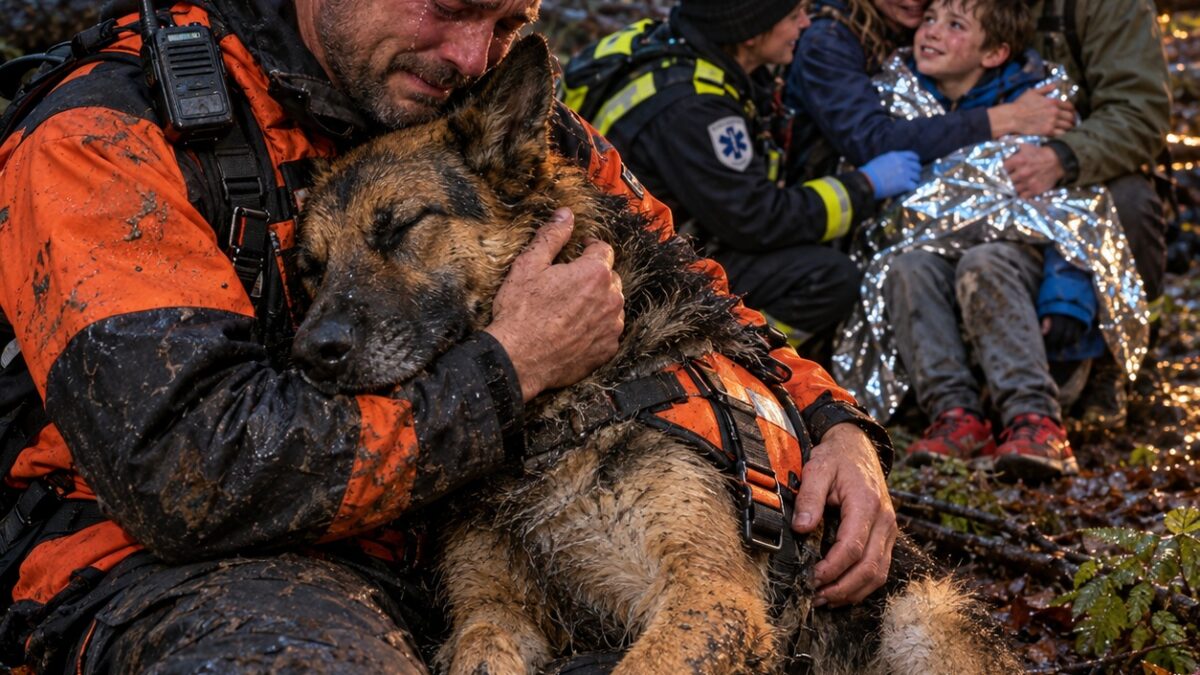
Jacob sat on the ground beside the rescue truck with his back against one wheel.
Rex lay across him like an oversized child.
Mud-covered paws.
Leaves caught between his toes.
A little twig behind one ear.
Jacob did not move.
He just held him.
Emily came over carrying a warm blanket.
“Can I?”
Jacob nodded.
She draped it over Rex.
Then stood there for a second.
Hand over her mouth.
Walked away wiping her eyes.
I sat beside Jacob.
For a while, neither of us spoke.
Daniel’s parents were maybe twenty yards away.
Mother still kneeling.
Father still holding him.
The sun pushed through the tree line.
Everything turned gold.
The same forest that had felt endless and hostile at three in the morning suddenly looked peaceful.
I hated it a little for that.
Jacob stroked Rex’s neck.
“He never stopped.”
I looked at him.
“Not once.”
“How far?”
“Seven kilometers.”
Pause.
“Maybe more.”
“He should’ve rotated out.”
“I tried.”
Jacob looked down.
“He kept working.”
“You trusted him.”
“Yes.”
“Why?”
Jacob thought.
Then:
“Because he knew.”
“Knew what?”
He shook his head.
“I don’t know.”
“That’s the problem.”
He laughed softly.
“I don’t know how to explain dogs without sounding crazy.”
“Try.”
Jacob looked toward the trees.
“He kept catching something.”
“Wind.”
“Scent.”
“Movement.”
“I don’t know.”
“But every time I thought he had lost it, he’d look east.”
“Like somebody was pulling him.”
An invisible thread.
That is how it had looked.
Rex had followed it until he found Daniel.
A medic checked him.
Paws.
Hydration.
Temperature.
Everything fine except exhaustion.
“Let him sleep.”
The medic said.
“As if I could stop him.”
Jacob replied.
We sat there while Rex slept.
Daniel was transferred to an ambulance for evaluation.
Before they left, his father walked over to us.
He looked at Rex.
“Is that the dog?”
“Yes.”
Jacob answered.
The man crouched.
His hands started shaking.
“Can I touch him?”
Jacob nodded.
Daniel’s father placed one hand on Rex’s muddy shoulder.
Then whispered:
“Thank you.”
His voice broke.
Rex slept through it.
Maybe that was fitting.
Heroes in stories usually hear the gratitude.
Dogs rarely need it.
At the hospital, doctors found Daniel mildly hypothermic and dehydrated.
Scratches.
Bruising.
Nothing serious.
A few hours later, he went home.
That should have been the end.
Operationally, it was.
Report filed.
Equipment checked.
Radios charged.
Vehicles cleaned.
Search map archived.
But some rescues stay open inside you.
That afternoon, I slept four hours.
Woke with mud still under one fingernail.
I showered.
Ate.
Then sat at my kitchen table thinking about a sleeping dog.
My wife asked:
“You okay?”
“Yeah.”
“You don’t look okay.”
“We found him.”
“I know.”
“He was alive.”
“I know.”
I stared at my coffee.
“Rex ran all night.”
She waited.
“Then when it was done, he just…”
I made a falling motion with my hand.
“Stopped.”
My wife smiled.
“Sounds like you.”
“No.”
“Sam.”
“I don’t sleep in people’s laps.”
“Not yet.”
I laughed.
Good.
Sometimes laughter returns your body after a rescue.
Three weeks later, Daniel’s family organized a thank-you gathering at the volunteer fire hall.
Nothing formal.
Chili.
Sandwiches.
Sheet cake.
Cheap coffee.
Dozens of rescuers and volunteers came.
People who had not seen one another clearly during the search because all we knew of each other were headlamps and radio voices.
Emily came.
Clean clothes.
Hair down.
Looked ten years younger than she had at dawn.
“You’re alive.”
I said.
“Barely.”
“Still useless?”
She smiled.
“I brought two blankets.”
“Overachiever.”
Then the side door opened.
Jacob walked in with Rex.
The room changed.
People noticed.
Conversation softened.
Rex wore no dramatic medal.
Just his working harness.
He looked normal.
That may be one of the strangest things about extraordinary dogs.
Afterward, they still want water.
They still sniff tables.
They still try to eat food dropped by children.
Daniel saw him.
The boy had been sitting with cousins near the far wall.
He stood so quickly his chair tipped.
“Rex!”
He ran.
Jacob started:
“Daniel, slow—”
Too late.
Daniel threw both arms around Rex’s neck.
Rex stood perfectly still.
Then licked the boy across the cheek.
The entire room made that sound people make when they are trying not to cry collectively.
Daniel laughed.
“Gross.”
Then hugged him again.
His mother came over.
She knelt.
Looked directly into Rex’s eyes.
“Thank you.”
Softly.
“You brought my son back.”
Rex tilted his head.
Tail wagged.
That was all.
Simple movement.
Enormous meaning.
Daniel looked at Jacob.
“Did he know it was me?”
Jacob smiled.
“He knew somebody was there.”
“How?”
“That’s his job.”
Daniel frowned.
“But how?”
Jacob laughed.
“Ask him.”
Daniel crouched.
“How?”
Rex sniffed his face.
No explanation.
Probably better.
Later, I found Emily standing beside me.
Watching Daniel and Rex.
“You know what?”
She said.
“What?”
“That night was my first search.”
“I remember.”
“I thought I was useless.”
“You told me.”
“I was terrified.”
“That’s allowed.”
She watched Rex.
“I kept thinking everyone else knew exactly what to do.”
“Nobody does.”
She looked at me.
“Seriously?”
“We know procedures.”
“Not outcomes.”
“That night, you all seemed so calm.”
“We were scared too.”
That surprised her.
Then she said:
“I understand something now.”
“What?”
“Everybody had something.”
She looked around the room.
“Hunters knew the woods.”
“You knew search strategy.”
“Jacob had Rex.”
“Medics had medical stuff.”
“I had…”
She laughed.
“A blanket.”
“Warm blanket.”
“Important distinction.”
She smiled.
“Maybe you don’t have to be the person who finds someone to matter.”
“No.”
I said.
“You just have to bring what you have.”
That became another lesson from that night.
People focused on Rex afterward.
Understandably.
He found Daniel.
But hundreds came.
Someone organized maps.
Someone brought batteries.
Someone made coffee.
Someone checked drainage culverts.
Someone comforted Daniel’s sister.
Someone managed traffic.
Someone carried blankets.
Someone answered radios for ten straight hours.
Search and rescue is rarely one hero.
It is a chain.
Rex was the link that finally reached Daniel.
But a chain works because every link holds.
A month after the search, I saw Jacob and Rex at the base.
Rex walked straight toward me.
Sniffed my hands.
Tail moved.
“Remember me?”
I asked.
Jacob said:
“He remembers everybody from that search.”
“Really?”
“No.”
He smiled.
“He thinks you might have food.”
Fair.
I scratched Rex behind the ears.
“Good dog.”
His eyes half closed.
“Good dog.”
That phrase feels inadequate sometimes.
What do you say to an animal that crossed a forest at four in the morning and found a child none of us could find?
Still:
Good dog.
Maybe simple words fit dogs best.
The story spread locally.
People wanted details.
How far?
How cold?
How did Rex know?
Did Daniel hear him?
Yes.
Daniel later told me exactly what happened from his perspective.
He had realized he was lost within maybe fifteen minutes.
Tried retracing the trail.
Could not.
Everything looked the same.
Then he kept walking because standing still felt worse.
That is a common mistake.
Understandable.
The woods became denser.
He tripped.
Scratched his hands.
At some point after dark, he heard people.
Faint.
He shouted once.
No answer.
Then wind moved through the trees.
He became unsure whether he had heard voices at all.
Around midnight, exhausted, he found the fallen tree.
The trunk created a pocket beneath it.
Less wind.
He crawled under.
Pulled leaves around himself.
He knew enough to stop wandering.
That decision probably helped save him.
He told me:
“I thought about Mom.”
“What about her?”
“That she’d be mad.”
“She wasn’t.”
“I know now.”
“What else?”
“My room.”
“My game.”
“My dog.”
They had a terrier at home.
Then:
“I kept thinking if I slept too hard nobody could find me.”
That sentence stayed with me.
“So did you sleep?”
“A little.”
“Then?”
“I heard barking.”
His face changed when he remembered.
“Not like coyotes.”
“How did you know?”
“I just knew.”
“It was loud.”
“Then again.”
“I thought, that’s a real dog.”
“A dog has a person.”
“So I knew somebody was close.”
The most beautiful sound he had ever heard.
A bark.
Think about that.
The noise neighbors complain about.
The thing people shout at dogs to stop doing.
In that moment, it meant:
You are not alone anymore.
Daniel tried calling.
Weak voice.
Rex heard or smelled or sensed something.
Whatever the mechanism, he arrived.
For months afterward, whenever I heard a dog bark in the distance during a search, I thought about Daniel under that tree.
Hope can sound very ordinary.
Sometimes it sounds like barking.
Search work returned to normal.
Lost hikers.
Car accidents.
Weather calls.
Rex and Jacob continued working.
That mattered to me.
The search was not Rex’s retirement story.
He still had a job.
Another year or two, maybe.
Health permitting.
Handlers watch working dogs carefully.
Seven is not ancient.
But not young.
Jacob told me he planned to retire Rex before the dog had to ask.
“He’d work until his legs fell off.”
“That sounds unhealthy.”
“It is.”
“So you decide for him.”
“That’s my job too.”
People admire a working dog’s refusal to quit.
But devotion creates responsibility in the handler.
Rex did not know how to protect his future from his drive.
Jacob had to.
That made me respect him more.
A few months after Daniel’s rescue, we responded to a missing elderly woman.
Rex worked about three hours.
Jacob called him out.
Another dog took over.
Rex looked furious.
He pulled toward the search line.
Jacob knelt.
“You’re done.”
Rex stared.
“Done.”
Eventually, the dog settled.
I said:
“He hates that.”
“Yes.”
“Do you ever feel guilty?”
“All the time.”
“Then why stop him?”
Jacob looked at me like the answer was obvious.
“Because I love him.”
There it was.
Love is not always asking for everything someone can give.
Sometimes it means stopping them before they empty themselves.
That lesson stuck with me too.
Rescue people are terrible at stopping.
We glorify endurance.
Long shifts.
No sleep.
Keep moving.
Useful in emergencies.
Dangerous as identity.
Rex slept in Jacob’s arms because nobody had stopped him before the job ended.
That was beautiful once.
It should not become a lifestyle.
I started paying more attention to my own team.
Mandatory water.
Rotation.
Rest.
Nobody becomes heroic by making themselves another casualty.
Emily eventually joined our volunteer unit formally.
Six months after Daniel, she completed additional training.
I teased her about the blanket.
She kept one in her vehicle permanently.
“See?”
She said.
“My specialty.”
Years later, she became one of the people comforting first-time volunteers.
That is how search teams grow.
Someone is terrified.
Someone older says:
Search the next piece of ground.
Then one day, the frightened person becomes the steady voice.
Daniel’s family stayed in touch.
Not constantly.
Birthdays.
Christmas card.
Once a year, usually around September 1, his mother sent a photograph.
Daniel getting taller.
Baseball uniform.
School.
One year, him standing beside Rex.
The captions were always simple.
Another year. Still grateful.
That was enough.
At twelve, Daniel wrote a school essay about the rescue.
His mother sent me a copy.
He described the forest.
The cold.
The fallen tree.
Then Rex.
One paragraph stopped me.
“Before Rex barked, I thought maybe nobody knew where I was. When I heard him, I knew the world still had me in it.”
I read that line three times.
The world still had me in it.
Nine years old when he felt forgotten.
Twelve when he found words for it.
I printed the essay.
Kept it at my desk.
Not because I enjoyed remembering the fear.
Because rescue is easy to reduce to logistics.
Coordinates.
Search grids.
Temperature.
Distances.
Times.
But underneath every map is a human question:
Does anybody know I am here?
Does anybody care enough to come?
Our job is to answer yes.
Sometimes with radios.
Sometimes with boots.
Sometimes with a dog.
Rex eventually retired.
Jacob invited a few of us.
No ceremony.
No plaque.
Just a Sunday morning at the training field.
Rex was nine.
A little gray around the muzzle.
Still alert.
Still furious when another dog began working a scent trail without him.
Jacob unclipped the working harness.
Held it in both hands.
Then replaced it with an ordinary red collar.
“That’s it?”
I asked.
“That’s it.”
Rex looked offended.
Daniel, now eleven, was there with his parents.
He carried a tennis ball.
“Can he still play?”
Jacob smiled.
“Try.”
Daniel threw it.
Rex exploded after it.
Retirement apparently did not apply to tennis balls.
We laughed.
When Rex returned, he dropped the ball at Daniel’s feet.
The boy threw again.
Watching them, I thought about the search.
The same dog.
Different purpose.
One night, he had followed a scent through seven kilometers of forest.
Now he was chasing a tennis ball badly thrown by the child he once found.
That felt like justice.
Quiet justice.
Rex went home with Jacob.
Slept on a couch he had technically been forbidden from using for years.
Jacob sent me a photograph.
Rex upside down.
Four paws in the air.
Caption:
Retirement is brutal.
I saved it.
The years moved.
That is what they do.
I remained in rescue.
Fourteen years.
Fifteen.
Sixteen.
People occasionally asked whether I remembered “that dog story.”
Of course.
But memory changes.
At first, I remembered the bark.
Then the boy.
Then Rex collapsing.
Later, I remembered smaller things.
Emily’s lost glove.
Mud on Jacob’s sleeve.
Daniel asking whether his parents were mad.
The twig behind Rex’s ear.
The way his mother kissed his hands.
How pale sunrise looked on wet leaves.
Real memory is not edited like a movie.
It keeps strange details.
One rainy evening, years after the search, Jacob called.
“Sam.”
“What’s up?”
“Rex isn’t doing great.”
My chest tightened.
“How bad?”
“Old.”
That was all.
Old.
No dramatic accident.
No line-of-duty injury.
Time.
He invited me over.
I went.
Rex lay on a thick bed near the fireplace.
Gray face.
Eyes still alert.
His tail moved when I entered.
Once.
Twice.
“Hey.”
I knelt slowly.
“Good dog.”
Rex lifted his head.
Sniffed my hand.
Then laid it back down.
Jacob sat on the floor beside him.
“He still remembers.”
“Probably smells the snacks.”
“Probably.”
We talked.
Not about death.
Not directly.
Searches.
Training.
Daniel.
Jacob told me Daniel still visited.
“He comes every September.”
“Really?”
“Every year.”
“He sits with Rex.”
“Doesn’t say much.”
“Kids grow up.”
I scratched behind Rex’s ear.
“Do you think dogs know what they did?”
Jacob considered.
“No.”
“Not like us.”
“They know the person.”
“The job.”
“The feeling.”
“Maybe.”
“That’s enough.”
It was.
I went home that night thinking about Daniel’s essay.
The world still had me in it.
Maybe Rex never understood he became part of one family’s history forever.
Maybe he only understood:
Scent.
Search.
Find.
Return to Jacob.
Sleep.
Dogs are lucky that way.
They do not carry monuments.
People do.
When Rex died, Jacob called me before he posted anything publicly.
He had been home.
On his bed.
Jacob beside him.
Peaceful.
I drove over.
Did not know what to say.
So I used the only words that had ever felt right.
“Good dog.”
Jacob cried.
I did too.
This story is not really about Rex dying, though.
I mention it because every life that matters eventually has an ending.
Pretending otherwise makes love smaller, not bigger.
What matters is what happened while he was here.
A boy got lost.
Hundreds came.
A dog worked.
The forest was cold.
The night was long.
And somewhere beneath a fallen tree, a nine-year-old heard barking and knew the world had not forgotten him.
That happened.
Nothing can take it away.
At Rex’s retirement, Daniel’s mother had once told me:
“I used to think the worst moment of my life was when Daniel disappeared.”
“What do you think now?”
“The worst moment was believing nobody knew where he was.”
She looked toward Rex.
“The best was realizing somebody did.”
That is why search work matters.
Not because every outcome is miraculous.
They are not.
I have been part of searches that ended differently.
Those families matter too.
Maybe more.
But the promise remains the same.
We come.
We look.
We carry what we have.
Maps.
Blankets.
Medical bags.
Knowledge.
Flashlights.
Dogs.
Hope.
Not the soft kind.
The kind with sore legs.
Mud.
Cold hands.
The kind that keeps walking.
When I think about that night now, I always return to one image.
Not Daniel under the tree.
Not his parents.
Not even the bark.
Rex in Jacob’s arms.
Eyes closed.
Completely empty.
He had spent every useful thing in his body.
Every step.
Every breath.
Every piece of focus.
Then the second Daniel was safe, he gave himself permission to stop.
I admired that for years as pure devotion.
I still do.
But I understand something different now too.
You cannot live every day that way.
Nobody can.
Not a dog.
Not a rescuer.
Not a parent.
Not a volunteer.
Give everything when everything is required.
Then rest.
Let somebody hold you.
That is part of the job too.
Jacob understood instinctively.
He did not wake Rex for praise.
Did not make him stand for photographs.
Did not pull him toward Daniel’s parents.
He sat against the truck.
Held the dog.
Let him sleep.
That may have been the second most loving thing I saw that morning.
The first was Daniel’s mother kissing her son’s hands.
Years later, I became a training supervisor.
First-night volunteers always ask similar questions.
“What if I get tired?”
“You will.”
“What if I get scared?”
“You will.”
“What if I don’t know what to do?”
“Ask.”
“What if I’m not the one who finds them?”
“Most people aren’t.”
Then I tell them about Emily.
First search.
Terrified.
Thought she contributed nothing.
She brought a blanket.
I tell them about Daniel.
How he hid beneath a tree because he had enough sense to get out of the wind.
I tell them about Jacob.
How he trusted Rex without pretending to understand everything Rex sensed.
I tell them about hundreds of people who gave one night.
And yes.
I tell them about Rex.
But never as a superhero.
That word is too easy.
I tell them he was a dog.
Seven years old.
Muddy.
Exhausted.
Trained.
Loved.
Determined.
And because he was all those ordinary things at once, he did something extraordinary.
One trainee once asked:
“What would have happened if Rex wasn’t there?”
I said:
“We don’t know.”
“Would you have found Daniel?”
“Maybe.”
“When?”
“I don’t know.”
She looked disturbed.
People want certainty after a successful rescue.
There is none.
Maybe another team reaches him an hour later.
Maybe daylight helps.
Maybe Daniel crawls out.
Maybe not.
The reason Rex matters is not because we can prove every alternate future ends badly.
He matters because in the future that actually happened, he was there.
He found him.
That is enough.
Daniel is older now.
Teenager.
Last I heard, tall.
Still hates cold weather.
Still keeps one photograph of Rex on his desk.
His father sent me a picture once.
Daniel standing beside the old fallen-tree area.
Daylight.
Summer.
He had asked to return.
His parents were not sure.
Eventually, they went.
Daniel stood beneath the trees.
Silent.
Then said:
“It looks smaller.”
Trauma does that.
Places become enormous inside memory.
Returning can restore scale.
He found the trunk.
Mostly rotted now.
Touched it.
Then left.
His mother asked:
“Do you feel better?”
Daniel said:
“No.”
Then after a moment:
“Different.”
Sometimes different is enough.
I know that.
Because twelve years in rescue has become more now.
And I am different.
The night Daniel disappeared taught me things training never had.
A search is not only technique.
It is refusal.
Refusal to let darkness make the decision.
Refusal to assume somebody else will show up.
Refusal to let exhaustion become the same thing as surrender.
But also:
Refusal to confuse being tired with being weak.
Refusal to think small contributions do not matter.
Refusal to make heroes out of people until they feel guilty for resting.
Hope has legs.
Yes.
Sometimes four of them.
But hope also needs water.
Blankets.
Sleep.
People willing to carry one another after the job.
Outside my window tonight, rain is falling.
It makes the same soft sound against leaves that I remember from the forest.
For years, rain at night brought that search back immediately.
Daniel.
Cold.
Rex.
Now the memory is gentler.
Not gone.
Gentler.
Somewhere, rescue teams are working tonight.
I know that.
A child may be missing.
A hiker overdue.
An elderly person confused.
A family waiting beside a radio.
Somewhere, a handler may be clipping a harness onto a dog.
The dog does not know about headlines.
Does not know families may remember his name for decades.
He knows:
Work.
Find.
Return.
That purity still moves me.
If I could speak to Daniel as he was beneath that tree, I would tell him:
Keep still.
Stay warm.
We are looking.
You cannot hear us clearly yet.
But we are coming.
If I could speak to Emily at three-thirty in the morning, legs shaking, thinking she was useless, I would say:
Keep the blanket.
You will need it.
If I could speak to Jacob as Rex pulled him toward that wall of deadfall, I would say:
Trust him.
And if I could speak to Rex?
I would not explain anything.
I would kneel.
Scratch behind his ears.
Say the only thing a dog like Rex ever needed to hear.
Good boy.
Then I would let him sleep.
Because he earned that sleep.
Not by being fearless.
Not by being magical.
By continuing.
Step after step.
Scent after scent.
Through mud.
Leaves.
Cold.
Darkness.
Until the boy at the end of that invisible trail was no longer alone.
That is what I remember most.
Not that Rex saved Daniel by himself.
Hundreds of us were there.
Daniel helped save himself by sheltering from the wind.
Jacob trusted his dog.
Volunteers searched.
Medics waited.
Parents kept believing.
Every piece mattered.
But in the final stretch, when all our human voices had blended into the forest and Daniel could no longer tell whether he was hearing people or imagination, Rex gave him something unmistakable.
A bark.
A real sound.
A promise with no words.
Someone is close.
Daniel later told me it was the most beautiful sound he had ever heard.
I believe him.
At dawn, when we carried him out, he kept asking:
“Where’s the dog?”
“Right there.”
I told him.
“Is he okay?”
“Yes.”
“He looks tired.”
“He is.”
“Because of me?”
I stopped.
“No.”
I said.
“Because he did his job.”
Daniel looked back at Rex.
Then smiled.
Years later, I wish I had answered slightly differently.
Yes, Rex was tired because he searched for Daniel.
But not because Daniel had done something wrong.
There is a difference between being the reason somebody gives effort and being guilty for receiving it.
Children need to learn that.
Adults too.
Sometimes people love us enough to get tired.
We honor that love by living, not by carrying guilt.
Daniel went home.
Rex slept.
The sun came up.
And the forest returned to being just a forest.
That is how enormous nights end.
Quietly.
A truck leaves.
An ambulance drives away.
Volunteers remove reflective vests.
Coffee gets poured.
Someone finds a lost glove.
The world keeps going.
But the people inside the story are changed.
I was.
Jacob was.
Emily was.
Daniel and his family certainly were.
And every time I stand at a search staging area before dawn and see new volunteers rubbing tired eyes, I remember that seven-year-old dog pressing his head against Jacob’s leg.
I remember the moment his body finally said:
Enough.
Then I remember Jacob catching him.
Holding him.
Whispering:
“He’s sleeping.”
Not embarrassed.
Not disappointed.
Proud.
That is the image I carry.
Rex did not finish the night standing triumphantly for applause.
He finished it safe in the arms of somebody he trusted.
Maybe that is the better ending anyway.
We spend so much time praising those who keep going.
We should also honor the people who make it safe for them to stop.
Jacob was that for Rex.
Daniel’s parents were that for Daniel.
Our team was that for each other.
And on the hardest nights, that may be what rescue really means.
You go into the dark for someone.
You find them.
You bring them back.
And when the person beside you has nothing left—
you hold them until they can rest.
My name is Sam Carter.
I have worked search and rescue for more than twelve years.
I have seen fire.
Floods.
Blizzards.
Ravines.
Fear.
Relief.
I have watched people do extraordinary things.
But when someone asks me what refusing to give up looks like, I do not picture a motivational speech.
I picture muddy paws.
Leaves caught in fur.
A cold forest before sunrise.
A little boy whispering:
“I knew somebody would come.”
And a dog who ran all night to prove him right.
Rex found Daniel.
Then he walked back to the man he trusted most in the world.
Pressed his tired body against him.
Closed his eyes.
And slept.
The boy was safe.
The search was over.
For that one moment, nothing else was required.

