PART 2:The Woman Who Slapped Me in a Hotel Lobby Had No Idea Why I Was Waiting There
𝗙𝗨𝗟𝗟 𝗦𝗧𝗢𝗥𝗬 


Not loudly.
Worse.
A short little sound like I had said something childish.
“Your son?”
“Yes.”
“What is he?”
She tilted her head.
“A busboy?”
Then:
“A dishwasher?”
I felt heat rise in my face.
“Please just check the guest list.”
That should have been easy.
There was a reception desk six feet away.
Computers.
Printed seating charts.
Staff with tablets.
My son had told me himself that my name was listed.
IRENE WASHINGTON.
VIP guest.
He had called me that afternoon.
“Mama, don’t let anybody seat you in the back.”
I laughed.
“Terrence, I’m going for dinner, not to negotiate.”
“You’re my guest.”
“I know.”
“Tell them your name.”
“I know my name, baby.”
He laughed.
“I’ll be there around eight forty-five.”
I remember looking at the clock.
Seven fifteen.
Plenty of time.
That was why I had arrived early.
I hated being late.
Always had.
The woman standing in front of me did not care about any of that.
“Please check,” I repeated.
Her face changed.
Something hardened.
“Shut your mouth.”
Then her hand moved.
Fast.
I did not have time to turn away.
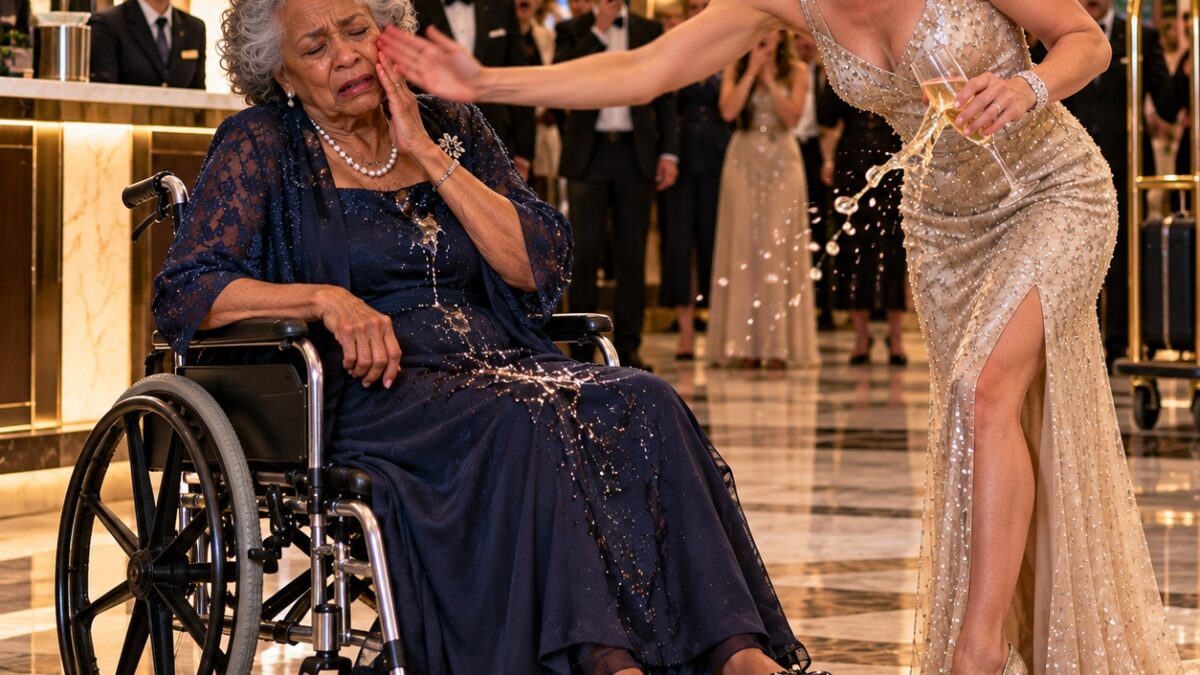
The slap cracked across the lobby.
My head snapped sideways.
For one second, I saw nothing except chandelier light.
Then marble.
Then my own hand gripping the armrest of my wheelchair.
A dozen staff members had seen it.
I know because when I looked up, several were staring.
Then they looked away.
My cheek burned.
“What did you just do?”
My voice trembled.
I hated that it did.
The woman folded her arms.
“Know your place.”
I stared at her.
“Don’t dirty up my event.”
That was my introduction to Sloan Peton.
I did not know her name yet.
I did not know she was the daughter of Preston Peton, chairman of Peton Properties.
I did not know the entire gala existed partly because her father needed to impress my son.
I did not know Washington Capital had spent eight months negotiating a financing agreement that could keep Peton Properties alive.
I did not know Peton Properties was carrying more debt than its balance sheet could safely hold.
I did not know my son was the man Preston Peton had been calling his company’s last lifeline.
All I knew was that a young woman had just slapped me across the face because she had decided I did not belong in her lobby.
My name is Irene Washington.
I was born in South Carolina in 1954.
By the time I was eight, my mother had moved us north.
New York.
Harlem.
Three rooms.
Radiators that clanged all winter.
Neighbors who knew who belonged to which child and which child belonged to whom.
I grew up poor.
Not poor in the romantic way people talk about after success.
Poor in the way that teaches you the exact number of slices left in a loaf of bread.
My mother cleaned offices.
My father disappeared when I was five.
I never knew whether he died, left, or simply decided fatherhood did not fit the life he wanted.
My mother never spoke badly about him.
That was one of many things I did not understand until I became a parent myself.
She had a small Bible.
Black leather.
Cracked spine.
She carried it everywhere.
Church.
Work.
Hospital.
Bus.
When she died, it became mine.
I still carried it at seventy-two.
It was in my handbag that night.
So was a photograph of Terrence graduating from college.
He was twenty-two in that picture.
Tall already.
Skinny.
Proud.
He had one arm around me and his diploma lifted in the other.
On the back, he had written:
LOVE YOU FOREVER, MAMA.
That photograph had survived three apartment moves, two floods, one kitchen fire in the building next door, and eleven years in which my hands had become less reliable.
It would not survive Sloan Peton.
Not in its original frame.
But I am getting ahead of myself.
Terrence was my only child.
His father died when Terrence was fourteen.
Construction accident.
After that, it was the two of us.
I worked three jobs at one point.
Morning cleaning in an office building.
Afternoons at a school cafeteria.
Evenings doing alterations for women at church.
Terrence used to sit beside the sewing machine doing homework.
Sometimes he fell asleep with his head on a math book.
I would carry him to bed even after he became almost too heavy.
Not because he needed carrying.
Because I needed to remember I still could.
He was smart.
Not the kind of smart that has to announce itself.
He watched.
Listened.
Understood people.
He earned scholarships.
Went to college.
Then business school.
Then finance.
The first time he made more money in one year than I had made in my entire life up to that point, he came to my apartment with groceries.
Not jewelry.
Not a new car.
Groceries.
He opened my refrigerator.
Saw almost nothing.
Turned around.
“Mama.”
“I have food.”
“You have mustard.”
“There are eggs.”
“Two.”
“You counting now?”
“I’m buying groceries.”
“You just got promoted.”
“Yes.”
“So go celebrate.”
“I am.”
That was Terrence.
People saw Washington Capital.
They saw suits.
Black cars.
Financial newspapers.
Buildings.
Deals.
What I saw was the boy who used to heat soup for me when I came home late.
By his late forties, he had built Washington Capital into one of the largest private investment firms in the country.
I understood only part of what he did.
Acquisitions.
Debt restructuring.
Real estate.
Infrastructure.
Private credit.
Words people on television said with serious faces.
Terrence tried explaining once.
I interrupted.
“Do you make honest money?”
He laughed.
“I try.”
“Do you hurt people?”
“I try not to.”
“Do you pay your taxes?”
He looked offended.
“Yes.”
“Then your mother understands enough.”
He never stopped inviting me into his world.
Most of the time, I refused.
Not because I was ashamed.
Because I did not enjoy rooms where everybody looked over one another’s shoulders to see who more important had arrived.
The Grand Western gala was different.
“Come for me.”
That was how he asked.
Not:
Come because Peton Properties matters.
Not:
Come meet influential people.
Come for me.
He told me Peton Properties was celebrating its fiftieth anniversary.
Washington Capital had a table near the stage.
“Sit there.”
“I don’t want to sit near a stage.”
“Mama.”
“What?”
“It’s my table.”
“So?”
“So I want you at it.”
I smiled.
“All right.”
That was why I bought the navy dress.
Seventy-eight dollars on sale.
More than I usually spent on something I would wear once.
Simple.
Long sleeves.
Modest neckline.
Terrence always said navy looked good on me.
I ironed it three times.
The arthritis in my fingers made the iron hard to grip.
But I wanted the seams right.
I wanted my son to see me and feel proud.
Not because he had ever been embarrassed by me.
Because mothers do foolish little things for their children no matter how old those children become.
At seven fifteen that evening, I called him.
“I’m here.”
“You made good time.”
“I left early.”
“Of course you did.”
I smiled.
“They’re still setting some things up.”
“Tell them Irene Washington.”
“I will.”
“I put you on the list personally.”
“I know.”
“I’m leaving downtown now.”
“Drive carefully.”
“I’m not driving.”
“Tell the driver.”
He laughed.
“You excited?”
“I feel underdressed.”
“Mama.”
“What?”
“You could wear your housecoat and still outrank everybody at my table.”
“Don’t talk foolish.”
“I love you.”
“I love you too.”
That was the last time I spoke to him before he found me in the service corridor.
After Sloan slapped me, she walked away.
Just walked away.
Like striking an old woman in a wheelchair had been a minor administrative task.
My cheek throbbed.
I sat there trying to breathe evenly.
One of the security guards near the elevators looked at me.
Young man.
Tall.
He started to move.
Then stopped when Sloan turned.
“Why is she still here?”
The guard cleared his throat.
“She says she’s waiting for her son.”
“Her son isn’t coming.”
She looked at me.
“Nobody is coming for you.”
“My son will be here soon.”
She turned to the guards.
“What are you waiting for?”
The taller one hesitated.
“Ma’am, maybe we should check the list.”
Sloan stared at him.
“Check what?”
Then she pointed at me.
“Look at her.”
My wheelchair.
My dress.
My bag.
“Does she look like she belongs at a Peton event?”
The guard went quiet.
I watched his eyes drop.
That hurt more than I expected.
He had almost helped.
Almost.
Then class, fear, hierarchy, salary—whatever it was—won.
Sloan crouched until her face was level with mine.
Perfume.
Champagne.
A smile with no warmth.
“You are trespassing.”
“I am not.”
“If you are not gone in sixty seconds, I will have you arrested.”
“For what?”
Her smile widened.
“And trust me.”
She lowered her voice.
“The police in this neighborhood don’t ask questions when I call.”
There was a time in my life when a sentence like that could freeze my blood.
Black woman.
Police.
Manhattan.
Her confidence was deliberate.
She wanted me to understand the imbalance.
But I was seventy-two.
I had buried a husband.
Buried my mother.
Survived poverty.
Raised a Black son in New York through years when every phone call after dark could become terror.
I knew fear.
Sloan Peton was not the first person to believe she could use it against me.
“Sixty seconds,” she said again.
Then stood and walked toward the ballroom.
I stayed.
What else was I supposed to do?
Terrence was coming.
Twenty minutes passed.
Guests began arriving.
Expensive gowns.
Tuxedos.
Fur.
Jewelry.
Perfume.
Laughter.
The lobby grew bright with money.
Sloan returned.
Saw me.
Stopped.
“You have got to be kidding me.”
Heads turned.
“I told you to leave.”
“I told you.”
I spoke quietly.
“My son is coming.”
“Stop saying that.”
Her voice rose.
“Does anybody know who let this woman in?”
Staff froze.
Nobody answered.
Sloan walked toward me.
Blocked my view of the ballroom doors.
“You know what I think?”
I said nothing.
“I think you wandered in from the street because you saw lights and rich people.”
I stared at her.
“I think you made up a son because you expected someone here to feel sorry for you.”
She leaned closer.
“And I think you’re sitting in that wheelchair because people give you more sympathy that way.”
The lobby went silent.
That one reached somewhere deeper.
I had been in my wheelchair eleven years.
A spinal condition first.
Then surgery.
Then complications.
I could stand briefly with help.
Could transfer.
Could take perhaps two steps on a very good day.
Walking was not part of my life anymore.
I had spent years making peace with that.
“That isn’t true.”
My voice was barely above a whisper.
“I’ve been in this chair eleven years.”
“I don’t need your life story.”
Sloan straightened.
“I need you gone.”
“My son has the invitation.”
“Oh, yes.”
She laughed.
“Your magical son.”
Then turned toward the people watching.
“Ladies and gentlemen, I apologize.”
Everyone looked at her.
“We had an uninvited guest wander in off the street.”
A woman in fur pulled her coat tighter.
A man in a tuxedo shook his head.
Nobody said:
Check the list.
Nobody.
I sat in that lobby and watched a room full of strangers accept Sloan’s version of me because it matched what they expected to see.
Old.
Black.
Wheelchair.
Simple dress.
Therefore:
Not invited.
Poor.
Confused.
Out of place.
That silence wounded me more deeply than the slap.
Cruel people exist.
I knew that.
What I had not prepared for was how quickly decent people could become furniture around cruelty.
Sloan saw the silence too.
It strengthened her.
She looked almost energized.
Then her eyes dropped to my handbag.
“Give me your bag.”
My hand tightened around the strap.
“Excuse me?”
“If your son invited you, there should be proof.”
“Please don’t touch my things.”
She reached anyway.
I tried to hold on.
My fingers were slow.
Arthritis.
Age.
Wheelchair.
Her hand was strong.
She pulled the bag from my lap.
“Please.”
She unzipped it.
Turned it upside down.
My life fell onto the marble.
Wallet.
Medication.
Church program.
Tissues.
Hand cream.
Reading glasses.
My mother’s Bible.
Three dollars and some change.
The graduation photograph.
Coins rolled.
One hit the base of a marble column.
Someone laughed nervously.
Not because it was funny.
Because sometimes people laugh when their conscience becomes uncomfortable.
Sloan looked down.
“No invitation.”
She nudged my mother’s Bible with the toe of her heel.
“Just junk.”
I stared at it.
Black leather.
Cracked spine.
My mother had held it when she was dying.
That photograph of Terrence lay face down.
I could see his handwriting through the clear backing.
LOVE YOU FOREVER, MAMA.
I wanted to pick it up.
I could not reach.
“That Bible belonged to my mother.”
My voice broke.
“I don’t care.”
Sloan said.
“It doesn’t change the fact that you don’t belong.”
Then a waiter passed with champagne.
Sloan reached for a flute.
Took one.
Drank slowly.
Watched me.
Her eyes moved over the navy dress.
I saw the decision before she made it.
“No.”
I whispered.
She tilted the glass.
Cold champagne poured onto my chest.
Down my dress.
Into my lap.
Steady.
Deliberate.
I gasped.
The navy fabric turned nearly black.
Liquid pooled around my thighs.
Ran between the wheels.
The smell was sharp.
Sweet.
Humiliating.
Three people gasped.
A man took out his phone.
Nobody came forward.
Sloan placed the empty glass on the desk.
“Now you match your situation.”
Her mouth curved.
“Wet.”
Pause.
“Messy.”
Then:
“Out of place.”
I looked down.
My hands rested in my soaked lap.
I could feel tears coming.
I blinked them away.
I had promised myself many years earlier that I would not cry in front of someone whose goal was to make me cry.
“I will wait for my son.”
My voice did not shake this time.
“Right here.”
That was when I finally made Sloan angry.
Not the arguing.
Not the refusal to leave.
My calm.
She wanted surrender.
She wanted me to shrink enough that she could feel correct.
Instead, I sat there.
Bruised.
Wet.
Still present.
Her face changed.
“Fine.”
She walked behind my wheelchair.
I felt her hands grab the handles.
“What are you doing?”
“What I should have done twenty minutes ago.”
Then she pushed.
Hard.
I gripped the armrests.
“Stop.”
She did not.
“Please stop.”
Not toward the main doors.
That would have meant pushing me past photographers and arriving guests.
Too visible.
She turned toward the back.
Past reception.
Past the kitchen entrance.
Through swinging doors.
Into a service corridor.
The floor changed from marble to stained concrete.
The air got colder.
Industrial cleaner.
Grease.
Garbage.
Fluorescent lights.
Sloan pushed me beside stacked bottle crates, cardboard, mop buckets, garbage bags.
Then locked the brakes.
“This is where you belong.”
I stared at the wall in front of me.
“Not in my lobby.”
Her voice echoed.
“Not at my gala.”
Then:
“Here.”
She pointed toward the garbage.
“With the rest of it.”
My hands had begun shaking badly.
My wet dress clung to my skin.
Cold air raised bumps along my arms.
“You can’t leave me here.”
Sloan smiled.
“Watch me.”
Two kitchen workers stood nearby.
Young man.
Middle-aged woman holding a ladle.
Both looked horrified.
Sloan pointed at them.
“If either of you helps her—water, food, blanket, phone call, anything—you’re fired.”
The woman’s lips parted.
Sloan continued.
“No reference.”
“No severance.”
“I’ll make sure you never work in a kitchen in this city again.”
The workers looked down.
“Understood?”
Slow nods.
“Good.”
She checked her reflection in a stainless-steel surface.
Adjusted her hair.
Then walked away.
Her heels faded.
The doors stopped swinging.
And I was alone.
Seventy-two years old.
Cold.
Wet.
Face bruised.
Medication somewhere in the lobby.
Phone on the floor.
Bible.
Photo.
Three dollars.
Everything.
I closed my eyes.
I did not pray.
That may surprise people who know me.
Mount Carmel Baptist had been my church for thirty-one years.
Choir before my wheelchair.
Piano sometimes.
Prayer had carried me through much of life.
But that moment?
I had nothing eloquent left.
Only breath.
In.
Out.
In.
Out.
I thought about leaving.
The loading dock was nearby.
Perhaps I could wheel myself outside.
Get a taxi.
Go home to Harlem.
Tea.
Dry nightgown.
My television.
My cat.
Pretend I had never arrived.
Then I pictured Terrence.
Walking into the ballroom in his good suit.
Looking for me.
Checking the VIP table.
Calling.
Asking:
Where is my mother?
I could not do that to him.
I could not let him wonder whether I had disappeared.
So I stayed.
Music began through the wall.
Vivaldi.
I recognized it.
Years before, I had played that piece on the church piano.
Before arthritis slowed my fingers.
Before the wheelchair.
Before a young woman with a champagne glass decided I was garbage.
I sat listening.
Twenty minutes.
Thirty.
Kitchen staff moved around me.
They avoided my eyes.
I did not blame them.
Rent.
Children.
Jobs.
People like Sloan depend on other people having too much to lose.
Then a young woman appeared.
Dark hair.
Hotel uniform.
Maybe twenty-two.
She carried a glass of water and a folded napkin.
Looked over her shoulder.
Then crouched beside me.
“Ma’am.”
Her voice shook.
“I’m so sorry.”
I looked at her name tag.
EMILY TORRES.
Front Desk.
“Thank you, sweetheart.”
She handed me the water.
My hands trembled so badly the surface shook.
She opened the napkin.
Blotted my dress gently.
“She said she’d fire you.”
“I know.”
“You shouldn’t risk that.”
Emily looked at me.
“Some things matter more than a job.”
I almost laughed.
Young people say brave things because they have not yet learned all the prices bravery can charge.
“You could lose everything.”
Emily shook her head.
“No, ma’am.”
“With respect.”
She pressed the napkin against the wet fabric.
“You lost more than I could lose tonight.”
I stared at her.
“And you’re still sitting here.”
Pause.
“Waiting.”
She swallowed.
“So I can risk a paycheck.”
That was when I cried.
One tear.
Not from Sloan.
Not from the slap.
Not from humiliation.
Kindness.
Sometimes cruelty makes you numb.
Kindness finds the place still alive underneath.
“What’s your name again?”
“Emily.”
“Emily Torres.”
“Yes, ma’am.”
I reached for her hand.
“I’m going to remember that.”
At 8:45, a black sedan stopped at the hotel entrance.
I did not see it.
I learned the details later.
Terrence stepped out wearing a charcoal suit.
Raymond Cross, senior counsel for Washington Capital, came with him.
Hotel management appeared immediately.
Smiles.
Hands.
Welcome, Mr. Washington.
Your table is ready.
The reserve Bordeaux is open.
Terrence asked one question.
“My mother should already be here.”
The general manager blinked.
“My mother.”
Terrence said again.
“Irene Washington.”
“Seventy-two.”
“Wheelchair.”
“She arrived around seven.”
Nobody knew.
That was the beginning.
Inside the ballroom, Preston Peton heard Terrence had arrived.
He rushed toward the lobby.
Peton Properties was in trouble.
Serious trouble.
The proposed Washington Capital transaction was worth $1.4 billion.
Without it, according to the documents Raymond later showed me, Peton Properties faced hundreds of millions in bond obligations with inadequate liquidity.
The company had been negotiating with Washington Capital for eight months.
Other funds had already declined.
My son was not simply a guest that night.
He was the person Preston Peton desperately needed.
Preston met him with both hands.
Smiled.
Welcomed him.
Terrence barely listened.
“Where is my mother?”
Preston turned to staff.
Confusion.
Terrence called my phone.
Once.
Voicemail.
Again.
Voicemail.
Third time.
Nothing.
That frightened him.
I always answered when I knew he was coming.
Always.
Then Sloan entered.
Champagne in hand.
Smiling.
“Mr. Washington.”
She extended her hand.
“I’m Sloan Peton.”
Terrence did not take it.
“Have you seen my mother?”
Her smile froze.
“Elderly woman.”
“Wheelchair.”
“Arrived around seven.”
Something flickered behind Sloan’s eyes.
Not full recognition.
The possibility was too impossible.
The woman she had slapped was nobody.
A trespasser.
Street trash.
Poor old Black woman.
That person could not possibly be Terrence Washington’s mother.
Terrence moved to the front desk.
His voice changed.
“I need everyone who worked this lobby between seven and eight.”
“Now.”
Not five minutes later.
Now.
That was when Emily stepped forward.
Hands clasped so tightly her knuckles had gone white.
“Sir.”
Terrence turned.
“I know where your mother is.”
The entire lobby went silent.
“Where?”
Emily looked at Sloan.
Then the floor.
Then Terrence.
And made the decision that changed her life.
“Follow me.”
The swinging doors opened.
I heard footsteps.
Many.
Emily appeared first.
Behind her:
Terrence.
Then Preston.
Sloan.
Raymond.
The general manager.
My son saw me.
I looked up.
And despite everything, I smiled.
“Baby.”
His whole body stopped.
“You came.”
Terrence stood completely still.
His eyes moved over me.
Wet dress.
Bruise.
Garbage bags.
Crates.
Cold concrete.
My shaking arms.
The napkin Emily had given me.
Then he came toward me and dropped to his knees.
Not caring about the suit.
Not caring about the concrete.
He took my hands.
“Mama.”
His voice broke.
My hands were cold inside his.
“What happened?”
I squeezed him.
“I’m fine now.”
“No.”
His eyes filled.
“Look at me.”
He touched my chin gently.
Turned my face toward the light.
Saw the purple handprint.
The shape of four fingers.
The swelling.
His expression changed.
I had seen my son angry.
Teenage anger.
Business anger.
Grief.
Frustration.
This was different.
Quiet.
Absolute.
“Who hit you?”
I did not answer.
I looked over his shoulder.
At Sloan.
That was enough.
Her face drained slowly.
Cheeks.
Lips.
Hands.
The champagne glass began trembling.
She understood.
The homeless woman.
The fake guest.
The nobody.
Was his mother.
Terrence stood.
Removed his jacket.
Wrapped it around my shoulders.
Tucked it around me.
Picked up the water.
Held it so I could drink.
Then turned toward Sloan.
“You.”
One word.
The glass fell from her hand.
Shattered on concrete.
Terrence spoke quietly.
“My mother called me at seven fifteen.”
Sloan took one step backward.
“She said she arrived early.”
Another.
“She was nervous.”
My son’s voice remained level.
“She had never been to a gala like this before.”
He looked at my dress.
“She told me she ironed her dress three times.”
His jaw tightened.
“Three times.”
I wanted to tell him to stop.
Not because Sloan deserved protection.
Because I could feel something in him hardening.
But Terrence did not shout.
He asked questions.
Precise.
Like business.
“Did you slap my mother?”
Sloan’s mouth moved.
No sound.
“Did you empty her handbag onto the lobby floor?”
Silence.
“Did you pour champagne on her?”
No answer.
“Did you push her wheelchair into this corridor?”
Sloan’s eyes filled.
“Did you leave her next to garbage?”
Nothing.
“And threaten to fire anyone who helped her?”
Emily stood behind us.
Terrence turned briefly.
His face softened.
“Thank you.”
Emily nodded.
“I won’t forget what you did.”
Then Preston stepped forward.
“Mr. Washington.”
His voice was trembling.
“I had no idea.”
Terrence turned toward him.
“Please.”
Preston continued.
“Let me explain.”
“This was a misunderstanding.”
“My daughter didn’t know.”
Terrence looked at him.
“She did not need to know.”
Preston stopped.
“She didn’t need to know who my mother was.”
The corridor became still.
“She needed to know how to treat a human being.”
That sentence stayed with me.
Because that was the entire truth.
If Sloan had known I was Irene Washington, mother of Terrence Washington, she would have treated me differently.
That was precisely why knowing did not matter.
Dignity that changes according to status is not dignity.
It is strategy.
Terrence looked at Preston.
“I came here tonight prepared to execute a $1.4 billion transaction.”
Preston’s eyes changed.
Sloan’s knees weakened.
Terrence paused.
“That deal is dead.”
Raymond opened his briefcase.
Removed one document.
Placed it on an empty crate.
“Formal notice of withdrawal.”
His voice was almost emotionless.
“All pending agreements between Washington Capital and Peton Properties are terminated effective immediately.”
“No extension.”
“No renegotiation.”
“No second meeting.”
Preston stared.
“You can’t.”
“We’ve been negotiating eight months.”
Terrence looked at him.
“Eight months.”
Then toward Sloan.
“Your daughter undid it in less than one evening.”
Preston looked sick.
“You don’t understand.”
“I understand exactly.”
“We default without this.”
“That is your problem.”
Sloan finally found her voice.
“I didn’t know.”
Tears had begun ruining her makeup.
“I swear.”
“I didn’t know she was your mother.”
Terrence stepped closer.
“You thought she was nobody.”
Sloan shook her head.
“No.”
“Yes.”
“You thought she was a poor old Black woman who wandered into your hotel.”
He glanced toward the garbage bags.
“And because you thought she was nobody, you believed you could treat her like garbage.”
Literally.
Sloan’s knees buckled.
She caught the wall.
I did not enjoy that.
I want to be clear.
I did not feel victory.
I felt tired.
Cold.
Hungry.
Sad.
There are moments people imagine they would celebrate.
Then they happen and all you want is home.
Terrence told the hotel manager he wanted every second of security footage preserved.
Lobby.
Corridors.
From seven o’clock forward.
Raymond would handle the legal side.
Then Terrence came back to me.
Crouched.
“We’re leaving.”
“You have your meeting.”
“No.”
“Terrence.”
“Mama.”
He kissed my forehead.
“We are leaving.”
I touched his cheek.
“This is business.”
“No business exists tonight.”
He looked around the corridor.
“Not after this.”
He stood behind my chair.
Then looked at Emily.
“Would you walk with us?”
Emily’s eyes widened.
“Yes, sir.”
We moved through the kitchen.
Then the lobby.
The ballroom guests never saw us leave.
That always struck me as fitting.
Three hundred people continued drinking.
Celebrating fifty years of Peton Properties.
Many of them did not know the company whose anniversary they were celebrating had just lost the deal keeping it alive.
Out front, the night air hit my face.
Cold.
But clean.
Terrence put me in the car himself.
Emily stood beside the door.
I took her hand again.
“You did right.”
Her eyes filled.
“I’m sorry nobody helped sooner.”
“So am I.”
Terrence said something quietly to Raymond.
Then got into the car beside me.
He did not let go of my hand the entire ride.
The story was online before midnight.
Someone in the lobby had filmed the slap.
Fourteen seconds.
That was all.
No context was necessary.
Young white woman.
Designer dress.
Elderly Black woman.
Wheelchair.
Hand.
Face.
By morning, millions had seen it.
By noon, television stations had names for it.
The Peton Slap.
I hated that.
It sounded like entertainment.
Like something people should watch between weather and sports.
The full story came out quickly.
The champagne.
My handbag.
My Bible.
The corridor.
The threats to staff.
The bruising.
Security video confirmed everything.
Sloan issued a statement through counsel.
“Deep regret.”
“Unfortunate incident.”
She emphasized that she had not known who I was.
That statement made people angrier.
And I understood why.
Because it revealed she had learned the wrong lesson.
The correct lesson was not:
Do not slap the mother of a billionaire.
It was:
Do not slap anyone.
Do not humiliate an old woman.
Do not decide a human being deserves cruelty because you think she cannot hurt you back.
The next morning, Raymond filed the criminal complaint.
I agreed.
Terrence asked whether I was sure.
“Yes.”
I did not want revenge.
But accountability matters.
There was clear evidence.
Physical assault.
I had a bruise for days.
The hotel cameras showed the rest.
Sloan was arrested later that week.
The image of her in handcuffs spread almost as quickly as the original video.
I did not celebrate that either.
Humiliation had already done enough work in the story.
Peton Properties collapsed.
Not overnight.
But faster than anyone predicted.
Washington Capital’s withdrawal exposed how little room the company actually had.
Within sixty-three days, Peton Properties defaulted on major bond obligations.
The board sought Chapter 11 restructuring.
Preston resigned.
Assets were sold.
Properties.
Collections.
Homes.
A real-estate family whose name had carried weight in Manhattan for decades became synonymous with a viral scandal and a failed balance sheet.
People said Sloan destroyed the company.
That was not entirely fair.
Peton Properties was already in serious trouble.
Healthy companies do not disappear because one investor leaves.
The scandal removed the lifeline.
It did not create the drowning.
Still, Sloan’s behavior made saving the company politically, ethically, and financially impossible for Terrence.
A business partner shows you who they are under pressure.
You should believe them.
Months later, Sloan pleaded guilty to misdemeanor assault.
She received community service at a senior care facility.
One hundred eighty hours.
I was told the judge said:
“You are not here because you made a mistake.”
Then:
“You are here because you decided some people do not deserve to be treated as people.”
I was not in the courtroom.
But when Terrence told me, I sat quietly for a while.
That was right.
There are accidents.
Then there are choices made repeatedly.
Sloan had many exits.
Check the guest list.
Ask my name.
Walk away after the first insult.
Stop after the slap.
Stop before the handbag.
Before the champagne.
Before pushing the wheelchair.
Before threatening employees.
Every time she had the chance to become a different version of herself.
She chose again.
That is why calling it “one mistake” never fit.
Terrence stayed silent publicly for three weeks.
Reporters came to my apartment.
Church.
Neighborhood.
People wanted statements.
I gave none.
I did not want to become famous because somebody hurt me.
That felt like letting Sloan define me twice.
Then Terrence asked me to come to the Harlem Community Center.
Small event.
Forty people.
Neighbors.
Church members.
Local business owners.
Emily was there.
No hotel uniform.
Blazer.
Leather portfolio.
She looked older somehow.
Not physically.
Responsibility does that.
Terrence stood at the podium.
He announced the Irene Washington Foundation.
I nearly fell out of my chair.
He had not told me the name.
“TERR—I mean, Mr. Washington.”
People laughed.
He smiled.
The foundation would support elderly residents facing abuse or discrimination.
Legal assistance.
Medical transportation.
Emergency housing.
First-year funding:
Twelve million dollars.
I stared at my son.
That child.
The boy who once slept beside a sewing machine.
Now standing behind a podium talking about millions.
Then he introduced Emily Torres as community outreach coordinator.
Twenty-two years old.
Her first assignment:
Build a volunteer network serving homebound seniors across Upper Manhattan.
She looked terrified.
Good.
Courage and fear can share the same chair.
Afterward, a reporter asked Terrence why the foundation carried my name instead of his.
He looked toward me.
I was holding a neighbor’s hand.
He said:
“Because she taught me what strength is.”
I lowered my eyes.
He continued.
“Not the kind that builds companies.”
“The kind that can sit in a freezing corridor, bruised and soaked, and still believe her son is coming.”
That embarrassed me.
I told him later.
“You made me sound like a saint.”
He laughed.
“You stayed.”
“I stayed because you would’ve panicked if I disappeared.”
“Exactly.”
“That’s motherhood.”
“No.”
He shook his head.
“That’s you.”
The foundation grew.
I did not run it.
Absolutely not.
At seventy-two, I had earned the right not to manage a twelve-million-dollar organization.
Emily did beautifully.
She called me every week at first.
“Mrs. Washington.”
“Irene.”
“I can’t call you Irene.”
“You better learn.”
She never did.
Eventually it became Miss Irene.
That I accepted.
She created partnerships with churches.
Senior centers.
Clinics.
Legal aid groups.
Volunteers who checked on isolated older adults.
Transportation programs.
Small things.
Rides.
Phone calls.
Help with paperwork.
Temporary hotel rooms for seniors escaping abusive family situations.
Things that can become the difference between danger and dignity.
Emily once asked why I had cried when she gave me the water.
I told her:
“Because you were the first person that night who behaved as though I existed.”
She looked hurt.
“That shouldn’t have mattered so much.”
“No.”
I squeezed her hand.
“But it did.”
People often underestimate the power of small decency.
They wait for heroic moments.
Most human beings are saved in smaller ways.
Someone brings water.
Someone checks the list.
Someone says:
Stop.
Someone walks beside you.
The tragedy of the Grand Western was not only Sloan.
It was how many people saw her and did nothing.
I thought about that for years.
The security guards.
Guests.
Staff.
Some feared losing jobs.
Some feared embarrassment.
Some simply believed Sloan because she looked like authority.
I understood their fear.
Understanding does not turn silence into courage.
But I understood.
Emily had the same risks.
She acted anyway.
That was why Terrence hired her.
Not as a reward for helping his mother.
At least that was not the entire reason.
Because judgment under pressure cannot always be trained.
Emily had shown hers.
Sloan had shown hers too.
That was the true contrast.
Years later, people still occasionally recognized me.
Usually at church.
“Are you Irene Washington?”
I would smile.
“Sometimes.”
They would want to talk about the slap.
I preferred talking about the foundation.
Or music.
Or Terrence.
Or anything else.
The dress?
I never wore it again.
I could have had it cleaned.
Terrence offered to buy me a closet full of new ones.
I refused.
The navy dress stayed folded in a box for a while.
Then I donated it.
Someone else could wear it without carrying the smell of champagne in memory.
The photograph of Terrence’s graduation cracked when it hit the lobby floor.
Emily recovered my things after we left.
The Bible too.
Medication.
Wallet.
Coins.
Everything.
Terrence had the photograph reframed.
Simple black frame.
It sits on my piano.
My mother’s Bible sits beside it.
The corner of the leather still has a faint scuff where Sloan’s heel touched it.
I considered replacing the cover.
Did not.
Some objects are allowed to show where they have been.
I kept playing piano at Mount Carmel.
Slower.
Arthritis.
But still playing.
That was important.
For a while after the gala, people treated me too carefully.
Church ladies carried things I could carry myself.
Men opened doors from twenty feet away.
Everybody wanted to protect Irene Washington.
I finally said:
“I was insulted. I did not become porcelain.”
That helped.
I did not want Sloan’s cruelty to turn me into someone permanently handled.
Terrence struggled more.
He called constantly.
Installed better security at my building without asking.
I made him remove half of it.
“Mama.”
“No.”
“Someone could—”
“Someone could always.”
“You live alone.”
“I’ve lived here thirty-one years.”
“I can buy you a better apartment.”
“There’s nothing wrong with this apartment.”
“It has one elevator.”
“So?”
“If it breaks—”
“I’ll complain.”
“Mama.”
I looked at him.
“What?”
He became quiet.
The gala frightened him.
He did not say that for months.
He was a man accustomed to having resources.
Influence.
Solutions.
That night, while I sat in a corridor less than a hundred feet from a ballroom filled with powerful people, none of his resources could help because he did not know I needed him.
That shook him.
“I should have been earlier.”
He told me once.
“No.”
“I should have sent someone.”
“No.”
“I should have—”
“Terrence.”
He stopped.
“You invited your mother to dinner.”
“Yes.”
“You did not send me into war.”
His eyes filled.
“This was not your fault.”
He nodded.
But grief and guilt do not always obey truth immediately.
He started visiting more.
Not bringing anything.
That was my condition.
“No groceries.”
“Mama.”
“No checks.”
“I wasn’t—”
“No new furniture.”
“Your chair is old.”
“So am I.”
That made him laugh.
Eventually, things settled.
Sloan completed her sentence.
I heard through the news that she spent her community-service hours at a senior residence.
I did not seek updates.
Someone once asked whether I wanted her to apologize directly.
“No.”
That surprised them.
“Why?”
“Because I don’t need anything from her.”
Forgiveness is a word people use carelessly.
I did not hate Sloan.
Hate takes energy.
At seventy-two, I had better places to spend mine.
Did I forgive her?
Perhaps.
Depending on what you mean.
I stopped needing her punished beyond what the law required.
I stopped replaying the slap every morning.
I stopped wanting her to understand me.
But I did not invite her into my life.
I did not tell Terrence to finance her family’s company.
I did not erase consequences.
Forgiveness without memory is not wisdom.
And compassion does not require renewed access.
I hoped Sloan became better.
For her own sake.
For the sake of anyone powerless she would encounter later.
That was enough.
Preston Peton never contacted me.
Not directly.
Perhaps pride.
Perhaps shame.
Perhaps lawyers.
I did receive one letter months after the bankruptcy filing.
No return address I recognized.
Handwritten.
It apologized for the Grand Western.
Not only Sloan.
The company culture.
The employees who were afraid.
The hierarchy.
The silence.
No signature.
I suspected Preston.
I could never prove it.
I kept the letter for a while.
Then threw it away.
Some apologies are for the person writing them more than the person receiving them.
That is okay.
They can still be useful.
The Grand Western Hotel remained open.
The Peton name disappeared from the directory.
The fiftieth-anniversary gala was also the last.
Irony enjoys symmetry.
Sometimes Terrence and I joked about it.
“Worst dinner invitation ever.”
He would say.
“I never even got dinner.”
“I’ll take you somewhere nice.”
“No gala.”
“Never.”
“No champagne.”
“Definitely not.”
“No marble.”
He laughed.
“You’re getting specific.”
“I learned.”
But beneath the humor remained something I never forgot.
How quickly I became invisible.
Not because nobody literally saw me.
They saw me clearly.
That was the problem.
They saw.
Then categorized.
Poor.
Old.
Black.
Disabled.
Therefore unimportant.
People talk about discrimination as though it always begins with hatred.
Often it begins with imagination.
The inability to imagine that a person who looks a certain way could belong in a certain room.
Sloan could not imagine I was invited.
Could not imagine my son was someone she needed.
Could not imagine an elderly Black woman in a wheelchair might have more connection to the evening than many people wearing diamonds.
So evidence became unnecessary.
Her assumption became reality.
Then every choice followed.
That is what frightened me most after the gala.
Not Sloan herself.
Certainty.
That kind of certainty allows ordinary people to become cruel while believing they are defending order.
I saw it in the guard who almost checked the guest list.
He knew the obvious answer.
Check.
Verify.
Thirty seconds.
But Sloan’s certainty overpowered his own judgment.
That is how systems fail.
Not always because everyone is cruel.
Because enough people surrender their judgment to the person acting most certain.
Emily did not.
That was her gift.
She saw me.
Not Terrence Washington’s mother.
Not future foundation namesake.
Me.
Wet dress.
Bruised cheek.
Cold.
She brought water.
That is why when people ask which moment from that night I remember most, they are surprised by my answer.
Not Terrence arriving.
Not Sloan’s face when she understood.
Not the $1.4 billion deal collapsing.
Not the security video.
Emily kneeling.
That is the moment.
The napkin.
Her frightened hands.
“Yes, I did.”
When I told her she did not have to help.
That sentence.
Yes, I did.
A moral life might be nothing more complicated than knowing when those words are true.
There are things you do because policy requires them.
Things because someone pays you.
Things because family expects them.
And sometimes you see another person being harmed and there is no reward, no protection, no audience.
You simply know:
Yes.
I have to.
Emily knew.
The others did not.
Terrence later told me the foundation had assisted thousands of older residents in its first years.
Some were victims of financial exploitation.
Some housing discrimination.
Some family abuse.
Some just needed help getting to a doctor.
I did not want statistics.
Terrence always had them anyway.
“Mama, listen.”
“No.”
“Twelve thousand medical rides.”
“Good.”
“Over three thousand legal consultations.”
“Wonderful.”
“Emergency housing—”
“Terrence.”
“What?”
“They are people, not quarterly earnings.”
He smiled.
“I know.”
“Do you?”
“I learned from you.”
“Then stop giving me numbers.”
He never did.
Businessman.
But he also began telling me stories.
A woman in Washington Heights whose landlord tried forcing her out after forty years.
A widower who had been sleeping in his car after an eviction scam.
An elderly woman whose daughter controlled her bank account and withheld medication.
The foundation helped.
Those stories mattered.
Not because my suffering had been necessary.
I reject that idea.
People like making suffering meaningful because meaning makes injustice easier to tolerate.
What Sloan did to me did not need to happen.
Nothing good that followed made it good.
The foundation was good because Terrence chose to build something after.
Emily’s career grew because she had courage.
Those were responses.
Not justification.
If I could erase that night and keep the foundation somehow, I would.
Pain is not holy because something useful grows afterward.
We are simply responsible for deciding what we grow from it.
That distinction became important to me.
Otherwise, people start telling victims to be grateful for lessons.
No.
I learned something.
I would rather have learned it over dinner.
My relationship with my son changed too.
Terrence had spent his life trying to give me things because I had spent his childhood unable to give him everything.
That is how children sometimes respond to poverty.
He wanted to reverse it.
Bigger apartment.
Driver.
Travel.
Clothes.
I refused most.
After the gala, our conversations became less about what he could buy me.
More about what he wanted to know.
He asked about my mother.
Really asked.
Not the short stories.
Her cleaning jobs.
Her Bible.
Her fear when we moved north.
He asked about his father.
The difficult parts.
Not only the noble dead-father version.
I told him his father could be stubborn.
Jealous.
Bad with money.
Beautiful singer.
Terrible cook.
“Why didn’t you tell me all that?”
“You were fourteen when he died.”
“I’m fifty now.”
“Exactly.”
We laughed.
Then he asked:
“Did you ever resent working three jobs?”
“Yes.”
That shocked him.
“Me?”
“No.”
“Your father for dying?”
I thought.
“Sometimes.”
Terrence looked down.
“You can be angry at someone for dying?”
“You can be angry at weather.”
“Doesn’t mean weather meant to hurt you.”
That conversation stayed with him.
People are complicated.
Love survives ugly feelings.
Dignity survives humiliation.
A person can be wounded without becoming the wound.
That is what I wanted Terrence to understand about me.
I did not want the Grand Western to become the most important thing that ever happened to his mother.
It wasn’t.
The most important things happened long before.
Raising him.
My marriage.
My mother.
Church.
Music.
Neighbors.
Ordinary Sundays.
The gala became famous because it was dramatic.
Life becomes valuable through less dramatic things.
Coffee.
Hands.
Songs.
A child sleeping beside a sewing machine.
People forget that.
Fame is a poor archivist.
It preserves explosions.
Not mornings.
So I made sure Terrence remembered mornings.
By the time I turned seventy-five, the bruise was a distant memory.
My cheek did not hurt.
The handprint was gone.
But every now and then, entering a hotel lobby made my stomach tighten.
Bodies remember what minds classify as finished.
I did not avoid hotels.
That mattered.
The first large event I attended afterward was a foundation anniversary.
Different hotel.
Terrence offered a private entrance.
“No.”
“Mama.”
“I’m using the front.”
Emily met me outside.
She was twenty-five then.
More confident.
Still Emily.
We entered together.
Marble floors.
Chandeliers.
Reception desk.
For one moment, I was back there.
Wet dress.
Coins on the floor.
Then a front-desk employee smiled.
“Good evening, Ms. Washington.”
Not because she knew whose mother I was.
Because she had been trained to greet people like people.
Simple.
I breathed.
“Good evening.”
We continued.
That felt like victory more than watching Peton Properties fall.
Fear had not taken the lobby from me.
I think often about Sloan’s sentence.
“I didn’t know she was your mother.”
People heard confession.
I heard worldview.
She believed treatment should depend on relationship to power.
If I were Terrence’s mother, kindness.
If not, contempt.
That is the sickness.
We all carry some version of it.
Maybe not as cruelly.
But we treat the CEO differently from the janitor.
The donor differently from the recipient.
The customer differently from the homeless person outside.
We calculate whose anger could cost us.
Whose gratitude benefits us.
That night stripped the calculation bare.
Terrence’s response did something important too.
Preston said:
“She didn’t know.”
My son answered:
“She didn’t need to know.”
Exactly.
A person should not need a powerful son to qualify for dignity.
Sometimes I worry people remember the story incorrectly.
They say:
“She slapped the wrong woman.”
No.
That phrase bothers me.
There is no right woman to slap.
No safe poor woman.
No acceptable elderly woman to humiliate.
No wheelchair user whose handbag becomes public property because she lacks a billionaire son.
Sloan did not choose the wrong victim.
She chose cruelty.
The consequence happened to be larger than she anticipated.
But the moral problem existed before Terrence arrived.
That is what I want remembered.
Emily understood before anybody knew my name.
That is why her part matters more to me than Sloan’s downfall.
Terrence founded something in my name.
Sloan lost a family empire.
Headlines moved on.
The world found another outrage.
But Emily made a moral decision while believing she might lose her job.
That decision tells you who she was.
Years later, she became executive director of the foundation.
I attended the ceremony.
She cried more than I did.
“Miss Irene.”
“Yes?”
“You remember what you told me?”
“I tell people lots of things.”
“In the corridor.”
I knew.
“I’m going to remember your name.”
I smiled.
“You did.”
“You changed my life.”
“No.”
I shook my head.
“You changed yours.”
She looked confused.
“You made the choice.”
“That night?”
“Yes.”
“Everything after started there.”
I pointed toward her.
“You did right before you knew anyone was going to reward you.”
“That belongs to you.”
I think that is true of character.
What you do before the consequence reveals itself.
Sloan acted when she believed there would be none.
Emily acted when she believed there could be one.
That is the whole story in two people.
Terrence once asked whether I would attend if Sloan ever requested a private meeting.
I said no.
“Why?”
“I don’t need to see her.”
“What if she wants to apologize?”
“She can.”
“To Raymond?”
“To God.”
Terrence laughed.
“I’m serious.”
“So am I.”
Forgiveness does not require access.
That was another thing age taught me.
Young people think closure requires conversation.
Sometimes closure is realizing you can live without one.
I know what Sloan did.
She knows.
The law knows.
Security cameras know.
No final speech required.
I hope she became kinder.
That hope does not require a seat at my kitchen table.
My mother would have understood.
She forgave people quietly.
Kept distance intelligently.
Her Bible had several verses underlined.
One about loving enemies.
Another about being wise as serpents.
People remember the first more often.
Mama remembered both.
I still have that Bible.
It sits on the piano beside Terrence’s graduation photograph.
New frame.
The old frame cracked when it hit the marble.
Sometimes children at church ask why the Bible looks so worn.
“Because it got used.”
That answer applies to people too.
I look worn.
Hands slower.
Chair older.
Voice perhaps softer.
Used.
Not useless.
I earned every year.
Sloan saw wear and thought worthlessness.
That is another mistake our culture makes.
Youth looks like value.
Speed.
Beauty.
Mobility.
Old age becomes inconvenience.
I have seen brilliant older people treated like children.
Disabled people spoken over.
Women ignored after gray hair.
Seniors financially controlled “for their own good.”
That became part of the foundation’s mission because I knew exactly what it felt like to be looked through.
Not every abuse includes a slap.
Some arrives smiling.
“Let me handle that for you.”
“You wouldn’t understand.”
“This is easier.”
“Don’t worry about the details.”
Dignity can disappear politely.
We tried to protect against that too.
Legal clinics.
Rights education.
Advocacy.
Emily understood.
She built programs around choice, not rescue.
Important difference.
Help should not reproduce the very powerlessness it claims to solve.
I told her:
“Don’t turn old people into projects.”
She wrote it down.
I laughed.
“You don’t have to write everything I say.”
“You say good things.”
“I also say nonsense.”
“I’ll edit.”
Smart girl.
My son kept growing Washington Capital.
He still invited me to important dinners.
I attended selectively.
When people introduced themselves by title, I usually forgot the title immediately.
Terrence teased me.
“Mama, that was a former treasury secretary.”
“He had spinach in his teeth.”
“Mama.”
“What?”
“He runs a sovereign fund.”
“He should run a toothbrush.”
I became dangerous at galas.
Terrence eventually stopped seating me near people he wanted to impress.
Joke.
Mostly.
But I never again spent three days worrying whether I looked as though I belonged.
That burden belonged to the room.
Not me.
If I had an invitation, I belonged.
If I did not, somebody could ask.
Simple.
One of the saddest details from the Grand Western remained the staff who looked away.
The middle-aged woman with the ladle found me years later.
She attended a foundation event.
Waited after.
“I was there.”
I knew immediately.
Her face had stayed with me.
“I know.”
She began crying.
“I’m sorry.”
I reached for her hand.
“She threatened my job.”
“I remember.”
“My husband had just been laid off.”
I nodded.
“I had two kids.”
“I know.”
“You don’t.”
“No.”
I smiled gently.
“But I understand.”
She cried harder.
“I should have helped.”
“Yes.”
That surprised her.
I did not say:
It’s okay.
Because she wanted absolution.
I could give compassion without rewriting truth.
“You should have.”
She nodded.
“I know.”
Then:
“I think about it all the time.”
I squeezed her hand.
“Then do something next time.”
She looked at me.
“That’s all?”
“What else is there?”
We cannot change the corridor.
We can change the next room.
That became something I repeated often.
Do something next time.
Guilt that does not alter behavior becomes vanity.
It keeps the focus on how badly you feel.
I wanted action.
Not endless apology.
Maybe Sloan eventually learned that in the senior-care facility.
Maybe one of those residents refused something she thought was best.
Maybe she listened.
I hope so.
Hope is cheap.
Still worth having.
The Peton name eventually vanished from most of the properties after restructuring.
People bought assets.
Rebranded.
New investors.
New boards.
Buildings do not care what family name sits in the lobby.
Capital moves.
Power moves.
Names move.
That is another reason treating status as identity is foolish.
Everything Sloan trusted that night could disappear.
It did.
My wheelchair remained.
My small apartment remained.
My church remained.
My son remained.
My mother’s Bible remained.
The things she thought proved I was nothing outlasted much of what she believed proved she was everything.
There is irony in that.
But I try not to enjoy it too much.
Pride is equal-opportunity poison.
People sometimes call me strong because I waited in the corridor.
I am not sure strength is the word.
Love, maybe.
Stubbornness.
Faith.
I knew my son was coming.
That was enough.
I did not need to know he was bringing lawyers.
Did not need to know a billion-dollar contract was in his briefcase.
Terrence was my boy.
He said he would come.
So I stayed.
That is what he later called strength.
To me, it was trust.
Maybe those are related.
The strongest relationships are built where promises still mean something.
Terrence said:
I’m coming.
I believed him.
When he finally appeared, the first thing I said was not:
She hit me.
Not:
Destroy them.
Not:
Look what they did.
“Baby.”
“You came.”
That is motherhood.
Even hurt, you are relieved your child arrived safely.
He still laughs about it.
“Mama, you were sitting beside garbage with a handprint on your face, worried about whether I made it.”
“Yes.”
“That is insane.”
“No.”
“That is you.”
Perhaps.
At eighty, if God gives me that long, I suspect Terrence will still call asking whether I need anything.
I will still say no.
He will send something anyway.
I will complain.
Then keep it.
That is our dance.
But after the Grand Western, he learned one important thing.
Do not confuse helping your mother with protecting her from life.
I still need life.
Risk.
Choice.
Public places.
Music.
Church.
People.
Not a guarded room.
He learned.
I learned too.
Being loved by someone powerful can be comforting.
But I do not want my dignity to depend on his power.
That would mean Sloan’s worldview won after all.
No.
Irene Washington deserved kindness before Terrence arrived.
That is the point.
The slap mattered before anyone knew my last name.
The champagne mattered.
The Bible.
The corridor.
Emily’s glass of water.
All before the billionaire walked through the door.
That is why when the foundation uses my story in training, I ask them to stop before Terrence arrives.
“Why?”
Emily asked once.
“Because that’s the test.”
What would you think if he never came?
What if Irene’s son really was a dishwasher?
What if I had no son?
No money.
No lawyer.
No viral video.
Would what happened still be wrong?
If the answer changes, we learned nothing.
So the training stops with me in the corridor.
Wet dress.
Bruised face.
Emily kneeling.
Then the question:
Who matters here?
Correct answer:
Both women.
Before anybody knows what follows.
Especially before.
That is how I want the story remembered.
Not as:
Rich man destroys family that insulted his mother.
Too easy.
Too shallow.
The real story is that one person looked at a stranger and decided she was beneath humanity.
Another looked at the same stranger and risked her livelihood to bring water.
Everything afterward—billions, bankruptcy, headlines, foundations—simply magnified those first choices.
Character was already visible.
Long before status entered the corridor.
I still play piano Sunday mornings.
Slower.
Some hymns I can no longer manage.
My left hand stiffens.
The congregation does not care.
They sing anyway.
Terrence sits in the third row when he can.
Too tall.
Always checking his phone until I glare.
Then he puts it away.
On the piano sits the graduation photograph.
New frame.
Next to it, Mama’s Bible.
Sometimes sunlight from the stained-glass windows hits both.
I think about marble.
Cold champagne.
Emily’s napkin.
Terrence kneeling on concrete.
Sloan saying:
Know your place.
I know my place now.
I knew it then too.
My place is wherever I am treated as a human being.
And when I am not, the shame does not belong to me.
It belongs entirely to the person who looked at another life and decided dignity had to be earned first.

