PART 2:My Son’s Bride Looked Across Her Wedding Ballroom and Decided I Didn’t Belong There
PART 2 and FULL ENDING  Thank you

Elliot stood beside her.
“Vanessa.”
His voice tightened.
“This is my mom.”
She looked at him.
Then back at me.
“You never told me.”
“Told you what?”
He asked.
She did not answer directly.
She didn’t have to.
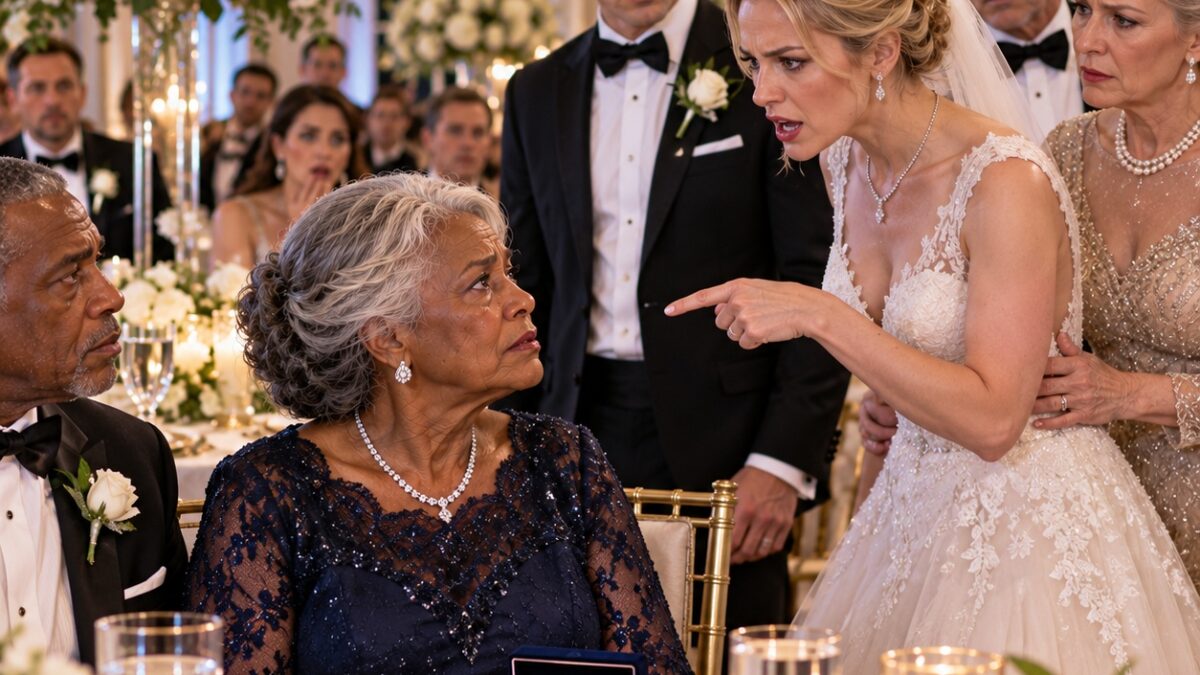
Her mother, Catherine Brooks, came up beside her.
Pearls.
Perfect blond hair.
A gown that probably cost more than some people’s cars.
She looked at me once.
Slowly.
Then took Vanessa by the arm.
“Did you know?”
Vanessa shook her head.
“No.”
Catherine’s face changed.
Not shock.
Calculation.
She turned toward her husband.
“Richard.”
That single word was enough.
Richard Brooks crossed the ballroom.
His expression was smooth.
Professional.
Controlled.
The sort of man who had spent forty years making sure the people around him understood when he expected obedience.
He asked Elliot to speak privately near the bar.
They moved away.
Not far enough.
I could not hear everything at first.
But Harold could.
He leaned slightly toward me.
His hand tightened around mine.
“What?”
I whispered.
His jaw moved.
“Nothing good.”
I looked across the ballroom.
Crystal chandeliers.
White orchids.
Gold-rimmed plates.
Twelve musicians playing near the wall.
Everything about the room had been designed to communicate wealth, refinement, order.
Nothing unexpected was supposed to happen there.
Apparently I was unexpected.
That alone would have been almost funny.
Because if the Brooks family had known who I was before that afternoon, they would have spent months trying to impress me.
My name is Monica Turner.
I founded Turner Capital Holdings twenty-two years earlier.
By the time of Elliot’s wedding, our investment portfolio was valued at approximately $2.3 billion.
We employed nearly four thousand people across four countries.
Large corporations waited for meetings with us.
Public institutions invested through funds we controlled.
Richard Brooks’s own investment company had hundreds of millions of dollars connected to our platforms.
He knew Turner Capital.
He simply did not know me.
I had always preferred it that way.
At home, I did not live like the woman business magazines occasionally described.
I drove a ten-year-old sedan because it worked.
I cooked Sunday dinner in the same kitchen Harold and I had used for years.
I wore clothes because I liked them.
Not because a designer had convinced someone they were expensive.
When neighbors asked what I did, I usually said:
“I help people with their money.”
It was true.
Just incomplete.
Harold had never cared about any of that.
He was a white man from Vermont who had grown up in a town where almost everyone looked like him.
We met at an engineering and finance conference when I was still building my first investment fund.
He was an engineering director.
Quiet.
Steady.
The kind of man who noticed loose hinges before anyone else heard the door squeak.
People stared sometimes when we were younger.
Black woman.
White man.
Harold rarely even noticed.
Once, early in our marriage, a waiter assumed we were not together and tried to seat us separately.
Harold looked at him.
Then looked at me.
Then said:
“If you have another wife for me somewhere, Monica would probably like advance notice.”
That was Harold.
Dry.
Calm.
Impossible to embarrass.
We built a life.
Then Elliot.
Our only child.
He looked almost entirely like Harold.
Light skin.
Blue eyes.
Sandy-brown hair.
As a baby, people often assumed I was his nanny.
The first few times, I corrected them.
Eventually I stopped wasting energy.
Elliot grew up knowing exactly who he was.
He never seemed ashamed of me.
He called every Sunday through college.
Sent flowers.
Came home when he could.
But he did something I did not fully understand until his wedding.
He allowed strangers to make assumptions.
And if those assumptions made his life easier, he often left them undisturbed.
That was how Vanessa Brooks entered our family without ever seeing a photograph of me.
Elliot met her in New York.
She came from old Connecticut money.
At least, that was how her family described themselves.
Her father ran Brooks & Associates, a midsize investment firm.
Her mother chaired charity boards and hosted galas where the invitation list mattered as much as the charity.
Elliot mentioned Vanessa a few times.
Smart.
Beautiful.
Funny.
Driven.
Then one Tuesday evening, while I was reviewing quarterly reports at home, he called.
“Mom.”
Something in his voice made me put down my pen.
“What happened?”
“Nothing bad.”
That was never reassuring.
Then:
“Vanessa’s pregnant.”
I sat very still.
Harold looked up from the living room.
I put the call on speaker.
“How far along?”
“Three months.”
“And?”
“We’re getting married.”
Harold stood.
“When?”
“Next month.”
I looked at the phone.
“You haven’t even brought her home.”
“I know.”
“I’ve never met her.”
“I know.”
“Your father hasn’t met her.”
“I know.”
He sounded nervous.
Excited.
Overwhelmed.
“We just want to do it quickly.”
Harold asked the questions I expected.
“Is she good to you?”
“Yes.”
“You sure about marriage?”
“Yes.”
“You thought this through?”
“Yes.”
Then Elliot said something I should have paid more attention to.
“We want you both there, obviously.”
Pause.
“But I know you’re busy.”
“If you can’t make it, I understand.”
I looked at Harold.
He looked at me.
“We’ll be there.”
I said.
“Of course we will.”
We wired Elliot eighty thousand dollars for the wedding.
Not because he asked for that exact amount.
Because Harold and I wanted to help.
No conditions.
No ownership.
It was our son’s wedding.
We assumed there would be time to meet Vanessa’s family when we arrived.
Time for warmth.
Introductions.
The beginning of something.
I packed my navy dress.
Simple cut.
Elegant.
No label anyone at the wedding would recognize.
I packed the bracelet.
That mattered more.
On the flight to Connecticut, Harold asked:
“You nervous?”
“No.”
He looked at me.
“You always lie badly.”
I smiled.
“Yes.”
“About what?”
“I want her to like me.”
He squeezed my hand.
“She’ll love you.”
There are some sentences that hurt only in retrospect.
The hotel was exactly what I expected from the Brooks family.
Five stars.
Polished wood.
Fresh lilies.
Staff moving silently.
Every surface shining.
When Harold and I entered the ballroom, I saw Elliot almost immediately.
Near the head table.
Black tuxedo.
Adjusting his tie.
Laughing.
He looked happy.
My chest tightened.
For all his adulthood, all his independence, I still saw the boy who used to run barefoot through our backyard.
“Elliot.”
I called.
He turned.
His face lit.
That smile was real.
He crossed the room fast.
“Mom.”
He wrapped his arms around me.
Then Harold.
“You made it.”
“Of course we did.”
Harold said.
“Where is she?”
I asked.
“I’ve been waiting to meet this woman.”
Something flickered in Elliot’s expression.
So small.
Barely visible.
At the time, I interpreted it as wedding nerves.
“She’s getting ready.”
He said.
“She’ll be out soon.”
Then he guided us to the front.
Family table.
My place was beside his.
Harold pulled out my chair.
I put the velvet box near my plate.
The ceremony had not begun.
People were still gathering.
Everything felt normal.
Until the bridal-suite door opened.
Vanessa emerged with Catherine beside her.
Beautiful dress.
Cathedral veil.
Blond hair pinned perfectly.
Richard followed.
Vanessa saw Elliot.
Smiled.
Then her eyes moved to me.
Stopped.
Everything that happened afterward came from that moment.
“She’s Black.”
The words were flat.
Almost offended.
Elliot stood.
“This is my mother.”
“You never told me.”
“I never thought I needed to.”
Her face flushed.
“You let me believe—”
“What?”
“That your family was…”
She stopped.
“Was what?”
“Normal.”
Elliot stared.
I felt Harold beside me become completely still.
Catherine took Vanessa’s arm.
She whispered:
“This is unacceptable.”
Then sent Richard toward Elliot.
That was when the wedding stopped being a family celebration and became a negotiation.
Richard cornered my son near the bar.
At first, their voices were low.
Then Harold repeated pieces to me later.
“My daughter will not walk down that aisle with that woman sitting in the front row.”
That woman.
Elliot said:
“That woman is my mother.”
Richard replied:
“I don’t care.”
He talked about photographs.
Guests.
Catherine’s planning.
How I “didn’t fit.”
Elliot pushed back.
For a few minutes.
Then Richard used leverage.
The New York apartment.
The car.
The job connection he had helped Elliot secure.
Money.
Status.
Access.
“If you make a scene.”
Richard told him.
“I pull everything.”
I watched my son return to the table.
His face had changed.
Older.
Tired.
He did not look at me.
That hurt more than Richard ever could have.
Vanessa pulled him toward the gift table.
Close enough that I heard nearly every word.
“You lied to me.”
“I didn’t lie.”
“You never told me your mother was Black.”
“Why would I?”
“Because it matters.”
“To who?”
“To my family.”
“To me.”
“Look at her.”
I remember those words.
Look at her.
I looked down at my own hands.
Dark skin.
Wedding ring.
Short nails.
Hands that had signed billion-dollar acquisitions.
Hands that had packed Elliot’s lunches.
Hands that had held Harold’s when his father died.
Apparently those hands had become evidence in a case I had never agreed to stand trial for.
Catherine returned.
She did not address me.
She addressed the wedding planner.
“There has been a seating change.”
The planner blinked.
“Mrs. Brooks?”
“Mrs. Turner will be moved to table fourteen.”
The planner looked alarmed.
“Table fourteen is by the service corridor.”
“I’m aware.”
“But she’s the groom’s mother.”
Catherine looked at her.
“I said table fourteen.”
Harold stood.
“No.”
His voice was low.
Final.
I put my hand on his arm.
“It’s fine.”
He looked at me.
“It is not fine.”
“It’s Elliot’s wedding.”
“So?”
“I will not be the reason it collapses.”
He stared at me.
Then the velvet box.
Then Catherine.
“Monica.”
“Please.”
Harold knew that tone.
He hated it.
But he sat.
I moved.
Table fourteen was hidden partly behind a partition near the kitchen.
The chairs did not match the rest.
The floral arrangement was smaller.
Every time the service door opened, I smelled dish soap and leftover food.
A waiter nearly hit me with a tray.
Never apologized.
Harold sat beside me.
His hands shook.
Not from fear.
Rage.
Across the ballroom, Catherine took my old place.
Richard poured wine.
Vanessa smiled for photographs.
Elliot came over.
He crouched beside me.
“Mom.”
His eyes were red.
“I’m sorry.”
“I know.”
“I didn’t know she would—”
“It’s your wedding day.”
I said.
“Go back.”
“It’s not okay.”
“No.”
“It isn’t.”
“Then come home tomorrow and we’ll talk.”
He stayed there.
Torn.
I touched his cheek.
“Go.”
He did.
I watched him sit beside Vanessa.
She kissed his face.
Never looked toward me.
A bridesmaid carrying champagne passed our table.
She slowed.
Looked at my dress.
Then smiled politely.
“Excuse me.”
“Yes?”
“If you’re with catering, I think the kitchen entrance is right behind you.”
For three seconds, I could not speak.
Then:
“I’m the groom’s mother.”
Her face turned red.
“Oh.”
She walked away quickly.
Harold closed his eyes.
“I am trying very hard.”
He said.
“Not to ruin our son’s wedding.”
“I know.”
At the next table, two women spoke about me as though I were not six feet away.
“Can you believe it?”
“Poor Catherine.”
“Imagine finding out like this.”
Finding out.
Like disease.
One woman lifted her phone.
Flash.
Then another.
Then another.
Soon several people were recording.
To them, I was no longer even an inconvenient relative.
I was spectacle.
Harold leaned toward me.
“Say the word.”
“What?”
“We leave.”
I looked at the head table.
Elliot.
My son.
He looked miserable.
But he remained seated.
“Not yet.”
I whispered.
I did not know what I was waiting for.
Maybe I was giving him one more chance.
Maybe myself.
Maybe I needed to see exactly how far these people would go.
The ceremony began.
Vanessa walked down the aisle on Richard’s arm.
Guests stood.
Cameras flashed.
Catherine cried into a monogrammed handkerchief.
Elliot waited under the chandelier.
When Vanessa reached him, he looked toward me.
Table fourteen.
I gave him a small nod.
His voice cracked during his vows.
Twice.
Vanessa’s did not.
When they kissed, the room erupted.
I clapped.
Harold did not.
The reception started immediately.
Waiters.
Music.
Wine.
Laughter.
Everything polished.
Everything smooth.
As though cruelty could disappear if the lighting was expensive enough.
That was when I picked up the velvet box.
Harold reached for me.
“What are you doing?”
“I need to try.”
“No.”
“She’s becoming our daughter-in-law.”
“Monica.”
“I need to know I tried.”
He released my arm.
I walked across the ballroom.
People watched.
Whispers followed.
I stopped beside Vanessa.
“Vanessa.”
She looked up.
I held out the box.
“I know we haven’t had the chance to talk properly.”
No response.
“But I wanted to give you something.”
Catherine leaned closer.
“It belonged to my grandmother.”
I opened the box.
“Every Turner bride has worn it.”
Vanessa did not reach for it.
She looked at the bracelet as though I had offered her something contaminated.
Then Catherine took the box from me.
Without asking.
She lifted the bracelet.
Turned it beneath the chandelier.
“What is this?”
Her voice carried.
Someone at the next table looked over.
“Is this from a pawn shop?”
Laughter.
Not everyone.
Enough.
“It is a family heirloom.”
I said.
“My grandmother wore it.”
“My mother wore it.”
“I wore it.”
I looked at Vanessa.
“I hoped you might—”
Catherine cut me off.
“You hoped my daughter would wear this?”
More laughter.
She placed the bracelet on the table.
Not gently.
Like trash.
“Leave it.”
She said.
“Someone can throw it out later.”
Something inside me became very quiet.
I reached for the bracelet.
Catherine slid it away.
I looked at her.
She stopped.
I picked it up.
Put it back in the velvet box.
Closed the lid.
Walked back to table fourteen.
Harold’s face had gone white.
“We are leaving.”
He said.
“No.”
“Monica.”
“No.”
“Why?”
I looked toward the head table.
“Because I need to know what comes next.”
The toast came thirty minutes later.
Best man.
Bridesmaid.
Stories.
Applause.
Then Catherine stood.
Champagne glass raised.
“I want to thank everyone for being here.”
She spoke about love.
Family.
Legacy.
Standards.
Excellence.
Preserving what mattered.
Then she looked toward Elliot.
“When Vanessa told us about him, we were thrilled.”
“Educated.”
“Well-spoken.”
“Good background.”
The phrases accumulated.
Then:
“And I know their children will be beautiful.”
She smiled.
“They’ll have the right genes.”
A few people laughed.
Others froze.
No one stood.
No one objected.
The words sat in my chest.
The right genes.
My grandmother would not have had them.
My mother would not.
I would not.
Yet everything the Brooks family respected financially was built partly on money managed by a Black woman they had sent behind the kitchen.
Vanessa took the microphone.
She thanked everyone.
Her father.
Her mother.
Her bridesmaids.
The wedding planner.
The florist.
The chef.
The hotel manager.
Seven friends by name.
Not me.
Not Harold.
Not even a nod toward table fourteen.
Then she raised her glass.
“To love.”
“To legacy.”
“To the future.”
Three hundred glasses lifted.
Mine stayed on the table.
Elliot looked toward me.
His lips moved.
I could not tell whether he said:
I’m sorry.
I love you.
Or nothing.
Two minutes later, the wedding planner approached.
No clipboard now.
Just a white envelope.
“Mrs. Turner.”
She looked miserable.
“I was asked to give you this.”
I opened it.
Ten crisp one-hundred-dollar bills.
A folded note.
Thank you for coming.
Please use this for your travel expenses.
It would be best if you left before the dancing begins.
V.
I read it twice.
Thick stationery.
Elegant handwriting.
Perfectly centered.
My dismissal had been formatted beautifully.
I handed it to Harold.
He read.
Stood so fast his chair scraped across the marble.
The music seemed to pause around the sound.
“Harold.”
“No.”
His neck flushed red.
“I am done.”
“Sit.”
“Monica.”
I took his hand.
“Please.”
He sat.
Still staring at Vanessa.
She was feeding Elliot cake for photographs.
Laughing.
I placed the envelope on the table.
One thousand dollars.
To make me disappear.
That was the moment.
Not the insult.
Not table fourteen.
Not the bracelet.
The envelope.
Because the money made their worldview complete.
They believed dignity was transactional.
They believed people could be priced.
I reached into my purse.
Took out my phone.
Typed three words.
Bring the team.
Sent.
Harold looked at me.
“What did you do?”
I put the phone away.
“Nothing yet.”
Across town, three drivers received instructions.
Our legal counsel had traveled with part of our executive team because Harold, suspicious after the first seating incident, had called them earlier in the afternoon.
I had told him he was overreacting.
He had told me:
“I hope so.”
Apparently, he had been right.
Ten minutes later, the first engine sounded outside.
Low.
Heavy.
Conversation near the windows slowed.
Someone looked.
“Are those Rolls-Royces?”
Three black Rolls-Royce Phantoms pulled into the hotel entrance.
I would like to tell you I arranged them for dramatic effect.
I did not.
Those were the cars our executive security and legal team had used for travel that weekend.
At Turner Capital, clients sometimes cared about appearance even when I did not.
That evening, appearance became useful.
Six people entered.
Three men in black suits.
Two women in gray blazers.
Gerald Hayes, Turner Capital’s chief legal counsel, carried his leather briefcase.
The ballroom doors opened.
Every head turned.
Gerald walked directly to table fourteen.
Stopped in front of me.
“Mrs. Turner.”
His voice carried.
“We received your message.”
Then:
“Everything is prepared.”
The ballroom went silent.
Not wedding silence.
Not polite silence.
The kind where everyone knows the room has changed but nobody understands how yet.
Vanessa’s hand froze on Elliot’s arm.
Catherine slowly lowered her glass.
Richard turned.
I stood.
Smoothed my navy dress.
“Thank you, Gerald.”
Then:
“Please introduce yourself.”
Gerald faced the room.
“My name is Gerald Hayes.”
“I serve as chief legal counsel for Turner Capital Holdings.”
Murmurs.
Phones appeared.
Richard’s posture changed almost immediately.
“Turner Capital Holdings is a privately held investment firm headquartered in Atlanta.”
Gerald continued.
“We manage assets across four countries.”
“Our current portfolio valuation is approximately $2.3 billion.”
Now the whispers grew louder.
Someone searched the company.
I saw the glow of screens.
Then Gerald said:
“The founder and chairwoman of Turner Capital Holdings is Mrs. Monica Turner.”
Silence.
Absolute.
The room did not gasp.
That would have been easier.
People simply stopped moving.
Catherine’s face drained.
Richard’s eyes shifted from Gerald to me.
Then the briefcase.
Then Diana Cole, our CFO.
Then back to me.
Recognition arrived.
Not of my face.
My company.
He knew Turner Capital because Brooks & Associates relied heavily on funds we controlled.
Quarterly statements.
Performance reports.
Requests for meetings.
Three months earlier, Richard had asked to meet Turner Capital’s chairwoman.
The request was declined because I was traveling and handling family matters.
The family matter had been Elliot’s wedding.
Richard stood.
“Monica.”
His voice had become smaller.
“I didn’t realize.”
I looked at him.
“No.”
“You didn’t.”
Diana stepped forward.
Gerald introduced her.
Then Ree Whitfield, our director of client relations.
Ree looked at Richard the way she looked at any client whose numbers failed to match the story.
Vanessa turned toward Elliot.
“You knew?”
Elliot looked at her.
“I told you she was my mother.”
“You knew she owned Turner Capital?”
“Yes.”
“And you never said?”
“You never asked what she did.”
That sentence hurt me too.
Because Elliot was right.
But he had also allowed assumptions to build until they trapped everyone.
I walked toward the center of the ballroom.
No microphone.
Didn’t need one.
“I came here today as a mother.”
I said.
“Not as a chairwoman.”
“Not as an investor.”
“Not as anyone you needed to impress.”
“I came to meet the woman my son loved.”
I held up the velvet box.
“I came to give her my grandmother’s bracelet.”
Nobody moved.
“Instead, I was moved from the family table to a seat beside the kitchen.”
“A bridesmaid mistook me for catering.”
“My family heirloom was called something from a pawn shop.”
I lifted the white envelope.
“And I was offered one thousand dollars to disappear before the dancing started.”
Whispers.
Vanessa looked down.
I set the envelope on the nearest table.
“I do not need your money.”
Then I looked directly at Richard.
“I never did.”
Richard approached.
Fast.
“Monica.”
He reached for my hand.
I pulled back.
“There has been a terrible misunderstanding.”
“No.”
I said.
“There has not.”
“We didn’t know.”
“If you had known who I was, you would have treated me differently.”
He opened his mouth.
“That is the problem.”
Nothing came out.
Catherine hurried over.
Her composure was gone.
“Mrs. Turner.”
“The bracelet…”
She swallowed.
“I didn’t mean…”
“You called my grandmother’s bracelet a pawn-shop trinket.”
“I was joking.”
“No.”
“You were comfortable.”
Her mouth trembled.
There was a difference.
Gerald opened his briefcase.
That was when the business side began.
“Proceed.”
I said.
He removed a folder.
“Effective immediately, Turner Capital Holdings is initiating withdrawal from all managed assets and investment relationships associated with Brooks & Associates.”
Richard stared.
Gerald continued.
“Primary equity fund.”
“Real-estate trust.”
“Offshore development portfolio.”
Diana looked at her tablet.
“Current exposure: approximately three hundred forty-two million dollars.”
Richard gripped the back of a chair.
“You cannot do this.”
Gerald looked at him.
“It has already been initiated.”
“When?”
Richard asked.
“Today.”
His eyes moved to me.
“You planned this?”
“No.”
I said.
“My husband called Gerald when your wife moved me to table fourteen.”
I looked toward Harold.
“I hoped we would not need the paperwork.”
Then back at Richard.
“Your family decided otherwise.”
Richard sank into a chair.
Catherine put both hands on his shoulders.
Around us, guests were recording openly now.
The very people who had photographed me as spectacle had found a new spectacle.
Money.
Power.
Consequences.
I hated that part.
Because I knew many of them were not suddenly ashamed of racism.
They were ashamed they had aimed it at the wrong Black woman.
That distinction stayed with me.
Then Gerald opened a second folder.
I frowned.
I had not expected that.
“Mrs. Turner.”
“There is one additional matter.”
“Gerald?”
He looked toward Elliot.
His expression softened.
“Mr. Turner.”
Elliot stood.
“What?”
“As part of standard due diligence conducted after your engagement, our security and legal teams reviewed certain publicly and legally accessible records.”
I felt unease.
“Gerald.”
I said.
He looked at me.
“You asked us to protect the family.”
Harold’s hand found mine.
Gerald continued.
“The reported pregnancy timeline presents significant inconsistencies.”
The ballroom went silent again.
Elliot looked at Vanessa.
“What is he talking about?”
Vanessa’s face went white.
Gerald explained that information obtained through legally authorized prenatal and investigative records raised substantial questions about paternity.
Then he produced evidence of communications between Vanessa and a man named Kyle Henderson.
Messages spanning months.
An ongoing affair.
And one line that turned Elliot’s face into something I will never forget.
He doesn’t know.
He’s too nice to question it.
This is our way out.
Elliot looked at Vanessa.
No anger at first.
Only disbelief.
“What is this?”
“Elliot.”
She stood.
“I can explain.”
“Explain what?”
His voice barely carried.
“You used me?”
“No.”
“I love you.”
“You lied.”
“About the baby?”
She started crying.
“Please.”
Elliot slowly removed his wedding ring.
The ceremony had ended less than an hour earlier.
He held the ring.
Then placed it beside the white envelope.
“The wedding is over.”
Vanessa collapsed into her chair.
Catherine rushed toward her.
Richard remained seated.
Head in his hands.
I stood there holding the velvet box.
I did not smile.
Did not enjoy it.
Truth can be necessary and still devastating.
I looked at Elliot.
My son had failed me that day.
He had allowed fear and financial pressure to keep him silent when he should have stood.
But he had also been deceived.
Used.
Humiliated.
I saw both truths at once.
That is motherhood.
More than one emotion in the same breath.
The first video appeared online before our car left the hotel.
Someone had recorded Catherine’s speech.
Her comment about “the right genes.”
My table.
The envelope.
Gerald.
The reveal.
The financial withdrawal.
By midnight, millions had seen parts of it.
The caption:
Bride humiliates groom’s Black mother at wedding—then learns who she is.
I hated that headline.
Because again, it implied my worth arrived with the billionaire part.
People online wrote:
She insulted a billionaire.
As though insulting a poor Black woman would have been less vile.
The problem was never that Vanessa mistreated someone powerful.
The problem was that she believed power determined who deserved dignity.
That was why I refused almost every media request.
Turner Capital issued one statement.
Mrs. Turner is spending time with her family and has no comment on private matters.
That was all.
The internet did not need me.
It had plenty.
The video showed enough.
Brooks & Associates began losing clients.
Not because I asked anyone else to leave.
I did not.
Because other investors watched what happened and made their own decisions.
Public pension funds.
Institutional clients.
Private investors.
Some cited discrimination.
Some cited reputational risk.
Some probably just wanted distance from scandal.
Within a week, Brooks & Associates had lost hundreds of millions more beyond Turner Capital’s withdrawal.
Richard’s board called an emergency meeting.
Forty minutes.
He resigned.
Catherine lost her charity-board positions.
Organizations that once advertised her name suddenly decided her values no longer matched theirs.
Friends disappeared.
Invitations stopped.
I heard these things through news reports and legal summaries.
I took no pleasure in them.
Consequences can be appropriate without being enjoyable.
Vanessa suffered the loudest public collapse.
The affair messages leaked.
Not from us.
From reporters and guests chasing the story.
Her social accounts disappeared.
Screenshots did not.
Kyle Henderson denied involvement.
Few believed him.
His employer placed him under review.
Again, none of that was under my control.
I did not need it to be.
I was finished controlling anything except my own family.
Three days later, Elliot appeared at our front door in Atlanta.
Suitcase.
Red eyes.
No ring.
I opened the door.
For a moment, neither of us spoke.
Then:
“Mom.”
His voice broke.
“I’m sorry.”
I could have said:
You should be.
Could have said:
Why didn’t you stand up?
Could have made him feel every second I spent at table fourteen.
Instead, I pulled him into my arms.
He folded around me like the boy he had once been.
“I should have said something.”
He whispered.
“Yes.”
“I should have stopped them.”
“Yes.”
“I let Richard scare me.”
“Yes.”
“I let Vanessa—”
I pulled back.
“Elliot.”
He looked at me.
“You are standing up now.”
His eyes filled.
“That matters.”
Harold came from the hallway.
He placed one hand on Elliot’s shoulder.
Squeezed once.
That was all.
Men like Harold sometimes say the most with their hands.
That evening, Harold cooked.
He had not cooked a full dinner in years.
Roast chicken.
Green beans.
Cornbread from my mother’s recipe.
The three of us sat at the kitchen table.
The same table where Elliot had done homework.
Where Harold once helped him build a model bridge.
Where I had signed early Turner Capital documents while Elliot ate cereal beside me.
No photographers.
No white orchids.
No gold-rimmed plates.
Just home.
After dinner, I brought out the velvet box.
Placed it beside Elliot.
He looked at it.
“This belongs in our family.”
I said.
“It always has.”
He opened it.
The bracelet caught the kitchen light.
He touched the clasp.
“The right woman will wear it.”
He said.
Someday.
I smiled.
“Yes.”
“The right woman will.”
For months, Elliot stayed close.
He did not return to New York immediately.
He worked remotely.
Went to therapy.
That was his decision.
Not mine.
He talked about how easy it had been to live inside assumptions.
Vanessa assumed he came from a certain kind of white family.
Richard assumed he could control Elliot financially.
Elliot assumed silence was harmless.
I asked him once:
“Why didn’t you tell her?”
“That you were Black?”
“Yes.”
He looked uncomfortable.
“I never thought I needed to.”
“Was that the only reason?”
He stayed quiet.
Good.
Truth usually enters through silence first.
Finally:
“I think I knew her family cared about appearances.”
“And?”
“I didn’t want it to become a thing.”
“So you made me invisible before I even arrived.”
He closed his eyes.
“Yes.”
That hurt.
But I needed the truth.
“I wasn’t ashamed of you.”
“I know.”
“I swear.”
“I know.”
“But I was avoiding conflict.”
“Yes.”
He looked at me.
“I’m sorry.”
“That is the part you need to learn.”
“What?”
“Conflict avoided does not disappear.”
“It waits.”
Sometimes it grows.
A year passed.
Our lives quieted.
Turner Capital remained Turner Capital.
The Brooks scandal became old news.
The internet found new outrage.
Good.
I wanted obscurity back.
Then Elliot met Sophie Reed.
Coffee shop.
Atlanta.
He spilled a drink on her lesson plans.
She laughed.
He offered to replace them.
She said:
“You’re definitely replacing these.”
He did.
Then bought her coffee.
Then dinner.
Sophie taught kindergarten.
White.
Blond hair.
Green eyes.
No old money.
No investment family.
No curated image.
When Elliot told me about her, I asked only:
“Is she kind?”
He smiled.
“Yes.”
“Does she know about me?”
He groaned.
“Mom.”
“I’m asking.”
“Yes.”
“How?”
“I showed her pictures.”
“Very modern.”
He laughed.
He brought Sophie home on their third date.
I made pot roast.
Not because she needed impressing.
Because I wanted pot roast.
Sophie ate two servings.
Asked for the recipe.
Then sat beside me on the couch looking through old photographs.
She laughed at Elliot’s bowl haircut.
Asked about Harold.
Asked about my mother.
Asked about the bracelet in one wedding photograph.
Not because she knew what it cost.
Because she wanted to know the story.
When they left, Elliot later told me he asked her:
“What do you think of my mom?”
Sophie apparently looked confused.
“She’s wonderful.”
Then:
“Why wouldn’t she be?”
That was the beginning.
Six months later, they were engaged.
This time, no hotel ballroom.
No guest list designed around last names.
No three hundred people.
Thirty-two.
Family.
Friends.
Our backyard.
Harold built the wooden arch himself.
Of course he did.
He spent three weekends sanding and staining it.
Then another morning complaining Elliot had positioned it wrong.
I hung lights.
Elliot mowed the lawn twice because I told him the lines were crooked.
Sophie arrived in a simple white dress.
Wildflowers.
No cathedral veil.
No performance.
I sat in the front row.
The front row.
Harold beside me.
Already crying before she reached the arch.
“You’re embarrassing yourself.”
I whispered.
“I don’t care.”
He whispered back.
The ceremony was short.
Elliot read vows from a folded sheet.
His voice cracked.
Twice.
Sophie spoke from memory.
When the officiant asked if anyone objected, all thirty-two guests laughed.
Elliot laughed hardest.
Afterward, Sophie came directly to me.
She sat.
Took my hand.
For a moment, she said nothing.
Then reached into the pocket of her dress.
Velvet box.
My breath stopped.
“Elliot told me.”
She said.
“About your grandmother.”
“Your mother.”
“You.”
She opened it.
The bracelet glowed in the afternoon sun.
Sophie held it toward me.
“Will you put it on me?”
My hands trembled.
This time not from humiliation.
Not from anger.
Joy.
Simple.
Uncomplicated.
I lifted the bracelet.
Closed it around her wrist.
The gold looked warm against her skin.
She turned it slightly.
“It’s beautiful.”
I smiled.
“It is now.”
Harold took a photograph.
Me.
Sophie.
The bracelet between us.
He later framed it.
Placed it in the hallway with our family pictures.
That evening, we ate outside.
Roast chicken.
Peach cobbler.
String lights.
Crickets.
Sophie danced barefoot with Elliot on the grass.
No Rolls-Royces.
No legal team.
No envelope.
No guests filming a spectacle.
Just family.
I watched them.
Then touched the empty velvet box in my purse.
One year earlier, another bride had looked at the same bracelet and seen something cheap.
Something embarrassing.
Something to throw away.
Sophie saw history.
Same bracelet.
Different heart.
That was the lesson I carried.
Not that wealth deserves respect.
It doesn’t.
Not that Vanessa made a mistake because she insulted a billionaire.
She made a mistake because she believed any human being could become less worthy because of race, class, appearance, or what she assumed their bank account contained.
The money only exposed the ugliness faster.
Sometimes people ask whether I regret what happened to Brooks & Associates.
No.
But I do not celebrate it either.
Richard built a company on judgment.
He judged badly.
Clients responded.
That is business.
Catherine built social influence around reputation.
Her behavior changed her reputation.
That is consequence.
Vanessa built a marriage on deception.
The marriage collapsed under truth.
That is not revenge.
It is structure meeting reality.
The person I worried about was Elliot.
Because he had spent too long confusing silence with kindness.
Richard threatened him.
Vanessa pressured him.
He folded.
That did not make him innocent.
But it did not make him irredeemable either.
He had work to do.
He did it.
That is why I forgave him.
Not because he was my son.
Because he changed.
There is a difference.
The morning after Sophie and Elliot’s wedding, I sat alone in my kitchen.
Coffee.
Bare feet.
House quiet.
The bracelet was gone from its box.
For the first time in decades.
I opened the lid anyway.
Empty velvet.
I smiled.
Harold walked in.
“What?”
“Nothing.”
He poured coffee.
“You’re smiling at an empty box.”
“It isn’t empty.”
He looked inside.
“It is absolutely empty.”
I laughed.
“Go away.”
He kissed my forehead.
That is what peace felt like.
Not the room cheering when Gerald announced who I was.
Not Richard’s face when he realized how much money he could lose.
Not Catherine apologizing.
Not Vanessa crying.
Those moments were consequences.
Peace came later.
In a quiet kitchen.
An empty box.
Knowing the thing I loved had gone where it was valued.
For years, Turner Capital had taught me to look at value differently from price.
Price is what someone offers.
Value is what something carries.
A company can have a billion-dollar valuation and no integrity.
A bracelet can cost very little and carry three generations.
A woman can arrive in a ten-year-old sedan and control more capital than a room full of people wearing designer clothes.
A mother can sit at table fourteen and still be the most important person in her son’s life.
People confuse price with value because price is visible.
Value requires attention.
Vanessa looked at me and made a calculation.
Black woman.
Simple dress.
No obvious status.
Unwanted.
Disposable.
Then Gerald announced Turner Capital.
Suddenly her calculation changed.
But I had not.
Same dress.
Same skin.
Same bracelet.
Same woman.
That was why Richard’s sentence bothered me most.
“If we had known who you were…”
He meant:
If we had known your financial rank.
If we had known your influence.
If we had known your company controlled ours.
If we had known mistreating you would cost us.
That is not respect.
That is fear.
I had no interest in being accepted under those terms.
I would rather sit near the kitchen with Harold than at the head table among people who required a portfolio statement before remembering my humanity.
That became something Elliot understood too.
He stopped trying to impress people who needed credentials before kindness.
His career changed.
Not overnight.
But he left the job Richard had helped him secure.
Found another firm.
Smaller at first.
Earned his place.
That mattered to him.
“I need to know I can do it without somebody’s father arranging it.”
He told me.
“Good.”
“Was that judgment?”
“Yes.”
He laughed.
That was our relationship after everything.
More honest.
Less polished.
Better.
Sophie never asked what she would inherit.
Never asked whether Elliot would eventually join Turner Capital.
Never asked what my houses were worth.
She asked how I made cornbread.
Where Harold grew up.
Why I chose finance.
What my grandmother’s name was.
Attention.
Again.
That became my standard.
People reveal themselves by what they ask.
Vanessa asked about image.
Catherine asked about background.
Richard asked what influence could be leveraged.
Sophie asked for stories.
Same family doorway.
Different heart.
Eventually, Turner Capital’s withdrawal from Brooks & Associates completed.
Business reporters analyzed the numbers for months.
Some argued our exit was too aggressive.
Others said any fund had the right to reassess reputational and governance risk.
I did not debate it publicly.
Turner Capital had legal rights.
We exercised them.
That was enough.
I did insist on one thing internally.
No employee was allowed to celebrate the Brooks collapse.
When someone sent me a message that said:
Karma.
I replied:
This is not entertainment.
Because it wasn’t.
Hundreds of employees worked at Brooks & Associates.
Many had nothing to do with Richard’s behavior.
Families depended on salaries.
Retirement plans.
Health insurance.
Consequences rarely fall only on the guilty.
That is why power should be exercised carefully.
I never wanted the story to become:
Black billionaire destroys racist family.
Too simple.
Too satisfying.
Reality is heavier.
A family exposed itself.
A business lost trust.
A marriage collapsed.
My son was hurt.
I was humiliated.
Then all of us lived with what followed.
No one truly wins a day like that.
You simply decide what should continue and what should not.
The media kept trying to make me a symbol.
I refused most of it.
One civil rights organization invited me to speak.
I did.
But not about wealth.
I spoke about dignity without credentials.
I said:
“If someone deserves respect only after you discover they are powerful, you are not respectful. You are strategic.”
That line traveled farther than I expected.
People quoted it.
Fine.
At least they quoted the part that mattered.
I also spoke about Elliot.
Not by name.
About children of interracial families.
About assumptions.
About silence.
About how avoiding difficult conversations can create conditions where prejudice grows unchecked.
Some people criticized me for protecting him.
Others thought I blamed him too much.
Both groups wanted simpler villains.
I stopped caring.
I knew my son.
He failed me at a critical moment.
He also repaired what he could.
Both truths belonged.
There is maturity in refusing to reduce people to one scene.
Vanessa’s scene was horrific.
Catherine’s behavior was vicious.
Richard used financial coercion.
Those things mattered.
But I did not need to spend the rest of my life thinking about them.
That would have given table fourteen permanent ownership over my mind.
I refused.
I returned to work.
Sunday dinners.
Harold’s endless home repairs.
Elliot and Sophie visiting.
Eventually grandchildren.
Yes.
When our first grandchild was born, Sophie asked me to be there.
Not because I was useful.
Not because I was Turner Capital.
Because I was family.
I held that little baby.
Brown curls.
Skin lighter than mine.
Darker than Sophie’s.
Perfect.
I thought of Catherine saying:
The right genes.
I felt anger flicker.
Then released it.
No.
Not here.
This child would not inherit that ballroom.
She would inherit the bracelet story someday.
But not as revenge.
As history.
I wanted her to know:
Your great-great-grandmother wore this.
Then your great-grandmother.
Then me.
Then your mother.
And what mattered was never whether anyone else thought it expensive.
Family value is not assigned by strangers.
That lesson became larger than jewelry.
I kept the original one-thousand-dollar envelope for a while.
Not the cash.
We returned that.
The note.
I placed it in a file.
Months later, I found it.
Read it once.
Thank you for coming.
Please use this for your travel expenses.
It would be best if you left before the dancing begins.
I almost kept it as proof.
Then I realized I did not need proof.
Three hundred people had seen.
Millions had watched video.
More importantly, I remembered.
So I shredded it.
Not ceremonially.
At the office.
Fed it through a cross-cut shredder between quarterly reports.
Gerald walked by.
Stopped.
“Is that…”
“Yes.”
He nodded.
Continued walking.
Some things do not deserve archives.
The bracelet did.
The note did not.
There is wisdom in knowing what to preserve.
Harold preserved the photo of Sophie and me.
He framed it himself.
Of course the frame was perfectly level.
He used a laser measure.
I mocked him.
He said:
“This hallway deserves standards.”
I laughed.
Standards.
That word had once been used by Catherine to justify exclusion.
Harold used it to align a photograph.
Words are like wealth.
Their meaning depends on the person carrying them.
Years after the wedding, Elliot once asked:
“Do you still think about table fourteen?”
“Yes.”
“How?”
“Less.”
“I do.”
I looked at him.
“What do you remember?”
He swallowed.
“You sitting there.”
“Dad shaking.”
“Vanessa laughing.”
Then:
“Me doing nothing.”
“You didn’t do nothing.”
“I didn’t do enough.”
Fair.
“No.”
“You didn’t.”
He nodded.
“What should I have done?”
I answered honestly.
“Stood beside me.”
“That simple?”
“Yes.”
“You didn’t need a speech.”
“You didn’t need to fight three hundred people.”
“Just stand.”
He looked down.
“I wish I had.”
“I know.”
Then I touched his hand.
“You stand now.”
He looked at me.
That was enough.
Children, even adult children, sometimes need to know repentance is not time travel.
You cannot return.
You can only stand differently the next time.
Elliot did.
When Sophie once faced a rude comment from a colleague about marrying into a wealthy family, Elliot corrected it immediately.
No silence.
No calculating.
He later told me:
“I heard Richard in my head.”
Good.
Pain used well becomes instruction.
That is one of the few gifts difficult experiences can offer.
Not because suffering is necessary.
I reject that romantic idea.
But once suffering happens, you can waste it or learn.
We learned.
Harold still drives me crazy.
He remains convinced furniture should last forever.
Our sofa is older than some Turner Capital employees.
I threaten to replace it.
He says:
“It has another decade.”
Sophie takes my side.
Elliot refuses involvement.
Healthy man.
Sunday dinners continue.
Sometimes thirty people.
Sometimes four.
No one has assigned seating.
That became my rule.
People sit where they sit.
Once, Elliot joked:
“What about table fourteen?”
I pointed to the patio.
“You can eat outside.”
He laughed.
Humor came back.
Eventually.
That mattered.
Because if you cannot laugh around the edges of old pain, sometimes the pain remains too central.
We never laughed at the racism.
Never at the bracelet insult.
Never at the threat.
But table fourteen became shorthand for bad judgment.
If someone set up a terrible chair arrangement at a fundraiser, Harold whispered:
“Table fourteen.”
I elbowed him.
Human beings are strange.
We turn sharp things into tools small enough to carry.
That is survival too.
What happened at that wedding taught me something I wish I had known sooner.
People often tell successful Black women:
Let your work speak.
Be excellent.
Be undeniable.
I built Turner Capital partly inside that philosophy.
Work harder.
Be smarter.
Leave no opening.
But excellence does not cure prejudice.
Money does not cure prejudice.
Status does not.
My $2.3 billion did not make me more human than the Black woman Catherine would have dismissed if I worked in the hotel kitchen.
That was the entire point.
Sometimes people tell me:
“They got what they deserved once they learned who you were.”
I correct them.
“They should have treated me properly before they knew.”
That is the lesson.
Not:
Be secretly powerful so bigots regret it.
No.
Most people subjected to racism do not have legal counsel waiting nearby.
They do not control investment portfolios.
They cannot withdraw $342 million.
Their dignity is not less because they lack leverage.
If the story means anything, it should mean that.
Vanessa was wrong before Gerald entered.
Catherine was wrong before Turner Capital mattered.
Richard was wrong before he recognized my name.
The wealth exposed their hypocrisy.
It did not create my worth.
That understanding saved me from becoming as class-conscious as they were.
I could have returned their contempt.
Poor them.
Small firm.
Social climbers.
No.
That would have accepted their system.
Just inverted the rankings.
I did not want their ladder.
I wanted out of the room built around it.
So I went home.
Cooked dinner.
Kept my old car.
Ran my company.
Welcomed Sophie.
Held my grandchild.
That was the life I preferred.
One afternoon, Sophie asked whether she should insure the bracelet.
I laughed.
“Probably.”
“What’s it worth?”
“Not much.”
She looked surprised.
“Really?”
“Financially.”
She touched it.
“And otherwise?”
I smiled.
“You already know.”
That was why she deserved it.
Not because she was white.
Not because she was a teacher.
Not because she was less wealthy.
Because she understood that value does not always arrive with an appraisal.
She wore it on anniversaries.
Family events.
One year she wore it while making Thanksgiving dinner.
I walked in.
Saw flour on her cheek.
Bracelet at her wrist.
“Are you cooking in that?”
She froze.
“Should I take it off?”
“No.”
I smiled.
“My grandmother would have loved that.”
Jewelry should live.
So should people.
That became my philosophy about almost everything after table fourteen.
Do not preserve yourself so carefully that you stop living.
I could have become guarded.
Suspicious.
I did, for a while.
When Elliot introduced Sophie, part of me studied every reaction.
Every glance.
Every question.
Waiting.
I hated that.
Vanessa had trained me to expect rejection.
I did not want to give her that power.
So I made myself remain open.
Carefully.
Sophie rewarded that openness.
Not because she owed me.
Because she was herself.
People deserve to meet the person in front of them, not the ghost of the person who hurt you before.
That is difficult.
Worth trying.
Elliot eventually thanked me for not telling Sophie every humiliating detail immediately.
“Why didn’t you?”
He asked.
“Because she was dating you.”
“So?”
“She needed to know you.”
“Not the worst thing that happened to you.”
He nodded.
“She learned eventually.”
Yes.
From him.
That mattered.
He told the story.
Including his failure.
No editing.
No self-protection.
Sophie came to me afterward.
She cried.
I did not.
I had already spent those tears privately.
She said:
“I’m sorry.”
“You didn’t do it.”
“I know.”
“But I hate that happened to you.”
“I know.”
Then:
“I would never—”
I stopped her.
“You do not have to promise to be the opposite of someone you never met.”
She looked confused.
“Just be yourself.”
That is enough.
And it was.
Years later, Turner Capital expanded.
Numbers changed.
Valuations grew.
Then shrank.
Markets do that.
The $2.3 billion figure became outdated.
Good.
I never wanted the story anchored to a number.
Numbers move.
Dignity should not.
Richard’s firm never fully recovered its former standing.
I heard he eventually sold a significant portion.
Catherine disappeared from public charity leadership.
Vanessa moved.
That was all I knew.
All I wanted to know.
Sometimes closure is simply losing curiosity.
One journalist once asked whether I would meet Vanessa if she requested forgiveness.
I said:
“I don’t know.”
People disliked that answer.
They wanted:
Never.
Or:
Of course.
Life is not obligated to be rhetorically satisfying.
I could forgive someone without allowing them back.
I could hear an apology.
Or decline.
I did not need to decide before the request existed.
Boundaries can be current.
Not theoretical.
What I knew was this:
I no longer hated her.
Hatred is expensive.
I manage assets for a living.
Bad investment.
Indifference became cheaper.
Eventually, the strongest memory of that wedding was not Vanessa’s face.
Not Catherine’s laugh.
Not Richard’s collapse.
It became Harold’s hand under the table.
Shaking.
Holding mine.
He had wanted to leave from the beginning.
He stayed because I asked.
Then he called Gerald because he feared I would keep enduring too much.
That was love too.
Not rescuing me without consent.
Preparing to stand when I finally said enough.
Harold once told me:
“I almost punched Richard.”
“I know.”
“You would have hated that.”
“Yes.”
“I still regret not doing it.”
I laughed.
“You were sixty.”
“I was in excellent shape.”
“Go fix something.”
He did.
Marriage.
Twenty-six years and counting.
There is nothing glamorous about the love that lasts.
It notices.
It waits.
It knows when you are lying about being okay.
It sits beside you at table fourteen even when leaving would be easier.
That was Harold.
That was home.
The Rolls-Royces became the part strangers remembered.
I barely did.
Cars.
Engines.
Theatrics accidental enough to look intentional.
Fine.
What I remembered was Harold following me to that terrible table.
No hesitation.
He did not care whether I was billionaire or broke.
He would have sat beside me beside the kitchen either way.
That is how you know.
Same gift.
Different hearts.
Same woman.
Different eyes.
Same table.
Different loyalties.
When my granddaughter is old enough, I will tell her about the bracelet.
Eventually, maybe table fourteen.
Not to teach revenge.
To teach selection.
Watch how people receive what you give.
Not only objects.
Your trust.
Your history.
Your vulnerability.
Your family.
Some people will examine the gold and ask what it costs.
Some will ask who wore it.
Some will laugh.
Some will hold out their wrist.
Choose accordingly.
That may be the best inheritance I can offer beyond money.
Turner Capital can give her assets.
The bracelet can give her memory.
My story can give her judgment.
If I do this right, she will value the third most.
One Sunday, years after everything, our family sat around the kitchen table.
Harold carving chicken.
Elliot opening wine.
Sophie wearing the bracelet.
Our granddaughter coloring beside me.
She looked up.
“Grandma?”
“Yes?”
“Why does Mommy always wear that bracelet here?”
I glanced at Sophie.
She smiled.
“It belonged to Grandma’s grandma.”
My granddaughter’s eyes widened.
“That’s old.”
“Very.”
“Is it expensive?”
I paused.
There it was.
The question.
Children ask plainly what adults disguise.
I leaned down.
“Not especially.”
“Then why keep it?”
I looked at Elliot.
Harold.
Sophie.
The little girl.
Because one woman carried it through a life no one remembers fully anymore.
Because another wore it into a marriage.
Because I carried it into a ballroom where people tried to make me believe I was less.
Because Sophie asked for it with love.
Because value is not the same as price.
I could have said all of that.
Instead:
“Because it remembers us.”
My granddaughter thought.
Then nodded.
Children understand more than we expect.
“Can I wear it someday?”
I smiled.
“If you know what it means.”
“What does it mean?”
I touched her cheek.
“That you never decide somebody’s worth by what you think they have.”
She frowned.
“That’s easy.”
I looked at the adults around the table.
“No, sweetheart.”
“It should be.”
That is the ending I choose.
Not Richard losing money.
Not Vanessa being exposed.
Not the internet.
Not the Rolls-Royces.
A little girl at my kitchen table learning that another person’s dignity should never depend on discovering a hidden fortune.
That mattered more than every consequence in Connecticut.
Because the best response to prejudice is not proving you outrank the person who despised you.
It is refusing to teach the next generation to rank people that way at all.
The night of Elliot and Sophie’s wedding, after the final guest left and the backyard went quiet, I found the empty velvet box in my purse.
I stood alone beneath the string lights.
The wooden arch Harold built cast a long shadow across the grass.
Inside the house, Elliot and Sophie were laughing.
Harold was probably wrapping leftover chicken with engineering-grade precision.
I opened the box.
Empty.
For one second, I saw table fourteen again.
The service door.
The wilting orchid.
Catherine setting the bracelet down like trash.
Then I looked through the kitchen window.
Sophie lifted her hand while speaking.
Gold flashed at her wrist.
The same bracelet.
Nothing about it had changed.
Only the heart receiving it.
I closed the box.
Put it back in my purse.
And smiled.
Some people will look at what you carry and decide it has no value because they do not understand where it came from.
Do not spend your life convincing them.
Protect it.
Carry it forward.
Wait for the person who recognizes the story before the price.
That is where it belongs.

