PART 2: The Officer Saw My Daughter-in-Law’s ID, Went Pale, and Whispered, “Do Not Go Home.”
 Thank you

My name is Dana Patterson.
Until that afternoon, I believed the worst thing that could happen to a family was losing someone you loved.
My husband had died two years earlier, and grief had taught me how quickly a normal life could become divided into before and after.
I thought I understood loss.
I didn’t.
Because death, terrible as it is, at least gives you one brutal truth to grieve.
What happened to us was different.
It made me question three years of birthdays, Christmas mornings, bedtime stories, family photographs, scraped knees, school pickups, whispered secrets, and goodnight kisses.
It made me wonder whether love could still be real when almost everything surrounding it had been built on a lie.
That afternoon began as one of the most ordinary afternoons of my life.
Sarah was driving me home after we had picked up some costume supplies for Emma’s upcoming school play.
Emma was eight.
At least, I believed she was eight.
She had been cast as a tree in some elaborate elementary-school production that required an unreasonable amount of green felt, cardboard leaves, and glitter.
Sarah and I had spent half the drive laughing about it.
“She is going to complain about the costume the second she sees it,” Sarah said.
“She chose to be a tree.”
“No. She wanted to be the moon. Apparently the moon had more lines.”
I laughed.
“That sounds like Emma.”
Sarah smiled.
And that smile is one of the things I remember most clearly.
Because less than ten minutes later, a patrol car appeared behind us.
The red and blue lights came on.
Sarah immediately stiffened.
At the time, I thought she was nervous because nobody enjoys being pulled over.
Looking back, her reaction was different.
Her fingers tightened around the steering wheel.
Her breathing changed.
Her eyes kept flicking toward the mirrors.
“Were you speeding?” I asked.
“No.”
“Maybe a taillight.”
“Probably.”
But she didn’t sound convinced.
She pulled onto the shoulder.
The officer approached the driver’s side window.
“Good afternoon, ma’am. License, registration, and proof of insurance.”
Sarah handed everything over.
“What did I do?”
“Your right brake light appears to be out.”
She laughed nervously.
“Oh. Okay. I didn’t realize.”
The officer looked at her license.
Then at her.
Then at the license again.
That tiny pause should have meant nothing.
But Sarah noticed it.
So did I.
“Is there a problem?” she asked.
“No, ma’am. Sit tight.”
He returned to his cruiser.
We waited.
A minute passed.
Then two.
Then five.
Sarah stopped talking.
Her knee began bouncing.
“Why is he taking so long?” she murmured.
“Probably paperwork.”
She reached for her phone.
Then stopped.
She looked toward the cruiser again.
Something in her face had changed.
Fear.
Not irritation.
Not impatience.
Fear.
When the officer returned, he was no longer casual.
His shoulders were tense.
His hand rested near his belt.
He asked me to get out.
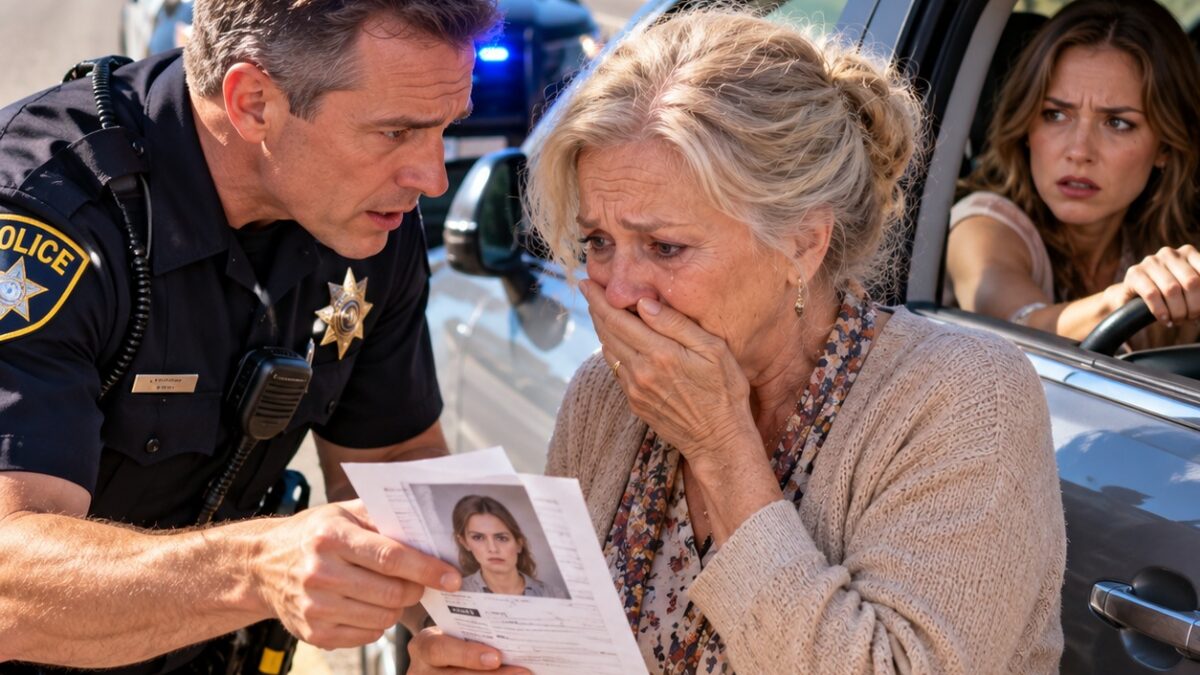
And minutes later, I was holding the paper that divided my life into two pieces.
Before I knew.
And after.
The photograph was unmistakable.
The woman in it was Sarah.
Except the name beneath her picture read:
JENNIFER WALSH.
Underneath that were words I had to read three times before my mind would accept them.
Wanted in connection with kidnapping and child endangerment.
I looked up at the officer.
“This is wrong.”
“I understand this is a shock.”
“No. You don’t understand. That woman is my daughter-in-law.”
He glanced toward the car.
“What’s your name, ma’am?”
“Dana Patterson.”
“And your relationship to the children?”
“My grandchildren.”
My voice broke on the word.
“Emma and Tyler.”
The officer’s expression changed.
Not suspicion.
Pity.
I hated that expression instantly.
“Mrs. Patterson, I think we need to continue this conversation somewhere private.”
“What do you mean?”
He took a careful breath.
“The children may not be who you believe they are.”
The world seemed to tilt.
I grabbed the side of the patrol car.
“What?”
“Please come with me.”
“What about Sarah?”
“Other officers are on the way.”
I stared at him.
“Is she dangerous?”
“I don’t know.”
That answer was worse than yes.
At the station, Officer Martinez sat across from me in a small interview room.
The air conditioning was too cold.
The metal chair beneath me felt harder every second.
The missing-person flyer lay between us.
“Mrs. Patterson,” he said, “the woman you know as Sarah Collins appears to be Jennifer Walsh.”
“Appears?”
“We’re confirming everything now, but the identifiers match. Fingerprints. Physical description. Facial recognition.”
I shook my head.
“No.”
“I know.”
“No, you don’t. Sarah married my son three years ago. I was at their wedding. Emma was the flower girl. Tyler carried the rings in this ridiculous little vest because he refused to wear a suit.”
Officer Martinez said nothing.
I pointed toward the photograph.
“She isn’t some stranger. She shops with me. She has Thanksgiving at my house.”
“I understand.”
“She told us she was from California.”
“Our records indicate Jennifer Walsh is from Oregon.”
“She said her parents were dead.”
“I can’t speak to that yet.”
“She said Emma and Tyler’s father died in a car accident before she met Mark.”
Officer Martinez’s face tightened.
“That’s not true.”
My fingers went numb.
“What do you mean?”
He turned the paper around.
“Emma and Tyler are not their legal names.”
I stopped breathing.
“The little girl’s name is Lily Chen. The boy is Mason Chen.”
“No.”
“Their biological father is Dr. David Chen.”
“No.”
“He lives in Portland.”
I pushed the paper away.
“No.”
“He’s alive.”
I stood so quickly my chair scraped against the floor.
“You’re wrong.”
“Mrs. Patterson—”
“You’re wrong.”
My voice rose.
“You have the wrong woman. You have the wrong children. You have the wrong family.”
Officer Martinez waited.
I hated him for waiting.
I hated the calm in his face.
I hated the paper on the table.
I hated the possibility that any of it could be true.
Then he said something that broke through my denial.
“Dr. Chen has been searching for his children for three years.”
I sat down.
Slowly.
My mouth went dry.
“What?”
“Jennifer Walsh worked as a nanny for the Chen family.”
I looked at the photograph again.
“She was their nanny?”
“Yes.”
The story came in pieces.
Each piece seemed impossible by itself.
Together, they formed something monstrous.
David Chen was a pediatric surgeon in Portland.
His wife, Linda, had died after a battle with cancer.
After her death, David struggled to balance a demanding career with raising two grieving young children.
Jennifer Walsh had been hired through a reputable agency.
By all accounts, she was excellent with Lily and Mason.
At first.
She helped them through grief.
She cooked for them.
Read to them.
Stayed beside them during nightmares.
She became important to them.
Then important became necessary.
Necessary became possessive.
According to investigators, Jennifer slowly began treating the children as though they belonged to her.
She encouraged them to call her Mama Jen.
Eventually, just Mama.
She began making decisions without consulting David.
When he tried to reestablish boundaries, she reacted badly.
When he later began dating again, the situation deteriorated further.
Jennifer apparently told the children that their father was replacing them.
That he didn’t love them enough.
That another woman would take their mother’s place.
Eventually David terminated Jennifer’s employment.
That should have been the end of it.
It wasn’t.
There were reports.
Accusations.
Attempts to portray David as neglectful.
Authorities investigated.
Nothing supported the claims.
But Jennifer’s attachment to the children had already crossed some line nobody could pull her back across.
During a visit with the children, she disappeared with them.
By the time anyone realized what had happened, she had a significant head start.
New documents followed.
New names.
New cities.
New identities.
Lily became Emma.
Mason became Tyler.
Jennifer Walsh became Sarah Collins.
And eventually, Sarah met my son.
Mark.
I stared at Officer Martinez.
“How did she meet him?”
“We’re still reconstructing that.”
“Did she target him?”
“We think she may have chosen someone stable.”
That word hurt more than I expected.
Stable.
My son was good.
Dependable.
Kind.
The kind of man who fixed his neighbors’ fences without charging them and remembered to call me every Sunday after his father died.
Sarah had told him she was a widowed mother.
She had told him the children’s father was dead.
Mark hadn’t merely accepted those children.
He had fallen in love with them.
He worked construction, and he often left the house before sunrise.
Still, he came home exhausted and helped with homework.
He built Tyler a wooden toy box.
He spent two weekends turning Emma’s room into a galaxy because she was obsessed with stars.
He carried photographs of those children in his wallet.
To him, they weren’t someone else’s children.
They were his.
“Does Mark know?” I whispered.
“We have no indication that he does.”
I covered my mouth.
For the first time that afternoon, I started crying.
Not because Sarah had lied to me.
Because I pictured my son.
I pictured Mark walking through the front door every evening believing he was coming home to his family.
I pictured him kissing Sarah.
Asking Emma about school.
Wrestling with Tyler on the living-room carpet.
And I imagined some man hundreds of miles away waking up every morning wondering where his children were.
Whether they were alive.
Whether they were frightened.
Whether they remembered him.
“There’s more,” Officer Martinez said.
I almost laughed.
Not because anything was funny.
Because I couldn’t understand how there could possibly be more.
“What?”
“Lily has a serious congenital heart condition.”
My body went cold.
“What kind?”
“Hypoplastic left heart syndrome.”
I knew almost nothing about it.
But the word heart was enough.
“She needs ongoing specialist care and medication.”
I stared at him.
“Emma doesn’t have a heart condition.”
Officer Martinez didn’t answer.
“She has mild anemia.”
“That may be what Jennifer told you.”
“She gets tired sometimes.”
“I understand.”
“She turns pale.”
“I understand.”
“She doesn’t like running in PE.”
My voice was shaking now.
“How bad is this?”
“Potentially very serious.”
I thought about every time Sarah had taken Emma to a doctor’s appointment alone.
Every time I had offered to go.
Every time she’d refused.
I remembered once telling her Emma looked almost gray after playing outside.
Sarah had smiled and said, “She’s always been sensitive to heat.”
Another memory hit me.
A bottle of children’s iron supplements on the kitchen counter.
Sarah had pointed to it once and said, “See? Nothing serious.”
I felt sick.
“Does her father know?”
“Dr. Chen is a pediatric surgeon. He was overseeing her care before she disappeared.”
Of course he knew.
That was when I understood that this wasn’t only about the past anymore.
It wasn’t only a kidnapping that happened three years ago.
It was happening now.
Every day Emma remained hidden was another day her father couldn’t protect her.
“What do you need me to do?”
Officer Martinez leaned forward.
“We need to contact your son without alerting Jennifer.”
I wiped my face.
“Why?”
“Because if she knows we’ve identified her, she may run.”
“She has nowhere to go.”
He gave me a look.
“She has successfully disappeared before.”
I thought about that.
New names.
Fake documents.
Different states.
Three years.
“What if she takes the children?”
“That’s exactly what we’re trying to prevent.”
I called Mark from the parking lot.
It was one of the hardest phone calls I’ve ever made.
Not because of what I said.
Because of what I couldn’t say.
“Hey, Mom.”
His voice was loud over construction equipment.
“Hi, honey.”
“You okay?”
“Yes.”
I sounded terrible.
He noticed immediately.
“You don’t sound okay.”
“I need you to meet me.”
“What’s wrong?”
“It’s about some paperwork from your father’s estate.”
There was a pause.
“We finished that months ago.”
“I know. Something came up.”
“Can Sarah come?”
My throat tightened.
“No.”
Another pause.
“Mom?”
“Please, Mark.”
He heard something in my voice then.
“Where?”
“Miller’s Coffee House.”
“I’ll be there in twenty minutes.”
When he walked into the coffee shop, his work boots were dusty and his shirt was streaked with drywall powder.
For one terrible second, I saw him at seven years old.
Running into the kitchen after school.
Trusting that if something bad had happened, his mother could explain it.
I couldn’t.
He slid into the booth.
“So what’s going on?”
I reached into my purse.
My hands trembled as I removed the flyer.
“Mark, I need you to look at something.”
He frowned.
“What?”
“Just look.”
I slid it across the table.
At first, he was confused.
Then his eyes found the photograph.
His forehead tightened.
Then he read the name.
I watched recognition turn into disbelief.
“Mom…”
He picked up the paper.
“What is this?”
“Keep reading.”
He did.
The color left his face.
“This is Sarah.”
“Yes.”
“No.”
“Mark—”
“No. This looks like her, but her name isn’t Jennifer Walsh.”
“I know what she told us.”
“Her name is Sarah Collins.”
He pushed the paper toward me.
“This is some kind of mistake.”
“I was in the car with her when the police stopped us.”
“What?”
“They ran her license.”
“Why would—”
“They identified her, Mark.”
His eyes lifted to mine.
I have never forgotten the fear in my son’s face.
“They’re saying Sarah is Jennifer Walsh.”
He laughed once.
A dry, stunned sound.
“That’s insane.”
“Emma and Tyler’s names are Lily and Mason Chen.”
His coffee cup slipped from his hand.
It hit the table sideways.
Coffee rushed across the surface.
Neither of us moved.
“They aren’t hers,” I whispered.
Mark stared at me.
I continued because stopping would have been worse.
“Their father didn’t die.”
Mark’s lips parted.
“He’s alive.”
“No.”
“His name is David Chen.”
“No.”
“He’s a pediatric surgeon in Portland.”
Mark froze.
Completely.
I saw something change.
Not disbelief.
Recognition.
“David Chen?”
“Yes.”
He leaned back.
“Oh, God.”
“What?”
He covered his face.
“Oh, God.”
“Mark?”
His shoulders started shaking.
I reached across the table.
He pulled his hands down.
His eyes were red.
“I knew something was wrong.”
The sentence frightened me.
“What do you mean?”
“I didn’t know this.”
He grabbed the flyer again.
“I swear to God, Mom, I didn’t know this.”
“I believe you.”
“But I knew something was wrong.”
He looked toward the window.
“Six months ago, I found IDs in Sarah’s purse.”
My pulse quickened.
“What kind of IDs?”
“Driver’s licenses. Different names. Different dates of birth.”
“And you didn’t tell anyone?”
His face collapsed with shame.
“I asked her.”
“What did she say?”
“She cried.”
He looked at me.
“She said she’d been in an abusive relationship. Said she had to hide from an ex who threatened her and the kids. She told me she’d used different identities for protection.”
“And you believed her.”
“I wanted to.”
His voice cracked.
“I loved her.”
That sentence contained the whole tragedy.
Love had not made Mark stupid.
It had made him willing to accept the explanation that hurt least.
“There were other things,” he said.
“Tell me.”
“Tyler used to talk about another house.”
My breath caught.
“What house?”
“A house with a big tree.”
He rubbed his forehead.
“He would say things like, ‘At my other house, my room was blue,’ or ‘My other daddy used to make pancakes.’ Sarah would get furious.”
“What did she tell you?”
“That kids invent memories.”
I closed my eyes.
“And Emma?”
“She calls for someone in her sleep sometimes.”
“Who?”
“Daddy.”
His voice became almost inaudible.
“But not me.”
He looked down.
“I found medication once too.”
My eyes opened.
“What medication?”
“Prescription bottles hidden in the back of a drawer.”
“For Emma?”
“Yes.”
“Whose name?”
“I thought it was an old doctor.”
“What name?”
He swallowed.
“Chen.”
I felt every hair on my arms rise.
“Mark…”
“I know.”
He started crying then.
Not quietly.
My thirty-five-year-old son sat in a crowded coffee shop and broke apart.
“I helped her.”
“No.”
“I did.”
“You didn’t know.”
“I helped a kidnapper hide stolen children from their father.”
“You didn’t know.”
“I married her.”
“You didn’t know.”
“I became their dad.”
His voice cracked violently.
“Some man has spent three years wondering whether his children were alive, and I was taking them to soccer practice.”
I reached across the table and held his hands.
“Mark. Look at me.”
He didn’t.
“Look at me.”
Finally, he did.
“You loved those children.”
“That doesn’t fix this.”
“No.”
I wasn’t going to insult him by pretending it did.
“But your love for them is exactly why you’re going to do the right thing now.”
He stared at me for a long time.
Then he whispered:
“What happens to them?”
“They go back to their father.”
His face tightened.
“I know.”
“Mark—”
“I know.”
He looked away.
“But they’re going to think I abandoned them.”
That was the first time my own heart truly broke.
Because I had been thinking about David Chen’s pain.
About Sarah’s deception.
About the children’s danger.
I hadn’t yet allowed myself to think about what Mark was going to lose.
Emma called him Daddy Mark.
Tyler waited at the window for his truck every afternoon.
Those children were not biologically his.
But grief doesn’t care about biology.
“They love me,” he whispered.
“I know.”
“I love them.”
“I know.”
“Mom, I don’t know how to stop being their father.”
I squeezed his hands.
“Maybe you don’t have to stop loving them.”
He closed his eyes.
“But we cannot keep them from the man who has spent three years trying to bring them home.”
“I know.”
Then he looked at me.
“Sarah’s pregnant.”
For several seconds, I couldn’t speak.
“What?”
“Twelve weeks.”
The coffee shop noise seemed to disappear.
“We found out last month.”
I leaned back.
Every time I thought the situation couldn’t become more complicated, another door opened.
“Does anyone else know?”
“No.”
“Are you sure?”
“Yes.”
He rubbed both hands over his face.
“What happens to my baby if Sarah goes to prison?”
I had no answer.
An hour later, Detective Rodriguez gave us more than answers.
She gave us evidence.
Photographs.
Records.
Reports.
School documents.
Medical files.
The truth, when placed on a table one page at a time, is harder to deny.
The first photograph showed David Chen in hospital scrubs.
He was younger in it.
Standing beside two children.
Emma.
Tyler.
Except they weren’t Emma and Tyler yet.
Lily and Mason.
A woman stood beside David.
Linda Chen.
Their mother.
She had died of cancer not long afterward.
I stared at the photograph.
Emma—Lily—had the same dimple in her cheek.
Tyler—Mason—had the same bright eyes.
“They look happy,” Mark said.
Detective Rodriguez nodded.
“By every account we have, they were.”
She explained Jennifer’s history with the family.
How trusted she’d become.
How much the children had depended on her after losing their mother.
How Jennifer had gradually convinced herself she wasn’t merely caring for them.
She was replacing what had been lost.
When David began trying to move forward with his life, Jennifer apparently saw it as a threat.
She interfered.
Manipulated schedules.
Undermined him with the children.
Then came false accusations.
When those failed, Jennifer took the children.
A map on the table showed her path afterward.
Oregon.
Idaho.
Nevada.
Arizona.
Motels.
Short-term rentals.
False addresses.
False names.
“She had help with documents,” Detective Rodriguez said.
“From who?” Mark asked.
“We’re still investigating.”
She showed us forged birth certificates.
Social Security records.
A death certificate declaring Jennifer Walsh dead.
Mark stared at it.
“She killed herself on paper.”
“In effect, yes.”
“So David thought she might be dead?”
“He investigated that possibility, but he never believed the children were.”
Detective Rodriguez placed another photograph down.
David sat alone in what looked like a child’s bedroom.
He was holding a small pink teddy bear.
Something about that picture destroyed me.
Maybe because there were no police lights in it.
No dramatic arrest.
No chase.
Just a father sitting in an empty room.
Waiting.
“He’s spent more than a hundred thousand dollars on investigators,” Detective Rodriguez said.
Mark looked down.
“He’s followed leads in fourteen states.”
I imagined three birthdays.
Three Christmases.
Three Father’s Days.
Three years of walking past bedrooms where his children no longer slept.
Then Detective Rodriguez opened Lily’s medical file.
The details frightened me even more than Officer Martinez had.
Her condition required specialist monitoring.
Medication.
Regular evaluation.
Without proper care, there was real risk.
Mark looked physically ill.
“Sarah told us Emma was anemic.”
“We believe Jennifer either misunderstood or rejected the seriousness of Lily’s diagnosis.”
“She gave her vitamins.”
Detective Rodriguez nodded.
Mark stood and paced toward the window.
“My God.”
He hit the window frame lightly with the side of his fist.
“She could have died in my house.”
“No one is saying this is your fault.”
“I was her father.”
His voice rose.
“I was supposed to notice.”
“You were given false information.”
“I saw her get tired.”
He turned toward me.
“Remember the zoo?”
I did.
Emma had become exhausted after barely an hour.
Sarah had insisted she just hadn’t slept well.
Mark looked shattered.
“How many times did I carry her because she said her legs hurt?”
I didn’t answer.
Detective Rodriguez waited.
Then she said, “The important thing now is what happens next.”
“What does happen next?” I asked.
“David is coming.”
Mark stopped moving.
“When?”
“Tomorrow morning.”
Neither of us spoke.
“He wants the reunion handled carefully,” she continued. “Child psychologists will be involved.”
“And Sarah?”
“Jennifer.”
Mark flinched at the name.
Detective Rodriguez noticed.
“She doesn’t know we’ve confirmed her identity.”
“She suspects,” I said.
“What makes you say that?”
“She watched me talking to Officer Martinez.”
Detective Rodriguez exchanged a look with another officer.
Then she told us something that made my blood run cold.
Jennifer had withdrawn several thousand dollars in cash.
She had searched flights to Mexico.
She wasn’t waiting for morning.
She was getting ready to run.
“Go home,” Detective Rodriguez told Mark.
He stared at her.
“You just told us she’s dangerous.”
“We’ll be nearby.”
“You want me to pretend nothing is wrong?”
“We need to prevent her from fleeing with the children.”
“What if she tries?”
“Do not physically confront her.”
“And my mother?”
“I’d prefer Mrs. Patterson stay away.”
I shook my head.
“No.”
“Mom—”
“No.”
“Mrs. Patterson—”
“Those children are scared. Mark is about to confront the woman he married. I’m not leaving him alone.”
Detective Rodriguez studied me.
Then sighed.
“Fine. But if anything changes, you leave immediately.”
When we reached the house, the first thing I saw was a suitcase near the front door.
Then another.
Mark stopped walking.
We heard drawers opening upstairs.
A zipper.
Footsteps.
Sarah appeared at the top of the staircase.
Her face changed when she saw us.
“You’re home.”
Mark forced his voice to stay calm.
“Yeah.”
She came downstairs quickly.
“We have to leave tonight.”
Every muscle in my body tightened.
“For what?” Mark asked.
“My cousin.”
“What cousin?”
“In California.”
Mark glanced at me.
Sarah noticed.
“What?”
“Nothing.”
“My cousin’s husband was in a terrible accident. She needs help with the kids. We need to go.”
“We?”
“Yes.”
“All of us?”
Sarah’s eyes flickered.
“At least me and the children.”
“How long?”
“A few weeks.”
Mark walked toward the suitcases.
One was open.
Winter clothes.
Favorite toys.
Photo albums.
Important documents.
This wasn’t a visit.
“You packed their birth certificates,” he said.
Sarah froze.
“I always travel with documents.”
“You packed Tyler’s dinosaur blanket.”
“He needs it to sleep.”
“You packed Emma’s winter coat.”
“So?”
“It’s over ninety degrees here, Sarah.”
“For California—”
“In October?”
Her face hardened.
“Why are you questioning me?”
“I’m trying to understand.”
“No, you’re interrogating me.”
She looked at me.
And I saw the exact moment suspicion became certainty.
“Dana.”
My mouth went dry.
“What?”
“Did you talk to the police today?”
Mark looked at me.
I kept my face still.
Sarah stepped closer.
“You were with that officer for a long time.”
“It was a traffic stop.”
“Then you disappeared.”
“I had errands.”
“For hours?”
Her eyes narrowed.
“Have you been asking questions about me?”
“No.”
The lie sounded weak.
Sarah laughed.
Not warmly.
“I knew it.”
“Knew what?”
“You never trusted me.”
“That isn’t true.”
“You’ve always thought Mark could do better.”
“Sarah—” Mark started.
She rounded on him.
“Don’t.”
Then back to me.
“You’ve been digging into my past.”
“No.”
“You have.”
“I haven’t.”
“Then why have strangers been calling me?”
My heart jumped.
“What strangers?”
“People asking about Emma and Tyler’s father.”
Mark stepped forward.
“What people?”
Sarah turned.
And just like that, her expression changed.
The anger disappeared.
Tears filled her eyes.
“Mark.”
I watched her transform.
It was terrifying.
“Baby, I need you to trust me.”
His jaw tightened.
“Tell me what’s happening.”
“There are things I haven’t told you.”
“What things?”
“About my past.”
“Okay.”
She reached for his hands.
He let her take them.
For a second, I thought he might collapse back into belief.
Because love doesn’t switch off the moment you discover a lie.
Part of Mark still wanted his wife back.
Sarah saw that.
She used it.
“Emma and Tyler’s father wasn’t the man I told you he was.”
Mark’s face became unreadable.
“He was abusive.”
I felt fury rise inside me.
“Sarah—”
She ignored me.
“Violent. Controlling. He had money and connections. When I escaped, I had to change our identities.”
“Our?” Mark asked.
“Mine and the kids’.”
“Why tell me he was dead?”
“Because I was scared.”
She cried harder.
“I was scared if anybody knew the truth, he would find us.”
“And the fake IDs?”
Her eyes widened.
“You remember those.”
“I remember.”
“They were for protection.”
“And the moving?”
“The same reason.”
“And why Tyler remembers another house?”
“He was traumatized.”
“And why Emma calls for another daddy in her sleep?”
Sarah’s face tightened.
“Because children remember trauma in strange ways.”
I could see Mark struggling.
Not with whether to believe her.
With the fact that some part of him still wanted to.
Then Emma appeared in the hallway holding her stuffed rabbit.
“Mama?”
Every adult stopped.
“Why are we moving again?”
The room went silent.
Mark slowly turned toward Sarah.
“Again?”
Sarah rushed to Emma.
“We’re not moving, baby. We’re going on a trip.”
Emma frowned.
“Like before?”
“What before?” Mark asked gently.
Sarah’s voice sharpened.
“Mark.”
He crouched.
“Emma, sweetheart, what do you mean?”
“The time we moved from our house with the big tree.”
Sarah stood.
“She’s confused.”
Emma looked at her.
“No, I’m not.”
Then Tyler ran in carrying two toy cars.
“Are we going to see my old room?”
Mark stared at him.
“What old room, buddy?”
“The blue one.”
Sarah stepped between them.
“Enough.”
Tyler blinked.
“I just want to know.”
“Go upstairs.”
“But—”
“Now.”
He flinched.
Mark’s voice changed.
“Don’t yell at him.”
Sarah turned.
“I’m his mother.”
The words landed differently now.
Mark stood slowly.
“What’s their father’s name?”
Sarah froze.
“What?”
“You heard me.”
“He’s dangerous.”
“What’s his name?”
“That doesn’t matter.”
“It matters to me.”
“Mark—”
“Is his name David Chen?”
I watched the blood leave Sarah’s face.
Silence.
Then she whispered:
“How do you know that name?”
Mark closed his eyes.
Not because he was confused anymore.
Because the last piece had fallen into place.
When he opened them, grief had replaced uncertainty.
“Jesus, Sarah.”
She stepped backward.
“Listen to me.”
“No.”
“You don’t understand.”
“I understand enough.”
“No, you don’t.”
He pulled out his phone.
Sarah lunged.
“Don’t.”
She grabbed his wrist.
“I’m calling the police.”
“No!”
The scream frightened Tyler.
He began crying.
Emma pulled him close.
Sarah lowered her voice.
“Mark, please.”
“Let go of me.”
“I’m pregnant with your child.”
His face twisted.
“Don’t use our baby like that.”
“I’m not.”
“You are.”
“We can still leave.”
Mark stared at her.
“Leave?”
“We can start over.”
“Where?”
She didn’t answer.
“Mexico?”
Sarah released his arm.
Her eyes widened.
Mark’s voice broke.
“I know about the money.”
“You looked at my account?”
“I know about the tickets.”
“Mark—”
“I know who you are.”
She backed away.
“I know Emma isn’t Emma.”
“Don’t.”
“I know Tyler isn’t Tyler.”
“Stop.”
“Their names are Lily and Mason Chen.”
Sarah covered her ears.
“Stop saying that.”
“Their father is alive.”
“Stop.”
“He has been searching for them for three years.”
“I SAID STOP!”
The children screamed.
I moved toward them.
Mark’s eyes filled with tears.
“You stole them.”
Sarah stared at him.
“No.”
“You stole them.”
“No.”
“You were their nanny.”
“I was their mother.”
“You were their nanny.”
“I raised them!”
“You kidnapped them!”
Her face changed.
For the first time, there was no performance left.
No Sarah.
No grieving widow.
No frightened survivor.
Just Jennifer Walsh.
Terrified.
Cornered.
And convinced she was about to lose everything.
“You don’t understand what he was like,” she whispered.
“Then let’s go to the police.”
“No.”
“If David abused them, prove it.”
“He has money.”
“Sarah—”
“Jennifer.”
We all turned toward Emma.
She was staring at Sarah.
“What did Daddy Mark call you?”
Sarah looked shattered.
“Sweetheart—”
“Who’s Jennifer?”
No one answered.
Sarah took another step backward.
Then she turned and ran upstairs.
Mark followed.
“Sarah!”
I stayed with the children.
Seconds later, I heard a drawer slam.
Then Mark’s voice.
“Put it down.”
My blood stopped.
I told Emma and Tyler to stay where they were.
Then I ran upstairs.
Sarah stood near the dresser.
A handgun shook in her right hand.
Mark stood ten feet away.
“Sarah.”
“Don’t come closer.”
I froze.
She wasn’t pointing it directly at anyone.
That did not make me feel better.
“Put the gun down,” Mark said.
“I’m not going to hurt you.”
“Then put it down.”
“You’re taking my family away.”
“They aren’t yours to take.”
Her face crumpled.
“I’ve been their mother for three years.”
“You kidnapped them.”
“I protected them.”
“You took them from their father.”
“He didn’t deserve them.”
“That’s not your decision.”
“He was never there!”
“He was working.”
“He chose that hospital over them every day.”
“He was a single father.”
“They cried for Linda. I was the one who held them.”
“That doesn’t make them yours.”
“You weren’t there!”
Sarah screamed.
“You don’t know what they were like after she died. Lily woke up every night asking where her mother was. Mason wouldn’t eat unless I sat beside him. David was exhausted. He needed me. They needed me.”
Mark’s eyes softened.
For one second.
“I believe they needed you.”
Sarah’s breathing slowed.
“But needing you didn’t give you the right to steal them.”
Her hand trembled.
I stepped forward carefully.
“Jennifer.”
She looked at me.
It was the first time I used her real name.
She flinched.
“Emma has a heart condition.”
Her expression shifted.
“What?”
“A serious one.”
“No.”
“David was treating it.”
“She has anemia.”
“No.”
“I’ve seen the records.”
“You haven’t.”
“She has hypoplastic left heart syndrome.”
Sarah shook her head violently.
“No. David exaggerated everything. He was obsessed with medical problems.”
“He’s a pediatric surgeon.”
“That doesn’t mean—”
“She could die.”
The gun lowered slightly.
“What?”
“She hasn’t had proper treatment in three years.”
“No.”
“You’ve been giving her vitamins.”
Sarah’s eyes filled.
“She takes iron.”
“She needs heart medication.”
“No.”
“She could go into heart failure.”
The gun dropped toward the floor.
Sarah looked suddenly very small.
“I didn’t know.”
I believed her.
Not because she deserved trust.
Because for the first time, her fear wasn’t about getting caught.
It was about Emma.
“I didn’t know,” she repeated.
Mark spoke gently.
“Then help her.”
Sarah looked at him.
“How?”
“Stop running.”
Her shoulders began to shake.
“If I stop, he’ll take them.”
“He should take them.”
She flinched as though he had struck her.
“Mark.”
“They’re his children.”
“They’re mine too.”
“No.”
His voice broke.
“They feel like yours.”
Tears ran down his face.
“They feel like mine too.”
That silenced her.
Mark looked at the gun.
“But loving them doesn’t make them ours.”
Sarah stared at him.
And finally, slowly, she placed the gun back inside the drawer.
At that exact moment, Emma appeared at the doorway.
“Mama?”
All three of us turned.
“Why do you have Daddy Mark’s gun?”
Sarah immediately closed the drawer.
“I was just checking something.”
Emma looked from Sarah to Mark to me.
Children know when adults are lying.
“I don’t want to go away again,” she whispered.
Sarah knelt.
“We might have to.”
“I like my school.”
“I know.”
“I like Miss Johnson.”
“I know.”
Emma hugged her rabbit tighter.
“Is it because Daddy David found us?”
Sarah stopped breathing.
Mark looked at me.
I looked at Emma.
“What did you say?” Sarah whispered.
Emma’s lower lip trembled.
“I remember him.”
Sarah sat down heavily on the floor.
Emma continued.
“He used to sing when I was scared.”
Sarah closed her eyes.
“He smelled like mints.”
The silence became unbearable.
“And he had Mama Linda’s picture.”
Sarah began crying.
Not theatrical tears.
Not the tears she’d used with Mark.
These were quieter.
Ugly.
Defeated.
Tyler appeared behind Emma.
“I remember Daddy David too.”
Sarah covered her face.
“He made Mickey Mouse pancakes.”
Tyler smiled faintly.
“And dinosaurs.”
Mark crouched beside him.
“Do you remember his face?”
Tyler nodded.
“A little.”
Then Emma asked the question none of us were ready for.
“Why did he stop looking for us?”
Sarah’s head snapped up.
“He didn’t.”
The words came from me.
Emma looked at me.
“He didn’t stop, sweetheart.”
Sarah stared at me.
I continued.
“He’s been looking for you the whole time.”
Emma’s face crumpled.
“For three years?”
“Yes.”
Tyler looked confused.
“Then why didn’t he come get us?”
“Because he didn’t know where you were.”
Emma turned toward Sarah.
“Did you hide us?”
Sarah began sobbing.
“I thought I was protecting you.”
“From Daddy?”
“I thought…”
She couldn’t finish.
Emma stood absolutely still.
Sarah reached for her.
Emma stepped backward.
That single movement seemed to hurt Sarah more than anything the police could ever do to her.
“I thought I could love you better,” she whispered.
Emma’s face twisted.
“But he loved us too.”
Sarah nodded.
“Yes.”
“You told me he didn’t.”
“I know.”
“You said he forgot me.”
“I know.”
“You said my dreams weren’t real.”
“I know.”
Emma began crying.
“So I thought I was bad for remembering him.”
Sarah made a sound I hope I never hear another human being make.
“Oh, baby.”
She crawled toward Emma on her knees.
“No. No, no. You were never bad.”
Emma let Sarah hold her.
After several seconds, Tyler joined them.
Mark turned away.
I saw his shoulders shaking.
I walked to him and put my hand on his back.
No one won in that room.
There was no satisfying moment where the truth arrived and justice instantly made everything clean.
Truth didn’t fix us.
It simply stopped the lying.
That evening, Sarah did not run.
The police remained nearby but, after speaking with Mark by phone, agreed not to storm the house while the children were calm and safe.
Detective Rodriguez wanted the transition handled as carefully as possible.
For the first time all day, we sat together.
No performance.
No fake history.
No invented dead husband.
Emma curled beside me on the couch.
Tyler leaned against Mark.
Sarah sat across the room.
“Grandma Dana?”
“Yes, sweetheart?”
“Are you sad?”
“A little.”
“Why?”
I looked at her.
How do you explain to an eight-year-old that you are grieving a family that technically never existed?
“Because sometimes loving somebody means things change.”
Emma thought about that.
“Is it because of Daddy David?”
“Yes.”
She twisted a strand of hair around her finger.
“What do you remember about him?”
For several seconds, she said nothing.
Then:
“He had gentle hands.”
My throat tightened.
“When I had bad dreams, he sat by my bed.”
“What else?”
“He had mints.”
I smiled through tears.
“You remembered that.”
“And Mama Linda.”
Sarah looked up.
Emma continued.
“There was a picture of her on Daddy’s desk.”
Tyler climbed onto the couch beside us.
“Daddy David taught me my bike.”
Sarah whispered:
“He did.”
We all looked at her.
“He ran behind you for almost twenty minutes because you refused training wheels.”
Tyler grinned.
“I remember falling.”
“You screamed like someone had cut your leg off.”
He laughed.
Then his smile faded.
“Does Daddy David hate us?”
Sarah’s entire face changed.
“No.”
She stood and crossed the room.
“No, sweetheart. Never.”
“Does he hate you?”
That question sat between us.
Sarah looked down.
“He has every reason to.”
Emma frowned.
“Why?”
Sarah swallowed.
“Because I took something from him that didn’t belong to me.”
“You mean us.”
“Yes.”
Emma stared at her.
Then Sarah said the truest thing I’d heard from her all day.
“I thought because I loved you, that made what I did okay.”
Mark looked at her.
“It didn’t.”
She nodded.
“No.”
She looked at both children.
“Love isn’t supposed to make somebody else disappear.”
Hours later, after Tyler had fallen asleep, Emma came downstairs again.
Sarah sighed.
“You need rest.”
Emma ignored her.
She came to sit beside me.
“Grandma Dana?”
“Yes?”
“Will Daddy David still want me?”
My heart nearly broke.
“Oh, sweetheart.”
“What if I’m different now?”
“He wants you.”
“What if he doesn’t like that I’m Emma?”
“You can ask him.”
She looked scared.
“Is he coming?”
I glanced toward Sarah.
She nodded slowly.
“Yes.”
“When?”
“Tomorrow.”
Emma gripped my hand.
“Will you be here?”
“Yes.”
“Daddy Mark too?”
Mark answered from across the room.
“I’m not going anywhere.”
Emma looked toward Sarah.
“And Mama Sarah?”
Sarah’s face crumpled.
“I don’t know.”
Emma seemed about to ask another question.
Instead, her hand went to her chest.
At first I thought she was frightened.
Then her face changed.
“Emma?”
She inhaled sharply.
Her breathing became fast.
Her lips began turning blue.
“Emma!”
She collapsed.
Everything else disappeared.
The kidnapping.
The police.
David.
The lies.
All of it.
There was only a child on the floor struggling to breathe.
Mark called 911.
I knelt beside her.
“Stay with me, sweetheart.”
Sarah dropped beside us.
“Oh God.”
Emma’s pulse felt wrong.
Rapid.
Uneven.
Tyler began screaming.
Sarah pulled him against her.
“This is my fault.”
“Not now,” I snapped.
“But—”
“Not now!”
Sirens arrived six minutes later.
It felt like an hour.
Paramedics rushed in.
One of them asked:
“Who are her parents?”
Sarah opened her mouth.
Stopped.
Then said:
“I’m her mother.”
Her voice broke.
She pointed toward Mark.
“He’s her father.”
For one more moment, the lie survived because explaining the truth would have taken longer than Emma could afford.
We followed the ambulance to Children’s Hospital.
Doctors moved quickly.
Questions came faster.
“What medication is she taking?”
Sarah stared at them.
“Vitamins.”
The doctor stopped.
“What?”
“And iron.”
“Does she see a cardiologist?”
Sarah looked terrified.
“I thought she was anemic.”
Mark grabbed her shoulders.
“Tell them who she is.”
Sarah nodded.
Then she walked to the nurses’ station.
I watched her speak.
The nurse’s expression changed immediately.
Phones came out.
Records were requested.
Within an hour, the hospital had contacted David Chen.
Emma’s actual medical history arrived.
The doctor came to us sometime after midnight.
“She is stable.”
My legs almost gave out.
“But she’s been without the appropriate medication for far too long.”
Sarah started crying.
“Is she going to die?”
“She is stable.”
The doctor emphasized the word.
“We’re going to regulate her medication, monitor her closely, and keep her here for several days.”
Sarah stood.
“My name isn’t Sarah Collins.”
The doctor looked at her.
“My name is Jennifer Walsh.”
Mark closed his eyes.
Sarah continued.
“Her real name is Lily Chen.”
The doctor’s expression barely changed.
Professionalism is an extraordinary thing.
“Her father is Dr. David Chen.”
“We’ve already spoken with him.”
Sarah stared.
“What?”
“He’s on his way.”
She sat back down.
For the first time, she looked as if she understood that there was nowhere left to run.
“Is she going to be okay?”
“With proper treatment, she has a much better chance of remaining stable.”
Sarah looked toward Emma’s room.
“I almost killed her.”
I didn’t know what to say.
She turned to me.
“I thought David was exaggerating.”
“Jennifer—”
“I thought he used medicine to control everything.”
She pressed both hands against her face.
“I loved her.”
“I know.”
“I loved her so much.”
“I know.”
“In trying to love her, I almost killed her.”
At three in the morning, David Chen arrived.
I was half asleep when I heard a man’s voice at the nurses’ station.
“My name is Dr. David Chen. My daughter Lily Chen was brought in tonight.”
I sat upright.
Sarah—Jennifer—was sleeping two chairs away.
I touched her shoulder.
“Jennifer.”
She opened her eyes.
Then she saw him.
I watched three years hit two people at the same time.
David looked older than the photographs.
Not physically old.
Worn.
The kind of tired that sleep cannot fix.
He saw Jennifer.
Stopped.
Then looked toward Tyler, asleep across two waiting-room chairs.
His hand covered his mouth.
Jennifer stood.
For several seconds, neither moved.
Finally, David said her name.
“Jennifer.”
She whispered:
“David.”
His eyes hardened.
Then fear overwhelmed anger.
“Is Lily okay?”
“She’s stable.”
He closed his eyes.
His shoulders dropped.
“Thank God.”
When he looked at Jennifer again, rage was there.
Grief too.
But he did not shout.
That almost made it harder.
“Three years.”
Jennifer looked down.
“I know.”
“Three years.”
“I know.”
“I searched fourteen states.”
She began crying.
“I know.”
“I didn’t know whether my children were alive.”
“David—”
“You don’t get to say my name like that.”
She stopped.
He looked toward Tyler again.
“Mason.”
Jennifer wiped her face.
“He goes by Tyler now.”
David’s jaw tightened.
“Of course he does.”
The bitterness in those four words cut through everyone.
I stood.
“Dr. Chen?”
He looked at me.
“My name is Dana Patterson.”
Recognition passed over his face.
“Detective Rodriguez told me about you.”
“I need you to know something.”
He waited.
“I didn’t know.”
“I understand.”
“My son didn’t know either.”
“I know.”
“We love them.”
His eyes softened.
“I know that too.”
I started crying.
“I am so sorry.”
He stepped forward and took my hand.
It surprised me.
“You didn’t take them.”
“No.”
“You cared for them.”
“Yes.”
“Then thank you.”
That nearly destroyed me.
Because this man had every reason to look at us and see the people who had lived inside the years stolen from him.
Instead, he thanked us.
Mark arrived from getting coffee and stopped when he saw David.
The two men looked at each other.
One was the biological father.
One had spent the last two years doing the daily work of fatherhood.
Neither had asked for the other.
“Dr. Chen.”
“Mark.”
Mark swallowed.
“I don’t know what to say.”
“Neither do I.”
“I love your kids.”
David’s eyes filled.
“I’ve been told.”
“I thought they were mine.”
“I know.”
“I never would have—”
“I know.”
Mark nodded.
Then looked away because he couldn’t hold himself together.
David surprised him too.
He placed a hand on Mark’s shoulder.
“Detective Rodriguez said you were good to them.”
Mark cried openly.
“I tried.”
“Then thank you.”
A nurse approached.
“Dr. Chen?”
David turned.
“Your daughter is awake.”
Every muscle in his body tightened.
“She asked for her mother.”
His face fell slightly.
“But when we told her you were here, she became very excited.”
David gripped the back of a chair.
“Can I see her?”
“Yes.”
He looked at Jennifer.
Then he said something none of us expected.
“Come with me.”
Jennifer stared.
“What?”
“Come with me.”
“Why?”
“Because she knows you as her mother.”
His voice trembled.
“And I have waited three years to see my daughter. I am not going to make the first five minutes about forcing her to choose between people she loves.”
Jennifer covered her mouth.
“David…”
“Don’t mistake this for forgiveness.”
“I won’t.”
“I may never forgive you.”
She nodded.
“But Lily comes first.”
We walked together to Emma’s room.
She looked tiny in the hospital bed.
Wires across her chest.
IV in her arm.
Her skin was pale.
When Jennifer entered, Emma smiled.
“Mama Sarah.”
Jennifer nearly collapsed.
“Hi, baby.”
Then Emma saw David.
Everything in the room stopped.
David approached slowly.
“Hi, Lily.”
Emma frowned.
“My name is Emma.”
David nodded.
“Okay.”
She looked surprised.
“You’re not mad?”
“No.”
“But you called me Lily.”
“Because Lily is the name I knew you by.”
He moved closer.
“But if you want me to call you Emma, I’ll call you Emma.”
She studied his face.
Then she said:
“You look like my dreams.”
David’s composure broke.
He sat beside the bed.
“Do you remember me?”
Emma nodded.
“You read me the mouse book.”
He laughed through tears.
“The one about the cookie?”
“You always fell asleep.”
“I did not.”
“You did.”
A tiny smile appeared.
“You’d fall asleep before the end.”
David wiped his face.
“And you would finish the story anyway.”
She nodded.
“Because I thought maybe you were listening.”
He bowed his head.
Then a small voice came from the doorway.
“Daddy David?”
David turned.
Tyler stood beside Mark.
David rose.
“Mason.”
Tyler hesitated.
“My name’s Tyler now.”
David nodded quickly.
“Okay.”
Tyler looked at him.
“Do you remember my dinosaur pancakes?”
David laughed.
“They were supposed to be dinosaurs.”
“They looked like blobs.”
“They absolutely did not.”
Tyler grinned.
Then ran.
David dropped to his knees and caught him.
I had never seen a human being hold another person the way David held his son.
Not like he was hugging him.
Like he was proving to himself that Tyler was real.
Emma reached toward them.
David lifted Tyler onto the bed.
Within seconds, all three were crying.
“We missed you,” Emma whispered.
David pressed his forehead against hers.
“I never stopped looking.”
“You didn’t forget us?”
“Never.”
“You weren’t making another family?”
“No.”
“You didn’t want to send us away?”
David shut his eyes.
“No, sweetheart.”
Emma glanced toward Jennifer.
Jennifer was crying silently.
“I’m sorry,” she whispered.
David didn’t look at her.
Not yet.
Tyler wrapped both arms around his father’s neck.
Emma then did something that told me children understand love more generously than adults.
She extended one hand toward Jennifer.
“Mama Sarah.”
Jennifer stepped back.
“This is your time with Daddy.”
“I want you too.”
Jennifer stared.
Emma’s hand remained outstretched.
“I want everybody.”
So Jennifer moved closer.
Mark stood behind her.
I stood behind Mark.
And around that hospital bed were people who had no sensible word for what they were to each other.
A biological father.
A man who had believed he was their father.
A woman who had stolen them and also raised them.
A grandmother who wasn’t technically their grandmother.
Two children trying to understand why loving one person apparently required losing another.
There was nothing normal about us.
But for that moment, nobody asked the children to choose.
The next few days were not nearly as simple as the original story Sarah had constructed for our lives.
Police were involved.
Attorneys were involved.
Child psychologists were involved.
Jennifer did not simply walk away from criminal responsibility because she admitted what she’d done.
But because the children were emotionally attached to her, authorities and mental-health professionals were careful about how contact ended.
David’s priority was the same every time anyone asked him what he wanted.
“My children safe.”
Not revenge.
Not humiliation.
Not even punishment.
Safe.
Jennifer agreed to a psychological evaluation.
She entered treatment.
Any future contact with the children would be determined by professionals and closely supervised.
David took legal custody immediately.
There was never any question about that.
Mark struggled the most with what came next.
The morning Emma was discharged, he stood in the parking garage beside David’s SUV.
Tyler’s dinosaur backpack was already inside.
Emma held my hand.
Mark knelt in front of them.
Tyler looked confused.
“Aren’t you coming, Daddy Mark?”
Mark’s face collapsed.
He recovered quickly.
“For a while, you guys need to go home with Daddy David.”
Tyler frowned.
“This is home.”
“No, buddy.”
Mark touched his cheek.
“This has been home.”
Emma began crying.
“Are you not our daddy anymore?”
Mark looked toward David.
David said nothing.
He let Mark answer.
Mark swallowed.
“I will always love you like a dad.”
“That’s not what I asked.”
God, she was brave.
Mark closed his eyes.
“No, sweetheart. I’m not your father.”
Emma started sobbing.
Mark pulled her against him.
“But listen to me.”
She buried her face in his neck.
“I am not disappearing.”
She looked up.
“You promise?”
“I promise.”
“People say that.”
The sentence hit all of us.
People say that.
Her entire childhood had taught her that adults could rewrite reality whenever it became inconvenient.
Mark took her hand and placed it against his chest.
“Then don’t believe the promise yet.”
She stared at him.
“Watch what I do.”
David looked away.
I saw him wiping his eyes.
Mark kept his promise.
He went to Portland.
At first, only temporarily.
Then longer.
He found construction work.
Rented a small apartment.
He gave David space to rebuild his relationship with the children, but he refused to become another person who vanished.
The children gradually stopped calling him Daddy Mark.
Not because anyone forced them.
The family therapist suggested letting the language evolve naturally.
Eventually Tyler called him Uncle Mark.
Emma followed.
The first time it happened, Mark went into another room and cried.
But later he told me:
“Mom, I think I can live with Uncle Mark.”
I smiled.
“Why?”
“Because uncles get to stay.”
Jennifer entered a residential treatment program.
The name Sarah faded.
Her therapists believed using her real identity was necessary.
She had spent years creating a false life.
Recovery had to begin with accepting who she actually was.
Jennifer Walsh.
Not Sarah Collins.
Not Lily and Mason’s mother.
Not a widow running from an abusive husband.
Jennifer.
A woman who had formed a dangerous attachment to grieving children and convinced herself that love gave her permission to take them.
Her diagnosis was complicated.
Severe depression.
Anxiety.
Delusional thinking.
Trauma.
None of those things erased what she’d done.
They explained parts of it.
Explanation is not absolution.
That was something I had to learn.
So did Mark.
There were days he hated her.
Days he missed her.
Days he hated himself for missing her.
Days he remembered the woman who made coffee beside him every morning and wondered which moments had been real.
I told him something I eventually came to believe myself.
“The lies were real lies.”
He looked at me.
“What does that mean?”
“It means we don’t have to pretend she didn’t deceive us.”
He nodded.
“But?”
“But the fact that she lied doesn’t mean every feeling everyone else had was fake.”
He stared at the floor.
“I loved her.”
“Yes.”
“I loved those kids.”
“Yes.”
“So what do I do with that?”
“You stop asking whether the love was real.”
I touched his hand.
“You decide what to do with the love now that you know the truth.”
Jennifer’s pregnancy ended during her second month of treatment.
She miscarried.
The loss devastated Mark.
It devastated Jennifer too.
For a while, her therapists worried it would undo the progress she’d made.
Mark visited her once afterward.
I drove him.
He came out two hours later and sat silently in my car.
I didn’t ask what they’d said.
Ten minutes into the drive, he spoke.
“She apologized to me.”
“For what?”
“Everything.”
He stared through the windshield.
“She said she doesn’t know whether she loved me or whether she loved the family I helped her pretend she’d built.”
“That must have been hard to hear.”
“It was.”
He was quiet.
“Then she said something worse.”
“What?”
“She said she thinks she did love me.”
“Why is that worse?”
“Because it would be easier if none of it was real.”
I understood.
People often think betrayal is simpler when you can label the betrayer a monster.
It isn’t.
Sometimes people who hurt you also loved you.
Sometimes love and damage exist in the same person.
That does not make the damage acceptable.
It makes grief more complicated.
Six months after the traffic stop, I was sitting in David Chen’s backyard in Portland.
Tyler was pushing Emma on a tire swing.
She looked healthier.
Her color had returned.
She had energy I’d forgotten a child her age was supposed to have.
Her medical care was consistent now.
She saw specialists.
Took the appropriate medication.
Complained about every appointment like any normal eight-year-old.
David brought me coffee.
“You’re spoiling me,” I said.
“You drove all the way from Sacramento.”
“I’ve driven farther for worse coffee.”
He laughed.
He laughed more now.
When I’d first seen him at the hospital, grief had hollowed out his face.
Six months later, he still carried scars.
But he looked like a man living again instead of searching.
“How are they doing?” I asked.
He watched the children.
“Better than I expected.”
“Nightmares?”
“Emma still has them.”
“And Tyler?”
“He asks complicated questions at inconvenient times.”
“That sounds like Tyler.”
David smiled.
“He asked me yesterday whether Jennifer is a bad person.”
“What did you say?”
“That she did something very wrong.”
I nodded.
“I didn’t want to teach him that people are either completely good or completely bad.”
“That’s probably wise.”
“He asked if I hate her.”
“What did you say?”
“The truth.”
I looked at him.
“That some days I do.”
He took a drink of coffee.
“And some days I mostly feel sad.”
“Do you think you’ll ever forgive her?”
David stared toward the swing.
“I don’t know.”
That answer impressed me more than some dramatic declaration of forgiveness would have.
He continued.
“I used to think forgiveness meant deciding what she did wasn’t as terrible as it felt.”
“It doesn’t.”
“No.”
He looked at Emma.
“I think maybe forgiveness, if I ever get there, will mean refusing to let what she did control the rest of my life.”
“That sounds healthier.”
“I have children to raise.”
Tyler suddenly yelled:
“Grandma Dana! Watch this!”
He attempted to jump from a low platform, stumbled, and landed in the grass.
I stood.
“You okay?”
He popped up.
“I meant to do that.”
David laughed.
“Of course you did.”
The sliding door opened.
Mark stepped outside.
He had moved to Eugene recently after accepting a better job, but he drove to Portland often.
Tyler ran to him.
“Uncle Mark!”
Every time I heard it, I felt both pain and gratitude.
Mark caught him.
“Hey, buddy.”
“I have a new dinosaur.”
“Impossible. You already own all the dinosaurs.”
“This one has feathers.”
“That sounds fake.”
“Daddy David says some dinosaurs had feathers.”
Mark looked at David.
“You’re ruining dinosaurs for me.”
David shrugged.
“Science.”
Their relationship had not become friendship overnight.
That would have been unrealistic.
There had been awkwardness.
Jealousy.
Grief.
Mark sometimes felt displaced when the children ran to David.
David sometimes struggled watching his children seek comfort from the man who had unknowingly occupied his role.
But they shared one thing stronger than pride.
They both loved Emma and Tyler.
And slowly, that became enough.
Emma ran over and hugged Mark.
“Are we still going to the museum Sunday?”
“If your dad says yes.”
She turned.
“Dad?”
David pretended to think.
“Homework first.”
“That’s blackmail.”
“Correct.”
She groaned dramatically.
I watched them and thought about the family I’d believed I had six months earlier.
Back then, everything had looked simple.
My son had a wife.
Two children.
A nice house.
Sunday dinners.
School plays.
Birthday cakes.
We were the kind of family people photographed for Christmas cards.
But the simplicity had been fake.
Now everything was complicated.
David was Dad.
Mark was Uncle Mark.
I was still Grandma Dana.
Jennifer, when the children spoke of her, was Mama Jennifer.
Not because anyone wanted to reward her.
Because erasing her entirely would require asking the children to erase three years of their own memories.
Therapists believed that would cause more harm.
So they were taught the truth in language they could understand.
Jennifer loved them.
Jennifer was not their mother.
Jennifer took them without permission.
That was wrong.
Their father never stopped loving or searching for them.
They were allowed to miss her.
They were allowed to love David.
They were allowed to love Mark.
They were allowed to be angry.
They were allowed to be confused.
Most importantly, they were no longer required to choose which parts of their own lives were permitted to exist.
One afternoon, Emma sat beside me on the back steps.
“Grandma?”
“Yes?”
“Can I ask you something?”
“Always.”
She picked at a loose thread on her jeans.
“Am I really Emma?”
I thought carefully before answering.
“What do you think?”
She shrugged.
“Daddy says my name was Lily.”
“Yes.”
“But I’ve been Emma for a long time.”
“Yes.”
“Do I have to pick one?”
“No.”
Her eyes lifted.
“Really?”
“You can be Lily Emma. Emma Lily. Emma at school. Lily with your dad. Whatever feels right while you’re figuring it out.”
She smiled faintly.
“Daddy calls me Emma most of the time now.”
“How does that feel?”
“Good.”
Then she frowned.
“But Mama Linda named me Lily.”
“Yes.”
“I don’t want to lose that.”
I put my arm around her.
“You don’t have to.”
She leaned against me.
After a minute, she asked:
“Are you really my grandma?”
That question hurt even though I had been expecting it for months.
“I don’t know what legally makes somebody a grandma.”
She looked worried.
“So no?”
I smiled.
“I know what makes me yours.”
“What?”
“You calling me at seven in the morning because you lost your science notebook.”
She giggled.
“You mailing me drawings.”
Her smile widened.
“You asking me to make pancakes even though your dad makes better ones.”
“He does.”
“Rude.”
She laughed.
I kissed her head.
“Blood tells you where you came from.”
I held her tighter.
“Love tells you who keeps showing up.”
She looked at me.
“So you’re staying?”
“Try getting rid of me.”
That evening, Jennifer called from treatment.
The visits were not yet in person.
Her doctors had approved occasional supervised video calls.
The first one had been difficult.
Emma cried afterward.
Tyler barely spoke.
The third went better.
This was the fourth.
David placed the tablet on the kitchen table.
Jennifer appeared on screen.
She looked different.
No styled hair.
No carefully constructed suburban-mom appearance.
She looked tired.
Older.
But more real.
“Hi,” she said.
“Hi, Mama Jennifer,” Emma replied.
Jennifer smiled and cried at the same time.
“Hi, sweetheart.”
Tyler held up his feathered dinosaur.
“Look.”
Jennifer laughed.
“Oh, wow.”
“It’s scientifically accurate.”
“Of course it is.”
For twenty minutes, they talked.
Nothing dramatic.
School.
Food.
Dinosaurs.
Emma’s upcoming cardiology appointment.
Jennifer listened carefully when Emma mentioned the appointment.
Then she said:
“You need to take your medicine exactly how the doctor says.”
Emma looked at her.
“I do.”
“Good.”
Jennifer’s voice shook.
“That’s very important.”
“I know.”
At the end, Jennifer looked toward David.
“Thank you.”
He nodded once.
Not warmly.
Not cruelly.
Then she looked toward Mark.
“Hi.”
“Hi.”
There was a lifetime inside that one word.
When the call ended, nobody tried to interpret it.
That was another thing we’d learned.
Not every emotion needs an immediate conclusion.
Sometimes you simply survive it.
Later that night, Mark and I sat outside.
“You okay?” I asked.
He shrugged.
“No.”
“Fair.”
He laughed quietly.
“I’m better than I was.”
“That’s different.”
“Yeah.”
He watched fireflies move near the fence.
“I think about the baby.”
“I know.”
“What if that was my only chance?”
“It wasn’t.”
“You don’t know that.”
“No.”
I took his hand.
“But neither do you.”
He was quiet.
“I spent two years thinking I was a father.”
“You were doing the work.”
“But they weren’t mine.”
“Children don’t become possessions because DNA matches.”
He looked at me.
“You know what I mean.”
“I do.”
He rubbed his face.
“I want a child someday.”
“I know.”
“But right now…”
Tyler shouted from inside.
“UNCLE MARK! EMMA STOLE MY PILLOW!”
Mark stood.
“Right now, you’re needed.”
He sighed dramatically.
“I see that.”
He walked inside.
I stayed on the porch.
David joined me a few minutes later.
“You’ve raised a good man,” he said.
I watched Mark through the window separating two arguing children.
“I think life is still raising him.”
David smiled.
“Probably true for all of us.”
The day before I drove back to Sacramento, Emma picked a dandelion from the yard.
She ran toward me.
“Grandma Dana!”
“What?”
“Make a wish.”
She held it beneath my nose.
I closed my eyes.
Six months earlier, I might have wished to have my old family back.
Sarah.
Mark.
Emma.
Tyler.
Sunday dinner.
Everything where it belonged.
But that family had never existed in the way I believed it had.
So I wished for something else.
I blew.
White seeds lifted into the warm air.
“What did you wish?” Emma asked.
“If I tell you, it won’t come true.”
“That rule is fake.”
“Who told you?”
“Daddy.”
“Your father is ruining everything.”
She laughed.
Tyler climbed onto the bench beside me.
“Just tell us.”
I looked at them.
“I wished for families to find their way home.”
Tyler frowned.
“But we’re already home.”
I looked around.
David was inside washing dishes.
Mark was fixing a loose board near the fence.
Emma was beside me.
Tyler’s head rested against my shoulder.
Somewhere hours away, Jennifer was trying to rebuild a life in which loving someone no longer meant possessing them.
Tyler was right.
We were home.
Not the home any of us had planned.
Not the family anyone would have drawn on paper.
David had his children back.
But he had also allowed Mark and me to remain in their lives.
Mark had lost a wife, a pregnancy, and the version of fatherhood he thought he’d been building.
But he had not lost the children.
I had discovered that my grandchildren weren’t biologically related to me.
And somehow, I was still their grandmother.
Jennifer had lost the false family she created.
But for the first time in years, she had stopped running long enough to face herself.
None of that made what happened acceptable.
A father lost three years with his children.
Two children had their identities altered.
A little girl’s health had been endangered.
My son had been deceived.
Our family had been built around a crime.
There are truths love cannot excuse.
But there are also wounds punishment alone cannot heal.
Months earlier, I had believed doing the right thing would mean choosing one side.
David or Jennifer.
Truth or love.
Justice or compassion.
What I eventually learned was harder.
Real love sometimes requires holding two truths at once.
Jennifer loved those children.
And she had no right to take them.
Mark was not their father.
And the fatherly love he gave them mattered.
I was not their biological grandmother.
And I was still Grandma Dana.
David had every reason to hate everyone connected to the life his children lived without him.
And instead of demanding that the children erase us, he allowed their world to become bigger.
The deception was Jennifer’s.
But the love other people gave those children was still real.
That was the part I carried with me on the long drive home.
Near sunset, my phone buzzed at a stoplight.
A message from Tyler.
Good night Grandma Dana. Daddy David says you can come next weekend.
A second message arrived.
Bring pancakes.
Then Emma sent one.
And glitter. I have a project.
I laughed so hard I started crying.
For years I had believed family was something life handed you.
Parents.
Children.
Marriage.
Blood.
Names on legal documents.
But sometimes family is also what remains after the documents are corrected.
After the lies collapse.
After everyone finally sees the truth.
Sometimes it is the people who continue showing up when staying would be easier to avoid.
The people who love children enough not to make those children carry adult guilt.
The people willing to say, I was wrong.
The people willing to say, I am angry, but I will not use you to punish someone else.
The people willing to let a child love more than one imperfect adult without demanding loyalty as payment.
The afternoon of that traffic stop, I thought Officer Martinez was destroying my family when he told me not to go home.
I understand now that he was showing me that the family I thought I had was already gone.
Maybe it had never existed.
What came afterward was harder.
Messier.
Far more painful.
But it was true.
And after everything we survived, I learned that truth doesn’t always leave you with less.
Sometimes, once the lies are gone, you finally discover what was strong enough to remain.
I pulled into my driveway after dark.
Before getting out, I looked at the photographs taped near my dashboard.
One showed Mark with Emma and Tyler at the zoo.
Another showed David standing behind them at Emma’s most recent school performance.
The newest photograph had all four of them.
Mark.
David.
Emma.
Tyler.
There was no Sarah in the picture.
No Jennifer.
Her part of the story was still unfinished.
Maybe it always would be.
Healing does not erase history.
Forgiveness does not restore stolen years.
Love does not automatically repair every consequence of what someone has done.
But healing can begin when people stop asking children to pay for adult mistakes.
I stepped out of the car.
My phone buzzed again.
This time it was Emma.
Three words.
Love you, Grandma.
I smiled.
Then I typed back the only answer that mattered.
Love you always.
And for the first time since that officer placed a wanted flyer in my shaking hands, I understood exactly what “always” meant.
It did not mean pretending nothing had happened.
It did not mean keeping people exactly where I wanted them.
It did not mean protecting a comfortable lie because the truth hurt.
It meant loving people enough to let truth rearrange everything.
Even when it broke your heart.
Especially then.

