PART 2: The Cruel Note My Son’s Bride Left on My Pillow Exposed What She Really Wanted From Our Family
PART 2 and FULL ENDING  Thank you

I grew up in a Montana town small enough that everybody knew when your father lost his job before your mother had figured out how to pay the electricity bill.
We were not destitute, but money was always a conversation conducted in whispers.
My father worked construction when work was available. My mother took in sewing, cleaned houses, and stretched groceries in ways I did not fully appreciate until I became an adult.
By nineteen, I understood something very clearly.
Security was not going to be handed to me.
If I wanted it, I would have to build it myself.
I had saved five hundred dollars from waitressing, bookkeeping, babysitting, and every other job I could fit around school. I used that money as part of the down payment on a tiny, neglected property nobody else wanted.
The roof leaked.
The plumbing groaned.
One bedroom had a hole in the floor.
Everyone told me I was crazy.
I spent months repairing that place, often working until midnight after finishing my regular job. When I eventually sold it, I made enough to buy another.
Then another.
By thirty, I had a modest real estate company.
By forty, Wilson Realty operated in three states.
I was never the smartest person in every room, but I was rarely the least prepared.
That lesson mattered later.
At thirty-two, I met Frank Wilson at a business conference.
Frank was not impressed by the size of my company.
He was impressed because I had replaced a broken bathroom pipe myself the night before giving a presentation to two hundred investors.
“You’re either very capable,” he told me over coffee, “or completely unwilling to admit when you need help.”
“Both,” I said.
He laughed.
I married him eighteen months later.
Frank was intelligent, patient, and unusually comfortable being married to an ambitious woman at a time when many men still seemed to consider a wife’s success an insult.
When our son Jackson was born, Frank cried harder than I did.
Jackson became the center of our lives.
We gave him opportunities we never had, but Frank was adamant that wealth should never become his identity.
Jackson had chores.
He had summer jobs.
When he wrecked his first car at seventeen, we made him contribute toward the repairs.
When he wanted to study architecture, we supported him because he loved it, not because it was prestigious.
He grew into a thoughtful man.
Kind.
Creative.
Sometimes too trusting.
That last quality came from Frank.
Five years before the wedding, Frank died after a brief battle with pancreatic cancer.
Nothing prepares you for losing someone who has occupied the space beside you for more than three decades.
People talk about grief as sadness.
Sadness was only part of it.
Grief was reaching across the bed at two in the morning and finding cold sheets.
It was hearing a joke and turning to tell someone who was no longer there.
It was walking into a restaurant and automatically asking for a table for two before remembering there was only one of you now.
Frank’s estate was substantial.
Combined with what we had built together and what I had built before our marriage, my net worth exceeded two hundred million dollars.
But the number itself mattered less to me than what Frank and I intended to do with it.
We had always planned to give Jackson significant financial support when he married.
Not because he needed rescuing.
He had his own successful career.
We simply remembered how hard the first years of marriage had been for us.
We wanted him to have choices.
Time.
Freedom from financial panic.
Years before Frank became ill, we agreed that when Jackson found the woman he wanted to build a life with, we would give him $120 million through a carefully structured transfer.
After Frank died, I intended to honor that promise.
Jackson took his father’s death terribly.
For nearly two years, he buried himself in work.
He designed buildings.
Accepted impossible deadlines.
Skipped holidays.
Rarely dated.
I worried about him constantly.
Then, eighteen months before the wedding, he attended a charity gala.
That was where he met Natalie Pearson.
The first time he told me about her, his entire face changed.
That should have made me happy.
And it did.
I had not seen him smile that way since before Frank died.
Natalie was beautiful in the polished way some people seem to practice.
Dark hair.
Blue eyes.
Perfect posture.
A laugh calibrated to make everyone around her feel entertaining.
She worked in public relations for a luxury fashion company and seemed to know every restaurant owner, event planner, photographer, stylist, and social figure in the city.
Three months after meeting her, Jackson proposed.
I thought it was fast.
I said nothing.
He was thirty-eight years old.
He was not a boy asking permission.
And more than anything, I wanted to see him happy again.
The first time Jackson brought Natalie to Sunday dinner, she was charming.
She admired the house without being obvious about it.
Asked about family photographs.
Listened while I told a story about Frank teaching Jackson to fish.
She even offered to help clear the table.
I remember calling my sister Judith that night.
“I think I like her,” I said.
Judith laughed.
“You sound surprised.”
“I was prepared not to.”
“That is because you are a mother.”
“I am trying to be a reasonable mother.”
“Those two things are frequently in conflict.”
I laughed then.
I stopped laughing a few months later.
At first, Natalie’s comments were small enough to dismiss.
She would look at one of my dresses and say, “That style is so classic, Babette. They really don’t make things like that anymore.”
Or she’d stare at an old family photograph and say, “You were actually very pretty when you were younger.”
Then smile.
As though the insult disappeared because her lips curved afterward.
If Jackson was nearby, she was affectionate.
If he stepped away, something shifted.
The smile flattened.
The warmth disappeared from her eyes.
Once, while Jackson was outside taking a call, Natalie asked me how long I planned to remain involved with Wilson Realty.
“As long as I enjoy it.”
She tilted her head.
“You don’t ever think about slowing down?”
“Sometimes.”
“Jackson worries about you.”
“He does?”
“He thinks you’re doing too much for someone your age.”
I looked at her carefully.
Jackson had never said that to me.
When he returned, Natalie immediately changed the subject.
I told Judith later.
“Maybe I’m becoming one of those suspicious mothers-in-law,” I said.
“Maybe,” she replied. “Or maybe your instincts are working.”
I preferred the first explanation.
The second frightened me.
So I ignored it.
I told myself Natalie was simply different from me.
Different generation.
Different upbringing.
Different tastes.
None of that made her bad.
When she and Jackson began wedding planning, however, the differences became sharper.
Natalie and her mother took control quickly.
Whenever I offered help, Natalie smiled and said they had it handled.
That was fine.
It was their wedding.
What bothered me was the contempt underneath everything involving our family.
For generations, Wilson brides had carried my grandmother’s pearl necklace on their wedding day.
Some wore it.
Others wrapped it around the handle of their bouquet.
It was not especially valuable.
It mattered because of where it had been.
My grandmother wore it.
My mother wore it.
I wore it when I married Frank.
I imagined giving it to Natalie as her something borrowed.
The evening before the rehearsal dinner, I brought out the velvet box.
“I wanted you to have this tomorrow,” I said.
Natalie opened it.
Her nose wrinkled almost imperceptibly.
“Oh.”
She lifted the pearls with two fingers.
“These are… vintage.”
“They’ve been in the family for four generations.”
“How sweet.”
Jackson smiled.
“Mom wore them when she married Dad.”
Natalie glanced at him, then back at the necklace.
“I already have my jewelry picked out.”
“Oh.”
“I mean, this is sentimental, obviously. It’s just not really the look.”
I felt ridiculous for being hurt.
“Of course.”
Jackson must have seen my expression because he quickly said, “Maybe you could wear them to the rehearsal dinner?”
Natalie sighed.
“Sure.”
Later that evening, I saw the pearls lying unattended on a side table.
She had never put them on.
I picked them up quietly and returned them to the box.
That should have been another warning.
Instead, I told myself I was being overly emotional because I missed Frank.
During the menu tasting, I suggested including one of his favorite dishes.
It was nothing elaborate.
Roasted chicken with rosemary, lemon, and potatoes.
Frank had loved it.
“So we could have one thing there for him,” I explained.
Natalie stared at me.
Then she looked at her maid of honor.
The maid of honor covered a smile.
Natalie said, “We’re trying to keep the menu elevated.”
I understood perfectly.
Frank’s favorite meal was not sophisticated enough for her wedding.
I nodded and let it go.
A few days later, we discussed the venue.
The Wilson family had celebrated major events at Lakeside Gardens for decades.
My parents had held their fortieth anniversary there.
Jackson’s christening reception had been there.
Frank’s retirement dinner had been there.
When I suggested it, Natalie laughed.
“Babette, I don’t want to get married somewhere that’s been hosting weddings since the Stone Age.”
Her friends laughed with her.
I looked at Jackson.
He looked at the floor.
That hurt more than her comment.
Still, I remained silent.
The ceremony would be held at the Westbrook Hotel instead.
Modern.
Exclusive.
Very expensive.
I paid the deposit.
I paid for the flowers.
The catering.
The orchestra.
The photography.
The bridal suite.
The rehearsal dinner.
I did not resent the money.
I could afford it.
What began to bother me was the expectation.
Natalie stopped asking and started assuming.
During one lunch, she spent nearly twenty minutes talking about houses.
Not homes.
Houses.
Square footage.
Neighborhoods.
Private gates.
Pools.
Guest wings.
She finally said, “Obviously, once the inheritance comes through, we’ll have more options.”
I set down my coffee.
“What inheritance?”
She blinked.
“The wedding money.”
“That isn’t an inheritance.”
“You know what I mean.”
“Do I?”
Her smile returned.
“Jackson said you and Frank always intended to help us.”
“We did.”
“How much?”
I looked at her.
She already knew.
I was certain of it.
Still, I said, “Enough to make your lives comfortable.”
She leaned forward.
“Jackson mentioned something around one hundred twenty.”
“Jackson should not have discussed private financial arrangements as though they were finalized.”
Her face tightened for the first time.
“But it is finalized, isn’t it?”
“The paperwork is being prepared.”
She relaxed.
“And when will it transfer?”
“The day after the wedding.”
Her entire demeanor brightened.
That moment stayed with me.
Not her gratitude.
She showed none.
Her relief.
As though she had been waiting for confirmation of a business transaction.
I tried to redirect the conversation.
“Frank hoped some of the money might eventually be used for charitable work.”
Natalie was already checking her phone.
“Mmm-hmm.”
“He believed wealth should create opportunities beyond our own family.”
“Absolutely.”
She typed something.
Then looked up.
“So do you think we could afford thirty thousand square feet without being ridiculous?”
I stared at her.
“Thirty thousand square feet is almost always ridiculous.”
She laughed.
I didn’t.
The week of the wedding, my discomfort became fear.
At the rehearsal dinner, I went to the restroom.
I entered a stall just as Natalie and two bridesmaids came through the door.
They did not know I was there.
“Oh my God,” Natalie said. “If Babette tells me one more story about Precious Frank, I may throw myself out a window.”
One bridesmaid laughed.
“At least she’s paying for everything.”
“That is literally the only thing making this tolerable.”
Another voice said, “And tomorrow you get the jackpot.”
Natalie laughed.
“One hundred twenty million reasons to keep smiling.”
My hand tightened around the edge of the stall.
“Once it’s transferred, things change,” she continued. “Jackson and I are moving.”
“Where?”
“West Coast, probably. Somewhere far enough that his mother can’t appear every Sunday carrying casseroles and dead-family traditions.”
They laughed again.
I stopped breathing.
Jackson had said nothing to me about moving.
Nothing.
One bridesmaid asked, “Is he really okay leaving?”
“He will be. Jackson always comes around eventually.”
Something about the certainty in her voice chilled me.
I waited until they left before stepping out of the stall.
My face in the mirror looked gray.
That night, I called Judith.
“I think she wants the money,” I said.
“Of course she wants the money.”
“No, Jude. I think she wants the money more than she wants him.”
There was silence.
“What happened?”
I told her.
When I finished, Judith asked, “Have you told Jackson?”
“No.”
“Why?”
“His wedding is tomorrow.”
“That isn’t an answer.”
“He loves her.”
“So?”
“So what if I’m wrong? What if I destroy his wedding because I overheard an ugly conversation?”
“Babette, she called your family traditions dead.”
“I know.”
“She said she has one hundred twenty million reasons to tolerate you.”
“I know.”
“And she told people she plans to move your son across the country after the money arrives.”
I closed my eyes.
“I know.”
Judith exhaled.
“You are protecting Jackson from pain today by potentially handing him a much greater pain tomorrow.”
She was right.
I knew she was right.
But grief had changed Jackson.
When Frank died, my son lost the person whose approval mattered most to him.
Natalie had arrived during that wound.
I was terrified that if I attacked her, he would see it as me trying to control the one person who had made him feel alive again.
“I’ll talk to him after the honeymoon,” I said.
Judith was quiet for a long time.
“I hope you don’t regret that.”
The next morning, Maria, my housekeeper of seventeen years, pulled me aside.
“Mrs. Wilson, can I tell you something strange?”
“Of course.”
“Miss Natalie has been asking me questions.”
“What kind?”
Maria looked uncomfortable.
“About your schedule. What time you sleep. Whether you take medication at night.”
A cold sensation moved through me.
“She asked you that?”
“Yes.”
“What did you say?”
“Nothing important. I told her I didn’t discuss your private business.”
“Did she explain why she wanted to know?”
“She said she was worried about your health.”
I almost laughed.
Instead, I thanked Maria.
That afternoon, I overheard Natalie on the phone in the hallway.
She did not know I was nearby.
“Once we have access, those properties can go immediately.”
Pause.
“Yes, including the old community building. She is sentimental about everything.”
My blood ran cold.
The building she called an “old community building” had been the first major property I ever purchased.
Years later, I converted it into a center that provided free childcare and after-school programs for single parents.
It lost money every year.
I loved it.
Natalie continued.
“Jackson will resist at first, but he always gives in.”
I stepped backward before she saw me.
That evening, I called one of my attorneys.
Not to stop the transfer.
Not yet.
I asked him to conduct a quiet background review.
What he found disturbed me.
Natalie had told us she had attended Parsons School of Design before moving into public relations.
There was no record of her enrollment.
She frequently referenced family wealth.
Her family had once been wealthy.
Much of it was gone.
The circumstances were complicated and unclear.
More troubling, Natalie had been engaged twice before.
Both men came from affluent families.
Neither engagement reached the wedding.
None of that proved she was a criminal.
But combined with what I had heard, it made my stomach turn.
I made one final attempt with Jackson.
We were standing alone near the terrace after dinner.
“Sweetheart, can I ask you something?”
“Sure.”
“Natalie once told me she studied at Parsons.”
His expression changed.
“Mom.”
“What?”
“Please don’t.”
“Don’t what?”
“Investigate her.”
The word struck me.
“I asked a question.”
“You’ve been suspicious of her for months.”
“Jackson—”
“She had a difficult childhood. There are parts of her past she doesn’t like discussing.”
“I understand.”
“Do you?”
His voice was sharper now.
“Because sometimes it feels like you’ve been waiting for a reason not to approve of her.”
That silenced me.
I wanted to tell him everything.
The restroom conversation.
The phone call.
The questions about my medication.
Instead, I saw exhaustion in his face.
Tomorrow was his wedding.
“I love you,” I said.
He softened immediately.
“I love you too.”
I touched his cheek.
“You know I only want you safe.”
“I know.”
He kissed my forehead.
“I am safe.”
I wish I had believed him.
That night, Natalie insisted I try a particular wine.
“I picked this bottle for you,” she said.
The first sip tasted strange.
Bitter underneath the sweetness.
“Do you like it?”
“It’s unusual.”
She watched me finish half the glass.
Later, she pressed a small capsule into my palm.
“Herbal sleep aid. You’ll need your rest.”
“I don’t normally take supplements.”
“It’s natural.”
Something in her eagerness bothered me.
I pretended to swallow it.
When she left, I dropped it into the trash.
I considered pouring out the wine too.
I didn’t.
That decision probably explained why I woke the next morning groggy and disoriented.
I remember preparing for bed.
I remember hanging my pale blue mother-of-the-groom dress on the wardrobe door.
I remember setting my jewelry box on the vanity.
Inside was an antique diamond brooch that had belonged to my grandmother.
I remember thinking about the toast I would give.
I wanted to talk about Frank.
About marriage.
About forgiveness.
About building a life with someone even when life itself became difficult.
Despite everything, I still intended to transfer the money.
Because Frank and I had promised.
Because Jackson was my son.
Because I was still clinging to the hope that Natalie might become better once the wedding pressure ended.
I fell asleep sometime before eleven.
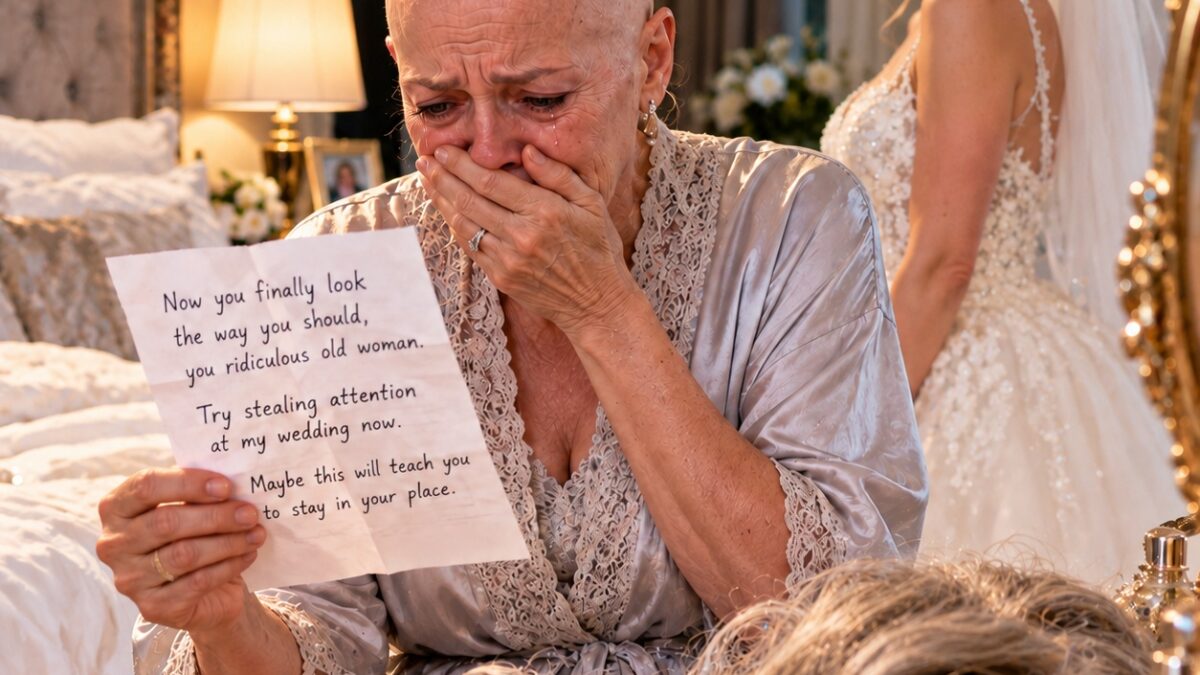
And woke without my hair.
After reading Natalie’s note, I tried calling Jackson.
Straight to voicemail.
Again.
Voicemail.
I texted him.
Something terrible happened. I need to speak with you immediately.
No response.
Ten minutes later, my phone chimed.
Natalie.
Don’t bother Jackson.
He’s preparing for his wedding.
And don’t come looking for sympathy.
Stay home. You have already made enough of this wedding about yourself.
I stared at the message.
Then I opened my closet.
My dress was on the floor.
Shredded.
Someone had taken scissors to it again and again until the pale blue silk looked like ribbons.
My jewelry box was missing.
I searched the bathroom.
Drawers.
Closet.
Under the bed.
Nothing.
Then I checked the security system.
Disarmed: 11:31 p.m.
Rearmed: 1:14 a.m.
Jackson had given Natalie the code months earlier.
“For emergencies,” he had said.
I called Maria.
She had arrived earlier than usual and was downstairs.
When she entered my bedroom and saw me, she screamed softly and covered her mouth.
“Oh, Mrs. Wilson.”
“Maria, did you see anyone here last night?”
Her eyes widened.
“I heard someone.”
“Who?”
“I thought it was you. Then I saw Miss Natalie coming out of your bedroom.”
My knees nearly buckled.
“What time?”
“After midnight. She told me you weren’t feeling well and had asked her to get something.”
I sat down.
Maria began crying.
“I should have checked.”
“No.”
“I should have known.”
“No, Maria.”
I squeezed her hand.
“This isn’t your fault.”
I looked at the clock.
The ceremony began at two.
Four hours.
I could call the police.
I should call the police.
What Natalie had done was assault.
Drugging me alone was serious.
Shaving my head without consent was assault.
Destroying my property and stealing jewelry only made it worse.
I picked up my phone.
Then I saw Jackson in my mind.
Standing at the altar.
Guests whispering.
Police walking into his wedding.
His bride being questioned.
Everything exploding in public.
I put the phone down.
For perhaps ten minutes, I cried.
Not because of my hair.
Hair grows.
I cried because I finally understood how much Natalie hated me.
And because some part of me already feared my son would not believe it.
I walked back to the bathroom mirror.
The first time I had looked at myself that morning, I had seen vulnerability.
Now I looked again.
I saw the nineteen-year-old girl who had bought a broken house with five hundred dollars.
I saw the woman who had survived recessions, lawsuits, failed developments, dishonest partners, childbirth, cancer diagnoses, and the death of the man she loved.
I had spent my whole life solving problems.
Was I really going to let Natalie Pearson reduce me to a frightened old woman because she had taken my hair?
“No,” I whispered.
I called Judith.
Then I called my lawyer.
Then I called Thomas, my financial adviser.
“Stop preparing tomorrow’s transfer,” I told him.
“All of it?”
“All one hundred twenty million.”
There was a pause.
“Babette, are you certain?”
“I have never been more certain.”
Judith arrived twenty minutes later.
When she saw me, she stopped in the doorway.
“Oh my God.”
I handed her the note.
She read it.
Her hands began trembling.
“We are calling the police.”
“Not yet.”
She looked at me as though I had lost my mind.
“Babette, she drugged you.”
“I know.”
“She assaulted you.”
“I know.”
“She robbed you.”
“I know.”
“And you are worried about ruining her wedding?”
“I’m worried about Jackson.”
Judith threw the note onto the table.
“Jackson is already in danger.”
The words hit hard.
She sat beside me.
“What are you going to do?”
“I’m going.”
“To the wedding?”
“Yes.”
“You can’t be serious.”
“I am.”
She stared at me for several seconds.
Then she smiled in the grim way only sisters can smile when they realize arguing is useless.
“All right.”
She stood.
“If you’re going, we’re going properly.”
Judith became a field commander.
She called a stylist she trusted.
The woman arrived carrying three wigs.
We chose one similar to my natural silver hair but shorter.
More modern.
My destroyed dress was impossible to replace on short notice, so Judith searched my wardrobe and found a navy dress I had worn to a charity gala.
Simple.
Elegant.
No sequins.
No attempt to compete with a bride.
Perfect.
While the stylist adjusted the wig, I stared at myself.
“I hate this,” I whispered.
Judith’s face softened.
“The wig?”
“The day.”
She sat beside me.
“This should have been happy.”
“I know.”
“I wanted to watch my son get married and think of Frank.”
“I know.”
“Instead, I’m preparing evidence against the woman he’s marrying.”
Judith took my hand.
“Babs, this is not about you failing as a mother.”
“I keep wondering what I missed.”
“Jackson fell in love with a performance.”
I looked at her.
“You really think it’s about the money?”
Judith’s expression hardened.
“I think one hundred twenty million dollars can make a bad person very patient.”
At the Westbrook Hotel, I felt every eye follow me.
Maybe that was only in my imagination.
Maybe humiliation makes you believe the whole world can see through your clothes.
I found Jackson near the ceremony room surrounded by groomsmen.
For one second, everything else disappeared.
He looked so much like Frank on our wedding day that I nearly cried.
“Jackson.”
He turned.
His smile appeared first.
Then confusion.
“Mom?”
He came toward me.
“What did you do to your hair?”
Before I answered, Natalie appeared.
Her dress was magnificent.
White silk.
Long train.
Diamond earrings.
She looked flawless.
Her eyes moved over me.
The smallest smile touched her mouth.
“Babette,” she said. “What a different look.”
I felt Judith stiffen behind me.
Natalie continued.
“Trying something new for the wedding?”
I stared at her.
“You know exactly what happened to my hair.”
Jackson frowned.
“What?”
Natalie’s face became innocence itself.
“I have no idea what she’s talking about.”
I reached for my purse.
“Jackson, last night Natalie entered my house after midnight.”
His expression changed.
“She drugged me.”
“Mom—”
“She shaved my head while I was unconscious.”
Natalie’s eyes instantly filled with tears.
It was so fast I almost admired the technique.
“What?”
“She destroyed my dress and stole my jewelry.”
Jackson’s face flushed.
Not with anger toward Natalie.
Toward me.
“Mom, stop.”
I froze.
“I have her note.”
“This is our wedding day.”
“I know.”
“How can you say something like this today?”
“Because it happened today.”
Natalie touched his arm.
“Jackson, please.”
Then she looked at me.
“I don’t understand why you hate me so much.”
I actually laughed.
One short, broken sound.
“Hate you?”
“I have tried so hard with you.”
“Your handwriting is on the note.”
“Babette, you’re upset.”
“Jackson, please look at it.”
I reached into my purse.
He stepped back.
“I don’t want to.”
That hurt more than waking bald.
“I can prove this.”
“I said I don’t want to see it.”
His voice rose.
Several groomsmen became very quiet.
“You’ve been suspicious of Natalie from the beginning.”
“That doesn’t mean—”
“You’ve questioned her family, her education, her intentions.”
“Because things didn’t add up.”
“And now on our wedding day you’re accusing her of drugging you?”
“Yes.”
“Do you hear how that sounds?”
I stared at my son.
I had spent nearly four decades protecting him from pain.
Standing there, I realized I had also protected him from too many uncomfortable truths.
Natalie rubbed his arm.
“It’s okay, honey.”
Then she turned to me.
“Babette is emotional.”
The condescension nearly took my breath away.
“Why don’t you sit down? The ceremony is about to begin.”
She guided Jackson away.
As she passed one bridesmaid, she whispered loudly enough for me to hear:
“I told you she’d eventually lose it.”
The bridesmaid giggled.
Natalie added, “Probably cut her own hair and forgot.”
I stood there.
Judith took my arm.
“Do not give her the satisfaction.”
“My son thinks I’m lying.”
“Right now.”
“He thinks I’m crazy.”
“Right now.”
I looked at her.
“What does that mean?”
“It means this day isn’t over.”
The ceremony began.
I sat in the front row.
I watched my son marry the woman who had drugged me hours earlier.
The officiant spoke about trust.
Commitment.
Respect.
I nearly laughed at the cruelty of it.
When he asked whether anyone knew a reason these two should not be joined, Judith’s hand closed around mine.
I had no intention of standing.
If Jackson would not examine a handwritten confession five minutes before the ceremony, shouting an objection in front of two hundred guests would only make Natalie look more like the victim she was pretending to be.
So I watched.
Jackson said, “I do.”
Natalie said it too.
They kissed.
People applauded.
And I felt as though I had just watched my son walk through a door into a burning building.
During cocktail hour, I heard Natalie’s version of the story spreading.
I had become unstable.
Jealous.
Possessive.
She told friends that I was “struggling with aging.”
She suggested I had cut my own hair during an emotional episode.
At one point, I heard her say, “Jackson and I are going to encourage her to see someone after the honeymoon.”
That was when my restraint finally disappeared.
I found a quiet corridor.
Called Thomas.
“Cancel everything.”
“I already paused the transfer.”
“No. I mean restructure it.”
There was a silence.
“What do you want?”
“Jackson protected.”
“From Natalie?”
“From anyone who believes marrying him creates access to our family assets.”
“All right.”
“And Thomas?”
“Yes?”
“Come to the reception.”
I called my lawyer next.
Then I returned to the ballroom.
Something had changed in me.
All morning, I had been reacting.
To my hair.
The note.
The destroyed dress.
Jackson’s disbelief.
Now I was finished reacting.
I knew what I would do.
Thomas arrived during dinner.
We spoke privately near the dance floor.
I showed him Natalie’s note.
His face tightened.
“Have you called police?”
“Not yet.”
“You should.”
“I will.”
He nodded.
“The transfer is dead.”
“And the trust?”
“My office is finalizing the revisions now.”
“Good.”
A young waiter approached us hesitantly.
“Mrs. Wilson?”
“Yes?”
“I’m sorry. My name is Alex.”
His face was pale.
“I don’t know if I should say anything.”
“Please do.”
He looked toward Natalie’s table.
“I was serving the bridal party earlier.”
My stomach tightened.
“They were talking about you.”
“What did they say?”
He swallowed.
“Mrs. Wilson… she was laughing about your hair.”
Thomas and I exchanged a look.
Alex continued.
“She said she finally put the old bag in her place.”
My throat tightened.
“She also said that by tomorrow they’d have your money, and then they could start getting rid of the things you were sentimental about.”
“Did anyone else hear this?”
“Two servers.”
“Would you be willing to tell someone officially?”
He nodded.
“Yes, ma’am.”
“Thank you.”
He started to leave.
“Alex.”
He turned.
“How old are you?”
“Twenty-three.”
“You have good instincts.”
He gave a nervous smile.
“My grandmother raised me.”
“I suspected there was a good woman somewhere behind that courage.”
His eyes watered.
Then he returned to work.
The speeches began.
Jackson’s best friend spoke first.
He talked about childhood.
College.
Frank.
He said he was grateful Jackson had found love after losing his father.
I watched my son smile.
My heart broke.
Natalie’s maid of honor spoke next.
She described Natalie as loyal, selfless, and compassionate.
Judith nearly choked on her wine.
Then the master of ceremonies introduced me.
The mother of the groom.
I stood.
Natalie watched me walk toward the microphone.
She looked relaxed.
Almost amused.
She believed I would behave.
Of course she did.
For months, I had.
I adjusted the microphone.
The room quieted.
“For those who haven’t met me, I’m Babette Wilson. Jackson’s mother.”
A few people smiled.
I looked at my son.
“First, I want to say that I love my son more than anything in this world.”
Jackson’s expression softened.
“And because I love him, I have spent much of the last year trying very hard not to interfere with his happiness.”
Natalie’s smile disappeared slightly.
“I told myself that differences in taste were normal. Differences in personality were normal. Even disrespect, occasionally, could be forgiven.”
Now the room was very quiet.
“But several people have asked me tonight about my new hairstyle.”
A few guests shifted uncomfortably.
I lifted both hands.
Then removed my wig.
Gasps traveled across the ballroom.
One woman covered her mouth.
A glass hit the floor somewhere behind me.
Jackson stood halfway from his chair.
“Mom?”
I held the wig at my side.
“This is not chemotherapy.”
More murmurs.
“It is not illness.”
I looked directly at Natalie.
“This morning I woke up completely bald because someone entered my house after midnight, drugged me, and shaved my head while I was unconscious.”
Natalie shot upright.
“This is insane.”
I continued.
“My wedding dress was destroyed.”
“Jackson, stop her.”
“My jewelry was stolen.”
“She is lying!”
I reached into my purse.
“And this note was left on my pillow.”
Natalie stopped shouting.
I unfolded the paper.
I did not embellish.
I simply read her words.
When I finished, the silence felt physical.
I looked toward Jackson.
His face had gone white.
He knew Natalie’s handwriting.
“Natalie?”
She shook her head rapidly.
“No.”
Jackson stared at the paper.
“Is that your writing?”
“Anybody could copy my handwriting.”
I continued.
“My security system recorded Natalie entering my home late last night.”
Natalie’s mother stood.
“This is disgusting. How dare you do this at your son’s wedding?”
“My housekeeper saw Natalie leaving my bedroom.”
“Lies.”
“The wine glass I used last night has been preserved for testing.”
Natalie’s face changed.
Barely.
But I saw it.
So did Jackson.
I looked at him.
“There is something else you need to know.”
His voice was almost a whisper.
“What?”
“Your father and I intended to give you one hundred twenty million dollars when you married.”
A wave of whispers moved through the ballroom.
“The transfer was scheduled for tomorrow.”
Natalie’s head snapped toward me.
I saw panic.
Real panic.
“That transfer has been canceled.”
She shouted before she could stop herself.
“You can’t do that!”
Every person in the room seemed to turn toward her.
Natalie realized her mistake.
She tried to recover.
“I mean—you promised Jackson.”
“I promised to help my son build a life.”
I looked at her.
“I did not promise to finance someone who assaults his mother.”
Natalie’s mask cracked.
“You have controlled everything from the beginning.”
Jackson turned toward her.
“Natalie.”
“No. I’m tired of this.”
She pointed at me.
“She inserts herself into everything. The venue. The food. The jewelry. The money.”
“The money?” Jackson repeated.
“Yes, the money.”
Her voice grew louder.
“This whole family acts as though she gets to decide whether we deserve our own future.”
Jackson stared at her.
“Our future was never dependent on my mother’s money.”
Natalie laughed sharply.
“Don’t be naive.”
His face changed.
“What does that mean?”
She looked around.
She had lost control now.
I could almost see the calculation failing behind her eyes.
“You think I put up with all this for nothing?”
Jackson became very still.
“All what?”
“Your mother’s judgment.”
“Natalie.”
“Her dead husband stories. Her ancient traditions. Her obsession with controlling you.”
I did not move.
The room listened.
Jackson’s voice dropped.
“You drugged my mother?”
Natalie looked at him.
“She was ruining everything.”
A collective gasp rose.
Jackson stared at her.
“What?”
“She wouldn’t stop.”
My hand tightened around the microphone.
Natalie continued.
“She had to be the center of every conversation. Frank this. Wilson tradition that. I wanted one day.”
“So you shaved her head?”
“Oh my God, Jackson. It’s hair.”
His face twisted.
“You drugged a sixty-eight-year-old woman.”
“It wasn’t enough to hurt her.”
“You don’t know that.”
“She woke up, didn’t she?”
That sentence destroyed whatever remained.
Jackson physically stepped backward.
I had never seen him look at another human being that way.
Not anger.
Horror.
Natalie looked toward me.
“And none of this would have happened if you’d simply known your place.”
I stared at her.
“My place?”
“You were supposed to transfer the money and let us live our lives.”
There it was.
Not hidden anymore.
Not whispered in a restroom.
Not disguised behind bridal smiles.
I spoke calmly.
“The money was never yours.”
Her face reddened.
“We are married.”
“For less than two hours.”
“That doesn’t matter.”
“It matters considerably.”
My lawyer stepped from the rear of the room.
Natalie noticed him.
Her expression shifted.
He said, “The prenuptial agreement you signed contains provisions addressing fraud, theft, and intentional harm against members of the Wilson family.”
Natalie’s mouth opened.
“What?”
My lawyer remained calm.
“The agreement you signed two weeks ago.”
She looked at Jackson.
“You said that was standard trust paperwork.”
Jackson’s confusion was immediate.
“No. I told you it was the prenup.”
“You said your attorneys needed signatures.”
“I sent it to you.”
“I didn’t read it.”
Jackson actually closed his eyes.
Natalie realized she had just admitted signing a major legal document without reviewing it.
My lawyer continued.
“Mrs. Wilson’s assets remain hers. The planned transfer has been stopped. Any future trust established for Jackson will be structured separately.”
Natalie pointed at me.
“You planned this.”
“No,” I said.
“I planned to give my son one hundred twenty million dollars tomorrow.”
I placed the wig on the table beside the microphone.
“You changed my plan.”
She lunged toward me.
“You vindictive old witch!”
Security moved immediately.
Two guards stepped between us.
Natalie struggled against one.
“That money is mine!”
Jackson stared at her.
“You keep saying that.”
She turned.
“What?”
“You keep calling it yours.”
“Because we’re married.”
“No. You called it yours before we were married.”
“Jackson, don’t start.”
“You knew the exact amount.”
“Of course I did.”
“You knew the transfer date.”
She hesitated.
He looked sick.
“How?”
Silence.
“How did you know the transfer was tomorrow?”
“I told her,” I said quietly. “Months ago.”
Jackson looked at me.
“Because she asked.”
His eyes returned to Natalie.
She stepped toward him.
“Baby, listen—”
“Don’t call me that.”
“Jackson.”
“Did you marry me for the money?”
Natalie laughed nervously.
“What kind of question is that?”
“A very simple one.”
“I love you.”
“Did you marry me for the money?”
She looked around the ballroom.
Every face was turned toward her.
Then anger replaced calculation.
“Well, what exactly did you think you were offering?”
Jackson flinched.
I closed my eyes briefly.
Natalie continued.
“You’re an architect.”
“So?”
“You make what? A few hundred thousand a year?”
His best friend muttered, “Jesus.”
Natalie ignored him.
“My monthly lifestyle costs more than that.”
Jackson stared at her.
“So that’s your answer.”
“I am being realistic.”
“You married me because of my family.”
“You wanted someone beautiful beside you.”
His face crumpled.
“What?”
“You get a wife people notice.”
She gestured at herself.
“I get security.”
The cruelty was breathtaking.
Even her mother whispered, “Natalie, stop.”
But Natalie had gone too far to stop.
“Don’t pretend you didn’t benefit too.”
Jackson removed his wedding ring.
The room seemed to inhale.
He placed it on the table.
“We’re done.”
Natalie’s eyes widened.
“You cannot end a marriage at the reception.”
“Watch me.”
“You’re emotional.”
“You assaulted my mother.”
“She deserved—”
Natalie stopped too late.
Jackson stared at her.
“Say it.”
She said nothing.
“You were going to say she deserved it.”
Natalie folded her arms.
“She humiliated me for months.”
“No.”
His voice broke.
“You felt judged. That’s not the same thing.”
He looked at my bare head.
“You drugged her.”
Natalie rolled her eyes.
“Stop being dramatic.”
That was the moment my son truly saw her.
Not the beauty.
Not the charm.
Not the woman who had entered his life while he was grieving.
The person underneath.
He whispered, “Who are you?”
Natalie’s face became cold.
“I am the woman you married.”
“Not for long.”
Security escorted her away from the front table.
She fought them verbally the entire time.
Her mother shouted at my lawyer.
Her father demanded everyone stop recording.
Several guests were already holding up phones.
As Natalie passed me, she leaned as close as security allowed.
“You think you’ve won?”
I looked at her.
“This was never a competition.”
“You humiliated me.”
“No.”
I lowered my voice.
“You humiliated yourself.”
She was removed from the ballroom.
Silence remained after her.
Not peaceful silence.
The kind left after an explosion.
The band had stopped.
Guests stood in clusters.
Nobody knew whether to leave.
Nobody knew where to look.
Jackson stood alone beside the dance floor.
Still wearing his tuxedo.
Still surrounded by flowers chosen for a marriage that had effectively ended before dessert.
I handed the microphone back to the stunned master of ceremonies.
Then I walked toward my son.
Every step hurt.
Because the fact that Natalie had been exposed did not make this a victory.
My son was devastated.
When he looked at me, his eyes were red.
“Jackson.”
He crossed the distance between us and wrapped both arms around me.
Then he started crying.
Not politely.
Not discreetly.
My son sobbed against my shoulder like the little boy who used to run into our bedroom during thunderstorms.
“I’m sorry.”
I held him.
“I’m so sorry, Mom.”
I closed my eyes.
“I didn’t believe you.”
“I know.”
“You showed me evidence and I wouldn’t even look.”
“I know.”
“I married her.”
I tightened my arms around him.
“I married someone who did this to you.”
“You didn’t know.”
“I should have.”
“No.”
“I should have seen it.”
I pulled back.
“Jackson, she worked very hard to make sure you didn’t.”
His face twisted.
“I was angry at you.”
“You were afraid.”
“I thought you wanted to control me.”
“Sometimes I probably did.”
He looked surprised.
I smiled sadly.
“I’m still your mother. We are not famous for perfect boundaries.”
A broken laugh escaped him.
Then he cried again.
The reception emptied gradually.
Jackson’s best friend handled the gifts.
Judith dealt with vendors.
My attorney spoke to hotel security.
Thomas confirmed again that no funds would move.
Later, Jackson touched the top of my head carefully.
“I can’t believe she did this.”
“Neither can I.”
“Does it hurt?”
“My scalp?”
He nodded.
“Not much.”
He swallowed.
“Everything else does.”
“Yes.”
He looked at the floor.
“Can the marriage really be undone?”
“We’ll explore every legal option.”
“I don’t care what it costs.”
I almost laughed.
“That’s probably the first financially irresponsible thing you’ve said all day.”
He smiled faintly.
Then his face collapsed again.
“I miss Dad.”
That sentence nearly broke me.
“So do I.”
“What would he say?”
I thought about Frank.
“He would tell you that discovering you were wrong is painful.”
Jackson nodded.
“And?”
“And refusing to admit you’re wrong is worse.”
That evening, Jackson’s best friend took him home.
He refused to let him spend the night alone.
I returned to my house with Judith.
Maria had changed my sheets.
The shredded dress was still in an evidence bag.
The empty place where my jewelry box had been looked strangely large.
Judith hugged me at the door.
“Call me if you need anything.”
“I will.”
“You won’t.”
“I might.”
“You absolutely won’t.”
I smiled.
She pointed at me.
“Call anyway.”
After she left, I stood in my bedroom.
The room felt contaminated.
Not physically.
Emotionally.
I removed the wig.
Set it on the vanity.
Then I looked at myself.
Bald.
Exhausted.
Dark circles under my eyes.
But I no longer saw the frightened woman from that morning.
My phone rang.
Natalie.
I almost ignored it.
Instead, I answered.
“What?”
Her voice was cold.
“You think you’ve won.”
“I don’t think that word applies.”
“You destroyed my marriage.”
I laughed once.
“You admitted in front of two hundred people that you married Jackson for money.”
“Because you provoked me.”
“You drugged me.”
“You cannot prove that.”
“The wine glass is being tested.”
Silence.
“And the security logs show you entered my house.”
“I had permission to use the code.”
“For emergencies.”
“You were sleeping.”
“That is not an emergency.”
“You’re going to make this ugly?”
“Natalie, you shaved my head while I was unconscious.”
“Oh, please.”
I closed my eyes.
The complete absence of remorse surprised me even after everything.
She continued.
“I’m fighting the prenup.”
“That’s your choice.”
“I’ll tell people you’re controlling.”
“Go ahead.”
“I’ll tell them you manipulated Jackson.”
“They watched you speak for yourself tonight.”
“I’ll make him come back.”
“No.”
“You don’t know him like I do.”
“I’ve known him thirty-eight years.”
“And he chose me.”
“For a while.”
Her breathing changed.
“You smug old—”
“Natalie.”
I interrupted quietly.
“The police will receive the security footage.”
Silence.
“The wine glass is being analyzed.”
More silence.
“Your messages are preserved.”
She said nothing.
“This call is being documented too.”
Her voice cracked.
“I deserved that money.”
I felt something inside me settle permanently.
There it was again.
Not Jackson.
Money.
“You deserved nothing that belonged to Frank and me.”
“Do you know what I put up with?”
I said nothing.
“His boring friends.”
My jaw tightened.
“His stupid buildings.”
I stared at the wall.
“His obsession with his dead father.”
My chest burned.
“His pathetic devotion to you.”
I whispered, “Goodbye, Natalie.”
Then I hung up.
My phone immediately rang again.
I blocked the number.
Then I sat on the edge of the bed and touched my scalp.
All day, people had treated my baldness as the symbol of what Natalie had taken from me.
Strangely, sitting there alone, I began to see it differently.
She had taken my hair.
But she had also stripped away my excuses.
For months, I had watched warning signs and called them differences.
I had heard contempt and called it stress.
I had seen greed and called it ambition.
I had mistaken silence for kindness because confrontation frightened me more than denial.
Natalie had not changed overnight.
She had simply escalated.
The person capable of shaving my head had been present all along.
I just had not wanted to see her.
My phone chimed.
Jackson.
Can I come over tomorrow?
Then another message.
I think we need to talk about everything.
I typed:
Of course.
Then:
I’ll make your favorite breakfast.
His reply arrived seconds later.
Love you, Mom.
I cried again.
But those tears felt different.
One week after the wedding, Jackson sat with me in the garden.
He had brought coffee and pastries.
My hair had begun growing back as rough silver stubble.
I no longer wore the wig at home.
There was something oddly freeing about that.
“How are you?” he asked.
“Better.”
“Really?”
“No.”
He laughed softly.
I smiled.
“But closer to better.”
He looked exhausted.
He had spent the first several nights in his childhood bedroom because returning to the apartment he had shared with Natalie felt impossible.
“I feel stupid,” he said.
“You aren’t.”
“All the signs were there.”
“Some.”
“You saw them.”
“I wasn’t in love with her.”
He stared into his coffee.
“I defended everything she did.”
“Yes.”
He looked up.
“You can say more than that.”
“Would it help?”
“I don’t know.”
I leaned back.
“Jackson, you were grieving when you met her.”
He flinched slightly.
“I wasn’t that fragile.”
“I didn’t say fragile.”
“What are you saying?”
“That your father died. You buried yourself in work. Then an exciting, beautiful woman appeared and made you feel alive again.”
He looked away.
“She didn’t create your weakness.”
“I know.”
“She entered during one.”
He was silent.
“She made everything intense,” he finally said.
“How?”
“Every disagreement became proof that someone was against us.”
I listened.
“If you questioned her, you were jealous.”
I nodded.
“If I disagreed, I wasn’t committed enough.”
He rubbed his face.
“If she hurt someone’s feelings, they were too sensitive.”
“That sounds familiar.”
He gave me a guilty look.
“I said that about you.”
“I remember.”
“I’m sorry.”
“I know.”
He looked toward the roses.
“I still don’t understand how I missed it.”
“Because manipulation rarely begins with the worst behavior.”
He looked back at me.
“If Natalie had shaved my head on your second date, would you have married her?”
“Obviously not.”
“Exactly.”
She had not begun there.
She had begun with charm.
Then dependency.
Then division.
Then disrespect.
Then control.
By the time she reached cruelty, everyone around her had already adjusted their definition of normal several times.
That conversation was the first time Jackson suggested therapy.
“I think I need help understanding why I accepted so much.”
I was quiet.
“And maybe we need help too.”
“We?”
“You and me.”
That surprised me.
He continued.
“I blamed you for trying to control me. Some of that was Natalie.”
He hesitated.
“But not all of it.”
I felt the defensive response rise immediately.
I forced myself not to speak.
Jackson looked almost apologetic.
“Mom, sometimes when Dad died, I felt like you held tighter.”
I nodded slowly.
“I probably did.”
“You called more.”
“I worried.”
“You questioned everything.”
“I worried.”
“You wanted to know where I was, whether I’d eaten, who I was seeing.”
“I worried.”
He smiled gently.
“I know.”
That made me cry.
Not because he had accused me.
Because he was right.
Losing Frank had terrified me.
Somewhere in my grief, I had become frightened that losing my husband meant I could also lose my son.
Natalie had exploited that fear.
She made normal concern look invasive.
Then she used my actual overprotectiveness to make the lie believable.
A good manipulator rarely invents everything.
They take a small truth and build a prison around it.
We began therapy together.
Individually too.
Dr. Carter helped Jackson examine how Natalie had isolated him from people who challenged her.
She helped me understand that protecting a grown child does not mean controlling his decisions.
Those sessions were uncomfortable.
Some weeks, Jackson left angry.
Some weeks, I did.
But slowly, something changed between us.
Before Natalie, our relationship had been loving but uneven.
Mother and son.
Protector and protected.
Afterward, we became two adults learning to speak honestly.
That was worth more than the illusion of closeness we had maintained before.
The legal aftermath was ugly.
Natalie denied drugging me.
Then claimed the wine had been accidentally contaminated.
Then suggested one of her bridesmaids might have been involved.
Then insisted the entire incident was a prank that had been misunderstood.
Her explanations changed whenever evidence contradicted the previous one.
The security records confirmed her presence.
Maria gave a statement.
The waiter and other staff members described her comments at the reception.
My missing jewelry was eventually recovered among belongings connected to the bridal suite.
That mattered to me most because of my grandmother’s brooch.
Money could replace diamonds.
It could not replace history.
The marriage unravelled legally almost as quickly as it had emotionally.
I did not celebrate.
I never wanted Jackson divorced days after marrying.
I wanted him happily married to someone who loved him.
Those are not the same thing.
Natalie attacked publicly for a while.
She posted vague statements online about controlling mothers.
Toxic in-laws.
Wealth being used as a weapon.
She portrayed herself as a young bride bullied by a powerful family.
Unfortunately for her, footage from the reception existed.
People had recorded her shouting about money.
They had recorded her admitting my hair “would grow back.”
They had recorded Jackson asking if she married him for financial security.
The public story never became what she wanted.
Eventually, even her attempts to reshape it faded.
Six months after the wedding, I revisited the $120 million.
For months, I could not look at that number without thinking about Natalie saying she had “120 million reasons” to tolerate me.
I began to resent the money itself.
Then Dr. Carter asked me a question.
“Why are you allowing Natalie’s relationship with wealth to redefine yours?”
That stopped me.
Frank and I had never considered money the problem.
Money amplifies.
It gives people options.
Sometimes it amplifies generosity.
Sometimes selfishness.
Sometimes character.
The problem had never been the $120 million.
The problem was handing enormous power to someone whose character we had not understood.
So I restructured everything.
Part went into a trust for Jackson.
His.
Protected.
Accessible under reasonable provisions.
Another portion went into an education trust for future grandchildren, should Jackson ever have children.
And a third portion became something I never could have imagined before the wedding.
The Wilson Foundation for Empowerment and Recovery.
We focused on people leaving emotionally, psychologically, and financially abusive relationships.
Not because every difficult partner was Natalie.
Not because every disagreement was abuse.
I had learned the danger of careless labels too.
But there are patterns.
Isolation.
Financial control.
Gaslighting.
Humiliation.
Threats.
Deliberately undermining a person’s confidence until they no longer trust their own judgment.
We funded emergency housing.
Legal assistance.
Counseling.
Education programs.
Jackson became deeply involved.
His architecture firm helped design transitional housing for people rebuilding their lives after abuse.
One afternoon, six months after the wedding, we toured one of the planned housing sites.
My hair had grown back.
I kept it short.
Much shorter than before.
Jackson looked at me while we stood in the unfinished lobby.
“You know, I like it.”
“My hair?”
“Yeah.”
I touched it.
“Your bride had stronger opinions.”
He winced.
“Too soon.”
“Six months.”
“Still too soon.”
I smiled.
He studied me.
“It fits you.”
“How?”
“Bold.”
I raised an eyebrow.
“Efficient.”
“Better.”
“No-nonsense.”
“I’ll accept that.”
He smiled.
“Dad would have liked it.”
That silenced us both.
Then I said, “Your father would have complained that I spent forty years telling him short hair wouldn’t suit me.”
Jackson laughed.
“He absolutely would.”
Those moments helped.
Ordinary moments.
Coffee.
Work.
Arguments about paint colors.
Sitting through foundation meetings.
Healing was not dramatic.
It did not happen at the microphone in the ballroom.
That was exposure.
Healing happened afterward.
Quietly.
Natalie tried several times to contact Jackson.
At first, she apologized.
Then she blamed stress.
Then alcohol.
Then me.
Then him.
When reconciliation failed, affection became threats.
When threats failed, threats became silence.
Eventually, she moved to another state.
Months later, we heard she had become involved with another wealthy man.
I did not investigate.
I had learned something else from the ordeal.
Not every fire is mine to put out.
One year after the wedding, Jackson and I sat in my garden near sunset.
We shared wine.
I checked the bottle myself.
He noticed.
“Still?”
“Probably forever.”
He smiled sadly.
“Fair.”
For a while, we watched the sun fall behind the trees.
Then he said, “I’ve been thinking about something.”
“That is always dangerous.”
He laughed.
“I’m serious.”
“All right.”
“If Natalie hadn’t gone that far…”
I knew what he meant.
“If she hadn’t shaved your head,” he continued, “I might have married her and stayed married.”
“You did marry her.”
“You know what I mean.”
“I do.”
He stared into his glass.
“I might have spent years slowly becoming someone I didn’t recognize.”
I said nothing.
“She would have pushed me farther from you.”
“Yes.”
“From my friends.”
“Probably.”
“Maybe from Dad’s memory too.”
That hurt.
He continued.
“And you might have kept trying to earn her approval.”
I laughed softly.
“That part is embarrassing.”
“You did.”
“I know.”
He looked toward the garden.
“And the foundation wouldn’t exist.”
“No.”
“All those people we’ve helped.”
I nodded.
“Sometimes I feel guilty saying anything good came from it.”
“You shouldn’t.”
“It sounds like I’m grateful she hurt you.”
“You aren’t.”
He looked at me.
“I’m grateful the truth arrived before the damage became permanent.”
He thought about that.
“That’s better.”
I smiled.
“I’ve had a year to phrase it.”
He laughed.
Then his expression became serious.
“I’m sorry.”
I knew immediately what he meant.
“You’ve apologized.”
“I’ll probably apologize again.”
“You don’t have to.”
“I do.”
“No.”
He looked at me.
I touched his hand.
“Jackson, there is a difference between being responsible for someone’s choices and regretting that you didn’t see those choices clearly.”
He swallowed.
“You did not shave my head.”
“No.”
“You did not drug me.”
“No.”
“You did not steal from me.”
“No.”
“You made mistakes.”
He nodded.
“So did I.”
“You?”
“I saw warning signs and remained silent because I wanted your wedding to be peaceful.”
His brow furrowed.
“I protected the ceremony more than I protected the truth.”
“You were trying to protect me.”
“Yes.”
“And that’s a mistake?”
“Sometimes.”
He looked surprised.
I continued.
“Peace purchased with silence is often only delay.”
The garden became quiet.
After a while, Jackson said, “Dad would like that.”
“Your father would claim he said it first.”
Jackson smiled.
“That too.”
As darkness approached, I asked him something I had avoided for months.
“Do you think you’ll fall in love again?”
He stared toward the roses.
“Yes.”
The answer surprised me.
Not because I wanted him afraid.
Because I knew how deeply Natalie had wounded his trust.
He continued.
“But differently.”
“How?”
“I used to think intensity meant connection.”
I listened.
“Natalie made everything feel enormous.”
“Passion can do that.”
“I want calm next time.”
I smiled.
“That sounds very old for thirty-nine.”
“Kindness.”
“Good.”
“Integrity.”
“Better.”
“Someone who doesn’t calculate my net worth before our first anniversary.”
“That is an especially strong standard.”
He laughed.
Then turned toward me.
“What about you?”
“What about me?”
“Dating.”
I stared at him.
“At sixty-nine?”
“You’re alive.”
“I noticed.”
“You’re beautiful.”
I touched my short hair.
“You may need your eyes checked.”
He became serious.
“Mom.”
“What?”
“You spent five years acting as if Dad dying meant that part of you had to die too.”
His words hit harder than I expected.
“I loved your father.”
“I know.”
“I still love him.”
“I know.”
“Then why would I—”
“Because loving someone who died doesn’t require you to stop living.”
I looked away.
The sunset blurred.
Frank had been my husband for more than thirty years.
For a long time, any thought of another man felt like betrayal.
But grief therapy had taught me that continuing life did not rewrite what came before.
“I don’t know,” I said.
Jackson smiled.
“That isn’t no.”
“Do not become one of those sons who signs his mother up for dating apps.”
He raised both hands.
“I would never.”
“Good.”
“I’d have Judith do it.”
I nearly spilled my wine laughing.
That night, after Jackson left, I stood before the same mirror where I had discovered my bald head one year earlier.
My hair was silver again.
Short.
Neat.
Different.
So was the woman beneath it.
A year earlier, I had believed strength meant staying composed.
Avoiding scandal.
Protecting family appearances.
Not making scenes.
I no longer believed that.
Sometimes strength is quiet.
Sometimes it is gracious.
And sometimes strength is walking into a ballroom after someone tried to humiliate you and refusing to carry their shame for them.
Natalie wanted me to wake up feeling powerless.
For a few minutes, I did.
She wanted me ashamed of my age.
My traditions.
My attachment to my family.
My hair.
My grief.
She wanted me small enough that I would quietly transfer a fortune and disappear from my son’s life.
Instead, she forced me to confront something I had spent years avoiding.
Money could not protect my family.
Appearances could not protect my family.
Silence certainly could not protect my family.
Only truth could give us the chance to protect ourselves.
I still had the note Natalie left on my pillow.
My attorney once asked whether I wanted it returned after the case concluded.
For a moment, I considered destroying it.
Instead, I kept it.
Not framed.
Not displayed.
It sits in a sealed envelope inside my desk.
I do not keep it because I enjoy remembering what happened.
I keep it because every once in a while, when I find myself ignoring an instinct because acknowledging it would be inconvenient, I remember that morning.
The strange taste of the wine.
The questions about my medication.
The restroom conversation.
The comments about money.
The properties Natalie planned to sell.
The way Jackson looked at his shoes when she insulted me.
The dozens of moments I minimized because I wanted harmony.
There is compassion in giving people the benefit of the doubt.
There is danger in giving them endless benefits after the doubt has become evidence.
I learned that distinction late.
But not too late.
Frank used to tell me that wealth reveals more than it changes.
Give a generous person money and they often become more generous.
Give a frightened person money and they may become more fearful of losing it.
Give a controlling person access to wealth and they may discover new ways to control.
I think about that often now.
Especially at the foundation.
People sometimes arrive embarrassed by how long they stayed in destructive relationships.
They ask how they could have been fooled.
How they ignored warning signs.
How they became isolated.
How someone they loved became someone they feared.
I never tell them they were foolish.
Because I watched my intelligent, capable son fall in love with an illusion.
And I watched myself cooperate with that illusion because the truth threatened the picture of family happiness I wanted so badly.
Cruel people rarely introduce themselves honestly.
They study what you love.
What you fear.
What you need.
Then they become useful to those needs until the cost of questioning them feels too high.
Natalie understood Jackson’s grief.
She understood my fear of losing my son.
She understood our family’s wealth.
She understood how reluctant I was to embarrass anyone publicly.
For a while, she used all of it.
But she misunderstood one thing.
She thought restraint was weakness.
She thought because I preferred dignity, I would accept humiliation.
She thought because I loved my son, I would finance anyone he chose without question.
She thought an elderly widow could be frightened into silence.
She was wrong.
The morning after that disastrous wedding, there was no $120 million transfer.
There was breakfast.
Jackson sat at my kitchen table in sweatpants, staring at pancakes he barely touched.
I sat across from him wearing no wig.
We talked for four hours.
About Natalie.
About Frank.
About grief.
About money.
About all the things we had both failed to say because saying them felt dangerous.
That morning mattered more to me than the fortune.
By noon, Jackson looked exhausted.
So did I.
He stood to leave.
Then he stopped near the doorway.
“Mom?”
“Yes?”
He walked back and kissed the top of my bald head.
“I love you.”
I smiled.
“I love you too.”
He hesitated.
“You really aren’t going to wear the wig?”
“Not today.”
“You look kind of tough.”
“Kind of?”
“Terrifying.”
“Better.”
He laughed.
It was the first genuine laugh I had heard from him since the wedding.
And standing there in my kitchen, bald and tired and surrounded by the wreckage of everything that had happened, I finally understood something.
Natalie had taken my hair.
She had destroyed a dress.
She had stolen jewelry.
She had nearly broken my relationship with my son.
But she had failed at the one thing she wanted most.
She had not taken my place.
Because a mother’s place is not secured by money.
It is not secured by controlling her child.
And it is not secured by winning every argument.
It is built through years of showing up.
Through mistakes.
Through forgiveness.
Through telling the truth even when the truth is painful.
A year after Natalie tried to humiliate me into disappearing, my son and I were closer than we had been before she entered our lives.
My grandmother’s brooch was back where it belonged.
The $120 million was protected.
The foundation was helping people whose stories were far more painful than mine.
My hair had grown back.
And the old woman Natalie thought she could frighten into silence?
She never came back.
I became someone else.
Not younger.
Not harder.
Not bitter.
Just clearer.
I still miss Frank every day.
I still love traditions.
I still tell too many stories about the people I have lost.
I still worry about Jackson more than a grown man probably wants his mother to worry.
But I have stopped apologizing for occupying space in my own life.
The woman staring back at me in the mirror now has short silver hair, lines around her eyes, and a scar inside her heart that no one else can see.
She also has something she did not possess before that wedding morning.
The certainty that dignity does not come from what other people leave untouched.
It comes from what remains yours after they have tried to take everything that makes you feel like yourself.
Natalie believed shaving my head would make me hide.
Instead, it became the day I finally stopped hiding from the truth.

