PART 2: My Son Was Barely Buried When His Widow Started Hunting for What He’d Kept From Her
 Thank you

My name is Koko Baker.
I was sixty-seven when my only child died.
There is no graceful way to say that.
People use words like loss because the actual sentence sounds too violent.
“My son died.”
Four words.
Yet they divide your life into everything that existed before them and everything that survives afterward.
Jackson was thirty-six.
He should have had decades ahead of him.
Instead, on an icy Tuesday evening in December, his car lost traction on a highway outside Chicago and struck a concrete barrier.
By the time paramedics reached him, there was nothing they could do.
But to understand why my son’s death eventually put me inside a courtroom fighting his widow for control of my own life, you need to understand Jackson first.
And you need to understand what he and I had survived together.
My husband Robert died when Jackson was five.
A construction accident.
One morning he kissed us goodbye.
That evening, two men were standing at my door.
The workers’ compensation barely covered the funeral and a few immediate expenses.
After that, it was me and Jackson.
I worked wherever people would hire me.
Office cleaning.
A diner.
Reception work.
Holiday shifts at a department store.
For a while I had three jobs.
We lived in a one-bedroom apartment.
Jackson got the bedroom.
I slept on a pullout couch.
He didn’t know until he was much older that sometimes I ate toast for dinner after he went to sleep because there wasn’t enough food for both of us to eat what I had cooked.
I never wanted him to feel poor.
And somehow, he didn’t become bitter.
He became responsible.
At twelve, he announced that he wanted a paper route.
“No.”
“Mom.”
“No.”
“We need money.”
“You need school.”
“I can do both.”
“You’re twelve.”
“So?”
“So twelve-year-olds are supposed to complain about chores, not volunteer to pay bills.”
He crossed his arms.
“I still complain about chores.”
I laughed despite myself.
He got the route.
Every morning before sunrise, he dragged himself out of bed, delivered newspapers, came home, showered, ate breakfast, and went to school.
I expected his grades to suffer.
They improved.
That was Jackson.
Tell him something was difficult and he heard a challenge.
Tell him something was impossible and he started building a schedule.
He graduated high school as valedictorian.
Northwestern offered him a full scholarship.
At graduation, he thanked me during his speech.
I sat in that auditorium crying so hard the woman beside me handed me tissues from her purse.
“Everything I know about persistence,” Jackson said from that stage, “I learned from watching my mother refuse to let hard circumstances decide what kind of life we were allowed to have.”
I still remember every word.
At Northwestern, he studied finance.
He told me once that poverty had made money feel like weather when he was a child.
Something unpredictable.
Something adults worried about.
Something that could suddenly become dangerous.
“I want to understand it,” he said. “If you understand something, maybe it can’t scare you as much.”
After college, he became a financial adviser.
He was good at it.
Very good.
By thirty, he had become one of the youngest senior advisers at a respected Chicago firm.
The first extravagant thing he bought wasn’t for himself.
It was a car for me.
I stared at the keys.
“Jackson.”
“What?”
“I have a car.”
“You have an archaeological artifact with license plates.”
“My car runs.”
“Sometimes.”
“I am not accepting this.”
He dropped the keys into my hand.
“Your struggling days are over.”
“I managed.”
“I know.”
He hugged me.
“Now let me manage some things for you.”
That was my son.
Which is why, when he called me six years before his death and said he’d met someone special, I wanted desperately for it to work.
Her name was Amanda.
They had met at a charity gala.
“Mom,” he said over the phone, “I think this might be the one.”
“You met her tonight.”
“I know.”
“Do you know her last name?”
He laughed.
“Yes.”
“Her birthday?”
“No.”
“Favorite food?”
“No.”
“Whether she’s secretly married?”
“Mom.”
“I’m establishing how little information you’re working with.”
“I knew you’d ruin this.”
But he sounded happy.
And I hadn’t heard him sound that happy about a woman before.
When I met Amanda, I understood his attraction.
She was striking.
Blonde hair that somehow always looked professionally styled.
Blue eyes.
Elegant clothing.
The kind of confidence that filled a room before she spoke.
She worked at an art gallery and could speak about paintings with such intensity that even I became interested in artists I’d never heard of.
At dinner, she asked me about Jackson as a child.
How we’d managed after Robert died.
What Jackson had been like in school.
What had made him interested in finance.
She listened carefully.
She touched his arm when he talked.
She laughed at his worst jokes.
I went home relieved.
Three months later, they moved in together.
Six months after that, he proposed.
I thought it was fast.
Jackson didn’t.
When my son decided something, he usually committed completely.
Their wedding overlooked Lake Michigan.
It was beautiful.
And expensive.
Very expensive.
That was the first time I noticed something about Amanda that bothered me.
She always knew prices.
Not approximately.
Exactly.
The dress was from a certain designer.
The floral arrangements needed a specific imported rose.
The china had to come from a particular supplier.
When Jackson suggested alternatives, Amanda always found a reason the cheaper option wouldn’t work.
“It only happens once,” she’d say.
Jackson smiled.
“I can afford it.”
And he could.
So I kept my concerns to myself.
After they married, the pattern continued.
Luxury handbags.
Jewelry.
International vacations.
New vehicles.
Renovations to rooms that had been renovated less than two years before.
If someone gave Amanda a gift, her eyes immediately evaluated it.
Not emotionally.
Financially.
I told myself I was being unfair.
I had grown up counting every dollar.
Maybe expensive things made me uncomfortable because I had never learned how to enjoy money without worrying about losing it.
And most importantly, Jackson seemed happy.
At first.
About two years into the marriage, he started visiting me alone.
He would arrive unexpectedly on Saturday afternoons.
Or call after work and ask if I had eaten.
Sometimes he’d sit on my balcony and say almost nothing.
Once I finally asked:
“Are you and Amanda okay?”
He smiled too quickly.
“Marriage has ups and downs.”
“That wasn’t my question.”
“We’re working through things.”
“Do you want to talk?”
He shook his head.
I respected that.
Maybe I shouldn’t have.
Eight months before he died, he came over on a warm evening.
We sat on the balcony drinking iced tea.
The city was beginning to glow beneath us.
Out of nowhere, he said:
“Mom, I arranged some things.”
“What things?”
“For you.”
I laughed.
“Why?”
“So you’re protected.”
“From what?”
“Life.”
I rolled my eyes.
“You’re thirty-six. I’m sixty-seven. Statistically, you’re supposed to be worrying about what happens when I die.”
He didn’t smile.
“Life doesn’t care about statistics.”
Something in his tone made me look at him.
“Jackson?”
He leaned forward.
“If anything happens to me, promise me you’ll accept what I’ve arranged.”
“What did you arrange?”
“You’ll find out if you ever need to.”
“I don’t like this conversation.”
“Promise.”
“Nothing is going to happen to you.”
“Mom.”
He sounded like the twelve-year-old boy demanding a paper route.
I sighed.
“Fine.”
“Say it.”
“I promise.”
“Good.”
Then he relaxed.
I wish I had asked more questions.
Our last family Thanksgiving was three weeks before the accident.
Jackson hosted.
Amanda was distracted.
She checked her phone constantly.
Twice she left the dining room to take calls.
“Gallery emergency?” I asked.
She smiled.
“Unfortunately.”
Jackson said nothing.
When I left, he walked me outside.
He hugged me longer than usual.
“I love you, Mom.”
“I love you too.”
“More than you know.”
I pulled back.
“What does that mean?”
He smiled.
“Nothing.”
Those were the last words my son ever said to me in person.
Three weeks later, my phone rang.
A hospital representative asked:
“Are you Jackson Baker’s mother?”
I knew before she finished.
Something about the tone.
There are voices professionals use when they’re about to divide your life.
I don’t remember the drive to the hospital.
I remember fluorescent lights.
I remember a nurse touching my elbow.
I remember entering a room.
Jackson was lying on a bed.
There was a cut above his eyebrow.
His face looked peaceful.
That was the cruelest part.
He looked like he might wake if I touched him.
I smoothed his hair.
“My baby.”
I hadn’t called him that in years.
I put my hand against his cheek.
Cold.
I kept thinking that mothers should have some power over this.
I had created him.
Fed him.
Protected him.
Stayed awake through fevers.
Held him when his father died.
Worked three jobs.
Watched him graduate.
Watched him marry.
Surely after doing all of that, I should have been able to bargain with death.
I couldn’t.
A nurse eventually said Amanda was outside.
I expected to find her destroyed.
Instead, I heard her before she saw me.
She was on the phone.
“Yes. I need the policy amounts.”
I stopped walking.
“No, both life insurance policies. And the investment accounts.”
My stomach tightened.
“I need to know what I’m entitled to.”
Then she saw me.
Her expression changed instantly.
She ended the call.
“Koko.”
She rushed forward and hugged me.
Her body pressed against mine.
Her face rested near my shoulder.
But the hug felt empty.
Maybe grief looks different on everyone.
I know that.
I told myself that then.
But her first question was:
“Did they give you Jackson’s phone?”
I stepped back.
“What?”
“His wallet. His phone. Personal effects.”
“I don’t know.”
“Oh.”
That small sound stayed with me.
The next days were fog.
There were forms.
Phone calls.
Decisions.
Amanda took control of the funeral.
At first, I was grateful.
Then I realized her priority seemed to be speed and cost.
She wanted cremation.
Jackson had once told me he wanted to be buried near his father.
I insisted.
Amanda resisted.
“Why spend that much money on a funeral?”
“Because it was what he wanted.”
“He was practical.”
“He was also my son.”
Her face hardened.
“I’m his wife.”
“And I raised him.”
That was our first real fight.
Eventually, with pressure from my closest friend Beatrice, we reached a compromise.
Jackson would be buried.
But Amanda chose almost everything else.
The least expensive casket.
Minimal flowers.
A small service.
During the funeral, she checked her watch.
Her mother questioned guests about how they knew Jackson.
Her father spent much of the service on his phone.
I told myself anger was easier than grief, and perhaps I was judging them because I needed somewhere to put the pain.
Then I overheard Amanda talking to her mother.
I had stepped into a hallway because I couldn’t breathe.
Their voices came from around the corner.
Amanda said:
“The lawyer says I should get everything.”
I froze.
Her mother asked something too quietly for me to hear.
Amanda answered:
“The house, investments, cars. Everything.”
Then she laughed softly.
“The old lady gets nothing unless Jackson specifically arranged something for her, and he wouldn’t have. He was too trusting.”
Old lady.
She meant me.
Her mother said:
“Go through his papers before anyone else does.”
“I am.”
“You don’t want anything appearing later.”
My hands went numb.
My son’s body had just been lowered into the ground.
And his widow was already discussing how to make sure I received nothing.
I left before they saw me.
I didn’t confront her.
Beatrice had already told me something that became important.
“Document everything.”
“Why?”
“Because something feels wrong.”
The next morning, Jackson’s attorney called.
Michael Donovan.
He asked to meet privately before the official reading of the will.
When I told Amanda, her reaction confirmed my unease.
“What does he want?”
“I don’t know.”
“I’m coming.”
“No.”
Her eyes narrowed.
“Why not?”
“He asked to see me privately.”
“He was Jackson’s attorney.”
“Yes.”
“Anything involving Jackson involves me.”
“Not necessarily.”
She stared at me.
Then smiled.
A false, controlled smile.
“Of course. You’re right. You should have some space.”
That evening, she sent four text messages asking whether Jackson had ever told me about additional accounts.
I didn’t answer.
The following afternoon, I sat across from Michael Donovan in his Chicago office.
He looked exhausted.
Not emotionally.
Professionally.
Like a man about to honor instructions he wished had never become necessary.
“Koko,” he said, “Jackson left something separate from the primary estate.”
He opened a folder.
“A trust.”
I stared at the documents.
“What trust?”
“He created it three years ago and amended it four months ago.”
Three years.
Before I’d noticed anything seriously wrong.
Michael continued.
“Jackson purchased a home in Oak Park.”
“For himself?”
“For you.”
I stared.
“He also placed two vehicles into the trust.”
My mouth opened.
“And established a separate account.”
“How much?”
Michael told me.
I gripped the arms of my chair.
It wasn’t enough to make me fabulously wealthy.
It was more significant than anything I had ever owned.
Enough that I would never need to fear rent, medical bills, or ordinary living expenses again.
“I don’t understand.”
“He wanted you financially independent.”
“Why wouldn’t he tell me?”
Michael reached into the folder.
“Because he was concerned you might tell Amanda.”
I stared at him.
“My son asked you to hide this from his wife?”
“Yes.”
He handed me an envelope.
My name was written across it.
Jackson’s handwriting.
I touched the letters.
For a few seconds, I couldn’t open it.
Then I broke the seal.
Mom,
If you’re reading this, something has happened to me.
I stopped.
Michael looked away, giving me privacy.
I continued.
Jackson apologized for the pain he knew I’d be experiencing.
Then he explained the trust.
The house.
The cars.
The money.
But the final section changed everything.
He wrote that Amanda’s spending had become increasingly alarming.
She had accumulated debts.
He had discovered financial activity she had hidden.
Arguments followed whenever he confronted her.
He had begun to question whether financial security had been part of the reason she married him.
Then came the sentence that made me cry hardest.
Please don’t reveal this arrangement immediately.
Give it time after my death.
Watch how Amanda behaves.
The main estate provides for her generously.
This is simply my way of making sure she can never jeopardize your security.
I lowered the letter.
“He knew.”
Michael chose his response carefully.
“He was concerned.”
“How concerned?”
“Enough to create this.”
I wiped my eyes.
“Does Amanda know?”
“No.”
“Can she discover it?”
“The trust was structured privately and legally.”
I looked at Jackson’s signature.
Then I remembered Amanda in the funeral hallway.
The old lady gets nothing.
I folded the letter.
“I won’t tell her.”
Michael nodded.
“I think that’s what Jackson hoped you’d do.”
At the official will reading, Amanda arrived with her parents.
She wore black.
Perfect hair.
Perfect makeup.
Controlled grief.
The main residence went to Amanda.
She also received other assets.
Then Michael explained that the investment portfolio Jackson had left for her would remain under restrictions for five years.
Amanda’s expression shattered.
“What?”
Michael repeated the terms.
“I don’t understand.”
“The principal remains protected.”
“That is our money.”
“Those were Jackson’s instructions.”
She looked directly at me.
As though I had somehow reached backward through time and rewritten his will.
When Michael announced my modest visible bequest, something changed in her eyes.
Relief.
She believed that was all.
I said nothing.
Afterward, she cornered me in the hallway.
“Did you know?”
“Know what?”
“The restrictions.”
“No.”
“Did you tell him to do this?”
“Amanda, Jackson managed money professionally.”
“You put ideas in his head.”
“No.”
“He wouldn’t have restricted me unless someone influenced him.”
Her voice was low now.
Sharp.
I looked at her.
For the first time, I saw not my son’s widow.
I saw a woman measuring what remained.
“Jackson made his own decisions.”
I walked away.
Three days later, I visited the Oak Park house.
The moment I stepped inside, I started crying.
Jackson had chosen everything.
The neighborhood was quiet.
The house was a Craftsman with a front porch and a small yard.
Not extravagant.
Warm.
The kind of place I’d admired for years.
Inside, the furniture matched my taste.
There were books by authors I loved.
My favorite coffee was in the kitchen.
Fresh towels filled the linen closet.
In the second bedroom, I found the sewing machine I had once casually mentioned wanting.
I sat on the bed and sobbed.
My son had been preparing a home for me while carrying problems in his marriage I barely understood.
On the nightstand was a framed photograph of us at Lake Michigan.
He had his arm around me.
We were both laughing.
I touched the glass.
“You knew me so well.”
Then I found the folder.
AMANDA.
Inside were credit-card statements.
Luxury purchases.
Loans.
Large withdrawals.
Some applications appeared to use Jackson’s information.
I felt physically ill.
This wasn’t a husband annoyed that his wife spent too much.
He had been documenting her.
Protecting himself.
Preparing.
I moved into the house quietly.
I told Amanda I was staying with a friend.
It was not entirely a lie.
The house had been given to me by the person who had been my closest friend for thirty-six years.
My son.
Amanda kept calling.
“How are you?”
“Fine.”
“Do you need money?”
“No.”
“Where are you staying?”
“With someone.”
“Who?”
“A friend.”
“What address?”
“I’d rather keep that private.”
At first, she tried sweetness.
Then concern.
Then guilt.
Eventually we met at a café.
She arrived wearing a new diamond bracelet.
“You look good,” she said.
“So do you.”
Her fingers touched the bracelet.
She noticed me looking.
“A gift.”
“That’s nice.”
She smiled.
“I’ve been worried about you.”
“I’m managing.”
“It just doesn’t feel right that Jackson left you so little.”
I nearly laughed.
Instead, I drank my coffee.
Amanda leaned closer.
“I’ve been thinking maybe I should give you an allowance.”
An allowance.
At sixty-seven.
From money my son had earned.
“No, thank you.”
“Koko.”
“I don’t need it.”
“I’d feel better.”
“I wouldn’t.”
Her eyes hardened briefly.
“Where exactly are you staying?”
“Somewhere comfortable.”
“I could visit.”
“That isn’t necessary.”
“Why are you being secretive?”
“Why are you so interested?”
Her smile disappeared.
Only for a second.
Then it returned.
“I promised Jackson I’d look after you.”
Three days later, I learned she had followed me.
I came home from the grocery store and saw her SUV parked several houses away.
Amanda was walking slowly past my house.
Looking at the windows.
Studying the driveway.
She had found me.
I drove directly into the garage.
Closed the door.
Then watched through the blinds.
She eventually left.
The next morning, I called a security company.
Cameras went up around the house.
A week later, my phone alerted me while I was having lunch with Beatrice.
Someone was at the front door.
Amanda.
I watched from my phone as she knocked.
Tried the handle.
Walked toward one of the windows.
Peered inside.
Then returned to the porch and placed a gift bag near the door.
“What is she doing?” Beatrice whispered.
“I don’t know.”
When I got home, we inspected the bag.
Inside was a scented candle.
The card said:
Thinking of you.
Love, Amanda.
Beatrice stared at it.
“I don’t like that.”
“It’s a candle.”
“My son works in private security.”
“Beatrice—”
“Humor me.”
We took it to him.
He cut into the wax.
Then stopped.
“What?”
He reached inside with tweezers.
A tiny electronic device emerged.
My stomach turned.
“What is that?”
He looked at me.
“A microphone.”
Beatrice whispered:
“Oh my God.”
The candle had been designed to listen inside my home.
That changed the way I saw everything.
Amanda wasn’t grieving badly.
She wasn’t merely greedy.
She was actively searching.
A few days later, she mailed me paperwork.
She said it was routine estate documentation.
I almost signed it.
Something stopped me.
Jackson, maybe.
Or fear.
I brought it to Michael.
He read the pages once.
Then again.
“Don’t sign this.”
“What is it?”
“A broad waiver.”
“For what?”
“If interpreted aggressively, you could be giving up rights connected to assets outside the primary will.”
My stomach tightened.
“The trust?”
“Potentially.”
“But she doesn’t know about it.”
“She may suspect something exists.”
That was when Amanda’s campaign became public.
Friends started calling.
“Koko, are you okay?”
“Yes.”
“Amanda said you’re having trouble remembering things.”
“What?”
“She says grief has made you confused.”
Another friend mentioned hearing that I had become paranoid.
Someone else said Amanda was worried I was being manipulated financially.
At first, I was humiliated.
Then angry.
Then afraid.
She was creating a story.
And she wasn’t creating it for gossip.
She was creating witnesses.
One afternoon, Thomas came to see me.
He had been Jackson’s best friend since college.
We sat in my kitchen.
He barely touched his coffee.
“There are things Jackson told me.”
My heart tightened.
“What things?”
“He was worried about Amanda.”
“I know about the money.”
Thomas nodded.
“There’s more.”
“Tell me.”
“He found cards he didn’t recognize. Loans. Withdrawals.”
“I found some of that.”
“He also thought she was having an affair.”
I stared at him.
“What?”
“He didn’t have complete proof when we last talked.”
“When?”
“Eight months before the accident.”
My son’s visits to me had become more frequent around that same time.
“Why didn’t he tell me?”
Thomas looked miserable.
“Because he didn’t want to hurt you.”
I laughed bitterly.
“He always did that.”
“What?”
“Protected me from pain.”
Thomas nodded.
“Three weeks ago, I saw Amanda with a man.”
“After Jackson died?”
“Yes.”
“Maybe a friend.”
“They were holding hands across the table.”
My grief reopened.
Not because Amanda had found someone after Jackson.
People survive differently.
But because everything pointed backward now.
Had she been seeing him while my son was alive?
Had Jackson known?
How lonely had my child been inside his own marriage?
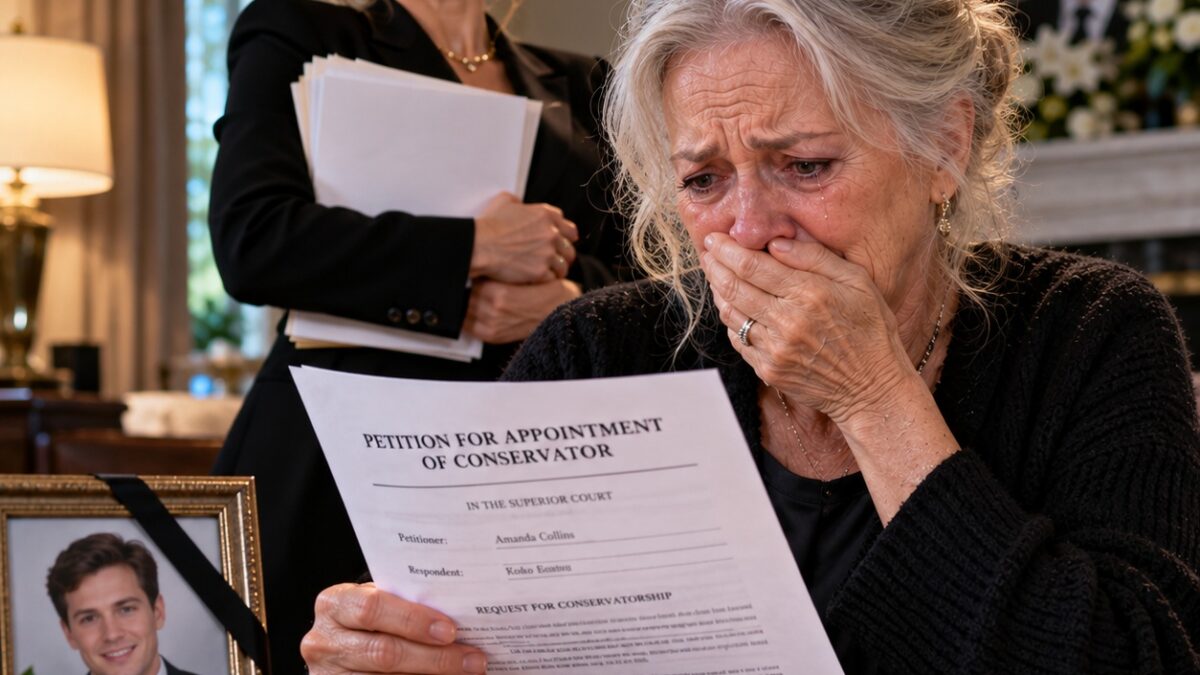
Then came the certified letter.
I signed for it at the door.
The return address belonged to a law firm I didn’t know.
Inside was a petition.
PETITION FOR APPOINTMENT OF CONSERVATOR.
At first, the words were legal noise.
Then their meaning became clear.
Amanda wanted the court to declare me unable to manage my own life.
The petition alleged cognitive decline.
Paranoia.
Confusion.
Financial irresponsibility.
It described my decision to hide my address as proof of irrationality.
My accusations against Amanda were characterized as delusions.
My refusal to let her manage my affairs was described as evidence that I couldn’t understand my own best interests.
Then I reached the supporting statements.
Two of Amanda’s friends.
And a psychiatrist.
I read his name three times.
I had never met him.
Yet he had submitted an opinion suggesting dementia.
My hands started shaking.
There was a hearing date.
Two weeks away.
If Amanda succeeded, she could potentially make decisions about my money.
My health care.
My residence.
Maybe even the trust.
I called Michael.
“Amanda is trying to have me declared incompetent.”
Silence.
Then:
“Bring me the papers.”
“Can she do this?”
“She can file.”
“Can she win?”
His pause terrified me.
“Koko, conservatorship proceedings are serious.”
My voice dropped.
“I’m not incompetent.”
“I know.”
“But what if the judge believes her?”
“Then we’re going to make sure the judge sees the evidence.”
An hour later, he finished reading.
His face was grim.
“This is not about inheritance anymore.”
“What is it about?”
“Control.”
He looked at me.
“If she obtains authority over you, she doesn’t simply gain access to financial decisions. She could have influence over where you live and how your assets are managed.”
I felt suddenly small.
Not mentally.
Humanly.
For the first time, I understood how vulnerable an older adult could become once someone successfully convinced other people that age itself meant incapacity.
“What do we do?”
“We document reality.”
Michael recommended an independent medical evaluation.
My longtime physician also agreed to assess me.
We hired an investigator.
And what he found made Amanda’s petition look even darker.
She had hired someone to follow me.
That was how she’d found the Oak Park house.
Someone connected to Amanda had improperly accessed information from my doctor’s office.
The psychiatrist who wrote the statement had never examined me.
He had based his comments largely on descriptions provided by Amanda’s relatives.
And Amanda had spoken to real-estate professionals about properties connected to Jackson.
Including mine.
“She knows about the house?” I asked Michael.
“She knows a property exists.”
“Does she know it’s mine?”
“She appears to suspect it.”
I suddenly understood everything.
The calls.
The surveillance.
The candle.
The waiver.
The rumors.
This wasn’t random greed.
Amanda believed Jackson had hidden something.
And she wanted legal authority powerful enough to reach it.
Then she came to my door.
Not alone.
She brought a woman she described as “a friend who helps older people.”
The woman was a geriatric case manager.
“Koko,” Amanda said, “I’ve been worried.”
“How thoughtful.”
She ignored my tone.
“I think it would be good for someone to evaluate what support you need.”
“I don’t need support.”
The case manager smiled professionally.
“Maybe we can just talk.”
So I let them.
Not because I trusted them.
Because Michael had told me something important.
“Do not give her a dramatic confrontation she can later describe as unstable behavior.”
So I sat.
Answered questions.
Medication?
One blood-pressure pill.
Cooking?
Daily.
Driving?
Yes.
Bills?
Paid electronically and on time.
Appointments?
Managed myself.
Housework?
Some myself, some hired.
Memory?
Normal for a sixty-seven-year-old woman who occasionally forgot where she’d left her glasses because they were on top of her head.
The case manager eventually looked uncomfortable.
There was nothing to evaluate.
Amanda stood at the door before leaving.
She smiled.
“Don’t worry, Koko.”
“I wasn’t.”
“Soon I’ll handle everything.”
My eyes met hers.
“All your concerns will be over.”
The threat was wrapped in sweetness.
But I heard it.
That night, I sat inside the house Jackson had created for me.
And I cried.
Not from weakness.
From rage.
My son was dead.
I had barely learned how to wake up in a world without him.
And instead of being allowed to grieve, I was being forced to prove that grief had not erased my mind.
I walked into the small office.
Opened one of the boxes I’d brought from my apartment.
Inside were papers I’d taken from Jackson’s belongings.
At the bottom was a USB drive.
A label was attached.
INSURANCE.
I almost ignored it.
Then something told me to plug it in.
Folders appeared on the screen.
Statements.
Emails.
Audio files.
Photographs.
My heart began pounding.
Jackson had created an archive.
Credit-card bills.
Loan documents.
Messages between him and Amanda.
Recordings of arguments about money.
And then a video file.
I opened it.
Amanda stood outside an upscale hotel.
A man had his arms around her.
She kissed him.
The date was two months before Jackson died.
I closed the laptop.
Then opened it again because some truths cannot be escaped by refusing to look.
There was also a draft letter to a divorce attorney.
Jackson had written it one week before his accident.
He described Amanda’s debt.
Dishonesty.
Financial activity.
And affair.
He had been preparing to leave her.
My son had known.
He died knowing.
That hurt in a new place.
I thought about Thanksgiving.
Amanda leaving the room with her phone.
Jackson covering for her.
His long hug when I left.
I love you, Mom, more than you know.
Had he wanted to tell me?
Had he decided to wait until after Christmas?
Had he been afraid I’d blame myself?
Questions without answers are one of grief’s cruelest gifts.
The USB drive gave us something else.
Evidence.
I brought it to Michael.
He looked through the files.
When he finished, he leaned back.
“This changes the case.”
“Good.”
“Koko.”
“I said good.”
He studied me.
“What?”
“You don’t sound relieved.”
“Because I’d rather have my son than evidence.”
His face softened.
“I know.”
The night before court, I barely slept.
I walked through the house.
Touched the furniture.
Looked at Jackson’s photograph.
Finally, I sat on the edge of my bed.
“I won’t let her do it.”
My voice sounded strange in the quiet room.
“I won’t let her take what you protected.”
I stared at his photograph.
“And I won’t let her take me.”
The morning of the hearing, I wore a navy suit Jackson had bought for my birthday.
Beatrice drove me.
“You look terrifying,” she said.
“Good terrifying?”
“Judge’s-favorite-retired-principal terrifying.”
“I was never a principal.”
“They don’t know that.”
I laughed.
It was the first laugh I’d had in days.
Michael met us outside.
“Remember.”
“I know.”
“Short answers.”
“I know.”
“No speeches.”
I looked at him.
“You’re removing all my fun.”
“Koko.”
“Fine.”
Amanda was already inside.
She had transformed herself.
No diamonds.
No designer handbag.
Simple black dress.
Hair pulled back.
Minimal makeup.
She looked like the grieving widow of a public-service announcement.
When she saw me, she smiled.
That smile said she believed she’d already won.
Her attorney began by describing me as vulnerable.
Grief-stricken.
Confused.
Paranoid.
She mentioned my secret move to Oak Park.
My unwillingness to tell Amanda where I lived.
My accusations of surveillance.
My suspicion that documents Amanda sent me were financially dangerous.
Presented separately, each fact could sound troubling.
Then Amanda testified.
“I loved Jackson deeply.”
I looked at my hands.
“I promised him I would care for his mother.”
Her voice trembled beautifully.
“Since his death, Koko has changed.”
She looked toward me with practiced sadness.
“She forgets conversations.”
Lie.
“She has accused me of trying to steal from her.”
Not exactly.
“She believes people are following her.”
True.
Because they were.
“She disappeared into another residence and refused to tell family where she was.”
Also true.
“She has become suspicious of everyone trying to help.”
I almost admired the construction.
Amanda didn’t need every statement to be false.
She needed true facts stripped of context.
When Michael’s turn came, he didn’t begin with Amanda.
He began with me.
My physician testified first.
“Mrs. Baker shows no evidence of dementia or significant cognitive impairment.”
Amanda’s attorney shifted in her seat.
“She is independent, oriented, capable of understanding complex information, and perfectly able to manage her own affairs.”
Then came friends.
People who had known me for decades.
Thomas testified.
He described Jackson’s concerns.
Amanda’s face tightened.
Then Michael called me.
I took the oath.
Sat down.
He asked me basic questions.
My address.
Finances.
Daily life.
Medical care.
Then:
“Why did you move without telling Mrs. Amanda Baker?”
“Because I discovered behavior that frightened me.”
“What behavior?”
“She repeatedly asked about assets after my son’s death.”
Amanda stared at me.
“She attempted to locate where I was living.”
“Did she find you?”
“Yes.”
“How?”
“I later learned she had hired someone to follow me.”
Her attorney objected.
Michael moved on carefully.
“Did Mrs. Baker leave anything at your home?”
“A candle.”
“A candle concerned you?”
Her attorney emphasized the word as if it proved their entire case.
Michael almost smiled.
“Why did the candle concern you?”
“Because a security professional cut it open.”
Michael placed an evidence bag on the table.
“And what was discovered?”
“A listening device.”
The courtroom changed.
Amanda’s face lost color.
Michael continued.
“Did Amanda send you legal documents?”
“Yes.”
“What did you do?”
“I brought them to counsel.”
“Why?”
“Because I don’t sign legal documents I don’t understand.”
The judge nodded slightly.
Michael asked:
“And what did your counsel advise?”
“That the documents could broadly waive rights involving assets outside Jackson’s visible estate.”
Amanda looked toward her lawyer.
Her composure was beginning to crack.
Then Michael asked about the conservatorship psychiatrist.
“Have you ever met Dr. Leonard Pierce?”
“No.”
“Have you ever spoken to him?”
“No.”
“Has he examined you?”
“No.”
“Yet he offered a statement concerning your mental state?”
“Apparently.”
The judge’s expression hardened.
Next came the investigator’s report.
Evidence of surveillance.
Attempts to obtain private information.
Real-estate inquiries.
Then came Jackson’s USB drive.
Michael placed it on the table.
Amanda looked at it.
Something in her face told me she recognized it.
“Your Honor,” Michael said, “Jackson Baker had documented financial concerns regarding his wife before his death.”
Amanda whispered to her attorney.
Michael continued.
“The files include records of undisclosed debts, financial transactions, suspected unauthorized loan activity, and evidence Mr. Baker was considering divorce.”
Amanda stood.
“He had no right!”
The judge looked sharply at her.
“Mrs. Baker.”
“Those were private!”
“Amanda,” her attorney whispered.
“He was spying on me!”
The courtroom went completely still.
She had forgotten the role.
For weeks, she’d presented herself as the grieving widow protecting her confused mother-in-law.
Now she looked furious that the dead husband she claimed to honor had documented her behavior.
The judge noticed.
Everyone noticed.
Michael did not need theatrics.
He simply said:
“This petition is presented as an attempt to protect Mrs. Koko Baker.”
He looked toward the judge.
“But there is no credible medical evidence that she requires protection from herself.”
Then he glanced toward Amanda.
“There is, however, substantial evidence suggesting the petitioner had strong financial motivation to obtain control over Mrs. Baker’s affairs.”
My heart hammered.
Michael sat down.
The judge reviewed his notes.
It felt like hours.
It was probably minutes.
Finally, he looked at me.
“Mrs. Baker.”
“Yes, Your Honor.”
“I find no basis for a conservatorship.”
My breath left my body.
“You appear fully capable of managing your personal, medical, and financial affairs.”
I closed my eyes.
Beatrice squeezed my hand behind me.
Then the judge looked at Amanda.
“I am also troubled by certain aspects of how this petition was assembled and by evidence suggesting it may not have been brought entirely in good faith.”
Amanda’s face was rigid.
“The petition is denied.”
Three words.
My freedom remained mine.
I thought I would feel triumphant.
Instead, I felt exhausted.
Like someone had finally removed a weight I should never have been forced to carry.
We walked into the hallway.
Amanda stood with her attorney.
I could have left.
Michael probably wished I had.
But Jackson had asked me to watch.
I had watched enough.
“Amanda.”
She turned.
Her eyes were furious.
“What?”
“There is something you should know.”
Michael looked at me.
“Koko.”
I raised one hand.
“No. It’s time.”
Amanda frowned.
“What?”
“Jackson left me more than the amount in the primary will.”
Silence.
“He created a private trust.”
Her face changed.
I continued.
“He bought me a house.”
Her lips parted.
“Two cars.”
She stared at me.
“And funded an account so I would never have to depend on you.”
“You’re lying.”
“No.”
“The house?”
“The one you’ve been trying to identify.”
Her skin went pale.
“He bought it for me two years ago.”
“No.”
“He established the trust three years ago.”
She looked toward Michael.
His silence confirmed everything.
Amanda shook her head.
“Why?”
The question sounded almost childlike.
I looked at her.
“Because he was afraid.”
“Of what?”
“You.”
She recoiled.
I didn’t raise my voice.
“He knew about the credit cards.”
Her jaw tightened.
“He knew about the loans.”
“Koko—”
“He knew about the withdrawals.”
“Those were marital matters.”
“And he knew about the affair.”
Whatever anger remained in her face disappeared.
For the first time since Jackson died, Amanda looked genuinely shocked.
“He didn’t.”
“He did.”
“You’re lying.”
“He had video.”
Her eyes filled.
“He was preparing to speak with a divorce attorney.”
Amanda leaned against the wall.
“No.”
“The draft letter was dated one week before the accident.”
“No.”
I realized then that despite everything, there was one truth Amanda hadn’t known.
Jackson was leaving.
Maybe she had believed she still controlled him.
Maybe she thought the arguments would pass.
Maybe she thought his love would keep him inside the marriage indefinitely.
Death had frozen their relationship before she discovered otherwise.
“He loved me,” she whispered.
I looked at her.
“I think he did.”
That answer surprised her.
“And I think loving you was making him miserable.”
She flinched.
I continued.
“He provided for you anyway.”
Her eyes hardened again.
“With restrictions.”
“Yes.”
“He humiliated me.”
“No.”
I shook my head.
“He protected himself.”
Then I stepped closer.
“And he protected me.”
Amanda looked at the courtroom doors.
At Michael.
At me.
For weeks, she had treated me like an obstacle between herself and money.
Now she understood that Jackson had anticipated her.
I didn’t need to gloat.
The truth was enough.
“Stay away from me.”
She said nothing.
“If you come onto my property again, follow me again, attempt to access my medical information, or try to place surveillance devices inside my home, I will pursue every legal remedy available.”
Her attorney touched her arm.
“Amanda.”
I turned away.
For the first time since the hospital called me, I felt as though I had completed something Jackson had started.
Not revenge.
Protection.
Amanda did not appeal the decision.
Within weeks, she sold the house Jackson had left her.
The restrictions on the investment funds remained.
Later, I heard she moved to Florida.
I didn’t care where.
I cared that she was no longer standing outside my house.
I cared that nobody could legally tell me where I was allowed to live.
I cared that my son’s final act of planning had worked.
But winning did not make grief disappear.
I still woke some mornings expecting Jackson to call.
I still saw something funny and reached for my phone.
I still bought his favorite cookies once and didn’t realize what I’d done until I was standing in my kitchen.
There are losses no court can correct.
No money can replace a child.
The Oak Park house became something more valuable than an inheritance.
It became a place where I learned how to live without Jackson physically present.
That spring, I planted a garden.
Dogwoods.
Hydrangeas.
Black-eyed Susans.
Jackson had always liked them.
I knelt in the soil until my knees hurt.
Beatrice came over.
“You know they sell flowers already grown.”
“Go home.”
She laughed.
“You’re sixty-seven.”
“I am aware.”
“Your knees are sixty-seven too.”
“They’re complaining.”
“You don’t say.”
The garden grew.
Slowly.
So did I.
Michael helped me create a small foundation in Jackson’s name.
We provided financial education and modest scholarships to single parents trying to put children through college.
The first scholarship recipient was a woman raising two sons while working nights.
When she hugged me and cried, I thought about the years when Jackson and I had shared a one-bedroom apartment.
I thought about newspapers delivered before sunrise.
Northwestern.
His graduation speech.
Maybe this was what inheritance was supposed to mean.
Not only what someone left you.
What you chose to carry forward.
Friends who had believed Amanda’s stories eventually returned.
Nancy came first.
She stood on my porch holding a plant.
“I owe you an apology.”
“You brought a plant. That helps.”
She laughed nervously.
Then cried.
“I believed her.”
“I know.”
“She was so convincing.”
“I know.”
“I should have trusted you.”
I hugged her.
“We all want to believe people.”
“That doesn’t excuse me.”
“No.”
I pulled back.
“But I don’t want to spend what’s left of my life collecting grudges.”
Six months after court, an envelope arrived from Miami.
Amanda’s handwriting.
I considered throwing it away.
Instead, I opened it.
Three pages.
She said she had started over.
She admitted something I hadn’t expected her ever to put in writing.
Financial security had been one reason she was attracted to Jackson.
She insisted it wasn’t the only reason.
She claimed she had eventually loved him.
Maybe she had.
People are capable of loving someone and exploiting them at the same time.
That’s what makes betrayal complicated.
She apologized for what she’d done after his death.
She said fear had taken over.
Fear of losing money.
Security.
Status.
She asked me to forgive her.
Then included her phone number and address.
I read the letter three times.
Was it sincere?
Manipulation?
A little of both?
Eventually, I realized the answer no longer mattered.
Forgiveness did not require access.
Compassion did not require reconciliation.
I folded the letter.
Placed it inside a file.
And never responded.
A year after Jackson died, I began volunteering at a senior center.
I spoke about financial exploitation.
Not only scammers.
Family members.
Caregivers.
People who manipulate grief.
People who manufacture doubt.
People who try to make older adults feel childish because age makes them easier to control.
At one session, I met Arthur.
Retired English professor.
Widower.
Gentle voice.
Terrible coffee preferences.
He came up afterward.
“You scared half the room.”
“Good.”
“I’ve already changed all my passwords.”
“Excellent.”
He smiled.
“Would you like coffee?”
“If you’re buying.”
“That sounds financially exploitative.”
I laughed.
It startled me.
I had forgotten laughter could come without guilt.
Arthur and I became friends.
Nothing dramatic.
Coffee.
Concerts.
Books.
Walks.
He had three children and three grandchildren.
His wife had died three years earlier.
He understood that grief doesn’t leave because someone new sits beside you.
On the anniversary of Jackson’s death, Arthur came to the cemetery.
He stood at a respectful distance while I knelt near the grave.
I placed flowers beside the stone.
“Hi, baby.”
The word still came naturally.
I told Jackson about the foundation.
The garden.
The scholarship recipients.
Beatrice’s endless opinions.
Arthur.
I told him I had kept my promise.
I told him his plan worked.
Then I touched his name engraved in stone.
“I just wish you were here to see it.”
For a moment, grief felt exactly as sharp as the hospital.
Then something softer came with it.
Gratitude.
Thirty-six years.
I had been his mother for thirty-six years.
Not long enough.
Never long enough.
But enough to shape my entire life.
When I returned to Arthur, he said:
“You raised a remarkable man.”
I wiped my eyes.
“He was better than me.”
“Most parents hope their children will be.”
We walked toward the car.
He added:
“The way he protected you after he was gone says a lot about him.”
I stopped.
“And about you.”
“What about me?”
“He knew you’d use what he left you wisely.”
That evening, I sat on my porch.
The sunset turned the sky orange and pink.
The garden moved in a light breeze.
For years, I had thought strength meant enduring.
Work harder.
Sleep less.
Keep going.
Raise the child.
Pay the rent.
Do whatever has to be done.
Jackson taught me another kind of strength after he died.
Strength can also mean believing yourself when someone else is trying to rewrite you.
It means protecting boundaries even when the person crossing them calls it love.
It means asking questions before signing papers.
It means understanding that being older does not make you incapable.
Grief does not make you incompetent.
Trust does not require blindness.
And forgiveness does not require handing someone another weapon.
I will always miss my son.
There is no inspirational ending that changes that.
Some mornings, I still wake with a weight in my chest.
Sometimes I hear a man’s laugh in a grocery store and turn around because for half a second I think it’s him.
Sometimes I stand in the kitchen of the house he bought me and hate that he had to die for me to enter it.
But I also understand now what Jackson was trying to give me.
It wasn’t a house.
It wasn’t two cars.
It wasn’t money.
It was choice.
The same thing Amanda later tried to take.
The right to decide how I would live.
Where I would live.
What I would do with the years still belonging to me.
My son’s final gift wasn’t wealth.
It was independence.
And when Amanda tried to take that from me, I defended it not because I cared more about money than family.
I defended it because Jackson had spent his last years making sure no one could turn my vulnerability into dependence.
One evening, I found the original letter he’d left with Michael.
I had read it so many times that the folds were soft.
I sat beside the window.
Read the final lines again.
Don’t feel guilty for accepting what I prepared for you.
You gave me everything when I had nothing.
Let me give you this.
I pressed the page against my chest.
For most of my life, I thought parenthood meant giving without expecting anything back.
And it does.
But I had forgotten that children grow up.
Sometimes they become the people who protect us.
Sometimes they see dangers we don’t want to see.
Sometimes they leave pieces of themselves behind in houses, gardens, scholarship funds, handwritten letters, and decisions made quietly years before they are understood.
Jackson couldn’t save his marriage.
He couldn’t survive that icy highway.
He couldn’t sit beside me in the courtroom.
But he still protected me.
And when the moment came, I protected myself.
That mattered.
Because losing someone you love should never mean losing your identity with them.
I had been Jackson’s mother.
I would always be Jackson’s mother.
But I was also still Koko.
A sixty-seven-year-old woman.
A widow.
A friend.
A homeowner.
A volunteer.
A woman learning that life could contain grief and laughter in the same afternoon.
A woman who could miss her son and still enjoy coffee with Arthur.
A woman who could forgive friends without inviting Amanda back into her life.
A woman who had been underestimated once too often.
Months later, I stood in the garden with my hands covered in dirt.
One of the black-eyed Susans had finally bloomed.
I took a photograph.
My first instinct was to send it to Jackson.
I opened my phone.
His name was still in my contacts.
For a moment, the ache returned.
Then I smiled.
“Look at that,” I whispered.
The flower moved in the breeze.
Maybe healing is not letting go.
Maybe that’s the wrong phrase.
I haven’t let go of Jackson.
I don’t want to.
Maybe healing is learning how to carry love after the person who gave it to you can no longer carry it with you.
I put my phone away.
Arthur was waiting on the porch with two cups of coffee.
Beatrice was due in an hour, probably prepared to criticize something about my garden.
The foundation had interviews scheduled the following week.
There were bills to pay.
Books to read.
People to help.
A life still waiting to be lived.
I walked toward the porch.
Before going inside, I looked back at the house.
The house Amanda had tried to reach.
The house Jackson had hidden.
The house that had once represented secrecy and fear.
It didn’t feel secret anymore.
It felt mine.
Not because my name was on the trust.
Because I had fought for the right to decide what happened inside my own life.
And I finally understood something I wish I had understood years earlier.
People who truly love you do not need to control you.
Jackson protected my independence.
Amanda tried to remove it.
That difference told me everything.
I had lost my son.
I had lost the daughter-in-law I once believed I knew.
I had lost friends temporarily.
I had lost my certainty that kindness always reveals character.
But I had not lost myself.
And when I think about that courtroom now, I don’t remember Amanda’s face when the judge denied her petition.
I don’t remember the shock when she learned about the trust.
I remember one quieter moment.
Walking out through the courthouse doors.
Cold air touching my face.
Beatrice beside me.
Michael a few steps behind.
And realizing nobody else had the authority to decide where I went next.
I could turn left.
I could turn right.
I could go home.
I could stop for lunch.
I could sit in a park.
I could change my mind.
I could live.
That freedom had always seemed ordinary before someone tried to take it.
Now it felt sacred.
Jackson had spent his life promising that one day I would never have to worry about money again.
In the end, he gave me something greater.
He reminded me that the life remaining after tragedy was still mine.
And I intend to live every day of it that way.

