PART 2 :My Son-in-Law Locked Me in a Garage, Drained My $8,000 Pension, and Bet No One Would Believe an Old Woman
PART 2 and FULL ENDING  Thank you

Six months earlier, I would have told you I trusted Derek.
Not completely.
A mother always sees things in the people her children marry that her children would rather she ignore.
But I trusted him enough.
Enough to sit at his kitchen table.
Enough to sleep beneath his roof.
Enough to hand over money.
That was the mistake I spent months blaming myself for.
Before Derek, there had been Harold.
My husband for forty-five years.
My best friend for longer than I knew how to measure.
Harold had been the sort of man who repaired things long after replacing them would have been easier.
Toasters.
Fence posts.
Relationships.
He believed almost anything could be saved if people were patient enough.
We raised two children together.
Sarah, our oldest, was emotional and generous and always too quick to believe people she loved.
Michael was different.
Quiet.
Analytical.
The kind of child who took apart a broken radio because he needed to understand why it had stopped working.
Harold used to joke that if the house ever burned down, Sarah would rescue the family photographs while Michael investigated the wiring.
Then Harold died.
There was no warning grand enough to prepare me.
His health had declined for months, but I had convinced myself we still had years.
People do that.
We bargain privately with time as though time cares.
After forty-five years, you stop imagining yourself as one person.
You become a system.
Harold knew which side of the grocery store I started on.
I knew exactly how long he would stare into the refrigerator before asking where something was that sat directly in front of him.
He made coffee before I woke.
I reminded him which relatives he had already told certain stories to.
At night, he reached for my hand without thinking.
Then one morning there was only one cup beside the coffeemaker.
One pillow untouched.
One side of the closet that would never change again.
Grief did not arrive as one dramatic collapse.
It came through ordinary things.
Mail addressed to both of us.
His reading glasses on the end table.
A grocery list where his handwriting ended halfway down the page.
The first time I accidentally bought his favorite cereal, I stood in the aisle holding the box and crying.
Two months after the funeral, Sarah began visiting more often.
At first, those visits saved me.
She brought groceries.
Helped me sort Harold’s clothes.
Sat beside me while we looked through photographs.
She let me tell the same stories repeatedly.
Sometimes we laughed.
Sometimes we both cried.
One afternoon, while folding Harold’s sweaters, she became unusually quiet.
“What is it?” I asked.
“Nothing.”
“Sarah.”
She sat on the edge of the bed.
“Derek lost his job again.”
I stopped folding.
“When?”
“Three weeks ago.”
“Why didn’t you tell me?”
“We didn’t want to worry you.”
“What happened?”
“The construction company cut staff.”
Her eyes filled.
“We’re behind on the mortgage.”
“Oh, honey.”
“I don’t know what we’re going to do.”
I sat beside her.
“Let me help.”
“No.”
“That wasn’t a question.”
“Mom, you just lost Dad.”
“And I did not lose the ability to write a check.”
She laughed through her tears.
“We can’t take your money.”
“You can accept help.”
“You need to think about your future.”
“I am thinking about my future. My future includes my children not losing their home.”
She hugged me.
I remember that hug.
Sometimes I wish I didn’t.
Because for months afterward, I tried to identify the exact point where my daughter’s genuine worry ended and Derek’s plan began.
I still do not know.
A few weeks later, Derek started coming with her.
At first, he was wonderful.
That is difficult for people to understand after they know what he eventually did.
They imagine evil announces itself.
It rarely does.
Derek arrived carrying groceries.
Fixed a leaking faucet.
Changed a bulb above the stairs.
Took the trash cans to the curb.
He asked whether I was sleeping.
Whether the house felt too large.
Whether I worried about falling.
His concern seemed thoughtful.
“Agatha, these stairs make me nervous.”
“I’ve been walking up them for thirty years.”
“That’s not the point.”
He touched the banister.
“What happens if you fall and no one knows?”
“I have my phone.”
“What if you can’t reach it?”
I smiled.
“You sound like Harold.”
Derek smiled back.
“Maybe he and I would’ve agreed about some things.”
That sentence touched me more deeply than he probably realized.
Or perhaps he knew exactly what it would do.
A lonely widow will forgive a great deal in someone willing to speak kindly about her dead husband.
The conversations gradually changed.
At first, Derek suggested practical modifications.
Handrails.
Better lighting.
A medical alert system.
Then he mentioned how expensive maintaining my house would become.
The roof would eventually need work.
The yard was too large.
Property taxes kept rising.
“You shouldn’t spend retirement worrying about maintenance.”
“What would you suggest?”
He hesitated as though the idea had only just occurred to him.
“You could live with us.”
I laughed.
“I’d drive you insane.”
“You wouldn’t.”
“Ask Sarah.”
Sarah smiled.
“I’d love having you.”
Derek leaned forward.
“Think about it. You wouldn’t be alone. We could help each other. Sarah would stop worrying.”
“And what would I do with this house?”
“Sell it.”
The word landed strangely.
This was not just a house.
Harold and I had raised our children there.
Michael had broken his wrist falling from the maple tree in the backyard.
Sarah had come downstairs wearing her prom dress on those stairs.
Harold had built shelves in the basement.
We had hosted Christmas dinners and graduation parties and thirty-five wedding anniversaries beneath that roof.
Selling it felt like erasing something.
Derek must have seen my hesitation.
“You wouldn’t be losing the memories.”
I looked at him.
“You’d just be leaving the building.”
There are sentences that sound wise when you are vulnerable.
I believed him.
Two weeks after listing the house, it sold for two hundred eighty-five thousand dollars.
After paying the remaining mortgage and closing costs, I had roughly two hundred thirty thousand left.
That money should have gone into my accounts.
Instead, I gave most of it to Sarah and Derek.
Even now, I can hear Harold’s voice in my mind asking the obvious question.
Why?
Because I was grieving.
Because my daughter was struggling.
Because Derek was unemployed.
Because they were behind on their mortgage.
Because family took care of family.
Because I had a widow’s pension, Social Security, and investment income.
Because I believed I had enough.
Because people often make their most expensive decisions while trying to prove love.
When I told them, Sarah burst into tears.
“Mom, no.”
“Yes.”
“This is too much.”
“Then use it wisely.”
She hugged me so tightly I could barely breathe.
“We’ll pay you back.”
“Nonsense.”
Derek stood behind her.
“Agatha, are you sure?”
His words were hesitant.
His eyes were not.
“This changes everything.”
“That’s the idea.”
“We can pay off our debts.”
“Good.”
“Maybe repair the house.”
“Good.”
“Maybe start thinking about having kids.”
Sarah laughed.
“Slow down.”
For the first time since Harold’s funeral, I felt useful.
That feeling mattered.
Widowhood had turned me into someone everyone wanted to protect.
Don’t lift that.
Don’t drive at night.
Don’t worry about this.
Let me handle that.
Giving Sarah the money made me feel like myself again.
Capable.
Needed.
Generous.
I moved into their spare bedroom the following week.
The first month was almost happy.
We ate dinner together.
Watched movies.
Sarah and I shopped on Saturdays.
Derek carried laundry upstairs for me.
When insomnia kept me awake, he sometimes sat at the kitchen table drinking coffee while I told him stories about Harold.
He seemed fascinated by our financial life.
At first, the questions sounded responsible.
“How does Harold’s pension work?”
“Lifetime survivor benefit.”
“How much?”
“About eight thousand a month.”
His eyebrows rose.
“That much?”
“Harold had a good plan.”
“And Social Security is separate?”
“Yes.”
“What about investments?”
“I have an adviser.”
“Do you pay him?”
“Of course.”
“Probably too much.”
I smiled.
“You sound jealous.”
“I just hate seeing companies take advantage of older people.”
The irony makes me sick now.
He began offering to help organize my statements.
I resisted.
Then he framed it as a favor.
“Let me handle the mail while you settle in.”
“I can handle mail.”
“I know. I just mean address changes are messy.”
He was right.
Pension statements went to my old house.
Insurance notices arrived late.
A bank sent replacement forms.
Derek offered to manage the forwarding.
Then he helped me create online accounts.
Then he suggested combining automatic payments.
Every step was small.
Reasonable.
Helpful.
That is how control often enters.
Not through a locked door.
Through convenience.
Two months after moving in, I realized I had not seen a bank statement in weeks.
“Derek?”
He was watching television.
“What?”
“Have you seen my pension statement?”
“I think there was a processing delay because of your address.”
“What about the bank?”
“Probably the same.”
“I’ll call tomorrow.”
“No need. I already did.”
I looked at him.
“You called my bank?”
“Just customer service.”
“They spoke to you?”
“I was helping.”
Something tightened in my stomach.
“Please give me the number you called.”
He laughed.
“Agatha, relax.”
“I am relaxed.”
“You’re getting worked up.”
“I asked for a phone number.”
He muted the television.
“Sarah!”
“What?”
“Your mom’s upset.”
I felt as though he had slapped me.
“I’m not upset.”
Sarah came downstairs.
“What happened?”
“Nothing happened.”
Derek sighed.
“She’s worried about her banking again.”
“Again?”
I stared at my daughter.
“I asked one question.”
Sarah sat beside me.
“Mom, Derek’s been helping with everything. You don’t need to stress.”
“I’m not stressed.”
“Okay.”
That word.
Okay.
Soft.
Careful.
The tone people use when they believe disagreement might upset a confused person.
I went upstairs and cried quietly in my room.
Not because of money.
Because something in the house had shifted and I could not explain what it was.
A few days later, Derek left his office door open.
I had gone in searching for a stapler.
That was when I found the statements.
Mine.
Hidden beneath a folder.
The first balance I saw was thirty-seven dollars and eighteen cents.
I thought I had opened the wrong account.
Then I saw my name.
I sat in Derek’s desk chair and read every page.
My pension was no longer being deposited into my usual account.
Eight thousand dollars a month had been redirected to an account I had never opened.
There were transfers.
Withdrawals.
Payments to creditors.
Large cash transactions.
My hands began shaking.
I checked another document.
Derek’s name appeared on the account.
For nearly two months, he had intercepted my income while telling me paperwork was delayed.
I do not know how long I sat there.
Long enough for grief to become disbelief.
Disbelief to become fear.
Fear to become anger.
The next morning, I waited until Sarah left for work.
Then I placed the statements across the kitchen table.
Derek walked in carrying coffee.
“Morning.”
“We need to talk.”
He smiled.
“Of course.”
He saw the papers.
The smile vanished.
That was the first time I met the real Derek.
“I found these in your office.”
His expression became flat.
“You went through my things.”
“They’re my bank statements.”
“My office is private.”
“My money is missing.”
He placed his mug down.
Very carefully.
“Sit down, Agatha.”
“I’m already sitting.”
“Then listen.”
He pulled out the chair across from me.
“You live here.”
“Yes.”
“You eat here.”
“Yes.”
“You use utilities.”
I stared.
“What does that have to do with my pension?”
“Everything.”
“That money belongs to me.”
He laughed once.
“No.”
I felt cold.
“What?”
“You can’t properly manage money anymore.”
“I managed money for forty-five years.”
“And now you’re older.”
“That doesn’t make it yours.”
“You gave us two hundred thousand dollars.”
“I gave you a gift.”
“Which is gone.”
My stomach dropped.
“What do you mean gone?”
“Debt.”
“All of it?”
“Life is expensive.”
“Derek.”
“Don’t use that tone.”
I stood.
“I am calling the bank.”
His chair scraped backward.
He stood too.
“No, you’re not.”
I had never been afraid of him before.
That morning I was.
He was taller than Harold had been.
Broad through the shoulders.
And when he stepped toward me, there was no charm left.
“You will leave my pension alone.”
“No.”
“I’ll call Sarah.”
“She knows you’re having problems.”
“What problems?”
He opened a kitchen drawer.
Pulled out a thick folder.
Placed it between us.
I opened it.
Power of attorney documents.
Medical evaluations.
Guardianship paperwork.
My name.
My date of birth.
Language describing cognitive impairment.
Memory loss.
Confusion.
Early-stage dementia.
I looked up.
“What is this?”
“Documentation.”
“I’ve never had a dementia evaluation.”
“According to Dr. Martinez, you have.”
“I have never seen a Dr. Martinez.”
Derek smiled.
“Amazing how cooperative doctors can be when they’re given the right information.”
My hands went numb.
“You forged this.”
“I protected the family.”
“This is a crime.”
“Careful.”
“Sarah knows?”
His expression softened into something almost paternal.
“Sarah knows her mother is struggling.”
“I am not struggling with dementia.”
“That’s exactly what someone with dementia would say.”
I stared at him.
The cruelty was not in the words.
It was in how well he had prepared them.
Every denial became evidence.
Every objection became confusion.
Every attempt to defend myself could be described as agitation.
“You’ve lied to her.”
“I spared her.”
“About what?”
“About how bad you are.”
I stood there looking at a man I had helped save from foreclosure.
A man who had eaten at my table.
A man who had listened to stories about my dead husband.
“You are sick.”
He shrugged.
“I’m practical.”
“I’ll call Michael.”
Derek laughed.
“With what?”
I instinctively reached toward the counter where my cell phone normally sat.
It had “stopped working” the previous week.
Derek claimed the battery was defective.
“The house phone—”
“For household use.”
“I live here.”
“You’re not calling anyone.”
“My son has been trying to reach me.”
“Oh, he calls.”
My heart jumped.
“What?”
“Michael calls regularly.”
“And?”
“I tell him you’re doing great.”
“You tell him—”
“Sometimes I say you’re sleeping.”
He smiled.
“Sometimes busy.”
“You keep him from me?”
“It’s easier.”
I felt the room tilt.
That was when I understood.
The money was only part of it.
Derek had been cutting every line between me and anyone who might believe me.
I looked toward the front door.
He saw it.
“Don’t.”
“I’m leaving.”
“Where?”
“Anywhere.”
“With what money?”
“I’ll go to Michael.”
“You don’t even know where your phone is.”
“I’ll ask a neighbor.”
He stepped closer.
“If you leave this house telling people crazy stories, I’ll have you institutionalized.”
I stopped.
“You wouldn’t.”
“I have medical paperwork.”
“It’s fake.”
“Can you prove that?”
I said nothing.
“Your daughter will tell people you’ve been confused.”
“She wouldn’t.”
“She already has.”
My chest tightened.
“You’ve been wandering at night.”
“No.”
“Getting agitated.”
“No.”
“Forgetting meals.”
“That never happened.”
“See?”
He smiled.
“You don’t remember.”
I understood then why predators like Derek were dangerous.
He did not merely lie.
He built systems around the lie.
He made the truth difficult to prove.
Then he leaned closer.
“If you behave, everything stays peaceful.”
“And if I don’t?”
“We’ll find another care arrangement.”
“What does that mean?”
He held my gaze.
“You’re smart enough to figure it out.”
I lowered my eyes.
Not because he had defeated me.
Because for the first time, I believed he might seriously hurt me.
“I understand.”
His charm returned.
“Good.”
Then, almost casually, he said, “I think you should move into the garage.”
I looked up.
“What?”
“Sarah says you’re disturbing her sleep.”
“That’s not true.”
“She worries when you wander.”
“I don’t wander.”
“We converted it.”
“You put a bed in the garage?”
“You’ll have privacy.”
“No.”
His eyes hardened.
“It wasn’t a request.”
Sarah came home that evening.
I tried to speak to her.
“Sweetheart.”
She looked exhausted.
“Mom, Derek told me you had another episode.”
“I did not.”
She closed her eyes.
“Please.”
“He is stealing from me.”
“Mom.”
“Listen.”
“Your doctor says this paranoia can happen.”
“What doctor?”
“Dr. Martinez.”
“I have never met him.”
Sarah’s face crumpled.
“Mom, you met him.”
“No.”
“You don’t remember.”
I grabbed her hands.
“Look at me.”
She did.
“I am your mother.”
“I know.”
“I do not have dementia.”
Tears filled her eyes.
“Then why would Derek lie about that?”
That question destroyed something inside me.
Because I realized she trusted him more than she trusted the woman who had raised her.
I whispered, “Money.”
She pulled away.
“Dad always said money changes people.”
“Yes.”
“But I never thought he meant you.”
I felt the words land.
“Sarah.”
“You gave us that money and now you keep acting like Derek stole it.”
“He is stealing from me now.”
“He’s managing your finances.”
“No.”
“Mom, please stop.”
I watched my daughter walk upstairs.
Derek appeared in the hallway behind her.
Our eyes met.
He smiled.
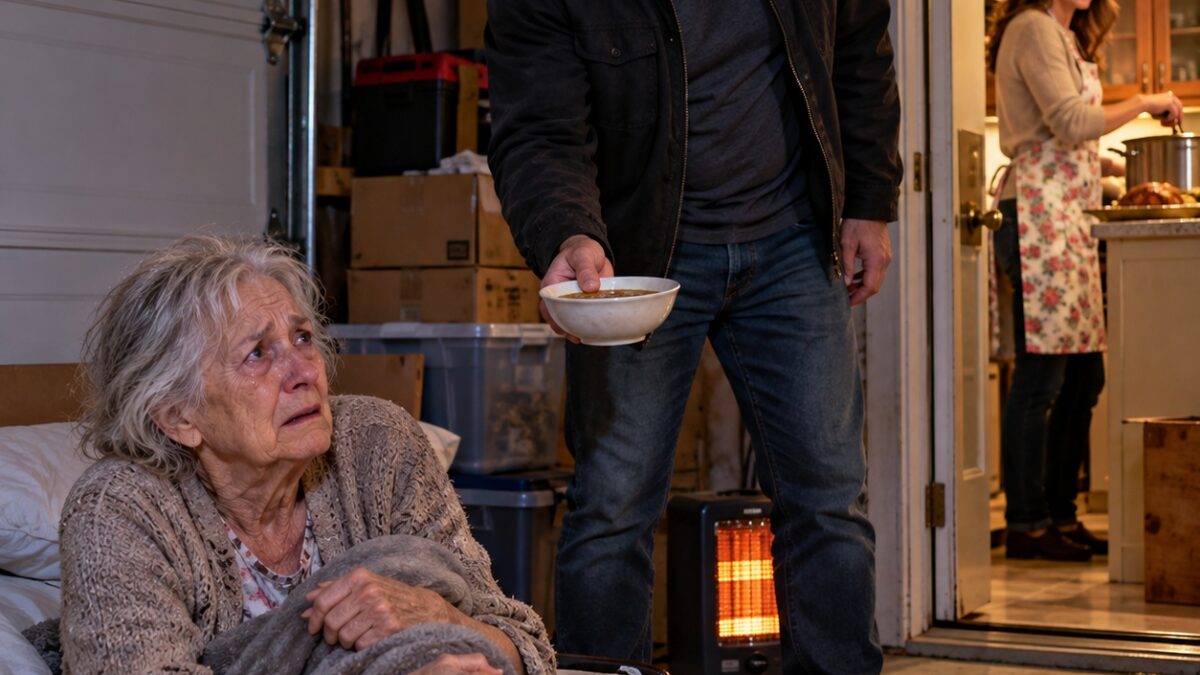
The garage was ready by morning.
A mattress.
A space heater.
A thin blanket.
The toilet.
Sarah stood near the doorway looking uncomfortable.
“Are you sure she’ll be warm?”
Derek kissed her forehead.
“She’ll be fine.”
“I can sleep upstairs.”
He looked at me.
“You get confused at night.”
“I do not.”
Sarah flinched.
“Mom.”
I stopped.
Derek gave me a warning look.
“This is temporary,” he told her.
“For everyone’s safety.”
Sarah nodded.
Then she hugged me.
“I love you.”
I stood stiffly in her arms.
“I love you too.”
She walked back into the house.
Derek waited until she disappeared.
Then he shut the garage door.
The lock clicked.
That sound changed my life.
The first week was unbearable.
Derek brought food once a day.
Sometimes twice if Sarah was watching.
He told her I was eating separately because routine helped dementia patients.
He gave me tea.
The tea made me sleepy.
Foggy.
I lost track of time.
Once, Sarah came into the garage and asked if I remembered what day it was.
I guessed wrong.
Her face fell.
After she left, Derek crouched beside me.
“See?”
I was terrified.
What if he was right?
What if I really was losing my mind?
Then one night I saw powder in the bottom of the tea.
Tiny pale granules.
I smelled it.
Bitter.
I did not drink.
I poured it into an old coffee can behind paint tins.
The next morning, my head felt clearer.
I skipped it again.
Clearer still.
By the fourth day, the fog had lifted enough for rage to return.
He was drugging me.
Not enough to kill me.
Enough to confuse me.
Enough to create symptoms that matched his documents.
From then on, I pretended.
When Derek brought tea, I drank only when he watched.
Then spat it into a rag.
When medication appeared in soup, I ate around it.
I began thinking again.
Planning.
The rear garage wall had old wooden boards near a storage alcove.
Two were loose.
For days, I worked at them with a rusty screwdriver.
A quarter turn at a time.
I waited until Sarah left for work and Derek drove away one morning.
Then I pulled the board loose.
The opening was narrow.
I scraped my shoulder.
Tore my sweater.
But I fit.
Outside air hit my face.
I almost cried.
I walked.
No coat.
No phone.
No purse.
Three blocks.
That was as far as I made it.
Derek’s car appeared on Maple Street.
He drove slowly.
Looking.
Hunting.
I considered running.
My legs were too weak.
Two women were walking dogs nearby.
Derek stopped.
Jumped out.
“Agatha!”
He sounded relieved.
“There you are!”
The women watched.
He approached me with his arms open.
I backed away.
“Don’t touch me.”
Their expressions changed immediately.
Not toward him.
Toward me.
Concern.
Pity.
Derek lowered his voice.
“She has Alzheimer’s.”
My heart sank.
“Sometimes she wanders.”
“That is not true.”
One woman gave me a sad smile.
“Oh, honey.”
“Please listen to me.”
Derek shook his head sympathetically.
“We’ve been trying to keep her safe.”
“He’s stealing my money.”
The women exchanged glances.
I heard myself.
An elderly woman without a coat.
Disheveled.
Claiming her son-in-law had stolen everything.
Exactly the story Derek had prepared them not to believe.
One woman touched my arm.
“You’re lucky to have family looking after you.”
I nearly screamed.
Derek opened the car door.
“Come on, Agatha.”
I had no choice.
In the driveway, his mask disappeared.
He turned off the engine.
“If you ever do that again…”
He looked at me.
“I will tell everyone you became violent.”
I said nothing.
“You’ll be committed.”
Still nothing.
“There are facilities where no one asks questions because everyone inside sounds exactly like you.”
I finally looked at him.
“You’re afraid.”
His eyes narrowed.
“Of what?”
“Of me talking.”
He slapped me.
Not hard enough to knock me unconscious.
Hard enough to remind me what he could do.
That night, he installed a deadbolt on the outside of the garage.
Then nailed boards over my escape gap.
The next weeks nearly broke me.
Hunger.
Cold.
Isolation.
The strange humiliation of hearing family life continue inches away.
Sarah laughing at television.
Cabinet doors closing.
The shower running.
Music.
Ordinary life.
Sometimes she opened the garage door.
“Mom?”
Derek always stood nearby.
“How are you?”
“Fine.”
“You comfortable?”
I would look at him.
“Yes.”
“Taking your medicine?”
“Yes.”
Sarah smiled sadly.
“We’re going to get you help.”
I wanted to say, I need help now.
Instead, I nodded.
That is the part people later struggled to understand.
Why didn’t you tell her?
Why didn’t you scream?
Why didn’t you run?
Why didn’t you fight?
Because survival changes the meaning of courage.
Sometimes courage is not screaming.
Sometimes courage is knowing when screaming will get you hurt before anyone believes you.
I scratched days into the side of the workbench.
One line each morning.
When I reached more marks than I could count at a glance, I stopped.
Then one morning I heard Derek’s phone ringing inside the house.
The garage shared a thin wall with the mudroom.
His voice carried.
“Michael! Hey, buddy.”
I pressed my ear against the wall.
My heart pounded.
“Yeah, your mom’s doing great.”
I closed my eyes.
My son.
“What?”
Pause.
“Oh, she’s resting.”
Another pause.
Derek’s tone changed.
“A visit?”
I held my breath.
“That’s thoughtful, but her doctor really wants us limiting excitement.”
I pressed closer.
“She’s had some cognitive issues.”
Long silence.
“Nothing serious.”
Derek laughed nervously.
“Maybe in a few weeks.”
Another pause.
“I’ll tell Sarah you called.”
The conversation ended.
I sat on the floor trembling.
Michael was suspicious.
I could hear it in Derek’s voice.
Three days later, I noticed an envelope beneath the garage door.
My name.
Michael’s handwriting.
I tore it open.
Mom,
I’ve been trying to reach you for weeks. Derek keeps saying you’re sleeping or busy. That doesn’t sound like you.
I’m worried.
I’m coming this weekend whether he likes it or not.
Stay strong.
Love,
Michael
I pressed the paper to my chest.
For the first time in three months, I smiled.
Saturday morning arrived gray and cold.
I barely slept.
Every engine made me sit upright.
Then I saw a blue Honda Civic turn into the driveway.
Same car Michael had driven since college.
I laughed and cried at the same time.
Derek came out of the house almost immediately.
Sarah followed.
From the garage window, I watched her run toward her brother.
“Michael!”
She hugged him.
He hugged her back.
But his eyes kept scanning the house.
“I called.”
His voice carried through the cold air.
“I told Derek I was coming.”
Derek held out a hand.
“Things have been crazy.”
Michael did not take it immediately.
“With Mom?”
“Her care needs.”
Michael looked at him.
“I want to see her.”
“Of course.”
Sarah smiled too quickly.
“She’s resting.”
Michael began walking toward the house.
Derek hurried beside him.
“Actually, she’s been confused lately.”
Michael stopped.
“What does that mean?”
“Early-stage dementia.”
Even from the garage, I saw my son go still.
“Who diagnosed her?”
“Dr. Martinez.”
“Where?”
“Riverside Medical.”
Michael pulled out his phone.
“I’ll call him.”
Derek’s face changed.
“No need.”
“I want to understand my mother’s condition.”
“He’s busy.”
“Then I’ll leave a message.”
“Michael—”
“Where is she?”
Sarah said, “Inside.”
“Show me.”
They disappeared.
Five minutes later, I heard Michael shouting.
“What do you mean she’s not in her room?”
My hands shook.
Footsteps.
A door slammed.
Then Michael came around the side of the house.
He saw the garage window.
Saw me.
Stopped.
I will never forget his face.
Confusion.
Then disbelief.
Then horror.
“Mom?”
I pressed both hands against the glass.
“Michael.”
He ran toward the door.
“Why is this locked?”
“Derek locked it.”
He pulled the handle.
“Mom, move back.”
He hit the door once with his shoulder.
Derek shouted from behind him.
“Michael!”
My son hit it again.
Wood cracked.
The third impact tore part of the frame away.
Michael came inside.
He stopped.
His eyes moved slowly around the garage.
The mattress.
The toilet.
The dirty dishes.
The thin blanket.
The scratches marking days.
Then he looked at me.
“Jesus Christ.”
I tried to stand.
My knees failed.
He caught me.
His arms felt like home.
“Mom.”
I buried my face against his chest.
“He took my money.”
“What?”
“He’s been drugging me.”
Michael pulled back.
His eyes dropped to my arms.
Bruises.
He touched one gently.
“Who did this?”
“Derek.”
His jaw tightened.
“How long?”
“Three months.”
“You’ve been living here three months?”
I nodded.
“He told Sarah I have dementia.”
Michael looked at my face.
“You don’t.”
“I know.”
“You look malnourished.”
“I am.”
He stood.
“Derek!”
The shout shook the garage.
Derek appeared.
Sarah behind him.
Her face went white when she finally saw the room properly.
“Mom?”
I looked at her.
Her hands rose to her mouth.
“You’ve been sleeping here?”
Derek stepped forward.
“I can explain.”
Michael moved between us.
“Do it.”
“Your mother has episodes.”
“She has bruises.”
“She falls.”
“I didn’t fall,” I said.
Sarah looked at me.
“Mom?”
“He did it.”
“No.”
Derek laughed nervously.
“She’s confused.”
Michael pointed at the lock.
“Why is the deadbolt outside?”
“For safety.”
“Whose?”
Silence.
Michael gestured toward the toilet.
“No running water.”
“We were working on it.”
“One space heater.”
“It works.”
“A mattress on concrete.”
“She insisted.”
I laughed.
It sounded almost strange after months without laughter.
Derek looked at me sharply.
“Something funny?”
“Yes.”
“What?”
“You’re running out of lies.”
Sarah stared at him.
“Derek?”
He turned.
“She’s been impossible.”
My daughter stiffened.
“What?”
“I’ve been doing everything.”
Michael stepped closer.
“You stole her pension.”
“I managed it.”
“You redirected eight thousand dollars a month into an account you control.”
Derek’s eyes changed.
“How do you know that?”
I looked at Michael.
So did Sarah.
My son ignored the question.
“You isolated her.”
“She needed supervision.”
“You drugged her.”
“That’s ridiculous.”
I pointed toward the coffee can.
“Check behind those paint cans.”
Michael found it.
Tea residue.
Crushed pills.
Derek’s face drained.
Sarah whispered, “What is that?”
Nobody answered.
Derek’s composure finally cracked.
“You all want the truth?”
Michael stared at him.
“Yes.”
“The truth is your mother was bleeding us dry.”
Sarah recoiled.
“What?”
“Eight thousand dollars a month.”
“That’s her money,” Michael said.
“She was sitting on it!”
My breath caught.
There it was.
Not denial.
Entitlement.
“We were drowning in bills.”
Sarah stared.
“We?”
Derek kept going.
“I did what needed to be done.”
“You stole from an elderly widow,” Michael said.
“I managed resources.”
“You locked her in a garage.”
“She had housing.”
“You drugged her.”
“To keep her calm.”
Sarah made a small sound.
Derek realized too late what he had admitted.
Michael slowly took out his phone.
“Say that again.”
Derek laughed.
“You think recording me scares me?”
“Should it?”
“Your mother isn’t the only person whose finances I manage.”
The sentence changed Michael’s face.
I saw something professional replace something personal.
“What did you say?”
Derek mistook his calm for weakness.
“I have clients.”
“Elderly clients?”
“People who need help.”
“Do their families know?”
“Sometimes.”
“Do they sign over accounts?”
“Sometimes.”
“Do you arrange medical evaluations?”
Derek smirked.
“When necessary.”
“Dr. Martinez?”
Silence.
Michael stared.
Derek shrugged.
“You’d be amazed what people will sign when they think Grandma is losing it.”
Sarah backed against the wall.
“Oh my God.”
Michael kept recording.
“How many?”
Derek laughed.
“You think I keep a list?”
“Probably.”
The arrogance vanished from Derek’s face for half a second.
Michael had guessed correctly.
Derek turned to me.
“You caused this.”
“No.”
“If you had minded your own business—”
“My money was my business.”
“You gave us everything.”
“I gave you two hundred thirty thousand dollars.”
“And it vanished.”
Sarah stared at him.
“What do you mean vanished?”
Derek ignored her.
I said, “Where did it go?”
“Debt.”
“All of it?”
His eyes slid away.
Michael noticed.
“What kind of debt?”
“None of your business.”
Then Derek glanced at a cardboard box near the garage wall.
Something seemed to occur to him.
He smiled.
“You know what your problem is, Michael?”
“What?”
“You’re sentimental.”
Michael said nothing.
“Just like her.”
Derek nodded toward me.
“She cried for days when I sold Harold’s Rolex.”
The world stopped.
“What?”
Derek looked at me.
I could not breathe.
Harold’s watch.
A Rolex I had given him for our twenty-fifth wedding anniversary.
I thought it was safely stored.
I planned to give it to Michael one day.
“You sold it?”
Derek shrugged.
“It was sitting around.”
“You told me it was in storage.”
“It helped cover her expenses.”
Michael’s voice became very quiet.
“What Rolex?”
“Your father’s.”
My son looked at me.
“You still had Dad’s watch?”
“I was saving it for you.”
Something in Michael changed.
He looked down at the watch on his own wrist.
Then he began removing it.
Slowly.
Derek frowned.
“What are you doing?”
Michael held his watch in his palm.
“I think we should clear something up.”
“What?”
“My job.”
Sarah looked confused.
“Michael?”
He had always been vague about work.
Federal compliance.
Financial investigations.
Government contracting.
Those were the phrases he used at holidays.
I knew his work involved financial crime.
I did not know how close it was about to come to my own life.
Michael opened his wallet.
Showed Derek his credentials.
“I’m a federal fraud investigator.”
Derek stared.
Michael continued.
“I specialize in elder financial exploitation.”
The color drained from Derek’s face.
“You’re bluffing.”
Michael held the identification closer.
Derek read it.
Then looked at him.
“No.”
“Yes.”
Sarah whispered, “Michael…”
He never looked away from Derek.
“My unit has been investigating suspicious elder-fraud patterns in this region for months.”
“You’re lying.”
“We’ve identified forged powers of attorney.”
Derek stopped breathing.
“Fraudulent incapacity evaluations.”
Silence.
“Suspicious transfers from pension and Social Security accounts.”
Derek’s eyes darted toward the house.
Michael noticed.
“And we’ve been looking at payments connected to a physician at Riverside Medical.”
Sarah covered her mouth.
“Dr. Martinez?”
Michael nodded once.
Derek suddenly laughed.
Too loudly.
“This is a family dispute.”
“No.”
“Your mother gave us money.”
“I’m not talking about what she gave you.”
Michael raised his phone.
“I’m talking about what you stole afterward.”
“You can’t prove anything.”
Michael’s voice remained calm.
“That’s what people say when they have never seen the evidence against them.”
Sweat appeared along Derek’s forehead.
He pointed toward the house.
“I have power of attorney.”
“Fraudulent.”
“I have medical evaluations.”
“Fraudulent.”
“You can’t know that.”
Michael smiled for the first time.
“Dr. Martinez has been more cooperative than you realize.”
Derek went still.
The silence felt dangerous.
Sarah looked between them.
“What does that mean?”
Michael answered without turning.
“It means federal investigators have been building a case.”
Derek’s jaw tightened.
“You set me up.”
“No.”
“You’ve been watching me?”
“I didn’t come here to arrest you.”
Michael looked at me.
“I came because I could not reach my mother.”
Then he faced Derek again.
“You decided to confess.”
Derek’s eyes moved to the phone.
“You recorded me.”
“Yes.”
He stepped forward.
Michael did not move.
“Give me the phone.”
“No.”
“Michael.”
“No.”
Derek grabbed Sarah’s arm.
She cried out.
Michael instantly shifted.
“Let her go.”
“She’s my wife.”
“You’re hurting her.”
Sarah struggled.
“Derek, stop.”
“Tell him!”
“What?”
“Tell your brother your mother is sick.”
Sarah stared at him.
Then at me.
At the mattress.
At my bruises.
At the deadbolt.
“I thought she was.”
“Tell him.”
“I thought you were helping her.”
“I am!”
“No.”
Her voice broke.
“No, you’re not.”
Derek tightened his grip.
“Sarah.”
“You lied to me.”
“I protected you.”
“You locked my mother in a garage.”
“She needed care.”
“You starved her.”
“I fed her.”
“One meal a day?”
His face twisted.
“She wasn’t contributing.”
Sarah stared at him.
“She gave us two hundred thirty thousand dollars.”
“That was gone!”
“Where?”
Derek said nothing.
“Where did it go?”
“I handled it.”
“Where?”
His eyes flashed.
“Enough.”
Michael took one step forward.
Derek released Sarah.
For a second, I thought it was over.
Then he reached inside his jacket.
The revolver appeared so suddenly Sarah screamed.
I stopped breathing.
Derek pointed it at Michael.
“No one moves.”
Michael raised both hands.
“Derek.”
“Shut up.”
“Think carefully.”
“I said shut up.”
Derek’s hand shook.
He looked less like the controlled predator who had terrorized me for months and more like a man discovering he had finally built a room with no exit.
“You’re going to delete the recording.”
Michael nodded slowly.
“Okay.”
“Now.”
“Let Sarah move away from you.”
“No.”
“She has nothing to do with this.”
“She’s my wife.”
“She’s terrified.”
Sarah was crying.
“Derek, please.”
He looked at her.
“You were supposed to support me.”
“I didn’t know.”
“You knew we needed money.”
“I didn’t know you were stealing it.”
“I did it for us!”
“You imprisoned my mother!”
His face contorted.
“I gave her shelter.”
I found my voice.
“You gave me a prison.”
Derek pointed the gun toward me for half a second.
Michael stepped sideways.
“Keep it on me.”
Derek looked back at him.
“Phone.”
Michael reached toward his pocket.
Then stopped.
“Before I give it to you, look at my watch.”
“What?”
“My watch.”
“I don’t care about your watch.”
“You should.”
Derek’s eyes flicked toward it.
Michael had removed it earlier after Derek mentioned Harold’s Rolex.
He held it in his open hand.
“Federal equipment.”
Derek stared.
Michael continued.
“Audio and video.”
“No.”
“Secure transmission.”
“You’re lying.”
“Real-time upload.”
Derek’s breathing became shallow.
“You delete my phone, you accomplish nothing.”
“That’s impossible.”
“The recording has already left the device.”
Derek’s eyes widened.
Michael held up the watch.
“It’s also transmitting my location.”
Silence.
“Do you really think a federal investigator working an active elder-fraud case came to a suspicious location without anyone knowing where he was?”
Derek’s gun hand began to shake harder.
“You came here for your mother.”
“I did.”
“So there’s no operation.”
“I said I came because of my mother.”
Michael’s voice hardened.
“I didn’t say I came alone.”
That was when we heard the sirens.
Far away.
Then closer.
Derek turned toward the driveway.
“No.”
The sound grew.
Sarah whispered, “Oh God.”
Derek looked at Michael.
“You planned this.”
“You planned this.”
“What?”
“Every stolen check.”
Another siren.
“Every forged signature.”
Closer.
“Every false medical report.”
Derek backed toward the wall.
“Every old person you chose because you thought no one would listen.”
Vehicles stopped outside.
Doors slammed.
Voices.
Derek raised the gun.
“If I go down—”
“Don’t.”
“I have nothing left.”
“You have a choice.”
“Shut up!”
A voice exploded through a loudspeaker.
“Derek Martinez! This is Special Agent Thompson with the Federal Bureau of Investigation. We have the property surrounded.”
Derek went white.
“Release the hostages and exit with your hands visible.”
“They know my name.”
Michael stared at him.
“Yes.”
“How?”
“Because you were never as careful as you believed.”
Derek looked toward the house.
Michael continued.
“You opened accounts using your real identity.”
“No.”
“You wrote checks connected to medical payments.”
“No.”
“You talked to people.”
“I never—”
“You bragged.”
Derek’s eyes widened.
“Poker games?”
Michael said nothing.
That was answer enough.
The loudspeaker sounded again.
“Derek Martinez, release everyone inside and surrender.”
Derek began sweating heavily.
Sarah whispered, “Put it down.”
“Don’t.”
“Please.”
“I did this for you.”
“No.”
“For our future.”
“No.”
“For our family!”
Sarah looked at me.
Then at him.
“My mother is my family.”
Derek recoiled as though she had struck him.
I saw it then.
The moment he realized he had lost everything he claimed he was protecting.
His wife.
His freedom.
His scheme.
His image.
His control.
“What happened to the money?” I asked.
Michael glanced toward me.
Derek stared.
“What?”
“My house money.”
Silence.
“My pension.”
Nothing.
“Where is it?”
Derek laughed bitterly.
“There were debts.”
“What debts?”
“Investments.”
Michael’s eyes narrowed.
“Gambling.”
“They were investments.”
Sarah stared.
“What?”
“Poker.”
“Oh my God.”
“Sports.”
Sarah began shaking her head.
“Cryptocurrency.”
“You stole my mother’s money to gamble?”
“I was going to multiply it.”
“You lost it.”
“I had bad timing.”
“You lost it.”
Derek’s voice rose.
“The Super Bowl was coming.”
Sarah stared as though she no longer recognized him.
“I had information.”
“You had an addiction.”
“It was a strategy!”
Michael spoke calmly.
“You owe people.”
Derek’s face changed.
That was the answer.
“How much?” Michael asked.
“Enough.”
“Dangerous people?”
Silence.
“Derek.”
“If I go to prison…”
He swallowed.
“They’ll kill me.”
Sarah’s face softened for one heartbreaking second.
Not because she forgave him.
Because she had loved him.
Love does not always disappear the moment truth arrives.
Sometimes it remains just long enough to make truth hurt more.
Michael lowered his voice.
“Then live.”
Derek looked at him.
“What?”
“Put the gun down.”
“You think prison is living?”
“It’s more living than forcing the agents outside to shoot you.”
Derek glanced toward the window.
Michael raised the watch slightly.
“They know you’re armed.”
“No.”
“They heard you threaten us.”
Derek’s mouth opened.
“They’re treating this as a hostage situation now.”
The loudspeaker returned.
“You have thirty seconds to surrender peacefully.”
Derek’s shoulders sagged.
I had spent months fearing him.
In that moment, he looked very small.
Not harmless.
Small.
There is a difference.
Michael said, “You want one thing you can still control?”
Derek looked at him.
“What?”
“How this ends.”
“I can’t fix it.”
“No.”
“I can’t pay everyone back.”
“Probably not.”
“I can’t undo what happened.”
“No.”
“What’s left?”
“The truth.”
Derek stared at him.
“Cooperate.”
Michael spoke slowly.
“Tell them who else is involved.”
Derek looked down.
“The doctor?”
“Yes.”
“Accounts?”
“Yes.”
“Other clients?”
“Yes.”
Michael’s voice remained steady.
“Help them recover what they can.”
Derek’s eyes filled.
“Will that matter?”
“It won’t erase what you did.”
I stepped forward slightly.
“But it will matter to the people you hurt.”
Everyone looked at me.
Derek’s face crumpled.
“I never meant…”
I almost laughed.
Not because anything was funny.
Because those words are so often spoken after deliberate cruelty.
You do not accidentally lock someone in a garage for three months.
You do not accidentally steal eight thousand dollars every month.
You do not accidentally forge dementia records.
You do not accidentally hide medication in someone’s food.
Still, I said nothing.
Derek looked at Sarah.
“What happens to us?”
She wiped tears from her face.
“Our marriage ended when you decided my mother was disposable.”
“Sarah.”
“I’ll testify.”
He closed his eyes.
“But…”
She struggled to speak.
“I hope you get help.”
Derek looked at me.
“Agatha.”
For months, hearing my name in his voice had made my stomach tighten.
Now it did nothing.
“I’m sorry.”
I studied him.
A man can be sorry because he hurt you.
Or because the consequences finally hurt him.
I did not know which one stood before me.
Maybe both.
“I hope you learn to understand what you did.”
He nodded.
Then slowly lowered the revolver.
Placed it on the concrete.
Raised his hands.
When he walked toward the front door, Michael followed several feet behind.
Sarah came to me.
For one second, neither of us knew what to do.
Then my daughter collapsed into my arms.
“I’m sorry.”
She sobbed against me.
“I’m so sorry.”
I held her.
“I believed him.”
“I know.”
“I thought you were sick.”
“I know.”
“I left you out here.”
I closed my eyes.
That wound would take longer.
But she was my daughter.
“I know.”
Federal agents entered.
Michael returned.
He wrapped one arm around both of us.
The three of us stood inside the garage where Derek had tried to erase me.
Outside, agents put him in handcuffs.
The nightmare ended there.
The consequences did not.
The first thing doctors told me at the hospital was that I was more physically compromised than I understood.
I had lost thirty-two pounds.
Malnutrition had weakened my muscles.
My bone density had suffered.
I was dehydrated.
The drugs Derek had been putting into my food and tea were still being identified.
Bruises covered both arms.
There was an older injury near my ribs from the day he shoved me against a workbench.
A nurse asked gently, “Did anyone hit you?”
“Yes.”
The word felt strange.
Because saying it to a professional made everything real in a new way.
“More than once?”
“Yes.”
“Did you feel afraid for your life?”
I thought about the institutions he threatened.
The locked garage.
The drugs.
The revolver.
“Yes.”
Sarah sat beside my hospital bed and cried through most of the interview.
I wanted to comfort her.
The nurse stopped me.
“You can love your daughter and still tell the truth.”
That sentence stayed with me.
Sarah had not imprisoned me.
Derek had.
But Sarah had failed to see what was happening.
Both things could be true.
Michael remained with federal investigators for most of the first forty-eight hours.
The case was larger than any of us understood.
Derek had not invented his “elder management” scheme for me.
I was one victim among several.
Investigators eventually tied him to seven elderly people over roughly two and a half years.
Seven.
That number haunted me.
I kept wondering what their garages had looked like.
Their basements.
Their spare rooms.
Their locked doors.
One woman, Mrs. Patterson, was seventy-three.
Derek had convinced her granddaughter and the granddaughter’s husband that she was cognitively impaired.
He arranged false evaluations.
Took control of her money.
Moved her into a basement.
Drained her retirement savings.
She died there.
Malnutrition.
Neglect.
When Michael told me, I had to sit down.
“She died?”
“Yes.”
“And he kept doing it?”
“Yes.”
I thought about Derek bringing me cold soup.
About him saying professional care was expensive.
About the way he watched me weaken.
“What would have happened to me?”
Michael did not answer.
He did not need to.
Derek’s arrest became part of a broader federal operation investigators called Operation Golden Years.
With his cooperation, authorities arrested twelve others connected to similar schemes.
One was the doctor responsible for fraudulent cognitive evaluations.
Another handled financial paperwork.
Others helped move money.
Some had convinced themselves they were providing services.
Some knew exactly what they were doing.
The total stolen from Derek’s known victims exceeded $1.2 million.
Money was recovered from accounts.
Assets.
Property.
Gambling platforms.
Some was gone forever.
Federal investigators eventually recovered approximately ninety-three percent of what Derek had taken directly from me.
That number should have made me happy.
It did not.
Money can be returned.
Time cannot.
Neither can the nights I spent hungry.
Or the moment I saw Sarah look at me like a woman she no longer trusted to understand her own life.
Sarah filed for divorce within a week.
The process was ugly.
Derek had moved stolen funds through joint accounts.
Her name appeared on documents she claimed she did not understand.
Investigators examined everything.
Sarah cooperated fully.
She gave them her phone.
Her computer.
Bank statements.
Messages.
Access to every account.
Then she entered therapy.
So did I.
At our first family session together, Sarah sat across from me twisting a tissue between her fingers.
“I don’t know how you can look at me.”
I said nothing.
“I left you there.”
“You believed you were protecting me.”
“That doesn’t make it okay.”
“No.”
She looked surprised.
I had spent weeks reassuring her.
That afternoon, our therapist encouraged me to stop protecting Sarah from my pain.
“I was angry with you,” I admitted.
She started crying.
“I know.”
“I needed you.”
“I know.”
“You chose his explanation over mine.”
“I know.”
“I told you he was stealing.”
She covered her face.
“I know.”
My own tears came.
“I kept waiting for you to look at me and see your mother.”
Sarah stood, then stopped herself from crossing the room.
“Can I sit beside you?”
I nodded.
She moved to my side.
“I see you now.”
I looked at her.
“I’m sorry it took this.”
“So am I.”
She reached for my hand.
I let her take it.
Forgiveness did not happen that afternoon.
Trust did not suddenly repair itself.
What happened was more valuable.
We stopped pretending.
Michael carried guilt too.
Two months after Derek’s arrest, we had dinner together.
Nothing elaborate.
Chicken.
Potatoes.
A pie Sarah bought because she still could not bake one properly.
Michael barely touched his food.
“What’s wrong?” I asked.
He put down his fork.
“I should have come sooner.”
“No.”
“Mom.”
“You came.”
“I knew something was wrong.”
“You didn’t know what.”
“I knew Derek’s excuses were strange.”
“You had a life.”
“That doesn’t matter.”
“It does.”
He shook his head.
“I investigate this for a living.”
The pain in his voice silenced me.
“My own mother became a victim of the exact crime I’m trained to detect.”
“You detected it.”
“After months.”
“You saved my life.”
His eyes filled.
“You really believe that?”
“I know it.”
He looked down.
“I keep thinking about the garage.”
“So do I.”
“If I had waited another month…”
“Don’t.”
“I could’ve—”
“Michael.”
He looked at me.
“I spent three months with Derek controlling my reality.”
I leaned toward him.
“I will not spend the rest of my life letting imaginary versions of the past control it too.”
He nodded slowly.
Then he removed the watch he had worn the day of the rescue.
“This?”
I smiled faintly.
“The famous watch.”
“It’s not exactly as dramatic as Derek probably thought.”
“What does it do?”
“Location tracking. Audio. Video. Vital-sign monitoring. Distress alerts.”
“And it really transmitted everything?”
“Yes.”
“You wear that all the time?”
“Certain cases.”
“Is that legal?”
He laughed.
“Mom.”
“I’m serious.”
“Everything was handled properly.”
“That sounds like something a federal agent would say.”
For the first time, our dinner felt normal.
Eight months after his arrest, Derek was sentenced.
He had agreed to plead guilty to multiple federal charges in exchange for cooperation.
The agreement required a lengthy prison term.
Twenty-five years.
With no possibility of parole for fifteen.
There were additional consequences related to Mrs. Patterson’s death.
I attended sentencing.
For days beforehand, I considered staying home.
Why see him again?
Why give him another minute of my life?
Then I realized I did not want Derek’s face to remain forever connected only to the garage.
I wanted to see him powerless.
Not because I enjoyed suffering.
Because I needed my body to understand what my mind knew.
He could no longer lock any door around me.
When I entered the courtroom, Derek looked older.
Prison had changed him.
Or perhaps fear had.
He did not smile.
Did not stare.
When it was my turn, I stood before the judge.
My hands trembled.
I let them.
For most of my life, I believed strength meant hiding fear.
Derek had taught me otherwise.
Strength could tremble and still speak.
“I trusted him.”
My voice echoed through the courtroom.
“I gave him money because he was family.”
Derek lowered his head.
“I moved into his home because I believed I was helping my daughter.”
I paused.
“He used grief as an opportunity.”
The room became still.
“He studied what made me vulnerable. My loneliness. My finances. My age. My trust in my child.”
I looked toward Derek.
“He stole my income.”
My voice tightened.
“He forged a story about my mind.”
I touched the edge of the witness stand.
“He drugged me until I began questioning my own memory.”
Sarah cried behind me.
“He locked me in a garage.”
I swallowed.
“For three months, I watched my daughter live twenty feet away while believing I was too confused to deserve freedom.”
Derek covered his face.
I kept speaking.
“Money was stolen.”
My voice steadied.
“Money can be recovered.”
I looked at the judge.
“But abuse changes how a person understands safety.”
Silence.
“For months afterward, I checked locks even when I knew I was safe.”
I took a breath.
“I hid food.”
Another.
“I panicked when I could not find my phone.”
Another.
“I questioned people who offered help.”
I looked at Derek again.
“That is what he stole that cannot simply be transferred back into an account.”
Later, Derek spoke.
He cried.
“I convinced myself I was helping people.”
I almost looked away.
“I told myself they needed financial management.”
His voice broke.
“The truth is I targeted people who were isolated because I knew they were easier to control.”
No one moved.
“I became a predator.”
For the first time, I heard him describe himself without excuse.
“I have no defense.”
He turned slightly toward the families.
“I’m sorry.”
I did not forgive him that day.
I still have not decided whether forgiveness is even the right word.
But I believed one part.
He finally understood enough to call what he had done by its real name.
Predation.
After sentencing, I expected to feel triumphant.
Instead, I felt tired.
Sarah took my arm.
“It’s over.”
I looked at the courthouse doors.
“No.”
“What?”
“The case is over.”
I squeezed her hand.
“But I don’t want the story to end with him.”
That sentence became the beginning of everything that came after.
With part of the money recovered from Derek’s crimes, I created the Harold Patterson Foundation for Elder Protection.
Harold, for my husband.
Patterson, for the woman who did not survive.
I wanted both names together.
One represented the safest love I had ever known.
The other represented the cost of failing to protect vulnerable people.
The foundation began small.
A rented office.
Three employees.
A legal referral network.
One hotline.
Then calls came.
A widow whose nephew had taken her bank card.
A man whose adult son pressured him into signing over property.
A grandmother being isolated from friends after moving into her daughter’s home.
A retired teacher suddenly declared incompetent by relatives who wanted control of her investments.
Different houses.
Different families.
Same patterns.
Isolation.
Control.
Money.
Shame.
Sarah became our first full-time employee.
At first, I worried her involvement came from guilt.
Maybe some of it did.
But guilt slowly became purpose.
“I can’t undo what I missed,” she told me one evening.
“No.”
“But I can teach people what I wish someone had taught me.”
That mattered.
Sarah began speaking with families about manipulation.
Not only how victims are manipulated.
How relatives are.
How an abuser can position himself as the helpful one.
The reasonable one.
The exhausted caregiver.
The person making “hard decisions.”
She told them about me.
About Derek telling her I wandered.
About medical documents she assumed were legitimate.
About how every question she asked received an answer that sounded plausible.
“I loved my husband,” she told one group.
“And because I loved him, I gave his explanations more weight than my mother’s fear.”
She paused.
“That is difficult to admit.”
I watched from the back of the room.
“But love is not evidence.”
That sentence made me cry.
Michael stayed with federal law enforcement.
My case became part of training discussions about elder financial abuse.
He spoke at conferences.
Taught investigators to treat sudden communication changes as warning signs.
“If someone who calls every Sunday abruptly stops calling,” he would say, “do not always accept the first convenient explanation.”
He never used my name unless I approved.
But everyone in the room knew the lesson came from somewhere personal.
I moved into an active senior community.
That decision surprised Sarah.
“You don’t want to live with me?”
She immediately regretted asking.
I smiled.
“Not even a little.”
She laughed.
Then cried.
“I understand.”
“I love you.”
“I know.”
“I need my own door.”
She nodded.
“And my own key.”
“I know.”
The apartment was beautiful.
Bright windows.
Good security.
People my age.
Classes.
A small garden.
A gym I avoided for the first month and eventually began using because my physical therapist threatened to lecture me.
Most importantly, I controlled my life.
My accounts.
My mail.
My phone.
My medication.
My visitors.
It sounds ordinary.
After what happened, ordinary felt luxurious.
Recovery took months.
I regained weight.
Strength returned slowly.
The first time I carried a full grocery bag from my car without assistance, I stood in my kitchen absurdly proud.
The emotional recovery was harder.
I struggled with kindness.
That sounds strange.
But after someone weaponizes helpfulness, every offer becomes suspicious.
Can I carry that?
No.
Would you like me to manage that bill?
Absolutely not.
Let me help you set up your account.
Stay away from my account.
My therapist smiled when I told her.
“Hypervigilance.”
“I call it common sense.”
“Sometimes they look similar.”
She helped me separate caution from fear.
“Trauma does not have to become your identity.”
I stared at her.
“What does?”
“What you build afterward.”
I thought about that for a long time.
The foundation became part of that answer.
We formed a survivor group.
Once a month, twelve of us sat in a circle.
No speeches.
No inspirational posters.
Coffee.
Cookies.
Stories.
Margaret was seventy-eight.
Derek had convinced her grandson to give him access to financial accounts.
She lost almost everything.
“He made me feel stupid,” she said during our first meeting.
We nodded.
“He made me feel old.”
More nods.
“He made me think needing help meant I should surrender control.”
I leaned forward.
“It doesn’t.”
Margaret smiled.
“I know that now.”
A year after Derek’s arrest, she stood beside me at the foundation anniversary.
Two hundred families had received some form of assistance.
Legal referrals.
Emergency funds.
Financial reviews.
Counseling.
Temporary housing.
One of our programs paired survivors with families currently experiencing suspected abuse.
We discovered something powerful.
People trapped inside manipulation often distrust professionals.
But they listen differently to someone who can say, I know why this sounds impossible. It happened to me too.
At the anniversary event, Michael found me standing near a photograph of Harold.
“You okay?”
“Yes.”
“You’ve been staring at Dad for ten minutes.”
“He would hate this tie you’re wearing.”
Michael looked down.
“What’s wrong with it?”
“Everything.”
He smiled.
“Now I know you’re okay.”
I touched Harold’s photograph.
“You think he’d be proud?”
Michael’s smile disappeared.
“Mom.”
“What?”
“He would be unbearable.”
I laughed.
“He’d tell every stranger in the grocery store about this foundation.”
“That’s true.”
“He’d carry brochures.”
“Probably.”
“He’d force people to take them.”
“Definitely.”
Michael put his arm around me.
“You turned a nightmare into a mission.”
I looked across the room.
Sarah was helping an elderly couple speak with one of our attorneys.
Margaret was laughing.
A volunteer served coffee.
For a moment, the garage felt impossibly far away.
“I didn’t do it alone.”
“No.”
He squeezed my shoulder.
“But you started it.”
Six months after that celebration, I received a letter.
Federal prison return address.
Derek.
I left it unopened for three days.
Then a week.
Sarah did not pressure me.
Michael did not ask.
Finally, one rainy afternoon, I opened it.
Agatha,
I know I have no right to ask you for forgiveness.
Good start, I thought.
He wrote about addiction treatment.
About cooperating with investigators.
About names and accounts he had helped authorities identify.
He wrote about Mrs. Patterson.
About me.
About finally understanding that the language he used—care, management, protection—had been ways of hiding what he was actually doing.
Control.
The final paragraph was short.
I am sorry I made you afraid in a place where you believed you were safe.
I folded the letter.
Then cried.
Not for Derek.
For the woman I had been on that garage floor.
Hungry.
Cold.
Listening to Sarah cook dinner.
Certain no one would come.
I still have not written back.
Perhaps one day I will.
Perhaps I will not.
I no longer believe forgiveness is something victims owe people who hurt them.
For me, forgiveness has become less about Derek and more about refusing to let what he did dictate the rest of my life.
I forgave myself first.
For selling my house.
For giving them money.
For trusting him.
For missing signs.
For becoming afraid.
For not escaping sooner.
Those were the things I punished myself for most.
My therapist finally asked me something simple.
“If another woman told you this story, would you blame her?”
“No.”
“Why?”
“Because she was grieving.”
“Anything else?”
“She trusted family.”
“Anything else?”
“She was manipulated.”
“Anything else?”
“She survived.”
My therapist leaned back.
“Then why are you the only victim in this story who does not deserve your compassion?”
I had no answer.
So I learned.
Sarah and I learned too.
Our relationship was not restored to what it had been before Derek.
I do not think relationships should always return to what they were.
Sometimes what existed before contained the weakness that allowed damage.
We built something different.
More honest.
Sarah stopped protecting me from information.
I stopped pretending hurt disappeared because someone apologized.
We argued.
Then talked.
She asked before helping.
I answered honestly when I did not want help.
Michael insisted we create a family emergency system.
One phrase.
Something ordinary enough to say during a phone call.
If any of us ever used it unexpectedly, the others would know something was wrong.
Sarah teased him.
“You’re paranoid.”
Michael shrugged.
“I’m professionally paranoid.”
I agreed to it.
After what happened, some forms of paranoia felt like wisdom wearing comfortable shoes.
Michael now calls every few days.
Sarah visits on Wednesdays unless one of us changes plans.
If I miss two calls, someone checks.
Not because I am helpless.
Because connection protects people.
That was perhaps the most important lesson.
Derek’s greatest weapon had never been the forged papers.
Or the drugs.
Or the bank accounts.
Or even the garage lock.
His greatest weapon was isolation.
He separated me from Michael.
Separated Sarah from reality.
Separated my financial life from my control.
Separated my symptoms from their cause.
Then he filled every empty space with his version of the truth.
Once connection returned, his entire construction collapsed.
Sometimes I think about the two women who saw Derek find me on Maple Street.
I wonder whether they ever learned what happened.
They meant well.
That is what makes the memory painful.
They saw an old woman and a concerned son-in-law.
They chose the more comfortable story.
I do not blame them.
But I think about what one question might have changed.
“Would you like to speak to us without him standing beside you?”
One question.
One private moment.
One chance for someone to hear me outside Derek’s story.
That is why our foundation trains people to ask.
Not accuse.
Not assume.
Ask.
Are you safe?
Do you control your own money?
Can you speak privately?
Do you have access to your phone?
Do you choose where you live?
Does anyone prevent you from seeing family?
Simple questions.
Questions I wish someone had asked me.
The scars on my ribs faded.
The bruises disappeared.
My weight returned.
My hair went grayer.
The garage marks remained somewhere unless Sarah had the workbench removed.
I never asked.
I did not need them anymore.
I remember every day well enough.
A year and a half after my rescue, Sarah and I drove past the house.
She had sold it during the divorce.
We did not plan to stop.
But she slowed.
The new owners had painted the shutters blue.
A bicycle rested against the porch.
Someone had planted flowers beside the driveway.
Sarah pulled over.
“You want to see?”
“No.”
She nodded.
Then she looked toward the garage.
“I hate that place.”
“I don’t.”
She stared at me.
“How can you not?”
I considered the question.
“I hate what happened there.”
“That sounds like the same thing.”
“It isn’t.”
I looked at the closed garage door.
“That room taught me exactly what fear feels like.”
Sarah’s eyes filled.
“It also taught me something else.”
“What?”
“How badly I wanted to live.”
She wiped her cheek.
“I used to lie there imagining breakfast.”
“Breakfast?”
“Coffee.”
She smiled.
“Toast.”
“Very ambitious.”
“Eggs.”
“Now you’re showing off.”
I laughed.
“I imagined sitting somewhere with sunlight and choosing what I wanted to eat.”
Sarah looked at me.
“And now?”
“I complain when the café overcooks my eggs.”
She laughed through tears.
“Progress.”
“Yes.”
We drove away.
I did not look back.
My pension still arrives every month.
Eight thousand dollars.
I see every deposit.
Every statement.
Every transaction.
Not because I am obsessed with money.
Because control over your life is made of small permissions.
Where your money goes.
Who has your passwords.
Who opens your mail.
Who enters your home.
Who speaks for you.
Those things seem administrative until someone takes them.
Then you understand they are freedom.
Harold used to tease me because I kept meticulous files.
Receipts.
Insurance papers.
Old tax documents.
“Babs,” he once said, “if the government ever forgets who we are, you’ll have enough paperwork to reconstruct civilization.”
I wish he had been there.
Not to save me.
That is important.
I spent enough of my life believing rescue was the only meaningful kind of strength.
I wish he had been there to see who I became after saving myself long enough for help to reach me.
Because that is what I did.
Michael broke the door.
Federal agents arrested Derek.
Doctors repaired my body.
Therapists helped repair my mind.
Sarah rebuilt trust with me.
But during those three months, when no one understood what was happening, I survived one decision at a time.
Do not drink the tea.
Remember the truth.
Save your strength.
Watch the lock.
Listen for phone calls.
Do not let him convince you that confusion means dementia.
Do not let him decide who you are.
Stay alive until someone hears the silence.
That was survival.
Not glamorous.
Not heroic.
Stubborn.
Quiet.
Daily.
And maybe that is why I refuse to describe myself as Derek’s victim without adding another word.
Survivor.
He stole money.
He sold Harold’s watch.
He damaged my relationship with Sarah.
He frightened me.
He weakened my body.
He tried to rewrite my mind.
But he failed at the one thing he believed would make every other crime permanent.
He failed to silence me.
The foundation now has Harold’s old photograph in the lobby.
Not the formal portrait from his retirement dinner.
A candid picture.
He is standing in our backyard holding a crooked birdhouse he built with Michael.
Sarah is laughing off camera.
I took the photograph.
Every morning when I walk past it, I touch the frame.
Not because I am trapped in the past.
Because I like remembering where love began before I spend the day dealing with what happens when people counterfeit it.
Real care does not take control and call it protection.
Real love does not isolate.
Real family does not require silence.
And getting older does not mean surrendering your right to be believed.
I know that now.
One evening, long after the trial, Michael and Sarah came to my apartment for dinner.
I made pot roast.
That detail was deliberate.
For months after my rescue, I could not smell pot roast without remembering the garage.
Warm kitchen.
Cold concrete.
Hunger.
So I avoided it.
Then my therapist asked whether I planned to let Derek own pot roast forever.
I laughed.
Then went home and bought one.
That night, Sarah entered my apartment and stopped.
“Oh.”
“What?”
She smelled the air.
Her expression changed.
“Mom.”
“I know.”
“You sure?”
“Yes.”
Michael came in behind her.
“What’s happening?”
Sarah whispered, “Pot roast.”
He understood.
We ate at my table.
No one mentioned Derek for nearly an hour.
That mattered too.
Trauma occupies every room at first.
Recovery is noticing one day that it has stopped being the loudest person in the house.
After dinner, Sarah washed dishes.
Michael dried them.
I sat with coffee and watched my children argue about the correct way to stack plates.
For a second, I saw them as children again.
Sarah bossing.
Michael correcting.
Harold pretending not to hear.
My chest ached.
But it was a good ache.
The kind grief becomes when enough love survives around it.
Michael joined me at the table.
“You happy?”
I looked around my apartment.
“At this exact moment?”
“Yes.”
“Very.”
Sarah called from the sink.
“She complained about my pie earlier.”
“It was dry.”
“It was not.”
Michael smiled.
“She’s definitely recovered.”
I threw a napkin at him.
Later, after they left, I locked my front door.
Once.
Not three times.
Then I walked through my quiet apartment.
Quiet used to frighten me after Harold died.
Then Derek made me fear confinement.
Now quiet meant something else.
Choice.
I chose to live alone.
I chose when family visited.
I chose when the lights went out.
I chose whether the door opened.
I chose whether a letter from prison deserved an answer.
I chose what happened to my money.
I chose which memories I carried forward.
Freedom, I learned, does not always roar when it returns.
Sometimes it sounds like one lock turning from the inside.
I switched off the kitchen light.
On the counter sat a photograph of Harold, Sarah, Michael, and me from years before.
We were younger.
Unaware of what was coming.
I used to wish I could go back and warn that woman.
Do not sell the house.
Do not trust Derek.
Keep your money separate.
Watch Sarah more closely.
Call Michael.
But I no longer want to live inside that fantasy.
The woman in that photograph had not failed.
She loved.
She trusted.
Someone exploited it.
The shame belongs to him.
Not her.
Not me.
And if I could speak to the woman lying on that garage floor—the one watching dinner through a narrow window, convinced the world had forgotten her—I would not tell her everything that was coming.
I would not tell her about federal agents.
Or courtrooms.
Or twenty-five years in prison.
Or recovered money.
Or foundations.
Or speeches.
She would not have believed me.
I would tell her something smaller.
Something she could use.
I would say:
Hold on.
Your mind is still yours.
Your children still love you, even if one of them cannot see the truth yet.
The man outside that door is not as powerful as he wants you to believe.
And somewhere beyond those walls, your absence is becoming louder than his lies.
Hold on.
One day, that door will open.
And when it does, you will walk out carrying something he never managed to steal.
Yourself.

