PART 2: My Daughter-in-Law Smirked When I Signed Away Her Duty to Care for Me—She Had No Idea What She’d Just Given Up
PART 2 and FULL ENDING  Thank you

My name is Avis Thornton.
I grew up just outside Portland, Maine, in a little coastal town where people understood the weather better than they understood money.
My father repaired boats.
My mother worked part-time at the library and full-time at stretching every dollar until it nearly tore.
We were not poor in the dramatic sense.
There was always food.
The lights stayed on.
Christmas happened every year.
But nothing was wasted.
Shoes were worn until the soles thinned.
Clothes passed from cousin to cousin.
Restaurant meals were reserved for birthdays.
And if something broke, my father fixed it before anyone considered replacing it.
My parents had three rules about money.
Never spend what you did not have.
Never measure yourself against people who spent more.
And never confuse price with value.
Those rules shaped my entire life.
I went to college on scholarships, part-time work, and a stubborn refusal to quit.
I became an elementary school teacher because I loved children, books, and the miraculous moment when a child finally understood something that had frightened them.
I spent forty years teaching third grade at Lincoln Elementary.
Nobody becomes a public school teacher to become wealthy.
At least nobody sensible does.
My salary was modest.
My classroom budget was worse.
There were years when I bought pencils, glue sticks, books, tissues, and art supplies with my own money because the school simply didn’t have enough.
And I loved the job anyway.
During my second year teaching, I met Harold Thornton.
He worked as an investment adviser at a local bank.
He was quiet.
Tall.
Dry sense of humor.
Unusually patient.
And completely unimpressed by displays of wealth.
Our first date was at a seafood place where the tables were covered in paper and the menu was handwritten on a board near the kitchen.
I knew I liked him when he ordered the cheapest thing there even though I later learned he could easily have afforded the most expensive.
We married within a year.
Harold made far more money than I did, but our lifestyle barely changed.
We bought a three-bedroom colonial house with creaky floors and a maple tree in the backyard.
We stayed there.
When colleagues bought larger homes, Harold simply smiled.
When neighbors traded in cars every three years, he kept his sedan until the transmission failed.
When his salary increased, our savings increased with it.
His favorite phrase was:
“Wealth that shouts is wealth that disappears.”
He believed real security should be boring.
Quiet.
Compounding slowly in the background while everyone else competed to appear successful.
At the time, I didn’t fully understand everything he was doing.
I knew he invested.
I knew he diversified.
I knew he studied tax law the way some men studied baseball statistics.
I knew every year he sat at the kitchen table with folders, spreadsheets, and a calculator and somehow looked happy.
What mattered to me was that he never made money feel like the center of our marriage.
Three years after we married, our son James was born.
He had Harold’s eyes and my stubbornness.
He was thoughtful from childhood.
Not especially rebellious.
Not difficult.
He loved puzzles, numbers, and anything he could take apart and put back together.
Harold believed James would eventually become an engineer.
James studied business instead.
But long before college, tragedy reshaped our lives.
Harold died suddenly of a heart attack when James was sixteen.
There was no long illness.
No time to prepare emotionally.
He left for work one morning.
By evening, I was a widow.
People say grief comes in waves.
Mine felt more like weather.
Some days were clear.
Some days the storm arrived without warning.
For months, I would reach for Harold in bed.
For years, I could not clean out the bottom drawer of his dresser.
But Harold had prepared financially for everything he could.
Life insurance.
Investment accounts.
Detailed estate instructions.
Carefully allocated portfolios.
Emergency cash.
College savings.
He could not protect us from missing him.
He had protected us from financial panic.
That mattered more than I understood at first.
James was sixteen.
He was grieving too.
I made his life my purpose.
Maybe too much.
I worked.
Tutored after school.
Attended every school meeting.
Every sporting event.
Every college interview.
I wanted him to have options.
He earned a partial scholarship.
I paid the remaining tuition.
When he hated the dorms, I helped with an apartment.
When he graduated, I bought him a used car.
When he married Stephanie, I contributed generously to the wedding.
Not extravagantly.
Generously.
Stephanie’s mother called our contribution “sweet.”
She said it in a tone that made the word feel like charity.
I noticed.
I said nothing.
Stephanie entered James’s life during college.
The first time he brought her home, I knew immediately that she and I saw the world differently.
She was beautiful.
Confident.
Ambitious.
Perfectly styled even at twenty-one.
Her father owned several car dealerships.
Her mother treated shopping as a competitive sport.
They lived in a large house designed to impress before you ever reached the front door.
Stephanie had grown up believing success should be visible.
Cars.
Watches.
Houses.
Schools.
Vacations.
Brands.
She noticed things.
The first time she entered my kitchen, her eyes moved over the cabinets.
The old refrigerator.
The chipped tile near the sink.
The curtains I had sewn myself years earlier.
She did not insult anything directly.
Not then.
But I saw the assessment.
I had spent enough years watching children judge one another’s lunchboxes and shoes to recognize it.
James loved her.
That mattered more to me than whether she liked my kitchen.
So I welcomed her.
They married one year after college.
Their life became increasingly different from mine.
They bought a large house in an expensive neighborhood.
Leased luxury cars.
Joined a country club.
Took elaborate vacations.
Stephanie documented almost everything online.
Restaurants.
Hotels.
Birthday parties.
School events.
Even ordinary Sunday brunch looked like an advertisement.
Eight years into their marriage, Emma and Ethan were born.
Twins.
Those children became two of the greatest joys of my life.
Emma had James’s thoughtful nature.
Ethan talked constantly.
They loved my house because I let them be messy.
We baked cookies.
Built blanket forts.
Read books on the floor.
Walked to the park.
Stephanie preferred scheduled activities.
Educational outings.
Organic snacks.
Coordinated clothes.
I admired much of her parenting.
She was organized.
Involved.
Protective.
But as the years passed, her attitude toward me became more obvious.
She believed I was financially limited.
I never corrected her.
Why would I?
Money was private.
Harold and I had always believed that.
And there was something else.
I wanted to know how people treated me when they believed there was nothing to gain.
Character is clearest when the person in front of you appears useless.
Stephanie gave me plenty of evidence.
“This neighborhood has changed, hasn’t it, Avis?”
Translation: Your house is in the wrong place.
“That couch has to be twenty years old.”
It was eighteen.
“I suppose on a teacher’s pension you learn to make things last.”
I smiled.
“I was raised that way.”
She would bring groceries when the twins visited.
“Just some healthier options. I wasn’t sure what you’d have.”
My refrigerator was always full.
Once, she looked at my car and said, “You know, some of the newer models have safety features that are really important for older drivers.”
The car was eight years old then.
Perfectly maintained.
I thanked her.
James sometimes apologized privately.
“Mom, Stephanie doesn’t mean anything by it.”
“Then why say it?”
“She just communicates differently.”
“That is a very useful phrase.”
“What?”
“Communicates differently.”
He sighed.
“Please don’t make this harder.”
That sentence became common.
Don’t make this harder.
Don’t take it personally.
She’s stressed.
She means well.
Keep the peace.
I heard variations for years.
James never defended her cruelty directly.
He simply refused to confront it.
At first, I understood.
Marriage requires compromise.
But there is a difference between compromising and allowing someone else’s discomfort to become everyone else’s responsibility.
James blurred that line.
I allowed him to.
Then, three months before the lawyer’s office, I had a minor stroke.
I woke one morning feeling strange.
My right hand was weak.
The words in my head seemed clear, but for several minutes they would not come out correctly.
I was frightened enough to call 911.
The hospital confirmed a small stroke.
No major permanent damage.
No cognitive impairment.
No paralysis.
I was lucky.
Very lucky.
Still, lying in that hospital bed forced me to face something I had avoided.
I was aging.
At sixty-eight, I was independent.
I drove.
Cooked.
Managed my home.
Handled my finances.
Traveled.
Volunteered.
But that might not always be true.
My doctor suggested I begin making plans.
Not because I needed care immediately.
Because responsible people make decisions before emergencies remove their choices.
That sounded exactly like something Harold would have said.
So I began thinking.
Would I want home care?
Would I move?
Who would hold medical power of attorney?
What if I needed assistance bathing or dressing?
What if I could no longer drive?
Would James be involved?
Would Stephanie?
And beneath those practical questions was one emotional one I hated admitting.
Would my son want me?
Not necessarily living under his roof.
I did not dream of moving into James’s house and reorganizing his kitchen.
I wanted to know whether I mattered enough that he would feel some responsibility for my well-being.
That question kept me awake.
Finally, I invited James, Stephanie, and the twins for Sunday dinner.
I cooked James’s favorite meal.
Pot roast.
Root vegetables.
Homemade rolls.
Apple pie.
Stephanie took one look at the food and smiled tightly.
“We’ve been trying to cut down on red meat.”
Of course.
“Studies are showing so much inflammation.”
James already had a forkful in his mouth.
“Mom, this is amazing.”
The twins grabbed two rolls each.
Stephanie sighed.
“Guys, one.”
Ethan hid the second roll behind his plate.
I pretended not to notice.
For most of dinner, we talked about school.
Emma had started piano lessons.
Ethan wanted to play hockey.
James described a project at work.
I waited until dessert.
Then I put down my fork.
“I want to talk about something important.”
The room quieted.
James immediately looked concerned.
“Is everything okay?”
“Yes.”
I smiled.
“For now.”
Stephanie stopped eating.
“The stroke made me think about the future.”
James nodded.
“I’ve been thinking about what happens if I eventually need help.”
Stephanie’s eyes moved toward him.
“I don’t need help now,” I clarified. “But my doctor suggested making plans.”
James opened his mouth.
Stephanie leaned close and whispered something.
His jaw tightened.
He cleared his throat.
“Mom, we’ve actually talked about this.”
“You have?”
“A little.”
Stephanie took over.
“There are wonderful communities now.”
I looked at her.
“Communities?”
“Assisted living.”
She smiled.
“Not nursing homes like people imagine. Some are almost like resorts.”
I looked at James.
He would not meet my eyes.
“Are you suggesting I move now?”
Stephanie responded before he could.
“Not necessarily tomorrow.”
Then:
“But honestly, sooner may be easier.”
I felt something cold settle in my chest.
James said, “Just so you’re settled before there is another health issue.”
“I’ve had one minor stroke.”
“I know.”
“My doctor says I am functioning normally.”
“Of course.”
Stephanie folded her hands.
“But prevention is better than crisis management.”
I looked around my dining room.
The room where James had done homework.
Where Harold had carved Thanksgiving turkey.
Where the twins had spilled juice on the rug.
Stephanie continued.
“This house is a lot.”
“It doesn’t feel like a lot.”
“All the stairs.”
“I climb them.”
“The yard.”
“I hire help for the heavy work.”
“The maintenance.”
“I manage it.”
She smiled patiently.
“Avis, people don’t always notice when things are becoming too much.”
There it was.
Not concern.
Authority.
James looked miserable.
I asked, “And if someday I actually needed assistance?”
Stephanie exhaled.
“Our house isn’t set up for that.”
I knew their house had six bedrooms.
She continued.
“We turned the guest room into a gym.”
I nearly laughed.
“And our schedules are impossible,” she added. “James travels. I have work. The kids have activities.”
James jumped in.
“Professional places have trained staff.”
“Activities,” Stephanie said.
“Transportation,” James added.
“Medical support.”
“Social events.”
It sounded rehearsed.
“How much do these places cost?” I asked.
Stephanie hesitated.
“Well, that’s something we’d research.”
Then she said the sentence I would remember forever.
“Do the better ones take Medicare? With your teacher’s pension, we should probably understand the budget.”
There was no malice in her tone.
That almost made it worse.
She genuinely believed she was discussing the cheapest acceptable way to dispose of a future inconvenience.
Before I answered, Ethan looked up.
“Why can’t Grandma live with us?”
Silence.
Stephanie’s face tightened.
He continued.
“We have the bonus room.”
Emma nodded.
“Grandma could have my room.”
“You’re not giving up your room,” Stephanie said quickly.
“I can sleep with Ethan.”
“No.”
“Why?”
“This is a grown-up conversation.”
Ethan frowned.
“But Grandma is family.”
I looked down at my plate because I suddenly could not trust my face.
Stephanie softened her voice.
“Grandma may need special care.”
“I don’t need special care,” I said.
“Not now.”
Stephanie’s tone became firmer.
“But planning ahead is exactly how we prevent emergencies.”
The discussion lasted another twenty minutes.
By the end, they had made their position unmistakable.
They did not want responsibility.
Not physical.
Not financial.
Not logistical.
They wanted professionals to handle whatever happened to me.
I could not decide which hurt more.
Stephanie’s eagerness.
Or James’s silence.
After they left, the house felt enormous.
Four plates still sat on the table.
Emma had left a drawing beside her glass.
Five stick figures holding hands.
Grandma.
Dad.
Mom.
Emma.
Ethan.
She had drawn a large red heart over all of us.
I sat down.
Then I cried.
Not polite tears.
Not the quiet kind I had allowed myself after funerals and difficult anniversaries.
I cried until my chest hurt.
I had not cried that way since Harold died.
It wasn’t because I expected my son to become my nurse.
I didn’t.
I had enough self-respect not to demand that.
What broke me was their relief at the idea of removing obligation.
Their first instinct was not:
How do we make sure Mom is safe?
It was:
How do we make sure this doesn’t become our problem?
I barely slept.
Memories arrived one after another.
Stephanie mocking the house.
James canceling dinner because they were “too busy,” followed by photographs of them at a restaurant that same night.
Holiday gatherings shifting permanently to their home.
My traditions disappearing because they were inconvenient.
The way James called me privately to apologize but almost never defended me publicly.
By sunrise, something inside me had changed.
The pain remained.
But beneath it was clarity.
If they wanted no responsibility for me, I could accept that.
I would never force love through obligation.
But independence works both ways.
The next morning, I called Thomas Blackwell.
Thomas had been Harold’s friend before he became our attorney.
He had handled our estate for decades.
He knew our actual finances.
“Avis,” he said warmly, “it’s good to hear your voice.”
“I’ve been better.”
I told him about the stroke.
Then the dinner.
Not every detail.
Enough.
“I need to update everything.”
“Your will?”
“Yes.”
“Healthcare directives?”
“Yes.”
“Power of attorney?”
“Yes.”
“And future care?”
“Especially that.”
He scheduled me for the next day.
Just before I left for the appointment, James called.
“Mom.”
“Hello, sweetheart.”
“Stephanie and I have been talking.”
I almost smiled.
“That sounds productive.”
“We think we should be involved in planning.”
“Planning what?”
“Your future.”
I looked at my purse on the table.
“As it happens, I’m on my way to see Thomas Blackwell.”
“Dad’s attorney?”
“Our attorney.”
“Oh.”
“I’m updating my will and healthcare documents.”
Long pause.
Then:
“Can we come?”
I almost said no.
Instead, I thought about transparency.
“Of course.”
I gave him the address.
Thomas’s office occupied the eighth floor of an old building overlooking Portland Harbor.
Heavy wooden doors.
Brass fixtures.
Original artwork.
Floor-to-ceiling windows.
The kind of office that quietly communicated expensive expertise.
I arrived first.
Thomas hugged me.
“You look well.”
“Apparently I am.”
He smiled.
“Sit.”
Before James and Stephanie arrived, I explained everything.
The dinner.
Their position.
Stephanie’s assumptions.
Thomas frowned.
“Are you sure you want them present?”
“Yes.”
“This is your private estate planning.”
“I know.”
“You don’t owe anyone transparency.”
“I want it.”
He studied me.
“Why?”
“Because I don’t want anyone later claiming they misunderstood.”
He nodded slowly.
“All right.”
Martha, his secretary, announced James and Stephanie.
Stephanie entered first.
Her eyes swept through the office.
The artwork.
The antique desk.
The harbor view.
Thomas’s tailored suit.
I watched her recalibrate.
“James,” Thomas said, standing. “It’s been years.”
They shook hands.
Then he turned to Stephanie.
“You must be Stephanie.”
She smiled.
“Avis doesn’t talk much about her legal affairs.”
“Privacy was important to Harold.”
Something flickered in her expression at my husband’s name.
For the next hour, we discussed living wills.
Medical proxies.
Healthcare powers.
End-of-life preferences.
James asked thoughtful questions.
Stephanie said little.
Then Thomas opened another folder.
“There is one additional document Avis may wish to consider.”
Stephanie immediately leaned forward.
“What is it?”
“A family care waiver.”
Her interest sharpened.
Thomas explained.
“It states formally that James and Stephanie have no obligation to provide physical care, housing, or financial assistance for Avis as she ages.”
Stephanie straightened.
“That sounds sensible.”
James shifted.
Thomas continued.
“It is primarily designed to remove ambiguity.”
“Exactly,” Stephanie said.
Thomas ignored her.
He turned to me.
“Avis, this protects them.”
“I understand.”
“It does not protect you.”
“I understand.”
“If you sign, you are explicitly acknowledging that you will arrange your own care.”
“Yes.”
Stephanie glanced at James.
Then asked casually, “Would something like this affect inheritance?”
Thomas’s eyes moved to her.
“The waiver and inheritance are separate.”
“Oh.”
“Avis remains free to distribute her estate however she chooses.”
“Of course.”
Stephanie smiled.
“I was just wondering how these documents interact.”
Thomas placed the waiver before me.
He read every provision.
Slowly.
Clearly.
When he finished, he asked:
“Questions?”
“No.”
James looked at me.
“Mom.”
I looked back.
“You really want this?”
“I want clarity.”
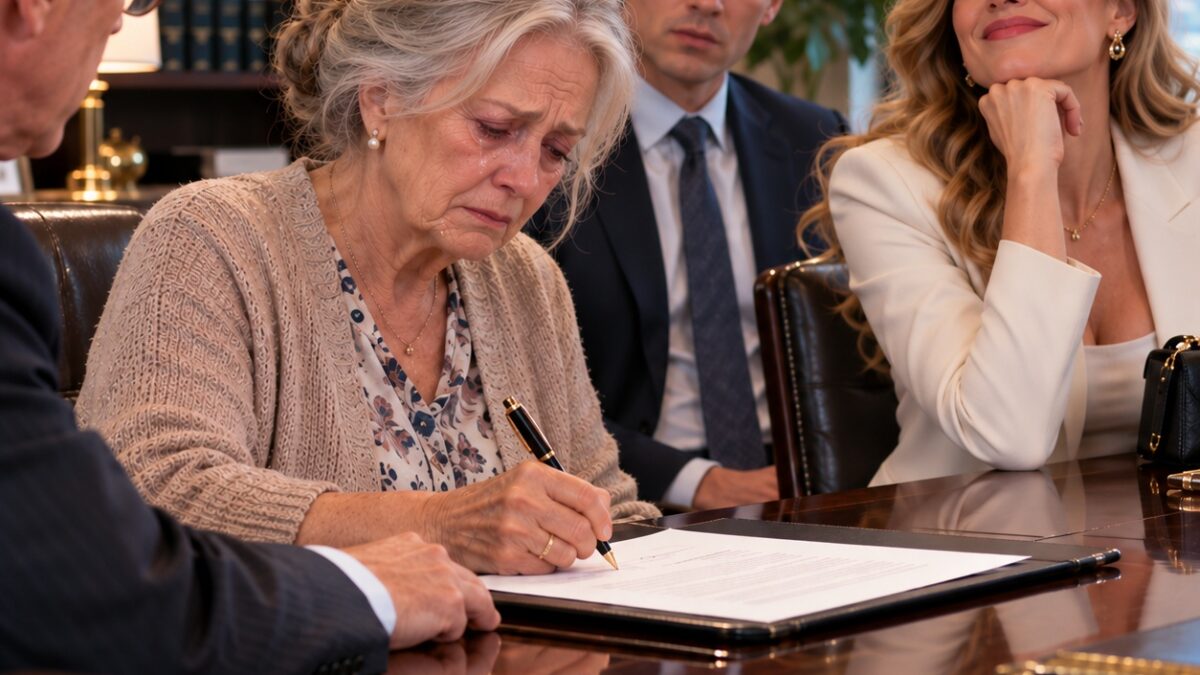
I picked up the pen.
Signed.
Stephanie’s smile appeared.
Small.
Satisfied.
Then that little disguised laugh.
“Smart decision,” she whispered to James. “This protects everyone.”
Thomas notarized the document.
Stephanie touched my arm when we stood.
“This is such a relief.”
There was that word.
Again.
“Now we can find somewhere appropriate for you without anyone misunderstanding what’s expected.”
I nodded.
Dignity is not weakness.
Sometimes dignity is simply refusing to give another person the emotional performance they are hoping to provoke.
I went home.
Made tea.
Sat in Harold’s old chair.
And finally let myself feel everything.
“Harold,” I whispered into the empty room, “what would you do?”
The chair across from me remained empty.
Of course it did.
But memory answered.
Harold did not believe in punishing people financially.
He also did not believe in rewarding entitlement.
I thought about everything we had done for James.
The tutoring.
College.
Apartment.
Car.
Wedding.
Emergency help over the years.
Never because he demanded it.
Because he was our son.
Then I thought about Stephanie.
The comments.
The contempt.
Her visible relief.
I called my sister Barbara.
Barbara lived in Arizona.
Never married.
No children.
Professor for most of her adult life.
She possessed one gift I sometimes wished she could turn off.
Absolute honesty.
“They did what?” she shouted after I finished.
“They suggested professional care.”
“No. The waiver.”
“Yes.”
“And you signed it?”
“I did.”
“Avis, sometimes you are too nice for your own good.”
“What should I have done? Force them to care for me?”
“No.”
“Exactly.”
“You could have made them squirm longer.”
I laughed despite myself.
Barbara continued.
“And Stephanie smiled?”
“Yes.”
“I never liked that woman.”
“You have mentioned that.”
“She wears shoes that cost more than some people’s rent and somehow still walks around like everyone else is beneath her.”
“Barbara.”
“What?”
I laughed again.
Then she became serious.
“What about James?”
I said nothing.
“Oh, Avis.”
“He’s caught in the middle.”
“He is forty-two.”
“I know.”
“The middle is where children stand.”
I closed my eyes.
“He doesn’t like confrontation.”
“Neither do doormats.”
“That is cruel.”
“So is letting your wife treat your mother like a future medical bill.”
The truth hurt.
Barbara sighed.
“What are you going to do?”
I looked toward Harold’s photograph.
“Change my will.”
“Good.”
“Not because I’m angry.”
“Of course you’re angry.”
“I don’t want anger making decisions.”
“Then let reality make them.”
That sentence stayed with me.
Reality.
Over the next three days, I reviewed everything.
Bank accounts.
Brokerage statements.
Insurance.
Retirement funds.
Property.
Tax records.
I asked my bank for a complete accounting.
The young officer helping me stared at the screen.
“Mrs. Thornton?”
“Yes?”
“Would you like an introduction to our private wealth division?”
“No, thank you.”
She looked again.
“You already have advisers?”
“Yes.”
“Of course.”
I smiled.
Harold would have loved that moment.
Our total estate had grown to just over $4.23 million.
Not billionaire wealth.
Not private-jet wealth.
But far more than Stephanie imagined.
More than I needed.
Enough to change lives if used well.
The following day, I returned to Thomas alone.
He closed his office door.
“I wondered when I’d see you.”
“That obvious?”
“That meeting was difficult to watch.”
“It was worse to sit through.”
He folded his hands.
“What do you want to do?”
“Start over.”
“With the will?”
“With everything.”
For two hours, we worked.
My first priority was the twins.
Emma and Ethan had done nothing wrong.
They loved me without calculation.
I established educational trusts totaling one million dollars.
College.
Graduate school if they wanted it.
Professional training if that became their path.
The money could not be used for cars.
Vacations.
Designer clothes.
Or lifestyle expenses.
Education only.
My second priority was care.
If James and Stephanie did not want responsibility, fine.
I would never require it.
I created a one-million-dollar professionally managed care trust.
Home health aide.
Assisted living.
Skilled nursing.
Medical equipment.
Transportation.
Whatever I needed.
I would never have to bargain with anyone for dignity.
My third decision surprised even me.
Two million dollars would establish a literacy foundation.
The Thornton Foundation for Literacy and Teacher Resources.
I had spent forty years watching good teachers buy classroom materials from their own pockets.
I knew children who reached third grade without owning a single book.
I knew schools where teachers photocopied workbooks because they could not afford enough copies.
For years, I had thought about helping.
Now I could.
Thomas smiled when I explained.
“Harold would like this.”
“I think so.”
Then he asked the difficult question.
“James?”
I breathed slowly.
“I don’t want to disinherit my son.”
“All right.”
“But I don’t want money to become a substitute for a relationship.”
Thomas nodded.
“So?”
“Two hundred thousand.”
He raised an eyebrow.
“With conditions.”
“What kind?”
“Regular involvement.”
He waited.
“Monthly visits.”
“Avis—”
“Not surveillance. Not forced affection.”
“Then be careful.”
“I know.”
I thought.
“Perhaps structure it as an incentive rather than control.”
“Better.”
“I want the document to reflect that if James completely removes himself from my life for more than six months without legitimate reason, the bequest returns to the foundation.”
Thomas wrote.
“And Stephanie?”
I looked out at the harbor.
“She asked for freedom from responsibility.”
“Yes.”
“I respect her choice.”
Thomas waited.
“So nothing?”
“Nothing directly.”
He nodded.
No judgment.
Just understanding.
Then I made another request.
“I want everyone present when the new plan is explained.”
“A will reading?”
“Yes.”
“Avis, actual formal will readings are rare.”
“I know.”
“They’re mostly a movie device.”
“I know.”
“Why?”
“Clarity.”
He studied me.
Then smiled slightly.
“I suppose you were a teacher for forty years.”
“What does that have to do with anything?”
“You still believe lessons require an audience.”
I smiled back.
“Sometimes.”
We scheduled it for the following week.
What happened between those meetings taught me more than the will reading itself.
One day after my private appointment with Thomas, Stephanie called.
“Avis!”
Her voice was brighter than I had heard in months.
“Hello, Stephanie.”
“We haven’t had you over in ages.”
That was technically true because she often declined my visits.
“The twins miss you.”
“I miss them too.”
“Why don’t you come for dinner?”
I almost laughed.
“Tonight?”
“Tomorrow.”
“What are we celebrating?”
“Nothing.”
Too quickly.
“Just family.”
I accepted.
Their home looked staged when I arrived.
Flowers.
Fine china.
Crystal glasses.
Everything polished.
Emma whispered while hugging me:
“Mom made us change three times.”
I kissed her head.
Stephanie had prepared salmon.
Fresh vegetables.
A salad involving ingredients I could not identify.
Throughout dinner, she was extraordinarily attentive.
“More water?”
“Are you comfortable?”
“Do you want another cushion?”
James looked relieved.
He probably thought his wife was finally trying.
I knew better.
After the twins left to do homework, Stephanie leaned forward.
“So.”
There it was.
“How are things going with your planning?”
“Fine.”
“With Thomas?”
“Yes.”
“Did you finish everything?”
“Mostly.”
She smiled.
“Good. It’s so important to be organized at this stage.”
At this stage.
I sipped water.
“My friend Janet’s mother didn’t plan properly,” Stephanie continued. “It was a nightmare after she passed.”
“I imagine.”
“Taxes. Probate. Confusion.”
She shook her head.
“Her children lost so much.”
“How unfortunate.”
“I’ve been reading about estate planning.”
“I didn’t know you were interested.”
She smiled.
“Well, family affects everyone.”
Of course.
She continued.
“James has a financial adviser through work.”
James frowned slightly.
“He’s very good,” she said. “Maybe he could review your accounts.”
“Thomas manages everything.”
“Yes, but Thomas is from Harold’s generation.”
I stared at her.
“So am I.”
She laughed.
“You know what I mean.”
“I don’t.”
“Strategies change.”
“Thomas seems current.”
Her smile tightened.
James jumped in.
“Mom, we were also thinking about the house.”
“What about it?”
“The market is strong.”
“So?”
Stephanie brightened.
“Developers are buying in your neighborhood.”
“Yes.”
“You could sell.”
“I could.”
“Downsize.”
“I could.”
“There are beautiful senior communities nearby.”
“Interesting.”
She leaned closer.
“You could free up equity.”
There it was.
Equity.
“Why would I need to?”
“For care.”
“Which care?”
“The facilities we discussed.”
I smiled.
“You’ve thought about this.”
“We’re trying to help.”
For the next hour, they suggested selling my house.
Liquidating furniture.
Consolidating accounts.
Giving James access to important documents.
Changing financial advisers.
Preparing heirlooms.
Everything framed as concern.
Everything pointing toward control.
Two days later, Stephanie invited me shopping.
The next day, she suggested a family vacation “once all your arrangements are settled.”
James called separately.
“Mom, do you have any jewelry or heirlooms you want to make sure stay in the family?”
I closed my eyes.
“Why?”
“Just planning.”
“Your wife asked you to call?”
Silence.
“James?”
“She mentioned it.”
“I see.”
One afternoon, I was at their house watching the twins in the backyard.
I entered through the kitchen for water.
Stephanie was on the phone.
She did not hear me.
“No, Janet, I’m telling you, there has to be something.”
I stopped.
“They lived too quietly.”
Pause.
“Harold worked in finance.”
Pause.
“And that lawyer’s office? That is not some small-town estate guy.”
My chest went cold.
Stephanie laughed.
“We already signed the waiver.”
Pause.
“Yes, exactly. We’re not responsible for her care.”
Another pause.
“But James is the only child.”
She lowered her voice.
“So whatever there is eventually comes to us.”
I did not move.
“I’m just trying to figure out the inheritance potential before we make any expensive commitments for the kids.”
I quietly backed away.
Returned to the yard.
Ethan ran toward me holding a soccer ball.
“Grandma! Watch this!”
I smiled.
“I’m watching.”
Inside, something had hardened.
Not hatred.
Certainty.
That evening, I wrote down Stephanie’s words.
Not because I planned revenge.
Because gaslighting does not always come from another person.
Sometimes you gaslight yourself.
You minimize.
Explain.
Excuse.
Forget.
I wanted a record of what actually happened so that I could not later convince myself I had overreacted.
That weekend, the twins stayed overnight.
Stephanie rarely allowed it.
Suddenly she thought “grandparent bonding” was important.
I did not punish the children for their mother’s motives.
We made cookies.
Played board games.
Watched an old movie.
At bedtime, Ethan asked:
“Why doesn’t Mom want you to live with us if you get sick?”
I sat still.
Emma said, “Grandpa Collins lives with Uncle Robert.”
That was Stephanie’s father.
Interesting.
I tucked the blanket around Ethan.
“Every family makes different choices.”
“I’d let you live with me,” Emma said.
“You’re eight.”
“I’ll have a house someday.”
I smiled.
“That is very kind.”
She yawned.
“You can have my room.”
I hugged them both.
Those children did not know anything about estates.
Waivers.
Inheritance.
Money.
They understood family more clearly than the adults.
The night before the meeting, I sat in my garden.
The maple tree Harold had planted decades earlier moved in the wind.
For the first time since the stroke, I felt peaceful.
I was not punishing anyone.
I kept repeating that to myself because motive mattered.
I was aligning my estate with reality.
My grandchildren’s education mattered.
My future care mattered.
My life’s work mattered.
James mattered.
But inheritance was not a salary for being my son.
And Stephanie was not owed a reward for tolerating me.
The next morning, Thomas’s conference room was ready.
Long mahogany table.
Leather chairs.
Water glasses.
Folders arranged at each seat.
I arrived early.
Thomas squeezed my hand.
“Last chance to do this privately.”
“No.”
“You’re sure?”
“Yes.”
“Then let’s begin.”
Barbara had flown in from Arizona.
She sat beside me wearing a purple jacket and an expression that suggested she had come prepared to enjoy herself.
“Behave,” I whispered.
“No promises.”
Michael Peterson, one of Thomas’s associates, sat across from us.
Eleanor Wright, an educator who had agreed to help structure the literacy foundation, sat beside him.
Then Dr. Harriet Summers arrived.
My physician.
Her presence was strategic.
If Stephanie attempted later to claim that the stroke affected my judgment, Dr. Summers could speak directly to my mental capacity.
James and Stephanie entered precisely on time.
Stephanie wore a cream suit.
Expensive.
Tailored.
Professional.
She stopped when she saw the room.
“I didn’t realize this was such a gathering.”
Thomas stood.
“Please sit.”
James glanced at Barbara.
“Aunt Barb?”
She smiled.
“Hello, James.”
He looked uneasy.
Stephanie noticed Eleanor.
Michael.
Dr. Summers.
“Who are all these people?”
“Relevant parties,” Thomas said.
She sat.
He began formally.
“We are here to review the revised estate plan of Avis Margaret Thornton.”
Stephanie folded her hands.
Before anything else, Dr. Summers spoke.
She confirmed that my stroke had caused no cognitive impairment.
She confirmed that I was competent to make financial, medical, and legal decisions.
Stephanie’s face tightened slightly.
Then Thomas began.
First the legal language.
Then my directives.
Then:
“Before discussing specific distributions, Mrs. Thornton has asked that I summarize the current value of her estate.”
Stephanie leaned forward.
I looked at James.
He looked confused.
Thomas opened another page.
He listed the house.
Investment accounts.
Mutual funds.
Bonds.
Retirement funds.
Cash reserves.
Insurance proceeds that had been invested years earlier.
Several managed accounts established by Harold.
With each item, Stephanie’s face changed.
James stopped tugging at his collar.
Thomas continued.
“The current estimated net value of these combined assets is approximately four million, two hundred thirty-five thousand dollars.”
Silence.
Absolute silence.
Stephanie’s mouth opened.
James stared at me.
Barbara looked straight ahead, clearly fighting a smile.
Stephanie spoke first.
“Four million?”
Thomas nodded.
“Approximately.”
She looked at me.
“You?”
I almost admired the honesty of her shock.
“What does that mean?” I asked.
“You live in that house.”
“Yes.”
“You drive an old car.”
“Yes.”
“You were a teacher.”
“Yes.”
Thomas said calmly:
“The estate reflects decades of disciplined investing by Avis and Harold Thornton.”
Stephanie looked betrayed.
Not surprised.
Betrayed.
As though I had concealed money that rightfully belonged in her calculations.
Thomas continued.
“Now, the distributions.”
She sat straighter.
“One million dollars will be placed in educational trusts for Emma and Ethan.”
James blinked.
Stephanie said nothing.
“These funds are restricted to undergraduate education, graduate education, accredited professional training, and related educational expenses.”
Stephanie frowned.
“So they can’t access it for anything else?”
Thomas looked at her.
“That is correct.”
He continued.
“Two million dollars will establish the Thornton Foundation for Literacy and Teacher Resources.”
Eleanor smiled.
Stephanie’s head snapped toward me.
“What?”
Thomas continued.
“The foundation will support public school reading programs, classroom libraries, teacher grants, and literacy initiatives.”
Stephanie looked horrified.
“Two million?”
“Yes.”
“To charity?”
I looked at her.
“To children.”
She looked away.
Thomas continued.
“One million dollars is allocated to a professionally managed personal care trust for Avis.”
Stephanie’s brow furrowed.
“A million dollars for care?”
Thomas nodded.
“The purpose is to guarantee high-quality care regardless of future medical circumstances.”
I spoke.
“Since I signed the waiver.”
She looked at me.
“I don’t want my needs to burden anyone.”
The sentence landed exactly as intended.
Not cruel.
Clear.
James lowered his eyes.
Thomas continued.
“To James Harold Davis, Mrs. Thornton leaves two hundred thousand dollars.”
James looked up.
Stephanie looked almost offended.
“Two hundred?”
Thomas kept reading.
“The bequest is subject to limited family-involvement provisions.”
Stephanie laughed sharply.
“Conditions?”
I answered.
“Yes.”
“What kind of conditions?”
“Relationship.”
Her eyes narrowed.
Thomas explained.
“Regular contact, reasonable participation in family holidays, and no unexplained complete estrangement for a period exceeding six months.”
Stephanie threw up her hands.
“That’s manipulation.”
I looked at her.
“No.”
She stared.
“Manipulation would be requiring James to provide my housing, medical care, or money.”
I nodded toward the file.
“You asked me to sign a document specifically removing those obligations.”
She went still.
“The trust asks only that a relationship exists if an inheritance is expected.”
James looked deeply ashamed.
Stephanie turned back to Thomas.
“What about the rest?”
Thomas blinked.
“I beg your pardon?”
“You said four million two hundred thirty-five.”
“Yes.”
“You’ve only allocated about four-point-two.”
Barbara actually coughed to hide a laugh.
Stephanie continued.
“What happens to the remaining thirty-five thousand?”
Thomas answered professionally.
“Legal expenses, administrative reserves, final expenses, and funeral costs.”
Stephanie stared at him.
“That’s all?”
“Yes.”
Her face changed completely.
“This is ridiculous.”
James whispered, “Stephanie.”
“No.”
She turned toward me.
“James is your only child.”
“Yes.”
“He should inherit everything.”
“Why?”
The question stopped her.
“What?”
“Why?”
“Because he’s your son.”
“He is.”
“And family wealth stays in the family.”
“The educational trusts are for my grandchildren.”
“Restricted trusts!”
“The care trust prevents your family from paying for me.”
She flushed.
“The foundation wastes two million dollars on strangers.”
Eleanor looked up.
I spoke quietly.
“Those strangers are children.”
Stephanie rolled her eyes.
“You know what I mean.”
“I do.”
James said:
“Steph, stop.”
She turned on him.
“No. This is insane.”
Thomas spoke.
“Mrs. Thornton is legally entitled to distribute her assets however she chooses.”
Stephanie pointed at the documents.
“She tricked us.”
I felt something inside me become very calm.
“How?”
“You let us think you were broke.”
“I never said I was broke.”
“You never told us you had millions.”
“No.”
“Why?”
I looked directly at her.
“Because money should not determine how people treat each other.”
The room went quiet.
Stephanie’s face reddened.
“You let me think you were living on a teacher’s pension.”
“I am receiving a teacher’s pension.”
“That isn’t the point.”
“What is the point?”
She stared.
I continued.
“You made assumptions about my worth.”
“You hid important information.”
“About my private finances.”
“We’re family.”
“You signed a document last week saying you wanted no responsibility for me.”
Her mouth tightened.
“That was about care.”
“Yes.”
“Not inheritance.”
I almost felt sorry for her.
Almost.
“Stephanie, you wanted the relationship defined only one way.”
She stared at me.
“You wanted no obligation toward me.”
“I never said that.”
“The waiver says exactly that.”
“Legally.”
“And now my will defines my financial obligations legally.”
“That is not the same.”
“Why not?”
She had no answer.
Thomas said gently:
“The care waiver and estate plan are separate documents. But Mrs. Thornton is correct that both clarify expectations.”
Stephanie pushed back her chair.
“This can be contested.”
Thomas nodded calmly.
“Anyone may attempt litigation.”
“Diminished capacity.”
Dr. Summers folded her arms.
“That is why I am here.”
Stephanie ignored her.
“Undue influence.”
Thomas said:
“The plan was developed privately between Mrs. Thornton and counsel. All decisions are documented.”
“This is revenge.”
I finally felt anger.
Not explosive.
Clean.
“No.”
Stephanie looked at me.
“Then what is it?”
“Consequences.”
James closed his eyes.
I continued.
“You believed I was a financial burden.”
“I never said that.”
“You discussed Medicare because you assumed I could not afford care.”
“We were being practical.”
“You suggested selling my house to fund a facility.”
“Again, practical.”
“You signed away any responsibility.”
“You agreed.”
“Yes.”
I nodded.
“I did.”
Then I leaned slightly forward.
“And because I agreed, I made certain you would never need to support me.”
She looked at the care trust documents.
“One million dollars.”
“Yes.”
“I also protected your children’s education.”
Her eyes moved toward the twin trusts.
“And I created something meaningful from the work Harold and I did.”
The foundation papers sat before Eleanor.
“I left my son money.”
“Barely.”
James flinched.
I turned to him.
“James?”
He finally looked at me.
His face was pale.
“I had no idea.”
“I know.”
“Dad never told me.”
“Your father believed money should remain private.”
Stephanie snapped:
“Convenient.”
Barbara said:
“Oh, for God’s sake.”
I touched her arm.
She sat back.
I asked James:
“Would knowing have changed how you allowed your wife to speak to me?”
He opened his mouth.
Nothing came out.
I already knew.
“That is why I never told you.”
Tears appeared in his eyes.
“Mom.”
“Money shouldn’t improve my value as a person.”
He looked down.
Stephanie grabbed her purse.
“This isn’t over.”
Thomas said nothing.
She pointed at me.
“I will talk to lawyers.”
“You should,” I said. “Good legal advice is always useful.”
Her face twisted.
She marched toward the door.
Then turned.
“James.”
He remained seated.
“James, are you coming?”
He looked at her.
Then at me.
Then back at her.
Finally, he stood.
“I need to think.”
Stephanie looked furious.
“We’ll talk at home.”
He didn’t answer.
They left.
The room remained quiet.
Then Barbara squeezed my hand.
“That was magnificent.”
“Barbara.”
“What?”
I laughed.
The tension broke.
Eleanor came around the table.
“Mrs. Thornton, I hope you understand what this foundation will mean.”
“I have an idea.”
“No.”
Her eyes filled with tears.
“I don’t think you do.”
She told me about schools waiting years for literacy grants.
Teachers buying books from thrift stores.
Children sharing outdated reading materials.
Classrooms without enough take-home books.
I thought about forty years of children walking through my classroom.
Some loved reading.
Some hated it because reading made them feel stupid.
Some discovered entire worlds once the right book reached their hands.
For the first time that day, the money felt joyful.
After everyone left, Thomas asked me to remain.
“You all right?”
“Yes.”
“Really?”
“No.”
He smiled sadly.
“That makes more sense.”
I stared at the empty chairs.
“I didn’t enjoy that.”
“I know.”
“I thought maybe I would.”
“Revenge is usually more satisfying in imagination.”
“It wasn’t revenge.”
“No.”
He paused.
“But you are still a mother.”
That was the problem.
No matter how justified my choices were, watching my son feel ashamed hurt.
“What do I do now?”
Thomas shrugged.
“Live.”
It sounded simple.
It wasn’t.
When Barbara and I left the office, James was waiting in the lobby.
Stephanie was gone.
“Mom?”
Barbara looked at me.
“It’s okay.”
She left us.
James sat heavily on a bench.
I sat beside him.
For a while, neither of us spoke.
Then:
“I’m sorry.”
His voice broke.
I looked at my son.
Forty-two years old.
Suddenly looking sixteen again.
“That’s a start.”
“I feel sick.”
“Why?”
“Because I didn’t know.”
“The money?”
“No.”
He shook his head.
“Not that.”
“What?”
“How bad it looked.”
I waited.
“How bad I looked.”
I said nothing.
“Stephanie said things.”
“Yes.”
“And I kept asking you to ignore them.”
“Yes.”
“I told you she didn’t mean it.”
“Yes.”
He rubbed both hands over his face.
“I knew she meant some of it.”
That admission mattered.
“Why didn’t you say anything?”
“I wanted peace.”
I almost smiled.
“So did I.”
“It wasn’t peace.”
“No.”
“It was me asking you to absorb the discomfort so I didn’t have to deal with it.”
There are moments when your child says something that makes you realize he has finally become an adult.
That was one of them.
“Yes,” I said.
He looked at me.
“Why didn’t you tell me about the money?”
I sighed.
“Would you have defended me differently?”
He opened his mouth.
Closed it.
I nodded.
“That is the answer.”
Tears filled his eyes.
“I hate that.”
“So do I.”
“I want to say I would have.”
“But?”
“I don’t know.”
“Exactly.”
I touched his hand.
“James, your father’s money does not make me more worthy of respect.”
“I know.”
“Do you?”
He looked away.
“I think I’m starting to.”
I continued.
“Stephanie showed me who she was when she believed I had nothing useful to give her.”
He flinched.
“And you showed me what you were willing to tolerate.”
“I know.”
“I am not saying that to hurt you.”
“I know.”
“I love you.”
His voice broke.
“I love you too.”
“Then we need something different.”
“What?”
“A relationship where you don’t ask me to accept disrespect because confronting it makes your marriage uncomfortable.”
He nodded slowly.
“I need boundaries.”
“Yes.”
“With Stephanie.”
“Yes.”
“And probably with you too.”
I smiled.
“Yes.”
He looked surprised.
“I was expecting an argument.”
“I had a stroke, not a personality transplant.”
He laughed through tears.
That helped.
“What happens now?” he asked.
“That depends on you.”
“The will?”
“The will is done.”
He swallowed.
“I mean us.”
I squeezed his hand.
“I want my son.”
He looked at me.
“Not an heir.”
He nodded.
“Not a caretaker.”
Another nod.
“My son.”
He cried then.
Quietly.
So did I.
The weeks that followed were difficult.
Stephanie consulted two attorneys.
Both told her essentially the same thing.
The estate plan was valid.
I was competent.
The assets were mine.
The waiver was legal.
She could be angry.
She could not transform anger into ownership.
Her next strategy involved James.
She wanted him to convince me to revise the will.
He refused.
That refusal caused the first major confrontation in their marriage that he did not retreat from.
He told me later.
“She said I should remind you who would be taking care of you.”
I stared at him.
“After signing the waiver?”
“I pointed that out.”
“What did she say?”
“That the waiver was only legal protection.”
I laughed.
“Convenient distinction.”
James smiled.
“She also wanted me to ask you to put the house in my name.”
I nearly choked on my tea.
“Why?”
“Gesture of reconciliation.”
I stared.
“And what did you say?”
“That I wasn’t her messenger anymore.”
I looked at him.
“Good.”
He smiled awkwardly.
“I should have said it years ago.”
“Probably.”
He visited weekly.
At first, the visits felt formal.
He would arrive with coffee.
Ask how I was.
Sit too straight.
Then slowly, the old James returned.
We argued about politics.
Complained about traffic.
Talked about the twins.
Remembered Harold.
One afternoon, James found me sorting old photographs.
He picked up one of his father.
“Dad would be disappointed in me.”
I shook my head.
“Your father would be disappointed in some choices.”
“Difference?”
“A person is not the worst thing they’ve done.”
He looked at me.
“Did he ever disappoint you?”
I laughed.
“Frequently.”
“Dad?”
“Your father once invested in a seafood distribution company run by his cousin because he felt guilty saying no.”
“What happened?”
“We lost thirty thousand dollars.”
James stared.
“He never told me.”
“Because afterward he called it tuition.”
“Tuition?”
“Cost of learning not to mix guilt and investment decisions.”
James laughed.
I smiled.
“Harold made mistakes.”
“He seemed perfect.”
“He was your father.”
I touched his hand.
“You saw him through a child’s eyes.”
That became part of James’s healing.
Understanding his father as a man.
Not a standard he could never reach.
Meanwhile, I began touring senior living communities.
Not because Stephanie had been right to push me out.
Because she had accidentally made me confront something useful.
I wanted options.
I found Cedar Grove.
Beautiful independent-living apartments.
Gardens.
Dining room.
Pool.
Library.
Transportation.
Healthcare support available later if needed.
I could live independently now and transition into more care without moving again.
The first time I toured it, I thought:
I could be happy here.
That surprised me.
Selling my house did not mean Stephanie had won.
Keeping it out of stubbornness would have made her too powerful too.
So I sold the colonial.
On my terms.
At my time.
For a very good price.
I kept Harold’s chair.
Our photographs.
My books.
The maple tree stayed behind.
That hurt.
But homes hold memories.
They are not the memories themselves.
The twins loved Cedar Grove.
Especially the pool.
Ethan said:
“Grandma, this place is better than our house.”
Stephanie looked offended.
Emma discovered the game room.
“Can we sleep over?”
I smiled.
“Ask your mother.”
Stephanie hesitated.
Then said yes.
Progress came in strange forms.
The foundation became the most fulfilling work I had done since retirement.
Eleanor and I visited schools.
We funded classroom libraries.
Teacher grants.
Reading intervention programs.
Book drives.
One elementary teacher cried when we told her she could replace forty-year-old materials.
“I’ve been buying books at garage sales,” she admitted.
I knew that life.
I had lived it.
We created a grant that specifically reimbursed teachers for classroom supplies.
Harold’s money had spent decades growing quietly.
Now it became books in children’s hands.
That felt right.
The first holidays after the will meeting were uncomfortable.
Stephanie came.
She was polite.
Cold.
But polite.
James no longer allowed dismissive remarks to pass without response.
At Thanksgiving, Stephanie looked at my old serving platter and said:
“You still use this?”
James replied immediately:
“Mom likes it.”
Stephanie said:
“I was just asking.”
James smiled.
“Then now you know.”
Small moment.
Huge difference.
She stopped.
I did not gloat.
I had no interest in turning James’s growth into a weapon against his wife.
Their marriage had to become healthier or end.
That was their work.
Eventually, they began counseling.
James told me only what he wanted to share.
Stephanie resented his new boundaries.
Then slowly seemed to recognize that his previous passivity had not actually been good for either of them.
One year after the will meeting, something unexpected happened.
Emma was celebrating her birthday.
The house was full of children.
Balloons.
Noise.
Wrapping paper.
Stephanie and I stood alone near the kitchen for a moment.
She looked toward the children.
Then said:
“I misjudged you.”
I waited.
She swallowed.
“For years.”
I said nothing.
“I thought you were…”
She stopped.
“What?”
“Just a retired teacher.”
I raised an eyebrow.
She looked embarrassed.
“I know how that sounds.”
“It sounds honest.”
“I thought you had nothing.”
The words stung even after everything.
She continued.
“And I treated you like that mattered.”
“Yes.”
She looked at me.
“I was wrong.”
I did not rescue her from the discomfort.
She needed to sit in it.
Then she said:
“And not only about the money.”
That mattered more.
I asked:
“What were you wrong about?”
She looked toward Emma.
“Value.”
I waited.
“You built a life I didn’t understand.”
Her voice was quiet.
“I thought simple meant unsuccessful.”
I nodded.
“And I thought expensive meant secure.”
I glanced at her.
She smiled sadly.
“Turns out expensive mostly means expensive.”
I laughed.
She did too.
It was not forgiveness.
Not completely.
It was not friendship.
But it was the first genuine conversation we had ever had.
“We all misjudge people,” I said.
She nodded.
“What matters is what we do after we realize it.”
She looked at me.
“Do you forgive me?”
That question deserved honesty.
“Some things.”
Her face fell slightly.
“Not everything?”
“Not yet.”
She nodded.
Fair.
That was another thing I had learned.
Forgiveness does not require pretending pain never happened.
James changed too.
During lunch one afternoon, he said:
“I spent years absorbing Stephanie’s values.”
“What do you mean?”
“The house.”
“Which is beautiful.”
“The cars.”
“They run.”
He smiled.
“The country club.”
“I like the buffet.”
He laughed.
Then became serious.
“I started thinking the things we had proved something.”
“Proved what?”
“That I was successful.”
“Are you?”
He considered.
“In some ways.”
“Then why prove it?”
He looked down.
“I forgot what Dad taught me.”
“Your father enjoyed nice things.”
“I know.”
“He simply didn’t need everyone else to see them.”
James nodded.
“That’s what I forgot.”
I smiled.
“Lessons come back.”
Two years after moving to Cedar Grove, I turned seventy.
Barbara flew in.
James came early.
Emma and Ethan made cards by hand.
Stephanie brought flowers.
Expensive flowers.
Of course.
But this time I did not see them as performance.
Maybe they were.
Maybe partly.
People are complicated.
The difference was that I no longer needed to guess what everything meant.
James helped set up chairs.
The twins argued over candles.
Barbara criticized the cake.
Stephanie rolled her eyes at Barbara and then laughed.
For a moment, everyone looked almost normal.
I stood back and watched.
Money had not created our problems.
It had exposed them.
Stephanie already valued status.
James already avoided conflict.
I already allowed disrespect because I feared losing my son.
The estate simply made those truths impossible to ignore.
And once they were visible, we had choices.
That was the gift.
Not the four million dollars.
Choice.
I could choose how I aged.
My grandchildren could choose education without debt.
Teachers could choose books for classrooms without paying from grocery money.
James could choose whether to become the man who avoided every difficult conversation or the man who learned to speak.
Stephanie could choose whether to continue measuring people by what they displayed.
And I could choose whether I spent the rest of my life trying to earn respect from people who had already shown me how they behaved when they thought I had nothing.
Sometimes I think about the day I signed the waiver.
I remember Stephanie’s smile.
The little laugh.
“This protects everyone.”
She was right.
Just not in the way she meant.
It protected James and Stephanie from having to care for me.
And it forced me to protect myself.
It forced me to answer questions I had postponed.
Where would I live?
Who would care for me?
What did I want my money to accomplish?
What legacy mattered?
What relationships were real?
Had they never pushed for that waiver, I might have drifted into the old plan.
James inherits everything.
Because that is what parents do.
No questions.
No structure.
No reflection.
Perhaps the twins’ education would still have been fine.
Perhaps the money would have supported another larger house.
More cars.
Vacations.
Handbags.
Country club fees.
Perhaps some of it would have been saved.
Perhaps not.
Instead, Harold’s quiet discipline became something larger.
Every time I visit a school funded by the Thornton Foundation, I think about him.
I picture him sitting at our kitchen table.
Calculator.
Coffee.
Receipts.
Investments.
The man who refused to replace a perfectly good coat because “there’s still another winter in it.”
He could never have imagined exactly where the money would go.
But I know he would understand.
Several months after my seventieth birthday, I visited Lincoln Elementary.
My old school.
The building smelled exactly the same.
Waxed floors.
Paper.
Cafeteria food.
A little dust.
The principal walked me to a classroom library funded by our foundation.
New shelves.
Hundreds of books.
Colorful cushions.
Children sitting on the floor reading.
One little girl held a book so close to her face her nose nearly touched the page.
I watched her turn pages carefully.
Her teacher whispered:
“She didn’t like reading before.”
“What changed?”
“She found books she actually cared about.”
I smiled.
That had been my entire career.
Finding the door.
Every child had one.
The right story opened it.
The teacher pointed toward a plaque.
THORNTON FOUNDATION READING ROOM.
My eyes filled with tears.
Harold’s name was included below mine.
I touched the plaque.
Not because I needed recognition.
Because I wished he could see it.
That evening, James joined me for dinner at Cedar Grove.
He noticed I had been crying.
“What happened?”
I told him about the school.
He smiled.
“Dad would be proud.”
“Yes.”
“He’d probably ask about administrative expenses.”
I laughed.
“Immediately.”
Then James became quiet.
“What?”
“Nothing.”
“That face means something.”
He looked at me.
“I used to think the will was punishment.”
“I know.”
“It wasn’t.”
“No.”
“It was a correction.”
I considered the word.
“Yes.”
He nodded.
“I needed one.”
“You needed a boundary.”
“So did you.”
I smiled.
“Yes.”
He looked around my apartment.
“You’re happy here?”
“I am.”
“Really?”
“Really.”
“I used to feel guilty that you moved.”
“Why?”
“Because Stephanie pushed the idea first.”
“I didn’t move for Stephanie.”
“I know that now.”
I looked around.
My books.
Harold’s chair.
Photos.
Emma’s drawings.
A vase Stephanie had given me.
“Sometimes another person can suggest something for the wrong reason and the idea can still become right.”
James smiled.
“You sound like a teacher.”
“I am a teacher.”
“Retired.”
“Once a teacher, always a teacher.”
He rolled his eyes.
Exactly as he had at sixteen.
For the first time in years, that felt comforting.
My life is quieter now.
I still drive.
A newer car, finally.
James insisted.
I made him promise not to tell Stephanie she had been right about advanced safety features.
He promised.
I volunteer at the foundation.
The twins visit.
Emma is becoming a serious reader.
Ethan still talks constantly.
Barbara calls every Sunday and complains that Arizona is full of people who do not know how to make seafood.
Stephanie and I remain different.
We probably always will.
But now when she visits, she speaks to me with respect.
Not because I am worth four million dollars.
At least I hope not.
Because she learned that respect withheld until money appears is not respect at all.
And I learned something too.
Silence can be graceful.
Silence can also become permission.
For years, I told myself I was being dignified when I ignored Stephanie’s comments.
Sometimes I was.
Sometimes I was simply afraid that confronting her would cost me access to James and the grandchildren.
Fear disguised itself as patience.
That realization was uncomfortable.
But necessary.
James once asked whether I would make the same decisions again.
“Yes.”
“Everything?”
I thought.
“I would speak sooner.”
He looked at me.
“About Stephanie?”
“About how her comments affected me.”
He nodded.
“I wish you had.”
“I wish you had defended me.”
He lowered his eyes.
“I know.”
I reached across the table.
“But we know now.”
That is the thing about family.
People talk as though love automatically produces healthy behavior.
It doesn’t.
Love without honesty can become resentment.
Love without boundaries becomes obligation.
Love without respect becomes endurance.
And inheritance without character becomes entitlement.
I do not believe children owe their parents lives of servitude because they were raised.
Parents choose to have children.
Children grow up.
They build their own lives.
But I also do not believe family means taking everything someone can give while carefully avoiding the inconvenience of giving anything back.
That was the imbalance I finally saw.
Stephanie wanted the inheritance without the relationship.
James wanted harmony without confrontation.
I wanted closeness without risk.
None of us could have everything we wanted.
So the waiver became a strange kind of gift.
It made the terms visible.
No obligation to care for me?
Fine.
No assumption of inheritance.
No financial dependency on my son?
Fine.
No reason for me to surrender control of my assets.
No secret fortune creating confusion?
Fine.
Then let’s speak plainly.
The final version of my estate plan remains essentially unchanged.
Emma and Ethan’s trusts are growing.
The care trust gives me extraordinary peace of mind.
The foundation has expanded.
James’s inheritance remains conditional on genuine family involvement.
Not perfect behavior.
Not obedience.
Relationship.
And Stephanie receives nothing directly from me.
I no longer feel angry about that.
At first, I worried people would see it as punishment.
Maybe some do.
But Stephanie is not my child.
I am not responsible for financing her life.
If James eventually inherits and chooses to share what is his, that is his decision.
That distinction matters.
One afternoon, years after the first meeting, Thomas visited Cedar Grove.
We had coffee.
He was semi-retired by then.
He looked around my apartment.
“You seem well.”
“I am.”
“Happy?”
“Yes.”
He smiled.
“I remember the day you signed that waiver.”
“So do I.”
“I thought you were making a terrible mistake.”
“Did you?”
“Yes.”
“Why didn’t you stop me?”
“You understood it.”
He shrugged.
“My job was to advise, not control.”
I laughed.
“Apparently everyone needed that lesson.”
He smiled.
“Stephanie certainly did.”
“Thomas.”
“What?”
We both laughed.
Then he became serious.
“You handled it well.”
“I don’t know.”
“You didn’t destroy your family.”
“I came close.”
“No.”
He shook his head.
“You stopped pretending the cracks weren’t there.”
That stayed with me.
Because that is what happened.
I did not break the family.
The waiver did not break it.
The will did not break it.
The money did not break it.
Those things exposed fractures that had been covered by politeness.
Once exposed, we finally repaired some of them.
Not perfectly.
Families rarely repair perfectly.
There are scars.
Stephanie and Barbara can barely tolerate each other.
James still slips into conflict avoidance sometimes.
I still become overly independent when I should ask for help.
The twins are teenagers now and consider all adults mildly embarrassing.
Normal.
Beautifully normal.
On my seventy-second birthday, Emma gave me a card.
Inside she wrote:
Grandma, I want to be like you when I grow up because you help people and don’t care what anyone thinks.
I laughed so hard I cried.
I care very much what people think.
I am simply learning that what they think cannot be the steering wheel of my life.
That distinction took me seventy years.
Ethan’s card said:
Thanks for letting us eat real butter.
Equally meaningful.
Sometimes I imagine Harold seeing all of this.
I picture him shaking his head at the family drama.
He hated drama.
Then asking to see the foundation’s financial statements.
Then quietly donating another hundred dollars to a classroom project even though his own foundation had already funded thousands.
That was Harold.
Quiet generosity.
Quiet wealth.
Quiet strength.
For most of my life, I thought quiet strength meant saying little.
Now I understand something else.
Quiet strength is not silence.
It is knowing when your voice does not need to be loud to be final.
The day I signed that care waiver, Stephanie believed I had surrendered.
I had not.
I had accepted her terms.
Then I built my future accordingly.
She wanted freedom from caring for me.
I gave it to her.
I wanted freedom from being treated like a burden while my assets were treated like an entitlement.
I gave that to myself.
And in the end, the most important number Thomas read aloud in that conference room was not $4.23 million.
It was zero.
Zero dollars I needed from James to survive.
Zero dollars I needed from Stephanie.
Zero reasons to tolerate disrespect out of fear that someday I would have nowhere else to go.
That freedom changed everything.
Not because money made me powerful.
Because preparation made me independent.
Harold understood that long before I did.
Security was never about showing people what you owned.
It was about making sure your choices remained yours.
Even when you were old.
Even when you were sick.
Even when someone underestimated you.
Especially then.
Sometimes I still think about Stephanie’s smirk as I signed my name.
For years, that memory hurt.
Now it almost makes me smile.
She thought the document had relieved her of a burden.
In a way, it had.
It relieved all of us of pretending.
And once the pretending ended, we finally discovered what was actually worth keeping.
Not the house.
Not the cars.
Not the inheritance.
Not appearances.
The children.
The memories.
The work.
The people who still showed up after money was removed from the conversation.
The relationships willing to survive honesty.
Everything else?
That was never really wealth to begin with.

