My Wife’s Boss Thought the Quiet Novelist Beside Her Would Never Read the Fine Print
FULL ENDING  Thank you

My name is Owen Crawford.
I was forty-eight years old when I finally learned how dangerous it can be when people mistake quiet for stupid.
I write historical novels.
Twelve so far.
Two made the New York Times bestseller list, although I learned years ago that saying that aloud makes people assume you either expect applause or money.
Usually both.
So I rarely mentioned it.
My most successful novel was called The Lanterns of Lakeside.
It followed Abigail Harlow, a young widow who kept her family’s house on Windham Lake alive through the Civil War while her brothers were away fighting and creditors circled the property.
The house was real.
Abigail was real.
Almost everything important in that book came from two years of research.
I read county deeds.
Probate files.
Tax ledgers.
Old letters with ink faded so badly I needed magnification to make out half the words.
I spent weeks in historical archives.
I walked the property in winter.
I studied how the lake froze.
I learned which section of the foundation had been repaired after a fire in 1871.
I knew that house more intimately than some people know their relatives.
My own house sat in Madison, Connecticut.
White colonial.
Dark shutters.
A long backyard.
Nothing extravagant.
I had purchased it three years before I met Diana using royalties from my first major book.
The back sunroom became my office.
That was where I wrote.
Morning light came through three walls of windows.
Oak and maple trees filled the yard.
In autumn, the leaves turned the whole room gold.
For years, Diana said she loved that room because it made me peaceful.
When we married eight years earlier, she told people she had fallen in love with my calm.
I had fallen in love with everything she was that I wasn’t.
Diana moved fast.
She thought fast.
She talked with her hands.
She could walk into a room of strangers and leave with five new contacts and two invitations to dinner.
She sold luxury real estate for Pinnacle Properties in New Haven.
And for six years in a row, she was their number-one agent.
Diana wore tailored suits and heels sharp enough to make marble nervous.
Her phone never stopped ringing.
She knew which developer was divorcing.
Which banker had a daughter applying to Yale.
Which family wanted to sell quietly before their neighbors found out they were in trouble.
I knew which general had written home from Antietam asking his wife to repair a barn roof.
For a long time, our differences worked.
She brought energy into my life.
I gave her somewhere quiet to return to.
She dragged me to restaurants I never would have chosen.
I convinced her that spending a Sunday afternoon reading could count as a successful day.
Then her job began taking more.
At first, it was one late dinner.
Then another.
Weekend showings.
Sunday calls.
Client emergencies.
Investor emergencies.
James emergencies.
James Caldwell owned Pinnacle Properties—or at least that was how everyone described it.
He was fifty-four.
Tall.
Tanned year-round.
Confident in the way men sometimes become when no one has said no to them in a very long time.
At first, his name meant nothing to me.
Then it began appearing in almost every conversation.
James needs me at the office.
James wants me at the dinner.
James has an investor flying in.
James says this listing could make my year.
James thinks I should attend the conference.
James wants me in Stamford tomorrow.
There are warning signs you recognize only after the story has ended.
While you are living through them, they look like ordinary details.
I trusted Diana.
That is important.
People often ask afterward how someone could miss what was happening.
The answer is simple.
If you begin with trust, you do not examine every late meeting like a detective.
You believe the person you love.
That is what trust is.
Or at least what I thought it was.
Our house became quiet.
Not my kind of quiet.
Mine had always been comfortable.
This was the silence of two people living parallel lives.
Diana would come home late.
I would ask how her day went.
“Same as always.”
“Anything interesting?”
“Nothing you’d care about.”
So eventually I stopped asking.
I went back to the nineteenth century.
At least people in 1863 wrote down what they were doing.
Money had always been the part of our marriage I liked least.
Not because I didn’t understand it.
Because Diana enjoyed managing household logistics, and I didn’t enjoy arguing about them.
A few years after she joined Pinnacle, she moved our taxes to Gordon Pratt.
“He handles everything for James,” she told me.
“That’s supposed to reassure me?”
She laughed.
“He’s the best CPA in the state.”
Gordon was forgettable.
Soft voice.
Wire-rimmed glasses.
Weak handshake.
Every April, a thick envelope arrived.
Forms covered in little yellow tabs.
SIGN HERE.
INITIAL HERE.
SIGN HERE.
I signed.
For years.
I rarely read them.
That admission still embarrasses me.
A man who had spent his career telling readers that details matter had turned his own financial life over to a stranger because reading tax forms felt tedious.
Every April, I handed Gordon Pratt something more useful than I understood.
A clean sample of my signature.
The trouble began on a Tuesday in early October.
I was in the sunroom working on a chapter when the front door slammed.
It was barely three in the afternoon.
Diana was almost never home that early.
I walked toward the kitchen.
She stood beside the island with her back half-turned to me, phone pressed against her ear.
Her voice was low.
Urgent.
“He’ll be there, James. I promise.”
Pause.
“I said I’ll handle it.”
She ended the call and turned.
For less than a second, her face looked guilty.
Then the expression vanished.
The professional smile replaced it.
“Oh. You’re here.”
I leaned against the doorway.
“I usually am.”
She did not laugh.
“Everything okay?”
“Fine.”
She opened the refrigerator and poured herself a glass of white wine.
At three in the afternoon.
I noticed.
She noticed me noticing.
“Long day.”
“It’s three fifteen.”
“Owen.”
“All right.”
She took a sip.
Then she reached into her bag and placed a glossy folder on the counter.
“Pinnacle is holding its fall showcase Saturday.”
I waited.
“Westbrook Hotel. Investors, developers, press.”
“Sounds exciting.”
“The governor is coming.”
“Congratulations.”
She stared at me.
“I need you there.”
That got my attention.
In six years with Pinnacle, Diana had never once invited me to a company event.
The last agency function I attended had been at her old firm.
Afterward, she told me I made clients uncomfortable because I stood quietly in corners.
“You need me there?”
“Yes.”
“Why?”
She pushed the folder toward me.
“Because of this.”
I looked down.
My stomach tightened immediately.
The photograph showed Harlow Place.
Abigail’s house.
White columns.
Gray roof.
Long lawn running toward Windham Lake.
The image had been taken near sunset, making the windows glow gold.
Across the cover, embossed lettering read:
THE LAKESIDE ESTATE
A REVOLUTIONARY LEGACY
$9.5 MILLION
I opened the brochure.
The first paragraph stopped me.
“Built in 1776 by Colonel Josiah Harlow, patriot and hero of the Revolution…”
I looked at Diana.
“What?”
I continued reading.
“General George Washington himself spent a night beneath this historic roof, a story later immortalized by bestselling novelist Owen Crawford…”
My own name was printed in gold beneath it.
I closed the brochure.
“Diana.”
She sighed immediately.
“No.”
“No what?”
“Don’t start.”
“Start what?”
“The history lecture.”
“There was no Colonel Josiah Harlow.”
She took another drink.
“Owen.”
“Thomas Harlow built the house in 1852.”
“No one cares.”
“George Washington had been dead for more than fifty years.”
She rolled her eyes.
“Buyers aren’t paying for dates.”
“Apparently they are paying nine and a half million dollars for a Revolutionary landmark that never existed.”
“It’s marketing.”
“It has my name on it.”
“So?”
“So my book says the exact opposite.”
Diana leaned against the counter.
“You write novels.”
“Historical novels.”
“Stories.”
“Based on documented history.”
“Still stories.”
I picked up the brochure again.
“This says Washington slept there.”
“So?”
“So he didn’t.”
She laughed once.
“Owen, normal people do not care about that distinction.”
I stared at her.
“Normal people care whether a nine-and-a-half-million-dollar property is being marketed honestly.”
Her expression hardened.
“Don’t.”
“Don’t what?”
“Use that tone.”
“What tone?”
“The one where you act morally superior because you spend all day reading old paper.”
I felt something small crack inside me.
Not enough to break anything.
Just enough to notice.
“I’m not acting morally superior.”
“Then stop making this difficult.”
I tapped the brochure.
“Diana, this isn’t a mistake. This is fabricated provenance.”
“Jesus.”
“There was no Revolutionary connection.”
“You think the buyer is going to care whether Washington slept there in 1776 or someone important slept there later?”
“Yes.”
“Why?”
“Because that is what they are being asked to pay for.”
She shook her head.
“You really don’t understand business.”
That sentence stayed with me.
I looked at the brochure again.
“This could be fraud.”
Her eyes flashed.
“Don’t you dare call James a fraud.”
I hadn’t said James.
I had said this.
That was the first moment I felt something beneath the conversation.
Something deeper than a bad brochure.
I watched her.
She seemed to realize her mistake.
Her shoulders dropped.
Her voice softened.
“Please.”
That frightened me more than her anger.
Diana rarely said please to me anymore.
“James just wants you there.”
“Why?”
“You’re the author associated with the house.”
“So I’m a prop.”
“No.”
“Yes.”
“He wants you to sign a few books. Talk to investors. Smile.”
“And repeat this history?”
“No one is asking you to lie.”
“The brochure already quoted me beside the lie.”
She reached across the counter and touched my arm.
“Owen, this sale matters.”
“How much?”
“More than you know.”
That was the most honest thing she said all afternoon.
“I’ll come.”
Relief washed across her face.
Too much relief.
“But I will not repeat the brochure.”
“You won’t have to.”
“Promise?”
She nodded.
“Yes.”
Her phone buzzed on the counter.
The screen lit.
JC.
Diana turned it face down before I could see the message.
That evening, after she went upstairs, I entered my office and opened a filing cabinet.
The certified deed was exactly where I remembered.
Harlow Place.
Transfer record.
Thomas Harlow.
I placed the county document beside Pinnacle’s brochure.
One was dull paper.
One was glossy.
One had a government seal.
One had gold lettering.
Truth had terrible marketing.
I slipped both into the inside pocket of my navy suit jacket.
I told myself I was being cautious.
The truth is, I was suspicious.
Writers live by patterns.
Something appears early in a story because eventually it matters.
By Saturday evening, I knew the brochure mattered.
I just didn’t understand how much.
The Westbrook Hotel ballroom had been transformed into a temple for rich people.
Architectural models sat beneath glass.
Waiters moved between investors carrying champagne.
A string quartet played near the windows.
Luxury developments appeared on giant illuminated displays.
And at the far end of the room stood a photograph of Harlow Place six feet tall.
THE LAKESIDE ESTATE
A REVOLUTIONARY LEGACY
Diana slipped her arm through mine.
“Please behave.”
“That’s an encouraging way to begin an evening.”
“I mean it.”
“I’m wearing a tie. That’s already excellent behavior.”
She almost smiled.
Almost.
Then she began introducing me.
“This is my husband, Owen Crawford.”
“The novelist.”
“Yes, that Owen Crawford.”
For twenty minutes, I became interesting.
A retired judge cornered me near the bar to argue about Gettysburg.
A state senator wanted to know whether Abigail Harlow had really operated the property alone.
A woman whose grandfather collected Civil War letters asked where she could donate them.
I was beginning to enjoy myself.
Then Diana’s hand tightened around my arm.
James Caldwell was walking toward us.
He was taller than I expected.
Dark suit.
Perfect teeth.
Skin the color of someone who owned property somewhere with better weather.
He extended his hand.
“So this is the famous Owen.”
His grip was aggressive in that childish way some men think demonstrates authority.
“Owen Crawford.”
“Six years Diana’s worked for me, and I was starting to think she invented you.”
A small group around us laughed.
James looked pleased.
“She says you hide in a room writing all day.”
“Only on weekdays.”
More laughter.
James grinned.
Then his hand moved to Diana’s lower back.
Not briefly.
Not accidentally.
It settled there with ease.
Familiarity.
Possession.
Diana leaned toward him.
Just slightly.
A movement most people would not notice.
But writers notice movements.
Then she caught herself.
Straightened.
James removed his hand.
“Your wife is the crown jewel of Pinnacle.”
“I’ve heard.”
He gave me a strange look.
Before anything else could be said, he turned.
“Come on. The governor’s here.”
He led us across the ballroom.
That was when I met Harold Linquist.
He was gray-haired, thin and reserved, probably in his late sixties.
He chaired the Northeast Heritage Trust, a private organization that purchased and preserved historic properties.
James treated him like royalty.
“Harold, this is Owen Crawford.”
Linquist shook my hand.
“I know exactly who Mr. Crawford is.”
He smiled.
“My wife loved The Lanterns of Lakeside.”
“Thank her for me.”
“We’re excited about preserving the Harlow property.”
“I’m glad.”
“Extraordinary Revolutionary provenance.”
I looked at James.
His smile never moved.
I said nothing.
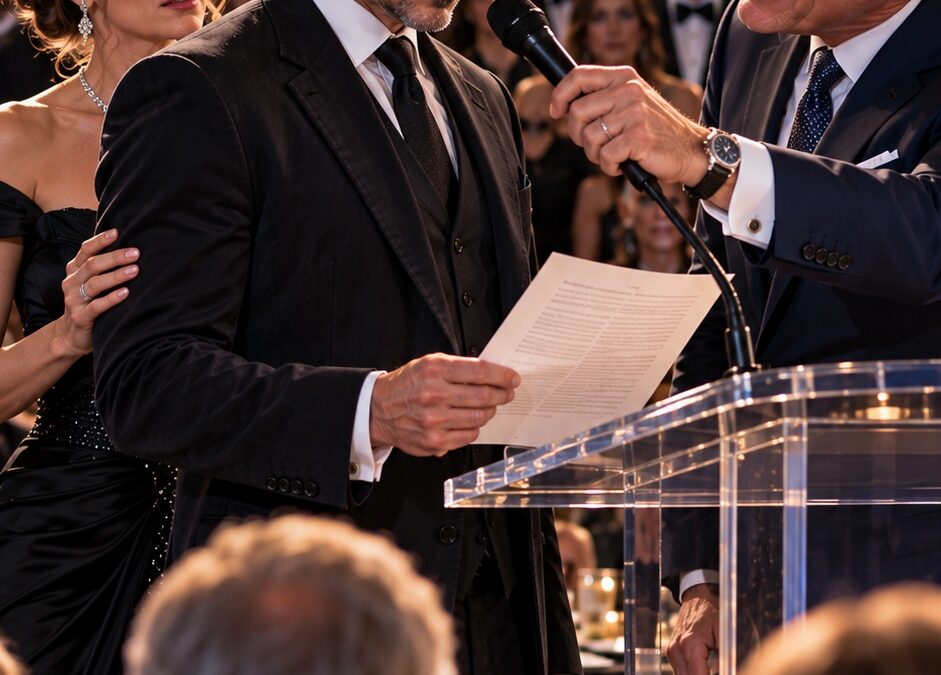
Five minutes later, James climbed onto a low stage.
He tapped the microphone.
The room quieted.
“Ladies and gentlemen, Governor, honored guests…”
Diana moved beside me.
Her body felt tense.
“Tonight,” James continued, “we celebrate a piece of American history.”
The giant photograph of Harlow Place glowed behind him.
“Built in 1776 by Colonel Josiah Harlow, hero of the American Revolution…”
I felt Diana’s fingernails press into my forearm.
“…and famous as the house where General George Washington himself spent a night…”
Applause.
James waited.
“And tonight, we are especially fortunate.”
He looked directly at me.
“To have with us the author who brought the Harlow legacy to millions of readers.”
My stomach dropped.
“Owen Crawford.”
Diana whispered, “No.”
James raised an arm toward me.
“Come on up.”
People turned.
Applause began.
Diana leaned close.
“Just smile.”
I looked at her.
“Please, Owen.”
I walked to the stage.
James wrapped one arm around my shoulders.
It felt like being handled by a politician at a county fair.
He held the microphone between us.
“People tell me writers live in an imaginary world.”
Laughter.
“So I have a challenge for our resident historian.”
He turned toward the audience.
“Let’s see whether a novelist knows this property as well as a salesman.”
More laughter.
Diana had gone pale.
James faced me.
“Owen, tell everyone about Colonel Josiah Harlow and the night George Washington slept beneath this roof.”
The trap was simple.
Either I lied for him.
Or I embarrassed my wife in front of half her professional world.
James smiled.
He knew exactly what he was doing.
For years, I had been the quiet husband.
The man who did not attend parties.
The man who avoided conflict.
The man who wrote books about people who had been dead for more than a century.
He thought quiet meant obedient.
I reached for the microphone.
“Thank you, James.”
His smile widened.
“That’s a generous challenge.”
I turned toward the room.
“And I accept it.”
Diana closed her eyes.
I continued.
“The house on Windham Lake is one of the most fascinating nineteenth-century homes in Connecticut.”
James’s smile shifted.
I reached into my jacket.
“But it was not built in 1776.”
The room became quiet.
“It was built in 1852 by Thomas Harlow, a lumber merchant from New London.”
James whispered, “What are you doing?”
I ignored him.
“There was no Colonel Josiah Harlow.”
A few people looked toward the brochure displays.
“And George Washington could not have slept in that house because he died more than fifty years before its foundation was laid.”
Silence.
I removed the certified deed.
“This is the county deed.”
I held it up.
“1852.”
Someone near the front leaned closer.
“The history printed in tonight’s brochure is incorrect.”
James’s face changed.
“The real story is better.”
I looked toward the giant photograph.
“Abigail Harlow became a widow during the Civil War. With much of her family away, she kept the property operating during debt, shortages and personal loss.”
I lowered the deed.
“She does not need an invented colonel.”
I looked at Linquist.
“She does not need George Washington.”
Then back to the audience.
“The truth is already good enough.”
For one second, no one moved.
Then the governor laughed.
Not mockingly.
Genuinely.
He began clapping.
Others followed.
Some slowly.
Some enthusiastically.
James leaned toward me while maintaining a frozen smile.
“You just made a very expensive mistake, pal.”
I turned my head slightly.
“No, James.”
I handed him back the microphone.
“Somebody else made it.”
I stepped off the stage.
Harold Linquist was waiting.
“May I?”
He pointed toward the deed.
I handed it to him.
He read the page twice.
Then looked at James.
The applause died.
“Mr. Caldwell.”
James climbed down.
“Harold, obviously there’s been some confusion—”
“Our trustees authorized nine and a half million dollars based upon the property’s Revolutionary significance.”
“The house is still historic.”
“It is.”
Linquist folded the copy carefully.
“But it is not what you represented.”
“We can discuss—”
“We will.”
Linquist handed me the deed.
“Our offer is suspended.”
Then he walked away.
I looked at Diana.
She stared at me like I had stabbed someone.
The rest of the evening became an exercise in observation.
James pulled Diana into a hallway.
They disappeared for ten minutes.
When she returned, her eyes were red.
Her lipstick remained perfect.
Later, I saw them near a service entrance.
He touched her wrist.
She closed her eyes.
He whispered something.
Her face softened.
And suddenly I did not need proof.
Not yet.
I had recognition.
The late Sundays.
The missed anniversary dinner.
The emergency conference in Stamford.
The calls she took outside.
The way his hand had rested on her back.
I had spent two years writing a novel about a nineteenth-century woman.
Somehow I had failed to read my own marriage.
The drive home lasted eleven miles before Diana spoke.
“Do you have any idea what you did?”
“I corrected a false statement.”
“You humiliated James.”
“I corrected a false statement.”
“In front of the governor.”
“The governor seemed fine.”
“That isn’t funny.”
“I’m not joking.”
“You killed the sale.”
I glanced at her.
“If the sale requires fraudulent history, maybe it deserves to die.”
“Stop using that word.”
“Fraud?”
“Yes.”
“You’re more upset about the word than the lie.”
She stared through the windshield.
“We had everything riding on that deal.”
I noticed it instantly.
“We?”
She froze.
The car continued another hundred yards.
“I meant the company.”
“No.”
“Owen.”
“You said we.”
“Don’t do this.”
I turned into our driveway.
Stopped.
Shut off the engine.
Neither of us moved.
“How long?”
She looked at me.
“What?”
“How long have you been sleeping with him?”
Her mouth opened.
Then she laughed.
A dry, brittle sound.
“You’re unbelievable.”
“How long?”
“You spend your life inventing stories. Now you’re inventing this.”
“I make things up professionally.”
I turned toward her.
“That’s why I recognize the difference.”
She shook her head.
“You’re paranoid.”
“I watched you tonight.”
“So?”
“His hand on your back.”
“That’s ridiculous.”
“The hallway.”
“Work.”
“You came back crying.”
“He was angry.”
“He touched you like a man comforting his girlfriend.”
Her expression changed.
Cold.
Careful.
“Be very careful, Owen.”
“Is that a threat?”
“If you keep pushing this, things between us are going to change permanently.”
I studied the woman sitting beside me.
For eight years, she had been my wife.
In that moment she sounded like a stranger negotiating a hostile contract.
“Fine.”
I unlocked my door.
“Then let me put this in language you understand.”
She stared.
“If you walk inside that house tonight and call James Caldwell, our marriage is over.”
A long silence.
Then Diana opened her door.
“You never understood ambition.”
She stepped out.
“James does.”
Ten minutes later, she came downstairs carrying an overnight bag.
She walked past me.
No apology.
No explanation.
Her Lexus disappeared down the street.
I sat alone in my car.
I expected grief.
It came.
But something else came with it.
A sentence.
We had everything riding on that deal.
Four days later, I learned what everything meant.
The envelope came from Shoreline Savings Bank.
Addressed to me personally.
I opened it beside the mailbox.
By the second paragraph, I had to grip the wooden post.
Formal notice to guarantor.
Windham Lake Holdings LLC.
Bridge loan.
$2.8 million.
Due November 1.
Collateral included my Madison property.
My house.
The one I purchased before I ever met Diana.
I read the page three times.
I had never heard of Windham Lake Holdings.
I had never guaranteed a loan.
I had never pledged my home.
I called the bank.
A loan officer named Kevin answered.
After verifying my identity, he confirmed the account.
“Yes, Mr. Crawford. You are listed as personal guarantor.”
“I am telling you I have never seen this loan.”
A pause.
“Sir, we have a notarized guarantee bearing your signature.”
“Send it to me.”
Within thirty minutes, the PDF was in my email.
I printed it.
Four pages.
Terms.
Collateral.
Legal language.
Then the signature.
Owen Crawford.
Perfect.
The curve of the O.
The long tail on the d.
Mine.
Except I had never written it.
Beneath the signature:
Gordon Pratt
Notary Public
State of Connecticut
Date:
March 14.
I stared at it.
Then something inside me clicked.
March 14.
I opened my calendar.
There it was.
Richmond, Virginia.
Research trip.
I had spent that entire week in the Virginia State Library studying Civil War supply records.
Three hundred miles away.
Hotel receipt.
Library sign-in sheets.
Restaurant charges.
Parking record.
I had proof.
The forgery suddenly stopped being frightening.
It became evidence.
I did not call Diana.
I called Mitch Kaplan.
Mitch and I had roomed together in college.
He now ran a law firm in Hartford.
He listened without interrupting.
Then he said, “Do not call your wife.”
“I wasn’t planning to.”
“Do not call the accountant either.”
“Why?”
“Because if they know you’ve found the guarantee, documents disappear.”
“What do I do?”
“First, we document the forgery.”
He paused.
“Second, you send me every record proving you were in Virginia.”
“All right.”
“Third, I’m going to introduce you to Frank Delgado.”
“Who is Frank Delgado?”
“Retired state police detective.”
“That sounds dramatic.”
“Owen.”
Mitch’s voice hardened.
“Someone forged your signature on a $2.8 million loan and pledged your home.”
I looked at the paper.
“You are already in the dramatic part.”
Frank Delgado met me two days later in a diner off Route 1.
Gray crew cut.
Sixty or so.
Thick forearms.
Few words.
He read the guarantee.
Then my tax filings.
Then the bank letter.
“Signature sample came from somewhere.”
“My accountant has years of tax forms.”
“Who chose the accountant?”
“Diana.”
“Who employs him?”
“Independent CPA.”
“Who refers him business?”
“James Caldwell.”
Frank nodded.
“There we go.”
“Already?”
“No.”
He took a sip of coffee.
“But now we know where to start.”
It took him nine days.
Nine days during which Diana did not come home.
She sent one message.
I need space.
I did not respond.
Frank pulled corporate records.
Reviewed the loan file through Mitch.
Interviewed former Pinnacle employees.
Spent nights watching Harlow Place.
When he finally called me to his office, his desk was covered in paper.
“Windham Lake Holdings was created in February.”
He pointed.
“Registered agent: Gordon Pratt.”
Another document.
“Funding moves through two other LLCs.”
Another.
“All connected to Caldwell.”
I leaned forward.
“James owns the property?”
“Effectively.”
“How much did he pay?”
“Four point two million.”
“And he was selling it for nine and a half.”
“If Linquist closed.”
I sat back.
“That’s more than five million dollars.”
“Before expenses.”
Frank tapped another file.
“Caldwell needed the deal badly.”
“Why?”
“Failed condo project in Stamford.”
He slid a report toward me.
“He’s carrying enormous debt.”
I looked at the loan paperwork.
“Why my house?”
“Bank didn’t like his collateral.”
“So he used mine.”
“Yes.”
“And my name.”
Frank nodded.
“Your novel gave him the marketing story.”
I stared at him.
“He needed me twice.”
“Exactly.”
My house for the loan.
My reputation for the sale.
Frank slid several photographs across the desk.
I saw Diana’s white Lexus.
Then James’s Range Rover.
Both parked at Harlow Place.
Another photo.
Diana on the porch.
James behind her.
His arm around her waist.
Another.
Kissing.
I put the photographs face down.
“How long?”
“Affair?”
“Yes.”
“At least a year.”
I breathed through my nose.
Frank waited.
“It gets worse.”
I almost laughed.
“Of course it does.”
“You’re not the first husband connected to one of Caldwell’s employees.”
“What does that mean?”
“He has a pattern.”
Three previous women.
Top agents.
Special assignments.
Affairs.
Promotions.
Then sudden terminations.
One agreed to speak.
Her name was Natalie Ror.
I met her in a coffee shop in Meriden.
Late thirties.
Tired eyes.
She held a folder against her chest.
“Three years ago, I was Pinnacle’s number-two agent.”
“Behind Diana.”
“Yes.”
She looked down.
“Then I became James’s favorite.”
She said the word with disgust.
“How did it end?”
“Like all his favorites end.”
Her mouth tightened.
“Something went wrong with an escrow account. He blamed me. I was fired.”
“Did you take the money?”
“No.”
“Could you prove it?”
“No.”
“And James?”
“Untouched.”
She opened the folder.
A printed email slid across the table.
“Why show me this?”
“My friend Paula worked Gordon Pratt’s front desk.”
I looked up.
“She quit in July.”
Natalie nodded.
“She printed that before leaving.”
I read the email.
From: James Caldwell
To: Gordon Pratt
One sentence changed everything.
If Lakeside goes south, D takes the fall. Her husband’s signature, her handwriting on the file, her name on every call to the bank. We stay clean.
I read it twice.
Diana.
My wife had been part of it.
But she had also been the designated scapegoat.
For weeks, I had imagined James and Diana as equal partners.
They weren’t.
She had betrayed me for a man who had already written the plan for betraying her.
“Does she know?” Natalie asked.
“No.”
“She thinks he loves her.”
“Yes.”
Natalie looked toward the window.
“I thought that too.”
The drive home changed something in me.
Until then, anger had been chaotic.
Personal.
Humiliating.
Now it became organized.
James had built his scheme around an assumption.
The quiet writer would never read the documents.
He was wrong.
I listed everyone who had a reason to know the truth.
Shoreline Savings.
The Northeast Heritage Trust.
The state real estate regulators.
Pinnacle’s board.
Then Frank mentioned a name.
Elizabeth Caldwell.
James’s wife.
Mitch arranged the meeting.
Elizabeth received me in the library of the Caldwell Family Foundation.
She was around fifty.
Silver-streaked hair.
Straight posture.
Gray eyes that missed very little.
I placed everything in front of her.
Bank notice.
Forged guarantee.
Richmond records.
Photographs.
Corporate filings.
Natalie’s email.
Elizabeth read quietly.
She did not react to the affair photographs.
That told me enough.
“You’re not surprised.”
“No.”
“About Diana?”
“About James.”
She folded her hands.
“There have been others.”
I nodded.
Then she touched the forged guarantee.
“This is different.”
“Yes.”
“This is criminal.”
“Yes.”
She looked at me.
“Do you know who owns Pinnacle Properties?”
“James.”
“No.”
I waited.
“My father founded Pinnacle in 1979.”
She leaned back.
“When he died, sixty percent came to me.”
I stared at her.
“James runs Pinnacle because I allow him to run it.”
“He tells everyone it’s his.”
“He likes people to believe that.”
“Why let him?”
A faint sadness crossed her face.
“Peace.”
That word landed between us.
“I spent twenty-six years letting him believe control and ownership were the same thing.”
She gathered the documents.
“That ends Friday.”
“What happens Friday?”
“Special board meeting.”
She stood.
“Ten a.m.”
“Am I invited?”
“You are the reason we’re having it.”
That afternoon, Frank and I visited Gordon Pratt.
His office sat above a pharmacy.
He was eating a sandwich when we walked in.
When he recognized me, he went pale.
“Owen.”
I set the guarantee on his desk.
“That’s your notary stamp.”
He swallowed.
“You signed it.”
“I was in Richmond.”
His mouth opened.
“I have hotel records.”
He said nothing.
“Library attendance.”
Silence.
“Restaurant receipts.”
Gordon pushed his glasses up.
“I remember you signing this.”
Frank stepped closer.
“Then you’ll remember this too.”
He placed the email from James on the desk.
Gordon stared at it.
Frank spoke quietly.
“Your former receptionist is prepared to testify where she found that.”
Gordon’s hand shook.
“Forgery and bank fraud.”
Frank leaned against the wall.
“You’re the least important person in this conspiracy.”
Gordon looked up.
“That is good news for you.”
He sat very still.
“If you cooperate now.”
The collapse took less than five minutes.
James had ordered him to use my old tax records.
Gordon traced the signature.
Stamped it.
The plan assumed the property would sell before the bridge loan came due.
The loan would disappear.
I would never know.
“How much did James pay you?”
“Fifty thousand.”
“And Diana?”
Gordon lowered his eyes.
“What about her?”
“Did she know the signature was forged?”
He hesitated.
Frank said nothing.
That silence did more work than shouting could have.
Gordon whispered, “Yes.”
Something inside me went still.
“She filled out the loan application.”
He rubbed his face.
“Your income. House value. Royalty statements.”
I said nothing.
“She said you never read financial forms.”
I looked at the man across from me.
That hurt more than the affair.
She knew exactly how to use my trust against me.
“What was her cut?”
“One-third of the profit.”
“Meaning?”
“More than a million if the sale closed.”
“And James?”
Gordon looked miserable.
“He told her after both divorces were finished, they’d be together.”
I stood.
For a brief period, after seeing Natalie’s email, I had felt something like pity for Diana.
That vanished.
She had not simply been manipulated.
She had supplied the information.
My house.
My income.
My signature habits.
The knife had been James’s.
But Diana had placed it in his hand.
The next morning, Gordon signed a sworn statement in Mitch’s office.
Mitch forwarded the evidence to Shoreline Savings.
Frank contacted someone he knew at the FBI field office.
By Wednesday, there was an active federal investigation.
Wednesday evening, Diana came home.
Seven o’clock.
She used her key.
Walked into the kitchen.
Her makeup was perfect.
Her hands trembled.
“We need to talk.”
I closed the book I was reading.
“The Linquist deal is dead.”
“I know.”
“James isn’t returning my calls.”
I said nothing.
“The bank keeps calling.”
“November first.”
She stared.
“Two point eight million.”
Her face changed.
“You know.”
“Yes.”
For half a second, fear replaced every other expression.
Then the saleswoman returned.
She opened her purse.
Pulled out a document.
Placed it on the island.
“The bank will extend the loan ninety days.”
I read the first line.
Ratification of Guarantee.
All I had to do was sign.
One signature.
The forgery would become legally meaningless because I would voluntarily adopt the debt.
Diana pushed a pen toward me.
“Sign.”
I looked at her.
“We sell Lakeside for whatever we can get.”
“No.”
“The bank gets paid.”
“No.”
“I’ll give you the divorce.”
I almost laughed.
“Give me?”
“Everything on your terms.”
“No.”
Her voice sharpened.
“If you don’t sign, they take the house.”
“No.”
“Owen, listen to me.”
“You listen.”
I pushed the paper back.
“The bank cannot take this house.”
“Yes, they can.”
“Not without a valid guarantee.”
She froze.
“I was in Richmond on March fourteenth.”
The color left her face.
“I have proof.”
“Owen—”
“Gordon talked.”
She gripped the counter.
“He told me who wrote the loan application.”
Her mouth trembled.
“James made me do it.”
There it was.
Not denial.
Not confusion.
An excuse.
“I’ll testify against him.”
I stared at her.
“I’ll tell the FBI everything.”
“You should.”
“We can fix this.”
“No.”
“Please.”
“No.”
She began crying.
“Owen, he manipulated me.”
“For a year?”
“He promised me—”
“You had a choice every day.”
I kept my voice low.
“Every dinner you missed.”
She looked down.
“Every lie.”
Tears fell.
“Every night at that house.”
Her shoulders shook.
“You chose him.”
“He loves me.”
I reached into a folder.
“No.”
I slid the email toward her.
She read.
Then again.
Her lips moved silently.
D takes the fall.
Her husband’s signature.
Her handwriting.
We stay clean.
Diana sat down hard.
“He wrote this?”
“Yes.”
“When?”
“April.”
She looked destroyed.
“One month after you gave them my financial information.”
“He said…”
Her voice failed.
“He told me we would…”
“I know what he told you.”
I almost felt sorry for her.
Almost.
“You were never his partner.”
She stared at the page.
“You were his insurance policy.”
She cried silently.
For several minutes, neither of us spoke.
Then I said, “Get a criminal lawyer.”
She looked at me.
“Not a divorce attorney.”
“Owen.”
“Whatever you tell the FBI, tell them because it is true.”
I stood.
“Not because you think it will bring me back.”
She left without another word.
The unsigned ratification stayed on the kitchen island for an hour.
Then I placed it with the rest of the evidence.
Friday morning, I wore the navy suit again.
Same jacket.
Same inside pocket.
Three weeks earlier, James Caldwell had stood beside me at a hotel and treated me like entertainment.
Now I walked into Pinnacle Properties carrying enough documents to dismantle his life.
The boardroom sat on the top floor of a glass building on Chapel Street.
At ten o’clock, everyone was seated.
Elizabeth at the head.
Her attorney.
Four directors.
Harold Linquist.
Kevin from Shoreline Savings.
Mitch beside me.
Frank by the window.
Then James entered.
Leather portfolio.
Tanned face.
Confident smile.
He saw me.
The smile stopped.
“What is he doing here?”
Elizabeth did not look up.
“Sit down, James.”
“This is a board meeting.”
“Yes.”
“Then why is Crawford here?”
“At my invitation.”
James stared at her.
Then me.
He sat.
Elizabeth nodded.
“Mr. Crawford.”
I stood.
I had written twelve novels.
I knew how to build a story.
You begin with the first lie.
I placed the Pinnacle brochure on the table.
“This is how I became involved.”
Then the deed.
“1852.”
Then the corporate records.
“Windham Lake Holdings.”
The loan.
“Two point eight million dollars.”
Then the guarantee.
“My forged signature.”
I passed around copies of the Richmond records.
“March fourteenth.”
Kevin from the bank had gone pale.
James leaned back.
“This is absurd.”
I continued.
“Gordon Pratt notarized the signature.”
Mitch distributed Gordon’s sworn statement.
James’s expression changed slightly.
Not much.
But enough.
Then he smiled.
“All right.”
He spread his hands.
“If everyone wants honesty, let’s have honesty.”
Elizabeth watched him.
“Diana Crawford handled the Lakeside paperwork.”
I remained standing.
“Her handwriting is on those forms.”
Kevin looked toward me.
James continued.
“She dealt with the bank.”
There it was.
Exactly as the email predicted.
“If something improper happened, it happened at her desk.”
I nodded.
“Interesting.”
James looked at me.
“What?”
“You’ve said that before.”
“I’ve never—”
I placed Natalie’s email in the center of the table.
James stopped speaking.
I read it.
Slowly.
“If Lakeside goes south, D takes the fall.”
Silence.
“Her husband’s signature.”
James’s jaw tightened.
“Her handwriting on the file.”
Elizabeth’s eyes never left him.
“Her name on every call to the bank.”
Then the final sentence.
“We stay clean.”
No one moved.
I looked directly at James.
“You wrote that to Gordon Pratt in April.”
“This proves nothing.”
“It proves intent.”
“You don’t know anything about real estate.”
“No.”
I nodded.
“But I know something about stories.”
He gave a bitter laugh.
“Please.”
“And yours has a structural problem.”
I closed the folder.
“You thought every other person in it was expendable.”
His face reddened.
“Your wife.”
I glanced at Elizabeth.
“Your employee.”
Diana.
“Your accountant.”
Gordon.
“Me.”
I sat down.
“You built your entire plan around people being too scared, too loyal or too inattentive to read what you wrote down.”
James stood.
“You smug little bookworm.”
His chair rolled backward.
“You have no idea who you’re dealing with.”
That sentence almost made me smile.
Three weeks earlier, he had said nearly the same thing.
“You challenged me at a party because you thought I was harmless.”
I looked up at him.
“You were right about one thing.”
“What?”
“I am quiet.”
He glared.
“But you confused quiet with weak.”
Elizabeth stood.
“The chair recognizes a motion.”
James turned.
“What?”
Her voice remained calm.
“Motion to remove James Caldwell as President and Chief Executive Officer of Pinnacle Properties effective immediately.”
James laughed.
“You cannot do that.”
Elizabeth looked at him.
“This is my company.”
“No.”
His voice rose.
“My company.”
“It was my father’s company.”
She paused.
“And sixty percent belongs to me.”
James stared.
“I permitted you to run it.”
Her eyes hardened.
“That permission is withdrawn.”
She turned toward the board.
“All in favor?”
Every hand rose.
James looked around.
One director after another.
No ally.
No escape.
Then Frank moved from the window.
Opened the boardroom door.
Two men in dark suits entered.
The taller one displayed a badge.
“James Caldwell?”
James did not answer.
“Special Agent Raymond Holloway, FBI.”
The room became absolutely silent.
“We have a federal warrant for your arrest on charges including bank fraud and conspiracy to commit forgery.”
James looked at Elizabeth.
Then the board.
Then me.
For the first time since I had met him, he looked small.
The agents took him out.
He never met my eyes.
The elevator doors closed behind him.
And that was the end of James Caldwell’s belief that he owned every room he entered.
The consequences took longer.
Federal cases do.
Divorces do too.
Diana gave the FBI a full statement before the board meeting.
Not because of me.
Because she finally understood James would sacrifice her.
She hired a criminal attorney.
Sold jewelry to pay legal fees.
Pinnacle terminated her immediately.
The State Real Estate Commission opened its own proceeding.
A year and a half later, the major cases were finished.
James pleaded guilty to bank fraud and conspiracy.
He received four years in federal prison.
Elizabeth divorced him.
Her father had insisted on a prenuptial agreement decades earlier.
James left with personal belongings, golf clubs and legal bills.
Diana was charged as a co-conspirator.
She cooperated extensively.
That mattered.
She avoided prison.
But she pleaded guilty to a felony.
Five years’ probation.
Her real estate license was permanently revoked.
Our divorce was quieter than I expected.
Maybe because by then there was nothing left to argue about.
The affair mattered.
The fraud mattered more.
The forged guarantee mattered most.
The Madison house had belonged to me before the marriage.
And because the guarantee was invalid, Shoreline Savings released every claim against it.
I kept my home.
Diana kept her car.
Her clothes.
And the debts in her name.
Last I heard, she rented a one-bedroom apartment in Waterbury and worked phones for an insurance company.
She sent me one letter.
Handwritten.
No lawyer.
No expensive stationery.
Just cheap lined paper.
She apologized.
Not in the polished way she used to apologize when she wanted an argument to end.
She wrote about the first years of our marriage.
The dinners.
The sunroom.
The quiet she once loved.
She admitted she had started seeing my calm as weakness.
She admitted James made ambition feel like intimacy.
She admitted the money dazzled her.
She said she hated herself for giving Gordon my information.
She said she had convinced herself the loan would disappear after the sale, so no one would really be hurt.
That was the sentence that told me she finally understood nothing.
Fraud does not become harmless because you expect it to work.
Betrayal does not become smaller because you expected your husband never to discover it.
At the end, she asked me to forgive her.
I read the letter twice.
Then I put it in the bottom drawer of my desk.
I did not write back.
Maybe forgiveness came eventually.
But reconciliation never did.
Gordon Pratt lost his accounting license.
And his notary commission.
Because he cooperated early, prosecutors gave him a suspended sentence and probation.
He sold his practice.
I never saw him again.
Shoreline Savings took control of Harlow Place after the collapse of Windham Lake Holdings.
The following spring, Harold Linquist returned.
The Northeast Heritage Trust bought the property.
At its real value.
Not as a Revolutionary landmark.
As what it actually was.
A remarkable nineteenth-century home with a documented Civil War history.
Today Harlow Place is a museum.
The first time I visited after restoration, I stood on the porch where Frank had photographed Diana and James together.
For a moment, the memory hurt.
Then a group of schoolchildren came running past me.
One stopped at the sign beside the front door.
The sign told Abigail Harlow’s story.
Widow.
Property manager.
Mother.
Woman who survived a war by refusing to let debt take her family home.
I had written every word.
Every date was correct.
No invented colonel.
No George Washington.
Just Abigail.
The truth.
It was enough.
Elizabeth took direct control of Pinnacle Properties after James’s removal.
Her first major hiring decision was to bring Natalie Ror back.
Natalie returned as a senior agent.
Within two years, she was one of the highest-producing brokers in Connecticut again.
Paula came back too.
Mitch still practices in Hartford.
Frank claims he is retired.
Nobody believes him.
Every October, they come to Madison.
We grill steaks.
Open a bottle of bourbon.
Mitch inevitably tells the story about the moment Gordon Pratt realized Frank knew exactly what he had done.
Frank insists Mitch exaggerates.
Natalie once joined us and said both men exaggerate.
I mostly listen.
That part of me never changed.
I still write in the sunroom.
Oak.
Maple.
Morning light.
My next novel is about the Civil War again.
Not about fraud.
Not about infidelity.
Not about a quiet writer taking down a real estate executive.
People have suggested I write that story.
Maybe someday.
But there is something I learned from all of it that matters more to me than James Caldwell going to prison.
For years, people mistook my silence for weakness.
Diana did.
James did.
Even I did sometimes.
I thought avoiding conflict meant maturity.
I thought signing whatever Gordon placed in front of me meant trust.
I thought not asking questions made me less controlling.
Some of that was true.
Some of it was cowardice disguised as peace.
There is a difference between trusting someone and refusing to look.
There is a difference between being quiet and surrendering your voice.
There is a difference between loving a person and handing them the power to define reality for you.
The night of the Pinnacle showcase, James believed he was putting a harmless novelist onstage.
He expected me to smile.
Repeat his fiction.
Give his lie credibility.
Diana expected the same thing.
They both thought the man who spent his life reading dead people’s documents would never bother reading theirs.
That was their mistake.
Not because I was cleverer.
Not because I was more powerful.
Because facts are patient.
The deed waited.
The bank record waited.
The email waited.
The notary stamp waited.
My Richmond receipts waited.
Every lie they told created another document.
Another contradiction.
Another loose thread.
All I eventually had to do was pull.
I used to think the most important part of writing was imagination.
I don’t anymore.
Observation matters more.
People always reveal themselves.
Sometimes through what they say.
Sometimes through what they refuse to say.
Sometimes through a hand resting too comfortably on someone else’s back.
Sometimes through one careless sentence in an email.
Sometimes through paperwork nobody expects you to read.
Quiet is not weakness.
Quiet is where you hear things.
And if you listen long enough, people eventually say the one thing they never meant for you to hear.

