My Wife Put a Pen in Front of Me at 6:30 A.M., but She Had No Idea I’d Been Building My Own File for Four Months
 𝗣𝗔𝗥𝗧𝟮 𝗔𝗡𝗗 𝗙𝗨𝗟𝗟𝗦 𝗧𝗢𝗥𝗬𝗜𝗦


My name is Vernon Dalton.
I was forty-one years old when my fifteen-year marriage collapsed.
I own a small manufacturing company in Indianapolis.
Specialized industrial equipment, mostly for food-processing plants.
Conveyors.
Stainless housings.
Custom handling systems.
Nothing glamorous.
Nobody sees our equipment and takes pictures beside it.
But I built the company from the ground up over fifteen years.
Started in rented space with two machines and one employee.
By the time this happened, we had a real shop, a stable client base, and enough business that I could provide a good life for my family without wondering whether payroll would clear on Friday.
My wife, Gina, was thirty-six.
Regional sales manager for a medical-supply company.
Good at her job.
Very good.
She could walk into a room full of hospital administrators, learn everyone’s name, remember who had children, who played golf, whose hospital system was expanding, and leave with three people convinced they had been the most interesting person she met all day.
We had two kids.
Trevor was fifteen.
Sophie was twelve.
For most of our marriage, I believed we were ordinary in the best possible way.
Busy.
Sometimes tired.
Sometimes disconnected.
But functioning.
I worked long hours during growth years.
Gina traveled more as she moved up.
The kids had practices.
School.
Friends.
We did what millions of families do.
We adjusted.
What I did not understand was that somewhere during those adjustments, Gina had started building another life.
I did not learn that from a lipstick stain.
Or a text message flashing across a phone.
I learned it from my brother.
His name is Travis.
He works at First National Bank.
He called me four months before the breakfast meeting.
Not casual.
Not the usual:
Hey, you watching the Colts?
His voice was careful.
“Vernon, I need to tell you something.”
“What?”
“I saw Gina open a new account.”
I was standing beside a laser cutter at the shop.
Machines running around me.
“So?”
“Personal.”
“She’s allowed to have an account.”
“I know.”
He paused.
“High traffic.”
That got my attention.
“What does that mean?”
“It means money is moving through it.”
“How much?”
“I’m not going to discuss account information I’m not authorized to disclose.”
“Then why are you calling me?”
“Because I know you.”
I stepped away from the noise.
“Travis.”
“Look at your own joint records.”
That was all he would say.
At first, I was irritated.
Not with Gina.
With him.
I thought he was putting suspicion into my marriage without enough information to justify it.
Then I pulled our joint statements.
Transfers.
$3,200.
$4,500.
$2,800.
Then another.
And another.
Money leaving our shared account.
Going somewhere I did not recognize.
I went back twelve months.
Then eighteen.
Some transfers were labeled vaguely.
Some looked like household expenses.
Some had no description I could make sense of.
Then I opened credit-card records.
Restaurants I had never visited.
Hotels in Louisville.
Jewelry I had never seen.
One room charge repeated.
Riverside Inn.
Thursday afternoons.
That was when I stopped guessing.
I hired Raymond Foster.
Private investigator.
Late fifties.
Built like a retired football coach.
Spoke quietly.
Listened more than he talked.
He asked me one question in our first meeting.
“What are you hoping I find?”
I thought about it.
“Nothing.”
He nodded.
“That’s usually the answer.”
His investigation ran four months.
I did not confront Gina.
That was harder than people think.
Once suspicion enters a marriage, every ordinary thing starts looking loaded.
Her phone face down.
A shower immediately after coming home.
A trip delayed.
A new blouse.
You can go insane assigning meaning to everything.
So I stopped interpreting.
I documented.
Raymond documented too.
Photographs.
Times.
Locations.
Witness statements.
Financial patterns.
The man was Jay Kensington.
Pharmaceutical sales director.
Married.
Three children.
Active in his church.
And, according to Raymond’s report, very active with my wife every Thursday afternoon.
Riverside Inn.
Room 237.
Same general time.
Week after week.
The first photograph nearly broke me.
Not because it showed anything graphic.
It showed Gina laughing.
Jay’s hand on her back.
The two of them walking toward the side entrance of the hotel.
That laugh hurt more than the hotel.
I remembered that laugh.
She used to laugh that way with me.
I sat in Raymond’s office holding the photograph.
He said nothing.
After a while, I asked:
“How long?”
“Evidence supports several months.”
“You think longer?”
“Yes.”
I looked down again.
“What do people usually do now?”
“Confront.”
“That good?”
“No.”
“Why?”
“Because they want emotional relief more than strategic safety.”
That sentence stayed with me.
I hired an attorney.
Lauren Mitchell.
Family law.
Sharp.
Efficient.
The kind of lawyer who could listen to twenty minutes of emotional chaos and summarize it in one sentence you wished you had thought of yourself.
I handed her everything.
She looked through Raymond’s file.
Bank records.
Hotel charges.
Transfers.
Then said:
“Do not let her know yet.”
That was the second person to tell me the same thing.
So I waited.
That is why, four months later, when I walked downstairs and found Gina sitting with three women at our dining room table, I was surprised by the performance but not by the fact that something was coming.
The women were Rochelle Morgan, Amira, and Whitney.
Rochelle was from some leadership retreat Gina attended the year before.
Whitney was part of a networking group.
Amira had been described to me twice as a consultant, although Gina had never explained what she consulted on.
All three had coffee.
All three looked at me as though I had arrived late to my own disciplinary hearing.
“Good morning,” Gina said.
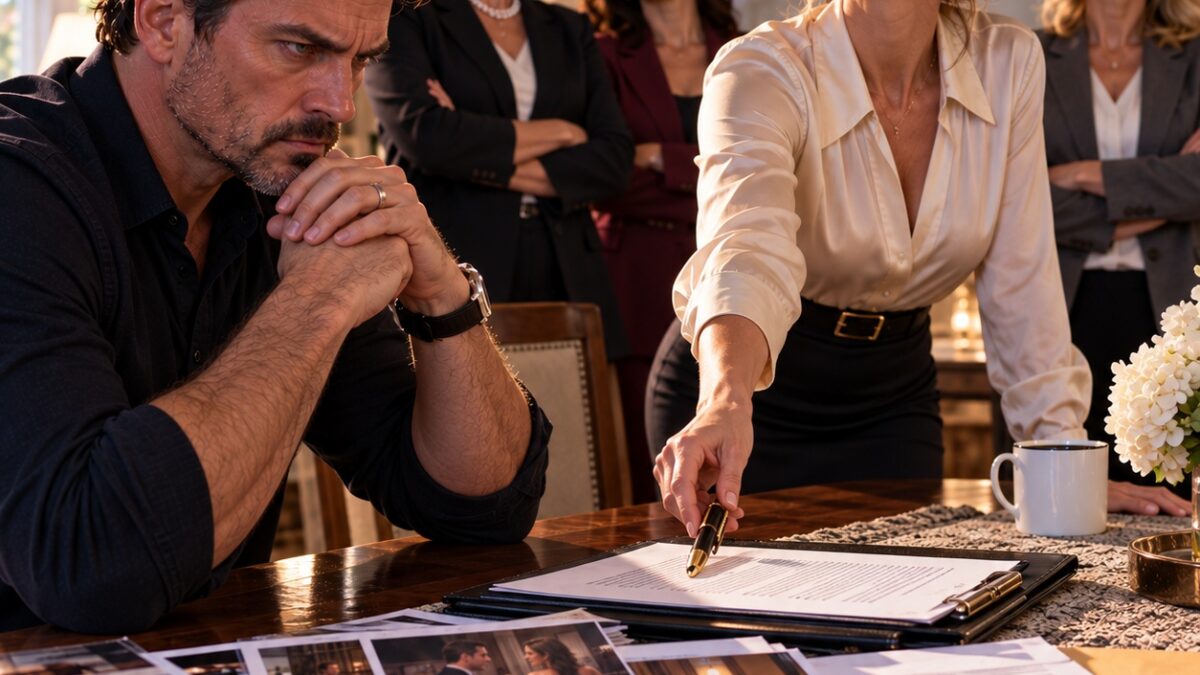
There was an empty chair at the head of the table.
“Sit down.”
I poured coffee first.
Nobody spoke.
Then I sat.
Gina slid a twelve-page document toward me.
Clean formatting.
Professional font.
Title:
PARTNERSHIP EXPECTATIONS AND HOUSEHOLD PROTOCOLS.
I looked at Gina.
“What is this?”
“A framework.”
Rochelle gave me a calm little smile.
“For healthier dynamics,” Gina continued.
I read.
Rule One:
All household decisions require mutual consultation with a seventy-two-hour notice period.
Rule Four:
Emotional availability demonstrated by daily check-ins of no fewer than fifteen minutes.
Rule Eight:
Personal criticism constitutes a boundary violation and may result in consequences.
I kept going.
Twelve rules.
The wording was strange.
Not marital.
Legal-adjacent.
Therapy-adjacent.
Just formal enough to make ordinary disagreement sound like noncompliance.
Near the bottom:
Violations of these expectations may result in formal relationship evaluation and potential separation.
I looked up.
“So this is an ultimatum.”
“It’s a choice,” Gina said.
“Difference?”
“You can step up and be the partner I need.”
Whitney leaned forward.
“Boundary setting is a sign of respect, Vernon.”
I looked at her.
“I didn’t ask you.”
She blinked.
Gina’s mouth tightened.
Whitney continued anyway.
“Gina is trying to create structure where there has been chaos.”
Chaos.
Fifteen years.
Two kids.
Mortgage.
Family vacations.
School plays.
Sunday dinners.
Apparently all chaos.
I looked back at Gina.
“You need an answer now?”
“Yes.”
“Why?”
“Because dragging this out is another form of avoidance.”
Rochelle slid the pen toward me.
“Sign it.”
I looked at the pen.
Then at the four women.
“If you care about your family,” Gina said, “you’ll sign.”
“And if I don’t?”
“Then we know where we stand.”
I picked up the pen.
Every shoulder around the table relaxed.
Just slightly.
They thought pressure had worked.
I turned the pen between my fingers.
Then set it down.
“I need thirty minutes.”
Whitney frowned.
“For what?”
“To get something from my office.”
Gina’s eyes narrowed.
“What could you possibly need?”
“Documents.”
I took my coffee.
Walked toward the garage.
My home office was in a converted section attached to the house.
Back corner.
Old filing cabinet.
Gina never opened it.
One drawer was labeled:
TAX DOCUMENTS 2018–2020.
That label was deliberate.
Inside were no tax documents.
Inside was insurance.
Four months of it.
Bank statements.
Credit-card copies.
Raymond Foster’s 180-page report.
Photographs.
Hotel records.
Witness statements.
Emails.
And divorce papers Lauren had already filed.
The hidden account had accumulated roughly $67,000 over eighteen months.
But money had moved through it more heavily than that.
Over time, deposits and withdrawals showed close to $92,000 passing through.
Some of that money had come from us.
Some sources were less clear.
Then there were the emails.
Those were worse than the photographs.
Gina to Rochelle:
Once Vernon signs the protocol document, I’ll have proof he agreed to my terms. Makes the divorce easier.
Rochelle replied:
Smart. Get witnesses too. Your 5% is secure.
Five percent.
I read that email probably fifteen times the first day Lauren showed it to me.
Rochelle was not moral support.
She had a financial interest.
Further messages indicated versions of the same thing with the others.
Gina had promised friends a portion of whatever she gained from the divorce.
They were not helping save my marriage.
They were investors in dismantling it.
The protocol was not therapy.
It was evidence they wanted me to create for them.
My signature could later be presented as acceptance of her terms.
Then any claimed violation could be framed as my failure.
I put everything into one thick envelope.
Twenty-eight minutes after leaving the table, I walked back.
They were still waiting.
Whitney had opened her laptop.
Gina looked irritated.
“Okay.”
I placed my coffee on the counter.
“I have what I needed.”
She gestured toward the pen.
“So you’re signing?”
“No.”
The room changed.
“But you should read these.”
I dropped the envelope in front of Gina.
She opened it.
First page.
Divorce petition.
Her eyes widened.
“What is this?”
“Divorce papers.”
She looked at me.
“Already filed.”
Silence.
“You’re being served today.”
I sat down.
“I figured I’d hand them to you myself.”
Rochelle reached across.
Grabbed the papers.
Read quickly.
“He can’t do this.”
I looked at her.
“I already did.”
“We have a strategy.”
I nodded.
“Had.”
Her head snapped up.
“Past tense.”
I pointed.
“Page four gets interesting for you.”
She kept reading.
Then stopped.
Her face changed.
“The email.”
I nodded.
“Five percent.”
Nobody spoke.
“My attorney especially liked the phrase asset protection.”
Amira slowly put down her coffee.
Reached for her purse.
Gina stared at me.
“You’ve been spying on me.”
“No.”
“You had me followed.”
“Yes.”
“You had no right.”
“Joint money disappearing.”
I kept my voice even.
“Joint credit cards.”
“Vernon—”
“Room 237.”
Her face emptied.
“Riverside Inn.”
Rochelle stopped reading.
“Every Thursday.”
Whitney closed her laptop.
“Jay Kensington.”
Gina whispered:
“You don’t understand.”
“Then explain the hotel.”
No answer.
“Explain the hidden account.”
No answer.
“Explain the emails.”
Her eyes filled.
“Explain why Rochelle gets five percent of whatever you take out of our marriage.”
Rochelle stood.
“This is becoming hostile.”
I opened the dining room door.
“Then you should leave.”
She stared.
“All of you.”
Amira went first.
Whitney followed.
Rochelle hesitated.
I looked at her.
“Meeting’s over.”
She left.
Then only Gina and I remained.
She looked at the papers.
“You planned this.”
“For four months.”
“You lied to me.”
That almost made me laugh.
Instead, I said:
“I waited until I knew what was true.”
She started crying.
I felt something.
But not enough to undo what I knew.
“The kids stay here with me while this gets sorted.”
Her head came up.
“You don’t decide that.”
“No.”
“My lawyer will explain why I’m asking for it.”
“You are not taking my children.”
“I’m not taking them anywhere.”
I looked toward the hallway.
“They live here too.”
That night, I moved into the guest bedroom.
Separate space.
Cleaner.
Around ten, Trevor knocked.
“Dad?”
“Come in.”
He sat at the edge of the bed.
Fifteen years old.
Old enough to understand too much.
Young enough that none of it should have belonged to him.
“Mom’s been crying.”
“I know.”
“She says you’re destroying the family.”
I said nothing.
“She told me and Sophie you’re having an affair.”
My jaw tightened.
“What do you think?”
Trevor stared at his hands.
“I know it isn’t true.”
“How?”
He shrugged.
“You’re always here.”
That was not proof, but I understood what he meant.
“You go to the shop.”
He counted.
“You come home.”
Pause.
“You don’t hide your phone.”
Another.
“Mom does.”
I looked at him.
“There’s more.”
“What?”
“I heard her.”
My chest tightened.
“With who?”
“That Jay guy.”
I did not breathe for a second.
“When?”
“Five weeks ago.”
He swallowed.
“Practice got canceled.”
“You came home.”
“She thought I was gone.”
“What did you hear?”
Trevor looked embarrassed.
“Stuff about when they could finally be together.”
I closed my eyes briefly.
“Why didn’t you tell me?”
“I didn’t know what to do.”
“Okay.”
“I’m not stupid, Dad.”
“I know.”
“I see stuff.”
“You’re not stupid.”
I sat beside him.
“But none of this should have been yours to figure out.”
He looked toward the doorway.
“If they ask, I want to stay with you.”
I said nothing.
“Sophie too.”
“Trevor.”
“We already talked.”
That hurt.
Not because I did not want them.
Because my children had been forced into a conversation no child should have to have.
“I don’t want you choosing sides.”
“She already made us.”
I looked at him.
“Your mother loves you.”
He said nothing.
“Whatever happens between us, that remains true.”
“Okay.”
After he left, I sat in the dark.
Gina had not just betrayed me.
She had started building a story where I was the villain.
And she had brought our children into it.
Two weeks later, the court ordered psychological evaluation.
Ninety minutes with Trevor.
Ninety with Sophie.
The report went to the judge.
Lauren called me.
“I need you to hear a phrase before you read it.”
“What?”
“Parental alienation.”
I had never heard it used formally.
Trevor told the evaluator Gina had asked him to monitor where I went.
Who I called.
Whether I spent extra time at the shop.
He said it made him feel like a spy.
Sophie said Gina told her I was trying to take the house and all their money.
That I was going to leave them with nothing.
Lauren exhaled.
“Judges take this seriously.”
“Good.”
“Don’t sound happy.”
“I’m not.”
“Combined with the affair and financial records, you look like the more stable parent.”
Then:
“But Gina is escalating.”
“How?”
“Her lawyer filed a motion alleging you are mentally unstable.”
I laughed once.
No humor.
“Anything else?”
“Financial control.”
“For what?”
“She says the secret account was necessary for safety.”
“Safety from what?”
“You.”
I stood from my desk.
“She used it for hotels.”
“I know.”
“She used joint money to fund an affair and calls that safety?”
“We’ll present the transactions.”
Lauren paused.
“Vernon, this gets uglier before it gets better.”
“How much uglier?”
“She is desperate.”
That answer arrived a few days later.
Travis called me Tuesday.
Not normal voice.
“Get down here.”
“What happened?”
“Now, Vernon.”
I drove to the bank during lunch.
He met me in a small conference room.
Door closed.
Papers waiting.
“Gina tried to access Trevor and Sophie’s education trusts yesterday.”
I went cold.
“What?”
“The accounts you created five years ago.”
I knew which ones.
“How much?”
“Trevor: sixty-eight thousand.”
He tapped another.
“Sophie: seventy-two.”
$140,000.
“Why?”
“She submitted withdrawal documents.”
“For what?”
“Immediate educational expenses.”
“They don’t have immediate expenses.”
“I know.”
“Could she access them?”
Travis slid another page.
“She also submitted a power of attorney.”
I looked down.
My name appeared.
Supposed signature.
Not even close.
Too loose.
Too rounded.
“What is this?”
“Forgery.”
The room went silent.
“She claimed you gave her sole authority.”
“I didn’t.”
“I know.”
“Stop the withdrawal.”
“Already stopped.”
“What next?”
“Bank policy required reporting.”
I looked at him.
“To?”
“Police.”
I leaned back.
“Jesus.”
“There’s more.”
Of course there was.
“Three weeks ago, she moved fifteen thousand out of Trevor’s account while she still had limited co-beneficiary access.”
My hands tightened.
“Where?”
“We’re tracing.”
“Why didn’t that trigger?”
“It looked within permissions at the time.”
He pushed another form toward me.
“Then she attempted to remove you as trustee.”
I stared.
Travis had worked around financial crime for fifteen years.
I had never seen him this angry.
“This isn’t panic.”
He pointed at the forged document.
“This is calculated theft.”
Not mine.
Our children’s.
That changed the case again.
During divorce discovery, Gina’s hidden account also became visible to the IRS.
Roughly $67,000 sitting in it.
Approximately $92,000 had moved through over three years.
No corresponding reported income.
Questionable deductions.
Because Gina and I had filed jointly, both names initially got flagged.
For several terrifying days, I had divorce attorneys, financial records, and tax issues all touching each other.
Travis’s documentation helped prove I had no knowledge of the account.
Lauren filed an emergency motion the next morning.
The hearing happened within days.
Judge Collins reviewed everything.
Education trusts.
Power of attorney.
Hidden account.
Tax records.
Psychological evaluation.
Hotel documentation.
Gina sat with her lawyer.
Pale.
The judge looked at her.
“Mrs. Dalton.”
Gina raised her eyes.
“You attempted to withdraw approximately $140,000 from accounts established for your children’s education.”
Her lawyer stood.
“Your Honor—”
The judge looked at him.
“I asked Mrs. Dalton.”
He sat.
The judge continued.
“The withdrawal relied in part on a power-of-attorney document bearing Mr. Dalton’s purported signature.”
Gina’s face tightened.
“Do you deny submitting it?”
“No.”
“Did Mr. Dalton sign it?”
Silence.
“Mrs. Dalton?”
“No.”
The courtroom became painfully still.
“Did he authorize you to sign for him?”
“No.”
The judge looked back at the file.
“You also maintained an undisclosed account through which substantial money moved for multiple years.”
Gina’s attorney rose again.
“My client was under severe financial stress.”
The judge’s expression did not change.
Gina said:
“I needed money for the children.”
I almost stood.
Lauren touched my arm.
Stopped me.
“Mr. Dalton froze access to accounts.”
The judge looked at her.
“You had no choices?”
Gina swallowed.
“I had limited choices.”
“No.”
Judge Collins’s voice hardened.
“You had many lawful choices.”
Silence.
“You could have sought temporary support.”
He counted them.
“Requested emergency relief.”
Another.
“Asked family for assistance.”
Then:
“You chose forged authority over your children’s funds.”
Gina looked down.
“Effective immediately, Mrs. Dalton is removed from authority over those education trusts.”
My throat tightened.
“Mr. Dalton will serve as sole trustee pending further order.”
Then:
“The alleged forgery will be referred to the district attorney.”
Gina’s shoulders dropped.
The judge continued.
“Given the pattern of financial concealment, the attempted trust withdrawals, and the custody evaluator’s report…”
I looked at Trevor’s empty chair in my mind.
Sophie’s.
“…the court awards Mr. Dalton primary custody.”
Gina looked up sharply.
“Supervised visitation for Mrs. Dalton pending review.”
Then the asset ruling.
Seventy percent to me.
Thirty to Gina.
Subject to final accounting.
Gina sat heavily.
In the gallery, Rochelle quietly stood.
Left the courtroom.
Her five percent investment had become significantly less attractive.
Three days later, Jay Kensington came to my shop.
That was a mistake.
Manufacturing floors have their own culture.
People can tell when somebody does not belong there.
Jay wore an expensive suit.
Polished shoes.
Walked through the entrance as though this were a corporate conference room.
I met him near the production office.
“Vernon.”
He extended his hand.
I looked at it.
Did not take it.
“We need to talk.”
“No.”
“This situation is out of control.”
“For you?”
“For everyone.”
“What do you want?”
“To de-escalate.”
I almost smiled.
“You mean make things easier for you.”
“I mean find a solution that doesn’t destroy people.”
“Which people?”
“Gina could lose everything.”
I stared at him.
“Is that what you came here to say?”
“She made mistakes.”
“So did you.”
“We all have families.”
“Interesting time to discover that.”
His jaw tightened.
“Vernon.”
“What I want is simple.”
“What?”
“For people to answer for what they did.”
He shook his head.
“You’re angry.”
“No.”
That surprised him.
“I was angry.”
I stepped slightly closer.
“Now I’m documenting.”
His expression changed.
“Your consulting company.”
Silence.
“The district attorney is looking at it.”
Jay’s face lost color.
I had learned through Lauren that his business dealings were drawing scrutiny.
Several clients had reported overbilling irregularities.
“You don’t know what you’re talking about.”
“Maybe.”
“But investigators do.”
“Vernon—”
“Leave my shop.”
“Please.”
That was the first time confidence disappeared.
“I have three kids.”
I looked at him.
“So do—”
I stopped.
“Two.”
He blinked.
“I have two kids.”
Then:
“You should have remembered yours before helping dismantle mine.”
Jay left.
I watched him cross the parking lot.
I expected satisfaction.
Nothing.
Just certainty.
Consequences are less emotionally exciting when you have spent months watching them approach.
The day Gina was sentenced, I did not take Trevor or Sophie to court.
They had seen enough adults turn family damage into theater.
I took them to their favorite pizza place instead.
Sophie stole Trevor’s crusts.
Trevor pretended to be furious.
My phone rang.
Lauren.
I stepped aside.
“It’s done.”
“What happened?”
“Eighteen months probation.”
I closed my eyes.
“No incarceration.”
“What else?”
“Five hundred hours community service.”
I waited.
“Fines and penalties totaling approximately one hundred sixty-two thousand.”
My jaw tightened.
“Tax side?”
“Lien remains.”
“How long?”
“She’ll be dealing with that for years.”
Lauren continued.
“Financial reporting conditions. Audit scrutiny.”
“What about the record?”
“Permanent.”
I looked at my kids through the restaurant window.
“And Jay?”
“Six other businesses have come forward.”
I leaned against the wall.
“Federal case is expanding.”
“Exposure?”
“Potentially several years.”
His wife filed for divorce the week of the indictment.
That part gave me no pleasure either.
Three kids.
Another family shattered around choices made by adults.
When I returned to the table, Sophie was at the arcade.
Trevor waited until she was far enough away.
“Dad.”
“Yeah?”
“Mom called me yesterday.”
I froze.
“From where?”
“Blocked number.”
“What did she want?”
“She wanted me to tell the judge you made me say I wanted to live with you.”
My jaw tightened.
“What did you say?”
“The truth.”
“Which was?”
“That nobody forced me.”
He looked at me.
“That I chose you because you’ve been honest and she hasn’t.”
Then:
“I hung up.”
Trevor studied my face.
“Was that okay?”
I put my hand on his shoulder.
“That was perfect.”
“Are you mad?”
“At you?”
“No.”
“At her.”
I thought about it.
“Yes.”
He nodded.
“I am too.”
“You’re allowed.”
I looked toward Sophie at the games.
“But you don’t have to stay angry forever just because I am angry now.”
He said nothing.
“You and your mother will have to decide what your relationship becomes.”
He looked skeptical.
“Later.”
“That’s fine.”
Ten months after the Wednesday breakfast, I stood on my porch with a beer.
October again.
Sky turning gold.
Trevor had become captain of the debate team.
Already talking about colleges.
Sophie’s therapist said she was processing things in healthy ways.
She asked me once whether I would ever marry again.
“Maybe.”
“When?”
“I don’t know.”
“Soon?”
“No.”
“Good.”
I laughed.
“Why good?”
“I like this.”
She looked around the kitchen.
“Just us.”
There was no triumphant feeling in that.
Just peace.
According to Trevor, Gina eventually moved in with Jay while his legal case continued.
I tried not to keep track.
One of the strange things about betrayal is how long the person who hurt you remains the center of your attention.
Where are they?
Who are they with?
Are they suffering?
Do they regret it?
At some point, that attention becomes another form of attachment.
I wanted out.
So I stopped asking.
The only things I needed to know concerned the children, court orders, taxes, and finances.
Everything else belonged to Gina’s life.
I thought about the protocol document sometimes.
Twelve rules.
Perfect font.
Boundary language.
Witnesses.
Pen.
They had designed the entire breakfast to create psychological pressure.
Not merely:
Sign this.
But:
A good husband signs this.
A mature man signs this.
A growing partner signs this.
Refusal means selfishness.
That was the trap.
They were trying to make caution feel like guilt.
I run a manufacturing business.
Nobody gets a signature from me under artificial urgency.
Contracts teach you that.
The faster someone insists you sign, the slower you should read.
That habit saved me.
Not because I am unusually brilliant.
Because I had already learned expensive lessons in business.
Years earlier, a supplier once pushed a contract across my desk and said the price disappeared at five o’clock.
I almost signed.
My attorney found language allowing them to adjust material surcharges without limit.
That one paragraph could have destroyed a year’s margin.
Since then, urgency makes me suspicious.
Not automatically of fraud.
Of incomplete information.
So when Rochelle slid that pen toward me, I did what I had trained myself to do.
Stopped.
That may have been the most important decision of the morning.
Not serving divorce papers.
Not revealing Jay.
Simply refusing to sign something while surrounded by people demanding immediate agreement.
I have thought about why Gina believed it would work.
Maybe because she remembered an earlier version of me.
The husband who wanted peace.
The man who avoided domestic conflict because twelve hours at the shop already used enough of his energy.
If Gina said:
Fine, Vernon.
I would often decide the argument was not worth another hour.
If she wanted furniture one way, fine.
Vacation there, fine.
Dinner with those people, fine.
That is not weakness.
Marriage requires flexibility.
But flexibility can become a predictable pressure point when someone starts using it deliberately.
She assumed I would choose peace again.
What she didn’t know was that four months of evidence had changed the question.
I was no longer deciding whether I wanted an argument.
I was deciding whether I would sign a document somebody intended to use against me in court.
Different problem.
I also think about Rochelle.
Five percent.
What kind of person accepts a percentage of a friend’s divorce settlement?
At first I wanted her punished somehow.
Then Lauren said:
“Being associated with all of this is punishment enough.”
Maybe.
Rochelle vanished quickly once subpoenas and emails became real.
Whitney stopped communicating.
Amira disappeared from Gina’s world almost immediately.
Support groups built around a plan have a strange way of dissolving once the plan carries legal consequences.
I learned something important there too.
Not every person validating you is on your side.
Sometimes validation is a business model.
Sometimes people benefit when your conflict escalates.
That applies far beyond divorce.
Friends.
Advisors.
Consultants.
Online strangers.
Anybody whose importance grows when your crisis grows deserves at least a little scrutiny.
Good support helps you think more clearly.
Bad support rewards you for becoming more extreme.
Gina’s group did the second.
They made every normal marital problem sound like evidence of oppression.
Every disagreement a boundary violation.
Every compromise proof she had been silenced.
Then they attached percentages.
That is not healing.
That is monetized grievance.
Still, I refuse to pretend our marriage had no problems before Jay.
It did.
I worked too much for years.
When the company was growing, I missed dinners.
Trevor’s early baseball games.
A school concert Sophie still reminds me about.
I came home mentally exhausted.
Sometimes Gina talked and I answered emails.
Sometimes she wanted a husband and got a man calculating production schedules.
Those failures were real.
I have apologized to the kids for mine.
I would apologize to Gina too if the conversation ever made sense.
But marital disappointment does not turn forgery into self-care.
Loneliness does not make secret accounts honest.
Feeling ignored does not justify taking money from your children’s college funds.
Adults are allowed to leave marriages.
Gina could have left.
She could have filed.
Could have asked for support.
Could have demanded mediation.
Could have told me she was in love with someone else.
Those would have hurt.
But they would have been choices inside reality.
Instead, she tried to engineer an outcome.
That distinction matters.
Trevor struggled most with trust afterward.
For several months, he checked everything I said.
If I told him I would be home at six, he texted at 5:45.
If I said we could afford something, he wanted to know how.
If Sophie asked whether their college funds were safe, he answered before I could.
At first, I thought he was becoming controlling.
His therapist corrected me.
“He’s trying to restore predictability.”
That made sense.
So I let him verify.
When he asked:
“Did you pay the tuition deposit?”
I showed him.
When he asked:
“Are Mom’s legal bills coming out of our accounts?”
I explained the structure in age-appropriate terms.
When he asked how much remained in his education trust, I showed him the balance.
Not because fifteen-year-olds should manage family finances.
Because secrecy had become poison in our house.
Sophie reacted differently.
She stopped asking questions.
That worried me more.
She got quieter.
Started drawing constantly.
Mostly houses.
Sometimes one half of the house was bright.
The other half black.
Her therapist told me not to interpret every picture.
So I didn’t.
Harder than it sounds.
One evening she came into my office.
“Dad?”
“Yeah?”
“Did Mom try to take my college money?”
I wanted to soften it.
Couldn’t lie.
“Yes.”
“All of it?”
“She tried to access the account.”
“Why?”
“I don’t know everything she was thinking.”
Sophie stared at the floor.
“Did she need it?”
“She had other lawful options.”
“That means no.”
Twelve years old.
Too smart.
I went around the desk.
“Listen to me.”
She looked up.
“Your account is safe.”
“Because Uncle Travis stopped her?”
“Because several adults did their jobs.”
She nodded.
“Will I still get to go to college?”
“Yes.”
“Even if it’s expensive?”
“We’ll figure it out.”
She leaned into me.
For the first time in weeks.
That was the moment the trust accounts stopped being numbers.
$68,000.
$72,000.
Those balances represented something to my children.
Future.
Safety.
The belief that adults had prepared for them.
Gina had almost turned that into another battleground.
That was the hardest thing for me to forgive.
Not the affair.
Not even Jay.
The kids.
I could understand unhappiness.
I could understand selfishness better than I wanted to.
I could not understand using Trevor and Sophie as financial resources or legal instruments.
The court’s custody decision felt severe when I first heard it.
Seventy percent assets.
Primary custody.
Supervised visitation.
Then I reread the record.
Forged power of attorney.
Attempted trust withdrawal.
Secret money.
Alienation.
False claims.
The ruling was not punishment for adultery.
It was a response to pattern.
That distinction mattered.
I never wanted a judge to punish Gina for leaving me.
I wanted the kids protected.
Lauren reminded me of that repeatedly.
“Do not argue morality.”
“What?”
“Argue facts.”
“But the affair—”
“Relevant where it touches finances and parenting.”
She looked at me.
“This is not church.”
That helped.
Court does not exist to decide who broke whose heart most cruelly.
At least it should not.
It decides legal issues.
Custody.
Assets.
Fraud.
Support.
Trusts.
When I focused there, I became calmer.
Every time I wanted to tell the judge what Gina had done to me emotionally, Lauren redirected.
“How does it affect the children?”
Or:
“Where is the money?”
Or:
“What document proves it?”
It was frustrating.
Also useful.
Evidence narrowed pain into something manageable.
A photograph can prove location.
Not love.
A bank statement can prove transfer.
Not motive.
A forged form can prove a false signature.
Not the entire marriage.
Keeping those categories separate prevented me from becoming what Gina was accusing me of being.
Unstable.
Vindictive.
Obsessed.
I was angry.
But anger and instability are not the same thing.
I learned to let documents speak.
That became especially important with the IRS.
When joint filers get flagged, “My spouse did it” is not a magical sentence.
Documentation mattered.
Dates.
Access.
Account ownership.
Transfer trails.
My lack of knowledge.
Travis helped organize everything.
Lauren coordinated with the right professionals.
For a few weeks, I was terrified the tax issue would become another way Gina’s decisions attached themselves to me.
Eventually, the record separated us.
Again:
Paper.
People complain that documentation feels cold.
Maybe.
But when memory conflicts with accusation, paper is mercy.
Months after sentencing, Travis and I had a beer.
He apologized.
“For what?”
“Not telling you more at the beginning.”
“You couldn’t.”
“I could’ve found a way.”
“No.”
I shook my head.
“You told me enough.”
“What if you’d ignored it?”
“I almost did.”
He looked surprised.
“I was mad at you.”
“I know.”
“How?”
“You hung up with ‘okay, man’ instead of ‘thanks.’”
I laughed.
He continued.
“I thought I might have blown up your marriage.”
“No.”
I looked at him.
“You pointed at smoke.”
That was all.
The fire already existed.
Another lesson.
The person who brings you bad news is not necessarily the person causing the problem.
That seems obvious.
It doesn’t feel obvious when the news threatens your life.
I nearly resented Travis because he made ignorance impossible.
Now I am grateful.
Raymond too.
Private investigators get portrayed as exciting.
His work was mostly boring.
Waiting.
Parking.
Time stamps.
Receipts.
Patterns.
He told me:
“People think surveillance is about catching one dramatic moment.”
“What is it actually?”
“Showing the dramatic moment wasn’t random.”
That describes the whole case.
One hotel visit can have an explanation.
Every Thursday?
Pattern.
One transfer?
Maybe ordinary.
Repeated transfers?
Pattern.
One lie to the children?
Bad moment.
Requests to monitor me?
Pattern.
One attempt to access money?
Maybe panic.
Forgery?
Pattern changes category.
That is what eventually sank Gina.
Not one mistake.
A structure.
She later said through her attorney that she had panicked.
I believe panic played a role.
But panic does not explain eighteen months of hidden funds.
Three years of unreported movement.
Repeated hotel visits.
Emails negotiating percentages.
A protocol document designed before the breakfast.
Those things require time.
Planning.
Gina did not fall off a cliff.
She walked down a staircase.
Choice after choice.
The same was probably true of Jay.
His legal problems expanded beyond us.
Other businesses complained.
Overbilling.
Consulting arrangements.
Irregularities.
When six additional businesses came forward, I stopped seeing him as simply the man who slept with my wife.
He had patterns too.
His confidence at my shop made more sense.
People who avoid consequences for years begin confusing lack of punishment with innocence.
Then eventually enough records accumulate.
I heard he was facing serious federal time.
I did not follow every update.
His wife divorced him.
Took the kids.
Most assets became part of their own legal fight.
Another family.
I felt sorry for the children.
Not for Jay.
But even then, I learned not to celebrate incarceration.
Prison does not put my marriage back together.
It does not erase Room 237.
It does not restore Trevor’s innocence.
Consequences are necessary.
Celebration is optional.
I chose not to build a life around watching people fall.
That is why the night Gina was sentenced, we ate pizza.
Not because I was dismissing what happened.
Because Trevor and Sophie deserved one evening where their mother’s legal consequences were not the center of the room.
Sophie played arcade games.
Trevor stole pepperoni off her slice.
They argued about music.
Normal.
Normal had become precious.
Ten months later, our house sounded different.
Less tension.
More silence sometimes, but clean silence.
Not the kind where someone is hiding a phone.
The kind where Trevor studied at the counter and Sophie drew on the floor.
I learned how much peace had been missing before I knew it was missing.
That frightened me.
Human beings normalize atmosphere.
We can live inside tension for years and call it personality.
Gina and I had become careful around each other before I ever knew about Jay.
I told myself:
Work stress.
Kids.
Age.
Marriage is not always exciting.
All true.
But there were signs.
She began guarding her phone.
Started taking calls outside.
Financial conversations became vague.
She reacted defensively to ordinary questions.
New friends appeared who seemed to know things about our marriage I did not remember discussing.
I saw pieces.
Did not connect them.
Would I do anything differently?
Yes.
I would not accuse sooner.
That surprises people.
I would verify sooner.
Those are different.
Accusation closes people.
Verification opens records.
If I could go back, I would still ask:
Where did this transfer go?
What is this hotel charge?
Why are we moving money?
But if the answers felt wrong, I would check.
Not because marriage should feel like an audit.
Because shared finances create shared consequences.
Trust does not require financial blindness.
I had been excellent at trust.
Poor at verification.
I fixed that.
Trevor’s education trust now has protections requiring independent confirmation for unusual withdrawals.
Sophie’s too.
The legal structure changed after Gina’s attempted access.
Lauren helped make sure authority was clean.
Travis advised on banking controls.
I am sole trustee under the court order.
But I also created successor arrangements in case something happens to me.
That mattered.
Protecting kids should never depend on one parent remaining alive and healthy forever.
The manufacturing company changed too.
Not because Gina had access to business accounts.
She did not.
But the experience made me review authority everywhere.
Who can sign?
Who can transfer?
Who can approve vendors?
Where do overrides exist?
My controller thought I had become paranoid.
Then I explained why.
She stopped using the word.
Good systems are not distrust.
They are what allow trust to survive without requiring perfection.
That applies to business.
Families.
Everything.
I think often about the breakfast wording.
“Either you’re in or you’re out.”
False choices are powerful.
They shrink the world.
Sign or you don’t care.
Agree or you’re abusive.
Comply or you’re afraid of growth.
Those formulations are designed to punish nuance.
Real life usually contains more than two doors.
At that table, I chose a third.
Pause.
That option exists more often than people realize.
You do not always have to answer immediately.
You can say:
I need time.
I need advice.
I need to read this.
I need copies.
I need a lawyer.
Pressure wants speed.
Good decisions usually want distance.
The thirty minutes I took changed everything.
Not because I needed thirty minutes to prepare.
I was already prepared.
I needed to refuse their timeline.
That may be why the moment still matters to me.
Gina wanted control of the sequence.
Ambush.
Witnesses.
Signature.
Future evidence.
Instead:
Pause.
My documents.
My filing.
Her service.
Sequence reversed.
There is no feeling quite like watching somebody realize the room no longer obeys the plan they wrote before you arrived.
I will admit something less noble.
A small part of me enjoyed that.
Not the pain.
The reversal.
For months, I had felt powerless.
Learning about hotel rooms.
Hidden money.
Watching my wife move through our house as if nothing had changed.
I had to stay quiet because lawyers and investigators told me silence mattered.
At breakfast, I finally acted.
That relief was real.
I do not apologize for it.
But the satisfaction lasted maybe ten minutes.
Then Trevor was crying.
Sophie was scared.
Divorce papers were real.
The fantasy of “winning” disappeared quickly.
Family court does not create winners.
At best, it creates boundaries around damage.
Primary custody did not feel like a trophy.
It felt like responsibility.
Supervised visitation did not make me happy.
It meant my children could no longer safely experience their mother without structure.
Seventy percent of marital assets did not feel like victory.
It meant a judge had read enough financial misconduct to justify an unequal split.
Every thing I “won” described something terrible.
That reframed success.
My goal became smaller.
Protect the kids.
Protect the business.
Tell the truth.
Finish the process.
Sleep.
That last one took months.
For a while, I woke around 3 a.m.
My mind would produce random questions.
What else?
Was there another account?
Another man?
Another loan?
Did Gina open credit cards in my name?
Did Jay know about the kids?
Did Rochelle know everything?
Trauma makes uncertainty addictive.
You keep searching because maybe one more answer creates safety.
Eventually Lauren told me:
“You have enough.”
“I need to know everything.”
“No.”
She looked at me.
“You want to know everything.”
“What’s the difference?”
“Need has an endpoint.”
That irritated me.
Then helped me.
I did not need every detail of Gina and Jay.
I did not need every conversation.
Every hotel visit.
Every lie.
I needed enough for legal decisions.
The rest would only feed pain.
So I stopped Raymond’s investigation once the case no longer required more.
I closed files.
Not literally all of them.
Some remain archived.
But emotionally.
I stopped treating Gina’s secret life as a puzzle I was responsible for solving.
That was freedom.
Sophie noticed first.
“You don’t look mad all the time anymore.”
“I looked mad?”
“You looked like your eyebrows hurt.”
Kids.
Brutal.
“Better?”
“Yes.”
Then she asked if we could get ice cream.
We did.
I have not dated seriously.
Not because I believe all women are untrustworthy.
That would be a lazy lesson.
Gina did what Gina did.
One person is not a gender.
One betrayal is not a universal rule.
But I am not in a hurry.
Sophie likes things quiet.
Trevor will leave for college before I am ready.
The company needs me.
For now, peace is enough.
Maybe someday another person fits into it.
Maybe not.
I am not afraid either way.
That may be the biggest difference between forty-one-year-old me at the breakfast table and the man I am now.
Back then, part of me believed losing the marriage meant losing the structure of my life.
Now I know structure can be rebuilt.
Slowly.
Kids first.
Work.
Home.
Friends.
Therapy when needed.
Paperwork when needed.
Pizza when needed.
There is dignity in ordinary recovery.
Trevor became captain of the debate team.
That makes perfect sense.
He spent a year watching adults argue about reality.
Now he does it with rules and judges.
He is looking at colleges.
Sometimes he talks about law.
I pretend not to react.
Sophie still draws houses.
They are brighter now.
I do not tell her I noticed.
Some improvements should belong to the person making them.
Gina’s supervised visitation was later reviewed under court process.
I will not pretend every interaction was easy.
Sometimes she called the kids from blocked numbers before that issue was addressed.
Trevor told me.
Sophie sometimes refused to speak.
I stayed out unless safety or orders required involvement.
That discipline mattered.
I refused to become the thing Gina had accused me of being.
Controlling.
Using the kids.
Every time anger told me to intervene, I asked:
Is this for them?
Or for me?
Hard question.
Useful.
The same applies to money.
The trust funds recovered what could be protected.
The $15,000 movement became part of the legal accounting.
The larger attempted withdrawal never cleared.
That matters.
Trevor and Sophie will still have the college support I intended.
That may be the one outcome I feel uncomplicated gratitude about.
Not because college money is more important than family.
Because children should not finance their parents’ collapse.
Gina crossed that line.
The legal system caught it in time.
I remain grateful to Travis.
To the bank controls.
To Lauren.
To whoever wrote the policy requiring suspicious authority documents to be escalated.
Sometimes systems work.
People usually tell stories when they fail.
I think we should notice when they succeed too.
The forged power of attorney looked fake to me immediately.
Too loopy.
Too loose.
That still bothers me in a strange way.
After fifteen years, Gina did not know my signature well enough to forge it convincingly.
Maybe she did not create it herself.
Maybe somebody else did.
I stopped caring.
The fraud mattered more than artistic quality.
But I remember staring at it and thinking:
This is what my name looks like when somebody needs me to agree without me being there.
That is what forgery really is.
Manufactured consent.
The breakfast document was a softer version of the same goal.
Get signature.
Create proof.
Use later.
One involved pressure.
One involved imitation.
Both depended on converting my name into permission.
That is why I am careful about signatures now.
Not fearful.
Careful.
My employees joke that I read equipment leases like Supreme Court briefs.
Fine.
Let them.
Every signature carries future consequences.
Most are ordinary.
Some are not.
You do not know which one until later.
Read anyway.
There is one question Trevor asked me that I did not answer well the first time.
“Did Mom ever love us?”
We were driving.
I nearly said:
Of course.
Then stopped.
“Why do you ask?”
“Because she tried to take our money.”
I gripped the wheel.
“People can love you and still make terrible choices.”
“That sounds fake.”
“I know.”
“Like therapist stuff.”
“Probably.”
He looked out the window.
“Do you think she loved us?”
“Yes.”
“Then why?”
“I don’t know.”
He looked at me.
“I mean that.”
I continued.
“I don’t know how somebody gets from loving their kids to convincing themselves stealing from their future is necessary.”
Trevor said nothing.
“But the fact I can’t explain it doesn’t mean every good thing before was fake.”
He remained quiet for a long time.
Then:
“I don’t know if I believe that.”
“That’s okay.”
I meant it.
Kids should not be forced into forgiveness on an adult timeline.
Neither should anybody.
Maybe Gina repairs those relationships.
Maybe she does not.
That belongs to Trevor and Sophie.
My responsibility is to leave the door to their own judgment unlocked.
Not push them through it.
Jay once told me:
“We all have families.”
That sentence comes back occasionally.
People invoke family most urgently when consequences arrive.
Richard Spencer in another kind of story might call that what family is for.
Gina framed theft as immediate needs for the children.
Humans are excellent at using noble words as cover.
Family.
Safety.
Growth.
Boundaries.
Protection.
The word itself proves nothing.
Behavior does.
Does “family” mean protecting your kids’ future?
Or using their accounts?
Does “safety” mean escaping danger?
Or funding hotels?
Does “growth” mean becoming healthier?
Or signing terms under pressure?
Does “support” mean helping a friend make clear decisions?
Or taking five percent of her divorce settlement?
Words matter.
But actions tell you what the word actually meant to the person using it.
I learned to listen for that.
That may be why I am less easily manipulated now.
Not more cynical.
More literal.
Show me.
If you say this is about the kids, show me how the kids benefit.
If you say this is for safety, show me the danger.
If you say this is mutual, show me where my input appears.
If you say this is temporary, show me the exit.
Business taught me that.
Marriage should have.
I still keep the protocol document.
Not on display.
In the legal archive.
Twelve rules.
The pen marks none.
Sometimes I imagine what would have happened if I signed.
Gina could have presented it later.
Claimed we mutually agreed to conditions.
Then documented alleged violations.
Maybe used the witnesses.
Maybe argued I accepted separation consequences.
Would it have determined the divorce?
Probably not by itself.
But it would have created noise.
And noise can become expensive.
Especially when mixed with accusations.
I am grateful I paused.
That is the cleanest lesson in everything.
Pause.
Not retaliate.
Not scream.
Not post online.
Not call the other man.
Not empty the bank accounts.
Not threaten.
Pause.
Document.
Get advice.
Then act.
Raymond told me the first mistake most betrayed spouses make is needing the other person to know immediately that they have been caught.
I understand the impulse.
Pain wants witness.
But announcing what you know also announces what evidence the other person may need to destroy or explain.
I was lucky.
I had guidance before I made that mistake.
Very lucky.
The day I learned about Jay, I wanted to drive straight to the hotel.
I sat in my truck instead.
Called Lauren.
She said:
“Go home.”
“That’s it?”
“Go home.”
“I want to confront him.”
“No.”
“Why?”
“Because the man sleeping with your wife is not your legal problem.”
That sentence made me furious.
Later, I understood.
Jay was emotionally central.
Legally secondary.
My children.
Money.
Assets.
Evidence.
Those were my priorities.
By refusing the confrontation I wanted, I protected things I actually needed.
That required swallowing pride.
Men are taught stories about betrayal that usually involve confrontation.
Punch him.
Expose her.
Storm in.
Make everybody admit it.
Real strength was much less satisfying.
Drive home.
Save the records.
Say nothing.
Meet the lawyer.
I hated it.
It worked.
I teach Trevor a version of that now.
Not about marriage.
Conflict.
He debates.
He gets angry.
Sometimes comes home furious because another kid misrepresented what he said.
“Correct the record.”
“I did.”
“Then stop fighting about the insult.”
“He called me dishonest.”
“Were you?”
“No.”
“Evidence?”
“I have my source.”
“Then use it.”
He rolls his eyes.
“You make everything sound like court.”
“Occupational trauma.”
He laughs.
Maybe he will learn sooner than I did.
Sophie teaches me the opposite lesson.
Not everything needs evidence.
Sometimes she wants me to listen.
Not solve.
That is harder for me.
One night she was crying about a friend.
I started giving advice.
She looked at me.
“Dad.”
“What?”
“Can you just be sad with me for five minutes?”
I stopped.
Sat beside her.
Five minutes.
No plan.
Turns out documentation is not the answer to every human problem.
Good to know.
That is another way the divorce changed me.
Before, I thought being useful meant solving.
Now I understand presence has value too.
Maybe Gina needed more of that years ago.
Maybe I did too.
Again:
Explanation is not excuse.
I can become a better man without rewriting her choices as my fault.
That balance took therapy.
I recommend it.
Not because it fixes everything.
Because after betrayal, your mind becomes a courtroom where you serve as lawyer, witness, accused, and judge.
A good therapist makes you leave some roles.
I needed that.
There were weeks when I obsessed over whether I should have seen it earlier.
The phone.
Trips.
Money.
Thursday afternoons.
A therapist finally asked:
“If you had seen one hotel charge a year earlier, what would you have assumed?”
“Work.”
“Why?”
“Because she traveled for work.”
“Is that unreasonable?”
“No.”
“So stop punishing yourself for not treating normal marriage as a criminal investigation.”
That helped.
Trust is not stupidity.
Trust becomes dangerous only when evidence repeatedly contradicts it and you refuse to look.
I looked once Travis warned me.
Maybe not instantly.
But enough.
I do not hate the man I was before.
He loved his wife.
Believed her.
Built a family.
Those are not weaknesses.
What changed is that I now understand trust and verification can coexist.
Travis checks banking controls.
I check statements.
My accountant sends quarterly summaries I actually read.
The kids can view their trust balances once they reach appropriate ages.
Transparency reduces mystery.
Mystery is not always bad.
But around money, too much mystery creates opportunity.
Ten months after the case, I stood on the porch.
Beer.
Gold October sky.
The house was quieter.
Trevor was inside arguing with a debate partner over video chat.
Sophie was doing homework.
I thought about that first morning.
Gina.
Rochelle.
Amira.
Whitney.
Four coffee cups.
One empty chair.
One pen.
They believed the question was:
Will Vernon sign?
The real question was:
What happens when somebody who has been quietly gathering facts is finally asked to give away his judgment?
I did not need to become cruel.
Did not need to outsmart everybody theatrically.
I only needed to say no.
Then use what I had prepared.
Preparation looks boring before crisis.
Bank statements.
Copies.
Dates.
Lawyer meetings.
Folders.
People laugh at organized men until organization becomes the thing standing between a family and disaster.
I was not prepared because I expected Gina to ambush me with a contract.
I was prepared because evidence had already told me something was wrong.
That distinction matters.
Preparation is not paranoia when it responds to facts.
I do not keep secret dossiers on people.
I do keep records when records matter.
There is a difference.
Eventually, the anger toward Gina cooled.
Not disappeared.
Changed temperature.
She became part of my past rather than an emergency happening every day.
That is progress.
Sometimes Trevor gives me updates I did not ask for.
“Mom started a new job.”
I say:
“Good.”
Or:
“Mom and Jay are fighting.”
I say:
“That’s theirs.”
He is learning not to make me his information dump.
I am learning not to invite it.
Sophie once asked whether I hoped Gina was unhappy.
I answered honestly.
“No.”
She looked surprised.
“Why not?”
“Because unhappy people make bad decisions too.”
That was partly a joke.
Partly not.
“I hope she becomes stable.”
“For us?”
“For herself.”
Sophie thought about it.
“That sounds nice.”
“It’s practical.”
Maybe kindness becomes practical after enough damage.
You stop needing punishment because peace is more valuable.
I got the things worth keeping.
Not because the judge gave me seventy percent.
Not because Gina got probation.
Not because Jay faced prison.
I kept Trevor’s trust.
Sophie’s trust.
The business.
The house.
My relationship with my brother.
My name.
And eventually, peace.
That last one did not arrive in a court order.
I had to build it.
Like the company.
Slowly.
One decision.
Then another.
Wake up.
Make breakfast.
Drive Sophie.
Check production.
Help Trevor.
Meet therapist.
Read statements.
Sleep.
Repeat.
That is how life becomes normal again.
There was no triumphant morning where I realized I was healed.
One day I simply noticed I had gone six hours without thinking about Gina.
Then a full day.
Then several.
That is what healing looked like.
Absence.
The problem stopped occupying every room.
The protocol document remains one of the strangest artifacts from my marriage.
It tried to define healthy partnership with rules designed for litigation.
Real healthy partnership cannot be created by ambush.
You cannot force openness with witnesses.
Cannot demand emotional safety through threats.
Cannot create mutuality using a document only one person wrote.
A framework can help when two people choose it.
A trap is different.
Consent matters.
Time matters.
The ability to say no matters.
If your partner cannot safely say:
I need time to read this,
then the problem is larger than the paper.
That is something I understand now.
The best answer I gave that morning was not the divorce envelope.
It was:
I need thirty minutes.
That sentence belonged to me.
Not Gina.
Not Rochelle.
Not fear.
Me.
Thirty minutes created space.
Space let preparation replace pressure.
Everything followed from that.
I sometimes wonder what would have happened if I signed just to make breakfast stop.
Maybe nothing immediately.
Maybe the divorce still unfolded similarly.
Maybe Lauren could have challenged the meaning.
But I would have spent months explaining why my name appeared beneath terms I did not truly accept.
That alone would have mattered.
Never sign something merely to end a conversation.
The conversation ends.
The signature stays.
Business taught me that long before marriage tested it.
I am grateful I remembered.
Trevor will probably leave for college soon.
His education account is healthy.
Sophie’s too.
Every time I see the balances, I think about the bank conference room.
Forged signature.
$140,000 target.
Travis saying:
This is criminal.
Those accounts survived because controls existed.
That is worth remembering.
Love your family.
And design systems that still work when somebody stops behaving lovingly.
That sentence would have offended me fifteen years ago.
Now I understand it.
Seat belts do not mean you expect a crash.
Fire extinguishers do not mean you expect a fire.
Financial controls do not mean you expect betrayal.
They mean consequences matter enough to prepare for.
I wish I had understood that sooner.
But I understand it now.
A few weeks ago, Sophie found an old family photo.
Beach trip.
She was maybe seven.
Trevor ten.
Gina beside me.
All four of us smiling.
Sophie brought it into the kitchen.
“Can I keep this?”
“Of course.”
She hesitated.
“Is that weird?”
“No.”
“You don’t mind seeing Mom?”
“No.”
She looked at the picture.
“We were happy there.”
“Yes.”
“Were we really?”
That question broke something open.
“Yes.”
I answered carefully.
“That day was real.”
She looked up.
“Even after everything?”
“Everything later doesn’t erase what happened before.”
She nodded.
Then took the photograph upstairs.
I stood in the kitchen a long time.
That may be the most honest thing I can say about my marriage.
There were real good years.
Then real bad choices.
One does not cancel the other.
I do not need to tell my children their childhood was fake to explain why the marriage ended.
I do not need to tell myself either.
Gina was my wife.
I loved her.
She betrayed me.
I protected myself.
She harmed the kids.
The court intervened.
She faced consequences.
Life continued.
No cleaner ending exists.
If you asked me what saved us, I would not say the private investigator.
Or the lawyer.
Or my brother.
Though all mattered.
I would say the habit of slowing down when paperwork appears under pressure.
That is where control returned.
Gina’s plan depended on immediate compliance.
My survival depended on refusing urgency.
It sounds small.
It wasn’t.
I have spent fifteen years manufacturing equipment that can injure someone if one component fails under the wrong load.
You learn respect for small parts.
A bolt can matter.
A sensor.
A guard.
A line in a contract.
A signature.
A thirty-minute delay.
Small things carry enormous consequences when pressure arrives.
That morning, I did not know exactly how the next ten months would unfold.
I did not know Gina would try to reach the education trusts.
Did not know about the forged power of attorney.
Did not know the IRS would get involved.
Did not know Jay’s business practices would draw other complaints.
Did not know the custody evaluator would use the phrase parental alienation.
I only knew one thing.
Something placed in front of me did not deserve my signature yet.
So I did not sign.
That was enough to keep the door open long enough for the rest of the truth to come through.
Today, the house is quieter.
The shop is busy.
Trevor argues for sport.
Sophie draws brighter houses.
The trust accounts are intact.
My name belongs to me.
And the old protocol document?
Still unsigned.
Exactly where it should be.

