My Son-in-Law Said, “Sit Down, Old Woman—What Can You Do?”—Six Months Later, I Bought Every Truck at His IRS Auction
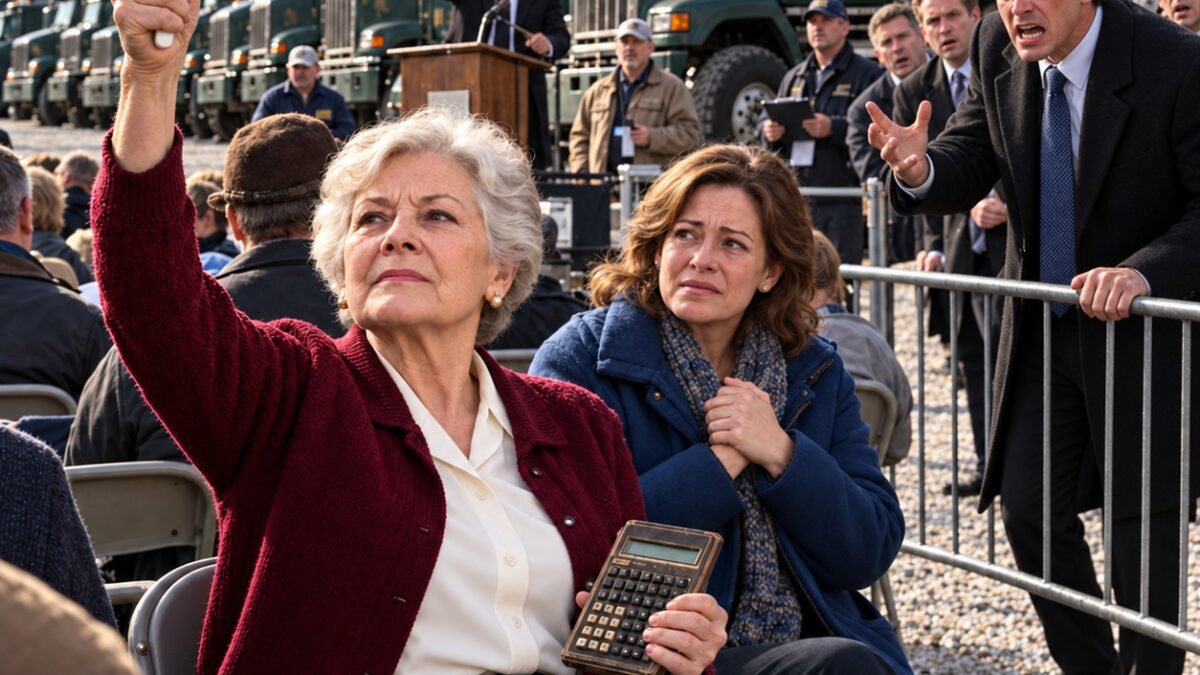
My Son-in-Law Said, “Sit Down, Old Woman—What Can You Do?”—Six Months Later, I Bought Every Truck at His IRS Auction
My son-in-law looked straight at me across an eighteen-person Christmas table, kept chewing his pie, and said, “Sit down, old woman—what can you do?” after his mother threw my daughter’s handmade gift into the kitchen trash while his sister zoomed in with her phone and laughed.
Nineteen days later, my daughter arrived at my back door shaking in the snow with an IRS letter addressed to Claire Caldwell, Treasurer and a second document her husband wanted her to sign admitting responsibility for more than $418,000 in unpaid payroll taxes she had never controlled.
Twenty-four weeks after that Christmas dinner, I was sitting in the third row of a gravel equipment yard with bidder paddle 47 on my lap and my forty-five-year-old HP 12C calculator in my hand while the federal government auctioned off every green truck my son-in-law believed his friends were going to buy back for him.
My name is Moren Hwitt.
I was seventy years old that Christmas.
I drove a 2014 Buick.
I lived in the same fourteen-hundred-square-foot ranch house my husband and I had bought decades earlier.
My left hip complained in cold weather.
I owned cardigans older than some of the people who had been laughing at me that night.
And to the Caldwell family, those facts apparently told them everything they needed to know.
They were wrong.
Christmas dinner began at exactly 5:30 because Lorraine Caldwell believed lateness was evidence of moral failure.
Her house sat at the top of Ridge Road in Bellwood Springs, Pennsylvania.
White colonial.
Black shutters.
Perfect lawn.
Flagpole nobody touched except the landscaping company.
That year, nine green trucks from Caldwell Fuel and Heating were lined along the circular drive with Christmas wreaths wired to their grilles.
Gold lettering ran across every tank:
CALDWELL FUEL & HEATING — SINCE 1951
People in town actually drove up Ridge Road every December to photograph them.
I parked my Buick behind the last truck and carried in a pecan pie nobody had asked me to bring.
There were eighteen people around Lorraine’s walnut dining table.
Bridge friends from Laurel Glenn Country Club.
Two of Brandon’s golf partners and their wives.
His younger sister Kendra, whose phone was already mounted on a miniature tripod beside the gravy boat.
Gordon Caldwell, Brandon’s father, sat at the head of the table.
He had been quieter since his stroke in 2022.
His right hand trembled slightly when he reached for his water glass.
Lorraine had arranged handwritten place cards.
Mine was beside the kitchen door.
“Moren, you’re here.”
She tapped the chair.
“Easier for you.”
Easier for what, she did not say.
I had spent seventy years watching people seat one another.
You learn things.
Who gets the head of the table.
Who gets placed near the host.
Who gets positioned where they can be useful.
And who gets tucked beside the kitchen because they are tolerated.
My daughter Claire sat halfway down beside Brandon.
Thirty-six years old.
Art teacher at Bellwood Springs Middle School.
Gentle in the way her father Frank had been gentle.
She believed patience could eventually persuade most people to become better.
All through dinner, her hand kept drifting beneath the table toward a flat silver-wrapped box beside her chair.
She had spent thirty hours restoring what was inside.
After dessert, Lorraine began opening gifts one at a time.
Cashmere.
Crystal.
Wine.
Perfume.
Then Claire pushed the silver box toward her.
“This one’s special.”
Lorraine opened it.
Inside was an eight-by-ten photograph.
A diner counter.
A woman in a pink waitress uniform laughing with a pencil behind her ear.
Beside her stood a skinny seventeen-year-old girl in a white apron clutching a glass coffee pot.
One of Lorraine’s bridge friends leaned closer.
“Oh, who’s that darling girl?”
Lorraine stared at the photograph.
One second.
Two.
Three.
The color drained from her face.
“It’s a mistake.”
She stood.
Walked through the kitchen door.
I heard the stainless-steel trash-can pedal.
Then the metal lid slammed shut.
Claire’s voice cracked.
“That’s your mother.”
Lorraine sat down.
“My mother is none of your business.”
“You told me every picture of her burned.”
“I said it was a mistake.”
“Lorraine—”
“Sit down, Claire.”
Around the table, people became fascinated by their plates.
Kendra kept filming.
I stood.
My napkin slid onto the rug.
Brandon did not move.
He did not even put down his fork.
He looked at me the way people look at a stray animal that wandered inside.
“Sit down, old woman.”
Kendra laughed.
Brandon chewed.
Then smiled.
“What can you do?”
PART2
For two seconds, I wanted to say every sharp thing I had swallowed at that family’s table since 2021.
Then the anger went cold.
Cold has always been more useful to me.
I turned around and walked into the kitchen.
Two caterers froze at the sink.
I stepped on the trash-can pedal.
The frame lay faceup in coffee grounds and cranberry sauce.
The glass had cracked diagonally across the girl’s face.
I lifted it carefully.
Took a clean towel.
Wiped the glass.
The corners.
The back.
Slowly.
The way you clean a child’s scraped knee.
Nobody came after me.
When I returned, the dining room was silent.
“Claire.”
My daughter looked up.
“Get your coat.”
Brandon muttered something about drama.
I did not ask him to repeat it.
We drove home through snow.
For the first four miles, Claire said nothing.
Then it came all at once.
“She said it was a mistake, Mom.”
“I heard her.”
“She told me every picture of her mother burned in a fire.”
I kept my eyes on the road.
“I found that one in your album at Thanksgiving.”
I looked over.
“My album?”
“The shoebox.”
Claire wiped her face.
“On the back it said ‘Dot and Lori, Blue Plate, 1975.’ I scanned it while you were carving the turkey.”
I gripped the steering wheel.
“I thought she’d love it.”
“Sweetheart.”
“What?”
“Do you know whose handwriting is on the back?”
She shook her head.
“Mine.”
Claire stared.
I had taken that photograph in July of 1975.
I was nineteen.
My father had been killed in a railroad coupling accident seven years earlier.
My mother cleaned other people’s houses six days a week.
I worked days at the Blue Plate Diner on Route 22 and took accounting classes at night.
Dot Puit was the head waitress.
Pink uniform.
Pencil behind her ear.
Big laugh.
Best coconut cream pie in Blair County.
She called everybody “hon.”
Dot had a daughter.
Lorraine.
Skinny.
Quick.
Embarrassed by everything.
Especially her mother.
One slow afternoon, I had a Kodak Instamatic in my purse.
“Dot, hold still.”
She laughed instead.
Lorraine grabbed the coffee pot like it might hide her.
Click.
That was the photograph.
Forty-six years later, I saw Lorraine again at Claire and Brandon’s engagement party.
Lemon-yellow dress.
Pearls.
Laurel Glenn Country Club.
I recognized her immediately.
“Lori.”
She froze.
“Blue Plate.”
Six women stood nearby.
“Your mother made the best coconut cream pie in the county.”
Lorraine gave a polished laugh.
“Oh, you must be confusing me with someone.”
Twenty minutes later, she caught me alone outside the ladies’ room.
No smile.
“Whatever you think you remember, you don’t.”
That was when I understood.
Lorraine Puit had erased herself.
Her father had supposedly been an engineer in Pittsburgh.
A house fire had supposedly destroyed every photograph.
No diner.
No waitress mother.
No pink uniform.
No poverty.
And I was the one person at Laurel Glenn who could look at Lorraine Caldwell and still see a seventeen-year-old girl pouring coffee.
So I kept her secret.
For four and a half years.
Never said Blue Plate again.
Never told Claire.
Never contradicted Lorraine’s invented childhood.
I thought I was respecting boundaries.
Maybe I was.
Maybe I was also making myself smaller to keep the peace.
By the time we reached my house, Claire understood why the photograph had terrified Lorraine.
“But why hate me?”
She asked.
“Because you’re my daughter.”
“That’s insane.”
“Fear rarely audits itself.”
Claire almost smiled.
Then her face changed.
“There’s something else.”
“What?”
“Kendra says I embarrassed the family.”
“Of course.”
“She says I need to act like part of the business.”
I turned toward her.
“What business?”
“Caldwell Fuel.”
“What do you mean?”
Claire shrugged.
“I’m the treasurer now.”
My hand stopped halfway to the coffee pot.
“Since when?”
“July.”
“Claire.”
“It’s nothing.”
She looked exhausted.
“Kendra gave it up. She said marketing needed all her time.”
“What exactly did she tell you?”
“That it’s just a title.”
I put the coffee down very carefully.
Thirty-five years of payroll and tax work had taught me something simple.
Nobody hands you a financial title because it means nothing.
“Tell me everything.”
Claire blinked.
“About what?”
“The day she gave it to you.”
June 29, 2025.
Sunday dinner.
Pot roast.
Kendra announced she was resigning as treasurer.
Then smiled at Claire.
“You should take it.”
Claire had laughed.
“I teach art.”
“It’s just a title.”
Lorraine had patted my daughter’s hand.
“Claire’s family now.”
I hated that detail.
Because according to Claire, it was one of the warmest things Lorraine had ever said to her.
Two days later, July 1, Claire went to Allegheny Ridge Bank during lunch.
Signed a signature card.
Signed a one-page officer acceptance.
Received a manila folder.
She put it in her desk.
Never read beyond the first page.
Between July and September, Brandon brought her eleven checks.
Tires.
Parts.
Pump maintenance.
$38,420 total.
Every check completed.
Claire only signed where Brandon pointed.
“Did anyone ever show you payroll deposits?”
I asked.
Her face went blank.
“What payroll deposits?”
I did not answer.
I was thinking about the date.
June 29.
One day before the end of a payroll-tax quarter.
People do not casually surrender titles on June 30.
Not in businesses with trouble.
A few days later, Claire mentioned something else.
October 16.
School open house.
She had stopped at Caldwell Fuel with a sandwich for Brandon.
On his desk:
An IRS envelope.
Heavy black letters:
FINAL NOTICE
“What happened?”
I asked.
“Kendra said it was a payroll-company clerical problem.”
“And Brandon?”
“He folded it.”
“What did he say?”
“Stay in your lane.”
My jaw tightened.
“When was the last company check you signed?”
Claire thought.
“September twenty-sixth.”
“And after October sixteen?”
“Nothing.”
That worried me more.
A final notice is rarely clerical.
It is the last polite stage before the government stops being polite.
January 8, I drove past Caldwell Fuel.
Heating-oil season.
Nineteen degrees.
Nine trucks should have been moving.
Four were.
Five sat cold against the fence.
Across the road, Dale Kowaltic was fueling his pickup.
Twenty-six years driving for Caldwell.
My old firm had done his mother’s taxes.
He tipped his cap.
“Moren.”
“How’s winter?”
He looked toward the yard.
“Weird.”
“How?”
“Supplier wants cash on delivery.”
“Since when?”
“November.”
That was bad.
“Christmas bonus?”
He snorted.
“Gone.”
“Brandon says slow winter?”
Dale shook his head.
“Nineteen degrees is not a slow winter.”
I went home.
Five days later, at 9:40 p.m., Claire called.
“Mom.”
Her voice sounded like a child.
“There’s a letter from the IRS.”
I sat upright.
“Addressed to you?”
“Yes.”
“What does it say?”
“My title.”
“Bring it here.”
“Tonight?”
“Now.”
“And bring anything Brandon asked you to sign.”
Twenty-five minutes later, Claire stood at my back door with wet hair and her school lanyard still around her neck.
I cleared the kitchen table.
Put on coffee.
Then took my HP 12C from the drawer.
Frank had bought that calculator when I passed the CPA exam in 1981.
Gold and black.
Still worked.
The IRS letter was dated January 9, 2026.
CLAIRE CALDWELL
TREASURER
CALDWELL FUEL & HEATING INC.
Revenue officer:
Gloria Haynes.
The company had failed to pay federal employment taxes for the second, third and fourth quarters of 2025.
Claire was invited to an interview.
Form 4180.
I knew Form 4180.
Then Claire handed me another sheet.
“Brandon gave me this Sunday.”
At the top:
STATEMENT OF OFFICER DUTIES
Written in Claire’s voice.
It claimed that since July 1 she controlled federal tax deposits.
Selected which creditors were paid.
Managed company disbursements.
At the bottom:
Her name.
Unsigned.
My hands went cold.
“He gave this to you two days before your IRS letter arrived.”
“Yes.”
That meant Brandon likely received notice first.
And had already chosen whose signature he wanted.
I turned back to the IRS balances.
Second quarter.
Third.
Fourth.
Trust-fund portion.
I added them.
Then again.
$418,640.
Claire stared.
“What does that mean?”
“This isn’t paperwork.”
“What?”
“It is a confession with your name typed underneath.”
She went pale.
I explained.
Every payday, money is withheld from workers for federal income tax, Social Security and Medicare.
That money never belongs to the company.
The company holds it temporarily.
If responsible people knowingly use it for something else, the IRS can pursue them personally.
Claire whispered:
“Every dollar?”
“Every dollar they assess.”
She put her head down on folded arms.
“He sleeps next to me, Mom.”
My heart broke.
“He sleeps next to me.”
I put my hand on her hair.
Then told her something I should have told her sixteen months earlier.
“I saw his numbers.”
She looked up.
“What?”
“August 2024.”
Brandon had come to my kitchen with a fourteen-page business plan.
Two propane trucks.
A depot.
$250,000 requested from me.
He called it an investment.
I read every page.
Customers paying in ninety-four days.
New equipment loan due every thirty.
Interest above nine percent.
Cash flow did not close.
“I can’t invest.”
I had told him.
He stood so fast the chair scraped.
“I didn’t come here for a lecture from an old woman.”
First time he used the phrase.
He borrowed anyway.
Then bought a $540,000 lake house.
And I never told Claire.
Because I had a rule.
My own mother had meddled in my sister’s marriage until the marriage broke.
I had sworn I would never do that.
So I kept quiet.
Their marriage.
Their business.
Their choices.
Now my daughter sat at my table facing a $418,640 federal problem.
Sometimes silence is respect.
Sometimes silence is cowardice dressed politely.
“I’m sorry.”
I said.
“You couldn’t have known this.”
“No.”
I squared the papers.
“But I know it now.”
Then I gave Claire three rules.
“Do not sign.”
She nodded.
“Do not post.”
“What?”
“Anything.”
“But Kendra—”
“I do not care what Kendra posts.”
Third:
“We read.”
“Everything?”
“Every page.”
The next morning at seven, I called Walter Ames.
Tax attorney.
Former junior accountant at my old firm.
“Moren Hwitt calling before breakfast?”
He said.
“Somebody’s in trouble.”
“My daughter.”
His voice changed.
“Tell me.”
Eleven minutes.
No interruption.
Then:
“She signs nothing.”
“Agreed.”
“She discusses no taxes with Brandon.”
“Agreed.”
“She gathers everything she is legally entitled to access as treasurer.”
“No snooping.”
“Correct.”
Then:
“Moren, titles do not decide these cases.”
“What does?”
“Access.”
Who controlled banking?
Who got notices?
Who chose creditors?
Who could pay the government?
Claire searched her email.
July 1.
PayBridge Payroll Services.
YOUR VIEW-ONLY ACCESS IS READY.
She had never activated it.
Friday evening Brandon came pounding on my door.
Navy parka.
Manila folder.
“Where is she?”
Claire came down the hall.
He held out the folder.
“Sign it tonight.”
“No.”
“Or you’re out.”
Claire stared.
“Out of what?”
“The house.”
Then:
“The family.”
I felt every muscle in my body tighten.
“I’m not signing something I didn’t do.”
“You were treasurer.”
“I signed eleven checks.”
“You had authority.”
“You filled them out.”
Brandon looked at me.
“What is your mother going to do?”
He smiled.
“Balance my checkbook?”
Then he put Lorraine on speaker.
“Brandon.”
Her voice came through cold and small.
“Stop wasting time on a mistake. Get the signature.”
Mistake.
Again.
Claire folded her arms.
“No.”
One syllable.
I have never been prouder.
Brandon turned red.
“You’ll regret this by spring.”
I closed the door.
Did not slam it.
Closed it gently.
Turned the deadbolt.
January 20.
6:41 p.m.
Claire activated the PayBridge account.
She was still treasurer.
Walter confirmed she had legal access to view company records.
We opened:
REPORTS
Then:
ACCOUNT ACTIVITY
Every change.
Every user.
Every timestamp.
We scrolled.
Then found it.
APRIL 3, 2025 — 11:52 P.M.
USER: B. CALDWELL
TAX SERVICE CHANGED: FULL SERVICE → SELF-FILE
I read it twice.
Claire frowned.
“What does that mean?”
“Until this moment, PayBridge automatically sent payroll taxes to the IRS.”
“And after?”
“The money stayed in the company account.”
Her face changed.
“Brandon did that?”
“At eleven fifty-two at night.”
Months before she became treasurer.
Then:
JULY 1 — TAX NOTICE CONTACT CHANGED — B. CALDWELL
Then:
JULY 1 — VIEW-ONLY USER CREATED — C. CALDWELL
At the bottom:
JANUARY 20, 2026 — 6:41 P.M. — C. CALDWELL — FIRST LOGIN
Claire covered her mouth.
“They set me up.”
“Yes.”
The log did not care who was married.
Who sat at Christmas dinner.
Who called whom family.
It remembered clicks.
We printed copies.
Sent them to Walter.
But another question kept me awake.
Before July 1, who received the tax warnings?
Next evening:
June 20.
SYSTEM NOTICE: NO FEDERAL TAX DEPOSITS RECORDED FOR SECOND QUARTER.
Recipient:
K. CALDWELL
Kendra.
Ten days later, she resigned as treasurer.
I stared at her resignation letter.
June 30.
Ten days.
“Kendra didn’t resign.”
Claire looked at me.
“What?”
“She evacuated.”
She had seen the warning.
Looked up what treasurer liability could mean.
Then found someone else.
An art teacher.
A daughter-in-law.
Someone Caldwell enough to sign.
Not Caldwell enough to protect.
And Lorraine had patted Claire’s hand.
Claire’s family now.
The only time she warmly called my daughter family was when they needed her signature.
February 2, Claire resigned.
Certified mail.
Four days later, return receipt signed by Kendra.
Two days after that, Kendra posted a photograph of Claire’s empty Sunday-dinner chair.
Caption:
Some people steal from family businesses and then run home to Mommy.
Nine hundred comments.
Thief.
Gold digger.
Parasite.
Claire wanted to post the audit log.
“No.”
“Mom, they’re lying.”
“I know.”
“Everyone at school is seeing this.”
“I know.”
“Then why not show them?”
“Because proof belongs with people who can act on it.”
She stared.
“Once you put evidence online, it becomes an argument.”
“Kendra is better at arguments.”
“Exactly.”
The audit log was for Gloria Haynes.
Not Facebook.
So I made pot roast.
Claire threw a pillow at the television.
Then we watched people bake cakes.
February 10.
IRS interview.
Walter’s office.
I waited in the lobby for two hours and ten minutes reading the same article about hydrangeas four times.
When Claire emerged, she looked exhausted.
In the car, she told me the questions.
Who had online banking?
Brandon and Lorraine.
Who decided which bills were paid?
Brandon.
Who received PayBridge warnings?
Kendra, then Brandon.
Who received IRS letters?
Brandon.
Who filled out the eleven checks Claire signed?
Brandon.
Did Claire know taxes were unpaid?
No.
Did she sign anything after seeing the October final notice?
No.
Then Gloria said:
“Titles do not answer my questions, Mrs. Caldwell.”
Pause.
“Bank access does.”
She promised nothing.
Closed the file.
Claire looked out the car window.
“She’s going to talk to Brandon.”
“Yes.”
“What if he lies?”
“The log will still be there.”
March 2, Brandon filed for divorce.
Claire read:
Irreconcilable differences.
She laughed once.
“That’s one thing we agree on.”
That same week, I repaired the photograph.
Keller’s Frame Shop.
Ed removed the cracked glass.
Under the magnifying lamp he noticed something.
Photo-lab stamp:
July 1975.
And behind Dot’s shoulder, inside the pie case:
COCONUT CREAM — 45¢
I laughed.
Dot would have laughed too.
Ed replaced the glass.
The girl in the apron was whole again.
I could have posted it.
Could have called Lorraine’s bridge friends.
Could have exposed her invented history.
I did not.
The photograph was not mine to weaponize.
Then the government moved.
March 12:
IRS levy on Caldwell Fuel’s bank accounts.
March 20:
Sixty-four paychecks bounced.
Tri-County Petroleum stopped deliveries.
April 1:
Caldwell Fuel and Heating closed after seventy-five years.
A printer-paper sign appeared:
CLOSED FOR RESTRUCTURING
The lender repossessed Brandon’s propane trucks and depot equipment.
Then came proposed trust-fund recovery penalties.
Brandon.
Lorraine.
Kendra.
$418,640.
Gordon received nothing.
Stroke had removed him from control.
For two weeks, Claire checked the mailbox every afternoon.
Nothing.
April 28, Walter called.
“They’re not proposing it against Claire.”
I found her in the school parking lot.
She put her forehead on the steering wheel.
Cried for ten minutes.
For the first time since Christmas, good tears.
She owed zero.
The log had done its job.
May 14, the IRS seized what remained.
Nine green oil trucks.
Two service vans.
Shop equipment.
Bright orange notices.
Then Dale called.
“Brandon has a plan.”
“Of course.”
“Trip Whitam buys everything cheap at the sale.”
“And?”
“Two weeks later, everybody comes back under a new company.”
“What company?”
“Keystone Comfort Heating.”
“And the taxes?”
Dale lowered his voice.
“Brandon says they belong to the old company.”
I sat at my kitchen table with the HP 12C.
Some men see a fire and learn to stop playing with matches.
Others complain about smoke while holding gasoline.
May 28.
Public auction notice.
June 11.
10:00 a.m.
Caldwell yard.
Anyone could bid.
I called Gail Row.
My former partner.
“What are you buying?”
She asked.
“Nine trucks.”
“At seventy?”
“Especially at seventy.”
We formed:
JUNIATA HOME HEATING.
Named for the river.
Leased an empty truck garage on Route 22.
Prepared certified funds.
I should explain something Brandon never bothered to ask.
The diner was not my career.
It was my beginning.
Accounting degree.
CPA.
Then 1992:
Gail and I opened Hwitt & Row above a laundromat.
Payroll.
Payroll taxes.
Small businesses.
By 2016:
Forty-two employees.
Clients across four counties.
A regional accounting firm bought us.
My share:
$6.4 million.
It had grown since.
I kept the ranch.
Kept the Buick.
Never saw a reason to buy a larger life simply because I could.
Claire knew.
The Caldwells did not.
Because when she started dating Brandon, we made an agreement.
My money would not enter the marriage.
No loans.
No gifts large enough to distort anything.
No inheritance conversation.
I wanted Claire loved as Claire.
The Caldwells never knew because they never asked.
Lorraine told people I had worked a diner register.
Half true.
In my career, I had watched dozens of family businesses die from unpaid payroll taxes.
It usually begins exactly the way Brandon began.
One late-night decision.
Use the withholding money now.
Put it back later.
Later rarely comes.
June 11.
Seventy-one degrees.
About sixty people in the gravel yard.
Equipment buyers.
Former Caldwell employees.
Neighbors.
Reporter.
Nine green trucks lined against the fence.
Orange seizure notices.
I sat in the third row.
Bidder paddle:
47.
HP 12C on my knee.
Envelope of cashier’s checks in my purse.
Claire beside me.
At 9:52, a silver Escalade arrived.
Brandon.
Aviators.
Golf shirt.
Trip Whitam behind him.
Kendra already filming.
“Caldwell comeback day!”
She told her livestream.
Lorraine came last.
White linen.
Dark glasses.
Brandon saw me.
He stopped.
Then found an audience.
“Want to know why your paychecks bounced?”
He pointed at Claire.
“Ask my wife.”
Murmurs.
Forty former employees looked toward my daughter.
She started to stand.
I put my hand over hers.
“Not yet.”
Brandon walked toward us.
“What are you doing here, old woman?”
A few golf friends laughed.
“Shopping?”
I checked my calculator battery.
I had waited twenty-four weeks.
Six more minutes was nothing.
At ten sharp, the IRS property specialist began.
“Lot one.”
2019 International delivery truck.
2,800-gallon tank.
Minimum:
$18,000.
Trip raised his paddle.
“Eighteen.”
I raised 47.
“Twenty from bidder forty-seven.”
Trip glanced at Brandon.
Twenty-two.
Twenty-four.
Thirty.
Thirty-five.
Forty-one.
Trip lowered his paddle.
“Sold.”
Gavel.
“Bidder forty-seven.”
Lot two.
Same.
Lot three.
Faster.
By lot four, Trip made a phone call.
Then leaned toward Brandon.
I heard:
“My letter says one-eighty, man. That’s all the bank approved.”
$180,000.
I ran it.
He would run dry by lot five.
He did.
Lot six.
Seven.
Eight.
Nine.
Two vans.
Shop equipment.
Total:
$356,500.
Every dollar credited against Caldwell Fuel’s debt.
I never stood.
Not once.
Kendra’s livestream comments exploded.
WHO IS THE GRANDMA?
BIDDER 47 AGAIN
Then Brandon came toward me.
No smile.
“You did this.”
His voice cracked.
“You set us up.”
I looked at my paddle.
“I’m sitting, Brandon.”
“What?”
“You told me to.”
Someone in the green jackets laughed.
Then another.
“You asked what I could do.”
I looked up.
“I can read.”
“Read what?”
The yard became silent.
“April third, 2025.”
His face changed.
“Eleven fifty-two at night.”
“What are you talking about?”
“You turned off automatic payroll-tax deposits.”
Kendra’s phone lowered.
“June twentieth.”
I continued.
“The first warning went to Kendra.”
Kendra went white.
“Ten days later, she resigned.”
“I didn’t—”
“July first.”
I looked directly at Brandon.
“You gave my daughter the title.”
Then:
“You moved the tax notices to yourself.”
His face went red.
“You don’t know anything about my business!”
He shouted.
“You’re a cashier.”
“A nobody from a diner.”
I stayed seated.
“The mistake was made at 11:52.”
I said.
“And it wasn’t my daughter’s.”
Dale stepped forward.
“Brandon.”
His voice was flat.
“That tax money came out of our checks.”
Brandon spun.
“Stay out of this.”
That was the moment.
Forty men and women stopped looking at Claire.
And looked at Brandon.
Their income-tax withholding.
Their Social Security.
Their Medicare.
The money had come from them.
Kendra started crying.
“I only did marketing.”
Nobody comforted her.
The IRS specialist stepped closer.
“Sir, back away from the bidder.”
Brandon kicked gravel.
Then Lorraine approached.
Removed her sunglasses.
“You humiliated my son.”
I looked at her.
“In front of the whole town.”
I reached beneath my chair.
Pulled out a flat brown-paper package.
Tore it open.
The restored photograph.
Dot laughing.
Lorraine at seventeen.
I handed it toward her.
“It was never a mistake, Lori.”
She froze.
“Look at your mother.”
Her hands did not move.
“She was proud of you.”
Sixty people watched.
Eventually Lorraine took the frame.
Her thumb slid over Dot’s face.
For one moment, the expensive woman disappeared.
A seventeen-year-old girl stood there.
Ashamed.
Hungry.
Loved.
Her mouth trembled.
Then the door closed again.
“It’s still a mistake.”
She turned toward the Escalade.
But she took the photograph.
Did not throw it away.
That was the only apology Lorraine Caldwell gave me.
I decided it would have to do.
Then I stood.
My hip objected.
I ignored it.
I turned toward the former employees.
“My name is Moren Hwitt.”
Some heads lifted.
“Some of you knew my old firm.”
Dale nodded.
“Hwitt & Row.”
“I bought these trucks for a new company.”
Pause.
“Juniata Home Heating.”
Nobody moved.
“We open Monday at seven.”
Then:
“Same jobs.”
Still silence.
“Same pay.”
Someone inhaled sharply.
“And anybody whose March paycheck bounced gets a signing bonus.”
Pause.
“Exactly equal to that missed paycheck.”
One person clapped.
Then another.
Within seconds, the gravel yard filled with applause.
An older driver named Hank sat on the bumper of lot three and covered his face.
I looked at Dale.
“I need an operations manager.”
He removed his cap.
“Yes, ma’am.”
Behind me, Brandon was shouting.
Nobody turned around.
Claire squeezed my hand.
Her eyes were wet.
“You stood up.”
I looked at her.
“Only when it mattered.”
Juniata opened June 15 at seven in the morning.
Fifty-eight of Caldwell’s sixty-four employees returned.
The first checks we issued were signing bonuses.
Exact amounts.
No speeches.
No rounding.
Dale handed them out.
By August, 2,700 of Caldwell’s old 3,100 customers had transferred over.
Not because of me.
Because their drivers called.
Customers often think they are loyal to brands.
Mostly they are loyal to the person who shows up before the heating tank runs dry in February.
We repainted the trucks deep river blue.
White lettering:
JUNIATA HOME HEATING
Every Tuesday, one drove down Ridge Road.
Past the Caldwell colonial.
Past the FOR SALE sign.
Kendra did not appeal her penalty.
It became final.
Her sponsors disappeared.
Her account went private.
She texted Claire:
You could have warned me.
Claire showed me.
“What do I say?”
“Nothing.”
She deleted it.
Brandon and Lorraine appealed.
Walter told me appeals take time.
“The log will still be there.”
Good.
The IRS filed liens.
Brandon sold the lake house.
Most proceeds went to lenders and government.
He moved into a two-bedroom apartment in Altoona.
I heard he sold used cars.
I did not celebrate.
A man losing everything does not restore what he tried to take from my daughter.
It only means consequences finally stopped missing him.
Laurel Glenn suspended Lorraine over unpaid dues.
Bev reported that the bridge luncheon got a new hostess.
“And the chicken salad is better.”
“Bev.”
“What?”
“I’m allowed small joys.”
Fine.
Claire’s divorce moved forward.
She kept her teaching job.
Her Subaru.
Savings.
And owed the federal government exactly zero dollars.
She rented a little apartment above a bakery.
Good north light.
Perfect for photograph restoration.
She still visited Gordon once a month.
That surprised me.
“He didn’t protect you.”
I said.
“He had a stroke.”
“He looked at his plate at Christmas.”
“I know.”
“Then why?”
“Because he is still a human being.”
That was Claire.
Last time, Gordon held her hand.
Struggled to speak.
Finally:
“I’m sorry, honey.”
The only Caldwell who ever said it.
In August, Lorraine left me an eleven-second voicemail.
“Moren.”
Long pause.
“I wondered whether you still have the original print.”
I did.
Shoebox album.
Top shelf.
Blue Plate.
I mailed it the next morning.
Plain envelope.
No note.
No speech.
Some things belong to the people in them.
My time is not one of those things.
I never called her back.
That became my boundary.
Claire decides who she sees.
I decide who sits at my table.
Saturday mornings, she now uses a small office at the Juniata garage to restore old photographs for employees.
Free.
A wall beside the time clock filled slowly.
Fathers on tractors.
Mothers in diner aprons.
Children with bicycles.
Weddings.
Military pictures.
One image shows Dale at eight years old sitting on his father’s fuel truck.
Another shows Hank’s mother behind a bakery counter.
Nobody is embarrassed by those photographs.
That may be my favorite thing about Juniata.
We do not ask anybody to reinvent where they came from before we respect where they are.
Every Sunday, Claire comes to dinner.
Sometimes Dale and his wife come.
Sometimes Bev.
Nobody sits beside the kitchen door unless they want to be closest to the pie.
My HP 12C still lives in my kitchen drawer.
Several keys are almost worn blank.
It survived Brandon.
So did I.
Claire teases me.
“Most mothers respond to Christmas insults by leaving early.”
“I did leave.”
“You bought an oil company.”
“Six months later.”
“Normal response.”
I remind her that I did not buy Caldwell Fuel.
I purchased seized assets.
She says that distinction makes me sound worse.
Maybe.
But I want something understood.
I did not spend $356,500 for revenge.
If revenge had been the objective, there were cheaper ways.
I bought nine trucks because nine trucks still worked.
I bought two vans because furnaces still break.
I bought shop equipment because people knew how to use it.
I started Juniata because sixty-four families had lost paychecks and 3,100 homes still needed heat.
Brandon believed a company belonged to the person whose last name was painted on the tank.
I had spent thirty-five years doing payroll.
I knew better.
A company is Monday morning.
The driver who knows which elderly customer needs the side door because she cannot hear the front bell.
The mechanic who can identify truck seven’s noise before anyone else hears it.
The office manager who remembers a customer from four digits of a phone number.
The person who sends payroll taxes where they belong.
That is a company.
The Caldwells lost theirs long before orange seizure notices appeared.
They lost it when people became objects.
Claire became a signature.
Kendra became marketing.
Employees became withheld taxes.
Customers became receivables.
And I became an old woman who could be dismissed because nobody at that table had ever asked what I had spent my life doing.
That is one danger of contempt.
It makes you stop asking questions about the person you underestimate.
If Brandon had asked, he might have learned I understood payroll taxes better than he did.
If Lorraine had asked, she might have learned I had protected her secret for nearly five years.
If Kendra had asked, she might have discovered Claire had a mother who knew exactly what Form 4180 meant.
Instead, they saw:
Buick.
Ranch house.
Diner.
Gray hair.
Old woman.
And filled in everything else themselves.
I do not mind being underestimated.
Sometimes it is useful.
What I mind is cruelty built on the belief that a person cannot answer back.
At Christmas, Brandon asked:
“What can you do?”
For a while, I thought the satisfying answer was:
I can buy your trucks.
It wasn’t.
The answer was:
I can read.
Read the IRS letter.
Read the statement before signing.
Read the bank authorization.
Read the payroll log.
Read the timestamp.
Read Kendra’s resignation date.
Read the tax warnings.
Read the auction notice.
Read every number twice.
Truth did not need me to invent anything.
It needed me to stop looking away.
That was my failure before it became my strength.
I saw Brandon’s cash-flow problem in 2024.
Stayed silent.
I saw Lorraine’s hostility toward Claire.
Stayed silent.
I knew the history Lorraine was terrified someone would expose.
Stayed silent.
I told myself I was respecting my daughter’s marriage.
Some of that was true.
Some of it was cowardice wearing polite clothes.
There is a difference between invading an adult child’s life and telling her you smell smoke.
I understand that now.
If I could return to 2024, I would not tell Claire:
Leave him.
I would tell her:
I reviewed Brandon’s business plan.
The company has a serious cash-flow problem.
You are an adult.
Use the information however you choose.
That is not meddling.
That is truth.
Parents do not need to drive the car.
Sometimes we should still mention the bridge is out.
Claire forgave me faster than I forgave myself.
“Mom.”
She said one Sunday.
“You did not turn off the taxes.”
“No.”
“You did not put my name on that statement.”
“No.”
“You did not make me treasurer.”
“No.”
“Then stop trying to serve someone else’s sentence.”
Art teachers occasionally become annoyingly wise.
I listened.
Mostly.
Juniata grew carefully.
That word matters.
Carefully.
We did not buy lake houses.
Did not expand because expansion sounded impressive.
Every payroll-tax deposit automated.
Every notice copied to multiple officers.
No single executive could silently shut off tax remittance without an outside-accounting alert.
Systems do not create honest people.
Good systems make dishonesty harder.
One afternoon, a young woman from the office brought me a form.
“I’m sorry.”
“For what?”
“This may be a stupid question.”
“No such thing.”
“I don’t understand what I’m signing.”
I put down my coffee.
“That is never a stupid question.”
Routine insurance designation.
Nothing dangerous.
But when she left, I thought about Claire.
It’s just a title.
There is no such thing as “just” a title if a signature sits beneath it.
Treasurer.
Director.
Trustee.
Guarantor.
Cosigner.
Officer.
Words create responsibility.
Sometimes liability.
Read them.
If somebody rushes you, read slower.
If somebody says everyone signs it, ask why.
If somebody says family does not need lawyers, that may be exactly when you need one.
Lorraine and I never became friends.
That would be sentimental nonsense.
Years later, I saw her at a pharmacy.
Different aisle.
No white linen.
No bridge-club audience.
She looked older.
So did I.
“Moren.”
“Lorraine.”
Pause.
Then:
“Thank you for the photograph.”
“You’re welcome.”
Her mouth moved.
Stopped.
I started walking.
Then she said:
“My mother really did make the best coconut cream pie.”
I stopped.
Looked back.
“Yes.”
“She used lard.”
“I know.”
“She never wrote the recipe down.”
“No.”
Silence.
Then Lorraine said:
“I should have kept more.”
I knew she was not talking about recipes.
“Yes.”
I said.
That was all.
No reconciliation.
No dramatic apology.
But Lorraine Puit had spoken about her mother without denying her.
Maybe that mattered.
I hope so.
Then I went home.
My time belonged to me.
Claire still comes every Sunday.
Her little apartment filled with restored photographs.
She began doing paid restoration work too.
Not enough to leave teaching.
Enough that strangers mail her faded family pictures.
She says:
“Damaged photographs do not always need to look new.”
“What do they need?”
“Whole enough to remember.”
I like that.
Maybe people are the same.
Not restored to who we were before damage.
Whole enough to continue.
The first Christmas after the divorce, Claire handed me a silver-wrapped package.
I stared.
She laughed.
“Open it.”
Inside was a new print of the Blue Plate photo.
But she had widened the scan.
In the far-left diner mirror, partly reflected, stood me.
Nineteen years old.
Camera raised to my face.
I had never noticed.
Three women in one picture.
Dot laughing.
Lorraine trying to disappear.
Me preserving the moment.
Claire added a little card:
THE WOMEN WHO WERE THERE.
I cried.
“Good tears?”
“Annoying tears.”
She hugged me.
Dale arrived with pie.
Nobody threw anything away.
That is what satisfying endings look like to me now.
Not people suffering.
People learning what deserves to stay.
Frank’s calculator stayed.
Dot’s photograph stayed.
Claire’s savings stayed.
Fifty-eight jobs stayed.
Thousands of customers kept receiving heat.
The unpaid taxes stopped being an invisible problem.
And my daughter’s name stayed off a debt she did not create.
The Caldwells asked what an old woman could do.
The answer was never:
Destroy them.
They did most of that themselves.
My answer was smaller.
I could read the page they expected my daughter not to read.
I could know June 30 meant something.
I could recognize a final notice.
I could ask who controlled the bank account.
I could call Walter at seven in the morning.
I could sit still while louder people lied.
I could wait until proof reached people authorized to use it.
I could raise bidder paddle forty-seven when the auctioneer asked for twenty thousand.
Then again.
And again.
And again.
Most importantly, I could learn that staying out of my daughter’s marriage did not require staying silent while people pushed her toward a cliff.
I learned late.
But not too late.
If I could return to Lorraine’s Christmas table now, I would still stand when she threw the photograph away.
Still retrieve it.
Still tell Claire to get her coat.
But when Brandon looked at me with pie on his fork and asked:
“What can you do?”
I would not answer.
There is no need to explain yourself to somebody committed to underestimating you.
Let them.
Let them mistake quiet for weakness.
Let them believe a Buick proves poverty.
Let them believe gray hair proves ignorance.
Let them laugh at an old calculator.
Then go home.
Read.
Document.
Ask questions.
Protect the person who trusts you.
And when truth finally enters the room, do not drag it to its feet.
Truth knows how to stand.
At 11:52 on a Thursday night, Brandon Caldwell clicked one setting that kept his employees’ tax money inside his company.
Ten weeks later, his sister stepped away from the title closest to the danger.
The next day, they handed that title to my daughter.
Months later, the IRS asked who actually controlled the money.
The family gave stories.
The audit log gave timestamps.
The timestamps won.
Today, the nine trucks are blue.
Every Tuesday, one still travels down Ridge Road.
Someone else eventually bought the Caldwell colonial.
The flagpole remained.
Different flag.
Different family.
No green trucks with wreaths.
Just a blue Juniata truck headed toward another furnace before someone’s house gets cold.
My bidder paddle hangs in the Juniata office.
Number 47.
Dale framed it.
I told him that was ridiculous.
“Yes, ma’am.”
Beside it is a copy of the auction notice.
Not because I want anybody to remember Brandon.
Because I want people to remember those trucks had another life before this one.
Companies do too.
Families do.
People do.
The old woman they told to sit down still sits plenty.
My hip appreciates it.
I sit at my kitchen table.
At the Juniata office.
In Claire’s apartment while she restores photographs.
At Sunday dinners beside people I actually want near me.
Sitting was never the insult.
The insult was believing age made me powerless.
They misunderstood power.
Power is not shouting loudest at Christmas.
Not owning the largest house on Ridge Road.
Not being company president.
Not even having millions in the bank.
Sometimes power is simply understanding the document in front of you while everybody else hopes you will be too intimidated to read it.
So if somebody ever hands your child a title and says:
“It doesn’t mean anything.”
Read.
If somebody hands them a confession and says:
“It’s just paperwork.”
Do not sign.
If somebody says:
“We’re family. Trust me.”
Trust may still be appropriate.
Reading is still free.
And if a man looks at you across a Christmas table, laughs and says:
“Sit down, old woman. What can you do?”
Sometimes the best answer is to do exactly what he says.
Sit down.
Open every page.
Run the numbers twice.
Wait.
Let the truth finish its work.
And when the auctioneer calls for the next bid—
raise your paddle.

