I woke up bald on the morning of my only son’s wedding. There was a handwritten note on my pillow from his bride.
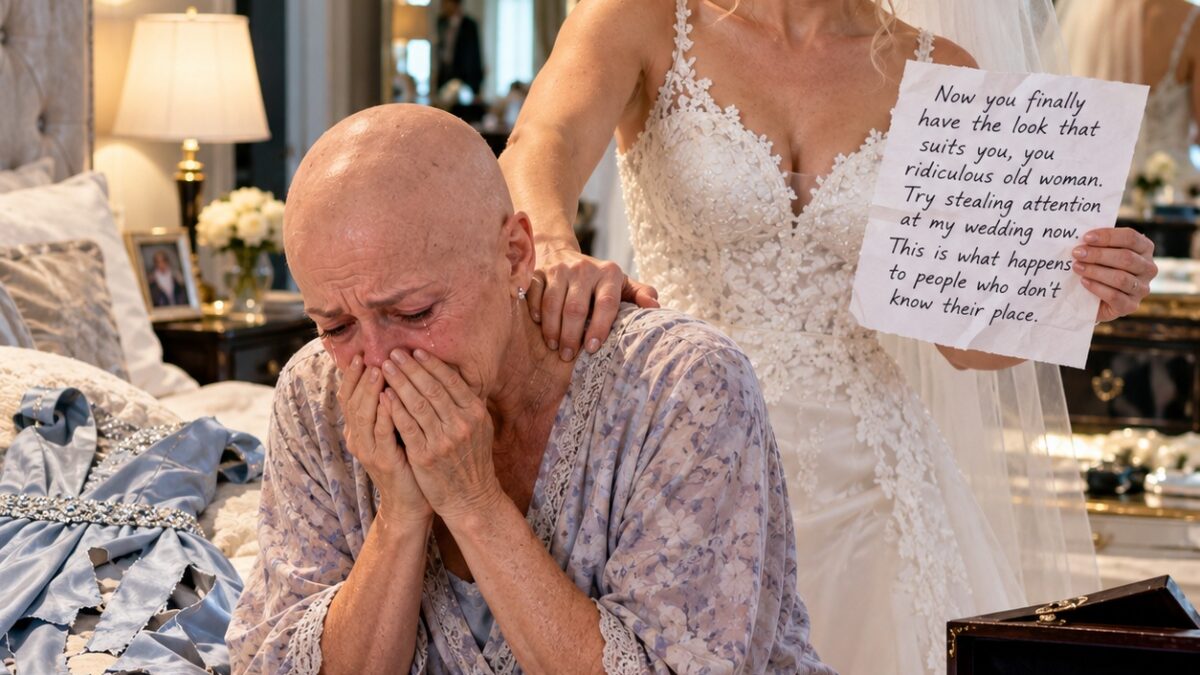
I woke up bald on the morning of my only son’s wedding.
There was a handwritten note on my pillow from his bride.
And less than twenty-four hours earlier, I had still been planning to give the two of them one hundred and twenty million dollars.
My name is Babette Wilson. I was sixty-eight years old when the woman my son loved decided that humiliating me was the easiest way to remove me from her path.
For several seconds that morning, I did not understand what my hand was touching.
I had awakened with a dry mouth, a pounding heaviness behind my eyes, and the strange sensation that I had slept much deeper than usual. Sunlight poured through the cream-colored curtains of my bedroom, turning the room gold.
For one peaceful moment, I remembered only one thing.
Jackson was getting married.
My son.
My only child.
The little boy who used to climb into our bed during thunderstorms was going to stand in front of everyone we loved and promise his life to someone else.
I smiled.
Then I reached up to brush my hair away from my face.
My fingers touched skin.
Smooth skin.
I froze.
I touched my head again.
Nothing.
No silver waves.
No soft curls at my temples.
No hair at all.
I stumbled from the bed so quickly that my knees nearly gave out beneath me.
The woman in the mirror did not look like me.
Her scalp was completely bare.
Not badly cut.
Not unevenly trimmed.
Shaved.
Every strand of the silver hair I had worn proudly for years was gone.
I stared at my reflection, waiting for logic to catch up with what my eyes were seeing.
It never did.
“What happened?”
My own voice sounded weak.
I touched my head again, as though hair might somehow reappear beneath my fingers.
Then I saw the folded sheet of paper on the nightstand.
I knew the handwriting before I opened it.
Natalie.
My future daughter-in-law.
The note was short.
Now you finally have the look that suits you, you ridiculous old woman.
Try stealing attention at my wedding now.
This is what happens to people who don’t know their place.
I read it twice.
Then a third time.
The room seemed to tilt.
And suddenly the strange wine from the night before made sense.
Natalie had insisted I try it at our small family dinner.
“This one is special,” she had said, smiling as she pushed the glass toward me. “I picked it out for you.”
It had tasted slightly bitter.
Not enough for me to refuse it.
Just enough for me to notice.
Later, she had offered me one of her “herbal sleep supplements.”
“You need to look rested tomorrow,” she had said. “It’s a huge day.”
Something in her voice had made me uneasy, so I had pretended to swallow the pill and later thrown it away.
Apparently, I had still consumed enough of whatever was in the wine to sleep through someone entering my bedroom.
Enough to sleep through clippers running across my head.
Enough to sleep through a woman shaving me bald because she believed I was competition at her wedding.
I sat on the edge of my bed.
And I cried.
Not loudly.
There was no dramatic scream.
No shattered mirror.
I simply sat there with both hands pressed against my bare scalp while tears ran down my face.
I had spent most of my adult life believing humiliation was something you could survive by refusing to show it hurt.
That morning, it hurt.
God, it hurt.
I had lost my husband five years earlier.
I had buried my parents.
I had built a business from almost nothing during an era when men routinely assumed the woman in the room was someone’s secretary.
I had negotiated hostile acquisitions, survived recessions, and once sat across from three bankers who laughed when I told them how much my company would be worth.
I had learned to endure being underestimated.
But there was something uniquely cruel about having your body altered while you slept.
Something violating.
Something intimate.
Natalie had not merely insulted me.
She had touched me while I was unconscious.
She had taken something from me because she wanted me to wake up ashamed.
And she had done it on the morning I was supposed to watch my son get married.
I grabbed my phone and called Jackson.
Straight to voicemail.
I tried again.
Nothing.
Then I texted.
Jackson, something terrible happened. Please call me immediately.
I waited.
Two minutes.
Five.
Ten.
My phone finally chimed.
But the message was not from Jackson.
It was from Natalie.
Don’t bother him.
He’s getting ready for the most important day of his life.
And don’t come looking for sympathy. You got what you deserved for trying to control everything. Stay home and stay out of our way.
For a long time, I stared at those words.
Stay home.
That was the plan.
She wanted to humiliate me badly enough that I would disappear.
My gaze moved toward the closet.
My mother-of-the-groom dress had been hanging there the night before.
Pale blue silk.
Simple.
Elegant.
Frank would have liked it.
I opened the closet.
The dress was on the floor.
Cut into strips.
I did not cry this time.
I simply stared.
Then I noticed the empty space on my dressing table.
My jewelry box was gone.
Inside it had been several pieces I had intended to wear, including my grandmother’s antique diamond brooch.
My heart began pounding differently now.
The sadness was still there.
But something colder had entered beside it.
I walked to the security panel.
The system had been disarmed at 11:30 the previous night.
Rearmed at 1:15 in the morning.
Jackson had given Natalie the code months earlier for emergencies.
I called Maria, my housekeeper.
She arrived early most mornings and had already been downstairs preparing coffee.
When she came into my bedroom and saw me, she stopped dead.
“Oh, Mrs. Wilson.”
Her hand flew to her mouth.
“Maria, did you see anyone here last night?”
Her face changed.
“I thought…”
“What?”
“I thought you knew.”
My stomach tightened.
She sat beside me.
“I heard something upstairs. I came out of the guest hallway and saw Miss Natalie leaving your room.”
“What time?”
“After midnight.”
“Did she say anything?”
Maria nodded slowly.
“She said you weren’t feeling well. She said you had asked her to get something for you. I believed her.”
“You did nothing wrong.”
“But I should have checked.”
“You believed my son’s fiancée was helping me. Any reasonable person would have.”
Maria looked at my head again.
Then at the note.
Her eyes filled with tears.
“She did this?”
“Yes.”
I looked at the clock.
The ceremony began in four hours.
Four hours.
My son was getting married in four hours, and his bride had drugged me, shaved my head, destroyed my dress, stolen jewelry from my bedroom, and ordered me to stay away.
For several minutes, I truly considered obeying her.
Not because she had won.
Because I was afraid.
Afraid of the whispers.
Afraid of people staring.
Afraid someone would assume I was sick.
Afraid Jackson would be angry if I disrupted the wedding.
Afraid that protecting myself would cost me my son.
That last fear had been controlling me for months.
I went back to the mirror.
The face looking at me seemed older than it had the night before.
Without my hair framing it, every line was exposed.
Every year.
Every loss.
Every sleepless night beside Frank during the final months of his illness.
I looked vulnerable.
Then I looked closer.
I was still there.
The woman who had built Wilson Realty was still there.
The nineteen-year-old girl from Montana who had saved five hundred dollars and bought a crumbling fixer-upper while everyone told her she was foolish was still there.
The thirty-year-old woman who owned a small real estate company was still there.
The forty-year-old woman who had expanded into three states was still there.
The widow who had buried the love of her life and somehow continued waking up every morning was still there.
Natalie had removed my hair.
She had not removed me.
I picked up her note again.
Then I looked at my phone.
I had two calls to make.
One to my sister.
The other to my lawyer.
And for the first time that morning, my hands stopped shaking.
────────── ✦ ──────────
To understand why I did not call the police immediately, you have to understand Jackson.
And to understand Jackson, you have to understand his father.
Frank Wilson was the kindest man I ever knew.
I met him when I was thirty-two at a business conference in Denver. I had already spent more than a decade building my company by then.
I grew up in a small Montana town where money was always tight.
My father repaired farm equipment.
My mother worked part time at a grocery store and somehow stretched every dollar until it nearly begged for mercy.
We were not miserable.
We were loved.
But I learned early that security was never guaranteed.
At nineteen, I took the five hundred dollars I had saved from every job I could find and put it toward a neglected little property that everyone else thought was worthless.
The roof leaked.
The kitchen floor sagged.
There was mold behind one wall and a plumbing system that seemed personally offended by water.
I fixed what I could myself.
I hired professionals when I had to.
Then I sold the place for a modest profit.
And I did it again.
Then again.
By thirty, I owned a small real estate company.
By forty, Wilson Realty had offices in three states.
Frank never treated my ambition like a personality defect.
That mattered more than people understand.
He was successful in his own right, but he never needed me to become smaller so he could feel larger.
When we married, he told me, “I don’t want half of your life, Babs. I want to build one with you.”
And we did.
Jackson was our only child.
From the moment he was born, Frank changed.
I had never seen a grown man become so completely helpless before eight pounds of baby.
He walked around the hospital telling nurses Jackson had “his grandfather’s hands,” even though newborn fingers all looked like tiny pink worms to me.
We loved that boy with everything we had.
Maybe too much.
We tried not to spoil him financially.
We made him work summers.
We taught him to respect staff.
We expected thank-you notes.
We made him understand that the money around him represented years of work, risk, sacrifice, and responsibility.
But he never had to wonder whether the electric bill would be paid.
He never wore shoes with cardboard inside because the soles had worn through.
He never heard his parents whisper about grocery money after bedtime.
Frank and I considered that a victory.
Jackson grew into a thoughtful young man.
He became an architect because, as a child, he was always drawing houses.
Not mansions.
Homes.
He cared about light, shape, community, and the strange emotional power of a space that makes someone feel safe.
Frank adored talking with him about design.
The two of them could sit for hours arguing over whether a building should “announce itself” or “belong quietly to the street.”
Then five years before the wedding, Frank died.
Pancreatic cancer.
Fast.
Cruel.
Unfair.
There was no time to adjust.
One month we were making summer plans.
A few months later, I was standing beside a grave trying to understand how a forty-year marriage could end with one person still having to go home.
Frank left his estate to me.
Combined with what we had built together, it was worth more than two hundred million dollars.
But we had always considered much of that wealth a family legacy.
Years before Frank became ill, we decided that when Jackson married, we would give him a substantial portion.
One hundred and twenty million dollars.
Enough that he and his future spouse could build a life without financial fear.
Enough to invest.
Enough to create something meaningful.
Enough, we hoped, to do some good in the world.
Frank did not believe in making children wait beside a deathbed for an inheritance.
“Give while you’re alive,” he used to say. “Then you get to see what love does with it.”
After Frank died, Jackson disappeared into work.
For nearly two years, he rarely dated.
Rarely socialized.
He grieved quietly.
Then, eighteen months before his wedding, he met Natalie Pearson at a charity gala.
She was striking.
Dark hair.
Blue eyes.
Perfect posture.
A laugh designed to travel across crowded rooms.
She worked in public relations for a major fashion company and seemed to know everyone worth knowing.
Most importantly, Jackson smiled around her.
A real smile.
The kind I had not seen since his father died.
I wanted to love her immediately.
That is important.
I did not begin suspicious.
I began grateful.
The first time Jackson brought Natalie to Sunday dinner, she was charming.
She admired my home.
Asked about photographs.
Wanted to hear how Frank and I met.
She touched Jackson’s arm when he spoke.
She laughed at his terrible jokes.
I went to bed that night thinking, Maybe this is exactly what he needed.
But small things began accumulating.
A comment about my clothes.
“You’re so cute, Babette. You really commit to that classic mature look.”
A joke about my age.
“You probably remember when people still mailed letters, right?”
A smile that disappeared the moment Jackson turned away.
Nothing large enough to confront.
Nothing obvious enough to explain without sounding petty.
My sister Judith noticed my hesitation before I admitted it.
“You don’t like her,” she said one afternoon.
“I didn’t say that.”
“You didn’t need to.”
“I want to like her.”
“Different thing.”
I told Judith about the comments.
She shrugged.
“Maybe she’s nervous around you.”
“Why?”
“You’re Babette Wilson.”
I laughed.
“I’m his mother.”
“You’re also worth a fortune, built a company from scratch, buried your husband without falling apart in public, and have a son who worships you. That can intimidate people.”
“I don’t want to intimidate her.”
“Then give it time.”
So I did.
Three months after meeting, Jackson and Natalie became engaged.
Fast.
Much faster than I would have preferred.
But he was forty-one, not nineteen.
I told myself he knew his own heart.
Then the wedding planning began.
Natalie and her mother took control immediately.
Every suggestion from me became a negotiation.
Every Wilson family tradition became something outdated.
When I suggested Lakeside Gardens, where three generations of our family had celebrated weddings and anniversaries, Natalie laughed.
“We’re looking for something more modern.”
Her mother smiled politely.
Natalie added, “No offense, Babette, but we don’t want the wedding to look like it was planned during the Stone Age.”
Her friends laughed.
Jackson stared at the table.
That hurt more than the joke.
Not because he should have fought every battle for me.
Because he knew it was disrespectful.
And he let silence make the choice for him.
They eventually selected the Westbrook Hotel.
Expensive.
Exclusive.
Photogenic.
I paid the deposit.
Then the menu became another fight.
Frank had loved a particular beef dish served with rosemary potatoes.
Nothing sophisticated.
Just good food.
I suggested adding it as a quiet tribute.
Natalie rolled her eyes when she thought I was not looking.
Later she announced she had selected “elevated cuisine” better suited to the event.
I told myself not to make everything about Frank.
Maybe I was holding too tightly to traditions because letting them go felt like losing him again.
So I kept trying.
I invited Natalie to lunch.
Again.
And again.
She accepted, but most conversations eventually circled back to money.
What neighborhoods would be smart for a second home?
Would Jackson receive assets directly?
How complicated were the family trusts?
Which properties did I intend to keep?
Was the one hundred and twenty million transfer still happening immediately after the wedding?
I noticed.
I chose not to react.
At one lunch, I said, “Frank and I always hoped some of the money would eventually support charitable work.”
Natalie looked down at her phone.
“Of course.”
“We funded a childcare program for single parents through one of our properties.”
“That’s wonderful.”
She did not look up.
“The building means a great deal to me.”
“I’m sure.”
Then she asked whether private jets were better owned directly or through a corporate entity.
That should have told me more than it did.
The week before the wedding, I brought out my grandmother’s pearl necklace.
Four generations of women in my family had worn it.
I did not expect Natalie to wear it during the ceremony if she did not want to.
I simply wanted to offer it.
She opened the velvet case.
Her expression changed instantly.
“Oh.”
I waited.
She lifted the pearls with two fingers.
“These are… old.”
“Yes.”
“No, I mean old old.”
“They belonged to my grandmother.”
She set them back down.
“I already have jewelry picked out. Something more current.”
I felt foolish.
Jackson noticed.
“Maybe you could wear them at the rehearsal dinner.”
Natalie glanced at him.
Then me.
“Sure.”
She never did.
Later, I found the necklace tossed on a side table beneath someone’s purse.
I picked it up quietly and returned it to its box.
That was the first night I admitted to myself that I did not trust the woman my son was marrying.
The rehearsal dinner confirmed why.
I went into the women’s restroom shortly after dessert.
I entered a stall.
Seconds later, Natalie came in with two bridesmaids.
They did not know I was there.
“God,” Natalie groaned. “Is this night ever going to end?”
One friend laughed.
“What now?”
“The old lady. Traditions, traditions, traditions. Frank liked this. Frank loved that. The Wilson family always does this.”
“At least she’s paying.”
Natalie laughed.
“And there’s the money tomorrow.”
My hand tightened around the edge of the stall.
One bridesmaid asked, “Still a hundred twenty?”
“One hundred and twenty million reasons to tolerate her.”
They all laughed.
Then Natalie said something I never forgot.
“Once the money lands, everything changes.”
“How?”
“Jackson already agreed we need space.”
My chest tightened.
“We’ll probably move across the country,” Natalie continued. “His mother has way too much influence. Once we have the money, he won’t need her.”
I closed my eyes.
The other woman said, “You are terrible.”
“No. I’m practical.”
Then they laughed again.
I remained inside the stall until they left.
When I came out, I looked at myself in the mirror and barely recognized the expression on my face.
I called Judith that night.
“I don’t think she loves him.”
“You heard her say that?”
“I heard her call me one hundred and twenty million reasons to tolerate.”
Judith went silent.
“I think she loves what comes with Jackson.”
“Tell him.”
“I tried before.”
“Try harder.”
“You don’t understand. Every time I question Natalie, he hears criticism of his judgment.”
“Then show him what you know.”
“What do I know? A conversation I overheard in a bathroom?”
“You know your instincts.”
I stared out the window.
“He’s happy.”
“Is he?”
“He thinks he is.”
“That isn’t the same thing.”
But I could not bring myself to destroy his wedding two days before it happened.
I told myself I would wait until after the honeymoon.
That decision nearly cost us everything.
The next morning, Maria approached me while I was having coffee.
“Mrs. Wilson, may I ask you something?”
“Of course.”
“Why is Miss Natalie asking about your medication?”
I lowered my cup.
“What?”
“She asked what prescriptions you take. Whether you use sleeping pills. What time you normally go to bed.”
“When?”
“Yesterday.”
“What did you tell her?”
“Nothing important. I said I don’t handle your medication.”
“Did she explain why she was asking?”
“She said she was concerned about your health.”
I nearly laughed.
Natalie had never once asked about my health.
Later that afternoon, I passed the terrace outside the hotel suite where several wedding preparations were taking place.
Natalie was on the phone.
She did not see me.
“Once we have access, those sentimental properties can go.”
I stopped.
She listened.
“No, Jackson won’t fight me. He always comes around.”
My blood ran cold.
One of those “sentimental properties” was the first building I had ever purchased.
The original fixer-upper had been replaced decades earlier with a community center offering free childcare and job assistance to single parents.
Another was our lake house.
Jackson had spent every childhood summer there.
Frank had taught him to swim off the old dock.
These were not meaningless numbers on a spreadsheet.
They were pieces of our life.
That night, for the first time, I had Natalie investigated.
I hated myself for doing it.
Then I hated what I found even more.
She had lied about parts of her education.
She presented herself as coming from substantial family wealth, but the reality was far more complicated.
And she had been engaged twice before.
Both men were wealthy.
Both relationships ended shortly before marriage.
There was nothing proving she had committed a crime.
Nothing dramatic enough to expose.
Just enough deception to deepen every concern I already had.
I tried to speak with Jackson.
“Your wedding announcement,” I said carefully. “I wanted to make sure the background information is correct.”
He stiffened.
“What information?”
“Natalie mentioned Parsons.”
His expression hardened immediately.
“Mom.”
“I’m only asking—”
“Stop digging into her life.”
“Jackson—”
“She’s had a difficult past. She doesn’t owe you every detail.”
“I’m not asking for every detail.”
“You never trust her.”
“I have reasons.”
“No, you have fears.”
That silenced me.
Because part of it was true.
I was afraid of losing him.
And Natalie had become very good at making every legitimate concern sound like a lonely widow’s inability to let go of her son.
So when I found myself sitting at that family dinner the night before the wedding, and Natalie poured me a glass of wine with a beautiful smile, I accepted it.
I drank.
Not because I trusted her.
Because I was tired of being the difficult one.
Then I went home.
And hours later, she entered my bedroom.
The next morning, Judith arrived thirty minutes after my call.
When I opened the door, she stared at me.
“Oh my God.”
I handed her the note.
Her face changed as she read.
“We’re calling the police.”
“No.”
“Babette.”
“Not yet.”
“She drugged you.”
“I know.”
“She shaved your head while you were unconscious.”
“I know.”
“She stole jewelry.”
“I know.”
“And you’re saying no police?”
“Not before I speak to Jackson.”
Judith threw the note onto the table.
“Your son just refused to answer you.”
“He may not have his phone.”
“Or she has it.”
“I cannot have officers walking into his wedding without trying to reach him first.”
“She assaulted you.”
“I know what she did.”
My voice cracked on the last word.
Judith’s anger softened.
I sat down.
“If I call the police now, Jackson will think I did it to stop the wedding. He already believes I’m trying to control him.”
“And what are you going to do instead?”
I looked at her.
“I’m going.”
“To the wedding?”
“Yes.”
“Like that?”
“Yes.”
She studied me for a moment.
Then a slow, grim smile appeared.
“All right.”
“What?”
“If we’re doing this, we’re doing it properly.”
Judith became a military operation disguised as a seventy-one-year-old woman with excellent taste.
She called a stylist friend.
Within an hour, three wigs had arrived.
We chose one close to my natural silver color but shorter and sharper than my usual style.
Judith found a navy dress in my closet.
Not a traditional mother-of-the-groom gown.
But elegant.
Strong.
Then my lawyer arrived.
Thomas, my financial adviser, joined by phone.
I placed Natalie’s note on the dining room table.
I told them everything.
The conversation I overheard.
The questions about my medication.
The wine.
The security log.
The missing jewelry.
The destroyed dress.
The money scheduled to transfer the next morning.
My lawyer looked at me.
“Do you still intend to transfer it?”
“No.”
I had never spoken that word so calmly.
“No?”
“No.”
“What would you like done?”
“Stop everything.”
Thomas spoke through the phone.
“All one hundred and twenty million?”
“All of it.”
My lawyer leaned forward.
“Babette, once emotions settle—”
“My emotions have never been clearer.”
I touched my wig.
“This woman entered my home and assaulted me because she believed she was already entitled to my money. I will not reward that belief.”
“What about Jackson?”
“The money was always intended for him.”
“So?”
“Protect it from her.”
There was a pause.
Then my lawyer said, “We can restructure.”
“Do it.”
I looked down at Natalie’s note.
“And I want documentation of every change.”
By the time Judith and I arrived at the Westbrook Hotel, I had stopped feeling ashamed.
I felt grief.
Anger.
Fear.
But not shame.
That belonged to Natalie.
The hotel lobby was filled with flowers.
White roses.
Orchids.
Candles.
Every surface gleamed.
I had paid for nearly all of it.
As we approached the private wedding level, I saw Jackson.
My heart almost broke.
He stood in his tuxedo laughing with his groomsmen.
For one impossible second, he looked exactly like Frank on our wedding day.
Same shoulders.
Same smile.
Same hopeful innocence.
“Jackson.”
He turned.
His face lit up.
Then he noticed my hair.
“Mom?”
I walked toward him.
“What did you do to your hair?”
Before I could answer, Natalie appeared.
White dress.
Perfect makeup.
Beautiful enough to make cruelty look impossible.
Her eyes met mine.
For the briefest second, her smile vanished.
She had not expected me.
Then the performance returned.
“Babette,” she said brightly. “What a dramatic new look.”
I stared at her.
“You know what happened to my hair.”
Jackson frowned.
“What does that mean?”
Natalie laughed lightly.
“I have no idea.”
I reached into my purse.
“Your bride came into my home last night.”
Natalie’s face remained still.
“She drugged me.”
“Mom.”
“She shaved my head while I slept.”
Jackson stared at me.
“She destroyed my dress and stole jewelry from my bedroom.”
“Stop.”
His voice was sharp.
Not toward Natalie.
Toward me.
That hurt more than anything she had done.
“Jackson, I have her note.”
“I said stop.”
“Please.”
“How could you do this today?”
My breath caught.
“Do what?”
“Accuse her of something insane minutes before our wedding.”
“It happened.”
Natalie’s eyes filled with tears with such perfect timing that I almost admired the skill.
“I knew she hated me,” she whispered.
“I don’t hate you.”
“I’ve tried so hard.”
Jackson put his arm around her.
My son.
Protecting the woman who had drugged me.
“Mom, you’ve been finding fault with Natalie from the beginning.”
“I can prove this.”
“I don’t want to see whatever you’ve convinced yourself proves it.”
I stared at him.
He looked angry.
Embarrassed.
Defensive.
And afraid.
Natalie touched his chest.
“It’s okay.”
Then she looked at me.
“Babette is emotional.”
Her smile was almost invisible.
“Why don’t you take your seat?”
As they walked away, I heard her whisper to a bridesmaid.
“I told you she’d lose it eventually.”
The woman laughed.
Natalie added, “Probably cut it herself and forgot.”
My knees nearly buckled.
Judith gripped my arm.
“You okay?”
“No.”
“Do you want to leave?”
I watched my son disappear through a doorway with Natalie.
“No.”
The ceremony began.
I sat in the front row.
I watched Jackson promise to love her.
Protect her.
Honor her.
Natalie spoke her vows with tears shimmering in her eyes.
Everyone thought they were witnessing love.
I watched a lie wearing white.
When the officiant asked whether anyone objected, Judith quietly placed her hand over mine.
I had no intention of standing.
Not yet.
Because I understood something now.
Jackson was not ready to hear me.
If I stopped the ceremony, I would become the villain Natalie had spent months teaching him to expect.
So I remained silent.
They married.
At the cocktail hour, I stood near a column with a glass of water.
I had stopped drinking anything I did not pour myself.
That was when I heard Natalie speaking to a group of guests.
“Poor Babette is really struggling.”
Someone asked what happened.
Natalie sighed.
“She showed up with that strange haircut and accused me of doing it.”
“No.”
“Yes. Jackson thinks she may need to talk to someone.”
My blood went cold.
Natalie lowered her voice.
“She’s been erratic lately. We’re worried.”
That was the moment everything changed.
The attack had been terrible.
The theft was terrible.
But this was different.
She was constructing a story in which I was mentally unstable.
A story that could be repeated.
Used.
Expanded.
A sixty-eight-year-old widow with substantial assets.
A controlling mother.
Confusion.
Erratic behavior.
Medication.
My daily routine.
Suddenly Maria’s warning sounded different.
What medications does she take?
Does she use sleeping aids?
When does she go to bed?
This was not merely a cruel prank.
Natalie had been studying my vulnerability.
I walked away from the group.
Then I called Thomas.
“Stop everything.”
“It’s already stopped.”
“Good.”
“I have the revised trust documents underway.”
“I want them finalized.”
“Today?”
“As much as legally possible today.”
“Babette—”
“And Thomas?”
“Yes?”
“Come to the reception.”
There was silence.
“Are you certain?”
“Yes.”
“Why?”
I looked across the room at Natalie.
She was laughing.
“Because tonight everyone is going to understand exactly what they’re celebrating.”
When I returned to the ballroom, something inside me had gone very quiet.
The chandeliers glittered.
The band played.
Guests laughed over champagne.
For years, I had believed dignity meant remaining composed.
Never embarrassing the family.
Never making private pain public.
That belief had benefited Natalie.
She counted on it.
She expected me to protect appearances even while she destroyed me behind them.
During dinner, several people approached me quietly.
One elderly aunt squeezed my hand.
“Are you receiving treatment, dear?”
I realized she thought I had cancer.
“No.”
“Oh.”
“I’m not sick.”
Her relief turned to confusion.
I smiled.
“Don’t worry. You’ll understand soon.”
Thomas arrived shortly before the speeches.
My lawyer came too.
He remained near the back.
Thomas found me beside the dance floor.
“Everything has been halted.”
“And the trust?”
“Your son’s share can be protected independently. We’ll need additional signatures and formal execution, but the structure is ready.”
“Good.”
I showed him the note.
His face hardened.
“This is criminal.”
“Yes.”
“Have you contacted police?”
“Not yet.”
“Babette.”
“I will.”
“When?”
“After my son hears the truth from someone he can’t dismiss.”
A young waiter approached us hesitantly.
His name tag read ALEX.
“Mrs. Wilson?”
“Yes?”
“I’m sorry to interrupt.”
“That’s all right.”
He glanced toward Natalie.
“I think you should know something.”
“What?”
“I was serving the bridal suite earlier.”
My heart tightened.
“She and some of the bridesmaids were talking.”
“About?”
His face reddened.
“You.”
Thomas and I exchanged a glance.
“What did she say?”
Alex swallowed.
“She said she put the old bag in her place.”
My jaw tightened.
“And?”
“She said by tomorrow they’d have your money.”
He looked miserable.
“She said after that they could start getting rid of your pathetic attachments.”
I closed my eyes briefly.
Alex rushed on.
“I’m sorry. I shouldn’t have listened.”
“You did nothing wrong.”
“I have three grandmothers.”
That almost made me smile.
“I just couldn’t hear someone talk like that and say nothing.”
I took a business card from my purse and handed it to him.
“Thank you.”
He nodded.
Then disappeared back into the crowd.
The best man spoke first.
He told stories about Jackson in college.
Everyone laughed.
Then he spoke about Frank.
My son looked down.
I almost lost my resolve.
The maid of honor followed.
She described Natalie as fiercely loyal.
The irony was nearly unbearable.
Then my name was announced.
“The mother of the groom, Mrs. Babette Wilson.”
Applause.
I stood.
Natalie looked directly at me.
She smiled.
Smug.
Certain.
She believed I had surrendered.
I walked to the microphone.
The room quieted.
I looked at my son.
He smiled at me cautiously.
Even after everything, love rose inside me so fiercely it hurt.
“Thank you all for being here.”
My voice did not shake.
“This is obviously an important day for my family.”
I paused.
“Many of you have been kind enough to ask about my new appearance.”
A few nervous laughs.
Natalie’s smile faded.
“Some people assumed I was ill.”
I raised my hands to my wig.
“I’m not.”
Then I removed it.
The ballroom gasped.
A glass hit the floor somewhere behind me.
Jackson stood halfway out of his chair.
My bare head gleamed beneath the chandeliers.
For one second, the old shame tried to return.
I let it pass through me.
Then I spoke.
“This is not a fashion decision.”
Silence.
“I woke up this morning completely bald after being drugged in my own home.”
Jackson stared at me.
Natalie did not move.
“I found this on my pillow.”
I unfolded the note.
My voice remained level as I read it.
“Now you finally have the look that suits you, you ridiculous old woman. Try stealing attention at my wedding now. This is what happens to people who don’t know their place.”
No one moved.
Every eye turned toward Natalie.
She shot to her feet.
“That’s a lie.”
I looked at her.
“My dress was cut apart.”
“She’s lying.”
“Jewelry was stolen.”
“Jackson, stop her!”
“I have security records showing my system was disarmed during the night.”
Natalie went pale.
“My housekeeper saw Natalie leaving my bedroom.”
Jackson slowly turned toward his wife.
“No.”
Natalie grabbed his arm.
“She’s manipulating this.”
I continued.
“There is still wine from last night available for testing.”
Now Jackson looked sick.
“Natalie.”
“Don’t listen to her.”
He pulled his arm away.
“Natalie.”
She looked at him.
“Tell me you didn’t do this.”
Her face changed.
Not much.
But enough.
I saw the calculation.
Should she deny?
Cry?
Attack?
She chose attack.
“She was ruining everything.”
The room erupted in whispers.
Jackson stared.
“What?”
Natalie realized too late that she had answered the wrong question.
“She was trying to control our wedding.”
My son’s face drained of color.
“So you did it?”
“No, I—”
“You drugged my mother?”
“She drank some wine.”
“You shaved her head?”
“She needed to learn boundaries.”
The silence that followed was almost violent.
I could see Jackson’s mind breaking apart and rebuilding itself around a truth he had refused to see.
Natalie pointed toward me.
“She has controlled you your whole life.”
Jackson whispered, “You shaved her head.”
“She would not stop.”
“You assaulted my mother.”
“Oh, don’t be dramatic.”
A collective gasp moved through the room.
“It’s hair,” Natalie snapped. “It grows back.”
I watched my son recoil.
Natalie looked around the ballroom and seemed to realize everyone was staring.
Her voice rose.
“You all act like she’s some saint. She uses money to control everything.”
I lifted the microphone again.
“Money is actually the other thing we need to discuss.”
Natalie froze.
I looked at Jackson.
“Your father and I intended to give you one hundred and twenty million dollars after your wedding.”
A murmur spread across the room.
Jackson closed his eyes.
I continued.
“That transfer was scheduled for tomorrow.”
Natalie’s breathing changed.
“Was?” she asked.
“Yes.”
Her face hardened.
“What do you mean, was?”
“I stopped it.”
The expression that crossed her face told every person in that ballroom more than any investigation ever could.
“You what?”
“The transfer will not happen.”
“You can’t do that.”
“I already did.”
“That money is ours.”
Jackson looked at her.
“Ours?”
Natalie turned.
“Of course ours.”
I spoke calmly.
“The money belonged to me.”
“It was promised.”
“To my son.”
“I’m his wife.”
“For less than two hours.”
Her mother stood.
“How dare you humiliate my daughter like this?”
I looked at her.
“Your daughter drugged me.”
“She says.”
“I have evidence.”
“You’ve always been jealous of her.”
I almost laughed.
“Of what?”
“You’re old. She’s young. Your son chose her.”
Jackson closed his eyes in embarrassment.
I turned toward him.
“Jackson, listen to me.”
He looked at me.
“I will never punish you for being deceived.”
His eyes filled.
“The money your father and I intended for you will still be protected for you.”
Natalie’s head snapped toward me.
“What does that mean?”
“It means it will be placed into structures designed for Jackson’s benefit.”
“No.”
“You will not control it.”
“No.”
“You will not sell properties that do not belong to you.”
“You vindictive old witch.”
Security moved closer.
Natalie lunged toward the microphone.
“That money is mine!”
And there it was.
The sentence that ended everything.
Not legally.
Not yet.
But emotionally.
Jackson stared at her.
“What did you say?”
She breathed hard.
“Jackson—”
“You said the money is yours.”
“Our future.”
“No. You said yours.”
She reached for him.
He stepped back.
“Don’t.”
Her expression softened instantly.
“Baby.”
“Don’t call me that.”
“Your mother is turning you against me.”
“You drugged her.”
“She was interfering.”
“You shaved her head.”
“I told you, it grows back.”
“You stole from her.”
Natalie rolled her eyes.
“Some jewelry? Seriously?”
My son stared at her as though she had transformed in front of him.
Maybe she had.
Or maybe the transformation was simply the collapse of illusion.
“You don’t even sound sorry.”
“I’m sorry this became public.”
That answer was worse than any confession.
Jackson backed away.
“Who are you?”
Natalie’s face tightened.
“Don’t do this.”
“I don’t know you.”
“Oh, stop acting naive.”
“What?”
“You knew why this relationship worked.”
He stared.
“What are you talking about?”
She laughed bitterly.
“Your salary wouldn’t cover my shopping.”
Someone near the back whispered, “Jesus.”
Natalie continued because rage had burned away whatever instinct for self-preservation she once possessed.
“You get a beautiful wife. I get security. That’s how the world works.”
Jackson looked physically struck.
“This was a business arrangement to you?”
“Don’t be childish.”
“I loved you.”
For the first time all night, Natalie seemed uncertain.
Jackson’s voice broke.
“I loved you.”
The room became uncomfortably intimate.
Nearly two hundred people witnessing a man realize that the person beside him had interpreted his love as leverage.
Natalie lowered her voice.
“Jackson, we can fix this.”
“No.”
“Yes.”
“No.”
She grabbed his sleeve.
He pulled away.
“Get out.”
Her face went blank.
“What?”
“Get out.”
“You can’t throw me out of my own wedding.”
“It’s over.”
“We’re married.”
“I don’t care.”
“You will.”
She pointed at me.
“When lawyers get involved, you’ll care.”
My lawyer stepped forward from the back.
“They already are.”
Natalie stared.
He introduced himself.
Then reminded her of the prenuptial documents signed before the wedding.
Her face changed.
“What prenup?”
Jackson looked confused too.
My lawyer frowned.
“The agreement executed two weeks ago.”
Natalie’s eyes darted toward Jackson.
He stared back.
“You told me you reviewed it.”
She said nothing.
“You told me your attorney reviewed it.”
“I was busy.”
“You lied about that too?”
My lawyer calmly explained that the agreement included provisions addressing fraud, abuse, theft, and criminal conduct.
Whatever Natalie imagined she had secured by getting married that afternoon was far less than she believed.
She began shouting.
At me.
At Jackson.
At the lawyer.
At her mother.
At anyone within range.
Security finally moved in.
As they escorted her toward the ballroom doors, she twisted around.
“This isn’t over!”
I stood beside the microphone with my wig still in one hand.
She glared at my bare head.
“You humiliated me!”
I looked at her.
“No, Natalie.”
The room quieted.
“You did that yourself.”
Then she was gone.
The doors closed.
And silence fell over what had been a wedding reception.
The flowers were still perfect.
The cake still stood untouched.
Candles still glowed.
The band members sat motionless beside their instruments.
But the celebration had died.
Jackson stood alone near the dance floor.
He was still wearing his tuxedo.
Still wearing his wedding ring.
Still technically a husband.
Yet he looked like a boy who had become lost in a crowd.
I handed the microphone to someone.
Then I walked toward him.
Every step hurt.
Not because I regretted telling the truth.
Because I knew the truth had broken his heart.
“Jackson.”
He looked at me.
His eyes were red.
For one awful second, I wondered whether he would blame me.
Then he crossed the distance between us and wrapped his arms around me.
He began to cry.
Not politely.
Not discreetly.
My forty-one-year-old son buried his face against my shoulder and sobbed.
“I’m sorry.”
I held him.
“I’m so sorry, Mom.”
I closed my eyes.
“I know.”
“I didn’t believe you.”
“You were overwhelmed.”
“I accused you.”
“You were being manipulated.”
“I chose her over you.”
I pulled back enough to look at him.
“You chose the person you believed she was.”
He shook his head.
“I should’ve known.”
“You wanted to love someone.”
“I should have listened.”
“Yes.”
That surprised him.
I touched his face.
“You should have listened.”
Tears spilled down his cheeks.
“And I should have trusted my instincts sooner.”
He swallowed.
“I’m sorry.”
“So am I.”
We held each other again.
Around us, guests began leaving.
Jackson’s best friend handled gifts.
Judith dismissed vendors.
My lawyer spoke quietly with security.
Thomas gathered documents.
The wedding dissolved piece by piece.
Hours later, Jackson left with his best friend because none of us wanted him alone.
I returned home.
The house felt different.
The bedroom felt worst of all.
I stood in the doorway and saw the place where I had awakened.
The note was gone, sealed as evidence.
The ruined dress had been bagged.
The empty jewelry space remained.
I entered the bathroom.
Then I looked into the mirror.
No wig.
No performance.
Just me.
Bald.
Exhausted.
Older than yesterday.
Stronger than yesterday too.
My phone rang.
Natalie.
I almost ignored it.
Then I answered.
“What?”
Her voice was ice.
“You think you won.”
“This was never a competition.”
“You destroyed my marriage.”
“You assaulted your husband’s mother.”
“You poisoned him against me.”
“I barely had to speak.”
“You’re going to regret this.”
I sat on the edge of the bed.
“I’m tired, Natalie.”
“I’ll fight the prenup.”
“Do that.”
“I’ll tell everyone you manipulated Jackson.”
“You already tried.”
“I’ll make him choose.”
“He already did.”
Silence.
Then her voice became vicious.
“I deserved that money.”
There it was again.
I closed my eyes.
“You deserved nothing that belonged to someone else.”
“Do you know what I tolerated?”
I said nothing.
“His boring friends. His stupid buildings. His obsession with his dead father. His pathetic need for your approval.”
I felt something inside me become completely still.
“Goodbye, Natalie.”
“I earned—”
I hung up.
Then I forwarded the recording to my lawyer.
The police received the security footage.
The remaining wine was tested.
Statements were taken.
The stolen jewelry was eventually recovered among Natalie’s belongings.
The legal process moved faster than I expected in some ways and slower in others.
Real life is rarely as clean as a courtroom drama.
There were filings.
Interviews.
Attorneys.
Negotiations.
Questions.
Jackson began the process of ending the marriage almost immediately.
Whether every legal issue would qualify for annulment was for the lawyers to determine, but he wanted no future with Natalie.
That part was certain.
For the first few nights, he stayed in his old bedroom at my house.
At forty-one.
Back beneath the roof where he had grown up.
The irony would have been funny under different circumstances.
One morning, I found him sitting alone in the kitchen at five-thirty.
“Couldn’t sleep?”
He shook his head.
I poured coffee.
He looked at my bare head.
I had stopped wearing wigs at home.
“I still can’t believe she did that.”
“Neither can I.”
“And I defended her.”
I sat across from him.
“Yes.”
He stared into his mug.
“Are you angry with me?”
I considered lying.
“No.”
His eyes lifted hopefully.
“I’m hurt.”
His face fell.
“But hurt and anger are different.”
“I don’t know how to fix this.”
“You don’t.”
He looked confused.
“You don’t fix trust with one apology.”
I reached across the table.
“You rebuild it.”
He nodded slowly.
“Will you let me?”
“Yes.”
He squeezed my hand.
A week after the wedding, we sat together in my garden.
He brought coffee and pastries.
The roses were opening.
The first shadow of hair had begun returning to my scalp.
Jackson stared out across the lawn.
“I feel like an idiot.”
“Stop saying that.”
“But I was.”
“You were deceived.”
“All the signs were there.”
“Yes.”
“And I ignored them.”
“Yes.”
He gave me an irritated look.
“You could disagree with me once.”
“I could.”
“But you won’t.”
“No.”
That made him laugh for the first time in days.
Then his expression grew serious.
“Dad would have seen through her.”
“I’m not sure.”
“He would.”
“Your father believed the best in people.”
“So do I.”
“Yes.”
“Is that a weakness?”
“No.”
I looked toward the roses.
“But goodness without boundaries can become an invitation.”
He absorbed that.
“I miss him.”
“So do I.”
“What would he say?”
I smiled.
“He would tell us both we had made mistakes.”
Jackson laughed quietly.
“That sounds like him.”
“Then he would make eggs.”
“Terrible eggs.”
“Awful.”
“And somehow use every pan in the kitchen.”
“Every single one.”
We laughed.
Then we cried.
Healing often looked like that.
Not dramatic breakthroughs.
Just grief and laughter occupying the same chair.
Several weeks later, Jackson came to me with an idea.
“I think I need therapy.”
I looked up.
“I’m serious.”
“I know.”
“I need to understand why I let someone isolate me from people I trusted.”
“That sounds wise.”
“And…”
He hesitated.
“And I think maybe we should go together sometimes.”
That surprised me.
“Why?”
“Because Natalie didn’t create every problem between us.”
I said nothing.
“She exploited problems that already existed.”
He looked nervous.
“I sometimes felt like you still saw me as a kid.”
That stung because it was true.
“I probably did.”
“And whenever I pushed back, you pushed harder.”
“I was afraid.”
“I know.”
“That doesn’t excuse it.”
“No.”
We sat quietly.
Then I said, “All right.”
“All right?”
“Therapy.”
Relief flooded his face.
We found Dr. Carter.
She specialized in manipulative relationships and family systems.
Jackson learned language for what Natalie had done.
Isolation.
Reframing.
Gaslighting.
Financial entitlement.
Triangulation.
I learned something less comfortable.
I had sometimes used concern as a way of avoiding the fact that my son was an adult.
After Frank died, Jackson became the center of my emotional life.
Not because I wanted him trapped there.
But because grief quietly reorganizes a person’s world.
Natalie had recognized that tension and weaponized it.
Whenever I raised legitimate concerns, she described me as controlling.
Whenever Jackson wanted independence, she encouraged him to interpret every question from me as interference.
She did not invent our weaknesses.
She studied them.
That realization changed me.
Six months after the wedding, I made a final decision about the money.
The one hundred and twenty million dollars had become poisoned in all our minds.
I wanted to change that.
I created three structures.
One trust for Jackson.
Protected.
Reasonable.
Designed to give him independence without handing anyone else control.
A second fund for future grandchildren, if I was fortunate enough to have them, focused on education and long-term security.
The third became something neither Frank nor I had ever imagined.
The Wilson Foundation for Empowerment and Recovery.
I put a substantial amount of money behind it.
We supported people escaping emotionally and financially abusive relationships.
We funded temporary housing.
Legal assistance.
Counseling.
Job training.
Research.
Education about coercive control and manipulation.
The first time I walked through one of the emergency housing programs we funded, a woman in her thirties approached me.
She had two children beside her.
She took my hands.
“I left because someone finally told me what was happening to me had a name.”
I could not speak for several seconds.
That night, I went home and stood in front of the mirror.
My hair had grown back.
Short.
Silver.
I could have returned to my old style.
I didn’t.
I kept it cropped.
Sharp.
Simple.
One afternoon, Jackson and I toured a building he was redesigning for the foundation.
He looked at me.
“You know, I like the hair.”
“Oh?”
“It suits you.”
I narrowed my eyes.
“Careful.”
He laughed.
“I mean it.”
“What does it say?”
“Bold.”
“Hmm.”
“Direct.”
“Better.”
“No nonsense.”
“That sounds old.”
“Distinctive.”
“I’ll accept that.”
He smiled.
Then his expression softened.
“You look like yourself.”
I understood exactly what he meant.
Not the woman I had been before Natalie.
The woman I had become after refusing to let Natalie define what remained.
Jackson threw himself into his architecture again.
Eventually, he began designing transitional housing for the foundation.
Small units.
Bright kitchens.
Safe courtyards.
Spaces built for people rebuilding their lives.
One day, while reviewing plans, he pointed to a bank of windows.
“People who have lived in fear need light.”
I looked at him.
Frank would have been proud.
Natalie continued causing trouble for several months.
Threatening legal action.
Posting accusations online.
Claiming I had destroyed her marriage because I could not tolerate another woman being important to my son.
Some people believed her.
Most did not.
Especially after recordings and footage from the wedding spread beyond her control.
Eventually, the noise faded.
She moved away.
Months later, we heard she had become involved with another wealthy man.
I did not investigate.
I did not care.
That surprised me.
There had been a time when I would have wanted to know everything.
Whether she was happy.
Whether she had suffered consequences.
Whether someone had finally exposed her.
But one of the unexpected freedoms of surviving someone’s cruelty is discovering that eventually their life becomes none of your business.
A year after the wedding, Jackson came to my house.
We sat in the garden with wine.
Actual wine.
Poured from a bottle I had opened myself.
He held his glass toward the sunset.
“One year.”
“One year.”
“Feels like ten.”
“I aged at least ten.”
He smiled.
“You look younger.”
“Flattery.”
“Therapy taught me healthy communication.”
“Apparently not honesty.”
He laughed.
Then he became quiet.
“You know what’s strange?”
“What?”
“If that day hadn’t happened…”
He paused.
“I might still be married to her.”
I looked at him.
“I might have spent years explaining away little cruelties.”
“Yes.”
“You might have spent years trying to keep peace with someone who hated you.”
“Probably.”
“The foundation wouldn’t exist.”
I looked toward the garden.
“No.”
“All those people we helped…”
He stopped.
“I hate what she did to you.”
“So do I.”
“But something good came from it.”
“Yes.”
He glanced at my short hair.
“You’re not going to say you’re grateful she shaved your head, are you?”
“Absolutely not.”
“Good.”
“I can appreciate what grew afterward without thanking the person who caused the wound.”
He nodded.
“That sounds like something Dr. Carter would say.”
“She’s expensive. I’m trying to get my money’s worth.”
He smiled.
Then his eyes filled.
“I’m still sorry.”
I knew immediately what he meant.
“I know.”
“I’m sorry I didn’t believe you.”
“I know.”
“I’m sorry I let her make me suspicious of you.”
“I know.”
“I’m sorry I didn’t protect you.”
I reached for his hand.
“And I’m sorry I couldn’t protect you from having your heart broken.”
“You tried.”
“Maybe too hard.”
He looked at me.
“I think some pain can’t be prevented.”
“No.”
“Only survived.”
“Yes.”
The sun lowered behind the trees.
For a while, we said nothing.
Then I asked the question I had avoided for months.
“Do you think you’ll love someone again?”
Jackson exhaled.
“I hope so.”
“That’s not an answer.”
He smiled.
“Yes.”
“Good.”
“But differently.”
“How?”
“I used to think intensity meant connection.”
I listened.
“Now I think kindness matters more.”
I nodded.
“Integrity.”
“Yes.”
“How someone treats people they don’t need anything from.”
“That’s a good one.”
“Whether their stories match their behavior.”
“Very good.”
He glanced at me.
“And whether Mom likes her.”
I shook my head.
“No.”
“No?”
“You don’t get to outsource your judgment to me.”
“Worth a try.”
We both laughed.
Then he raised one eyebrow.
“What about you?”
“What about me?”
“Dating.”
I almost choked on my wine.
“I’m sixty-nine.”
“And?”
“And your father was the love of my life.”
“That doesn’t mean life ended when his did.”
I looked at him.
“You’ve been talking to Judith.”
“She thinks you should meet someone.”
“Judith thinks everyone should meet someone.”
“She says wisdom is attractive.”
“She says many things.”
“I think you’re beautiful.”
That caught me off guard.
He gestured toward my hair.
“Bold. Distinctive. Remember?”
I smiled.
“We’ll see.”
That night, I stood in front of my bedroom mirror.
The same mirror.
The same room.
One year earlier, I had looked into that glass and seen a frightened woman with a shaved head.
I had thought Natalie had taken something essential from me.
My dignity.
My place in my son’s life.
My control over my own body.
My confidence.
But humiliation only becomes identity when you agree to carry it for the person who handed it to you.
I had stopped carrying Natalie’s.
My hair had returned.
But I never returned to the woman I had been before.
That woman cared too much about appearances.
She believed family peace sometimes required swallowing disrespect.
She believed protecting her son meant protecting him from painful truths.
She believed strength meant never letting anyone see her shaken.
I no longer believed any of those things.
Strength was standing in a ballroom without my hair because shame belonged to the person who attacked me, not the person who survived.
Strength was telling my son the truth even when he hated hearing it.
Strength was also admitting when I had been wrong.
It was therapy.
Boundaries.
Apologies.
Legal documents.
Hard conversations over coffee.
It was learning that love without honesty becomes fear with good manners.
Frank once told me that the money we built meant nothing unless it allowed people we loved to live with greater freedom.
For years, I thought he meant financial freedom.
Now I understood something else.
Money could protect.
Money could corrupt.
Money could reveal.
It had revealed Natalie.
It had also forced Jackson and me to reconsider what inheritance truly meant.
The greatest thing Frank left our son was never the money.
It was the example of a man who loved without needing control.
The greatest thing I could leave Jackson was not one hundred and twenty million dollars either.
It was the knowledge that love should never require him to stop seeing clearly.
That family should never demand obedience as proof of loyalty.
That kindness without boundaries is dangerous.
That suspicion without evidence is corrosive.
That trust is precious precisely because it can be broken.
And that when it breaks, sometimes it can be rebuilt stronger than before.
I switched off the bathroom light.
Then I touched my short silver hair.
For the first time in my life, I was glad it had grown back differently.
Not because Natalie had done me a favor.
She had not.
Cruelty does not become kindness simply because the person it wounded eventually heals.
But healing can create meaning that cruelty never intended.
Natalie had entered my bedroom believing she could make me small.
She believed removing my hair would remove my confidence.
She believed shame would keep me away from my son’s wedding.
She believed money made her powerful.
She believed age made me weak.
She believed silence was something she could force upon me.
She was wrong about every one of those things.
A year later, I did not remember that wedding as the day I lost my hair.
I remembered it as the day I stopped surrendering my judgment just to keep the peace.
The day my son lost a marriage and began rebuilding himself.
The day money stopped being merely an inheritance and became a way to protect people who had once believed they had no way out.
The day a family nearly broke apart and finally learned how to speak honestly to one another.
I still missed Frank.
I always would.
Sometimes, when Jackson laughed in the garden, I heard his father.
Sometimes I walked past an old photograph and wished he had been there to tell me what to do.
But perhaps he had.
Give while you’re alive, he used to say.
Then you get to see what love does with it.
I had once believed he was talking about money.
Now I knew he had been talking about everything.
Time.
Truth.
Courage.
Forgiveness.
Second chances.
The willingness to tell someone you love what they do not want to hear.
The humility to admit when you should have listened.
Those were inheritances too.
And unlike money, no manipulator could steal them.
Before I went to bed that night, my phone buzzed.
A message from Jackson.
Breakfast tomorrow?
I smiled.
Only if you’re cooking.
Three dots appeared.
That seems risky.
Very.
Mom?
Yes?
Love you.
I stood there for a moment, looking at those two words.
Then I typed back.
Love you too.
A year earlier, Natalie had believed she could separate us by turning love into a contest.
Her versus me.
Wife versus mother.
Future versus past.
Money versus family.
But love had never needed a winner.
It only needed truth.
And after everything we had lost, truth was finally what we had left.
It was enough.

