I Watched Someone Dump an Old Labrador by the Lake—Then He Sat Under the Willow for Three Hours Waiting for Them to Come Back
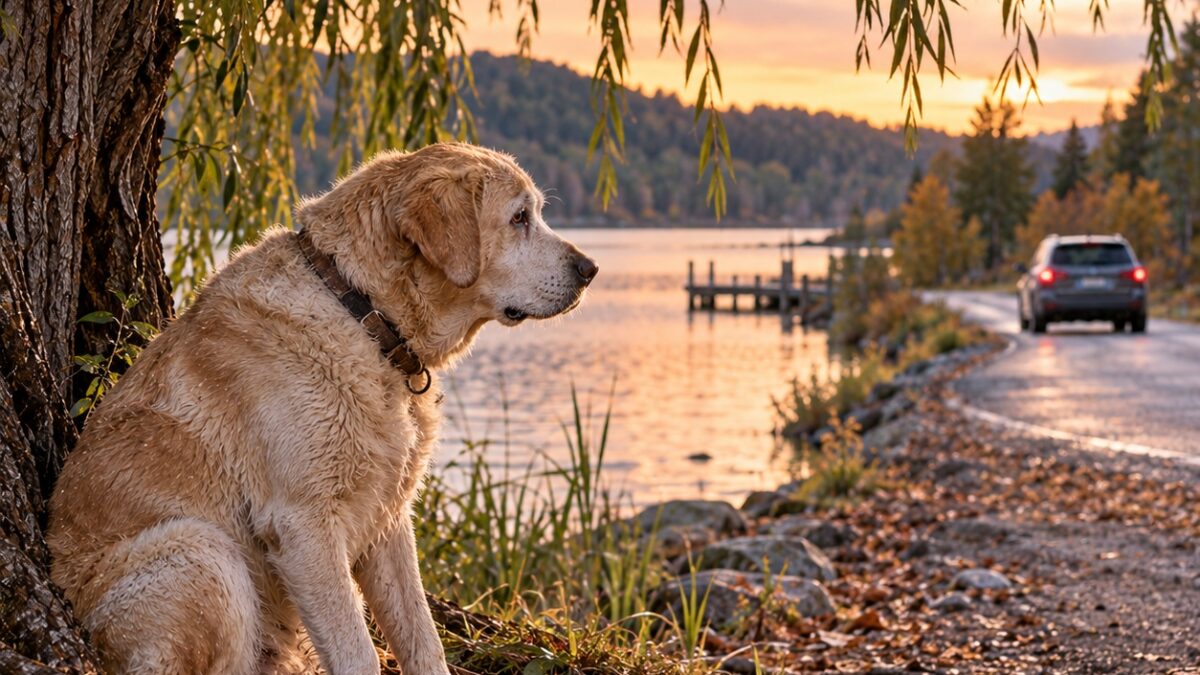
I Watched Someone Dump an Old Labrador by the Lake—Then He Sat Under the Willow for Three Hours Waiting for Them to Come Back
I watched the car door open beside the lake, saw an old yellow Labrador step onto the gravel with the slow stiffness of a dog who had spent years trusting the people inside, and then watched the door close and the car drive away without anyone looking back.
The dog followed for only a few steps before stopping beneath an old willow, and for the next three hours he sat in exactly the same place staring at the road, as though every sound of tires might be the people he loved returning to say they had made a terrible mistake.
When I finally knelt beside him, he looked at me once and then turned his eyes back toward the bend where the car had disappeared, and I understood with a pain I still cannot explain that he already knew he had been abandoned—he simply was not ready to stop waiting.
My name is Walter Ashby.
I was sixty-seven years old that morning.
I had lived beside that lake for most of my life.
The little house where I slept had been built by my grandfather, back when the road was dirt and the trees along the eastern shore were young enough that he could see nearly the whole lake from the kitchen window.
By the time I inherited the place, the trees had grown thick.
So had I, in some ways.
I had become a man comfortable with silence.
At least that was what I told myself.
People often confuse being accustomed to something with being happy about it.
I had been alone long enough that loneliness had stopped announcing itself.
It simply lived with me.
I made coffee for one.
Bought groceries for one.
Fished alone.
Ate alone.
Watched the evening disappear across the lake without having to explain to anyone why I preferred listening to frogs and wind over television.
Years earlier, there had been another person in the house.
My wife.
Even after she was gone, I kept some of her things where they had always been.
A chipped mug she liked.
A blanket folded across the back of the couch.
A small ceramic bowl beside the kitchen sink.
I did not speak about her often.
Not because she had stopped mattering.
Because speaking her name sometimes opened a door I did not know how to close.
So I learned to live around the silence.
Fishing helped.
Fishing asks nothing from you except patience.
You can sit beside water for six hours without catching anything and nobody accuses you of wasting time.
The lake changes constantly while pretending to remain still.
Morning silver.
Noon blue.
Evening gold.
Storm black.
I understood that.
On the morning Tanner arrived, although I did not know his name yet, I was sitting on the eastern bank where the reeds grew almost waist high.
My line had been in the water for perhaps forty minutes.
The fish were ignoring me.
That was normal.
Birds moved through the trees.
A breeze pushed small ripples across the surface.
Then I heard tires on gravel.
There was a narrow road behind the fishing area.
Mostly locals.
Occasionally someone looking for a quiet place.
I barely turned at first.
The car stopped beneath the old willow about fifty yards away.
Engine running.
Then a door opened.
From the inside.
That detail stays with me.
Nobody got out.
Nobody walked around to help.
The door simply swung open.
For a moment, nothing happened.
Then a dog appeared.
An old yellow Labrador.
Gray around the muzzle.
His back curved slightly with age.
He put one front paw onto the gravel.
Then the other.
Paused.
Looked inside the car.
As though waiting for a person to follow.
No one did.
The door closed.
The car began moving.
The Labrador took three or four steps after it.
Not running.
Not barking.
He simply followed.
Then stopped.
The car rounded the bend.
Disappeared.
The dog remained there.
Looking.
I lowered my fishing rod.
And waited.
PART2
At first, I told myself there had to be an explanation.
Human beings are very skilled at inventing explanations when reality is ugly.
Maybe the driver was going to park farther down.
Maybe someone else was coming.
Maybe the dog had jumped out accidentally and the driver had not noticed.
Maybe this was some strange arrangement I did not understand.
So I waited.
The Labrador walked slowly back to the exact place where the car had stopped.
Under the willow.
Then he sat.
He faced the road.
That was all.
Ten minutes passed.
Then twenty.
I kept looking behind me.
No car.
No person walking toward us.
The dog did not wander.
He did not approach the lake.
Did not sniff through the grass.
He sat as though he had been given an instruction.
Wait here.
Maybe somebody had told him that before.
Maybe he had spent years waiting outside stores.
Beside doors.
In driveways.
In the back seat.
Dogs become experts at waiting for the people they love.
They do not understand that one day the same skill can become cruelty.
An hour passed.
The sun rose higher.
My line stayed in the water.
I forgot about it.
The dog’s posture changed slightly.
His head lowered.
But every time tires sounded somewhere beyond the trees, his head lifted immediately.
Hope.
Then disappointment.
Again.
Again.
I watched that cycle until I almost could not stand it.
A truck passed without stopping.
The Labrador stood.
Tail moved once.
Truck continued.
He sat again.
Twenty minutes later, another car.
Same thing.
Stand.
Look.
Wait.
Sit.
I started to hate the sound of engines.
By the second hour, I had stopped pretending somebody was coming.
By the third, I understood exactly what I had witnessed.
Someone had driven an old dog to the lake.
Opened the door.
Waited for him to step out.
Then left him.
I do not know who they were.
I never learned.
I do not know what story they told themselves on the drive home.
Maybe the dog had become inconvenient.
Maybe old.
Maybe expensive.
Maybe they had decided somebody would find him.
Maybe they had convinced themselves that leaving him beside a lake was kinder than whatever other option they imagined.
I try not to invent too much.
The truth I saw was enough.
They left.
He waited.
Three hours.
I finally put my fishing rod on the ground.
My knees complained when I stood.
Sixty-seven had begun announcing itself through joints I had once taken for granted.
I walked toward him slowly.
The dog noticed immediately.
His head rose.
But he did not move.
I stopped maybe fifteen feet away.
“Hey.”
One ear shifted.
“That’s a terrible morning, isn’t it?”
The Labrador stared.
I felt foolish talking to him.
Then I remembered I had spent half my life talking to fish.
So I continued.
“I saw what happened.”
His eyes moved toward the road.
That hurt.
Not me.
The road.
Still.
I took another step.
The dog did not growl.
Did not shrink away.
That somehow felt worse.
Fear would have been easier to understand.
His expression seemed empty.
Not hopeless exactly.
There was still too much waiting in him for hopelessness.
It looked like acceptance fighting with disbelief.
As though one part of him knew nobody was returning while another part kept saying:
Not yet.
Give them another minute.
I crouched.
The dog looked at me.
Then back at the road.
“Okay.”
I said.
“I get it.”
I sat down on the gravel.
Not directly in front of him.
Beside him.
Several feet away.
We both looked toward the lake.
There is something strange about sitting beside an animal who does not know you.
Silence becomes honest.
You cannot impress a dog with biography.
He did not care that my grandfather built the house nearby.
Did not care that I had fished that lake since childhood.
Did not care how many years I had lived alone.
I was simply an old man sitting beside him.
Maybe that was enough.
“Fish aren’t biting.”
I told him.
His ears moved slightly.
“Probably because they’re smarter than I am.”
Nothing.
I continued anyway.
I told him about the willow.
How it had been smaller when I was a boy.
How my grandfather used to complain its roots would eventually break apart the shoreline.
They never did.
I told him about the little wooden boat my grandfather had built.
Still floating somehow despite being old enough to qualify for retirement twice.
I talked because I did not know what else to offer.
Every few minutes, the Labrador looked toward the road.
So did I.
Nothing.
Another hour passed.
I went to my truck.
Opened the back door.
Then gave the whistle my father used for his dog when I was a child.
The Labrador lifted his head.
For one second, I thought he might come.
Then his eyes returned to the road.
I closed the door.
Went back.
Sat closer.
“You’re waiting.”
I said.
His breathing was slow.
“I know.”
I looked toward the empty bend.
“But maybe you could wait with me.”
He sighed.
Deep.
Tired.
Not dramatic.
The sound of an old body carrying something heavy.
I slowly extended my hand.
He watched.
I stopped inches from his head.
Let him decide.
Eventually, he leaned slightly.
My fingers touched his fur.
Soft.
Warm from the sun.
Beneath it, I could feel more bone than I expected.
His age was everywhere once I was close.
The slight stiffness in his shoulders.
The gray muzzle.
The tired eyes.
Maybe he had not been eating enough.
Maybe age alone.
I did not know.
I only knew someone had left him when he was old enough to need more care, not less.
My chest tightened.
“You deserved better than that.”
I whispered.
His ear moved beneath my fingers.
I gave him water from my bottle.
Poured it into a shallow container from my fishing gear.
He drank slowly.
Then I offered a piece of bread from my bag.
He took it carefully.
So carefully that his teeth barely touched my fingers.
That nearly broke me.
An abandoned dog still worried about hurting the stranger feeding him.
The sun began descending.
Shadows lengthened.
I had been at the lake nearly all day.
The Labrador had been there longer than any creature should spend waiting for people who had intentionally left.
I stood again.
My knees cracked.
“Listen.”
I said.
“I’m going home.”
He looked toward the road.
“I know.”
I swallowed.
“I’m not them.”
Of course, he could not understand.
Or maybe tone communicates more than vocabulary.
“I’m not going to drag you.”
“I’m not going to make you do anything.”
“But it’s getting dark.”
I walked toward my car.
Slowly.
I did not look back.
That was difficult.
Every step, I expected silence.
Then—
a soft sound.
Paws on gravel.
I stopped.
Did not turn.
Another step.
Then another.
My throat tightened.
I kept walking.
At the car, I opened the rear door.
Only then did I look.
The Labrador stood ten feet behind me.
He glanced toward the lake road.
Once.
Then at me.
I stepped aside.
His decision.
He approached the car.
Stopped.
Looked inside.
Blank seat.
Then at me again.
“It’s not much.”
I said.
“But it’s warm.”
He climbed in.
Slowly.
One front paw.
Then another.
Back legs more difficult.
I almost helped.
Stopped myself.
He managed.
Then lay down across the seat.
Head on his paws.
Eyes on me.
I closed the door.
Walked around.
Sat behind the wheel.
For a long moment, neither of us moved.
I had not owned a dog in decades.
I had no dog food.
No dog bed.
No plan.
I had gone fishing.
That was all.
I looked in the mirror.
The Labrador watched me.
“Well.”
I said.
“Let’s go home.”
Home.
The word sounded different with another heartbeat in the car.
The drive took less than fifteen minutes.
He never stood.
Every time I checked the mirror, his eyes were open.
Watching.
When I pulled into my driveway, he raised his head.
The house looked exactly as it always had.
Weathered wood.
Small porch.
Grandfather’s stone chimney.
Nothing had changed.
Except everything had.
I opened the rear door.
The dog hesitated.
I waited.
Eventually, he climbed out.
He stood in the driveway.
Looked back toward the road.
Of course.
Even here.
Still waiting.
I opened the house.
“Come on.”
He followed.
Inside, he stopped at the threshold.
I had never thought about what my house looked like to a dog.
Wood floors.
Old furniture.
Fireplace.
Fishing gear in one corner.
Books.
Silence.
He sniffed.
Then stepped in.
I found old blankets in the cedar chest my grandfather had owned.
Folded them near the fireplace.
Put down a bowl of water.
Then drove to the little store before it closed and bought dog food.
I stood in the pet aisle for ten minutes because apparently there are more types of dog food than there are types of human cereal.
Senior.
Sensitive stomach.
Chicken.
Lamb.
Grain free.
Not grain free.
I finally asked an employee.
“I have an old Labrador.”
“What does he normally eat?”
“I met him this morning.”
The young woman stared.
“That’s complicated.”
“You have no idea.”
I bought what she recommended.
When I returned, the Labrador was standing near the front window.
Looking outside.
Road direction.
I did not need to ask.
I placed food down.
He came slowly.
Sniffed.
Ate a little.
Then stopped.
Looked toward the door.
I sat on the floor.
“Eat.”
He did not.
I looked away.
After a while, I heard chewing.
Good.
The first night, neither of us slept much.
I put blankets in the living room.
He lay on them.
Eyes open.
Every sound lifted his head.
A car in the distance.
Wind.
The house settling.
My footsteps.
Around midnight, I gave up sleeping in my bedroom.
I took a pillow to the couch.
The Labrador watched.
“I’m not leaving.”
I said.
The sentence surprised me.
Maybe both of us needed to hear it.
I lay on the couch.
He remained on the blankets.
For a long time, I listened to his breathing.
I wondered whether he was listening to mine.
At some point near dawn, I slept.
When I woke, he was sitting near the window.
Waiting.
The second morning, I made coffee for myself and breakfast for him.
No name.
That bothered me.
But naming felt dangerous.
Not because I feared attachment yet.
Because what if somebody came looking?
What if the people who abandoned him returned?
What if I had misunderstood?
What if he belonged somewhere else?
A name felt like claiming something I had no right to claim.
So I called him Friend.
“Morning, Friend.”
His ears moved.
“Hungry, Friend?”
He looked at the bowl.
“Good.”
That became enough.
I took him back to the lake.
I do not know why.
Maybe I wanted to fish.
Maybe I wanted to test something.
Maybe part of me still wondered whether someone would return.
The Labrador climbed into the car more easily.
At the lake, he went directly to the willow.
Sat.
Road.
My chest sank.
Of course.
I set up my rod nearby.
I pretended to fish.
He waited.
Every car—
head up.
Every car passing—
head down.
I told myself I should stop bringing him there.
But another part thought he needed to know.
Needed to see the truth for himself.
Maybe dogs do not process abandonment like people.
Maybe I was projecting.
Still, he chose the willow.
So I let him.
I sat beside him.
We waited together.
Nobody came.
That evening, he followed me to the car without hesitation.
Small change.
Day three.
Same morning.
Coffee.
Food.
Lake.
Willow.
He still watched the road.
I caught a small fish.
Nothing worth keeping.
I held it up.
“Look.”
The Labrador glanced.
I moved it slightly.
For the first time, his tail moved.
Once.
Barely.
I froze.
“Was that—”
Tail still.
I smiled.
“Okay.”
I did not celebrate out loud.
Did not want to embarrass either of us.
That night, I lay in bed and stared at the ceiling.
I smiled in the dark like a fool.
One tail wag.
That was all.
It felt enormous.
Day four, he surprised me.
I was preparing the old wooden boat.
Grandfather built it with his hands.
There are places where the wood is worn smooth from decades of contact.
I expected Friend to stay on shore.
Instead, he walked to the edge.
Looked at the boat.
Looked at me.
Then climbed in.
I nearly dropped an oar.
“Well.”
I said.
“That’s brave.”
He sat near the front.
I pushed off.
The lake was almost perfectly still.
Morning mist hovered.
The Labrador faced forward.
Nose lifted.
Wind moving through his ears.
Something in his body seemed to change.
On land, he kept looking backward.
Toward the road.
In the boat, there was no road.
Only water.
Horizon.
Maybe that helped.
We drifted.
I rowed.
He watched.
I thought about my grandfather.
He would have liked the dog.
He liked anyone who could sit quietly without demanding entertainment.
When we returned, Friend stepped out carefully.
Then waited for me.
Not the road.
Me.
I noticed.
Did not say anything.
Day five, I drove into town alone for groceries.
The entire trip, I worried.
Ridiculous.
He had survived a life before me.
Still, I hurried.
When I returned, I unlocked the door.
Friend stood inside.
Tail moved twice.
He had been waiting for me.
Not the old car.
Not the road.
Me.
I set down the bags.
“Hey.”
He sat.
Tilted his head.
I had the strangest sensation.
Somewhere in the last five days, I had become someone expected.
That frightened me more than I wanted to admit.
Being expected creates responsibility.
It also creates meaning.
I had forgotten the difference.
Day six, an unlucky squirrel crossed the yard.
Friend saw it.
His ears shot up.
Then a sound came out.
One short bark.
Rough.
Almost broken.
He stopped immediately.
Looked at me.
Like he had surprised himself.
I laughed.
A real laugh.
The sound startled me nearly as much as the bark.
I had not heard myself laugh like that in months.
Maybe longer.
Friend’s tail moved.
“Don’t encourage me.”
I said.
He barked again at the squirrel.
The squirrel left.
Victory.
That evening, the house felt less silent.
Not noisy.
Alive.
There is a difference.
Day seven, we walked toward the forest behind my property.
Friend stayed beside me.
No leash.
I had bought one, but around the house he seemed content to follow.
I showed him an old tree.
“My grandfather taught me to read under this.”
I said.
Friend sniffed the trunk.
“He believed children learned better outside.”
The dog looked upward.
Branches moving.
“He was probably wrong about a lot of things.”
I smiled.
“But he was right about some.”
I sat near the roots.
Friend remained close.
I told him about my grandfather.
Then my father.
The dog my father had when I was a boy.
An old black mutt named Jasper who slept beneath the kitchen table.
I had not thought about Jasper in years.
Memory is strange.
One dog opens a door to another.
I began remembering pieces of childhood I had not visited in decades.
Grandfather’s hands.
Father’s whistle.
The smell of wet dog near a woodstove.
Friend did not know he was pulling history out of me.
He simply listened.
Day eight, I was reading beside the fireplace.
Friend had been lying across the room.
At some point he stood.
Walked toward me.
Then lowered himself at my feet.
His head came to rest across one shoe.
I stopped reading.
My hand hovered.
Then touched his back.
He sighed.
Deep.
The fire cracked.
I did not turn the page for twenty minutes.
It was the best evening I had spent in years.
Not because anything happened.
Because something no longer felt missing.
That thought frightened me.
I had spent years proving I did not need anyone.
People say solitude brings peace.
It can.
But there is a point where peace becomes numbness and you stop noticing because nobody is there to reflect you back to yourself.
Friend had begun reflecting.
I smiled more.
Spoke more.
Left the house with purpose beyond fishing.
Bought things I had not bought in years.
Dog food.
Brush.
Treats.
A second bowl.
I caught myself checking the weather based on whether it would be comfortable for him.
My life expanded by inches.
Day nine, I named him.
The decision happened at breakfast.
He sat near me.
Waiting.
Patient.
That word had defined him since the lake.
Waiting.
For the car.
For food.
For me to move at the speed of an old man.
For trust.
“Tanner.”
I said.
The name had been in my mind all morning.
I do not have a grand explanation.
It sounded steady.
Old-fashioned.
Like something that could belong beside a lake.
“Tanner.”
He lifted his head.
My chest tightened.
“That’s you.”
Tail.
One movement.
Then two.
“Tanner.”
This time he stood.
Came closer.
I touched his head.
There.
Name.
Not ownership exactly.
Recognition.
A way to call one specific life toward me.
I had feared naming him because names make attachment visible.
By day nine, it was already too late to avoid attachment.
So I gave it language.
Tanner.
Day ten, rain came.
We stayed inside.
Water ran down the windows.
Tanner lay near the glass.
I made coffee.
Sat beside him.
For some reason, rain made me think about my wife.
Maybe because she used to love rainy days.
She would open windows slightly just to hear it.
I had not spoken about her to anyone in a long time.
I spoke to Tanner.
“I was married once.”
His ear moved.
“She liked this house more than I did.”
I watched the rain.
“She could make silence feel warm.”
The words came slowly.
“After she was gone, silence changed.”
Tanner looked at me.
I stroked behind his ear.
“I think I told myself I preferred it.”
I swallowed.
“Maybe sometimes I did.”
Rain tapped the window.
“But there’s a difference between choosing quiet and having no one to speak to.”
Tanner shifted closer.
“That’s embarrassing.”
He rested his head on my knee.
I laughed softly through tears.
“Yeah.”
I whispered.
“You’re not telling anyone.”
He stayed.
Dogs do not interrupt grief.
That may be one of their greatest gifts.
They do not say:
She would want you to be happy.
They do not say:
Everything happens for a reason.
They do not become uncomfortable because the person you lost has been gone “too long.”
They stay.
That day, Tanner stayed.
And I talked.
For the first time in years, I said things aloud I had kept trapped because silence had become habit.
I told him how strange it was to wake alone after decades beside another person.
How the first year had felt impossible.
How eventually impossible became routine.
How guilty I sometimes felt because routine meant I was surviving.
How loneliness sometimes looked less like sadness and more like forgetting why you would bother cooking a real meal.
Tanner listened.
When I finally stopped, rain was still falling.
Nothing had been solved.
I felt lighter anyway.
Day eleven, Tanner brought me a stick.
This should not have been important.
It was.
I was outside near the porch.
Tanner wandered near the edge of the yard.
He returned carrying a wet stick.
Dropped it at my feet.
Then stepped backward.
I stared.
“What?”
He looked at the stick.
Then me.
“You want me to throw that?”
Tail.
I picked it up.
“Old man.”
I said.
“You sure?”
I threw.
Not far.
Tanner ran.
Not fast.
Age in his gait.
But ran.
He picked up the stick.
Returned.
Dropped it.
I laughed.
Again.
Seven times.
I counted.
On the seventh, Tanner went after the stick, returned halfway, then lay down in the grass with it between his paws.
“That’s what I thought.”
I walked over.
Sat beside him.
His tongue hung from his mouth.
Eyes brighter.
I scratched his head.
“Seven is enough.”
We sat there together.
Sun after rain.
Wet grass.
Two old creatures tired from a game neither had expected.
I remembered watching him sit under the willow.
Motionless.
Now he had run because something was fun.
That difference felt enormous.
Day twelve, I washed him.
His coat needed it.
I filled a large tub with warm water.
I expected resistance.
Tanner watched.
I let him sniff.
Then helped him in.
He stood.
Patient.
I worked carefully.
Mud and old dirt came away.
His yellow coat became lighter.
Gray face clearer.
He closed his eyes while I washed around his neck.
I wondered whether hands had always been kind to him.
I could not know.
I made mine gentle.
When we finished, I wrapped him in towels.
Tanner stood in my kitchen looking deeply offended by the entire process.
I laughed.
“Now you look respectable.”
He shook water everywhere.
“Never mind.”
The floor needed cleaning.
I did not care.
Day thirteen changed everything.
I woke before sunrise.
For the first time, Tanner was already waiting near the door.
Tail moving.
I made coffee.
Gathered my fishing gear.
“Ready?”
He stood.
We walked instead of driving.
The gravel road curved toward the lake.
Same road.
The one where the car had disappeared.
Tanner walked beside me.
Not behind.
Beside.
His head stayed forward.
A car approached.
My body tensed automatically.
Tanner’s did not.
He glanced once.
Then continued walking.
I almost stopped.
That was the first time.
The first car he had not followed with his eyes.
The road was becoming a road again.
Not a promise.
We reached the willow.
Tanner paused.
I did too.
He sniffed the ground.
Nothing dramatic.
No stare down the road.
Then he followed me toward the water.
I sat in my usual place.
Cast the line.
Tanner sat beside me.
The lake was gold with sunrise.
Mist floated over the surface.
For several minutes, neither of us moved.
Then Tanner stood.
Walked toward the shallows.
Stepped into the water.
One paw.
Then another.
The water reached just above his ankles.
He stood.
Facing the open lake.
Sunlight around him.
I forgot the fishing rod.
Tanner looked toward the horizon.
Then turned.
Looked at me.
Tail moved.
Not once.
Not cautiously.
His entire back end moved with it.
Joy.
Clear.
Unashamed.
I put the rod down.
Started laughing.
Loud enough that birds lifted from the willow.
Tanner ran toward me.
Actually ran.
Water flying from his paws.
He stopped in front of me.
Mouth open.
Eyes bright.
Tail still going.
I put both arms around his neck.
Held him.
“Okay.”
My voice broke.
“Okay.”
He leaned into me.
And I understood.
He had stopped waiting.
Not because he had forgotten.
I do not think forgetting is required for healing.
The road had simply become smaller than what existed beside him now.
Lake.
Boat.
House.
Food.
Fireplace.
Me.
He had somewhere else to look.
I do not know exactly when a place becomes home for an animal.
Maybe it happens slowly.
Maybe through repeated meals.
The same voice.
The same bed.
A person leaving and returning.
Maybe home is not a single moment.
But on the thirteenth morning, standing in that lake with his tail moving like happiness had finally become safe, Tanner looked home to me.
And I realized something else.
My house had become home again too.
For years, I had lived there.
Maintained it.
Slept.
Cooked.
Read.
But there had been a difference between inhabiting a building and belonging to a life.
Tanner had changed that without trying.
There was someone to come back to.
Someone whose bowl needed filling.
Someone who made mornings different from evenings.
Responsibility creates rhythm.
Rhythm creates attachment.
Attachment creates fear.
And love.
I had spent years avoiding the fear.
I had accidentally avoided much of the love too.
Tanner did not repair the loss of my wife.
I would never say that.
No creature replaces another.
My wife had been part of my life in a way Tanner could never be.
And Tanner became part of my life in a way no person could imitate.
Love does not replace.
It adds.
That was something I had forgotten.
The heart is not a room with one chair.
It can hold grief and affection at the same time.
I learned that from an abandoned old Labrador standing in shallow water.
After day thirteen, we stopped counting.
Life simply continued.
Tanner became my shadow.
Morning coffee.
Tanner.
Walk to the lake.
Tanner.
Fishing.
Tanner.
Boat.
Tanner.
Reading by the fireplace.
Tanner.
If I went to town, he watched from the house until I returned.
Eventually, I began taking him when possible.
He liked riding once he learned the car did not mean abandonment.
The first few rides were difficult.
He sat rigid.
Every stop made him alert.
I could see the old memory.
Car stops.
Door opens.
What happens next?
So I changed the pattern.
Car stops.
We both get out.
Walk.
Car again.
Home.
Repeat.
One trip at a time.
Evidence.
That is how trust works.
Not through promises.
Through patterns.
Eventually, Tanner would climb into the car without hesitation.
Head near the window.
Nose working.
I would look at him and remember the first car.
The one that drove away.
Then I would think:
Not this one.
This one goes home.
There are wounds you cannot erase.
You can create enough new endings that the old one stops owning every beginning.
Tanner taught me that.
Four months passed.
The source of this story could end there.
Tanner healthy enough.
Living with me.
No longer waiting at the willow.
That is enough.
But those four months contained a thousand small things that mattered to me more than dramatic moments.
He learned the sound of my coffee grinder.
Every morning, as soon as it started, Tanner stood.
Breakfast connection.
He learned which cabinet held treats.
Of course.
He learned my fishing schedule.
If I slept late, he would come to the bedroom and stare.
No barking.
Just judgment.
I learned his sleeping noises.
A little sigh when he settled.
Occasional snore.
Paws moving in dreams.
Once he barked softly while asleep.
I wondered what he was chasing.
I hoped it was a squirrel.
Not a car.
I never woke him to ask.
He began sleeping on the couch beside me.
At first, floor.
Then one paw.
Then the whole dog.
Old dogs negotiate furniture rights faster than lawyers.
I objected for approximately three days.
Then bought a cover.
Tanner won.
He followed me into the kitchen.
Stood exactly where I needed to step.
I learned to shuffle.
He discovered he liked bits of apple.
Did not like carrots.
He would accept carrots, chew once, then place them on the floor as though returning defective merchandise.
I stopped offering.
We learned each other.
That phrase may sound ordinary.
It is not.
To learn another living creature is intimacy.
What they fear.
What comforts.
What makes them move closer.
When they need space.
Tanner learned me too.
He knew when I was going fishing by the way I moved before I picked up the rod.
Knew when I was leaving town.
Knew which chair I used for reading.
Knew that after dinner I sometimes sat on the porch.
He would arrive before I did.
There is something powerful about being anticipated.
For years, nobody had anticipated me.
I came and went without affecting another schedule.
At first, that felt like freedom.
Later, I realized it was also a kind of invisibility.
Tanner saw me.
Not philosophically.
Practically.
Where is Walter?
When is Walter home?
What is Walter doing?
I mattered because his day included me.
That changed mine.
I began cooking actual meals more often.
Strange.
Why would a dog cause that?
Routine.
If I was already making his dinner, I might as well make mine.
I cleaned more.
Walked more.
Went outside even when fishing did not interest me.
He needed movement.
So I moved.
My doctor probably would have approved of Tanner more than anything else I had done for my health in years.
I did not tell him that.
There were difficult moments too.
Tanner was old.
Some mornings his joints were stiff.
He took longer getting up.
I learned not to rush him.
At the lake, he sometimes tired sooner.
We shortened walks.
I began carrying extra water.
The first time he stumbled getting into the boat, my stomach dropped.
I helped.
He looked embarrassed.
“You’re old.”
I said.
Then laughed.
“So am I.”
There was comfort in that.
We were not pretending youth.
We were adapting together.
I stopped viewing age only as decline.
Age is also knowledge.
Tanner knew how to wait.
Knew how to read tone.
Knew when silence was enough.
I knew which parts of the lake held fish in spring.
How weather moved across the water.
How to repair old wood.
How to sit without filling every silence.
We had skills.
Old ones.
Useful ones.
Maybe that is why we fit.
Neither of us needed the other to be impressive.
Presence was enough.
Sometimes people at the lake asked where Tanner came from.
At first, I told the whole story.
Car.
Door.
Willow.
Three hours.
Later, I shortened it.
“I found him here.”
That was enough.
I did not want every person who met Tanner to see abandonment first.
He was more than the dog someone left.
That was an event.
Not identity.
People would pet him.
“Good boy.”
Tanner would wag.
I liked those interactions.
No pity.
Just affection.
He deserved ordinary love.
One afternoon, a woman recognized him from seeing him under the willow that first day.
She said:
“Is that the dog?”
I nodded.
She stared.
“He stayed there so long.”
“I know.”
“I thought maybe the owners were coming back.”
“So did I.”
She looked ashamed.
“I drove past.”
There it was.
The sentence.
I could have been angry.
Part of me was.
But I had almost done the same thing.
I had sat fishing for three hours partly because I wanted another explanation.
So I said:
“You noticed.”
“But I didn’t stop.”
“You can next time.”
She looked at Tanner.
Then stroked his head.
“I’m sorry.”
Tanner wagged.
He did not need her apology.
Maybe she did.
That encounter taught me something.
It is easy to divide people into those who care and those who do not.
Reality is messier.
Sometimes people care but hesitate.
Assume.
Fear making things worse.
Tell themselves someone else is responsible.
The goal should not only be shame.
It should be changing the next decision.
Stop next time.
Ask.
Check.
Call.
I had changed because of Tanner.
Maybe she would too.
That mattered more than anger.
I never found out who left him.
Some people asked whether I tried.
No.
Maybe I could have.
A license plate?
I had not memorized it.
The car itself had become more shape than detail in memory.
Part of me wanted answers.
Why?
How long had they had him?
Did they feel anything?
Did they miss him later?
Another part decided those questions belonged to a road that no longer mattered.
Tanner had spent enough time looking backward.
I did not want to build my life around doing the same.
The people who left him had already taken one chapter.
They did not deserve the rest.
So I stopped asking.
Home was forward.
That did not mean I forgave them.
It meant I refused to give them more space than necessary.
Sometimes healing is not forgiveness.
It is relocation of attention.
Tanner helped.
Whenever anger rose, he would do something ordinary.
Bring a stick.
Want food.
Fall asleep.
The present demanded more useful things.
One evening, four months after I found him, we were sitting on the porch.
The lake visible through trees.
Tanner’s head on my foot.
I thought about the first night.
His eyes open.
Listening.
Now he slept.
Completely.
Deep.
His paw moved.
Dream.
I touched his ear.
He did not wake.
Trust.
People often talk about trust as a feeling.
It is also physical.
Muscles relax.
Eyes close.
Breathing deepens.
An animal allows vulnerability.
Tanner trusted the room enough to stop guarding it.
I sat very still.
Not because I was afraid to wake him.
Because I wanted to appreciate the fact he could sleep.
For me, that became more meaningful than the tail wag.
A wag says happiness.
Sleep says safety.
He had both.
I had something similar.
Before Tanner, nights could feel long.
Especially winter.
The house creaked.
Wind.
Old pipes.
I was not afraid.
Just aware.
Of myself.
Of the empty rooms.
Of memory.
With Tanner, those sounds changed.
If a noise happened, his ear moved.
Sometimes he lifted his head.
Then slept.
I would think:
If he is not worried, neither am I.
Ridiculous maybe.
Comforting.
I slept better.
The house became shared space.
Shared space has warmth even when the thermostat is unchanged.
I understood why my wife had loved having people around more than I did.
She used to say:
“A house should know somebody lives in it.”
I would tell her houses do not know things.
She would roll her eyes.
Now dog hair collected near the couch.
A bowl sat beside the kitchen wall.
A stick occasionally appeared where no stick belonged.
The house knew.
Or at least I did.
I wished I could tell her.
Maybe I did, sometimes.
At night.
“Tanner stole my chair today.”
Silence.
Or:
“You’d like him.”
I was certain of that.
She would have spoiled him.
No doubt.
Probably let him sleep in the bed immediately instead of pretending there were rules.
I imagined her saying:
“Walter, look at that face.”
Then my resistance ending.
Some arguments continue after people are gone.
You already know how they would win.
Tanner gave me new ways to remember my wife without remembering only her absence.
That was another gift.
Before him, thinking of her often led directly to grief.
After Tanner, memories sometimes connected to humor.
She would have loved this.
She would have said that.
Grief became conversation again.
Lighter at the edges.
Not less real.
Maybe this is how companionship heals.
Not by removing sorrow.
By introducing enough other emotion that sorrow is no longer alone.
Tanner did that.
There were mornings I looked at him and felt grief for what had happened to him.
Then joy because he was here.
Those feelings existed together.
I stopped trying to choose.
A mature heart can hold contradiction.
Sad and grateful.
Old and alive.
Missing someone and loving someone else.
Waiting and moving on.
Tanner had done that at the willow.
He waited.
Then followed me.
That step toward my car did not mean the people who left him had never mattered.
It meant hunger, darkness, and a stranger’s patience eventually made another choice possible.
Moving forward does not betray the past.
I needed that lesson as much as he did.
After my wife was gone, I sometimes believed enjoying something deeply meant forgetting her.
So I kept happiness small.
Safe.
Fishing.
Coffee.
Enough to continue.
Not enough to risk feeling guilty.
Tanner did not understand those rules.
He brought a stick.
Demanded play.
Jumped into the boat.
Put his head on my foot.
Life ignored my guilt.
Eventually I did too.
One morning on the lake, I laughed at Tanner barking at a bird.
Then suddenly thought:
She would love this.
Instead of the memory ruining the moment, it joined it.
That was new.
I looked upward.
“See?”
I whispered.
Tanner looked at me.
“Not you.”
He barked.
Fine.
Him too.
The boat became our favorite place.
Tanner always sat near the front.
Nose toward the open lake.
Sometimes I would stop rowing.
Let us drift.
The water would tap against the wood.
I imagined my grandfather shaping those boards decades earlier.
He could not have known an abandoned Labrador would one day sit there.
Life reuses things.
Boats.
Houses.
Hearts.
What is built for one chapter can hold another.
I liked that.
The house built by my grandfather had held my childhood.
My marriage.
My loneliness.
Now Tanner.
The boat had held my grandfather.
Father.
Me.
Now Tanner.
Nothing is only what it was created for.
Maybe people are the same.
I had thought the important roles of my life were finished.
Husband.
Working man.
Son.
Then at sixty-seven, unexpectedly:
Someone’s person.
Tanner’s person.
That mattered.
Age did not mean the story had stopped adding nouns.
I liked that too.
People can become invisible as they age.
Not intentionally.
The world rushes.
Young families.
Jobs.
Technology.
New things.
An older man fishing alone does not attract attention.
I had accepted that.
Tanner noticed me every morning.
There is dignity in being necessary to one living creature.
Not grand importance.
Specific importance.
His bowl.
His walk.
His ride.
His place beside the fire.
I mattered there.
He mattered to me.
That was enough.
Sometimes I wondered whether Tanner would have followed anyone that first night.
Maybe.
He was abandoned.
Hungry.
Tired.
Perhaps any gentle person with a car would have become his path away from the lake.
That thought never diminished our bond.
Love does not have to be predestined to be real.
We met because I happened to be fishing.
He followed because I stayed.
Then day by day, coincidence became relationship.
That is how much of life works.
We romanticize beginnings after we know endings.
At the time, it was just:
Old dog.
Old man.
Sunset.
Car.
Only later:
Tanner and Walter.
Home.
I find that comforting.
You do not need to recognize the important moment immediately.
Sometimes you simply make the next decent choice.
Meaning arrives later.
The first decent choice was putting down the fishing rod.
Then waiting.
Water.
Bread.
Open car door.
Blanket.
Food.
Return to lake.
Name.
Everything after built from small decisions.
No heroic act.
That matters because people often think kindness must be dramatic to count.
It does not.
Sit beside the dog.
That can be enough to begin.
I did not “save” Tanner alone.
He had to choose me.
That is another thing.
I could offer a car.
He had to climb in.
Offer home.
He had to enter.
Offer affection.
He had to lean.
Offer name.
He had to respond.
Relationship is participation.
I did not rescue an object.
I met another will.
An old dog with history I could not know.
Respecting that made our bond stronger.
I never forced him away from the willow.
I waited until he followed.
I am glad.
If I had dragged him into the car on hour one, maybe he would still have been physically safe.
But the choice mattered to me.
Maybe to him.
At the very least, it taught me something:
Help should leave room for dignity.
Tanner had already lost control over enough.
The car door opened.
He was put out.
No choice.
I did not want our story to begin with another forced movement.
So I waited.
He came.
That became a pattern.
When he was ready.
Boat.
Couch.
Bed eventually.
Yes, Tanner eventually decided the bed was better than the floor.
Of course.
It happened perhaps several weeks after he came home.
I woke around two in the morning.
Something moved.
I opened my eyes.
Tanner stood beside the bed.
He looked up.
I said:
“No.”
Tail.
“You have a perfectly good blanket.”
He continued staring.
I sighed.
“Fine.”
He climbed.
Slowly.
Turned.
Lay near my feet.
I smiled into the darkness.
The next night he returned.
Within a week, he had expanded his territory to almost half the mattress.
I complained.
There was nobody else to hear.
Tanner ignored me.
The house grew warmer.
I do not mean temperature.
There were mornings I woke because his paw touched my leg.
For a second, I would forget.
Then remember.
Dog.
Here.
Home.
That first moment after sleep can be strangely honest.
Before thought assembles defenses.
I was happy.
Simple.
No guilt.
No philosophy.
Happy.
At sixty-seven.
After years of believing happiness belonged mostly to earlier versions of myself.
That surprised me.
Maybe there are forms of joy only older people understand.
Quiet ones.
Not achievement.
Not excitement.
Presence.
Warm dog.
Coffee.
Morning light.
A lake you have known sixty years.
Someone beside you who also understands waiting.
I had no need for more.
Months continued.
Tanner’s body became a little stronger with consistent food.
He remained old.
I did not try to turn him young.
Old dogs deserve care appropriate to who they are, not who people wish they were.
Shorter runs.
More rest.
Easy entry to the boat.
I built a small step beside the porch when I noticed climbing was harder.
He used it immediately.
I felt absurdly proud.
At some point, caring for him became my language.
Not dramatic affection.
Adjustments.
Water placed where convenient.
Blanket thicker in cold weather.
Walk shorter when stiff.
I understood why marriage had been built from similar things.
My wife used to put my gloves near the heater before I went outside.
I barely noticed.
Now I understood.
Love often looks like anticipating difficulty.
I wished I had thanked her more.
There are regrets you cannot fix backward.
You can let them improve what you do forward.
So I cared for Tanner carefully.
Maybe some of that gratitude belonged to her too.
He received it.
That is how love can travel.
One winter evening, months after Tanner arrived, the lake began freezing near the edges.
We sat on the porch.
He wore an old blanket across his back because I had become exactly the kind of man who put blankets on dogs and did not care who judged me.
The willow stood bare.
I could see it through the trees.
Tanner could too.
He looked toward the lake.
Not road.
That difference still moved me.
I said:
“Remember?”
He looked at me.
“Probably better if you don’t.”
I rubbed his neck.
“Some things don’t deserve remembering every day.”
He rested his chin on my knee.
We watched snow begin.
I had once feared winter loneliness.
Dark early.
Quiet.
Now Tanner slept beside the fire.
I read.
Sometimes spoke aloud.
Snow outside.
Warmth inside.
There is no need to defeat darkness when you have something worth returning to.
That became my winter.
When spring returned, Tanner entered the shallows again.
Same place.
Day thirteen memory.
His tail still wagged.
Maybe slower.
I laughed.
Not as loudly.
Joy had become familiar enough not to surprise me.
That was another beautiful change.
At first, every tail wag felt like an event.
Later, tail wags became normal.
You want healing to become ordinary.
You do not want a dog to remain a symbol forever.
Tanner deserved to be boring.
I deserved boring happiness.
We got it.
Some mornings the fish bit.
Most mornings they did not.
Tanner did not care.
He watched birds.
Slept.
Brought sticks.
Occasionally leaned too far over the side of the boat and nearly gave me a heart attack.
Ordinary.
Four months after he came home, if a stranger saw us at the lake, they would have assumed we had been together years.
Old man.
Old Labrador.
Fishing.
They would not know there had once been a car.
A door.
A road.
Three hours of waiting.
I liked that.
Pain had become invisible in the present.
Not erased.
Integrated.
That is probably the best ending any wound gets.
I think often about the people who left him.
Less than I used to.
I hope, at minimum, that they understand what they did.
But Tanner does not need them for the ending.
That is important.
A satisfying life does not require the person who hurt you to witness your recovery.
Sometimes they never do.
Sometimes they never apologize.
Sometimes they vanish around a bend.
Healing cannot wait for their participation.
Tanner stopped looking at the road.
That is the lesson.
Not revenge.
Not them regretting.
The road became unimportant.
Home became larger.
That is freedom.
I had spent years waiting in my own way too.
Not for my wife to physically return.
I knew better.
But waiting for life to feel like it once had.
Waiting for old happiness.
Old certainty.
Old companionship.
Those things were not coming back in the same form.
Tanner helped me stop looking down that road.
Life did not return my past.
It offered a yellow Labrador.
Different.
Enough.
Maybe more than enough.
The mistake would have been rejecting new love because it did not resemble what I lost.
I came close.
Years of solitude.
Fear.
No dog because dogs die.
No people because people leave.
If Tanner had not been abandoned at that lake, perhaps I would have continued exactly as I was.
Functional.
Quiet.
Fine.
That word again.
Fine.
Sometimes life has to interrupt us because we have become too skilled at surviving without living.
Tanner interrupted.
He did not save my life in the physical sense.
I was not dying.
But he changed its texture.
He made time feel inhabited.
That matters.
Days used to pass.
Now they contained him.
Maybe that is saving enough.
When people say pets “save” us, I know some dislike the phrase.
I understand.
Animals should not carry responsibility for human healing.
Tanner did not fix me.
He gave me a relationship in which I practiced being connected again.
I did the work too.
I opened the door.
Bought food.
Talked.
Allowed attachment.
The rescue went both ways only because both of us participated.
That is more honest.
I gave Tanner a home.
Tanner reminded me home is not only a roof you own.
It is expectation.
Return.
Presence.
The place where someone’s absence changes the room.
The place where somebody chooses to stay.
That final part matters most.
Choose.
Tanner had been left.
Then he chose.
Car.
House.
Boat.
Bed.
Me.
Repeatedly.
I never stopped being grateful.
One night, near the end of those first four months, I fell asleep on the couch.
Book open on my chest.
Tanner beside me.
I woke sometime after midnight.
The fire had nearly gone out.
Tanner’s back pressed against my leg.
His breathing deep.
His paw touched my hand.
I looked at him in the low light.
Gray muzzle.
Closed eyes.
I thought about the willow.
The three hours.
Then I realized something.
On that first day, I thought Tanner was waiting for the people who abandoned him.
True.
But perhaps what hurt me was recognizing waiting itself.
I had been doing it too.
Waiting without admitting it.
For companionship to become safe again.
For grief to release permission.
For life to knock on my door because I had no intention of going out to find it.
Instead, life stepped out of a car and sat under a willow.
Cruel beginning.
Unexpected gift.
I would never say Tanner needed to be abandoned for us to meet.
No.
He deserved better.
I wish he had never known that pain.
If I could change his past without losing our future, I would.
We should never romanticize suffering simply because something beautiful followed.
The beauty is not justification.
It is what grew afterward despite what happened.
That distinction matters.
Someone did something cruel.
Then another person chose not to leave the cruelty as the final fact.
That is our part.
We cannot always control the first event.
We control what we do when we witness the aftermath.
I put down my fishing rod.
That was the beginning.
If there is one thing I would tell anyone who sees an animal alone in a place that feels wrong, it is not:
Take the animal immediately.
Situations differ.
Safety.
Ownership.
Authorities.
All matter.
But do not look away because you assume there is an explanation.
Pause.
Pay attention.
Make sure.
That is what I nearly failed to do.
I am grateful I did not.
Tanner’s story could have gone differently.
After another three hours.
Night.
Cold.
Road.
Anything.
Instead, he slept beside me.
That difference began with attention.
Attention is underrated.
People think kindness is emotion.
Often kindness is observation sustained long enough to create responsibility.
I saw.
Kept looking.
Could not pretend anymore.
Then acted.
That is all.
When Tanner and I walk to the lake now, he no longer stops at the willow.
Sometimes he sniffs.
Dogs sniff everything.
But he does not sit facing the road.
He moves toward the water.
That is how I know the present has become stronger.
Not because memory vanished.
Because his body has another routine.
Lake means boat.
Fish.
Walter.
Water.
Sticks.
Not abandonment.
The meaning of places can change.
I know because my house changed too.
After my wife was gone, it had become a monument without intending to.
Her mug.
Her chair.
Her absence.
I walked around memory carefully.
Tanner turned it back into a house.
Dog bowl.
Mud.
Hair.
Noise.
Bed occupied.
The old things remained.
But new things accumulated beside them.
That is how grief becomes livable.
Not removal.
Accumulation.
More life around the absence.
Eventually the absence is still there but no longer the only furniture in the room.
Tanner added furniture.
Sometimes literally.
He claimed the couch.
I let him.
One evening, I caught myself telling him:
“Your mother would have hated you on that cushion.”
I stopped.
Your mother.
I laughed.
My wife had never met him.
Still, the phrase felt natural.
Maybe family expands backward in imagination too.
I could picture them together.
She would have liked Tanner.
That was enough.
I no longer felt guilty imagining new things inside old memories.
That was healing.
I had not expected a dog to teach me that.
Dogs rarely respect our expectations.
Good.
As Tanner aged further, I became aware our time was limited.
Of course.
He had arrived old.
That was part of the bargain.
Some people said:
“Must be hard adopting a senior.”
Yes.
But hard is not wrong.
An old dog offers fewer years perhaps.
He also arrives as himself.
History already written into him.
Habits.
Preferences.
Gray.
I did not need twenty years to justify four months.
Or one year.
Duration is not the only measure of value.
My marriage had lasted years and still ended.
Tanner’s time would end too.
Everything does.
Fear had once used that as an argument against attachment.
Now I saw it as an argument for attention.
Shorter means notice more.
Not panic.
Notice.
I watched him sleep.
Took the boat when weather was good.
Let him sniff as long as he wanted.
Old dogs deserve unhurried walks.
Old men too.
We had finally found someone willing to move at the same speed.
That made me smile.
Sometimes I imagined the person who left Tanner thought age made him a burden.
If so, they were wrong.
Age made him compatible with me.
He did not need six-mile runs.
Neither did I.
He liked naps.
Excellent.
Quiet mornings.
Perfect.
We fit because both of us had slowed enough to appreciate what faster lives overlook.
Light on water.
A fish jumping.
Wind in reeds.
A stick.
Warm floor.
Presence.
None of that looked exciting from outside.
Inside, it was life.
I stopped feeling sorry for Tanner.
That was important.
Pity can become its own prison.
He had been abandoned.
Yes.
But he was not only abandoned.
He was funny.
Patient.
Stubborn.
Selective about vegetables.
Terrible at judging boat edges.
Excellent at sleeping.
He had a life beyond injury.
I wanted people to see that.
I wanted to see that.
So when memories of the car came, I did not stare too long.
Tanner was here.
That was the larger truth now.
The car drove away.
He stayed.
At first under the willow.
Later with me.
The word stayed changed meaning.
That might be the heart of everything.
At the willow, staying meant hope trapped in abandonment.
At home, staying meant choice.
Same behavior.
Different world.
That is why I never say I “kept” Tanner.
Keeping sounds too much like preventing departure.
He chose to remain.
Every open door.
Every walk.
Every lake morning.
He returned.
That is home.
The place you can leave and still choose again.
My wife had done that for years.
Not leave permanently.
Ordinary departures.
Work.
Errands.
Visits.
Then return.
I had taken that rhythm for granted.
Tanner restored it.
I go to town.
Return.
He waits.
We go to lake.
Return.
Life has departures that do not become loss.
That lesson softened the world.
Maybe one day Tanner would leave permanently.
Maybe me first.
Until then, return.
Again.
Enough.
One early morning, four months after I watched the car abandon him, we sat in the boat.
Mist.
Sun barely above trees.
Tanner at the bow.
I held the rod loosely.
No fish.
I looked at him.
He looked back.
Tail moved.
I said:
“You know something?”
He waited.
“I’m glad you followed me.”
He turned back toward the water.
Typical.
I smiled.
Then added quietly:
“I’m glad I followed you too.”
Because I had.
Not physically at first.
But Tanner had led me somewhere.
Out of the quiet life I had mistaken for completion.
Toward attachment.
Risk.
Routine.
Laughter.
He had shown me an old man can still have a new chapter without betraying the chapters that came before.
That is important.
People talk about starting over as though you erase everything.
I did not start over.
I continued differently.
So did Tanner.
His previous life existed.
My previous life existed.
We arrived with histories.
Then built something that did not require forgetting either.
That is a more honest kind of beginning.
I am sixty-seven.
Tanner is old.
We are not blank pages.
We are pages with writing all over them.
Some crossed out.
Some stained.
Still room in the margins.
That is enough.
If I could return to the moment the car door opened, I would still feel anger.
I would still want to stop the vehicle.
Ask why.
Demand explanation.
But I also know I would keep my eyes on Tanner.
Because he was the one left behind.
Too often we spend more energy on the person causing harm than the creature needing help.
Anger is natural.
Care must come first.
Tanner did not need revenge.
He needed water.
Time.
A seat.
A home.
So that is where the story belongs.
With him.
Not the driver.
The driver exits around the bend.
Tanner continues.
That is justice enough for this story.
Not legal justice.
Emotional.
The person who abandoned him becomes irrelevant.
The dog they left becomes deeply loved.
They do not own the ending.
I do.
Tanner does.
Mostly Tanner.
And our ending is quiet.
No confrontation.
No dramatic reunion with the people who left him.
No need.
Just mornings.
Lake.
Boat.
Fireplace.
A dog whose tail moves without hesitation.
An old man who laughs more than he used to.
That is enough consequence for cruelty.
It failed to define the rest.
There is one phrase I often think about:
He waited three hours.
People hear that and feel heartbreak.
I do too.
But three hours was only the visible waiting.
Who knows how long Tanner had been waiting before that?
Waiting for care.
Affection.
Someone to notice age.
Someone to slow down.
Maybe the people in the car had loved him once.
Perhaps that makes it worse.
Perhaps not.
I do not know.
What I know is that eventually his waiting changed.
He stopped waiting for people who were not coming.
He began waiting for me to return from the store.
That may sound similar.
It was completely different.
He had evidence.
I returned.
Every time.
That is trust.
Waiting supported by history.
Not desperation.
I made a promise to myself I would never leave him somewhere wondering.
If I had to go, I made it clear through routine.
Home.
Return.
Consistency.
Maybe Tanner understood.
Maybe simply learned.
Either way, his eyes changed.
The road stopped controlling them.
I sometimes see people say dogs “live in the moment.”
I think that is partly true and partly too simple.
Animals remember.
Their bodies remember.
Tanner remembered cars.
The willow.
Perhaps voices.
But he could also invest fully in the present when it became safe.
Humans are often worse at that.
We keep sitting under old willows long after the road has emptied.
I had.
Grief had left me there.
Tanner walked away first.
I followed.
That is perhaps the most accurate way he saved me.
He showed me waiting can end without betrayal.
You can stand.
Turn.
Follow a new path.
The people you lost or loved before do not become less important.
You simply stop requiring the past to return before allowing the present to matter.
I needed years to learn that.
Tanner needed thirteen days to show me.
Dogs are efficient teachers.
Not gentle with our excuses.
One evening, I looked at my wife’s old mug.
Then Tanner.
For the first time, I did not feel pulled between them.
My wife belonged to my life.
Tanner belonged too.
No competition.
Love accumulates.
There was the answer.
I wished I could have known earlier.
But maybe some truths only become believable when they arrive with a yellow Labrador.
I accept the timing.
Tomorrow morning, I will wake early.
Tanner will probably already be awake.
He will hear me making coffee.
We will walk toward the lake.
The gravel road will curve beneath the willow.
He may sniff there.
Maybe not.
It no longer matters.
We will reach the eastern bank.
I will cast a line.
He will sit.
If the weather is calm, we will take the old wooden boat.
He will sit near the front.
Nose toward the horizon.
I will row.
Maybe catch something.
Probably not.
The sun will rise.
Mist will lift.
And for a while, there will be nothing in the world except water, wood, an old man, and an old dog who no longer watches the road.
That is the life we have.
No grand promise.
No forever.
Just enough mornings to make a home.
When Tanner eventually rests his head on my foot tonight, I will let him.
If his paw touches my hand, I will not move unless I need to.
I will listen to his breathing.
I will remember, perhaps, the first day.
The car door.
The gravel.
The willow.
Three hours.
But I will not stay there long.
Because Tanner does not.
He is asleep in my house.
The ending is here.
Not there.
People say sometimes the greatest gifts arrive when you stop looking for them.
That sounds sentimental.
Maybe it is.
I went fishing.
I did not ask for a dog.
Tanner did not ask to be abandoned.
Neither of us chose the beginning.
We chose what came after.
That is the part I believe in.
A car can leave.
A life can break.
A person can disappear.
A dog can spend three hours staring down a road.
Then another person can sit beside him.
Water can be offered.
A car door can open for a different reason.
The dog can decide to climb in.
The road can lead somewhere else.
That is not fate.
Maybe not miracle.
It is choice.
One decent choice after a cruel one.
Then another.
And another.
Until the cruel choice is no longer the last thing that happened.
That is what Tanner and I built.
The people who left him made one decision.
They put him out.
They drove away.
I cannot undo it.
But their decision did not get to be final.
Tanner followed me.
I brought him home.
He waited for me.
I returned.
Again.
Again.
Again.
Eventually, he stopped looking backward.
Eventually, so did I.
That is enough.
More than enough.
My name is Walter Ashby.
I am sixty-seven years old.
I live in a small house by the lake my grandfather built.
Every morning, I fish.
Beside me is an old yellow Labrador named Tanner.
Sometimes he sits at the edge of the water.
Sometimes he sleeps near my boots.
Sometimes he climbs into my grandfather’s boat before I am ready and looks at me like I am the one delaying the morning.
He is gray around the face.
Slow in the joints.
Patient.
So am I.
Four months ago, he sat beneath a willow staring at an empty road because somebody had driven away and left him there.
Today, when a car passes, Tanner may lift an ear.
Sometimes he does not even do that.
He looks at the lake.
At the boat.
At me.
And when I stand to go home, he stands too.
Not because he has nowhere else to go.
Not because he is afraid I will leave.
He simply walks beside me.
That is the difference.
That is everything.
He once waited for people who had chosen not to return.
Now he belongs somewhere where he does not have to wonder.
And after years of believing I was perfectly comfortable alone, I discovered the same thing.
I do not wait for my old life anymore.
I carry it.
Then I walk forward.
Tanner beside me.
Two old creatures who thought the important part of life had already happened.
We were wrong.
Sometimes the next chapter begins with an open car door.
Sometimes with heartbreak.
Sometimes with a stranger sitting quietly beside you until you are ready to move.
And sometimes home is not the place where somebody first taught you to stay.
Sometimes home is the place where, after being given every chance to leave—
you choose to remain.

