I Returned to the Cabin Where My German Shepherd Vanished Six Years Ago—Then Something Stepped Out of the Pines and Stopped Me Cold
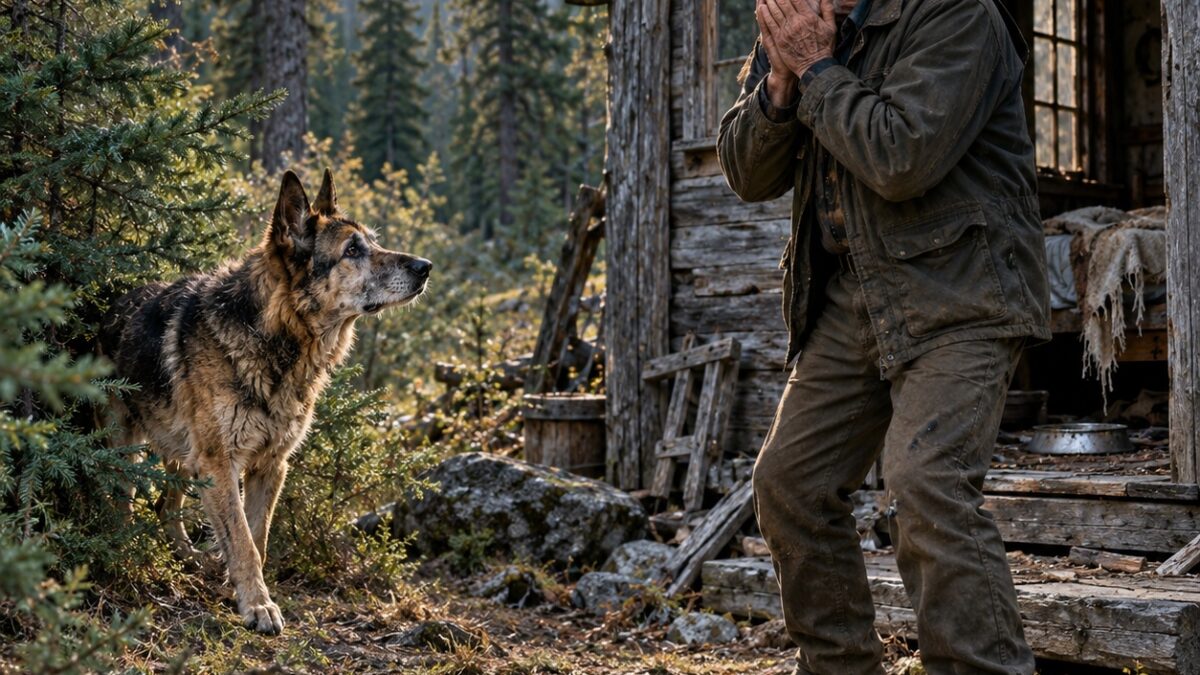
I Returned to the Cabin Where My German Shepherd Vanished Six Years Ago—Then Something Stepped Out of the Pines and Stopped Me Cold
Six years after a violent storm took my German Shepherd into the forest, I returned to the abandoned cabin where I had waited for him until grief finally convinced me he was never coming home.
I expected to find mold, broken windows, and the ruins of the life I had walked away from, but beside my old bed lay Rex’s filthy, torn blanket exactly where he had always slept—as if someone had been using it.
Then branches cracked beyond the clearing, a thin gray-muzzled dog stepped out from between the pines, and when he lifted his eyes to mine, I forgot how to breathe.
My name is Douglas Harwood.
I am a retired forest ranger.
For most of my adult life, I believed I understood forests better than I understood people.
Trees are honest.
Weather is honest.
Rivers are honest.
A mountain does not pretend to care about you.
A storm does not apologize after destroying something.
I liked that certainty.
Rex liked it too.
He was a German Shepherd, dark across the back, tan through the legs and face, with ears that seemed too large when he was young and eyes that missed almost nothing.
For years, we lived together in an old cabin deep beyond the main road.
It was never beautiful in the way magazines use that word.
The porch leaned slightly.
The windows rattled when the wind came down from the ridge.
Mice occasionally believed the pantry belonged to them.
The roof required more repairs than I care to remember.
But it was ours.
Rex slept near my bed.
Every morning he waited by the door while I made coffee.
Every evening, if I sat outside, he lay beside my chair and watched the trees.
I knew his footsteps.
He knew mine.
I talked to him constantly.
Not commands.
Everything.
Work.
People.
Weather.
Regrets.
He knew every secret I never told another person.
Then came the storm.
Even six years later, I could still hear it.
Wind hitting the cabin hard enough to shake the windows.
Branches snapping somewhere beyond the walls.
Rain striking the roof in sheets.
Rex pacing.
Restless.
Alert.
I had seen storms before.
So had he.
But that one frightened him.
At some point, in the confusion, Rex disappeared.
I remember calling until my throat hurt.
I remember moving through the trees afterward, looking for tracks where rain had already destroyed most of them.
I remember believing that if I searched one more trail, walked one more ridge, checked one more place we had visited together, I would see those familiar ears above the brush.
I did not.
Days became something heavier.
Then time did what time always does.
It forced reality forward whether I agreed or not.
Eventually, I left the cabin.
That decision became the shame I carried longest.
I told myself there was nothing left there.
I told myself Rex was gone.
I told myself the storm had taken him far enough into the wilderness that I would never know what happened.
Maybe he had been injured.
Maybe he had become lost.
Maybe he had simply run until fear became distance.
Every possibility hurt.
But uncertainty hurt most.
So I closed the cabin.
Walked away.
And for six years, I tried to build a life around the missing piece.
I never replaced Rex.
People suggested it.
“You should get another dog.”
They meant well.
But another dog would have been another dog.
Not Rex.
You do not replace history.
You continue without it.
At least, that was what I thought.
Then, six years later, something pulled me back.
I wish I could give you a dramatic reason.
A dream.
A letter.
A sign.
There was none.
I was simply older.
Retired.
And tired of wondering whether memory had become more frightening than the place itself.
So I drove back.
The road was worse than I remembered.
Grass crowded the track.
Branches scraped the side of my truck.
When I finally reached the clearing, I almost did not recognize it.
The cabin looked smaller.
Older.
Half surrendered to the forest.
I stood there for a long time.
Then I heard something.
A branch breaking beyond the edge of the clearing.
I turned.
Nothing.
Another sound.
Closer.
Then movement between two pines.
Dark fur.
A thin body.
Gray around the muzzle.
And two ears I knew before I allowed myself to know anything else.
PART2
I stopped breathing.
That is not exaggeration.
My body simply forgot.
The dog stood perhaps thirty feet away.
Too thin.
Older.
One front leg held slightly differently.
His coat was rough and tangled.
There were gray hairs around his face.
For one terrible second, my mind rejected what my eyes were seeing.
Six years.
Dogs do not wait six years.
Lives do not return after you have buried them without a grave.
The forest does not give back what it takes.
Then the dog lifted his head.
His eyes met mine.
And the world split open.
“Rex?”
My voice barely existed.
The dog froze.
His ears came forward.
I felt my knees weaken.
“Rex.”
This time his name broke in the middle.
The dog took one step.
Stopped.
His head tilted slightly.
That tiny movement destroyed me.
Rex used to do that when I said something he did not understand.
Always the same angle.
Always the right ear turning first.
I dropped to my knees.
“Rex.”
He moved.
Not fast.
He could not move fast anymore.
But he came.
First walking.
Then a strange uneven trot.
Then faster than his old body seemed capable of.
By the time he reached me, I was crying too hard to see clearly.
He collided with my chest.
Not violently.
Just enough.
I wrapped both arms around him.
His body shook.
Mine did too.
I buried my face against his neck.
“Rex.”
His tail moved.
Slowly at first.
Almost uncertain.
As if six years had made even joy unfamiliar.
Then faster.
Thump.
Thump.
His entire rear body started moving with it.
He tried licking my face.
Once.
Again.
Then again.
I laughed through tears.
“You remember me.”
That sentence hurt more than anything.
Of course he remembered.
But some part of me had been afraid he would not.
Afraid I had abandoned him so completely that even memory had let me go.
Rex pressed his head beneath my chin.
I held him tighter.
He was painfully thin.
My hands found ribs beneath rough fur.
His hips were prominent.
One shoulder felt sharper than I remembered.
He smelled like earth, old leaves, wet fur, and forest.
But beneath all of it was something impossible.
Familiarity.
Home has a smell.
I had forgotten that.
I do not know how long we stayed there.
Minutes.
Maybe longer.
Time was irrelevant.
I was sixty-something years old, kneeling in dirt in front of a ruined cabin, holding a dog I had mourned for six years.
Nothing in my life had prepared me for the emotional violence of getting something back after convincing yourself it was gone forever.
Grief has structure.
You learn how to carry absence.
You create rituals around it.
You stop looking at doors.
Stop listening for paws.
Stop expecting a shape beside the bed.
It hurts, but eventually the pain becomes predictable.
Then imagine all of that being shattered by the thing you grieved walking out of the trees.
I had no structure for that.
Only Rex.
Warm.
Alive.
Old.
Real.
I touched his face.
Gray muzzle.
Small scars I did not remember.
One ear had a notch near the edge.
His eyes, though.
The same.
Older, perhaps.
But still Rex.
“Where were you?”
I whispered.
He licked my wrist.
“Six years.”
My voice broke again.
“Where were you for six years?”
No answer.
There would never be one.
That was the first truth I had to accept.
Finding Rex did not solve the mystery.
It only transformed it.
Now the question was no longer whether he had survived.
He had.
The question became how.
And maybe worse—
why had he stayed here?
I sat on the ground.
Rex remained pressed against me.
When I tried standing, he stood too.
I took one step toward the cabin.
He followed.
Not cautiously.
Immediately.
That caught my attention.
The cabin door hung partly open.
I had locked it when I left six years earlier.
Time had done what time does.
Wood warped.
Hinges rusted.
Part of the frame had shifted.
There were enough gaps in the structure that a determined dog could have found ways in and out over the years.
I stepped onto the porch.
The boards groaned.
Rex went ahead of me.
He did not sniff the doorway like an unfamiliar place.
Did not hesitate.
He simply entered.
Like a dog coming home.
I stood outside.
My hand on the frame.
Something cold moved through me.
“Rex?”
He disappeared into the darkness.
I followed.
The smell hit first.
Dust.
Mold.
Old wood.
Dampness.
Years.
Furniture had shifted.
One chair lay on its side.
The table was covered in grime.
Part of the ceiling showed water damage.
Leaves had blown through broken sections near a window.
The place looked abandoned.
Except Rex did not behave like it was abandoned.
He moved toward the back room.
My old bedroom.
I followed.
My flashlight crossed the bed frame.
Mattress ruined.
Dust thick across what remained of the floor.
Then the light reached the corner beside the bed.
I stopped.
“No.”
The word came out before I understood why.
There was a blanket.
Rex’s blanket.
The old brown one I used to keep beside my bed.
Dirty now.
Torn.
Flattened.
But positioned exactly where he had always slept.
Rex walked to it.
Turned once.
Then lowered himself.
My legs gave out.
I sat on the edge of the damaged bed frame.
Looked at him.
Looked at the blanket.
Then back.
All the possible explanations I had carried for six years began rearranging themselves.
The storm frightened him.
He ran.
Maybe farther than he intended.
Maybe he became disoriented.
Maybe he spent hours or days trying to find his way back.
And when he finally did—
I may already have been gone.
The cabin closed.
Empty.
No truck.
No voice.
No me.
But Rex knew this place.
This was home.
So he stayed.
I put both hands over my face.
“No.”
Rex lifted his head.
I shook mine.
“No, no, no.”
The guilt came like physical pain.
I had spent six years telling myself Rex had disappeared.
What if Rex had spent six years believing I had?
I dropped to the floor beside him.
The boards were cold.
Dust covered my knees.
I did not care.
“Forgive me.”
Rex watched.
“I’m sorry.”
My voice collapsed.
“I’m so sorry.”
His tail moved once against the floor.
Small.
Soft.
I reached for him.
“I searched.”
That sounded like an excuse the moment I said it.
“I looked for you.”
Another excuse.
“I thought you were gone.”
Rex rested his head on my knee.
That ended the argument.
Dogs do not need our legal defense.
They do not sit as judges over the timeline of our failures.
Rex simply put his head where it had rested hundreds of times before.
I touched the gray fur around his ears.
“You waited.”
The idea was unbearable.
Maybe he had not waited every day in a human sense.
I knew enough about animals not to turn instinct into a romantic story without evidence.
Maybe the cabin was simply shelter.
Familiar territory.
A reliable place near water and food sources.
Maybe Rex roamed widely and returned periodically.
Maybe survival, not devotion, kept him near.
But the blanket beneath his body was real.
His immediate return to the room was real.
The fact that he had appeared from the forest within minutes of my arrival felt real in a way I could not explain.
Whatever the precise psychology, this place had remained his home.
And I had left it.
I stayed at the cabin that night.
I had not planned to.
My original idea had been a brief visit.
Look around.
Face the memories.
Drive back before dark.
Instead, I cleared enough debris from one room to make a safe place.
I had emergency supplies in the truck.
Blankets.
Water.
Food.
Basic things old habits made me carry.
Rex watched everything.
When I opened food, his attention sharpened.
That made me smile despite myself.
“Still you.”
I gave him a small portion first.
He ate too quickly.
I stopped myself from giving more immediately.
His thinness frightened me, but feeding an undernourished dog too much at once can cause problems.
Old ranger knowledge.
Basic animal care.
I would need a veterinarian.
Soon.
For that night, careful.
Water.
Food in smaller amounts.
Warmth.
Rest.
I spread a clean blanket near the old one.
Rex sniffed it.
Then chose his original.
I laughed softly.
“Of course.”
He circled.
Lay down.
I stayed beside him.
Darkness in that cabin felt different from six years before.
Back then, darkness had contained waiting.
I would hear wind and imagine paws.
Hear branches and open the door.
Call.
Nothing.
Now darkness contained breathing.
Rex’s breathing.
Slow.
Uneven occasionally.
But present.
I lay on a camping pad near him.
Could not sleep.
Every time I closed my eyes, memories came.
Rex young.
Running ahead on trails.
Rex standing beside a creek.
Rex wet from rain.
Rex sleeping near my bed.
Then the storm.
Empty forest.
Empty cabin.
Six years.
I opened my eyes.
He was still there.
I reached over.
Placed my hand on his back.
Rex exhaled.
Deeply.
The sound nearly made me cry again.
“We’re here.”
I whispered.
He did not move.
“We’re both here.”
Sometime before dawn, I finally slept.
I woke to sunlight entering through a damaged window.
For one panicked second, I forgot.
Then I felt warmth against my leg.
Rex.
He had moved during the night.
Instead of his old blanket, he was lying against me.
His head rested near my knee.
I did not move.
I watched him breathe.
Gray muzzle.
One paw twitching in sleep.
My chest tightened.
Six years earlier, I had spent mornings waking and remembering he was missing.
Now I woke and remembered he had returned.
No.
That was wrong.
I had returned.
Rex was the one who had been here.
That distinction mattered.
When he woke, he looked at me.
Tail.
I laughed.
“Morning.”
He stretched slowly.
Age showed.
His left leg stiff.
Slight limp.
I stood.
My own knees complained.
“Yeah.”
I said.
“I know.”
Rex looked at me.
“We both got old.”
That seemed fair.
Outside, morning air was sharp and clean.
The forest was quiet.
I stood on the porch.
Rex came beside me.
Shoulder against my leg.
We looked toward the trail.
For years, that trail represented leaving.
The path back to roads.
People.
Life elsewhere.
That morning, I saw it differently.
It was simply a path.
Nothing more.
Rex sniffed the air.
Then walked into the grass.
Not far.
A few yards.
He stopped.
Looked back.
Old habit.
I remembered that look.
Whenever we hiked, Rex would move ahead, then check whether I was following.
I had forgotten.
My throat tightened.
“I’m here.”
He continued.
I followed.
The first walk was short.
His limp became more noticeable after several minutes.
I did not push.
We turned back.
At the porch, Rex paused.
Looked at me.
Then at the door.
I opened it.
He went inside.
The simplicity of that nearly broke me.
He expected the door to open.
Maybe for years it had not.
Or maybe the damaged structure eventually let him in.
Still, the act felt symbolic to me.
A door.
A man.
A dog.
Home.
I had spent decades in forests learning not to impose too much human meaning on animal behavior.
Rex made me violate that rule constantly.
I needed to get him examined.
That meant leaving.
The thought made me anxious.
Not because Rex would disappear immediately.
But because I had only just found him.
The idea of taking my eyes off him felt impossible.
So I made the practical decision.
We would go together.
I opened the truck door.
Rex stopped.
His body changed.
Not fear exactly.
Caution.
Cars had once meant rides with me.
Trails.
Supply runs.
Normal life.
But six years had passed.
I crouched.
“Come on.”
He watched.
“I’m not leaving you.”
I hated how much the sentence sounded like a promise to myself.
Rex approached.
Sniffed the truck.
Then looked at me.
I lifted him carefully enough to help his aging hindquarters.
He stiffened at first.
Then settled.
Passenger side.
The exact place he used to ride.
I sat behind the wheel.
Looked at him.
Rex looked forward.
For one second, it was six years ago.
Then gray muzzle.
Thin body.
Reality.
I started the engine.
Rex’s ears moved.
We drove.
The veterinarian could not tell me how Rex had survived either.
No one could.
He was underweight.
Dehydrated, though not critically at that moment.
His coat and skin showed the effects of living outdoors.
There were old scars.
His left leg had evidence of an old injury that had healed imperfectly.
Teeth worn.
Age consistent with the years.
But no immediate condition that explained away the impossible fact.
He had survived.
“How?”
I asked.
The veterinarian shook her head.
“Dogs are resourceful.”
“I know.”
“If he knew the forest…”
“He did.”
“Water sources?”
“Yes.”
“Wildlife, discarded food, things around old properties…”
“Possible.”
She examined his paws.
“He adapted.”
That word hurt.
Adapted.
Six years of survival compressed into one word.
“What about the cabin?”
“What about it?”
“He stayed there.”
The veterinarian looked at me.
“You know that?”
I hesitated.
“No.”
Not scientifically.
“I found his old blanket used.”
“He came straight inside.”
“He knew everything.”
She nodded.
“Then maybe it stayed part of his territory.”
Territory.
Home.
Different words describing overlapping truths.
I accepted both.
We made a care plan.
Nutrition.
Hydration.
Rest.
Monitoring his leg.
Follow-ups.
Nothing magical.
Rex was old.
Living wild for years had taken a toll.
I asked the question I did not want to ask.
“How long?”
The veterinarian looked at me.
“You just found him.”
“I know.”
“Then don’t start losing him again today.”
That shut me up.
She was right.
I had spent six years grieving.
I was not going to turn reunion into anticipatory grief within twenty-four hours.
Rex had today.
So did I.
Enough.
We returned to the cabin.
I could have taken Rex back to my other place.
A cleaner house.
Reliable utilities.
Comfort.
Easier veterinary access.
But as we approached the old road, Rex became more alert.
When the clearing appeared, his head lifted.
Tail moved.
He knew.
That settled something in me.
I would repair the cabin.
Not restore it into something fancy.
Not erase its age.
Make it safe.
Habitable.
Home again.
The decision sounded ridiculous when I said it aloud.
“I’m staying.”
Rex sniffed the porch.
“I know.”
“I left once.”
He looked up.
“I’m not doing it again.”
Maybe I should have considered practical details longer.
My age.
The road.
Condition of the building.
Work required.
But sometimes the correct decision arrives emotionally before logistics can object.
The logistics can catch up.
So I began.
Cleaning came first.
Dust.
Mold.
Broken furniture.
Rotten material.
I worked slowly.
Rex followed me.
That was one of the most emotional things.
Not the reunion.
Not the blanket.
Following.
I would move a chair.
Rex moved.
Carry boards outside.
Rex came to doorway.
Sweep.
Rex watched.
If I sat, exhausted, he lay at my feet.
Exactly like before.
Six years had changed everything and nothing.
I caught myself talking aloud within hours.
“Window frame is worse than I thought.”
Rex tilted his head.
“Don’t look at me.”
“You weren’t doing maintenance.”
Tail.
I laughed.
“I suppose you were busy surviving.”
That stopped the laughter.
I touched his head.
“Sorry.”
Rex leaned into my hand.
Again, forgiveness without trial.
I repaired the easiest window first.
Then the door.
The door mattered emotionally more than structurally.
I replaced damaged sections.
Strengthened the frame.
Fixed the latch.
When I finished, I opened it.
Closed it.
Opened again.
Rex watched.
“You see?”
I said.
“This one opens now.”
Maybe absurd.
I did not care.
I kept the old blanket.
I could not throw it away.
It was filthy.
Damaged beyond practical use.
I cleaned what I safely could.
Then placed it near a new bed.
Rex preferred the old blanket for several nights.
Eventually, he started using the new one too.
That transition made me smile.
Memory and comfort did not have to compete.
He could have both.
The cabin gradually changed.
Not quickly.
I was not thirty anymore.
Every repair took longer.
My back protested.
My hands stiffened.
Rex moved slowly too.
We matched each other.
I joked about it.
“Two old men fixing one old house.”
He would look at me.
“That includes you.”
Tail.
“Exactly.”
We began walking forest trails again.
Short ones.
Places we used to know.
The first time we reached an old bend near a creek, Rex stopped.
Sniffed.
Looked around.
I wondered whether he remembered.
Probably scent more than scene.
Maybe nothing.
I remembered enough for both of us.
He used to run ahead there.
Splash in water.
Return covered in mud.
Now he walked carefully to the edge.
Drank.
Then stood beside me.
I sat on a rock.
“Slower.”
I said.
Rex rested.
“Better, maybe.”
I meant it.
When we were younger, every hike had distance.
Destination.
Work.
Now a creek half a mile away could be the entire day.
There was freedom in that.
No need to conquer anything.
We had already lost enough time.
Why rush what remained?
One evening, I sat outside in the repaired wooden chair.
Sun lowering behind trees.
Rex lay beside me.
Head on paws.
The scene looked so ordinary that I felt tears before I understood why.
For six years, I had imagined his ending.
None of those imagined endings contained this.
I had pictured him dead in the storm.
Injured somewhere.
Taken by wildlife.
Found by another person.
Maybe surviving elsewhere.
Anything.
Never this.
Rex beside my chair.
Same clearing.
Older.
Alive.
I put my hand on his back.
He did not look up.
Comfortable enough not to respond.
That made me happier than constant excitement.
He knew I was there.
No need to check.
I thought about waiting.
People called what Rex had done loyalty when I later told the story.
Maybe.
But waiting is not always noble.
Sometimes it is what happens when there is nowhere else that feels like home.
Rex may have stayed because he believed I would return.
Or because this was familiar territory.
Or both.
I could not know.
But I began understanding something about myself.
For six years, I had been waiting too.
I just did it somewhere else.
I waited for guilt to fade.
It did not.
Waited for memory to become less sharp.
Sometimes.
Waited for the question of Rex to stop appearing unexpectedly.
Never.
Neither of us had moved as far away as I thought.
The cabin restoration gave my days structure.
Morning coffee.
Rex outside.
Breakfast for both.
Work on something.
Rest.
Walk.
More repairs.
Evening.
I had been retired before returning, but retirement had felt shapeless.
Now time had edges again.
Not duty.
Not work exactly.
Care.
Home.
Rex.
That was enough.
One afternoon, behind the cabin, I found something in the brush.
Metal.
Rust.
At first, I thought it was old hardware.
Then I picked it up.
Collar.
Rex’s old collar.
My hands started shaking.
The leather was ruined in places.
Metal rusted.
But the buckle still moved.
I sat on the ground.
Rex came over.
Sniffed it.
No dramatic reaction.
For me, the object contained a whole life.
I remembered fastening it around his neck years earlier.
Taking it off at night sometimes.
The tag.
The sound when he moved.
Somewhere during the storm or afterward, it had come off.
And there it was.
Behind the cabin.
Another piece of evidence.
Another question.
Had Rex returned soon after I left?
Had the collar snagged?
Had he lost it months later?
Years later?
No answer.
I cleaned it as best I could.
The leather was worn but usable enough for a symbolic moment.
I looked at Rex.
“You want this?”
He sniffed again.
I fastened it gently around his neck.
Not tight.
Rex stood still.
Then looked at me.
Something inside me settled.
“Yeah.”
I whispered.
“Now you look right.”
That was a human idea.
Rex had been perfectly Rex without the collar.
Still, seeing it there made the years fold.
Past touching present.
He wagged.
I smiled.
“All right.”
“Everything’s where it belongs.”
The collar did not stay on constantly.
It was old.
I did not want it causing irritation.
Eventually I preserved it more than used it.
But the first moment mattered.
A circle closed.
Not perfectly.
Nothing closes perfectly after six years.
But enough.
Some nights, wind moved through trees the way it had during the storm.
Those nights were difficult.
The first one, Rex became restless.
So did I.
Rain hit the roof.
Not violently.
But enough.
I watched him.
He watched the door.
My stomach tightened.
For one irrational second, I was back six years.
Rex disappearing.
Storm.
Panic.
I wanted to close every exit.
Lock him beside me.
That would have been fear pretending to be love.
Instead, I sat down.
Called him.
“Rex.”
He came.
Lay beside me.
I rested my hand on his back.
The storm passed.
He stayed.
I stayed.
Neither of us needed to prove anything by going outside.
That night healed something in me.
Maybe him too.
I cannot know.
I stopped fearing every weather report eventually.
Not completely.
But enough.
Rain became rain again.
Wind became wind.
The forest became home, not the place that stole my dog.
That transformation took time.
Rex helped simply by existing beside me.
People occasionally visited.
Old acquaintances.
Neighbors from farther down the road.
They could barely believe Rex.
“Six years?”
“Yes.”
“Here?”
“As far as I can tell.”
“How did he live?”
“I don’t know.”
“Did anyone feed him?”
“I don’t know.”
“Why didn’t he leave?”
“I don’t know.”
That answer frustrated people.
Humans want complete stories.
Beginning.
Cause.
Middle.
Explanation.
End.
Rex gave me an ending without all the missing chapters.
I learned to accept that.
Mystery did not make his survival less real.
Some people wanted to call him miraculous.
Others said dogs have strong homing instincts.
Some suggested perhaps hunters or travelers had fed him.
Possible.
Maybe he ranged much farther than I imagined.
Possible.
Maybe he had another shelter somewhere in the forest.
Possible.
I welcomed practical explanations.
They did not diminish anything.
Rex had survived through intelligence, instinct, adaptation, luck, and whatever help the environment or people may have provided.
No need for magic.
The emotional miracle was not how he ate.
It was that we met again.
I became careful about saying Rex “waited six years.”
That phrase is powerful.
Also impossible to prove literally.
He did not sit motionless beside the cabin every day like a statue.
He survived.
Ranged.
Searched.
Rested.
Adapted.
But he returned.
That I knew.
The blanket.
The territory.
His familiarity.
His appearance near the clearing.
So when I say he waited, I mean something broader.
He never severed whatever connection kept bringing him back to the place we had shared.
That is enough for me.
I apologized less over time.
At first, every quiet moment produced:
“I’m sorry.”
Rex did not need that forever.
Eventually, apology can become another way of centering yourself.
He was alive now.
I was here now.
Better to feed him.
Walk.
Repair.
Stay.
Action mattered more than repeating guilt.
So I changed the sentence.
Instead of:
“I’m sorry I left.”
I said:
“I’m here.”
Better.
Rex’s health improved somewhat with regular food and care.
He gained weight.
Coat softened.
His limp remained.
Old injury.
Age.
The veterinarian did not promise it would disappear.
I did not need it to.
Rex moved comfortably enough.
We adjusted distance.
If he tired, home.
No pushing.
He had spent six years doing whatever survival demanded.
Now his body could dictate pace.
He rediscovered indoor comfort quickly.
Very quickly.
One cold evening, I found him stretched near the stove.
“Interesting.”
I said.
“So much for wild independence.”
Rex opened one eye.
“Six years in the forest and you’re back to stealing the warmest spot in two weeks.”
No response.
“Impressive.”
He slept.
That was one of my favorite things about him.
Survival had not turned him into some tragic symbol.
He still liked warmth.
Food.
My chair.
Routine.
Dogs are wonderfully practical.
He began putting on weight enough that lifting him into the truck became harder.
I complained.
“You used to be too thin.”
Rex looked at me.
“This is good.”
Then I grunted while helping him.
“But inconvenient.”
Tail.
“Don’t enjoy this.”
We went to follow-up appointments.
Nothing dramatic.
That was wonderful.
Monitor.
Nutrition.
Joint care.
Age.
I had spent so long fearing that finding him would immediately lead to losing him again.
Instead, we got routine.
Routine is a blessing after uncertainty.
One afternoon, while cleaning the cabin, I found an old photograph.
Rex young beside me.
Maybe three or four.
Strong body.
Bright coat.
Me younger too.
I sat.
Rex came near.
I held the picture toward him.
“That’s you.”
He sniffed it.
Unimpressed.
“And me.”
Nothing.
“We looked good.”
Rex walked away.
I laughed.
“Fair.”
The photograph made me sad, but not in the old way.
Aging used to feel like evidence of loss.
Now I saw it as evidence we had reached another time together.
Gray muzzle meant years.
Some with me.
Some without.
But still years.
I was grateful.
I placed the photograph on a shelf.
Not as a shrine.
Just part of the cabin.
Old Rex.
Old collar.
New blanket.
Current Rex.
History layered.
That was home.
I realized eventually that the cabin itself had done something similar.
Old boards remained.
New repairs beside them.
Some scars visible.
Some replaced.
The structure did not become what it had been.
It became livable again.
Rex too.
Me too.
We were not restored.
We were repaired enough.
I began liking that phrase.
Repaired enough.
Not perfect.
Home.
People often talk about second chances as though they reset the clock.
They do not.
A second chance arrives carrying everything from the first.
Age.
Regret.
Scars.
Time lost.
You do not get six years back because you reunited.
That truth hurt.
Rex had aged without me.
I had aged without him.
No emotional moment could return those seasons.
At first, I mourned that constantly.
Then I realized mourning lost time could consume the time we had regained.
I stopped.
Or tried.
If Rex wanted to sleep, let him sleep.
If the sunset was good, watch.
If I had a repair that could wait until tomorrow, sometimes it waited.
I had learned that “later” is not guaranteed.
But neither should that knowledge turn every moment into pressure.
Sometimes a dog sleeping at your feet is already enough.
There was an evening when I noticed Rex watching the trail.
His body still.
Head raised.
My chest tightened.
Old fear.
Was he going to leave?
Had something called him back into the woods?
Then he stood.
Walked a few yards.
Relieved himself.
Returned.
I laughed at myself for five full minutes.
“Very dramatic, Douglas.”
Rex ignored me.
Trauma makes ordinary behavior look symbolic.
You have to retrain yourself too.
Eventually, Rex wandered short distances around the clearing without me panicking.
He always returned.
That repetition mattered.
Every return contradicted six years of fear.
Not because Rex owed me proof.
Because my nervous system needed evidence.
He gave it without knowing.
I began sleeping deeply again.
For years after the storm, bad weather woke me.
Even elsewhere.
I would listen.
Imagine Rex outside.
Ridiculous after enough time.
Still happened.
At the cabin, with Rex near me, the old association weakened.
Wind.
Rex breathing.
Rain.
Rex breathing.
Safe.
Again.
Again.
Memory rewritten not by forgetting but by new experiences.
One morning, I opened the door and found light snow.
Rex stood beside me.
We both watched.
He stepped out.
Sniffed.
I followed.
Snow around the cabin looked almost exactly as I remembered from winters before he disappeared.
For a moment, I could not tell whether I was old or young.
Then my knee hurt.
Answer provided.
I laughed.
Rex looked back.
“Nothing.”
We walked.
Slowly.
Two old bodies leaving two sets of tracks.
That image stays with me.
Sometimes, I wondered whether Rex remembered the storm specifically.
There was no way to know.
He reacted to weather sometimes.
But dogs respond to sounds, pressure, environment.
I did not turn every movement into trauma.
He deserved freedom from my narrative.
If he wanted to sleep during rain, good.
If he paced, I stayed near.
No assumptions necessary.
The most important change in our relationship was that I stopped trying to make up for six years.
You cannot.
At first, I gave him too much food emotionally, not literally.
Too much attention.
Hovered.
Constant touching.
Checking.
Rex occasionally moved away.
That humbled me.
Love after guilt can become intrusive.
He needed space too.
So I learned.
Sometimes he wanted me.
Sometimes he wanted the porch.
Sometimes the warm stove.
Sometimes the forest edge.
Home allowed choice.
I respected it.
The fact that Rex chose to return to my side after having space became more meaningful than keeping him close through fear.
That is trust.
Not confinement.
One afternoon, I was repairing a section of porch.
Rex disappeared around the cabin.
Five minutes.
Ten.
I kept working.
At fifteen, anxiety started.
I stood.
“Rex?”
No answer.
My heart began climbing.
Then he appeared from behind a cluster of brush carrying something disgusting in his mouth.
I stared.
“You terrified me for that?”
Rex looked pleased.
“Absolutely not.”
I took several steps backward.
“Whatever that is, it does not live in the cabin.”
He approached.
“No.”
Tail.
“Rex.”
He dropped it.
I laughed.
The sound surprised me.
There it was.
Normal dog problem.
Not disappearance.
Not grief.
Something gross found in woods.
I had missed problems like that.
I cleaned up his treasure.
Rex looked betrayed.
Good.
We were ordinary again.
The cabin repairs eventually reached a point where I could call the place solid.
Not new.
Never wanted new.
But safe.
Roof patched.
Windows secure.
Door reliable.
Interior cleaned.
Bed usable.
Stove maintained.
Porch repaired.
I stood outside one evening and looked at it.
Rex beside me.
“We did okay.”
He sat.
Technically, I did most of the construction.
But emotional supervision counts.
“Mostly me.”
Rex leaned against my leg.
“Fine.”
“Team effort.”
I considered selling my other place.
The thought came naturally.
I did not need two lives.
The source of my story is clear: I decided not to leave.
I honored that.
The details of paperwork did not matter to Rex.
The decision did.
This was home.
I stayed.
Some people thought I was romanticizing isolation.
Maybe.
But I was not cutting myself off from the world.
I still drove out.
Bought supplies.
Saw people.
Veterinary care.
Handled ordinary life.
The difference was where I returned.
Return became the central word.
Six years ago, Rex returned and I was gone.
Now every time I left, I returned.
That mattered to me.
Perhaps to him.
I made a ritual without intending to.
Whenever I came back from town, I called his name before reaching the porch.
“Rex.”
Usually he appeared.
Sometimes from inside.
Sometimes yard.
Sometimes already waiting.
I would say:
“I’m back.”
Simple.
Maybe unnecessary.
I needed it.
One winter afternoon, I was delayed longer than expected.
Road issue.
Nothing serious.
By the time I reached the cabin, darkness had fallen.
I felt guilty.
When headlights entered the clearing, Rex stood near the porch.
My heart broke open again.
He had waited.
But this time, the truck arrived.
I got out.
“I’m back.”
Rex came to me.
Tail.
I knelt.
Not from guilt this time.
Gratitude.
One old wound receiving a different ending.
That is how healing works sometimes.
You cannot redo the original moment.
You can create enough new ones that the old outcome stops feeling inevitable.
Rex and I had many such small corrections.
Door closes.
Door opens.
Storm comes.
We remain.
Trail disappears around bend.
We return.
Night.
Morning.
Simple.
I began writing some of this down.
Not because I expected anyone to read it.
Retirement gives a man time to become sentimental.
Maybe that is unfair to retirement.
I had always been sentimental.
Just better at hiding it.
I wrote about the forest.
Rex.
Waiting.
Home.
Sometimes he lay at my feet while I wrote.
I would read sentences aloud.
He seemed unimpressed.
Reasonable.
One night, I wrote:
I did not find Rex. I found the place where he had refused to stop belonging.
Then I crossed it out.
Too poetic.
Still, the thought remained.
I had driven back believing I was revisiting a grave.
Instead, I discovered home had been inhabited all along.
That changed my understanding of absence.
For six years, I had said:
“Rex is gone.”
But from his perspective, maybe I was.
There is humility in reversing the sentence.
We are always the center of our own grief.
Maybe someone else is waiting on the other side of it.
That thought made the apology deeper.
Not endless.
Deeper.
I could not know whether Rex experienced abandonment the way a human would.
But I knew my leaving had consequences.
The cabin empty.
No food from me.
No warmth I provided.
He adapted because he had to.
So I honored his survival by not turning it into a romantic excuse for my departure.
I had left.
I believed he was dead or gone forever.
I made the best decision I could with what I knew.
And still, Rex bore the result.
Two truths.
No need to simplify.
Forgiveness, if that is what his behavior represented, did not erase responsibility.
It allowed relationship after it.
That mattered.
Rex never punished me.
Dogs rarely waste energy on moral theater.
He wanted food.
Warmth.
Walks.
Company.
I followed his lead.
Live now.
Age advanced.
Not dramatically within the source timeframe, but enough that each season made me more conscious of time.
I refused to count months obsessively.
Still, I noticed.
Stiffer mornings.
More gray.
Longer naps.
I adapted.
Shorter walks.
Better bedding.
Joint support from veterinary advice.
No heroic hikes.
Rex had already done enough surviving.
We discovered a favorite route behind the cabin.
Gentle slope.
Creek.
Open patch where sun reached ground.
Rex liked lying there.
I brought a small folding stool eventually.
We would sit.
No conversation necessary.
Some days birds.
Some days wind.
Once deer at distance.
Rex watched.
Did not chase.
Age or wisdom.
Probably age.
I thought often:
If I had known he was here, I would have come sooner.
Of course.
That sentence is useless but unavoidable.
Regret always wants to revise the information available at the time.
I could not.
So I replaced it with:
I am here now.
Again.
Better sentence.
The old collar eventually hung from a peg near the door.
Not on Rex constantly.
A reminder.
I sometimes touched it before leaving.
Metal cool.
Rust cleaned but still visible.
Another object that survived imperfectly.
Like us.
The blanket stayed too.
I put it in a dry protected spot near his new bed.
Rex used the new bed more often over time.
One evening, I noticed he had not touched the old blanket in days.
At first, sadness.
Then relief.
He did not need the past object constantly.
It could remain without being his only comfort.
That felt healthy.
For both of us.
I stopped sleeping with my hand on him every night.
At first, I needed physical proof.
Warm body.
Breathing.
Eventually, trust.
Rex could sleep across room.
I could close eyes.
He would probably be there in morning.
Probably.
That word is enough for every relationship.
Nothing is absolute.
We live on probability and love anyway.
One evening, a strong storm approached.
Weather report.
Wind.
Heavy rain.
My whole body reacted before the first drop.
I checked door.
Windows.
Roof.
Rex.
Old instincts and old fear.
He lay near stove.
Calm.
I sat beside him.
“Bad weather.”
Ear moved.
“Remember?”
No response.
I regretted asking.
Let memory belong to him.
Rain began.
Hard.
Wind pushed branches.
Cabin creaked.
Not as violently as six years earlier.
Still enough.
I found myself listening for panic.
Rex lifted his head once.
Then lowered it.
I laughed softly.
“You’re better at this than me now.”
I lay on the floor beside him for a while.
Storm moved through.
At some point, I fell asleep.
When I woke, dawn.
Rex still there.
No disappearance.
I stepped outside.
Branches down.
Wet ground.
Cabin standing.
I cried.
Not because anything had happened.
Because nothing had.
Sometimes healing is surviving an ordinary repetition of the thing that once destroyed you.
Storm.
Morning.
Still here.
I made coffee.
Rex ate breakfast.
The world continued.
That day may have healed more in me than the reunion.
People love reunion stories because they contain an explosion of emotion.
Dog runs.
Human cries.
Music, if it is a video.
But living after reunion is harder.
You have to make the returned thing real.
Not a miracle.
A relationship.
Feed.
Vet.
Repair.
Forgive.
Adjust.
Age.
Stay.
That is the part that mattered most to me.
Finding Rex was one moment.
Remaining with him became the life.
I sometimes wondered whether my promise—
“I will never leave again”—
was too absolute.
Humans should be careful with absolute promises.
I still had to go to town.
Appointments.
Life.
Eventually death would separate us one way or another.
But I understood what I meant.
I would not abandon the shared home again while I had a choice.
I would return.
That was a promise I could practice.
Each return strengthened it.
Rex became more affectionate with time.
Or perhaps I noticed more.
Head on knee.
Shoulder against leg.
Following me from room to room occasionally.
He did not cling constantly.
Good.
Trust is not always proximity.
Sometimes it is sleeping deeply while someone moves around because you believe they are not disappearing.
Rex did that.
I noticed.
One afternoon, I went outside to work.
Rex remained asleep inside.
At first, I expected him to follow.
He did not.
I smiled.
Six years after surviving alone, he trusted a closed door enough to keep sleeping.
That meant something.
I worked.
Returned.
He opened one eye.
No tail explosion.
No panic.
Just:
Oh. You’re back.
Ordinary trust.
Beautiful.
I thought about what home means.
Source makes this explicit, and I came to understand it bodily.
Home is not walls.
My cabin walls had been empty when I left.
Rex made them home through memory and presence.
Then when I returned, we remade home together.
Home is where someone expects your return.
Where your body relaxes.
Where objects carry history.
Where you can age without being dismissed.
Where absence is temporary, not permanent.
The cabin itself was only structure.
Belonging was us.
That realization changed the way I thought about the six lost years.
At first, I saw them only as theft.
Time stolen.
Later, I saw them also as proof of continuity.
Somehow, despite separation, we both retained enough of the old bond to recognize home immediately when reunited.
That did not make the loss good.
Nothing would.
But it meant the bond had survived.
That comforted me.
I asked Rex how he survived constantly at first.
Eventually I stopped.
No answer was coming.
The forest knew.
Rex knew in whatever form dogs retain life history.
That was enough.
Mysteries do not always need solving to stop hurting.
Sometimes they need acceptance.
Maybe he hunted small animals.
Maybe found water from creeks.
Maybe people occasionally fed him.
Maybe he scavenged.
Maybe winters nearly killed him.
Maybe sheltered under the cabin or inside after the door failed.
I could build endless possibilities.
I chose not to.
Those years belonged to Rex.
I could care for the dog who emerged from them.
That was my role.
His scars became less frightening with familiarity.
Not invisible.
Simply part of body.
The notch in ear.
Old leg injury.
Rough places in fur.
I stopped touching them as evidence.
Touched Rex.
Whole.
One evening, he rested his head on my knee the same way he had the first day inside after reunion.
I looked down.
“Do you forgive me?”
The question slipped out.
Rex sighed.
Tail tapped once.
I laughed through tears.
“You’re very generous.”
Maybe forgiveness is another human word.
Maybe Rex simply loved me.
That was enough.
I forgave myself more slowly.
That was the real struggle.
Rex had no interest in watching me suffer as repayment.
I had to learn that guilt is not loyalty.
Staying was loyalty.
Care was loyalty.
Repairing the cabin.
Returning.
Feeding.
Walking at his pace.
Those actions honored the past better than self-punishment.
So I let some guilt go.
Not all.
Enough.
The forest also became mine again.
At first, every trail carried the question:
Is this where Rex went?
Did he sleep here?
Did he search here?
Eventually, trails became trails.
Birds.
Water.
Light.
Current day.
Like the barn in previous story, but separate. No cross-reference.
Disaster loses territory when ordinary experiences accumulate.
I lived that.
One morning, Rex and I reached a small clearing where wildflowers had started.
He sniffed slowly.
Then sat.
I sat beside him.
No significance.
No old memory attached.
A new place.
That mattered.
Not everything in our renewed life had to be tied to before.
We could create experiences with no six-year shadow.
I cherished those.
The source tells that some evenings I listened to Rex breathing beside me.
That became true ritual.
Night.
Forest silent.
Wind in trees.
Rex near bed.
My hand on his back.
“We’re home.”
Sometimes I said it.
Sometimes not.
His breathing answered.
Deep.
Calm.
I stopped needing him to understand the words.
I understood them.
That was enough.
The old cabin changed acoustically too.
Before restoration, every wind sound felt threatening.
After repairs, it felt solid.
Wood settling.
Stove.
Rex’s nails.
My footsteps.
The sounds of occupancy.
An abandoned building has a different silence from an inhabited one.
I had learned that from houses and from hearts.
I started using “our” again.
Our cabin.
Our trail.
Our chair.
Our evening.
For six years, I had used singular language.
My truck.
My place.
My life.
Language revealed attachment before I noticed emotionally.
Rex made the plural return.
I wondered sometimes whether he understood my retirement.
Maybe not.
He probably only knew I was around more.
That may have been the best gift timing gave us.
If I had found him while still working full schedule, we would have had less time.
Now we had days.
Long ones.
Slow ones.
Exactly what two old companions needed.
There was no grand purpose.
That became part of the healing.
We were not trying to accomplish anything.
Restore cabin enough.
Care for bodies.
Walk.
Live.
After years as ranger, purpose had always been external.
Protect land.
Monitor.
Respond.
Work.
Now purpose became presence.
I liked it.
I think Rex did too.
One morning, I stood outside looking down the overgrown trail that led toward the road.
Rex came beside me.
Shoulder against leg.
The source’s moment.
I remember it clearly.
The trail was still rough.
Grass.
Branches.
A route outward.
For six years, leaving had been tied to loss.
I stood there and realized I did not want to go.
Not because I was afraid of the world.
Because I had finally chosen where I wanted to return.
I turned toward the cabin.
Rex turned too.
That synchronized movement was so simple.
I smiled.
“We’re staying.”
Tail.
“Yeah.”
We walked back.
That was when I understood the sentence I had been avoiding.
Six years earlier, I had not only lost Rex.
I lost a version of myself.
The man who lived without constant regret.
The man who trusted home.
The man who knew where he belonged.
I had continued functioning.
Retired.
Ate.
Slept.
Saw people.
Life.
But part of me remained in that clearing, calling into rain.
Returning did not restore youth.
It did not erase guilt.
It returned connection.
That was enough to make me feel whole in a new way.
Rex had been waiting.
Perhaps for me.
Perhaps for home.
Perhaps both.
And somehow I had been waiting too.
We met in the middle six years late.
Some people might say that kind of story proves fate.
I do not know.
Fate is a large word.
I believe in smaller things.
Memory.
Scent.
Territory.
Regret.
Decision.
An old man choosing to drive back.
An old dog emerging at the right moment.
Chance can be beautiful without being destiny.
I did not need the universe to plan it.
It happened.
That was enough.
I kept writing.
The pages became a record.
Not only of Rex.
Of the cabin.
Repairs.
Weather.
Walks.
Small things.
I began understanding that ordinary days deserve documentation too.
Trauma gets remembered automatically.
Peace sometimes needs help.
So I wrote:
Rex slept in sun for two hours.
We reached creek.
He ate well.
Rain overnight. Stayed calm.
Simple.
A ledger of life.
Maybe one day those notes would matter to no one.
They mattered to me.
They proved the second chance had substance.
Not just one reunion moment.
Days.
Weeks.
Seasons.
I found myself saying “thank you” to Rex sometimes.
Not for waiting.
That felt too heavy.
For smaller things.
“Thanks for coming with me.”
“Thanks for not chasing that.”
“Thanks for making me take a break.”
He understood none of the specifics.
Tone.
Presence.
Enough.
The source ending says he taught me it is never too late to come home.
I resisted that phrase at first because sometimes it is too late.
That is reality.
People die.
Animals die.
Places disappear.
We should not turn one lucky story into a universal guarantee.
But there is another meaning.
As long as the door still exists and someone is willing to return, maybe home can be rebuilt.
Not as it was.
As it can be.
That is what Rex and I did.
We did not get our old life back.
We got a new life containing the old one.
Much better way to say it.
Rex was not the young dog I lost.
I was not the man he lost.
We met as older versions.
Recognition bridged the difference.
That moved me deeply.
Love did not require youth.
Did not require unchanged bodies.
Rex smelled, saw, heard enough of me.
I saw enough of him.
The bond adapted instantly.
Maybe that is loyalty.
Not never changing.
Recognizing through change.
His gray muzzle became one of my favorite features.
I touched it often.
Proof of time.
Time I hated because I missed it.
Time I loved because it meant he survived.
Same gray hairs.
Two meanings.
Life is like that.
One evening, Rex fell asleep with his head on my boot.
Exactly as he had years earlier.
I did not move for almost an hour because waking him felt criminal.
My leg went numb.
Worth it.
Some habits returned unchanged.
Others did not.
We accepted both.
I stopped asking what he had done every winter.
No use.
Instead, winter came with me there.
Food.
Warmth.
Shelter.
If cold made his leg ache, care.
That was how I answered the unknowable past.
By changing the known present.
There is a human instinct to compensate backward.
You cannot feed an animal today enough to erase yesterday’s hunger.
You cannot provide warmth now that physically reaches six winters ago.
I had to accept that.
Care moves forward.
So forward we went.
Slowly.
The cabin’s porch chair became my evening place.
Rex beside me.
Sunset.
Sometimes insects.
Sometimes cold air.
No conversation.
Peace.
The source calls it gratitude and quiet joy.
Yes.
Those words are accurate.
I had spent years thinking peace would come from accepting Rex was gone.
It came instead from accepting Rex was here and time was finite.
Strange.
Grief had taught me one half of love.
Reunion taught the other.
Loss makes you understand value.
Return makes you understand responsibility.
Once given back something impossible, you must decide how to live with it.
I chose presence.
I made mistakes.
Overfed treats occasionally.
Hovered.
Worried.
Tried to extend walks when he was tired because I was nostalgic.
Caught myself.
Adjusted.
A second chance does not make you perfect.
It gives you more opportunities to choose better.
That was enough.
Rex occasionally looked at me as if I was foolish.
Probably accurate.
I think he enjoyed my retirement.
There were more meals together.
More porch.
More random conversation.
He had no need for ambition.
I learned from that.
Rangers measure distance, weather, tasks.
Dogs measure now.
Maybe retirement is partly learning dog time.
This meal.
This sun.
This person.
This nap.
I became good at it.
I do not know how many nights Rex spent alone near the cabin.
I know how many he spent after I returned.
Each one mattered.
We could count those.
No need to count ghosts.
One night, stars were unusually bright.
Power had not yet been fully restored in the way modern houses have it—though I had enough basics. The exact utility details do not matter.
The forest darkened completely.
Rex lay outside with me.
I looked up.
“You know, I thought I’d never see you again.”
Tail barely moved.
“I suppose you thought the same.”
Maybe.
“I’m sorry.”
Pause.
“I know. Stop apologizing.”
I laughed at myself.
Rex closed eyes.
“Good talk.”
That became our emotional rhythm.
I spoke.
Rex tolerated.
Perfect friendship.
The story of our reunion spread among a small circle.
People wanted details.
Photos.
I was careful.
Rex was not a symbol.
He was old and needed peace.
I let people be moved.
But I did not turn his life into a performance.
He had survived six years without an audience.
He deserved privacy.
Some visitors cried when they met him.
Rex accepted attention briefly.
Then usually returned to his bed.
I loved that.
He did not understand his own mythology.
Good.
He had more important things.
Sleeping.
The old collar drew questions.
“Is that the one?”
“Yes.”
“You found it?”
“Behind the cabin.”
People loved that detail.
I did too.
But I stopped putting it on him often.
Let history hang on peg.
Rex did not need to wear the past around his neck.
Nice metaphor, perhaps too neat.
Still true practically.
One day, he sniffed the collar.
Then walked away toward food.
I laughed.
Exactly.
As months passed, the cabin became cleaner but still old.
I did not replace every scar.
Some wall marks remained.
Some original boards.
I wanted continuity.
Not museum.
Not new construction pretending nothing happened.
A repaired place should be allowed to show repairs.
Humans too.
Dogs too.
I became less ashamed of my own aging.
Rex helped there.
Watching him move slowly without apology.
Rest when tired.
No embarrassment about limp.
He simply existed inside his body.
Humans make aging moral.
We call slowing failure.
Rex did not.
If he needed more time, he took more time.
I began doing the same.
When my hands hurt, I stopped work.
When back hurt, sit.
No heroism.
Cabin would wait.
I had learned the danger of believing every task must be finished before rest.
Time with Rex mattered more.
There was one afternoon I chose sitting over repairing a cabinet.
Sun good.
Rex outside.
I joined him.
Cabinet remained broken another week.
Best decision.
No regret.
I thought about all the years I had chosen work over simple presence before the storm.
Not constantly.
But enough.
I could not change those either.
So now I chose differently when possible.
Second chance.
Again.
Rex’s favorite position by evening became curled near my chair, one paw almost touching my boot.
Not always contact.
Close enough.
I came to love that distance.
Trust without neediness.
Companionship without performance.
The source says he knew all my secrets.
He still did.
I told him more.
Retirement anxieties.
Fear of losing him again.
Embarrassment over crying.
Thoughts about aging.
He remained an excellent listener.
Zero useful advice.
Perfect confidentiality.
One night, I asked:
“What happens when one of us goes first?”
Bad question.
Rex slept.
I smiled sadly.
“Exactly.”
Do not borrow grief from tomorrow.
That became another lesson.
We had today.
Again.
I have wondered whether my decision to remain at the cabin was wise medically or logistically.
People could argue.
But within the source, it was the choice.
I maintained access to care.
Made the place safe.
Stayed connected enough.
The cabin became viable.
Not reckless isolation.
I mention that because romantic stories can encourage foolishness.
Home should not require refusing necessary care.
Rex’s follow-ups mattered.
My own needs too.
We balanced.
The emotional truth remained:
I no longer wanted my life organized around departure.
I wanted a place of return.
Cabin gave that.
Rex confirmed it.
The forest changed through seasons.
Green.
Gold.
Bare.
Snow.
Each season with Rex felt borrowed.
Then I stopped calling it borrowed.
It was ours.
Borrowed suggests someone is about to reclaim it.
Life is temporary, yes.
But while living it, possession can be full.
Our winter.
Our spring.
No apology.
Spring was especially emotional.
The clearing brightened.
New growth over places that had looked dead.
Too obvious metaphor.
I still noticed.
Rex lay in sun.
I repaired small things.
Life.
No need to say more.
One morning, he barked at something near trees.
His voice surprised me.
Older.
Still strong.
I walked out.
Nothing serious.
Squirrel perhaps.
I laughed.
“There he is.”
Rex looked pleased.
For a moment, young dog flashed through old body.
Then gone.
Beautiful.
Those flashes happened occasionally.
A sudden trot.
A sharp ear movement.
The way he turned when I said his name.
Age layered over continuity.
I stopped wishing for youth.
Recognized the dog in front.
That is love too.
I eventually stopped telling him:
“You were there all this time.”
The phrase carried too much grief.
Instead:
“You’re here.”
Present tense.
Again.
Better.
Present tense became philosophy.
Not future.
Not six years ago.
Here.
One evening I was writing and Rex was at my feet.
The source’s closing scene almost exactly.
Stars outside.
Forest quiet.
My hand on his head.
I heard his breathing.
I said:
“We’re home, Rex.”
He sighed.
Deeply.
I do not claim he understood English sentence.
He understood tone.
Touch.
Place.
Maybe enough.
I looked around cabin.
Repairs.
Old photograph.
Collar on peg.
Blankets.
Rex.
I felt settled in a way I had not for years.
Everything was not perfect.
Everything was in place.
Different.
There is a phrase people use:
Closure.
I dislike it.
Nothing truly closes.
The storm remained part of us.
Six years remained missing.
The mystery remained.
What happened to Rex each winter?
Unknown.
Did he wait specifically for me?
Unknown.
Why did he appear exactly when I returned?
Unknown.
No closure.
But peace.
Peace does not require answers to every question.
That was new to me.
Rex gave me uncertainty with companionship.
Much easier to carry.
I had spent a career reading tracks.
Animal signs.
Weather.
Trying to interpret environments.
Rex’s missing years were a trail I could never fully read.
Eventually I stopped trying.
The final sign was enough.
He came out of the trees.
Recognized me.
That was the end of tracking.
Start of living.
If you ask what moment changed me most, it was not the first sight of him.
Not exactly.
It was the blanket.
Seeing it beside the bed.
Because that transformed the story from miraculous encounter into something painful and intimate.
Rex had not simply survived somewhere in a vast forest.
He had preserved connection to the place we shared.
That realization forced me to face my leaving.
It also gave the cabin meaning again.
The old blanket was proof of belonging, not necessarily literal waiting.
That is how I think of it now.
Belonging survives absence.
Sometimes.
If you ask what moment healed me most, it was the later storm.
Waking after rain and finding Rex still there.
Nothing dramatic.
That gave my body new evidence.
Storm does not always take.
Morning can return with what you love intact.
I needed that.
If you ask what moment made me happiest, maybe the disgusting thing he brought around the cabin.
Because I was irritated.
Imagine.
After six years of grief, I got to be irritated at Rex again.
What luxury.
Normal annoyance is intimacy too.
I treasure all of it.
People often say loyalty means never leaving.
I think that is too simple.
Sometimes loyalty means returning.
Rex ran during storm.
Fear.
Instinct.
He returned.
I left after believing him gone.
Six years later, I returned.
Neither of us had perfect permanence.
What mattered was return.
Maybe that is a more forgiving definition.
Home can survive departures if return remains possible.
Not always.
But sometimes.
We were lucky.
I never forget luck.
There is no lesson that guarantees anyone else will find a lost dog six years later.
Most will not.
I would never tell a grieving person:
“He may still be waiting.”
That could be cruel.
Our story was rare.
Extraordinary.
The lesson is not prediction.
It is gratitude.
When impossible good fortune happens, live inside it fully.
That is what I tried to do.
I also learned not to let guilt waste the gift.
Important.
For weeks after reunion, guilt threatened to make every moment about my failure.
Rex did not need that version of me.
He needed present Douglas.
Food.
Vet.
Walk.
Repair.
Rest.
So I became present.
That was my apology.
Actions last longer than repeated sorry.
The old trail to outside world remained overgrown.
I kept enough clear for safe travel.
But I liked some wildness.
The forest had reclaimed edges.
So had Rex.
So had I.
Home did not need to look exactly as before.
There were mornings I stood with him at edge of clearing and simply listened.
Birds.
Wind.
Nothing.
As ranger, I used to listen professionally.
Identify.
Assess.
Now I listened aesthetically.
No report.
That felt luxurious.
Rex sniffed.
Same principle.
No mission.
One day, a distant storm rolled without reaching us.
Thunder far away.
Rex lifted head.
I touched him.
He stayed calm.
I did too.
Progress.
I did not photograph every milestone.
Sometimes memory should be enough.
I have few photos from reunion period.
That surprises people.
I was busy living it.
No regret.
The one image I keep most clearly needs no camera.
Rex emerging from pines.
Gray muzzle.
Thin body.
Stop.
Eyes.
Recognition.
Then movement.
I will carry that until I cannot carry memories anymore.
There is another image.
Rex beside me on porch after cabin repaired.
Healthier.
Still old.
Sunset.
That image matters more now.
Reunion is spectacular.
Belonging is quiet.
I prefer quiet.
As I write this, Rex lies at my feet.
Source line.
True.
His breathing steady.
Forest silent.
My hand resting on his head.
Stars beyond window.
The old cabin does not feel abandoned.
It feels inhabited by history.
Not haunted.
Different.
Haunted means past dominates present.
Here, past and present coexist.
That is home.
I am Douglas Harwood.
Retired forest ranger.
A man who once believed wilderness had taken his dog forever.
I was wrong.
Or at least incomplete.
The storm separated us.
The forest kept Rex alive in ways I will never fully understand.
The cabin remained his anchor.
And six years later, I returned.
Not because I knew he was waiting.
Because I was tired of running from the place where I had lost him.
That decision gave me back more than I deserved to expect.
I found Rex.
But that sentence still feels backwards.
Rex was there.
I was the one who needed to find my way back.
He did not ask for an explanation.
Did not make me earn his affection over months.
He recognized me.
Came.
Pressed against me.
That immediate trust humbled me more than anger would have.
If he had growled, I might have understood.
Instead, tail.
Face licks.
Head on knee.
That forgiveness—if we call it that—created responsibility.
Do not waste what is given freely.
I stayed.
We repaired the cabin.
We walked slower trails.
I listened to his breathing.
Found his collar.
Put it around him once more.
Sat through storms.
Returned from errands.
Fed him.
Let him rest.
Let myself rest.
No grand adventure.
The second chance was ordinary.
That is why it mattered.
One evening, months after reunion, I looked at Rex and realized I had gone several hours without thinking about the six lost years.
At first, guilt.
Then joy.
We were finally living beyond the reunion.
The absence no longer occupied every room.
That was healing.
The six years did not disappear.
They became one part of a larger story.
Before.
Missing.
After.
Life.
I think that is the best anyone can hope for after grief.
Not erase.
Expand.
Add enough new life around the wound that it no longer fills the entire frame.
Rex and I did that.
Day by day.
The final promise I made was simple.
“I won’t leave again.”
I understand now what it means.
Not literal constant proximity.
Not controlling fate.
It means:
I will not choose abandonment while I have the choice to stay connected.
If I go, I return.
If your body slows, I adapt.
If the cabin breaks, I repair.
If fear comes, I sit beside you.
If age comes, we age together.
If one of us eventually must go where the other cannot follow, that will not erase the fact that until then, we were here.
Together.
That is the promise I can keep.
Rex seems to believe it.
Or perhaps he simply trusts the routine.
That is enough.
Trust does not need philosophy.
It needs evidence.
Every morning I wake.
Every evening I return.
Same hands.
Same voice.
Same cabin.
Again.
Again.
Again.
Eventually, evidence becomes certainty.
Sometimes he stands at the edge of the clearing and looks into the forest.
I let him.
I no longer see the forest as rival.
It held him when I did not.
That thought is difficult.
Also grateful.
Whatever fed him.
Sheltered him.
Kept him alive.
I owe it.
The same wilderness I once blamed gave me the chance to meet him again.
Nature is not moral.
It simply is.
Rex survived within it.
That is enough.
When he turns from the forest and walks back toward me, I still feel something.
Every time.
Return.
The word again.
He chooses home.
Maybe because food is there.
Warmth.
Me.
All good reasons.
I choose it too.
I have been asked whether I regret leaving six years ago.
Of course.
But regret without context becomes unfair.
At the time, I believed Rex was gone.
I had searched.
I had broken under uncertainty.
I made a human decision.
I cannot punish that version of myself forever.
Rex does not.
I am trying to follow his example.
Would I leave now?
No.
But I have information now that I did not then.
That matters.
Compassion should extend backward too.
Even toward ourselves.
Hard lesson.
Rex does not care about any of this philosophical work.
He wants dinner.
Good.
I appreciate his priorities.
Sometimes while writing, I hear him sigh.
That sound reminds me to stop.
I close notebook.
Put hand on him.
Present tense.
The source ends with “everything is well.”
I would phrase it slightly differently.
Everything is not well in the sense that nothing bad happened.
Much bad happened.
Six years lost.
Rex suffered.
I grieved.
The cabin decayed.
Time cannot be repaired like a window.
But everything is well now in the sense that nothing more is required to make this moment meaningful.
Rex at feet.
Cabin standing.
Forest quiet.
Me here.
Enough.
I do not need to know every missing chapter.
I do not need to recover every lost year.
I do not need Rex to become young.
I do not need myself to stop regretting completely.
I only need to stay awake to the fact that the thing I thought was impossible is breathing beside me.
That is enough gratitude for one life.
Tonight, stars are bright.
The forest outside is almost completely silent.
Rex sleeps near my chair.
I can hear his breathing.
Occasionally a paw moves.
Dream, perhaps.
I wonder if he dreams of the six years.
I hope not.
I hope dogs dream mostly of immediate things.
Running.
Food.
Smells.
People.
Maybe me.
Maybe the cabin.
No way to know.
I reach down.
Place my hand on his head.
Gray fur soft beneath my fingers now.
Much softer than the day he emerged from the trees.
He opens one eye.
“Go back to sleep.”
Eye closes.
I smile.
“We’re home.”
A deep sigh.
The same one.
My favorite sound.
Six years ago, I closed a door believing there was nobody left to come back for.
Somewhere, sometime after that, Rex found his way home and discovered me gone.
That thought will probably hurt for the rest of my life.
But it is no longer the final thought.
The final thought is this:
I came back.
He was there.
He recognized me.
We opened the door again.
I once believed loyalty meant never losing someone.
Now I think loyalty can survive being lost.
It can survive fear.
Distance.
Time.
Mistakes.
Not always.
But ours did.
I do not know why I was lucky enough to receive that.
I only know what to do with it.
Stay.
Tomorrow morning, I will make coffee.
Rex will probably wake when he hears me.
We will go outside.
Slowly.
He will smell the grass.
Maybe we will walk to the creek.
Maybe only the clearing.
If his leg hurts, we turn around.
Nothing needs to be achieved.
Then we will return to the cabin.
Our cabin.
The place that once held my worst memory.
The place that now holds him.
That is what home became.
Not the place where nothing terrible happened.
The place where we returned after it did.
Rex taught me that.
Not with heroism.
Not through a dramatic rescue.
By surviving.
By remembering.
By lying on an old blanket.
By walking out of the forest when an old man finally came back.
By placing his head on my knee as if six years were something love could acknowledge without letting them become everything.
I still say his name sometimes just to hear what happens.
“Rex.”
Ear.
Head lift.
Eyes.
Tail.
Proof.
Small proof.
The name still reaches him.
The voice still belongs to me.
The dog still answers.
After six years of silence, I never take that for granted.
Rex.
He looks up now.
I laugh.
“Nothing.”
He lowers his head.
That is all.
No mission.
No question.
No tragedy.
Just a name spoken in a room where the one being called is still there to hear it.
There may be no greater gift.
I thought I had returned to the cabin to face what I had lost.
Instead, an old German Shepherd stepped out of the pines and showed me that some things do not disappear simply because we stop believing they can still be waiting.
I had called him lost.
Maybe we both were.
The difference was Rex stayed close to the place that had once meant home.
I wandered farther.
Six years later, I finally followed the trail back.
And there he was.
Older.
Thinner.
Scarred.
Still Rex.
Still capable of looking at me as if no explanation was required before love could begin again.
So when people ask what happened next, I do not give them another miracle.
There wasn’t one.
There was work.
Cleaning.
Repairs.
Veterinary visits.
Meals.
Short walks.
Rain.
Sun.
Sleep.
A collar found in the brush.
A blanket beside a bed.
An old man learning to forgive himself.
An old dog learning that the door would open every time I returned.
Ordinary things.
Those became our miracle.
And if someday someone finds these pages after both Rex and I are gone, I hope they do not read them as a story about a dog waiting six years.
Read them as a story about coming back while there was still time.
Because waiting alone is not enough.
Someone has to return.
I almost did not.
That is the part that scares me most.
There are decisions in life that look small while you are making them.
One drive.
One old road.
One visit to a ruined cabin.
Then something walks out of the forest and divides your life into before and after.
I will never understand why I went back exactly when I did.
I no longer need to.
I went.
Rex came.
That is enough.
He is sleeping now.
My hand rests on his head.
Outside, the trail toward the world is dark.
Tomorrow I may drive down it for supplies.
I will come back.
The day after, perhaps we will sit on the porch.
I will probably complain about my knees.
Rex will probably ignore me.
Good.
Let life be that simple.
For years, I thought closure meant accepting that Rex was gone.
I know better.
Closure was never what I needed.
I needed home.
A place where the story could continue without denying what happened.
A place where the lost years and the returned days could exist together.
The old cabin became that place.
Rex made it that place.
I am Douglas Harwood.
Retired forest ranger.
Caretaker of one stubborn old cabin.
Companion to one even more stubborn old German Shepherd.
And I have learned something I wish I had understood before the storm.
Home is not where nothing gets lost.
Home is where, if life gives you the impossible grace of finding each other again, you stop wasting time asking whether you deserve the second chance.
You open the door.
You make room.
You stay.
Rex shifts at my feet.
His shoulder touches my boot.
I look down.
Gray muzzle.
Eyes closed.
Breathing deep.
There are no questions in this moment.
No six-year mystery.
No storm.
No guilt.
Only warmth.
“We’re home, Rex.”
His tail moves once against the floor.
Maybe coincidence.
Maybe answer.
I smile anyway.
“Yeah.”
I lean back in the old chair.
Outside, wind moves gently through the trees.
The same forest that once seemed endless and cruel now sounds like what it always was.
Trees.
Night.
Life continuing.
And inside the cabin, beside the bed where his torn old blanket once waited in the dark, Rex sleeps knowing—or at least living as though he knows—that when morning comes, I will still be here.
That is the promise.
Not that nothing will ever separate us.
No one can promise that.
Only this:
I came back.
And for every day we are given now, I will keep coming back.
Because six years ago I thought I had lost my dog forever.
What I really lost was the road home.
Rex remembered it for both of us.
And when I finally found it again, he was still there.

