I Almost Drove Past the Mother Dog Hiding With Three Puppies—Then She Made One Sound I Couldn’t Leave Behind
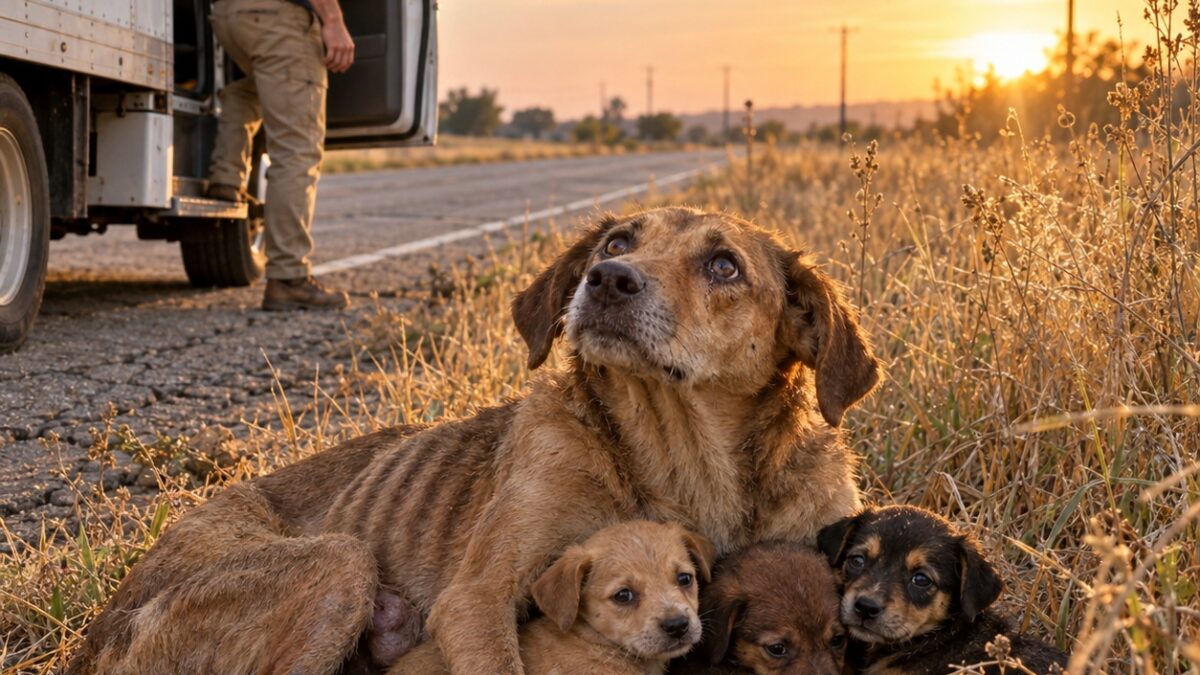
I Almost Drove Past the Mother Dog Hiding With Three Puppies—Then She Made One Sound I Couldn’t Leave Behind
I was already climbing back into my delivery truck when the starving mother dog lifted her head from the dry grass, looked straight at me, and made one low, broken sound that stopped me with my hand still on the door.
Her three puppies were pressed against her ribs, too weak and frightened to understand why the only person who had finally stopped was about to drive away, and when their mother tried to stand between them and the road, her legs shook so badly that she nearly collapsed.
I turned back toward her, and the way she watched me in that moment felt less like a dog begging a stranger for help than a mother making one last decision to trust someone with everything she had left.
My name is Daniel.
I was thirty-two years old when I met Margot.
At the time, I was a delivery driver.
Most of my life happened through a windshield.
Warehouses.
Loading docks.
Highways.
Gas stations.
Coffee in paper cups.
Addresses entered into a GPS.
Boxes loaded.
Boxes delivered.
Back home.
Sleep.
Repeat.
I had been doing it long enough that roads had become something I moved across rather than something I noticed.
That changed because of four dogs hidden in dry grass.
I almost missed them.
That is the truth I think about more than any other part of this story.
I almost kept driving.
The road was one I had traveled dozens of times.
Not particularly dangerous.
Not particularly beautiful.
A narrow strip of pavement running past open ground and neglected lots before reconnecting with the highway.
I was behind schedule.
That mattered to me then.
I remember glancing at the clock on the dashboard and thinking about how much time I had already lost that morning.
Then something moved near the shoulder.
I saw a patch of brown.
Maybe a bag.
Maybe an animal.
I drove another fifty yards.
Something in me said:
Keep going.
Someone else will handle it.
You have deliveries.
You are not animal control.
Then another voice, quieter but more irritating, said:
You saw something.
I slowed.
Looked in the mirror.
Nothing.
For several seconds, I argued with myself.
Then I pulled over.
The truck engine stayed running.
I walked back.
At first, I saw only the mother.
She was lying partly beneath tall, dry grass several yards from the pavement.
Thin.
Far too thin.
Her coat dull.
Her body positioned strangely, almost curled around something.
Then one small head appeared.
Then another.
Then a third.
Three puppies.
I stopped.
“Oh, no.”
The mother lifted her head.
Her eyes met mine.
She did not growl.
Did not bark.
Her body tensed, but she stayed where she was.
The puppies pressed closer.
I crouched several feet away.
“Hey.”
The mother watched.
I had no idea what I was doing.
I was a delivery driver standing beside a road talking to a dog like she could explain the situation.
“Are those yours?”
Her ears moved.
Stupid question.
Of course they were.
I pulled out my phone.
Called a local shelter.
Then another number they gave me.
While I waited for instructions, I found water in the truck and brought it back.
The mother would not approach at first.
So I placed the container down and moved away.
She looked at me.
Then the water.
Then the puppies.
Only when I sat several feet back did she crawl toward it.
She drank.
Then went immediately back to her babies.
That was the first thing about Margot that stayed with me.
She was starving.
Thirsty.
Exhausted.
But every decision still passed through the puppies first.
Eventually, help was arranged.
I managed to get the puppies safely into the truck.
The mother followed only after them.
She climbed into the cab as though getting inside a stranger’s vehicle was terrifying but letting her babies disappear without her was worse.
I drove them to the shelter.
The whole way, I kept checking the mirror.
Three puppies curled together.
Their mother around them.
At the shelter, staff took over.
That should have been the end of my part.
I had done the decent thing.
Stopped.
Called.
Transported them.
Now professionals had them.
I went back toward my truck.
Opened the door.
Then I heard the sound.
A whine.
Low.
Broken.
I turned.
Margot stood inside the shelter entrance, held gently by one of the workers.
She was looking directly at me.
Not the road.
Not the puppies.
Me.
And for one terrible second, I felt as though I were abandoning her too.
PART2
I almost walked back inside.
Instead, I told myself not to be ridiculous.
She was safe.
That was the goal.
Food.
Water.
Medical care.
Shelter.
Her puppies beside her.
Everything she needed more than she needed a delivery driver she had met an hour earlier.
So I left.
Physically.
My mind did not.
For the rest of that day, I drove on autopilot.
I delivered boxes.
Collected signatures.
Backed into loading docks.
Answered two calls from dispatch.
I remember almost none of it.
I kept seeing Margot’s eyes.
People talk about trust as though it develops slowly.
Usually, it does.
But sometimes trust appears because there is no time for anything else.
Margot had been on the side of a road with three puppies.
I stopped.
She had to make a decision about me before she had evidence.
Danger?
Help?
Stay away?
Follow?
She chose help.
That decision bothered me in a way I did not understand.
She had trusted me because she had no better option.
Then I had handed her to strangers and left.
Of course those strangers were exactly who she needed.
I understood that logically.
Emotion is not especially interested in logic.
That evening, I got home later than usual.
My wife, Emma, was already there.
Emma and I had been together for ten years.
Ten years is long enough for another person to recognize your silence before you understand it yourself.
She looked up from the couch.
“You okay?”
“Yeah.”
I went to the kitchen.
Opened the refrigerator.
Closed it.
Emma waited.
I poured water.
She waited.
Finally:
“What happened?”
“Nothing.”
She gave me the look.
Every married person knows the look.
Not angry.
Not impatient.
Just:
Try again.
I sat beside her.
“There were dogs.”
“Dogs?”
I told her.
Road.
Grass.
Mother.
Three puppies.
The water.
Shelter.
The sound when I left.
Emma listened without interrupting.
That is one of the reasons I married her.
She does not rush people toward the part where she can speak.
When I finished, she asked:
“How bad was the mother?”
“Thin.”
“How thin?”
“Too thin.”
“And the puppies?”
“Small.”
“Scared.”
I rubbed my hands together.
“I should have stayed longer.”
Emma frowned.
“At the shelter?”
“Yes.”
“Why?”
“I don’t know.”
“They were safe.”
“I know.”
“Daniel.”
“I know.”
I leaned back.
“That’s the problem.”
“What?”
“I know all the right things.”
“I know I did what I was supposed to do.”
“I know the shelter knows more than I do.”
“But I keep feeling like I left.”
Emma was quiet.
Then she reached for my hand.
“Call them.”
“It’s late.”
“Tomorrow.”
I nodded.
I lasted forty minutes.
Then I called.
A staff member answered.
I explained who I was.
“The mother with three puppies.”
“Oh.”
Her voice warmed.
“Yes.”
“How are they?”
“She ate.”
Relief hit immediately.
“All of it?”
“Most.”
“The puppies are eating too.”
“Are they okay?”
“They’re tired.”
“They need care.”
“But they’re stable.”
Stable.
I had never understood how beautiful that word could sound.
“Can I come tomorrow?”
There was a pause.
“Yes.”
I thanked her.
Hung up.
Emma watched me.
“Well?”
“They’re okay.”
She smiled.
“You want to go back.”
“I think so.”
“No.”
She squeezed my hand.
“You don’t think so.”
“You do.”
I looked at her.
“I can’t not go back.”
She nodded.
“Then I’m coming.”
The next morning, we drove to the shelter together.
I talked too much on the way.
That is what I do when nervous.
I explained details Emma had already heard.
Where I stopped.
How the puppies were positioned.
How the mother had climbed into the truck.
Emma let me repeat myself.
Halfway there, I said:
“What if they don’t remember me?”
Emma looked over.
“They’re dogs.”
“I know.”
“That means I have no idea.”
“Helpful.”
“I’m your wife, not a canine psychologist.”
I laughed.
First time since the roadside.
Then another fear arrived.
“What if somebody already adopted one?”
Emma was silent.
I looked at her.
“What?”
“Nothing.”
“No.”
“That was a face.”
She looked out the window.
“I’m thinking.”
“About?”
“Let’s get there first.”
We arrived.
The shelter worker who had helped the first day recognized me.
“Daniel.”
“Hi.”
“This is my wife, Emma.”
“Nice to meet you.”
Emma immediately asked:
“Can we see them?”
The woman smiled.
“Come on.”
We walked through the corridor.
Dogs barking.
Metal kennel doors.
The smell of disinfectant.
Food.
Blankets.
My heart started beating harder.
Then I saw Margot.
She was lying beside her puppies.
At the sound of our footsteps, her head lifted.
Not generally toward the hall.
Toward me.
Her ears moved forward.
She stood.
Slowly.
Still weak.
But stood.
Then she walked toward the kennel door.
I stopped.
Emma stopped.
Margot came all the way forward.
Pressed her nose between the bars.
I crouched.
“Hey.”
My voice broke.
I put my fingers through carefully.
Margot smelled them.
Then licked them.
Once.
Twice.
I heard Emma inhale sharply beside me.
The shelter worker said:
“She remembers you.”
I looked back.
“Really?”
“She didn’t do that with everyone yesterday.”
Margot kept her nose against my hand.
I felt something in my chest tighten and open at the same time.
Recognition.
Maybe it was scent.
Maybe simple association.
Maybe I represented water.
Transport.
Safety.
I did not need a romantic explanation.
She remembered enough to come toward me.
That was enough.
Emma knelt beside me.
One of the puppies stumbled toward the front.
Tiny.
Rounder than the previous day already, or maybe I wanted to see improvement.
Emma smiled.
“Oh.”
That single sound told me everything.
She was gone.
Emotionally.
Completely.
I knew my wife.
The same way she had known I would return.
The shelter employee explained their condition.
Mother underweight.
Puppies needing continued observation and nourishment.
Not ready to leave immediately.
They needed several more days of care.
Emma listened.
Asked practical questions.
Food.
Medical needs.
Vaccinations.
Follow-up.
I was still staring at Margot.
Then Emma said:
“We want all four.”
I turned.
“What?”
She looked at me.
“All four.”
The shelter employee looked surprised.
I probably looked more surprised.
“Emma.”
“What?”
“Three puppies.”
“I can count.”
“And the mother.”
“Yes.”
“That’s four dogs.”
“Correct.”
“We have zero dogs.”
“Currently.”
I stared.
Emma’s eyes were wet.
But her voice was calm.
“She kept them alive.”
“She got them this far.”
“You stopped.”
“She trusted you.”
“And now we’re going to separate her from the puppies as soon as everyone’s healthy?”
I had not even thought that far.
Shelter adoption often means puppies finding homes individually.
The mother eventually finding another.
Perfectly normal.
Often necessary.
But the moment Emma said it, I pictured Margot watching one puppy leave.
Then another.
Then another.
After everything.
My chest hurt.
“We can’t make a decision because we feel guilty.”
I said.
Emma nodded.
“Agreed.”
“Four dogs is huge.”
“Yes.”
“Food.”
“Yes.”
“Vet bills.”
“Yes.”
“Training.”
“Yes.”
“Our house.”
“Yes.”
“Travel.”
“Yes.”
“My schedule.”
“I know your schedule.”
I looked at the shelter worker.
She was trying very hard not to participate in our marriage.
Emma took my hand.
“I am not saying this because I feel sorry for them.”
She said.
“I’m saying it because when you told me that story last night, you were already talking about them like they belonged somewhere in your life.”
“And now I’m here.”
“And I feel it too.”
I looked back at Margot.
She was sitting quietly.
One puppy had climbed partly over her front leg.
She lowered her head and licked its face.
Emma whispered:
“We have room.”
That was true.
Our house was not huge, but the yard was decent.
We both worked.
But schedules could be managed.
We had talked about getting a dog before.
One.
Never four.
I started laughing.
Emma frowned.
“What?”
“This is insane.”
“Yes.”
“You understand this is insane.”
“Completely.”
I looked at Margot.
Then the puppies.
Then Emma.
“Okay.”
Emma smiled through tears.
“Okay?”
“Okay.”
We filled out paperwork that day.
Not the final adoption yet.
There were checks.
Medical clearance.
The shelter needed to finish care.
Everything had to be done correctly.
We went home without them.
That was harder than I expected.
But this time, leaving felt different.
Not goodbye.
Preparation.
Emma turned our spare room into what looked like a small pet supply warehouse.
Beds.
Blankets.
Puppy pads.
Food.
Bowls.
Toys.
A gate.
Then another gate because apparently three puppies can defeat architectural assumptions.
I put an old blanket in the back of the truck.
The same truck where they had first ridden.
Every day, I called.
Emma visited whenever she could.
Sometimes both of us.
The puppies improved quickly.
Mother more slowly.
She ate.
Rested.
Her coat remained dull.
Her body thin.
But there was more life in her eyes every visit.
We eventually named her Margot.
Emma chose it.
“Why Margot?”
“She looks like a Margot.”
“That is not an explanation.”
“It’s the correct one.”
I tried the name.
“Margot.”
The mother lifted her head.
Emma smiled.
“See?”
Coincidence.
Probably.
Still.
Margot.
The puppies took longer.
Emma wanted each name to sound distinct.
“Something that feels like a beginning.”
She said.
“Names don’t have feelings.”
“Wrong.”
I surrendered.
Olivier.
Ruby.
Perry.
Olivier was the bold one almost immediately.
He investigated every hand.
Every bowl.
Every gap in a gate.
Ruby was gentler.
She liked contact.
Would settle against Emma whenever allowed.
Perry was smaller.
He watched me.
Maybe because I transported him.
Maybe because I smelled like truck upholstery and coffee.
Whatever the reason, he kept choosing my side.
“You have a favorite.”
Emma accused.
“I do not.”
Perry slept against my shoe.
“You absolutely do.”
“I treat them equally.”
“Sure.”
The day they were cleared to come home, I woke before my alarm.
I lay there staring at the ceiling.
Emma turned toward me.
“You awake?”
“No.”
“Liar.”
I smiled.
“I feel like we’re making a terrible decision.”
Emma laughed softly.
“Probably.”
“Good.”
“That helps.”
Then she touched my arm.
“We’re ready.”
Were we?
No.
I do not believe anyone is fully ready for three puppies and a recovering mother.
There are states that should require emergency permits for that level of chaos.
But we had prepared.
That was close enough.
I parked outside the shelter.
The same building where I had felt guilty leaving them.
This time, the doors opened and our family came out.
Margot first.
Leash.
Careful steps.
Stronger.
The puppies came next, contained safely.
Noise.
Movement.
Olivier already trying to investigate freedom.
Emma laughed.
Margot saw the truck.
She stopped.
For one second, I wondered if she remembered the first ride.
The roadside.
Fear.
Being taken somewhere unknown.
Then she walked forward.
No pulling.
She approached the truck.
I opened the door.
Margot climbed in.
Just like the first day.
But everything was different.
The first time, she climbed because her puppies were inside and she had nowhere safe to go.
This time, she climbed because Emma was beside her, I was there, and the road ahead ended at home.
The puppies settled around her.
I sat at the wheel.
Emma beside me.
I checked the mirror.
Margot lowered her head over one of the pups.
Closed her eyes.
She slept.
That image nearly made me cry before we left the parking lot.
On the first ride, she had watched everything.
Alert.
Unsure.
Protecting.
Now she slept.
Trust can sometimes be measured by closed eyes.
The drive home was short.
It felt like a road I had been waiting years to drive.
Our first hour at home destroyed all romantic expectations.
Olivier peed within three minutes.
Perry found an electrical cord.
Ruby disappeared beneath a chair and refused to come out.
Margot stood in the living room looking overwhelmed.
Emma laughed until she had tears in her eyes.
“What have we done?”
I said.
“You said okay.”
“You manipulated me.”
“Absolutely.”
Then Olivier began chewing a table leg.
“Your son.”
I said.
“Your favorite’s eating the rug.”
Emma replied.
Perry was eating the rug.
Fair.
The first night, nobody slept.
The puppies woke each other.
Then us.
Margot paced.
She checked every room.
Every puppy.
Every door.
She seemed unable to settle completely.
At 2:30 in the morning, I sat on the floor.
Margot stood across from me.
“Everybody’s here.”
I said.
She watched.
“No one’s missing.”
Her eyes shifted toward the hallway.
I tapped the floor beside me.
“Come on.”
Margot eventually approached.
Lay several feet away.
Not touching.
I stayed.
The puppies made another noise.
Margot’s head lifted.
Then settled.
That first week taught us humility.
We had bought beautiful dog beds.
The puppies preferred cardboard.
We bought toys.
They preferred shoes.
We created a carefully organized feeding area.
Olivier attempted to stand in his bowl.
Ruby once carried food into another room.
Perry discovered cabinets.
Margot watched everything with the expression of an exhausted mother who had already survived worse and was not impressed by our management.
Her own adjustment was quieter.
She ate well.
That was the first relief.
Small meals.
Veterinary guidance.
Steady.
Weight slowly returning.
But she remained watchful.
Especially with me.
Every time I came home, Margot looked toward the door before the puppies did.
At first, she did not rush over.
She simply watched.
As though confirming:
He came back.
The next day:
He came back.
Again.
Again.
Eventually she started waiting near the door.
That was when our home began changing for me.
Before, coming home meant entering a building where Emma might be depending on her schedule.
Sometimes she arrived first.
Sometimes me.
Normal marriage.
Now there was always a reception committee.
Olivier learned the sound of my truck.
The first time I pulled into the driveway and saw three puppy faces and Margot in the window, I sat in the cab longer than necessary.
I had spent years seeing my truck as work.
Metal.
Diesel.
Miles.
Now it meant something to four dogs.
That strange fact made the vehicle feel different.
When I opened the door, Olivier came running.
Perry behind.
Ruby more calmly.
Margot walked.
Steady.
She reached me.
Pressed her head against my leg.
That was enough to erase an entire bad day.
Perry became my shadow.
Emma had been right.
I had a favorite.
I denied it for months.
He followed me into the kitchen.
Garage.
Laundry room.
If I sat on the couch, Perry climbed up.
Head on my thigh.
I would say:
“Go bother your mother.”
Emma would answer:
“He is.”
Olivier became fearless.
Maybe too fearless.
He was the puppy who would investigate the vacuum cleaner instead of running.
The puppy who learned how to push open a partly closed door.
The first to bark at delivery drivers.
Which felt ironic considering his father figure delivered things for a living.
Ruby became exactly what Emma had predicted.
Gentle.
She loved sitting with Emma by the window.
Would place herself against her side.
If Emma read, Ruby stayed.
If Emma moved, Ruby followed slowly.
Our house developed personalities.
Margot remained the center.
The puppies could scatter in three directions.
Margot always knew.
Olivier outside.
Ruby couch.
Perry under my feet.
She monitored.
But over the first months, that vigilance softened.
She began to play.
The first time shocked us.
Olivier had grabbed a toy.
Margot watched.
Then suddenly moved.
Play bow.
Olivier froze.
Then exploded toward her.
Margot ran.
Emma called me from the kitchen.
“Daniel!”
I thought something was wrong.
I ran in.
“What?”
She pointed outside.
Margot was chasing Olivier around the yard.
Not fast at first.
Then faster.
Ruby joined.
Perry joined because Perry joined everything I was near.
Four dogs running.
Margot’s body still thinner than it should have been.
But moving freely.
Emma put one hand over her mouth.
I stood beside her.
Neither of us spoke.
That was the mother I had found lying in grass beside a road.
Now she was running because nothing needed to be protected for one minute.
There was food inside.
Water.
Fence.
People.
Safety.
She could play.
People underestimate how much security play requires.
You need energy beyond survival.
You need confidence that the environment will remain safe while you become silly.
Margot was becoming silly.
That mattered.
Her coat began changing too.
Food.
Medical care.
Rest.
Time.
The dullness faded.
Her body filled out.
Her gait became stronger.
She started looking like a dog instead of an emergency.
I loved that.
Not because she became more beautiful.
She had always mattered.
Because her body finally stopped advertising hardship everywhere she went.
Health allowed strangers to see Margot instead of asking:
“What happened to her?”
That is a kind of freedom.
About three months after they came home, I took Margot alone on a short ride.
The puppies stayed with Emma.
I wanted to see how Margot handled the truck without them.
She jumped in.
Sat beside me.
At first, alert.
I drove slowly.
No destination.
Just around the neighborhood.
Then farther.
Margot eventually lay down.
At a red light, I looked over.
“You know, this is where we met.”
Her ears moved.
“Not literally.”
I laughed.
“You understand.”
She did not.
Probably.
I drove.
Something about the road brought back that first day.
Dry grass.
Her body curled around three puppies.
The whining sound.
I realized how easily I could have missed them.
Ten seconds.
A different glance.
A phone call distracting me.
A truck behind me making it difficult to pull over.
Life contains terrifying amounts of chance.
People sometimes describe things afterward as fate because randomness is uncomfortable.
I do not know whether I believe in fate.
I know I stopped.
That is enough.
A decision does not have to be destined to be important.
Maybe that makes it more important.
I could have continued.
I did not.
My entire home now contained the consequences.
Shoes chewed.
Dog beds.
Food containers.
Vet bills.
Noise.
Love.
Emma and I talked about that often.
“Imagine if you kept driving.”
She would say.
I hated imagining it.
Not because I believed I personally was the only person who could have helped.
Maybe someone else would.
Maybe soon.
Maybe not.
The uncertainty was enough.
I started looking at roads differently.
Not obsessively.
But attentively.
Animals.
People.
Cars stopped strangely.
Anything that did not fit.
I had spent my career driving through landscapes.
Margot taught me to look at them.
There is a difference between seeing and noticing.
Seeing is automatic.
Noticing creates responsibility.
Sometimes inconvenient responsibility.
That is why we avoid it.
You notice a dog.
Now what?
A person walking alone where they should not be.
Now what?
It is easier not to see.
But once you truly notice, the question follows you.
Will you stop?
Margot turned me into someone more willing to answer yes.
Not recklessly.
Not every situation is safe.
Call professionals when needed.
But do not let inconvenience make the decision for you.
That was the lesson.
About six months in, Margot stopped checking the front door whenever I left the room.
It happened so gradually I did not notice immediately.
At the beginning, if I stood, her eyes followed.
If I went outside, she watched through the window.
Later:
I could walk to the garage.
Return.
Margot asleep.
Trust.
She knew.
Daniel leaves.
Daniel returns.
Emma leaves.
Emma returns.
Food comes.
Nobody disappears.
The puppies learned this from the beginning.
Margot had to relearn.
I do not know her history before the road.
The source of this story did not give me every detail, and I never needed to invent them.
Maybe she had known care before.
Maybe not.
What mattered was what we saw.
A thin mother.
Three puppies.
Roadside.
Need.
Then what happened afterward.
Sometimes we spend too much time trying to explain why an animal suffered.
The animal needs us focused on what comes next.
Margot needed consistency.
So we gave it.
Morning.
Meals.
Walks.
Vet.
Home.
Again.
That repetition changed her.
It changed me too.
I had always thought stability was boring.
Thirty-two.
Delivery job.
Same roads.
Same house.
Ten-year marriage.
I occasionally wondered whether life had become too predictable.
Then Margot arrived.
I learned predictability can be a gift.
For a frightened animal, knowing what comes next is safety.
For people too.
Emma beside me.
Home.
Four dogs.
The routine I once thought ordinary became something I valued.
Not because nothing could change.
Because change had shown me what the routine held.
Belonging.
I became more aware of Emma.
That may sound strange.
We had been together ten years.
Love can become so familiar you stop seeing the work another person does.
The dogs made it visible again.
Emma waking early to feed.
Cleaning a mess without complaint.
Sitting with Ruby.
Checking Margot’s condition.
Researching food.
Coordinating appointments when I was on the road.
One evening, I came home late.
Emma was asleep on the couch.
Ruby curled against her.
Perry on the floor.
Olivier upside down.
Margot near Emma’s feet.
I stood in the doorway.
That image made me emotional.
This woman had heard me say:
I found four dogs.
And responded:
Let’s go see them.
Then:
Let’s take all of them.
Not because she was impulsive.
Because she understood the responsibility and chose it with me.
I loved her before.
Obviously.
But I saw her differently after Margot.
Compassion looks beautiful when it becomes logistics.
It is easy to say:
Poor dogs.
Harder to wake at 4:00 a.m. because a puppy is crying.
Emma did both.
That is love with sleeves rolled up.
One evening, I told her:
“You’re a good person.”
Emma looked suspicious.
“What did you do?”
“Nothing.”
“You’re complimenting me randomly.”
“Yes.”
“What did the dogs break?”
“Nothing.”
She stared.
I laughed.
“Forget it.”
“No.”
She smiled.
“Say it again.”
“You’re impossible.”
“Not the same thing.”
I kissed her.
The dogs interrupted immediately.
Family.
About a year after the rescue, the puppies were no longer puppies in the visual sense.
Olivier had grown into a large, confident dog.
Ruby still thought she belonged in Emma’s lap regardless of physics.
Perry remained my shadow.
Margot looked strong.
Her coat shone.
She moved with confidence.
If someone met her then, they might never guess how fragile she had looked in the roadside grass.
Her eyes remained the same.
That is what I noticed.
Deep.
Watchful.
Wise in the way humans like to describe older dogs, though I do not know what wisdom means to a dog.
But I remembered those eyes looking at me when I almost drove away.
That connection never disappeared.
One Sunday morning, I woke early.
No alarm.
The house quiet.
Emma still asleep.
I made coffee.
Walked outside.
The air was cool.
Sun not fully up.
Margot lay in the grass.
Olivier, Ruby, and Perry were running around her.
They were grown now.
Still her babies in some invisible way.
Olivier chased Perry.
Ruby joined.
Margot watched.
Then she saw me.
She stood.
Walked over.
Sat beside me on the porch steps.
Placed her head on my knee.
I put my hand over her neck.
For a while, I simply watched the three younger dogs run.
I thought about the roadside.
The dry grass.
My truck idling.
The clock.
That stupid sense of urgency.
I had been worried about deliveries.
Schedules.
People waiting for packages.
All reasonable.
Then four lives appeared at the edge of the road.
I almost ranked them beneath the schedule.
That thought humbled me.
We all do it.
Not with dogs necessarily.
Life becomes lists.
Tasks.
Deadlines.
We begin treating interruptions as enemies.
But sometimes the interruption is where the real life is.
I did not know that when I pulled over.
I only knew something looked wrong.
That was enough.
Margot shifted.
Head heavier on my knee.
“Yeah.”
I whispered.
“You changed everything.”
She closed her eyes.
Emma came outside carrying two coffees.
“Already made mine.”
I said.
“This one’s better.”
She handed it over.
Probably true.
She sat on my other side.
For several minutes, we watched the dogs.
Then Emma said:
“You know what I think about sometimes?”
“What?”
“If you hadn’t stopped.”
I looked at Margot.
“I think about it too.”
“Our life would be so empty.”
I laughed.
“We had a life before.”
“I know.”
She smiled.
“But look.”
I looked.
Four dogs.
Morning.
Yard.
Noise.
Hair probably accumulating inside at an irresponsible rate.
“You’re right.”
Emma touched Margot’s back.
“You gave them a home.”
I shook my head.
“No.”
“We gave them a home.”
Then looked at Margot.
“And she asked first.”
Emma smiled.
“That sound?”
I nodded.
The whine.
I could still hear it.
Not literally.
Memory.
The sound that made me turn.
At first, I thought it was desperation.
Now I think of it differently.
Margot was not surrendering.
A mother who had given up would not use her remaining energy to call after the stranger leaving.
She believed enough to ask.
Hope.
Tiny.
Dangerous.
Still there.
That sound was hope with no guarantee of an answer.
I happened to answer.
Maybe that is why it stayed with me.
We like to imagine hope as optimistic.
Bright.
Sometimes hope sounds terrible.
A weak whine beside a road.
A call made because there is no good option left.
Hope is not confidence.
It is the refusal to let silence be final.
Margot refused.
I turned.
That simple exchange created a family.
People often call me a rescuer when they hear the story.
I am uncomfortable with that.
I stopped.
Called people who knew what to do.
Drove them to safety.
Then Emma and I adopted them.
Those actions mattered.
But “rescuer” can make it sound like I possessed some special quality before the moment.
I did not.
I was tired.
Behind schedule.
Distracted.
Ordinary.
That is important.
If helping required extraordinary people, most suffering would be doomed.
It does not.
Sometimes it requires an ordinary person willing to interrupt an ordinary day.
That is more hopeful.
You can be that person.
I can be that person.
Not always.
Nobody can stop for everything.
But when something is directly in front of you and obviously needs help, the decision matters.
Margot made me understand that deeply.
I started stopping more.
Not irresponsibly.
If I saw an animal loose near traffic, I called appropriate help.
If a vehicle was stranded in a dangerous place, I checked whether assistance was coming.
Once, I helped a frightened dog get away from a busy intersection.
Not every stop created a family.
Most did not.
Good.
I already had four dogs.
Emma would kill me.
But the habit of noticing remained.
One afternoon, Emma said:
“Margot ruined you.”
“How?”
“You can’t drive past anything anymore.”
“Not true.”
“You stopped for a turtle.”
“It was in the road.”
“You redirected traffic for a turtle.”
“It was a big turtle.”
She laughed.
“I rest my case.”
Maybe Margot had ruined me.
I preferred this version.
The puppies developed adult personalities exactly as their early behavior predicted.
Olivier believed every visitor came specifically to see him.
He would position himself between the door and whoever entered.
Tail moving.
Confidence absurd.
Ruby remained soft.
If Emma was sad, Ruby seemed to know.
She would press closer.
Again, I do not know whether dogs understand sadness the way we describe it.
She understood behavior.
Tone.
Changes.
Enough.
Perry followed me everywhere.
One Saturday I spent three hours fixing something in the garage.
Perry lay beside the workbench.
I moved tools.
He moved.
I crawled underneath something.
He tried to come too.
“Perry.”
He wagged.
“You are not mechanically qualified.”
No concern.
I eventually gave him an old towel as a designated work zone.
He ignored it and lay on my foot.
Margot became less mothering as the younger dogs matured.
That interested me.
At first, she watched constantly.
Later, she let them make stupid decisions.
Maybe every mother has a point where she says:
Fine.
Learn.
Olivier once ran straight into a garden chair while chasing Perry.
Margot watched.
No reaction.
Appropriate.
You cannot protect children forever.
Dogs understand this before some parents.
Still, if one made a distressed sound, Margot reacted instantly.
Motherhood remained.
Changed shape.
I admired her.
She had started the story doing everything she could for those puppies.
When I found her, her own body was depleted.
That matters.
Mother animals often pay physically for keeping young alive.
We saw the result.
Thin body.
Dull coat.
Still protecting.
Later, when she was healthy, she got to exist beyond motherhood too.
I wanted that for her.
She played alone.
Sat with me.
Explored the yard.
Rode in the truck.
Slept beside our bed.
She became Margot, not only “the mother dog.”
That distinction mattered.
Caregivers deserve identities beyond caregiving.
Animals too.
One evening, Margot climbed onto the couch without asking.
First time.
She had always preferred floor or bed near us.
She stood beside me.
Looked at the cushion.
Then me.
“Go ahead.”
She climbed.
Turned.
Lay against my leg.
Perry objected because that was apparently his location.
He tried squeezing between us.
Margot gave him one look.
Perry reconsidered his legal claim.
I laughed.
“Still your mother.”
Margot rested.
Emma walked in.
Stopped.
“Oh.”
“What?”
“She never does that.”
“I know.”
Emma sat on the other side.
Margot between us.
She slept.
A year earlier, this dog had been outside beside a road, her entire world three vulnerable puppies.
Now she slept between two people.
Her grown young safe nearby.
Some endings are so quiet they almost disappear.
That is why you have to notice them.
Safety is often boring from outside.
Nobody running.
Nobody crying.
No dramatic music.
A dog asleep.
That is the point.
I became fascinated by sleep after Margot.
On the roadside she had been alert.
At the shelter, watchful.
At home, gradually deeper rest.
The first time she slept on her back, belly partly exposed, Emma took a photo.
“Look.”
I stared.
Margot looked ridiculous.
One paw in the air.
Mouth slightly open.
I smiled.
“That’s trust.”
Emma said.
She was right.
A body that believes the environment is safe can surrender consciousness differently.
Margot was safe enough to look ridiculous.
Beautiful.
The three younger dogs had never developed that same vigilance after rescue.
They had been young enough that safety became normal quickly.
Margot remembered more.
At least her behavior suggested she did.
That made each relaxed habit meaningful.
Sometimes I wondered whether she remembered the road.
The grass.
My truck.
I could not know.
I stopped needing to.
She knew the present.
That was enough.
My job kept me on the road.
Long hours.
Highway miles.
Sometimes overnight routes.
Before the dogs, those hours belonged mostly to thoughts about work.
Afterward, I thought about home.
Emma.
Dogs.
Margot at the door.
Perry probably destroying something.
Olivier barking at perfectly innocent people.
Ruby stealing Emma’s chair.
The idea of return changed driving for me.
Every route had a destination beyond the delivery.
Home.
I had always had Emma.
I want to be clear about that.
Our marriage was not empty.
The dogs did not create love where none existed.
They made me more conscious of what I already had.
Return.
Someone waiting.
A place where your arrival matters.
Margot had known what it meant not to have that certainty.
Her response to home made me appreciate mine.
People sometimes need an outsider to show them what their ordinary blessings look like.
Margot was that outsider.
She entered our house and treated consistency like something extraordinary.
Food twice a day.
Water.
A closed fence.
Same people.
Beds.
Her gratitude was not theatrical.
She simply relaxed.
That relaxation made me see the structure.
Emma and I had spent ten years building a reliable life.
I had stopped noticing.
Margot noticed with her body.
Then I noticed too.
Reliability is love in practical clothing.
Not exciting.
Essential.
One day, I came home frustrated after work.
Traffic.
A customer complaint.
Dispatch mistake.
Nothing catastrophic.
I entered angry at everything.
Olivier greeted me like I had returned from war.
Perry followed.
Ruby appeared.
Margot approached last.
She stood.
Looked at me.
Then pressed her forehead into my thigh.
I put my hand on her neck.
My anger dissolved enough for perspective to return.
Nothing had changed about work.
My nervous system changed.
Connection does that.
It does not solve the problem.
It reminds you the problem is not the whole world.
I became less likely to carry work into the house.
Emma appreciated that.
“Margot deserves a raise.”
She said.
“She doesn’t have a job.”
“Exactly.”
“She’s outperforming you.”
Rude.
Probably true.
The rescue also changed how Emma and I thought about family.
We had not built our life around children.
That was our reality.
The dogs did not become human substitutes.
I dislike that framing.
They became their own form of family.
Different.
Real.
Four lives integrated into ours.
The house became organized around needs beyond two adults.
Schedule.
Care.
Expense.
Affection.
Mess.
Family can take many shapes.
Ours had paws.
That was fine.
A year after the rescue, if someone asked how many dogs we had, I would say four without thinking.
Then sometimes remember:
We once had none.
That seemed impossible.
How had the house sounded?
Quiet.
Too clean.
No nails across floors.
No barking when my truck arrived.
No toys under furniture.
We had been happy.
Yes.
Then life became fuller.
Emma’s word.
Full.
Not better in every measurable sense.
More expensive.
More complicated.
Travel harder.
Furniture suffering.
Still fuller.
That was exactly right.
Fullness includes inconvenience.
A life with nothing disrupting you may be comfortable.
It can also be narrow.
The dogs widened ours.
I began to understand why Margot’s first look had affected me so much.
It was not only pity.
She was asking me to participate.
That is scary.
People like compassion when it remains emotional.
Feel bad.
Move on.
Participation costs.
Time.
Delay.
Calls.
Then possibly four dogs.
You never know.
I joke, but the principle matters.
Stopping can change your obligations.
That is why we hesitate.
We fear what helping will ask next.
Sometimes it asks little.
Sometimes much.
You do not have to adopt every animal you help.
We happened to choose that.
The first responsibility was simply:
Do not leave them in danger.
One step.
Then another.
The outcome emerged.
I tell people this because I do not want them to hear our story and think:
I could never take four dogs, so I should not stop.
Wrong.
Stop.
Call.
Get help moving.
Someone else may foster.
Another person may adopt.
Compassion is a relay.
I happened to carry more than one leg of this particular race.
That is all.
The shelter staff mattered enormously.
Without them, I had no idea what to do medically.
They received.
Fed.
Observed.
Guided us.
Prepared them.
People sometimes tell rescue stories with one hero because narratives are simpler that way.
Real rescue is usually a network.
Person who notices.
Person who answers the phone.
Veterinary staff.
Shelter worker cleaning bedding.
Person handling adoption paperwork.
Family.
Everyone.
Margot and her puppies survived because several people did one part correctly.
That is encouraging.
You do not have to do everything.
Do your part.
The shelter worker who first told me Margot recognized me became someone we stayed in touch with.
We sent photos.
Updates.
Growth.
One photo of the three puppies months later got a response:
They don’t even look like the babies who came in.
I stared at the message.
Neither did Margot.
But change was more than visual.
Their entire expectations had changed.
The puppies grew up expecting food.
Margot learned to.
The puppies expected people to return.
Margot learned to.
Security creates different personalities.
I sometimes wondered who the puppies would have become if nobody stopped.
I refused to dwell.
That timeline was not ours.
This one was.
Olivier bold.
Ruby gentle.
Perry ridiculous.
Margot steady.
Specific lives.
That is why intervention matters.
You are not only preventing death or suffering.
You are protecting futures with details you cannot yet see.
When I stopped, I saw:
Four dogs.
Need.
A year later, I saw:
Olivier stealing a tennis ball.
Ruby sleeping against Emma.
Perry following me into the garage.
Margot lying in sunlight.
Those futures were invisible in the grass.
Still real.
That humbles me every time.
Every suffering animal contains an unknown ordinary future.
Maybe couch.
Yard.
Family.
You cannot know.
Give it a chance.
I became more careful not to romanticize Margot’s suffering.
People sometimes said:
“Maybe she was meant to find you.”
I understood the sentiment.
But Margot did not need to suffer beside a road in order for our family to have meaning.
If I could give her a life where she never experienced that fear and still somehow meet her, I would.
Suffering is not a gift because something good follows.
The gift is what people build afterward.
I did not thank the road for hurting her.
I thanked chance—or whatever word—for giving me the opportunity to respond.
That distinction matters to me.
Do not justify cruelty or neglect because a rescue story becomes beautiful.
The beauty is resistance to the bad thing.
Not proof it was necessary.
Margot deserved safety from the beginning.
Her puppies did too.
We could not rewrite before.
We could write after.
So we did.
A year of meals.
Vet care.
Play.
Sleep.
Home.
The story became longer than the road.
That is victory.
One afternoon, Margot and I returned to that road.
Not intentionally at first.
I was working nearby and later brought her with me during a day off.
I debated whether it was a mistake.
Maybe places matter to dogs.
Maybe not like human memory.
I did not want to create distress for symbolic reasons.
So I stopped at a distance.
Margot got out.
Leash.
She sniffed.
Nothing dramatic.
The grass was greener than when I found her.
Different season.
She walked.
Looked.
No obvious fear.
At the general area where they had been, she sniffed longer.
I watched.
My chest tightened.
Then Margot looked at me.
Tail moved.
We continued.
That was all.
I had expected something bigger.
Humans love ceremonies.
Animals often refuse.
Good.
Margot did not need the road to provide closure.
She had home.
I did.
I stood there longer than she wanted.
Finally Margot pulled gently toward the truck.
I laughed.
“Okay.”
She had places to be.
Probably dinner.
We drove home.
That trip helped me more than her.
The place looked ordinary.
Smaller than memory.
Trauma enlarges geography.
Returning can restore scale.
Dry grass.
Road.
Nothing mystical.
The important place was now our house.
I liked that.
The story did not belong to the roadside anymore.
It belonged to the kitchen, yard, bedroom, garage.
To everyday spaces where Margot lived.
That is where rescued animals deserve to end up emotionally too.
Not permanently displayed beside their suffering.
Allowed to be present.
When people met Margot and did not know the story, I sometimes did not tell it.
They would say:
“Beautiful dog.”
I said:
“Thanks.”
Maybe pet her.
Move on.
I enjoyed that.
Margot did not need every interaction framed by tragedy.
She was beautiful because she was Margot.
Not because she had survived something.
Her past mattered medically and emotionally.
It did not need to become her introduction forever.
That is dignity.
The puppies had even less connection to the story as they aged.
They knew home.
Good.
I never wanted them living inside our gratitude.
They did not owe us.
We chose them.
They owed nothing except being dogs.
Very successfully.
Olivier destroyed two pairs of shoes over the first year.
Perry once ate part of a cardboard package I needed.
Ruby shed on everything Emma owned.
Margot stole food exactly once.
A sandwich.
I turned and caught her.
She froze.
Old fear flashed across her body.
That hurt.
I lowered my voice.
“Hey.”
No yelling.
I took what remained.
Then stepped away.
Margot watched.
I acted normal.
Several minutes later, I called her.
She approached cautiously.
I gave her appropriate food.
Not reward for stealing.
A way to show the incident had ended.
No danger.
She relaxed.
That moment reminded me the past sometimes remained hidden until a small event exposed it.
Recovery is not amnesia.
Safety does not guarantee no triggers.
It gives you better endings to those moments.
Margot stole food.
Human responded without violence.
Life continued.
Another safe ending added.
Maybe that is how old fear shrinks.
Not through forgetting.
Through being outnumbered.
One bad history.
Hundreds of safe days.
Eventually the evidence shifts.
I saw that happen.
Margot became confident enough to take up space.
At first she slept near walls.
Later center of the room.
At first she moved when people approached.
Later humans walked around her.
That was one of my favorite developments.
A dog who assumes:
I belong here.
Go around.
Beautiful.
I once nearly tripped over her and said:
“Margot!”
She looked up.
No remorse.
Emma laughed.
“Your rescue is complete.”
“What?”
“She inconvenienced you and doesn’t care.”
Correct.
That is belonging.
Nobody feels at home while constantly trying not to be a burden.
Margot stopped.
I hope every rescue animal reaches that point.
Not entitlement exactly.
Security.
I am allowed to exist here without earning every square foot.
Humans could learn from that too.
I did.
My job sometimes made me feel replaceable.
Driver.
Route.
Delivery metrics.
Numbers.
At home, I was specific.
Daniel.
Emma’s husband.
Margot’s person.
Perry’s favorite chair.
Olivier’s truck sound.
Ruby’s occasional backup human when Emma was not available.
Specificity makes belonging.
That helped.
I stopped defining myself only by work.
Work mattered.
It paid for an impressive quantity of dog food.
But it was not everything.
Margot had entered the cab as a rescue passenger.
Eventually all four dogs rode with us on carefully planned outings.
The truck had become part of family memory.
I kept that old blanket longer than necessary.
It was stained.
Worn.
Emma tried to throw it out.
“No.”
She looked at me.
“It’s disgusting.”
“It’s historical.”
“It smells historical.”
“Still.”
She shook her head.
I kept it in the garage.
Eventually Margot began sleeping on it sometimes.
That destroyed me emotionally the first time.
Same blanket from the day home.
Now hers.
Objects accumulate meaning whether we want them to.
I did not keep many sentimental things before.
I do now.
Not too many.
Emma has limits.
But the blanket stays.
One year after the rescue, I marked the date.
Not as a birthday.
We did not know all their actual birthdays with certainty.
I thought of it as Stop Day.
Emma hated the name.
“That sounds like a traffic campaign.”
“What would you call it?”
“Family Day.”
“That sounds like a holiday at a school.”
We compromised by not naming it publicly.
We gave the dogs extra treats.
That evening, Emma and I sat outside.
Margot beside us.
The younger three playing.
Emma said:
“A year.”
I nodded.
“Feels longer.”
“In a good way?”
“Yes.”
I looked at Margot.
“Do you remember who we were before?”
Emma laughed.
“Yes.”
“Quiet.”
“You miss it?”
I considered.
Sometimes.
Honestly.
Four dogs are loud.
But I shook my head.
“No.”
“Me neither.”
Then Olivier knocked something over.
Emma sighed.
“Maybe occasionally.”
We laughed.
Full.
That word again.
Our life was full.
Sometimes too full.
Still.
I thought about the sound Margot made when I tried to leave the shelter that first day.
What if she had stayed silent?
Would I still have returned?
Probably.
I think so.
But that sound sealed something.
Maybe because it was the last thing I heard.
The emotional equivalent of a hand on my sleeve.
Wait.
I turned.
That was all.
The rest grew from attention.
I tell drivers I work with:
Look at the shoulder.
Not only because of safety.
Because roads collect things people lose.
Animals.
Belongings.
Sometimes people.
Most are not yours to solve personally.
But notice.
Call.
An attentive driver can change an outcome.
We spend thousands of hours behind glass.
The temptation is to treat the world outside like scenery.
It is not.
Life is happening there.
I learned that because Margot looked back.
Her eyes made the roadside real.
Years later, I suspect that will remain the image.
Not the puppies playing.
Not adoption.
The look.
A mother dog deciding whether the stranger in a truck could be trusted.
I did not deserve that trust yet.
I tried to become worthy afterward.
Maybe that is what trust asks.
Not perfection.
Responsibility.
You accepted it.
Now behave accordingly.
I stopped.
Transported.
Returned.
Adopted.
Fed.
Came home.
Again.
Trust was no longer something Margot gave once.
We built it.
That matters because people romanticize “instant bonds.”
The first look was powerful.
The relationship required a year of boring proof.
Love is often like that.
Spark.
Then dishes.
Or in our case, dog bowls.
The boring part is what makes the emotional part real.
Emma understood before I did.
She did not say:
Margot trusts you, so destiny.
She said:
Four dogs means food, vets, schedules.
Then chose yes.
That is mature love.
Emotion translated into commitment.
I admire her for it.
I told her once:
“You’re the reason this worked.”
Emma shook her head.
“No.”
“Daniel, you stopped.”
“You brought them.”
“We both stayed.”
That was accurate.
Stopping saved one moment.
Staying built the life.
Maybe that is the whole story.
People celebrate the stop.
The rescue.
The dramatic action.
But animals live in what follows.
Can you stay?
Tomorrow?
After the excitement?
After the bills?
After the puppy chews something expensive?
After Margot has a bad day?
Staying is the larger rescue.
We did.
Not perfectly.
Enough.
Margot stayed too.
At first, she could have bolted through an open door.
Never did.
Later, she would wander the yard and return.
No fear.
Choice.
Every return moved me.
I stopped watching anxiously eventually.
That was my trust in her.
Relationship goes both directions.
One summer evening, the gate did not latch properly.
I discovered it partly open.
Panic.
I ran outside.
Margot was sitting in the front yard.
Olivier beside her.
Ruby and Perry still behind the fence.
Margot saw me.
Tail.
She could have gone.
Did not.
I closed the gate.
Sat on the steps.
My heart racing.
Margot walked over.
Head on my shoulder.
I laughed shakily.
“You really live here.”
That was the moment I fully understood.
Home is not containment.
It is return.
Same lesson Walter and Tanner—no, different story. Yet perhaps all these rescue stories keep circling the same truth because animals make it visible.
Margot had options.
She stayed.
That is what I had felt at the shelter in reverse.
She trusted me enough to follow.
Then eventually trusted home enough not to leave.
Our lives became connected by repeated choices.
I think about that whenever someone says rescued animals are “grateful.”
Maybe.
I prefer trust.
Gratitude implies debt.
Margot owed us nothing.
Trust is relationship.
She learned we were safe.
We learned her needs.
That is enough.
The puppies owed us nothing either.
They repaid our kindness primarily by increasing vacuuming requirements.
Acceptable.
If people adopt expecting gratitude, they may resent normal animal behavior.
Dogs chew.
Bark.
Get sick.
Need things.
They are not monuments to your compassion.
They are family members with species-specific chaos.
We learned quickly.
We loved them better because we stopped expecting sainthood.
Margot was calm mostly.
The younger three handled chaos.
Balanced ecosystem.
About a year after rescue, Margot’s transformation became so complete physically that I compared photos once.
Roadside:
Thin.
Coat dull.
Body curved around puppies.
Home:
Strong.
Fur bright.
Standing in yard.
I showed Emma.
She looked.
Then said:
“Her eyes.”
“What?”
“They’re the same.”
Exactly.
Same eyes.
The first day, they carried vigilance.
Now calm.
But the depth remained.
That made the photos feel connected.
Same dog.
Different world.
That matters.
People often say rescue “changes” animals.
Sometimes the animal was always there.
Circumstances changed enough for the personality to emerge safely.
Margot had always been attentive.
Protective.
Quiet.
Trusting enough to ask.
We gave her room to express those traits without desperation.
That is not creating a new dog.
It is allowing the existing one to live.
The puppies underwent the opposite.
They grew up largely safe after rescue.
Their personalities were shaped mostly by security.
I could see the difference.
Olivier assumed the world was his friend.
Margot assessed.
Ruby expected comfort.
Margot accepted it more deliberately.
Perry demanded proximity.
Margot chose it.
History leaves behavioral textures.
Neither better.
Just different.
We respected them.
I stopped wanting Margot to become carefree exactly like the puppies.
She was herself.
Healthy did not need to mean forgetful.
She could remain observant.
That was part of her.
Recovery should not erase identity.
It should reduce suffering.
Margot suffered less.
That was enough.
Our veterinarian became part of the family’s world too.
Four dogs means the vet knows you by name.
And probably your credit card.
I joked:
“We should have bought a horse.”
Emma said:
“Do not.”
Good boundary.
Margot’s health stabilized.
Weight normal.
Coat.
Energy.
Every appointment with good news felt like another brick in the house we were building around her.
Not literally.
Security.
I realized veterinary care itself can become trust.
The first visits made her anxious.
Later, she walked in more calmly.
Same building.
Same people.
Nothing bad beyond necessary discomfort.
Safe endings again.
Repetition.
I became fascinated by how living beings update expectations.
Humans too.
A bad experience teaches.
A series of good ones can teach differently.
Not erase.
Update.
Maybe that was happening to me.
Before Margot:
Interruption = inconvenience.
After:
Interruption may matter.
Before:
Four dogs = impossible.
After:
Tuesday.
Before:
Responsibility = burden.
After:
Structure.
Life updates when evidence changes.
We need to let it.
Some people keep old beliefs even after reality improves.
Margot did not.
She learned home.
I tried to learn from her.
When Emma reached for my hand, I let her.
When friends invited us, we went when possible.
When the dogs made the house messy, I stopped treating mess as failure.
Flexibility.
Margot’s presence softened rigid parts of me.
Not dramatically.
Gradually.
One morning, I was late for work because Perry refused to come inside.
Old Daniel would have been furious.
I was irritated.
Then Perry finally ran in carrying something disgusting.
I chased him.
Emma laughed.
I left late.
The world did not end.
Maybe life had room for five minutes.
That seems small.
For someone who had spent years measuring days in deliveries and timelines, it was growth.
Margot taught me to stop.
Perry taught me delays are inevitable.
Different curriculum.
One night, a thunderstorm hit.
The puppies reacted differently.
Olivier barked.
Ruby sought Emma.
Perry glued himself to me.
Margot stood near the window.
Alert.
I sat beside her.
Lightning.
Thunder.
She did not panic.
But she did not lie down.
I placed my hand on her back.
After several minutes, she leaned into me.
We stayed.
Storm passed.
Margot eventually slept.
I thought about the roadside again.
Weather can feel enormous when you have no shelter.
Now walls.
Roof.
People.
The basic infrastructure of home is invisible until you imagine not having it.
Margot made me grateful for our roof.
Such an ordinary object.
Keeps rain out.
Gives a dog a place to wait through thunder.
Enough.
I became less interested in grand gestures.
Small reliable things moved me more.
Food bowl filled.
Gate latched.
Emma checking Margot’s coat.
Perry waiting by my truck.
Ruby asleep.
Olivier bringing a toy.
Those were the opposite of abandonment.
Abandonment is not only leaving.
It is absence of repeated care.
Home is repeated care.
That is why one dramatic rescue does not finish the work.
You have to build the opposite every day.
We did.
I think Margot eventually believed it completely.
One morning, I left before dawn.
She did not get up.
I stood near the door.
“Really?”
Margot opened one eye from her bed.
No concern.
I laughed.
“You trust me too much now.”
Eye closed.
Perfect.
My leaving no longer required monitoring.
She knew the pattern.
I come back.
That is one of the greatest compliments an animal can give a person:
Not watching the door.
I left for work smiling.
Driving became meditative.
Not because highways changed.
I did.
I looked at roadsides.
Thought about random lives intersecting.
Truckers see a country from an unusual angle.
Edges.
Back roads.
Rest stops.
Places others pass quickly.
We are often the first to see an accident.
A stranded animal.
A problem.
That creates responsibility.
I took it more seriously after Margot.
Not savior responsibility.
Alertness.
Call the right people.
Do not assume.
That was enough.
I told one younger driver the story.
He said:
“Man, four dogs?”
“That’s what you got from this?”
“It’s a lot.”
“It is.”
“I’d keep driving.”
He laughed.
I did not.
He saw my face.
“I’m joking.”
“Good.”
Then I said:
“You don’t have to adopt them.”
“Just don’t leave something suffering because you don’t want the whole responsibility.”
He nodded.
That was the message.
You can start help without being the endpoint.
I happened to become the endpoint.
Great.
Not required.
Margot’s story should encourage stopping, not scare people with four-dog adoption.
Emma agreed.
“If someone uses us as a model, emphasize the gates.”
“What?”
“Multiple gates.”
Fair.
One year after the rescue, I woke one night around three.
Could not sleep.
I walked to the living room.
Margot was there.
Not beside the bed that night.
She lifted her head.
I sat.
She came over.
Head on my leg.
The house silent except for dogs breathing.
I thought about the title someone might give our story.
Mother dog rescued with three puppies.
Truck driver adopts all four.
Nice.
Simple.
But real life inside the headline was richer.
The story was not a single rescue.
It was a series of choices.
Margot chose to trust.
I chose to stop.
Shelter chose to take them.
Emma chose to come.
We chose four.
Then every day after, choose again.
Food.
Care.
Patience.
The dramatic beginning makes people click.
The repeated middle makes the ending true.
I stroked Margot’s ears.
She slept.
No audience.
That was the real story.
I wish more people valued the private part.
Rescue organizations know it.
The glamorous moment is pulling an animal from danger.
Then paperwork.
Cleaning.
Medicine.
Transport.
Foster.
Behavior.
Adoption checks.
Follow-up.
Work.
Love becomes administrative sometimes.
That does not make it less beautiful.
It makes it functional.
Margot survived because compassion became organized.
I will always respect that.
A feeling made me stop.
Systems helped me know what to do next.
Both necessary.
Emotion without structure can fail.
Structure without emotion can become cold.
Together:
Rescue.
Our home was similar.
Love plus routines.
Calendars.
Vet appointments.
Food budget.
The unromantic machinery of care.
Emma excelled at it.
I handled the truck-related dog transport.
Division of labor.
Family.
Eventually, the four dogs developed their own relationships with one another.
Olivier and Perry roughhoused.
Ruby often avoided their nonsense.
Margot sometimes joined.
Sometimes walked away.
I liked watching her choose.
Choice is easy to overlook in domestic animals.
We control so much.
Food time.
Doors.
Leashes.
But giving reasonable choices matters.
Margot had experienced a time when she had few.
At home:
Which bed?
Inside or yard when safe?
Come for affection or stay away?
Toy?
Room?
Small choices.
I think they helped.
I know they helped me see her as a participant rather than recipient.
She was not an object we saved.
She was Margot.
A will.
Preferences.
History.
Our responsibility was stewardship.
Not ownership in the emotional sense.
That viewpoint changed how I treated all four.
Respect.
Not merely affection.
They became happier for it.
So did we.
On the anniversary morning, sitting with Emma, I said:
“I think she saved us too.”
Emma looked at me.
“Don’t get dramatic.”
I laughed.
“Seriously.”
“We were fine.”
“Yes.”
“But?”
I watched Margot.
“We were moving.”
“What does that mean?”
“Work.”
“Home.”
“Weekend.”
“Repeat.”
“We loved each other.”
“We had a good life.”
“But I think I was moving through it too fast.”
Emma was quiet.
Margot’s head stayed on my knee.
“I don’t think I noticed enough.”
Emma leaned into my shoulder.
“Now you notice everything on the road.”
“Occupational hazard.”
She smiled.
Maybe “saved us” was too dramatic.
Margot did not rescue a failing marriage.
Nothing like that.
She deepened our attention.
Made us participate more actively in home.
That mattered.
You do not need to be broken for something to improve your life.
Sometimes good becomes fuller.
Emma was right from the beginning.
Full.
I liked that better than saved.
Margot filled.
The puppies filled.
Our home filled.
My attention filled.
The word carried less debt.
The dogs did not have to heal us.
They simply joined us.
Transformation happened around the joining.
That is more honest.
I thought about Margot’s whine as an invitation now.
Come back.
Not:
Save me forever.
Just:
Do not leave yet.
Maybe every important relationship begins with some version.
Stay another minute.
Listen.
Come back.
Then the next choice.
Emma and I had begun similarly years before.
A conversation extended.
Another date.
Another year.
Relationship is repeated refusal to leave too soon.
That theme sat at the center of everything.
Margot called.
I turned.
Then returned to the shelter.
Emma came.
We waited for medical clearance.
The dogs came home.
We stayed.
No single moment enough alone.
Continuity.
That is love.
One day Margot stopped sleeping beside our bed and chose a spot in the hallway.
Emma worried.
“Does she not want to be near us?”
I laughed.
“She lives here.”
Maybe she simply liked the airflow.
We had reached the stage where not every behavior required emotional interpretation.
That was progress for us.
Rescue can make humans hyper-attentive.
Every movement becomes:
Is she afraid?
Is she okay?
What does that mean?
Eventually, you let the dog be a dog.
Margot sleeping in hallway because hallway comfortable.
Good.
We relaxed.
She relaxed.
Normal life.
That was always the destination.
One afternoon, I came home and Margot did not greet me.
I panicked for two seconds.
Then found her asleep in the sun.
Did not wake.
I stood over her.
Chest rising.
Fine.
I smiled.
A year earlier, my arrival mattered enough to wake her.
Now safety mattered enough that she could sleep through it.
Better.
I went inside quietly.
Perry greeted me with enough enthusiasm for all four.
Balance.
The dogs aged.
Not dramatically within the source year, but growth changed the puppies.
Margot remained the adult anchor.
I wondered how she perceived them.
Did she still smell them as babies?
Animal relationships are richer than our categories.
I did not need answers.
Watching was enough.
One evening, Ruby curled beside Margot.
Both asleep.
Olivier outside.
Perry with me.
I took a photograph.
No reason.
Later, scrolling through pictures, I reached the original roadside image I had taken for rescue documentation.
Then the photo of Ruby and Margot.
Same family.
Different context.
I cried.
Quietly.
Emma saw.
“You okay?”
“Yeah.”
She sat.
I showed her.
She cried too.
We laughed at ourselves.
Dogs remained asleep.
Humans are strange.
We need visual proof of time because memory makes everything feel simultaneous.
Photo one:
Need.
Photo two:
Home.
The distance between them was one year of care.
That is the work.
I keep both.
Not to dwell.
To remember responsibility can alter trajectories.
On difficult days, that evidence helps.
People sometimes feel the world is too large and damaged to change.
Maybe.
You cannot fix everything.
You can change the next photograph for one family.
That counts.
Margot’s life is not a statistic to her.
It is everything.
Three puppies too.
Four entire worlds.
Helping four does not fail because millions remain.
That philosophy protects against despair.
Do the part in front of you.
Then support systems doing more.
I learned from Margot.
The title says she looked at me as if she had waited for that exact moment her whole life.
I do not know if that is literally true.
Probably not.
But that is how it felt.
A look can contain history even when you do not know the history.
Margot looked at me.
I felt asked.
That feeling changed my behavior.
Maybe meaning does not require literal interpretation.
Her eyes said nothing in words.
I responded anyway.
That is communication.
Human-animal relationships are full of it.
Posture.
Distance.
Tone.
Movement.
We learned each other over time.
Margot knew my truck before seeing me.
I knew her small sigh before she settled.
These signals became language.
Home develops its own language.
Emma and I already had one.
Four dogs added dialects.
Life got louder.
Richer.
One year after rescue, the best part was that Margot no longer needed the extraordinary story.
She had routine.
I hoped that would continue.
Not endless medical drama.
Not viral moments.
Morning.
Evening.
Yard.
Couch.
That is what I wish for every rescued animal.
The right to become uninteresting to strangers.
Interesting only to their people.
Margot achieved that.
To the internet, perhaps a rescue story.
To me:
The dog who sits beside the porch while I drink coffee.
Who checks the kitchen when Emma cooks.
Who tolerates Olivier.
Who knows the truck.
Specific.
Loved.
That is better than inspirational.
I once said to Emma:
“If we had only taken Margot, life would be easier.”
Emma looked at the three younger dogs wrestling.
“Do you regret all four?”
Perry slammed into my leg.
Olivier stole a toy.
Ruby barked at them.
I sighed.
“No.”
“Ask me during vet bill week.”
She laughed.
No regret.
Difficulty and regret are different.
People confuse them.
A choice can be hard and right.
Four dogs were hard.
Right for us.
That does not mean everyone should do it.
It means commitment can coexist with inconvenience.
I stopped expecting right choices to feel easy.
That lesson applied elsewhere.
Work.
Marriage.
Family.
Sometimes right looks like getting up when tired.
Paying.
Cleaning.
Returning.
Margot taught through logistics again.
The day she first sprinted fully across our yard remains one of my favorite memories.
Not in source chronology exactly—it happened gradually—but the moment of noticing was real.
I was outside.
Margot and the younger dogs.
Olivier took off.
Margot followed.
Fast.
Body strong.
Her coat caught sunlight.
I stopped.
No thought.
Just watched.
She ran past me.
Turned.
Came back.
If you had shown me that dog on roadside day, I might not have believed it.
Health changes posture.
Safety changes movement.
Freedom has a physical expression.
Margot’s was running.
Then she stopped and looked at me.
Same eyes.
Different body.
I remembered the first look.
Help us.
Now maybe:
Watch this.
I laughed.
“Go.”
She did.
The younger dogs followed.
I stood there feeling something close to awe.
Not because dogs running is rare.
Because context made it sacred.
That is what rescue does to ordinary moments.
It gives them history.
I never stopped being aware of the privilege.
Margot could have died beside that road.
The puppies too.
Instead:
Run.
That is enough miracle for me.
No supernatural explanation needed.
Human attention.
Shelter care.
Food.
Adoption.
Time.
Biology responding.
Beautiful.
I grew less interested in destiny and more interested in responsibility.
Maybe fate placed me there.
Maybe random.
Either way, I had a choice.
That is where morality lives.
Not why you encountered suffering.
What you do next.
I stopped.
Good.
Then keep choosing.
That became my standard.
Not heroic identity.
Behavior.
Anyone can behave compassionately in one moment.
Character develops when it becomes pattern.
I wanted Margot’s influence to become pattern.
Notice.
Help.
Return.
Stay.
I am still working on it.
Some days I am impatient.
Distracted.
Human.
But better.
That is enough.
The final scene of the source has Margot asleep at my feet.
Olivier, Ruby, and Perry in beds.
Emma beside me reading.
Crickets outside.
I return to that image often because it is exactly the kind of ending I believe.
Quiet.
Tonight, Margot is at my feet.
She is not watching the road.
Not protecting three hungry babies in dry grass.
Not deciding whether to trust a stranger.
She is asleep.
Deep.
Perry is nearby.
Olivier has somehow taken more bed space than physically necessary.
Ruby is curled in hers.
Emma is reading.
Sometimes she turns a page.
Crickets outside.
My truck sits in the driveway.
Tomorrow, I will get back behind the wheel.
Highways.
Stops.
Deliveries.
A life that from outside looks almost exactly like the one I had before.
But I am different inside it.
I look.
That is the change.
Road shoulders.
Grass.
Movement.
Not with fear.
Attention.
Because I know what can be hidden in plain sight.
A mother.
Three puppies.
A whole future waiting for somebody to notice.
I also understand stopping does not always produce an ending you get to keep.
Most times you help and continue.
That is okay.
Margot happened to become family.
That makes the story personal.
The larger lesson remains simple.
You do not have to know the entire outcome before doing the next decent thing.
I did not know I would adopt four dogs when I pulled over.
Thank God.
I might have panicked.
I only had to decide:
Stop or keep driving.
Then:
Call or ignore.
Then:
Transport or leave.
Then later:
Return.
Then:
Can we commit?
Life became manageable because the questions arrived one at a time.
Maybe that is useful beyond rescue.
We frighten ourselves with the whole future.
Do the next right thing.
Then see.
Margot did not ask me for a year.
She asked me for one stop.
Everything else grew.
I sometimes think compassion works best that way.
Not grand promises.
Immediate response.
Then repeated decisions.
The first stop opened a door.
The rest of us walked through gradually.
Emma says if I ever bring home another entire canine family, she is moving out.
I do not believe her.
Still, I have agreed the household is full.
Very full.
Perfectly full.
I use that word now.
Not empty.
Not saved.
Full.
The house is full.
My time is full.
My clothes are full of dog hair.
My truck sometimes smells like dog.
My phone is full of photos nobody asked to see.
My heart—
I know.
Too sentimental.
Emma would tease me.
But true.
Full.
Margot taught me fullness can begin as interruption.
Sometimes the thing derailing your schedule is the thing that later gives the schedule meaning.
I still meet deadlines.
I still work.
Responsibility does not require chaos.
But I leave some room.
Attention.
A few minutes.
That is what changed.
I no longer treat every delay as lost time.
Sometimes stopping is where life stops being background.
I wish I could thank the version of myself who pulled over.
Not because he was brave.
He was irritated.
Curious.
Uncertain.
He almost did not.
That makes the decision more valuable to me.
Good actions do not require pure motives.
You can be annoyed and help.
Scared and help.
Busy and help.
You do not need to feel noble.
Act.
Feeling can catch up.
Mine did.
Margot’s trust came before my emotional understanding.
I followed it.
I am grateful.
If I could speak to Margot as she was that first day, I would not tell her:
You are going to live with me.
Too much.
I would say:
Hold on.
This man is turning around.
You made the sound.
He heard.
Your puppies are coming too.
There will be food tonight.
Tomorrow too.
A woman named Emma is going to meet you and cry.
She is going to name your babies Olivier, Ruby, and Perry because apparently she believes names should sound like new beginnings.
You are going to sleep inside.
Eventually, you will stop checking whether Daniel returns.
You will know.
The puppies will grow.
One will become ridiculously bold.
One gentle.
One will follow Daniel everywhere.
You will run in a yard.
Your coat will shine.
Your body will become strong.
A year from now, you will rest your head on Daniel’s knee while your grown puppies play around you.
You will not need to ask for anything in that moment.
Everything necessary will already be there.
She could not understand.
Good.
A dog only needs the next safe thing.
Water.
Truck.
Shelter.
Meal.
Home.
Maybe humans should live a little more that way.
The future does not have to be explained before it becomes possible.
Margot looked at me.
I stopped.
That was enough to begin.
The rest was built.
One day at a time.
One return.
One meal.
One night.
One ridiculous puppy disaster.
One vet visit.
One quiet morning.
Until the roadside became the smallest part of a much larger story.
That is how I know rescue worked.
Not because I still remember where we found them.
Because most days, I do not think about it at all.
I think:
Margot needs breakfast.
Perry is blocking the hallway.
Olivier stole something.
Ruby is with Emma.
Life.
The past only returns occasionally.
Like tonight.
Margot moves in her sleep.
Her paw touches my shoe.
I look down.
The same dog.
The same eyes, closed now.
Safe.
There is no need for her to look at me and ask anything.
I already know.
Tomorrow, I will leave for work.
She will hear the truck.
When I return, Olivier will probably get to the door first.
Perry will follow.
Ruby will come.
Margot will stand.
Walk toward me.
Not because she fears I might disappear forever.
Because she knows the opposite.
I come back.
That certainty took time.
I am proud of it.
More proud than the first rescue.
Stopping made me useful for an hour.
Returning made me family.
That is the difference.
If there is one thing Margot taught me, it is that kindness can start with a moment, but love is built by repetition.
Stop once.
Return again.
Again.
Again.
Until the frightened animal no longer counts the departures.
Until the mother does not watch the door.
Until the puppies grow.
Until everyone sleeps.
That is the ending.
Not that I saved four dogs.
Not that they saved me.
Those sentences are too simple.
We met at a bad moment.
I made one good decision.
Then Emma and I made another.
Then hundreds more ordinary decisions followed.
And eventually, a starving mother dog beside a road became Margot, sleeping at my feet in a house filled with the three lives she fought to protect.
I almost kept driving.
That truth will always hurt.
But I did not.
That truth changed everything.
My name is Daniel.
I am thirty-two years old.
I drive a delivery truck.
I spend most of my working life on roads.
And now, every road feels slightly different because I know the shoulder is not empty simply because everyone else is passing it.
Sometimes there is something waiting there.
Something frightened.
Something exhausted.
Something that cannot make the world stop on its own.
Sometimes all it needs is for one person to notice.
One person to slow down.
One person to turn around.
That day, it happened to be me.
Tonight, Margot sleeps without watching anything.
Olivier, Ruby, and Perry are safe.
Emma turns another page beside me.
The house is quiet in the way a full house becomes quiet after everyone has finally settled.
A peaceful quiet.
Not empty.
Margot sighs.
I reach down and rest my hand on her head.
She does not wake.
She does not need to.
She already knows I am here.
And maybe that is the greatest difference between the dog I saw beside the highway and the dog lying beside me now.
That first day, Margot looked at a stranger and had to gamble everything on one question:
Will you stay?
Today, she no longer has to ask.
She knows the answer.

