HOA Queen Parked Her Escalade on My Late Wife’s Driveway—Then She Learned I Had Spent 30 Years Designing Things That Don’t Move
HOA Queen Parked Her Escalade on My Late Wife’s Driveway—Then She Learned I Had Spent 30 Years Designing Things That Don’t Move
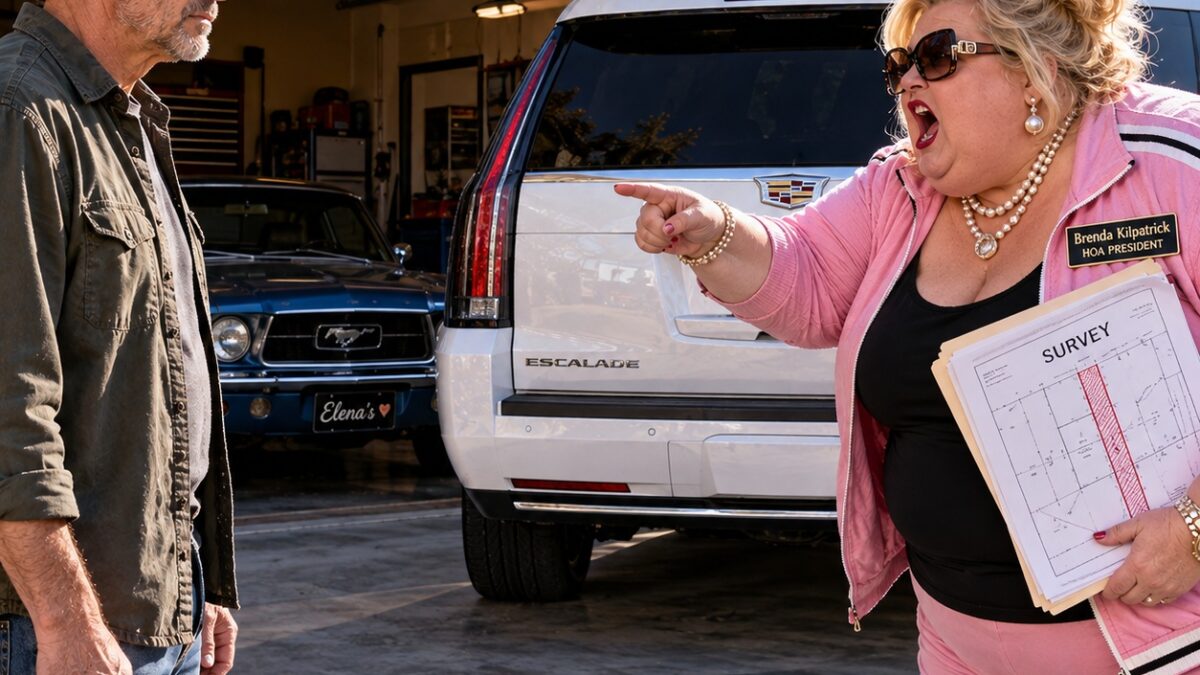
Brenda Kilpatrick parked her white Escalade sideways across my garage, looked at the place where my late wife’s 1967 Mustang used to sit every night after chemotherapy, and told me with a smile that three feet of my driveway now belonged to the public and I needed to “get over it.”
She waved an official-looking survey under my nose, threatened demolition, city enforcement, federal investigations, and forced sale if I refused to surrender the strip, believing a grieving fifty-eight-year-old widower would panic before he ever checked the records.
What Brenda did not know was that I had spent thirty years as a civil engineer learning exactly how to separate real authority from paper theater—and by the time she finally came racing toward my property at 6:47 one morning, I had built something steel, legal, documented, and completely indifferent to her ego.
My name is Marcus Weatherby.
I was fifty-eight when Brenda decided my grief made me easy prey.
Two years earlier, I buried my wife, Elena, in a Tucson cemetery after eighteen months of cancer.
There are sounds you stop hearing because life makes them ordinary.
For me, one of them had been the ticking of Elena’s Mustang engine after she pulled into our driveway in the evening.
I would hear the garage door.
Then the low rumble.
Then silence.
Then the tiny metallic clicks as the engine cooled.
Sometimes I could smell her vanilla perfume before she stepped inside.
During the worst months of treatment, I learned to recognize her energy by how long she sat behind the wheel before opening the door.
Some days she came inside laughing.
Some days she sat with both hands on the steering wheel until I walked out and helped her.
We had owned that 1967 Mustang longer than some people stay married.
After Elena died, I could not stand our old house.
Every room had her shape.
So I sold almost everything, took early retirement after thirty years in civil engineering, and moved to Saguaro Springs.
Quiet HOA neighborhood.
Modest ranch house on Desert Willow Drive.
Long concrete driveway.
Two-car garage.
Desert willows out front because they had been Elena’s favorite.
The Mustang came with me.
Of course it did.
I parked it in the garage, covered it with a soft tarp, and started restoring it.
Carburetor.
Electrical.
Interior.
One piece at a time.
It gave my hands something to do when my head became too loud.
That house was supposed to be where I learned how to live without Elena.
Then Brenda Kilpatrick walked into my driveway.
Five foot four.
Fake blonde highlights.
Designer athleisure.
Huge sunglasses.
White Escalade.
Vanity plate.
Eight years as HOA president had apparently convinced her that neighborhood bylaws were a branch of federal government.
Week one, she criticized my landscaping.
“The desert willows don’t fit the community aesthetic.”
“They’re staying.”
She looked surprised.
Week two, she spent forty minutes with a tape measure checking my driveway width.
The driveway had been poured in 1987.
I had the permits.
She left irritated.
Week three, she came for the land.
I was in the garage rebuilding the Mustang’s carburetor when her heels clicked across the concrete.
I remember that sound because it invaded the one place I had made sacred.
The Mustang sat behind me.
Tools laid out in order.
Motor oil on my hands.
Elena’s old keychain hanging from a peg beside the workbench.
Then Brenda appeared holding a manila folder.
“Marcus.”
I turned.
She opened it.
Inside was a survey.
Red lines.
Official-looking seal.
My driveway shifted three feet on paper.
“Your driveway is built on public property.”
I looked at her.
Then the paper.
Then at the concrete beneath our feet.
“Is that right?”
“I’ve reviewed city records extensively.”
She tapped the red line.
“Three feet of this driveway belongs to the municipality.”
My engineering instincts started screaming immediately.
But I stayed calm.
“I’ll verify it against my deed.”
She smiled.
“You do that, honey.”
Then she pointed toward my garage.
“Until this is resolved, I’ll use the public portion for HOA business.”
Five minutes later, her Escalade was parked across the garage.
Right where Elena’s Mustang used to sit after work.
Right where I used to wait for the driver’s door to open.
That was the moment the dispute stopped being irritating.
And became personal.
PART2
I stood in the desert heat staring at the Escalade.
White paint.
Chrome.
HOA sticker.
Brenda standing beside it with the casual confidence of a person who believed the paper in her hand had already rewritten reality.
Behind the closed garage door was Elena’s Mustang.
I could almost hear the old engine cooling.
That phantom ticking sound grief sometimes gives you when it wants to remind you that memory is stronger than silence.
“Move your vehicle.”
Brenda pushed her sunglasses higher.
“I’m legally parked.”
“No.”
“This section is municipal.”
“Move your vehicle.”
She tilted her head.
“Marcus, I understand you’re still adjusting to the community.”
I looked at her.
“Move. Your. Vehicle.”
Her smile disappeared.
For one second, I saw what existed underneath the HOA-president performance.
Anger.
Not because I had done anything wrong.
Because I had refused to accept her version of authority.
Then the smile came back.
“I’ll move it when I’m done.”
She walked toward the street.
I did not touch her vehicle.
I did not yell.
I did not threaten.
I went inside.
That night, my kitchen table became an evidence station.
Original deed.
Title policy.
County survey.
1987 builder’s site plan.
Architectural drawings.
Permit records.
Every document from closing.
I spread them beneath the fluorescent light and traced lines.
Measurements.
Setbacks.
Road edge.
Right-of-way.
Parcel corners.
Then I compared them with Brenda’s survey.
At first, I thought maybe somebody had made a drafting error.
Then I noticed the seal.
Wrong format.
Then the notation style.
Wrong.
Then dimensions that did not reconcile with the original plat.
I pulled county records online.
The truth was immediate.
My property line did not stop three feet before Brenda claimed.
It extended beyond her line.
Her document was not merely inaccurate.
It had been manufactured to look official.
I sat there for several minutes.
My first instinct was anger.
My second was engineering.
Anger is useful for about thirty seconds.
Then measurements become more productive.
I started cross-referencing property records.
That was when things became ugly.
Mrs. Patterson.
Boundary dispute.
“Public-property encroachment.”
Sold quickly.
Lost around thirty thousand dollars in value.
The Martinez family.
Same type of complaint.
Children’s college savings drained while they dealt with a forced quick sale.
Mr. Thompson.
Similar.
The Johnsons.
Same pattern.
Each family was told part of their driveway or lot had become public property.
Each received official-looking paperwork.
Each became frightened.
Each sold under pressure.
Then, after the panic sale, a real estate contact linked to Brenda appeared with low offers or helped move the property.
I sat back.
Four families.
Three years.
Same method.
This was not an aggressive HOA president misreading a plat.
It looked like a system.
Create boundary panic.
Invoke fake municipal authority.
Threaten enforcement.
Force a desperate sale.
Profit from the gap.
I thought about Elena.
During cancer treatment, people told me grief would make me vulnerable to bad decisions.
They meant emotional decisions.
Selling too quickly.
Giving things away.
Signing something because I did not care anymore.
Brenda had seen a widower restoring his dead wife’s car and apparently reached the same conclusion.
Weak.
Distracted.
Easy.
She was wrong.
Monday morning, 6:30, her Escalade arrived again.
Diesel rumble.
Door slam.
My new alarm clock.
She stepped out in hot-pink athleisure, clipboard in one hand, coffee in the other.
“Morning, Marcus.”
I walked outside.
“Move your car.”
“Public parking.”
“My deed says otherwise.”
She waved her survey.
“City records override homeowner assumptions.”
That sentence was so confidently wrong I almost admired it.
“Let me see the actual city transfer.”
Her smile tightened.
“You’ve seen the survey.”
“No. I want the official municipal action transferring title.”
She paused.
“That isn’t how this works.”
“It is exactly how this works.”
I pointed toward the driveway.
“Property does not become municipal because you draw a red line.”
She pulled a typed notice from the clipboard.
Fancy header.
Official-looking logo.
“Thirty days to acknowledge the public boundary or face city enforcement.”
I took it.
Read.
No city department.
No file number I recognized.
No clerk notation.
No hearing reference.
No recording information.
Nothing.
I folded it.
“Thank you.”
“For what?”
“Another document.”
She did not understand what I meant.
That afternoon, I drove downtown to the county recorder’s office.
Two hours through Tucson traffic.
The building smelled like old paper, recycled air, and government coffee.
A clerk named Patricia helped me.
Twenty-two years in property records.
She took one look at Brenda’s survey.
Then a second.
Her eyebrows moved.
“Where did you get this?”
“HOA president.”
“This isn’t municipal.”
“How can you tell?”
She tapped the page.
“Wrong font for our current forms.”
Then the seal.
“Wrong seal.”
Then the red line.
“We don’t mark these this way.”
She looked at me.
“This is fabricated.”
There it was.
Clean.
Professional.
No theatrics.
I asked for certified copies of my actual parcel survey.
Patricia printed them.
My line extended 4.2 feet farther than Brenda’s forged version.
Meaning part of the area she had called public was actually mine.
Then Patricia searched my street.
Her face changed.
“Four other properties requested boundary verification in the last three years.”
I already knew some.
Still, hearing it from her mattered.
She pulled files.
Patterson.
Martinez.
Thompson.
Johnson.
Same fake-survey pattern.
“Did they challenge?”
“Most couldn’t afford to.”
Her tone softened.
“Quick sales. Losses between fifteen and thirty thousand.”
I drove home with certified copies beside me.
Angry.
Focused.
Then I turned onto Desert Willow Drive and saw bright orange against my garage.
A violation sticker.
Huge.
PUBLIC PROPERTY ENCROACHMENT
15 DAYS TO COMPLY
FORCED DEMOLITION POSSIBLE
I parked.
Walked closer.
My hands started shaking.
Not because I believed it.
Because the sticker was attached to the garage holding Elena’s Mustang.
That car was one of the last things I had left that still felt touched by her.
I put my palm against the garage door.
For a moment, I could smell hospital disinfectant.
Vanilla perfume.
Hot engine.
Grief does that.
It folds years together without permission.
Then I called Jim Martinez.
Elena’s old probate attorney.
By coincidence, uncle to the Martinez couple Brenda had pressured in 2021.
Jim reviewed my documents.
Called me back.
“Marcus, I’ve been waiting for someone to fight her.”
“Your nephew’s case?”
“He lost money because she scared them into believing the city would take half their frontage.”
“What she’s doing looks criminal.”
“It may be.”
“What do I do?”
Silence.
Then Jim said something I did not expect.
“You’re an engineer.”
“Yes.”
“Maybe stop thinking only like a plaintiff.”
“What are you suggesting?”
“Build something permanent.”
The next morning, Brenda arrived with two board members.
Janet.
Retired teacher.
Phil.
Bank manager.
Matching HOA polo shirts.
They looked like hostages to matching embroidery.
“We’re conducting an official inspection,” Brenda announced.
I walked outside with the certified county survey.
“Good.”
I spread documents across the hood of my truck.
“Here’s the actual record.”
Janet leaned over.
Phil followed.
“My property extends beyond Brenda’s claimed line.”
Janet looked at the seals.
Then Brenda.
“Where did your map come from?”
“Updated city data.”
Phil frowned.
“Municipal boundaries don’t just change overnight.”
“They were corrected.”
“Through what proceeding?”
Brenda’s face reddened.
Phil lifted the forged sheet.
“This doesn’t look like a city survey.”
Janet looked at Brenda the way only a retired teacher can look at someone caught cheating.
“Did you create this?”
“Of course not.”
“Who did?”
“The city.”
“Which office?”
Brenda turned toward me.
“This is harassment.”
I almost laughed.
Phil stepped back.
“I’m not participating in any enforcement based on this.”
Janet nodded.
“Neither am I.”
They left.
Brenda remained.
Alone.
Fake survey in hand.
She looked at me with something I had not seen before.
Concern.
Good.
The next morning, she brought landscapers.
White pickup.
Desert Vista Landscaping.
Three men who looked confused about why they were standing in my driveway at seven in the morning.
Brenda pointed at the ground.
“City-approved boundary markers.”
Carlos, crew chief, studied her papers.
Experienced contractors develop instincts.
Real permits have a rhythm.
File numbers.
Signatures.
Departments.
Stamped orders.
Brenda’s documents looked like someone had watched local government from across a parking lot and tried to recreate it in Microsoft Word.
“Ma’am,” Carlos said carefully, “we need a signed municipal work order before modifying public property.”
“The HOA has authority.”
“Okay, but we still need the city order.”
I walked out holding the certified survey.
“Before you dig, you should know this is private property.”
Carlos read my survey.
Compared.
His expression changed.
He handed Brenda’s paperwork back.
“We’re not touching this.”
“This is urgent.”
“Then get the city to send the work order.”
“You’re contracted.”
“Not to get arrested.”
He waved his crew back toward the truck.
Brenda’s face went rigid.
Then she called code enforcement.
Actual code enforcement.
Twenty minutes later, Officer Rivera arrived.
Tablet.
City databases.
Real authority.
“What’s the complaint?”
Brenda spoke quickly.
“Homeowner interfering with municipal property maintenance.”
She handed him the fake survey.
Rivera looked at it maybe ten seconds.
“This isn’t ours.”
Brenda blinked.
“What?”
“We don’t issue boundary modifications through HOA stationery.”
He turned to me.
“Your documentation?”
I handed him Patricia’s certified copies.
He checked his tablet.
Then looked at Brenda.
“Property is privately owned.”
Her mouth opened.
Rivera continued.
“Also, knowingly filing false municipal reports can create legal problems. I recommend resolving this through proper civil channels.”
He left.
Brenda stood on my driveway.
The heat seemed to get louder.
That afternoon, neighbors started calling.
Mrs. Vanessa first.
“Marcus, Brenda says your driveway could get the whole block condemned.”
“What?”
“She says your encroachment affects municipal access.”
I laughed.
Mrs. Vanessa taught calculus for thirty years.
She laughed too.
“Thought so.”
By dinner, five more calls.
Property values.
Condemnation.
Municipal boundary crisis.
Brenda was converting ignorance into fear.
So I went door to door.
Not campaigning.
Educating.
Certified survey copies.
Actual parcel line.
Code officer’s determination.
Mr. Thompson stared at Brenda’s fake map.
Then his face changed.
“She used this on me.”
“Same design?”
“Identical.”
He sat down.
“I lost eighteen thousand dollars.”
There was no humor in his voice.
By Thursday morning, Brenda’s fear campaign had achieved the opposite of what she wanted.
Neighbors were comparing documents.
Stories.
Dates.
Jim called.
“Six households want to talk.”
“About what?”
“Joint action.”
He paused.
“She tried to isolate you.”
“I know.”
“She may have just connected all the victims.”
That Friday, Brenda arrived with “legal counsel.”
Crystal Davidson.
Discount business suit.
Briefcase.
Large glasses.
A performance.
She opened the briefcase.
“Mr. Weatherby, I represent Saguaro Springs HOA in public-property disputes.”
“What’s your Arizona bar number?”
Silence.
Brenda looked at her.
Crystal’s face changed.
“I serve as consulting counsel.”
“Bar number?”
“My husband handles registration.”
I almost felt sorry for her.
Almost.
I called Jim on speaker.
“Jim, what are the requirements for representing parties in municipal property disputes?”
His voice came through calm.
“Licensed attorney. Active bar status.”
Crystal snapped the briefcase shut.
Brenda shouted:
“She has full settlement authority.”
Jim continued.
“Anyone falsely presenting themselves as licensed counsel should be very careful.”
Crystal was back in her SUV before the sentence ended.
That should have embarrassed Brenda enough to stop.
It did not.
Later that afternoon, neighbors called about a supposed federal investigation.
Apparently I was now under investigation for fraudulent homestead claims, illegal automotive business, environmental violations, and possibly tax issues.
The FBI documentation Brenda showed people was just as real as her city survey.
I was rebuilding my dead wife’s Mustang carburetor.
In Brenda’s imagination, that made me a federal criminal enterprise.
Saturday morning, she returned with private security.
Four vehicles.
Two men attempting intimidation.
Crystal standing behind them.
Brenda wearing a blazer and heels.
She shouted from the driveway.
“By authority of municipal code enforcement and federal property regulations, you are ordered to cease illegal activity and surrender public property.”
I walked outside wiping my hands.
“Which municipal code?”
“47B.”
“There is no 47B.”
Her face flickered.
“What federal agency?”
“The Department of Property Compliance.”
I stared at her.
“Say that again.”
“The Department of Property Compliance.”
A federal department that existed only in Brenda’s imagination.
I called Rivera.
Speaker.
“Officer, someone is claiming federal authority to seize private property. What document would be required?”
“Court order and actual law enforcement, Mr. Weatherby.”
He paused.
“Anybody else attempting seizure could be committing theft or criminal damage.”
The security men looked at each other.
One started walking toward his vehicle.
Brenda turned.
“Where are you going?”
Neither answered.
Within minutes, the security theater dissolved.
I thought we were reaching the limits of absurdity.
I was wrong.
Sunday night, I received a text.
She’s planning something terrible for your house. Desert Rose Diner. 8:00. Come alone. D.
Dale.
Brenda’s husband.
I barely knew him.
Insurance salesman.
Traveled constantly.
I assumed the text was a trap.
Still went.
The Desert Rose Diner sat on Tucson’s industrial edge beneath flickering fluorescent lights.
Dale was in a corner booth.
Mid-fifties.
Gray beard.
Shaking hands.
Black coffee.
He looked like he had not slept in days.
“Marcus.”
I sat.
“If this is about Brenda—”
“It’s worse than you know.”
He slid a manila envelope across the table.
Bank records.
Casino receipts.
Credit cards.
Emails.
Contracts.
I read.
$47,000 in gambling losses over eighteen months.
Large withdrawals.
HOA account transfers.
Patterns tied to Dale’s travel.
Then another set of records.
Monica Vasquez.
Real estate associate.
Emails discussing the Patterson property.
Martinez.
Thompson.
Johnsons.
Fake boundary problems.
Pressure.
Lowball purchase.
Profit splits.
The more I read, the colder I felt.
“This is organized.”
Dale nodded.
“Brenda creates the violation. Monica pushes the sale.”
“How much?”
“About eighty-three thousand in profits from the four families.”
I stared at him.
“Why are you showing me?”
“Because yours is phase three.”
He handed me printed emails.
My address.
My house.
My driveway.
Projected forced-sale margin:
$42,000.
Then the part that made my stomach drop.
Discussions about broken windows.
Vehicle damage.
Creating fear.
Making the homeowner feel unsafe.
“You need to leave,” one email said indirectly through planning language.
Not legally.
Emotionally.
They wanted me frightened enough to sell thirty thousand below value.
I looked at Dale.
“This goes beyond fraud.”
“I know.”
“Why haven’t you stopped her?”
He laughed.
It sounded exhausted.
“Joint accounts. Debt. She controls everything socially.”
Then he placed divorce papers on the table.
“Filed yesterday.”
I looked at him.
“My attorney says I have maybe forty-eight hours before she realizes how much I copied.”
“You understand what happens if this is real.”
“I do.”
“Police.”
“I know.”
“Prosecutors.”
“I know.”
His eyes filled.
“I should’ve stopped her earlier.”
That was the first honest sentence of the night.
I did not absolve him.
Did not attack.
There would be time for responsibility.
Right then, I needed information.
“What is she planning next?”
Dale leaned closer.
“She wants you desperate.”
Monday morning, my garage became a war room.
Elena’s Mustang under its cover.
Dale’s documents spread across my workbench.
Jim joined by phone.
Police would get copies.
Victims would get lawyers.
But I had another problem.
Physical access.
Brenda had already parked on my driveway.
Sent contractors.
Sent fake security.
Discussed vandalism.
The driveway was the point of contact.
I called Bob.
Electrician neighbor.
Forty years of experience.
He arrived twenty minutes later with diagrams.
“You need access control.”
“What kind?”
“Boom barrier.”
He spread specifications.
Steel.
Hydraulic.
Manual emergency backup.
Vehicle-rated.
Proximity sensors.
Authorized access.
Legal height.
Concrete footings.
My engineering brain became very happy.
Not because I wanted to hurt anyone.
Because a well-designed access barrier does one simple thing:
It removes ambiguity.
Property starts here.
Unauthorized vehicles stop here.
“What’s installation?”
“Three days.”
“Cost?”
“About five grand all-in depending on concrete.”
“Do it.”
Before anything went in the ground, I checked legal requirements.
Property line.
Clearance.
Fire access.
Emergency override.
Every detail.
After weeks of Brenda inventing rules, I wanted the barrier to be painfully legitimate.
Tuesday, excavation.
Four-foot reinforced footings.
Concrete.
Real property line based on Patricia’s certified survey.
Mrs. Vanessa brought iced tea.
“This whole neighborhood has been waiting for somebody to stand up to her.”
I shook my head.
“This only works if the paperwork is right.”
“Marcus, normal people don’t say that while pouring a bunker.”
“It’s not a bunker.”
“What is it?”
“Access-control infrastructure.”
She laughed.
Wednesday, Bob ran conduit.
Control panel.
Proximity detection.
Battery backup.
Manual emergency mode.
Remote operation.
Thursday, final installation.
Bright yellow boom.
Reflective striping.
Eight-foot clearance when raised.
Emergency breakaway features.
Nothing hidden.
Nothing designed to injure.
Designed to stop unauthorized access.
We tested it repeatedly.
“Beautiful,” I said.
Bob grinned.
“Elena would’ve liked this.”
That hit me harder than expected.
I looked toward the garage.
“She liked watching me overbuild things.”
“She’d be proud.”
I did not answer.
That evening, I added cameras.
4K.
Cloud backup.
Multiple angles.
Timestamped.
Audio.
If Brenda came back, no one would need to debate what happened.
Friday, she went political.
Community-center rally.
Megaphone.
Folding chairs.
“Dangerous barrier.”
“Children’s safety.”
“Emergency access.”
She claimed ambulances could not enter.
I had designed the system specifically to allow emergency override.
Facts did not matter to Brenda.
Fear did.
She hired a media company.
By evening, Facebook was full of a professionally edited video portraying me as a dangerous widower building a death trap to terrorize neighbors.
Drone footage.
Ominous music.
Comments from people who had never met me.
“HOA should seize the property.”
“This man is unstable.”
“Someone call fire department.”
They did.
Saturday, Battalion Chief Rodriguez arrived.
Actual fire department.
Real safety authority.
“Received a complaint about emergency access.”
I walked him through everything.
Clearance.
Manual release.
First-responder override.
Breakaway protections.
Backup power.
He tested.
Checked.
Then said:
“This exceeds what we need.”
“No violation?”
“No.”
He looked toward Brenda’s Escalade parked across the street.
“No concerns.”
Brenda was livestreaming.
Perfect.
Her audience got to watch actual emergency professionals dismantle her latest story.
I thought that might be enough.
Then she touched Elena.
Not physically.
Her memory.
I returned from grocery shopping and saw purple scattered across the driveway.
For several seconds, my mind could not understand what I was seeing.
Then I did.
Elena’s memorial roses.
Uprooted.
Roots exposed.
Stems broken.
Flowers crushed into the concrete.
The garden I had planted for her beside the garage looked like someone had taken a shovel to a grave.
I dropped the grocery bag.
A jar broke.
I did not care.
I walked into the flower bed.
One rose bush still partly rooted.
Another thrown toward the curb.
The smell was everywhere.
Sweet.
Broken.
I knelt.
My hands touched dirt.
And for the first time since this began, I wanted to hurt someone.
Not metaphorically.
I wanted Brenda to feel something.
I wanted her to understand what she had touched.
Then Elena’s voice appeared in my memory.
Not a literal voice.
The way grief returns the person you loved in fragments.
She used to tell me:
“Marcus, when you’re angry, you get stupid.”
She was right.
I stood.
Walked inside.
Pulled the camera footage.
There.
Brenda.
Two men.
Pointing.
Directing.
Roses being destroyed deliberately.
Clear faces.
Clear timestamp.
Clear trespass.
I called Rivera.
He watched.
His expression hardened.
“This is criminal damage.”
He looked at me.
“Do not engage her.”
“I won’t.”
“Good.”
I replanted what I could the next morning.
Added more lighting.
More cameras.
Mrs. Vanessa helped.
She did not say much.
Neither did I.
Some grief does not need commentary.
Dale texted:
Final phase tomorrow. Permanent solutions. Be ready.
Monday morning, power tools woke me.
Four men.
Sledgehammers.
Crowbars.
Portable concrete saw.
Brenda in cargo pants and a hard hat.
Bullhorn.
Fake municipal work order.
“By order 847C, this illegal structure must be removed within thirty minutes.”
I walked outside with coffee.
The crew chief looked at the barrier.
Then the footings.
Then her paperwork.
“Where is the demolition permit?”
“I am the municipal authority.”
He stared.
“No, ma’am.”
“This is emergency removal.”
He looked at me.
“Your permit documents?”
I handed him the file.
He read enough.
Then handed Brenda’s page back.
“We’re done.”
She shouted.
“You’re under contract.”
“We’re not destroying a legal installation based on this.”
They packed.
Left.
Brenda stood alone in the heat wearing a hard hat crooked on her head.
Later, she returned.
Different approach.
Manila envelope.
“Let’s be adults.”
I stayed behind the barrier.
She opened the envelope.
Cash.
Five thousand dollars.
“For voluntary removal.”
“In exchange for?”
“You sign an agreement stating the entire boundary dispute was a mutual misunderstanding.”
I stared at her.
“Are you offering me money to sign something that hides your fake documents?”
“This is compensation.”
I took out my phone.
Activated recording.
“So you’re offering cash if I remove a lawful barrier and sign a statement describing your forged boundary claim as a misunderstanding?”
Her face changed.
“This conversation never happened.”
She snatched the envelope.
Left.
That evening Dale warned me again.
Tonight. Lock doors. Call police if anyone approaches.
I called Rivera.
Not because I wanted drama.
Because Brenda’s escalation pattern had crossed into things I could no longer manage privately.
Cameras.
Floodlights.
Locks.
Phone charged.
Then nothing happened overnight.
Silence.
Which scared me more.
Tuesday morning.
6:47.
I was asleep when the engine woke me.
Hard acceleration.
Not normal driveway speed.
I went to the blinds.
White Escalade.
Brenda behind the wheel.
She backed up.
Aligned.
Then accelerated toward the boom barrier.
For one second, I could not believe she was actually doing it.
Then engineering took over.
Barrier down.
Steel anchored in reinforced footings.
Her Escalade moving maybe fifteen miles per hour.
Too fast.
I reached for my phone.
Impact.
The sound cracked through the neighborhood.
Metal.
Glass.
Airbags.
The barrier flexed within design tolerance.
Held.
The Escalade did not.
Front end crumpled.
Radiator steam.
Horn briefly stuck.
My first thought was not satisfaction.
It was:
Is she alive?
I called emergency services.
Then walked outside but stayed behind the gate.
Brenda pushed at the driver’s door.
Airbag dust everywhere.
She was moving.
Good.
Within minutes Rivera arrived.
I had warned him the day before.
An investigative reporter, Sarah Martinez, arrived soon after because Dale’s evidence had already begun circulating through attorneys and media.
Neighbors came outside.
Brenda climbed from the Escalade.
Face red.
Hair disordered.
She pointed at my barrier.
“That thing attacked my car!”
I actually closed my eyes.
Rivera looked at her.
“Are you injured?”
“I want him arrested!”
“For what?”
“Property assault!”
There are sentences a human brain needs extra time to process.
Property assault was one.
I held up my phone.
“I have the footage.”
Rivera watched.
Multiple angles.
Brenda backing up.
Accelerating.
Impact.
No ambiguity.
He looked at her.
“Ma’am, you drove into a stationary barrier on private property.”
“It shouldn’t be there!”
“It is lawfully installed.”
“It’s public land!”
She pulled the same forged survey from her Escalade.
Even then.
Even with steam coming from the radiator.
Sarah stepped forward.
“Ms. Kilpatrick?”
Brenda turned.
“Sarah Martinez, Channel 9.”
Camera behind her.
“Our investigation has reviewed documents alleging approximately forty-seven thousand dollars in gambling losses, HOA fund diversion, and coordinated property fraud involving previous homeowners. Would you like to comment?”
Brenda stopped.
The neighborhood stopped.
People who had come outside expecting another driveway argument suddenly heard the larger story.
She looked at Sarah.
Then Rivera.
Then me.
“Those are lies.”
Rivera’s expression did not move.
By then, law enforcement had received Dale’s records and Jim’s victim documentation.
The arrest that followed was not because a barrier “won.”
It was because evidence had accumulated across fraud, property damage, attempted destruction, and related conduct.
Handcuffs came out.
Brenda stared at them.
I did not feel triumph.
Not exactly.
Relief.
Mostly relief.
Weeks of fake authority had finally met actual authority.
As she was led away, neighbors stood around quietly.
The source story turns this moment into applause.
My memory would be different.
I would remember the silence first.
Because once a neighborhood tyrant becomes a criminal suspect in front of everyone, the emotion is not simple joy.
Some people had trusted her.
Some had voted for her.
Some had lost money.
Some felt stupid.
Some felt vindicated.
Mrs. Vanessa cried.
Old Thompson stood with both hands in his pockets.
Bob stared at the barrier.
I looked toward the garage.
Elena’s Mustang was safe.
That mattered more than Brenda.
Six months later, consequences were no longer theoretical.
The broader fraud investigation produced criminal charges.
Property-fraud evidence.
HOA fund issues.
The gambling records explained motive but were not, by themselves, the crime.
Brenda and Monica faced the coordinated property scheme.
Restitution became part of the process.
The families she had targeted finally had a path toward recovering money.
Dale’s divorce moved forward.
The HOA held emergency elections.
And something unexpected happened.
Saguaro Springs did not collapse.
Without Brenda dominating everything, the neighborhood became more normal.
Financial transactions required dual approval.
Boundary complaints required independent surveys.
Records became easier to inspect.
People stopped treating “HOA says” as equivalent to “law says.”
Property values recovered.
The Martinez family used recovered money to restore the college savings they had lost.
Mrs. Patterson replanted her garden.
Thompson rebuilt part of his retirement cushion.
Bob’s barrier business exploded.
That man still blames me.
“Do you know how many homeowners want these things now?”
“You’re welcome.”
“I’m seventy.”
“Then charge more.”
He did.
The boom barrier remained at my driveway.
I maintained it.
Not as a weapon.
Access control.
Bright yellow.
Reflective.
Emergency release clearly marked.
Kids in the neighborhood started calling it the Justice Gate.
I hated the name.
Then secretly liked it.
But the real change for me had nothing to do with steel.
Janet—the former board member who had walked away from Brenda’s forged survey—started stopping by on weekends.
At first, HOA paperwork.
Then Mustang questions.
One afternoon she looked at the wiring diagram.
“That ground path is wrong.”
I stared.
“What?”
She pointed.
“You’re chasing voltage drop through the body connection.”
“You know classic electrical?”
“My father restored cars.”
She smiled.
“I learned before you were old enough to have gray hair.”
I handed her the multimeter.
“Prove it.”
She did.
Her laugh caught me off guard.
Not because it sounded exactly like Elena.
It did not.
But something about the joy in it hit the same place grief lived.
I went quiet.
Janet noticed.
“You okay?”
“Yes.”
She did not push.
That kindness mattered.
Later, while we worked on the Mustang transmission, she said:
“Elena would want you to keep living.”
I stared at the gearbox.
“People say that.”
“I’m not saying move on.”
“Good.”
“I’m saying move.”
That was different.
I looked at her.
She continued.
“You can carry someone without standing still.”
That sentence followed me for weeks.
The Mustang had become my way of preserving Elena.
Maybe too much.
I was not restoring a car.
I was restoring a doorway into memory.
Nothing wrong with that.
Unless memory becomes the only room you live in.
The Brenda fight had forced me out of that room.
Neighbors.
Police.
Attorneys.
Victims.
Meetings.
Construction.
Responsibility.
Elena had not come back.
But I had.
Little by little.
My civil case eventually resolved.
The source story gives a sixty-thousand-dollar settlement contribution toward something I cared about.
I kept that core.
I used half the settlement funds to establish the Elena Weatherby Engineering Ethics Scholarship at Arizona State University.
Not because Elena was an engineer.
She was better at people than I ever was.
But engineering ethics mattered after what happened.
Documents.
Surveys.
Seals.
Professional authority.
All of those can protect people.
Or become tools of intimidation when falsified.
I wanted students to understand the difference.
The first recipient was Maria Santos.
First-generation college student.
Civil engineering.
Her family had experienced a property-fraud dispute.
At the award ceremony, she told me:
“People like my parents are terrified when someone shows up with official documents.”
I nodded.
“They should respect documents.”
She looked surprised.
“Not fear them.”
I continued.
“Verify them.”
That became the point.
Never teach people that every official notice is fake.
That creates another kind of ignorance.
Teach them to know where authority comes from.
A real surveyor has credentials.
A real municipal action has a record.
A real attorney has a bar number.
A real enforcement order has an issuing authority.
Knowledge does not eliminate rules.
It eliminates fake ones.
Sarah Martinez’s investigation continued beyond Brenda.
HOA oversight.
Financial transparency.
Conflicts of interest.
The series received recognition.
Policy debates followed.
Whether every reform claimed in the original story happened exactly as dramatically is less important than the theme I carried forward:
Sunlight makes petty dictators smaller.
Transparency.
Audits.
Independent review.
Clear records.
That is how you reduce the space for someone like Brenda.
Not by hoping the next president is nicer.
Systems should not depend entirely on personality.
That lesson came directly from engineering.
A bridge cannot rely on the driver being careful.
You design guardrails.
Redundancy.
Load factors.
Fail-safe behavior.
Governance deserves the same thinking.
Dual approval.
Independent survey.
Recorded decisions.
Conflict disclosure.
Oversight.
Guardrails.
Humans fail.
Design for it.
My own guardrail still stood at the driveway.
People photographed it occasionally.
I found that ridiculous.
They saw steel.
I saw concrete footings.
Electrical backup.
Clearance calculations.
Emergency release.
A response to repeated trespass risk.
That was the difference between engineering and mythology.
The mythology said:
Marcus built an unstoppable gate and Brenda destroyed herself.
The truth was less satisfying but more useful.
I checked my deed.
I verified the survey.
I went to the recorder.
I documented patterns.
I called counsel.
I involved law enforcement when behavior escalated.
I installed legal access control.
I recorded events.
When Brenda made mistakes, evidence existed.
The barrier alone solved nothing.
The paper trail did.
Steel without paper would have been another dispute.
Paper plus lawful engineering changed the risk.
That became the lesson I repeated.
One year later, a man from another HOA called me.
No idea how he got my number.
“Is this Marcus?”
“Yes.”
“I need to build one of those gates.”
“Why?”
“HOA keeps using my driveway.”
“Is the driveway yours?”
“Yes.”
“Recorded?”
“Pretty sure.”
I sighed.
“Do not buy steel yet.”
“What?”
“Get your deed.”
“But—”
“Deed first.”
He sounded disappointed.
People want the dramatic object.
They do not want the boring verification.
“Survey?”
“Yes.”
“Recorder?”
“Yes.”
“Then attorney if needed.”
“Gate last?”
“Gate maybe never.”
That is engineering.
Do not design a solution before defining the problem.
Brenda’s mistake had been the opposite.
She defined the solution first:
Control.
Then invented the problem:
Public property.
Everything afterward served control.
That is why her arguments kept changing.
Driveway.
Then code.
Then municipal authority.
Then federal authority.
Then fire safety.
Then media pressure.
Then vandalism.
The issue was never genuinely the driveway.
The issue was leverage.
Once I understood that, I stopped trying to win each individual argument emotionally.
I built one record.
Everything went into it.
Fake survey.
County verification.
Orange sticker.
Witness calls.
Board members.
Contractor refusal.
Officer Rivera.
Fake counsel.
Federal claim.
Dale’s records.
Camera footage.
Rose destruction.
Bribe attempt.
Barrier impact.
One timeline.
People underestimate timelines.
When abuse happens gradually, each event can be dismissed.
“Misunderstanding.”
“Bad communication.”
“Overzealous enforcement.”
Put dates side by side and patterns appear.
That is how engineers diagnose failure.
That is how lawyers build cases.
That is how communities recognize abuse.
Pattern.
Mrs. Patterson told me later:
“I thought I was the only one.”
That hurt.
Every victim thought they were uniquely unlucky.
Brenda’s greatest protection was separation.
One frightened homeowner at a time.
No shared information.
No comparison.
The minute neighbors compared papers, the scheme weakened.
That is true far beyond HOAs.
Bad systems love isolated victims.
Good systems connect records.
I told Maria Santos that at the scholarship ceremony.
“Engineering is about connections.”
She thought I meant beams.
“I mean people too.”
She smiled.
“Very philosophical for a concrete guy.”
“I’m retired.”
Apparently retirement makes you philosophical.
Elena would have laughed.
Her memorial roses recovered.
That mattered more than I expected.
The bushes Brenda had damaged did not all survive.
Some did.
I replaced the others with the same variety.
The garden came back.
Not identical.
That became important.
I had spent two years trying to preserve things exactly.
Mustang.
Roses.
Memories.
But recovery is not restoration in the museum sense.
Sometimes new growth appears beside damaged roots.
Still connected.
Different.
One morning, Janet was helping with the Mustang.
We opened the garage.
Sunlight fell across the hood.
The paint had finally reached the stage where reflection looked clean.
She stepped back.
“She’s beautiful.”
I knew she meant the car.
Still, my throat tightened.
“Elena was.”
Janet nodded.
“I know.”
No correction.
No awkwardness.
Then she touched the fender.
“So is this.”
That was the first time I accepted those two truths together.
Loving the car did not mean pretending the car was Elena.
Restoring it did not keep her alive.
It kept a connection alive.
That was healthier.
Brenda had attacked the driveway because she thought grief made it weak.
In reality, grief made the line more important.
But the fight eventually taught me that memory does not need territory defended forever with clenched fists.
Once the threat ended, I could soften.
That surprised me.
I started inviting neighbors over.
Coffee.
Mustang work.
Bob complaining about invoices.
Mrs. Vanessa appearing with gossip and pastries.
Janet with electrical advice.
Saguaro Springs became what I had originally hoped.
Quiet.
Not silent.
Community.
Not control.
There is a difference.
The new HOA board asked me once whether I wanted to join.
I laughed so hard Bob nearly dropped his coffee.
“No.”
They looked disappointed.
“Marcus, you understand the issues.”
“That is exactly why I’m saying no.”
I did not want revenge through office.
I did not want to become the anti-Brenda Brenda.
Systems improve when no single person becomes indispensable.
I gave them recommendations.
Independent boundary review.
Conflict disclosures.
Financial controls.
Then stayed off the board.
Good fences make good neighbors.
So do limited terms.
Dale eventually rebuilt his life too.
I remained careful about turning him into a hero.
He had known more than he acted on for too long.
He admitted that.
He had responsibilities.
Still, when he finally stepped forward, the evidence mattered.
People are rarely cleanly good or bad.
Brenda had become destructive.
Dale had been passive.
Then he acted.
That action prevented worse.
I could acknowledge both.
Years later, he sent a Christmas card with his new wife.
He looked lighter.
I was glad.
Not because his happiness erased anything.
Because people should be allowed to become better than the worst season of their lives.
I wanted that for myself too.
I did not want to remain Marcus-the-widower-fighting-Brenda forever.
A story can save you.
Then trap you if you keep living inside it.
The boom barrier stopped being a battlefield.
It became hardware.
I serviced the hydraulics.
Checked battery backup.
Repainted scratches.
Neighborhood kids still called it Justice Gate.
Fine.
I called it Barrier One.
Engineers ruin good folklore.
One day a child asked:
“Did a bad lady really crash into it?”
His mother looked embarrassed.
I crouched.
“She drove somewhere she wasn’t supposed to.”
“Did the gate win?”
I considered.
“The gate did its job.”
That answer pleased me more.
Winning is emotional.
Doing the job is engineering.
The barrier did not hate Brenda.
Did not judge.
Did not punish.
It simply remained where it was designed to remain.
There was something almost poetic about that.
The whole fight began because Brenda believed I would move.
My boundary.
My rights.
My grief.
My decisions.
She applied pressure expecting movement.
The final object she encountered had been designed not to move.
Maybe that is why people loved the symbolism.
Still, I never forgot the safety side.
A fifteen-mile-per-hour collision is dangerous.
Brenda could have been badly hurt.
I would never recommend creating a trap.
The barrier was visible.
Marked.
Reflective.
Legally installed.
Its purpose was access control.
Her decision to ram it was hers.
That distinction mattered morally and legally.
I was relieved she survived.
Consequences do not require tragedy.
When people retold the story online, they made the impact the climax.
For me, the real climax had happened earlier.
At the county recorder’s office.
When Patricia said:
“This is fabricated.”
Because that sentence changed my emotional posture.
Until then, Brenda had tried to make me doubt my own land.
That is what fake authority does.
It uses formal language to make you question things you know.
Deed.
Driveway.
Garage.
Home.
The moment a neutral official confirmed the truth, fear became strategy.
Then the rest was execution.
Document.
Protect.
Expose.
That is why information matters.
If you understand what you own and can prove it, intimidation loses oxygen.
Not instantly.
Brenda escalated for weeks.
But internally, she had already lost the most important thing.
My uncertainty.
I no longer asked:
What if she’s right?
I asked:
What will she fabricate next?
Different question.
Much stronger position.
Grief had taught me uncertainty in a different way.
For eighteen months of Elena’s cancer, we lived inside uncertain language.
Scans.
Markers.
Response.
Progression.
Treatment options.
Every appointment could change the future.
After her death, I thought I wanted certainty more than anything.
Then Brenda arrived with fake certainty.
“This is public property.”
“City records override your deed.”
“You must comply.”
I learned something.
Certainty is not the same as truth.
Sometimes honest uncertainty is safer.
Patricia did not say:
“I feel like your survey is fake.”
She checked.
Rivera checked.
Chief Rodriguez checked.
Jim checked credentials.
Facts.
Authority earned through verification.
That made me more cautious about my own confidence too.
I was an engineer for thirty years.
I could still be wrong.
That is why I did not rely only on experience.
I went to the recorder.
Attorney.
City.
Fire department.
Actual experts.
Expertise should increase your willingness to verify, not reduce it.
Brenda treated her position as proof.
That was fatal to her judgment.
One afternoon Maria, the scholarship student, visited the house.
She wanted to see the barrier.
I showed her.
Then the Mustang.
Then Elena’s roses.
She looked at the garden.
“This is what they destroyed?”
“Yes.”
“You replanted?”
“Of course.”
She touched one bloom carefully.
“My mom stopped planting flowers after our property dispute.”
I looked at her.
“Why?”
“She said she didn’t want to love anything attached to the house because someone could take it.”
That sentence hurt more than I expected.
Fraud does that.
It steals beyond money.
Security.
Attachment.
Future planning.
Why improve a home if somebody can fabricate a claim and force you out?
I told Maria:
“Tell your mother to plant something.”
She smiled.
“I will.”
Property rights sound dry until you understand what they protect.
Not merely dirt.
Memory.
Routines.
Children’s rooms.
Gardens.
Cars that belonged to dead wives.
The right to invest emotionally in a place without someone manufacturing an exit.
That was why Brenda’s behavior felt so violating.
She was not just stealing value.
She was weaponizing home.
That is why the neighborhood reforms mattered more than her sentence.
A prison term punishes one person.
A better system protects the next family.
Dual signatures.
Independent survey.
Transparent finances.
Those are unglamorous.
Good.
I trust unglamorous.
The older I got, the less interested I became in dramatic justice.
I wanted boring prevention.
No fake survey.
No victim.
No viral story.
That would have been better.
But we did not get that timeline.
So we used what happened.
Elena’s scholarship.
Community reforms.
Victims recovering.
Lessons.
You cannot turn harm into good exactly.
You can build good beside it.
That is different.
Important distinction.
I would never say Brenda’s crimes were worth it because a scholarship resulted.
No.
The crimes were wrong.
The scholarship was our response.
Pain does not become necessary because people create meaning afterward.
Elena taught me that too.
Cancer did not “happen for a reason.”
We created reasons to keep living after it.
That is all.
The roses bloomed.
The Mustang ran.
The scholarship funded students.
Life continued.
Not because loss was good.
Because we were still here.
I think that is why I became less obsessed with Brenda’s eventual misery than some neighbors.
People wanted updates.
Is she suffering?
Did she lose everything?
Does she regret it?
I stopped caring.
Her consequences belonged to courts and restitution.
My life belonged to me.
If I needed Brenda unhappy to feel whole, she would still control something.
I refused.
The best revenge cliché is “living well.”
I dislike clichés.
But that one contains engineering truth.
Stop feeding energy into a failed system.
Build elsewhere.
I did.
The Mustang finally ran under its own power one spring morning.
First ignition after the restoration work.
I sat behind the wheel.
Hands on the same steering wheel Elena had touched thousands of times.
Janet stood outside.
Bob too.
Mrs. Vanessa had somehow learned about the test and appeared with coffee.
I turned the key.
Crank.
Nothing.
Again.
Crank.
Then engine.
Rumble.
Uneven.
Then smooth.
The sound filled the garage.
I closed my eyes.
For one second, I was back at the old house.
Waiting for Elena to pull in.
Then I opened them.
New house.
New people.
Same car.
Different life.
I cried.
Nobody made fun of me.
Not even Bob.
That was how I knew he respected the moment.
I drove the Mustang down the driveway.
Barrier rose automatically.
The irony did not escape me.
The machine built during the fight opened for the car tied to Elena.
Good engineering should protect what matters without becoming another prison.
The Mustang passed.
Barrier lowered behind us.
I drove through Tucson.
Sun.
Dry air.
Engine noise.
No HOA.
No Brenda.
Just movement.
Janet rode beside me.
She did not talk much.
Perfect.
At one stoplight, she looked over.
“You okay?”
“Yes.”
And for once, completely true.
That evening, I parked the Mustang exactly where Brenda’s Escalade had once blocked the garage.
I shut the engine off.
Tick.
Tick.
Tick.
Cooling metal.
The sound I had missed for years.
I sat there.
Elena was not coming through the door.
I knew.
But the sound no longer destroyed me.
It connected.
Memory without drowning.
I think that was the real end of the story.
Not Brenda’s arrest.
Not prison.
Not a barrier surviving impact.
Me sitting in Elena’s Mustang and hearing the engine cool without wishing the past would reopen.
Healing.
Quiet.
No audience.
Still, the community story continued.
Years later, Saguaro Springs had new leadership.
People still complained.
Of course.
Trash bins.
Paint.
Parking.
A functional HOA is still an HOA.
But complaints were smaller because power was less concentrated.
Records online.
Meeting minutes available.
Financial reports clearer.
A boundary issue triggered an independent survey before anyone received a threatening letter.
That happened once.
The homeowner turned out to be encroaching by about eighteen inches.
He corrected it.
No forged document.
No crisis.
No house sold.
No barrier.
Perfect.
That is success.
A system solving small problems while they are small.
Brenda had converted small issues into weapons.
The new board did the opposite.
That is leadership.
When someone asked me to speak at a community meeting about “resilience,” I nearly refused.
The word felt too inspirational.
But Maria convinced me.
“People will listen.”
So I went.
I did not tell them to fight.
I told them to read.
Deed.
Plat.
Survey.
Bylaws.
Actual code.
Financial statements.
I said:
“Bullies count on two things: fear and ignorance.”
The room quieted.
“Fear is human. Ignorance is fixable.”
That was my whole speech.
Almost.
Then:
“If someone claims authority over your property, do not start with rage. Start with one question: show me.”
Show me the document.
Show me the record.
Show me the vote.
Show me the permit.
Show me the law.
Real authority should be able to answer.
If it cannot, keep asking.
That line became the only part people quoted.
Fine.
Better than calling a steel barrier a superhero.
The morning mail still comes.
Mostly boring.
Bills.
Insurance.
Scholarship letters.
Once I received a notice about the boom barrier from the HOA.
My heart actually jumped.
Old reflex.
Then I opened it.
Routine inspection of emergency-access equipment.
Due next month.
I laughed so hard I had to sit down.
The notice was legitimate.
Procedure.
I scheduled inspection.
Passed.
That may have been the funniest proof that life had normalized.
A real HOA notice.
Based on real policy.
About real equipment.
Issued correctly.
I complied.
No war.
Amazing what happens when authority stays inside its lane.
The barrier still has a small mark from Brenda’s impact.
I could replace the arm.
Bob offered.
I said no.
“Symbolic?”
“No.”
“Then why?”
“Still within tolerance.”
He rolled his eyes.
Maybe a little symbolic.
Not a trophy.
Reminder.
Systems work when designed properly.
Human systems require the same care.
Inspection.
Maintenance.
Correction.
That scar reminded me to keep checking both.
Dale once asked whether I hated Brenda.
We met after some legal proceeding years later.
I thought.
“No.”
He looked surprised.
“What do you feel?”
“Tired.”
He laughed sadly.
“That sounds right.”
Then I added:
“And protective.”
“Of what?”
“Everything she tried to turn into leverage.”
My land.
Elena’s memory.
Neighbors’ savings.
Truth.
That feeling remained.
Not vengeance.
Protectiveness.
Maybe that is what grief became when it matured.
At first, grief made me want to protect the past from change.
Later, it taught me to protect what the past had given me.
Elena had given me love.
Humor.
Perspective.
A Mustang.
Memories.
Not a command to stop living.
Janet had been right.
Carry.
Do not stand still.
The scholarship carried Elena forward into people she never met.
That felt healthier than freezing her name on a memorial plaque alone.
Students graduated.
Some wrote.
One sent me a photo from a bridge project.
Another from a municipal planning office.
Maria eventually interned with a firm focused on land and infrastructure.
She emailed:
I verify every survey twice because of you.
I replied:
Three times if Brenda designed it.
She understood.
Humor is another form of healing.
I could joke about the fake survey now.
At the beginning, it threatened my home.
Years later, it became a teaching example.
I laminated a copy.
Not the original.
A reproduction.
At scholarship events, I sometimes held it up.
“This looks official.”
Students nodded.
“It isn’t.”
Then the real survey.
“Authority is not a font.”
That got laughs.
But it mattered.
We live in a world where visual credibility is easy to manufacture.
Seal.
Logo.
Letterhead.
Uniform.
Clipboard.
Those things trigger obedience.
Professionals need to teach people how to verify beyond appearance.
Brenda had built her whole scheme on appearance.
White Escalade.
HOA title.
Official-looking paper.
Fake counsel.
Fake city order.
Fake federal department.
Private security.
Media production.
Everything looked like authority.
Until actual authority arrived.
Recorder.
Code officer.
Fire chief.
Attorney.
Police.
Court.
Facts usually look less dramatic.
That is one reason fraud works.
The lie arrives dressed.
Truth arrives holding a file.
I learned to love the file.
The older I get, the less impressed I am by volume.
Brenda shouted.
Officials checked.
One of those methods lasted.
The morning she rammed the barrier, physics became the final neutral authority.
Mass.
Velocity.
Steel.
Concrete.
No argument.
But I still do not romanticize that part.
I would rather she had stopped after Patricia’s survey.
Or Phil’s objection.
Or Rivera’s warning.
Or the contractor refusal.
Or the fire inspection.
Any of those exits were available.
She kept choosing escalation.
That is what eventually made consequences severe.
People often imagine bullies are powerful because they never back down.
Sometimes not backing down is exactly what destroys them.
Strength includes correction.
If someone proves you wrong, stop.
Apologize.
Repair.
Move.
Darlene never learned that.
I did.
There were moments I almost overreacted.
Jim stopped me.
Rivera stopped me.
Elena’s remembered voice stopped me.
Good systems include people who can stop you too.
That is accountability.
I was not the hero because I was always right.
I succeeded because I verified enough to know when I was right and listened when others had expertise I did not.
Civil engineering teaches humility if you survive long enough.
Concrete cracks.
So do assumptions.
Check both.
Today, Desert Willow Drive looks almost boring.
That pleases me.
Children ride bikes.
Mrs. Vanessa still knows everything about everyone.
Bob claims retirement while accepting new barrier jobs.
Janet still corrects my wiring.
The Mustang runs.
Elena’s roses bloom.
The HOA sends legitimate notices occasionally.
The barrier rises for authorized vehicles and lowers behind them.
Normal.
One evening, I stood outside at sunset.
Arizona sky orange and purple.
Roses moving slightly in dry wind.
The Mustang visible inside the garage.
Barrier down.
No Escalade.
No camera crews.
No police.
I thought about the first morning.
Brenda calling my driveway public.
The perfume.
The heat.
The place where Elena used to park.
I realized something.
Brenda had assumed grief was emptiness.
That because Elena was gone, the place mattered less.
She understood grief completely backward.
Love does not disappear when the person does.
Sometimes the empty place becomes more meaningful.
But there is another danger.
You can guard the empty place so hard you never let life enter again.
I had almost done that.
Brenda’s attack forced me to defend.
Then the aftermath forced me to live.
Strange sequence.
I would not thank her.
Never.
But I can acknowledge what I chose to build afterward.
Not because of her.
In response.
That difference matters.
People do not get credit for the strength others develop surviving them.
Brenda does not get credit for the scholarship.
Elena does.
The students do.
I do.
The community does.
Brenda only created harm.
We decided what to build with the space afterward.
That is ownership too.
Ownership of the story.
I stopped telling it as:
The HOA queen who attacked my driveway.
Eventually it became:
The year I learned documents matter more than intimidation.
Then:
The year my neighborhood learned how to protect itself.
Then, quietly:
The year I started living again.
All true.
Different layers.
If you ask what I am proudest of, it is not the boom barrier.
It is not watching Brenda arrested.
Not the settlement.
Not even the Mustang.
It is that when fear tried to make everyone smaller, the community eventually became more informed instead.
Mrs. Patterson stopped thinking she had been stupid.
The Martinez family rebuilt.
Thompson learned he had not been alone.
Janet found her voice.
Dale finally disclosed evidence.
Maria entered engineering.
Neighbors learned to ask questions.
That is the opposite of what Brenda’s scheme needed.
Fraud thrives on shame.
Transparency breaks shame.
People speak.
Compare.
Suddenly patterns emerge.
That is community defense.
No steel required.
The steel was just visible.
The real barrier became knowledge.
Much harder to ram.
One of the last letters I received from Maria ended:
People like Brenda rely on families believing that official-looking paperwork means resistance is useless. I want to build systems where ordinary people can understand what is real.
I printed it.
Put it beside Elena’s photograph in my office.
That is legacy.
Not a viral video.
Not a headline.
Someone younger deciding to build better systems because they saw what bad ones can do.
My thirty years of engineering had mostly produced structures.
Roads.
Drainage.
Foundations.
Things measured in concrete and steel.
In retirement, somehow, the work became softer.
Trust.
Education.
Access to information.
Still engineering, in a way.
Different materials.
Same principle.
Build so load travels safely.
Add redundancy.
Do not let one failure collapse everything.
Saguaro Springs now had redundancy.
Brenda had been a single-point failure.
Never again.
I sometimes sit in the Mustang after a drive.
Engine off.
Cooling.
Tick.
Tick.
Tick.
Elena’s keychain still hangs near the ignition.
I hold it.
Not every time.
Sometimes.
I tell her things in my head.
The scholarship.
Maria.
Janet.
Bob.
The ridiculous Justice Gate nickname.
I imagine Elena laughing hardest at “property assault.”
She would have.
Then I go inside.
That matters.
I do not stay in the car forever.
Memory.
Then life.
The door opens.
I walk through.
Healing in one motion.
Brenda once tried to use my grief as leverage.
She misread it.
Grief had made me vulnerable.
But not in the way she expected.
It made me care fiercely about truth because loss had already taken enough.
I was not giving a liar three feet of ground simply because she printed red lines.
I was not surrendering the garage holding Elena’s Mustang because someone slapped orange paper on it.
I was not allowing fake authority to rewrite a deed.
She picked the wrong widower.
Not because I was tougher.
Because I knew how to verify.
That is less cinematic.
More important.
If I had been a mechanic instead of an engineer, the answer could still have been the same.
Go to the recorder.
Call a lawyer.
Ask for credentials.
Get real documents.
Call real authorities.
The hero of the story was not my profession.
It was the paper trail.
My engineering experience simply taught me to respect it.
Brenda relied on intimidation.
I relied on verification.
That difference widened with every move she made.
By the time she hit the barrier, the outcome had already been decided in records, footage, witness statements, and financial evidence.
The collision was noise.
The case was paper.
Never forget that.
Steel looked dramatic.
Documentation made it matter.
Years from now, the barrier may be removed.
The hydraulic system will fail eventually.
Concrete cracks.
Metal rusts.
The Mustang will need more work.
Roses die and grow again.
But the systems the neighborhood changed may last longer.
The scholarship may last longer.
Maria’s career may last longer.
That is what I mean when I say engineering taught me to build things that outlast tyrants.
Not every structure is physical.
Sometimes the strongest thing you build is a process someone cannot easily corrupt.
Sometimes it is a rule requiring two signatures.
Sometimes an independent survey.
Sometimes a student who knows how to read a plat.
Sometimes a homeowner who asks:
“Show me the real document.”
Brenda’s power had depended on people not asking.
Now they ask.
That is why she can never really come back, even if another personality like hers someday tries.
The neighborhood is harder to fool.
That is a permanent solution.
One afternoon, a new family moved into Saguaro Springs.
Young couple.
Baby.
They waved.
I helped them unload a bookshelf because apparently retirement means becoming free labor for anyone within sight.
The husband pointed toward the barrier.
“You’re the guy.”
“I’m a guy.”
“The HOA story.”
“Unfortunately.”
He laughed.
“We read about it before buying.”
“That should’ve scared you away.”
“Actually, the new controls made us feel safer.”
I stopped carrying the shelf for a second.
That sentence meant more than he knew.
The neighborhood once frightened families into leaving.
Now transparency helped one choose to arrive.
Full circle.
We carried the bookshelf inside.
Their baby slept through everything.
Normal.
Again.
The thing I wanted most.
Normal.
No one should need to become a crusader simply to use their own driveway.
No one should need cameras, attorneys, barriers, reporters, and police to preserve a recorded boundary.
The best outcome is not a heroic fight.
It is a system where the fight never becomes necessary.
I hope Saguaro Springs stays boring.
I hope the Justice Gate becomes nothing more than an odd yellow piece of equipment children joke about.
I hope future board presidents are forgettable.
Competent.
Transparent.
Boring.
That would be success.
Elena’s roses bloom beside the driveway.
Sometimes petals land on the concrete.
I sweep around them carefully.
Not because every petal is sacred.
Because the garden is alive.
That is different from a memorial frozen in time.
It changes.
New growth.
Old stems.
Seasons.
Like grief.
Like communities.
Like people.
This morning, I drove the Mustang out.
Barrier rose.
Sunlight hit the hood.
I paused at the end of the driveway.
Three feet of land Brenda once claimed was public.
Still mine.
No fireworks.
No applause.
No HOA president screaming.
Just concrete.
It looked ordinary.
Property rights often do.
The extraordinary part is what ordinary ground can hold.
A marriage memory.
A retirement.
A car.
A garden.
A future.
That is why it mattered.
I turned onto the street.
In the mirror, the barrier lowered.
Elena’s roses moved in the wind.
I smiled.
Not because I defeated Brenda.
Because she no longer mattered.
That is the final victory.
Not prison.
Not restitution.
Not steel.
Irrelevance.
She had spent months trying to become the central authority in my life.
Today she is a chapter.
Closed.
The driveway remains.
The Mustang remains.
The roses remain.
My neighbors remain.
My work continues in different forms.
And every time somebody tries to manufacture authority over someone who does not know better, there are now a few more people in this community willing to ask the right questions.
That is enough.
More than enough.
Brenda arrived believing an official-looking piece of paper could turn my land into hers.
She left behind a neighborhood that learned official-looking is not the same as official.
She believed a widower would panic.
Instead, grief taught me what was worth protecting.
She believed fear would isolate people.
Instead, victims started talking.
She believed a title gave her power.
Actual records showed its limits.
She believed my driveway would move.
It did not.
And on the morning she finally tried to move it with three tons of SUV, she discovered the most basic engineering principle of the entire story:
Reality does not care how entitled you feel.
The barrier did not argue.
The concrete did not negotiate.
The property record did not change because she shouted.
Facts simply stayed where they had always been.
So did I.
And after everything Brenda tried to take from me, that turned out to be enough.

