FULL STORY:Someone Left Two One-Week-Old Kittens to Die in a Cardboard Box—When Rescuers Opened It, the Starving Sisters Were Still Holding Onto Each Other
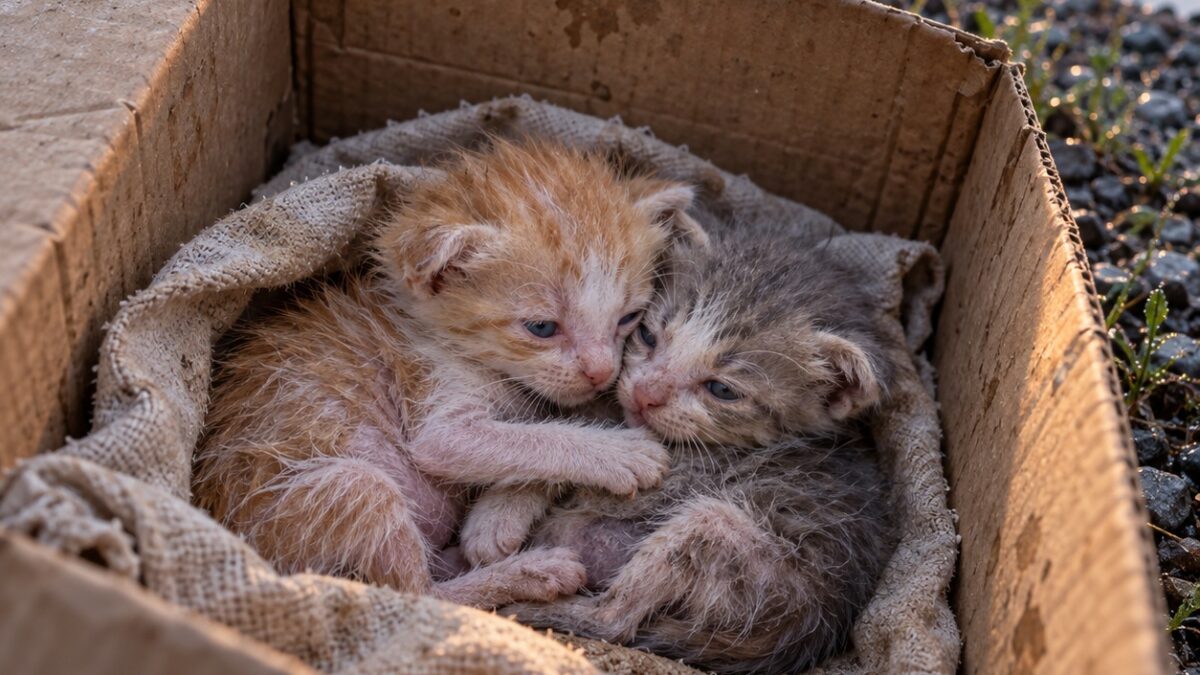
FULL STORY CONTINUATION
Getting them out of the box was only the beginning.
Rescue stories often become simple when we tell them afterward.
Animal found.
Animal treated.
Animal recovers.
Animal gets adopted.
Four lines.
Clean.
Hopeful.
Easy.
Real rescue rarely feels that way while it is happening.
The first stage is often uncertainty.
You have the animal.
Now what?
How much damage has already been done?
How long has the body been without enough food?
How severe is the dehydration?
Can something this small tolerate treatment?
Will they survive the next few hours?
The next night?
The next feeding?
Allah and Mia needed almost everything.
Food.
Fluids.
Warmth.
Medication.
Vitamin support.
Monitoring.
Then the same things again.
And again.
Every few hours.
Their bodies were too young and too weak for long stretches without care.
At one to two weeks old, kittens are completely dependent.
They do not simply need calories.
They need help maintaining the basic conditions that make survival possible.
A healthy kitten that age normally gets those things from its mother almost automatically.
Warmth from her body.
Milk when hungry.
Cleaning.
Security.
A heartbeat nearby.
Allah and Mia had lost that support before they were capable of replacing any part of it themselves.
Now people had to become the bridge.
The first goal was not to make them playful.
Nobody was waiting for a dramatic transformation.
The first goal was smaller.
Stabilize.
Warm them.
Give their bodies something to work with.
Correct dehydration gradually.
Provide nourishment carefully.
Watch.
Then watch again.
When an animal is severely depleted, even helping can require patience.
You cannot always take a body that has been starved and simply overwhelm it with everything it lacked.
The body has to accept help.
Digest.
Respond.
Recover in increments.
So their caregivers worked around the clock.
Every few hours, another feeding.
Another check.
Another moment of wondering whether the kittens looked slightly stronger or whether hope was making everyone imagine improvement.
Allah and Mia spent much of those early days sleeping.
Curled together.
Wrapped in soft blankets now instead of a thin cloth inside a roadside box.
Sometimes they barely changed position for long stretches.
Their bodies had almost no extra energy.
Whatever strength existed was being used for the most important work.
Breathing.
Digesting.
Maintaining temperature.
Repairing damage caused by hunger and dehydration.
Growing.
Surviving.
When people see healthy kittens sleeping, the sight is comforting.
In those first days, sleep could be frightening.
You watched the rise and fall of a tiny chest.
Waited.
Another breath.
Then another.
Sometimes the smallest signs were the biggest relief.
A swallow.
A slight movement.
A response when touched.
A head turning toward warmth.
No one needed a miracle all at once.
They needed the next breath.
Then the next.
Then the next feeding.
Allah began showing the first small changes.
When a caring hand touched her, she started responding.
Not strongly at first.
A tiny shift.
A little nuzzle.
Her face pressing toward warmth instead of lying completely still.
That movement said something her body could not say any other way.
She had enough energy now to notice comfort.
Mia followed with her own sign.
A faint sound.
Barely a meow.
Almost nothing.
But when a kitten who arrived too weak to demand anything finally makes a sound, that sound can fill an entire room.
It means there is energy behind it.
Intent.
A tiny animal beginning to participate in life again.
Mia’s voice did not need to be loud.
Everyone caring for her heard what mattered.
She was still there.
The sisters remained close.
That did not change.
If one shifted, the other often found her again.
If they slept, they slept pressed together whenever possible.
Their relationship had been the one constant through whatever happened before rescue.
It made sense that they would continue seeking each other.
Sometimes humans talk about animals comforting one another as if we need to prove they experience connection in exactly the same way we do.
I do not think that is necessary.
Whatever word we choose, Allah and Mia repeatedly moved toward each other.
They rested together.
Responded to each other.
Seemed calmer when close.
That is enough.
Their bond did not need a human definition to matter.
One of the most beautiful changes came when they began sleeping differently.
At first, exhaustion had pulled them into sleep.
That kind of sleep does not look peaceful when you are watching a sick animal.
It looks like the body has simply run out of options.
Later, something changed.
Their bodies loosened.
Their breathing became easier.
They settled into the blankets rather than collapsing into them.
They stretched a little.
Shifted positions.
Rested against one another without the same frightening stillness.
They were sleeping because they were safe enough to sleep.
That difference is enormous.
Hunger forces exhaustion.
Safety permits rest.
For perhaps the first time since they had been placed inside that box, Allah and Mia did not need every bit of awareness directed toward discomfort.
Warmth surrounded them.
Food would come again.
Hands that lifted them did not disappear afterward.
Voices returned.
The environment remained predictable.
Animals learn safety through repetition.
Not speeches.
Not promises.
Experience.
You are fed.
Then fed again.
You are cold.
Someone makes you warm.
You wake.
Someone is still there.
You cry.
A person responds.
Day after day, the nervous system begins learning something it did not know before.
Maybe I do not have to be afraid every second.
Allah and Mia could not understand the concept of rescue.
But their bodies could understand consistency.
And consistency slowly changed them.
Their temperature improved.
Hydration improved.
The frightening thinness began giving way to the first hints of growth.
Their fur no longer looked as dull.
Their faces became more expressive.
Their eyes seemed brighter.
Little by little, they looked less like two animals trying not to die and more like kittens.
That transition is difficult to describe because there is rarely one dramatic moment.
Nobody wakes one morning and announces:
They are saved now.
Recovery accumulates.
A slightly better feeding.
A stronger swallow.
A louder sound.
A few extra grams of weight.
A little more movement.
Better sleep.
Warmer paws.
Then one day, you realize the kitten in front of you is trying to go somewhere.
That happened with Allah and Mia.
First came crawling.
Awkward.
Slow.
Their legs still learning what legs are supposed to do.
Then came the famous kitten wobble.
The body rises.
One paw forward.
Another.
Back legs disagree with the front.
The kitten sways.
Corrects.
Takes another step.
Sometimes goes sideways by accident.
Sometimes sits down without deciding to.
If you have ever watched a very young kitten learn to move, it is almost impossible not to smile.
Allah and Mia were no different.
Only the meaning behind those steps felt heavier.
The first time one of them stumbled forward, it was more than cute.
That little body had once been too weak to move inside a cardboard box.
Now it wanted to explore.
There is a point during recovery when curiosity starts replacing exhaustion.
I think that is one of the best signs.
A sick animal often lives in a very small world.
Pain.
Hunger.
Cold.
Sleep.
Nothing beyond immediate survival matters.
Curiosity expands the world.
What is that?
Can I reach it?
What is behind this blanket?
Where did my sister go?
Why is that shadow moving?
The future begins to exist again.
Allah became curious.
Mia did too.
They investigated their bedding.
Crawled toward movement.
Followed sounds.
Bumped into things.
Lost balance.
Tried again.
They were not graceful.
They were alive.
The sisters who had barely moved now began creating the gentle chaos kittens are supposed to create.
That mattered more than perfection.
Allah might try to climb somewhere and discover halfway through that she had overestimated her abilities.
Mia might follow simply because her sister had gone first.
Then both might end up tangled together.
Normal kitten problems.
Beautiful problems.
Nothing about those moments looked like the cardboard box anymore.
That is what recovery does when it succeeds.
It slowly makes the beginning harder to recognize.
Their bodies filled out.
Fur softened.
Their eyes held more awareness.
They became more responsive to people.
Touch stopped being only part of treatment.
It became affection.
Hands were no longer simply feeding hands.
They became places to nuzzle.
Warm laps became somewhere to sleep.
Human presence became associated with comfort instead of uncertainty.
That transition can be easy to overlook.
Medicine fixes biological problems.
Care rebuilds expectation.
Allah and Mia learned that people could be trusted to return.
The importance of that deserves attention.
Their story begins with disappearance.
Someone left them.
Whatever contact they had known before ended.
They waited inside a box.
Then rescue began creating the opposite pattern.
People returned.
Again.
And again.
Food came.
Again.
And again.
The kittens did not have to understand abandonment to feel the difference between inconsistency and care.
At first, hunger probably shaped every waking moment.
Later, feeding became routine.
At first, dehydration threatened them.
Later, water and proper support were simply part of life.
At first, their tiny bodies conserved every bit of energy.
Later, they spent energy on things that served no survival purpose at all.
Play.
Chasing.
Exploring.
That is luxury for an animal who has been close to death.
Play is energy with nowhere urgent to go.
A kitten playing is a body saying:
I have enough.
Enough food.
Enough warmth.
Enough strength.
Enough safety to spend something on joy.
Allah and Mia began spending.
They chased shadows.
That image stays with me.
A shadow offers nothing.
No calories.
No warmth.
No shelter.
There is absolutely no reason to chase one except because movement is interesting.
Because being alive has become interesting.
The kittens followed shifting shapes across floors.
Pounced.
Missed.
Turned.
Tried again.
Normal.
Exactly what everyone had fought to give them.
They learned laps too.
Warm human laps.
Places where they could curl without needing to press against each other solely for survival.
They still had each other.
But now closeness was a choice inside safety, not the final defense against loneliness.
That distinction matters.
Their first box had forced them together because nothing else existed.
Their new life gave them options.
Blankets.
Beds.
People.
Food.
Space.
And still they remained sisters.
Their bond had carried them through the worst beginning.
Nothing about getting healthier erased it.
Some rescue stories focus heavily on how terrible the animals looked at first.
I understand why.
The contrast is powerful.
Before and after.
Starving.
Healthy.
Weak.
Playful.
But I think there is a danger in letting the suffering become the most important thing about them.
Allah and Mia were not only the kittens someone abandoned.
They became kittens with personalities.
Preferences.
Energy.
Curiosity.
They deserved to be known for the lives that came afterward too.
That is why I love the ordinary parts of their recovery.
A kitten stumbling.
A kitten napping.
A kitten making a tiny sound because breakfast is taking too long.
A kitten becoming confident enough to wander farther from the safe blanket.
These moments would not attract attention if they belonged to animals who had always been safe.
For Allah and Mia, ordinary became extraordinary.
One of the first things rescuers had seen was two bodies barely breathing.
Later, those bodies could not stay still.
Think about that distance.
Inside the box:
Conserve everything.
Later:
Run because something moved.
Inside the box:
No strength to cry properly.
Later:
Make noise because a human is too slow.
Inside the box:
Thin cloth.
Later:
Warm lap.
Inside the box:
Nobody coming back.
Later:
Families.
That last change mattered most.
Rescue can save an animal from immediate death.
That is not always the same as giving them a permanent life.
There is a middle stage.
Treatment.
Recovery.
Growth.
Socialization.
Then the question:
Where will they belong?
Allah and Mia eventually reached that point.
Healthy enough.
Strong enough.
Old enough for life to expand beyond rescue care.
That should be a happy transition.
It can also be emotional.
The people who spend sleepless nights feeding a fragile kitten form attachments.
How could they not?
You watch the chest rise when you are afraid it will stop.
Celebrate a tiny weight gain.
Wake every few hours.
Learn every little sound.
Then one day, success asks you to let go.
That is rescue.
The goal is not to keep every animal forever.
The goal is to make them capable of belonging somewhere safe.
Allah found a loving home.
Mia did too.
Families who wanted them.
Not tolerated them.
Not accepted them because there was no other option.
Chose them.
That word matters to me.
Chosen.
Their earliest story contains the opposite.
Someone decided they could be left.
Later, other people decided:
You belong here.
There is no medication for that transformation.
No vitamin.
No fluid bag.
No formula.
Belonging comes from relationship.
From somebody preparing a place.
Waiting.
Wanting the animal to arrive.
Learning personality.
Taking responsibility for every ordinary day that follows.
Allah and Mia finally had that.
No cardboard.
No roadside uncertainty.
No waiting to see whether somebody returned.
Now there were homes.
Warmth.
Food.
Laps.
Routine.
People.
The story could end there.
Healthy kittens adopted.
Happy ending.
But I keep returning to that first box.
Not because I want to remain inside the pain.
Because the distance between that box and their final lives is what makes the story matter.
Imagine how little had to go differently for the ending to disappear.
Someone could have driven past.
Another person could have assumed the box was empty.
Rain could have come.
Heat.
Cold.
More hours without food.
More dehydration.
Their bodies were already frighteningly depleted.
At that age, kittens have almost no reserve.
They cannot wait indefinitely for luck.
Their survival window was small.
Then someone looked.
That is the whole hinge of the story.
Look inside.
Simple.
No heroic equipment.
No dramatic chase.
No complicated operation.
Someone saw a box and investigated.
Kindness sometimes begins with attention.
Before feeding.
Before medicine.
Before adoption.
Somebody has to notice.
That may be why the question How many people passed them? is so haunting.
We do not know.
Maybe none.
Maybe many.
Speculating cannot change anything.
But the thought reminds me how invisible suffering can be.
Not every abandoned animal cries loudly in the center of the road.
Some are hidden.
Some are too weak to make noise.
Some look like trash from a distance.
Allah and Mia could not make themselves visible.
Someone else had to be willing to look closer.
That same principle continued through their recovery.
Look closer.
A sleeping kitten may simply be tired.
Or dangerously weak.
A faint sound may seem insignificant.
Or be the first sign of returning strength.
A slight movement toward a sister may look tiny.
Or tell you the animal is still responding.
Good rescue is attention repeated.
Watch.
Notice.
Adjust.
Respond.
The caregivers who helped Allah and Mia through those first days did not have the luxury of assuming everything was improving.
They monitored.
Fed.
Supported.
Waited.
Then did it again.
That kind of care is not dramatic enough for most viral videos.
It is repetitive.
Messy.
Exhausting.
Sometimes frighteningly boring.
You want something to happen.
Weight increase.
Stronger cry.
Better movement.
Instead, the animal sleeps.
So you wait.
Check breathing.
Prepare the next feeding.
Hope without certainty.
People often say rescued animals are fighters.
Allah and Mia certainly survived.
But I think it is important not to turn survival entirely into personality.
They were babies.
Their bodies fought because bodies try to live.
They also survived because somebody found them.
Because people fed them.
Hydrated them.
Supported them.
Monitored them.
Kept them warm.
A brave animal without care can still die.
A determined kitten cannot manufacture milk.
Hope needs hands.
Allah and Mia had hands around them when they needed them.
Gentle ones.
That changed everything.
I imagine the first time Allah nuzzled into one of those hands.
At the beginning, human contact may have simply meant being lifted.
Moved.
Fed.
Checked.
Then warmth became recognizable.
The kitten responded.
Tiny face pressing closer.
A simple instinct.
Still emotionally enormous.
Trust rarely arrives as a grand decision.
Especially in animals.
It accumulates through experience.
Nothing bad happened this time.
Food followed touch.
Warmth followed.
Rest.
The next hand was gentle too.
And the next.
Eventually the body stops bracing as much.
That is trust before language.
Mia’s first faint sounds had similar meaning.
Healthy kittens can be remarkably opinionated.
Hunger is announced.
Discomfort announced.
Being moved two inches from the preferred position can become a personal catastrophe.
A kitten too weak to complain is frightening.
So the return of voice is not merely noise.
It is strength.
Demand.
Participation.
Mia began participating.
Then both did.
As they grew, their world expanded from blankets to surroundings.
Every new surface became information.
Soft.
Hard.
Warm.
Cold.
Something moved.
Follow it.
Something made noise.
Turn toward it.
The kittens who once had nothing to explore but cardboard began discovering that the world contained variety.
That can be one of the happiest parts of raising rescued babies.
You watch curiosity being born.
The first uncertain approach toward something new.
Then confidence.
Allah might reach it first.
Mia follow.
Or the other way around.
The source does not tell us every detail of their personalities, and I will not invent what we do not know.
What we know is enough.
They became playful.
Confident.
Healthy.
They chased shadows.
They slept in laps.
They greeted days that once might never have existed for them.
That transformation is already extraordinary without adding anything.
People love dramatic rescue moments because they are easy to identify.
Opening the box.
Lifting the kittens.
First feeding.
Those are visible turning points.
But the true transformation happened across many unrecorded ordinary hours.
Somebody waking again.
Cleaning.
Preparing food.
Checking hydration.
Giving medication.
Providing vitamins.
Keeping bedding warm.
Watching two tiny chests rise and fall.
These hours built the ending.
A loving home is made possible by a thousand earlier acts nobody photographs.
That is what I think about when people say:
One act of kindness saved them.
Yes.
And then many acts had to follow.
The first person looked inside.
Another cared for them.
Someone funded or provided what they needed.
Caregivers continued when progress was slow.
Families eventually opened their homes.
Kindness works best as a chain.
One person does not have to do everything.
They only have to avoid being the broken link.
Look.
Pick up the box.
Make the call.
Prepare the feeding.
Offer the home.
Do the part in front of you.
Allah and Mia’s story exists because enough people did.
When the sisters finally reached the point where they looked like healthy young cats, the first photographs must have become almost difficult to reconcile with the present.
That happens often in rescue.
You place two images beside each other.
First:
Sharp bones.
Tired face.
Dirty fur.
Fear.
Second:
Bright eyes.
Fuller body.
Play.
Comfort.
The human mind wants to call them two different animals.
They are not.
That is the important thing.
The same life continued.
The kitten who barely moved became the cat chasing shadows.
The kitten who could barely produce a sound became the one confident enough to expect attention.
The sisters did not get replaced by healthier versions.
They healed.
Continuity is what makes rescue so powerful.
The ending was hidden inside the beginning even when nobody could see it.
Allah already contained the kitten who would someday play.
Mia already contained the cat who would someday sleep safely in a home.
Their bodies just needed enough time and care to reach those versions of themselves.
That is why early photographs can be deceptive in another direction too.
They show damage.
They do not show possibility.
You cannot photograph a future.
You can only make room for one.
Their rescuers did.
I think about their names too.
Allah and Mia.
Names matter because abandoned animals often enter rescue without much identity beyond circumstance.
Box kittens.
Roadside babies.
The weak sisters.
Then someone names them.
Suddenly updates become personal.
Allah ate.
Mia made a sound.
Allah gained strength.
Mia walked.
They are no longer an anonymous problem.
They become lives people can follow.
This does not magically save them.
But language changes relationship.
It is harder to think of something as disposable once it has a name.
Maybe whoever abandoned them had names for them.
Maybe not.
We do not know.
What we know is that rescue gave them identities that continued into life.
They were not remembered only as two kittens in a box.
They became Allah and Mia.
That is important.
I also think about the word sisters.
Twin sisters, the story calls them.
They entered the worst part together.
And when rescuers opened the box, they were still physically choosing closeness.
Humans often romanticize sibling bonds in animals.
Again, we do not need to overstate what we cannot know.
The observable truth is beautiful enough.
They stayed pressed together.
When one moved, the other responded.
They slept together.
They found comfort in proximity.
During a period when almost everything had been taken from them, their sister remained.
That may have helped regulate warmth.
May have reduced stress.
May simply have been instinct.
Whatever the biology, the image remains.
Two babies.
No mother.
No home.
No reliable food.
Still not completely alone because each other existed.
Then rescue widened that circle.
Sister.
Blanket.
Caregiver.
Home.
Family.
Safety expands like that sometimes.
One reliable thing becomes two.
Then three.
Eventually the world is no longer made entirely of threats.
I imagine there came a day when Allah woke and did not immediately search for Mia because she already felt safe.
Not because the bond disappeared.
Because safety no longer depended exclusively on her sister’s body being pressed against hers.
That is what successful care does.
It gives choices.
You can be together because you want to.
You can wander because you know you can return.
You can sleep apart because nothing is going to happen.
That is freedom.
The opposite of the cardboard box.
A box is confinement.
A safe home is structure without fear.
Food will be there.
People will be there.
Rest is allowed.
Play is allowed.
Allah and Mia learned all of that.
Sometimes adoption is described as the end of rescue.
I think of it differently.
It is the point where emergency care becomes ordinary responsibility.
The dramatic part ends.
That is good.
No kitten should remain a crisis forever.
Eventually you want the story to become boring.
Breakfast.
Nap.
Play.
Vet check.
Toy under the couch.
Hair on furniture.
Warm windowsill.
Somebody talking to the cat as though she understands every word.
That is success.
Allah and Mia got boring lives in the best possible way.
Families.
Routine.
Belonging.
No one staring at their chests to make sure they were breathing.
No one calculating whether they had enough strength for the night.
No cardboard box waiting in memory every morning.
Just life.
I do not know whether cats remember early abandonment in any form we would recognize.
Nobody can ask them.
I do not need them to remember.
The story belongs partly to us because we witnessed the difference.
Allah and Mia get to live without retelling it.
They do not owe anyone gratitude.
Animals do not need to understand rescue to deserve it.
They do not have to become unusually affectionate because people saved them.
They do not have to perform inspiration.
They get to be cats.
Curious.
Independent.
Playful.
Sleepy.
Hungry.
Affectionate on their own terms.
That may be my favorite part.
Suffering did not become their permanent identity.
The box is part of their history.
Not their whole life.
When people share rescue stories, the most shocking photograph often travels farthest.
I understand.
Shock stops the eye.
But I wish recovery photographs traveled just as far.
Look at them now.
That matters.
The image of two weak kittens pressed together explains why help was urgent.
The image of two healthy cats explains why the help was worth giving.
Both belong to the story.
Without the first, we forget vulnerability.
Without the second, we forget possibility.
Allah and Mia carry both.
There is another thing their story teaches me.
Abandonment is not always loud.
Sometimes cruelty leaves no dramatic scene.
No person caught on camera.
No confrontation.
Only absence.
Somebody was there.
Then nobody.
For a kitten one week old, absence can be deadly.
People often focus on intentional violence because it is easier to recognize.
Neglect can kill just as effectively.
No food.
No water.
No warmth.
No care.
Hours become dangerous.
Then fatal.
Allah and Mia were found before absence completed its work.
That phrasing is harsh.
But true.
Hunger had already taken energy.
Dehydration had already weakened them.
They had become unnaturally light.
If nobody looked inside—
I stop there.
Because they were found.
The alternate ending does not deserve more space than the life they actually received.
We can acknowledge how close they came without making death the center.
Life won enough days afterward to outweigh that road.
That is what matters.
The first days after rescue probably felt endless to the people caring for them.
Sleep in fragments.
Feeding schedules.
Checking.
Worry.
Progress too small to celebrate publicly.
Then suddenly the kittens begin moving more.
A faint meow becomes a stronger one.
A nuzzle becomes climbing into a hand.
A few unstable steps become exploring.
Exploring becomes play.
The caregiver who once begged the kitten simply to swallow now has to keep her from wandering somewhere inconvenient.
That change can make a person laugh and cry in the same minute.
You spent days hoping she would move.
Now:
Please stop climbing that.
Beautiful inconvenience.
It is the same reason a healthy appetite becomes emotionally powerful.
At first, feeding is something done carefully because the kitten is too weak.
Later, the kitten may complain because the food is not arriving fast enough.
That complaint is victory.
The animal expects the future.
Food exists.
It should be here.
Now.
Expectations are a form of security.
An abandoned animal has none.
A loved one develops many.
Allah and Mia eventually lived in a world dependable enough to become demanding about it.
Good.
Let them demand.
Let them chase shadows.
Let them occupy warm laps as though those laps were created specifically for them.
Let them wake people at inconvenient times.
Let them ignore expensive toys and play with something ridiculous.
Those details are what rescue is for.
Not merely continued heartbeat.
Life with texture.
Pleasure.
Preference.
Relationships.
One of the strongest lines in their story is that curiosity means the future has started mattering again.
I believe that.
Curiosity assumes there will be another second.
You investigate because you expect to continue existing long enough to learn the answer.
What is behind this?
Where does that sound come from?
Can I reach the moving shadow?
A body in immediate crisis has no energy for those questions.
Allah and Mia eventually did.
Their questions became kitten questions.
That is recovery.
I also love that they both found homes rather than remaining defined as a rescue pair forever.
Their bond matters.
But belonging grew larger than the bond.
Families chose them.
That means humans took responsibility for everything after the dramatic rescue ended.
Vaccinations.
Food.
Care.
Patience.
All the ordinary commitments.
Adoption is not a photograph.
It is thousands of days.
That is why the families matter so much.
Rescuers saved Allah and Mia from the box.
Families saved them from ever needing rescue again.
Different roles.
Both essential.
When I imagine the first night in a permanent home, I do not need to invent specific details.
I only think about contrast.
First known image:
Cardboard.
Thin cloth.
Weak body.
Sister pressed close.
Later:
Warmth.
A place prepared for them.
People expecting them.
Nothing temporary about the care.
That is enough.
Belonging is powerful because it answers the question abandonment creates.
Will someone come back?
Yes.
Again.
And again.
Eventually the question stops needing to be asked.
The person becomes part of the environment.
Home.
Food comes from here.
Rest happens here.
This is where I wake.
This is where I am safe.
Animals deserve that certainty.
Allah and Mia finally had it.
I keep returning to the person who opened the box.
We do not know everything about that moment.
We do not need to embellish it.
Somebody looked.
The kittens were found.
That small action split time.
Before.
After.
Before:
Nobody coming back.
After:
People refusing to leave.
Before:
Hunger worsening.
After:
Feedings every few hours.
Before:
Dehydration winning.
After:
Hydration support.
Before:
Cold cardboard.
After:
Blankets.
Before:
Silence.
After:
Mia’s faint little voice.
Before:
Barely moving.
After:
Clumsy steps.
Before:
Box.
After:
Home.
A rescue can be that simple in structure even when the work afterward is hard.
One decision opens possibility.
The rest builds on it.
That is why stories like this make me look twice at ordinary things.
A box beside a road.
A movement under cloth.
A faint sound.
Something slightly out of place.
Not because every box contains kittens.
Most do not.
But attention costs very little.
The consequences of missing suffering can be enormous.
Allah and Mia survived because somebody’s attention interrupted abandonment.
I think that is the clearest lesson.
Not everyone can foster.
Not everyone can adopt.
Not everyone can afford veterinary care.
But everyone can notice.
Everyone can decide something unusual is worth checking.
Everyone can make the next call.
Rescue begins long before treatment.
It begins when indifference ends.
Somewhere in their recovery, Allah and Mia stopped looking like victims.
That transition deserves its own moment.
There is a stage where strangers can look at the animal without immediately seeing the injury or starvation.
They see the face first.
Personality.
Beauty.
Playfulness.
The past becomes information rather than appearance.
Allah and Mia reached that stage.
The dangerously thin bodies filled out.
Eyes brightened.
Fur softened.
Movement became confident.
The physical evidence of the roadside box faded.
That does not mean the story disappeared.
It means healing became stronger than the visual memory of harm.
I love that.
So many rescue animals carry beginnings they never chose.
The goal is not to erase history.
It is to make history smaller than the life that follows.
At one to two weeks old, those terrible days represented a large percentage of everything Allah and Mia had known.
Every safe day afterward changed the ratio.
One week of love.
One month.
One year.
More.
Eventually the box becomes a tiny fraction.
That is arithmetic I believe in.
Add good days.
Keep adding.
Let the bad beginning become mathematically small.
Families can do that.
Every breakfast adds.
Every nap in a lap.
Every game.
Every quiet night.
Every morning when someone is still there.
The past cannot be deleted.
It can be outnumbered.
Allah and Mia began life with too many hours of hunger.
I hope they receive years of ordinary abundance.
That is justice enough.
No revenge against whoever left them.
No dramatic punishment required for the story to have meaning.
The kittens lived.
That is the answer.
People sometimes want rescue stories to identify a villain.
Who abandoned them?
Why?
How could someone do that?
Those questions are understandable.
The source does not tell us.
I will not invent an owner.
A reason.
An excuse.
Maybe someone was cruel.
Maybe someone was desperate.
Maybe someone believed leaving the box would somehow lead to rescue.
We do not know.
What we know is the condition the kittens were found in.
That is enough to understand the urgency.
Speculation adds heat.
Facts add truth.
Two kittens.
One to two weeks old.
Cardboard box.
Roadside.
Thin.
Dehydrated.
Starving.
Barely moving.
Barely breathing.
Found alive.
Treated.
Recovered.
Adopted.
That sequence is powerful without invention.
The same is true of their sisterhood.
We do not need to claim they made some heroic pact.
They were babies.
But the observable image already carries everything.
Allah shifts toward Mia.
Mia turns toward Allah.
Two tiny movements.
That was resilience at the scale available to them.
People think resilience should look impressive.
Standing.
Fighting.
Running.
Sometimes resilience is a head turning one inch.
A paw touching fur.
A body leaning toward warmth.
When strength is almost gone, the smallest movement can be enormous.
That was Allah and Mia.
They did not need to roar.
They barely had voices.
Still here.
That was enough.
As their recovery continued, I imagine their caregivers gradually allowed themselves more hope.
Not certainty.
Hope.
At first, perhaps every successful feeding brought relief.
Later, a playful moment.
Then the realization that nobody had checked their breathing anxiously in a while.
That is a beautiful threshold.
Crisis leaves quietly.
One day the room is full of fear.
Then fewer checks.
Fewer emergency thoughts.
Conversation shifts.
What do they like?
Who is more curious?
When will they be ready for homes?
The language changes before you notice.
Patient.
Kitten.
Pet.
That shift means survival has stopped being the only subject.
Allah and Mia crossed it.
The first time they chased something simply because it moved, the story was already changing.
The first peaceful lap nap changed it again.
The first family saying yes changed it permanently.
I think rescue workers live for those transitions.
Not because they erase the hard parts.
Because they justify returning to another hard case tomorrow.
If you only saw suffering, eventually it would crush you.
Recovery gives suffering context.
This one made it.
That matters.
Another box may be waiting somewhere.
Another animal may be too weak to call attention to itself.
You remember Allah and Mia.
You look.
Hope becomes practical again.
That is the broader value of stories like theirs.
They do not prove every rescue will succeed.
That would be dishonest.
Sometimes help arrives too late.
Sometimes treatment fails.
Sometimes newborn animals are simply too fragile.
Allah and Mia’s survival does not cancel those realities.
What it proves is that weakness is not the same as hopelessness.
Barely moving is not dead.
Shallow breathing is still breathing.
A faint response is still response.
If life remains and qualified care is possible, there may still be something worth fighting for.
Their rescuers believed that.
Then their bodies answered.
Stronger.
Warmer.
Brighter.
Walking.
Playing.
Living.
I think about Mia’s little sound often.
At first, barely a meow.
If you recorded it and played it for someone with no context, they might hear almost nothing.
Context transforms it.
A kitten found nearly silent finally makes a sound.
The room hears life.
This is why caregivers celebrate strange things.
Urine.
Stool.
Weight.
Temperature.
Appetite.
Noise.
Things healthy-animal owners barely think about.
During rescue, every basic function becomes evidence.
The body is returning.
Later you stop celebrating each one because normality takes over.
Good.
The goal is to become bored by health.
Allah and Mia earned that boredom.
Eventually nobody needed to announce:
Mia ate.
Allah moved.
Because of course they did.
Healthy kittens do.
Of course.
Two of the sweetest words in rescue.
Of course she ate.
Of course she played.
Of course she woke up.
Of course she is fine.
At first, nothing is “of course.”
Everything is uncertain.
Recovery converts miracles into expectations.
That may be what belonging does too.
At the beginning:
Will somebody come back?
Later:
Of course.
That is home.
Allah and Mia finally learned of course.
Food?
Of course.
Warmth?
Of course.
Care?
Of course.
Morning?
Of course.
Someone there?
Of course.
What a difference from the box.
I wish every abandoned animal could reach that point.
Not all will.
That is why the ones who do deserve to be celebrated without turning their suffering into entertainment.
Remember the pain because it explains the rescue.
Then spend more time on the life.
Allah and Mia are alive.
Healthy.
Playful.
Confident.
Loved.
That should be the longest part of the story, even if the worst photograph gets the most attention.
I also think about the thin cloth that covered them.
Such a small detail.
Someone placed cloth in the box.
We cannot know why.
Maybe an attempt at warmth.
Maybe simply something already there.
Whatever its origin, the cloth was not enough.
A newborn kitten needs more than fabric.
Needs nourishment.
Care.
Stable temperature.
Protection.
Presence.
The cloth could not substitute for a mother.
The box could not substitute for a home.
Good intentions, if there were any, would not have changed the biological reality.
That is another hard lesson.
Animals this young cannot simply be left somewhere with the hope that they will manage.
They cannot.
They are dependent.
Allah and Mia survived because dependence was eventually answered with actual care.
Every few hours.
Not once.
Again.
That repetition mattered more than any single emotional moment.
People sometimes ask what love looks like in rescue.
I think it looks like an alarm clock in the middle of the night.
Wake.
Feed.
Check.
Clean.
Warm.
Repeat.
Then go back to sleep knowing the alarm will sound again soon.
Love can be very unromantic.
Schedules.
Supplies.
Medication.
Laundry.
Record keeping.
It becomes beautiful afterward because the animal lives.
Allah and Mia’s recovery came from that kind of love.
Practical.
Persistent.
Not glamorous.
When they began sleeping peacefully, the caregivers finally got a different kind of reward.
Not a dramatic thank-you.
Just kittens relaxed enough to rest.
Animals rarely repay care in human forms.
They do not understand debt.
Good.
Care should not be transactional.
The reward is seeing the animal no longer need saving.
Allah and Mia reached that point.
I imagine the moment someone realized:
They’re going to be okay.
Maybe there was no single moment.
Maybe it came gradually.
Curiosity.
Walking.
Play.
Healthy appearance.
At some point fear simply lost the majority vote.
Hope became expectation.
Then life.
The story says their clumsy steps were when it became clear.
Curiosity mattered.
They were no longer only surviving.
They were learning to live.
I think that line captures everything.
Survival is biological.
Living is expansive.
Survival asks:
Can I make it to the next hour?
Living asks:
What is that shadow?
Whose lap is this?
Can I climb there?
Where is my sister?
What happens if I jump?
Different questions.
Allah and Mia got to ask the second kind.
That is what rescue gave them.
When they eventually went to loving homes, the emergency chapter closed.
I hope the families were told the story.
Probably.
How could you meet cats like that and not want to know where they came from?
But I also hope the story did not become a burden placed on them.
They do not need to spend life being “the abandoned kittens.”
They can simply be Allah.
Simply Mia.
That is another form of healing.
Identity expands.
The wound stops being the headline.
They become the cat who loves the window.
The cat who steals a certain sleeping spot.
The cat who wants breakfast early.
The cat who chases shadows.
The cat somebody misses when they leave the house.
Those are richer identities.
Belonging creates them.
I love the idea that somebody now looks for Allah before going to bed.
That somebody notices Mia has not entered the room yet.
Not because they are fragile rescue animals.
Because they are family.
Presence matters.
Absence is noticed.
That reverses the first scene completely.
At the road, their absence from someone’s life had apparently been allowed.
In a home, their absence becomes a question.
Where is she?
Come here.
There you are.
That is belonging in its simplest form.
You are noticed.
Allah and Mia were finally noticed.
First by rescuers.
Then by caregivers.
Then by families.
Their entire story can be understood as a widening circle of attention.
Box unnoticed.
Box noticed.
Kittens noticed.
Needs noticed.
Progress noticed.
Personalities noticed.
Families choose them.
Loved animals live inside attention.
Not constant surveillance.
Awareness.
Someone knows whether you ate.
Whether you are acting normal.
Where you sleep.
What scares you.
What comforts you.
That is what abandonment removes.
Allah and Mia got it back.
I think that is why the ending matters more than the rescue moment.
Rescue is intervention.
Belonging is permanence.
A dramatic save can happen in minutes.
A home proves itself over time.
One day.
Another.
Another.
Nobody leaves.
Nobody closes the cardboard flaps.
Nobody sets the box beside a road.
Morning keeps arriving with care attached.
Eventually the kittens grow.
The early weeks become distant.
Their bodies no longer resemble what rescuers first lifted.
The memories belong mostly to humans now.
Good.
Let Allah and Mia live forward.
There is enough looking backward in rescue because we need to explain why help mattered.
Animals themselves are often better at the other direction.
Eat.
Sleep.
Play.
Today.
Maybe that is one of the gifts they give back.
They remind us that survival is valuable because of what becomes possible afterward.
Not because suffering was meaningful.
Suffering is not required for a life to be beautiful.
Allah and Mia would have deserved a warm beginning.
They did not get one.
What happened afterward does not make abandonment good.
It makes rescue good.
Important distinction.
We should never romanticize the box because it led to an inspiring story.
The box was wrong.
The hunger was wrong.
The dehydration was wrong.
The fear and cold were wrong.
The beauty came from people interrupting those things.
From care.
From recovery.
From belonging.
That is where meaning belongs.
Sometimes people say:
Everything happens for a reason.
I do not know that.
I would rather say:
Bad things happen.
Then people can choose what happens next.
Allah and Mia were abandoned.
Then someone looked.
That second event did not justify the first.
It opposed it.
That is compassion.
Not explaining suffering.
Answering it.
Their caregivers answered hunger with food.
Dehydration with fluids.
Weakness with support.
Cold with warmth.
Fear with consistency.
Abandonment with presence.
Eventually families answered the final question.
Where do we go now?
Home.
That is a complete rescue.
I think about the box less sadly now.
Not because it stopped being heartbreaking.
Because I know it was not the final container of their lives.
For a brief period, cardboard defined their world.
Then the world grew.
Blankets.
Rooms.
Hands.
Sister.
Play.
Laps.
Homes.
Families.
The box became smaller and smaller behind them.
That is what I want for every rescued animal.
Not simply escape.
Expansion.
A world large enough that the place they were hurt becomes tiny in comparison.
Allah and Mia got that.
Today, when you look at them, the first thing you would not see is hunger.
You would see cats.
Healthy ones.
Confident.
Playful.
Present.
That matters.
The body no longer tells the story of deprivation.
It tells the story of growth.
Their eyes no longer look like they are conserving energy.
They look outward.
Interested.
Their movements no longer ask whether enough strength remains.
They use strength carelessly, the way healthy young animals should.
Run.
Turn.
Pounce.
Sleep.
Wake.
Again.
Life without rationing.
There is a kind of wealth in that.
Not money.
Physical abundance.
Enough energy to waste on play.
Enough trust to sleep deeply.
Enough safety to relax.
Enough food to expect more tomorrow.
Allah and Mia became rich in all the things the cardboard box lacked.
I hope their families understand how extraordinary ordinary life can be for them.
Not every day.
You cannot stay emotionally amazed forever.
Eventually a cat scratching furniture is simply annoying.
A kitten waking you early is simply inconvenient.
That is good too.
When rescued animals become normal enough to frustrate you, crisis has truly ended.
Love is not constant gratitude.
It includes boundaries.
Training.
Cleaning.
Vet bills.
Hair.
Noise.
Mess.
All of that is belonging.
No one loves an inspirational story every day.
They love the actual animal.
Allah and Mia deserved people who loved the actual cats.
They found them.
That is why the ending works.
Not because the kittens became symbols.
Because they became pets.
Family.
Wanted.
Chosen.
I think back to the phrase that opens their story.
Too young to know abandoned.
Exactly.
They did not know the word.
But their bodies knew the experience.
Hunger.
Cold.
No one returning.
Now perhaps they still do not know the word belonging either.
But their bodies know that experience too.
Warmth.
Full stomach.
Familiar hands.
Safe sleep.
Someone returning.
Words are ours.
Experience is theirs.
Allah and Mia got the experience that matters.
They matter.
They are wanted.
They are loved.
When I imagine the road now, I do not see the box as an ending anymore.
I see it as a door somebody almost failed to open.
That image changes everything.
Closed:
Two kittens disappearing quietly.
Opened:
Rescue.
Care.
Growth.
Play.
Homes.
Entire futures were hidden beneath cardboard flaps.
That is why I keep thinking about the person who stopped.
Maybe it seemed like nothing at first.
Maybe curiosity.
Maybe concern.
Maybe simple instinct.
Whatever made them look, I am grateful.
Lives are sometimes separated by enormous interventions.
Surgery.
Emergency medicine.
Heroic risk.
And sometimes by someone deciding an ordinary box is worth checking.
Allah and Mia needed the second kind.
One look.
Then many acts of care afterward.
A future can begin that quietly.
The sisters who once had barely enough strength to move toward one another grew into cats strong enough to chase shadows.
The babies who could barely breathe grew into animals who could sleep peacefully because they trusted the world around them.
The kittens nobody seemed to be coming back for became cats whose families chose them.
And that is the part I return to most.
Chosen.
Not found accidentally forever.
Not tolerated.
Not merely rescued from death.
Chosen for life.
The story does not end when the box opens.
It ends much later.
With food already waiting.
With warm laps.
With confident little paws moving through a home.
With Allah somewhere safe.
With Mia somewhere safe.
With people who know their names.
With mornings that no longer begin in hunger.
And with two tiny lives that once seemed light enough to disappear proving, day after day, that someone looking inside that box had changed everything.

