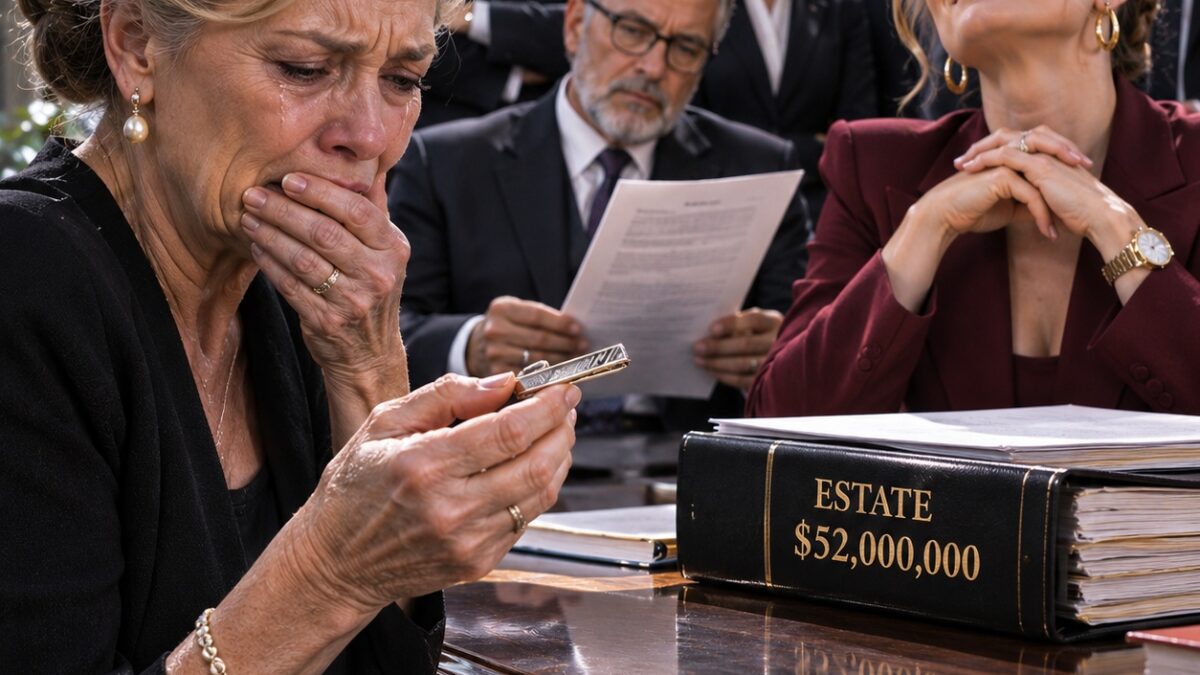
FULL STORY:She Took My Husband’s $52 Million Empire and Left Me With One Silver Tie Clip — By the Time She Discovered Her Mistake, It Was Too Late
FULL STORY CONTINUATION
I didn’t confront Rebecca.
That surprised her.
I could tell.
She lingered after everyone else left the conference room, slowly putting files into her briefcase as if she were waiting for me to break.
Maybe she expected tears.
Maybe anger.
Maybe she wanted me to demand an explanation so she could remind me that the documents were final and I was only an emotional widow who didn’t understand estate law.
Instead, I stood.
I wrapped my scarf around my neck.
And I walked out.
The elevator ride down twenty-two floors felt longer than Patrick’s final week in the hospital.
Outside, the cold air hit my face hard enough to make my eyes water.
But I didn’t cry.
Not yet.
I drove home.
For nearly an hour, I sat in our driveway without turning off the engine.
The house looked different.
Not because anything had changed.
Because now I didn’t know whether it was mine.
That was the first real cruelty of what Rebecca had done.
Money mattered.
Of course it did.
But it wasn’t the money that hollowed me out.
It was the erasure.
The idea that somebody could take forty-three years of breakfasts, hospital rooms, mortgage payments, anniversaries, arguments, private jokes, funerals, business decisions, and ordinary Tuesdays and simply delete my name from the final document.
By late afternoon, I was sitting in the dark in Patrick’s study.
His desk still smelled faintly of cedar and the aftershave he’d worn for twenty years.
I opened the top drawer.
Receipts.
Pens.
Sticky notes.
His favorite mechanical pencil.
I almost closed it.
Then the drawer caught.
It always did.
Patrick used to complain about it.
I used to tell him I liked the squeak because I could hear when he was looking for something.
I pulled harder.
The drawer opened completely.
Behind an old clothbound ledger was a thin manila folder.
I didn’t recognize it.
No label.
No date.
Nothing.
Inside were three sheets of paper.
The first was handwritten.
Patrick’s handwriting.
Shaky, but unmistakable.
I read the first line.
Rebecca wants me to update the will.
I stopped breathing.
The rest was short.
She says the holdings have changed and the language needs to be clearer. I think she’s being careful. Maybe too careful. She has started drafting documents on my behalf.
Then:
I haven’t signed anything yet.
My fingers tightened around the page.
The last line hurt most.
I haven’t told Marietta. She’ll ask questions I’m afraid I don’t have the strength to answer.
I sat back.
For a long time, all I could hear was the ceiling fan.
Patrick had known something was wrong.
Maybe not everything.
But enough to be uneasy.
The second page was a photocopy of a will draft I had never seen.
Red marks crowded the margins.
Sections had been crossed out.
Others rewritten.
Halfway down the page, I found my name.
In the event of my passing, I leave my personal assets, including home shares and designated accounts, to my wife, Marietta Sloan.
A red line had been drawn through the paragraph.
In Patrick’s handwriting beside it:
Discuss with Rebecca.
The third page was a schedule of legal appointments.
Two dates were from the last months of Patrick’s illness.
I knew those weeks by heart.
Chemo on Monday.
Blood tests Wednesday.
Physical therapy Friday.
He had been exhausted.
There were only short windows when I hadn’t been beside him.
And looking at the dates, I realized something.
Those appointments fell inside those exact windows.
The periods when Rebecca had insisted I go home.
“Get some rest,” she would tell me.
“I’ll stay with him.”
I had thanked her.
God help me.
I had thanked her.
I sat in that chair until dawn.
I read Patrick’s note again and again.
Around four in the morning, I opened my purse and removed the tie clip.
I turned it over.
Nothing.
No engraving.
No compartment.
No secret message like something out of a movie.
Just silver.
But Patrick had chosen it.
Or at least Rebecca said he had.
I thought back to the last time I remembered him wearing it.
It had been at his retirement dinner.
Daniel Cow had given it to him.
Daniel.
I hadn’t thought about him in years.
He had been one of Patrick’s oldest advisers.
Not the most important man in the room.
Not the loudest.
But when Patrick needed to know whether something was real or merely convenient, he asked Daniel.
By seven in the morning, I had his number.
My thumb hovered above the call button.
Then I pressed it.
He answered on the second ring.
“Daniel?”
A pause.
“Marietta?”
His voice softened immediately.
“Oh, Marietta. I’m so sorry.”
I swallowed.
“Can we meet?”
There was another pause.
This one different.
“Of course.”
“I need to show you something.”
“When?”
“Today.”
“Give me an hour.”
That was Daniel.
No questions before he understood what the questions were.
We met at a little café off Elm Street.
Same wooden booths.
Same chipped cups.
Same terrible jazz Patrick used to pretend he liked.
Daniel read the three pages without speaking.
When he reached Patrick’s handwritten note, he took off his glasses and rubbed his eyes.
“Did Rebecca know you had this?”
“No.”
“Keep it that way.”
Something in his tone made my stomach tighten.
“You think this matters?”
He looked at me.
“Marietta, this doesn’t look like a man confidently changing his estate plan.”
“What does it look like?”
“A man questioning what’s being done around him.”
He picked up the copy of the amended will.
“Who witnessed the final version?”
“Two names I don’t recognize.”
He read them.
His mouth tightened.
“Patrick always used people he knew.”
“I know.”
“Neighbors. Board members. Friends.”
“I know.”
Daniel took out a notebook.
“We don’t confront Rebecca.”
I almost laughed.
“That was going to be my first question.”
“It would also be your first mistake.”
He began writing dates.
“First we get certified copies of everything filed with the county. Then we compare them with Patrick’s drafts.”
“And then?”
“We follow the paper.”
For the first time since the funeral, I felt something other than grief.
Purpose.
Daniel pointed toward me.
“And you change nothing at home.”
“What do you mean?”
“Don’t let Rebecca know you’re suspicious.”
“I don’t think she comes by unless she wants something.”
“Good.”
He closed the folder.
“Let her think you’re exactly where she left you.”
I looked at him.
“Erased?”
Daniel’s expression hardened.
“Quiet.”
There was a difference.
I was beginning to understand it.
The first week was almost unbearable because nothing happened quickly.
Movies lie about investigations.
They make discovery look like a key turning in a lock.
Real life is paperwork.
Phone calls.
Waiting.
Wrong offices.
Old records.
People who promise to get back to you.
Daniel requested the county filings.
I searched Patrick’s study.
Not frantically.
Carefully.
The calendar was the first thing that mattered.
Patrick kept a leather planner despite owning every electronic device imaginable.
“I trust paper,” he used to say.
“Paper doesn’t beep at me.”
Most entries were ordinary.
Doctors.
Lunches.
Foundation meetings.
Medication reminders I had written myself.
Then I found one name circled twice.
HAL GIVENS.
I remembered Hal vaguely.
Tax consultant.
Former nonprofit adviser.
Patrick had known him through one of the education programs.
I called Daniel immediately.
“Hal Givens.”
“What about him?”
“Patrick met him while he was sick.”
Daniel paused.
“When?”
I read the date.
“That’s six weeks before he died.”
“I’ll contact him.”
Two days later, Daniel called back.
His voice was different.
More urgent.
“Hal remembers Patrick.”
I sat at the kitchen table.
“What did he say?”
“Patrick wanted advice about beneficiary protections.”
My heart started beating faster.
“For me?”
“Yes.”
Daniel continued.
“He specifically asked how to make sure you had permanent housing, healthcare support, and control protections in the trust.”
I closed my eyes.
Patrick had been thinking about me.
That shouldn’t have surprised me.
But after Rebecca’s meeting, I had begun doubting everything.
“What happened?”
“Hal offered to arrange an independent review.”
“And?”
“Patrick never came back.”
My hand tightened around the phone.
“Why?”
“A week later, Rebecca called Hal’s office.”
I already knew.
“She canceled.”
“Yes.”
“What did she say?”
“That Patrick no longer required his services.”
I stood.
“Did Patrick tell her to do that?”
“Hal doesn’t know.”
“Does he have records?”
“Intake notes.”
I sat again.
“Daniel.”
“I know.”
“What does this prove?”
“Not enough by itself.”
The answer frustrated me.
“But combined with Patrick’s handwriting?”
“It shows concern. Intent. Possible interference.”
“Possible.”
“Marietta, I know you want a sentence that says Rebecca did this.”
“I want the truth.”
“Then we have to build something stronger than anger.”
Patrick would have said the same thing.
That annoyed me.
It also steadied me.
The next morning, Daniel introduced me to Lydia Velasquez.
Lydia was a probate litigation attorney in her mid-fifties.
She wore no jewelry beyond a watch.
She wasted no words.
She read everything Daniel had collected.
Then she asked me a question.
“Do you want money or do you want the estate examined?”
I stared at her.
“What’s the difference?”
“The strategy.”
“I want to know what Patrick actually wanted.”
“That answer may help you financially.”
“Fine.”
“It may also hurt.”
“I’ve already been told my husband left me nothing.”
Lydia nodded once.
“Good.”
“Good?”
“You understand the worst-case emotional outcome.”
She opened the disputed will.
“I’m more concerned with process.”
She pointed to the witness signatures.
“Who are they?”
“I don’t know.”
“I do.”
Daniel looked up.
Lydia continued.
“Their names have appeared in another disputed-document matter.”
“Lawyers?”
“Notaries.”
“Rebecca’s?”
“People who have been paid by firms to handle document witnessing.”
My mouth went dry.
“Improperly?”
“In at least one allegation.”
Daniel leaned forward.
“Enough to challenge execution?”
“Not yet.”
Lydia closed the folder.
“But enough to make me very interested.”
We found the trust addendum in Patrick’s old file cabinet.
Unsigned.
Drafted repeatedly.
Covered in his handwritten changes.
My name appeared under a section titled SURVIVOR PROTECTIONS.
Housing.
Healthcare.
Legal support.
Lifetime co-trustee authority.
Beside it Patrick had written:
We talked about this.
Then:
Rebecca said she’d handle it.
I sat on the garage floor holding the document against my chest.
That sentence hurt more than I expected.
Patrick had trusted her.
That was becoming clear.
He hadn’t simply been weak.
He hadn’t abandoned me.
He had handed responsibility to someone he believed would protect both of us.
And Rebecca had somehow turned that trust into control.
Lydia moved quickly after seeing the addendum.
She filed a motion asking the probate court to preserve the estate.
Three days later, she called.
“Granted.”
I stood in my kitchen.
“What does that mean?”
“Temporary freeze. Rebecca cannot transfer major estate assets or retitle property without court scrutiny.”
I closed my eyes.
For weeks, Rebecca had been moving through Patrick’s world as though everything belonged to her.
Now, for the first time, someone had told her no.
I expected anger.
Instead, that afternoon, I received an invitation.
Heavy cream paper.
Embossed lettering.
Rebecca was hosting a tribute to Patrick at the country club.
Cocktails.
A charity auction.
A celebration of his legacy.
I almost tore it in half.
Then I read the list of auction items.
Patrick’s signed baseball.
His vintage fountain pen.
A first-edition novel.
My first-edition novel.
I had given it to him for his fifty-fifth birthday.
Rebecca had taken it from my house and listed it for auction.
I called Daniel.
“I’m going.”
He was quiet.
“Are you sure?”
“Yes.”
“I’ll come.”
“No.”
“Marietta—”
“I’m not going to confront her.”
“Then why go?”
I looked at Patrick’s empty chair.
“Because she needs to see that I still exist.”
The country club was full when I arrived.
People Patrick and I had known for thirty years.
Business partners.
Foundation directors.
Families we had vacationed with.
People who had eaten Thanksgiving dinner in our home.
Rebecca stood near the center of the room in a black dress, greeting everyone with practiced warmth.
When she saw me, her smile flickered.
Only for a second.
Then she recovered.
“Marietta.”
“Rebecca.”
“I’m glad you came.”
Were you?
I almost asked.
Instead, I walked past her.
At the auction table, the first-edition novel sat beneath a little card.
PATRICK SLOAN’S FAVORITE BOOK.
Nothing about me.
I touched the cover.
A man beside me spoke.
“Mrs. Sloan?”
I turned.
He introduced himself as one of Patrick’s former investment partners.
“I’m so sorry for your loss.”
“Thank you.”
“How are you handling everything?”
“One day at a time.”
He nodded.
“And the trust? I assume you’ll keep Patrick’s allocation strategy.”
I stared at him.
“What?”
“The family trust.”
“I’m not the trustee.”
His expression changed.
“Excuse me?”
“Rebecca is.”
“But you and Patrick always—”
“He transferred control.”
The man looked toward Rebecca.
“When?”
“Six months before he died.”
He said nothing.
And that silence told me Rebecca had not been explaining the transition openly.
Before I left, another old board member mentioned something else.
“Rebecca had contacted us before Patrick passed.”
“How long before?”
“A few weeks.”
“About what?”
“Foundation continuity.”
“What did she say?”
“Suggested donation structures. Executive responsibilities. Legal language.”
He seemed to realize he was saying too much.
“I assumed Patrick had approved it.”
“Did the email say that?”
He hesitated.
“No.”
That was when everything hardened inside me.
Rebecca had not simply stepped into a vacancy after Patrick died.
She had prepared for it while he was alive.
I left without saying goodbye.
In the parking lot, I gripped the steering wheel until my knuckles hurt.
For months, I had been asking whether Rebecca had taken advantage of Patrick’s death.
Now I was asking a worse question.
Had she taken advantage of his dying?
Lydia filed the formal contest the following Monday.
Potential fraud.
Undue influence.
Improper execution.
The court scheduled a preliminary hearing and allowed discovery.
That one word changed everything.
Discovery meant emails.
Calendar records.
Digital communications.
Office logs.
Document metadata.
The things people forget still exist after conversations end.
Rebecca had been good at controlling rooms.
Paper was less obedient.
The first email Lydia obtained had been sent six weeks before Patrick died.
Subject:
REVISED STRUCTURE — IMMEDIATE ACTIONS
Rebecca instructed her staff to finalize trust changes quickly.
Then came the line that made my hands go cold.
Remove co-beneficiary privileges per our discussion.
No name.
No explanation.
But those privileges were mine.
Forty-three years reduced to six words.
I read the sentence three times.
Lydia watched me.
“Can you continue?”
“Yes.”
“You don’t have to.”
“Yes, I do.”
More records came.
Sunday execution timestamps.
Late-evening notary entries.
Documents Patrick supposedly signed at Rebecca’s firm on days building access records showed he had never entered.
We requested a forensic handwriting review.
Patrick’s signatures from hospital consent forms were compared with the estate amendments.
The expert would not call the signatures definitely forged.
But there were inconsistencies.
Pressure.
Stroke shape.
Spacing.
Enough to question.
Not enough to conclude.
Then Lydia received a phone call.
One of Rebecca’s former assistants wanted to speak.
Her name was Ava Kendall.
The deposition took place on a Tuesday morning.
Ava arrived wearing jeans and a gray cardigan.
She looked terrified.
Lydia explained everything slowly.
No accusations.
No pressure.
Just facts.
Ava nodded.
“I kept notes.”
Rebecca had involved her in the estate revisions six weeks before Patrick died.
Procedures were rushed.
Review meetings were shortened.
Standard acknowledgement sections disappeared.
One Sunday evening, Ava returned to the office for her jacket.
Rebecca and another employee were in the conference room.
Documents were spread across the table.
Rebecca asked Ava to witness a signature.
“I asked where Mr. Sloan was,” Ava said.
My heart pounded.
“What did she say?” Lydia asked.
“She said he had stepped out.”
“Did you see him?”
“No.”
“Did you see him sign the document?”
“No.”
“Why did you witness it?”
Ava looked down.
“Rebecca told me he had just signed and they were behind schedule.”
“Did that bother you?”
“Yes.”
“How do you know?”
Ava opened her planner.
She turned to the page.
7:43 P.M. SUNDAY — WITNESSED SIGNATURE FOR R. NO P PRESENT.
No Patrick present.
The room became silent.
Ava continued.
She had also noticed formatting changes.
References requiring my acknowledgment as co-trustee had been removed.
And two days before Patrick’s final hospitalization, she overheard Rebecca on the phone.
“What did she say?”
Ava swallowed.
“Something about distributing assets.”
“Exact words, if you remember.”
Ava looked directly at Lydia.
“Liquidate silently. No delays.”
Daniel closed his eyes.
I didn’t.
I wanted to see everything.
Every ugly piece.
Every sentence.
Every date.
Because for months I had felt as though I were losing my mind inside my own marriage.
Now the facts were beginning to answer me.
Rebecca learned about Ava’s deposition within forty-eight hours.
Her attorneys sent me a letter.
It accused me of grief-driven interference.
Personal bitterness.
Harassment.
Abuse of the probate process.
They threatened to pursue legal costs if I did not withdraw.
I read the letter at breakfast.
Then I folded it.
Daniel called.
“How are you?”
“I’m drinking tea.”
“That’s not what I asked.”
“I spent six months watching my husband die.”
I looked out the window.
“I can survive a letter.”
Lydia’s response included Ava’s testimony.
Office security logs.
Patrick’s drafts.
Hal’s intake notes.
Metadata discrepancies.
The handwriting analysis.
The motion was no longer about a widow being unhappy with an inheritance.
It was about whether Patrick Sloan’s final wishes had been lawfully executed at all.
And Rebecca knew it.
The foundation invited me to a formal transition meeting anyway.
That was Rebecca.
Even while the legal structure beneath her was cracking, she kept performing certainty.
The new foundation office was glass and marble.
Beautiful.
Cold.
I arrived five minutes early.
Rebecca sat at the head of the table.
Of course she did.
The meeting began with financial reports.
Donation schedules.
Program updates.
Then Rebecca stood.
She thanked the board for trusting her.
She spoke about Patrick’s vision.
Continuity.
Leadership.
Responsibility.
She even thanked me.
“Marietta stood beside Patrick during his earliest years.”
I almost smiled.
Forty-three years reduced to “earliest years.”
Then she said:
“And now, with her grace, I carry that work forward.”
My grace.
As though I had stepped aside willingly.
As though I had placed the keys in her hand and blessed her takeover.
I reached into my bag.
I removed a small envelope.
Patrick’s oldest friend on the board sat beside me.
I passed it to him.
He raised an eyebrow.
“Please read it.”
Inside was Ava’s notarized statement.
A summary of Lydia’s court filing.
And a copy of the trust provision Rebecca had altered.
He read.
His face changed.
Then he passed it to the next director.
And the next.
Paper traveled quietly around the table.
Rebecca noticed.
“What is that?”
Nobody answered.
Her smile tightened.
When the envelope returned to me, I stood.
“Thank you for inviting me.”
Rebecca’s voice sharpened.
“Marietta.”
I looked at her.
“My attorney can answer any questions the board has.”
Then I walked out.
No shouting.
No accusations.
No dramatic speech.
I didn’t need one.
By the time I reached home, three board members had called Lydia.
The vote transferring full executive authority to Rebecca was postponed.
An independent review was requested.
For the first time, Rebecca’s greatest weapon—certainty—was gone.
People were questioning her.
And all I had done was let them read.
The silence that followed lasted almost a week.
No threats.
No letters.
No messages.
Lydia warned me not to mistake it for peace.
“They’re regrouping.”
But I wasn’t frightened anymore.
I had stopped trying to predict Rebecca.
Instead, I returned to ordinary things.
I watered the plants.
I cleaned Patrick’s study.
I made the soup he loved.
I walked around the neighborhood at dusk.
I began remembering that my life had existed before the lawsuit and would continue after it.
Then, on Sunday afternoon, Lydia called.
“Rebecca’s attorneys contacted us.”
My chest tightened.
“What now?”
“They’re not challenging the trust inquiry.”
I sat down.
“What?”
“Rebecca is withdrawing from her position as managing executive of the foundation.”
I said nothing.
“She isn’t admitting wrongdoing,” Lydia continued. “The statement says she wants to preserve the foundation’s reputation.”
“Of course.”
“But she’s stepping aside.”
I looked toward the garden.
Patrick’s maple trees were bare.
For months, I had imagined this moment.
I thought I would feel victorious.
I didn’t.
I felt tired.
Then relieved.
Then sad.
Not for Rebecca.
For all of us.
For Patrick, who had trusted the wrong person.
For me, who had almost believed his silence meant he had chosen to abandon me.
For a family that had turned love and legacy into paperwork and control.
“Marietta?”
“I’m here.”
“Are you okay?”
“Yes.”
And I was.
Not joyful.
But steady.
The foundation formed an interim oversight committee made up largely of people who had worked with Patrick in the early years.
One of them sent me a short note.
You were right to protect what mattered.
I kept that note.
Not because it proved I had won.
Because somebody finally understood what I had been trying to do.
Lydia later laid out my options.
We could pursue damages.
Restitution.
Broader allegations.
Additional litigation.
“Do you want to continue?” she asked.
I thought about Rebecca.
About courtrooms.
Lawyers.
Months becoming years.
“No.”
Lydia studied me.
“Are you sure?”
“Yes.”
“Why?”
“Because I know what Patrick wanted now.”
“And the money?”
“I want what I’m legally entitled to under the restored trust.”
“That may be substantial.”
“I understand.”
“But no punitive action?”
“No.”
Daniel frowned slightly.
“Marietta, after what she did—”
“I’m not protecting Rebecca.”
I looked at him.
“I’m protecting what’s left of my life.”
That was the difference revenge never understands.
Winning every battle can still leave you trapped inside the war.
I didn’t want to spend the rest of my years waking up thinking about Rebecca.
I wanted to think about Patrick.
The real Patrick.
The complicated man who had loved me, made mistakes, trusted badly, and left pieces of the truth behind because somewhere inside his illness he realized something was wrong.
The most important piece came after the fighting was nearly over.
I was cleaning Patrick’s desk when I found another envelope.
It had been tucked behind an old ledger.
No label.
No instruction.
Inside was an earlier will.
Dated one year before the disputed revision.
My name appeared throughout it.
Lifelong co-trustee.
Housing protections.
Income.
Medical support.
Foundation authority.
But it was the handwritten notes in the margins that made me cry.
Patrick had written reminders to himself.
M and I discussed this in Maine.
Keep the scholarship fund independent.
House remains hers regardless of trust changes.
And near the end:
Family is not only blood or name. It is who stands beside you when no one is watching.
I read that sentence until the words blurred.
For months, I had wanted Patrick to speak to me from beyond the grave.
Not literally.
I wasn’t foolish.
I wanted something that told me the man I had loved for forty-three years had not consciously erased me.
This was it.
Not a perfect legal instrument.
Not some miraculous secret will that instantly solved everything.
Just intention.
His intention.
His handwriting.
His voice.
I touched the silver tie clip sitting beside me.
And suddenly I remembered something.
At Patrick’s retirement dinner, Daniel had given him that clip.
Later that night, Patrick held it up and said:
“Daniel says details matter because people who lie usually concentrate on the big picture.”
I had laughed.
“What does that even mean?”
“It means everybody watches the expensive watch.”
He clipped the little silver bar onto his tie.
“Nobody watches the tie clip.”
I sat completely still.
The tie clip had never contained a hidden message.
Patrick hadn’t left me a puzzle box.
But it had brought me back to Daniel.
Maybe intentionally.
Maybe not.
I would never know.
And somehow, I no longer needed to.
Patrick didn’t have to orchestrate everything after his death for our marriage to have meant something.
He was sick.
He was frightened.
He trusted Rebecca too much.
He failed to tell me what was happening.
Those were painful truths.
But they were human truths.
I took the earlier will to Daniel.
“Can you preserve this?”
“For the case?”
“No.”
He looked surprised.
“For history.”
We archived it with Patrick’s papers.
Not as a weapon.
As part of the record.
A few weeks later, I returned to the foundation.
The office felt different.
Not warmer exactly.
Just less theatrical.
People asked me questions.
Real questions.
One director wanted advice about a scholarship program Patrick and I had helped create twenty years earlier.
Another asked if I remembered why he had insisted on separating educational grants from operating funds.
I did.
Patrick worried that one day somebody would use the scholarship money to cover administrative shortages.
“He said children shouldn’t lose opportunities because adults overspent on buildings,” I told them.
The director smiled.
“That sounds like him.”
“It is.”
Nobody offered me Rebecca’s old position.
I didn’t want it.
That mattered.
Once, I had thought restoration meant getting every chair back.
Every title.
Every dollar.
Every public acknowledgment.
Now I understood something better.
You can reclaim your place without occupying the seat of the person who tried to erase you.
I helped where I wanted.
I left when I wanted.
I belonged because I had built part of it.
Not because someone appointed me.
At home, I began changing things.
Slowly.
I moved Patrick’s cane from the back door.
That was harder than I expected.
I cried while carrying it upstairs.
I donated some of his clothes.
Kept others.
I packed his hospital bag.
I left his books where they were.
Grief stopped feeling like an emergency.
It became something I carried.
Some days heavier.
Some days almost gentle.
My name was formally restored in the trust records.
The original co-trustee protections were acknowledged.
The court-supervised review resolved the contested amendments.
The estate was redistributed according to the corrected structure.
Rebecca did not attend the final meeting.
I didn’t ask why.
Daniel sat beside me.
Lydia sat across from us.
When the last document was signed, Lydia closed the folder.
“That’s it.”
I stared at her.
“That’s it?”
“Yes.”
No music.
No applause.
No one burst through the door to confess.
A legal fight that had consumed months of my life ended with a folder closing.
I started laughing.
Daniel smiled.
“What?”
“I expected something bigger.”
Lydia smiled too.
“Most endings are paperwork.”
Patrick would have loved that.
Spring arrived slowly.
The first daffodils appeared in the community garden behind a center Patrick and I had helped fund years ago.
I visited one morning.
A plaque stood beside the path.
Weathered now.
The inscription read:
IN HONOR OF THOSE WHO PLANT FOR A FUTURE THEY MAY NEVER SEE.
Patrick chose that sentence.
I had argued it was too sentimental.
He told me I was emotionally defective.
I told him he was dramatic.
We were both laughing when the plaque was unveiled.
Standing there years later, I finally understood why he loved it.
Legacy isn’t control.
It isn’t whose name appears first on a letterhead.
It isn’t whether somebody gets the larger office.
Legacy is what survives after the people who built something are no longer there to defend it.
Rebecca thought Patrick’s legacy was authority.
The estate.
The foundation.
The trust.
She wanted control of the machinery.
But Patrick’s real legacy had escaped her long before she tried to own it.
It was in scholarship recipients.
Community programs.
Board members who remembered his principles.
Documents covered in his handwriting.
And in me.
A few weeks later, I received a letter from a young woman who had received one of our first education grants.
She was now working at a nonprofit mentoring girls from the neighborhood where she grew up.
She wrote:
I don’t know whether you remember me, but the scholarship changed the direction of my life.
I remembered her.
Barely.
Patrick remembered every student.
I cried reading the letter.
Then I placed it beside his photograph.
“That’s your legacy,” I whispered.
Not the $52 million.
Not the house.
Not the boardroom.
That.
Rebecca contacted me once.
Months after she stepped down.
She asked to meet.
We chose a quiet café halfway between our homes.
She arrived first.
No designer briefcase.
No assistant.
No board agenda.
Just Rebecca.
For the first time since Patrick died, she looked tired.
Really tired.
She wrapped both hands around her coffee.
“I owe you an explanation.”
I sat across from her.
“You owe me more than one.”
She nodded.
“I know.”
I waited.
Rebecca looked toward the window.
“When Patrick got sick, everything became unstable.”
“For him.”
“For all of us.”
“You were still flying to conferences.”
Her jaw tightened.
“I was managing the foundation.”
“You were managing your career.”
“Yes.”
The honesty surprised me.
“I thought if I could control the estate structure, I could protect what he built.”
“From whom?”
She looked at me.
“From uncertainty.”
I almost laughed.
“That isn’t a person, Rebecca.”
“I know that now.”
“Did Patrick ask you to remove me?”
She looked down.
“No.”
The answer hurt despite everything I already knew.
“Did he ask you to take control?”
“He told me to simplify things.”
“That wasn’t my question.”
“No.”
I let the silence remain between us.
“Did you believe you were entitled to it?”
She looked at me.
“At the time?”
“Yes.”
“Yes.”
There it was.
Not grief.
Not confusion.
Entitlement.
“I thought you would keep the house,” she continued.
“You knew I had been removed from the trust.”
“I thought arrangements could be made.”
“After you controlled everything.”
She didn’t answer.
I leaned forward.
“You stood at that conference table and said there were no remaining distributions assigned to me.”
“I know.”
“You didn’t even look at me.”
“I couldn’t.”
That surprised me.
“Why?”
“Because I knew exactly what I had done.”
For a moment, I saw something I had refused to imagine.
Shame.
Not enough to excuse her.
But real.
“Why invite me to the country club?”
She smiled bitterly.
“Because I wanted everybody to see that everything was under control.”
“Even me.”
“Especially you.”
“And the foundation meeting?”
“The same.”
I nodded.
“At least you’re consistent.”
Rebecca almost smiled.
Then her face collapsed again.
“I’m sorry.”
I waited.
The words sounded smaller than I expected.
Not meaningless.
Just insufficient.
“I don’t forgive you yet,” I said.
She nodded.
“I understand.”
“I may never.”
“I understand.”
“But I don’t want to hate you.”
Her eyes filled.
“Why?”
“Because that would still give you too much space in my life.”
We sat quietly for a while.
Then I stood.
“Goodbye, Rebecca.”
“Marietta?”
I stopped.
“I did love Patrick.”
I looked at her.
“I know.”
“And I thought I was protecting his work.”
“You were protecting your right to control it.”
Her eyes dropped.
“There’s a difference.”
I left.
That was the last private conversation we ever had.
The annual donor luncheon arrived in early spring.
For decades, Patrick and I had attended together.
Then his health declined.
Then everything else happened.
When the invitation came, my name appeared under HONORED GUESTS.
I almost threw it away.
Not because I was angry.
Because I wasn’t sure I needed that room anymore.
That was new.
For most of the previous year, every room Rebecca controlled had felt like somewhere I needed to reclaim.
Now I could choose.
I went.
Not to prove anything.
Because I wanted to.
I wore a soft gray suit and pinned Patrick’s old silver oak-tree pin to my collar.
The ballroom looked the same.
Round tables.
Polished floors.
Soft music.
Wine glasses waiting at every place setting.
Rebecca’s name was nowhere in the program.
I noticed.
Then I stopped thinking about it.
During lunch, people came to speak to me.
Some apologized for not calling.
Others behaved as though nothing had happened.
I accepted what I could.
Ignored what I couldn’t.
Near the end, a younger board member named Lee approached the stage.
She spoke about the scholarship initiatives.
The community center.
Patrick’s early vision.
Then she paused.
“There is someone here today who was part of that vision long before many of us joined the foundation.”
I looked down.
She said my name.
Not ceremonially.
Not theatrically.
Warmly.
“Marietta Sloan.”
People turned.
Lee continued.
“Some institutions survive because people fight loudly for them. Others survive because somebody quietly refuses to let the truth be rewritten.”
My throat tightened.
“She has done that for this foundation.”
Applause began.
Soft at first.
Then stronger.
I stood.
Only for a moment.
I nodded.
Then I sat.
I didn’t need to speak.
That was the strange thing.
For months, I had fought because I believed being erased meant I needed to force everybody to hear me.
Now my name had returned to the room.
And silence no longer felt like disappearance.
It felt like choice.
That evening, I walked home alone.
The bookstore Patrick loved still had its lights on.
In the front window was a copy of his favorite novel.
The same title Rebecca had tried to auction.
I stopped.
I laughed.
Then I went inside and bought it.
The cashier asked if it was a gift.
“Yes,” I said.
“For who?”
I thought about Patrick.
Then about myself.
“For me.”
At home, I made tea.
I opened the back door.
Spring air moved through the kitchen.
Patrick’s chair was empty.
It would always be empty.
Nothing Rebecca did had caused that.
Nothing I won could undo it.
That was another truth I had finally accepted.
I carried my tea to the study.
The silver tie clip lay on the desk.
Beside it were Patrick’s notes.
Ava’s statement.
The restored trust documents.
The letter from the scholarship recipient.
And the earlier will.
I touched the tie clip.
When Rebecca handed it to me after the funeral, I thought it was almost insulting.
A tiny object for a forty-three-year marriage.
Now I understood why I had kept it.
It reminded me of the moment everything changed.
Not because Patrick had hidden a secret code inside it.
Not because he had predicted what would happen.
But because it forced me to ask the first question.
Why?
Why would Patrick leave me nothing?
Why would he remove me without a conversation?
Why would a man obsessed with details allow his estate to become vague precisely when he was most vulnerable?
Why had Rebecca been so prepared?
Questions had saved me.
Not suspicion alone.
Not anger.
Questions followed by evidence.
Evidence followed by patience.
And patience followed by truth.
I looked around the room.
Months earlier, I had sat in that same chair feeling like a stranger inside my own home.
Now I noticed everything that was still mine.
The books Patrick and I chose together.
The desk we argued about buying.
The dent in the wall from the year he tried to move a filing cabinet by himself.
The photograph of us in Maine.
The ugly ceramic bowl our niece made when she was eight.
The ordinary evidence of a life.
No will could erase that.
No executive title could replace it.
No board vote could transfer it.
I had spent months thinking the fight was about Patrick’s $52 million estate.
It wasn’t.
The money mattered because security matters.
Fairness matters.
Law matters.
But the real fight had been over authorship.
Who got to decide what my marriage meant after Patrick could no longer speak?
Who got to decide whether forty-three years were a partnership or an inconvenience?
Rebecca believed the person controlling the paperwork controlled the story.
For a while, I believed her.
Then I found Patrick’s handwriting.
Then Hal’s notes.
Then Ava’s planner.
Then the emails.
Then the security logs.
Then the trust drafts.
No single piece saved me.
Together, they did.
Truth often works like that.
Not as one dramatic revelation.
As a hundred small things refusing to stay buried.
I poured another cup of tea.
Outside, the maple trees moved gently in the wind.
Patrick had planted them thirty years earlier.
He told me they would probably outlive us.
He was right about one of us.
I smiled.
“I’m still here,” I whispered.
The room stayed quiet.
But this time, the quiet didn’t feel empty.
It felt full.
Of memory.
Of evidence.
Of grief.
Of love.
Of everything I had almost allowed someone else to redefine.
I picked up the new copy of Patrick’s favorite novel and opened it to the first page.
Then I laughed because I remembered exactly what he used to do.
Whenever he bought me a book, he wrote inside the cover.
Not something profound.
Usually something ridiculous.
I found a pen.
And in my own handwriting, I wrote:
For Marietta.
You were never erased.
I closed the book.
For the first time since Patrick died, I did not feel like his widow sitting inside the ruins of a life.
I felt like myself.
Marietta Sloan.
Wife.
Partner.
Witness.
Woman.
Still here.
Still standing.
Still capable of deciding what happened next.
And when I turned off the study light, I left the documents in the drawer unlocked.
I didn’t need to hide them anymore.
The truth had already been seen.
The record had been corrected.
My place had been restored.
And the woman Rebecca once expected to disappear had finally learned the most important thing Patrick could never have written into any will.
A name can be crossed out on paper.
A voice can be ignored in a conference room.
A seat can be taken.
A title can be stolen.
But a life you actually lived cannot be rewritten simply because somebody else holds the pen.
Not if you are still here to pick up your own.

