FULL ENDING:The Pen Was Already in My Hand When a Stranger Whispered Something That Made Me Look at My Sister’s Husband Differently
FULL ENDING  Thank you

“She wouldn’t want this,” he had told me gently.
And I had believed him.
Why wouldn’t I?
I had known Victor for more than two decades.
He was my brother-in-law.
My sister had trusted him with everything.
Her money.
Her medical decisions.
Her home.
Her life.
Then this stranger grabbed my wrist and said ten words that changed everything.
Victor cleared his throat.
“Is there a problem?”
The woman didn’t release me.
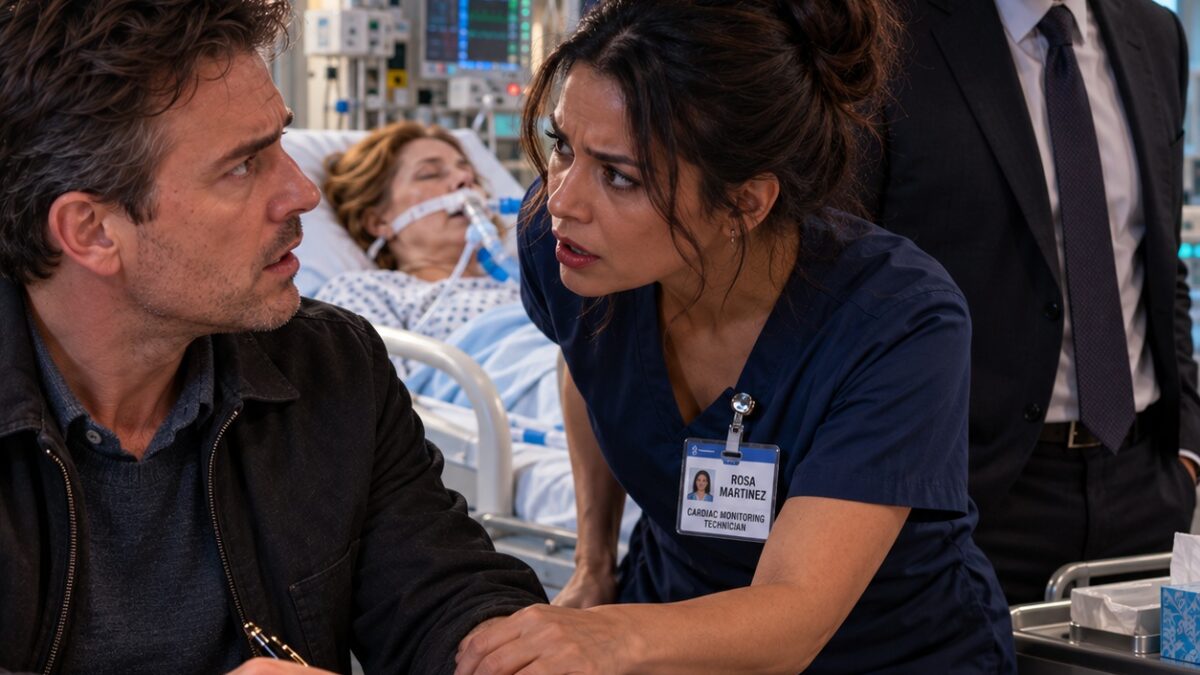
Her badge read:
ROSA MARTINEZ
CARDIAC MONITORING TECHNICIAN
NIGHT SHIFT
“This is a family matter,” Victor continued.
His voice was still calm.
But something inside it had tightened.
Rosa looked at me.
Not him.
“Hospital protocol requires that I clarify a discrepancy before these documents are signed.”
Victor’s jaw moved.
“What discrepancy?”
“I need ten minutes.”
Rosa still watched me.
“If I’m wrong, you can sign everything afterward.”
Her fingers tightened slightly.
“But if I’m right and you sign now, nobody gets another chance.”
Victor looked at the pen.
Only for a moment.
But I saw it.
I had spent forty years auditing medical claims, insurance records, hospital billing, compliance files, and numbers designed to look innocent.
Numbers had taught me something people often didn’t.
When someone wants you focused on the obvious thing, watch what they glance at when they think you aren’t paying attention.
Victor wasn’t looking at my sister.
He was looking at the signature line.
I put the pen down.
Victor stared at me.
“Martha.”
My heart was pounding so violently I could hear it beneath the ventilator.
“What are you doing?”
I looked at him.
Then at Rosa.
“Taking ten minutes.”
I didn’t know those ten minutes would expose an attempted murder.
I didn’t know they would uncover falsified medical records, a secret relationship, a bribed physician, and a $4.2 million reason my sister was worth more to Victor dead than alive.
I only knew that a terrified woman had stopped my hand.
And something inside me believed her.
Four days earlier, my phone had rung just after sunrise.
I was standing barefoot in my kitchen in Santa Teresa, New Mexico, waiting for coffee.
Victor’s name appeared on the screen.
He never called that early.
I answered immediately.
“Victor?”
“Martha.”
Something in his tone made me set down the mug.
“What’s wrong?”
“It’s Lillian.”
I remember the steam rising from my coffee.
I remember sunlight just beginning to reach the kitchen window.
And I remember how controlled he sounded.
Not calm exactly.
Controlled.
He said Lillian had collapsed overnight.
He claimed he found her on the bedroom floor when he got up to wake her.
Paramedics arrived quickly.
She had suffered what doctors believed was a catastrophic stroke.
“She’s alive?”
I asked.
Victor paused.
“Technically.”
That word bothered me immediately.
Technically.
“She is on a ventilator.”
“Can I talk to the doctor?”
“The neurologist will call you.”
“What happened?”
“I told you.”
“No.”
I gripped the edge of the kitchen island.
“What happened before she collapsed?”
“She was asleep.”
“No headache?”
“No.”
“Dizziness?”
“Martha, she was asleep.”
He sounded annoyed.
Then he corrected himself.
Softer.
“I am sorry.”
I closed my eyes.
“I’m trying to understand.”
“I know.”
He exhaled.
“They don’t think there’s meaningful brain activity.”
“How long has she been there?”
“Since around three.”
“And they’re already saying that?”
“The scans are bad.”
He continued speaking in complete sentences.
Hospital.
Room number.
Attending physician.
Ventilator.
Neurological prognosis.
Then he said:
“Lillian would not want to live like this.”
I opened my eyes.
“Victor.”
“We need to prepare ourselves.”
Prepare ourselves.
She had been in the hospital only hours.
The phrase sounded too finished.
Too rehearsed.
I asked again to speak with a physician.
He said one would call.
No one did.
Then, almost casually, he mentioned paperwork.
“There may be decisions that require family authorization when you arrive.”
“Why me?”
“You’re her sister.”
“You’re her husband.”
“There are circumstances where they prefer another relative involved.”
I didn’t know enough in that moment to challenge him.
So I packed.
Six hours of desert highway separated Santa Teresa from the El Paso hospital.
The entire drive, Lillian kept appearing in pieces.
Her laugh.
Loud and sudden.
The way she hummed while cooking.
The way she refused to throw away glass jars because “somebody will need one eventually.”
The text she’d sent me two nights before Victor called.
We need to talk when you have time.
I am thinking of making some changes.
No explanation.
I had answered:
Call tomorrow?
She replied:
Soon.
We never talked.
That text haunted me the entire drive.
I went first to their house because Victor told me he was at the hospital and I could pick up some clothing for Lillian.
The house was too neat.
That’s difficult to explain unless you’ve walked into a home where something terrible supposedly happened.
I expected disorder.
A dropped blanket.
A glass knocked over.
Something.
Instead, every surface was clean.
Bed made.
Bathroom tidy.
Kitchen counters empty.
There was a faint chemical smell in the bedroom.
Not bleach.
Something medicinal.
I couldn’t place it.
Lillian’s phone was missing from the nightstand.
Victor later told me police had taken it.
I accepted that at the time.
At the hospital, he hugged me.
His arms were stiff.
Then he immediately began talking.
“The neurologist believes the stroke was massive.”
We hadn’t even left the lobby.
“He said there is almost no chance.”
“Which neurologist?”
“Dr. Barnes.”
“Can I speak to him?”
“Tomorrow.”
“Why not now?”
“He’s gone.”
We entered the elevator.
Victor kept talking.
Insurance.
Ventilation.
Costs.
Prognosis.
The vocabulary of death before I had even seen my sister.
When we reached the ICU, Lillian looked asleep.
Not dying.
Not damaged.
Asleep.
I know how irrational that sounds.
A person can look peaceful while critically ill.
I knew that.
Still, something bothered me.
Her skin was warm.
Color normal.
Her chest rose perfectly with the ventilator.
Too perfectly.
She looked less like someone fighting a catastrophic neurological injury than someone being kept deeply sedated.
I told myself grief was making me suspicious.
The next two days passed in a kind of hospital fog.
Doctors appeared briefly.
They used careful phrases.
“Severe injury.”
“Poor prognosis.”
“Minimal meaningful response.”
“Unlikely recovery.”
Every time I asked to see detailed EEG results or neurological imaging, there was a reason I couldn’t.
Still under review.
Not uploaded yet.
Attending physician would explain.
Another consultant would come tomorrow.
Tomorrow kept moving.
Victor was always present when doctors entered.
Always.
He stood near the bed with one hand on the rail.
He answered questions before anyone could finish asking them.
One neurologist said:
“Any history of headaches?”
Victor immediately replied:
“No.”
I looked at him.
Lillian had complained about headaches twice that month.
Nothing severe.
But she had mentioned them.
Before I could speak, Victor continued.
“No dizziness.”
“No medication changes.”
“Perfectly healthy.”
The doctor wrote something.
Moved on.
I began to realize Victor wasn’t simply participating in her care.
He was controlling the story.
Then Naomi appeared.
Tall.
Elegant.
Perfect hair.
Neutral-colored clothes that looked expensive.
Victor introduced her late the first night.
“This is Naomi.”
Naomi smiled.
“I’ve been helping with coordination.”
“What kind of coordination?”
“Patient support.”
I looked for a hospital badge.
Nothing.
“What organization?”
She smiled again.
“I’m just helping Victor navigate everything.”
Victor changed the subject.
Naomi seemed to exist everywhere.
Hallway.
Waiting area.
Cafeteria.
Near Lillian’s room.
She stood too close to Victor.
Touched his arm casually.
Leaned toward him when speaking.
They shared glances that looked less like grief and more like timing.
I once asked a nurse:
“Is Naomi with the hospital?”
The nurse frowned.
“Who?”
That answer stayed with me.
So did Victor’s obsession with money.
He never said:
“I need her gone.”
Of course not.
He said:
“She wouldn’t want savings drained.”
“Insurance won’t cover everything forever.”
“This isn’t living.”
“Every day here costs thousands.”
“Lillian believed in dignity.”
Dignity became his favorite word.
One afternoon, he thought I was in the restroom.
I heard him in the hallway.
His tone was different.
Hard.
“We cannot wait much longer.”
Pause.
“It needs to happen while the assessment stands.”
I stepped out.
Victor saw me.
His face changed immediately.
“Martha.”
“Everything okay?”
“Yes.”
He smiled too quickly.
“Do you need anything?”
“No.”
That night, I watched Lillian more carefully.
Her hands weren’t rigid.
Her skin remained warm.
When a nurse suctioned her airway, her brow seemed to pull together.
Barely.
A tiny crease.
I pointed it out to Victor.
“Reflex.”
“How do you know?”
“The doctor told me.”
“Which doctor?”
“Martha.”
He sighed.
“You need to stop looking for signs that aren’t there.”
Maybe he was right.
Maybe I was a sister inventing hope.
I almost accepted that.
Then I tried to access Lillian’s medical portal.
Restricted.
Victor had full access.
I did not.
That made sense legally.
He was her spouse.
Still, everything seemed to narrow through him.
Information.
Doctors.
Paperwork.
Access.
And everyone around him seemed strangely rushed.
That became the question I couldn’t dismiss.
If Lillian were truly gone, why was everyone so afraid of time?
Why not wait another day?
Another scan?
Another neurological consultation?
Why did Victor need documents now?
Why did Naomi keep checking the clock?
Why did someone keep reminding me that prolonged treatment was expensive?
By the third morning, I was no longer asking whether something was wrong.
I wanted to know how much was wrong.
Then Rosa grabbed my wrist.
She took me down a side corridor.
Past storage.
Through a monitoring station.
Into a cramped technical room filled with dim screens and humming equipment.
She closed the door.
Only then did she release me.
Her hands were shaking badly now.
“I could lose my job.”
I sat.
“What did you see?”
Rosa swallowed.
“I work nights.”
“I know.”
“Cardiac and neurological monitoring.”
She turned one screen.
Lines pulsed across it.
I had spent enough years around claims and hospital documentation to know what some of them represented.
Not enough to interpret them.
Enough to know they weren’t flat.
“They told you your sister has no meaningful brain activity.”
“Yes.”
Rosa looked directly at me.
“That is not true.”
I stopped breathing.
“What?”
“She has responses.”
“What kind?”
“Small.”
Rosa pointed at the screen.
“Inconsistent.”
“Isn’t that what reflexes do?”
“Some.”
She clicked through another set of data.
“But when sedation is lowered, her heart rate changes.”
Another.
“Facial muscles respond.”
Another.
“Neurological activity increases.”
My hands began shaking.
“She is not brain dead.”
“The doctor said—”
“The doctor sees what is in the chart.”
Rosa leaned closer.
“And the chart isn’t clean.”
She took out her phone.
Opened a private folder.
Screenshots.
Medication administration logs.
Time stamps.
She had circled several in red.
“What am I looking at?”
“Sedatives.”
She scrolled.
“Every time Victor has prolonged private access, sedation increases within an hour.”
I stared.
“Victor can’t order medication.”
“No.”
“Then who does?”
“That is the problem.”
Orders appeared.
Then were altered.
Some were backdated.
Others disappeared from active view.
Rosa had photographed them before changes.
“How?”
“Someone with medical access.”
Naomi entered my mind immediately.
“Is Naomi clinical staff?”
Rosa shook her head.
“I have never found a badge.”
“What about the attending physician?”
Rosa’s face tightened.
“I reported the pattern.”
“To whom?”
“My supervisor.”
“What happened?”
“I was told not to speculate.”
“That’s it?”
“They said the attending approved everything.”
Rosa hesitated.
Then:
“The attending physician knows Victor.”
“How?”
“I’ve seen them together.”
“Hospital?”
“Cafeteria.”
“Talking?”
“Like friends.”
The room seemed smaller.
“There is more.”
Rosa swiped again.
“Two nights ago, I came in early.”
“What time?”
“About one-thirty.”
“I saw Victor and Naomi in Lillian’s room.”
“Alone?”
Rosa nodded.
“Door closed.”
“Allowed?”
“No.”
“When I entered, the infusion pump had been changed.”
She showed me a photograph.
Medication bag.
Label.
Dosage.
“I had set up the previous concentration.”
“This one was wrong.”
“How wrong?”
“Too high.”
My stomach dropped.
“Fatal?”
“Not immediately.”
“What would it do?”
“Keep her profoundly unresponsive.”
“Make assessments worse?”
Rosa looked at me.
“Yes.”
Another photo.
Victor leaning toward the infusion pump.
Another.
Naomi near the door.
Watching the hallway.
“I copied everything.”
“Why?”
“I was afraid they would erase it.”
“Why haven’t you called police?”
Rosa’s eyes filled.
“I didn’t know what I could prove.”
“You have photographs.”
“I have medical irregularities.”
She shook her head.
“And Victor is her legal medical decision-maker.”
“Then why did you stop me?”
Rosa’s face changed.
Because now we reached the point that frightened her most.
“Without your signature, they can’t move forward with the comfort-care authorization they want.”
The words took several seconds to settle.
“What?”
“Victor’s authority isn’t enough under the current circumstances.”
“Why?”
“There are questions around the directive.”
She swallowed.
“They need another family signature.”
“Mine.”
“Yes.”
I thought about the paper.
The pen.
Victor’s eyes.
Rosa whispered:
“They are waiting for you.”
My skin turned cold.
“They need it to look like mercy.”
I leaned back.
If Rosa was correct, my sister wasn’t being kept alive while her brain failed.
She was being kept unconscious while people built a medical record claiming she had already failed.
Then they needed me to authorize the thing that would actually kill her.
“How much time?”
Rosa looked at the clock.
“I don’t know.”
“Hours?”
“Maybe less.”
I stood.
“What are you doing?”
“Making them think I’m still signing.”
Rosa looked terrified.
“Martha.”
“If they know I believe you, they’ll change something.”
“What then?”
“We get someone outside the attending team.”
“How?”
“You know another neurologist?”
She hesitated.
“Chief of neurology.”
“Can you reach him?”
“Yes.”
“Then reach him.”
“What about Victor?”
I opened the door.
“Let him watch the pen.”
While Rosa moved, I went back to the visitor lounge.
I needed to understand motive.
Fear can make you see conspiracies everywhere.
Motive helps separate theory from reality.
I had been retired for several years, but forty years in medical claims had left habits.
You follow records.
Public filings first.
Victor and Lillian appeared comfortable.
House overlooking El Paso.
New cars.
Travel.
But comfort can be debt wearing expensive clothing.
Property records showed two commercial developments associated with Victor.
Both refinanced recently.
Both delayed.
Liens.
One already in default.
That changed the shape of things.
Then I thought about insurance.
Lillian had always believed in it.
Life.
Long-term care.
Disability.
I remembered her mentioning a policy years earlier.
Through records I could legally access as family under existing paperwork, I found the update.
Six months earlier.
Policy value:
$4.2 million.
Beneficiary:
Victor.
Sole beneficiary.
I stared at the screen.
Six months.
Around the time Lillian had first said things felt strange.
Around the time she asked me questions about estate planning.
Around the time she mentioned wanting to redirect part of her future estate toward charities she cared about.
I remembered one conversation.
“Martha, do you think it’s strange to leave money somewhere your spouse doesn’t control?”
“Depends.”
“He thinks everything should stay inside the family.”
“What do you think?”
“I think family can include more than the person you’re married to.”
I had laughed.
I wish I hadn’t.
Then I heard voices.
Victor and Naomi.
Coming closer.
I stayed still.
Victor:
“This has gone on long enough.”
Naomi:
“Stay calm.”
“She should have signed already.”
“Pressure creates mistakes.”
Then Naomi said:
“We just need her cooperation.”
Cooperation.
Not consent.
Not understanding.
Cooperation.
“Once the papers are signed, the rest is automatic.”
My body went rigid.
“No one questions comfort care.”
Her voice became lower.
“It is designed to end quietly.”
Victor exhaled.
“And then we’re free.”
Free.
From debt.
From consequences.
From Lillian.
Their shadows stopped outside the lounge.
I stared at the floor.
This wasn’t panic.
It wasn’t a desperate husband making one terrible decision.
It was architecture.
Legal wording.
Hospital procedure.
Medication.
Timing.
A death built slowly enough to look compassionate.
They entered.
I gave them the face they expected.
Tired.
Defeated.
“I am sorry.”
Victor’s shoulders relaxed.
“I needed a moment.”
Naomi smiled.
“Of course.”
“These decisions are heavy.”
“Yes.”
I looked at both of them.
“Especially when so much is at stake.”
Victor missed it.
“Ready?”
“Almost.”
We walked back toward Lillian’s room.
The documents remained exactly where I’d left them.
Victor had even straightened the pen.
I sat beside my sister.
Picked up the first page.
Read slowly.
Victor stood close.
“We really should not delay.”
“I know.”
Naomi moved nearer.
“I need to understand one thing.”
“What?”
She asked.
“The neurological assessments.”
Victor stiffened.
“What about them?”
“I want the exact timeline.”
I looked toward the chart.
“Especially the assessments performed after sedation increases.”
Victor answered too fast.
“The doctors handled all that.”
“I know.”
I looked at him.
“But I am being asked to authorize an irreversible decision.”
Naomi smiled tightly.
“This isn’t the time for an audit.”
She had no idea how badly she had chosen the wrong word.
I had spent most of my career auditing people who said exactly that.
Then an announcement sounded from the station.
“Code consult, ICU three.”
Victor’s head turned.
“What is that?”
Naomi answered immediately.
“Probably routine.”
I stood.
“I need water.”
Victor looked like he wanted to stop me.
He couldn’t.
Too many nurses around.
I stepped into the hallway.
Rosa stood at the station.
Beside her was an older physician I hadn’t seen before.
Gray hair.
Tablet.
His face looked furious.
“Dr. Newman,” Rosa whispered.
“Chief neurologist.”
He looked up.
“You’re Lillian Hail’s sister?”
“Yes.”
“Come here.”
No greeting.
No reassurance.
“Your sister is not brain dead.”
My knees nearly gave.
“What?”
“Her sedation level is dangerously high.”
He turned the tablet.
“Medically unjustified.”
He pointed.
“Her EEG demonstrates preserved neurological activity.”
I pressed one hand against the counter.
“That means?”
“It means the previous prognosis was not adequately supported.”
“Can she recover?”
“I cannot promise that.”
His voice remained blunt.
“But she should never have been placed on a path toward withdrawal based on this data.”
“What happened?”
“Someone altered the treatment plan.”
Behind me, Victor’s voice rose.
“What is going on?”
Rosa looked toward security.
“We need them here.”
Victor entered the hallway.
“This is outrageous.”
Dr. Newman turned.
“Mr. Hail, you are no longer authorized to remain during evaluation.”
“I am her husband.”
“Leave.”
Naomi reached for Victor.
“We should go.”
Too late.
Two security officers approached.
Behind them came hospital administration.
One administrator held a tablet.
“We have reviewed surveillance.”
Victor froze.
“Surveillance?”
“Past seventy-two hours.”
The administrator looked at me.
“And residential footage provided as part of the emergency review.”
He turned the screen.
First clip.
Victor inside Lillian’s ICU room late at night.
Hand on the infusion pump.
Naomi near the door.
Second clip.
Victor carrying a small insulated case into the house days before the emergency.
Third clip.
Victor leaving the master bedroom approximately twenty minutes before the 911 call.
My knees weakened.
“This is a misunderstanding.”
Victor’s voice cracked.
“I was following instructions.”
Hospital administration answered:
“The medication instructions were falsified.”
Dr. Newman looked at me.
“If those withdrawal papers had been signed, Lillian likely would have been removed from support within the hour.”
I thought of Rosa.
Ten minutes.
Just ten minutes.
Then we heard sirens.
I walked back into my sister’s room.
The pen still lay on the table.
Victor followed.
His face had lost all color.
“Martha.”
I picked up the pen.
He stepped forward.
“Please.”
I looked at him across Lillian’s bed.
“I am not signing.”
The door opened.
Two police officers entered.
I put the pen down.
“I am letting the truth sign for itself.”
For the first time, calculation disappeared from Victor’s face.
Fear replaced it.
Real fear.
One officer spoke.
“Victor Hail, step away from the patient.”
“This is my wife.”
“Step away.”
“I have every right—”
“Not anymore.”
Naomi backed toward the wall.
Victor looked at me.
“Martha.”
His voice lowered.
“You’re emotional.”
I almost laughed.
“This isn’t who you are.”
“You’re right.”
“Lillian would not want chaos.”
That sentence did something to me.
For days, he had used my sister’s supposed wishes like weapons.
So I asked the question that had been growing inside me since Rosa grabbed my wrist.
“When did you decide my sister was worth more dead than alive?”
Nobody moved.
Naomi inhaled sharply.
Victor stared.
“What kind of question is that?”
“An overdue one.”
“You’re grieving.”
“Am I?”
I walked to Lillian’s side.
Placed my hand over hers.
Her fingers moved.
Tiny.
Barely visible.
Victor saw it.
His face drained.
“That is impossible.”
Dr. Newman stepped forward.
“No.”
“Her sedation is already being reduced.”
He looked at Victor.
“She has been responsive longer than your records claim.”
Victor took one step back.
Hit Naomi.
Then he said the thing that destroyed whatever defense he might still have imagined.
“You said this would be finished today.”
Naomi hissed:
“You said the paperwork would be signed.”
One police officer raised his eyebrows.
“Paperwork to finish what?”
Naomi shut her mouth.
Too late.
The officer moved.
“Victor Hail, you’re being detained in connection with attempted harm against your wife.”
“This is absurd.”
Victor raised his voice.
“I did nothing.”
“Everything was approved.”
Dr. Newman said:
“By the physician who falsified orders and received money through a company connected to you?”
Victor’s legs seemed to weaken.
He grabbed the bed rail.
Released it.
Naomi tried to move toward the door.
An officer said:
“Stop.”
She ran.
Three steps.
Security intercepted her.
She screamed.
The polished, quiet woman disappeared instantly.
Victor watched as security brought her down.
Handcuffs closed around his wrists.
He looked at Lillian.
Really looked at her.
Maybe for the first time in days.
“You were supposed to stay asleep.”
His voice was almost a whisper.
I stepped closer.
“She wasn’t dying.”
That was all I said.
They led him away.
Naomi followed.
Crying now.
Mascara streaked.
When the door closed, the room seemed physically different.
Lighter.
Like somebody had removed poison from the air.
Dr. Newman turned to me.
“We’re transferring her.”
“Where?”
“Secure neurological ICU.”
“Victor?”
“No access.”
“Naomi?”
“No.”
“Attending?”
“Removed from the case.”
I nodded.
Couldn’t speak.
Nurses began preparing equipment.
As they moved Lillian, her eyelids fluttered.
Once.
Then again.
Tiny movement.
Enough.
Three days later, I sat beside her in a different ICU.
Different floor.
Different staff.
Locked access.
Victor’s name nowhere near her chart.
The ventilator was gone.
Lillian breathed on her own.
Unevenly.
But herself.
Sedation had been lowered carefully over three days.
I held her hand.
Tracing the freckles I had known since childhood.
Then her fingers moved.
I froze.
“Lillian?”
Nothing.
Then eyelids.
Flutter.
Again.
Open.
Her eyes were unfocused.
Confused.
But open.
I stood so fast the chair moved backward.
“Lillian?”
She looked toward my voice.
Her lips moved.
Nothing came.
I leaned closer.
“Martha.”
Barely a whisper.
That broke me.
I laughed and cried at the same time.
Pressed her hand against my face.
“You scared me.”
Her brow tightened.
“Why…”
She swallowed.
“Why does everything feel so heavy?”
I kissed her forehead.
“Because you’ve been asleep too long.”
The investigation moved quickly after that.
Once the hospital records were preserved, everything became easier to trace.
Victor’s development projects had been failing.
Debt.
Defaults.
Personal guarantees.
He was running out of room.
Naomi was not a patient liaison.
She was his affair partner.
And eventually, investigators discovered, part of his financial exit plan.
She had experience around medical administration and insurance paperwork.
She knew just enough legal language to understand how a death could be made to look medically inevitable.
The attending physician had accepted payments through a shell company connected to Victor.
He altered medication orders.
Backdated records.
Approved increased sedation.
Accepted neurological conclusions he should have challenged.
When confronted with Rosa’s photographs and system logs, he confessed.
The original event at home was reconstructed from evidence.
Lillian had not suffered the catastrophic stroke Victor described.
She had suffered a neurological event.
Serious.
But survivable.
Victor took advantage of it.
Instead of allowing her to recover naturally, he helped create a medical picture of irreversible damage.
Naomi coordinated timing.
The physician handled the chart.
Victor controlled family communication.
Then I was supposed to sign.
Mercy.
Dignity.
Compassion.
Words designed to clean the blood off what they were doing.
Victor was charged with attempted murder and conspiracy.
Naomi faced related conspiracy and attempted-murder charges.
The physician lost his license and faced criminal prosecution.
Lillian survived.
That was the part that mattered.
Not perfectly.
Recovery isn’t a movie.
Nobody wakes up one morning and walks out of neurological ICU exactly as they entered.
Lillian spent months in rehabilitation.
Speech.
Strength.
Balance.
Memory.
One side remained weaker.
She eventually walked with a slight limp.
Some pieces of memory returned slowly.
Others never came back completely.
She would sometimes forget a name and remember it an hour later.
Sometimes she would stop in the middle of a sentence because she couldn’t locate the next word.
But she was alive.
Months later, she sat beside me at a rehabilitation center and asked about Victor.
Not details.
Not the trial.
Just:
“Did he really do it?”
I didn’t answer immediately.
She looked down.
“I trusted him.”
I squeezed her hand.
“That wasn’t your crime.”
She looked at me.
“I should have known.”
“No.”
“Martha—”
“You loved your husband.”
I said it firmly.
“That is not a confession.”
Tears filled her eyes.
“What if I had died?”
I thought about that pen.
Rosa’s hand.
Ten minutes.
“You didn’t.”
“That doesn’t answer me.”
“No.”
I nodded.
“It doesn’t.”
I looked at her.
“If you had died, I would have signed the paper.”
Lillian’s face changed.
“I would have believed him.”
I hated saying it.
“But Rosa stopped me.”
“Who is Rosa?”
I smiled.
“The bravest woman I’ve ever met.”
Rosa almost lost her job.
For about twelve hours.
Then hospital counsel learned what she had preserved.
By the end of the week, administration was calling her actions “critical patient advocacy.”
Institutions have a remarkable ability to rename courage once lawyers confirm it was useful.
Lillian wanted to meet her.
The first time Rosa entered the rehabilitation room, she looked uncomfortable.
Like she wanted to disappear into the wall.
Lillian held out a hand.
Rosa took it.
“You saved my life.”
Rosa immediately shook her head.
“No.”
“Yes.”
“I noticed something.”
“You spoke.”
Rosa looked down.
Lillian squeezed her hand.
“Lots of people notice.”
Silence.
“Not everybody speaks.”
Rosa cried.
So did I.
That was the real lesson.
Not that hospitals can’t be trusted.
That would be foolish.
Most of the people who cared for Lillian were good.
Nurses.
Doctors.
Therapists.
Technicians.
People who had no idea one part of the system had been manipulated.
The lesson was about pressure.
Urgency.
Unquestioned authority.
There are decisions in life you can reverse.
Buy the wrong car.
Take the wrong job.
Paint a room a terrible color.
Then there are decisions where the ink dries once.
Those deserve time.
I spent forty years auditing claims.
I had seen fraud hidden in duplicate billing.
Codes changed by one digit.
Dates shifted.
Services billed twice.
Records technically complete and morally false.
Still, when it was my sister, grief almost made me stop thinking.
That’s what Victor counted on.
Not stupidity.
Grief.
People imagine manipulation works because victims are weak.
Usually it works because victims are overwhelmed.
Victor created a narrow tunnel.
Catastrophic stroke.
No hope.
Lillian would hate this.
Treatment is expensive.
Sign here.
Every sentence pushed me toward one conclusion.
Rosa gave me ten minutes.
Ten minutes widened the tunnel.
That’s all truth sometimes needs.
Space.
Victor’s case went forward slowly.
Criminal cases do.
There were hearings.
Motions.
Experts.
Insurance records.
Hospital logs.
Naomi’s messages.
Payments to the physician.
The $4.2 million policy.
The most disturbing part wasn’t any single piece.
It was planning.
Six months earlier, the policy increased.
Around the same time, Victor’s financial trouble deepened.
Around the same time, Naomi became more present in his life.
Around the same time, Lillian told me she wanted to discuss changes.
Investigators recovered messages between her and Victor.
In one, Lillian wrote:
I want my estate plan reviewed independently.
Victor replied:
Why? We already have everything organized.
She answered:
Because organized for you isn’t necessarily organized for me.
I read that line three times.
That was my sister.
Even before the hospital.
Seeing something.
Not enough yet.
But seeing.
She had scheduled an appointment with an estate attorney for the week after she collapsed.
Victor knew.
That appointment could have changed the policy beneficiary.
Could have altered property rights.
Could have made his financial rescue disappear.
Suddenly the timeline became very simple.
He wasn’t only drowning in debt.
He was about to lose access to the one asset large enough to save him.
Lillian.
That sentence makes me sick even now.
A person becoming an asset.
That is what murder for money requires.
Somewhere inside the killer, the victim stops being a human being and becomes a number.
Victor once loved my sister.
I believe that.
Twenty-two years is too long to reduce to one crime.
There were photographs.
Vacations.
Anniversaries.
Family holidays.
He sat beside her when our mother died.
He once drove eight hours through a snowstorm because Lillian was afraid to fly home alone after surgery.
Those things happened.
Then something inside him changed.
Or maybe pressure revealed something that had always been there.
I stopped trying to solve that question.
Understanding a motive isn’t the same as understanding a person.
Lillian’s recovery became the only timeline I cared about.
First unassisted breath.
First clear word.
First time standing with assistance.
First ten steps.
The day she fed herself.
The first time she laughed hard enough to complain it hurt.
We celebrated ridiculous things.
Buttons.
Shoes.
Walking to the bathroom without a nurse.
One morning, physical therapy took her outside.
El Paso sunlight.
Dry.
Bright.
She closed her eyes.
Tilted her face toward the warmth.
“I am still here.”
Her voice was stronger by then.
I stood beside her.
“Yes.”
She opened her eyes.
“I almost wasn’t.”
That one I couldn’t answer.
Because she was right.
Ten minutes.
Sometimes I would wake at three in the morning seeing the signature line again.
My hand.
The pen.
What if Rosa had been on another floor?
What if she had decided it wasn’t her business?
What if Victor had convinced administration to keep her away?
What if I had been embarrassed by a technician interrupting?
What if I had said:
The doctors know best.
What if I’d signed?
People told me to stop thinking like that.
I couldn’t.
Not at first.
Eventually Lillian said something that helped.
“You keep treating the ten minutes like luck.”
“What else was it?”
“Rosa made a choice.”
“Yes.”
“You made one too.”
“I almost signed.”
“But you didn’t.”
“Barely.”
“Barely still counts.”
I looked at her.
She smiled.
“Ask any person who almost fell off a cliff.”
That was Lillian coming back.
Humor.
Sharp and strange.
I started sleeping better after that.
The trial began the following year.
I won’t pretend I remember every day clearly.
Courtrooms blur.
Arguments repeat.
But I remember seeing Victor.
Gray suit.
Older.
Much older.
He looked toward me once.
I looked away.
Not because I was afraid.
Because I had already spent enough of my life looking at him.
Rosa testified.
Quietly.
Precise.
Medication logs.
Monitor changes.
Photographs.
The defense tried to make her look inexperienced.
Emotional.
Overstepping.
She never raised her voice.
“I was responsible for monitoring the patient’s data.”
“Yes, but not interpreting—”
“I did not diagnose.”
“What did you do?”
“I preserved abnormalities.”
That sentence destroyed half their argument.
The chief neurologist testified next.
He explained preserved function.
Sedation.
Why the prior conclusions were unsupportable.
The prosecutor showed timing.
Victor visits.
Medication increases.
Assessments conducted during deepest sedation.
Naomi’s communications.
The physician’s payments.
Then the life insurance.
$4.2 million.
The defense objected.
The jury heard it anyway under motive evidence.
I testified last among the family.
The prosecutor asked about the documents.
The pen.
The whisper.
Victor’s pressure.
His statements about costs.
Naomi.
The conversation I overheard.
The message Lillian sent before collapsing.
Then:
“Mrs. Hale, why did you stop signing?”
I looked toward Rosa.
She sat behind the prosecutor.
“Because someone asked me to wait ten minutes.”
The prosecutor nodded.
“Did you regret waiting?”
“No.”
That was the easiest answer I gave all day.
Victor was convicted.
Naomi too.
The physician eventually entered a plea.
Sentencing gave me less satisfaction than I expected.
A judge can state a number.
Years.
Decades.
Restitution.
Loss of license.
None of it gives Lillian back the months she spent rebuilding language.
It doesn’t erase the limp.
It doesn’t restore trust.
It doesn’t make twenty-two years of marriage simple.
Justice matters.
It just isn’t magic.
Lillian filed for divorce from Victor from a rehabilitation facility.
That part almost made me laugh.
The first form she insisted on signing after nearly dying because of another form was divorce paperwork.
The attorney asked if she wanted more time.
“No.”
Lillian looked at me.
“This one I’ve considered.”
Her hand still wasn’t fully steady.
She signed slowly.
Nobody rushed her.
That mattered.
She moved to Santa Teresa later.
Not permanently at first.
Just through rehab.
Then she found a small house ten minutes from mine.
One story.
Wide hallway.
No stairs.
Back patio facing the desert.
She complained it was too small.
I told her she had spent twenty-two years dusting a house large enough for people she didn’t like.
She laughed.
Bought it.
We started having coffee together three mornings a week.
Sometimes we talked.
Sometimes not.
Trust after something like that returns strangely.
Lillian became suspicious of doctors for a while.
Then embarrassed by the suspicion.
I told her not to be.
“Ask.”
“What?”
“Everything.”
“I feel difficult.”
“Be difficult.”
“Martha.”
“Politely difficult.”
She smiled.
I went with her to appointments until she stopped needing me.
The first time she went alone, she called afterward.
“I asked for the medication list.”
“Good.”
“And made them explain two things twice.”
“Excellent.”
“I think they hate me.”
“They don’t.”
“How do you know?”
“They work in medicine.”
I smiled.
“They’ve met worse than a woman asking questions.”
That became another part of recovery.
Agency.
Victor had tried to take time from her.
Then choice.
Then life.
Every independent decision became a small restoration.
She changed her estate plan.
The life-insurance policy became part of litigation and eventually paid nothing to Victor.
Her beneficiaries changed.
A portion went to family.
A significant portion to patient-safety and neurological-rehabilitation charities.
Lillian told me:
“Don’t tell anybody how much.”
“I wasn’t planning to.”
“Victor liked numbers.”
“I know.”
“I want mine to mean something else.”
I understood.
Rosa remained at the hospital.
Promoted eventually.
Not because of the case officially.
Hospitals are careful about wording.
But everyone knew.
A patient-safety committee asked her to participate.
She hated public speaking.
Lillian volunteered me to help.
I told her I had never coached anybody through a speech.
“You audited executives for forty years.”
“That isn’t speech coaching.”
“Same facial expression.”
Rosa laughed so hard she had to sit down.
Her first presentation was fifteen minutes.
She ended with one sentence.
“If something in the data feels wrong, don’t silence the question because the person asking it has the smallest title in the room.”
I wrote that down.
It applied to more than hospitals.
Authority is useful.
Expertise matters.
But systems become dangerous when titles replace evidence.
Victor understood titles.
Husband.
Decision-maker.
Physician.
Patient liaison.
Sister.
He arranged them around me.
Everyone had a role.
All I had to do was perform mine.
Grieving sister.
Sign here.
Rosa refused her assigned role.
Technician.
Stay quiet.
That changed everything.
I sometimes think about Naomi.
Not often.
People expect me to hate her more than Victor.
I don’t.
Victor had loved Lillian.
That betrayal is too large for easy comparison.
Naomi was strategy.
Victor was the wound.
During one hearing, prosecutors showed messages where Naomi told him:
You need to stop thinking like a husband.
Think like a beneficiary.
I had to leave the courtroom.
Outside, I vomited into a trash can.
A bailiff brought me water.
I kept hearing that sentence.
Think like a beneficiary.
Later Lillian asked what happened.
I didn’t tell her.
She eventually read it in discovery.
She called.
“I’m okay.”
“You don’t sound okay.”
“I said I’m okay.”
I waited.
Then she whispered:
“Was I ever a person to him at the end?”
I closed my eyes.
“Yes.”
“How do you know?”
“Because he had to work so hard to turn you into something else.”
Silence.
That answer wasn’t perfect.
It was the only one I had.
Eventually she said:
“I’ll take it.”
There are lessons people try to extract from terrible experiences.
Sometimes too quickly.
Everything doesn’t need to become wisdom.
Some things are simply awful.
But time did leave me with a few truths.
The first is that irreversible decisions deserve resistance to urgency.
If somebody keeps saying now, ask why tomorrow is dangerous to them.
That doesn’t mean delay every medical decision.
Sometimes time matters medically.
But urgency should come from the patient’s condition.
Not another person’s convenience.
Second:
A person’s calm tone doesn’t make their story true.
Victor sounded reasonable.
Rosa sounded frightened.
For several minutes, I trusted the calm man more than the frightened technician.
That could have killed Lillian.
Fear sometimes means somebody understands the stakes.
Third:
Paperwork can be a weapon.
People think danger looks violent.
A gun.
A threat.
A screaming argument.
Victor’s plan looked like consent forms.
Medical orders.
Insurance.
Comfort-care language.
Everything quiet.
Clean.
Professional.
The most dangerous object in the room was a pen.
Fourth:
Never confuse love with surrendering every question.
Lillian trusted Victor.
That trust was not stupidity.
I want to be clear about that.
She didn’t cause what happened by believing her husband.
People use betrayal to tell victims they should have been suspicious sooner.
That puts responsibility backward.
The person who violates trust owns the violation.
Still, after trust is broken, asking questions is not betrayal.
It is protection.
Fifth:
Courage isn’t always dramatic.
Rosa didn’t tackle Victor.
She didn’t give a speech.
She took screenshots.
She watched timestamps.
She reported once.
Got dismissed.
Kept watching.
Then when the signature appeared, she grabbed my wrist.
That was courage.
Specific.
Useful.
Timed correctly.
I began volunteering with a medical advocacy group after Lillian became stronger.
Nothing formal at first.
They asked me to speak to families about reviewing medical documentation.
I always started the same way.
“I am not a physician.”
Then:
“And neither are most of you.”
“But you are allowed to ask what the physician is seeing.”
You can ask for:
The actual report.
The medication list.
The timeline.
A second opinion.
An explanation in plain language.
You can ask:
What changes if we wait?
What changes if we don’t?
Who benefits from this decision?
What is reversible?
What is not?
I never told families to distrust hospitals.
I told them to participate.
There is a difference.
Most clinicians welcomed it.
Good professionals usually don’t fear informed questions.
Years after the case, Lillian and I returned to El Paso for one final legal matter.
By then, she walked without a cane most days.
The limp appeared only when tired.
We drove past her old neighborhood.
She went quiet.
“You want to stop?”
“No.”
“You sure?”
“Yes.”
We kept driving.
At a red light, she looked toward the hills.
“I thought I would feel something.”
“What?”
“More.”
I understood.
The old house was still there.
Different car.
Different family.
The bedroom where she nearly died belonged to somebody else’s life now.
She smiled faintly.
“It’s just a house.”
“Eventually.”
“What?”
“Places become themselves again.”
She looked at me.
“When did you become philosophical?”
“Retirement.”
“You were unbearable before retirement.”
“Also true.”
She laughed.
That sound still makes me grateful.
We went to lunch.
She ordered enchiladas.
Complained about the salsa.
Insisted the restaurant used to make it hotter.
Ordinary.
That was the miracle.
Not opening her eyes in ICU.
Not exactly.
The real miracle was complaining about salsa years later.
Getting impatient in traffic.
Forgetting where she put her glasses.
Calling me because her washing machine sounded strange.
Life becoming too ordinary to appreciate every second.
That’s what Victor almost stole.
Not simply survival.
Ordinary time.
Birthdays where nothing happens.
Sunday mornings.
Arguments about recipes.
Bad television.
All the hours we assume will keep arriving because until something changes, they always have.
One summer evening, we sat on Lillian’s patio.
Desert cooling slowly.
She was reading.
I was pretending to read while watching a bird attack one of her planters.
She closed the book.
“Martha.”
“What?”
“Do you ever think about signing?”
I knew immediately.
“Yes.”
“How often?”
“Less.”
“What did it feel like?”
“The pen?”
“The moment.”
I thought.
“Like everybody else had already decided.”
She nodded.
“That scares me more than Victor sometimes.”
“Why?”
“Because if Rosa hadn’t been there…”
“I know.”
Lillian looked toward the horizon.
“You would have signed.”
“Yes.”
She didn’t accuse me.
Didn’t reassure me.
Just accepted it.
After a while, she said:
“I would have signed too.”
I turned.
“For you.”
“If everyone told me what they told you.”
She shrugged.
“I would have trusted them.”
That helped.
More than she knew.
We sat quietly.
Then she said:
“Maybe that’s why the story isn’t that you almost signed.”
“What is it?”
“You stopped.”
I smiled.
“Barely.”
She looked at me.
“Barely still counts.”
Same thing she’d said years earlier.
Maybe that was her lesson to me.
People imagine the important decision is the first one.
It often isn’t.
Sometimes we start wrong.
Pick up the pen.
Trust the wrong person.
Believe the first explanation.
The important decision is what we do when new evidence arrives.
Can we stop?
Can we change direction?
Can we tolerate looking foolish for having believed something five minutes earlier?
Pride keeps people inside bad decisions.
I was lucky enough to let go of mine.
Victor’s entire plan depended on people continuing once they had started.
Doctor filed the prognosis.
Administration moved toward paperwork.
Victor established urgency.
I drove six hours preparing to say goodbye.
The psychological momentum all moved one direction.
Death.
Rosa interrupted the momentum.
Sometimes the bravest word in the world is wait.
Lillian keeps a photograph of Rosa in her living room.
The three of us.
Taken one year after the hospitalization.
Rosa in the middle because Lillian insisted.
Rosa hates the photograph.
Says her hair looks terrible.
Lillian told her:
“You looked worse when you saved me.”
Rosa laughed.
I framed another copy.
Under mine I wrote:
TEN MINUTES.
No explanation.
I don’t need one.
People who visit sometimes ask.
“What does that mean?”
I usually say:
“Everything.”
I’m seventy now.
Retirement looks different from what I once imagined.
I thought I’d travel more.
Read.
Garden.
Instead I learned more about neurology, patient rights, insurance policy structures, and criminal procedure than any retired medical auditor should ever need.
Lillian is doing well.
Not perfect.
Well.
She volunteers at a rehabilitation center twice a month.
Mostly talks with people recovering from strokes and neurological injuries.
New patients love her because she never gives inspirational speeches.
Someone complains:
“I hate therapy.”
Lillian says:
“So did I.”
Someone says:
“My leg won’t work right.”
She says:
“Mine still gets lazy.”
Someone cries because recovery is slow.
She sits.
No slogans.
No promises.
Just:
“I know.”
That’s more useful.
Victor became a name in court records.
Nothing more.
I don’t follow prison updates.
Don’t search appeals.
Don’t care how his days are structured.
That may sound cold.
I spent enough of my life inside his decisions.
I don’t want him occupying any more.
Naomi disappeared from our personal world after sentencing.
The doctor too.
I know outcomes.
Not details.
Lillian asked me once why I didn’t track them.
“Don’t you want to know they’re still paying?”
“No.”
“Why?”
“Because then I’d still be building my days around them.”
She thought about it.
“Fair.”
Justice happened.
Life needed to happen after.
That distinction matters.
People who have been betrayed sometimes become custodians of the betrayer’s punishment.
They check.
Watch.
Measure suffering.
I understand the impulse.
But eventually you have to decide whether the person who tried to destroy your future gets to remain the main character in it.
Victor doesn’t.
Rosa mattered more.
Dr. Newman mattered more.
Lillian mattered more.
I mattered more.
Even the pen mattered more.
That pen stayed with me.
Not the hospital’s property technically.
A cheap black pen.
I accidentally put it in my purse during the confusion.
Found it later.
For years, it sat in a desk drawer.
I considered throwing it away.
Couldn’t.
Then one day Lillian saw it.
“Is that…”
“Yes.”
She picked it up.
Turned it over.
“Why do you have this?”
“I don’t know.”
She smiled.
“You should use it.”
“For what?”
“Something good.”
That year, the patient-safety foundation Rosa worked with organized a fundraiser.
They asked Lillian and me to contribute to a new emergency advocacy program.
I signed the donation agreement with that pen.
Lillian watched.
When I finished, she said:
“Better.”
The pen ran out of ink not long after.
I kept it anyway.
Objects don’t carry morality.
People assign meaning.
A pen can authorize death.
Or fund somebody who stops it.
Same object.
Different hand.
That’s maybe where my story ends now.
Not in Victor’s arrest.
Not in court.
Not even in Lillian opening her eyes.
It ends in a quiet office years later.
My sister sitting across from me.
A donation form on the desk.
That same pen in my hand.
No one rushing me.
No one standing over my shoulder.
No one telling me what the person I love supposedly wants.
I read every page.
Lillian laughed.
“You’re taking forever.”
I looked at her.
“Problem?”
“None.”
“You in a hurry?”
She smiled.
“Not anymore.”
Then I signed.
Because some signatures should change a life.
The difference is making sure it’s the life you intend to change.

