FULL ENDING :“WHERE IS OUR MONEY?” My Daughter-in-Law Screamed After Her Payment Failed—But When She Revealed What She Had Planned to Buy With My Savings, I Finally Understood Everything
FULL STORY CONTINUATION
I stopped at the bottom of the porch steps.
For a few seconds, neither of us moved.
The afternoon sun was still bright enough to make me squint, and somewhere two houses down, someone was running a lawn mower. My neighbor’s wind chimes clicked softly in the breeze.
Everything around us looked ordinary.
Chloe did not.
Her jaw was clenched.
Her cheeks were flushed.
She had her phone in one hand and was gripping it so tightly that her knuckles had gone white.
I had seen Chloe irritated before.
I had seen the little tightening around her mouth when I disagreed with her.
I had seen the cold smile she used when she wanted to insult me without saying anything openly rude.
This was different.
This was panic mixed with rage.
And that frightened me more than if she had simply looked angry.
“Where did you move the money?” she repeated.
I stayed where I was.
“To accounts in my name.”
She stared at me.
“What do you mean, accounts in your name?”
“I mean exactly what I said.”
“You closed the accounts.”
“Yes.”
Her mouth fell open.
Then she laughed once.
It was a sharp, disbelieving sound.
“You can’t do that.”
I almost thought I had misunderstood her.
“Excuse me?”
“You can’t just close everything without telling anybody.”
“Apparently I can.”
“David didn’t know.”
“No.”
“I didn’t know.”
“That was intentional.”
Her eyes widened.
The woman who had spent months speaking to me as if I needed supervision suddenly looked genuinely offended that I had made a decision without consulting her.
“Clara, we are supposed to be helping you manage these things.”
“No, Chloe. You decided that.”
“David and I have been organizing everything.”
“My finances do not need organizing.”
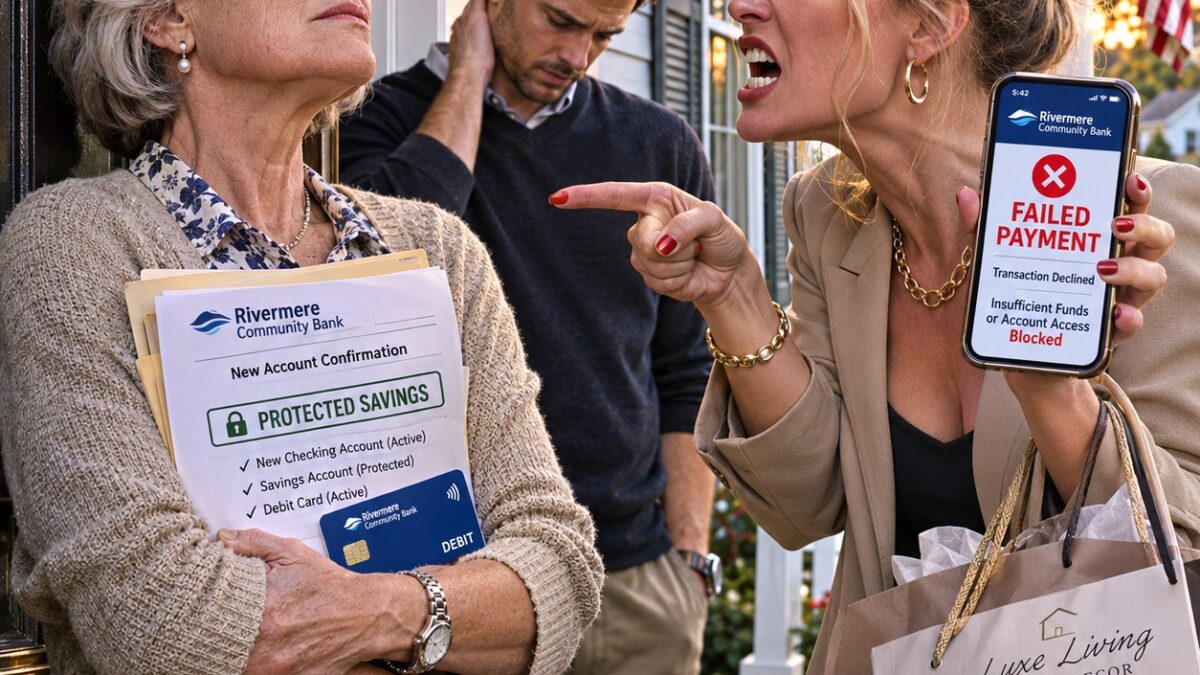
She held up her phone.
“The card attached to the grocery account declined.”
There it was.
Not concern that I had been robbed.
Not concern that something had happened to me.
Not even a question about whether I had made the transfer safely.
Her problem was that my old debit card no longer worked.
“I know,” I said.
“What do you mean you know?”
“I closed the account. Of course the card stopped working.”
She walked down one step.
I stayed where I was.
“What were you trying to buy?”
Her expression flickered.
Just briefly.
But I saw it.
“I was checking something.”
“With my card?”
“The card was already connected.”
“That wasn’t my question.”
She looked toward the street.
I followed her eyes.
Mrs. Henderson, my neighbor across the road, was standing behind her curtains.
I could see the fabric shift.
Chloe noticed too.
Her voice lowered slightly, though not enough to make the conversation private.
“You are making this into something it isn’t.”
“I haven’t made it into anything.”
“I was trying to manage your expenses.”
“I never asked you to.”
“You don’t understand how much easier this could be if you stopped fighting everyone who’s trying to help you.”
That word again.
Help.
It had become Chloe’s favorite weapon.
Every intrusion arrived wrapped inside it.
Rearranging my cabinets was helping.
Reading my mail was helping.
Criticizing my purchases was helping.
Trying to turn my guest room into her office was helping.
Asking for access to my bank account was helping.
I had begun to wonder whether there was anything a person could not justify by using that word.
“What exactly were you trying to buy?” I asked again.
She crossed her arms.
“That’s not the point.”
“It is very much the point.”
“The account shouldn’t have been closed without a conversation.”
“With whom?”
“With family.”
I almost smiled.
“Family doesn’t mean financial committee.”
Her eyes narrowed.
“You’ve been acting strange lately.”
“I changed my locks and moved my money.”
“Exactly.”
“Those are normal things for a homeowner and an account holder to do.”
“Not when your son has been helping you.”
“My son has never managed my bank account.”
“David trusts me to handle financial things.”
“Then handle his.”
Her face changed.
The anger came back.
“You know what? This attitude is exactly why we were worried.”
“We?”
“Yes, we.”
“You and David?”
“Obviously.”
“About what?”
She threw one hand toward the house.
“This.”
I looked behind me.
“My porch?”
“No, Clara. Your stubbornness. Your refusal to accept that you’re getting older.”
That landed harder than I expected.
Not because I believed her.
Because I suddenly understood how deliberate the language had become.
Getting older.
Overwhelmed.
Outdated.
Unsafe.
Impractical.
For months, Chloe had been quietly constructing a version of me that required intervention.
She had not simply been helping.
She had been building a justification for taking control.
I felt something inside me settle.
Not anger.
Clarity.
“You’re right,” I said.
She blinked.
“What?”
“I am getting older.”
For one second, she looked relieved.
As though I had finally admitted the thing she needed me to admit.
Then I continued.
“And getting older has taught me not to hand control of my life to people who haven’t earned it.”
The relief vanished.
She stared at me.
“I came here because something important happened.”
“You mean the card stopped working.”
“No.”
She looked at her phone again.
Then she inhaled sharply.
“I was setting up an investment.”
I said nothing.
She continued, speaking quickly now.
“It was going to benefit the whole family.”
“What investment?”
“It’s complicated.”
“Try me.”
She rolled her eyes.
That tiny gesture almost made me laugh.
For weeks, she’d been implying that I was too old to understand basic finances.
Now the plan involving my savings was apparently too complicated to explain.
“I found an advisor,” she said. “He has access to a private investment structure. David and I have been talking about moving some money into it.”
“Your money?”
“Our money.”
I waited.
She knew exactly what I was asking.
Her eyes moved away.
“And?”
“And there are minimum asset requirements.”
I felt a coldness move through my chest.
“How much?”
“Clara—”
“How much?”
She exhaled.
“The advisor needed to verify the combined available balance.”
“Combined with what?”
“Our accounts.”
“And mine.”
She did not answer.
That was the answer.
I stared at her.
“How much of my money were you planning to use?”
“We weren’t going to take your money.”
“Then why did you need my balance?”
“Because it increased what we qualified for.”
“How?”
She looked frustrated.
“It’s not that simple.”
“Then simplify it.”
“We were creating a family investment strategy.”
“No.”
Her eyebrows rose.
“No?”
“No, you were creating your investment strategy and using my assets to make it possible.”
“It would have benefited you too.”
“You didn’t ask me.”
“I was going to.”
“When?”
“After everything was finalized.”
That sentence stopped me.
I stared at her.
She must have heard it too.
Heard what she’d just admitted.
“After it was finalized,” I repeated.
“I didn’t mean—”
“You were going to make decisions involving my savings and tell me after the arrangement was already completed.”
“No.”
“That is exactly what you said.”
“You’re twisting my words.”
“I’m repeating them.”
Her voice rose.
“You always do this!”
“Do what?”
“Make everything sound terrible.”
I looked at her.
“Chloe, you came screaming to my house because you discovered you couldn’t access money that never belonged to you.”
“I was not accessing it!”
“The card declined.”
“That was groceries!”
“Your groceries?”
Silence.
There it was again.
The little pause that told me more than any explanation could.
I walked up one step.
Then another.
Not toward her aggressively.
Toward my front door.
She moved aside instinctively.
I unlocked the new lock.
The sound of the bolt turning was surprisingly satisfying.
Chloe heard it.
Her gaze dropped to the key.
“You changed the locks too?”
“Yes.”
Her face went almost blank.
“Why?”
“Because I wanted to.”
“David has a key.”
“Had.”
Her lips parted.
“You took his key away?”
“I changed the lock. His old key no longer works.”
“You had no right.”
I turned slowly.
“I had no right to change the locks on my own house?”
“You know what I mean.”
“No. I genuinely don’t.”
“You’re shutting us out.”
“I’m requiring you to knock.”
She stepped forward.
“Do you understand how insulting that is?”
I looked down at the key in my hand.
Yesterday, Chloe had been holding my spare key in my hallway and explaining why she ought to keep it permanently.
Today, she was telling me I had insulted her by deciding who could enter my house.
The entitlement was so complete that for a moment it almost fascinated me.
“Chloe,” I said, “why did you need David’s key this afternoon?”
She froze.
“What?”
“You came to my house before I got here.”
Her eyes shifted.
“No, I didn’t.”
“Mrs. Henderson saw you.”
Nothing.
“You walked to the side door and tried the key.”
Her face drained.
“I thought you might be inside.”
“You were pounding on my front porch five minutes later.”
“I was checking.”
“For what?”
She folded her arms.
“I don’t have to explain myself.”
“In my house, you do.”
She laughed bitterly.
“Oh, now it’s your house.”
I stared at her.
“What did you just say?”
“I mean—”
“No. Finish the sentence.”
She looked away.
I felt my pulse in my throat.
“Chloe.”
“I mean you’re acting like nobody else matters.”
“My name is on the deed.”
“David is your only child.”
“Yes.”
“He’s going to inherit it someday.”
The words hung between us.
For the first time, I saw the future Chloe had been imagining.
Not my future.
Hers.
The house.
The savings.
The investments.
The bank balance.
The guest room.
None of it was really mine in her mind.
It was merely property she expected to gain access to eventually.
And because she had already decided where everything was going, my continued ownership had become an inconvenience.
I opened the door.
Then stopped.
“I know about the grocery receipts.”
She looked at me sharply.
“What grocery receipts?”
“The three orders you made through my account.”
“Those were normal purchases.”
“Steak?”
Her mouth tightened.
“Wine?”
No answer.
“Cleaning supplies delivered to your apartment?”
“It was a mistake.”
“Three times?”
“The app mixed up the cards.”
“All three times?”
She looked down at her phone.
I watched the anger drain from her expression.
It was replaced by calculation.
She was trying to work out what I knew.
I decided to help her.
“I printed everything.”
Her eyes came back to mine.
“Three receipts. Dates, amounts, itemized purchases.”
“Clara, this is ridiculous.”
“Is it?”
“I probably clicked the wrong payment method.”
“Three times.”
“Yes.”
“And never noticed?”
“I order a lot of things.”
“Apparently I paid for some of them.”
Her jaw clenched.
“I would have paid you back.”
“You never mentioned it.”
“I didn’t know.”
“You just said you clicked the wrong card.”
“I mean I didn’t realize it had happened.”
“Then how did you know immediately today when that same card stopped working?”
She stopped.
For once, Chloe had nothing ready.
I didn’t smile.
There was no pleasure in catching her.
Only disappointment.
Because somewhere beneath all my suspicion, I had wanted there to be an innocent explanation.
I had wanted to believe she was overbearing but well-intentioned.
I had wanted to believe my son’s wife was simply enthusiastic, perhaps controlling, perhaps insensitive, but not dishonest.
That hope disappeared on my porch.
A car turned into my street.
Chloe looked toward it.
So did I.
David’s sedan pulled into the driveway.
He braked too hard.
The car rocked slightly.
He got out almost before the engine was off.
“Mom!”
He hurried toward us.
His tie was loose, his sleeves rolled up, his face tight with worry.
Then he saw Chloe.
“What is happening?”
Chloe moved immediately.
Her shoulders dropped.
Her voice changed.
The angry woman who had been shouting at me moments earlier vanished.
“David.”
She sounded wounded.
“Your mother moved all her money.”
He looked at me.
“Mom?”
“And changed the locks,” Chloe added.
His eyes moved to the new deadbolt.
He looked confused.
“Why?”
“Because I wanted my house secure.”
Chloe gave a short laugh.
“See?”
David rubbed his forehead.
“Mom, please. Chloe called me at work crying.”
I looked at her.
No tears now.
Interesting.
“She said you accused her of stealing.”
“I didn’t use that word.”
Chloe snapped, “You said I was taking your money!”
“I said you charged your groceries to my card.”
David looked between us.
“What?”
Chloe immediately answered.
“It was a mistake.”
I walked inside.
Neither followed.
I went to the table where I had left the folder.
Then I returned.
I handed it to my son.
“Read.”
He hesitated.
“Mom—”
“Read it.”
David opened the folder.
The first receipt was highlighted.
He looked at the items.
Then the delivery address.
His face changed.
He flipped to the second.
Then the third.
“Chloe?”
She crossed her arms.
“It was an app error.”
David looked at her.
“All three?”
“I already explained this.”
“To who?”
“To Clara.”
David stared at her.
She became defensive.
“Why are you looking at me like that?”
“Because these went to our apartment.”
“I know.”
“And Mom paid?”
“I didn’t do it intentionally.”
I watched my son’s face.
David was forty years old.
But in that moment, I saw the same expression he had worn as a boy whenever two friends were fighting and he wanted desperately not to choose a side.
His father used to tease him about it.
David hated conflict.
At eight, he’d once apologized to both children after they fought over a toy he didn’t even own.
At sixteen, he allowed a friend to borrow his car after I’d forbidden it because saying no felt rude.
At twenty-five, he stayed in a terrible job for three years because he didn’t know how to tell his boss he was leaving.
David had always mistaken avoiding conflict for kindness.
Usually, the person willing to push hardest benefited from that.
Now that person was his wife.
“Mom,” he said slowly, “I’m sure there’s an explanation.”
Something in me hurt.
Not surprise.
Recognition.
Of course that was his first instinct.
Smooth it over.
Make both women calm down.
Find an explanation that required nobody to be wrong.
I took the folder from his hands.
“David, do you know about the investment account?”
He frowned.
“What investment account?”
Chloe turned toward me.
“Clara.”
I ignored her.
“The family investment plan.”
David looked at his wife.
“We talked about some investment options.”
“Did you know she was planning to include my savings?”
His eyes widened.
“What?”
Chloe spoke quickly.
“I was not including her money.”
“You needed my balance.”
“That is different.”
David looked lost.
“What balance?”
I watched the realization spread across his face.
“Chloe,” he said, “what did you do?”
“Nothing!”
Her voice cracked.
“Nothing happened because Clara freaked out and closed everything.”
The sentence landed harder than she realized.
David stared at her.
“What was supposed to happen?”
She shook her head.
“It’s complicated.”
I almost laughed.
“That is exactly what she told me.”
“Can everybody stop?” David said.
His hands came up.
“Just stop for one minute.”
We did.
He stood between us.
The porch felt suddenly too small.
David turned to Chloe first.
“Did you give an advisor information about Mom’s money?”
“I didn’t give him account numbers.”
“That wasn’t my question.”
She hesitated.
“I told him what we might have available as a family.”
David’s face hardened.
“You told him Mom’s savings were available?”
“No! Not available. Potentially part of the total asset picture.”
“Without asking her?”
“I was going to ask.”
“When?”
Chloe looked at me.
I said nothing.
Finally she answered.
“Before anything was actually transferred.”
David closed his eyes.
I could almost see the battle occurring inside him.
The instinct to defend his wife.
The instinct to avoid accusing anyone.
And somewhere beneath both, the realization that what Chloe had done was wrong.
He opened his eyes.
“How much money were you planning around?”
“It wasn’t a fixed amount.”
“Chloe.”
She threw up her hands.
“I was trying to help this family build something!”
“Using Mom’s money.”
“Why is everyone saying that? She has savings sitting there earning practically nothing.”
I felt something cold move through me.
David heard it too.
He stared at his wife.
“How do you know what she’s earning?”
Silence.
His eyes narrowed.
“Chloe.”
She looked away.
“Her statements were sitting out.”
I said, “Two of my bank envelopes were opened before I saw them.”
David turned toward me.
“What?”
“She said she sorted my mail.”
“Mom, you didn’t tell me.”
“I didn’t understand yet what I was looking at.”
Chloe shook her head violently.
“This is insane. I opened mail because I was helping.”
“It had my name on it.”
“You leave everything lying around!”
“In my own house.”
“No one is saying it isn’t your house!”
“You did five minutes ago.”
David looked at her.
“What did you say?”
“Nothing.”
I answered.
“She reminded me you’re my only son and therefore will inherit the house someday.”
“That’s not what I meant!”
David’s expression changed again.
He looked embarrassed now.
Deeply embarrassed.
Not by me.
By her.
“Chloe,” he said quietly, “why would you say that?”
“Because she is acting like we’re strangers.”
“We don’t own her house.”
“I know that.”
“Then stop talking like we do.”
Chloe looked at him as if he’d slapped her.
“You’re taking her side?”
There it was.
The sentence people use when facts are no longer helping them.
Taking sides.
David rubbed both hands over his face.
“I’m not taking sides.”
“Yes, you are.”
“No. I’m asking why you were using Mom’s card and reading her bank statements.”
“I already told you.”
“And why were you talking to an advisor about her money?”
“Because someone in this family has to think ahead!”
The words came out loudly.
Mrs. Henderson’s curtain shifted again.
Chloe noticed.
She lowered her voice.
“David, your mother is sitting on a significant amount of money.”
I stared at her.
Sitting on.
As though I were occupying something I had no use for.
As though forty years of work had created a pile of resources waiting for a younger person with better ideas.
Chloe continued.
“And you know how expensive everything is getting. Housing. Retirement. Investments. We could structure things intelligently instead of watching opportunities disappear.”
David said nothing.
She stepped closer to him.
“You agreed we should be planning.”
“For us.”
“For the family.”
“Mom is family, Chloe. That doesn’t mean her money is ours.”
She looked at me.
Then back at him.
“You know you’ll inherit it eventually.”
David’s face went white.
I had already heard the thought.
For him, hearing it from his wife’s mouth was different.
He took a step backward.
“Don’t.”
“What?”
“Don’t talk about Mom like she’s already dead.”
Chloe’s face changed.
For the first time that afternoon, she appeared genuinely shocked.
“I didn’t mean that.”
“You keep talking about what we’ll inherit.”
“Because we’re discussing long-term planning.”
“No.”
His voice was still quiet.
But something had changed.
“No, Chloe.”
She stared at him.
David rarely used that tone.
I knew because I had raised him.
When he finally reached his limit, the softness disappeared completely.
He looked at the receipts again.
Then at my front door.
Then at me.
“Mom, did she try to get into the house today?”
“Yes.”
Chloe said, “I was checking on her.”
“Did you call first?”
“No.”
“Why not?”
“I had a key.”
“You had my key.”
“He’s my husband. I can use his key.”
David looked at the new lock.
Then at me.
“You changed them this morning?”
“Yes.”
“Why?”
“Because yesterday I found Chloe holding the spare key and saying she should keep it permanently.”
He turned toward his wife.
She immediately said, “For emergencies.”
“I’ve had that key for years,” David said.
“And she needed someone responsible to have it.”
I saw the sentence hurt him.
His expression flickered.
“Someone responsible?”
“You know what I mean.”
“I think I’m starting to.”
She sighed dramatically.
“David, please.”
He looked at me.
His shoulders fell.
“Mom, I had no idea.”
“I know.”
I meant it.
David had allowed Chloe to manage their household.
She paid the bills.
Organized accounts.
Handled online purchases.
Set appointments.
Made plans.
He had been happy to let her.
It reduced conflict.
It reduced decisions.
And now the same habit had spilled into my life.
“I know you didn’t,” I repeated.
His eyes were wet.
“But you should have.”
He nodded.
That hurt him.
I let it.
Sometimes protecting people from every painful truth prevents them from changing.
Chloe looked furious again.
“So now this is David’s fault?”
“I didn’t say that.”
“You’re blaming him because you don’t like me.”
“No.”
“You never have.”
“That isn’t true.”
“You judge everything I do.”
I looked at her carefully.
“Chloe, I welcomed you into my home.”
“You tolerated me.”
“I cooked Sunday dinner every week.”
“That doesn’t mean anything.”
“I gave you a key when David asked.”
“You gave David a key.”
“Exactly.”
She stared.
I continued.
“I let you help with groceries. I listened when you suggested changing insurance companies. I allowed you to organize some household paperwork because I thought you wanted to make my life easier.”
“I did.”
“Then why did making my life easier always give you more access?”
She stopped.
“Why did every suggestion end with you controlling something that had previously belonged only to me?”
“That’s not fair.”
“Kitchen cabinets.”
I counted them slowly.
“Mail.”
She looked away.
“House key.”
Her arms folded tighter.
“Guest room.”
David closed his eyes.
“Checking account.”
Silence.
“Investment plans.”
No one spoke.
The list hung between us.
I didn’t need to raise my voice.
Individually, every incident had been easy to dismiss.
Together, they formed a pattern.
A very clear one.
Chloe’s face tightened.
“So what do you want?”
I had asked myself that question all morning.
The answer was simpler than I expected.
“Boundaries.”
She laughed.
“Of course.”
“I mean it.”
I looked first at David.
Then Chloe.
“No one has access to my accounts.”
Chloe opened her mouth.
I raised one hand.
“No.”
She stopped.
“No one gets my banking information. No one opens my mail. No one uses my cards.”
I looked toward the door.
“No one has a house key except me.”
David nodded slowly.
“If I decide someday that I want someone else to have one, I’ll decide who.”
“Okay,” he said.
“No one changes a room in my house.”
Chloe’s expression became sour.
“No one rearranges my belongings.”
“Clara, you make it sound like—”
“And no one discusses my money with investment advisors without my explicit permission.”
She stopped.
I looked at her.
“Do you understand?”
Her eyes were hard.
“You’re treating us like criminals.”
“No.”
“Like strangers.”
“No.”
“What would you call this?”
“Treating you like adult guests.”
That silenced her.
I turned toward my son.
“David, you are always my son.”
His eyes filled.
“I love you.”
“I love you too, Mom.”
“But being my son does not make you my owner.”
He winced.
“I know.”
“And being your wife does not give Chloe authority over me.”
He nodded.
Chloe looked toward the driveway.
The fight seemed to leave her body all at once.
Her shoulders lowered.
She looked tired now rather than angry.
But I knew better than to mistake exhaustion for understanding.
“Fine,” she muttered.
I said nothing.
She looked at David.
“Are we done?”
He seemed surprised.
“Chloe—”
“I said fine. She wants her boundaries. She has them.”
The bitterness was obvious.
David looked at me.
“Mom, maybe we should go.”
“I think that’s best.”
He nodded.
Chloe walked down the steps.
She did not say goodbye.
She climbed into her car and slammed the door so hard the sound echoed off the neighboring houses.
David remained on the porch.
For several seconds, neither of us spoke.
Then he whispered, “I’m sorry.”
I looked at my son.
He suddenly looked much younger than forty.
“I know you are.”
“I should’ve paid more attention.”
“Yes.”
He swallowed.
I could see that he had expected me to reassure him.
To tell him he couldn’t have known.
To soften the truth.
I didn’t.
Because he had known enough.
He had seen Chloe moving boxes into my guest room.
He had heard her criticize my spending.
He had watched her ask for account access.
He had seen my discomfort.
What he had not done was ask himself whether keeping his wife happy was costing his mother her peace.
“I don’t know what to do,” he admitted.
“With Chloe?”
He nodded.
“That is between you and your wife.”
“She’ll say you’re turning me against her.”
“Am I?”
“No.”
He answered quickly.
Then slower.
“No.”
“Then don’t let her make me responsible for what you’re feeling.”
He looked toward her car.
She was staring straight ahead.
Waiting.
“I love her,” he said.
“I know.”
“She isn’t a terrible person.”
“I didn’t say she was.”
“She likes control.”
I almost smiled.
“That is one way to describe it.”
He looked embarrassed.
“She handles everything because I’m bad at that stuff.”
“No, David.”
He frowned.
“You aren’t bad at it.”
“I am.”
“You avoid it.”
He looked at me.
“There is a difference.”
I had wanted to tell him that for years.
When his father died, David stopped asking my advice about relationships.
Maybe because grief made us both retreat.
Maybe because he was tired of hearing a mother tell him to stand up for himself.
But standing there on my porch, I could finally see the price of all the small decisions he’d refused to make.
Other people had begun making them for him.
“You don’t have to become controlling just because Chloe is,” I said. “But you do have to become responsible.”
He stared at the porch boards.
“I know.”
“Do you?”
He nodded.
“I think I’m starting to.”
I touched his arm.
“I hope so.”
He hugged me.
It was awkward at first.
Then tighter.
“I really am sorry, Mom.”
I closed my eyes.
“I know.”
When he stepped away, I said, “Call before you come next time.”
He smiled weakly.
“I will.”
“And David?”
“Yeah?”
“Do not give anyone a key to my house.”
Despite everything, he laughed.
“I promise.”
I watched him get into his car.
Chloe pulled away first.
David followed a few seconds later.
Then the street became quiet.
I stood outside for a long time.
The confrontation was over.
But my body hadn’t realized it yet.
My hands were trembling.
The same way they had trembled when the hospital called to say my husband’s condition had worsened.
The same way they trembled when I signed the final mortgage payment years earlier.
Big moments often arrive quietly in the body after they’re already finished.
I went inside.
Locked the door.
Then checked it twice.
Not because I was frightened Chloe would return.
Because I liked the sound.
My lock.
My key.
My decision.
I walked into the kitchen.
The cabinets were still arranged the way I had put them back after Chloe’s last “improvement.”
My coffee was in the cupboard beside the mugs.
My garden gloves were on the counter.
A stack of mail sat untouched near the fruit bowl.
For months, I had walked through those rooms feeling subtly observed.
Was I spending too much?
Was I using space efficiently?
Was my system outdated?
Was I becoming forgetful?
Was I being difficult?
That evening, I noticed something remarkable.
None of those questions entered my mind.
I made dinner.
Roasted chicken.
Potatoes.
Green beans.
Nothing impressive.
I poured a small glass of wine.
Not the expensive imported kind Chloe had charged to my account.
A simple bottle I had bought myself.
I carried dinner to the small table near the back window.
The sky turned orange over the garden.
I watched the tomatoes move slightly in the breeze.
And for the first time in months, my house felt completely quiet.
Not lonely.
Quiet.
There is a difference.
Loneliness feels like something is missing.
Peace feels like nothing is demanding your attention.
I had forgotten how good peace felt.
The next morning, I woke at 6:20.
I made coffee.
Premium coffee.
The kind Chloe had criticized on my receipt.
I poured it into my favorite blue mug.
Then I sat at the kitchen table and opened my banking app.
The new accounts were there.
Checking.
Savings.
My name.
My balance.
No shared access.
No linked card anyone else could use.
No financial app under someone else’s control.
I stared at the screen.
Nothing dramatic had changed.
The numbers were almost identical to the day before.
But they looked different.
Safe.
I thought about the word Chloe had used.
Safety.
She had said she wanted access to my accounts for safety.
But my money had never felt safer than it did after she lost access to it.
That realization stayed with me.
By 8:00, I was outside.
I watered the tomatoes.
Pulled weeds.
Trimmed dead leaves from the rosebush near the fence.
At 9:15, Mrs. Henderson appeared beside her mailbox.
She waved.
“Morning, Clara.”
“Morning.”
She hesitated.
Then walked across the street.
I knew what was coming.
“I don’t mean to pry.”
Mrs. Henderson always meant to pry.
But she was also kind.
So I smiled.
“You heard yesterday.”
“The entire block heard yesterday.”
“I suspected.”
“She was very upset.”
“Yes.”
Mrs. Henderson lowered her voice.
“Are you all right?”
That question felt different coming from her.
There was no hidden suggestion that I needed management.
No request for access.
No assumption that being sixty-eight made me incompetent.
Just concern.
“I’m fine.”
She studied me.
“You sure?”
“Yes.”
She glanced toward my front door.
“I saw her trying that side door before you came home.”
“I know.”
“I almost went over.”
“Thank you.”
“I thought maybe she’d forgotten something.”
“She had.”
Mrs. Henderson raised an eyebrow.
“Permission.”
For half a second she stared at me.
Then she laughed.
I laughed too.
The sound surprised me.
It had been a while since I’d found any part of the situation funny.
She touched my arm.
“Well, for what it’s worth, I’m glad you changed the locks.”
“So am I.”
She returned home.
I went back to my garden.
Around noon, my phone rang.
David.
I almost let it go to voicemail.
Not because I was angry.
Because I didn’t want to spend another afternoon arguing.
But I answered.
“Hello?”
“Mom.”
His voice sounded tired.
“Hi.”
There was a long pause.
Then he said, “I’m sorry.”
“You already said that.”
“I know.”
Another pause.
“I wanted to say it when Chloe wasn’t standing there.”
I sat at the table.
“All right.”
“I should have listened sooner.”
I closed my eyes.
That mattered.
Not because I needed him to punish himself.
Because I needed him to see what had happened.
“Yes,” I said. “You should have.”
He was silent.
I wondered whether he regretted calling.
Then he said, “I know.”
That was when I realized something had changed.
My son was finally allowing an uncomfortable conversation to remain uncomfortable.
He wasn’t immediately escaping it.
He wasn’t asking me to reassure him.
He was sitting with the truth.
“Did you know about the grocery purchases?” I asked.
“No.”
“The investment?”
“Not the way she described it yesterday.”
“What did you know?”
He sighed.
“Chloe said she had found an advisor who might help us build a better investment portfolio.”
“And my money?”
“She said there might be ways to structure family assets.”
I felt my jaw tighten.
“Did you ask what that meant?”
“No.”
“Why?”
“I thought she knew what she was doing.”
“That isn’t the same as permission.”
“I know.”
He sounded miserable.
I softened slightly.
“David, I’m not asking you to choose between me and your wife.”
“I know.”
“I mean it.”
“I know.”
“But I am asking you not to ask me to sacrifice myself so your marriage feels easier.”
Silence.
I continued.
“Yesterday you initially wanted me to calm down.”
He sighed.
“Yes.”
“Why?”
“Because I thought if you calmed down, Chloe would calm down.”
I almost laughed.
“Exactly.”
He was quiet.
“I always do that, don’t I?”
“Yes.”
“Dad used to say I could negotiate peace in a room where nobody was fighting.”
I smiled.
“He did.”
David laughed weakly.
“I hated when he said that.”
“He wasn’t wrong.”
“No.”
I could hear him breathing.
Then he said, “Chloe thinks you’re trying to humiliate her.”
“I haven’t told anyone what she did.”
“I told her that.”
“I didn’t call the police.”
“I know.”
“I didn’t threaten her.”
“I know.”
“I moved my money and changed my locks.”
“I know.”
“Then the humiliation she’s feeling is coming from being caught.”
He didn’t answer immediately.
Finally he said, “That’s basically what I told her.”
That surprised me.
“How did that go?”
“Badly.”
I smiled despite myself.
“I imagine so.”
“She slept in the guest room.”
“At your apartment?”
“Yes.”
“Good.”
He laughed.
“Mom.”
“Sorry.”
“No, you’re not.”
I laughed again.
It felt good.
Then his voice became serious.
“She’s angry because I asked her to show me everything.”
“Everything?”
“Bank accounts. Credit cards. Apps. Investment emails.”
My smile faded.
“And?”
“I don’t know yet.”
Something in his tone concerned me.
“David.”
“It’s not some huge secret crime, Mom.”
I waited.
He continued.
“But she likes to move money around. Open promotional accounts. Sign up for things. She has a lot more going on than I realized.”
“Your money?”
“Ours.”
“Then you need to understand it.”
“I know.”
I almost told him what to do.
Close accounts.
Separate finances.
Change passwords.
Talk to an attorney if necessary.
But I stopped myself.
This was exactly the boundary I had established.
My son was an adult.
His marriage was his responsibility.
He didn’t need me replacing Chloe as the person who made decisions for him.
“I’m glad you’re looking,” I said.
“That sounds like something Dad would say.”
“Your father would’ve added something about reading the fine print.”
David laughed.
“He read everything.”
“Twice.”
“Even restaurant menus.”
“He distrusted hidden fees.”
That made both of us laugh.
For a few moments, we were simply mother and son.
No Chloe.
No bank account.
No boundary dispute.
Just memories.
Then David said, “Can I come see you Sunday?”
I glanced toward the kitchen.
Sunday dinner had been our routine.
For weeks, I had dreaded it.
Chloe rearranging something.
Commenting on something.
Suggesting something.
“Just you?”
He hesitated.
“I was thinking me and Chloe.”
I didn’t answer.
“Mom, she knows she can’t walk in. She knows she can’t touch anything.”
“That isn’t an apology.”
“I know.”
“Has she apologized?”
“No.”
“Then I’m not ready for Sunday dinner.”
He sounded disappointed.
But he didn’t argue.
“Okay.”
“David.”
“Yeah?”
“You can come.”
“Without her?”
“For now.”
He took a breath.
“Okay.”
I knew that would cause problems in his marriage.
But I also knew inviting Chloe back simply because excluding her felt uncomfortable would teach her that my boundaries disappeared as soon as she waited long enough.
I wasn’t going to do that.
David came Sunday afternoon.
He knocked.
That detail mattered more than he knew.
I opened the door.
He stood there holding a bakery box.
“What is that?”
“Peace offering.”
“To whom?”
He smiled.
“You.”
“I thought we were already at peace.”
“Dessert, then.”
I let him in.
He looked around the entryway.
“Feels weird not having a key.”
“Good.”
He laughed.
“You’re enjoying this.”
“A little.”
He put the box in the kitchen.
Apple turnovers.
My favorite.
We ate at the dining table.
For the first time in months, nobody commented on my coffee.
Nobody reorganized the serving dishes.
Nobody asked whether the utility bill was too high.
Nobody suggested changing anything.
We talked.
Really talked.
David told me work had been stressful.
I told him the tomatoes were producing too many tomatoes.
He told me Chloe was still angry.
I told him I wasn’t surprised.
Eventually he asked, “What would it take for you to let her come back?”
The question was fair.
I considered it.
“Respect.”
“How do you measure that?”
“Behavior.”
He nodded.
“You don’t need some dramatic apology?”
“I would appreciate an apology.”
“But?”
“But apologies are easy when people want access restored.”
David leaned back.
“So you want her to prove it.”
“I want her to stop doing the things that caused the problem.”
He looked toward the hallway.
“No mail.”
“No mail.”
“No money.”
“No money.”
“No office.”
I smiled.
“Definitely no office.”
“No key.”
“No key.”
He nodded.
“That seems fair.”
“It was always fair.”
“I know.”
I studied my son.
He looked tired.
“Are you okay?”
He rubbed his face.
“I don’t know.”
I waited.
Finally he said, “I think I’ve spent years letting Chloe decide things because she decides fast.”
“That can be convenient.”
“It was.”
“Until?”
“Until I realized I didn’t know what she’d decided.”
I didn’t say anything.
He looked at me.
“Did Dad ever do that to you?”
“Make decisions without telling me?”
“Yeah.”
I laughed.
“Your father once bought an entire table saw without telling me.”
David smiled.
“I remember that thing.”
“He claimed it was fifty percent off.”
“Was it?”
“No idea.”
We laughed.
Then I said, “But household finances? No.”
David’s smile faded.
“Why?”
“Because we considered those shared decisions.”
“What if you disagreed?”
“We argued.”
“You and Dad?”
“Frequently.”
He looked shocked enough to make me laugh.
“David, your father and I were married for thirty-eight years. Do you think we floated through every day agreeing?”
“I don’t remember you fighting.”
“We usually waited until you were asleep.”
“That explains a lot.”
I smiled.
“Your father hated confrontation almost as much as you do.”
“Really?”
“Yes.”
“But when something mattered, he stayed in the room.”
David looked down.
That was the lesson.
I didn’t need to explain it.
He understood.
The following weeks became quieter.
Chloe did not come to my house.
She did not call.
She did not text.
I heard about her through David.
At first she insisted I was overreacting.
Then she shifted to saying my reaction had been understandable but excessive.
Then she said she had made “a few mistakes.”
I recognized the progression.
It was easier to move from innocence to mistake than from wrongdoing to accountability.
I didn’t chase an apology.
My life had stopped revolving around whether Chloe approved of me.
That itself was a victory.
I went back to the routines I enjoyed.
Tuesday mornings at the garden center.
Thursday afternoon coffee with Mrs. Henderson.
A Saturday book club I had stopped attending because Chloe kept scheduling “family planning” conversations on weekends.
I found myself saying yes to things again.
Not expensive things.
Not dramatic things.
Ordinary things.
Lunch.
A movie.
A drive to see a friend.
I had not realized how much of my life had begun shrinking around the expectation that Chloe might object.
That realization embarrassed me at first.
I considered myself independent.
I’d been widowed.
Managed a home.
Handled money.
Made decisions alone.
How had I allowed a younger woman to make me nervous about buying coffee?
The answer came slowly.
Control rarely begins with a command.
If Chloe had walked into my house the first day I met her and demanded access to my bank account, I would have laughed.
If she had announced that my guest room belonged to her, I would have shown her the door.
If she had told David she expected to inherit my home while I was still living in it, I would have recognized the danger immediately.
But she hadn’t done that.
She started with tiny corrections.
A cabinet.
A receipt.
A suggestion.
A spare key.
Each individual moment seemed too small to justify conflict.
And because I avoided the conflict, the next request became slightly larger.
That was how boundaries disappeared.
Not because I had no boundaries.
Because I allowed each one to move by an inch.
Eventually, I looked around and discovered the line was nowhere near where I had originally put it.
Three weeks after the porch confrontation, Chloe called.
Her name appeared on my phone at 7:12 in the evening.
I stared at it.
Then answered.
“Hello?”
“Clara.”
Her voice sounded controlled.
“Hello, Chloe.”
“Can we talk?”
“We are.”
She paused.
“I mean in person.”
I hesitated.
“About what?”
“Everything.”
I looked around my living room.
The house was quiet.
I had no desire to disturb that peace.
But I also knew that refusing every conversation forever would turn a boundary into a wall.
“Tomorrow afternoon,” I said.
“At your house?”
“Yes.”
She paused again.
“Okay.”
“And Chloe?”
“Yes?”
“Knock.”
She exhaled.
“I will.”
At two the next afternoon, someone knocked.
Not pounded.
Knocked.
Three times.
I opened the door.
Chloe stood on the porch.
She was alone.
No boxes.
No phone in her hand.
No grocery bags.
No folder of financial advice.
Just Chloe.
“Hi.”
“Hello.”
“Can I come in?”
The fact that she asked mattered.
“Yes.”
I stepped aside.
She entered.
Then stopped near the entryway.
She didn’t walk automatically toward the kitchen.
Another small thing.
But I noticed.
“Would you like coffee?”
“Yes, please.”
We sat at the dining table.
For a moment, neither of us spoke.
Chloe looked uncomfortable.
I let her.
I had spent too many months rushing to make her comfortable whenever I asserted myself.
This time, if she had something to say, she could find the words.
Finally, she looked at me.
“I was wrong.”
I waited.
She seemed irritated by my silence.
But she continued.
“I shouldn’t have used your card.”
“No.”
“I shouldn’t have opened your bank mail.”
“No.”
“And I shouldn’t have discussed your savings with that advisor.”
“No.”
She looked down.
“I thought I was helping.”
I almost interrupted.
But I didn’t.
“That’s not entirely true,” she added.
That surprised me.
She looked at her hands.
“I thought I was helping, but I also thought I knew better.”
I stayed quiet.
“You live alone,” she said. “You don’t spend much. You have savings. David and I are trying to build a future. And I guess I started thinking that since everything would eventually stay in the family anyway, there wasn’t much harm in planning around it.”
The honesty was uncomfortable.
But valuable.
“Do you understand why that frightened me?”
She nodded.
“I do now.”
“Do you?”
“Yes.”
I leaned forward.
“Then tell me.”
Her expression tightened slightly.
I could see she didn’t like being tested.
But she answered.
“Because I treated your money like it was waiting for us.”
I felt something loosen inside me.
“Yes.”
“And your house.”
“Yes.”
“And I kept using your age as an excuse.”
That one surprised me.
She looked embarrassed.
“I knew you were capable.”
I stared.
“You did?”
“Yes.”
“Then why did you keep talking to me like I wasn’t?”
She looked away.
“Because it made my suggestions harder to refuse.”
There it was.
The sentence I had needed.
Not because it excused anything.
Because it named the behavior correctly.
Chloe had known what she was doing.
Maybe not at the beginning.
Maybe not every time.
But eventually.
She had discovered that framing me as old and overwhelmed gave her leverage.
And she used it.
“That was cruel,” I said.
Her eyes filled.
“I know.”
I didn’t comfort her.
Not yet.
She continued.
“I think I was scared.”
“Of what?”
“Money.”
That surprised me.
She laughed bitterly.
“My parents never had any. My mom still rents. My dad had three bankruptcies.”
I had known her parents struggled.
Not the extent.
Chloe looked around my dining room.
“You have a paid-off house. Savings. Retirement income. You don’t panic about rent.”
“I have worried about money plenty.”
“I know. But it looks stable from the outside.”
I understood then.
Not excused.
Understood.
Chloe had seen my stability the way people sometimes see a full pantry when they are hungry.
Not simply as something to admire.
As something they might need to claim before it disappeared.
“You were trying to make my security part of yours,” I said.
She nodded.
“And I told myself it was okay because David is your son.”
“Yes.”
She wiped one eye.
“I know that’s wrong.”
I sat back.
This was more than I’d expected from her.
But I had learned to judge behavior over words.
“What happens now?” she asked.
“That depends.”
“On what?”
“You.”
She looked confused.
“I am not giving you access again.”
“I know.”
“No key.”
“I know.”
“No banking.”
“I know.”
“No mail.”
She nodded.
“No financial planning unless I request it.”
“Okay.”
“And the guest room stays a guest room.”
For the first time, she smiled faintly.
“Okay.”
I studied her.
“You can visit.”
Her eyes lifted.
“Really?”
“Yes.”
“But you call first.”
“I will.”
“And if I say no, the answer is no.”
She nodded.
I poured more coffee.
Neither of us mentioned forgiveness.
I wasn’t ready for that word.
But when Chloe left that afternoon, she stood at the door and said, “Thank you for hearing me.”
I replied, “Thank you for saying it.”
That was enough.
The next Sunday, David called.
“Can we come for dinner?”
I smiled.
“Both of you?”
“Yes.”
“Six o’clock.”
He sounded relieved.
“Should we bring anything?”
“Dessert.”
“Apple turnovers?”
“Those worked last time.”
When they arrived, they knocked.
Chloe handed me a bakery box.
Then she waited for me to invite her inside.
I noticed.
Dinner was awkward for the first twenty minutes.
Of course it was.
No real family conflict disappears because one conversation went well.
But eventually, we began talking normally.
David told a story about work.
Chloe asked about my tomatoes.
I complained about squirrels.
Nobody discussed my bank account.
After dinner, Chloe carried plates to the kitchen.
I followed.
She opened one cabinet.
Then froze.
For a second, we stared at each other.
She laughed nervously.
“Where do these go?”
I smiled.
“Second cabinet from the left.”
She put them there.
Didn’t rearrange anything.
That tiny moment told me more than the apology had.
She was learning.
So was I.
Months passed.
Our family did not return to what it had been.
I don’t think families ever truly return after boundaries are exposed.
They become something else.
Sometimes worse.
Sometimes healthier.
David became more involved in his own finances.
He didn’t suddenly transform into a forceful man who loved confrontation.
That would not have been realistic.
But he began asking questions.
He reviewed statements.
He stopped signing forms without reading them.
When Chloe made decisions that involved both of them, he stayed in the conversation.
They argued more.
Strangely, David told me their marriage also became more honest.
“Turns out avoiding every argument doesn’t actually create peace,” he said one afternoon.
I smiled.
“Your father could’ve told you that.”
“I know.”
Chloe stopped referring to my money as family assets.
She stopped asking what I intended to do with the house.
She stopped examining receipts.
On the rare occasions when I asked for help with technology, she helped with exactly what I requested and nothing more.
The first time it happened, my phone stopped syncing photographs.
I called her.
She came over.
Fixed it.
Then handed the phone back.
No lecture.
No password request.
No suggestion that she should manage the device permanently.
“Done,” she said.
“Thank you.”
She smiled.
“You’re welcome.”
Ordinary.
That was what I wanted.
Not power.
Not revenge.
Ordinary respect.
My relationship with David changed too.
For years, I had protected him from discomfort the same way he protected himself from it.
If he failed to call, I didn’t mention it.
If Chloe overstepped, I kept quiet because I didn’t want him “caught in the middle.”
But there was no middle.
There were simply choices.
His wife’s feelings.
His mother’s boundaries.
His own responsibility.
He could care about all three.
The idea that one person’s comfort required another person’s silence had caused the entire problem.
I was finished participating in that arrangement.
One afternoon, several months after I changed the accounts, David came over alone.
He knocked.
I opened the door.
“You know you can stop looking proud of yourself every time you knock,” I said.
He grinned.
“I’m demonstrating personal growth.”
“Very impressive.”
He came inside.
We sat on the back patio.
My tomatoes had finally stopped producing at an unreasonable rate.
Autumn leaves covered the yard.
David looked around.
“Do you ever wish Dad were here?”
The question caught me.
“Every day.”
He nodded.
“He would’ve handled all this better than me.”
I thought about my husband.
A quiet man.
Patient.
Steady.
Not perfect.
“No,” I said.
David looked surprised.
“You don’t think so?”
“I think he would’ve handled it differently.”
“How?”
“He would have avoided the conversation for two months, then exploded while fixing a cabinet.”
David laughed.
“That sounds like Dad.”
“Exactly.”
I smiled.
“Your father was good, David. He wasn’t magical.”
He looked toward the garden.
“I think after he died, I started trying to keep everybody happy.”
“You did that before.”
“I know. But worse.”
I understood.
Loss changes family systems in strange ways.
My husband had been a stabilizing force.
After he died, David and I each reacted differently.
I became more independent.
David became more conflict-avoidant.
Then Chloe entered that empty space with certainty.
She liked deciding things.
David liked not deciding things.
For a while, that arrangement worked perfectly.
Until the decisions extended to me.
“I’m sorry I made you feel alone,” he said.
I looked at him.
“You did.”
His eyes filled.
Again, I did not immediately rescue him from the discomfort.
“I thought defending Chloe was what a husband was supposed to do.”
“Sometimes it is.”
He looked at me.
“But not automatically.”
“No.”
He nodded.
“I’m learning.”
“So am I.”
He smiled.
“What are you learning?”
“That saying no sooner saves a lot of trouble later.”
He laughed.
“That sounds obvious.”
“It wasn’t.”
I looked at my house.
My husband and I had bought it when we were young.
The neighborhood had changed.
Trees had grown.
Families had moved in and out.
Our mortgage had been paid off years earlier.
Every room contained a memory.
David taking his first steps near the sofa.
Birthday cakes in the kitchen.
His father asleep in a recliner with a newspaper across his chest.
Christmas mornings.
Hospital equipment during my husband’s final months.
Grief.
Recovery.
For a while, Chloe’s behavior had made me feel as though my own history no longer gave me authority there.
I had begun asking whether things were practical.
Whether keeping a guest room was wasteful.
Whether buying good coffee was irresponsible.
Whether changing something in my own house would annoy someone who didn’t live there.
It seemed ridiculous now.
But that was the nature of slow control.
It changed your questions before it changed your life.
You stopped asking, “What do I want?”
You started asking, “Will this upset them?”
That was how I knew I had taken my life back.
Not because Chloe had apologized.
Not because David finally understood.
Not because my accounts were secure.
Because I had started asking myself what I wanted again.
One morning, almost a year after everything happened, I drove to the bank.
Sarah, the manager who had opened my new accounts, recognized me.
“Clara.”
“Good morning.”
She smiled.
“How’s everything going?”
“Quietly.”
“That’s usually good with banking.”
“It is.”
We reviewed my accounts.
Updated a beneficiary designation.
Discussed fraud protection.
Nothing dramatic.
Before I left, Sarah asked, “Do you want to add anyone as an authorized user?”
A year earlier, that question might have made me nervous.
I would have thought about David.
About emergencies.
About whether Chloe would take offense.
This time, I simply answered.
“No.”
Sarah nodded.
“No problem.”
And that was it.
No guilt.
No explanation.
No speech.
Just no.
I walked outside into the morning sunlight.
For most of my life, I had believed independence was something you either had or didn’t have.
I was wrong.
Independence is maintained through thousands of tiny decisions.
Who has your key.
Who sees your mail.
Who knows your passwords.
Who gets to question your purchases.
Who can enter your home.
Who is allowed to turn concern into authority.
The big moment on my porch mattered.
But the real change happened afterward.
Every time I opened my own mail.
Every time I bought something without imagining Chloe examining the receipt.
Every time someone knocked instead of walking in.
Every time David asked instead of assumed.
Every time Chloe stopped herself before crossing a line.
Those were the moments my life became mine again.
I never hated my daughter-in-law.
Even at my angriest, I didn’t want her humiliated or destroyed.
I wanted her to understand something simple.
I was alive.
Not an estate.
Not a future inheritance.
Not a balance sheet.
Not an aging woman whose resources were waiting to be reassigned by younger people.
Alive.
Capable.
Present.
And entitled to make decisions about the life I had built.
The most painful part of the whole experience wasn’t the unauthorized groceries.
It wasn’t even the investment scheme.
It was realizing how easily love can become entitlement when nobody says no.
Chloe had convinced herself that planning around my money was responsible.
David had convinced himself that avoiding confrontation was kindness.
And I had convinced myself that keeping the peace was more important than defending my boundaries.
All three of us were wrong.
Peace created by one person surrendering isn’t peace.
It’s silence.
Family support that requires financial access isn’t automatically support.
And concern that only moves in one direction—toward greater control—is not concern I am willing to accept anymore.
I still host Sunday dinner.
Not every week.
Sometimes I want my Sunday to myself.
The first time I canceled because I simply didn’t feel like cooking, Chloe said, “No problem.”
David said, “We’ll see you next week.”
Nobody asked whether I was confused.
Nobody arrived anyway.
That might sound small.
To me, it felt enormous.
One Sunday in early spring, we ate on the back patio.
David grilled chicken.
Chloe brought salad.
I made potatoes.
After dinner, Chloe glanced toward the tomato beds.
“Are you planting those again?”
“Yes.”
She smiled.
“You always buy way too many plants.”
I looked at her.
She froze.
For half a second, panic crossed her face.
Then she laughed.
“I mean, completely your decision.”
David burst out laughing.
I did too.
Even Chloe eventually joined us.
That moment told me we’d come farther than I realized.
Not because the past was forgotten.
Because we could recognize it without repeating it.
Later that evening, after they left, I washed the dishes.
I sorted my mail.
I checked my bank balance.
Then I made a cup of premium coffee even though it was nearly eight at night and I knew it might keep me awake.
I carried the mug to the living room.
The house was quiet.
Exactly the way it had been on the morning I decided to change everything.
But I was different.
Back then, the quiet had been tense.
I had known someone was pushing against the edges of my life.
I had known something was wrong, even before I was willing to name it.
Now the quiet belonged to me.
My front door was locked.
The key was in the small ceramic bowl beside the entryway.
My bank statements were unopened on the table because I had not gotten around to them yet.
Nobody else had touched them.
The guest room upstairs still held the quilt my husband and I bought on a trip to Vermont years ago.
My winter coats were exactly where I had left them.
My kitchen cabinets were arranged in a way that probably made no sense to Chloe.
And I liked them that way.
I thought about the day she stood on my porch demanding to know where the money had gone.
At the time, I believed the bank transfer was the important decision.
It wasn’t.
The important decision had happened earlier.
The moment I stopped asking myself whether I was being unreasonable.
The moment I accepted that discomfort did not automatically mean I was wrong.
For women my age, that can be surprisingly difficult.
We are taught to smooth things over.
Keep families together.
Avoid embarrassing anyone.
Be grateful when adult children offer help.
Don’t seem suspicious.
Don’t be difficult.
Don’t overreact.
But there is a cost to being endlessly easy to manage.
Eventually, someone may begin managing you.
I had almost allowed that to happen.
Not because I was weak.
Because I loved my son.
Because I wanted his marriage to succeed.
Because I didn’t want Chloe to think I disliked her.
Because every individual incident looked too small to justify a fight.
A coffee receipt.
A cabinet.
A key.
An app.
A guest room.
A bank statement.
Until they weren’t small anymore.
Four hours after I moved my money, Chloe’s reaction exposed everything.
That was the gift hidden inside the confrontation.
If she had simply shrugged when the old card stopped working, I might have doubted myself.
If she had asked politely what happened, I might have believed I overreacted.
Instead, she raced to my house furious because my money had become inaccessible to her plans.
She showed me exactly how much control she believed she had lost.
And once I saw it clearly, I could never unsee it.
I don’t regret changing the accounts.
I don’t regret the locksmith.
I don’t regret telling David he should have listened sooner.
I don’t even regret making Chloe earn her way back into my home.
I regret only one thing.
That I waited until I felt cornered.
I should have spoken when she first rearranged the kitchen.
Not because moving plates was a terrible offense.
Because my silence taught her that my preferences were negotiable.
I should have spoken when she criticized my coffee.
Not because coffee matters.
Because my money was not hers to audit.
I should have spoken when she reached for the spare key.
I should have spoken when she carried those office boxes upstairs.
I should have spoken before she ever believed “family” was permission.
I know that now.
These days, when I stand in my kitchen in the morning, I sometimes think about my husband.
He would have found the whole situation exhausting.
He would have hated the shouting.
He would have changed the locks himself and probably complained about the quality of the hardware the locksmith used.
I can almost hear him.
“Should’ve used a heavier deadbolt, Clara.”
I smile every time I imagine it.
Then I pour my coffee.
Open my mail.
Check my accounts.
And continue with my day.
Nobody needs to authorize it.
Nobody needs to monitor it.
Nobody needs to improve it.
My life does not have to be efficient enough for Chloe.
My money does not have to be productive enough for an advisor I’ve never met.
My spare bedroom doesn’t need to justify its existence.
My house doesn’t have to become someone else’s future simply because I am getting older.
I am allowed to occupy my own life fully until the last day I am here.
That was the lesson.
Not that daughters-in-law are dangerous.
Not that adult children cannot be trusted.
Not that people should cut off their families the moment something feels uncomfortable.
The lesson was simpler.
Help should still leave you with a voice.
Love should still leave you with ownership of yourself.
And a boundary that makes someone furious may tell you exactly how much they benefited from you having none.
I didn’t lose my family when I moved my savings.
For a while, I was afraid I might.
Instead, David finally learned that avoiding conflict does not protect relationships.
Chloe learned that concern does not create authority.
And I learned that I did not have to become smaller in order to keep people close.
I still love my son.
I have learned to love Chloe with clearer eyes.
They are welcome in my home.
They sit at my table.
We laugh.
Sometimes we disagree.
Sometimes Chloe has to catch herself before offering advice I didn’t request.
Sometimes David still tries to make everybody happy.
And sometimes I still wait too long before saying no.
We are human.
None of us changed completely.
But the structure changed.
They visit.
They do not manage.
They ask.
They do not assume.
And when I say no, the conversation does not continue until my answer becomes yes.
That is enough.
Tonight, as I sit in the same house where all of this began, the porch light is on.
The doors are locked.
My bank card is in my wallet.
My savings are where I put them.
There is a stack of unopened mail beside me.
Tomorrow morning, I will decide when to open it.
The guest room upstairs is empty.
Maybe someone will sleep there next month.
Maybe nobody will use it for a year.
Either way, it remains exactly what I choose it to be.
My home.
My room.
My money.
My life.
And after sixty-eight years, I finally understand that protecting those things does not make me selfish.
It means I am still here.
It means I still get a say.
It means the woman who spent decades building a stable life does not disappear simply because someone younger has ideas about how that life could be better organized.
The day Chloe stood on my porch demanding access was the day she expected me to back down.
Instead, it became the day I remembered something I should never have forgotten.
I was never asking permission.
And from that day forward, I never did again.

