FULL ENDING :My Husband Forced Me to Confess to a $480 Million Theft I Never Committed — His Family Celebrated, Until ONE Detail Exposed the Biggest Mistake of Their Lives
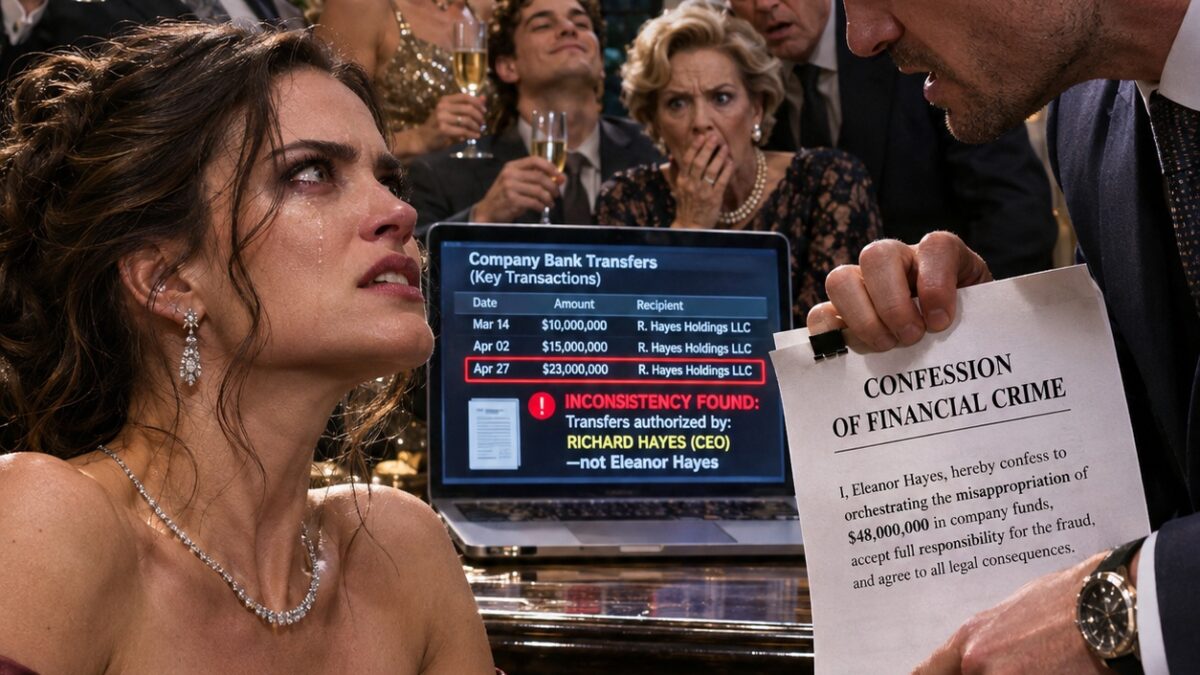
FULL STORY CONTINUATION
I signed anyway.
That was the part that haunted me longest.
Not the accusation. Not the humiliation. Not even the divorce.
The moment I put my signature beneath words somebody else had written, I felt something inside me pull away, warning me to stop. But Warren’s hand was still on my shoulder, and the man who had promised to love me through everything was looking at me as though my entire future depended on doing what he asked.
My signature looked smaller than usual.
Humphrey took the paper before the ink was completely dry.
“Very sensible, my dear.”
Warren kissed my forehead.
“You did the right thing. Now we have time.”
I wanted to believe him so badly that I ignored the way he avoided my eyes.
We returned to the dining room together.
Philippa was seated at the head of the table, one hand resting beside her untouched glass of water. Humphrey placed the signed confession in front of her.
“It’s done, madam.”
She examined my signature.
“Good.”
That was all.
Three years of marriage, hundreds of late nights, thousands of invoices, and the woman who had never called me by my name needed only one word to dismiss my entire life.
Then Humphrey opened another folder.
“There is one additional administrative matter.”
He pushed several pages toward me.
I recognized Warren’s signature before I understood the heading.
Petition for Dissolution of Marriage.
I looked up.
“Warren?”
He stared at the table.
“Leona, please understand.”
“You signed divorce papers?”
“It’s necessary for the bank. They need to see the family has completely separated itself from the person responsible for the missing funds.”
“The person responsible?”
His jaw tightened.
“You know what I mean.”
“No, Warren. I don’t.”
Philippa sighed.
“The bank will ask questions on Monday. If my son remains married to a woman who has confessed to stealing company funds, they will cancel the entire Crestmore financing package.”
I looked at the man standing beside me.
“Thirty minutes ago, you promised you would fight for me.”
“I will.”
“While divorcing me?”
“It’s paperwork, Leona.”
I stared at him.
“Paperwork?”
He reached for my hand, but I stepped away.
“You told me the confession was only paper. Now our marriage is only paper. Tell me something, Warren. Is there anything between us that isn’t?”
For the first time that night, he had no answer.
Humphrey cleared his throat.
“Your departure from the company and residence is effective immediately. Personal belongings only. Company devices, vehicle, files, and equipment remain property of Thornbury Holdings.”
Philippa checked her watch.
“Mercy will supervise your packing. Ten minutes.”
I almost laughed.
“Ten minutes?”
“You have already taken enough from this family.”
I walked upstairs without another word.
Mercy, the housekeeper who had quietly helped me through three years of awkward dinners and cold mornings, followed me into the bedroom.
She stood near the door while I opened my suitcase.
I didn’t know what to take.
There were dresses Warren had bought me, jewelry from anniversaries, shoes I had worn to company functions, photographs of our wedding, and the blue blouse I’d worn on my first day at Crestmore.
Some of those things belonged to a woman I no longer recognized.
I took my mother’s photograph, a few clothes, my personal documents, and the little silver necklace my aunt had given me when I turned twenty-one.
I left the diamonds.
I left the wedding photographs.
I left the silk dresses hanging untouched.
“Seven minutes, Madam Leona,” Mercy whispered.
Her eyes were wet.
“I’m sorry.”
I tried to close the suitcase.
My hands wouldn’t cooperate.
Then I remembered the password.
The wedding date.
The phrase I had told exactly one person.
I turned.
“Mercy, please ask Warren to come upstairs.”
He appeared two minutes later.
“What is it, Leona?”
I stood beside the bed.
“The phrase for my security token was our wedding date.”
His face remained still.
“You remember.”
“You were the only person I told.”
“Leona—”
“Did you use my token?”
The silence lasted barely three seconds.
It felt like an entire lifetime.
Then his expression hardened.
“Who do you think designed the escrow system? My mother controls the finance department. She has access to the IT staff, the offices, everything.”
“That’s not an answer.”
“Be careful what you’re accusing me of.”
“I am asking my husband whether he stole from his own company and blamed me.”
He came closer.
“You signed a confession saying you took the money. Do you understand what that means?”
Something cold moved through my chest.
“Are you threatening me?”
“I’m explaining reality. Right now, I’m the only person in this family who still believes you.”
“Then come with me.”
He looked toward the door.
“I can’t.”
“Warren.”
“Not yet. I’ll call you.”
He had said those words so many times during our marriage.
Not yet.
When my mother-in-law insulted me at dinner, he would defend me later.
When I wanted to challenge an unauthorized invoice, he would speak to his mother later.
When I asked whether we could move into our own home, away from Philippa’s constant surveillance, he would consider it later.
Now I understood how dangerous those two little words could become.
I picked up my suitcase.
At the front entrance, Mercy opened the door.
Rain had begun falling over Ikoyi.
Behind me, the mansion glowed with chandeliers, polished marble, and the wealth I had worked so hard to protect.
Nobody followed me.
I stepped into the rain.
Three years earlier, I had entered that house wearing a wedding dress.
That night, I left wearing an old blouse and carrying everything I owned.
I had ten minutes to pack.
I would spend the next five years remembering every second.
By Monday morning, the confession was everywhere.
Philippa had ordered Humphrey to circulate it to developers, banks, contractors, and property companies throughout Lagos.
The document included my signature, my former title, and a statement that I had voluntarily accepted responsibility for unauthorized transfers totaling 480$ million.
There was no mention of the threats.
No mention of the promised investigation.
No mention of Warren’s assurances.
Just my name beneath a lie.
I discovered what had happened when I returned to Crestmore to collect the notebooks I’d left in my office.
Two security guards blocked the entrance.
“Sorry, madam. You’re not permitted inside.”
“My personal things are upstairs.”
“Barrister Humphrey’s instructions.”
I looked past them at the unfinished structure.
The building had been my daily life for three years.
I knew which concrete columns had required additional reinforcement. I knew which supplier delivered late. I knew the names of men whose children were sick, whose wives were expecting babies, whose salaries were keeping entire households alive.
And suddenly I wasn’t allowed through the gate.
“Who gave you permission to stop her?”
Baba Barnabas was coming toward us.
He had a hard hat under one arm and anger written across his face.
“Baba, please,” one guard murmured.
“No. This woman worked here every day. She saved this company more money than anybody sitting in that big house.”
Humphrey’s black car pulled up behind him.
He stepped out, adjusting his cuffs.
“Good morning, Barnabas. Is there a problem?”
“Yes,” Baba said. “A very big problem.”
Humphrey looked at me.
“Miss Bassey, I believe your departure arrangements were clear.”
“Those notebooks are mine.”
“Anything in the site office is under company control until our internal review is completed.”
Baba stepped forward.
“You cannot call this girl a thief.”
Humphrey smiled without warmth.
“Careful.”
“I have worked for this family for twenty-two years. I served Mr. Thornbury before he died. I have seen honest people and dishonest people come through those gates.”
“Barnabas.”
“A thief does not stand in the sun for six hours counting cement bags to stop other thieves from robbing the company.”
Workers had begun gathering behind the security post.
Humphrey noticed.
His smile disappeared.
“Your services are no longer required.”
Baba blinked.
“What?”
“Final salary and benefits will be arranged by Friday. You’re dismissed.”
Twenty-two years.
One sentence.
I reached for Baba’s arm.
“Please. Don’t lose your job because of me.”
He shook his head.
“My daughter, I didn’t lose my job because of you.”
He looked directly at Humphrey.
“I lost it because somebody in that house cannot bear the truth.”
We walked away together.
Neither of us spoke until we reached the roadside.
Then Baba placed his hand on my head.
“Whatever they tell you, Leona, remember this. You know who you are.”
I wanted to believe him.
But by then, nearly everyone else in Lagos seemed convinced they knew who I was.
And their version of me was a thief.
My aunt was waiting when I returned to her little house in Yaba.
She had spread a clean wrapper over the old sofa where I used to sleep before I married Warren.
She didn’t ask where my luggage was.
She didn’t ask whether my husband would come.
She simply took one look at my face and pulled me into her arms.
I cried harder than I had cried the night before.
When I finally told her everything, she listened without interrupting.
Then I handed her the confession.
She put on her reading glasses.
For a long time, she said nothing.
“Did you write these words?”
“No.”
“Did you choose this bank account?”
“No.”
“Did you type the amount?”
“No, Auntie. Humphrey prepared everything.”
She tapped the page.
“Then why are you looking at it as though it belongs to you?”
“Because my signature is there.”
“Your signature is there. Their words are there. Those are two different things.”
I stared at her.
She pushed the document back toward me.
“People who lie often hide a little truth inside the lie. Find it.”
That night, while my aunt slept, I sat beneath the weak yellow light in her sitting room and read my confession.
I read every sentence.
Then I read the numbers.
The amount was correct.
480$ million.
The supplier was Silver Birch Supplies.
And beside the supplier’s name was a complete bank account number.
I remembered Mrs. Nwosu’s audit presentation.
She had announced the amount and the supplier.
But I could not remember her reading that account number aloud.
I went through the evening again in my mind.
Philippa shouting.
Warren looking down.
Humphrey producing the document.
The threats.
The deadline.
And something else.
Before Mrs. Nwosu had clearly stated the amount, Warren had murmured something under his breath.
Four hundred and…
I couldn’t be certain.
I hadn’t understood it then.
But the memory bothered me.
I pulled out a notebook and wrote one question.
Who gave Humphrey the complete Silver Birch account number before the confession was prepared?
Below it, I wrote another.
Who knew my clearance phrase?
Then I wrote Warren’s name.
My hand shook.
I crossed nothing out.
For the first time since leaving the mansion, I wasn’t simply crying over what had happened.
I was counting.
Philippa’s campaign to ruin my reputation worked.
Every job interview ended the same way.
A receptionist would initially smile, recognize my experience, and take my résumé to the manager.
Then somebody would discover my name.
Sometimes I was told the vacancy had been filled.
Sometimes a manager would come out personally.
“Miss Bassey, your qualifications are impressive, but given the Crestmore matter, we cannot expose ourselves to unnecessary risk.”
One man didn’t bother pretending to be polite.
“Everybody has seen your confession. Why would I put you near company money?”
“Because I didn’t steal anything.”
“Then why did you sign it?”
I had no answer he was prepared to accept.
Warren had promised to call.
I tried his number twenty-three times.
At first it rang.
Then it went straight to voicemail.
Eventually the number became unreachable.
Three months after my divorce, I saw a photograph of him attending a charity dinner with a woman named Imogen.
He looked happy.
I couldn’t finish reading the caption.
Money became a daily calculation.
My savings disappeared into transportation, document searches, and legal consultations that ended as soon as a lawyer heard Philippa Thornbury’s name.
My aunt insisted on returning to the market despite the pain in her knees.
I told her to stop.
She told me rent didn’t pay itself.
One afternoon, I visited the Corporate Affairs Commission and paid to search Silver Birch Supplies.
The company had been registered nine months before the suspicious payments began.
The registration had been handled by a clerk employed in Humphrey Okafor’s chambers.
I brought the information home.
My aunt studied it.
“So the lawyer who wrote your confession has a clerk connected to the company that received the money.”
“Yes.”
“Then you’ve found something.”
“I’ve found a connection. Not proof.”
“What’s the difference?”
“A connection makes people suspicious. Proof makes them unable to deny it.”
“Then keep looking.”
“I need money, Auntie. Proper lawyers. Investigators. Access to company records. All I have is a ruined name.”
She removed her glasses.
“You also have the brain that built Crestmore.”
I shook my head.
“They won’t let me near a construction company.”
“Then start with somebody who doesn’t know enough to be afraid.”
A week later, I found Mr. Lucas.
He owned a modest block yard on the mainland.
His office had a leaking roof, his delivery truck was older than I was, and half his workers seemed convinced that counting inventory was an unnecessary inconvenience.
He hired me for $40,000 a month.
It wasn’t enough to restore my life.
It was enough to begin.
Within two weeks, I discovered missing payments and delivery discrepancies.
One customer insisted he’d ordered two thousand blocks.
His driver attempted to collect the entire quantity.
I stopped him.
“He only paid for nineteen hundred and fifty,” I told Mr. Lucas. “The balance from his second transfer never cleared.”
Mr. Lucas checked the account.
I was right.
He laughed so loudly that workers came to the office door.
“You see this woman? Since she arrived, nobody can steal even one block from me.”
Later, when the others had gone, I asked him why he’d hired me.
He leaned back in his chair.
“My wife told me you were the woman who stole 480$ million.”
“And you didn’t believe her?”
“I believed you signed a confession.”
“That’s not the same thing?”
“No. A woman who successfully steals 480$ million does not usually spend ten hours in the sun counting blocks for $40,000 a month.”
For the first time in months, I smiled without forcing it.
It wasn’t vindication.
But it was something.
Six months after leaving Warren, I saw him again.
I was delivering blocks to a property in Ikoyi.
The marble driveway was beautiful, but the homeowner insisted that our truck enter through the service gate because she didn’t want construction dust near her imported stone.
I carried the delivery receipt to the entrance.
A woman opened the door.
She wore an expensive white dress and gold earrings.
“Four hundred and twenty blocks,” I said. “Please sign here.”
She glanced at the paper.
Then she looked at my face.
Her mouth opened in delight.
“No.”
I knew that expression immediately.
Recognition.
Not the pleasant kind.
“You’re Leona.”
“Yes, madam.”
“The Crestmore girl.”
I held out the clipboard.
“The driver is waiting.”
She laughed.
“Oh, this is wonderful.”
Then she called into the house.
“Darling! Come see who’s delivering my building materials.”
Warren appeared behind her.
For a moment, his expression went completely blank.
“Leona?”
Imogen smiled.
“Your ex-wife. Can you believe it?”
I kept the clipboard extended.
“Four hundred and twenty blocks.”
Imogen looked me up and down.
“I’ve seen your confession. All my friends have. We passed it around our group chat.”
I said nothing.
“So this is what 480$ million looks like after the money runs out.”
Warren’s face tightened.
“Imogen, go inside.”
She ignored him.
“We’re getting married in March. I’d invite you, but I wouldn’t want anything disappearing from the gift table.”
“Inside,” Warren repeated.
This time she obeyed.
I remained where I was.
“Please sign.”
Warren took the clipboard.
He signed without reading it.
I looked at his signature.
Once, I had believed that same handwriting meant safety.
“Six months,” I said quietly.
He stopped.
“You said you’d call.”
“I couldn’t.”
“Not once?”
“You don’t understand what’s happening with Crestmore.”
“Then explain it.”
He glanced toward the house.
“Mom arranged my engagement to Imogen. Her father sits on the bank’s board. We need his support.”
“And finding the person who stole 480$ million?”
“I’m still working on it.”
“Warren.”
“I am.”
“Is that another promise?”
He lowered his voice.
“Don’t come to this part of town again. Not for a while.”
“For my own good?”
He didn’t answer.
I took the clipboard and walked away.
The driver, who had witnessed more than I wanted him to, remained silent until we reached the truck.
“Madam Leona,” he said, “was that your husband?”
“He was.”
“He didn’t defend you.”
I watched the gates close behind us.
“No,” I said. “He never does when it matters.”
I learned something that afternoon.
The people who had destroyed my life were moving forward with theirs.
They were choosing wedding dates, buying clothes, attending parties, and sleeping peacefully.
They had made my suffering a closed chapter.
But I was still living inside it.
And I was beginning to understand that nobody was coming to rescue me.
If I wanted my name back, I would have to build something strong enough to stand against theirs.
The opportunity arrived at a property auction.
I hadn’t gone there to buy anything.
I couldn’t have purchased a parking space.
Mr. Lucas had asked me to inspect a potential commercial property that a relative of his was considering.
The building was twelve stories high, unfinished, and visibly deteriorating.
Nine years of rain had left reddish streaks down exposed reinforcement bars.
The lower levels appeared solid.
The upper four worried me.
Inside the auction hall, wealthy developers raised their bidding paddles as though the building were a prize waiting to be collected.
Nine hundred million.
One billion.
One billion and fifty million.
A man in a cream suit kept raising his paddle.
Someone beside him whispered that the property could become luxury apartments.
I opened the engineering report.
Page six made my stomach drop.
The approved foundation was designed for eight floors.
Someone had added four without adequate structural reinforcement.
The bidding reached $1.2 billion.
I stood.
“Excuse me.”
Nobody paid attention.
I raised my voice.
“Please don’t bid any higher until you read page six.”
The auctioneer frowned.
“Madam, if you aren’t bidding, please remain seated.”
“The foundation was approved for eight stories. The building has twelve.”
A few heads turned.
“The upper reinforcement has been exposed for nine years. The engineers will have to remove and reconstruct major portions before anybody can safely occupy it.”
Someone laughed.
“Are you an architect?”
“No.”
“A structural engineer?”
“I’m a construction finance controller who reads the documents before authorizing the payment.”
More laughter.
Then somebody recognized me.
“That’s the Crestmore thief!”
The room changed instantly.
People began whispering.
A man near the front turned around to stare.
My cheeks burned.
For one terrible moment, I was back in Philippa’s dining room, surrounded by people who believed a document more than the woman standing before them.
I forced myself to continue.
“The cost of making that building safe could exceed $700 million. Anybody paying more than $500 million today is buying a problem.”
The man in the cream suit examined his report.
His assistant leaned close.
Then the assistant looked up.
“Sir, she’s right. The original approval is for eight floors.”
The man lowered his paddle.
The bidding slowed.
Eventually, Chief Bartholomew purchased the property for approximately $1.15 billion after earlier bids had climbed recklessly.
I headed for the exit before the crowd could turn its attention back to me.
“Miss!”
I kept walking.
“Miss Crestmore!”
I stopped.
The man in the cream suit hurried toward me.
“You may have just saved me half a billion naira.”
“Then I’m glad you listened.”
“You were right about the foundation.”
“It’s written in the report.”
He smiled.
“Apparently you’re the only person in that room who thought to read it.”
I glanced toward the other guests.
“You shouldn’t be seen talking to me. It won’t help your reputation.”
“Why?”
“Because everybody thinks I’m a thief.”
“Did you steal the money?”
“No.”
He nodded.
“Then I believe you.”
I stared at him.
He said it so simply.
Not as charity.
Not as a favor.
As though my answer was worth considering.
“My name is Felix Okonkwo,” he continued. “I own a small company that buys distressed buildings.”
“Distressed?”
“Abandoned, unfinished, mismanaged, badly financed. Buildings other people won’t touch.”
“Sounds dangerous.”
“Very. That’s why I need somebody who can tell me when I’m about to make a terrible mistake.”
I almost smiled.
“Someone who reads page six?”
“Exactly.”
“Mr. Okonkwo, every developer in Lagos has seen that confession.”
“Then they know you’ve worked with large amounts of money.”
“They think I stole it.”
“My last business partner stole from me. I know what a thief looks like after the money disappears.”
He handed me his card.
“Monday. Eight in the morning. Don’t be late.”
“Are you offering me a job?”
“I’m offering you a chance to tell me which buildings I shouldn’t buy.”
He paused.
“And I’d prefer to know your real name.”
I looked at the card.
Then I looked at him.
“Leona Bassey.”
He smiled.
“Good. That’s the name I’ll put on the office door.”
Iron Will Capital was not impressive when I first saw it.
The office occupied two rooms above a pharmacy in Yaba.
One ceiling fan made an irritating clicking noise.
There were three desks, two functioning computers, and a chair with a damaged leg.
Felix was already working when I arrived.
I checked my watch.
Seven fifty-two.
He looked up.
“Eight minutes early.”
“You told me eight.”
“I did.”
He gestured toward the questionable chair.
“That’s yours. Don’t lean back.”
A young man lay asleep across another desk.
Felix pointed at him.
“Dapo. My assistant. He works hard when he’s conscious.”
Dapo opened one eye.
“Good morning, sir.”
Felix handed me three folders.
“Three distressed properties. Three owners willing to sell. We have enough capital to purchase one.”
“When do you need the recommendation?”
“Friday.”
I opened the first file.
“What time is it?”
“Eight-oh-two.”
“I’ll have an answer by four.”
Dapo sat up.
“Today?”
“I need to inspect them first.”
Felix folded his arms.
“Paper lies?”
“Sometimes.”
“And buildings?”
“Buildings usually tell you where they’re hurting if you know what to look for.”
By noon, I had rejected two.
The first had concealed plumbing damage and hollow sections where proper concrete infill should have been.
The second sat on land with unresolved access problems that the seller had carefully omitted from his presentation.
Felix grew increasingly frustrated.
“If you reject the third one, I won’t have anything to buy.”
“Then don’t buy anything.”
He looked at me.
“That’s easy to say when it isn’t your money.”
I stopped beside his car.
“It isn’t my money. That’s why I’m being careful with it.”
He said nothing.
“I lost everything because I trusted documents somebody else prepared. I won’t let you do the same.”
He stared at me for a moment.
Then he opened the driver’s door.
“All right, Miss Bassey. Show me the third building.”
We bought that property.
Six months later, we had renovated it, leased every unit, and recovered enough capital to begin looking for another.
That was how Iron Will grew.
Not through miracles.
Through small decisions made carefully.
We inspected foundations.
We challenged valuations.
We walked away from deals that looked spectacular on paper and terrible in person.
We found buildings whose owners had run out of financing rather than buildings whose structures had failed.
Felix taught me negotiation.
I taught him how to spot manipulation hidden inside technical reports.
Dapo learned that a delivery receipt was not proof a delivery had occurred.
And slowly, I remembered what it felt like to be useful without being afraid.
But the Thornbury confession followed me.
One afternoon, Felix received a call from an investor named Mr. Coker.
Coker had considered providing $500 million for a property development in Ikorodu.
Felix listened quietly.
Then he said, “I’m sorry we couldn’t do business.”
He ended the call.
I knew something was wrong.
“What happened?”
“Coker has a condition.”
“What condition?”
“He wants Iron Will to remove you from the company.”
I looked down.
“He knows about Crestmore.”
“Yes.”
“How much was he offering?”
“Five hundred million.”
That was more money than Iron Will had ever secured from a single investor.
I stood and began clearing my desk.
Felix frowned.
“What are you doing?”
“Making this easier.”
“Sit down.”
“Felix, half a billion naira—”
“I already refused.”
I turned.
“What?”
“He wanted me to fire you. I told him no.”
“You’ve only known me six months.”
He leaned back.
“Four years ago, my best friend from university stole our company’s money.”
I stopped moving.
“He was my business partner. We built the company together. I trusted him with every account.”
Felix looked toward the window.
“One day, the bank discovered that money had been transferred under my authorization. My digital clearance was attached to everything.”
“Did you authorize it?”
“No.”
“What happened?”
“By the time I proved he had copied my credentials, he was in Canada. My company was gone. Investors didn’t want explanations. They wanted someone to blame.”
He gestured around the cramped office.
“This is what I built afterward.”
I sat down slowly.
“When I heard you say you signed a confession but didn’t steal the money,” he continued, “I recognized something.”
“What?”
“My own voice.”
I couldn’t speak.
He shrugged.
“So we’re not taking Coker’s money.”
“Felix—”
“Find me another building, Leona.”
I laughed weakly.
“We’ve looked at everything available.”
“Then find something everybody else is afraid to touch.”
I thought of the auction.
The unfinished twelve-story building.
Chief Bartholomew.
The ruined upper floors.
And the foundation that could still support eight safe levels.
“There is one,” I said.
Felix looked interested.
“Tell me.”
Chief Bartholomew was not pleased to see me.
“You’re the woman who embarrassed everybody at the auction.”
“I warned everybody.”
“Same thing.”
He sat behind an enormous desk in an office filled with expensive furniture.
“My engineers now say the building will cost $800 million to repair.”
“And they’re probably right if you insist on keeping twelve floors.”
“What would you do?”
“Remove the top four. Keep the eight the foundation was designed to support.”
He frowned.
“Eight floors instead of twelve?”
“Eight safe floors instead of twelve dangerous ones.”
“And the cost?”
“Approximately $260 million for the demolition, repairs, and necessary restructuring, subject to the final engineering confirmation.”
Felix slid a proposal across the desk.
“We’re offering $450 million for the property.”
Chief Bartholomew stared at him.
“I paid $1.15 billion.”
“I know,” Felix said.
“You think I’m a fool?”
“I think you’re holding an asset that loses value every month.”
I opened my calculations.
“Your financing obligations are due soon. You have no completed apartments to sell. Your engineering report already documents structural deficiencies. Every additional delay increases your losses.”
Chief looked at me.
“You have quite a mouth.”
“I’ve been told.”
He studied the numbers.
“Four hundred and fifty million?”
“Immediate financing,” Felix said.
Chief leaned back.
“People told me you were a thief, Miss Bassey.”
I didn’t respond.
He picked up his pen.
“Maybe you are. Because you’re robbing me in my own office.”
He signed.
“Now get out before I change my mind.”
Outside, Felix started laughing.
“You should have seen his face.”
“He made a bad purchase.”
“And you made sure we didn’t.”
We restored the building.
The work was harder than either of us expected.
Removing the upper structure required precise engineering and careful coordination. Some nights I slept three hours because a supplier had failed to deliver materials or an inspection revealed a problem that needed immediate correction.
But every completed floor felt like another piece of myself returning.
Then I found Baba Barnabas.
He was selling recharge cards near a busy roadside in Oshodi.
For a few moments, I could barely recognize him.
His shoulders were bent.
His hard hat was gone.
His hands still looked like a builder’s hands.
“Baba?”
He turned.
“Leona?”
When I told him I wanted him to supervise a project, he looked at me as though I had offered him the moon.
“Are you sure?”
“Twenty-two years of experience doesn’t disappear because one lawyer gets angry.”
He shook his head.
“Those people took everything.”
“No,” I said. “They took our jobs. They didn’t take what we know.”
On his first morning, he arrived before sunrise.
He had polished his old boots.
I gave him a new hard hat.
He held it against his chest.
“Madam Leona,” he whispered, “thank you.”
“Don’t thank me yet. I expect you to work.”
He laughed.
And for a moment, the years between Crestmore and that dusty roadside seemed to fall away.
One night, a heavy storm rolled over Lagos while we were preparing the renovated building for inspections.
Rain hammered the unfinished sections.
Water threatened to enter several upper floors.
Baba and I hurried between workers, directing plastic sheeting and moving vulnerable materials.
“Cover the eastern side!” I shouted.
A gust of wind caught the edge of a sheet.
Baba nearly lost his footing.
I grabbed the material.
Then another pair of hands caught it from the opposite side.
Felix.
His shirt was already soaked.
“What are you doing here?” I shouted over the rain.
“Dapo said you were on-site!”
“You could have stayed home!”
“You think I’d leave you and Baba fighting a storm alone?”
Baba shook his head.
“An owner carrying plastic sheets. I’ve seen everything now.”
Felix grinned.
“Then help me before I change my mind.”
We worked until the worst of the rain passed.
At two in the morning, I sat on a stack of bricks beneath a temporary shelter, shaking from exhaustion.
Felix sat beside me.
He offered his jacket.
“Here.”
“It’s wet.”
“Less wet than you.”
I laughed.
He turned toward me.
“What?”
“Nothing.”
“Then why are you laughing?”
“Because you always have an answer.”
He became quiet.
For a while, we listened to water dripping from the scaffolding.
Then I said something I hadn’t planned to say.
“The last time I trusted a man completely, I signed away my life for him.”
Felix didn’t move.
“I know.”
“He held my face in his hands. He said he would protect me.”
Felix looked at me.
“I’m not asking you to sign anything.”
I swallowed.
“I don’t think I’m ready to trust somebody like that again.”
He nodded.
“Then don’t.”
“You make it sound easy.”
“It isn’t easy.”
He brushed rainwater off his sleeve.
“But you don’t owe anybody trust just because they ask for it.”
I looked at him.
“Not yet, Felix.”
He smiled faintly.
“Not yet is fine.”
“Really?”
“Leona, I buy buildings that take five years to finish. Patience isn’t something I struggle with.”
I rested my head against the damp concrete wall behind us.
For the first time in years, sitting beside a man didn’t make me feel that I had to promise him anything.
And that frightened me almost as much as it comforted me.
Over the next several years, Iron Will became one of the largest buyers of distressed property in Lagos.
We acquired unfinished buildings, restructured failed developments, and converted neglected structures into profitable properties.
Dapo became one of our most trusted managers.
Baba supervised multiple construction teams.
Felix and I remained partners.
When investors asked about my past, he no longer became defensive.
He would simply say, “She’s the reason we know what we’re buying.”
Eventually, our reputation became stronger than the old accusations.
But I never stopped reading the confession.
Not one night.
The paper grew soft at the folds.
I kept copies in my office, my safe, and a folder at home.
I had spent money on lawyers and investigators.
Every route led to the same obstruction.
Silver Birch had received the payments, but without access to the original Crestmore accounts and related banking records, we could not conclusively trace where the money had gone.
A lawyer told me something I never forgot.
“Either the company opens its records voluntarily, or someone with proper legal authority compels them.”
“Such as?”
“A court. Regulators. Or a lender with contractual audit rights.”
At the time, it seemed impossible.
Philippa would never invite me into Thornbury Holdings.
Then Crestmore began to fail.
The mall had been unfinished for years, with construction stopped for the last two.
The cranes stood motionless.
Contractors were owed millions.
Shop owners demanded refunds.
Three banks withdrew support.
And the Thornbury name, once treated as unquestionable security, no longer persuaded anyone to lend.
One morning, Dapo entered my office carrying a broker’s request.
“Ma, there’s a distressed company looking for financing.”
“Which one?”
“Thornbury Holdings.”
I put down my pen.
He continued carefully.
“Crestmore Mall needs emergency funding. The banks have declined. Their contractors are threatening legal action.”
For several seconds, I heard nothing except the air conditioner.
Then Dapo said, “The broker asked if Iron Will might be interested.”
I reached for my old confession.
I placed it on the desk.
Five years.
Five years of interviews that ended when somebody saw my name.
Five years of watching my aunt struggle before I could finally buy her a comfortable home.
Five years of rebuilding my career while my former husband built another life.
Five years of knowing that the answer existed somewhere inside the company that had destroyed me.
“Dapo?”
“Yes, ma?”
“Tell the broker we’re interested.”
He nodded.
“Shall I schedule a meeting with their finance department?”
“No.”
“Then with the board?”
“The owner of Iron Will Capital will meet Philippa Thornbury personally.”
“Where?”
I looked at the photographs of Crestmore.
The unfinished roof.
The exposed steel.
The building I’d drawn on a napkin when I still believed Warren’s promises.
“On the roof,” I said.
“At sunset.”
Philippa arrived nearly twenty minutes late.
She stepped onto the Crestmore roof wearing an expensive dark suit, followed by Gilbert Eze, a banking executive who had been helping coordinate the financing discussions.
I was already waiting.
The city stretched beneath us.
Five years earlier, I had stood in almost the same spot with a clipboard in my hand, trying to keep the project alive.
Now I stood there as the owner of the company capable of saving it.
Philippa looked toward the man beside me.
“Where is this lender?”
Gilbert glanced at me.
“Madam, this is—”
“People who want my business should arrive early,” she interrupted.
I turned.
“In your house, Mama, you gave people ten minutes to pack their entire life.”
Her face changed.
“I think you can wait five.”
“Leona?”
“Good evening, Mrs. Thornbury.”
Gilbert looked between us.
“You know each other?”
Philippa’s mouth tightened.
“She was married to my son.”
I walked toward the edge of the roof, maintaining a safe distance from the unfinished perimeter.
“I drew the first sketch of this building on a napkin. Do you remember?”
She said nothing.
“You laughed.”
“What are you doing here?”
“Business.”
Gilbert cleared his throat.
“Madam, Miss Bassey is the owner of Iron Will Capital.”
Philippa stared at me.
For the first time in my life, she appeared genuinely unable to find a response.
Then she recovered.
“This woman confessed to stealing from us.”
I nodded.
“I signed a document, yes.”
“You are a thief.”
I took the old confession from my folder.
“Do you remember this?”
Her gaze moved to the paper.
“Humphrey prepared it.”
“Your son put the pen in my hand.”
“Then you remember what happened.”
“Every night.”
Her eyes narrowed.
I held the document between two fingers.
“Five years ago, you made sure every developer in Lagos saw this paper. You made sure I couldn’t get a job sweeping a construction site.”
“Your actions had consequences.”
“They did.”
I looked around at the unfinished mall.
“So did yours.”
Gilbert shifted uneasily.
“Perhaps we should discuss the proposed financing.”
I nodded.
“Six billion naira.”
Philippa’s expression changed again.
I continued.
“Enough to finish Crestmore, pay the contractors, and settle outstanding obligations to shop owners.”
“And what do you want?”
“Full access to the relevant financial records.”
“How far back?”
“Five years.”
She laughed sharply.
“Absolutely not.”
“Then there is no loan.”
“You think you can dictate terms to me?”
“I don’t think anything, Mrs. Thornbury. I’m telling you the terms under which my company is willing to risk six billion naira.”
“You’ve become very arrogant.”
“I learned from the best.”
Gilbert looked toward the silent crane.
“Madam, if we cannot secure funding, the litigation will begin this week.”
Philippa’s face remained hard.
But I saw the calculation behind her eyes.
Crestmore had become a desperate problem.
And I was standing in front of her with the only available solution.
We didn’t complete the agreement that evening.
That wasn’t the point.
I wanted her to see me.
I wanted her to understand that the girl she’d thrown into the rain had returned with something she could not buy through family connections.
Financial independence.
When I reached the stairwell, she called after me.
“You’re still a thief, Leona. Money doesn’t change that.”
I looked back.
“Then you’re going to find the next few months very interesting.”
I walked away before she could answer.
Felix was waiting downstairs.
As soon as I saw him, my knees weakened.
He caught my elbow.
“Leona?”
I shook my head.
“She called me a thief.”
He said nothing.
“Five years, Felix. And she said it exactly the same way.”
“You didn’t let her see you shake.”
“Oh, I shook.”
I placed a hand against my chest.
“Just not where she could see it.”
He pulled me into his arms.
I let myself cry.
Not because Philippa had won.
Because I had finally stood in front of her without needing her permission to remain standing.
The financing negotiations brought Warren back into my life.
But before that happened, I saw him at another auction.
Iron Will was bidding on a commercial property on Admiralty Way.
Imogen was there.
She wore an expensive pink outfit and held a bidding paddle as though it were a weapon.
When she saw me, she smiled.
“Still buying buildings with other people’s money?”
I didn’t answer.
The bidding began.
$1.5 billion.
$1.6 billion.
Imogen raised her paddle.
I raised mine.
The room grew quiet as the amounts climbed.
$1.8 billion.
$1.9 billion.
Dapo leaned close.
“Ma, that’s above the expected range.”
“I know.”
“Are we continuing?”
I looked toward Imogen.
She was watching me with the same expression she’d worn when I delivered blocks to her house.
“Two billion,” I said.
The auctioneer repeated the bid.
Imogen hesitated.
Then she lowered her paddle.
The property was ours.
As I stood to leave, she called out.
“Everybody knows who you are!”
People turned.
“You stole 480$ million and came back pretending to be respectable.”
I faced her.
“You can keep Warren, Imogen.”
Her smile vanished.
“I didn’t come here for him.”
I picked up my folder.
“I came here for the building.”
Back at the office, Dapo checked the bidder information.
“Ma, something doesn’t make sense.”
“What?”
“Imogen Couture reported around $110 million in profit last year.”
“And?”
“She was prepared to bid nearly $2 billion.”
I looked at the figures.
“Find out where her financing comes from.”
Dapo nodded.
“Anything specific?”
“Start with the companies connected to her husband’s business interests.”
He wrote it down.
That evening, Warren appeared at our office.
He asked to speak with me alone.
Felix wasn’t pleased.
“You can say anything you need to say in front of me,” he told Warren.
Warren looked exhausted.
“Leona, please. Five minutes.”
I asked Felix to give us some privacy.
He hesitated.
Then he left, promising to remain downstairs.
Warren stood beside my desk.
“You look different.”
“I am different.”
“You built all this?”
“Felix and I did.”
He glanced around.
“I’ve been following Iron Will.”
“That doesn’t surprise me.”
He swallowed.
“Five years.”
I waited.
“Five years I’ve looked at Imogen across the breakfast table and thought about you.”
I felt something tighten inside me.
“You never called.”
“I was afraid.”
“You could have sent a message.”
“I didn’t know what to say.”
“An apology would have been a beginning.”
He lowered his head.
Then he said the words I had waited years to hear.
“It was my mother.”
I stared at him.
“What?”
“She created Silver Birch. She used the money to settle debts from Dad’s old business.”
My heart began pounding.
“Why would she use my account?”
“She had the IT staff copy your authorization token.”
“And the password?”
He looked away.
“Mom asked me for it. One night at dinner. She said if you were ever unavailable, she needed a way to authorize urgent payments.”
I could barely breathe.
“You gave it to her.”
“I didn’t know what she intended.”
“You gave her the phrase I chose because it was our wedding date.”
His eyes filled with tears.
“I know.”
I turned toward the window.
Five years.
Five years of wondering.
And now the man who had betrayed me was standing in front of me saying the answer was his mother.
“I found out after you left,” he continued.
“When?”
“About a year later.”
“And you said nothing?”
“Mom threatened to cut me off. She said if I exposed her, I’d lose the company, the house, everything.”
I looked at him.
“So you let me lose everything instead.”
He began crying.
I hated that the sound still affected me.
“I brought proof,” he whispered.
He placed a flash drive on my desk.
“Emails. Internal records. The instructions Mom sent to Humphrey. Everything.”
I stared at it.
“Why now?”
“Because I can’t live with it anymore.”
He stepped closer.
“Use it, Leona. Clear your name.”
I held the drive.
For one brief, terrible moment, I wanted to believe that the man I’d married had finally come back to do the right thing.
But I remembered our wedding date.
I remembered the confession.
I remembered the divorce papers.
And I remembered something I’d been trying to understand for five years.
Warren had always known exactly what I needed to hear.
Felix met me in the office after Warren left.
I showed him the drive.
He listened while I explained Warren’s accusation against Philippa.
Then he asked one question.
“Did you open it?”
“Not yet.”
“Good.”
He held out his hand.
“Give it to an independent digital forensics examiner.”
“Felix—”
“Before you read anything or send anything. We don’t know what he put on it.”
“He says it contains proof.”
“He also said he’d protect you the night you signed a false confession.”
I looked away.
Felix continued more gently.
“You’ve spent five years building something real. Don’t risk it because Warren finally decided to cry.”
I sat down.
“You don’t understand what it’s like to read that confession every night.”
“I know I don’t.”
“I want to know who did it.”
“So do I.”
“I want my life back.”
He pulled a chair beside me.
“Then let’s get it back without giving them another chance to destroy you.”
I looked at the drive.
Something inside me was still that frightened young woman in the Thornbury library.
She wanted Warren to be telling the truth.
She wanted the marriage to have contained at least one honest promise.
But another part of me remembered the auction report.
Page six.
The part nobody wanted to read.
I put the drive into its protective case.
“All right,” I said.
Felix exhaled.
“Thank you.”
“I’ll have it examined.”
That night, I arranged a meeting with Mrs. Filomena Udo, an independent digital forensics specialist whose firm had previously worked with Iron Will.
I didn’t tell Warren.
I didn’t tell Philippa.
And for reasons I would later struggle to explain, I didn’t tell Felix everything I intended to do.
I needed Warren to believe he still understood me.
I needed his confidence to remain intact.
Most of all, I needed to see what he would do when he thought I had fallen into his hands again.
The next day, negotiations with Thornbury Holdings moved forward.
Philippa agreed to a formal meeting.
I offered $6 billion.
She insisted the audit should cover only twelve months.
I refused.
“Five years.”
“That’s excessive.”
“Then find another lender.”
Gilbert shifted beside her.
“Madam, due diligence on historical obligations is not unreasonable given the company’s financial condition.”
Philippa glared at him.
I kept my voice calm.
“Every supplier. Every related company. Every payment.”
Humphrey leaned forward.
“I strongly advise against granting such broad access.”
Philippa turned toward him.
“I didn’t ask you what you advised.”
The room fell silent.
Then she looked at me.
“Fine. Five years.”
Humphrey’s face tightened.
I noticed.
More importantly, I noticed Warren watching him.
For the first time, I wondered whether my former husband was not simply afraid of what his mother had done.
Perhaps he was afraid of what the records would reveal about him.
After the meeting, Warren called.
“Did you open the drive?”
“Not yet.”
His voice became urgent.
“Leona, don’t let Mom know you have it.”
“Why?”
“She’ll make Humphrey destroy the evidence.”
“Felix wants it examined first.”
A pause.
“Experts take time. You know how powerful Mom is. Every day you wait gives her another chance to bury the truth.”
I looked at the drive lying on my desk.
“Then what do you suggest?”
“Send the emails to the bank and the board. Make it impossible for her to deny them.”
“Tomorrow morning?”
“Yes. Nine.”
“Warren?”
“Yes?”
“Are you sure?”
“I’m with you this time, Leona.”
He sounded exactly as he had sounded five years earlier.
Gentle.
Earnest.
Certain.
I closed my eyes.
“All right.”
After the call, I sat motionless for several minutes.
Then I called Mrs. Udo.
“Can you bring the isolated laptop tonight?”
“Yes.”
“And I need you to document absolutely everything.”
She hesitated.
“Are you anticipating malicious software?”
“I’m anticipating somebody who thinks he knows how to use my trust against me.”
Mrs. Udo arrived at my apartment that evening carrying an examination kit and a laptop prepared for forensic analysis.
The drive was handled under documented conditions.
She connected it to her equipment.
I sat opposite her, holding my old confession.
A small status window appeared on her screen.
She frowned.
“Interesting.”
“What?”
“There’s a hidden executable component.”
“Can you tell what it does?”
“Not yet.”
She examined the drive further.
A few minutes later, she looked up.
“The program is designed to send a notification when the device is accessed.”
“To whom?”
“Let’s trace it.”
We waited.
Then she showed me the destination information.
The communication pointed toward systems associated with Humphrey Okafor’s chambers.
I felt the old familiar coldness settle inside me.
“Can you document that?”
“Yes.”
“And the emails?”
She examined the metadata.
“Some original material appears to have come from a company server, but several messages have inconsistent creation data.”
“How inconsistent?”
“Enough that I wouldn’t treat them as authentic without independent verification.”
She worked through the night.
By morning, she had identified three suspicious emails that appeared to have been created recently on a computer associated with Humphrey’s office.
The remaining legitimate records had apparently been copied using credentials tied to his chambers.
I thought about Warren sitting in my office, crying.
I thought about the way he’d insisted I send everything quickly.
And suddenly I understood.
The drive wasn’t a gift.
It was a weapon.
The authentic files were bait.
The fabricated emails were meant to make me accuse Philippa falsely.
And the hidden notification would tell Humphrey the moment the trap had been opened.
I asked Mrs. Udo to prepare a formal report and preserve the evidence.
Then I did something Felix would later call the most frightening decision I’d ever made.
I allowed Warren to believe I had swallowed the bait.
I called him.
“I saw the emails.”
He was silent for half a second.
Then he whispered, “You believe me now?”
“I believe somebody used my account.”
“Then send them.”
“I want your mother to see them first.”
“Leona—”
“If she’s responsible, I want her to look at the words and know I have proof.”
He exhaled.
“Fine. But don’t wait.”
I prepared a controlled disclosure of the suspicious emails and sent it only to Philippa.
Not to the bank.
Not to regulators.
Not to the board.
Only Philippa.
Then I waited.
The next morning, my phone rang.
Humphrey’s voice was cold.
“Miss Bassey, Madam Thornbury expects you at the house.”
I returned to the mansion in Ikoyi.
The place where I’d once needed permission to sit at the dining table.
Mercy opened the door.
For an instant, her expression softened.
“Madam Leona.”
“Hello, Mercy.”
Philippa was waiting inside with Warren and Humphrey.
Three familiar faces.
One familiar room.
Five years had passed, but my stomach remembered everything.
Philippa threw the printed emails onto the table.
“I never wrote these.”
I remained standing.
“Then someone used your name.”
Humphrey stepped forward.
“These emails are fabricated.”
“Are they?”
“Yes. Wrong dates. Wrong originating machine. We can prove it.”
I looked toward Warren.
“Tell her where the drive came from.”
He frowned.
“What drive?”
I held his gaze.
“Warren.”
He turned to Philippa.
“Mom, I haven’t spoken to Leona privately in five years.”
The words were almost impressive in their cruelty.
He said them without hesitation.
I remembered the night he’d put the pen in my hand.
I remembered thinking there had to be a limit to how easily he could lie to me.
Apparently there wasn’t.
“She came to my office,” he told his mother. “She’s been obsessed with this family for years.”
Philippa looked at me.
“Is that true?”
I said nothing.
Humphrey produced another document.
“A complaint alleging misuse of confidential company information. If these materials are circulated, Iron Will Capital may face serious consequences.”
I read the heading.
A prepared accusation.
Just like the confession.
Humphrey had always enjoyed preparing a story before allowing me to speak.
Philippa leaned toward me.
“Five years ago, you signed a document admitting to theft. Today you bring forged emails into my house.”
“Someone forged those emails.”
“Yes. You.”
Warren shook his head sadly.
“Leona, please get help.”
It was the final performance.
The concerned ex-husband.
The protective mother.
The respected lawyer.
And me, the unstable woman who couldn’t let go of the past.
I looked at each of them.
Then I picked up the documents.
“Are the financing discussions over?”
Philippa’s eyes flashed.
“Completely.”
“Then I won’t waste any more of your time.”
I walked toward the door.
Behind me, Warren spoke softly.
“Goodbye, Leona.”
I didn’t turn.
I needed him to believe he’d watched me lose.
And I needed Philippa to understand that the next time her family put a document in my hand, I might be the one who had written it.
By afternoon, rumors were spreading.
A lender associated with Thornbury’s troubled financing had allegedly accessed confidential records and attempted to use forged correspondence.
Investors called.
A buyer in Ikeja asked for his deposit back.
Our bankers requested explanations.
Dapo entered my office looking frightened.
“Ma, if this reaches the wrong people, they could freeze our financing facilities.”
I nodded.
“I know.”
“Forty buildings. Hundreds of workers.”
“I know, Dapo.”
Felix shut the door.
“There’s a way to protect Iron Will.”
I looked at him.
He continued.
“We tell them I took the drive. I opened it. You had nothing to do with it.”
I stared.
“What?”
“I’ll sign a statement taking responsibility.”
“Felix—”
“I lost my name once. I know I can survive it.”
He stepped closer.
“You’ve spent five years rebuilding yours.”
The room became very quiet.
I thought about Warren holding my face and promising to save me while making certain I took the blame.
Then I looked at Felix.
A man offering to take the blame for something he hadn’t done.
I felt my eyes fill.
“No,” I said.
He shook his head.
“Leona—”
“Nobody is losing their name.”
I turned toward Dapo.
“Close the blinds.”
He looked confused.
“Ma?”
“Please.”
When he did, I opened my safe and removed Mrs. Udo’s report.
I placed it on the table.
“There’s something you both need to see.”
Felix read the first page.
His expression changed.
“What is this?”
“The drive was examined on an isolated forensic computer under Mrs. Udo’s supervision.”
I explained the hidden notification.
The copied legitimate files.
The three fabricated emails.
The connection to Humphrey’s office.
Dapo stared at me.
“You knew?”
“I suspected before Warren brought the drive.”
Felix looked up.
“How?”
I took out the confession.
“Five years ago, when Mrs. Nwosu announced the missing money, Warren reacted before she finished stating the amount.”
I closed my eyes, hearing the distant voice again.
“Four hundred and eighty.”
Felix remained silent.
“At the time, I couldn’t prove he’d known the figure. I was frightened, and everything happened too quickly. But every night I read this confession, I remembered that moment.”
Dapo leaned forward.
“So you suspected Warren had taken the money.”
“Yes.”
“Then why let him give you the drive?”
“Because if he was involved, he would do whatever he could to keep us from tracing Silver Birch.”
Felix looked down at the report.
“You let them believe you were finished.”
“I needed them comfortable.”
“And this morning? When you left the house looking devastated?”
I swallowed.
“Some of it wasn’t acting.”
He looked at me.
“Leona.”
“I knew Warren was setting me up. But hearing him deny we’d even spoken still hurt.”
Felix sat back.
“And you let me think you’d fallen for him again.”
“I needed your reaction to be real. Warren was watching you.”
He said nothing for a long time.
Then he looked at the examiner’s signature.
“This report proves the emails were fabricated in Humphrey’s office.”
“It does.”
“We can clear Iron Will immediately.”
“We can address the complaint, yes.”
“Then why haven’t you released everything?”
“Because exposing the forged emails won’t tell us where the 480$ million went.”
I tapped the confession.
“I don’t want a small victory that leaves the original lie intact.”
Felix stared at me.
“What do you want?”
“Every account.”
“Every payment?”
“Every company connected to Silver Birch.”
“And Warren?”
I looked at the old signature on the confession.
“I want the truth about Warren written somewhere he can’t erase it.”
Our next opening came from Imogen.
Dapo discovered that Imogen Couture had placed a $300 million deposit on a commercial unit in the Admiralty Way building Iron Will had recently acquired.
The transaction had been arranged through a broker.
She apparently hadn’t realized the property belonged to my company.
Dapo brought me the payment details.
“Ma, the funds came through a company called Talogate Ventures.”
I stared at the name.
“Who owns it?”
“That’s complicated.”
He showed me the registry information.
Talogate sat beneath layers of other companies.
But its registration history included one very familiar detail.
The same clerk from Humphrey Okafor’s chambers.
The man who had registered Silver Birch Supplies.
I felt a pulse of excitement that I hadn’t allowed myself to feel in years.
“Same clerk?”
“Yes.”
“Same lawyer?”
“Yes.”
I looked at Felix.
“Now we have a second company.”
He nodded slowly.
“And money connected to Warren’s current wife.”
I turned to Dapo.
“Preserve every transaction record we lawfully hold for that purchase. Get counsel to coordinate the next steps.”
“Understood.”
“Then find out everything we can legally establish about Talogate.”
Dapo looked at me.
“Every naira?”
“Every naira.”
He smiled.
“Just like the cement?”
I smiled back.
“Exactly like the cement.”
But we still needed the Thornbury records to establish the complete transfer chain.
And Philippa had just thrown me out of her house.
Again.
I wasn’t worried.
She had now seen emails falsely written in her own name.
I suspected she knew more about Silver Birch than she’d admitted.
Sooner or later, she would have to ask herself who had used her identity and why.
I had spent five years counting things other people ignored.
Now I needed Philippa to start counting.
Two days later, Gilbert Eze arrived at Iron Will.
He requested a private meeting.
He looked uncomfortable.
“Miss Bassey, I’m not here on official bank business.”
I invited him to sit.
“Then why are you here?”
“Mrs. Thornbury asked me to bring you a message.”
Felix remained standing beside my desk.
Gilbert continued.
“She has instructed Humphrey to withdraw the threatened complaint.”
I kept my expression neutral.
“And?”
“She wants to meet you tonight.”
“Where?”
“The old Thornbury office in Apapa.”
I knew the building.
Warren’s father had used it before the family became wealthy.
It had been empty for years.
“Why there?”
“She said you would understand.”
Felix folded his arms.
“I’m coming.”
Gilbert shook his head.
“Mrs. Thornbury requested that Miss Bassey attend alone.”
Felix looked at me.
“That family has put you in a room alone twice. Both times you came out carrying less than you went in with.”
I appreciated the warning.
But something had changed.
“This time,” I told him, “Philippa is asking for the meeting.”
He didn’t like it.
Neither did I.
But I went.
The old office smelled of dust and faded wood.
A single desk stood beneath a window overlooking the street.
There were photographs on the walls of buildings constructed decades earlier.
Philippa sat behind the desk.
For once, she wasn’t wearing diamonds.
“Sit down, Leona.”
I stopped.
She had said my name.
Not girl.
Not that woman.
Leona.
“It took you long enough,” I said.
She looked toward the window.
“My husband built his first house from this room. One desk. One telephone. A man who barely slept.”
I remained silent.
“He trusted people,” she continued. “More than he should have.”
“That’s a dangerous family trait.”
She looked at me sharply.
Then she opened a folder.
“Those emails you sent me were not mine.”
“I know.”
“You knew?”
“I knew somebody fabricated them.”
“Humphrey?”
“His office created the suspicious messages. The evidence has been preserved.”
Philippa closed her eyes briefly.
When she opened them, she seemed older.
“I’ve known about Silver Birch for four years.”
The room became strangely quiet.
I couldn’t move.
“What?”
“One year after you left our house, two men came to my gate.”
She looked down at the desk.
“They were collecting debts from a failed luxury estate in Abuja. Warren had taken financing without telling me.”
My heart began pounding.
“He’d invested company money?”
She nodded.
“Through other entities. He was trying to prove he could run projects without me.”
“And the money?”
“The estate failed. His lenders wanted repayment.”
I leaned forward.
“Silver Birch.”
“Yes.”
I couldn’t breathe.
She opened the folder.
“Every payment Silver Birch received from Crestmore went on to Talogate Ventures.”
I stared at her.
“Talogate.”
“I traced the ownership through the intermediate companies.”
She pushed a document toward me.
Warren’s signature was at the bottom.
A beneficial ownership declaration.
I had seen that handwriting on wedding vows, birthday cards, contracts, and divorce papers.
Now it was attached to the company that had received the missing money.
I touched the page.
“Your son.”
“Yes.”
For a long moment, I couldn’t speak.
Then the words came out.
“You knew.”
Philippa stared at me.
“Leona—”
“Four years.”
“Yes.”
“You knew your son stole the money.”
“Yes.”
“You knew I hadn’t.”
“Yes.”
Something broke inside my chest.
Not loudly.
It was worse than that.
It was the quiet destruction of the last explanation I had been willing to accept.
I could understand a woman believing her son’s lies.
I could understand a proud family making terrible decisions during a scandal.
But Philippa had discovered the truth.
She had held proof.
And she had chosen to let my name remain ruined.
“Where was I when you found out?” I asked.
She said nothing.
“I was counting blocks in Mushin for $40,000 a month.”
Her face tightened.
“My aunt was standing in the market with bad knees because I couldn’t help her pay rent.”
“Leona—”
“And every company in Lagos was laughing at me.”
“I paid the money back.”
I stared.
“What?”
“All 480$ million. I sold three of my husband’s properties to cover the losses. The company was made whole.”
I pushed my chair back.
“You paid back the money?”
“Yes.”
“And I was still a thief.”
She didn’t answer.
I raised my voice.
“I WAS STILL A THIEF!”
Philippa flinched.
Then she straightened.
“Yes.”
The admission was almost unbearable.
“Because clearing your name,” she said, “would have meant exposing Warren.”
“Your son.”
“My son.”
I looked away.
Three years.
Three years of calling her Mama.
Three years of bringing flowers to Sunday dinner.
Three years of working until midnight because Warren promised that when Crestmore opened, she would finally accept me.
“I called you Mama,” I whispered.
Philippa’s eyes lowered.
“I know.”
“You never once called me your daughter.”
She looked at the desk.
“I didn’t want you in my family, Leona.”
I felt tears on my face.
“I know.”
“I didn’t believe a girl from Yaba belonged with my son.”
“And now?”
“Now I know my son is not the man I wanted to believe he was.”
I laughed bitterly.
“So you’re sorry?”
She hesitated.
“No.”
The answer stunned me.
“I’m not going to pretend I was kind to you,” she continued. “I wasn’t. I protected my child.”
“And who protected me?”
She had no answer.
After a long silence, she opened another folder.
“I asked you here because Warren and Humphrey used my identity to destroy your company.”
“Just like they used mine.”
“Yes.”
“And now you want something.”
“I want Crestmore finished.”
Of course.
Even after all those years, the building was what mattered to her.
“What are you offering?”
“A deal.”
Philippa’s proposal was simple.
Iron Will would lend Thornbury Holdings $6 billion.
We would complete Crestmore.
But the audit would cover only twelve months, not five years.
The Silver Birch period would remain beyond its scope.
In exchange, Philippa would pay me $200 million personally and write a letter acknowledging that she no longer believed I’d stolen the money.
The condition was permanent silence.
I would never publicly identify Warren as the thief.
I would never expose Talogate.
I would never discuss the real reason I had been forced to leave the Thornbury family.
I sat very still.
“Two hundred million.”
“Yes.”
“And a private letter.”
“In my handwriting.”
“Not a public apology?”
“No.”
“Not a correction to the companies you sent my confession to?”
“No.”
“You want me to remain a thief in every public record.”
“You would have compensation.”
“And Warren keeps his name.”
“He’s still my son.”
I looked toward the old photographs.
Every picture represented something Philippa’s husband had built.
And everything she had done over the previous five years had been justified as protecting his legacy.
“What happens if I refuse?”
“Then there’s no loan.”
“And Crestmore fails.”
She nodded.
“Contractors sue you. Shop owners demand their money. The banks ask questions.”
I leaned forward.
“Newspapers ask questions, too.”
Her eyes narrowed.
“Is that a threat?”
“It’s a calculation.”
We sat in silence.
Then I looked at the folder containing Warren’s ownership records.
“If you want my silence, I need copies of everything you’ve shown me.”
“Why?”
“Because your son has already tried to destroy me twice. I need protection if he tries again.”
Philippa considered that.
“Gilbert will arrange copies.”
“And every director must sign the loan documents.”
“Every director?”
“Yes.”
“Why?”
“Because I want the company fully committed to the financing. No disputes later about authorization or responsibility.”
She studied me.
“Warren will sign.”
“Good.”
“And you’ll accept the twelve-month audit?”
“Yes.”
“The compensation?”
“Yes.”
“The private letter?”
“Yes.”
“No journalists.”
“Not one.”
Philippa extended her hand.
I shook it.
For the first time, she almost smiled.
“You’re a better businesswoman than my son.”
I looked down at our joined hands.
Five years earlier, she had offered me freedom in exchange for a lie.
Now she was offering me money in exchange for silence.
She believed she understood the price of everything.
What she had never understood was that I had spent my entire life learning to read the small print.
Felix was waiting at my office when I returned.
He took one look at me.
“What happened?”
“She knew.”
His expression changed.
“What?”
“Four years. She knew it was Warren.”
I placed the documents on the table.
“She traced Silver Birch to Talogate. She paid the stolen money back herself.”
Felix stared at Warren’s signature.
“Then we have him.”
“Yes.”
“What does Philippa want?”
“A deal.”
I told him about the $200 million.
The private letter.
The twelve-month audit.
The promise never to speak Warren’s name publicly.
He listened.
Then he asked, “And what did you say?”
“I agreed.”
He looked at me as though he hadn’t heard correctly.
“You agreed?”
“Yes.”
“To keep Warren’s theft secret?”
“Yes.”
“For $200 million?”
I didn’t answer.
He stood.
“Leona, you don’t need her money.”
“I know.”
“You own forty buildings. Iron Will is stronger than Thornbury.”
“I know.”
“Then why?”
I looked down.
“Because sometimes things change.”
He laughed once.
There was no humor in it.
“Five years, Leona.”
“Felix—”
“Five years of reading that confession. Five years of telling me you wanted your name back.”
“I still do.”
“Then why would you sell the truth?”
I felt my throat tighten.
“Please trust me.”
He stepped back.
“That’s what Warren asked you to do.”
The words hurt.
He saw it.
But he didn’t take them back.
“When we met, you told me to read page six. You told me the part nobody reads is usually the part that matters most.”
“I remember.”
“I’m looking at you now, and I don’t recognize what I’m reading.”
I wanted to tell him everything.
I wanted to open my folder and show him what I had already instructed our lawyers to prepare.
But Felix was honest in a way Warren had never been.
His face revealed what he felt.
And Philippa had become increasingly watchful.
She would notice relief.
She would notice confidence.
She might even notice that Felix and I were pretending to disagree.
I couldn’t risk it.
“I’m sorry,” I said.
He stared at me.
Then he turned and walked out.
That night, I cried harder than I had cried in years.
Not because I regretted my plan.
Because I hated what it required from the one person who had never asked me to betray myself.
The following morning, Felix told Dapo he was stepping back from daily management.
He would retain his shares.
He would fulfill his professional obligations.
But he didn’t want to sit beside me while I accepted payment for silence.
Dapo tried to stop him.
“Sir, Madam Leona always has a reason.”
Felix shook his head.
“Not every reason is a good one.”
“Have you read the contract?”
“Not yet.”
“Maybe you should.”
Felix said nothing.
Later, I visited my aunt.
She was sitting beneath the old market sign I’d preserved and hung in the house I’d bought her.
I gave her Philippa’s letter.
She read it slowly.
I, Philippa Thornbury, no longer believe that Leona Bassey took any money from Thornbury Holdings.
My aunt removed her glasses.
“Five years.”
“Yes.”
“Five years to write one honest sentence.”
I nodded.
“But it’s private.”
“Yes.”
“And you accepted money to keep quiet?”
“Yes.”
She studied me.
“Leona, when you were nineteen, a woman gave you twenty naira too much change at the market.”
I remembered.
“You walked across the market in the rain to return it.”
“Auntie—”
“I didn’t raise you to keep money that isn’t yours.”
“I know.”
“If those people have made you the kind of woman who keeps the wrong change, then they’ve taken something worse than your name.”
I reached for her hand.
“Do you trust me?”
“With my life.”
“Then trust me a little longer.”
Her eyes narrowed.
“Have you spent the money?”
“No.”
“Do you intend to keep it?”
“No.”
I looked toward the old market sign.
“I’m counting, Auntie.”
She studied my face.
Then she nodded.
“Then count quickly.”
She squeezed my hand.
“And when you’re done, tell that boy with the wet jacket the truth before he leaves your life.”
That evening, Felix came to say goodbye to my aunt.
She let him speak.
Then she asked him two questions.
“In five years, has Leona ever purchased a building without examining it?”
“No.”
“Has she ever signed a contract without reading every line?”
“No.”
“Even the small print?”
Felix looked up.
My aunt pointed toward the door.
“Then go read what she’s making them sign.”
He stood.
“What?”
“Not what she says she’s doing. What she’s written.”
She turned back toward her television.
“And take your fruit before you leave. I didn’t wash it for decoration.”
Felix arrived at Iron Will after nine that night.
He asked Dapo for the loan documents.
He read them once.
Then again.
On the third reading, he stopped at Clause 14.
Clean Hands.
If any director of Thornbury Holdings was established to have diverted company funds for personal benefit, the entire $6 billion loan would become due within forty-eight hours.
Every director would also make a written declaration that he or she did not directly or indirectly own any business that had received unauthorized company funds.
The security package included the shares of Thornbury Holdings, the Crestmore development, and the Thornbury family residence.
Felix turned the page.
Warren Thornbury’s declaration was waiting for his signature.
He sat down.
Then he started laughing.
Quietly at first.
Then harder.
When he found me in the office, I was reviewing the final schedules.
He placed the contract on my desk.
“You never sold anything.”
I looked up.
“No.”
“You’re making them sign their own ending.”
I nodded.
“And the twelve-month audit?”
“Exactly what Philippa asked for.”
He shook his head.
“You already have her historical records.”
“Yes.”
“And Talogate?”
“We can establish its connection through the documentation she provided, the transaction records, and the preserved evidence. Our lawyers have organized everything for proper presentation.”
He looked at me.
“Why didn’t you tell me?”
“Because you would have looked relieved.”
He considered that.
“Philippa would have noticed.”
“Yes.”
He sat across from me.
“And I was angry.”
“I know.”
“I said things I shouldn’t have.”
“You were right about what you thought I’d done.”
He reached for my hand.
“Leona.”
I looked at him.
“You need to understand something. I’m not angry because you didn’t trust me enough.”
“Then why?”
“Because I thought I was watching you become the person who hurt you.”
I swallowed.
“I was afraid of that, too.”
He squeezed my hand.
“And now?”
“Now we finish what we started.”
The signing took place the following week.
Every director was present.
Philippa sat at the head of the table.
Warren lounged beside her, looking much more relaxed than he had during the five-year audit negotiations.
Humphrey had prepared himself for what he believed would be a routine financial closing.
Gilbert Eze attended as the bank’s representative and witness.
Our lawyers reviewed the main terms.
Six billion naira.
Crestmore construction funding.
Twelve months of routine account access.
Security over the company shares, development assets, and family residence.
Then came Clause 14.
Humphrey paused.
“Clean hands.”
He read it.
“This is rather aggressive.”
I nodded.
“Given Crestmore’s history, our financing partners require strong protections against undisclosed related-party transactions and diversion of funds.”
Philippa waved her hand.
“We have nothing to hide.”
I looked at her.
“Then it shouldn’t be a problem.”
Warren laughed.
“Relax, Mom. The last twelve months are clean.”
Humphrey cleared his throat.
“The clause refers to directors’ conduct, not merely the routine audit period.”
“Of course,” I said.
I watched his expression.
He didn’t look pleased.
But Philippa was impatient.
“Sign the papers.”
The directors’ declarations came next.
Each signer confirmed the absence of undisclosed ownership interests in businesses that had received company funds.
Warren picked up his pen.
“Do I need to list my car?”
A few people laughed.
“And my wife with expensive taste?”
I smiled politely.
“Only relevant beneficial ownership interests, Mr. Thornbury.”
“Then there’s nothing to declare.”
He signed.
One page.
Then another.
Then another.
I watched the pen move.
I thought about my own signature five years earlier.
How desperately I had wanted to understand what I was signing.
How little time they’d given me.
Warren had all the time in the world.
Humphrey sat beside him.
The full documents were available.
Every term was read aloud.
And still, Warren signed without understanding the danger.
Philippa signed.
Humphrey signed in his corporate capacity.
Then Felix entered.
“My apologies. I believe I’m needed for Iron Will’s signature.”
He sat beside me.
For one brief moment, our eyes met.
We signed.
Gilbert witnessed the completion.
“The financing will be released tomorrow morning,” he announced.
Philippa exhaled.
“Finally.”
Warren extended his hand to me.
“No hard feelings, Leona.”
I shook it.
“Of course.”
He smiled.
“You came back for my family’s company. In the end, you’re just paying to finish it.”
I held his gaze.
“In the end, Warren, everybody pays for something.”
He laughed.
He had no idea how expensive his signature was about to become.
Four months later, Crestmore was almost complete.
For the first time in years, the cranes moved regularly.
Contractors returned.
Concrete floors were polished.
Escalators were installed.
Shop owners began inspecting their units.
Baba Barnabas supervised the final construction teams with the energy of a man who had recovered twenty years of his life.
Every time I visited, he showed me something.
“Madam Leona, look at this section. Do you remember when we argued about these columns?”
“I remember.”
“Now look at them.”
“Beautiful work, Baba.”
He grinned.
“Good workers.”
“Good supervision.”
“Good money paid on time.”
We laughed.
The rebuilding of Crestmore meant more to me than revenge.
Four hundred workers had once depended on that project.
Many of them had lost wages when the development stalled.
Some had moved away.
Some had taken desperate jobs.
Others had waited years for contracts to resume.
I wanted the building completed.
I wanted its shops open.
I wanted every honest worker who had suffered because of Warren’s theft to see something worthwhile rise from it.
But I also wanted the truth spoken in the place where so much of it had begun.
Felix knew my plan.
“The topping-out ceremony?” he asked.
I nodded.
“Everyone will be there.”
“The board.”
“Yes.”
“The bank.”
“Yes.”
“Contractors and tenants.”
“Yes.”
“And journalists?”
“None.”
He smiled slightly.
“You promised Philippa.”
“I did.”
“And you’re keeping that promise?”
“Every word.”
He looked at the documents arranged across my desk.
“You know she won’t forgive you.”
I smiled without humor.
“She didn’t forgive me when I was innocent.”
Felix reached across the table.
“Will you be all right?”
I thought about the young woman who had once stood in the rain outside the Thornbury gates.
“I don’t know.”
He squeezed my hand.
“Then I’ll stand beside you.”
The topping-out ceremony was held on a bright afternoon.
The roof had been prepared for the final ceremonial steel beam.
Workers gathered near the crane.
Tenants, contractors, bank representatives, and the directors of Thornbury Holdings occupied rows of temporary chairs.
There were speeches planned.
Refreshments.
A large presentation screen for construction photographs and financial milestones.
No journalists.
Just the people whose businesses, money, and livelihoods had been tied to Crestmore.
Philippa arrived wearing a cream suit.
Warren followed with Imogen.
Humphrey carried his usual leather folder.
When Warren saw me, he smiled.
“Beautiful building, isn’t it?”
“It is.”
“My father’s dream.”
I looked up at the structure.
“It was everybody’s work.”
He laughed.
“Still correcting me.”
“Some habits are useful.”
His smile thinned.
“Enjoy your moment, Leona. Not many people get to stand beside a Thornbury project twice.”
I didn’t respond.
The ceremony began.
Gilbert welcomed the guests and described the successful financing and completion program.
Then Warren took the microphone.
He spoke about his father’s vision.
He praised Philippa’s determination.
He thanked contractors and shop owners for remaining patient.
He mentioned Iron Will only at the end.
“And to our lender, thank you for providing the money that allowed our family to complete this dream.”
Applause followed.
I watched him enjoy it.
Five years earlier, he had told me everybody in Lagos would know Crestmore had been built because of me.
Now he stood on that same building and claimed the victory for himself and his mother.
I felt surprisingly calm.
Gilbert returned to the microphone.
“And finally, our financing partner, Miss Leona Bassey of Iron Will Capital.”
Felix looked at me.
I stood.
As I walked toward the front, I saw Baba Barnabas beside the construction team.
He nodded once.
I took the microphone.
“Good afternoon.”
The room quieted.
“Five years ago, I stood on this roof when much of it was unfinished concrete and exposed steel.”
I looked around.
“I counted every bag of cement that went into these floors.”
A few workers smiled.
“I knew the suppliers. I knew the foremen. I knew the people who stayed late because a delivery was delayed or because a concrete pour couldn’t safely be interrupted.”
I glanced toward Warren.
“Some of you knew me as the girl from Yaba.”
Philippa became very still.
“Others knew me by another name.”
The room was silent.
“The Crestmore thief.”
Warren shifted in his chair.
I continued.
“Five years ago, I signed a confession stating that I had transferred 480$ million from Crestmore’s escrow account to Silver Birch Supplies.”
I nodded toward Dapo.
The confession appeared on the screen.
I heard murmurs.
“Barrister Humphrey Okafor prepared this document.”
Humphrey leaned forward.
“My husband placed the pen in my hand.”
Warren’s face hardened.
“And I signed it because I was promised that doing so would protect me while the truth was investigated.”
I looked at the signature.
“It was the worst decision of my life.”
Nobody moved.
“But the paper contained something important.”
I pointed toward the account number.
“The exact Silver Birch bank account.”
I turned back to the room.
“The auditor had not read this number to me before the confession was prepared. I did not write it. I did not choose it.”
Humphrey stood.
“This is inappropriate.”
I held up one hand.
“Please sit down, Barrister.”
“You cannot turn a construction ceremony into a personal accusation.”
“I’m discussing the financial records of the project everybody here funded.”
Gilbert stood slowly.
“Perhaps we should allow Miss Bassey to finish.”
Humphrey sat.
I nodded toward Dapo.
The next record appeared.
“This is the Silver Birch account.”
Bank entries filled the screen.
“Every naira transferred from Crestmore went onward within days.”
The figures appeared in chronological order.
“Four hundred and eighty million naira.”
I looked toward Warren.
“Almost every transfer led to the same destination.”
The company name appeared.
TALOGATE VENTURES.
I heard a chair scrape.
“Talogate was hidden beneath layers of corporate ownership.”
The next document appeared.
“The registration chain leads through companies formed by the same clerk who registered Silver Birch Supplies.”
Humphrey stood again.
“I’ve registered hundreds of companies.”
“I know,” I said.
“And I also know who ultimately owned this one.”
Dapo displayed the beneficial ownership document.
Warren Thornbury’s signature appeared at the bottom.
The room erupted.
Warren jumped to his feet.
“That’s fake!”
I remained still.
He pointed at me.
“She’s a forger! Everybody knows she forged emails from my mother!”
Philippa looked toward him.
I nodded.
“Someone certainly forged emails in Mrs. Thornbury’s name.”
I turned toward Dapo.
“Please show the examiner’s report.”
The forensic findings appeared.
“The three fabricated emails were created using equipment associated with Barrister Humphrey’s chambers.”
Humphrey turned pale.
“The flash drive containing those emails was given to me by Warren Thornbury.”
Warren shook his head.
“No.”
“The same drive contained a hidden program that notified a system associated with Humphrey’s office when it was opened.”
I looked directly at Warren.
“The purpose was to make me circulate false evidence, damage my own company, and prevent a proper examination of Thornbury’s historical accounts.”
“This is a lie!” he shouted.
I stepped away from the microphone for a moment.
Then I looked at Philippa.
“Mrs. Thornbury, you know those emails weren’t yours.”
She didn’t answer.
I continued.
“You also know the ownership document is real.”
Warren turned toward his mother.
“Mom, tell her!”
Philippa remained seated.
“Mom!”
Her eyes were fixed on the signature.
For the first time, Warren looked afraid of her silence.
Then Imogen stood.
“Warren?”
He spun toward her.
“Sit down.”
She stared at the screen.
“Talogate Ventures?”
“Imogen, not now.”
“That’s where the money for my Admiralty Way shop came from.”
Everyone turned.
Her voice rose.
“You told me it was your bonus.”
“Sit down!”
“You said it came from your father’s estate!”
“Imogen!”
“My name is on that purchase!”
She looked at me.
“Are you telling me the money came from the same account that received stolen Crestmore funds?”
“The records show the payment came from Talogate,” I answered.
Imogen turned back to Warren.
“You let me put my name on that?”
He reached for her arm.
She pulled away.
“Don’t touch me.”
Humphrey tried to approach Philippa.
“Madam, I can explain—”
“Sit down,” she said.
Her voice was quiet.
He stopped.
Philippa looked toward Warren.
“You used my name.”
“Mom—”
“You and Humphrey created those emails.”
“I didn’t—”
“Don’t.”
He fell silent.
“I paid your debts,” she said.
Her voice trembled.
“I sold your father’s buildings. I protected you for four years.”
People began looking at one another.
I watched her.
She seemed to have forgotten the audience.
“And after everything I did, you made me the villain in another lie.”
Warren’s face collapsed.
“Mom, please.”
She looked away.
I returned to the microphone.
“For five years, people asked me why I signed a confession if I didn’t steal the money.”
I held up the old paper.
“I signed it because the family needed someone to blame.”
The roof was silent again.
“And to make the accusation believable, the document included real financial details.”
I touched the page.
“The same account number that eventually helped us trace the money.”
I thought about my aunt.
People who lie always hide a little truth inside the lie.
I looked toward Baba Barnabas.
He was crying.
Then I looked at Gilbert.
“Mr. Eze, would you please read Clause 14 of the financing agreement?”
Warren turned.
“What?”
Gilbert opened the loan documents.
His expression became serious.
“Clause 14. Clean Hands.”
Humphrey’s face changed.
I watched recognition spread across it.
Gilbert continued.
“If a director is shown to have diverted company funds for personal benefit, the full outstanding loan becomes due within forty-eight hours.”
He turned the page.
“If the obligation is not discharged, the agreed security enforcement provisions apply to the pledged company shares, development assets, and family residence.”
Warren stared at him.
“No.”
Gilbert lifted the directors’ declarations.
“Mr. Warren Thornbury certified that he did not directly or indirectly own any company that received unauthorized Thornbury Holdings funds.”
He paused.
“The ownership and transaction records presented today contradict that certification.”
Warren looked at Humphrey.
“You said it was safe.”
Humphrey didn’t answer.
“You said twelve months was clean!”
I looked at Warren.
“The routine audit was twelve months.”
He stared.
“Clause 14 wasn’t.”
Philippa rose.
“Leona, we had an agreement.”
I turned toward her.
“Yes, Mrs. Thornbury.”
“You gave me your word.”
“And I’ve kept it.”
She looked around wildly.
“Look at these people!”
I nodded.
“Directors. Contractors. Tenants. Financial representatives. The people whose money kept this project alive.”
“You promised not to expose Warren publicly!”
“I promised not to speak to journalists or the press.”
I gestured toward the audience.
“There’s not one journalist here.”
Her face drained.
“This is a contractual enforcement meeting conducted in front of the people whose interests were affected. I’ve made no statement to the press.”
“You planned this.”
I looked at her.
“Yes.”
“From the meeting in Apapa?”
“No.”
I thought of the rain outside the mansion.
“I started planning the night you gave me ten minutes to pack.”
Gilbert stood beside the microphone.
“On the basis of the documented breach and the required notices, Iron Will Capital is serving its demand for repayment.”
He placed the notice on the table.
“Six billion naira.”
Warren laughed nervously.
“You’re joking.”
Gilbert continued.
“Forty-eight hours.”
Warren looked around.
“Nobody can raise six billion naira in two days!”
I met his eyes.
“I know.”
He stared at me.
And finally, he understood.
I hadn’t returned to Crestmore to ask the Thornburys for permission to clear my name.
I had returned with contracts they signed themselves.
The final beam was lifted that afternoon.
The crane moved slowly above the gathered workers.
Baba Barnabas supervised every movement.
People applauded when the beam settled into place.
For five years, that roof had represented unfinished promises.
Now it was complete.
But the celebration inside the Thornbury family had ended.
As the ceremony concluded, Felix joined me near the edge of the gathering.
“You did it,” he said.
I looked toward the city.
“Not yet.”
He smiled.
“Still counting?”
“Forty-eight hours.”
By that evening, Warren was calling every bank he knew.
He tried Lagos.
Abuja.
Foreign contacts.
Former investors.
People his father had helped decades earlier.
Nobody would provide a six-billion-naira emergency loan to a company whose director had just been exposed for misusing funds and making a false financial declaration.
Humphrey accused Warren of recklessness.
Warren accused Humphrey of creating the emails, arranging Silver Birch, and hiding the Talogate ownership chain.
Imogen accused Warren of lying about every major financial arrangement in their marriage.
I wasn’t there to hear the shouting.
But statements, recordings, and witness accounts eventually revealed how quickly they turned on one another.
Humphrey had protected Warren’s hidden investments.
Warren had used Leona Bassey’s authorization credentials as the convenient route into the escrow account.
The missing money had gone toward the failed Abuja development and related obligations.
Philippa had discovered the truth later and quietly repaid the company’s loss rather than expose her son.
And for years, all three had allowed the blame to remain on me.
Their stories no longer matched.
Their interests no longer aligned.
The family name that had once united them became the thing each tried to save at the expense of the others.
Meanwhile, Imogen’s business began falling apart.
Her property transactions were examined.
The Talogate-funded purchase became entangled in the financial investigation.
The account connected to the payment was frozen pending verification.
Her father, facing scrutiny over his connections to the family, withdrew from his banking position.
She told Warren not to return to their home.
When I heard about it, I felt no satisfaction.
Imogen had humiliated me when I delivered blocks to her house.
She had laughed at my confession.
But I had no desire to celebrate another woman discovering that Warren had lied to her.
She would have to deal with the consequences of her own choices.
I had mine.
With eight hours remaining before the repayment deadline, Warren came to Iron Will.
Dapo called me.
“Ma, Mr. Thornbury is here.”
I looked toward Felix.
He was sitting across from me.
“You don’t have to see him,” he said.
“I know.”
Dapo waited.
“He says he’ll remain in reception as long as necessary.”
I closed the folder.
“Let him come up.”
Felix started to stand.
“Stay,” I told him.
He sat back down.
Warren entered looking like a man who hadn’t slept in days.
His shirt was wrinkled.
His eyes were bloodshot.
The confidence he’d carried through every board meeting was gone.
“Leona.”
I gestured toward the chair.
“Sit.”
He remained standing.
“I’ll tell the authorities everything.”
I waited.
“Silver Birch. Talogate. Humphrey. The token. The emails. All of it.”
“That would be appropriate.”
“And my mother.”
I watched him carefully.
“She knew, Leona. For four years. She knew and let you suffer.”
“I know.”
His face changed.
“You know?”
“Yes.”
He looked at Felix.
Then back at me.
“Then please. Stop the clock.”
I said nothing.
“Give us six months instead of forty-eight hours.”
“No.”
“Three months.”
“No.”
“One month, Leona. Just enough time to arrange something.”
“The agreement was signed by every director.”
“I have nothing!”
His voice cracked.
“Imogen threw me out. My accounts are frozen. Humphrey is going to blame everything on me.”
“He helped you commit the fraud.”
“He’ll try to save himself.”
“Then you should cooperate with the investigation.”
Warren gripped the chair.
“Please. Let me keep one building. The house. Something.”
I looked at him.
Five years earlier, I’d begged him to let me keep my marriage.
He had told me the divorce was paperwork.
Now he was begging me to let him keep property.
“In exchange for what?” I asked.
“My statement.”
“You’ll give that statement anyway.”
“Leona.”
“The investigators have records. Humphrey is already cooperating. You don’t have leverage.”
He sank into the chair.
For several seconds, he stared at the floor.
Then he looked up.
“Do it for us.”
I felt my chest tighten.
“For what we had.”
I remained silent.
“Three years, Leona. You loved me.”
“Yes.”
He swallowed.
“Did you really?”
I looked directly at him.
“Yes, Warren.”
He seemed relieved.
“I loved you enough to sign a false confession because you held my face in your hands and told me to trust you.”
His relief disappeared.
“I loved you enough to believe that a man who shared my bed would never deliberately destroy my name.”
Tears filled his eyes.
“I was afraid.”
“So was I.”
“Please.”
I shook my head.
“You don’t get anything else from that love.”
He stared at me.
“Nothing?”
“Nothing.”
I stood.
“Dapo will see you out.”
Warren remained seated for a moment.
Then he slowly rose.
At the door, he turned.
“Leona?”
I waited.
“I’m sorry.”
For five years, I had imagined what those words would feel like.
I had imagined relief.
Vindication.
Perhaps even forgiveness.
Instead, I felt tired.
“Goodbye, Warren.”
When he left, Felix came to stand beside me.
I sat down and covered my face.
“That was harder than I thought.”
Felix rested a hand on my shoulder.
“It’s supposed to be.”
I looked up.
“Why?”
“Because you loved him. And you didn’t have to stop being human to hold him accountable.”
I closed my eyes.
For the first time, I believed that was true.
At nine the following morning, the forty-eight-hour period expired.
Thornbury Holdings had not repaid the loan.
Gilbert and the legal representatives confirmed the contractual default and the completion of the agreed enforcement process.
The pledged ownership interests and secured assets passed to Iron Will Capital under the documents Thornbury’s directors had signed.
The boardroom fell silent as the final confirmation was read.
Philippa sat rigidly in her chair.
Warren looked at the floor.
Humphrey wasn’t permitted to direct the proceedings.
I entered with Felix and Dapo.
Gilbert looked toward me.
“Miss Bassey, as the new controlling owner, the chair is yours.”
I approached the seat Philippa had occupied for decades.
I didn’t sit immediately.
For a moment, I remembered standing at the opposite end of her dining table while she called me a thief.
Then I pulled out the chair.
“My first decision,” I said, “is to remove Warren Thornbury as a director of this company.”
Warren looked up.
“Leona—”
“Effective immediately.”
I turned the page.
“Barrister Humphrey Okafor is removed as company secretary and legal counsel.”
Humphrey opened his mouth.
I continued.
“Thornbury Holdings will provide all relevant historical financial records to the appropriate authorities, including the Silver Birch and Talogate transactions and the internal authorization records.”
Gilbert nodded.
“Understood.”
“Every account. Every payment. Every related-party transaction.”
I looked around the room.
“No more documents disappearing because they embarrass somebody important.”
Philippa finally spoke.
“And me?”
I turned toward her.
“You are no longer chairwoman.”
She looked at the empty space before her.
“Are you accusing me of stealing the money?”
“No.”
I took a breath.
“Clause 14 wasn’t about you taking money. It was about your son’s conduct and the declarations he signed.”
Her eyes filled.
“You knew I had repaid it.”
“Yes.”
“And you still did this.”
I looked at her.
“You paid back the company’s money, Mrs. Thornbury.”
I paused.
“You never paid back my five years.”
She lowered her head.
Warren stood.
“You took everything.”
I met his eyes.
“No.”
I thought of my aunt counting provisions.
Of Baba Barnabas selling recharge cards.
Of Mr. Lucas giving me a job nobody else would offer.
Of Felix carrying wet sheets through a storm.
“I took back what the numbers proved was yours to lose.”
Gilbert approached Warren.
“The legal team needs your statement today.”
Warren looked toward Philippa.
“Mom?”
She did not raise her head.
“Please look at me.”
She remained silent.
The man who had once been protected at any cost finally had to stand without his mother’s shield.
I turned to the board.
“Next item.”
Nobody spoke.
“The Crestmore grand opening. We have a lot of work to do.”
The investigation continued after the ownership transfer.
Humphrey gave a statement.
The clerk who had registered Silver Birch and Talogate was questioned.
Financial records were examined.
The electronic authorization history was reviewed.
The story that had been hidden behind my confession finally began to emerge through evidence rather than rumors.
When the authorities confirmed that I had not taken the money, my old confession was formally withdrawn.
The correction reached the institutions that had once received the accusation.
I held the official notice in my hands for a long time.
Five years.
A signature had ruined my name in one night.
Restoring it had required years of work.
I took the notice to my aunt.
She was sitting beneath her old market sign, drinking tea.
I placed it before her.
She read slowly.
Then she looked up.
“Leona Bassey had no part in the theft.”
I nodded.
“It’s finished, Auntie.”
She read the sentence again.
“Officially withdrawn.”
“Yes.”
She touched the paper.
“Did you speak to the newspapers?”
“Not once.”
“Because of your promise?”
“Yes.”
She laughed softly.
“Even after everything, you’re still counting your promises.”
I sat beside her.
She folded the notice carefully.
Then she asked, “What about the money Philippa gave you?”
“I haven’t kept it.”
“Good.”
“There’s something I want to show you.”
My next meeting was with Baba Barnabas.
He arrived at my office wearing his best shirt.
He looked worried.
“Madam Leona, Dapo said it was urgent.”
“It is.”
“Did something happen at the site?”
“No.”
“Did I make a mistake?”
I smiled.
“Sit down, Baba.”
He sat cautiously.
I placed a folder in front of him.
“From today, you’re the site director of Crestmore Mall.”
He blinked.
“The whole building?”
“The whole building.”
He stared at the appointment letter.
“Madam, I’m a foreman.”
“You’re a builder.”
“I mix cement.”
“You’ve supervised construction for twenty-two years. You understand that building better than most people who have sat in executive offices discussing it.”
He looked overwhelmed.
I pushed another document toward him.
“Iron Will is also granting you a five-percent ownership interest in Crestmore.”
His mouth opened.
Then closed.
“Five percent?”
“Yes.”
“Madam Leona, I don’t understand.”
I leaned forward.
“Five years ago, you lost your job because you refused to call me a thief.”
His eyes filled.
“You stood in the mud outside the gate and told the truth when everybody else was afraid.”
“Any honest man would have done it.”
“Not everybody did.”
He looked down.
For a while, neither of us spoke.
Then I gave him another assignment.
“There are unpaid workers and shop owners who lost money while Crestmore remained unfinished.”
He nodded.
“I know.”
“Philippa gave me $200 million in exchange for my silence.”
Baba looked up sharply.
“I’ve arranged for that money to go into a compensation and relief fund.”
“Her money?”
“Yes.”
I handed him the records.
“We’ll work with the finance and legal teams to identify eligible workers and shop owners, verify their losses, and distribute the money properly.”
His hands trembled.
“Every person?”
“Every person we can establish is owed assistance, with every payment documented.”
He stared at the folder.
“Madam, this will take time.”
“Then we start immediately.”
He wiped his eyes.
“Every naira counted?”
I smiled.
“Every naira.”
Baba stood.
He tried to speak.
No words came.
Then he reached for my hand.
I let him hold it.
Some debts could never truly be repaid.
But that didn’t mean we shouldn’t try.
The first time I returned to the Thornbury mansion as its owner, my aunt came with me.
We stood outside the gates.
Five years earlier, I had walked out through those same gates with a suitcase.
Now the keys were in my hand.
My aunt looked at me.
“Go on.”
I didn’t move.
She touched my arm.
“My daughter, you’ve earned the right to walk through the front.”
I took a breath.
Then I opened the gate.
Mercy was waiting near the entrance.
When she saw me, her eyes filled.
“Madam Leona.”
I smiled.
“Hello, Mercy.”
She stepped forward.
“I’ve thought about that night so many times.”
“So have I.”
“I wanted to say something.”
“You warned me not to accuse Warren inside the house.”
“I was afraid.”
“I know.”
She looked down.
“I’m sorry.”
I took her hand.
“You were kind to me when kindness was dangerous.”
She began crying.
I walked into the dining room.
The table was exactly where I remembered it.
The chandeliers.
The long curtains.
The polished floor.
And the place where I had stood while Philippa called me a thief.
I approached that spot.
My aunt stayed near the doorway.
“This is where they made me sign,” I said.
She nodded.
“And now?”
I looked around.
“Now nobody here can make me sign anything I haven’t read.”
Mercy approached quietly.
“Madam Philippa is upstairs.”
I turned.
“She has been packing since yesterday.”
I said nothing.
“She asked whether you would speak with her.”
I looked toward the staircase.
Then I nodded.
“I’ll go.”
Philippa was sitting beside an open suitcase when I entered her bedroom.
For once, the room looked ordinary.
Clothes were folded on the bed.
Drawers stood open.
A woman who had lived there for thirty-five years was trying to decide what to take.
She looked up.
“How long?”
I knew what she meant.
“You can stay tonight.”
She swallowed.
“And tomorrow?”
“By noon, the house must be vacated.”
She looked around.
“Thirty-five years.”
“I know.”
“This was my home.”
“I know.”
Her gaze settled on me.
“You’ve become very hard.”
I considered that.
“No. I’ve learned to make decisions without pretending they have no consequences.”
She looked away.
“And the $200 million?”
“It’s going to the workers and shop owners who suffered because of Crestmore.”
She closed her eyes.
“That was supposed to buy your silence.”
“I kept my promise about the press.”
“You destroyed my family.”
I looked at her.
“Your family destroyed itself.”
She said nothing.
I stepped toward the door.
“Mrs. Thornbury?”
She looked up.
“For three years, I tried to make you love me.”
Her expression changed.
“I thought if I worked hard enough, if I protected the company, if I made Warren happy, you would eventually see me as family.”
I swallowed.
“But the day I needed somebody to protect me, you gave me ten minutes.”
Philippa looked down.
“I was protecting my son.”
“Yes.”
I waited.
“And I was somebody’s daughter, too.”
She began crying quietly.
I didn’t move toward her.
There were things compassion could acknowledge without undoing.
“Good night, Mrs. Thornbury.”
I closed the door gently behind me.
When Crestmore finally opened, every shop had a tenant.
The escalators ran.
The lights shone through glass storefronts.
Families walked through the corridors.
Workers who had spent years waiting for the development to be completed stood proudly beside the finished building.
My aunt insisted on touring every floor.
“All six of them?” I asked.
“Every one.”
“Your knees?”
“My knees can complain tomorrow.”
Baba Barnabas walked beside us, pointing out details no ordinary visitor would notice.
Dapo kept receiving calls from prospective tenants and investors.
Felix stayed near me.
At one point, my aunt stopped beside a railing and looked down at the crowded atrium.
“Leona.”
“Yes, Auntie?”
“Look at all these people.”
I followed her gaze.
Children laughed.
Shopkeepers greeted customers.
Workers moved through the building wearing clean uniforms.
A place that had once been abandoned was alive again.
I thought about everything it had cost.
Then I thought about everything we’d saved.
That evening, Felix asked me to walk with him to the upper floor where we’d once sat during the storm.
The old stack of bricks was gone.
The unfinished walls had become polished surfaces.
But I remembered the exact spot.
He stood near the window.
“This is where you told me not yet.”
I smiled.
“You remember?”
“I remember everything.”
He looked toward the floor.
“You were sitting on a pile of bricks. I was sitting on a bucket. We were both soaked.”
“And you gave me a wet jacket.”
“It was less wet than you.”
I laughed.
He smiled.
Then he became serious.
“Leona, I’ve waited a long time.”
“I know.”
“And I’m not asking you to sign anything.”
I looked at him.
“Felix.”
“I don’t need a contract. I don’t need a promise made because you’re afraid to lose me.”
He stepped closer.
“I just need to know if it’s still not yet.”
For a moment, I couldn’t answer.
I remembered Warren holding my face in the library.
I remembered the pen.
The confession.
The rain.
Then I remembered Felix sitting across from me, offering to take responsibility for a scandal he hadn’t caused because he wanted to protect my name.
He had never asked me to become smaller to make him feel secure.
He had never treated my success as an insult.
He had never needed me to surrender my judgment as proof of love.
I reached for his hand.
“The last time I trusted a man completely, I signed my name on a lie for him.”
Felix nodded.
“I know.”
“And when Iron Will was threatened, you offered to put your own name on the blame to protect mine.”
“I would do it again.”
I shook my head gently.
“You won’t have to.”
He looked at me.
I smiled through tears.
“It’s not yet anymore.”
For a moment, he simply stared.
Then he laughed softly and pulled me into his arms.
I held him.
Not because I was afraid of being alone.
Not because I needed somebody to rescue me.
Because I had finally learned that love could be something other than a debt.
Not everybody accepted the consequences as quietly.
Imogen lost the financial security she had expected from her marriage.
Her business interests became tangled in the investigation into Talogate.
The expensive shop she’d believed Warren had financed for her became another reminder of his lies.
She eventually closed the troubled business and separated from him.
Humphrey faced the consequences of the records, the fabricated emails, and his involvement in the unauthorized transactions.
The clerk who had registered the companies provided information during the investigation.
Warren lost the position, money, and family protection that had allowed him to avoid accountability for years.
I didn’t follow every development.
I no longer needed to know what he ate for breakfast or whom he called when a bank refused to answer.
His life was no longer the center of mine.
That was its own kind of freedom.
Philippa found that wealth had purchased her plenty of acquaintances but very few friends.
Many of the people who had attended her Sunday lunches stopped returning her calls.
Her sister in Ibadan would not take her in.
And one rainy evening, Mercy came to find me.
“Madam Leona.”
I looked up from my desk.
“What is it?”
“Madam Philippa is at the gate.”
I became still.
“She says she has nowhere to go.”
I closed the file.
Outside, rain was falling.
Of course it was.
For a moment, the years folded together.
Then I went downstairs.
Philippa stood beneath the entrance light wearing a dark coat.
She looked smaller than I remembered.
Older.
Her hair was damp.
When she saw me, she straightened instinctively.
“Leona.”
“Mrs. Thornbury.”
She looked past me toward the house.
“I went to my sister.”
I waited.
“She wouldn’t let me stay.”
“I’m sorry.”
“I called friends. People I’ve known for thirty years.”
Her voice cracked.
“Everybody is busy. Everybody is traveling.”
I said nothing.
She looked toward the entrance.
“One room.”
I watched her.
“Please. Just one.”
She pointed vaguely toward the back of the property.
“The room behind the kitchen. Where the drivers used to sleep.”
I felt my chest tighten.
Thirty-five years in the mansion.
Thirty-five years giving orders.
And now she was asking to sleep in a room she once considered beneath her guests.
“I’m sixty-two years old,” she whispered.
“I know.”
“I have nowhere else.”
I looked at the rain.
For five years, I had imagined this woman understanding what it felt like to stand outside a home that had suddenly become someone else’s property.
Now she was standing in front of me.
And what I felt wasn’t triumph.
It was sadness.
She reached for my hand.
“I was protecting my child.”
I looked at her.
“Any mother would have done it,” she continued. “You don’t understand because you weren’t in my position.”
I slowly withdrew my hand.
“Who protected me?”
Her face changed.
“Leona—”
“You knew for four years.”
She looked down.
“You watched me lose my marriage. My job. My reputation.”
“I made mistakes.”
“You watched my aunt struggle. You watched Baba lose twenty-two years of service because he defended me.”
Tears rolled down her face.
“I know.”
“And you said nothing because I wasn’t your child.”
She didn’t answer.
I looked through the open doorway into the mansion.
Then back at her.
“Five years ago, you gave me ten minutes to pack.”
Philippa closed her eyes.
“I remember.”
“I had nowhere to go.”
“I know.”
“You didn’t ask whether I was safe. You didn’t ask whether I had money. You didn’t even let me take my personal notebooks.”
She began crying harder.
“Leona, please.”
I turned toward Mercy.
“Have you called the car?”
“Yes, madam.”
I looked at Philippa.
“A car service is on its way.”
Her expression collapsed.
“You’re sending me away?”
“I’ve arranged transportation. You can choose where the driver takes you.”
She stared at me.
“That’s all?”
I took a breath.
“You have one hour to decide.”
“An hour?”
“Yes.”
She looked toward the house.
“After thirty-five years?”
I felt tears in my own eyes.
But I didn’t change my answer.
“It’s more time than you gave me.”
She covered her mouth.
I stepped back.
“Goodbye, Mrs. Thornbury.”
I walked inside.
Mercy closed the door gently.
And for the first time since the night I’d been expelled from that house, I didn’t feel as though I was leaving something unfinished behind me.
A week later, I returned to Crestmore with my aunt.
The compensation program had begun distributing verified payments.
Some workers received overdue wages.
Some shop owners recovered money they had feared was gone forever.
Baba insisted on personally reviewing the payment records with the finance team.
Dapo joked that we’d created another Leona.
Baba smiled.
“No. Madam Leona created me again.”
I heard him say it and nearly cried.
My aunt walked through the mall slowly, stopping to admire storefronts and greet workers.
At one point, an older woman approached us with tears in her eyes.
She had paid a shop deposit years earlier and had nearly given up hope of receiving anything back.
“Madam,” she said, “I thought I’d die before this place opened.”
I held her hand.
“I’m glad you’re here to see it.”
She thanked me again and again.
After she left, my aunt looked at me.
“You see?”
“What?”
“This is what money is supposed to do.”
I smiled.
She squeezed my arm.
“Help people stand up again.”
We continued walking.
Felix joined us near the central escalator.
Dapo hurried toward me carrying another folder.
“Ma, three developers want to speak with Iron Will about unfinished projects.”
I laughed.
“Already?”
“Yes. One is a commercial building with twelve floors.”
I raised an eyebrow.
“Approved for how many?”
Dapo smiled.
“I haven’t checked.”
“Then start with page six.”
Felix laughed.
“Some things never change.”
I looked at him.
“Some things shouldn’t.”
My aunt slipped her arm through mine.
We stood for a moment overlooking the finished mall.
I could see families shopping, workers greeting one another, and the steady movement of people through a building that had once seemed destined to remain empty.
Five years earlier, I had lost my husband, my home, my career, and my reputation in a single night.
I’d believed the worst thing about that night was the confession.
But the real wound had been discovering how easily people I’d loved could decide my life was expendable.
Warren had treated my trust as a tool.
Philippa had treated my reputation as a reasonable sacrifice.
Humphrey had treated the truth as paperwork he could arrange to suit whoever paid him.
And for a long time, I had allowed their version of me to exist inside my own head.
The guilty woman.
The foolish wife.
The girl from Yaba who should have known better than to marry into a wealthy family.
I no longer believed any of it.
I had been frightened.
I had been betrayed.
I had signed something I shouldn’t have signed.
But I had also survived.
I had rebuilt my life without stealing from anybody.
I had learned to trust again without surrendering my judgment.
And I had discovered that the little lesson my aunt taught me at her market stall was worth more than every lecture I’d heard in the Thornbury boardroom.
Count what is yours.
Question what doesn’t add up.
Never mistake somebody else’s confidence for proof.
And when someone puts a document in front of you, read every word before you decide what it means.
Felix touched my shoulder.
“What are you thinking about?”
I looked across the bright atrium.
“I’m counting.”
He smiled.
“Counting what?”
I thought of Warren.
The old mansion.
The confession.
Baba’s hard hat.
My aunt’s market sign.
Mr. Lucas’s block yard.
Felix’s little office above the pharmacy.
The buildings we’d restored.
The people we’d helped.
And the woman I had finally become.
“Everything they took,” I said.
Then I looked at him.
“And everything I took back.”
My aunt laughed.
“Finally, my daughter.”
She glanced toward the upper floors.
“Come. I want to see the rest.”
“All six floors?”
“Every one.”
I offered her my arm.
She took it.
“My knees are old,” she said, “but today they can walk.”
I smiled.
“Then hold on, Mama.”
Together, we walked toward the escalator.
And as we rose above the crowded mall, I thought about the confession that had once seemed certain to destroy me.
For five years, I’d carried it everywhere.
I’d read it until the folds wore thin.
I’d cried over it, hated it, questioned it, and searched every number for a truth nobody wanted me to find.
In the end, the family that wrote it had made one mistake.
They thought forcing me to sign their words meant they controlled what those words would prove.
They never understood that a girl who grew up counting every last coin in a Yaba market stall would eventually count every last naira they tried to hide.
They told me to sign the confession.
They never told me not to read it.

