HOA Karen Hired Her Fake Cop Nephew to Terrorize My Family—Then He Put His Hands on My Wife
Six months earlier, Oakwood Estates had looked like the answer to every question Sarah and I had been asking about where we wanted to raise Emma and Marcus.

Two hundred homes outside San Antonio.

Tree-lined streets.

Fresh mulch around the common areas.

Automatic sprinklers ticking at dawn.

A community pool.

Walking paths.

Kids riding bicycles between driveways while parents stood around grills on Friday nights.

The HOA dues were higher than I liked.

Three hundred fifty dollars a month.

But the neighborhood was maintained, the reserves looked healthy, and most residents seemed reasonable.

The Chens next door brought dumplings the evening we moved in.

Three houses down, the Rodriguez family invited us to a barbecue before we had even finished unpacking.

Mrs. Patterson, an elderly widow near the cul-de-sac, arrived with a handwritten list of plumbers, electricians, and mechanics she trusted.

Then Brenda Hartwell introduced herself.

Fifty-two.

Bleached blond bob.

Designer athletic clothes.

White BMW SUV.

HOA president.

Also a real estate agent.

She spoke with the polished warmth of somebody who had spent years selling homes and learning how to make every demand sound like helpful advice.

“Military family?”

“Yes.”

“We’re very proud of our service families here.”

“Glad to hear it.”

“We do find that transitioning into highly regulated civilian communities can take some adjustment.”

I looked at Sarah.

Sarah looked at me.

Neither of us laughed until Brenda was gone.

Two weeks later, the first violation notice appeared.

Zip-tied to our mailbox.

AMERICAN FLAG — UNAPPROVED SEASONAL DECORATION.

Fine:

$150.

Remove within forty-eight hours.

I read it twice.

The flag was small.

Mounted properly.

Not illuminated.

Not blocking anything.

Sarah called Brenda.

Politely.

Of course.

Sarah could tell a person he was being unreasonable in a tone that made him feel like she had offered soup.

Brenda did not soften.

“Community standards apply equally.”

Sarah said something about federal and state protections for displaying the American flag.

Brenda replied:

“Military families sometimes have difficulty adjusting to civilian expectations.”

That sentence bought Brenda a permanent place in my memory.

I removed the flag temporarily while I checked the governing documents.

Not because Brenda was right.

Because I wanted to know exactly what I had agreed to before I picked a fight.

That was my first mistake in Brenda’s eyes.

I read.

People like her depend on residents not reading.

Then Derek arrived.

Brenda introduced him as Oakwood’s new security contractor.

Twenty-eight.

Her nephew.

Unemployed before that, according to neighborhood gossip.

Failed the police academy twice.

I did not initially care about gossip.

What mattered was his behavior.

He drove a white pickup with magnetic signs reading TITAN SECURITY SOLUTIONS.

He wore a surplus-style uniform and a badge.

The first time he confronted me, I was washing my F-150.

“Commercial vehicle violation.”

I looked at the truck.

Then at him.

“It’s my personal vehicle.”

“Too large.”

“According to what?”

“My measurement.”

“It has veteran plates.”

“Doesn’t matter.”

“No commercial markings.”

“Still violates appearance standards.”

“Show me the rule.”

He gave me the same answer he would repeat for months.

“My measurement is what counts.”

Fine:

$200.

I disputed it.

The citation disappeared.

No apology.

Two weeks later:

Grass height.

$200.

Plus $50 daily until correction.

I measured the lawn.

Three and a quarter inches.

HOA limit:

Three and a half.

I photographed the ruler against the grass in six different places.

Sent it to the board.

Requested Derek’s measurement logs.

No response.

Then I asked for his security credentials.

That finally produced action.

Not documentation.

An emergency board meeting.

Tuesday.

Two in the afternoon.

Twenty-four hours’ notice.

I was at training.

Sarah went.

Brenda sat at the front of the clubhouse with four friendly board members.

Sarah brought photographs.

Lawn measurements.

Copies of prior notices.

A written request for Derek’s license information.

She explained that the citation lacked the measurements supposedly supporting it.

Then asked for a neutral reinspection.

Reasonable.

Brenda responded by proposing broader immediate-enforcement authority.

Not investigating Derek.

Not producing credentials.

Expanding his power.

The motion passed three to one.

Sarah called me afterward.

“They changed the rule.”

“What rule?”

“Basically all of them.”

The next afternoon, Derek returned wearing a new laminated badge.

Then came three citations within an hour.

Children’s bicycles visible.

$150.

Garden hose visible from street.

$150.

Welcome mat “misaligned.”

$150.

I wish I were joking.

We disputed them in writing.

Again.

Then Brenda moved the battle online.

The Oakwood neighborhood Facebook group became an unofficial courtroom.

“Some families do not understand community values.”

“Certain residents confuse military service with exemption from neighborhood standards.”

“Safety requires respect for enforcement personnel.”

Nobody named us.

Everybody knew.

Nancy, one of Brenda’s closest allies, wrote:

“Military people think rules don’t apply because they have guns.”

Sarah responded with photographs and documents.

Brenda’s supporters called her defensive.

One person accused her of “playing the military spouse card.”

That night, I finally stopped assuming Derek was merely incompetent.

I checked his company.

Titan Security Solutions.

No Texas business registration matching his operation.

No security license we could locate through the relevant state records.

No insurance certificate provided to residents.

No company contract in the HOA’s disclosed vendor list.

I called the state licensing office.

They had no record of Derek Hartwell operating the business he claimed.

That was the moment I became genuinely concerned.

An unlicensed man was driving through a two-hundred-home neighborhood wearing a badge and acting like a police officer.

I filed a written complaint.

Then requested HOA financial records.

Brenda responded by telling Derek to “handle” us.

I learned that later.

At the time, all we saw was escalation.

Every evening around six, Derek drove slowly past our house.

Sometimes twice.

Sometimes he parked across the street.

Engine running.

Smoking.

Watching our windows.

Emma asked:

“Why does the mean man sit there?”

She was twelve.

Marcus was nine.

I gave them the safest answer I could.

“He works for the HOA.”

“Is he police?”

“No.”

“Then why does he have a badge?”

Good question.

Soon Derek followed Sarah to the grocery store.

She would come out carrying milk and cereal and find him parked several rows away.

Watching.

If she approached, he claimed he was “monitoring community compliance.”

Oakwood was nowhere near the grocery store.

Then he approached our children at the school bus stop.

That changed everything.

Emma came home pale.

“Dad?”

“What happened?”

“The HOA man talked to us.”

“What did he say?”

She repeated it nearly word for word.

“Tell your parents your family is getting a reputation. Maybe you need a community more suitable for your lifestyle.”

Sarah put her hand on my arm.

That was probably wise.

I felt the kind of anger that makes a person’s hearing narrow.

“Did he touch you?”

“No.”

“Marcus?”

“No.”

“Did he follow you?”

“He drove away.”

I went into the garage.

Closed the door.

Then called my attorney.

That afternoon, we installed additional security cameras.

Driveway.

Front walk.

Side yard.

Back fence.

High-definition recording.

Audio where lawful.

Cloud backups.

Derek’s behavior transformed from rumor into timeline.

Drive-by.

Timestamp.

Parking across from us.

Timestamp.

Walking past the side fence.

Timestamp.

Following Sarah’s car from the neighborhood entrance.

Timestamp.

Once cameras appeared, he should have stopped.

Instead, he became more aggressive.

That was Derek’s defining weakness.

Every limit felt like humiliation to him.

The more evidence we collected, the more desperately he needed to demonstrate that evidence did not matter.

Meanwhile, Sarah made friends with the wife of Bob, the HOA treasurer.

Bob was one of Brenda’s reliable votes.

His wife was not.

Over coffee, she mentioned that Derek was supposedly earning around $3,000 a month.

For security.

That did not match the HOA records I had received.

No security line item.

No approved contract.

No board vote.

Instead, monthly payments appeared under maintenance and repairs.

Several were roughly $3,000.

Different descriptions.

Property monitoring.

Emergency maintenance.

Community support.

The payee information eventually traced back to Derek.

I called Bob.

Not accusatory.

“Did the board approve a security contract?”

Silence.

“I’d have to check.”

“You’re treasurer.”

More silence.

“What amount?”

“About three thousand monthly.”

His face changed when I showed him later.

He genuinely did not know.

That discovery opened another door.

If Brenda could hide Derek’s payments, what else was she hiding?

Our attorney sent a formal records demand.

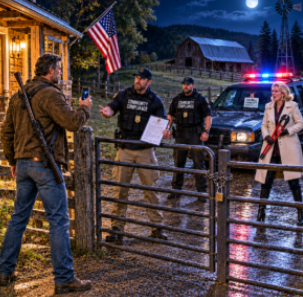
While that moved, Derek confronted me in the driveway.

He blocked my truck.

Walked to the driver’s door.

“I need to search the vehicle.”

I stared at him.

“For what?”

“Contraband.”

I actually laughed.

“Warrant?”

“HOA enforcement doesn’t require one.”

“Badge number?”

He tapped the plastic badge.

“That isn’t a badge number.”

“You know what I mean.”

“Supervisor?”

“Brenda.”

“State license?”

His jaw flexed.

“I’m contracted enforcement.”

“No. You’re an HOA contractor.”

“Same authority.”

“No.”

I got out slowly.

Kept distance.

“Private contractors do not become police because an HOA pays them. You don’t get to search my truck.”

“You military people always think you’re special.”

I looked at the camera above the garage.

Then back at him.

“This conversation is being recorded.”

He drove away.

That recording became another piece.

Then neighbors started contacting us.

Mrs. Chen said Derek had demanded access to her backyard to inspect “foreign plant material.”

The Rodriguez family received noise complaints connected to traditional music during their daughter’s celebration.

Mrs. Patterson found Derek behind her house close to midnight claiming he was measuring a fence.

A younger mother said he followed her children while claiming to provide a “security escort.”

The pattern was ugly.

It also appeared selective.

Families Brenda liked received warnings.

Families she considered difficult received fines.

Minority families.

Military families.

Older homeowners.

People less likely to have money for lawyers.

Sarah created a shared spreadsheet.

Date.

Resident.

Incident.

Witnesses.

Photographs.

Citation number.

Outcome.

The list kept growing.

Then I had to leave for mandatory training.

The moment my truck disappeared from the driveway, Derek’s behavior got worse.

He began appearing near our property after dark.

Our cameras caught him walking near the bedroom side of the house with a flashlight.

Sarah called the police nonemergency line.

The first response was dismissive.

“Sounds like an HOA civil dispute.”

That phrase infuriated me more than almost anything Derek said.

A man creeping around a bedroom window at night is not transformed into a civil dispute because he carries a clipboard.

Sarah filed a report anyway.

Then Derek appeared at the children’s hospital.

Twice.

He tried to speak with Sarah during her shift about “official HOA business.”

Hospital security removed him.

Then banned him.

He filed a 911 report claiming there was a violent domestic disturbance at our house.

Police arrived.

They found Sarah helping Emma with algebra while Marcus practiced piano.

One responding officer questioned Derek.

Warned him about false emergency reports.

Derek responded that military families were “trained in deception.”

The officer wrote it down.

Thank God for people who write things down.

Derek had just created an official police report documenting his fixation.

Brenda finally realized he was becoming a liability.

Our cameras caught the two of them speaking beside her BMW in the clubhouse parking lot.

She told him to reduce enforcement temporarily.

Derek took that as betrayal.

His behavior became less predictable.

That was when I cut my training short and came home.

Family emergency leave.

Sarah did not know exactly when I would arrive.

Neither did Derek.

So when I turned onto our street early that afternoon and saw Sarah’s vehicle in the driveway, I parked behind the house.

I wanted to surprise her.

I slipped inside.

Started making lunch.

Then her car door opened again outside.

She had apparently realized she had left groceries in the cargo area.

Derek’s truck came down the street seconds later.

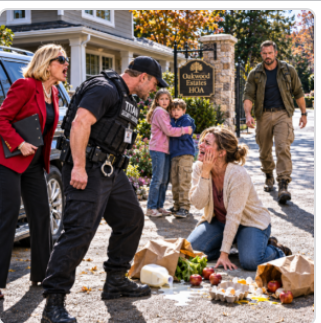
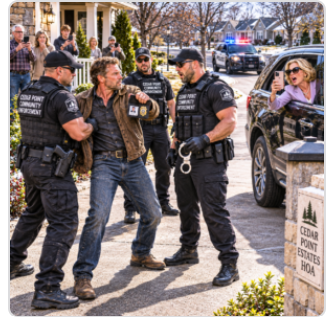
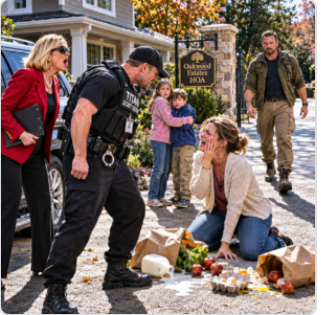
And I watched him slap her.

After he left, we called the police.

Sarah filed the assault report.

We provided footage.

Close view.

Clear audio.

No ambiguity.

Derek claiming enforcement authority.

Sarah carrying groceries.

His hand striking her.

The moment he stepped on the eggs after she fell.

That detail disturbed the detective.

Not legally significant by itself.

Emotionally revealing.

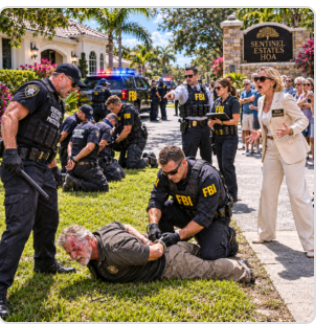
Derek was arrested on the assault case after review of the evidence.

He did not remain free to drive past our children every evening.

For the first time in months, our street became quiet.

Sarah sat at the kitchen table that night with ice against her cheek.

Emma and Marcus were asleep.

“I should’ve done more sooner,” I said.

“No.”

“I knew what he was.”

“We both knew.”

“I left.”

“You went to work.”

“I should’ve—”

“Jake.”

I stopped.

“You are not going to rewrite this until it becomes your fault.”

That was Sarah.

Even bruised, she could still diagnose people.

The assault triggered broader subpoenas and records requests.

The HOA financial file finally opened.

What investigators and our lawyers found made Derek’s three-thousand-dollar payments look small.

Money moved from pool reserves.

Landscaping accounts.

Community-event funds.

Emergency reserves.

Some payments went toward Brenda’s personal expenses.

Luxury travel.

Vehicle costs.

Legal bills from her divorce.

Personal services.

Derek’s expenses.

The total suspicious diversion eventually exceeded $75,000 over several years.

That number mattered.

So did documentation.

Receipts.

Bank statements.

Internal emails.

Vendor records.

Board minutes that did not match actual spending.

Sarah, home recovering from the assault, read the governing declaration from beginning to end.

One afternoon she called me into the kitchen.

“Read this.”

The provision required major enforcement programs of the type Brenda had created to receive approval from sixty percent of homeowners through the association’s prescribed process.

“Did they ever hold that vote?” Sarah asked.

“No.”

“Petition?”

“No.”

“Then where did Brenda get authority for this?”

“She didn’t.”

Sarah leaned back.

For months, we had been treating each citation as an individual abuse.

Now we understood the enforcement program itself had never been approved according to the governing documents.

The entire structure rested on Brenda saying it existed.

Then pretending repetition made it legitimate.

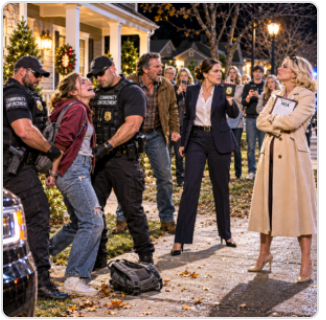
Neighbors learned about the assault.

They began comparing stories publicly.

The spreadsheet Sarah had created grew from a private record into the foundation of an accountability group.

Five households.

Then twelve.

Twenty-three.

Forty-seven.

People who had been embarrassed began speaking.

Mrs. Patterson described Derek demanding entry into her deceased husband’s workshop.

Mrs. Chen produced photographs of cultural decorations she removed after repeated citations.

The Rodriguez family showed notices about music and cooking odors.

A mother on Maple Street brought video of Derek following her children.

Even Brenda’s old allies became uncomfortable.

Nancy, who once wrote that military families believed rules did not apply to them, stopped defending Brenda.

Bob cooperated with the financial review.

The more records appeared, the harder it became to maintain the idea that Derek was simply one rogue contractor.

Then Derek began talking.

Sitting in county jail gave him time to reconsider family loyalty.

He had recordings.

Lots of them.

Apparently he had secretly recorded conversations with Brenda as insurance in case she ever blamed everything on him.

That was exactly what she tried to do.

Brenda issued a statement claiming Derek had exceeded his authority.

She had supposedly instructed him only to observe and report.

Derek’s recordings said otherwise.

Her voice:

“Make that military family understand they’re not welcome here.”

Another:

“Use whatever pressure you need. I want compliance.”

Another discussed targeting households she believed could be pressured easily.

The financial recordings were worse.

Brenda talked casually about moving HOA money between accounts because homeowners rarely audited the records carefully.

One recording referred to dues-paying residents as sheep.

That one reached the neighborhood quickly.

Her presidency did not survive it.

Before the recall vote even happened, eighty-nine percent of reachable homeowners had signed a petition demanding her removal or resignation.

Brenda tried one more strategy.

Smear us.

Anonymous social media accounts appeared.

Posts claimed I was unstable because of military service.

Flyers suggested combat veterans represented safety risks.

Fake online reviews targeted Sarah’s professional reputation.

Someone called the hospital claiming she was emotionally unstable around children.

That move failed spectacularly.

Sarah had worked there for years.

Parents knew her.

Nurses knew her.

Doctors knew her.

Hospital administration reported the harassment and publicly stood behind her.

Every attack generated more witnesses.

More metadata.

More screenshots.

More evidence.

Brenda’s desperation eventually became criminal in new ways.

She attempted to create backdated paperwork suggesting she had tried to fire Derek months earlier.

Investigators compared file creation dates.

Printer records.

Email histories.

The story did not hold.

Then she reported a break-in at her own house.

She claimed people connected to me had entered and left threatening messages referencing military tactics.

Police investigated.

Neighbor cameras showed no intruders.

The alleged threatening notes came from paper and writing instruments linked to Brenda’s own home.

Items supposedly stolen were later found moved elsewhere on the property.

That false report added another layer to the case.

Derek heard about it from jail.

Whatever loyalty remained disappeared.

He turned over even more audio.

More emails.

More instructions.

By then, Brenda was facing multiple investigations.

Financial.

Criminal.

HOA governance.

Real-estate licensing.

Civil litigation.

She attempted to leave Texas.

At Dallas Fort Worth International Airport, authorities stopped her carrying a large amount of cash and documents that raised additional concerns.

Her bail status changed.

The woman who once patrolled Oakwood in a white BMW telling neighbors how high their grass could grow was now answering to actual courts.

I didn’t celebrate.

Sarah didn’t either.

There was relief.

But no celebration.

Because our kids had spent months looking through windows before going outside.

Because Sarah still flinched when a white pickup slowed near the house.

Because Mrs. Chen had removed decorations she loved.

Because an elderly widow had been afraid inside her own backyard.

Because money could be returned.

Time could not.

The civil case moved alongside the criminal proceedings.

Our attorneys documented the assault.

Harassment.

Stalking incidents.

Financial harm.

Emotional distress.

Improper enforcement.

The HOA’s role.

Derek’s individual conduct.

Brenda’s conduct.

Other homeowners pursued their own claims.

We eventually resolved our civil case for approximately $175,000 plus attorney fees through the parties and applicable coverage or recovery mechanisms.

It was significant money.

It did not turn the experience into a profit.

Medical bills came out.

Legal expenses.

Security improvements.

Lost time.

Counseling.

The value of a settlement is not the same as the value of what happened.

I wish more people understood that.

Derek eventually entered a resolution that included incarceration, probationary restrictions, restitution obligations, and a prohibition on returning to security work.

He had started the entire situation wanting the image of authority.

The final legal orders specifically removed his ability to present himself that way again.

Brenda’s financial case became more serious.

The state proved a pattern of misused HOA funds and related conduct.

She ultimately received a prison sentence, restitution obligations, and extended supervision after release.

Her real-estate career collapsed.

Personal assets were used in recovery proceedings.

The white BMW disappeared.

The vanity plate disappeared.

The entire identity she had built around appearing successful and powerful dissolved into court filings.

Yet the most important vote in Oakwood was not a criminal verdict.

It happened inside the same community center where Brenda had once changed enforcement rules to protect Derek.

This time, the room was full.

Standing room.

Homeowners lined the walls.

Sarah sat beside me.

Still a faint discoloration along her cheek.

Brenda was already suspended.

The question was what Oakwood became next.

People wanted revenge.

Some wanted to dissolve the HOA.

Others wanted every fine issued under Brenda refunded immediately.

One man wanted a permanent ban on any security contractor.

Mrs. Chen stood.

“I don’t want revenge.”

The room quieted.

“I want receipts.”

That became the direction.

Audit everything.

Reconcile every dollar.

Review every fine.

Return money where enforcement lacked legal basis.

Publish vendor contracts.

Require board approval.

No secret payments.

No family contractors without disclosure.

No security program without licensing verification.

No harassment disguised as compliance.

Then someone nominated Sarah for interim president.

She stared at them.

“No.”

People laughed.

She looked at me.

“Absolutely not.”

I whispered:

“You’d be good.”

She turned.

“You don’t get a vote in this conversation.”

She accepted two days later.

Her first board meeting lasted four hours.

I attended the first ten minutes.

Then left.

Sarah did not need me there.

She removed the private-security program.

Suspended disputed fines.

Opened records.

Created an independent audit committee.

Put financial statements online for members.

Required recorded votes for major contracts.

Then she did something Brenda never would have done.

She created an appeal process.

Not because every homeowner would be right.

Because authority deserves review.

Oakwood did not become a lawless neighborhood.

Rules still existed.

Grass limits.

Parking.

Common areas.

Architectural review.

We still paid dues.

A year later, I received a legitimate violation notice because I left a trailer in the driveway longer than allowed.

I checked the rule.

The HOA was right.

I moved it.

Sarah laughed for ten minutes.

“Do you want me to call the president?”

“I hate you.”

“You married the president.”

“Terrible judgment.”

The neighborhood changed slowly.

Mrs. Chen put her red lanterns back.

The Rodriguez family hosted music at community events.

Mrs. Patterson’s grandchildren played in the yard where Derek once prowled with a flashlight.

The annual meeting stopped feeling like a courtroom.

Budget reports became boring.

Boring was beautiful.

We created a scholarship fund partly from recovered money and community donations.

Not named after us.

Not named after the case.

Just Oakwood families supporting children.

Emma and Marcus were recognized academically the first year.

I was proud.

Sarah cried.

Then denied crying.

Our story traveled farther than I expected.

Military-family organizations contacted us.

HOA reform groups asked Sarah to speak.

Other residents around Texas shared similar experiences with overreaching boards and unlicensed “security.”

What had happened at Oakwood was extreme.

But the mechanism wasn’t unique.

Fear of fines.

Ignorance of governing documents.

Reluctance to hire lawyers.

Board members who assume nobody reads statements.

Contractors wearing uniforms that imply more authority than they possess.

Sarah started speaking at workshops.

Her message was always less dramatic than mine.

“Read what you sign.”

“Ask for the rule.”

“Ask for the vote.”

“Ask for the contract.”

“Ask for the license.”

“If someone says they have authority, make them show where it comes from.”

She never called people enemies.

Never used military metaphors.

Never made herself the hero.

That made people trust her more.

Eventually, reform proposals reached state lawmakers.

The case became one of several cited examples in debates over HOA transparency, contractor oversight, financial disclosure, and homeowner protections.

Some reforms passed.

Others didn’t.

That was democracy.

Slow.

Messy.

Better than one HOA president deciding the law herself.

I eventually left active operational life completely.

Not because Brenda drove me out.

Because I had already been moving toward a different stage.

I began helping military families understand civilian legal systems.

Not as some commando teaching people how to fight HOAs.

As a man who had learned the value of boring paperwork.

That surprised everyone who knew me.

It surprised me most.

Years earlier, if you asked what I trusted, I might have said training.

Teamwork.

Preparation.

Discipline.

Now I would add:

Certified mail.

Meeting minutes.

Bank records.

Licensing databases.

Security footage.

People joke about bureaucracy until bureaucracy is the thing proving somebody lied.

That lesson came at a cost.

Sarah’s cheek healed within days.

The emotional bruise took longer.

For months, if Derek’s old model of pickup appeared on our street, she would go quiet.

Not panic.

Not freeze.

Just watch.

Emma noticed.

So did Marcus.

Children notice everything adults think they hide.

We found a counselor.

Family sessions.

At first I hated them.

Not because therapy bothered me.

Because sitting in a room and admitting I had been afraid felt harder than most physical training I had ever done.

The counselor asked:

“What were you afraid of?”

I answered:

“That I wouldn’t be home next time.”

Sarah looked at me.

That was the real thing.

Not that I couldn’t protect her.

That I could not always be there.

Military families learn to live inside that fact.

Deployment.

Training.

Duty.

Distance.

Brenda and Derek exploited it.

Derek got bolder when my truck disappeared.

He treated Sarah as the weaker target.

That knowledge haunted me.

The counselor made me say something else aloud.

Sarah had survived before I came home.

She filed reports.

Went to meetings.

Collected records.

Protected our children.

Built the spreadsheet.

Connected neighbors.

She did not need me to rescue her.

I needed to stop rewriting our story as though the Navy husband came home and saved everyone.

The truth was better.

My wife built half the case.

Maybe more.

That changed how I told the story.

When people asked about the slap, I stopped starting with what I did afterward.

I started with what Sarah did before.

She documented.

She kept calm.

She went to the board.

She called police.

She helped neighbors.

She read the covenants.

She found the sixty-percent provision.

She organized forty-seven families.

Then eighty-nine percent of the neighborhood backed reform.

That was not military planning.

That was nursing.

Observe.

Document.

Identify patterns.

Escalate appropriately.

Protect the vulnerable.

Turns out Sarah had been running operations her whole career.

She just called them patient care.

One evening, long after the court cases ended, we were sitting outside while Emma studied inside and Marcus played basketball in the driveway.

Sarah asked:

“You know what bothers me?”

“What?”

“That everyone remembers the slap.”

I looked at her.

“It was dramatic.”

“So were six months before that.”

“I know.”

“No, I mean the story gets reduced to one horrible second.”

She touched her cheek unconsciously.

“But Derek was dangerous before he hit me.”

“Yes.”

“And Brenda was corrupt before he hit me.”

“Yes.”

“And nobody cared enough.”

That was true.

Because small abuses are easy to normalize.

A bad citation.

One rude contractor.

One strange expense.

One board meeting scheduled when working people can’t attend.

One family treated differently.

One resident followed.

One child approached.

Each can be explained away.

Then something happens that cannot.

A slap.

An arrest.

A financial audit.

A camera clip.

People suddenly ask:

How did we get here?

The answer is usually:

Slowly.

Oakwood had not become unhealthy in one day.

Residents had been trained to give Brenda the benefit of the doubt because fighting her cost time.

Time is expensive.

Most people have jobs.

Children.

Illness.

Mortgages.

A $150 fine often feels cheaper than three evenings of research and a lawyer’s consultation.

Brenda knew that.

Her power was not the bylaws.

It was exhaustion.

That became the lesson Sarah taught best.

“Make accountability cheaper than silence.”

Oakwood’s reforms did that.

Documents online.

Appeals by email.

Quarterly reports.

Contract disclosure.

Recorded board votes.

Residents didn’t have to become amateur investigators to know where their dues went.

The system did not depend on everyone being vigilant every minute.

Good systems shouldn’t.

Derek left jail eventually.

He remained restricted from security work.

I heard he lived with family.

Worked low-wage jobs.

Complained to anyone who listened that military people had destroyed his life.

I had no interest in correcting him.

Some people need a villain.

If he wanted me, fine.

He stayed away from my family.

That was enough.

Brenda’s release came later.

Supervision.

Restitution.

Financial monitoring.

No real-estate comeback.

No HOA presidency.

No white BMW cruising Oakwood.

I saw her once after everything.

Grocery store.

Of course.

She was standing near produce.

I nearly walked away.

Then she saw me.

“Jake.”

“Brenda.”

No cameras.

No board.

No courtroom.

Just two people beside a display of oranges.

“I heard Sarah’s doing well.”

“She is.”

“The kids?”

“Good.”

She nodded.

“I never told Derek to hit her.”

I studied her.

“I know.”

Her face shifted.

“You do?”

“I heard the recordings.”

“I told him to pressure you.”

“Yes.”

“I didn’t mean—”

“Brenda.”

She stopped.

“You don’t get to control the exact shape of the thing after you create the conditions for it.”

Her eyes dropped.

“I lost everything.”

I could have said:

Good.

I didn’t.

“You lost a lot.”

“You think I deserved it.”

“I think courts decided what consequences you deserved.”

She looked at me.

“You always talk like that?”

“Sarah says it’s annoying.”

That almost made her smile.

Almost.

Then she said:

“I was scared.”

“Of what?”

“Losing control.”

That answer made more sense than anything she had ever said.

Because that was the entire story.

Derek feared being seen as powerless.

So he wore a badge.

Brenda feared losing control.

So she expanded enforcement.

Residents feared conflict.

So they paid fines.

I feared failing my family.

So I nearly turned every problem into something I personally had to defeat.

Fear was everywhere.

The difference was what people did with it.

“I hope you build something else,” I said.

She stared.

“Why would you say that?”

“Because Sarah taught me people are more useful when they stop being the worst thing they ever did.”

I walked away.

I did not forgive her.

Those are different things.

The first American flag Brenda fined us for eventually went back into the yard.

Same flag.

Same pole.

I could have turned it into a spectacle.

News cameras.

Veterans.

Big ceremony.

Didn’t.

One Saturday morning, Marcus helped me reinstall it.

He had grown almost as tall as Sarah.

He tightened the bracket.

“Is this the illegal flag?”

“No.”

“The famous flag?”

“No.”

“The Brenda flag?”

“Absolutely not.”

He laughed.

“Then what is it?”

“A flag.”

We raised it.

Done.

No speech.

Sarah watched from the porch.

Emma filmed ten seconds, then stopped.

That was enough.

The annual Oakwood community festival eventually included a small veterans ceremony.

But it wasn’t about us.

Military families.

Teachers.

Nurses.

First responders.

Neighbors.

Mrs. Chen sold dumplings.

The Rodriguezes brought music.

Mrs. Patterson sat beneath a tent complaining that everybody overcooked hamburgers.

Normal community.

The first year, I walked the old route Derek used to patrol.

Kids ran around me during a charity 5K.

I remembered his white pickup idling there.

Then a seven-year-old nearly knocked me over chasing his sister.

The memory disappeared under laughter.

That felt better than revenge.

Years later, Sarah became well known for HOA accountability work.

She completed additional legal training and started helping homeowners understand records requests and enforcement procedures.

I teased her.

“You became Brenda.”

She stared at me.

“I will hurt you.”

“Community standards.”

“Sleep outside.”

I laughed.

She didn’t.

Eventually she did.

Laugh, I mean.

Our marriage survived because humor returned.

That was another thing I underestimated.

When fear lives in a house, laughter becomes quieter.

Then one day it comes back.

At first carefully.

Then normally.

The smell I remember from that terrible afternoon is still milk on hot asphalt.

Not Derek’s cologne.

Not dust.

Milk.

For years, spilling milk in the driveway could pull me backward in time.

Then one summer, Marcus dropped an entire gallon while unloading groceries.

The jug burst.

White liquid spread everywhere.

I froze.

Sarah looked at me.

She knew.

Then Marcus said:

“Dad, don’t cry over it.”

Terrible joke.

I laughed so hard I had to sit on the tailgate.

Sarah laughed too.

Marcus had no idea why it was that funny.

Maybe he did.

Children grow up.

They learn the parts adults thought they had hidden.

That day, milk became milk again.

I think recovery works like that.

Not forgetting.

Reassigning meaning.

The same became true of uniforms.

For a while, Sarah hated private security.

Hospital guards.

Mall guards.

Anyone with a black polo and radio.

Then slowly, ordinary people replaced Derek in that image.

A hospital security officer who walked her safely to her car.

A licensed guard at a concert who helped Emma find a lost purse.

A security supervisor who politely asked for identification at an office.

Authority itself had not hurt us.

One man pretending authority was unlimited had.

That distinction mattered.

The civil settlement paid bills and funded part of our future.

We used some money for home security.

Some for counseling.

Some for Emma and Marcus.

A portion went toward the neighborhood scholarship fund.

Not because we wanted to be saints.

Because I didn’t want every dollar associated with that case to feel like compensation for pain.

Some of it needed to become something good.

Oakwood’s property values did eventually improve under transparent governance.

Not because of national publicity.

Because the association became predictable.

Buyers could see audited reserves.

Clear rules.

Stable dues.

Real meeting minutes.

No bizarre enforcement department.

No secret related-party contracts.

Boring governance is attractive.

Who knew?

The new board also created conflict-of-interest rules.

Family members of directors could not receive contracts without disclosure and independent approval.

Vendors had to prove insurance.

Licenses when required.

Competitive bids above certain thresholds.

Financial controls required multiple signatures.

People called the reforms excessive.

Then someone would say:

“Remember Derek.”

Motion passed.

Sometimes institutional memory is useful.

State lawmakers eventually used Oakwood and several other HOA scandals when considering broader reforms.

I testified once.

Not as a Navy SEAL.

Not as a celebrity victim.

As a homeowner.

I brought the first flag violation.

The $200 truck citation.

The grass-height notice.

Then the image of Sarah’s groceries spread across our driveway.

I placed them side by side.

One legislator asked:

“What is the connection?”

“Escalation.”

I explained.

“If residents have no practical way to challenge small abuses, the person abusing authority learns there is no cost.”

Another asked:

“Are you suggesting HOAs should lose enforcement power?”

“No.”

“Then what?”

“Make power auditable.”

That was Sarah’s phrase.

I stole it.

Licensing where licensing is required.

Clear notice.

Appeals.

Financial disclosure.

Limits on contractors.

No physical detention powers invented by board vote.

Nothing revolutionary.

Just boundaries.

The same thing we had been asking Brenda to respect from the beginning.

When the hearing ended, a veteran approached me.

Older.

Vietnam cap.

He shook my hand.

“SEAL?”

“Yes.”

“Thought so.”

“How?”

“You sit like you’re waiting for the door to explode.”

I laughed.

He became serious.

“My HOA’s fine. Good board.”

“Glad to hear it.”

“Don’t let people think they’re all crooks.”

“I don’t.”

“Good.”

That conversation stayed with me.

Anger loves categories.

Karen.

HOA.

Security.

Government.

Military.

Civilian.

Good.

Bad.

Reality doesn’t cooperate.

There were HOA board members who failed us.

There were others who helped.

A police dispatcher initially dismissed Sarah’s complaint.

Another officer documented Derek carefully and helped the case.

Derek was unlicensed and abusive.

Other private security professionals later treated our family with dignity.

My military service gave me discipline.

It also sometimes tempted me toward thinking every conflict needed an opponent.

Sarah corrected that.

Justice required distinctions.

Years after Oakwood changed, a new family moved into the house across from us.

Young couple.

Baby.

The husband knocked on our door one evening holding an HOA notice.

“You’re Jake, right?”

“Yes.”

“I was told you know about HOA stuff.”

Sarah yelled from the kitchen:

“Don’t encourage him.”

He showed me the paper.

Fence paint.

Wrong shade.

He looked genuinely worried.

“What should I do?”

“Check the approved color list.”

“That’s it?”

“If your color is wrong, repaint.”

He seemed disappointed.

“But aren’t HOA fines abusive?”

“Sometimes.”

“This one?”

I compared the paint sample.

Definitely wrong.

“This one appears boringly legitimate.”

Sarah called:

“Thirty-dollar trash can fine!”

“Not helping.”

The neighbor laughed.

He repainted the fence.

No lawsuit.

No scandal.

That interaction mattered almost as much to me as our victory over Brenda.

We had not survived one abusive HOA president just to become people who assumed every rule was tyranny.

Accountability cuts both ways.

Residents owe communities what they actually agreed to.

Boards owe residents only the authority they actually possess.

The trouble begins when either side invents more.

Emma eventually left for college.

Marcus followed a few years later.

Before Emma moved out, she found an old external hard drive labeled DEREK.

“What is this?”

“Old camera files.”

“Can I watch?”

“No.”

“I was there.”

“You were twelve.”

“Dad.”

I thought.

Then handed it to her.

She watched some.

Not the assault first.

Drive-bys.

Facebook screenshots.

Derek near the bus stop.

Finally the driveway.

She stopped before the slap.

“I remember Mom coming inside.”

I waited.

“I remember thinking you were going to kill him.”

My stomach tightened.

“Were you scared of me?”

She thought about it.

“No.”

Then:

“I was scared of what he was making you become.”

That hurt.

Because twelve-year-old Emma had seen something adults missed.

I had spent months imagining discipline meant I was unaffected.

Children saw the tension.

My silences.

The way I checked cameras.

The way I scanned streets.

“I’m sorry.”

“You didn’t do anything.”

“I brought that energy into the house.”

She shrugged.

“We all did.”

Then she smiled.

“Mom was scarier.”

“That is objectively true.”

We laughed.

She took the hard drive.

“Can I keep a copy?”

“Why?”

“Because someday you two are going to tell this story wrong.”

Fair.

She became our unofficial archivist.

Marcus wanted none of it.

His answer:

“Derek was an idiot. Brenda was a criminal. Can we move on?”

Also fair.

Families do not heal uniformly.

Some remember.

Some archive.

Some joke.

Some avoid.

All can be valid.

Sarah and I finally replaced the driveway concrete years later.

Not because of the assault.

Tree roots.

The old slab had cracked.

When contractors broke out the section where the groceries had fallen, I stood watching.

Sarah came outside.

“You doing that thing?”

“What thing?”

“Making normal construction symbolic.”

“No.”

“Yes.”

The jackhammer broke the slab.

Chunks lifted.

Loaded into a truck.

New concrete poured.

By evening, the driveway looked different.

Sarah stared at it.

“Okay.”

“What?”

“I admit this feels good.”

I smiled.

“Symbolism?”

“Shut up.”

The next morning, milk delivery from a local dairy arrived.

A glass bottle sat on the new concrete.

Sarah took a picture.

Sent it to me.

Caption:

RECLAIMED TERRITORY.

I saved it.

Brenda and Derek became less important with time.

That’s the ending nobody puts in dramatic videos.

The villain shrinks.

Not because you defeat them harder.

Because your life grows around the damage.

Children graduate.

Dogs age.

Work changes.

Neighbors move.

Trees get taller.

Paint fades.

Your wife laughs without touching the bruise that isn’t there anymore.

One day you realize you haven’t said the person’s name in months.

That is victory I trust.

The last official document connected to the case arrived after most of the public attention was gone.

A financial reconciliation from Oakwood.

Every disputed account reviewed.

Recovered money listed.

Restitution applied.

Vendor payments corrected.

Reserve balance restored.

At the bottom:

CERTIFIED BY INDEPENDENT AUDITOR.

Sarah read it.

“That’s beautiful.”

“You’ve become a very strange person.”

“Look at those reconciled balances.”

I laughed.

We framed nothing.

Filed it.

Closed the drawer.

That was the end.

Not Brenda being arrested.

Not Derek sentenced.

Not television interviews.

A balanced ledger.

A community that could account for its own money.

Because that was the thing Brenda assumed would never happen.

Someone would eventually add the numbers.

I still have the American flag.

The one from our second week in Oakwood.

Edges slightly faded.

It hangs now from the porch.

No special ceremony.

No spotlight.

No plaque saying HOA KAREN LOST.

Just a flag.

Occasionally a new neighbor asks whether the story about the $150 flag fine is true.

“Yes.”

“What did you do?”

“Paid nothing.”

“Seriously?”

“Seriously.”

Then they’ll ask:

“Were you angry?”

“Very.”

“What stopped you from going after them immediately?”

That answer changed over the years.

At first I said strategy.

Evidence.

Discipline.

Now I say:

“Sarah.”

Because she did.

Every time I wanted to turn Brenda and Derek into enemies, Sarah forced me to remember they were people operating inside systems.

If we fixed only the people, another person could abuse the same weakness.

So we fixed both.

The contractors left.

The president left.

The accounting system changed.

The appeals process changed.

Residents became involved.

Records became visible.

That lasted longer than revenge.

One October evening, we held the annual community gathering near the pool.

Children ran between tables.

Mrs. Chen brought dumplings.

Rodriguez family music played.

Nobody measured decibels.

Mrs. Patterson complained that the coffee was weak.

Sarah stood with me near the old clubhouse door.

“You know Brenda used to stand right there?”

“I know.”

“She’d hate this.”

“Why?”

“Too many uncontrolled cultural foods.”

I laughed.

Then looked around.

No uniforms.

No fake security pickup.

No family avoiding another.

Just neighbors.

“This is what she said she wanted.”

“What?”

“Community.”

Sarah looked at me.

“No. She wanted control.”

That was the distinction.

Community accepts that people disagree.

Control cannot.

Community asks for consent.

Control demands compliance.

Community has rules.

Control treats rules as weapons.

Brenda kept using the word values.

Oakwood’s values.

Community values.

Property values.

She talked about values so often that nobody asked what she personally valued most.

Control.

Once she lost it, everything else collapsed.

I used to think strength meant never being controlled.

Military training can feed that idea if you misunderstand it.

Real strength turned out to be more complicated.

Sometimes strength was Sarah sitting through an HOA meeting while I was gone.

Sometimes it was me not putting Derek through his truck when he blocked my driveway.

Sometimes it was Emma telling us what he said at the bus stop.

Sometimes it was Bob admitting he had signed records without reading enough.

Sometimes it was Nancy apologizing.

Sometimes it was a police officer writing down a ridiculous false-report complaint instead of laughing and forgetting.

Sometimes it was forty-seven families putting their names into a shared spreadsheet.

Nobody looked heroic doing any of those things.

Together, they changed everything.

That is the version I want remembered.

Not:

Navy SEAL destroys HOA Karen.

That makes a good thumbnail.

It makes a bad lesson.

My training helped me control my reaction.

It did not give me special property rights.

Sarah’s nursing career did not make assault against her worse than assault against anyone else.

Our flag did not make us more American than our neighbors.

We were not entitled to more protection because I served.

We were entitled to the same protection everyone should have.

That is what made Derek’s fake authority so dangerous.

He targeted people he believed would comply.

Immigrants.

Widows.

Military spouses alone at home.

Families with children.

People whose schedules made board meetings difficult.

Power searches for asymmetry.

Accountability reduces it.

The first thing I teach military families now is not how to “fight back.”

It is how to slow things down.

Ask for documents.

Don’t answer threats with threats.

Save emails.

Take photographs.

Request minutes.

Verify licensing.

Check whether fines follow the governing documents.

Call actual law enforcement when conduct becomes criminal.

Hire counsel when necessary.

Talk to neighbors.

Do not let an abusive authority isolate you.

And don’t assume a badge means anything until you know who issued it.

Derek’s laminated badge still exists somewhere in an evidence archive.

I never wanted it.

Never asked for it.

A reporter once asked whether I wished I had kept it as a trophy.

“No.”

“Why?”

“Because it was never worth anything.”

That was the point.

The badge had power only because people reacted to it.

Once state investigators checked the underlying reality, the plastic returned to being plastic.

One Saturday morning, long after the cases ended, Sarah and I drove through Oakwood with the windows down.

Fresh mulch.

Sprinklers.

Children.

Somebody grilling.

Exactly the smell and sound of the neighborhood we thought we bought six months before Brenda introduced herself.

We passed the corner where Derek used to park.

Empty.

The clubhouse.

Busy with a birthday party.

Mrs. Chen’s house.

Red lanterns.

Rodriguez home.

Music from the backyard.

Then ours.

American flag moving slightly in the wind.

Sarah turned to me.

“So.”

“So?”

“Was moving here a mistake?”

I considered it.

“Ask me before or after Brenda?”

“After everything.”

I parked.

Emma and Marcus were home visiting.

Cars crowded the driveway.

Sarah waited.

“No.”

She looked surprised.

“Really?”

“No.”

“Why?”

I looked around.

“Because this is home.”

She nodded.

Then:

“Very sentimental, Commander.”

“Don’t tell anybody.”

We went inside.

That night, after everyone left, I walked to the mailbox.

Same style Brenda once claimed needed approval.

I checked the mail.

Utility bill.

Veterans organization newsletter.

HOA envelope.

I laughed.

Opened it.

Annual budget notice.

Reserve contribution increase.

Two percent.

I read it at the curb.

Numbers balanced.

Audit attached online.

Board vote listed.

Sarah opened the front door.

“What is it?”

“HOA.”

She put her hands on her hips.

“Do I need to call the lawyers?”

“No.”

“Security?”

“No.”

“State police?”

“No.”

“What are you going to do?”

I folded the letter.

“Pay the dues.”

She smiled.

And that, more than anything, told me we had won.

Not because the HOA disappeared.

Because it became what it was supposed to be.

A boring organization managing shared property under agreed rules.

No dictator.

No fake cop.

No family contracts hidden as maintenance.

No fear.

Just homeowners arguing over budgets.

I walked back toward the house.

For a moment I remembered that afternoon years earlier.

Sarah standing among broken groceries.

Milk on the driveway.

Derek adjusting his fake badge.

“Next time, follow HOA rules.”

He had believed those words ended the discussion.

Instead, they began the record.

Camera footage.

Police report.

Licensing search.

Financial audit.

Neighbor statements.

Board minutes.

Bank transfers.

Audio recordings.

Court orders.

One piece at a time, every layer of borrowed authority came apart.

Brenda Hartwell wanted Oakwood to believe her office made her untouchable.

Derek Hartwell wanted a plastic badge to make him feared.

What ended them was far less dramatic.

People checked.

That is all.

They checked the license.

Checked the contract.

Checked the vote.

Checked the bank account.

Checked the camera.

Checked the messages.

Checked the bylaws.

Checked the story.

And once enough people checked, there was nowhere left for the lie to live.

Sarah still says the most important moment was not Derek being arrested.

Not Brenda losing the recall.

Not the settlement.

Not the audit.

She says it was the first Oakwood meeting after the reforms.

A homeowner stood up and challenged one of Sarah’s proposed policies.

Brenda would have shut him down.

Sarah listened.

Changed part of the proposal.

Then thanked him.

I asked later why that moment mattered.

“Because I disagreed with him.”

“So?”

“And he still got to speak.”

That is community.

Not obedience.

Years after HOA Karen Brenda Hartwell tried to turn Oakwood Estates into her private kingdom, that may be the most satisfying thing she accidentally taught us.

A good neighborhood is not one where everyone follows one powerful person.

It is one where no powerful person gets to decide alone what everyone else is allowed to become.

Derek once stood in our driveway convinced his badge made him authority.

Brenda sat in a clubhouse convinced her title made disagreement misconduct.

They both discovered the same thing.

Authority without accountability is only a costume.

And costumes come off very quickly once people start asking for the paperwork underneath.
Disclaimer: This story is fictional and created for entertainment purposes only. Any names, characters, places, or events are fictitious or used fictitiously. No real person or organization is intended to be portrayed.

Recommended for You

View Archive arrow_forward
News

HOA Karen Had Fake Officers Handcuff My 17-Year-Old Daughter for Breaking Her Curfew—Then My Wife Stepped Outside With a Real Badge HOA Karen decided our neighborhood needed its own “curfew enforcement,” then hired two men with plastic badges to stop my seventeen-year-old daughter on a public street and put her in handcuffs. When my wife ran outside and saw grown men restraining our child in front of our own home, Karen smiled and threatened to fine us if we interfered. What Karen did not know was that my wife was the county District Attorney—and the moment those fake officers touched our daughter, the HOA dispute stopped being about rules and became a real criminal investigation. The night everything broke open began so quietly that I remember the sound of my daughter’s shoes before I remember the shouting. It was a little after nine. Cool fall air. Porch light on. Television low in the living room. My wife, Rachel, was sitting at the dining table reading through a stack of work papers she had brought home. I was in the kitchen washing a coffee mug when I heard footsteps approaching from the direction of the neighborhood entrance. Our daughter Emma was seventeen. Smart. Stubborn. Funny when she wanted to be. Capable of turning a five-minute conversation about homework into a constitutional argument. She had been at her friend Claire’s house four blocks away and texted me fifteen minutes earlier. Walking home. I had sent back: Love you. Be careful. Then came a voice from outside. “There she is.” Another voice. “Stop right there.” I froze. Emma shouted. “What are you doing?” The mug slipped from my hand into the sink. Rachel looked up. Then came a scream. Not annoyance. Not teenage outrage. Fear. We both moved at the same time. I reached the front door first. What I saw on the sidewalk in front of our house took my brain several seconds to process. Emma’s backpack lay on the pavement. One man had her left wrist twisted behind her back. Another was closing a pair of cheap metal handcuffs around her right wrist. They wore dark polo shirts with black pants and silver-colored badges clipped above their belts. Not police uniforms. Close enough at first glance to scare someone. A flashlight beam swept across Emma’s face. And standing three feet away, holding a clipboard beneath the streetlight, was Karen Holloway. HOA president. Blonde hair fixed perfectly. Long beige coat. Black sunglasses resting on top of her head despite the fact it was night. She looked pleased. Actually pleased. “Good,” Karen said. “Now maybe these kids will understand the rules.” Emma jerked against the man holding her. “Dad!” I was already moving. “Take your hands off my daughter.” The man holding her stepped back half a foot but kept his grip. “Sir, stay back.” “Who the hell are you?” “Community enforcement.” “That isn’t an answer.” Karen moved between us. “Mark, don’t engage him. We have authority.” I looked at her. “Authority to do what?” Emma was crying now. Not sobbing. Angry tears. Her face was red. “Dad, they said I’m under arrest.” My stomach dropped. I looked at the men. “Did you tell my daughter she was under arrest?” The older one lifted his chin. “She violated community curfew.” “That isn’t what I asked.” Karen snapped her clipboard shut. “She has been warned repeatedly.” I stared at her. “There is no curfew.” “There is now.” Rachel came through the front door behind me. She took one look at Emma. Then stopped. I’ve been married to Rachel for twenty years. I have watched her argue murder motions. Handle furious witnesses. Stand in front of juries. Tell grieving families things they never wanted to hear. I had never seen her face look the way it did that night. Not loud. Not wild. Controlled. Which was much worse. “Remove your hands from my child.” The man holding Emma looked toward Karen. Karen gave him a tiny shake of the head. “Do not release her until the violation paperwork is completed.” Rachel walked down the porch steps. “I’m going to say this once.” Karen stepped forward. “Oh, please. Don’t make this dramatic. She was out after nine. We’ve had complaints. The HOA adopted enhanced youth safety rules last month.” Rachel pointed at Emma. “She is seventeen years old, walking home on a public street, and two adult men have put her in handcuffs.” Karen’s expression hardened. “This is official HOA law enforcement.” I almost thought I had misheard her. Rachel did not. Karen continued. “If you interfere, both of you will be fined for obstruction.” Rachel reached inside her coat. The two men tensed. Then she pulled out her county credentials. Held them under the streetlight. The older man’s eyes went straight to the seal. Rachel’s voice stayed completely level. “My name is Rachel Collins.” The man’s grip loosened. Karen rolled her eyes. “We know who you are.” Rachel ignored her. “I am the elected District Attorney for this county.” The younger man dropped Emma’s backpack. Rachel continued. “You are not police officers.” Neither man answered. “You have restrained a minor. You represented yourselves as law enforcement. And unless one of you can show me a warrant, statutory authority, or actual peace-officer commission in the next five seconds, you will remove those cuffs.” Karen laughed. “You cannot use your office to override HOA rules.” Rachel turned toward her. “This is not an HOA issue anymore.” The men looked at each other. The younger one whispered: “Karen?” She snapped: “Do your job.” That was when headlights swept across the street. A sheriff’s cruiser turned the corner. Then another. Karen smiled. Actually smiled. “Perfect.” She pointed toward us. “I called them. Now we’ll see who understands the law.” The first cruiser stopped. Sheriff Daniel Mercer stepped out. He had worked with Rachel for years, but he didn’t walk toward her first. He looked at Emma. The cuffs. The two men. The fake-looking badges. Karen. Then he asked one simple question. “Who here is actually law enforcement?” And for the first time that night, nobody wearing one of Karen’s silver badges answered. part 2 My name is Michael Collins. At the time, I was forty-eight years old, a civil engineer by trade, husband to a prosecutor, father to a daughter who believed any household rule deserved at least one appeal, and reluctant resident of Maplewood Hills. We had lived there twelve years. When we moved in, Maplewood was exactly what we wanted. Tree-lined streets. A small pool. A clubhouse nobody used enough. Kids riding bikes after dinner. Neighbors who waved without requiring committee approval. Then Karen Holloway became HOA president. Karen did not invent dysfunction. She industrialized it. At first, her changes were small. More violation notices. Stricter parking interpretation. New rules about trash cans. Then she started calling ordinary problems “community security concerns.” A teenager skateboarding too late? Security concern. Children playing basketball after sunset? Noise and safety concern. A delivery van parked for fifteen minutes? Traffic-control matter. Some people thought Karen was annoying. I thought she was dangerous because she had begun confusing private association authority with government power. The first time she proposed a neighborhood curfew, Rachel laughed. Not because youth safety was funny. Because the proposal was ridiculous. Karen introduced it during an HOA meeting in August. Children under eighteen, she said, should not be outdoors in common areas after nine p.m. without a parent. I raised my hand. “What’s the enforcement mechanism?” “Warnings initially.” “And after that?” “Fines.” “Against whom?” “The household.” Rachel was beside me. She leaned closer. “She cannot create criminal detention authority.” “I know.” Karen continued. “Repeat offenders may be referred to community enforcement.” Rachel raised her hand. Karen looked irritated. “Yes, Rachel?” “Define community enforcement.” Karen smiled. “We are reviewing security options.” “Private security?” “Professionals.” “Licensed security?” “We are exploring several options.” Rachel leaned back. “That means no.” Karen’s jaw tightened. “The board has authority to protect residents.” “Within the governing documents.” “We have broad safety powers.” “Broad isn’t unlimited.” Karen smiled. “Not everyone here practices criminal law, Rachel.” That line produced a strange silence. Because everyone in Maplewood knew what Rachel did. Karen knew too. But Karen had a habit of speaking as if titles mattered only when they belonged to her. Rachel didn’t argue. She asked for the proposed rule in writing. It arrived two weeks later. MAPLEWOOD YOUTH SAFETY AND COMMUNITY ORDER POLICY It prohibited unsupervised minors from using designated common areas between 9 p.m. and 5 a.m. That was already questionable in scope. But the version Karen started distributing said something broader. It referred to “neighborhood grounds.” Then “streets within Maplewood.” Then “community jurisdiction.” Those phrases mattered. Because Maplewood’s streets were public. The HOA did not own them. Rachel sent an email to the board. Short. Professional. She explained that the association could regulate common amenities within its lawful authority, but it could not create police powers over public streets or authorize private contractors to detain residents. Karen replied: Thank you for your personal opinion. Rachel printed that email. I asked why. She shrugged. “Habit.” That habit became important. The policy passed anyway. Not unanimously. Two board members opposed it. One abstained. Karen announced it as a major public-safety improvement. Then the warnings started. Emma received one because she sat on a bench near the clubhouse at 9:12 after walking Claire home. She brought the paper inside. “Am I grounded by the government now?” I read it. “No.” “Karen says it’s official.” “Karen says many things.” Rachel read the notice. No signature from licensed security. No citation authority. Just: YOUTH CURFEW VIOLATION — FIRST WARNING We sent a written objection. No response. A week later, the Johnsons’ sixteen-year-old son was stopped while walking his dog. Two men in polo shirts asked for identification. He refused. His parents received a $250 fine for “failure to cooperate with community officers.” That phrase bothered Rachel. “Officers?” She requested the security contract. Karen delayed. Then denied the first records request, claiming security procedures were confidential. Another resident, Leonard Price, had been HOA treasurer for six years. Quiet man. Retired accountant. The type who apologized before correcting your math. He called me privately. “Michael, something isn’t right.” “What?” “The security expenses.” “What about them?” “Karen has been approving checks.” “Board-approved?” “Some.” “And the others?” He lowered his voice. “She says they’re emergency authority.” “How much?” “I don’t know yet.” That was enough to make me start saving everything. Not investigating. Not playing detective. Just documenting. Emails. Notices. Meeting minutes. Photographs of the men Karen called “community officers.” Their badges bothered me. Gold-colored plastic. Generic star in the center. Words around the edge: MAPLEWOOD COMMUNITY ENFORCEMENT No government identifier. No license number. No security company name. Rachel told me: “Do not confront them unless necessary. If they claim police powers, call the sheriff.” That seemed simple. Until Karen started acting as though the badges made the men real. They began patrols. SUV. Magnetic decals. Flashlights. Radios. They stopped teenagers. Questioned guests. Threatened homeowners with “detention for obstruction.” Most people laughed at first. Then one elderly resident told me a patrolman blocked her driveway until she answered questions about her grandson. Another homeowner said one of them threatened to “write him up for resisting.” Rachel became concerned enough to contact the sheriff professionally—not as district attorney directing a case, but simply to flag a potential public-safety issue. Sheriff Mercer said the office had received two informal complaints but no formal report involving actual detention. “Someone needs to document a specific incident,” he said. Nobody wanted to be first. That’s how bad authority grows. Everyone thinks somebody else will challenge it. Then people adapt. Parents began telling teenagers to be home before nine even though the HOA had no police authority. Not because they accepted Karen’s rule. Because they didn’t want trouble. Emma hated that. “This is stupid.” “Yes.” “So why do I have to follow it?” “You don’t have to follow an invalid arrest rule.” “So I can stay out?” “You still have parents.” She rolled her eyes. “Different dictatorship.” “Exactly.” We set our own household expectation. Text us. Tell us where you are. Be sensible. That night, Emma left Claire’s house around 8:50. She texted. She should have been home by nine. Claire’s little brother got sick. Emma helped clean up. Then she started walking. At 9:17, Karen was waiting near our block with the two men. Later, we would learn why. Emma had been singled out. Not randomly. Karen had sent a message earlier that evening: Collins girl is out again. Make an example so residents understand enforcement is real. That sentence eventually appeared in evidence. But that night, all we knew was that our daughter had been placed in handcuffs. Sheriff Mercer approached the two men slowly. “Identification.” The older one handed over his badge. Mercer turned it in his hand. Plastic backing. Gold foil emblem. No state seal. No commission number. “Who employs you?” The man looked at Karen. Karen answered. “The association.” Mercer looked at her. “I asked him.” The younger man finally spoke. “We’re contractors.” “For who?” “Maplewood HOA.” “Security company?” Silence. Mercer handed the fake badge to a deputy. “Do either of you hold a peace officer commission?” “No.” “Are you licensed security?” The older man hesitated. “Contract security.” “That wasn’t my question.” Karen stepped forward. “This is ridiculous. They are authorized community officers.” Mercer looked at Emma. “Who put the cuffs on her?” The older man raised his hand reluctantly. “Why?” “Curfew violation.” “Whose curfew?” “HOA.” Mercer stared at him. Then at Karen. Then back at him. “An HOA fine is not an arrest warrant.” Karen threw up her hands. “She broke community law.” Rachel closed her eyes. Mercer said: “There is no such thing as HOA criminal law.” Karen pointed toward Rachel. “She is interfering because that’s her daughter.” Mercer nodded. “Correct. Which is why she isn’t running this scene.” That sentence mattered. Rachel immediately stepped back. She put one arm around Emma. Then said: “Sheriff, because my child is the victim, I am formally recusing myself from any prosecutorial decisions arising from this incident.” Karen looked confused. Mercer didn’t. “Understood.” Rachel continued. “I’ll notify the chief deputy DA and request conflict counsel or a special prosecutor if charges are presented.” That was how real authority worked. Not by saying: I’m the DA, therefore I control everything. By recognizing when authority had limits. Karen never understood that. The deputies removed Emma’s handcuffs after photographing them. They photographed her wrists. Collected the fake badges. Took possession of the cuffs with consent from the men. Separated witnesses. Neighbors had already begun gathering. Phones everywhere. Karen noticed. “Stop recording me!” Nobody stopped. One deputy asked whether Karen had instructed the men to restrain Emma. Karen answered: “They were carrying out HOA policy.” “Did you tell them to handcuff her?” “I told them to enforce the rules.” “That wasn’t my question.” Her mouth tightened. “They were trained.” “By whom?” Silence. The older man looked at Karen. Then said: “She gave us scripts.” Karen whipped around. “Do not speak without counsel.” Mercer raised one hand. “Mrs. Holloway, stop instructing witnesses.” That sentence was the first crack. The men were not taken away simply because Rachel said “felony.” The sheriff’s office did something much more damaging. They investigated. Emma gave a statement. So did I. Rachel gave hers as a witness and parent. The two contractors were questioned separately. Karen was interviewed separately. Our front-door camera captured the final part of the detention. Claire’s family had a camera capturing Emma leaving their street. A neighbor across from us recorded the moment the men stopped her. Another phone video captured Karen saying: “Finally, we’re teaching these brats some respect.” That clip spread across Maplewood before midnight. The sheriff’s office asked everyone not to edit or delete originals. By morning, Karen’s fake police program was the only thing anyone wanted to discuss. Rachel went to work. But not to prosecute. The case had already become a conflict for her office. Her own daughter was a victim. Rachel notified the court administration and state prosecutorial coordinating office that morning. Within days, an outside special prosecutor from a neighboring judicial district was assigned. Karen later tried claiming Rachel had weaponized the DA’s office. The recusal paperwork answered that. Timestamped before charging decisions. That was important. The sheriff’s investigation expanded because of the two fake officers. One of them, Mark Ellis, cooperated early. He wasn’t a hardened criminal mastermind. He was a part-time security contractor who had been paid cash for Maplewood patrol shifts. Karen told him the HOA had “delegated detention authority.” He believed enough of it to participate. Not enough to save himself from consequences. But enough to explain how the scheme worked. Karen provided scripts. The sheriff found copies. Printed on Maplewood HOA letterhead. STOP SUBJECT. IDENTIFY VIOLATION. DECLARE COMMUNITY DETENTION. ADVISE OBSTRUCTION PENALTIES. USE RESTRAINTS IF SUBJECT ATTEMPTS TO LEAVE. When Rachel heard about the scripts, she went silent. Then said: “She wrote that?” The investigator nodded. Rachel shook her head. An HOA president had written a fake arrest protocol. The second contractor initially blamed Mark. Then Mark produced text messages. Karen: Need both of you at west gate tonight. Collins girl likely out past curfew. Do not let parents interfere. Make it visible. That phrase mattered. Make it visible. The goal wasn’t safety. It was spectacle. Intimidation. The sheriff obtained lawful process for relevant HOA records after the special prosecutor approved the application. No dramatic “raid” based on Rachel’s anger. A judge reviewed probable cause. Then investigators searched specified HOA office and storage areas. They found fake violation forms. Blank “community detention reports.” Boxes of generic badges. Plastic handcuffs. Patrol scripts. Resident photographs. Files tracking teenagers. And financial records. That’s where Leonard Price became central. He had been right. HOA money was missing. Not millions. Something more believable and therefore more damning. Checks for “security consulting.” Cash reimbursements. Travel charges. Hotel receipts. Payments to a company associated with Karen’s cousin. An account Karen called an “emergency compliance reserve.” The board had never formally created it. Leonard had signed several blank checks early in Karen’s presidency because she told him vendors needed same-day payment. He regretted it immediately. Then became afraid to challenge her. “I should’ve stopped,” he told investigators. But he didn’t hide what happened. That cooperation mattered. Other residents came forward. Mr. Johnson showed records of a $1,000 fine issued after his daughter had friends on the driveway after nine. Mrs. Feldman, a widowed teacher, brought letters threatening collection if she didn’t repaint shutters from cream to “Maplewood Beige.” Another family had been charged security-response fees because their teenage son refused to provide a fake community officer with identification. The pattern became larger than Emma. That was the point where our anger changed. At first, I wanted consequences because Karen had terrified my daughter. Then I realized Emma was simply the incident Karen had finally pushed far enough to force everyone to look. The special prosecutor charged only what the evidence supported. False imprisonment-related counts. Conspiracy tied to the detention scheme. Unlawful impersonation conduct where provable. Fraud-related charges connected to falsified security authority. Financial crimes supported by the HOA records. Karen was not charged with every terrible thing neighbors accused her of. Good. Criminal cases aren’t revenge collections. They require proof. The two fake officers faced separate cases. Mark entered a plea agreement requiring cooperation. The second man contested more of the allegations but was ultimately convicted on narrower counts tied to unlawful restraint and false representations of authority. Karen fought everything. Her lawyer claimed she believed the HOA possessed broad contractual authority. The state responded with her own emails. Her scripts. Board minutes. The absence of any adopted detention power. Warnings from HOA counsel. That last part surprised everyone. Months before Emma was handcuffed, Maplewood’s attorney had sent Karen an email. Private security may observe and report. They should not represent themselves as police, physically detain residents for covenant violations, or use restraints absent an independent lawful basis. Karen replied: Understood. We need stronger language so residents take compliance seriously. Then she hired the men anyway. At trial, that email hurt more than any angry witness. Because it destroyed ignorance. Karen had been told where the line was. She crossed it deliberately. Rachel did not sit at the prosecution table. She sat beside me. Parent. Witness family. Nothing more. The special prosecutor, Anne Prescott, handled the case. Emma testified. I was proud of her and hated that she had to do it. She walked to the witness stand wearing a dark blue dress and no makeup. Her hands shook when she swore the oath. Anne spoke gently. “Emma, tell us what happened when you reached your street.” Emma looked toward the jury. “Two men blocked me.” “What did they say?” “That I was under arrest.” “Did you believe they were police?” “At first.” “What happened next?” “One grabbed my wrist.” She swallowed. “I tried to pull away.” “Why?” “Because I was scared.” “Then?” “He put my arm behind me and cuffed me.” The courtroom was silent. Anne asked: “What did you think was happening?” Emma’s voice cracked. “I thought I was being kidnapped.” I looked down. Rachel squeezed my hand. Emma continued. “Karen was standing there smiling.” Across the room, Karen stopped looking at her. That detail was small. Human. More powerful than every dramatic accusation. The defense tried to show that Emma knew the men were HOA security. She answered honestly. “I knew Karen said they were HOA. They were telling me I was arrested and couldn’t leave. I was seventeen. I didn’t know what they were allowed to do.” Exactly. Children should not need criminal-procedure training to walk home safely. Leonard testified about the money. Board members testified about what they had and had not approved. The HOA attorney testified about the warning. Mark testified about the scripts. Then the prosecution displayed Karen’s handwritten training page. Her handwriting. Her notes. Say “official detention.” Do not say private security unless directly asked. The jury saw it. Karen saw them see it. That’s when her entire defense began feeling impossible. The special prosecutor’s closing argument was simple. “This case is not about whether an HOA can make rules. It can.” She paused. “It is about what happens when someone decides rules are not enough and begins manufacturing powers she does not possess.” No theatrics. No speech about tyranny. Just the line. Karen had authority. Limited authority. She wanted more. So she invented it. The jury returned guilty verdicts on multiple counts, though not every charge. That’s how real trials work. The most serious convictions involved the conspiracy surrounding unlawful detention, fraud-related misuse of HOA processes, and financial misconduct proven through association records. At sentencing, the judge did not give Karen fifteen years because she was disliked. The court considered the statutory ranges, her role, the fact that a minor had been physically restrained, financial losses, the planning reflected in the scripts, and the number of residents affected. Karen ultimately received a substantial prison sentence totaling more than a decade across the grouped offenses, with restitution obligations and additional conditions. Mark received far less because he cooperated and had no prior record. The other contractor received a separate sentence. Rachel sat beside Emma during sentencing. No victory smile. No whispered celebration. Just relief. Karen’s son attended. He cried. That mattered too. People who do terrible things still have families. Justice doesn’t require enjoying every piece of their pain. The HOA itself did not magically disappear because Karen was convicted. Maplewood was a legal association attached to property covenants. One criminal president could not erase that structure with handcuffs. Instead, homeowners called a special election. Karen had already been removed from office while charges were pending. Leonard resigned as treasurer after helping reconstruct the finances. Not because residents blamed him equally. Because he said he needed to stop carrying the guilt of having signed papers without reading enough. A neutral management company was hired temporarily. Outside accountants audited the association. The board rescinded the fake curfew policy. All “community detention” procedures were voided. Security contracts were terminated. Improper fines were reviewed. Many were refunded or credited. Mrs. Feldman’s shutter penalty disappeared. Mr. Johnson’s youth-curfew fine disappeared. Every household received a written acknowledgment: MAPLEWOOD HOA HAS NO CRIMINAL LAW-ENFORCEMENT AUTHORITY. Frankly, I wanted that sentence engraved on the clubhouse. Rachel said no. Emma said yes. The new board president was Mrs. Patterson. Seventy-one. Retired librarian. Terrifying in an entirely different way. She read every line of every contract. The first security company that submitted a proposal included the phrase: ENFORCEMENT OFFICER. Mrs. Patterson crossed it out. “They’re guards,” she said. The vendor representative looked uncomfortable. “They perform compliance support.” “They observe and report.” “Yes.” “Then call them security guards.” He changed the proposal. I loved her immediately. Emma’s recovery took longer than the HOA’s. That’s the part stories usually rush. Karen was arrested. Court happened. Rules changed. But Emma still flinched when a dark SUV slowed near her. She stopped walking home after dark for months. Even when she knew intellectually nobody had authority to arrest her over an HOA rule, her body remembered those cuffs. Rachel found a trauma counselor who worked with adolescents after frightening law-enforcement encounters. Emma hated the idea. Went anyway. The first month, I drove her everywhere. Then one evening she said: “I’m walking to Claire’s.” I looked at Rachel. Rachel looked at me. Neither of us spoke. Emma rolled her eyes. “You two are making it weird.” “Text us.” “I know.” “Phone charged?” “Dad.” “Okay.” She left. I stood near the window like a lunatic. Rachel came beside me. “You’re worse than Karen.” “That’s offensive.” “Stop watching.” “I’m looking at the landscaping.” “You hate that shrub.” “I’ve changed.” She pulled me away from the window. Emma came home at 9:23. Walked straight up the street. No one stopped her. She opened the door. “See?” I hugged her. She groaned. “Dad.” “Deal with it.” Slowly, Maplewood felt like a neighborhood again. Children stayed outside after dinner. Teenagers sat near the pool without being photographed. Parents stopped checking the HOA app every morning. People began lingering on porches. The whole place had spent years adjusting to Karen’s surveillance without realizing how abnormal it had become. The old fake badges became evidence. The fake detention reports stayed in court storage. Emma’s broken pair of handcuffs was eventually released after the case. She didn’t want them. I understood. One night, she asked me to throw them away. I did. No bonfire. No symbolic public burning. Just a trash bin. Sometimes healing doesn’t need an audience. The more important thing was what replaced them. Nothing. No badge. No fake patrol. No curfew enforcement. Empty space where invented authority had been. Rachel returned fully to normal work after the special prosecutor finished the conflict case. People occasionally told her: “You must have enjoyed taking Karen down.” Rachel always corrected them. “I didn’t prosecute her.” “You were the DA.” “I was also the victim’s mother.” That answer taught half the neighborhood more about ethical authority than Karen ever had. Rachel could have used her title to dominate the situation. Instead, the first meaningful thing she did after protecting Emma was step away from prosecutorial control. Karen had done the opposite. Every time she found a limit, she invented a reason the limit didn’t apply. That difference became the heart of the story for me. Power isn’t proven by how much you can do. Sometimes power is proven by knowing what you should not do. A year after the incident, Maplewood held a community picnic. Nothing fancy. Grills. Music. Children everywhere. Emma attended with Claire. At nine fifteen, I checked the time without thinking. Emma caught me. “Don’t.” “Didn’t say anything.” “You looked at your watch.” “I’m forty-nine. I look at clocks.” She laughed. Then walked away with her friends. Karen’s old house had been sold by then. New family. Two children. A dog that barked at everything. Perfectly ordinary. The property didn’t look evil. That surprised me. For years, Karen’s house had felt like headquarters. Once she was gone, it was just siding and windows. Places don’t create authority. People do. Systems either constrain them or fail to. Maplewood had failed because too many board members let Karen say: “I’ll handle it.” Security. Violations. Money. Meetings. Youth enforcement. Then nobody asked enough questions. Why does an HOA need handcuffs? Who approved badges? Who authorized detention? Why are teenagers being tracked? Why are checks blank? Where is the lawyer’s opinion? Questions that sound embarrassingly obvious afterward. That’s why the new board adopted a rule I liked. Every major policy proposal required a section titled: LEGAL AUTHORITY AND LIMITS Not just what the HOA wanted to do. Where the power came from. And where it stopped. Mrs. Patterson joked that Rachel should write every one. Rachel refused. “Hire your own attorney.” Mrs. Patterson smiled. “See? Boundaries.” Exactly. Leonard visited us about eighteen months later. He had moved to another neighborhood. He looked healthier. “I wanted to apologize to Emma.” We called her downstairs. He stood awkwardly in the living room. “I signed some of the checks that paid those men.” Emma looked at him. “You didn’t handcuff me.” “No.” “You didn’t tell them to?” “No.” “Then why are you apologizing?” “Because I saw things I should have challenged earlier.” Emma thought about that. Then said: “Okay.” Leonard looked confused. “Okay?” “Apology accepted.” That was our daughter. Then she added: “But don’t sign blank checks anymore.” Leonard laughed for the first time since he arrived. “I promise.” After he left, Rachel looked at Emma. “That was kind.” Emma shrugged. “He looked miserable.” I said: “You sound like your mother.” “That is also offensive.” Life kept moving. Rachel won reelection. Emma went to college the following year. Not far. Far enough. On move-in day, I installed a small camera in her car. She caught me. “No.” “It’s for parking.” “No.” “Dashcam.” “Dad.” Rachel watched us argue. Finally, she said: “Dashcam stays.” Emma pointed. “You’re both impossible.” Family democracy. Not perfect. Still better than Karen’s. The criminal case eventually became training material inside the sheriff’s office—not because HOA abuse was unique, but because impersonation involving private authority can escalate quickly. Deputies were reminded to ask residents: Who claimed law-enforcement authority? What exactly was said? Was movement physically restricted? Were restraints used? Were badges displayed? Did the subject believe they were free to leave? Those details mattered. The case also taught Maplewood residents something uncomfortable. Karen did not wake up one morning and jump directly from parking fines to handcuffing teenagers. The escalation happened incrementally. First: More aggressive notices. Then: Security patrols. Then: “Community officers.” Then: Official-looking badges. Then: Commands. Then: Threats of detention. Then: Actual restraints. Every previous step normalized the next. That is how fake authority becomes dangerous. Not because the lie is perfect. Because people get used to it. One evening, years later, Rachel and I walked through Maplewood after dinner. We passed the same corner where Emma had been stopped. No patrol car. No Karen. Just a kid on a skateboard and two teenagers laughing near a mailbox. Rachel slowed. “You think about it?” “Every time.” “Me too.” We stood there. I could still see Emma in my mind. Wrist twisted. Backpack falling. Karen smiling. The memory still made my chest tighten. Rachel reached for my hand. “I’ve prosecuted people who did worse things,” she said. “I know.” “This one felt different.” “Because it was Emma.” “Yes.” Then she said something I had heard her tell victims’ families many times. “The system isn’t supposed to feel personal.” “But?” “It always does to somebody.” That was why recusal mattered. That was why independent evidence mattered. That was why the sheriff photographed the cuffs instead of simply taking Rachel’s word. That was why the special prosecutor presented Karen’s own messages. Because justice cannot become credible by replacing one person’s fake authority with another person’s unchecked real authority. It has to survive scrutiny. Karen’s system never could. There was one question people kept asking me. “Why didn’t you stop the men physically before Rachel came outside?” The answer is simple. I was about to. If they had begun moving Emma away, I would have intervened. But Rachel arrived within seconds. Then the sheriff. And once real law enforcement took control, the safest thing I could do was stay with my daughter and let evidence speak. Standing by Emma did not require creating a second dangerous confrontation. That’s another lesson Karen never understood. Resisting abuse does not always mean escalating harder. Sometimes it means refusing to comply while documenting everything and getting legitimate authority involved. That night, Karen wanted chaos. Chaos made her feel powerful. What destroyed her was procedure. Badge verification. Witness separation. Camera preservation. Search warrants. Board minutes. Financial records. Emails. Recusal. Independent prosecution. Jury instructions. Sentencing law. Every boring safeguard that Karen thought she could skip eventually became the wall she couldn’t climb. The fake officers had props. Plastic badges. Cheap cuffs. Scripts. Karen had a title. HOA president. Rachel had something different. Real authority with real limits. That distinction is why one system survived and the other collapsed. Years later, Maplewood still has an HOA. Some people assume I would rather it disappear completely. I wouldn’t. The pool still needs maintenance. Common landscaping still needs funding. Someone still has to negotiate insurance and repair the clubhouse roof. HOAs are tools. Tools aren’t moral. People decide how they are used. Karen tried turning ours into a government. The new board turned it back into an association. That is exactly where it belongs. Emma came home from college one Thanksgiving and walked through the neighborhood with me. We passed the clubhouse. A small sign near the entrance read: PRIVATE SECURITY PERSONNEL ARE NOT LAW ENFORCEMENT OFFICERS. Emma stopped. “Seriously?” “New policy.” “They really needed a sign?” “Apparently.” She laughed. “Can I steal it?” “No.” “Why?” “Because that would be an actual crime.” “Dad.” We kept walking. When we reached the old corner, Emma stopped again. For a second, she became seventeen in my mind. Then she looked at me. “I used to hate this street.” “I know.” “I don’t anymore.” That meant more to me than Karen’s sentence. More than the board election. More than every news story. Because Karen had tried to make our daughter feel powerless in her own neighborhood. And eventually, Emma took that place back. That’s the ending I remember. Not Karen in court. Not the fake badges on an evidence table. Not the headlines. My daughter walking the same street at night without looking over her shoulder. That was justice too. Quiet justice. The kind nobody films. Karen believed authority meant making people afraid to challenge you. Rachel taught me the opposite. Real authority can tolerate questions. It can explain its source. It can identify its limits. It can step aside when fairness requires it. Karen’s power ended the moment people stopped accepting “because I said so” as an answer. The sheriff asked for credentials. The special prosecutor asked for evidence. The jury asked what Karen knew. The board asked what it had actually approved. Residents asked where their money went. And every honest answer made Karen’s kingdom smaller. Until there was nothing left except the person behind the clipboard. No police powers. No curfew jurisdiction. No right to arrest. No legitimate detention authority. No magical immunity. Just a woman who had spent years confusing obedience with consent. The night Emma was handcuffed, Karen thought she had finally proven her system worked. She had patrolmen. Badges. A policy. A frightened teenager. Neighbors watching. Then my wife stepped outside. Karen thought Rachel’s badge was the thing that destroyed her. It wasn’t. The badge only started the question. What authority do you actually have? Karen never had a legitimate answer. And once that became clear, every fake rule, every counterfeit badge, every secret payment, every invented arrest script, and every threat she had used against Maplewood began collapsing under its own weight. That’s why I don’t remember Karen’s final sentence as the most important moment. I remember Sheriff Mercer holding one of those plastic badges beneath the streetlight. He turned it over. Looked at the cheap backing. Then looked toward Karen. She had spent years convincing people that piece of metal meant power. The sheriff simply asked: “Who issued this?” Nobody answered. That silence was the beginning of the end. Because the truth about fake authority is simple. It works only while nobody asks where it came from. 𝗧𝗛𝗘 𝗘𝗡𝗗 HOA Karen Had Fake Officers Handcuff My 17-Year-Old Daughter for Breaking Her Curfew—Then My Wife Stepped Outside With a Real Badge HOA Karen decided our neighborhood needed its own “curfew enforcement,” then hired two men with plastic badges to stop my seventeen-year-old daughter on a public street and put her in handcuffs. When my wife ran outside and saw grown men restraining our child in front of our own home, Karen smiled and threatened to fine us if we interfered. What Karen did not know was that my wife was the county District Attorney—and the moment those fake officers touched our daughter, the HOA dispute stopped being about rules and became a real criminal investigation. The night everything broke open began so quietly that I remember the sound of my daughter’s shoes before I remember the shouting. It was a little after nine. Cool fall air. Porch light on. Television low in the living room. My wife, Rachel, was sitting at the dining table reading through a stack of work papers she had brought home. I was in the kitchen washing a coffee mug when I heard footsteps approaching from the direction of the neighborhood entrance. Our daughter Emma was seventeen. Smart. Stubborn. Funny when she wanted to be. Capable of turning a five-minute conversation about homework into a constitutional argument. She had been at her friend Claire’s house four blocks away and texted me fifteen minutes earlier. Walking home. I had sent back: Love you. Be careful. Then came a voice from outside. “There she is.” Another voice. “Stop right there.” I froze. Emma shouted. “What are you doing?” The mug slipped from my hand into the sink. Rachel looked up. Then came a scream. Not annoyance. Not teenage outrage. Fear. We both moved at the same time. I reached the front door first. What I saw on the sidewalk in front of our house took my brain several seconds to process. Emma’s backpack lay on the pavement. One man had her left wrist twisted behind her back. Another was closing a pair of cheap metal handcuffs around her right wrist. They wore dark polo shirts with black pants and silver-colored badges clipped above their belts. Not police uniforms. Close enough at first glance to scare someone. A flashlight beam swept across Emma’s face. And standing three feet away, holding a clipboard beneath the streetlight, was Karen Holloway. HOA president. Blonde hair fixed perfectly. Long beige coat. Black sunglasses resting on top of her head despite the fact it was night. She looked pleased. Actually pleased. “Good,” Karen said. “Now maybe these kids will understand the rules.” Emma jerked against the man holding her. “Dad!” I was already moving. “Take your hands off my daughter.” The man holding her stepped back half a foot but kept his grip. “Sir, stay back.” “Who the hell are you?” “Community enforcement.” “That isn’t an answer.” Karen moved between us. “Mark, don’t engage him. We have authority.” I looked at her. “Authority to do what?” Emma was crying now. Not sobbing. Angry tears. Her face was red. “Dad, they said I’m under arrest.” My stomach dropped. I looked at the men. “Did you tell my daughter she was under arrest?” The older one lifted his chin. “She violated community curfew.” “That isn’t what I asked.” Karen snapped her clipboard shut. “She has been warned repeatedly.” I stared at her. “There is no curfew.” “There is now.” Rachel came through the front door behind me. She took one look at Emma. Then stopped. I’ve been married to Rachel for twenty years. I have watched her argue murder motions. Handle furious witnesses. Stand in front of juries. Tell grieving families things they never wanted to hear. I had never seen her face look the way it did that night. Not loud. Not wild. Controlled. Which was much worse. “Remove your hands from my child.” The man holding Emma looked toward Karen. Karen gave him a tiny shake of the head. “Do not release her until the violation paperwork is completed.” Rachel walked down the porch steps. “I’m going to say this once.” Karen stepped forward. “Oh, please. Don’t make this dramatic. She was out after nine. We’ve had complaints. The HOA adopted enhanced youth safety rules last month.” Rachel pointed at Emma. “She is seventeen years old, walking home on a public street, and two adult men have put her in handcuffs.” Karen’s expression hardened. “This is official HOA law enforcement.” I almost thought I had misheard her. Rachel did not. Karen continued. “If you interfere, both of you will be fined for obstruction.” Rachel reached inside her coat. The two men tensed. Then she pulled out her county credentials. Held them under the streetlight. The older man’s eyes went straight to the seal. Rachel’s voice stayed completely level. “My name is Rachel Collins.” The man’s grip loosened. Karen rolled her eyes. “We know who you are.” Rachel ignored her. “I am the elected District Attorney for this county.” The younger man dropped Emma’s backpack. Rachel continued. “You are not police officers.” Neither man answered. “You have restrained a minor. You represented yourselves as law enforcement. And unless one of you can show me a warrant, statutory authority, or actual peace-officer commission in the next five seconds, you will remove those cuffs.” Karen laughed. “You cannot use your office to override HOA rules.” Rachel turned toward her. “This is not an HOA issue anymore.” The men looked at each other. The younger one whispered: “Karen?” She snapped: “Do your job.” That was when headlights swept across the street. A sheriff’s cruiser turned the corner. Then another. Karen smiled. Actually smiled. “Perfect.” She pointed toward us. “I called them. Now we’ll see who understands the law.” The first cruiser stopped. Sheriff Daniel Mercer stepped out. He had worked with Rachel for years, but he didn’t walk toward her first. He looked at Emma. The cuffs. The two men. The fake-looking badges. Karen. Then he asked one simple question. “Who here is actually law enforcement?” And for the first time that night, nobody wearing one of Karen’s silver badges answered. part 2 My name is Michael Collins. At the time, I was forty-eight years old, a civil engineer by trade, husband to a prosecutor, father to a daughter who believed any household rule deserved at least one appeal, and reluctant resident of Maplewood Hills. We had lived there twelve years. When we moved in, Maplewood was exactly what we wanted. Tree-lined streets. A small pool. A clubhouse nobody used enough. Kids riding bikes after dinner. Neighbors who waved without requiring committee approval. Then Karen Holloway became HOA president. Karen did not invent dysfunction. She industrialized it. At first, her changes were small. More violation notices. Stricter parking interpretation. New rules about trash cans. Then she started calling ordinary problems “community security concerns.” A teenager skateboarding too late? Security concern. Children playing basketball after sunset? Noise and safety concern. A delivery van parked for fifteen minutes? Traffic-control matter. Some people thought Karen was annoying. I thought she was dangerous because she had begun confusing private association authority with government power. The first time she proposed a neighborhood curfew, Rachel laughed. Not because youth safety was funny. Because the proposal was ridiculous. Karen introduced it during an HOA meeting in August. Children under eighteen, she said, should not be outdoors in common areas after nine p.m. without a parent. I raised my hand. “What’s the enforcement mechanism?” “Warnings initially.” “And after that?” “Fines.” “Against whom?” “The household.” Rachel was beside me. She leaned closer. “She cannot create criminal detention authority.” “I know.” Karen continued. “Repeat offenders may be referred to community enforcement.” Rachel raised her hand. Karen looked irritated. “Yes, Rachel?” “Define community enforcement.” Karen smiled. “We are reviewing security options.” “Private security?” “Professionals.” “Licensed security?” “We are exploring several options.” Rachel leaned back. “That means no.” Karen’s jaw tightened. “The board has authority to protect residents.” “Within the governing documents.” “We have broad safety powers.” “Broad isn’t unlimited.” Karen smiled. “Not everyone here practices criminal law, Rachel.” That line produced a strange silence. Because everyone in Maplewood knew what Rachel did. Karen knew too. But Karen had a habit of speaking as if titles mattered only when they belonged to her. Rachel didn’t argue. She asked for the proposed rule in writing. It arrived two weeks later. MAPLEWOOD YOUTH SAFETY AND COMMUNITY ORDER POLICY It prohibited unsupervised minors from using designated common areas between 9 p.m. and 5 a.m. That was already questionable in scope. But the version Karen started distributing said something broader. It referred to “neighborhood grounds.” Then “streets within Maplewood.” Then “community jurisdiction.” Those phrases mattered. Because Maplewood’s streets were public. The HOA did not own them. Rachel sent an email to the board. Short. Professional. She explained that the association could regulate common amenities within its lawful authority, but it could not create police powers over public streets or authorize private contractors to detain residents. Karen replied: Thank you for your personal opinion. Rachel printed that email. I asked why. She shrugged. “Habit.” That habit became important. The policy passed anyway. Not unanimously. Two board members opposed it. One abstained. Karen announced it as a major public-safety improvement. Then the warnings started. Emma received one because she sat on a bench near the clubhouse at 9:12 after walking Claire home. She brought the paper inside. “Am I grounded by the government now?” I read it. “No.” “Karen says it’s official.” “Karen says many things.” Rachel read the notice. No signature from licensed security. No citation authority. Just: YOUTH CURFEW VIOLATION — FIRST WARNING We sent a written objection. No response. A week later, the Johnsons’ sixteen-year-old son was stopped while walking his dog. Two men in polo shirts asked for identification. He refused. His parents received a $250 fine for “failure to cooperate with community officers.” That phrase bothered Rachel. “Officers?” She requested the security contract. Karen delayed. Then denied the first records request, claiming security procedures were confidential. Another resident, Leonard Price, had been HOA treasurer for six years. Quiet man. Retired accountant. The type who apologized before correcting your math. He called me privately. “Michael, something isn’t right.” “What?” “The security expenses.” “What about them?” “Karen has been approving checks.” “Board-approved?” “Some.” “And the others?” He lowered his voice. “She says they’re emergency authority.” “How much?” “I don’t know yet.” That was enough to make me start saving everything. Not investigating. Not playing detective. Just documenting. Emails. Notices. Meeting minutes. Photographs of the men Karen called “community officers.” Their badges bothered me. Gold-colored plastic. Generic star in the center. Words around the edge: MAPLEWOOD COMMUNITY ENFORCEMENT No government identifier. No license number. No security company name. Rachel told me: “Do not confront them unless necessary. If they claim police powers, call the sheriff.” That seemed simple. Until Karen started acting as though the badges made the men real. They began patrols. SUV. Magnetic decals. Flashlights. Radios. They stopped teenagers. Questioned guests. Threatened homeowners with “detention for obstruction.” Most people laughed at first. Then one elderly resident told me a patrolman blocked her driveway until she answered questions about her grandson. Another homeowner said one of them threatened to “write him up for resisting.” Rachel became concerned enough to contact the sheriff professionally—not as district attorney directing a case, but simply to flag a potential public-safety issue. Sheriff Mercer said the office had received two informal complaints but no formal report involving actual detention. “Someone needs to document a specific incident,” he said. Nobody wanted to be first. That’s how bad authority grows. Everyone thinks somebody else will challenge it. Then people adapt. Parents began telling teenagers to be home before nine even though the HOA had no police authority. Not because they accepted Karen’s rule. Because they didn’t want trouble. Emma hated that. “This is stupid.” “Yes.” “So why do I have to follow it?” “You don’t have to follow an invalid arrest rule.” “So I can stay out?” “You still have parents.” She rolled her eyes. “Different dictatorship.” “Exactly.” We set our own household expectation. Text us. Tell us where you are. Be sensible. That night, Emma left Claire’s house around 8:50. She texted. She should have been home by nine. Claire’s little brother got sick. Emma helped clean up. Then she started walking. At 9:17, Karen was waiting near our block with the two men. Later, we would learn why. Emma had been singled out. Not randomly. Karen had sent a message earlier that evening: Collins girl is out again. Make an example so residents understand enforcement is real. That sentence eventually appeared in evidence. But that night, all we knew was that our daughter had been placed in handcuffs. Sheriff Mercer approached the two men slowly. “Identification.” The older one handed over his badge. Mercer turned it in his hand. Plastic backing. Gold foil emblem. No state seal. No commission number. “Who employs you?” The man looked at Karen. Karen answered. “The association.” Mercer looked at her. “I asked him.” The younger man finally spoke. “We’re contractors.” “For who?” “Maplewood HOA.” “Security company?” Silence. Mercer handed the fake badge to a deputy. “Do either of you hold a peace officer commission?” “No.” “Are you licensed security?” The older man hesitated. “Contract security.” “That wasn’t my question.” Karen stepped forward. “This is ridiculous. They are authorized community officers.” Mercer looked at Emma. “Who put the cuffs on her?” The older man raised his hand reluctantly. “Why?” “Curfew violation.” “Whose curfew?” “HOA.” Mercer stared at him. Then at Karen. Then back at him. “An HOA fine is not an arrest warrant.” Karen threw up her hands. “She broke community law.” Rachel closed her eyes. Mercer said: “There is no such thing as HOA criminal law.” Karen pointed toward Rachel. “She is interfering because that’s her daughter.” Mercer nodded. “Correct. Which is why she isn’t running this scene.” That sentence mattered. Rachel immediately stepped back. She put one arm around Emma. Then said: “Sheriff, because my child is the victim, I am formally recusing myself from any prosecutorial decisions arising from this incident.” Karen looked confused. Mercer didn’t. “Understood.” Rachel continued. “I’ll notify the chief deputy DA and request conflict counsel or a special prosecutor if charges are presented.” That was how real authority worked. Not by saying: I’m the DA, therefore I control everything. By recognizing when authority had limits. Karen never understood that. The deputies removed Emma’s handcuffs after photographing them. They photographed her wrists. Collected the fake badges. Took possession of the cuffs with consent from the men. Separated witnesses. Neighbors had already begun gathering. Phones everywhere. Karen noticed. “Stop recording me!” Nobody stopped. One deputy asked whether Karen had instructed the men to restrain Emma. Karen answered: “They were carrying out HOA policy.” “Did you tell them to handcuff her?” “I told them to enforce the rules.” “That wasn’t my question.” Her mouth tightened. “They were trained.” “By whom?” Silence. The older man looked at Karen. Then said: “She gave us scripts.” Karen whipped around. “Do not speak without counsel.” Mercer raised one hand. “Mrs. Holloway, stop instructing witnesses.” That sentence was the first crack. The men were not taken away simply because Rachel said “felony.” The sheriff’s office did something much more damaging. They investigated. Emma gave a statement. So did I. Rachel gave hers as a witness and parent. The two contractors were questioned separately. Karen was interviewed separately. Our front-door camera captured the final part of the detention. Claire’s family had a camera capturing Emma leaving their street. A neighbor across from us recorded the moment the men stopped her. Another phone video captured Karen saying: “Finally, we’re teaching these brats some respect.” That clip spread across Maplewood before midnight. The sheriff’s office asked everyone not to edit or delete originals. By morning, Karen’s fake police program was the only thing anyone wanted to discuss. Rachel went to work. But not to prosecute. The case had already become a conflict for her office. Her own daughter was a victim. Rachel notified the court administration and state prosecutorial coordinating office that morning. Within days, an outside special prosecutor from a neighboring judicial district was assigned. Karen later tried claiming Rachel had weaponized the DA’s office. The recusal paperwork answered that. Timestamped before charging decisions. That was important. The sheriff’s investigation expanded because of the two fake officers. One of them, Mark Ellis, cooperated early. He wasn’t a hardened criminal mastermind. He was a part-time security contractor who had been paid cash for Maplewood patrol shifts. Karen told him the HOA had “delegated detention authority.” He believed enough of it to participate. Not enough to save himself from consequences. But enough to explain how the scheme worked. Karen provided scripts. The sheriff found copies. Printed on Maplewood HOA letterhead. STOP SUBJECT. IDENTIFY VIOLATION. DECLARE COMMUNITY DETENTION. ADVISE OBSTRUCTION PENALTIES. USE RESTRAINTS IF SUBJECT ATTEMPTS TO LEAVE. When Rachel heard about the scripts, she went silent. Then said: “She wrote that?” The investigator nodded. Rachel shook her head. An HOA president had written a fake arrest protocol. The second contractor initially blamed Mark. Then Mark produced text messages. Karen: Need both of you at west gate tonight. Collins girl likely out past curfew. Do not let parents interfere. Make it visible. That phrase mattered. Make it visible. The goal wasn’t safety. It was spectacle. Intimidation. The sheriff obtained lawful process for relevant HOA records after the special prosecutor approved the application. No dramatic “raid” based on Rachel’s anger. A judge reviewed probable cause. Then investigators searched specified HOA office and storage areas. They found fake violation forms. Blank “community detention reports.” Boxes of generic badges. Plastic handcuffs. Patrol scripts. Resident photographs. Files tracking teenagers. And financial records. That’s where Leonard Price became central. He had been right. HOA money was missing. Not millions. Something more believable and therefore more damning. Checks for “security consulting.” Cash reimbursements. Travel charges. Hotel receipts. Payments to a company associated with Karen’s cousin. An account Karen called an “emergency compliance reserve.” The board had never formally created it. Leonard had signed several blank checks early in Karen’s presidency because she told him vendors needed same-day payment. He regretted it immediately. Then became afraid to challenge her. “I should’ve stopped,” he told investigators. But he didn’t hide what happened. That cooperation mattered. Other residents came forward. Mr. Johnson showed records of a $1,000 fine issued after his daughter had friends on the driveway after nine. Mrs. Feldman, a widowed teacher, brought letters threatening collection if she didn’t repaint shutters from cream to “Maplewood Beige.” Another family had been charged security-response fees because their teenage son refused to provide a fake community officer with identification. The pattern became larger than Emma. That was the point where our anger changed. At first, I wanted consequences because Karen had terrified my daughter. Then I realized Emma was simply the incident Karen had finally pushed far enough to force everyone to look. The special prosecutor charged only what the evidence supported. False imprisonment-related counts. Conspiracy tied to the detention scheme. Unlawful impersonation conduct where provable. Fraud-related charges connected to falsified security authority. Financial crimes supported by the HOA records. Karen was not charged with every terrible thing neighbors accused her of. Good. Criminal cases aren’t revenge collections. They require proof. The two fake officers faced separate cases. Mark entered a plea agreement requiring cooperation. The second man contested more of the allegations but was ultimately convicted on narrower counts tied to unlawful restraint and false representations of authority. Karen fought everything. Her lawyer claimed she believed the HOA possessed broad contractual authority. The state responded with her own emails. Her scripts. Board minutes. The absence of any adopted detention power. Warnings from HOA counsel. That last part surprised everyone. Months before Emma was handcuffed, Maplewood’s attorney had sent Karen an email. Private security may observe and report. They should not represent themselves as police, physically detain residents for covenant violations, or use restraints absent an independent lawful basis. Karen replied: Understood. We need stronger language so residents take compliance seriously. Then she hired the men anyway. At trial, that email hurt more than any angry witness. Because it destroyed ignorance. Karen had been told where the line was. She crossed it deliberately. Rachel did not sit at the prosecution table. She sat beside me. Parent. Witness family. Nothing more. The special prosecutor, Anne Prescott, handled the case. Emma testified. I was proud of her and hated that she had to do it. She walked to the witness stand wearing a dark blue dress and no makeup. Her hands shook when she swore the oath. Anne spoke gently. “Emma, tell us what happened when you reached your street.” Emma looked toward the jury. “Two men blocked me.” “What did they say?” “That I was under arrest.” “Did you believe they were police?” “At first.” “What happened next?” “One grabbed my wrist.” She swallowed. “I tried to pull away.” “Why?” “Because I was scared.” “Then?” “He put my arm behind me and cuffed me.” The courtroom was silent. Anne asked: “What did you think was happening?” Emma’s voice cracked. “I thought I was being kidnapped.” I looked down.