HOA Karen Sent Fake Cops to Raid My Montana Cabin Over Six Inches of Fence—Then Tried to Brand Me a Threat
I moved to Montana because I wanted peace.
People hear that word and imagine silence.
That wasn’t what I wanted.
Silence can feel empty.
Peace is different.
Peace is waking before sunrise because you choose to, not because somebody needs you. It is coffee on a porch while snow settles on pine branches. It is hearing a hawk somewhere above the ridge and having nowhere else you need to be.
By sixty-five, I thought I had earned some of that.
I had spent most of my adult life around security work, wilderness operations, training, logistics, and difficult terrain. I had broken bones in places I cannot pronounce correctly anymore. I had buried friends. I had watched younger men inherit the work I once believed I would do forever.
Five years before Montana, I lost the friend who mattered most.
Tom Reeves.
People later told the story as though Tom had been killed by an HOA.
That is too simple.
He died of heart failure.
But the final years of his life were consumed by a property battle that stripped him of sleep, savings, confidence, and finally his home.
His association fined him for everything.
Fence height.
Exterior paint.
Grass.
Noise.
A faded flag.
Parking.
Storage.
Every dispute became another letter.
Every letter became another expense.
The board knew he was exhausted.
They kept pressing.
Eventually Tom sold.
He moved inland to a smaller place surrounded by cardboard boxes he never fully unpacked.
One week later, his heart gave out.
Our last call stayed with me.
“They won’t stop, Mark.”
His voice had sounded smaller than I had ever heard it.
Not frightened.
Worn out.
That difference haunted me.
After the funeral, I began looking for a place where nobody could make my entire life revolve around paint charts and board meetings.
That was how I found Snowshoe Peak.
The cabin sat near the base of the mountain on wooded acreage, two bedrooms downstairs, a loft, stone chimney, workshop, and an old five-foot chain-link fence running along the western boundary.
The fence existed before I arrived.
I repaired it.
Tightened several sections.
Replaced rusted posts.
On one stretch I added six inches of reinforcement because winter snowpack pushed deer and occasionally larger animals toward the garden side.
I never thought of it as political.
Then Dolores Whitmore knocked on my door.
She was fifty-six.
Blonde hair that looked engineered to resist weather.
Pearls.
Expensive lipstick.
Camel-colored coat.
Clipboard.
She introduced herself as chairwoman of the Snowshoe Ridge Homeowners Association.
I knew an HOA loosely covered a cluster of cabins farther down the slope.
My parcel appeared near its edge on local maps, but the property records I had reviewed at purchase did not place my cabin under every set of restrictions Dolores later claimed.
That distinction became important.
At the time, I invited her in for coffee.
A mistake.
Not because civility was wrong.
Because Dolores used hospitality as reconnaissance.
Her eyes moved around my kitchen.
Security screens.
Books.
Old military photographs.
Radio equipment.
Maps.
She asked about cameras.
“Lots of security for somewhere so quiet.”
“Old habit.”
“Were you military?”
“A long time ago.”
“What kind?”
“Enough.”
She smiled.
“How many people visit?”
“Friends.”
“Men?”
“Sometimes.”
“What do you all do here?”
“Eat too much.”
She laughed.
Then her eyes moved through the window toward the fence.
“There’s an aesthetic issue.”
“What issue?”
“The western fence exceeds community height requirements.”
“By how much?”
“Approximately six inches.”
I thought she was joking.
She was not.
“Our maximum is four feet.”
“The existing fence is higher than that.”
“Yes.”
“It was here when I bought the cabin.”
“That doesn’t make it compliant.”
“It also doesn’t automatically make your rule applicable to my parcel.”
Her smile narrowed.
“Everybody here cooperates.”
“That isn’t the same as jurisdiction.”
The temperature in the kitchen changed.
Three days later I received a certified letter.
VIOLATION OF REGULATION 42.3B.
Fence height.
Seven days to correct.
Attached to the notice was a business card.
MONTANA BOUND CONSTRUCTION — TRAVIS WHITMORE.
Dolores’s nephew.
That detail bothered me more than the six inches.
I responded politely.
The fence was pre-existing.
I requested the governing document establishing that Regulation 42.3B lawfully applied to my parcel.
I also mentioned that I was consulting my longtime friend Ralph Sharp, a retired attorney who had spent years dealing with land-use and security matters.
Dolores did not answer my jurisdiction question.
Instead, the paperwork multiplied.
Firewood stacked incorrectly.
Mailbox finish.
Bird feeder.
Driveway gravel.
Exterior lighting.
Solar batteries.
Garden location.
Four or five communications some days.
Pressure by volume.
It was a tactic I recognized.
Give someone enough small problems and eventually he trades principle for quiet.
Then came the fake environmental report.
It claimed my septic system was contaminating protected soil.
My solar batteries were producing prohibited electrical emissions.
My vegetable garden was disrupting deer migration.
The document looked official.
Logos.
Signatures.
Agency names.
None survived basic verification.
The phone numbers were dead.
Two agencies did not exist.
One signature belonged to a person I could find no record of.
That was when I stopped laughing.
Dolores was manufacturing authority.
Not simply exaggerating HOA power.
Creating documents.
Frank Ellison visited me the following afternoon.
He had lived near Snowshoe Ridge twenty years.
Former game warden.
Steady man.
He watched me split firewood for a minute.
Then said:
“Take the fence down.”
I stopped swinging the maul.
“Why?”
“You can’t beat her.”
“You tried?”
He looked away.
“That’s not what I said.”
“What happened?”
He eventually told me three families had moved within two years after long disputes with Dolores.
Threats.
Fines.
Property claims.
Warnings of foreclosure.
Real-estate offers arriving at suspiciously convenient times.
“You cross her and things happen,” Frank said.
“What things?”
“Inspections. Complaints. Banks get nervous. Buyers show up.”
He looked toward my cabin.
“I’m telling you as a friend. Six inches isn’t worth it.”
That sentence stayed with me.
Six inches wasn’t worth it.
Exactly.
So why was Dolores investing this much effort?
Ralph asked the same question when I called him.
He listened quietly.
Then said:
“Follow money or property.”
“You think this is bigger?”
“HOA presidents don’t fake environmental reports because they care about six inches of fencing.”
Days later, the mysterious sedan appeared.
Black.
Government-style plates.
A man calling himself Michael asked about renting my cabin.
He claimed he was a writer.
He asked too many questions about cameras and visitors.
I declined.
Photographed his card.
Sent the information to Ralph.
We did not “hack” anybody.
We did something less dramatic and more useful.
We documented.
Public records.
Corporate filings.
Property transfers.
Board minutes.
Vendor relationships.
Ralph began pulling what he legally could.
I improved cameras.
Not weapons.
Cameras.
Trail feeds.
Driveway.
Gate.
Exterior doors.
When my six old teammates arrived for our annual hunting trip, I told them there was a property dispute and possible surveillance.
“Do not become part of it,” I said.
Jim looked around at the cameras.
“A little late for that.”
“I’m serious.”
“So am I.”
They understood.
We hunted.
Cooked.
Talked too late into the night.
And watched unfamiliar vehicles stop near the tree line.
Then the 2:47 raid happened.
The morning after, Sheriff Cole’s office processed the scene.
Fake uniforms.
Decommissioned cruisers.
Imitation paperwork.
Battering ram.
Body cameras.
Radios.
No lawful warrant.
The men gave conflicting stories at first.
Then one began talking.
Dolores had hired them through an intermediary security company.
They were told I was dangerous.
Unstable.
Possibly armed.
Refusing lawful HOA orders.
They were promised legal cover.
The leader carried what Dolores called an emergency enforcement authorization.
It was worthless.
The contractors faced serious consequences for what they had done.
The investigation into who organized the operation widened.
Ralph had captured part of the convoy arriving from his vehicle because he had been driving toward my cabin after receiving an alert from me.
Combined with my cameras, there was no factual ambiguity about the forced entry.
I assumed Dolores was finished.
Two days later she held a press conference.
That taught me something important about people like Dolores.
Exposure does not always produce retreat.
Sometimes it produces marketing.
She stood beneath a new banner in the community park and announced a $1.7 million beautification initiative.
Pool renovation.
Park improvements.
Street maintenance.
Landscaping.
Children played behind her while local reporters took photographs.
She described recent conflict as “unfortunate division.”
Never mentioned fake officers.
Never mentioned my damaged door.
Never mentioned the forged-looking documents.
She said:
“We are moving forward.”
And people wanted to believe her.
Why wouldn’t they?
A renovated park sounds better than corruption.
For several days, neighborhood posts praised her.
I became the difficult outsider.
The paranoid veteran.
The man who turned a fence disagreement into a tactical confrontation.
For about twelve hours, I wondered whether they were right.
Then I walked the fence.
Six inches.
That was all.
No rational person launches a paper war, surveillance campaign, and fake enforcement raid over six inches unless six inches represents something else.
So Ralph started knocking on doors.
Not threatening.
Asking.
He wanted enough signatures for an emergency meeting and independent audit.
We expected resistance.
Instead, people began talking.
Mrs. Kalinski cried before Ralph finished explaining the petition.
Dolores had warned the seventy-six-year-old widow that her foundation was failing.
Expensive repairs were supposedly inevitable.
Selling quickly would protect her children’s inheritance.
Conveniently, a buyer connected to a local investment company had offered cash.
Frank admitted he had received absurd violations too.
Sprinkler noise.
Dog barking.
Truck angle.
Anonymous warnings about future property assessments.
He thought he was alone.
That was Dolores’s real advantage.
Isolation.
Everyone believed the pressure was personal.
Once people compared letters, patterns appeared.
Then Dolores escalated again.
A complaint reached the county describing me as armed, unstable, psychologically dangerous, and surrounded by paramilitary mercenaries.
It purported to come from a concerned neighbor.
That allegation frightened me more than the fence letters.
False reports about an armed veteran can get people hurt.
Ralph’s attorney requested the complaint through proper channels where available. Digital evidence was preserved and later reviewed by qualified investigators. The email account tied back through records obtained during the inquiry to internet access associated with Dolores.
Other fabricated community accounts surfaced too.
Messages praising her policies.
Complaints supporting her enforcement.
Anonymous “residents” who apparently existed only when she needed public support.
Then Gary Stanton came forward.
Gary had been quiet through most of the drama.
Retired detective.
White-collar division.
He had started checking property records independently after his sister received a suspicious offer for her home.
He brought us a folder.
Shell companies.
Property purchases.
Consulting contracts.
Developer correspondence.
A corporation called Pinnacle Resort had been purchasing options around Snowshoe Ridge.
Several intermediary companies linked back to people connected with Dolores.
Including her nephew Travis.
The pattern was ugly.
Pressure older or financially vulnerable owners.
Create uncertainty about property condition or HOA liability.
Push fines.
Increase fear.
Then present a buyer.
Three families had already sold.
Below what later appraisals suggested the property might have been worth.
And Pinnacle’s interest depended on assembling enough contiguous land for a resort project.
My cabin sat near one of the remaining gaps.
The fence was not the issue.
My refusal to become manageable was.
By the time Ralph called the emergency HOA meeting, seventy-eight of eighty-five households had signed the petition.
The community center was packed.
People stood along walls.
Dolores sat in front wearing pearls and a cream jacket.
Ralph began with evidence.
Not accusations.
Board expenditures.
Property transactions.
Witness statements.
Fake environmental notices.
The midnight raid.
Vendor connections.
Then financial records.
Dolores stood.
“You are listening to a disgruntled outsider and a man with a documented obsession with this association.”
She pointed at me.
“Marcus Hale is unstable.”
The room changed.
That word has power when attached to veterans.
She knew it.
“He brought military personnel into a residential community.”
Jim was not present.
Neither were the others.
Deliberately.
Dolores continued.
“He created a fortified compound.”
“My cabin has cameras,” I said.
She ignored me.
“He has threatened residents.”
“Who?”
She paused.
“Multiple residents.”
“Name one.”
Her voice rose.
“This is exactly the aggression I’m talking about.”
For several seconds, I saw uncertainty spread through the audience.
That was the danger of stigma.
Facts take time.
Fear is instant.
Then Gary stood.
He carried his folder to the front.
“She’s right about one thing.”
Dolores looked almost relieved.
“This isn’t about a fence.”
Gary laid the first bank record under the document camera.
Pinnacle Resort.
Escrow deposit.
Property acquisition schedule.
Then transfers.
Shell companies.
Consulting payments.
One company linked to Travis.
Another linked through filings to a longtime Dolores associate.
The room went silent.
Gary explained what he could prove and carefully separated it from what still required investigation.
That distinction gave him credibility.
Mrs. Thompson began crying.
Dolores had told her the home she shared with her late husband was structurally unsafe.
A buyer arrived days later.
“I thought she was helping me,” she whispered.
Frank stood.
Then another homeowner.
Then another.
Stories connected.
Anonymous letters.
Fines.
Sudden inspections.
Low offers.
Threats of costly repairs.
Three families gone.
The purpose became visible.
Pressure created sellers.
Sellers created parcels.
Parcels created the development opportunity.
Dolores tried to speak.
Nobody shouted her down.
That would have helped her.
Instead, Helen Marsh, the association secretary, read the bylaws governing a no-confidence vote.
Ballots were distributed.
Eighty-one to two.
Dolores and Travis voted for her.
Everybody else removed her.
She gathered her papers.
Walked out.
No applause.
No screaming.
Just silence.
That was more powerful.
Forty-eight hours later, the district attorney announced a formal criminal investigation into suspected financial and document fraud connected to property transactions.
Federal investigators later became involved where interstate financial activity and electronic communications created federal jurisdiction.
I was a witness.
Nothing more.
That mattered to me.
This was no longer my war.
Investigators followed records.
Shell entities.
Transfers.
Contracts.
Emails.
Pinnacle relationships.
Other counties.
Eventually they uncovered similar acquisition activity beyond Snowshoe Ridge.
The total suspected losses reached millions.
Travis faced his own exposure.
He chose to cooperate.
That hurt Dolores more than anything I could have done.
His emails and recordings showed pressure from her.
Not innocence.
But context.
He had participated.
He had also been controlled.
The courts sorted responsibility more carefully than neighborhood gossip ever could.
Dolores eventually faced conviction on multiple fraud-related counts tied to the scheme proven against her.
The exact sentence was less important to me than restitution and property restoration.
Accounts were frozen.
Assets connected to unlawful proceeds were targeted.
Victims filed claims.
Some transactions were unwound.
Others required compensation rather than reversal.
Mrs. Thompson received financial relief after the fraudulent pressure surrounding her property was established.
Frank stayed.
The three families who had sold faced more complicated civil fights.
Justice did not magically rewind every decision.
That is one part stories often leave out.
Damage can be repaired.
Not always erased.
Snowshoe Ridge elected a new board.
Finances became public.
Meeting minutes actually described decisions.
Vendor conflicts required disclosure.
Major property actions required independent counsel.
People could appeal fines without being treated like enemies.
Then something unexpected happened.
The neighborhood became a neighborhood.
Barbecue tables appeared in the community park.
People shared tools.
Children used the playground Dolores had promised to renovate but never completed properly.
Residents finished it themselves with a legitimate budget and volunteer labor.
I helped rebuild two benches.
Frank painted them.
Badly.
We let the paint dry anyway.
For the first time since moving to Montana, I felt like I belonged somewhere.
Not because everybody agreed.
Because disagreement no longer meant warfare.
Six months after Dolores’s conviction, a letter arrived.
Her handwriting.
I recognized it from the old violation notes.
No threat.
No demand.
No excuse.
Mostly regret.
Then one line stopped me.
If you still have photographs of Tom’s flower garden, I hope you plant it again.
I sat at my kitchen table holding the page.
Tom’s garden.
Roses.
Irises.
Lavender arranged in a rough spiral he called the Hope Ring.
I had never told Dolores about it.
At least, not knowingly.
The letter forced me to confront something I had kept hidden from almost everyone at Snowshoe Ridge.
I had not discovered Dolores by accident.
After Tom died, I became obsessed with the machinery behind what happened to him.
Not every HOA.
Not every strict board.
The predatory ones.
Associations used as vehicles for land pressure.
Developers working through insiders.
Fake inspection threats.
Manufactured fines.
Vulnerable owners pushed toward convenient buyers.
I spent two years gathering public records.
Patterns.
Corporate connections.
Victim stories.
Dolores Whitmore’s name appeared near several suspicious property transactions in Montana.
When I saw the cabin near Snowshoe Peak for sale, I understood exactly where it sat.
Near her community.
Near land Pinnacle had been watching.
I bought it anyway.
More honestly:
Part of me bought it because of that.
The fence?
It had existed already.
But the extra six inches of reinforcement were not entirely innocent.
I knew Dolores cared about visual control.
I knew she might react.
The cameras were not only for wildlife and security.
They were evidence systems.
My friends did not arrive randomly.
I chose Montana for the hunting trip because I believed Dolores might escalate once outside attention began building.
I did not know she would send fake police.
I did not know she would attempt a forced midnight entry.
But I had placed myself where I expected pressure.
That truth complicated everything.
Standing in Tom’s old-style garden I had recreated beside my cabin, I asked myself a question I had avoided.
Had I sought justice?
Or revenge?
There is a dangerous point where those two things begin wearing each other’s clothes.
I had wanted Dolores exposed.
Publicly.
Completely.
I wanted someone like her to feel what Tom had felt.
Cornered.
Watched.
Unable to control the narrative.
That part of me was not noble.
I could admit that now.
But another truth existed beside it.
Dolores still chose every escalation.
I did not forge her documents.
I did not order fake officers to my door.
I did not pressure Mrs. Thompson.
I did not move money through shell companies.
I did not fabricate residents.
I created circumstances where I believed a predatory system might reveal itself.
Whether doing that was wise is a question I still carry.
Ralph hated when I said that.
“You didn’t make her commit fraud.”
“No.”
“You didn’t make her raid your cabin.”
“No.”
“Then stop taking responsibility for her choices.”
“I’m taking responsibility for mine.”
That ended the argument.
Mostly.
There were more files in my study.
Other developers.
Other attorneys.
Other associations.
Patterns crossing state lines.
For years, I thought exposing every one of them was my responsibility.
After Dolores, I changed my mind.
I turned relevant evidence over to qualified attorneys and investigators when appropriate.
Then I stopped playing detective.
That was important.
I was sixty-five.
I had come to Montana seeking peace.
I had nearly turned grief into a permanent occupation.
Tom would have hated that.
The garden helped.
I planted roses first.
Then irises.
Then lavender.
A spiral.
Not perfect.
Tom would have complained.
He always believed gardens should look accidental even when they took enormous planning.
On the morning the first lavender opened, I stood barefoot in the soil.
I remembered something Tom used to say.
“Hope isn’t a feeling. It’s a stubborn habit.”
For five years, I had treated his death as an instruction to fight.
Maybe it was also an instruction to live.
The fake officers received consequences according to what investigators proved each had knowingly done.
Some claimed Dolores and the contractor had deceived them about the authority.
That mattered.
The leader who knowingly used fake law-enforcement appearance and participated in the forced entry faced more serious consequences than the men who withdrew early.
Again, real justice distinguishes.
It does not flatten everyone for dramatic satisfaction.
The private investigator who once approached me as “Michael” eventually cooperated too.
He admitted Dolores hired him to gather material that could support claims I was unstable and dangerous.
What changed his mind was not fear of me.
It was seeing the manufactured documents and hearing Dolores pressure him to characterize ordinary security measures as evidence of extremism.
He kept instructions.
Turned them over.
Another brick in the wall.
I never saw Dolores after sentencing.
I heard she stayed with relatives while legal matters continued.
Someone said she worked temporarily at a roadside diner.
I don’t know if that was true.
I stopped checking.
That was part of recovery too.
For months, I had known where she was.
What she filed.
Who she called.
What company her nephew used.
Obsession masquerades easily as vigilance.
Eventually I chose not to know.
Snowshoe Ridge became quieter.
Not silent.
Good.
Children shouted near the park.
Dogs barked.
Frank’s pickup still sat at what Dolores once called an “unsightly angle.”
Nobody cared.
The new HOA board sent me one fence notice.
I almost laughed when I opened it.
The chair, Helen Marsh, had written:
Our updated records show uncertainty regarding whether Regulation 42.3B applies to your parcel. We are suspending the matter pending legal review. No fine is assessed.
A month later:
The association has determined your western fence is not subject to the claimed restriction. Matter closed.
That was it.
No war.
No fake seal.
No environmental apocalypse caused by a bird feeder.
I framed neither letter.
I put them in a drawer.
Normal paperwork should not become memorabilia.
Frank came over one morning.
He leaned against the five-foot-six-inch fence.
“Still six inches too tall.”
“Tragic.”
“Could bring down civilization.”
“I worry every day.”
He smiled.
Then grew serious.
“I’m sorry.”
“For what?”
“Telling you to give in.”
“You were scared.”
“I was a coward.”
“No.”
He looked at me.
“Marcus—”
“Fear and cowardice are not the same thing.”
He absorbed that.
“So what am I?”
“Someone who eventually spoke.”
He nodded.
We stood there listening to wind move through the pines.
That became the real theme of Snowshoe Ridge for me.
People eventually spoke.
Mrs. Thompson.
Frank.
Gary.
Ralph.
Paige from the accounting records.
Travis.
Even the private investigator.
Dolores’s power depended on everyone believing they were alone.
The moment people compared experiences, the structure weakened.
That lesson was bigger than any HOA.
Predatory systems isolate first.
They tell each person:
This problem is yours.
Your fine.
Your debt.
Your mistake.
Your unstable foundation.
Your inappropriate fence.
Your bad attitude.
Then shame keeps everyone quiet.
Community begins when someone says:
“That happened to me too.”
Years later, I started teaching survival skills to local teenagers.
Fire building.
Navigation.
First aid.
Weather awareness.
No tactical fantasy.
No war stories unless they asked.
One afternoon, a sixteen-year-old named Jesse asked me:
“What’s the most important survival skill?”
I expected him to guess fire.
Water.
Shelter.
I said:
“Knowing when your own brain is lying to you.”
He frowned.
“What does that mean?”
“When you’re cold, tired, angry, or scared, your mind starts offering bad shortcuts.”
“Like?”
“Run without checking direction. Fight when you should leave. Freeze when you should move. Assume you’re alone when help exists.”
He thought about it.
“That’s not wilderness.”
“No.”
“It’s everything.”
“Exactly.”
That answer would have annoyed younger me.
Older me liked it.
The cabin remained.
The cameras stayed too.
Fewer.
I removed two trail cameras once the investigation ended.
Ralph called that progress.
Jim called it weakness.
We still held the annual hunting trip.
Nobody wore tactical gear around the cabin.
Nobody wanted to recreate the raid.
We cooked badly.
Argued about football.
Fell asleep too early.
One night Jim stood on the porch with me.
“You really bought this place because of Dolores?”
“Partly.”
“You never told us that at first.”
“No.”
“You manipulated us.”
The accusation hurt because it contained truth.
“I asked you to hunt here.”
“You knew something might happen.”
“I knew harassment might happen. I didn’t expect fake cops.”
He looked into the dark.
“We would’ve come anyway.”
“I know.”
“That doesn’t excuse not telling us.”
“I know.”
He turned.
“Good.”
Then he handed me a beer.
Forgiveness among old friends rarely needs a speech.
That conversation changed how I told the story.
For a long time, I made myself sound purely reactive.
Dolores attacked.
I defended.
That was incomplete.
I chose the battleground.
I placed cameras.
I researched her.
I expected pressure.
I allowed six friends to enter a situation without giving them the whole history.
That was wrong.
Not legally equivalent to what Dolores did.
Not morally equal.
But wrong enough that I owed them honesty.
They gave me that lesson.
The new HOA board eventually invited me to join.
I laughed for almost a minute.
Helen did not.
“We could use someone skeptical.”
“You want me on an HOA board?”
“Yes.”
“Absolutely not.”
“Fair.”
I attended open meetings occasionally.
That was enough.
The finances were public.
Vendor contracts bid competitively.
Minutes published.
A conflict-of-interest policy prohibited officers from steering work to relatives without disclosure and independent review.
Someone suggested naming it the Whitmore Rule.
Helen rejected that.
Good decision.
Reform should outlive personalities.
Pinnacle Resort abandoned its original acquisition plan.
A smaller development happened years later on land purchased through ordinary voluntary sales.
Some residents sold.
Some stayed.
No mysterious inspections.
No fake foundation warnings.
No coercive fines.
That proved something I wish Tom had lived to see.
Development itself was not the enemy.
Money was not the enemy.
HOAs were not automatically the enemy.
The enemy was using power dishonestly to remove another person’s ability to choose.
I could disagree with a developer and still respect a legitimate offer.
What Dolores built was different.
She tried to manufacture consent through exhaustion.
That was the line.
My fence still stands.
Five feet six inches.
Weathered now.
I replaced another section last spring.
No violation letter arrived.
Frank helped.
He measured one post.
“Five feet seven.”
“Cut it.”
He looked shocked.
“Dolores finally won?”
“No. It looks crooked.”
We cut it.
That felt like freedom.
Doing what made sense because I chose it.
Not because somebody threatened me.
Tom’s garden blooms behind the cabin now.
Roses.
Irises.
Lavender.
Hope Ring.
I never recreated it perfectly.
I stopped trying.
One summer evening, Mrs. Thompson visited with her granddaughter.
She walked through the garden slowly.
“Tom planted this?”
“The original.”
“It’s beautiful.”
“He’d say mine is too organized.”
She smiled.
Then she asked:
“Do you forgive Dolores?”
I took a long time answering.
“I don’t know.”
“Do you hate her?”
“No.”
That surprised me when I said it.
Anger had burned hot for years.
Eventually it ran out of fuel.
“What do you feel?”
“Sad.”
“For her?”
“For everybody.”
Mrs. Thompson nodded as though that made sense.
Maybe it did.
Dolores destroyed lives.
She also destroyed her own.
That does not erase responsibility.
Understanding consequence is not the same as excusing conduct.
I stopped needing her to suffer in order for justice to feel real.
The people she hurt needed restoration.
The community needed protection.
Future victims needed the pattern exposed.
That mattered.
Her misery did not repair a single fence.
Years after the case, Ralph brought me a storage box.
“What’s this?”
“Your old files.”
“I thought you had them.”
“Copies.”
Inside were the first fake environmental report.
Fence notices.
Property maps.
Photographs.
Public filings.
Tom’s original documents.
I spent the afternoon deciding what to keep.
Most went to secure archival storage with counsel where necessary.
Some I shredded.
The first fence notice stayed.
Not because it frightened me.
Because of how ridiculous it looked now.
Six inches.
That was the opening.
Dolores believed I would focus on the absurdity.
Laugh.
Get angry.
Fight about measurements.
Meanwhile, the real machinery sat behind the letters.
Acquisition.
Fear.
Money.
That pattern exists in many forms.
Distract people with the small conflict while the larger incentive remains hidden.
I teach young people to ask:
What does the other person gain if I accept their version?
Not because everyone is corrupt.
Because incentives explain behavior.
That question would have helped Tom.
It helped me.
On the tenth anniversary of Tom’s death, I drove to where he had lived before selling.
The house had new owners.
Different paint.
Different fence.
No reason to knock.
I sat in my truck down the road.
For years, I blamed myself for not helping him more.
I had been busy.
Traveling.
Working.
When he complained about the HOA, I treated it like aggravation.
“Get a lawyer.”
“Fight the fine.”
“Don’t let them bother you.”
Easy advice when you are not the person waking at 3:00 a.m. wondering whether you can afford another legal letter.
Tom needed a friend.
I gave him strategies.
That failure shaped everything afterward.
Maybe too much.
I could not save Tom.
Exposing Dolores did not change that.
But somewhere between grief and revenge, I eventually found a better promise.
If someone tells me they are being crushed, I listen first.
Not fix.
Listen.
Then we find help.
That was what I should have done for him.
I drove back to Montana the next morning.
Snow started near the state line.
By the time I reached Snowshoe Peak, the world had turned white.
The cabin lights glowed through the pines.
I parked.
Walked to the fence.
Six inches.
Still absurd.
Still standing.
Then I noticed something tied to the gate.
A small paper bag.
Inside were homemade cookies and a note from Frank.
HOA APPROVAL PENDING. Eat before inspection.
I laughed loud enough to scare birds from the trees.
Peace.
That was peace.
Not the absence of conflict.
The return of ordinary humor after conflict stops defining you.
I carried the bag inside.
Lit the fire.
The security monitors remained dark.
No strange cars.
No fake badges.
No Dolores.
Later, I stood at the kitchen window looking toward Tom’s garden beneath the snow.
The story people remember is the raid.
Ten fake officers.
Three fake cruisers.
Six old military friends.
Real sheriff arriving.
Dramatic.
Easy to tell.
But that was never the most important part.
The most important part was Mrs. Thompson opening her door.
Frank admitting he was afraid.
Gary following money.
Ralph asking neighbors to compare stories.
Residents voting eighty-one to two.
Investigators following evidence rather than gossip.
A community learning that authority should never be trusted merely because it prints itself on official-looking paper.
Dolores wanted everyone separated.
The truth required connection.
That was what defeated her.
Not me.
Not special operations veterans.
Not a security system.
People talking to one another.
Records compared.
Fear named.
And once the truth had enough witnesses, even the best performance of authority could not keep standing.
I came to Montana believing I needed a fortress.
I built cameras.
Reinforced fences.
Tracked vehicles.
Prepared for threats.
Some of that was reasonable.
Some was grief wearing tactical clothing.
What I actually needed was a community willing to knock on one another’s doors.
It took me years to understand that.
Tom had wanted the same thing.
His garden was called the Hope Ring for a reason.
“Hope is a stubborn habit,” he used to say.
So is fear.
So is control.
So is silence.
The habit you feed becomes the life you live.
I spent years feeding anger because it kept me moving.
Eventually I planted something else.
The next spring, the lavender came back thicker.
I stood in the soil with my hands dirty and no phone in my pocket.
No camera.
No file.
No plan.
Just sunlight.
Frank shouted from the fence.
“Marcus!”
“What?”
“Your bird feeder is causing undesirable wildlife patterns!”
I looked at the three chickadees sitting on it.
“Call enforcement!”
He laughed.
I laughed too.
No one came.
That was the point.
Dolores had wanted six inches of fence to prove she could control me.
Instead, six inches exposed a system she had spent years building.
But the final victory was not watching her lose office.
It was not the investigation.
It was not the conviction.
It was not even seeing the resort scheme collapse.
It was standing beside that same fence years later and realizing I no longer needed Dolores to be afraid of me.
I no longer needed anyone to be afraid.
The law had done its work.
The records remained.
The neighbors remembered.
The community had changed.
And I had changed with it.
I closed the garden gate.
The latch settled.
No sirens.
No flashing lights.
No uniforms pretending to be something they were not.
Only the mountain wind moving through the pines, the same sound I had come to Montana hoping to hear in the first place.
Peace.
Not silence.
Peace.
𝗧𝗛𝗘 𝗘𝗡𝗗
HOA Karen Sent Fake Cops to Raid My Montana Cabin Over Six Inches of Fence—Then Tried to Brand Me a Threat
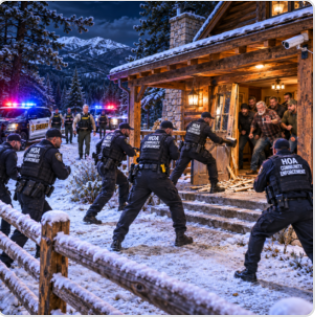
HOA Karen sent ten fake officers to my Montana cabin at 2:47 in the morning because my fence stood six inches higher than the “community standard” she claimed controlled my land.
They arrived in decommissioned patrol cars, carried a battering ram, and surrounded my house while six old military friends slept inside.
What Karen didn’t understand was that the fence dispute was only the visible edge of something much larger—and every forged notice, fake badge, midnight camera, and financial threat she sent my way was quietly becoming evidence.
The first thing I saw was red light moving across the snow.
The second was blue.
For half a second, lying in the dark upstairs bedroom of my log cabin, I thought I was dreaming about another place and another life. Then the perimeter alarm sounded from the control panel downstairs, three short tones followed by the hard mechanical voice I had programmed myself.
“Vehicle movement. South approach.”
I looked at the clock.
2:47 a.m.
Nobody legitimate came up Snowshoe Road at 2:47 in the morning without calling first.
I pulled on jeans, stepped into boots, and went downstairs.
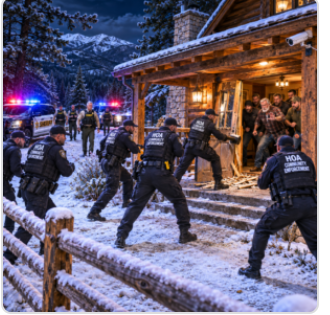
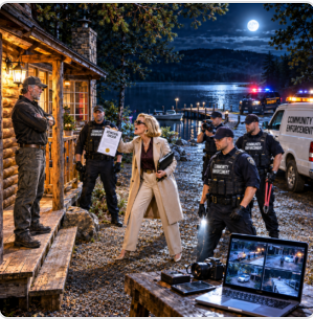
The security monitor beside the fireplace showed three patrol-style cruisers sitting in my driveway with their emergency lights on. Ten men were spreading across the property.
Uniforms.
Tactical vests.
Badges.
Flashlights.
One carried a battering ram.
Another was moving toward the side gate.
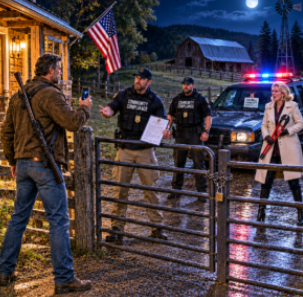
A third stood near the western fence—the same fence Dolores Whitmore had spent the previous two months telling me was an existential threat to community order because it stood six inches too tall.
I leaned closer to the monitor.
Something was wrong.
Not one thing.
Everything.
Their spacing was too tight. Their movements were theatrical. The uniforms matched too perfectly, like costumes ordered from the same catalog. The cruisers had the silhouette of county patrol cars, but the markings were slightly off. No unit numbers where our sheriff’s office normally placed them. No county seal on the front doors.
And there was no reason ten sworn officers would conduct a tactical midnight operation over a chain-link fence.
My stomach tightened anyway.
The possibility that they were fake frightened me.
The possibility that they were real frightened me more.
A corrupt HOA president could lie to private contractors.
She could also lie to actual law enforcement.
If someone had reported guns, hostages, or an armed veteran threatening neighbors, officers might arrive expecting danger. A confused movement from inside the house could turn a ridiculous fence dispute into a tragedy.
Behind me, floorboards creaked.
“Marcus?”
It was Jim, one of six old friends staying with me for our annual hunting trip.
“Stay inside.”
He came down another step.
“What’s happening?”
“People outside claiming to be police.”
That woke everyone.
Within seconds the cabin held six alert men in thermal shirts, hunting clothes, and socks, all asking the same questions.
Real?
Unknown.
Armed?
Some appeared to be.
Warrant?
None shown.
Contact?
Not yet.
I had spent thirty years working around mountain security, wilderness training, and men who had operated in places where bad assumptions became permanent mistakes. My friends had similar backgrounds. That did not make us invincible. It made us deeply respectful of how quickly armed confusion could become irreversible.
“No heroics,” I told them.
Jim nodded immediately.
“Agreed.”
I checked my phone.
The county sheriff’s dispatch number was already connected through my security system. I had called them manually less than thirty seconds after seeing the monitor.
The dispatcher had confirmed something important.
No county units had been sent to my property.
Real deputies were on the way now.
I activated the exterior loudspeakers.
My voice carried across the snow.
“This is private property. County dispatch has been contacted. The sheriff’s office has confirmed no lawful operation is scheduled at this address. Do not approach the residence. Real law enforcement is en route.”
For three seconds, nobody outside moved.
Then the man with the battering ram advanced toward my porch.
Another spread toward the rear.
That told me enough.
I repeated the warning.
“Do not breach the residence.”
A voice from outside shouted:
“Marcus Hale, open the door!”
“Identify your agency.”
“Snowshoe Community Enforcement.”
That was not a law-enforcement agency.
“Do you have a court-issued warrant?”
“You are in violation of HOA enforcement orders.”
I looked at Jim.
He looked at me.
Neither of us said anything.
Then a second voice shouted:
“Open now or we will make entry!”
The battering ram hit the front door.
Once.
The frame groaned.
The men inside my cabin moved automatically, but I raised my hand.
“Hold.”
The ram hit again.
I spoke through the loudspeaker.
“You are being recorded. County law enforcement is approximately minutes away. Leave now.”
Instead, three men started toward the porch.
My friends moved into defensive positions inside the house, staying away from windows and maintaining distance from the entry. Nobody went hunting for a fight. Nobody wanted one.
Then the front door splintered around the lock.
That was the moment the situation changed.
Not because of who we were.
Because they had forced entry into an occupied home after being explicitly told they had no lawful authority.
The first man through the damaged doorway raised his hands as though commanding a room.
“Everybody down!”
He never finished the second sentence.
Jim intercepted him, controlled his arms, and put him on the floor without striking him. Another intruder came through too quickly behind the first and was stopped by two men who forced him away from the stairs. A third reached for something at his belt, and one of my friends shouted for him to show his hands. The man froze.
Nobody fired.
Nobody chased anyone outside.
Nobody tried to turn the cabin into a battlefield.
The rest of the group, suddenly realizing the “old man with a fence” was not the easy target they had been promised, began retreating toward the vehicles.
Then genuine sirens cut through the night.
The sound was different.
Maybe because I knew they were real.
Maybe because the fake officers knew too.
Actual county units came around the bend, lights sweeping across the pines.
The men outside stopped.
One dropped his clipboard.
Another raised both hands.
The two men inside my cabin were restrained on the floor, uninjured and waiting for deputies.
I stepped onto the porch only after dispatch told me uniformed county officers were on scene.
Sheriff Aaron Cole climbed from the lead vehicle.
He took one look at the damaged door, the fake uniforms, and the imitation patrol cars.
Then he looked at me.
“Marcus.”
“Aaron.”
“What in God’s name is this?”
I looked toward the man wearing the fake badge.
“I was hoping you could tell me.”
By sunrise, real deputies had found the answer.
The patrol cars were decommissioned vehicles repainted to look official.
The men were private contractors.
The “warrant” they carried had no judge’s signature, no legitimate case number, and no lawful issuing court.
And the woman whose name appeared repeatedly in the paperwork was HOA president Dolores Whitmore.
That should have been the end of a ridiculous fence dispute.
Instead, it was the first morning we understood the fence had never been the real target.
part 2
I moved to Montana because I wanted peace.
People hear that word and imagine silence.
That wasn’t what I wanted.
Silence can feel empty.
Peace is different.
Peace is waking before sunrise because you choose to, not because somebody needs you. It is coffee on a porch while snow settles on pine branches. It is hearing a hawk somewhere above the ridge and having nowhere else you need to be.
By sixty-five, I thought I had earned some of that.
I had spent most of my adult life around security work, wilderness operations, training, logistics, and difficult terrain. I had broken bones in places I cannot pronounce correctly anymore. I had buried friends. I had watched younger men inherit the work I once believed I would do forever.
Five years before Montana, I lost the friend who mattered most.
Tom Reeves.
People later told the story as though Tom had been killed by an HOA.
That is too simple.
He died of heart failure.
But the final years of his life were consumed by a property battle that stripped him of sleep, savings, confidence, and finally his home.
His association fined him for everything.
Fence height.
Exterior paint.
Grass.
Noise.
A faded flag.
Parking.
Storage.
Every dispute became another letter.
Every letter became another expense.
The board knew he was exhausted.
They kept pressing.
Eventually Tom sold.
He moved inland to a smaller place surrounded by cardboard boxes he never fully unpacked.
One week later, his heart gave out.
Our last call stayed with me.
“They won’t stop, Mark.”
His voice had sounded smaller than I had ever heard it.
Not frightened.
Worn out.
That difference haunted me.
After the funeral, I began looking for a place where nobody could make my entire life revolve around paint charts and board meetings.
That was how I found Snowshoe Peak.
The cabin sat near the base of the mountain on wooded acreage, two bedrooms downstairs, a loft, stone chimney, workshop, and an old five-foot chain-link fence running along the western boundary.
The fence existed before I arrived.
I repaired it.
Tightened several sections.
Replaced rusted posts.
On one stretch I added six inches of reinforcement because winter snowpack pushed deer and occasionally larger animals toward the garden side.
I never thought of it as political.
Then Dolores Whitmore knocked on my door.
She was fifty-six.
Blonde hair that looked engineered to resist weather.
Pearls.
Expensive lipstick.
Camel-colored coat.
Clipboard.
She introduced herself as chairwoman of the Snowshoe Ridge Homeowners Association.
I knew an HOA loosely covered a cluster of cabins farther down the slope.
My parcel appeared near its edge on local maps, but the property records I had reviewed at purchase did not place my cabin under every set of restrictions Dolores later claimed.
That distinction became important.
At the time, I invited her in for coffee.
A mistake.
Not because civility was wrong.
Because Dolores used hospitality as reconnaissance.
Her eyes moved around my kitchen.
Security screens.
Books.
Old military photographs.
Radio equipment.
Maps.
She asked about cameras.
“Lots of security for somewhere so quiet.”
“Old habit.”
“Were you military?”
“A long time ago.”
“What kind?”
“Enough.”
She smiled.
“How many people visit?”
“Friends.”
“Men?”
“Sometimes.”
“What do you all do here?”
“Eat too much.”
She laughed.
Then her eyes moved through the window toward the fence.
“There’s an aesthetic issue.”
“What issue?”
“The western fence exceeds community height requirements.”
“By how much?”
“Approximately six inches.”
I thought she was joking.
She was not.
“Our maximum is four feet.”
“The existing fence is higher than that.”
“Yes.”
“It was here when I bought the cabin.”
“That doesn’t make it compliant.”
“It also doesn’t automatically make your rule applicable to my parcel.”
Her smile narrowed.
“Everybody here cooperates.”
“That isn’t the same as jurisdiction.”
The temperature in the kitchen changed.
Three days later I received a certified letter.
VIOLATION OF REGULATION 42.3B.
Fence height.
Seven days to correct.
Attached to the notice was a business card.
MONTANA BOUND CONSTRUCTION — TRAVIS WHITMORE.
Dolores’s nephew.
That detail bothered me more than the six inches.
I responded politely.
The fence was pre-existing.
I requested the governing document establishing that Regulation 42.3B lawfully applied to my parcel.
I also mentioned that I was consulting my longtime friend Ralph Sharp, a retired attorney who had spent years dealing with land-use and security matters.
Dolores did not answer my jurisdiction question.
Instead, the paperwork multiplied.
Firewood stacked incorrectly.
Mailbox finish.
Bird feeder.
Driveway gravel.
Exterior lighting.
Solar batteries.
Garden location.
Four or five communications some days.
Pressure by volume.
It was a tactic I recognized.
Give someone enough small problems and eventually he trades principle for quiet.
Then came the fake environmental report.
It claimed my septic system was contaminating protected soil.
My solar batteries were producing prohibited electrical emissions.
My vegetable garden was disrupting deer migration.
The document looked official.
Logos.
Signatures.
Agency names.
None survived basic verification.
The phone numbers were dead.
Two agencies did not exist.
One signature belonged to a person I could find no record of.
That was when I stopped laughing.
Dolores was manufacturing authority.
Not simply exaggerating HOA power.
Creating documents.
Frank Ellison visited me the following afternoon.
He had lived near Snowshoe Ridge twenty years.
Former game warden.
Steady man.
He watched me split firewood for a minute.
Then said:
“Take the fence down.”
I stopped swinging the maul.
“Why?”
“You can’t beat her.”
“You tried?”
He looked away.
“That’s not what I said.”
“What happened?”
He eventually told me three families had moved within two years after long disputes with Dolores.
Threats.
Fines.
Property claims.
Warnings of foreclosure.
Real-estate offers arriving at suspiciously convenient times.
“You cross her and things happen,” Frank said.
“What things?”
“Inspections. Complaints. Banks get nervous. Buyers show up.”
He looked toward my cabin.
“I’m telling you as a friend. Six inches isn’t worth it.”
That sentence stayed with me.
Six inches wasn’t worth it.
Exactly.
So why was Dolores investing this much effort?
Ralph asked the same question when I called him.
He listened quietly.
Then said:
“Follow money or property.”
“You think this is bigger?”
“HOA presidents don’t fake environmental reports because they care about six inches of fencing.”
Days later, the mysterious sedan appeared.
Black.
Government-style plates.
A man calling himself Michael asked about renting my cabin.
He claimed he was a writer.
He asked too many questions about cameras and visitors.
I declined.
Photographed his card.
Sent the information to Ralph.
We did not “hack” anybody.
We did something less dramatic and more useful.
We documented.
Public records.
Corporate filings.
Property transfers.
Board minutes.
Vendor relationships.
Ralph began pulling what he legally could.
I improved cameras.
Not weapons.
Cameras.
Trail feeds.
Driveway.
Gate.
Exterior doors.
When my six old teammates arrived for our annual hunting trip, I told them there was a property dispute and possible surveillance.
“Do not become part of it,” I said.
Jim looked around at the cameras.
“A little late for that.”
“I’m serious.”
“So am I.”
They understood.
We hunted.
Cooked.
Talked too late into the night.
And watched unfamiliar vehicles stop near the tree line.
Then the 2:47 raid happened.
The morning after, Sheriff Cole’s office processed the scene.
Fake uniforms.
Decommissioned cruisers.
Imitation paperwork.
Battering ram.
Body cameras.
Radios.
No lawful warrant.
The men gave conflicting stories at first.
Then one began talking.
Dolores had hired them through an intermediary security company.
They were told I was dangerous.
Unstable.
Possibly armed.
Refusing lawful HOA orders.
They were promised legal cover.
The leader carried what Dolores called an emergency enforcement authorization.
It was worthless.
The contractors faced serious consequences for what they had done.
The investigation into who organized the operation widened.
Ralph had captured part of the convoy arriving from his vehicle because he had been driving toward my cabin after receiving an alert from me.
Combined with my cameras, there was no factual ambiguity about the forced entry.
I assumed Dolores was finished.
Two days later she held a press conference.
That taught me something important about people like Dolores.
Exposure does not always produce retreat.
Sometimes it produces marketing.
She stood beneath a new banner in the community park and announced a $1.7 million beautification initiative.
Pool renovation.
Park improvements.
Street maintenance.
Landscaping.
Children played behind her while local reporters took photographs.
She described recent conflict as “unfortunate division.”
Never mentioned fake officers.
Never mentioned my damaged door.
Never mentioned the forged-looking documents.
She said:
“We are moving forward.”
And people wanted to believe her.
Why wouldn’t they?
A renovated park sounds better than corruption.
For several days, neighborhood posts praised her.
I became the difficult outsider.
The paranoid veteran.
The man who turned a fence disagreement into a tactical confrontation.
For about twelve hours, I wondered whether they were right.
Then I walked the fence.
Six inches.
That was all.
No rational person launches a paper war, surveillance campaign, and fake enforcement raid over six inches unless six inches represents something else.
So Ralph started knocking on doors.
Not threatening.
Asking.
He wanted enough signatures for an emergency meeting and independent audit.
We expected resistance.
Instead, people began talking.
Mrs. Kalinski cried before Ralph finished explaining the petition.
Dolores had warned the seventy-six-year-old widow that her foundation was failing.
Expensive repairs were supposedly inevitable.
Selling quickly would protect her children’s inheritance.
Conveniently, a buyer connected to a local investment company had offered cash.
Frank admitted he had received absurd violations too.
Sprinkler noise.
Dog barking.
Truck angle.
Anonymous warnings about future property assessments.
He thought he was alone.
That was Dolores’s real advantage.
Isolation.
Everyone believed the pressure was personal.
Once people compared letters, patterns appeared.
Then Dolores escalated again.
A complaint reached the county describing me as armed, unstable, psychologically dangerous, and surrounded by paramilitary mercenaries.
It purported to come from a concerned neighbor.
That allegation frightened me more than the fence letters.
False reports about an armed veteran can get people hurt.
Ralph’s attorney requested the complaint through proper channels where available. Digital evidence was preserved and later reviewed by qualified investigators. The email account tied back through records obtained during the inquiry to internet access associated with Dolores.
Other fabricated community accounts surfaced too.
Messages praising her policies.
Complaints supporting her enforcement.
Anonymous “residents” who apparently existed only when she needed public support.
Then Gary Stanton came forward.
Gary had been quiet through most of the drama.
Retired detective.
White-collar division.
He had started checking property records independently after his sister received a suspicious offer for her home.
He brought us a folder.
Shell companies.
Property purchases.
Consulting contracts.
Developer correspondence.
A corporation called Pinnacle Resort had been purchasing options around Snowshoe Ridge.
Several intermediary companies linked back to people connected with Dolores.
Including her nephew Travis.
The pattern was ugly.
Pressure older or financially vulnerable owners.
Create uncertainty about property condition or HOA liability.
Push fines.
Increase fear.
Then present a buyer.
Three families had already sold.
Below what later appraisals suggested the property might have been worth.
And Pinnacle’s interest depended on assembling enough contiguous land for a resort project.
My cabin sat near one of the remaining gaps.
The fence was not the issue.
My refusal to become manageable was.
By the time Ralph called the emergency HOA meeting, seventy-eight of eighty-five households had signed the petition.
The community center was packed.
People stood along walls.
Dolores sat in front wearing pearls and a cream jacket.
Ralph began with evidence.
Not accusations.
Board expenditures.
Property transactions.
Witness statements.
Fake environmental notices.
The midnight raid.
Vendor connections.
Then financial records.
Dolores stood.
“You are listening to a disgruntled outsider and a man with a documented obsession with this association.”
She pointed at me.
“Marcus Hale is unstable.”
The room changed.
That word has power when attached to veterans.
She knew it.
“He brought military personnel into a residential community.”
Jim was not present.
Neither were the others.
Deliberately.
Dolores continued.
“He created a fortified compound.”
“My cabin has cameras,” I said.
She ignored me.
“He has threatened residents.”
“Who?”
She paused.
“Multiple residents.”
“Name one.”
Her voice rose.
“This is exactly the aggression I’m talking about.”
For several seconds, I saw uncertainty spread through the audience.
That was the danger of stigma.
Facts take time.
Fear is instant.
Then Gary stood.
He carried his folder to the front.
“She’s right about one thing.”
Dolores looked almost relieved.
“This isn’t about a fence.”
Gary laid the first bank record under the document camera.
Pinnacle Resort.
Escrow deposit.
Property acquisition schedule.
Then transfers.
Shell companies.
Consulting payments.
One company linked to Travis.
Another linked through filings to a longtime Dolores associate.
The room went silent.
Gary explained what he could prove and carefully separated it from what still required investigation.
That distinction gave him credibility.
Mrs. Thompson began crying.
Dolores had told her the home she shared with her late husband was structurally unsafe.
A buyer arrived days later.
“I thought she was helping me,” she whispered.
Frank stood.
Then another homeowner.
Then another.
Stories connected.
Anonymous letters.
Fines.
Sudden inspections.
Low offers.
Threats of costly repairs.
Three families gone.
The purpose became visible.
Pressure created sellers.
Sellers created parcels.
Parcels created the development opportunity.
Dolores tried to speak.
Nobody shouted her down.
That would have helped her.
Instead, Helen Marsh, the association secretary, read the bylaws governing a no-confidence vote.
Ballots were distributed.
Eighty-one to two.
Dolores and Travis voted for her.
Everybody else removed her.
She gathered her papers.
Walked out.
No applause.
No screaming.
Just silence.
That was more powerful.
Forty-eight hours later, the district attorney announced a formal criminal investigation into suspected financial and document fraud connected to property transactions.
Federal investigators later became involved where interstate financial activity and electronic communications created federal jurisdiction.
I was a witness.
Nothing more.
That mattered to me.
This was no longer my war.
Investigators followed records.
Shell entities.
Transfers.
Contracts.
Emails.
Pinnacle relationships.
Other counties.
Eventually they uncovered similar acquisition activity beyond Snowshoe Ridge.
The total suspected losses reached millions.
Travis faced his own exposure.
He chose to cooperate.
That hurt Dolores more than anything I could have done.
His emails and recordings showed pressure from her.
Not innocence.
But context.
He had participated.
He had also been controlled.
The courts sorted responsibility more carefully than neighborhood gossip ever could.
Dolores eventually faced conviction on multiple fraud-related counts tied to the scheme proven against her.
The exact sentence was less important to me than restitution and property restoration.
Accounts were frozen.
Assets connected to unlawful proceeds were targeted.
Victims filed claims.
Some transactions were unwound.
Others required compensation rather than reversal.
Mrs. Thompson received financial relief after the fraudulent pressure surrounding her property was established.
Frank stayed.
The three families who had sold faced more complicated civil fights.
Justice did not magically rewind every decision.
That is one part stories often leave out.
Damage can be repaired.
Not always erased.
Snowshoe Ridge elected a new board.
Finances became public.
Meeting minutes actually described decisions.
Vendor conflicts required disclosure.
Major property actions required independent counsel.
People could appeal fines without being treated like enemies.
Then something unexpected happened.
The neighborhood became a neighborhood.
Barbecue tables appeared in the community park.
People shared tools.
Children used the playground Dolores had promised to renovate but never completed properly.
Residents finished it themselves with a legitimate budget and volunteer labor.
I helped rebuild two benches.
Frank painted them.
Badly.
We let the paint dry anyway.
For the first time since moving to Montana, I felt like I belonged somewhere.
Not because everybody agreed.
Because disagreement no longer meant warfare.
Six months after Dolores’s conviction, a letter arrived.
Her handwriting.
I recognized it from the old violation notes.
No threat.
No demand.
No excuse.
Mostly regret.
Then one line stopped me.
If you still have photographs of Tom’s flower garden, I hope you plant it again.
I sat at my kitchen table holding the page.
Tom’s garden.
Roses.
Irises.
Lavender arranged in a rough spiral he called the Hope Ring.
I had never told Dolores about it.
At least, not knowingly.
The letter forced me to confront something I had kept hidden from almost everyone at Snowshoe Ridge.
I had not discovered Dolores by accident.
After Tom died, I became obsessed with the machinery behind what happened to him.
Not every HOA.
Not every strict board.
The predatory ones.
Associations used as vehicles for land pressure.
Developers working through insiders.
Fake inspection threats.
Manufactured fines.
Vulnerable owners pushed toward convenient buyers.
I spent two years gathering public records.
Patterns.
Corporate connections.
Victim stories.
Dolores Whitmore’s name appeared near several suspicious property transactions in Montana.
When I saw the cabin near Snowshoe Peak for sale, I understood exactly where it sat.
Near her community.
Near land Pinnacle had been watching.
I bought it anyway.
More honestly:
Part of me bought it because of that.
The fence?
It had existed already.
But the extra six inches of reinforcement were not entirely innocent.
I knew Dolores cared about visual control.
I knew she might react.
The cameras were not only for wildlife and security.
They were evidence systems.
My friends did not arrive randomly.
I chose Montana for the hunting trip because I believed Dolores might escalate once outside attention began building.
I did not know she would send fake police.
I did not know she would attempt a forced midnight entry.
But I had placed myself where I expected pressure.
That truth complicated everything.
Standing in Tom’s old-style garden I had recreated beside my cabin, I asked myself a question I had avoided.
Had I sought justice?
Or revenge?
There is a dangerous point where those two things begin wearing each other’s clothes.
I had wanted Dolores exposed.
Publicly.
Completely.
I wanted someone like her to feel what Tom had felt.
Cornered.
Watched.
Unable to control the narrative.
That part of me was not noble.
I could admit that now.
But another truth existed beside it.
Dolores still chose every escalation.
I did not forge her documents.
I did not order fake officers to my door.
I did not pressure Mrs. Thompson.
I did not move money through shell companies.
I did not fabricate residents.
I created circumstances where I believed a predatory system might reveal itself.
Whether doing that was wise is a question I still carry.
Ralph hated when I said that.
“You didn’t make her commit fraud.”
“No.”
“You didn’t make her raid your cabin.”
“No.”
“Then stop taking responsibility for her choices.”
“I’m taking responsibility for mine.”
That ended the argument.
Mostly.
There were more files in my study.
Other developers.
Other attorneys.
Other associations.
Patterns crossing state lines.
For years, I thought exposing every one of them was my responsibility.
After Dolores, I changed my mind.
I turned relevant evidence over to qualified attorneys and investigators when appropriate.
Then I stopped playing detective.
That was important.
I was sixty-five.
I had come to Montana seeking peace.
I had nearly turned grief into a permanent occupation.
Tom would have hated that.
The garden helped.
I planted roses first.
Then irises.
Then lavender.
A spiral.
Not perfect.
Tom would have complained.
He always believed gardens should look accidental even when they took enormous planning.
On the morning the first lavender opened, I stood barefoot in the soil.
I remembered something Tom used to say.
“Hope isn’t a feeling. It’s a stubborn habit.”
For five years, I had treated his death as an instruction to fight.
Maybe it was also an instruction to live.
The fake officers received consequences according to what investigators proved each had knowingly done.
Some claimed Dolores and the contractor had deceived them about the authority.
That mattered.
The leader who knowingly used fake law-enforcement appearance and participated in the forced entry faced more serious consequences than the men who withdrew early.
Again, real justice distinguishes.
It does not flatten everyone for dramatic satisfaction.
The private investigator who once approached me as “Michael” eventually cooperated too.
He admitted Dolores hired him to gather material that could support claims I was unstable and dangerous.
What changed his mind was not fear of me.
It was seeing the manufactured documents and hearing Dolores pressure him to characterize ordinary security measures as evidence of extremism.
He kept instructions.
Turned them over.
Another brick in the wall.
I never saw Dolores after sentencing.
I heard she stayed with relatives while legal matters continued.
Someone said she worked temporarily at a roadside diner.
I don’t know if that was true.
I stopped checking.
That was part of recovery too.
For months, I had known where she was.
What she filed.
Who she called.
What company her nephew used.
Obsession masquerades easily as vigilance.
Eventually I chose not to know.
Snowshoe Ridge became quieter.
Not silent.
Good.
Children shouted near the park.
Dogs barked.
Frank’s pickup still sat at what Dolores once called an “unsightly angle.”
Nobody cared.
The new HOA board sent me one fence notice.
I almost laughed when I opened it.
The chair, Helen Marsh, had written:
Our updated records show uncertainty regarding whether Regulation 42.3B applies to your parcel. We are suspending the matter pending legal review. No fine is assessed.
A month later:
The association has determined your western fence is not subject to the claimed restriction. Matter closed.
That was it.
No war.
No fake seal.
No environmental apocalypse caused by a bird feeder.
I framed neither letter.
I put them in a drawer.
Normal paperwork should not become memorabilia.
Frank came over one morning.
He leaned against the five-foot-six-inch fence.
“Still six inches too tall.”
“Tragic.”
“Could bring down civilization.”
“I worry every day.”
He smiled.
Then grew serious.
“I’m sorry.”
“For what?”
“Telling you to give in.”
“You were scared.”
“I was a coward.”
“No.”
He looked at me.
“Marcus—”
“Fear and cowardice are not the same thing.”
He absorbed that.
“So what am I?”
“Someone who eventually spoke.”
He nodded.
We stood there listening to wind move through the pines.
That became the real theme of Snowshoe Ridge for me.
People eventually spoke.
Mrs. Thompson.
Frank.
Gary.
Ralph.
Paige from the accounting records.
Travis.
Even the private investigator.
Dolores’s power depended on everyone believing they were alone.
The moment people compared experiences, the structure weakened.
That lesson was bigger than any HOA.
Predatory systems isolate first.
They tell each person:
This problem is yours.
Your fine.
Your debt.
Your mistake.
Your unstable foundation.
Your inappropriate fence.
Your bad attitude.
Then shame keeps everyone quiet.
Community begins when someone says:
“That happened to me too.”
Years later, I started teaching survival skills to local teenagers.
Fire building.
Navigation.
First aid.
Weather awareness.
No tactical fantasy.
No war stories unless they asked.
One afternoon, a sixteen-year-old named Jesse asked me:
“What’s the most important survival skill?”
I expected him to guess fire.
Water.
Shelter.
I said:
“Knowing when your own brain is lying to you.”
He frowned.
“What does that mean?”
“When you’re cold, tired, angry, or scared, your mind starts offering bad shortcuts.”
“Like?”
“Run without checking direction. Fight when you should leave. Freeze when you should move. Assume you’re alone when help exists.”
He thought about it.
“That’s not wilderness.”
“No.”
“It’s everything.”
“Exactly.”
That answer would have annoyed younger me.
Older me liked it.
The cabin remained.
The cameras stayed too.
Fewer.
I removed two trail cameras once the investigation ended.
Ralph called that progress.
Jim called it weakness.
We still held the annual hunting trip.
Nobody wore tactical gear around the cabin.
Nobody wanted to recreate the raid.
We cooked badly.
Argued about football.
Fell asleep too early.
One night Jim stood on the porch with me.
“You really bought this place because of Dolores?”
“Partly.”
“You never told us that at first.”
“No.”
“You manipulated us.”
The accusation hurt because it contained truth.
“I asked you to hunt here.”
“You knew something might happen.”
“I knew harassment might happen. I didn’t expect fake cops.”
He looked into the dark.
“We would’ve come anyway.”
“I know.”
“That doesn’t excuse not telling us.”
“I know.”
He turned.
“Good.”
Then he handed me a beer.
Forgiveness among old friends rarely needs a speech.
That conversation changed how I told the story.
For a long time, I made myself sound purely reactive.
Dolores attacked.
I defended.
That was incomplete.
I chose the battleground.
I placed cameras.
I researched her.
I expected pressure.
I allowed six friends to enter a situation without giving them the whole history.
That was wrong.
Not legally equivalent to what Dolores did.
Not morally equal.
But wrong enough that I owed them honesty.
They gave me that lesson.
The new HOA board eventually invited me to join.
I laughed for almost a minute.
Helen did not.
“We could use someone skeptical.”
“You want me on an HOA board?”
“Yes.”
“Absolutely not.”
“Fair.”
I attended open meetings occasionally.
That was enough.
The finances were public.
Vendor contracts bid competitively.
Minutes published.
A conflict-of-interest policy prohibited officers from steering work to relatives without disclosure and independent review.
Someone suggested naming it the Whitmore Rule.
Helen rejected that.
Good decision.
Reform should outlive personalities.
Pinnacle Resort abandoned its original acquisition plan.
A smaller development happened years later on land purchased through ordinary voluntary sales.
Some residents sold.
Some stayed.
No mysterious inspections.
No fake foundation warnings.
No coercive fines.
That proved something I wish Tom had lived to see.
Development itself was not the enemy.
Money was not the enemy.
HOAs were not automatically the enemy.
The enemy was using power dishonestly to remove another person’s ability to choose.
I could disagree with a developer and still respect a legitimate offer.
What Dolores built was different.
She tried to manufacture consent through exhaustion.
That was the line.
My fence still stands.
Five feet six inches.
Weathered now.
I replaced another section last spring.
No violation letter arrived.
Frank helped.
He measured one post.
“Five feet seven.”
“Cut it.”
He looked shocked.
“Dolores finally won?”
“No. It looks crooked.”
We cut it.
That felt like freedom.
Doing what made sense because I chose it.
Not because somebody threatened me.
Tom’s garden blooms behind the cabin now.
Roses.
Irises.
Lavender.
Hope Ring.
I never recreated it perfectly.
I stopped trying.
One summer evening, Mrs. Thompson visited with her granddaughter.
She walked through the garden slowly.
“Tom planted this?”
“The original.”
“It’s beautiful.”
“He’d say mine is too organized.”
She smiled.
Then she asked:
“Do you forgive Dolores?”
I took a long time answering.
“I don’t know.”
“Do you hate her?”
“No.”
That surprised me when I said it.
Anger had burned hot for years.
Eventually it ran out of fuel.
“What do you feel?”
“Sad.”
“For her?”
“For everybody.”
Mrs. Thompson nodded as though that made sense.
Maybe it did.
Dolores destroyed lives.
She also destroyed her own.
That does not erase responsibility.
Understanding consequence is not the same as excusing conduct.
I stopped needing her to suffer in order for justice to feel real.
The people she hurt needed restoration.
The community needed protection.
Future victims needed the pattern exposed.
That mattered.
Her misery did not repair a single fence.
Years after the case, Ralph brought me a storage box.
“What’s this?”
“Your old files.”
“I thought you had them.”
“Copies.”
Inside were the first fake environmental report.
Fence notices.
Property maps.
Photographs.
Public filings.
Tom’s original documents.
I spent the afternoon deciding what to keep.
Most went to secure archival storage with counsel where necessary.
Some I shredded.
The first fence notice stayed.
Not because it frightened me.
Because of how ridiculous it looked now.
Six inches.
That was the opening.
Dolores believed I would focus on the absurdity.
Laugh.
Get angry.
Fight about measurements.
Meanwhile, the real machinery sat behind the letters.
Acquisition.
Fear.
Money.
That pattern exists in many forms.
Distract people with the small conflict while the larger incentive remains hidden.
I teach young people to ask:
What does the other person gain if I accept their version?
Not because everyone is corrupt.
Because incentives explain behavior.
That question would have helped Tom.
It helped me.
On the tenth anniversary of Tom’s death, I drove to where he had lived before selling.
The house had new owners.
Different paint.
Different fence.
No reason to knock.
I sat in my truck down the road.
For years, I blamed myself for not helping him more.
I had been busy.
Traveling.
Working.
When he complained about the HOA, I treated it like aggravation.
“Get a lawyer.”
“Fight the fine.”
“Don’t let them bother you.”
Easy advice when you are not the person waking at 3:00 a.m. wondering whether you can afford another legal letter.
Tom needed a friend.
I gave him strategies.
That failure shaped everything afterward.
Maybe too much.
I could not save Tom.
Exposing Dolores did not change that.
But somewhere between grief and revenge, I eventually found a better promise.
If someone tells me they are being crushed, I listen first.
Not fix.
Listen.
Then we find help.
That was what I should have done for him.
I drove back to Montana the next morning.
Snow started near the state line.
By the time I reached Snowshoe Peak, the world had turned white.
The cabin lights glowed through the pines.
I parked.
Walked to the fence.
Six inches.
Still absurd.
Still standing.
Then I noticed something tied to the gate.
A small paper bag.
Inside were homemade cookies and a note from Frank.
HOA APPROVAL PENDING. Eat before inspection.
I laughed loud enough to scare birds from the trees.
Peace.
That was peace.
Not the absence of conflict.
The return of ordinary humor after conflict stops defining you.
I carried the bag inside.
Lit the fire.
The security monitors remained dark.
No strange cars.
No fake badges.
No Dolores.
Later, I stood at the kitchen window looking toward Tom’s garden beneath the snow.
The story people remember is the raid.
Ten fake officers.
Three fake cruisers.
Six old military friends.
Real sheriff arriving.
Dramatic.
Easy to tell.
But that was never the most important part.
The most important part was Mrs. Thompson opening her door.
Frank admitting he was afraid.
Gary following money.
Ralph asking neighbors to compare stories.
Residents voting eighty-one to two.
Investigators following evidence rather than gossip.
A community learning that authority should never be trusted merely because it prints itself on official-looking paper.
Dolores wanted everyone separated.
The truth required connection.
That was what defeated her.
Not me.
Not special operations veterans.
Not a security system.
People talking to one another.
Records compared.
Fear named.
And once the truth had enough witnesses, even the best performance of authority could not keep standing.
I came to Montana believing I needed a fortress.
I built cameras.
Reinforced fences.
Tracked vehicles.
Prepared for threats.
Some of that was reasonable.
Some was grief wearing tactical clothing.
What I actually needed was a community willing to knock on one another’s doors.
It took me years to understand that.
Tom had wanted the same thing.
His garden was called the Hope Ring for a reason.
“Hope is a stubborn habit,” he used to say.
So is fear.
So is control.
So is silence.
The habit you feed becomes the life you live.
I spent years feeding anger because it kept me moving.
Eventually I planted something else.
The next spring, the lavender came back thicker.
I stood in the soil with my hands dirty and no phone in my pocket.
No camera.
No file.
No plan.
Just sunlight.
Frank shouted from the fence.
“Marcus!”
“What?”
“Your bird feeder is causing undesirable wildlife patterns!”
I looked at the three chickadees sitting on it.
“Call enforcement!”
He laughed.
I laughed too.
No one came.
That was the point.
Dolores had wanted six inches of fence to prove she could control me.
Instead, six inches exposed a system she had spent years building.
But the final victory was not watching her lose office.
It was not the investigation.
It was not the conviction.
It was not even seeing the resort scheme collapse.
It was standing beside that same fence years later and realizing I no longer needed Dolores to be afraid of me.
I no longer needed anyone to be afraid.
The law had done its work.
The records remained.
The neighbors remembered.
The community had changed.
And I had changed with it.
I closed the garden gate.
The latch settled.
No sirens.
No flashing lights.
No uniforms pretending to be something they were not.
Only the mountain wind moving through the pines, the same sound I had come to Montana hoping to hear in the first place.
Peace.
Not silence.
Peace.