PART 2: They Tied Her Legs and Threw Her Into Floodwater—Two Years Later, She Walked Into a Pool on Her Own
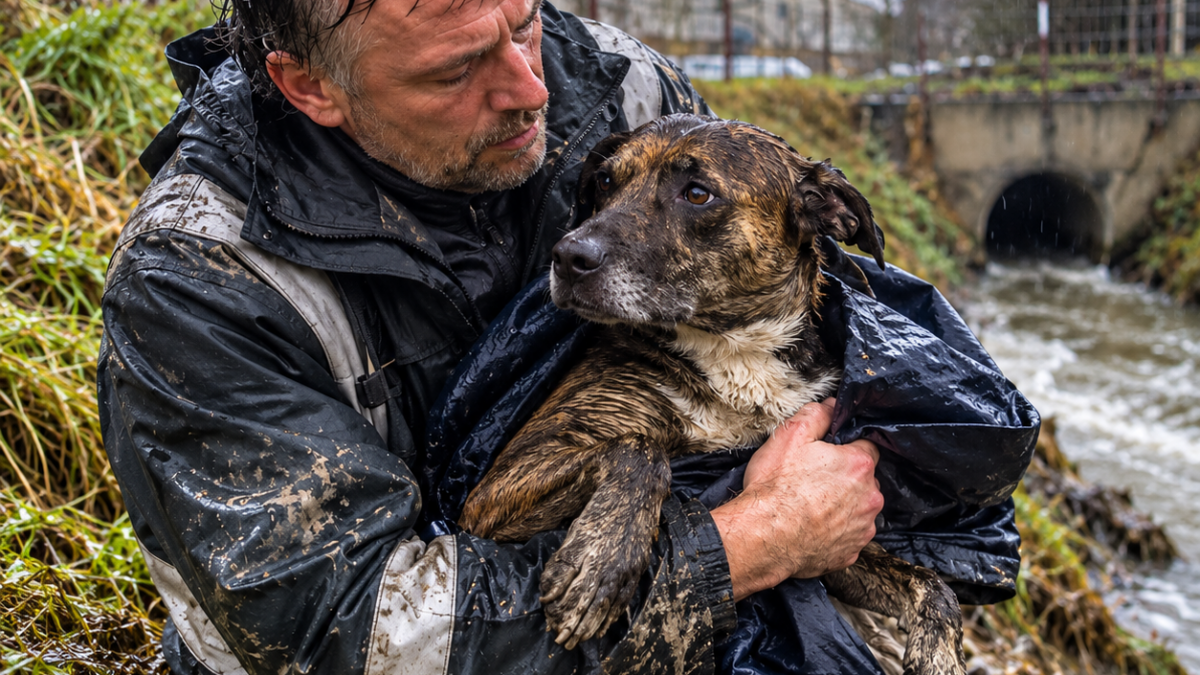
—
PART 2:
The delivery driver’s name was Thomas.
I learned that later.
At the time, all I knew was that he had a white van, a dry blanket behind the passenger seat, and the good sense not to waste time asking questions.
“We need a vet,” I said.
“I know one ten minutes away.”
“Emergency?”
“They’ll take her.”
We lifted the dog carefully.
The moment I touched her legs, she cried out.
Not loudly.
That almost made it worse.
It sounded like she had learned long ago that screaming didn’t help.
Thomas opened the back of his van.
We placed her on two folded blankets.
She immediately curled into herself.
I climbed beside her.
Thomas looked at my soaked clothes.
“You okay?”
“Drive.”
He drove.
I kept one hand near her face.
Not touching.
Just close enough that she could smell me.
Her whole body trembled.
Cold.
Shock.
Fear.
Probably pain.
The yellow rope lay on the floor beside my boots.
I had brought it with me without consciously deciding to.
Cut into four pieces.
Dirty.
Wet.
Blood on one section where it had sliced her skin.
I stared at it.
Thomas glanced at me through the mirror.
“Somebody did that?”
“Yes.”
His jaw tightened.
“Jesus.”
The dog’s head moved.
I looked down.
“Easy.”
She opened her eyes.
For several seconds, she stared directly at me.
Then the van hit a pothole.
She panicked.
Her body jerked.
She tried to stand.
Her legs collapsed beneath her.
“No, no.”
I lowered my voice.
“You’re safe.”
Safe.
It was a ridiculous word.
She had just been bound and thrown into floodwater.
She had no reason to believe safety existed.
Still, I kept saying it.
“You’re safe.”
By the time we reached the clinic, her gums were pale.
The receptionist took one look at her and shouted toward the treatment area.
Two veterinary technicians came running with a stretcher.
“What happened?”
“Found in a drainage ditch.”
“Hit by a car?”
“No.”
I held up the rope.
“She was tied.”
The technician stopped.
“Tied?”
“All four legs.”
Her face changed.
They took the dog through the double doors.
I tried to follow.
A veterinarian blocked me gently.
“Let us stabilize her.”
“I found her.”
“I understand.”
“Is she going to live?”
“We need to work.”
The doors closed.
For the first time since I had heard that sound from the ditch, I had nothing to do.
So I sat down.
Water pooled beneath my boots.
Mud streaked the floor.
My hands began shaking.
Not slightly.
Violently.
The receptionist brought me a towel.
“Sir?”
“I’m fine.”
I wasn’t.
Thirty-three years.
For thirty-three years, I had not gone deeper than knee-high water.
That morning I had walked almost chest-deep into a flooded drainage channel.
Not because I had become brave.
Because fear had simply become less important than what was drowning in front of me.
My phone rang.
My supervisor.
“Marc, where the hell are you?”
I looked toward the treatment-room doors.
“At a veterinary clinic.”
Silence.
“You what?”
“I found a dog.”
“Marc, we have six inspection sites—”
“She was tied up in a flooded ditch.”
Another silence.
Then his voice changed.
“Is she alive?”
“I don’t know.”
“All right.”
“I may be here a while.”
“Stay.”
That surprised me.
“Jean—”
“Stay there. I’ll cover your route.”
“Thank you.”
I hung up.
Thomas returned from moving his van.
He sat beside me.
“I called the police.”
I looked at him.
“Already?”
“This wasn’t an accident.”
“No.”
“You kept the rope?”
I looked down.
“Yes.”
“Good.”
I hadn’t thought of evidence.
Thomas had.
Almost forty minutes passed before a veterinarian came out.
She introduced herself as Dr. Claire Morin.
I stood.
“How is she?”
“Alive.”
I exhaled.
That one word felt enormous.
Claire continued.
“She inhaled water. We’re concerned about aspiration pneumonia. Her body temperature is dangerously low. She’s dehydrated despite being found in water, and she has pressure injuries around all four limbs from the rope.”
“Anything broken?”
“We’re taking X-rays.”
“Internal injuries?”
“Nothing obvious yet.”
“Was she in there long?”
Claire’s expression hardened.
“Long enough.”
I stared at the doors.
“Can I see her?”
“Not yet.”
“Did she have a chip?”
“We scanned her.”
“And?”
“No microchip.”
Of course.
“Age?”
“Probably three or four.”
“Breed?”
“Mixed. Possibly Staffordshire-type ancestry, maybe some shepherd. Hard to say.”
I nodded.
Then asked the question I had been avoiding.
“Do you think somebody meant to kill her?”
Claire looked at the pieces of yellow rope in my hand.
“I’m a veterinarian, not an investigator.”
“But?”
She exhaled.
“Dogs don’t accidentally tie all four legs together.”
Thomas muttered something under his breath.
Claire’s eyes moved toward my wet clothes.
“You went into the water?”
“Yes.”
“You should get checked too.”
“I’m fine.”
“You’re bleeding.”
I looked down.
A branch had cut my shin.
I hadn’t noticed.
“It’s nothing.”
Claire studied me.
“You’re shivering.”
“So is she.”
“She has a heated IV and three people taking care of her.”
I almost laughed.
“You veterinarians always this bossy?”
“Only with difficult patients.”
Thomas smiled.
I didn’t.
But I did accept a blanket.
The police arrived an hour later.
Two officers.
They photographed the rope.
Took my statement.
Took Thomas’s.
Asked exactly where I had found her.
“Could she have gotten tangled in something?”
“No.”
“How do you know?”
“Because the rope was wrapped around all four legs several times and knotted.”
One officer nodded grimly.
“Did you touch the knots before cutting them?”
“I had to.”
“Obviously.”
“I wasn’t thinking about evidence.”
“You were keeping her alive.”
That helped more than he knew.
They placed the rope into evidence bags.
I watched them seal it.
A strange anger had begun growing inside me.
Not explosive.
Cold.
Deliberate.
Somebody had held this dog long enough to bind her.
They had felt her struggling.
Maybe heard her crying.
Then brought her to a drainage channel during heavy rain and threw her in.
That required choices.
Several of them.
This was not one impulsive second.
This was cruelty with time to reconsider.
And whoever had done it had kept going.
Claire came back around noon.
“X-rays are clear.”
“No fractures?”
“No.”
I nearly smiled.
“But?”
She nodded.
“There’s always a but.”
“What?”
“Her lungs are our biggest concern now. She aspirated a significant amount of contaminated water.”
“Can you treat it?”
“Yes. Oxygen, antibiotics if infection develops, monitoring. The next twenty-four to forty-eight hours matter.”
“What about her legs?”
“Circulation is returning. That’s good. But the rope caused deep abrasions and swelling.”
“Will she walk?”
“We think so.”
Think.
Not know.
I hated uncertainty.
Then Claire said something unexpected.
“She responds to you.”
“What?”
“When we brought her out of sedation, she became agitated. One of the nurses mentioned your voice from the hallway. She settled.”
I stared.
“That doesn’t make sense.”
“Animals don’t always need things to make sense.”
“Can I see her?”
Claire smiled slightly.
“For five minutes.”
The treatment room smelled like disinfectant and warm air.
The dog lay inside a large kennel beneath heated blankets.
An IV line ran into her front leg.
Bandages wrapped all four limbs where the rope had cut her.
Oxygen flowed through a tube nearby.
She looked smaller now.
Fragile.
Her brindle coat had dried into uneven waves.
The white patch on her chest was brighter than I remembered.
I crouched.
“Hey.”
Her eyes opened.
Immediately.
I froze.
One ear lifted.
The folded one.
“There you are.”
Her head moved toward me.
I opened the kennel only after Claire nodded.
I didn’t reach inside.
I simply placed my hand near the opening.
She sniffed.
Then slowly moved her nose against my fingers.
My throat tightened.
“You remember me?”
Her tongue touched my knuckles.
Once.
Claire looked away politely.
I stayed six minutes.
She let me.
Before I left, I asked, “Does she have a name?”
“No identification.”
“Then she needs one.”
Claire raised an eyebrow.
“You naming her?”
I thought about the ditch.
The water.
The way she had pressed her head against my arm.
My brother’s name came into my mind.
Julien.
Then another memory.
Julien used to call every female dog “Luna” when we were children because our grandmother had owned one with that name.
I hadn’t thought about that in decades.
“Luna.”
The dog’s ear moved.
Claire smiled.
“Luna it is.”
The police investigation started the same afternoon.
The industrial area had security cameras.
Not many.
But enough that officers requested footage from several warehouses and a fuel depot.
They also checked recent lost-dog reports.
Nothing matched Luna.
No microchip.
No collar.
No registration.
She seemed to have appeared from nowhere.
The next morning, I returned before work.
Claire met me at reception.
“She made it through the night.”
I closed my eyes.
“Good.”
“She’s coughing more.”
My relief faded.
“That’s expected?”
“Not ideal, but not surprising. We’re watching her lungs.”
I sat beside Luna’s kennel for twenty minutes.
She didn’t move much.
But she watched me.
When I stood to leave, she tried to get up.
Her bandaged legs shook.
“Stay.”
She ignored me.
Of course.
She made it halfway upright before collapsing.
Claire came over.
“Luna.”
The dog’s eyes remained on me.
I crouched again.
“I’m coming back.”
I had no idea why I said it.
But she settled.
From then on, I visited every morning and evening.
At first, I told myself it was because I had found her.
Then because she recognized me.
Then because the clinic staff was busy.
By Day Four, I stopped inventing excuses.
I wanted to see her.
She had survived the first critical window.
No severe pneumonia.
Her lungs were improving.
She started eating.
That was another battle.
The first bowl of wet food was placed near her.
She stared at it.
Didn’t move.
Claire stepped away.
Still nothing.
I sat on the floor.
“You have to eat.”
Luna watched me.
I put a little food on my fingers.
Held it near her.
She flinched.
I stopped.
That was the first time I noticed something beyond the water trauma.
Hands frightened her.
Not always.
But certain movements.
A hand raised above her head.
A quick reach toward her collar area.
Anything near her hindquarters.
She became rigid.
Claire noticed too.
“Previous abuse?”
“Likely.”
I clenched my jaw.
“How much?”
“No way to know.”
I lowered my hand.
Placed the food on the floor instead.
Luna sniffed.
Then ate.
Small bite.
Then another.
Within minutes, she was eating from the bowl.
I sat beside her.
“That’s it.”
Her tail moved.
Barely.
The first wag I ever saw.
The investigation produced its first lead on Day Five.
An officer called me.
“We have video.”
My stomach tightened.
“Of Luna?”
“Possibly.”
“What does it show?”
“A dark hatchback entering the service lane behind the warehouses at 4:12 a.m.”
“And?”
“Leaves eleven minutes later.”
“That’s it?”
“Another camera caught the vehicle closer.”
“Plate?”
“Partial.”
I stood in the maintenance depot parking lot with the phone pressed to my ear.
“Can you identify it?”
“We’re working on it.”
“Does the video show the dog?”
A pause.
“Yes.”
My hand tightened around the phone.
“What happens?”
“We’d prefer you not watch it right now.”
That told me enough.
“What happens?”
The officer exhaled.
“A person removes what appears to be a dog from the rear of the vehicle.”
“Alive?”
“Moving.”
“And?”
“The camera angle doesn’t show the ditch.”
“How long until they return?”
“Four minutes.”
Four minutes.
Long enough.
I closed my eyes.
“Was there more than one person?”
“One.”
“Man or woman?”
“Likely male.”
I wanted a name.
A face.
An address.
Something I could turn my anger toward.
Instead, I had a dark car and four minutes.
“Call me when you know.”
“We will.”
That night I told Claire.
She leaned against the counter.
“You’re angry.”
“Yes.”
“Be careful.”
“With what?”
“With needing punishment more than Luna needs recovery.”
I stared at her.
“That man tried to kill her.”
“I know.”
“He tied her legs.”
“I know.”
“He threw her into floodwater.”
Claire’s voice stayed calm.
“And you saved her.”
“That doesn’t erase what he did.”
“No.”
“Then why are you telling me to let it go?”
“I didn’t.”
She stepped closer.
“I’m telling you not to let him own the part of your life that belongs to her.”
I said nothing.
Claire looked through the glass.
Luna was sleeping.
“The best thing you can do tonight is sit with that dog.”
So I did.
A week after the rescue, Luna stood without assistance.
Only for seven seconds.
I counted.
Her legs trembled.
She looked confused by her own body.
Then sat down.
I applauded.
Claire laughed.
“It’s seven seconds.”
“It’s more than zero.”
The next day, eleven.
Then twenty.
By the second week, she walked across the treatment room.
Slowly.
Bandages smaller.
Head low.
Every few steps, she stopped and looked at me.
I walked backward.
“Come on.”
She followed.
Her body was beginning to heal.
Her mind was not.
Water terrified her.
Even a metal bowl could trigger panic if it was filled too high.
The first time a technician tried gently rinsing mud from one paw, Luna screamed.
Not yelped.
Screamed.
She threw herself sideways.
The technician immediately stopped.
I ran into the room.
Luna crawled behind me.
Claire knelt several feet away.
“It’s okay.”
Luna trembled so violently I could feel it through my pant leg.
The sink continued dripping.
Drip.
Drip.
Drip.
Each sound made her flinch.
I reached over and shut it off.
That evening, Claire explained trauma responses.
“Her brain connected water with helplessness.”
“I understand that.”
“No. You understand the idea.”
She pointed toward Luna.
“Her body believes water kills.”
I looked down.
Luna was sleeping beneath my chair.
Claire continued.
“You can’t reason that away.”
“How do we fix it?”
“Slowly.”
“How slowly?”
“Months.”
I didn’t like the answer.
Then she added:
“Maybe years.”
That answer was worse.
Three weeks after I found Luna, the police identified the car.
Registered to a man named Philippe Renaud.
Thirty-nine.
Lived less than ten miles from the industrial area.
I didn’t know him.
But someone at the clinic recognized the surname.
Claire searched old records.
Then called me into her office.
“We treated a dog registered to a Philippe Renaud eighteen months ago.”
I stared.
“What dog?”
“Female brindle mix.”
My pulse increased.
“Show me.”
She hesitated because of privacy rules.
The police had already requested records under proper authority, so she limited herself to what was permitted.
But she told me enough.
The dog had been called Naya.
Approximately two years old then.
Brindle.
White chest.
Folded ear.
The old registration photo left no doubt.
Luna had once been Naya.
I stared at the image.
She looked healthier.
Still cautious.
But heavier.
Clean.
A collar around her neck.
“That’s her.”
“Yes.”
“What was she treated for?”
“Gastrointestinal illness.”
“Any injuries?”
Claire’s expression changed.
“One older rib fracture noted on imaging.”
“Explanation?”
“Owner said she fell down stairs.”
I laughed once.
Not because anything was funny.
“What else?”
“That is all I can discuss.”
“Police know?”
“Yes.”
I looked at Luna through the office window.
Someone had once called her Naya.
She had belonged somewhere.
I wondered whether she had ever been loved there.
Then I stopped wondering.
Love does not tie four legs together.
The police arrested Philippe two days later.
Not dramatically.
No chase.
No confrontation.
He denied everything.
Claimed the dog had run away weeks earlier.
Claimed the security footage was unclear.
Claimed the yellow rope could belong to anyone.
Then investigators found matching rope in his garage.
Same type.
Same diameter.
Same manufacturing pattern.
More importantly, a neighbor told police she had seen Luna—Naya—at his property only two days before the rescue.
Another neighbor reported hearing arguments and a dog crying during the night.
The case strengthened.
I wanted to meet him.
The police told me no.
That was probably wise.
For several nights, I imagined what I would say.
Did she look at you when you tied her?
Did she struggle?
Did you hear her hit the water?
Did you wait to see whether she sank?
Were you angry?
Bored?
Drunk?
Did you think being an animal meant her terror mattered less?
The questions consumed me.
Then one evening, I arrived at the clinic and found Luna standing near the door.
No leash.
No coaxing.
Waiting.
The moment she saw me, her tail began moving.
I forgot Philippe for almost an hour.
Claire was right.
Punishment belonged to the courts.
Luna belonged to the present.
The shelter system was supposed to take over once Luna was medically cleared.
I knew that.
Everyone knew that.
Then Claire asked where Luna would go while the legal case continued.
A temporary foster home was needed.
I answered too quickly.
“Mine.”
Claire smiled.
“What?”
“Nothing.”
“I can foster a dog.”
“Of course.”
“I have a yard.”
“Excellent.”
“I live alone.”
“Perfect.”
“You think this is funny.”
“A little.”
“It’s temporary.”
“Marc.”
“What?”
“You have visited her twice a day for twenty-six days.”
“That doesn’t mean anything.”
“You brought her a new bed yesterday.”
“The clinic floor is cold.”
“You bought a bed with her name embroidered on it.”
“That was the only model.”
“It literally says LUNA.”
I had no response.
Claire smiled.
“Temporary.”
“Exactly.”
Luna came home with me on a Saturday.
The first obstacle was the car.
She refused to get in.
Thomas had transported us after the rescue, and every ride since had been in clinic vehicles.
My utility van terrified her.
I stood beside the open door.
“Take your time.”
Luna backed away.
We waited.
Ten minutes.
Twenty.
I sat on the curb.
Eventually she approached.
Sniffed the step.
Retreated.
Approached again.
One paw up.
Then down.
I didn’t touch her.
Thirty-four minutes after we started, she climbed inside.
I closed the door gently.
“Good girl.”
She pressed herself against the far side.
I drove home at half the speed limit.
My house had been quiet for years.
Too quiet, though I had never admitted it.
After my divorce, I kept the place practical.
Clean.
Sparse.
No children.
No pets.
Work boots by the door.
Coffee every morning.
Dinner alone.
Television mostly for background noise.
Luna stepped inside and immediately changed the entire geography.
She inspected the hallway.
The kitchen.
Living room.
Then froze when she saw the bathroom.
The bathtub was visible through the open door.
She backed away.
I closed it.
“Not today.”
She chose the space beneath my dining table.
That became her first safe place.
I placed her new bed nearby.
She ignored it.
Naturally.
For three nights she slept under the table.
I slept on the couch.
I told myself it was temporary.
Then one night around 2:00 a.m., I woke and saw her standing beside me.
Just watching.
“Hey.”
Her tail moved once.
I lowered one hand.
She stepped closer.
Rested her chin against my fingers.
Then lay on the rug beside the couch.
That was the first night we both slept properly.
Life with Luna developed rituals.
Morning walk at 6:15.
Breakfast.
I went to work.
At first, Claire helped arrange a volunteer who checked on her at midday.
When I returned, Luna waited behind the front door.
Not barking.
Listening.
The moment my key turned, her tail hit the wall.
Thump.
Thump.
Thump.
I began looking forward to that sound before I even left work.
She was terrified of hoses.
Avoided puddles.
Would not walk across wet pavement if there was another route.
Rain was worst.
The first storm after she came home turned her into the dog from the ditch again.
She hid beneath the dining table.
Panting.
Eyes wide.
I sat several feet away.
Didn’t touch her.
Rain hammered the windows.
I could smell wet soil through an open vent.
And suddenly my own memories came too.
Julien.
River.
Screaming.
The strange stillness after they pulled his body out.
For decades, I had believed avoiding water meant I had survived what happened.
Watching Luna tremble, I realized avoidance and healing were not the same thing.
We were both dry.
Both safe.
And both still living beside water that existed only in memory.
I sat on the floor.
“I get it.”
Luna watched me.
“I hate it too.”
Thunder rolled.
She crawled out.
Not all the way.
Just enough to place one paw beside my knee.
I stayed there until the storm passed.
The legal case moved slowly.
Months.
Evidence.
Statements.
Veterinary reports.
Security footage.
Philippe’s attorney argued that the video did not clearly show him throwing the dog into the ditch.
The prosecution didn’t need that single image.
They had the car.
The dog’s prior registration.
The rope.
Witness timeline.
Physical injuries consistent with binding.
The neighbor’s statement.
And Philippe’s changing story.
First Luna ran away.
Then he claimed he had rehomed her.
Then he said someone else must have taken her.
His contradictions became their own evidence.
I was called to testify.
The night before, I barely slept.
Not because I feared speaking.
Because I knew I would see him.
The courthouse was smaller than I expected.
Philippe sat at the defense table.
Ordinary-looking.
That disturbed me.
I had built a monster in my head.
Instead, he wore a dark jacket and had thinning hair and tired eyes.
He could have been someone buying bread.
Someone waiting at a bus stop.
Someone you forgot five minutes after passing.
Cruelty doesn’t always wear a face that warns you.
When I took the stand, I described the ditch.
The rope.
The current.
Luna disappearing.
The defense attorney asked whether I had personally witnessed anyone throw the dog into the water.
“No.”
“So you cannot say my client did that.”
“I can say somebody tied all four of her legs.”
“That wasn’t my question.”
“No.”
“And you cannot say my client placed her there.”
“I didn’t see him do it.”
“Thank you.”
He turned away.
I added:
“But I saw what happened because someone did.”
The attorney stopped.
The judge looked toward me.
I continued only after permission.
“She couldn’t have tied herself.”
The courtroom went silent.
Philippe didn’t look at me.
That bothered me more than if he had.
Then the prosecutor showed photographs of Luna’s rope injuries.
Philippe looked down.
Later came the security footage.
The car.
The service road.
The shape of a dog being removed.
I watched Philippe’s face.
For one second, he looked toward the screen.
Then away.
That was the closest I ever came to understanding him.
He didn’t want to look at what he had done.
Luna hadn’t been given that choice.
The court ultimately found him responsible for serious animal cruelty and abandonment under the applicable charges brought against him.
There were penalties.
A suspended custodial component combined with supervision and financial consequences.
He was prohibited from owning animals for a significant period.
He was ordered to pay portions of the veterinary and care costs.
Some people were angry the punishment wasn’t harsher.
Part of me was too.
I wanted a sentence measured in terror.
Tie his hands.
Put him somewhere cold.
Make him understand helplessness.
That fantasy lasted perhaps ten seconds.
Then I imagined Luna under my dining table.
Healing.
Trusting.
Sleeping.
And I understood something I’m not proud to admit took me that long to learn.
Becoming cruel in response to cruelty would not honor her.
So I settled for something harder.
I watched him walk out knowing the record now existed.
His name was attached to what he had done.
He could not erase her.
And he could not have her back.
That last part mattered more than I expected.
Because by then, the legal foster arrangement was ending.
Luna was eligible for adoption.
Claire called me.
“So.”
“So what?”
“She needs a permanent home.”
“I know.”
“Applications opened this morning.”
I stared at her.
“You opened applications?”
“That’s how adoption works.”
“You could’ve told me first.”
“I am telling you.”
“I’ve had her six months.”
“As a foster.”
“She sleeps in my bedroom.”
“Fosters sometimes do.”
“She knows my work schedule.”
“How useful.”
“She hates carrots.”
“Critical information.”
“She has her own drawer.”
Claire stopped.
“Her own drawer?”
“For medication. Treats. Things.”
“You are aware dogs generally do not require furniture administration?”
I folded my arms.
“How many applications?”
“Three already.”
My stomach dropped.
Claire smiled.
“Marc.”
“What?”
“Do you want to adopt her?”
I looked through the clinic door.
Luna was asleep near reception.
A red bandana around her neck.
The same dog who had once been underwater with her legs tied.
I suddenly felt stupid.
“Obviously.”
“Then say it.”
“I want to adopt her.”
Claire held out a folder.
“Good. I printed the paperwork yesterday.”
I stared.
“You’re unbearable.”
“So I’ve been told.”
I signed.
Luna became legally mine.
Or I became hers.
Depends who you ask.
The first year was about safety.
The second became about trust.
They were not the same thing.
Safety was Luna knowing I wouldn’t hit her.
Trust was sleeping on her back with her stomach exposed.
Safety was eating while I stood nearby.
Trust was stealing food from my plate when I turned around.
Safety was letting me clip on a leash.
Trust was bringing the leash to me.
Water remained the last territory we could not enter.
We never forced it.
That was Claire’s rule.
And eventually mine.
At first, even seeing a garden hose made Luna retreat.
So I left one in the yard without using it.
For weeks.
She sniffed it.
Walked past.
One day stepped over it.
I celebrated privately.
Then came bowls.
I switched from metal to ceramic because reflections sometimes bothered her.
Filled them shallow.
Never splashed.
Eventually she stopped watching the water while drinking.
Rain improved slowly.
I bought her a waterproof coat.
She hated it more than rain.
So that experiment lasted six minutes.
Instead, we stood beneath the porch during light showers.
Door open behind us.
Luna chose whether to step forward.
The first time one raindrop hit her nose, she jumped backward.
The second time, she stayed.
Three months later, she walked across wet grass.
Six months later, she followed me down the driveway during drizzle.
One year after the rescue, she willingly stepped through a shallow puddle.
I called Claire immediately.
“Luna walked through water.”
“Is she injured?”
“No.”
“Then why are you calling at seven in the morning?”
“She walked through a puddle.”
Silence.
Then:
“On purpose?”
“Yes.”
Claire laughed.
“That’s wonderful.”
“I know.”
“You sound like a proud father.”
“I’m hanging up.”
I did.
I was.
My own relationship with water changed alongside hers.
I began therapy.
At forty-nine years old.
For something that happened when I was fifteen.
I nearly canceled the first appointment.
Three times.
The therapist asked why I had finally come.
I told her about Luna.
“She made you enter water.”
“No.”
I shook my head.
“She gave me a reason stronger than leaving it.”
That became the work.
We talked about Julien.
For years I had remembered only the moment he disappeared.
My therapist made me remember everything else.
His obsession with model airplanes.
The gap between his front teeth.
How he cheated at Monopoly.
The way he hated tomatoes but ate ketchup.
I had reduced my brother to the day he died.
Trauma had stolen everything that came before.
Luna had been reduced to water too.
A ditch.
A rope.
A drowning attempt.
But she was more than what happened there.
So was Julien.
So was I.
During our second summer together, Claire invited us to a rehabilitation center that sometimes used controlled hydrotherapy for injured dogs.
I almost laughed.
“Absolutely not.”
“I’m not suggesting Luna go into the pool.”
“Then why?”
“Exposure.”
“To what?”
“A building where water exists and nothing bad happens.”
I hated how reasonable that sounded.
The first visit lasted four minutes.
Luna entered the lobby.
Heard splashing behind a closed door.
Stopped.
Turned around.
We left.
No pressure.
The second visit lasted nine minutes.
The third, she walked past the hydrotherapy-room door.
Tail low.
But moving.
We gave her chicken afterward.
Progress.
Months passed.
Eventually, the therapist opened the door while Luna remained twenty feet away.
Inside was a warm rehabilitation pool.
A Labrador recovering from hip surgery walked on an underwater treadmill.
Luna stared.
Body rigid.
I crouched.
“We can go.”
She didn’t.
She watched.
The Labrador splashed.
Nothing happened.
A technician laughed.
Nothing happened.
The dog received a treat.
Nothing happened.
Luna took one step closer.
I could barely breathe.
Not because I wanted her in that pool.
Because I understood exactly what she was doing.
Watching another animal survive water.
The same way I had watched people swim from a distance for thirty-three years.
She stayed three minutes.
Then turned toward the exit.
We left immediately.
“You did good,” I told her.
Her tail wagged.
At home, I sat on the porch for a long time.
Luna rested beside me.
“Maybe we’re both ridiculous.”
She sighed.
“Yeah.”
The industrial ditch where I found her was eventually modified.
Better fencing.
Improved drainage.
Additional security cameras.
The municipality cited flood safety.
The animal cruelty case was another reason nobody wrote officially.
I visited once after the work was completed.
Alone.
I stood above the water.
My body reacted before my mind.
Heart faster.
Hands cold.
Memory.
But the ditch looked smaller than I remembered.
Trauma does that.
It enlarges places.
I stayed five minutes.
Then left.
I never took Luna there.
She didn’t need to return.
Healing does not require revisiting every battlefield.
That became important later.
People often heard Luna’s story and suggested dramatic things.
“Take her swimming so she knows she’s safe.”
No.
“Put her in shallow water.”
No.
“She needs to face her fear.”
No.
A frightened animal does not owe anyone a heroic transformation.
Luna could have spent her entire life avoiding water and still had a successful recovery.
I needed to understand that before what happened next could matter.
Nearly two years after I found her, my sister Sophie invited me to a family lunch.
She had recently moved into a house with a small swimming pool.
My first response was no.
She knew why.
“Marc, you don’t have to go near it.”
“I know.”
“You can stay inside.”
“I know.”
“Bring Luna.”
That made the decision harder.
Luna loved Sophie.
Mostly because Sophie dropped food.
We went.
The pool was in the backyard.
Blue.
Calm.
Nothing like the ditch.
That distinction mattered to humans.
Probably not to Luna.
The moment she saw it through the glass door, she stopped.
I stopped too.
Sophie noticed.
“We can close the curtains.”
“No.”
“You sure?”
“No.”
I laughed nervously.
“But leave them.”
Luna stared at the water.
Then looked at me.
I opened the back door.
She backed away.
So I closed it again.
We ate lunch inside.
Nobody mentioned the pool.
Afterward, my nieces went outside.
No splashing.
They knew the rules.
Luna watched through the window.
A tennis ball rolled across the patio.
Stopped several feet from the pool edge.
Luna wanted it.
I could see the conflict.
She stepped outside.
Slowly.
I followed but kept distance.
She grabbed the ball.
Returned immediately.
Victory.
Small.
Enough.
Two weeks later, Sophie invited us again.
This time Luna walked into the yard without hesitation.
She avoided the pool by ten feet.
Then five.
Then forgot about it while begging near the grill.
Months of work had taught me not to turn every improvement into a ceremony.
So I pretended not to notice.
Inside, I was shouting.
A third visit came later that summer.
Hot day.
The pool cover was off.
Sophie sat on the edge with her feet in the water.
I stayed under the umbrella.
At that point, I had progressed far enough in therapy to sit near a pool.
Not enter.
Near.
That alone would have seemed impossible two years earlier.
Luna wandered around the yard.
Sniffed flowers.
Investigated a lizard.
Stole half a piece of bread from my niece.
Normal life.
Then she approached Sophie.
Sophie froze.
“Marc.”
“Don’t move.”
Luna sniffed her wet foot.
Backed away.
Returned.
Sniffed again.
A drop of water fell onto the patio.
Luna licked it.
My chest tightened.
Sophie looked at me.
I shook my head.
Don’t react.
Luna walked away.
That was all.
Another month passed.
Autumn came.
Winter.
Then spring.
Two years after the rescue, Luna was a different dog in almost every visible way.
Her coat shone.
The rope scars around her legs had faded beneath fur.
She had gained healthy muscle.
She loved strangers selectively.
Loved children carefully.
Hated delivery scooters.
Still hated carrots.
Still slept beneath the dining table during severe thunderstorms, but sometimes came out before they ended.
And she had discovered tennis balls.
Obsessively.
I blamed my nieces.
One Saturday in early summer, Sophie hosted my mother’s birthday.
The whole family came.
Luna too.
Someone brought a bright orange tennis ball.
My nephew threw it across the lawn.
Luna chased.
Again.
Again.
Then the throw went wrong.
The ball hit the patio.
Bounced once.
Rolled directly into the swimming pool.
Everything stopped.
The ball floated six feet from the edge.
Luna ran after it.
Stopped so suddenly her nails scraped concrete.
My nephew whispered:
“Sorry.”
“It’s fine.”
I walked toward Luna.
She stared at the ball.
Her breathing changed.
Fast.
I recognized it immediately.
Fear.
“Leave it.”
I clipped the leash loosely.
“We have another ball.”
Luna didn’t move.
“Come on.”
She took one step toward the water.
I froze.
“No pressure.”
Another step.
The pool surface moved slightly in the breeze.
Luna backed away.
I relaxed.
“Good. Let’s go.”
Then she walked forward again.
Sophie came out of the house.
“What’s happening?”
“Nothing.”
“What do you mean nothing?”
“Everyone stop talking.”
The family became silent.
Luna reached the edge.
She lowered her head.
Sniffed.
The orange ball floated.
Six feet.
Maybe seven.
Her whole body trembled.
I could see the ditch in her posture.
Legs stiff.
Neck extended.
Weight backward.
I crouched several feet away.
“Luna.”
She looked at me.
“We don’t need that ball.”
No movement.
“We can buy a thousand.”
Her ears shifted.
Then something happened I still struggle to describe without feeling it in my chest.
Luna placed one front paw on the first submerged step.
There were wide stairs into the shallow end.
Her paw entered the water.
She jerked it back.
Nobody moved.
I heard my sister crying quietly behind me.
Luna sniffed the wet paw.
Then placed it down again.
Water reached her ankle.
She stood.
Ten seconds.
Twenty.
She put the second paw onto the step.
Her breathing remained fast.
I wanted to pull her away.
Protect her.
Stop the fear before it grew.
But she had chosen this.
That mattered.
Luna stepped down.
Water reached her chest.
She panicked.
For one second.
She turned sharply toward me.
I opened my hands.
“You can come out.”
The steps were right behind her.
She knew.
She stayed.
Then she looked at the ball.
Took another step.
Her front feet left the stair.
Her body floated.
I saw the instant she realized something impossible.
Her legs were free.
All four.
Free.
She paddled.
Awkwardly at first.
Splashing.
Then smoother.
She swam six feet.
Reached the ball.
Closed her mouth around it.
Turned.
And swam back.
Nobody in my family made a sound.
Not until Luna’s front paws hit the steps.
She climbed out.
Water poured off her coat.
She stood on the patio.
Shook.
Covered everyone nearby in water.
Then dropped the orange ball at my feet.
Tail wagging.
I sat down.
Right there on the concrete.
Because my legs stopped working.
Luna pushed the ball toward me.
Again.
I covered my face.
Sophie crouched beside me.
“Marc.”
I couldn’t speak.
My mother was crying.
My nephew was crying.
Even my brother-in-law, who thought crying was a structural weakness, looked away suspiciously.
Luna barked.
Once.
Impatient.
The ball.
I laughed.
Actually laughed.
Then I picked it up.
“No.”
Her tail kept moving.
“I am not throwing this back in.”
She barked again.
“You’re insane.”
She ran toward the pool.
Stopped at the edge.
Looked back.
And waited.
I stared.
“No.”
She wagged harder.
Sophie whispered:
“I think she wants you to throw it.”
“I know what she wants.”
My hands started shaking.
Not because of Luna anymore.
Because the pool was in front of me.
For two years, I had helped her approach water without forcing her.
Now she stood beside it.
Waiting for me.
I thought about Julien.
Fifteen years old.
A river.
Fear.
Thirty-three years.
Then Luna underwater.
My arm beneath her head.
Her body trusting me because she had no other choice.
Now she had every choice.
And she was choosing water.
I stood.
Walked toward the edge.
My heart pounded.
Luna watched.
I took off my shoes.
Sophie grabbed my arm.
“You don’t have to.”
“I know.”
That sentence mattered.
I know.
No one was drowning.
No emergency.
No obligation.
For the first time in my adult life, if I entered water, it would be because I chose to.
I stepped onto the first stair.
Cold.
My body locked.
Memory hit.
Julien.
My mother.
River.
I almost stepped back.
Then Luna entered beside me.
One paw.
Two.
She looked up.
I laughed through tears.
“You’re supposed to be the traumatized one.”
Her tail struck the water.
I stepped down again.
Water reached my knees.
Then waist.
I stopped.
That was enough.
More than enough.
Luna moved forward.
Swam a small circle.
Returned.
Placed both front paws against my chest.
I held her.
Water around us.
Her legs moving freely beneath the surface.
Mine planted on the pool floor.
Thirty-three years after my brother drowned, I stood waist-deep in water holding the dog I had once pulled from a ditch.
Luna licked my face.
I closed my eyes.
For years, I had imagined healing would feel like defeating fear.
It didn’t.
Fear was still there.
My heart still raced.
My hands still shook.
Healing felt like being afraid and discovering fear no longer got the final vote.
I stayed in the pool for maybe three minutes.
Then climbed out.
Luna remained on the steps.
Sophie wrapped a towel around my shoulders.
Nobody said anything for a while.
Finally my nephew held up the orange ball.
“Should I throw it?”
I looked at Luna.
She stared at it.
Then at the pool.
Then back.
I smiled.
“Not too far.”
He threw.
The ball landed in the shallow end.
Luna jumped.
Actually jumped.
Splash.
She swam.
Retrieved it.
Returned.
And did it again.
And again.
The dog whose legs had once been tied so she could not swim became difficult to get out of a swimming pool.
There was no better revenge.
Not against Philippe personally.
Against what he had tried to make true.
He had used water as a weapon.
Luna turned it into play.
He had tied her legs so she could not move.
She chose to swim.
He had left her to disappear.
She became impossible to forget.
That afternoon, someone took a photograph.
I didn’t know until later.
Luna in the pool.
Orange ball in her mouth.
Me standing waist-deep beside her.
One hand on her shoulder.
Both of us soaked.
Both smiling, if dogs can smile.
Claire cried when I showed her.
“You went in?”
“Waist-deep.”
“Marc.”
“Don’t make this dramatic.”
“You have avoided swimming for three decades.”
“I stood in a pool.”
“With Luna.”
“Yes.”
Claire looked at the photograph again.
“She chose to go in?”
“Completely.”
“Were you training her?”
“No.”
“Forcing?”
“No.”
“Food lure?”
“No.”
“The ball?”
“The ball fell in accidentally.”
Claire shook her head.
“That dog.”
“Yeah.”
She handed the phone back.
Then said:
“You understand this doesn’t mean she’s cured.”
“I know.”
“She may still panic around fast water.”
“I know.”
“She might hate baths forever.”
“She does.”
“She may never tolerate rivers.”
“She doesn’t need to.”
Claire smiled.
“Good.”
That was the real ending, though the story continued.
Healing did not turn Luna into a water dog overnight.
She liked Sophie’s pool.
That particular pool.
Those steps.
That yard.
Familiar people.
Control.
She still refused lakes.
Still avoided the river.
Still didn’t enjoy hoses.
And I never needed her to.
The victory was choice.
In the ditch, somebody had removed every choice she had.
Legs tied.
Body thrown.
Current deciding where she went.
At the pool, she decided everything.
Approach.
Stop.
Step in.
Step out.
Swim.
Return.
That difference was the whole world.
The photograph eventually reached the police officer who had investigated her case.
He called me.
“I heard Luna swims now.”
“News travels.”
“I’ve got something you might want to know.”
“What?”
“Renaud applied to have his animal-ownership restriction reviewed early.”
My mood changed instantly.
“And?”
“Denied.”
I smiled.
“Why?”
“Among other things, the court reviewed the severity of the original offense and the veterinary evidence.”
I looked toward the yard.
Luna was sleeping in sunlight.
“So the record held.”
“Yes.”
“He still can’t own another animal.”
“Correct.”
I thanked him.
After the call, I sat beside Luna.
She opened one eye.
“You know that man?”
Her tail moved.
“He doesn’t get another dog.”
Luna rolled onto her side.
I rubbed her stomach.
“That’s enough.”
It was.
My revenge fantasies had changed completely over two years.
At first, I wanted Philippe afraid.
Then punished.
Then publicly humiliated.
Eventually, what I wanted became much simpler.
I wanted him unable to hurt another animal.
The court handled that.
I wanted Luna safe.
We handled that.
And I wanted the memory of what he had done to lose its power.
Luna handled that herself.
Two years and three months after the ditch, Thomas—the delivery driver who had helped me pull her out—visited.
He had not seen Luna since the clinic.
When she opened the door with me, he stopped.
“That’s her?”
Luna barked.
Thomas laughed.
“She’s huge.”
“She was starved when you saw her.”
He crouched carefully.
Luna sniffed him.
Then licked his chin.
Thomas’s face changed.
“She remembers?”
“Maybe scent.”
He stroked her neck.
“I thought she was going to die.”
“So did I.”
He looked at me.
“And you?”
“What about me?”
“I thought you were going to drown too.”
I laughed.
“Thanks for telling me now.”
“You were standing almost chest-deep next to that pipe.”
“I remember.”
Thomas became serious.
“I almost didn’t stop.”
“What?”
“I saw your van. Thought somebody was fixing the drainage.”
He looked at Luna.
“Then I saw you fall.”
I hadn’t known.
“What made you stop?”
“Something looked wrong.”
He rubbed Luna’s chest.
“I think about that sometimes.”
“So do I.”
“How close things get.”
He was right.
A sound half-heard.
A van almost continuing.
A driver almost not stopping.
A dog almost reaching the culvert.
Lives sometimes turn on seconds too small to notice while they’re happening.
Thomas joined us at Sophie’s pool later that summer.
He watched Luna retrieve the orange ball.
Then looked at me.
“You’re kidding.”
“No.”
“That dog?”
“Yes.”
“The one whose legs—”
“Yes.”
He stopped speaking.
Luna climbed out.
Shook water across his pants.
Thomas stared down.
Then laughed.
“Fair enough.”
We told him about my first time entering the pool.
He looked at me differently.
“I didn’t know you were afraid of water.”
“Most people didn’t.”
“You went into that ditch anyway?”
I nodded.
“For her?”
“Yes.”
Thomas looked at Luna.
Then said quietly:
“Maybe she came back so you could do it twice.”
I didn’t answer.
I’m still not sure I believe things happen for reasons.
Julien didn’t drown so I could someday save a dog.
Luna wasn’t abused so she could heal me.
I hate explanations that turn suffering into some necessary lesson.
Suffering is suffering.
It does not become good because something meaningful comes afterward.
But we can choose what we build from what remains.
That, I believe.
Luna built trust.
I built a life that included water without letting it rule me.
The local animal welfare organization eventually asked us to participate in a training program about cruelty cases.
Not as entertainment.
Education.
Recognizing binding injuries.
Preserving evidence.
How to assist an animal found in water without endangering yourself.
The last part mattered.
I had acted impulsively.
The rescue succeeded.
That did not make my method safe.
Rescue professionals later explained that entering fast-moving floodwater can kill the rescuer and leave two victims instead of one.
At presentations, I always said that clearly.
“Call emergency services. Use poles, ropes, flotation devices, trained rescue teams if there is time. Don’t assume what I did was the correct procedure because it worked.”
People sometimes looked disappointed.
They wanted heroism.
I wanted fewer funerals.
Luna attended only quiet events.
Crowds exhausted her.
She wore a blue harness.
People were instructed to let her approach.
A teenager once asked why there were faint marks around her lower legs.
I explained.
His face changed.
“Someone really tied her?”
“Yes.”
“Why?”
“I don’t know.”
“What happened to him?”
“He was prosecuted.”
“Did he go to prison?”
“Not in the way you’re imagining.”
The teenager frowned.
“That sucks.”
I smiled slightly.
“Maybe.”
He looked at Luna.
She was lying beside my chair.
“Then he got away with it.”
“No.”
The boy looked at me.
I pointed toward Luna.
“He lost her.”
“That’s not punishment.”
“For him? Maybe not enough.”
I rubbed Luna’s ear.
“But look at what he wanted.”
The boy waited.
“He wanted this dog helpless, silent, and gone.”
Luna rolled onto her back.
A volunteer scratched her stomach.
I continued.
“She’s none of those things.”
The teenager smiled.
That was the revenge people understood.
Not violence returned.
A future stolen back.
Luna became famous locally for a while.
I disliked that.
People wanted photographs.
Interviews.
Sensational headlines.
DOG THROWN INTO WATER LEARNS TO SWIM AGAIN.
Some were accurate enough.
Others exaggerated.
MIRACLE DOG LOVES WATER.
Not exactly.
I corrected reporters whenever possible.
“She loves one pool.”
“Why the distinction?”
“Because fear isn’t a movie.”
I explained.
“She doesn’t have to become the opposite of traumatized to prove she healed.”
One journalist actually printed that sentence.
I appreciated it.
Two years after her first swim, Luna still approached the pool differently from other dogs.
She would stand at the edge.
Look.
Decide.
Sometimes enter.
Sometimes not.
No one pushed.
That was sacred.
My therapist said I had adopted the same method.
I still didn’t enjoy rivers.
I crossed bridges now without gripping the wheel.
I could sit beside a lake.
I learned to swim again at fifty-one.
That happened quietly.
An instructor.
An empty pool early in the morning.
Luna was not there.
I wanted that part to belong to me.
The first lesson, I stood on the steps for almost fifteen minutes.
The instructor never rushed me.
Eventually I floated on my back for perhaps four seconds.
Then panicked.
Stood.
Breathing hard.
“That was enough,” she said.
I nodded.
Second lesson: eight seconds.
Third: half a pool length holding the wall.
Months later, I swam twenty meters.
Badly.
But I swam.
When I told Sophie, she cried.
When I told Claire, she said:
“Luna swims better.”
“That is completely irrelevant.”
“Still true.”
I told my mother last.
She was eighty-three.
We sat at her kitchen table.
When I explained, she stared at me for a long time.
Then she said Julien’s name.
We rarely did.
“He would’ve laughed at you.”
I smiled.
“Yes.”
“He was always the better swimmer.”
“Yes.”
She took my hand.
“I always wondered if you blamed yourself.”
My throat closed.
“For what?”
“For not going in.”
I looked away.
I had never said it aloud.
Not once in thirty-six years.
“I was fifteen.”
“I know.”
“I froze.”
“I know.”
“I should’ve—”
“No.”
Her voice became sharp.
“Marc.”
I looked at her.
“You were a child.”
Something inside me broke open.
Not violently.
Quietly.
Like a knot finally giving way.
The same way that yellow rope had given way beneath my knife.
My mother squeezed my hand.
“You couldn’t save Julien.”
I started crying.
She did too.
“But you saved Luna.”
I shook my head.
“That doesn’t make it even.”
“No.”
She understood immediately.
“Nothing makes it even.”
Exactly.
We don’t heal by balancing losses.
We heal by allowing the next story to be different.
My brother died in water.
Luna lived.
Both truths could exist.
Neither canceled the other.
Years passed.
The orange tennis ball from Sophie’s pool became Luna’s favorite.
Of course.
The first one eventually split.
I bought an identical replacement.
Luna knew.
She rejected it.
I searched online for the exact model.
Ordered six.
She accepted one after I rubbed it against the old ball.
Dogs are ridiculous.
The original yellow rope remained in police evidence until the case was fully closed.
Eventually, I was asked whether I wanted the pieces returned.
My first instinct was no.
Then yes.
Then no again.
Finally I requested one section.
Claire thought I was making a mistake.
“Why keep it?”
“I don’t know.”
“That’s not a great reason.”
I brought it home anyway.
It stayed sealed inside the evidence bag for months.
Hidden in a drawer.
One night, I took it out.
Bright yellow.
Still ugly.
I expected rage.
Instead, it looked small.
Just rope.
A cheap manufactured object.
Its power had always come from what someone chose to do with it.
I took it to my garage.
Used part of it to tie up a bundle of old branches for disposal.
That may sound ridiculous.
It felt perfect.
The thing once used to bind Luna’s legs became ordinary rope again.
Nothing sacred.
Nothing powerful.
Nothing deserving a shrine.
The rest I threw away.
Not burned dramatically.
Not buried.
Garbage bin.
Done.
By the time Luna was seven or eight, her face had begun graying.
She slowed.
Not much.
Still chased balls.
Still inspected every grocery bag.
Still hated carrots with moral conviction.
But naps became longer.
At Sophie’s pool, she sometimes preferred lying under the umbrella rather than swimming.
I understood.
We both had less to prove.
One summer afternoon, my nephew—now a teenager—threw the orange ball into the water.
Luna looked at it.
Looked at him.
Then lay down.
He laughed.
“She doesn’t want it.”
“No.”
“Should I get it?”
“Yes.”
He jumped in.
Retrieved the ball.
Placed it beside Luna.
She put one paw over it.
I smiled.
Choice.
Always choice.
That was the gift we guarded most carefully.
Luna had spent at least part of her early life with someone who controlled everything through fear.
Where she stood.
What happened to her body.
Whether she lived.
Afterward, we gave her control whenever safely possible.
Want affection?
Approach.
Want space?
Take it.
Want to walk?
Walk.
Want to go home?
Home.
Want to swim?
Swim.
Want to remain dry?
Stay dry.
It sounds simple.
For an abused animal, choice can be revolutionary.
The final legal update came years after Philippe’s conviction.
His ownership ban remained in force through its term.
There were no known further animal cruelty cases attached to him.
I accepted that as the best outcome available.
People sometimes asked whether I forgave him.
No.
At least not in the traditional sense.
I didn’t hate him anymore.
That wasn’t forgiveness.
It was disinterest.
Eventually he became irrelevant to Luna’s daily life.
That was stronger.
For a while, every conversation about Luna ended with him.
“What kind of monster did that?”
“Did they catch him?”
“What punishment?”
Then gradually the questions changed.
“How old is she?”
“Does she like other dogs?”
“Why does she carry that orange ball everywhere?”
“Is she allowed on your couch?”
Yes.
Unfortunately.
Philippe became one paragraph.
Luna became an entire book.
That is how justice should work when possible.
The victim’s life grows larger than the crime.
One winter, Claire retired from the veterinary clinic.
At her farewell gathering, I brought Luna.
Claire knelt.
Luna walked directly into her arms.
“You remember me?”
Tail wag.
“You screamed at me for three months.”
Luna licked her.
Claire laughed.
“I’ll take that as an apology.”
I handed Claire a framed photograph.
The pool photo.
Luna swimming beside me.
Claire stared at it.
Then turned it over.
I had written:
**You told us healing might take years. You were right.**
Claire hugged me.
Then whispered:
“And you didn’t rush her.”
“No.”
“That’s why this picture exists.”
I looked at Luna.
Maybe.
Or maybe one stubborn dog simply decided an orange ball was worth negotiating with history.
At ten, Luna developed arthritis.
Mild at first.
Then noticeable.
We used medication.
Soft bedding.
Shorter walks.
She stopped jumping into the car.
I bought a ramp.
Unlike every stubborn working dog in every rescue story, Luna accepted it immediately because I covered it in cheese.
Efficient.
Swimming actually became useful then.
Not the pool as trauma exposure.
Exercise.
Warm water reduced pressure on her joints.
Sophie offered her pool during summer.
A canine hydrotherapy center during winter.
The first time we returned to professional hydrotherapy for treatment, the same building where Luna once couldn’t enter the water room, I felt the entire circle closing.
A technician lowered a ramp.
Luna walked down.
No panic.
No shaking.
Entered warm water.
Started paddling.
The young therapist had never heard her history.
She said:
“She’s very comfortable in water.”
I looked at Claire’s old notes in my mind.
Body believes water kills.
I smiled.
“She worked on it.”
The therapist nodded casually.
“Good girl.”
She had no idea.
Maybe that was best.
Eventually healing becomes so ordinary that strangers cannot see how hard-earned it was.
There is beauty in that.
When Luna was eleven, I returned once more to the industrial zone.
This time I brought her.
I had always believed she didn’t need to go back.
She didn’t.
But the old ditch had been almost entirely rebuilt into a controlled drainage channel with barriers.
There was no exposed floodwater.
No reason for her to recognize it.
We were nearby for another reason.
I parked.
Luna looked out the window.
I hesitated.
Then opened the door.
She climbed down.
We walked along the service road.
Her nose worked.
Maybe scents last in ways humans cannot comprehend.
Maybe not.
When we reached the approximate location, Luna stopped.
My heart tightened.
She sniffed a patch of grass.
Then urinated on it.
I stared.
“That’s your statement?”
She walked on.
I laughed so hard I had to lean against the fence.
All those years I imagined closure as solemn.
Luna had other ideas.
We continued.
No trembling.
No panic.
Nothing.
Whether she remembered or not, that place had no authority over her now.
Before leaving, I stood above the rebuilt drainage channel.
Water moved beneath a grated barrier.
I listened.
No panic.
Some sadness.
Julien.
Luna.
My younger self.
The man I had become.
Then Luna pulled gently on the leash.
Time to go.
“Yeah.”
We went home.
As Luna aged, people who knew her story sometimes spoke as though she would live forever.
Survivors become symbols.
Symbols aren’t supposed to weaken.
Dogs do.
At twelve, her hearing declined.
At thirteen, stairs became difficult.
At fourteen, the orange around her muzzle had turned almost completely white.
Her brindle coat faded.
She slept deeply.
Dreamed often.
Sometimes her paws moved.
Running somewhere.
Swimming, maybe.
I never knew.
She still visited Sophie’s pool on warm days.
Eventually she stopped swimming out to retrieve the ball.
She stood on the first step instead.
Water around her ankles.
Then knees.
Cooling old joints.
That was enough.
One afternoon, I sat beside her on the steps.
I had become comfortable enough with pools to sit waist-deep without thinking much about it.
Sophie watched from a chair.
“Do you remember the first time?”
“Yes.”
“I thought you were going to faint.”
“I nearly did.”
Luna leaned against me.
Sophie smiled.
“She saved you.”
I looked at her.
“No.”
Sophie raised an eyebrow.
“You’re still doing that?”
“Yes.”
“Marc—”
“She didn’t save me.”
I stroked Luna’s wet shoulder.
“She gave me a reason to save parts of myself.”
Sophie considered that.
“Fine.”
“Thank you.”
“She still did most of the work.”
I laughed.
“Probably.”
The end of Luna’s life came slowly enough for me to see it approaching.
Kidney disease.
Manageable at first.
Then not.
Medication.
Diet.
Fluids.
Good days.
Hard days.
I had spent years telling myself I would never let her suffer because of my fear of losing her.
When the time came, that promise became difficult.
She stopped eating breakfast.
Then refused the orange ball.
That was when I knew.
The veterinarian—Claire’s successor—came to my house.
Luna lay on her bed near the open patio door.
Rain had fallen earlier.
The yard smelled wet.
She wasn’t afraid.
Her breathing was tired.
I sat beside her.
The orange ball between her paws.
I thought about the first day.
Brown water.
Yellow rope.
Cold.
Her head against my forearm.
“I’ve got you.”
I said it again.
Fourteen years later.
Or close to it.
“Don’t move. I’ve got you.”
Her eyes opened.
Still brown.
Still hers.
She licked my fingers.
Slowly.
Exactly as she had on the grass beside the ditch.
That nearly destroyed me.
I laughed through tears.
“You remember how to do that.”
The veterinarian gave us time.
I told Luna things she didn’t understand.
Thank you.
I’m sorry.
You were brave.
You were difficult.
You ruined two couches.
You never learned to like carrots.
You made me buy six identical orange balls because apparently manufacturing differences mattered.
You made me walk into water twice.
The first time to keep you alive.
The second because you showed me I could.
Eventually I rested my forehead against hers.
“You can go.”
Her breathing slowed.
I kept one hand on her chest.
The same place I had rubbed years earlier while begging her to breathe.
This time I didn’t beg.
Love changes its job at the end.
Once, my job had been to keep her here.
Now it was to make leaving gentle.
Luna died with all four legs free.
That mattered to me.
I had never thought about it until that moment.
Her body stretched comfortably across her bed.
No rope.
No panic.
No water over her face.
Door open.
Rain smell outside.
Home.
I buried her ashes beneath a tree in my yard.
Not near water.
Not because water remained bad.
Simply because she loved that tree.
Squirrels lived there.
She had spent ten years failing to catch them.
It felt appropriate.
I placed the old orange ball beneath the soil with her.
Then changed my mind.
Dug it back up.
Some things I wasn’t ready to surrender.
It sits on my bookshelf now.
Faded.
Cracked.
Beside a photograph.
You know which one.
The pool.
Luna swimming.
Me beside her.
Sometimes visitors see it.
They ask about her.
I tell the story differently depending on who is asking.
Children get the short version.
“She was hurt, then she got better.”
Rescue workers get the detailed version.
Rope.
Floodwater.
Evidence.
Trauma.
Choice.
My nieces and nephews already know everything.
But when someone asks what moment mattered most, they expect me to say the rescue.
The ditch.
Cutting the rope.
Pulling Luna out.
I don’t.
That moment mattered because she lived.
But it was not her greatest moment.
Her greatest moment happened two years later.
Sunny backyard.
Family lunch.
Orange ball floating in a pool.
No one forcing her.
No emergency.
No reason she had to prove anything.
She could have walked away.
And everyone would still have loved her.
That is exactly why what happened next mattered.
She stepped forward.
One paw into the water.
Then another.
She discovered her legs were free.
And she swam.
Not because somebody threw her.
Because she chose to enter.
Not because survival required it.
Because she wanted a ball.
A stupid orange tennis ball.
People like dramatic symbolism.
Maybe that sounds too simple for them.
But I have spent enough time around trauma to know that ordinary desire can be more powerful than grand speeches.
Luna didn’t return to water to conquer her past.
She wanted her toy.
And for the first time, the past wasn’t strong enough to stop her.
That is freedom.
I once believed revenge meant making Philippe feel what Luna felt.
Helplessness for helplessness.
Fear for fear.
Pain for pain.
I was wrong.
The most complete revenge required nothing from him.
He did not need to witness it.
He did not need to apologize.
He did not need to understand.
Luna’s life simply became larger than what he had done.
That was enough.
He tied her legs.
She ran for years.
He used water to try to kill her.
She learned to swim.
He discarded her.
She became my family.
He tried to make her disappear.
Her story changed the way people in our area responded to cruelty cases.
He lost the right to own animals.
Luna gained the right to choose nearly everything about the rest of her life.
There is no balance more satisfying than that.
Years after Luna died, I was walking near a community pool when I heard children splashing.
I stopped.
For most of my adult life, that sound would have tightened every muscle in my body.
This time, it didn’t.
I stood by the fence.
Blue water.
Sunlight.
Laughter.
My brother came to mind.
Not the river.
Julien himself.
Eleven years old.
Missing front tooth.
Red swim trunks.
Calling me a coward because I wouldn’t jump from the highest diving board.
I laughed quietly.
“You were right about that one.”
A woman nearby looked at me strangely.
I didn’t care.
Then I imagined Luna.
Brindle coat darkened by water.
Orange ball in her mouth.
Tail moving.
I realized both of them had finally become bigger in my memory than the water associated with them.
That may be the closest thing to healing I will ever understand.
If I could return to that rainy morning near the warehouses, I would still be afraid.
People sometimes tell me:
“You were brave.”
I usually disagree.
I was terrified.
My legs froze the moment I entered the ditch.
My hands shook.
Every step toward Luna carried my brother’s death with it.
Courage was never the absence of that fear.
It was one more step.
Then another.
The same was true for Luna.
First the puddle.
Then rain.
Then the pool edge.
One paw.
Another.
One step down.
Then floating.
Then swimming.
Maybe that is why we understood each other.
Neither of us healed dramatically.
We healed in inches.
If you are waiting for fear to disappear before you move, you may wait forever.
Sometimes you move while fear comes with you.
Eventually, it gets tired of leading.
The last thing Claire ever said to me about Luna before retiring was this:
“Remember, Marc. We didn’t teach her water was safe.”
I asked what she meant.
She smiled.
“We taught her she could leave.”
It took me years to fully understand.
In the ditch, Luna could not leave.
At every stage afterward, she could.
The clinic sink stopped.
The hose was put away.
The pool door stayed open.
The steps remained behind her.
Nobody trapped her.
That is what made safety real.
Not the absence of water.
The presence of an exit.
I think people are like that too.
Sometimes trauma is not healed by proving the world can never hurt you again.
It can.
Sometimes healing is knowing you have choices now that you didn’t have then.
People who will listen.
Doors you can open.
Places you can leave.
A hand you can trust.
Luna taught me that.
She never knew she was teaching anything.
She was a dog.
A stubborn, food-stealing, carrot-hating dog who liked exactly one swimming pool and an absurd orange tennis ball.
That was enough.
There are still mornings when heavy rain wakes me before dawn.
For a second, I hear that broken cough from the ditch.
Splash.
Silence.
My body remembers.
Then I look toward the bookshelf.
Orange ball.
Photograph.
Luna’s collar.
And the memory continues farther than it once did.
I don’t stop at the ditch anymore.
I see the clinic.
The first tail wag.
Her sleeping under my dining table.
The puddle.
The courthouse.
The yard.
The pool.
Her first stroke through blue water.
Her wet paws against my chest.
Her old body resting on the first step years later.
Her final lick against my fingers.
A complete life.
That is what the man who threw her away could never erase.
He controlled four minutes of her story.
Maybe a few terrible years before that.
But he did not get the ending.
Luna did.
And if anyone ever asks me what victory looks like after cruelty, I don’t picture a courtroom.
I don’t picture punishment.
I picture a brindle dog standing at the edge of a swimming pool.
Terrified.
Free.
Looking at an orange ball.
Knowing she could walk away.
Then stepping forward anyway.
One paw.
Then another.
Until the water lifted her body.
Her legs began moving.
And for the first time in her life, water carried Luna only where she chose to go.