Six Families Passed Over the Old Saint Bernard—Then a 79-Year-Old Widower Saw What He Did at 4:12 Every Day
PART 2
“He isn’t waiting for a car,” Henri said.
His hand remained on Moka’s head.
“He’s waiting to leave for the lake.”
I looked toward the west door.
Then at the clock.
4:03.
“What happens at 4:12?”
Henri closed his eyes briefly.
“My wife used to put on her coat at 4:10.”
Moka’s ears moved at the word wife.
Henri noticed.
His mouth trembled.
“Colette would clip his leash at 4:12 exactly.”
I sat down.
Henri continued.
“They walked west from our house to the lake.”
“And the seventh bench?”
Henri nodded.
“They waited for me there.”
“For you?”
“I worked afternoons at the bus depot for years.”
He tapped the thermos.
“My shift ended at four-thirty.”
He smiled, but grief pulled at the edges.
“I’d bring coffee. Colette brought Moka. We met at the seventh bench at 4:38.”
I looked at Moka.
Then the green duck.
Henri saw where I was looking.
“That was hers.”
“The toy?”
“She bought it for him eight years ago.”
The duck barely resembled a duck anymore.
Its green fabric had faded almost gray.
One wing was half missing.
Henri touched it.
“He carried that ridiculous thing every afternoon.”
I thought about what we’d watched for days.
4:12.
Pick up the duck.
Go to the west door.
Wait.
4:38.
Return to bed.
Moka wasn’t waiting for someone to collect him from the shelter.
He was trying to continue a routine that no longer had a road attached to it.
I asked carefully:
“Was Colette Moka’s owner?”
Henri looked at me.
“We both were.”
My stomach tightened.
That didn’t match Moka’s intake paperwork.
He had arrived as an owner surrender.
The form listed:
Previous owner deceased. No surviving household member able to provide care.
I remembered the line because it was one of the reasons we’d assumed there was no family coming.
“Henri…”
He knew what I was going to ask.
“I didn’t surrender him.”
The room went quiet.
Moka stood between us.
Henri’s hand rested on the stroller.
“What happened?”
He took a long breath.
“Ten months ago, Colette died.”
I waited.
“She collapsed at home one morning.”
His voice flattened in the way people speak when they’ve told the worst part often enough to survive the sentence.
“Aneurysm.”
Moka lowered himself beside Henri.
Henri automatically adjusted one of the dog’s paws so it wouldn’t twist under him.
Natural.
Practiced.
Not the action of a stranger.
“She died at the hospital that night.”
“I’m sorry.”
He nodded.
“Two weeks later, I had a heart attack.”
I said nothing.
“I spent three weeks in the hospital and almost three months in cardiac rehabilitation.”
He looked down at Moka.
“I couldn’t take him.”
“But somebody did?”
“My nephew Alain.”
The name landed hard.
“He had keys to the house. He promised he’d care for Moka until I came home.”
Henri’s jaw tightened.
“Three weeks after I entered rehab, Alain told me Moka had gone to a temporary foster family in the countryside.”
My chest went cold.
“He lied?”
Henri looked at me.
“I found out four days ago.”
I stood.
“How?”
“A neighbor sent me one of your shelter posts.”
Of course.
We had posted Moka twice.
Large senior dog.
Medical adoption.
No applications.
Hundreds of reactions.
Six meet-and-greets.
Nothing.
Henri pulled an old phone from his pocket.
The photograph on the screen was one of ours.
Moka asleep with the green duck.
“I saw this.”
His finger hovered over the image.
“I called.”
I remembered the call.
A man asking many specific questions.
What time did Moka wake?
Did he still carry the duck?
Which door did he prefer?
Our receptionist had thought the caller sounded confused.
We had asked him to come in with identification.
Henri hadn’t come immediately.
Instead, apparently, he built a stroller.
“You waited four days?”
He looked mildly offended.
“The front axle wasn’t strong enough.”
I almost laughed.
He didn’t.
“He’s seventy-two kilos. You don’t improvise wheel bearings with seventy-two kilos.”
That was the first moment I understood Henri.
Some people handle grief by talking.
Some pray.
Some shut down.
Henri built things.
He had spent forty years repairing buses other people depended on.
Now the dog he loved couldn’t walk far enough to reach the seventh bench.
So Henri engineered the problem.
“What did Alain tell us?”
I asked.
“I don’t know.”
“I can check.”
Henri nodded.
“I’d like that.”
Our director pulled Moka’s intake file.
The signature belonged to Alain Delorme.
Relationship to owner:
Nephew / authorized caretaker.
Reason for surrender:
Both elderly owners deceased or permanently incapacitated. No viable home.
My stomach turned.
Henri read it.
His expression didn’t change.
That was worse than anger.
“He told you I was permanently incapacitated.”
“Yes.”
“I was walking with a cane by then.”
I didn’t know what to say.
“He had power to surrender Moka?”
Our director answered carefully.
“He represented himself as the temporary legal caretaker and provided household documentation. We will need to review whether the surrender was valid.”
Henri nodded.
No shouting.
No demand.
Just:
“Please do.”
Then he looked at Moka.
The dog had fallen asleep beside his shoe.
Our director asked:
“What do you want, Mr. Delorme?”
Henri looked surprised.
“My dog.”
Simple.
Of course.
But simple emotionally did not mean simple practically.
Moka was old.
Huge.
Arthritic.
Henri was seventy-nine.
Widowed.
Recently recovered from a heart attack.
His house might not be safe.
His finances mattered.
His support system mattered.
Love mattered too.
All of it had to be considered.
I hated that.
Because watching Moka’s nose pressed against that red thermos made every procedural question feel cruel.
But procedure exists because emotion can make people reckless.
So we did things properly.
First, veterinary review.
Then legal review of the surrender.
Then home assessment.
Then mobility plan.
Henri accepted every condition.
Not happily.
But without complaint.
When I said:
“We can’t simply send Moka home today.”
Henri looked at him for a long time.
Then nodded.
“I know.”
Moka’s head lifted.
Henri said:
“But could I take him to the lake?”
Our director hesitated.
“As a supervised outing?”
“Yes.”
“When?”
Henri looked at the wall clock.
4:07.
“Now.”
We checked with the vet.
Short controlled movement was allowed.
Moka could not walk one hundred seventy meters.
But he didn’t have to.
The stroller had already answered that.
At 4:10, we stood outside the shelter.
Henri unfolded the ramp.
Moka stared.
The platform was low.
Gray mattress.
Yellow ribbon on the handle.
“What is that ribbon?” I asked.
Henri touched it.
“Colette’s scarf.”
A small piece of it, cut and tied.
Moka sniffed.
Tail moved once.
Henri tapped the platform.
“Up.”
Moka tried.
His front paws reached the mattress.
His back legs failed.
I moved to help.
Henri stopped me.
“Wait.”
Moka tried again.
Nothing.
Henri put on a wide support sling we’d provided.
“Now.”
Together, Henri and I helped the old dog up.
Seventy-two kilograms of fur, bone, stubbornness, and arthritis.
Moka finally stood on the platform.
Then slowly lay down.
The stroller didn’t move.
Henri tested both brakes.
Released them.
Looked at me.
“Ready?”
I should have been the one asking him.
At 4:12 exactly, we left the shelter.
Henri noticed the time.
So did I.
Moka did not look at the clock.
He looked west.
We walked to the parking lot.
Henri loaded the stroller into a small van using a second folding ramp.
Of course he had built one for the van too.
“Did you sleep this week?”
I asked.
“No.”
That explained everything.
The lake was only a few minutes away.
Henri parked.
We unloaded Moka.
He became more alert immediately.
Nose lifted.
Air.
Water.
Wet leaves.
Birds.
Memory.
The path curved along the shore.
First bench.
Moka raised his head.
Second.
Nothing.
Third.
Nose working.
By the fifth, he tried to stand.
Henri touched his neck.
“Not yet.”
At the sixth, Moka began whining.
Soft.
Almost puppy-like.
Then the seventh bench appeared.
Old wood.
Green metal supports.
Facing the lake.
Moka stood before Henri stopped the stroller.
I helped lower the ramp.
Moka stepped down.
One front foot.
Then another.
Back legs shaking.
He ignored the pain.
Walked toward the bench.
Pressed his nose against the left side.
Sniffed the seat.
Then looked beneath it.
Henri covered his mouth.
“That’s where she sat.”
Moka searched again.
Behind the bench.
Under it.
Beside the path.
No Colette.
Of course.
But dogs do not understand “of course” the way people do.
They understand scent.
Routine.
Absence.
Return.
Moka picked up his green duck.
He had carried it in the stroller.
He placed it on the bench.
Exactly on the left side.
Henri sat on the right.
I turned away.
It felt private.
Henri unscrewed the red thermos.
Click.
Moka’s head rose.
Henri poured coffee into the metal cup.
The smell drifted.
Moka settled beneath the bench.
At 4:38, the church clock across the water rang.
One.
Two.
Three.
Four.
Then the half-hour chime.
Moka lifted his head.
Looked at Henri.
And for the first time since he had arrived at our shelter, he did not stand up to leave.
He put his head on Henri’s shoe.
Henri whispered:
“I’m here.”
That was the appointment.
Not Colette.
Not the car.
Not the shelter door.
4:38 had always been the time Henri arrived.
Moka had spent every afternoon getting ready to meet someone who had disappeared from his life at the same time Colette did.
He had lost both of them.
One to death.
One to a hospital he couldn’t understand.
And then he had been moved away from the only road that led to the lake.
I sat on the far end of the bench.
Henri stared at the water.
“He thought I left too.”
I didn’t answer.
“He waited ten months.”
Moka breathed heavily.
Old-dog breathing.
Henri touched his ears.
“You stubborn bastard.”
His voice broke.
“Ten months.”
Moka licked his trouser leg.
Henri laughed.
Cried.
Then did both at once.
We stayed until almost five.
When we returned to the shelter, Moka did something else none of us expected.
He did not go to the west door.
He went straight to kennel eighteen.
Dropped the duck.
Lay down.
For the first time, the ritual had completed.
The next afternoon, we all watched the clock.
4:11.
Moka slept.
4:12.
Nothing.
4:13.
Still sleeping.
4:38.
He opened one eye.
Then closed it.
Our receptionist started crying.
I pretended not to notice.
Henri came every day after that while we sorted the paperwork.
Same red thermos.
Same stroller.
Same old mechanic’s jacket.
He sat beside Moka.
Sometimes talked.
Sometimes didn’t.
On the third day, I asked:
“What did Alain say when you confronted him?”
Henri’s mouth hardened.
“He said he did what was practical.”
“What does that mean?”
“He said I was in cardiac rehab. Colette was dead. Moka was old and expensive.”
He looked toward kennel eighteen.
“He said there was no point keeping a dying dog for a dying man.”
I felt anger rise.
Henri didn’t.
Or if he did, he carried it differently.
“What did you say?”
“I told him he was no longer authorized to make decisions for me.”
That sounded bigger than an argument.
Henri confirmed it.
Alain had been helping with bills and household affairs during the hospitalization.
Henri revoked the authorization.
Changed access.
Updated legal documents.
Added his neighbor, Sylvie, and his former coworker Bernard as emergency contacts.
He did not scream.
Did not threaten.
He made sure Alain could never again decide what happened to something Henri loved.
That was more effective.
Our shelter formally reviewed the surrender.
Because Alain had misrepresented Henri’s status, the paperwork was referred to the appropriate authorities and legal advisers.
I won’t pretend it became some dramatic criminal case.
It didn’t.
There were administrative consequences.
Questions.
Documentation.
A formal complaint.
But the outcome we cared about came quickly:
Moka could legally return to Henri once the home assessment passed.
That assessment happened two days later.
I went with our veterinary nurse.
Henri lived in a small one-story house on the edge of town.
The moment I entered, I understood why he’d asked about the seventh bench before he’d asked anything else.
Photographs of Colette were everywhere.
Colette laughing beside a bus.
Colette holding a younger Moka.
Colette wearing the yellow scarf.
Colette sitting at the lake.
Seventh bench.
Moka under her knees.
Henri beside them with the red thermos.
The house had been modified.
Runners over slippery floors.
Furniture moved to create wide paths.
A low orthopedic bed in the living room.
Another near the bedroom.
Raised food bowls.
A ramp to the garden.
A second ramp into the van.
Handholds mounted near Henri’s own steps.
I pointed at one.
“For you?”
“For both of us.”
Fair.
The garage looked like a mechanical workshop.
The stroller sat on a stand.
Beside it were spare wheels.
Bearings.
Bolts.
A tool roll.
“You built all this in four days?”
Henri shrugged.
“I had most of the frame.”
“For what?”
He stared at the stroller.
“For Colette.”
I didn’t understand.
“She had cancer before the aneurysm?”
“No.”
“Knees?”
“Bad hips.”
He smiled faintly.
“She refused wheelchairs.”
“Why?”
“Said they made her feel old.”
“She was how old?”
“Seventy-six.”
I laughed.
Henri did too.
“I started rebuilding the stroller for her after she complained about the long path to the lake.”
He ran a hand over the metal.
“She died before I finished it.”
I looked at the gray mattress.
“And you finished it for Moka.”
“Yes.”
There it was again.
Not built.
Finished.
The machine had begun as one act of love.
Then grief gave it a second purpose.
Our nurse inspected everything.
The garden was fenced.
Henri had a pet-care account.
Monthly pension adequate for medication.
His neighbor had agreed to help with lifting emergencies.
Bernard owned a van.
Henri had scheduled a dog walker for mornings twice a week.
He even had a battery-powered lifting hoist in the garage.
I stared.
“You are not planning to use that on Moka.”
“Only if he collapses and I can’t get leverage.”
The nurse examined it.
“Actually…”
I put up my hand.
“Do not encourage him.”
Henri smiled.
The real question wasn’t whether Henri loved Moka.
That was obvious.
The question was whether his body could safely manage Moka’s body.
The answer was:
Not alone.
Henri knew that.
And unlike many proud people, he didn’t pretend otherwise.
“I am seventy-nine,” he said.
“I know.”
“I’ve had one heart attack.”
“Yes.”
“My back is mediocre.”
“Mediocre?”
“French medical term.”
“It is not.”
“Should be.”
Then he became serious.
“I can’t lift him.”
He looked directly at me.
“So I won’t build a life that depends on me lifting him.”
That was the answer I needed.
Ramps.
Stroller.
Support sling.
Neighbors.
Vet.
Dog walker.
Plan.
Not independence.
Support.
We approved the adoption.
Henri came the next morning.
No ceremony.
No press.
No balloons.
Just paperwork.
He signed slowly.
Moka’s new address was technically his old address.
Same house.
Same garden.
Same man.
Different life.
Before leaving, Henri knelt awkwardly beside him.
“Home?”
Moka stood.
Painfully.
But faster than I’d seen.
We helped him onto the stroller.
Green duck beside him.
The shelter staff gathered near the lobby.
The young volunteer who had laughed at the stroller on the first day approached Henri.
“I owe you an apology.”
Henri looked at him.
“For what?”
“I laughed.”
“At my engineering?”
“Yes.”
“Was it funny?”
“A little.”
Henri nodded.
“Then apology rejected.”
The volunteer laughed.
So did Henri.
Moka drooled on both of them.
Appropriate.
At the door, Henri stopped.
Looked back at us.
“Six families?”
I nodded.
“Six.”
He looked at Moka.
“They wanted a dog who could keep up.”
Maybe that was unfair.
Families are allowed to choose animals they can care for.
But Henri wasn’t criticizing them.
He was thinking.
Then he said:
“I needed one who understood slowing down.”
And they left.
The first week was harder than the adoption photo suggested.
Always is.
Moka knew the house.
But not as it was now.
Colette’s scent had faded.
Furniture had moved.
His bed was new.
Henri was there without her.
At 4:10 each afternoon, Moka became restless.
Not frantic.
He looked toward the door.
Henri honored the routine.
At 4:12, they went out.
Not always to the lake.
Some days only the garden.
Some days down the street.
When weather was good, Henri loaded the stroller.
Lake.
Seventh bench.
Red thermos.
Green duck.
At 4:38, Henri sat.
Moka rested at his feet.
The routine changed slowly from grief into habit.
Then from habit into pleasure.
That’s the strange thing about rituals.
The same action can hold pain first and comfort later.
Moka began to love the stroller.
At first, he tolerated it because it took him to the lake.
Then he started walking toward it when Henri opened the garage.
If Henri rolled it out without Moka, the dog became offended.
One morning, Henri used it to carry garden soil.
Moka barked until he unloaded the bags.
I received a photograph.
Caption:
Vehicle theft accusation.
I replied:
He’s right.
Henri answered:
I built it.
He owns it.
No response.
Case closed.
The monthly injections helped.
So did weight management.
Moka dropped four kilograms.
Not too much.
Enough to reduce pressure on his hips.
Physical therapy increased strength.
He never moved easily.
That wasn’t the goal.
Comfort.
Stability.
Access.
Those were the goals.
Henri modified the stroller constantly.
Wider front tires for mud.
Better brake cable.
Removable rain canopy.
Small storage basket.
Cup holder.
I laughed at the cup holder.
“Coffee,” he said.
“For you?”
“No. For the thermos.”
Of course.
The faded yellow ribbon remained.
Always.
Some objects aren’t equipment.
They’re history.
The green duck survived too.
Barely.
Henri tried replacing it once.
Same size.
Same color.
Moka sniffed the new one.
Walked away.
Henri called.
“He rejected it.”
“What did you expect?”
“It was twenty euros.”
“Tragic.”
“The old one is filthy.”
“Also tragic.”
He repaired the original wing with upholstery thread.
Former bus mechanic.
Saint Bernard toy surgeon.
Life develops unexpected specializations.
Two months after adoption, Alain came to Henri’s house.
Henri told me later.
I asked whether he had warned him.
“No.”
“Why did he come?”
“To explain himself.”
“How generous.”
Henri ignored the sarcasm.
Alain said he’d been overwhelmed.
Work.
Children.
Bills.
Henri’s medical situation.
Colette’s death.
A giant elderly dog.
He had believed surrender was the most practical option.
Henri asked:
“Why did you tell me he was in foster care?”
Alain didn’t have a good answer.
Then he said something worse.
“I thought you’d get over it.”
Henri stared.
“Get over what?”
“The dog.”
Moka lay beside the radiator.
Green duck under his chin.
Henri said:
“I got over needing your permission.”
Then asked Alain to leave.
No fight.
No revenge speech.
Door closed.
Henri changed nothing afterward because he’d already changed everything that mattered.
Emergency contacts.
Legal documents.
House keys.
Finances.
Alain’s influence was gone.
That was the consequence.
People often imagine revenge as something dramatic.
But sometimes the most complete revenge is simply removing somebody’s ability to make the same choice twice.
Henri did that.
Moka did something better.
He forgot to care about Alain entirely.
Six months after adoption, the shelter organized a senior-dog event.
Henri reluctantly agreed to bring Moka for one hour.
Mostly because we wanted families to see mobility aids.
The stroller became the attraction.
People touched the tires.
Asked questions.
One man photographed the ramp.
Henri talked about load distribution like he was back at the depot.
Moka slept through his own presentation.
A woman approached me.
“Is that the dog six families rejected?”
I hated the word rejected.
“Six families decided he wasn’t the right fit.”
She nodded.
“Same thing.”
“No.”
I meant it.
It wasn’t the same.
Choosing a young dog because you cannot safely manage a seventy-two-kilogram senior is not cruelty.
Pretending every family must choose the hardest case helps nobody.
Moka did not need everybody.
He needed the right somebody.
Henri.
That day, a couple in their sixties came to meet an eleven-year-old shepherd mix with arthritis.
They asked about ramps.
Medication.
Strollers.
Three days later, they adopted him.
Henri pretended not to be pleased.
He sent me a message:
Tell them bicycle tires, not stroller wheels.
That became the beginning of something.
The shelter asked whether Henri would help us adapt a donated cart for a dog recovering from spinal surgery.
He agreed.
Then another.
Then a third.
Soon, once a week, Henri worked in our maintenance room.
Old mechanics do not retire.
They simply find smaller fleets.
He rebuilt:
Two mobility carts.
A ramp.
A low feeding stand.
A wagon for a Great Pyrenees with cancer.
He refused payment.
Accepted coffee.
Moka usually slept nearby.
People started calling the area “Henri’s garage.”
He objected because it wasn’t technically a garage.
We ignored him.
The seventh bench remained theirs.
Almost every Sunday.
Lake.
Stroller.
Thermos.
Duck.
I joined them once in summer.
Children stopped to pet Moka.
Henri allowed it if Moka was awake.
A little boy asked:
“Why is he in a baby stroller?”
Henri said:
“Because he has better transportation than you.”
The boy looked at his parents’ stroller.
Then at Moka’s bicycle tires.
He nodded seriously.
“Yeah.”
Moka drooled on him.
The boy was delighted.
Henri and I sat at the bench.
He poured coffee.
I asked:
“Why 4:12 exactly?”
He smiled.
“Colette hated being late.”
“That explains 4:38.”
“No.”
“What does?”
“Bus route seventeen.”
I looked confused.
“My bus passed the lake entrance at 4:36. I walked two minutes.”
“You did that every day?”
“Twenty-two years.”
“Even after you retired?”
“Colette insisted.”
“Why?”
Henri looked toward the water.
“Because when something works, she said you don’t change it just because you can.”
Moka breathed beside us.
The clock at the church rang.
4:38.
Henri unscrewed the thermos.
Click.
Moka opened one eye.
I realized the sound wasn’t merely familiar.
It was part of an entire life.
The bus.
The lake.
Colette.
Henri.
Coffee.
Duck.
Bench.
Home.
Moka’s memory was not one image.
It was a sequence.
The shelter had interrupted it.
Henri restored enough of the sequence that the old dog could finally stop waiting.
The first year anniversary of Colette’s death arrived.
Henri didn’t tell us beforehand.
He didn’t need to.
I saw him the next week.
“You okay?”
“No.”
Honest.
“Moka?”
“No.”
Also honest.
I sat.
Henri said:
“He went to her side of the bed last Thursday.”
“Does he do that?”
“Never.”
That was the anniversary.
Moka had no calendar.
Maybe scent.
Routine.
Coincidence.
Henri didn’t turn it into something mystical.
Neither did I.
But he allowed it to matter.
“He stayed there all night.”
“Did you?”
Henri looked at me.
“I couldn’t sleep.”
So they spent the night in the same room.
Two widowers, in different ways.
That is what I came to think of them as.
Henri had lost Colette.
Moka had lost the woman who clipped his leash at 4:12.
Both had lost the shape of their days.
Then found each other again.
Not because the loss disappeared.
Because the routine reopened.
A year passed.
Then another winter.
Moka surprised all of us.
The vet who had warned about “months, not years” stopped making predictions.
“Medically offensive,” she called him.
He had worsening arthritis.
A heart murmur.
Dental problems.
But appetite remained excellent.
Interest remained.
Good days outnumbered bad.
Those were the metrics that mattered.
Henri tracked them on a wall calendar.
Green dot:
Good.
Yellow:
Mixed.
Red:
Hard.
For months, mostly green.
Then more yellow.
Normal aging.
Henri didn’t panic.
He had become excellent at reading Moka.
Pain day?
Short garden trip.
Good day?
Lake.
Very good day?
Moka walked the first thirty meters before entering the stroller.
He seemed proud.
Henri pretended not to be.
At eighty, Henri’s own cardiologist told him to walk more.
He laughed.
“I push seventy kilos around a lake.”
The cardiologist apparently responded:
“Then push faster.”
Henri disliked him.
I approved.
One afternoon, something happened that frightened everyone.
Henri fell.
Not while pushing Moka.
At home.
He reached for a jar on a high shelf.
Stepped backward.
Lost balance.
Hit the kitchen floor.
Hip bruised badly.
No fracture.
But he couldn’t stand.
His phone lay on the counter.
Too far.
Moka was in the living room.
Henri called him.
Moka tried to rise.
Failed once.
Tried again.
Walked into the kitchen.
Henri later told me:
“I thought, wonderful. Now there are two of us on the floor.”
Moka stood beside him.
Henri grabbed the support handle on Moka’s harness.
Not to pull himself up.
Just to reach.
Then Moka began barking.
Deep Saint Bernard bark.
Once.
Again.
Again.
He almost never barked at home.
Neighbor Sylvie heard.
Came over with the spare key.
Found Henri.
Called Laurent? Wait Henri has no child; earlier emergency contact Sylvie and Bernard. We’ll use them.
She called emergency services.
Henri spent one night at the hospital.
Moka stayed with Bernard.
The next morning Henri returned.
Moka didn’t go to the west door at 4:12.
He followed Henri room to room.
At 4:38, he finally slept.
Henri said:
“He kept his appointment with me instead.”
That was the moment their relationship stopped feeling like Henri rescuing an old dog.
Moka had done what he could.
Not heroic in the movie sense.
He barked.
Enough.
Sometimes enough is heroic.
After the fall, we modified Henri’s house again.
Emergency pendant.
Lower shelves.
Better rails.
Sylvie daily check-ins.
This mattered.
People online eventually learned part of the story and said:
“An eighty-year-old man shouldn’t have a seventy-kilogram dog.”
I understood the concern.
But blanket rules are lazy.
The question isn’t age alone.
It’s support.
Plan.
Environment.
Capacity.
Henri had all four.
When capacity changed, we changed the plan.
That’s responsible ownership.
Not pretending age doesn’t exist.
Not surrendering in advance to what might happen.
Alain tried once more to intervene after Henri’s fall.
He called the shelter.
Said:
“This proves I was right.”
I took the call.
That was unfortunate for him.
I said:
“Right about what?”
“That he can’t handle Moka.”
“Henri fell reaching for a jar.”
“He’s eighty.”
“Yes.”
“And the dog is huge.”
“Yes.”
“What happens next time?”
“We use the emergency plan.”
“You’re encouraging this.”
I took a breath.
“Alain, the last time you made a unilateral decision about Moka, you falsely represented Henri’s condition and surrendered his dog.”
Silence.
“The shelter will not discuss Henri’s private arrangements with you unless he authorizes it.”
“He’s my uncle.”
“He’s also competent.”
That ended the call.
Henri later thanked me.
Then said:
“You were too polite.”
Probably.
But effective.
The second year anniversary of Moka’s adoption became a small celebration.
Not at the shelter.
Seventh bench.
Five people.
Henri.
Sylvie.
Bernard.
Me.
Dr. Perrin.
Moka.
Red thermos.
Green duck.
We brought chicken.
Moka ignored us until chicken appeared.
His priorities remained admirable.
At 4:12, Henri looked at his watch.
“Two years.”
I said:
“You were told months.”
He shrugged.
“Mechanics don’t trust estimates.”
Dr. Perrin heard.
“Veterinarians hate you.”
“Mutual respect.”
Moka received chicken.
The lake was still.
Colette’s yellow ribbon moved in the breeze.
Henri poured coffee.
Nobody made a speech.
Some anniversaries don’t need language.
Moka reached thirteen.
Then probably fourteen.
Records were imperfect.
His good days slowly became mixed.
The stroller changed from convenience to necessity.
He stopped walking the first thirty meters.
Then stopped using the ramp without help.
Henri added a small hand-crank winch.
I objected.
He demonstrated.
Safe.
Slow.
Padded harness.
Of course it worked.
“Do you ever stop engineering?”
“No.”
Fair.
Moka’s heart murmur worsened.
Kidney values changed.
Medication increased.
Henri updated the calendar.
More yellow.
Some red.
Still green.
Then the green days became precious.
One March morning, Moka refused breakfast.
Henri called the vet.
By afternoon, he ate chicken.
Relief.
Two weeks later, same thing.
Then fatigue.
We adjusted.
For a while, better.
Senior care is like that.
Not one decline.
Waves.
Recover.
Adjust.
Lose a little.
Find a new normal.
Moka stopped getting into the stroller one week.
Not because of fear.
Because his body was tired.
Henri sat beside him in the garage.
“Lake?”
Moka lifted his head.
No attempt to stand.
Henri understood.
That day, they stayed home.
At 4:12, Henri rolled the stroller into the garden anyway.
Placed the green duck on it.
Opened the red thermos.
Click.
Moka’s ears moved.
Henri sat beside him.
“Same appointment.”
The location changed.
The ritual didn’t have to disappear.
That was important.
People often make the mistake of forcing old animals to continue things because the humans need proof they’re still themselves.
Moka did not need to reach the seventh bench every week to remain Moka.
Sometimes the lake came to him through sound.
Thermos.
Duck.
Henri.
Enough.
The final lake trip happened in early summer.
I didn’t know it would be final.
Henri did.
Maybe.
He called me.
“Are you working Sunday?”
“No.”
“Come at four.”
Nothing else.
I met them at the lake.
Moka was thinner.
The stroller had a sun canopy now.
Gray muzzle almost white.
Green duck between his paws.
Henri looked older too.
Eight-one.
Maybe eighty-two by then depending exact dates.
He had lost weight.
Still sharp.
Still stubborn.
We walked to the seventh bench.
Slowly.
The gravel section was harder.
I offered to push.
Henri said:
“I’ve got him.”
Halfway through the gravel, I asked again.
This time Henri let me help.
That mattered.
He had learned support too.
At the bench, Moka did not try to get out.
We parked beside it.
Henri sat on the right.
I sat farther away.
At 4:12, the church bells didn’t ring.
Wrong time for bells.
Henri looked at his watch anyway.
Moka slept.
At 4:38, Henri unscrewed the thermos.
Click.
Moka opened his eyes.
Henri poured coffee.
Then removed the green duck from the stroller.
Placed it on Colette’s side of the bench.
Moka watched.
Henri said:
“She can borrow it.”
His voice shook.
Moka stretched his neck.
Touched the duck once with his nose.
Then lowered his head.
I looked at the lake because I couldn’t look at Henri.
After several minutes he said:
“The first year after Colette died, I thought surviving meant staying exactly where she left me.”
I waited.
“Moka thought the same.”
He looked down at the dog.
“We were both wrong.”
“What changed?”
Henri smiled faintly.
“The appointment.”
I didn’t understand.
He explained.
“Every day at 4:38, I used to arrive.”
“Yes.”
“Moka thought he was waiting for the past.”
He rubbed Moka’s ear.
“But all those years, he was actually waiting for someone to show up.”
I felt tears.
Henri continued:
“That can still happen.”
Simple.
Brutal.
True.
We stayed until the sun dropped lower.
Before leaving, Henri took Colette’s yellow ribbon from the stroller handle.
Untied it.
For years, it had been there.
He placed it around the green duck on the bench.
I stared.
“You’re leaving it?”
Henri nodded.
“Moka doesn’t need it anymore.”
He picked up the duck again.
The ribbon stayed.
A piece of Colette at the seventh bench.
Moka kept the toy.
That felt right.
The following week, Moka’s health declined sharply.
Breathing.
Appetite.
Pain.
The calendar filled with red.
Henri called Dr. Perrin.
She came to the house.
Examined him.
Listened to his heart.
Checked gums.
Hips.
Kidneys.
Then sat at the kitchen table.
Henri asked:
“Can you make him comfortable?”
“For a little while.”
“How little?”
“I don’t know.”
“Would he enjoy it?”
Dr. Perrin didn’t answer immediately.
That was the answer.
Henri looked toward the living room.
Moka slept near the stroller.
Green duck beneath his chin.
Henri said:
“I need tomorrow.”
“Okay.”
“One day.”
“Okay.”
No bargaining for weeks.
No denial.
One day.
He called Sylvie.
Bernard.
Me.
Nobody made it a party.
Moka hated fuss.
Henri cooked beef.
Moka ate a little.
That pleased everyone more than it should have.
At 4:12, Henri opened the back door.
The stroller stayed inside.
Moka couldn’t stand.
Henri sat on the floor.
Opened the red thermos.
Click.
Moka’s eyes opened.
Henri poured coffee.
The smell filled the room.
At 4:38, he touched Moka’s shoulder.
“I’m here.”
Exactly the words from the lake.
The next morning, Dr. Perrin returned.
Home euthanasia.
No clinic.
No car.
No stress.
Moka lay on his gray mattress.
The stroller beside him.
Green duck under one paw.
Henri sat on the floor despite his knees.
I asked whether he wanted help into a chair.
“No.”
Of course.
Moka’s head rested across Henri’s leg.
Dr. Perrin gave the sedative.
Moka relaxed.
All the tension left his body.
The enormous dog seemed suddenly very small.
Henri stroked his forehead.
“You don’t have to get up at 4:12 anymore.”
His voice broke.
“You don’t have to wait at any door.”
Moka breathed slowly.
Henri bent closer.
“Colette isn’t coming back.”
The truth sounded cruel.
Then he added:
“But I came.”
That broke all of us.
Moka’s eyes were nearly closed.
Henri whispered:
“And you waited long enough.”
The final medication went in.
Moka took one breath.
Another.
Then none.
The red thermos sat on the table.
The stroller remained by the door.
The green duck stayed under his paw until Henri finally lifted it.
No dramatic ending.
No bark.
No clock.
A dog who had spent months waiting died with the person he had been waiting for sitting exactly where he could feel him.
That was enough.
Henri kept Moka’s ashes at home for several months.
Then did something surprising.
He took a small portion to the lake.
Seventh bench.
4:38.
He scattered them near the reeds where Moka used to sniff.
Not on the path.
Not under the bench.
“Too many shoes,” he said.
Practical even in grief.
The rest stayed beside Colette’s photograph.
The red thermos went on the shelf too.
Henri stopped using it.
Not because it hurt.
Because its job was finished.
The stroller came back to the shelter.
Fresh paint.
New mattress.
New brake cables.
Henri had rebuilt it before donating it.
Of course.
A small brass plate on the frame read:
MOKA — KEEP GOING
The first dog to use it was a twelve-year-old Bernese Mountain Dog recovering from surgery.
Then a mastiff with bone cancer.
Then an elderly Labrador whose family wanted one last walk by the river.
The cart became our most borrowed piece of equipment.
Henri maintained it.
Every month.
Tires.
Bearings.
Bolts.
Ramp.
He refused to let anyone else touch the brakes.
“Liability,” he’d say.
Really:
Love.
Months after Moka died, one of the six families who had passed him over came back.
The family with the little girl.
I recognized them.
The mother looked embarrassed.
“We saw the story about Moka.”
I said nothing.
She continued.
“I felt guilty.”
“You shouldn’t.”
“We chose the easier dog.”
“You chose the dog you could safely care for.”
She looked relieved.
Then her daughter pointed toward kennel twelve.
An eleven-year-old mixed breed.
Gray muzzle.
Smaller than Moka.
Arthritis.
The girl said:
“What about him?”
The parents exchanged a look.
They met him.
Asked questions.
Medication.
Mobility.
Cost.
Not romantic questions.
Responsible ones.
They adopted him.
Not because they owed Moka.
Because Moka had changed what “old” looked like to them.
That was emotional justice.
Moka did not get chosen by the first six families.
But his life helped another senior dog become visible.
The shelter created a small mobility-support program using donations generated by his story.
We did not name it after Henri.
He refused.
So we named it after the dog.
The Moka Mobility Fund.
It paid for:
Ramps.
Harnesses.
Wagons.
Short-term medication.
Home modifications for senior adopters.
One year later, nine elderly dogs had gone home with mobility support that might otherwise have kept them in kennels.
Henri pretended not to care.
He kept the spreadsheet.
That told me everything.
Alain returned once more.
Not to the shelter.
To Henri.
He apologized.
Properly this time.
No excuses.
Henri listened.
Alain said:
“I thought getting rid of Moka would make your life easier.”
Henri answered:
“It made your life easier.”
Alain looked down.
That was the truth.
Henri continued:
“I know you were overwhelmed.”
“I was.”
“You were still wrong.”
“Yes.”
Silence.
Then Alain asked:
“Can you forgive me?”
Henri later told me he hated that question.
Because forgiveness sounds like a door someone else gets to ask you to open.
He said:
“I can stop carrying it.”
Not the same.
Better.
They were never close again.
But they were civil.
Henri didn’t need revenge.
He had already removed Alain from control.
Moka was safe before he died.
The lie had failed.
The dog got home.
Everything else was secondary.
Henri remained part of our shelter for years.
He built things.
Not just carts.
Confidence.
Young volunteers who once saw old dogs as hopeless cases began asking:
“What adaptation would make this work?”
That question changed outcomes.
Instead of:
Too old.
Too heavy.
Too blind.
Too arthritic.
We began asking:
What would make daily life safe?
Ramp?
Support sling?
Walker?
Shorter route?
Home visit?
Medical subsidy?
Sometimes the answer was still:
This adoption is not a fit.
That’s okay.
Compassion without realism helps nobody.
But “difficult” stopped automatically becoming “impossible.”
Henri taught us that.
Moka too.
At eighty-three, Henri finally stopped crawling under carts to repair axles.
His back won.
We bought him a rolling mechanic’s stool.
He complained that it made him look old.
I stared.
He realized what he’d said.
Then laughed so hard he coughed.
Colette would’ve enjoyed that.
The seventh bench remained.
I visited sometimes.
Not because I’m sentimental.
I am.
But I deny it professionally.
One autumn afternoon, I found Henri there.
No stroller.
No dog.
Just the red thermos.
I sat beside him.
“I thought you retired that.”
“I did.”
“Then?”
He held up the cup.
“Retirement is reversible.”
Fair.
4:38 came.
No Moka.
No Colette.
Henri poured two coffees.
Handed me one.
We sat.
After a while, I asked:
“Do you still think about 4:12?”
“Sometimes.”
“Does it hurt?”
“Yes.”
Then:
“Less badly.”
He looked toward the lake.
“Moka spent months standing at that shelter door because he thought the next part of the day was supposed to happen.”
I listened.
“He taught me something.”
“What?”
Henri took a sip.
“If the person doesn’t come, eventually you have to change the appointment.”
That sounded sad.
He smiled.
“Or invite someone new.”
He lifted his coffee toward me.
I understood.
We stayed until after five.
Years passed.
Henri eventually moved into a smaller apartment closer to his sister.
No garden.
No need for one anymore.
He kept Colette’s photographs.
Moka’s ashes.
The green duck.
Yes.
The duck survived.
Barely.
He placed it on a shelf beside the red thermos.
I told him it belonged in a museum.
He said:
“It belongs in the trash.”
“Then throw it away.”
“No.”
Exactly.
Henri died peacefully at eighty-six.
His sister called the shelter because his will contained one strange instruction.
The Moka Mobility Fund received a portion of his estate.
Not huge.
Enough.
And the old green duck?
He left that to us too.
With a note:
Do not let anyone wash it. He hated that.
We didn’t.
It sits inside a clear box in our staff room.
Not on public display.
Too much of Moka’s life belonged to strangers looking through kennel bars.
The duck belongs behind staff doors.
Where people who knew him can see it.
The strange stroller is still used.
We have rebuilt it three times.
New tires.
New bearings.
New mattress.
Henri’s original rear crossbar remains.
He’d be proud.
Or critical.
Probably both.
The brass plate is scratched now.
Still readable:
MOKA — KEEP GOING
Every time a senior dog rides out through the west door in that cart, I remember the first time I saw Moka standing there at 4:12.
Green duck in his mouth.
Waiting.
I used to think that was the saddest thing about him.
It isn’t.
The saddest thing was that Moka had lost the map of his life and kept showing up at the same place hoping the next step would somehow return.
The beautiful part is that one person eventually understood the map.
Henri didn’t come because Moka was easy.
He wasn’t.
Didn’t come because there were years guaranteed.
There weren’t.
Didn’t come because he wanted to feel heroic.
He hated attention.
He came because a seventy-nine-year-old mechanic looked at a seventy-two-kilogram dog who could barely stand and did not ask:
“How long will he last?”
He asked:
“How far is it to the seventh bench?”
That question contained everything.
Not death.
Life.
Distance.
Access.
How do we get him there?
That is the question I carry now.
When an old dog arrives.
When a frightened adopter hesitates.
When a disability looks overwhelming.
Not:
Why can’t this work?
First:
What would it take?
Sometimes too much.
Sometimes impossible.
But sometimes the answer is only:
Two bicycle tires.
A stronger crossbar.
A folding ramp.
A red thermos.
And one person willing to show up at 4:38.
Six families walked away from Moka before noon.
I don’t blame them.
Moka didn’t need six families.
He needed Henri.
Henri had spent ten months learning how quiet a house becomes after the person you love is gone.
Moka had spent months standing at a shelter door trying to keep one old appointment alive.
They were both waiting.
Neither knew for what.
Then a stroller wheel clicked.
A dented thermos appeared.
Moka lifted his head.
And two lives that had been interrupted found the same road again.
Not forever.
Nothing is forever.
But long enough.
Long enough for the seventh bench.
Long enough for one more winter.
Long enough for chicken.
Repairs.
Falls.
Barks.
Coffee.
Lake water.
One more good summer.
Long enough for an old Saint Bernard to stop looking at the clock every afternoon.
And long enough for an old man to understand that coming home does not always mean returning to the life you lost.
Sometimes it means building a new way to carry what remains.
Six families had walked away from Moka before lunchtime, and each rejection seemed to make the old Saint Bernard a little smaller.
Then a seventy-nine-year-old widower noticed that Moka kept staring at the shelter clock at exactly the same time every afternoon.
The next morning, he returned pushing the strangest homemade stroller I had ever seen—and carrying something that made Moka forget the pain in his legs.
I was standing outside kennel eighteen when the sixth family left.
Their little girl had loved Moka.
Completely.
She had buried both hands in the thick fur around his neck, laughed when he drooled on her sleeve, and announced that she wanted “the giant teddy bear.”
For ten minutes, I thought maybe this would finally be it.
Then Moka tried to stand.
His front legs straightened first.
His rear end followed nearly three seconds later.
The trembling was so violent that his water bowl rattled against the kennel wall.
The girl’s smile disappeared.
Her mother looked at me.
“Does he always get up like that?”
I could have softened it.
Shelter workers learn quickly how tempting that becomes.
You want the animal to go home.
You want the family to believe love will make everything easy.
But love does not replace information.
“His arthritis is advanced,” I said. “Medication helps, but he needs short walks, a lot of rest, and sometimes physical assistance getting up.”
The father looked at Moka’s size.
Seventy-two kilograms.
Nearly one hundred sixty pounds.
“What happens if he falls?”
“You need a plan.”
“Can one person lift him?”
“No.”
That was the answer.
The family stayed another twenty minutes.
They were kind.
Nobody said anything cruel.
Nobody called him a burden.
But an hour later, they left with a two-year-old mixed breed from kennel seven.
The little girl walked past Moka holding a bright blue leash.
Moka raised his head.
Watched them.
Then lowered his enormous gray muzzle onto the green stuffed duck he’d carried since intake.
The duck had almost no wings left.
Its beak was partly torn.
Nobody knew why Moka loved it.
We had offered him cleaner toys.
New toys.
Squeaky toys.
Rope toys.
He ignored every one.
Only the green duck mattered.
At 4:11 that afternoon, Moka was asleep.
At exactly 4:12, his eyes opened.
He lifted his head toward the wall clock.
Then he stood.
Painfully.
Slowly.
Front legs first.
Rear legs trembling after.
He picked up the green duck and walked toward the west door.
There he stopped.
No barking.
No scratching.
No whining.
He simply stood facing the exit.
At 4:38, he turned around.
Walked back to kennel eighteen.
Lay down.
The next day, he did it again.
4:12.
Up.
Duck.
West door.
4:38.
Back to bed.
Then again the following afternoon.
We assumed he was waiting for his former owner’s car.
Old dogs remember routines with terrifying precision.
A door.
A key.
A vehicle.
A certain hour.
We thought Moka had learned the time someone used to collect him.
We were wrong.
Not about the waiting.
About what he was waiting for.
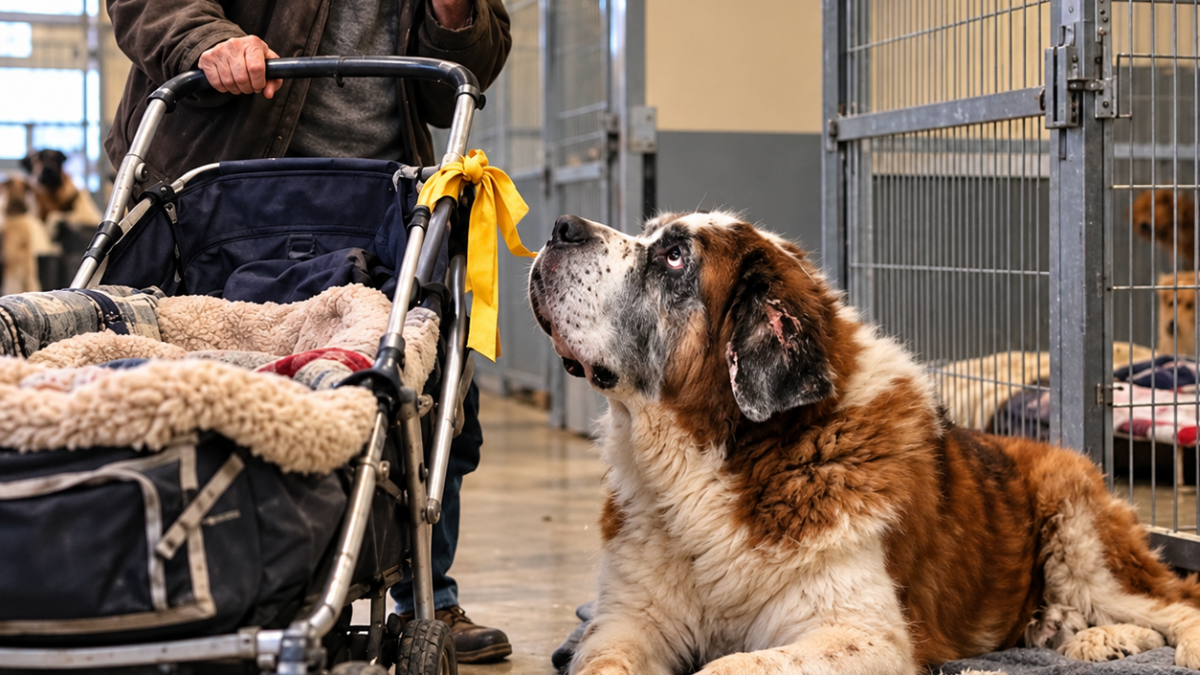
The following Saturday, an elderly man entered the shelter pushing what looked like a double stroller for children that had been rebuilt by someone with industrial experience and absolutely no concern for elegance.
The seats were gone.
In their place was a low metal platform covered with a thick gray mattress.
The original small wheels had been replaced with bicycle tires.
A folding ramp was mounted under the frame.
Two additional brakes sat near the rear axle.
The frame had been reinforced with welded crossbars.
A faded yellow ribbon hung from one side of the handle.
One of our younger volunteers stared.
Then laughed quietly.
The old man heard him.
He didn’t react.
He walked to the front desk and asked:
“How far is it from here to the lake?”
I frowned.
“What lake?”
“The large lake west of town.”
He pointed toward the west wall.
“And from the parking area to the seventh bench, do you know the distance?”
I stared at him.
He continued:
“One hundred seventy meters approximately. The last twenty-five are gravel unless they’ve resurfaced it.”
His name was Henri Delorme.
Seventy-nine years old.
Municipal bus mechanic for nearly forty years.
Widowed ten months earlier.
He didn’t ask to see puppies.
Didn’t ask what dogs were easiest.
Didn’t ask who was house-trained.
He had come for Moka.
I explained everything.
The arthritis in both hips.
The damaged right knee.
Spinal stiffness.
Monthly injections.
Daily medication.
Weight management.
Fall risk.
Difficulty entering vehicles.
Possible incontinence later.
And finally, the part that had ended several other conversations.
“You should understand that his time may be measured in months rather than years.”
Henri listened without interrupting.
Then rested one hand on the strange stroller.
“It holds one hundred eighty kilograms on flat ground,” he said. “One hundred on the ramp. I replaced the front bearings Wednesday and reinforced the rear crossbar Thursday.”
I looked at him.
“You built this for him?”
His eyes dropped.
“I finished it for him.”
That sentence stayed with me.
Inside kennel eighteen, Moka barely reacted when Henri appeared.
He didn’t stand.
He didn’t approach.
Henri placed a piece of chicken several feet away.
Moka ignored it.
That alone was unusual.
Henri sat on the floor.
No calling.
No clapping.
No reaching for him.
Then one wheel of the stroller made a soft metallic click.
Moka’s head snapped up.
Henri slowly reached inside his coat and removed a dented red thermos.
Moka stood.
Immediately.
Slowly, yes.
Painfully, yes.
But with purpose.
He passed the chicken without looking at it.
Went directly to Henri.
Pressed his nose against the thermos lid.
Then rested his forehead against the padded edge of the stroller.
Henri placed one hand between his ears.
“You kept the appointment longer than any of us,” he whispered.
I asked what he meant.
Henri looked at Moka.
His eyes filled.
Then he said:
“He isn’t waiting for somebody to collect him from the shelter.”
He looked toward the west door.
“He’s waiting to go to the lake.”
— END OF FACEBOOK OPENING / CONTINUE BELOW —
I sat down.
Moka remained beside Henri.
The old man’s fingers moved slowly through the thick fur around his neck.
“What happens at 4:12?” I asked.
Henri looked at the clock.
It was 3:58.
“My wife, Colette, used to put on her coat at 4:10.”
Moka’s ears moved at her name.
Henri noticed.
His mouth tightened.
“At 4:12 exactly, she clipped on his leash.”
“And they went to the lake?”
“Yes.”
“Every day?”
“Almost.”
“Rain?”
“Unless it was dangerous.”
“Winter?”
“Shorter route.”
“Summer?”
“Longer.”
Henri rubbed Moka’s ear.
“He knew the routine better than we did.”
I thought about the west door.
The waiting.
The duck.
“What happened at 4:38?”
That made Henri smile.
The first real smile I’d seen.
“My bus route ended at 4:30.”
“You were still working?”
“Until seventy-two.”
“Long time.”
“Bus mechanics don’t retire. We become unpaid consultants.”
I laughed.
He continued:
“My depot was east of the lake. I’d drive over, park, then walk to bench seven.”
“Why seven?”
“Colette said bench six had bad wind and bench eight smelled like ducks.”
I looked at the green toy.
Henri did too.
“That duck?”
“She bought it from a market stall eight years ago.”
“It barely exists.”
“Moka disagrees.”
Fair.
Henri tapped the thermos.
“I brought coffee.”
“For both of you?”
“For us. Moka got biscuit crumbs.”
“Every day?”
“Enough days to become a life.”
The room suddenly felt smaller.
I could see it.
Colette leaving the house.
Moka beside her.
Lake path.
Bench seven.
Henri arriving.
Red thermos.
4:38.
A family built around one unremarkable daily appointment.
Then I remembered Moka’s surrender form.
“Henri.”
He looked up.
“Our records say his previous owner died.”
“Colette died.”
“And that no surviving household member could care for him.”
His face changed.
“I didn’t surrender Moka.”
The air left the room.
Henri took a long breath.
“Ten months ago, Colette collapsed at home.”
Moka lowered himself beside him.
“She had complained of a headache that morning. Nothing unusual. By noon she was in hospital.”
His voice flattened.
“Aneurysm.”
I waited.
“She died that night.”
“I’m sorry.”
Henri nodded once.
“Two weeks later, I had a heart attack.”
I stared.
“Two weeks?”
“Fourteen days.”
He gave a humorless smile.
“Apparently grief has cardiovascular opinions.”
“How serious?”
“Serious enough.”
He spent three weeks in hospital.
Then almost three months in cardiac rehabilitation.
He couldn’t safely return home.
Couldn’t walk far.
Couldn’t lift anything.
Couldn’t manage Moka.
His nephew Alain offered to help.
“He had keys,” Henri said. “He handled bills. Groceries. Mail. He promised Moka would remain in the house.”
“So what happened?”
“After about three weeks, Alain told me Moka was staying with a temporary foster family in the countryside.”
“You believed him?”
Henri looked offended.
“He was my sister’s son.”
Fair.
“He sent updates?”
“Short ones.”
Henri pulled out his phone.
Old messages.
Moka fine.
Eating.
Foster says he sleeps a lot.
Don’t worry about dog. Focus on rehab.
The messages grew less frequent.
Henri called.
Alain said the foster family lived far away and didn’t want visits.
Then eventually he said Moka had “settled permanently.”
Henri was hurt.
But recovering from a heart attack had made every conflict feel physically dangerous.
“I told myself maybe it was better for him.”
His eyes stayed on Moka.
“I couldn’t walk him.”
“You were planning to?”
“Yes.”
“When?”
“As soon as I was cleared.”
He looked at the stroller.
“That frame originally wasn’t for him.”
I remembered his wording.
Finished it for him.
“For Colette?”
Henri nodded.
She had developed severe hip pain the year before she died.
Still wanted the lake.
Refused wheelchairs.
Henri had bought an old double stroller from a family.
Removed the seats.
Started rebuilding it as a resting platform she could use between walks.
“She said I was turning her into freight.”
I smiled.
“She sounds difficult.”
“She was magnificent.”
His eyes filled.
“She never got to use it.”
After Colette’s death, the half-finished frame sat in the garage.
Then four days earlier, Henri’s neighbor sent him one of our shelter posts.
A photograph of Moka.
Green duck beneath his muzzle.
Henri said he recognized him before reading the name.
“What did you do?”
“Called you.”
Our receptionist had taken the call.
An elderly man asking questions about the exact time Moka stood at the west door.
We’d thought he sounded confused.
“I asked when I could collect him,” Henri said.
“And we told you legal ownership needed verification.”
“Yes.”
“And you spent four days finishing the stroller.”
“The front axle was unacceptable.”
I stared.
“You found out your dog had been surrendered without your consent, and your first response was to rebuild an axle?”
Henri considered.
“No.”
“What was the first?”
“I broke a chair.”
I blinked.
He looked embarrassed.
“Kitchen chair.”
That was more human.
“Then I rebuilt the axle.”
I laughed despite myself.
Moka raised his head at the sound.
Henri looked down.
“You’ve already caused trouble.”
Moka’s tail moved once.
We pulled the intake file.
The surrender had been signed by Alain Delorme.
Relationship to owner:
Nephew / authorized caretaker.
Reason:
Owner deceased or permanently incapacitated.
Henri read the line twice.
His face went pale.
“Permanently incapacitated.”
“Yes.”
“I was walking with a cane by then.”
I said nothing.
“I was making coffee.”
His voice shook.
“I was not dead.”
Our director joined us.
She reviewed the documents.
Alain had provided identification.
Household records.
Temporary financial authorization Henri had signed while hospitalized.
The shelter had believed he could make the decision.
Legally, the situation wasn’t clear enough to simply release Moka immediately.
That crushed Henri.
He didn’t shout.
That somehow made it worse.
He looked down at Moka.
The dog had fallen asleep against his shoe.
“Can I take him outside?”
Our director hesitated.
“Not off the property today.”
Henri nodded.
Then he looked at the clock.
4:07.
“Can I take him to the lake with staff supervision?”
We all stared.
He said:
“If what you’ve told me about his hips is accurate, he cannot walk the full path.”
He touched the stroller.
“That problem is already solved.”
Our veterinarian agreed to a short supervised outing.
Moka was medically stable.
Exercise had to remain limited.
The stroller was safer than a long walk.
At 4:10, we stood outside.
Henri unfolded the ramp.
Moka stared.
He sniffed the mattress.
The yellow ribbon.
Then the old red thermos.
His tail moved.
Henri said:
“Up.”
Moka put his front paws on the platform.
Tried to push.
His rear legs failed.
I stepped forward.
Henri raised one hand.
“Wait.”
Moka tried again.
Nothing.
Henri took out the broad support sling we’d used at the shelter.
He looked at me.
“Now.”
Together we guided the old dog onto the platform.
Moka stood.
Then lowered himself onto the mattress.
The stroller barely moved.
Henri checked the brakes.
Twice.
At 4:12, we left.
Exactly.
The lake was less than ten minutes away by car.
Moka became alert the moment Henri opened the van.
Nose lifted.
The scent of water.
Wet leaves.
Mud.
Birds.
Something old inside him woke.
Henri lowered the stroller.
We began along the path.
First bench.
Moka raised his head.
Second.
Nothing.
Third.
His nose worked harder.
At bench five, he tried to stand.
Henri touched his shoulder.
“Not yet.”
Bench six.
Moka began whining.
Very softly.
Then bench seven appeared.
Old wooden seat.
Green metal legs.
Facing the water.
Moka stood before the stroller stopped.
I helped lower the ramp.
The old dog stepped down.
Front legs first.
Rear legs trembling.
Then he walked.
Not toward Henri.
Toward the bench.
He sniffed the left side.
Under the seat.
Behind it.
Around the path.
His breathing grew fast.
He was searching.
Henri turned away.
I understood.
That was Colette’s place.
Moka looked again.
No Colette.
Dogs don’t understand death as absence with an explanation.
They understand someone not being where they always were.
Moka returned to the stroller.
Picked up the green duck.
Carried it to the bench.
Placed it on Colette’s side.
Henri sat on the right.
Then unscrewed the thermos.
Click.
Moka’s head rose.
The smell of coffee drifted.
Henri poured a cup.
At 4:38, the church clock across the water sounded.
Moka looked at Henri.
And then something happened.
For the first time since he’d entered our shelter—
he stopped searching.
He lay beneath the bench.
Put his head on Henri’s shoe.
Henri whispered:
“I’m here.”
The words weren’t dramatic.
That made them worse.
He had disappeared from Moka’s life without explanation.
Colette had too.
One died.
One was taken away by an ambulance and then a hospital.
Moka had lost both humans in almost the same month.
Then the house.
Then the lake.
Then the routine.
He had spent ten months waiting for a day to finish properly.
4:12 meant leave.
4:38 meant Henri arrives.
At the shelter, he could reproduce the first half.
Stand.
Duck.
West door.
But the second half never came.
Henri had.
Finally.
We stayed by the lake until five.
On the drive back, Henri said almost nothing.
Neither did I.
When we entered the shelter at 5:17, Moka walked past the west door.
No pause.
Straight to kennel eighteen.
He lay down.
Green duck beneath his chin.
The next day, everyone watched the clock.
4:11.
Moka slept.
4:12.
Nothing.
4:13.
Still asleep.
At 4:38, he opened one eye.
Closed it again.
Marisol at reception cried.
Nobody mocked her.
That single missed ritual told us more than a behavioral report could.
Moka hadn’t forgotten.
He had completed something.
The legal review took several days.
Henri came every morning.
Sometimes with the red thermos.
Sometimes not.
Always with the stroller.
He sat beside Moka.
Read the newspaper.
Talked about nothing.
“Rain tomorrow.”
“Bernard says the carburetor on his old Peugeot is impossible.”
“Colette would hate what they’ve done to the bakery.”
Moka listened.
Or slept.
Both seemed acceptable.
On day three, Henri told me more about Alain.
“He always wanted things cleanly solved.”
“What does that mean?”
“When his mother died, he sold her house in six weeks.”
“That isn’t necessarily bad.”
“No.”
Henri looked toward Moka.
“But Alain doesn’t understand that some problems aren’t meant to be removed.”
He meant grief.
Age.
Responsibility.
Moka.
“When you were in rehab,” I asked, “did he visit?”
“Twice.”
“Only twice?”
“He has children.”
Henri defended him automatically.
Interesting.
“Do you hate him?”
Henri thought about it.
“No.”
“Angry?”
“Yes.”
“Why no hate?”
“Too much maintenance.”
That was Henri.
Efficient even emotionally.
The home assessment happened five days later.
His small house told the truth before he did.
Colette everywhere.
Photographs.
A yellow scarf folded beside the mirror.
Her gardening gloves.
Two coffee cups in a cabinet even though only one had been used in months.
And Moka.
His old things had never left.
A huge ceramic water bowl sat in the garage.
An old leash hung near the back door.
His name was still written on a storage container.
Henri had not expected to lose him forever.
He had preserved a space.
The house itself needed adjustments.
Henri had already made most.
Non-slip runners.
Furniture shifted apart.
Low orthopedic bed.
Raised feeding platform.
Garden ramp.
Wide turn area near the door.
Emergency contacts taped beside the phone.
Sylvie next door had a key.
Bernard, a retired bus driver, had agreed to help if Moka fell.
“You arranged all this before we approved him?”
Henri looked confused.
“What else would I do?”
The nurse inspecting the house asked:
“What if you have another cardiac event?”
Henri answered immediately.
“Sylvie calls Bernard. Bernard takes Moka. Veterinary authorization and feeding schedule are in that drawer. Money is in a separate account.”
He pointed.
“I updated my will yesterday.”
I stared.
“Yesterday?”
“Alain taught me paperwork matters.”
That sentence carried more bitterness than anything else he’d said.
We approved the return.
Not pity.
Not because of the lake.
Because Henri had a workable plan.
The day Moka went home, Henri signed the adoption transfer required after the legal review resolved the invalid surrender.
It felt absurd.
A man signing documents to adopt his own dog.
Henri read every line.
Then said:
“I’m keeping this.”
“You should.”
“So nobody can invent another version of my death.”
Dark.
Funny.
Painfully reasonable.
Moka entered the van on the stroller.
Green duck beside him.
At the shelter door, Henri stopped.
“How many families met him?”
“Six.”
“And left?”
“Six.”
He looked down.
“Good.”
I was surprised.
“Good?”
“They made the right decision.”
I stared.
Henri continued.
“If they couldn’t carry what he needs, taking him out of guilt would have been worse.”
That mattered.
“Still hurts,” I said.
“Of course.”
He looked at Moka.
“But he didn’t need six.”
Then he smiled.
“He needed one stubborn mechanic.”
Homecoming was not magical.
That should be said.
Moka remembered the house.
But memory collided with change.
Colette’s chair remained.
Her scent barely did.
Henri’s gait was slower.
Furniture had moved.
The bedroom door had been widened.
For the first week, Moka woke at night and wandered.
At 4:10 every afternoon, he still became restless.
Henri honored the routine.
Some days, they went to the lake.
Some days, Moka only walked to the garden gate.
On cold days, Henri wheeled him around the block.
At 4:38, Henri always appeared with the thermos.
The routine became less about waiting.
More about belonging.
One rainy Wednesday, Henri decided not to go out.
At 4:12, Moka stood by the door.
Henri sat beside him.
Opened the thermos.
Click.
Moka looked.
Henri poured coffee into the metal lid.
“We’re staying home today.”
Moka remained standing.
Henri touched the floor beside him.
“Sit.”
Moka lay down.
At 4:38, both were asleep.
Henri later told me:
“That was the day I knew the lake wasn’t the important part.”
“What was?”
“Being expected.”
That stayed with me too.
Moka’s treatment helped.
Not enough to make him young.
Nothing would.
But pain medication reduced stiffness.
Monthly injections improved movement.
Hydrotherapy strengthened his hindquarters.
The first session was a disaster.
Moka refused the treadmill pool.
Planting seventy kilograms of Saint Bernard against the ramp creates a surprisingly convincing argument.
The therapist tried chicken.
No.
Cheese.
Nothing.
Henri called from the side:
“Moka.”
One ear moved.
He rolled the red thermos on the floor.
Click.
Moka turned.
Henri stepped toward the water.
Moka followed.
The therapist stared.
“You’ve trained him with coffee?”
Henri looked offended.
“No.”
“What is that?”
“Marriage.”
Nobody understood.
Henri didn’t explain.
Over the next months, Moka lost four kilograms.
Healthy loss.
Reduced joint pressure.
His coat improved.
He became more interested in visitors.
Especially Sylvie.
She brought ham.
Henri accused her of bribery.
She said:
“You built a machine for him. Let me have ham.”
Fair.
The stroller evolved.
Henri replaced the rear tires.
Added a rain canopy.
Then reflective strips.
Then a small basket beneath.
“What goes there?” I asked.
“Water.”
“And?”
“Medication.”
“And the thermos?”
“Separate holder.”
“Of course.”
Then he added one unnecessary feature.
A brass bell.
I asked why.
Henri said:
“Because Colette hated cyclists sneaking up behind her.”
The bell sounded ridiculous.
Moka loved it.
The yellow ribbon stayed.
Always.
At the lake, people began recognizing them.
Old man.
Old dog.
Homemade stroller.
Seventh bench.
One afternoon, a woman approached.
“Can I ask what happened to him?”
Henri said:
“Age.”
She looked embarrassed.
“I mean the stroller.”
“So do I.”
I almost laughed.
He softened.
“Arthritis.”
She nodded.
“My dog stopped walking far last year.”
“Then shorten the distance without shortening the world.”
That was Henri’s philosophy.
Not spoken dramatically.
Mechanically.
If legs can’t manage distance, move the body another way.
If the bench is too far, build wheels.
If grief destroys routine, rebuild one.
If you can’t lift seventy kilograms, make sure no emergency depends on lifting seventy kilograms.
Problem.
Constraint.
Adaptation.
That was how Henri loved.
The shelter eventually asked him to help modify a wagon for a Bernese Mountain Dog recovering from spinal surgery.
He refused at first.
“I’m retired.”
Then came in Monday at eight.
By lunch, he’d removed the original axle.
“This thing is dangerous.”
“You’re retired.”
“Quiet.”
He rebuilt it.
Then another cart.
Then a ramp.
Then a low feeding platform.
Soon our maintenance room became unofficially known as Henri’s garage.
He objected.
It wasn’t a garage.
We ignored him.
Moka accompanied him twice a month.
Slept beside the workbench.
Green duck beneath his chin.
Young volunteers who once laughed at mobility equipment began asking Henri questions.
Load limits.
Ramp angles.
Tire width.
Center of gravity.
One day, the same volunteer who had laughed at Henri’s stroller showed up carrying a rough sketch.
“My uncle has an old mastiff.”
Henri looked.
“Your front support is wrong.”
The volunteer smiled.
“Can you show me?”
Henri grunted.
That meant yes.
This was Moka’s revenge on being passed over.
Not six families suffering.
Something better.
People learning.
Senior dogs becoming less invisible.
The shelter started a small mobility lending program.
Henri’s design became the prototype.
Two years later, we had four carts.
Three ramps.
Several support harnesses.
Moka knew none of this mattered.
He cared about chicken.
That’s probably healthier.
Alain eventually came to Henri’s house.
Unexpectedly.
Henri called me afterward.
“He came to apologize.”
“Did he?”
“He attempted.”
“What does that mean?”
“He explained.”
“Not the same.”
“No.”
Alain said he had been overwhelmed.
Henri’s heart attack.
Colette’s death.
His own work.
Children.
Bills.
A huge aging dog requiring medication.
He believed Henri would never return to independent life.
He believed finding Moka another home was practical.
Henri asked:
“Then why lie?”
Alain didn’t answer.
That was the center.
Not surrender.
Deception.
Taking away Henri’s choice.
Later, Alain said:
“I thought you’d get over losing the dog.”
Henri became quiet when telling me.
“What did you say?”
“I told him I had gotten over trusting him.”
Hard.
Accurate.
“Then?”
“I asked him to leave.”
“Did you forgive him?”
“No.”
“Do you want to?”
Henri thought.
“I want to stop arranging my day around anger.”
That sounded like forgiveness from a distance.
Henri disagreed.
“Forgiveness is optional. Peace is not.”
I wrote that down later.
He would hate that.
The first anniversary of Moka’s return came quietly.
No shelter event.
No social post.
Henri didn’t want a spectacle.
We met at bench seven.
Me.
Sylvie.
Bernard.
Dr. Perrin.
Henri.
Moka.
The red thermos.
At 4:38, Henri poured coffee.
Then gave Moka a piece of biscuit.
Exactly as Colette once had.
He looked at the empty left side of the bench.
Then said:
“She’d complain he’s too fat.”
Dr. Perrin said:
“He’s a perfect weight.”
Henri nodded.
“Colette considered veterinary science advisory.”
We laughed.
Moka slept.
The lake moved.
No miracle.
Just continuation.
The following winter was harder.
Cold stiffened Moka’s hips.
Henri heated towels before morning walks.
Built a covered transition ramp between the back door and garden.
Added rubber strips for traction.
I visited once and found Moka lying beneath a radiant heater in the garage.
“You’ve built him a spa.”
Henri said:
“No.”
“There’s heated flooring.”
“Localized thermal assistance.”
“Spa.”
He ignored me.
Moka snored.
The relationship between Henri and Moka changed too.
At first Henri had been the caretaker.
Then one afternoon, Henri fell.
Not because of Moka.
He reached too high for a jar.
Stepped backward.
Lost balance.
Hit the kitchen floor.
No fracture.
But he couldn’t stand.
Phone on the counter.
Emergency pendant charging in the bedroom because Henri had forgotten to wear it.
Moka was asleep in the living room.
Henri called.
Moka struggled up.
Walked in.
Henri later joked:
“At first I thought, excellent. Two invalids.”
Moka stood near him.
Henri grabbed the support handle on his harness to reposition himself.
Moka couldn’t pull him up.
Too old.
Too unstable.
Instead, Moka barked.
Deep.
Huge.
Again.
Again.
Sylvie heard through the wall.
Used her key.
Found Henri.
Called emergency services.
One night in hospital.
Bruised hip.
No major injury.
When Henri returned, Moka stayed within three feet of him all day.
At 4:12, he did not go to the door.
At 4:38, he was still beside Henri.
Henri called me.
“He missed the appointment.”
“Maybe he had a more important one.”
Silence.
Then:
“Maybe.”
That moment mattered.
For months, Henri had rebuilt Moka’s life.
Then Moka did the only thing he could when Henri needed help.
Barked.
Enough.
After that, Henri accepted an emergency pendant.
Lowered the kitchen shelves.
Allowed Bernard to install another handrail.
I teased him.
“You’re adapting.”
He said:
“Don’t make it emotional.”
Too late.
Moka turned thirteen.
Then maybe fourteen.
Records were unclear.
Dr. Perrin stopped estimating lifespan.
Every time she tried, Moka survived the prediction out of spite.
“Medically rude,” she called him.
His arthritis worsened gradually.
The stroller changed from optional support to essential transportation.
He stopped walking the first thirty meters to the lake.
Henri didn’t care.
“If wheels exist, use wheels.”
At home, Moka still moved room to room.
Slowly.
The green duck followed.
Sometimes he forgot where he’d left it.
Then searched.
Henri bought an identical replacement.
Moka ignored it.
Henri complained:
“Twenty-four euros.”
“You knew he’d ignore it.”
“I hoped age would reduce standards.”
It hadn’t.
Colette’s yellow ribbon faded almost white.
Henri replaced nothing sentimental.
Only functional parts.
Bearings.
Bolts.
Tires.
Brake cables.
Memory stayed original.
One afternoon, a family visited the shelter asking about a ten-year-old shepherd with arthritis.
They had seen a photograph of Moka’s stroller online.
The father asked:
“What if he can’t walk far later?”
I pointed toward Henri’s cart.
“We adapt.”
They adopted the shepherd three days later.
A month later, they sent us a picture.
Old dog in a garden wagon.
Tongue out.
Happy.
I forwarded it to Henri.
His response:
Front wheels too narrow.
I replied:
Anything else?
Dog looks good.
That was praise.
Moka’s third spring home became his last truly strong season.
Warm weather loosened his joints.
He ate well.
Still barked at delivery vans.
Still expected lake visits.
One afternoon, he walked almost forty meters before asking—by stopping completely—to enter the stroller.
Henri called me.
“Forty.”
“Forty what?”
“Meters.”
I knew immediately.
“Good.”
“Forty-two actually.”
“Of course you measured.”
“I am a mechanic.”
I didn’t know that mechanics measured dog walks.
Apparently they do.
Then summer came.
Heat was harder.
Lake visits moved later.
4:12 became symbolic rather than exact on hot days.
That bothered Henri initially.
“Routine matters.”
Dr. Perrin said:
“Heatstroke matters more.”
Henri adjusted.
That was love too.
Not worshipping routine so much that routine becomes harmful.
Some evenings they went at six.
Moka adapted.
The appointment had stopped being a prison.
It became a choice.
That was the real healing.
The final summer lake trip came on a mild Sunday.
Henri called me.
“Come at four.”
No explanation.
I knew.
Moka was thinner.
Breathing harder.
The stroller had a new sun canopy.
Green duck between his paws.
At bench seven, he didn’t try to get down.
Henri sat on the right.
I sat farther away.
He unscrewed the thermos at 4:38.
Click.
Moka opened his eyes.
Henri poured coffee.
Then untied Colette’s faded yellow ribbon from the stroller handle.
I stared.
He’d never removed it.
He held it for a long time.
Then tied it around the left side of the bench.
Not tightly.
Just enough.
“What are you doing?”
“Leaving something.”
“For Colette?”
“For me.”
I waited.
Henri looked at the lake.
“The first year after she died, I thought staying loyal meant changing nothing.”
Moka breathed quietly.
“Then Moka came home.”
He looked down.
“He waited at that shelter door because he believed the old schedule was still the only way the day could end.”
I said:
“So did you.”
Henri smiled.
“Exactly.”
He touched the ribbon.
“Colette isn’t here.”
“No.”
“Moka is.”
“Yes.”
“And someday he won’t be.”
I didn’t answer.
Henri picked up the green duck.
“Moka keeps this.”
“Obviously.”
The ribbon stayed.
He took the thermos.
The stroller.
The dog.
We left the bench.
For the first time, something connected to Colette remained behind by choice.
That mattered more than Henri said.
Moka declined quickly afterward.
Appetite.
Breathing.
Standing.
Pain control became less effective.
Calendar markings turned from mostly green to yellow.
Then red.
Henri had used the system for months.
Good day.
Mixed.
Hard.
He stared at the final two weeks.
Too much red.
Dr. Perrin came.
Examined him.
Sat at the kitchen table.
“We can adjust medication.”
Henri asked:
“Will he enjoy the extra time?”
Dr. Perrin didn’t answer immediately.
Henri nodded.
He understood.
“One more day.”
She agreed.
One.
Not ten.
Not “until he can’t move.”
One day.
Henri gave him beef.
Too much.
Moka ate some.
Left some.
That told us everything.
At 4:12, Henri wheeled the stroller into the living room.
Moka couldn’t climb onto it.
Henri sat beside him instead.
Red thermos.
Click.
Moka opened his eyes.
At 4:38, Henri said:
“I’m here.”
Moka’s tail moved once.
The next morning, Dr. Perrin returned.
Home euthanasia.
Moka lay on the thick gray mattress from the stroller.
We had carried it inside.
The stroller itself stood beside him.
Green duck under one paw.
Henri sat on the floor.
His knees must have hurt.
He didn’t move.
The sedative went in.
Moka relaxed.
Muscles softening.
Breathing slowing.
Henri stroked the white fur around his muzzle.
“You don’t have to get up at 4:12 anymore.”
His voice broke.
“You don’t have to wait at any door.”
Moka’s eyes half closed.
Henri bent closer.
“Colette isn’t coming back.”
The sentence felt brutal.
Necessary.
Then:
“But I came.”
Silence.
“And you waited long enough.”
Moka breathed once.
Twice.
Dr. Perrin administered the final medication.
Henri kept his hand between Moka’s ears.
Exactly where it had been when they first reunited.
The breathing stopped.
Nobody spoke.
The clock in the kitchen read 10:26.
Wrong time.
Good.
Moka’s life did not have to end on schedule.
For a long time, Henri remained on the floor.
Then he lifted the green duck.
Held it against his chest.
I looked away.
Grief deserves privacy even inside company.
Moka’s ashes returned weeks later.
Henri kept most beside Colette’s photograph.
A small portion went to the lake.
Bench seven.
4:38.
Of course.
Henri scattered them near the reeds.
Not under the bench.
“Too many shoes.”
Even grief could not remove his practical instincts.
The red thermos went onto a shelf at home.
Retired.
The stroller came to us.
Henri rebuilt it first.
New brake lines.
New mattress.
Fresh bearings.
A brass plate on the frame:
MOKA — KEEP GOING
The first dog to use it was a twelve-year-old Bernese Mountain Dog recovering from surgery.
Then a mastiff with osteosarcoma.
Then an old Labrador whose family wanted one final river walk.
The stroller became the most requested item in our mobility program.
Henri maintained it monthly.
He refused to let volunteers adjust the brake tension.
“People underestimate stopping distance.”
For a stroller.
Carrying old dogs.
I loved him for that.
The six families who had passed Moka by became part of the story too.
One returned.
The family with the little girl.
The mother looked uncomfortable.
“I’ve thought about him a lot.”
I said:
“You didn’t do anything wrong.”
“We chose the younger dog.”
“Yes.”
“Maybe we should have—”
“No.”
I stopped her.
“You chose the dog you could care for.”
She looked relieved.
Then her daughter saw an eleven-year-old mixed breed in kennel twelve.
Gray muzzle.
Smaller.
Arthritis.
“What’s wrong with him?”
The mother said:
“Nothing is wrong with him.”
That answer made me smile.
They met him.
Asked hard questions.
Medication.
Cost.
Mobility.
Future.
Then adopted him.
Not guilt.
Preparedness.
That was Moka’s quiet revenge on every assumption.
He had not been right for those six families.
But his life changed what one family saw when they looked at the next old dog.
The Moka Mobility Fund began that year.
Donations paid for:
Ramps.
Support harnesses.
Wagons.
First-month medication.
Home modifications.
Transportation.
Within a year, nine senior dogs found homes with mobility support.
Within three years, twenty-seven.
Henri kept the spreadsheet.
I asked why.
“Numbers tell you whether sentiment is useful.”
There he was.
Alain eventually apologized properly.
Years after the surrender.
He came to Henri’s apartment.
Henri told me later.
No excuses this time.
Just:
“I lied because I knew you’d say no.”
Henri answered:
“Yes.”
“I thought I was helping.”
“No.”
“I was overwhelmed.”
“I know.”
“I shouldn’t have done it.”
“No.”
Then Alain asked:
“Can you forgive me?”
Henri hated the question.
He told him:
“I can stop carrying it.”
Different.
Enough.
They became civil.
Never close.
Actions have consequences that apologies don’t erase.
Henri did not spend his final years punishing Alain.
He simply never again gave him authority over anything important.
That’s accountability too.
Henri remained with our shelter until his back finally stopped cooperating.
At eighty-three, we banned him from crawling beneath carts.
He objected.
We bought a rolling mechanic’s stool.
He said:
“This makes me look old.”
The room went silent.
Then Henri realized what he’d said.
He laughed until he coughed.
We never let him forget it.
At eighty-four, he visited bench seven less often.
Walking had become harder.
Irony.
I offered the Moka stroller once.
He looked at me.
“Absolutely not.”
“Colette said the same.”
“That is manipulative.”
“Yes.”
He eventually allowed Bernard to bring a wheelchair.
Only once.
To the lake.
Seventh bench.
He complained the entire time.
Then stayed for forty minutes.
At 4:38, he opened the red thermos.
The same one.
Retirement had ended.
He poured two coffees.
One for himself.
One for me.
No Moka.
No Colette.
Still an appointment.
Henri said:
“I used to think Moka was waiting for the past.”
I waited.
“He wasn’t.”
“What was he waiting for?”
“Someone to show up.”
He handed me coffee.
“That can still happen.”
Years later, Henri moved to a smaller apartment near his sister.
No garden.
No dog.
He kept three things from the old routine.
Colette’s photograph.
Red thermos.
Green duck.
The duck sat on a shelf.
One wing barely attached.
I told him to throw it away.
He said:
“It should be thrown away.”
“Then?”
“No.”
Exactly.
Henri died peacefully at eighty-six.
His sister called us.
His will included a donation to the Moka Mobility Fund.
Not enormous.
Enough to keep the program running for years.
Then there was one strange line:
The green duck goes to the shelter. Do not wash it. He hated that.
We did not wash it.
It sits inside a clear box in our staff room.
Not in the lobby.
Not for visitors.
Moka had spent enough time being looked at through barriers.
The duck stays with the people who knew what it meant.
The stroller still works.
We’ve rebuilt it three times.
New tires.
New mattress.
New wheel bearings.
Henri’s rear crossbar remains original.
Naturally.
Every time we roll another old dog through the west door, I remember Moka at 4:12.
The first time, I thought his ritual was heartbreaking.
Now I understand it differently.
Moka had lost the map of his life.
He kept repeating the last direction he remembered.
Stand.
Take duck.
Go west.
Wait.
He had faith that if he kept doing his part, somebody else would eventually complete the sequence.
For months, nobody did.
Then Henri walked through the shelter doors with a homemade stroller and a dented red thermos.
One wheel clicked.
Moka looked up.
That tiny sound connected ten months of loss to everything that came after.
People often ask me why Henri adopted such a difficult dog at seventy-nine.
I always correct them.
Henri didn’t adopt a difficult dog.
He reclaimed a relationship that had been stolen from both of them.
And then, because reclaiming wasn’t enough, he redesigned their lives around what their bodies could still do.
That is the part I want people to remember.
Not heroism.
Adaptation.
Henri never pretended Moka wasn’t old.
Never said love would cure arthritis.
Never acted as if seventy-nine were forty-nine.
He admitted the limits.
Then engineered around them.
Can’t walk to bench seven?
Wheels.
Can’t climb into van?
Ramp.
Can’t lift dog?
Support sling, neighbors, emergency plan.
Can’t bring Colette back?
No solution.
Live anyway.
That’s harder engineering.
Moka did the same emotionally.
Colette gone.
Henri gone.
Home gone.
He couldn’t understand why.
So he preserved the only piece he could.
Time.
4:12.
4:38.
A dog using routine to keep a bridge intact.
Until somebody finally crossed it.
Six families passed him over.
I no longer call it rejection.
They looked at reality and knew it wasn’t theirs to carry.
That’s responsible.
Moka didn’t need everyone.
He needed one person who understood that the question was not:
“How many years are left?”
It was:
“How do we get to the seventh bench?”
That question changed everything.
Because a life near its end is still a life happening now.
Distance still matters.
Coffee still smells like coffee.
Lake water still moves.
A worn duck still matters because somebody loved it yesterday.
An old dog can still wait.
An old man can still show up.
And sometimes two beings who have both lost the person who organized their world can build a new schedule together.
Not forever.
Nothing is.
But long enough for one more lake visit.
One more winter.
One more cup of coffee.
One more ridiculous modification to a stroller.
One more bark that brings a neighbor running.
One more good day marked green on a calendar.
Long enough for Moka to stop watching the clock.
Long enough for Henri to stop thinking his own life had ended with Colette.
Long enough for other senior dogs to go home because somebody saw a ramp and thought:
Maybe difficult doesn’t mean impossible.
That is the ending I prefer.
Not Moka dying.
Not Henri dying.
Not Alain apologizing.
The ending is continuation.
Somewhere, right now, another old dog rides in the cart Henri built.
The brass plate shakes slightly over rough ground.
MOKA — KEEP GOING
And every time those wheels turn, a seventy-nine-year-old mechanic and the Saint Bernard who waited for him are still, in some small practical way, making sure someone else reaches the next bench.