She Was Chained Just Feet From Her Crying Puppies—Then We Learned Why She Never Stopped Watching Them
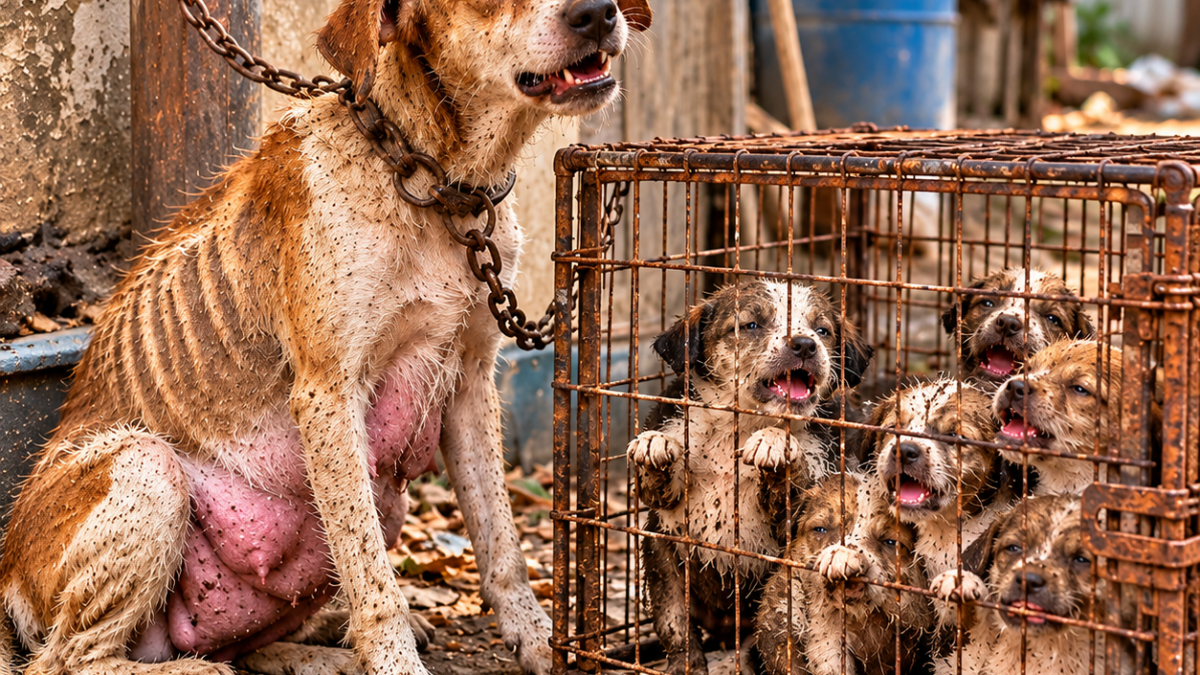
—
PART 2
—
The first problem was figuring out how frightened the mother really was.
A scared dog on a chain can be unpredictable.
Not because she is vicious.
Because she has no escape route.
Every instinct tells her to create distance, but the chain has already decided how much distance she is allowed.
So we moved slowly.
One rescuer stayed near the cage.
I remained with the mother.
Another began documenting the conditions.
The empty bowls.
The chain.
The cage.
The ground.
Everything.
The mother watched us closely.
But every few seconds, her attention returned to her puppies.
I offered a little food.
She smelled it.
For a moment, hunger won.
She took the piece quickly.
Then immediately looked back toward the cage.
“Good girl.”
Another piece.
This time she took it more gently.
I moved slightly closer.
She allowed it.
Behind us, one of the puppies started whining.
The mother became restless again.
“It’s okay.”
I knew those words weren’t enough.
So we stopped talking and started changing the situation.
The cage door was secured with a bent piece of wire.
It took one of the rescuers several attempts to loosen it.
The sound of metal scraping made the puppies retreat.
Their mother began pulling against her chain.
“Almost there,” I told her.
The wire finally came loose.
The rescuer opened the door.
Nobody reached inside immediately.
We didn’t want terrified puppies scattering through an unfamiliar yard.
She placed a towel at the opening.
A small tan puppy came first.
One paw.
Then another.
Its legs seemed weak.
The mother saw it.
Her entire body changed.
She cried.
Not barked.
Cried.
The puppy answered.
I will never forget that sound.
The mother pulled forward.
The chain tightened.
Again.
That was enough.
“We need her loose.”
We had already determined that the collar and chain could be safely removed.
I positioned myself beside her.
“Easy, mama.”
My fingers found the clasp.
She flinched.
I stopped.
Let her smell my hand again.
Then tried once more.
Click.
The chain fell.
For perhaps half a second, the mother didn’t understand.
She stood still.
Then the puppy cried.
She ran.
Straight to the cage.
She reached the first puppy and began licking its face so frantically that the little one nearly fell over.
Then a second puppy emerged.
Then a third.
Four.
Five.
Five puppies.
The mother moved between them as though she couldn’t decide which one needed her first.
She smelled every body.
Licked every head.
Checked beneath every belly.
The puppies climbed over one another trying to reach her.
One pushed beneath her chest.
Another crawled underneath.
The smallest simply pressed its face against her leg.
One of the rescuers turned away.
She was crying.
I wasn’t doing much better.
The mother had been separated from them by only a few feet.
Now she acted as if they had returned from another world.
She lay down.
The puppies crowded around her.
For the first time since we entered that yard, the mother stopped pacing.
She closed her eyes.
Just for a second.
Then opened them again and began cleaning one puppy.
I crouched nearby.
“There.”
She looked at me.
“I told you.”
Maybe it was coincidence.
Maybe I wanted to believe she understood.
But her expression seemed softer.
We gave her water first.
Fresh.
Clean.
She drank for a long time.
We controlled how much food appeared at once.
She was thin enough that we wanted veterinary advice before letting her gorge.
The puppies needed evaluation too.
We had no reliable information about their ages.
No vaccination history.
No medical records.
Nothing.
The smallest puppy looked particularly weak.
We needed to leave.
Soon.
But before transporting them, there was another issue.
Who legally controlled the dogs?
The property owner was eventually contacted.
That conversation became the beginning of the conflict none of us wanted.
He arrived irritated rather than worried.
The first thing he said was:
“What are you doing in my yard?”
Not:
Are the puppies okay?
Not:
What happened?
Not:
Do they need a veterinarian?
His concern was the yard.
One of the rescuers explained calmly.
“We received a welfare report.”
“They have food.”
I looked at the nearly empty container.
“Where?”
He pointed vaguely.
“I feed them.”
“How often?”
“Enough.”
The mother was lying beside her puppies behind us.
Her ribs were visible even through her coat.
The rescuer kept her voice level.
“The animals need medical evaluation.”
“They’re fine.”
The smallest puppy tried to stand.
Its legs shook.
I watched the man.
“Does that look fine to you?”
His jaw tightened.
“They’re dogs.”
I hate that sentence.
Not because it is inaccurate.
Because of what people sometimes mean by it.
Just dogs.
As though the category reduces pain.
As though hunger matters less.
Fear matters less.
Motherhood matters less.
The rescuer responded before I could.
“Yes. They are dogs. Which means they require food, water, adequate shelter and appropriate care.”
The man crossed his arms.
“You people always make things dramatic.”
Behind him, the mother dog was licking dirt from one puppy’s face.
I looked at the chain lying on the ground.
Then at the cage.
Nobody needed to manufacture drama.
It was already there.
We explained that the dogs’ conditions had been documented.
Animal welfare authorities had been contacted.
Given the concerns, the dogs needed examination.
The conversation became louder.
He insisted they belonged to him.
One rescuer calmly repeated:
“Ownership does not remove welfare obligations.”
That sentence finally made him quiet.
Not cooperative.
Quiet.
There is a difference.
The authorities who arrived took statements.
They inspected the yard.
Photographed the chain.
The cage.
The bowls.
The dogs.
The owner attempted to explain.
The mother was chained because she “wandered.”
The puppies were caged because they “made a mess.”
The food bowl was empty because they had “already eaten.”
Maybe parts of that explanation were technically possible.
But the physical condition of the animals would tell its own story.
The dogs were released into rescue care pending further review.
The moment we received permission to transport them, we moved.
The mother refused to enter the vehicle at first.
Not because she was afraid of us.
Because the puppies were being placed in another crate.
She followed them desperately.
We stopped.
Instead of separating them farther than necessary, we rearranged.
Mother first.
Then puppies where she could smell and hear them immediately.
Once the first puppy was near her, she climbed in.
That told me everything.
I sat nearby during the drive.
We decided to call the mother Grace.
Maybe because grace was what she had shown her babies despite having almost nothing.
Maybe because we needed a name quickly.
The puppies received temporary names later.
Benny.
Scout.
Milo.
Poppy.
And the smallest girl, Hope.
Hope worried us most.
At the clinic, Grace tried to follow every puppy into the examination room.
When a technician carried Hope away, Grace stood.
Whined.
Tried to go after her.
I put a hand on Grace’s shoulder.
“She’s coming back.”
Grace stared toward the door.
“You have to trust us.”
It felt unfair asking that.
What reason did Grace have to trust people?
Humans had controlled the chain.
The cage.
The food.
The distance between her and her babies.
Now humans wanted her to believe they were helping.
Trust would have to be earned.
Again.
The veterinarian examined Grace first.
Underweight.
Dehydrated.
Skin irritation around the neck where the collar had rubbed.
Parasites.
A mild infection.
Nothing immediately life-threatening, thankfully.
But her body showed prolonged stress.
The veterinarian looked at me.
“She’s been giving more than she’s getting.”
I knew what he meant.
Producing milk.
Caring for puppies.
Trying to maintain her own body.
Motherhood consumes enormous energy even when conditions are good.
Grace had been attempting it while thin.
Stressed.
Restricted.
Underfed.
“She needs calories,” the veterinarian said.
“Carefully?”
“Regularly. Good nutrition. Clean water. Rest. Parasite treatment. We’ll monitor her.”
Then the puppies.
Benny was thin but active.
Scout had intestinal parasites.
Milo had a skin infection.
Poppy was dehydrated.
Hope was worse.
She had low blood sugar and was significantly smaller than the others.
When the veterinarian lifted her, Grace began whining from across the room.
“We should keep Mom where she can hear them,” he said.
We did.
Hope received supportive care.
Warmth.
Fluids.
Nutrition.
The veterinary team monitored her closely.
Grace would not settle until Hope returned.
When the tiny puppy was finally placed back near her, Grace smelled her from nose to tail.
Then pulled her against her chest.
I watched.
“She thought we took her.”
One technician nodded.
“She’s going to have separation issues after what happened.”
Probably.
But we could work with fear.
We could not repair a relationship if we kept repeating the thing that created the fear.
So from that moment, unless medically necessary, Grace knew where her puppies were.
That first night, the family slept together on clean bedding.
No metal bars between them.
No chain.
Grace curled around the five puppies.
Hope tucked beneath her chin.
I checked on them before leaving.
The room was quiet.
Warm.
Grace opened one eye when I approached.
“Just me.”
She relaxed.
I placed fresh water nearby.
For a few seconds, I stood and watched her.
The difference between the yard and the clinic was almost absurd.
At the yard, she had spent her energy trying to move several feet.
Now the puppies were physically touching her.
All five.
I whispered:
“Sleep.”
Grace closed her eyes.
That was the first night.
The second brought challenges.
Grace guarded the puppies from unfamiliar staff.
Not aggressively at first.
She simply positioned her body between them.
If someone approached too quickly, she growled softly.
We respected it.
A growl is communication.
Punishing it would only remove the warning.
Instead, the team slowed down.
Voice first.
Treat.
Touch.
Then puppy handling.
Grace learned.
This hand returns the baby.
This person brings food.
This person changes bedding.
This person does not take anyone away forever.
By the fourth day, she stopped standing every time a known technician entered.
By the sixth, she wagged when breakfast arrived.
By the end of the first week, something extraordinary happened.
Grace played.
It lasted maybe ten seconds.
One of the puppies, Scout, grabbed the corner of her blanket.
Grace nudged him.
Scout pulled.
Grace pulled back.
Tiny tug-of-war.
Then another puppy joined.
Grace bounced sideways.
Actually bounced.
I laughed.
“Look at her.”
The exhausted mother chained beside the wall had been hiding an entirely different dog.
Not weak by nature.
Not solemn.
Not defeated.
She had been exhausted.
There is a difference.
Once her body received food and her mind received safety, personality returned.
Grace liked affection.
She especially liked scratches near her shoulders.
She hated baths.
She stole puppy food even when her own bowl was full.
And she made a strange little grunting sound when comfortable.
One evening I found her lying on her back while five puppies crawled across her stomach.
I smiled.
“This is what you wanted, huh?”
Grace looked at me upside down.
Her tail moved.
Maybe.
The puppies improved rapidly.
Hope required the most attention.
For several days, we worried she might fall behind.
She tired faster.
Ate less.
Slept more.
Grace seemed to know.
When the other puppies moved away, Grace often kept Hope near her.
Sometimes she licked Hope for minutes at a time.
We supplemented carefully.
Monitored her weight.
Every few grams mattered.
Then one morning Hope gained more than expected.
The technician announced it as though she had won an Olympic medal.
“Hope gained forty grams!”
Everyone cheered.
Grace barked because the noise startled her.
Then the puppies started barking because Grace barked.
The entire room became chaos.
Perfect chaos.
Life.
Two weeks after rescue, the puppies had changed dramatically.
Rounder bellies.
Brighter eyes.
More energy.
They turned the recovery room into a disaster every few hours.
Newspaper shredded.
Water bowls stepped in.
Blankets dragged.
Toys stolen.
Benny discovered that shoelaces were apparently prey.
Scout believed human toes existed for attacking.
Poppy climbed everything.
Milo slept after approximately four minutes of activity.
Hope, once the weakest, developed the loudest bark.
Grace watched all of it with the exhausted expression of every mother who has realized her children have become mobile.
“You wanted to reach them,” I reminded her one afternoon.
Grace looked at the puppies destroying a blanket.
“You regret it now?”
She sighed.
I laughed.
Fair.
Meanwhile, the welfare case continued.
Veterinary records became important.
Not emotional descriptions.
Measurements.
Weights.
Parasite loads.
Hydration.
Condition scores.
The irritation around Grace’s neck.
The developmental condition of the puppies.
Photographs from the yard.
The cage dimensions.
Access to water.
Shelter.
Those details mattered.
Because accountability should not depend on how angry a story makes people.
It should depend on evidence.
The property owner insisted we had exaggerated everything.
He said the animals were not neglected.
He said Grace was chained only temporarily.
He said the puppies had enough space.
He said he intended to improve the setup.
Intent.
Again that word.
I had heard it in other cases.
I intended to feed them.
I intended to fix the shelter.
I intended to come back.
I intended.
Animals live in what actually happens.
Grace could not eat intentions.
The puppies could not sleep on intentions.
The chain did not become longer because someone planned to change it later.
During the review, the neighbor who first contacted us gave a statement.
She described hearing the puppies.
Watching Grace strain toward them.
Seeing the bowls empty more than once.
She admitted she had hesitated to call.
“I thought maybe I was interfering.”
That sentence mattered.
Many people hesitate for that reason.
They don’t want to cause trouble.
They don’t want to accuse someone unfairly.
They tell themselves somebody else knows more.
The neighbor looked at the investigator.
“Then one of those puppies cried for almost an hour.”
Her eyes filled.
“And I watched the mother pull against that chain until she gave up.”
She looked down.
“That’s when I called.”
One phone call.
That was all it took to start changing six lives.
Back at the clinic, Grace didn’t care about investigations.
She cared about lunch.
And puppies.
Mostly puppies.
We began preparing for foster placement.
The pups still needed time before adoption.
Grace needed more recovery.
Keeping all six together indefinitely was difficult, but separating them had to happen gradually.
The first trial involved moving two puppies into an adjoining room for twenty minutes.
Grace panicked.
She paced.
Listened.
Whined.
The moment they returned, she inspected them.
We slowed down.
Ten minutes.
Then fifteen.
Then thirty.
Always return.
Gradually, Grace learned a new lesson.
Separation did not always mean loss.
That mattered beyond the puppies.
Someday, they would leave.
They were supposed to.
Healthy puppies grow.
They become independent.
They find homes.
For Grace, who had already experienced forced separation, that transition needed to feel different.
Choice.
Safety.
Return.
Routine.
Not chain and cage.
After several weeks, the puppies were old enough and healthy enough for foster arrangements.
We placed them in pairs initially, with careful socialization.
Grace remained with an experienced foster named Anna.
The first evening without all five puppies confused her.
She walked room to room.
Checked corners.
Listened at the door.
Anna sat on the floor.
“Come here.”
Grace didn’t.
She checked the hallway again.
Then returned.
Anna offered her a blanket that carried the puppies’ scent.
Grace smelled it.
Lay down.
But didn’t sleep.
The foster called me.
“She’s searching.”
“I expected that.”
“I feel terrible.”
“Don’t.”
“What should I do?”
“Routine. Calm. Don’t make it dramatic.”
“She keeps going to the door.”
“Let her check.”
“What if she thinks we abandoned them?”
“She’ll learn they’re safe.”
That was the hard truth.
Grace could not remain physically attached to the puppies forever simply because people had once separated them cruelly.
Healing doesn’t mean avoiding every trigger forever.
Sometimes it means creating a different outcome.
The puppies were safe.
Grace was safe.
No one was crying in a cage.
No one was chained.
After three nights, Grace slept through most of the night.
After a week, she began exploring Anna’s home.
After two, she discovered the couch.
That became a problem.
Or, according to Grace, a solution.
Anna had initially declared:
“No dogs on the couch.”
Grace waited until Anna left the room.
Then climbed up.
By the time Anna returned, Grace was asleep on a pillow.
Anna sent me a photo.
Caption:
“I have lost.”
I responded:
“Yes.”
The transformation in Grace continued.
Her ribs disappeared beneath healthy weight.
The collar irritation healed.
Her coat became softer.
Her eyes looked different.
That was the change people noticed most.
At the yard, Grace’s eyes had always seemed divided.
Half on strangers.
Half on the puppies.
Always monitoring.
Always calculating.
In foster care, she began looking directly at people.
No cage to check.
No chain to fight.
No baby crying beyond reach.
The vigilance faded.
She became affectionate.
Very affectionate.
Grace leaned.
That was her thing.
If she liked you, she stood beside your leg and slowly shifted her entire body against you until you either supported her weight or moved.
Anna called it “the Grace collapse.”
Visitors learned quickly.
“She’s going to lean.”
“What?”
Too late.
Grace would fall lovingly against them.
She had spent so long prevented from reaching the beings she loved.
Now physical closeness seemed to matter enormously.
The puppies, meanwhile, thrived.
Benny and Milo entered one foster home.
Poppy and Scout another.
Hope stayed temporarily with a veterinary foster because we wanted to monitor her growth.
Videos arrived daily.
Benny stealing socks.
Milo sleeping in a food bowl.
Poppy barking at her reflection.
Scout discovering stairs.
Hope chasing a ball almost as large as she was.
I showed the videos to Grace when visiting Anna.
Did she understand the screen?
Probably not.
But when puppy sounds played, her ears lifted.
Then she looked toward the hallway.
That always hurt.
“Your babies are okay.”
Grace looked at me.
“They’re causing trouble.”
Her tail moved.
“Lots of trouble.”
Good.
Puppies should cause trouble.
It means they have enough safety to waste energy.
Within two months, the first adoption applications arrived.
Poppy found a family first.
A couple with an older dog met her three times.
They didn’t choose her because she was the cutest.
They chose her because their senior dog seemed to tolerate her chaotic personality better than expected.
Poppy’s adoption picture showed her asleep with one paw across the older dog’s back.
Scout went next.
A family with two children.
We taught the children how to interact properly.
No grabbing.
No bothering him while eating.
Respect sleep.
Let him come to you.
They listened better than many adults.
Benny found a home with a young man who ran every morning and wanted an active companion.
Milo went to a quiet home with a retired couple.
He immediately discovered retirement suited his personality because it involved frequent naps.
Hope was last.
Not because nobody wanted her.
Because we waited.
She had started as the fragile puppy.
We wanted certainty.
When her veterinarian finally cleared her, applications flooded in.
Anna joked:
“Grace’s smallest baby became the celebrity.”
Hope was adopted by a woman who had followed her recovery from the beginning.
She had no other animals.
Worked from home.
Understood Hope’s history.
And, most importantly, never once referred to her as “the poor little thing.”
She asked:
“What does she enjoy?”
That question always tells me something.
Not:
What happened to her?
What’s wrong with her?
What trauma does she have?
What does she enjoy?
Toys.
Food puzzles.
Sleeping under blankets.
Running in circles after baths.
That was Hope now.
The adoption went through.
All five puppies had homes.
Then we faced a question I had quietly been avoiding.
Grace.
People had applied for her too.
Fewer than for the puppies.
That happens.
Puppies attract attention.
Adult mothers are sometimes overlooked after doing the hardest work.
But Anna had a problem.
She had become attached.
Very attached.
I visited one afternoon.
Grace was on the couch.
Of course.
Anna was beside her.
I asked:
“Have you looked at the applications?”
“No.”
“Anna.”
“No.”
“You’re fostering.”
“I know.”
“The goal is adoption.”
“Correct.”
“By someone.”
“Yes.”
“Possibly not you.”
Anna stared at me.
Grace placed her head in Anna’s lap.
I waited.
Anna sighed.
“She sleeps beside my bedroom door.”
“That is not legally binding.”
“She knows my schedule.”
“Still not.”
“She cries when I leave.”
“We’re working on that.”
“She likes my couch.”
“Your couch?”
Anna looked down at Grace.
“Our couch.”
There it was.
I smiled.
“So this is happening?”
Anna scratched Grace’s chest.
“I keep thinking about that chain.”
Her voice changed.
“She spent who knows how long trying to reach her babies.”
Grace closed her eyes.
Anna continued:
“And now when she wants to come near me, she can.”
I sat quietly.
“I don’t want her ever reaching the end of something that stops her from getting to family again.”
That decided it.
Grace was home.
The adoption paperwork became official a week later.
Anna bought her a new collar.
Soft.
Wide.
Comfortable.
No chain attached.
Just identification.
When she clipped it on, Grace shook her head dramatically.
Anna laughed.
“Very expensive. Please appreciate it.”
Grace leaned against her.
“That’ll do.”
We organized a reunion several months later.
Not because dogs require family reunions the way humans do.
Mostly because we did.
All five puppies were invited with their families.
Grace arrived first.
Healthy.
Confident.
Her coat shining.
She walked into the fenced field and began sniffing.
Then the first car arrived.
Poppy.
Poppy jumped out.
Grace froze.
The dogs looked at one another.
Poppy approached.
Grace smelled her.
Then Poppy launched into play.
Grace responded.
The next car brought Benny.
Then Milo.
Scout.
Finally Hope.
Soon six dogs were running around the field.
Not desperately.
Not trying to break through bars.
Just playing.
The neighbor who made the original call came too.
She stood at the fence.
For several minutes, she said nothing.
Then she whispered:
“I can’t believe it.”
Grace ran past us.
Hope behind her.
The neighbor covered her mouth.
“That little one was the one in the corner?”
“Yes.”
“She looked like she could barely move.”
“I remember.”
The neighbor started crying.
“I nearly didn’t call.”
I looked at her.
“But you did.”
“I waited two days.”
“You called.”
“I should’ve done it immediately.”
Maybe.
But guilt is useful only if it changes what we do next.
I told her:
“Next time you’ll call sooner.”
She nodded.
“Yes.”
“That matters.”
Grace approached.
The neighbor crouched.
“Do you remember me?”
Grace sniffed her.
Then leaned.
The neighbor nearly fell over.
I laughed.
“That means she likes you.”
Grace pressed harder.
The woman wrapped both arms around her.
“I’m sorry.”
Grace licked her face.
Dogs do not hand out moral judgments in the way humans do.
Maybe that is one of their gifts.
The legal case eventually reached its conclusion.
Again, this portion belongs to the dramatized expansion rather than the confirmed facts from the original account.
The documented conditions mattered.
The veterinary assessments mattered.
The neighbor’s statement mattered.
The owner’s explanations were heard.
But so were the photographs.
The chain.
The cage.
The insufficient access to clean food and water.
The physical condition of Grace and her puppies.
There was no courtroom spectacle.
No shouting match.
No revenge fantasy.
There was a decision.
The dogs would not be returned.
The former owner faced penalties and restrictions on future animal ownership.
The animals remained legally with the rescue and their adoptive families.
When I heard the decision, I expected to feel triumphant.
Instead, I mostly felt tired.
Anna called.
“It’s over?”
“Yes.”
“He can’t take her?”
“No.”
Silence.
Then I heard her exhale.
“Good.”
That word contained everything.
Not celebration.
Relief.
Grace was lying beside Anna when I visited later.
The new collar around her neck.
No chain.
Her head on Anna’s foot.
“You know the best part?” Anna asked.
“What?”
“She has no idea.”
I looked at Grace.
Anna smiled.
“She doesn’t know there was a hearing.”
“No.”
“She doesn’t know somebody officially decided she belongs here.”
Grace rolled onto her side.
Anna rubbed her belly.
“She just knows dinner happens at six.”
Exactly.
That was the real victory.
Grace did not need to understand justice.
She needed to live inside the result.
Food.
Home.
Safety.
Freedom.
Family.
The person who once controlled the chain no longer controlled anything about her life.
That mattered more than punishment.
Years began passing.
The puppies grew.
Their families stayed in touch.
We received birthday photographs.
Scout hiking.
Poppy asleep beside her older canine brother.
Benny wearing a ridiculous holiday sweater.
Milo occupying an entire sofa despite being a medium-sized dog.
Hope standing proudly beside the woman who adopted her.
Each photograph felt like a correction.
A response to that first yard.
Five puppies once trapped behind bars.
Now five homes.
Five beds.
Five families.
Five sets of people complaining about chewed shoes and dog hair.
Beautiful.
Grace changed too.
Once her mothering responsibilities ended, she seemed to discover a second puppyhood.
She chased balls.
Badly.
She never understood returning them.
Anna would throw.
Grace would chase.
Pick up the ball.
Then run in the opposite direction.
“That is not fetch.”
Grace did not care.
She loved car rides.
Hated vacuum cleaners.
Became obsessed with cheese.
Learned how to open one particular cabinet with her nose.
And continued leaning against everyone she trusted.
The chain had controlled the radius of her world.
Now Grace chose her own distance.
There was something satisfying about watching her in the backyard.
Anna had installed secure fencing.
Grace could move from one end to the other freely.
Sometimes she ran simply because she could.
No destination.
No puppy calling.
No food waiting.
Just movement.
One afternoon I watched her sprint across the yard.
She reached the far fence.
Turned.
Ran back.
Anna laughed.
“She does that every night around seven.”
“Why?”
“No idea.”
Grace made another lap.
Maybe dogs don’t need a reason for freedom.
Maybe using it is enough.
The puppies visited occasionally.
As they became adults, their relationship with Grace changed.
They no longer climbed all over her.
She didn’t mother them constantly.
They were simply dogs who recognized something familiar in each other.
Hope remained especially interested in Grace.
At reunions, she often stayed close.
Anna loved that.
“Her baby.”
I always corrected her.
“Adult daughter.”
“No.”
Hope was fully grown.
Anna refused reality.
“Still baby.”
Fair enough.
One reunion happened almost exactly a year after rescue.
We chose a quiet park.
All six dogs arrived.
Someone brought the original photographs.
I wasn’t sure that was a good idea.
But seeing them beside the dogs became powerful.
One image showed Grace chained beside the wall.
The cage visible behind her.
Another showed tiny faces between rusted bars.
Then I looked up.
Grace was lying in grass.
No collar pressure.
No chain.
Hope was wrestling with Scout.
Benny had stolen someone’s water bowl.
Poppy was begging for food.
Milo was asleep.
The photographs seemed almost impossible.
The neighbor stood beside me.
“That photo hurts.”
“Yes.”
She looked at Grace.
“But this helps.”
Yes.
That was why before-and-after photographs matter when used respectfully.
Not because suffering is entertainment.
Because change needs evidence.
One image says:
This happened.
The other says:
It did not have to stay this way.
Grace eventually became involved in something none of us planned.
Anna began fostering nursing mothers.
The first arrived two years after Grace’s adoption.
A frightened dog with three puppies.
Anna called me.
“Do you think Grace can handle this?”
“Maybe.”
“What if she gets upset?”
“Introduce slowly.”
Grace met the mother through a barrier first.
No aggression.
Curiosity.
Then indifference.
Good.
Over several days, the dogs became comfortable sharing space at a distance.
Grace seemed especially fascinated by the puppies.
Not obsessed.
Gentle.
She sniffed them when allowed.
Then walked away.
One afternoon, Anna found Grace lying near the foster family’s enclosure.
Not trying to enter.
Just there.
The mother dog slept.
The puppies slept.
Grace slept outside.
Anna took a photograph.
Caption:
“She’s guarding them.”
Maybe.
Maybe not.
But the image made me emotional.
Once Grace had been the mother needing rescue.
Now her home had become a safe place for another one.
Anna fostered more.
Grace adapted.
Some mothers liked her.
Others needed distance.
Anna respected both.
Grace became part of the household stability.
The foster dogs watched her.
Grace ate calmly.
Slept openly.
Approached Anna without fear.
For nervous dogs, that information mattered.
If Grace trusts this person, maybe I can.
The transformation expanded beyond Grace herself.
Her rescue changed Anna.
Anna changed other dogs.
Those dogs changed other families.
One phone call from one neighbor kept echoing outward.
That is something cruelty never anticipates.
Suffering can reproduce itself.
But so can care.
Years later, I returned to the original neighborhood.
Not intentionally.
I happened to be nearby.
The old wall was still there.
The yard looked different.
Cleaner.
The cage was gone.
The chain was gone.
I stopped across the street for a moment.
Memories returned instantly.
Puppies crying.
Grace pulling.
Metal scraping dirt.
Her neck straining forward.
The tiny paw reaching through the bars.
For years, that scene had made me angry.
Standing there again, I expected the same.
Instead, another image appeared.
Grace running across Anna’s yard.
That became stronger.
The old yard had once represented the entire world we knew about Grace.
Now it seemed tiny.
A location.
A bad chapter.
Nothing more.
Whoever had controlled her there no longer mattered to her daily life.
That person did not feed her.
Did not walk her.
Did not sleep beside her.
Did not take her to the veterinarian.
Did not celebrate adoption anniversaries.
Did not receive the full-body lean when coming home.
Grace’s life had moved so far beyond that yard that the place seemed almost irrelevant.
That was a better kind of revenge.
Not destroying somebody else.
Becoming unreachable by what they once controlled.
Grace had done that completely.
She became older.
Gray appeared around her muzzle.
Anna reacted exactly as expected.
“No.”
I laughed.
“You cannot stop time.”
“Watch me.”
Grace was sleeping on the couch.
“She’s aging.”
“She is mature.”
“She has arthritis.”
“Mature arthritis.”
“Anna.”
“I refuse.”
But underneath the jokes was gratitude.
Grace had become old enough to have arthritis.
Old enough to need joint supplements.
Old enough to sleep more.
When we found her, we worried about whether she and the puppies had enough food and water.
Now Anna worried whether Grace’s orthopedic bed was supportive enough.
That contrast never stopped feeling extraordinary.
Grace’s walks became shorter.
She still loved going out.
But eventually she preferred sniffing to distance.
Anna learned to measure walks in quality instead of miles.
Ten minutes at one interesting bush could apparently be an excellent outing.
Grace continued leaning.
Only now people had to brace themselves carefully because her balance wasn’t as good.
The first time she leaned against me as a senior dog, I laughed.
“You still do this?”
Grace pressed harder.
“Okay.”
I supported her.
Her head rested against my hip.
For one moment, I remembered the first time I approached her.
She had stayed near the chain’s limit.
Wouldn’t come fully toward me.
Now she placed all her weight against humans voluntarily.
Trust is sometimes measurable in pounds.
Grace gave us all of hers.
Anna’s fostering work continued.
One spring, another nursing mother arrived with puppies.
The mother was extremely fearful of people.
She hid.
Wouldn’t eat if Anna stood nearby.
Grace began lying several feet away.
At first, the new dog ignored her.
Then watched.
Grace approached Anna.
Received a treat.
Walked away.
Again.
Next day.
Again.
Eventually the foster mother came closer too.
Anna called me.
“She’s copying Grace.”
That was the moment Grace’s whole story seemed to turn in a circle.
The dog who once could not reach her own babies was now helping another mother learn that the human near her puppies was safe.
No training program could have made that symbolism more perfect.
Grace didn’t know.
She wasn’t performing redemption.
She simply lived normally.
Sometimes normality is the strongest example.
The years brought losses too.
Milo, one of the puppies, developed cancer as an older dog.
His family did everything reasonable.
Treatment.
Medication.
Comfort.
When his time came, they let him go peacefully.
Anna cried for days.
Grace was old by then.
Did she understand that one of her puppies was gone?
We couldn’t know.
We didn’t pretend to.
But Milo had lived more than a decade surrounded by people who adored him.
The puppy once caged on dirty ground became an old dog.
That mattered.
Benny followed years later.
Then Poppy.
Age took them one at a time.
Each family sent photographs.
Each goodbye hurt.
But none of those endings resembled the one that had nearly been written in that yard.
No puppy died forgotten behind rusted bars.
They became old.
Loved.
Known.
Mourned.
There is enormous dignity in being mourned.
It means your life occupied real space in somebody else’s world.
Hope lived the longest of the litter.
Her family sent a picture on her twelfth birthday.
Gray face.
Bright eyes.
A birthday bandana.
I showed it to Anna.
Grace was asleep nearby, very old now.
Anna stared at the photograph.
“That tiny puppy?”
“Yes.”
“The one we thought—”
“Yes.”
She touched Grace.
“You did good, mama.”
Grace slept.
Maybe that was one sentence every mother deserves.
You did good.
Not perfectly.
Not under perfect conditions.
But you kept trying.
When chained away from them, Grace pulled.
When released, she ran.
When sick, she fed them.
When safe, she cared for them.
Then eventually, she let them go.
And they lived.
Grace’s final year was quiet.
Arthritis worsened.
Her hearing faded slightly.
She slept deeply.
Still ate well for most of the year.
Still loved cheese.
Still occupied the couch.
Then her appetite changed.
Anna noticed immediately.
Nobody knew Grace better.
“She left breakfast.”
“How much?”
“Half.”
“Maybe stomach upset.”
“Grace doesn’t leave breakfast.”
True.
A veterinary visit followed.
Tests.
Age-related organ changes.
Medication.
Diet.
For a while, improvement.
Then decline again.
Anna faced the decision every good guardian eventually fears.
When does continuing treatment serve the dog?
When does it serve our inability to say goodbye?
Grace had lived a long life.
A good one.
But good lives still end.
One evening, Anna called me.
“She fell trying to stand.”
“Is she hurt?”
“Not injured.”
Her voice cracked.
“She looked embarrassed.”
Dogs probably don’t experience embarrassment exactly as we imagine.
But I understood what Anna meant.
Grace had always been independent.
Her body was no longer cooperating.
The veterinarian examined her the next morning.
Pain could still be managed.
But not indefinitely.
Her kidneys were declining.
Mobility worsening.
Appetite inconsistent.
We agreed to watch quality of life carefully.
Good days.
Bad days.
Comfort.
Interest.
Food.
Interaction.
Rest.
For several weeks, Grace rallied.
She even did the lean again one afternoon.
Anna laughed and cried simultaneously.
“You’re going to knock me over.”
Grace pressed harder.
Anna wrapped both arms around her.
“Fine.”
Then came the night Grace would not eat cheese.
Anna knew.
“She refused cheese.”
I understood immediately.
Grace refusing normal food could happen.
Cheese?
That was different.
The veterinarian came the next day.
The conversation was gentle.
No emergency.
No panic.
Just truth.
More aggressive treatment might gain a little time.
But likely not comfortable time.
Anna sat beside Grace.
“I promised her something.”
“What?”
“That she’d never be trapped again.”
I nodded.
Anna stroked her.
“I don’t want to trap her in a body that hurts just because I can’t let go.”
That was love.
Painful.
But love.
They scheduled an at-home goodbye.
Grace would not return to a stressful clinic for her final moments.
Her living room.
Her couch.
Her blanket.
Her person.
I visited the evening before.
Grace was lying on the floor because she preferred it that day.
I sat beside her.
“Hey, mama.”
Her eyes opened.
Tail moved once.
Still there.
I touched the side of her face.
Her coat was gray around the muzzle but soft.
Nothing like the dusty dog beside the wall.
“You remember me?”
Grace smelled my hand.
Then slowly shifted.
Leaned.
Even lying down, she found a way.
I laughed through tears.
“Of course.”
Anna sat opposite us.
For a long time, we talked about the beginning.
Not because we wanted to hurt ourselves.
Because enough years had passed for the memory to hold both pain and gratitude.
“The cage,” Anna said.
“I remember.”
“She could see them?”
“Yes.”
“All five?”
“Yes.”
“And couldn’t reach?”
“No.”
Anna looked down at Grace.
“I hate that.”
“So do I.”
She touched Grace’s paw.
“How long?”
“We never really knew.”
Grace breathed slowly.
Anna whispered:
“I wish I could go back and cut that chain sooner.”
I understood.
But none of us could.
We only had what happened.
The neighbor eventually called.
We went.
The chain came off.
Grace reached her babies.
Everything after that became possible.
Anna looked at me.
“Do you think she remembered it?”
“The yard?”
“Yes.”
“I don’t know.”
She nodded.
“Maybe I don’t want her to.”
Grace sighed.
I said:
“But even if she did, she had a lot more years here than there.”
Anna’s face crumpled.
That was the important arithmetic.
We don’t erase terrible days.
We outnumber them.
One safe night.
Then another.
One full meal.
Then thousands.
One gentle touch.
Then a lifetime of them.
Eventually the good becomes the larger country.
The next afternoon, the veterinarian arrived.
Grace was on her favorite blanket.
Anna had given her small pieces of cheese.
Grace accepted two.
Refused the third.
Anna smiled sadly.
“Two is enough.”
I sat near Grace’s shoulders.
Anna stayed by her face.
The veterinarian explained everything even though we already knew.
Anna nodded.
Then she leaned close.
“Do you remember your babies?”
Grace’s ear moved faintly.
Anna’s voice broke.
“They were safe.”
She stroked Grace’s head.
“All of them.”
Another breath.
“They got homes.”
Grace relaxed beneath her hand.
“You did your job.”
Anna kissed her forehead.
“You can rest now.”
The veterinarian gave the first medication.
Grace became sleepy.
No fear.
No chain tightening around her neck.
No metal bars between her and anyone she loved.
Anna placed her face close to Grace’s.
“I’m right here.”
I remembered the yard.
Grace stretched as far as possible, trying to reach a crying puppy.
Now nobody was beyond her reach.
Anna’s hand touched her face.
Mine rested on her shoulder.
People she trusted were inches away.
The veterinarian continued.
Grace’s breathing slowed.
Anna whispered:
“You’re free.”
One final breath.
Then stillness.
I looked at Grace and thought about that word.
Free.
It had meant something physical on the first day.
Remove the chain.
Open the cage.
Years later, it meant something else.
Free from pain.
Free from fear.
Free from the need to protect everyone.
Grace had carried responsibility for her puppies when nobody else seemed willing to.
Now her work was done.
All five had lived.
All five had known homes.
All five had been loved.
Grace had known the same.
Anna kept her collar.
Not the old one.
That had been discarded long ago.
The soft collar she wore after adoption.
She placed it beside a photograph.
In the photograph, Grace was running across the backyard.
No puppies.
No chain.
Just Grace.
Mid-stride.
Mouth open.
Ears back.
She looked almost like she was laughing.
Anna chose that photograph intentionally.
“I don’t want the chained picture to be the one people remember.”
I agreed.
The chained picture mattered.
It documented what happened.
But documentation is not identity.
Grace had been chained.
She was not a chained dog.
Grace had been a mother separated from her puppies.
She was not permanently helpless.
She became a companion.
A foster mentor.
A couch thief.
A cheese addict.
An old dog.
Family.
That was who she was.
After Grace died, Anna took several months away from fostering.
The house was too quiet.
Then one morning, she called.
“I got an email.”
“About?”
“A mother dog.”
I smiled before she finished.
“Puppies?”
“Four.”
“Where?”
“Shelter transfer.”
“Healthy?”
“Mostly. Mom’s scared.”
I waited.
Anna sighed.
“I said yes.”
Of course.
The mother arrived two days later.
Thin.
Nervous.
Protective.
Her puppies stayed with her.
Always.
Anna arranged the room carefully.
Large pen.
Open access for the mother.
Soft bedding.
Food.
Water.
No chains.
No forced separation.
The mother watched every movement.
Anna sat several feet away.
No grabbing.
No demands.
Just presence.
Eventually the mother approached.
The process began again.
Different dog.
Different puppies.
Same lesson.
Months later, all four puppies were adopted.
Then their mother.
Anna fostered another family.
Then another.
Grace’s life continued shaping care long after she was gone.
That is the part I wish people understood about rescue.
You rarely save only one animal.
Sometimes you change one person’s behavior.
That person helps another.
Then another.
A neighbor sees suffering and calls sooner next time.
A foster learns to recognize maternal stress.
A child grows up understanding that animals require more than a bowl tossed into a yard.
Compassion can spread through practical habits.
Grace left those habits behind.
Speak before touching.
Give mothers access to their babies.
Provide adequate nutrition.
Don’t punish fear.
Don’t treat confinement as care.
Notice.
Document.
Call.
Help.
One afternoon, years after Grace’s death, I met the neighbor who had originally reported her.
She asked:
“Do you still think about them?”
“All the time.”
“Even now?”
“Yes.”
She smiled.
“I do too.”
She told me she had since reported two other animal welfare concerns.
Both turned out to be situations where the owners needed support rather than punishment.
In one case, an elderly man had become too sick to care properly for his dogs.
Instead of simply removing them, local volunteers helped arrange veterinary care and rehoming.
The neighbor said:
“I used to think calling meant accusing somebody.”
“And now?”
“Now I think it means asking somebody to look.”
Exactly.
Not every welfare concern involves cruelty.
Sometimes poverty.
Illness.
Ignorance.
Crisis.
But animals cannot call for themselves.
Somebody has to notice.
Grace’s story taught her that.
It taught me something too.
For a long time, I wanted anger to be the ending.
I wanted the person responsible for that yard to see Grace later.
Healthy.
Free.
Loved.
I wanted them to understand exactly what they had denied her.
Maybe that desire is natural.
We see suffering and want balance.
But years changed my perspective.
The strongest ending wasn’t somebody else hurting.
It was Grace no longer hurting.
The chain mattered less every year she lived without one.
The cage mattered less every year her puppies slept in homes.
The neglect mattered less—not because it was acceptable, never that—but because it lost control over what happened next.
That is the kind of revenge I believe in now.
Not repeating pain.
Breaking its authority.
Grace did that.
Her first known world was measured in feet.
The length of a chain.
The distance to the cage.
How close she could get before metal stopped her.
Her later world was measured differently.
Miles walked with Anna.
Rooms she could enter freely.
A yard she could cross at a run.
Homes her puppies grew up in.
Lives touched by the foster families that came after her.
Her world expanded until that chain became almost absurdly small.
That is what healing did.
It made the thing that once controlled everything become only a detail.
Sometimes I still picture the first puppy reaching through the cage.
Tiny paw.
Grace stretching.
Not enough distance.
Then I replace it deliberately.
Hope as an adult.
Gray muzzle.
Birthday bandana.
Loved.
The same paw that once reached through rusted metal spent years resting on couches.
Running through grass.
Scratching at bedroom doors.
Growing old.
That is the ending.
Not the cage.
Sometimes I picture Grace’s neck against the chain.
Then replace it.
Grace’s soft adoption collar.
Loose.
Comfortable.
Identification tag tapping against it while she ran.
That is the ending.
Not the chain.
Sometimes I hear the crying.
Then I remember the reunion field.
Six dogs running.
People laughing.
No barriers.
That is the ending.
Not the crying.
Every cruel image acquired an answer.
Empty bowl.
Thousands of meals.
Dirty ground.
Clean beds.
Rusty cage.
Open yards.
Chain.
Freedom.
Helpless mother.
Loved old dog.
Fear.
Trust.
That is why the past does not get the last word unless we let it.
Years after everything happened, Anna sent me one final photograph from her foster room.
A new mother dog lay on soft bedding.
Four puppies pressed against her.
The pen gate was open.
The mother could step away whenever she wanted.
Food sat nearby.
Clean water.
Blankets.
Anna’s caption contained only five words:
“Grace taught me to do this.”
I stared at it.
That was her legacy.
Grace could not speak our language.
She never told us what those days beside the wall felt like.
She never explained whether the chain hurt.
Whether the puppies cried at night.
Whether she understood why she could see them but not touch them.
She never told us how afraid she was.
She didn’t need to.
Her body had already told us.
Pull.
Stop.
Pull again.
Listen.
Watch.
Wait.
And when the chain finally fell?
Run.
That is the image I keep.
Not Grace trapped.
Grace moving.
The clasp opens.
The metal hits the dirt.
For one split second she stands there, almost as if freedom is too unfamiliar to understand.
Then one puppy cries.
And Grace runs.
Nothing stops her.
No chain.
No person.
No fear strong enough.
She reaches her baby.
Then another.
Then all five.
She smells them.
Licks them.
Lies down.
Their tiny bodies crowd against hers.
And for the first time in who knows how long, being only a few feet away finally means being together.
That moment was not the end of Grace’s story.
It was the beginning.
She still needed treatment.
The puppies still needed care.
There were legal questions.
Foster transitions.
Adoptions.
A lifetime after.
But everything depended on that first simple change.
The thing holding her was removed.
Sometimes rescue really is that clear.
Remove what causes suffering.
Then build what makes safety possible.
Grace did the rest.
She raised her babies.
Recovered.
Trusted.
Played.
Found a home.
Helped other frightened dogs without ever knowing she was helping them.
Grew old.
Was loved.
And eventually died with the person she trusted close enough to touch.
The mother who once heard her babies crying from beyond the reach of her chain never again spent her life separated from love by a piece of metal.
That was the promise.
And unlike the promises people sometimes make casually to animals, this one was kept.
For the rest of her life.