PART 2: While My Father Was Dying, the HOA Paved a Road Through My Vineyard—Then I Made Their President Watch Me Tear It Out
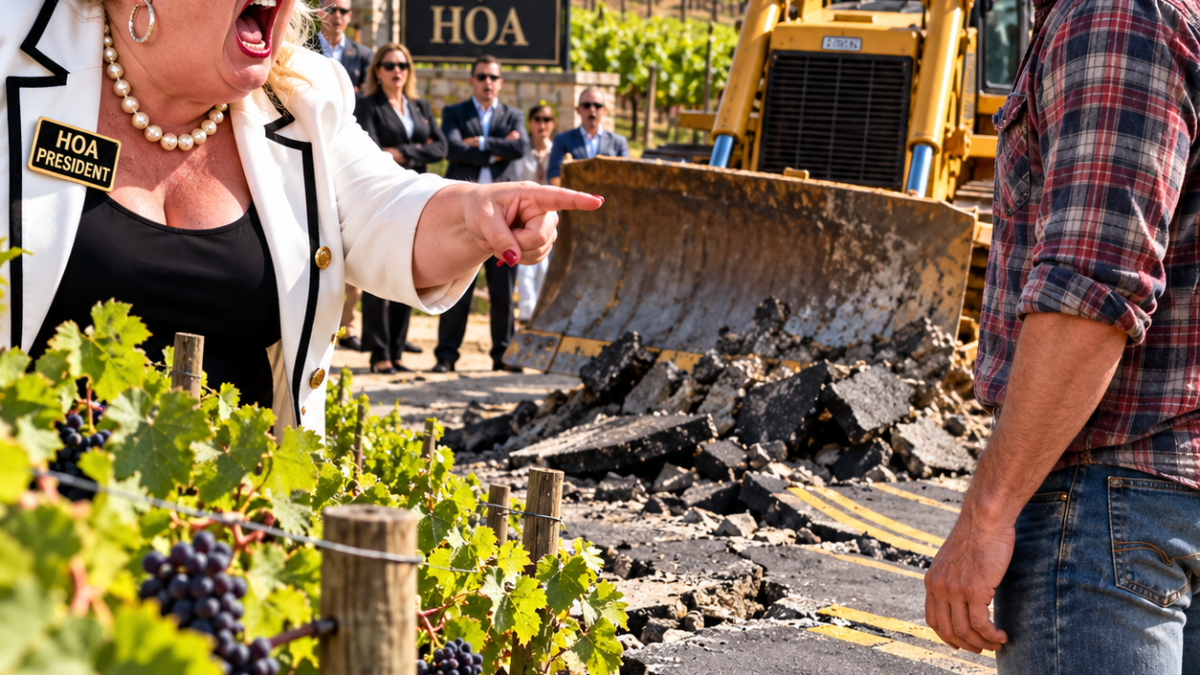
PART 2
Behind me, she shouted that I hadn’t heard the last of her.
She was right about that.
But the next time we stood beside that road, the situation would be very different.
And Karen wouldn’t be the one giving orders.
My grandfather bought the ten-acre property in the 1950s, back when this part of the county was mostly farms, dirt roads, and stretches of open countryside.
He wasn’t wealthy.
He was a veteran with a worn truck, a modest savings account, and an almost unreasonable belief that if a man worked hard enough, he could build something worth leaving behind.
He chose grapes.
Not because they were easy.
Anyone who has worked a vineyard knows there’s nothing easy about growing good wine grapes.
He chose them because they required patience.
You couldn’t rush a vine into producing quality fruit.
You couldn’t bully it.
You couldn’t make it grow faster just because you wanted results.
You prepared the soil, protected the roots, pruned carefully, watched the weather, and trusted that time would eventually reward the effort.
My father loved that lesson.
Growing up, I didn’t appreciate it nearly as much.
I complained about pulling weeds.
I complained about repairing trellises.
I complained about getting up before sunrise during harvest season.
My father would hand me a pair of pruning shears and say, “Someday you’ll understand why this matters.”
I used to think he was talking about work.
Only after he died did I realize he had been talking about belonging.
The vineyard wasn’t simply ten acres of agricultural land.
It was the one place our family had always been able to return to.
I spent twenty-two years serving as a combat engineer in the United States Army.
I built roads, cleared obstacles, supervised heavy equipment operations, and learned the unpleasant consequences of treating terrain as an afterthought.
There are few things more satisfying than constructing something useful.
And few things more dangerous than building in the wrong place.
When I retired, I returned to the vineyard.
My father was getting older, and the work was becoming harder for him.
We had a modest but respected small-batch wine operation. Nothing glamorous. No enormous tasting room or destination wedding venue.
Just excellent Zinfandel, loyal customers, and a reputation my family had earned one harvest at a time.
I had plans.
New trellises.
Better irrigation.
A renovated storage building.
Eventually, perhaps, a small tasting room that would allow visitors to see the property without turning it into a tourist attraction.
My father liked most of those ideas.
He especially liked the part where I would do the heavy lifting.
Then Oak Haven Estates arrived.
Five years earlier, a developer had purchased a large tract adjoining our land and begun building an upscale subdivision.
The first houses went up along the western boundary.
Then the roads.
Then the ornamental trees and decorative entrance signs.
Within a few years, identical beige houses wrapped around two sides of my vineyard.
I didn’t object to people wanting homes.
I didn’t object to landscaping standards or neighborhood rules.
I simply expected those rules to stop at the property line.
Karen Prescott disagreed.
The first letter arrived shortly after she became HOA president.
It complained about the height of the grass along my fence.
The second objected to the compost pile near my equipment shed.
The third claimed my tractor’s early-morning noise interfered with residents’ enjoyment of their property.
Every letter carried the same implication.
She believed her HOA had authority over my land.
Every response from me included the same information.
My property was independently owned.
It predated the subdivision.
I had never joined Oak Haven Estates.
I had never signed its covenants.
And its board had no authority to impose its landscaping regulations on my vineyard.
I sent copies of the deed.
Copies of the county parcel map.
Sometimes I even highlighted the boundary lines.
Karen never acknowledged being wrong.
She simply found something new to complain about.
Once, she appeared at my gate and demanded that I remove an old tractor parked beside the equipment shed.
“It’s visible from the neighborhood,” she said.
“It’s visible from my driveway too,” I replied.
“That isn’t the point.”
“Then what is?”
“It detracts from the appearance of Oak Haven.”
I looked at the tractor.
Then at the neat rows of vines stretching behind it.
“Karen, this is a working farm.”
“That doesn’t excuse everything.”
“No,” I said. “But it does explain the tractor.”
She left furious.
I thought that would be the worst of it.
I was wrong.
Because Karen wasn’t satisfied with controlling the neighborhood she already governed.
She wanted to control what the neighborhood could see.
And my vineyard, with its weathered fences, irrigation equipment, uneven slopes, and old agricultural buildings, didn’t match her carefully manicured vision.
I was an obstacle.
She just needed an opportunity to remove it.
That opportunity came when my father got sick.
His pancreatic cancer diagnosis arrived with the kind of terrible certainty that leaves very little room for denial.
He lived three states away by then, close to the specialists who were treating him.
At first, he insisted he didn’t need help.
Then he began losing weight.
Then he struggled to make it from his bedroom to the kitchen.
Eventually, the doctors stopped talking about treatment and started talking about comfort.
I packed a bag, hired a local caretaker named Leo to check the property, and drove to be with him.
I told Leo to maintain the grounds, keep the irrigation functioning, and contact me if anything serious happened.
But nobody had prepared either of us for a neighborhood association willing to treat a man’s absence as an invitation to seize his land.
For six months, my world shrank to hospital rooms, medication schedules, doctor appointments, and the quiet sounds of a house where someone was slowly dying.
My father still asked about the vineyard.
Even when he couldn’t eat much.
Even when pain medication made conversation difficult.
“How are the old Zinfandel vines doing?” he’d ask.
“Still stubborn,” I’d tell him.
He’d smile.
“Good. They take after your grandfather.”
Sometimes we talked about the coming harvest.
Sometimes he asked whether I’d repaired the irrigation pump.
Once, near the end, he made me promise something.
“Don’t let anybody turn that place into another subdivision.”
I laughed softly.
“Dad, nobody’s building houses in our vineyard.”
He studied my face.
“I’m serious, Jack.”
“I know.”
“That place belongs to the family. Don’t let somebody convince you it’s worth more as something else.”
I took his hand.
“I won’t.”
He nodded.
Then he closed his eyes.
My father died on a quiet Tuesday morning.
I buried him two days later.
After the funeral, I drove twelve hours home.
I was exhausted, numb, and desperate to stand somewhere that still felt like him.
I wanted to walk the rows we had worked together.
I wanted to touch the rough trunks of the oldest vines.
I wanted to sit beside my grandfather’s memorial stone and try to remember what life had felt like before cancer entered our family.
Instead, I found Karen’s road.
And when I walked through the property that first evening, the damage looked even worse than it had during our confrontation.
The contractors hadn’t merely laid asphalt over the grass.
They had excavated the vineyard.
Torn out root systems.
Graded the slope.
Crushed the soil beneath heavy equipment.
Destroyed irrigation connections and removed nearly two hundred productive vines.
Some of those vines had been producing grapes for decades.
They couldn’t simply be replaced by driving to a garden center and buying a few plants.
Even with genetically related heritage stock, the maturity, character, and production history of those original vines were gone.
The preliminary loss was already over $100,000.
That was before counting the restoration work and future production losses.
Then I found something that nearly brought me to my knees.
Near the eastern edge of the road, half-buried in a pile of discarded gravel, was a broken piece of gray granite.
I recognized the engraved letters immediately.
THORNE.
My grandfather’s memorial stone.
The contractors had dug it out, damaged one corner, and tossed it aside like construction waste.
I knelt in the dirt.
For several minutes, I couldn’t move.
I had spent months preparing myself to lose my father.
I hadn’t prepared myself to come home and discover that someone had treated everything he loved as disposable.
I carried the broken stone to my equipment shed.
Then I went inside the house, sat at my father’s old oak desk, and opened the drawer containing our property records.
The first document I pulled out was the original survey from 1954.
The second was the updated survey I’d commissioned after retiring.
Both showed the same boundary.
Both showed the vineyard as privately owned agricultural property.
And neither contained an easement granting Oak Haven Estates access through my land.
I spread the documents across the desk.
Then I opened my laptop.
If Karen believed a board resolution could override seventy years of recorded property ownership, I wanted to know exactly where that belief came from.
And if she’d deliberately taken advantage of my father’s illness to push this project through, I wanted proof.
By dawn, my desk was covered in documents.
HOA bylaws.
County maps.
Board meeting minutes.
Developer filings.
Property records.
And one especially interesting item.
Board Resolution 2023-17B.
The resolution Karen had claimed gave her the right to pave through my vineyard.
I read it three times.
It authorized funding for a community access project.
It described the proposed road as a safety improvement.
It allowed the board to hire a contractor.
But nowhere did it demonstrate that the association actually possessed the land or a legal right to cross it.
It was a document approving construction.
Not a document authorizing the taking of private property.
There was a difference.
A very expensive difference.
And Karen was about to learn just how expensive.
The first formal letter took me most of the following afternoon to write.
Not because I didn’t know what to say.
Because every time I looked at the photographs of the destroyed vineyard, I wanted to write something I couldn’t afford to say in court.
I kept deleting words.
Criminal.
Thief.
Arrogant.
Cruel.
Those words might have been accurate descriptions of how I felt, but feelings weren’t going to restore two hundred grapevines.
Evidence might.
So I wrote the letter the way I’d prepare an engineering incident report.
Specific.
Documented.
Impossible to misunderstand.
I identified my parcel number, attached my deed and boundary surveys, listed the damage, and demanded immediate removal of the road.
I included photographs of severed irrigation lines, the destroyed vines, the broken memorial stone, and the point where the asphalt crossed my recorded property boundary.
I also included a preliminary estimate of the losses.
Six figures.
And that was before an independent agricultural expert assessed the long-term damage.
I offered the board ten business days to respond with a restoration plan.
If they refused, I would pursue legal action.
I sent the letter by certified mail to the HOA’s official address.
Then I mailed copies to every board member individually.
Karen Prescott.
Gerald Whitmore, treasurer.
Brenda Collins, secretary.
And the two remaining directors.
I wanted every person who had voted for that road to know what they had authorized.
More importantly, I wanted proof they’d been notified.
For ten days, nothing happened.
No contractor arrived.
No apology came.
Nobody offered to discuss compensation.
The road remained exactly where it was, gleaming in the sunshine as though it had always belonged there.
A few Oak Haven residents even began using it.
I watched a man jog halfway down the pavement, turn around at the oak tree, and head back toward the subdivision.
One afternoon, two children rode their bicycles across it.
I didn’t blame them.
They’d probably been told the path belonged to their neighborhood.
The fact that people were already using my land made the situation more urgent, not less.
I couldn’t safely begin restoring the vineyard while the association was encouraging public access through it.
On the eleventh morning, I found an envelope taped to my front door.
At first, I thought it might finally be a response to my demand.
Instead, it was a violation notice.
OAK HAVEN ESTATES HOMEOWNERS ASSOCIATION
NOTICE OF NONCOMPLIANCE
FINE: $250
The offense?
Failure to maintain landscaping consistent with community appearance standards.
I read the explanation.
Then I read it again.
The notice specifically referenced the damaged area of my vineyard adjacent to the new walking path.
The same damaged area their contractors had created.
I stood on my porch holding the paper, feeling an almost unbelievable mixture of rage and disbelief.
They had destroyed my vines.
Paved over my property.
Ignored my demand for restoration.
And now they were fining me because the damage they caused was ugly.
I started laughing.
Not because it was funny.
Because the alternative was to put my fist through the nearest wall.
I photographed the notice, scanned it, and added it to the folder.
Then I went online and checked the date of the next HOA board meeting.
Thursday.
Seven o’clock.
Oak Haven Community Clubhouse.
For the first time since returning home, I was looking forward to a confrontation.
The clubhouse was exactly what I expected.
Cream-colored walls.
Folding chairs.
A table covered in bottled water.
A framed list of community rules hanging beside a photograph of the subdivision entrance.
At the front sat Karen and her board.
Karen occupied the center chair, directly behind a small wooden gavel.
She looked up when I entered.
Her expression immediately soured.
I took a seat in the back.
About fifteen residents attended.
Most seemed interested in ordinary neighborhood business: maintenance fees, seasonal decorations, irrigation schedules, and parking restrictions.
I waited through all of it.
Karen discussed acceptable holiday lighting for nearly twenty minutes.
She lectured a homeowner about leaving a trash can visible from the street.
Then she congratulated the board on its successful community improvement initiative.
The new access road.
My access road.
I watched as several residents nodded politely.
Gerald, the treasurer, kept staring at the papers in front of him.
Brenda smiled every time Karen spoke.
Nobody mentioned the vineyard.
Finally, Karen opened the floor for homeowner comments.
I stood.
“Jack Thorne. I own the ten-acre vineyard adjoining Chestnut Lane.”
Every head turned.
Karen gripped her pen.
“Mr. Thorne, this meeting is for HOA members.”
“I understand. I’m not a member.”
“Then your concerns should be submitted through the appropriate channels.”
“I’ve already submitted them. Certified mail. To every board member. Ten business days ago.”
Gerald looked up.
Karen’s face tightened.
“This matter is being reviewed by counsel.”
“Good,” I replied. “Then you should have no trouble answering a simple question.”
She said nothing.
I held up my deed.
“What legal authority did this association rely on when it approved construction of a road through my property?”
A woman in the second row turned toward her husband.
Someone whispered, “His property?”
Karen leaned toward the microphone.
“The board acted based on developer documentation and the association’s responsibility to provide safe community access.”
“Did you purchase the land?”
“No.”
“Did I sign an easement?”
“Mr. Thorne—”
“Did you obtain a recorded right-of-way from the county?”
“The situation is more complicated than that.”
“No, Karen. It isn’t.”
Her cheeks reddened.
“You do not have the floor to interrogate this board.”
I raised the survey.
“This is a county-recorded property boundary. Your road crosses it for approximately two hundred yards. I have never sold you that land, never given you permission to use it, and never joined your association.”
Karen gave a small, contemptuous smile.
“We believe a public right-of-way exists.”
“Where is it recorded?”
“That information is with our attorney.”
“Then give me the recording number.”
Silence.
The kind that makes even the people in the back of a room stop shifting in their chairs.
Gerald began straightening a stack of papers.
I waited.
Karen finally spoke.
“We’re not going to conduct legal discovery at a homeowners’ meeting.”
“Fair enough. Then explain the $250 fine you issued me.”
I held it up.
Several residents leaned forward.
“This notice claims my vineyard is in violation because of damaged landscaping.”
Karen lifted her chin.
“Property standards exist for a reason.”
“The landscaping is damaged because your contractors bulldozed it to build your road.”
A murmur swept through the room.
I continued.
“You destroyed nearly two hundred producing grapevines, severed irrigation lines, damaged a family memorial, and now you’re trying to fine me for the mess you created.”
A man near the aisle shook his head.
“Seriously?”
Karen struck her gavel.
“Order.”
I lowered the paper.
“Did the board know the road was on private land?”
“Enough, Mr. Thorne.”
“Did you know?”
“You’re becoming disruptive.”
“Then tell everyone why your community road doesn’t actually go anywhere.”
That got their attention.
A woman near the back slowly raised her hand.
Karen looked irritated.
“Yes, Linda?”
Linda spoke hesitantly.
“I was wondering about that too.”
Karen blinked.
“About what?”
“The trail. I walked down there last weekend. It just ends at that big tree. We were told it would connect to the park.”
“That’s phase two,” Karen answered quickly.
Linda frowned.
“But there’s a farm beyond the tree.”
“Future improvements are still being evaluated.”
“I thought the fire department needed that access,” a man said.
Another resident turned.
“I was told it was going to be a jogging trail.”
“Wait,” someone else interrupted. “We paid an assessment for an emergency road.”
For the first time that evening, Karen looked genuinely uncomfortable.
The problem with telling different lies to different people is that eventually those people end up in the same room.
I saw the realization spreading across their faces.
Their president hadn’t simply authorized a new walking path.
She had sold them multiple versions of the same project.
I stepped away from my chair.
“Every homeowner in this association should ask what documents were used to justify this construction. Because if the board built a road on property it had no right to use, the association could face substantial financial liability.”
Gerald cleared his throat.
“Mr. Thorne, perhaps we could arrange a private conversation.”
I looked at him.
“I tried that. You received my letter.”
He swallowed.
Karen slammed her gavel again.
“This discussion is over.”
I wasn’t finished.
“One more thing.”
“No!”
I looked past her at the residents.
“I want to be very clear about something. I don’t want your houses. I don’t want your neighborhood to suffer. I want my land restored.”
Several people nodded.
“But your board is refusing to fix a problem it created. Every additional day this road remains on my property adds to the damage and to the association’s potential costs.”
Karen stood.
“You will leave this meeting immediately.”
I folded the survey.
“Gladly.”
Then I looked at each board member.
“You’ve all been formally notified. Nobody here can claim they didn’t know.”
I walked toward the door.
Behind me, the room erupted.
“Karen, where’s the easement?”
“How much did this road cost?”
“Why wasn’t this explained before we voted?”
“Are we going to have to pay for this?”
Karen shouted for order.
The gavel struck repeatedly.
I opened the clubhouse door and stepped into the cool night air.
For the first time since coming home, I felt the smallest flicker of hope.
Because Karen had made a mistake.
She thought her authority came from convincing four board members to support whatever she wanted.
But the people sitting in that clubhouse weren’t her employees.
They were homeowners.
And they’d just learned that her decisions might cost them far more than a few extra dollars in association dues.
The next morning, I called the one person I trusted to understand both the technical and legal sides of what had happened.
Marcus Cole.
Marcus and I had served together in the Army Corps of Engineers.
He’d been one of the most disciplined officers I’d ever known.
When a plan went wrong, he never wasted time shouting about whose fault it was.
He identified the failure, documented the damage, and corrected the problem.
After leaving the service, he’d gone to law school on the GI Bill.
Now he ran a successful practice specializing in land-use disputes, property rights, and litigation involving local governments and homeowners associations.
He answered on the third ring.
“Jack Thorne. I thought you were dead.”
“Not yet.”
“Then either you’re calling to buy me dinner or you’ve built something that’s about to collapse.”
“Neither.”
“That’s disappointing.”
“Somebody built a road through my vineyard.”
Silence.
Then Marcus said, “Say that again.”
“The HOA next door paved a ten-foot-wide road through my land while I was taking care of Dad.”
“How far?”
“About two hundred yards.”
“Recorded easement?”
“No.”
“Permission?”
“No.”
“Survey?”
“Two of them. Both show the property is mine.”
“And they know this?”
“I’ve told them in writing for years.”
Marcus let out a long breath.
“Jack, please tell me you haven’t done anything stupid.”
“Define stupid.”
“Have you touched the road?”
“No.”
“Threatened anybody?”
“No.”
“Good. Keep it that way.”
I leaned against the kitchen counter.
“They destroyed nearly two hundred vines, Mark. Including heritage stock.”
His voice changed.
He’d met my father.
He knew what that place meant to us.
“Send me everything,” he said. “Every deed, survey, photograph, letter, email, and notice. I want the names of the contractor and every board member.”
“Already organized.”
“Of course it is. You always did like paperwork more than healthy people.”
He paused.
“And Jack?”
“Yeah?”
“I’m sorry about your dad.”
For a moment, I couldn’t speak.
“Thanks.”
“Your father was a good man.”
I looked through the kitchen window toward the damaged vineyard.
“I know.”
Marcus let the silence sit between us.
Then he said, “We’re going to handle this properly. We protect the evidence, establish the boundaries, get the court involved if necessary, and make them restore what they damaged.”
“How expensive could this get?”
“For them?”
“Yes.”
“Very.”
That was the first time I’d heard anything resembling confidence since returning home.
I needed it.
Because I wasn’t just fighting over land.
I was fighting the feeling that I’d failed the last person who had ever depended on me the way my father had.
Marcus arranged a meeting with a local surveying company, but there were a few things I needed to investigate before the surveyor arrived.
I began talking to my neighbors.
Not to accuse them.
To find out what Karen had told them.
Linda was the first person I visited.
She lived in a modest two-story house a few streets from the clubhouse.
When she opened the door and saw me, she looked nervous.
“Mr. Thorne?”
“Jack is fine.”
She glanced toward the street.
“I don’t want any trouble with Karen.”
“Neither do I,” I said. “I just want to know what the board told residents about the road.”
Linda hesitated.
Then she invited me inside.
Her kitchen table was covered in school papers and unopened mail.
She poured two cups of coffee.
“They told us it was necessary,” she began.
“Necessary for what?”
“Emergency access. Karen said the fire department had concerns about reaching the undeveloped land behind your property.”
I shook my head.
“There’s a county fire road a quarter mile north of my vineyard.”
Linda looked surprised.
“And the land behind mine belongs to the Miller family. It’s privately owned farmland. There isn’t a public access route there.”
She stared into her coffee.
“She said the road would eventually connect to a county park.”
“Did she show you an approved plan?”
“No.”
“An easement?”
“No.”
“A letter from the fire department?”
Linda frowned.
“No. She just said the board had handled the approvals.”
I took out my survey and showed her the route.
Her expression changed when she saw the road ending inside my boundary.
“She never told us it crossed your property like that.”
“Did she tell you the association had purchased the land?”
“No.”
“Did she tell you I’d consented?”
Linda looked embarrassed.
“She made it sound like everything had already been arranged with you.”
I felt my jaw tighten.
“That’s what I thought.”
Linda stood and walked toward a drawer.
“There’s something else.”
She retrieved a folded newsletter.
“The board sent this around before the special assessment vote.”
I opened it.
There, beneath a cheerful heading about community safety, was a photograph of the proposed access route.
The newsletter described an essential improvement that would enhance emergency response, pedestrian mobility, and neighborhood property values.
It mentioned none of the legal questions.
None of the destroyed vines.
And certainly nothing about my refusal to grant access.
“How much was the assessment?” I asked.
Linda gave me the amount.
I wrote it down.
Then I looked at the newsletter again.
“Who built the road?”
“Prescott Construction Services, I think.”
The name sounded familiar.
“Any connection to Karen?”
Linda looked uncomfortable.
“Her sister’s husband owns it.”
I slowly lowered the newsletter.
“Her brother-in-law?”
She nodded.
“Everybody knows that.”
“Was there a competitive bidding process?”
“I assumed there was.”
That word kept appearing.
Assumed.
Residents assumed the permits existed.
They assumed the board had legal authority.
They assumed the road was necessary.
They assumed the contractor had been selected properly.
Karen had built her project on other people’s assumptions.
I thanked Linda and went to the next house.
Then the next.
By late afternoon, I’d spoken to nearly a dozen residents.
The story changed slightly every time.
One couple had been promised a nature trail that would raise home values.
A retired schoolteacher believed the fire department had demanded the project.
A younger homeowner thought it was the first phase of a bicycle route.
One man had been told the county planned to acquire neighboring land for a public park.
Nobody had seen a final approved plan.
Nobody had seen a recorded easement.
And several residents had complained about the extra money they’d been required to pay.
By the time I got home, I had a notebook full of statements.
I called Marcus.
“You’re going to love this.”
“That depends.”
“Karen used her brother-in-law’s company.”
There was a pause.
“Was the relationship disclosed in the board’s records?”
“I haven’t found any disclosure.”
“Interesting.”
“She also told half the neighborhood the fire department ordered the road and the other half it was a park trail.”
“Did either agency actually approve it?”
“Not that I’ve found.”
Marcus made a quiet sound.
“Keep gathering documents. Don’t make accusations you can’t prove yet.”
“I’m working on it.”
“And Jack?”
“Yeah?”
“Get that new survey done before you argue with her again.”
Henderson arrived the following morning in a dusty white truck loaded with surveying equipment.
He was a gray-haired man who looked as though he’d spent his entire adult life outdoors.
He shook my hand, glanced across the vineyard, and removed his sunglasses.
“Good Lord.”
“That’s pretty much what I said.”
He walked to the edge of the road.
Then he looked at the old oak tree.
“Your father used to bring me a bottle of wine every Christmas.”
I nodded.
“He did that for a lot of people.”
“Best Zinfandel in the county.”
Henderson crouched near the asphalt.
“Whoever did this made one hell of a mess.”
“That’s why you’re here.”
He unfolded the maps I’d provided.
Then he compared them with the county control points and the measurements on his equipment.
He didn’t rush.
He didn’t guess.
He worked methodically, moving between the recorded boundary markers and the new road.
I followed at a distance.
After almost an hour, he stopped near the cul-de-sac and pointed at a spot about five feet beyond the curb.
“This is where your property begins.”
“You’re certain?”
He looked offended.
“Jack, I don’t put stakes in the ground because I have a feeling.”
He drove a marker into the soil beside the asphalt.
Then another.
And another.
Bright pink flags began appearing along the road.
Some stood beside the pavement.
Others were positioned directly in its path.
By the time Henderson finished, the flags made the situation impossible to ignore.
The road didn’t merely clip the corner of my land.
It ran deep into it.
Nearly its entire length lay beyond Oak Haven’s boundary.
Henderson stood beside me and studied the results.
“There is no ambiguity here.”
“Could the developer’s preliminary map override this?”
“No.”
“What about a board resolution?”
He laughed.
“Son, I could vote tomorrow that your tractor belongs to me. Doesn’t make it mine.”
That was the first genuine laugh I’d managed since the funeral.
Henderson’s expression turned serious again.
“I knew your grandfather. I knew your father. Those men worked too hard for this place to have somebody come along and pretend their title disappeared.”
I looked at the markers.
For weeks, Karen had been speaking as though her authority was unquestionable.
Now I had something she couldn’t argue away with a speech.
A professionally documented boundary survey.
No opinions.
No competing interpretations.
Just coordinates, recorded ownership, and a road located where it had no legal right to exist.
Henderson finished his report and drove away.
Less than an hour later, Karen arrived.
Her car came around the cul-de-sac so quickly that I heard the tires before I saw her.
She slammed the door and marched toward the pink flags.
I was sitting on my porch with a cup of coffee.
“What is this?” she shouted.
I stood.
“Morning, Karen.”
She pointed at the markers.
“Who authorized those?”
“A licensed surveyor.”
“You are deliberately defacing community property.”
“No. I’m documenting my own.”
She walked toward the nearest flag.
“These stakes are ridiculous. The developer’s map clearly shows the access corridor.”
“Then you should have no problem explaining why the official county survey shows something different.”
Karen pulled out her phone.
“I’m calling our attorney.”
“That’s a good idea.”
She narrowed her eyes.
“You think this is funny?”
“No. I think you’ve been relying on people being too intimidated to question you.”
Her face darkened.
“Those markers do not change the board’s authority.”
“They don’t need to. Your board never had authority here.”
She stepped closer.
“You are attempting to undermine an important community project.”
I took my phone from my pocket.
“There’s someone I’d like you to speak with.”
Before she could respond, I called Marcus and put him on speaker.
He answered immediately.
“Jack?”
“Mark, I’ve got Karen Prescott here. She’s questioning the survey.”
“Good morning, Ms. Prescott.”
Karen stiffened.
“Who is this?”
“Marcus Cole. I’m Mr. Thorne’s attorney.”
She shifted her weight.
“Our legal counsel has already reviewed this matter.”
“Then I encourage your counsel to contact my office. I’m looking at the certified survey now. Your association has constructed a substantial improvement on property owned by my client without any recorded right to do so.”
Karen opened her mouth.
Marcus continued.
“The previous demand for removal and restoration has expired without a meaningful response. Unless the matter is resolved immediately, we’ll seek judicial relief and damages.”
“This was approved by our board.”
“Your board cannot authorize construction on land it doesn’t own, Ms. Prescott.”
“The developer—”
“If the developer has a recorded easement, your attorney can provide it.”
Silence.
“We’ll be filing suit,” Marcus continued. “I strongly recommend that you preserve every document relating to the project, including emails, contracts, invoices, and communications between board members.”
Karen’s eyes flicked toward me.
“And I suggest you avoid interfering with the survey markers,” Marcus added.
For several seconds, she didn’t speak.
Then she said, “This is harassment.”
“No, ma’am. This is a property dispute that your association can still resolve by complying with the law.”
The call ended.
Karen stood motionless beside the nearest pink flag.
I took a sip of coffee.
“Anything else?”
She looked at the road.
Then at the flags.
Then back at me.
Her voice was lower now.
“You have no idea how much trouble you’re causing.”
I shook my head.
“Karen, I know exactly how much trouble this is causing.”
I pointed toward the ruined vines.
“You’re the one who hasn’t counted the cost yet.”
She turned and walked back to her car.
No final threat.
No triumphant speech.
Just the sharp sound of her door closing before she drove away.
I watched until her car disappeared.
Then I looked down at the pink flags.
For the first time, the boundary wasn’t something hidden in a filing cabinet.
It was visible.
Physical.
Undeniable.
And it was about to become the foundation of the case that would destroy Karen’s carefully manufactured authority.
Marcus filed the lawsuit the following week.
Seventy pages.
By the time I’d finished reading it, I understood why he’d always been so difficult to beat at anything involving strategy.
He hadn’t simply asked the court to order Oak Haven to remove its road.
He had reconstructed the entire history of the dispute.
The original ownership records.
The development of Oak Haven Estates.
My repeated written objections to HOA interference.
The unauthorized excavation.
The destruction of the vineyard.
The ignored demand for restoration.
The ridiculous $250 fine.
And the certified survey establishing that the road was on my property.
The complaint named the Oak Haven Estates HOA.
It also named Karen, Gerald, Brenda, and the two other directors individually, based on their alleged involvement in authorizing and maintaining the encroachment.
Marcus was careful to explain that personal liability wasn’t automatic.
We still had to prove the facts and establish the legal grounds.
But he intended to find out exactly what each director knew and when they knew it.
Our claims included trespass, property damage, private nuisance, interference with title, and allegations that the board had acted together to deprive me of my property rights.
We sought removal of the encroachment, restoration costs, lost agricultural income, attorney’s fees where recoverable, and additional damages supported by the evidence.
The total potential exposure was substantial.
When Marcus sent me the final draft, he called.
“Read page forty-three again.”
I opened the document.
It contained the allegations concerning the board’s knowledge of my objections.
“What am I looking for?”
“The distinction between making a mistake and knowingly continuing one.”
I read the section carefully.
Then I understood.
“If they were warned about the boundary and built anyway…”
“That makes their good-faith defense much harder.”
“And if they knew I was away?”
“Then I want to know why they believed your absence made it appropriate to proceed.”
I stared at the paragraph.
My father’s illness had already taken six months of my life.
Now it seemed Karen might have viewed those six months as a construction schedule.
Marcus spoke again.
“Jack, I want you to understand something.”
“I’m listening.”
“We have a strong case, but litigation is not an instant solution. They’ll delay. They’ll deny. They’ll try to make this expensive.”
“How long?”
“I can’t promise a timeline.”
“What do you need me to do?”
“Stay disciplined. No confrontations. No threats. No equipment near that asphalt until we have clear legal authority.”
I glanced through the window.
The road was visible from my kitchen.
Every morning, it reminded me that someone had taken something from my family.
“Understood.”
“And don’t let her bait you.”
I gave a humorless laugh.
“That’s asking a lot.”
“I know. But every time she talks, she seems to make our case better. Let her keep doing that.”
He was right.
I just didn’t realize how spectacularly right until we began receiving the HOA’s legal responses.
The first response accused me of acting in bad faith.
Karen’s attorney described the road as a legitimate community improvement constructed with a reasonable belief that a future access easement existed.
He questioned whether my damages were exaggerated.
He suggested my vineyard was poorly maintained.
He characterized my lawsuit as an attempt to force a small neighborhood association into an excessive financial settlement.
I read the filing at my desk.
Then I called Marcus.
“They’re saying I caused this?”
“They’re saying a lot of things.”
“They actually describe the road as a benefit to my property.”
“I saw that.”
“How is destroying two hundred vines a benefit?”
“It isn’t. But they don’t have a deed or recorded easement to rely on, so they’re trying to change the subject.”
The association also resisted our requests for documents.
Marcus had demanded the original development records, internal emails, meeting notes, proposed access plans, communications with local agencies, bids, invoices, and payment records for the paving project.
The response was a thin packet.
A few incomplete board minutes.
One construction bid.
A letter from their attorney stating that other documents were either unavailable, privileged, or irrelevant.
I spread the contents across my desk.
“That’s everything?”
“That’s what they’ve produced so far,” Marcus said.
“Where are the competing bids?”
“Good question.”
“Where are the planning approvals?”
“Another good question.”
“Where are the emails?”
“Exactly.”
He paused.
“I’m filing a motion to compel production.”
I stared at the construction invoice.
Prescott Construction Services.
The amount was much higher than I’d expected for a relatively short strip of pavement.
“Mark, can they really claim they lost all those records?”
“They can claim it. Whether the judge believes them is another matter.”
“Do you think they’re hiding something?”
“I think they’re working remarkably hard to avoid showing us documents that should be routine.”
A few days later, we received Karen’s sworn affidavit.
That document changed everything.
It was an extraordinary piece of writing.
According to Karen, I was an aggressive, unreasonable property owner who had disrupted the peace of Oak Haven Estates.
My vineyard was supposedly an ongoing nuisance.
The agricultural equipment was dangerous.
The vegetation posed a fire risk.
And the association had acted responsibly to protect its residents.
She even claimed that I had personally intimidated her.
I remembered her standing beside the road, threatening me with arrest.
Apparently, our memories of that conversation were very different.
But the most important part of her affidavit wasn’t the personal attack.
It was the map she’d attached.
A grainy photocopy of an old developer drawing.
It showed the original proposed layout of Oak Haven Estates.
A dotted line crossed my property.
Beside the line were three words.
POTENTIAL FUTURE ACCESS.
I stared at them.
I knew that map.
I’d seen it before.
Years earlier, my father and I had attended a county planning commission meeting where the developer presented preliminary subdivision plans.
The developer wanted a future access route across our vineyard.
My father objected immediately.
He stood in that meeting room, holding the original deed, and explained that no public access rights existed through our property.
I remembered how angry he’d been afterward.
Not because someone had proposed the route.
Because the developer had drawn it on a map without first speaking to the people who owned the land.
We went back for the next hearing.
And the next.
Eventually, the planning commission approved Oak Haven Estates with a specific condition.
The proposed access through our property was prohibited.
The final approved plan excluded it.
I remembered my father tapping the relevant paragraph with his finger.
“Keep this,” he told me. “Somebody will pretend they don’t remember.”
At the time, I’d laughed.
Now I understood why he’d been so insistent.
I went straight to the filing cabinet.
The documents were exactly where he’d left them.
Original hearing correspondence.
The final approval.
And the planning commission resolution specifically denying access through the Thorne property.
I placed the preliminary sketch beside the final resolution.
One said potential future access.
The other said that access was not approved.
Karen had submitted the first while ignoring the second.
I called Marcus.
“You’re going to want to see this.”
“Send it.”
I scanned everything.
Ten minutes later, my phone rang.
“Jack,” Marcus said, “where did you get the final commission resolution?”
“My father kept it.”
“Certified?”
“I can obtain a certified copy from the county.”
“Do that immediately.”
“You recognize the problem?”
“Oh, I recognize the problem.”
He sounded almost delighted.
“Her affidavit relies on a preliminary proposal that was expressly rejected in the final approval.”
“Exactly.”
“Was the resolution publicly available?”
“Yes.”
“Was the developer notified?”
“Yes.”
“Do we have any indication Karen knew about it?”
“Not yet.”
“Then that’s what we need to establish.”
I looked at my father’s handwriting on the folder.
The familiar block letters.
The date.
The words he’d written across the top.
NO ACCESS GRANTED.
I ran my thumb over the ink.
“Dad,” I whispered, “you were right.”
The next court hearing was the first time I saw Karen outside the environment she controlled.
There was no clubhouse.
No gavel.
No friendly board members sitting beside her.
Just a courtroom, a judge, two attorneys, and the evidence.
Karen sat behind her lawyer wearing a dark blazer.
Her hair was carefully styled.
Her posture was rigid.
She glanced at me as I entered, then quickly looked away.
Marcus placed our exhibits on the table.
When the hearing began, the HOA’s attorney argued that our discovery requests were overly broad and that the association had already produced the relevant documents.
Marcus didn’t raise his voice.
He simply explained that we had received one contractor bid, incomplete meeting minutes, and no meaningful record of the approval process.
Then he presented Karen’s affidavit.
The preliminary development sketch.
And the final county resolution.
The judge examined both documents.
“Counsel,” she asked the HOA’s attorney, “is this the map your client relied upon?”
“Yes, Your Honor. It illustrates the proposed access alignment.”
“Proposed?”
“Yes.”
The judge looked at the final resolution.
“And this document expressly prohibits the access route?”
The attorney shifted.
“There appears to be some disagreement about the interpretation of the planning history.”
Marcus stood.
“Your Honor, the resolution states that no access shall be established through the adjoining Thorne parcel. The language is explicit.”
The judge read the relevant provision again.
I watched her face.
Her eyes narrowed.
She turned toward the HOA’s attorney.
“Was this final resolution reviewed before the road was constructed?”
“I cannot answer that definitively at this time.”
“Then your client should be able to produce the documents that establish what was reviewed.”
The attorney began to object.
The judge held up a hand.
“I am not interested in litigating this through incomplete records and unsupported assertions.”
The room went quiet.
She ordered the association to produce the responsive documents, including emails, meeting materials, contractor records, and communications about the road.
She gave them forty-eight hours to comply with the order.
Then she addressed Karen’s affidavit.
“Counsel, I suggest you review your client’s representations carefully against the public record.”
The attorney nodded.
“Yes, Your Honor.”
“If any sworn statement requires correction, I expect that issue to be addressed appropriately.”
I glanced toward Karen.
Her expression had changed.
She wasn’t smiling.
She wasn’t rolling her eyes.
She wasn’t whispering angrily to Brenda.
She was staring at the table.
For the first time, she looked like a woman beginning to understand that being president of a homeowners association did not make her immune to scrutiny.
Outside the courthouse, Marcus adjusted his jacket.
“Well,” he said, “that went well.”
I looked at him.
“She could have prevented all of this.”
“Yes.”
“All she had to do was admit she didn’t own my land.”
“Yes.”
“Instead she chose to fight.”
Marcus gave me a serious look.
“People who build their authority on never admitting they’re wrong often keep doubling down until the consequences become impossible to escape.”
I thought about my father.
About the maps he’d carefully preserved.
About Karen dismissing his memorial stone as debris.
“Do you think she’ll finally settle?”
“Maybe.”
“That’s not a very confident answer.”
Marcus smiled faintly.
“Let’s see what she hands over in forty-eight hours.”
The records arrived in cardboard boxes.
I had expected documents.
I hadn’t expected an entire weekend of digging through thousands of pages of meeting notes, invoices, emails, and bank records.
But Marcus was prepared.
He had already organized the material into categories.
Planning.
Ownership.
Construction.
Approvals.
Payments.
Communications.
I took leave from everything else and went to his office.
Linda had introduced me to a retired accountant named Arthur Benson, who had spent years questioning Oak Haven’s financial reporting.
Arthur was a quiet man in his seventies with silver hair, wire-rimmed glasses, and an almost supernatural ability to notice discrepancies in financial statements.
He came in carrying a notebook, a calculator, and a folder of HOA budget summaries he’d collected over the years.
“I’ve never liked the way they report expenses,” he told Marcus.
“Why?”
“Every annual report contains nice round numbers. Landscaping. Maintenance. Improvements. Administration. Very few detailed breakdowns.”
Marcus nodded.
“We’ll focus on the road project first.”
Arthur smiled.
“That’s where I intended to start.”
For several hours, we worked almost silently.
Paper rustled.
Computers hummed.
Occasionally, Arthur made a note.
Then, sometime after lunch, I found the first email.
It was from Gerald, the HOA treasurer, to Karen.
The subject line read:
ACCESS CORRIDOR—LEGAL CONCERNS
Gerald had written that the association did not possess a confirmed easement through the Thorne property.
He recommended obtaining a new survey before authorizing construction.
He also questioned whether the preliminary developer sketch was sufficient to establish legal access.
I read it twice.
Then I handed it to Marcus.
His expression sharpened.
“Interesting.”
A few pages later, we found Gerald’s follow-up.
He had once again urged Karen to consult an independent real estate attorney.
He warned that constructing the road without title confirmation could expose the association to significant liability.
Then came Karen’s reply.
It was short.
Dismissive.
And devastating.
Gerald, stop being such a worrywart. The developer’s map is good enough. Thorne isn’t even here. It’s better to ask for forgiveness than permission. Just get it done before he gets back.
I stopped reading.
For a moment, the words blurred.
Thorne isn’t even here.
I could almost hear her voice saying them.
She hadn’t simply ignored the ownership problem.
She’d recognized my absence as an opportunity.
While I was sitting beside my father’s hospital bed, she had been discussing how quickly to pave over his vineyard before I returned.
I read the email again.
Then a third time.
My throat tightened.
Marcus watched me.
“Jack?”
I set the paper down carefully.
“She knew.”
He nodded.
“Yes.”
“She knew the land wasn’t hers.”
“We now have strong evidence that she was warned about it.”
“She knew I was gone.”
Marcus said nothing.
I looked at him.
“Do you understand what that means?”
“I do.”
“My father was dying. I was holding his hand while she was trying to figure out how fast a contractor could get a bulldozer onto our property.”
I stood and walked toward the window.
For several seconds, I couldn’t trust myself to speak.
I’d been angry when I first found the road.
I’d been furious when Karen threatened me.
But this was different.
This felt personal in a way no property dispute should ever feel.
She had turned the worst six months of my life into a tactical advantage.
Marcus approached quietly.
“Jack, this email is important. Very important. But I need you to stay focused.”
I nodded.
He placed the document inside a separate folder.
“We’re going to preserve it. And we’re going to find out whether anybody else objected.”
There were more emails.
Brenda encouraged Karen to complete the project before the next round of neighborhood inspections.
She referred to the vineyard as an embarrassment.
Another message discussed how the improved corridor would make the eastern side of the development look more appealing.
Someone suggested that once the road was finished and residents began using it, removing it would become politically difficult.
That sentence stopped me.
They hadn’t just wanted to build a road.
They had wanted to create a situation in which the road’s existence could be used as an argument for keeping it.
Build first.
Establish public use.
Then tell the owner the project was too important to reverse.
It was a calculated attempt to turn an unauthorized intrusion into a permanent feature.
Arthur, meanwhile, was following the money.
And what he found was even worse.
“Marcus,” he said quietly, “you need to look at this.”
He placed two invoices beside a bank statement.
The paving contract had been awarded to Prescott Construction Services.
There was no evidence of competing bids.
No independent price comparison.
No meaningful documentation explaining how the contractor had been selected.
Arthur had assembled pricing information for comparable work.
“The association paid nearly double what I’d expect for a job of this size,” he said.
Marcus studied the documents.
“Could site conditions account for the difference?”
“Some variation, certainly. But not this much without a convincing explanation.”
Then Arthur pointed at a separate line item.
PROJECT CONSULTING SERVICES—$20,000
I frowned.
“Consulting for what?”
“That’s what I want to know,” Arthur replied.
The payment went to a company I’d never heard of.
Cedar Ridge Advisory LLC.
Arthur had checked the state’s corporate registry.
The company was registered under Karen’s maiden name.
For several seconds, nobody spoke.
Then Marcus leaned forward.
“Are you certain?”
Arthur slid the registration document across the table.
“See for yourself.”
I looked down.
Karen’s legal name.
Her company.
Her payment.
Twenty thousand dollars of HOA money transferred to an entity associated with the same woman who had pushed the project through.
A project she knew involved land the association didn’t own.
I felt an ugly satisfaction rise inside me.
But Marcus was already thinking beyond it.
“We need to establish exactly what services were provided, how the payment was authorized, and what representations were made.”
Arthur nodded.
“Agreed.”
“Could this be fraud?” I asked.
Marcus looked at the documents.
“It raises serious questions. There may be civil and criminal implications, including issues involving electronic communications and financial transactions. But we document first and let the evidence establish what happened.”
Arthur sat back.
“She’s been spending the neighborhood’s money as though it belongs to her.”
I looked at the photograph of the destroyed vineyard on Marcus’s desk.
Then at the $20,000 consulting invoice.
The road had always been ugly.
Now I understood that the ugliness wasn’t confined to the asphalt.
Behind it was a chain of decisions made by people who had been warned, knew the risks, and continued anyway.
And at the center of it was Karen Prescott.
The woman who’d looked me in the eye and claimed that community progress mattered more than my family’s history.
She had used her neighbors’ money to build a road through my vineyard.
And the records now raised the possibility that she’d personally benefited from the project.
When Marcus finished reviewing the documents, he closed the folder.
“I think we have enough to make them a very serious offer.”
“What kind of offer?”
“The kind that gives them one final opportunity to resolve the civil dispute before the litigation becomes much more expensive.”
I stared at him.
“What about Karen?”
Marcus met my eyes.
“Her financial records and sworn statements raise issues that won’t disappear simply because the road gets removed.”
For the first time, I saw what the next phase would look like.
We were no longer trying to convince Karen to be reasonable.
We were showing everyone else exactly what her decisions had cost them.
And there would be no gavel big enough to silence that evidence.
Marcus prepared the settlement offer over the next several days.
By then, Karen’s position had deteriorated badly.
The survey proved the road crossed my land.
The final county planning documents established that the proposed access route had never been approved.
Her own emails showed she knew I was absent and had been warned about the missing easement.
And the financial records raised serious questions about how the contractor had been selected and why a company linked to Karen had received twenty thousand dollars.
Still, I didn’t want revenge for the sake of revenge.
I wanted something specific.
My land back.
The vineyard restored.
The losses paid.
And the people responsible removed from positions where they could do the same thing to someone else.
Marcus’s settlement demanded that the association fund complete removal of the road under my supervision.
The restoration would include soil rehabilitation, irrigation replacement, and replanting with appropriate heritage Zinfandel stock.
It demanded reimbursement for my legal expenses and documented property losses.
It also called for an additional $200,000 settlement payment.
I had already decided what I would do with that money.
My father had spent years helping veterans in the county.
He wasn’t a wealthy man, but he believed that people who’d served their country deserved support when they came home.
I wanted to establish a fund in our family name to help local veterans with housing, employment, and emergency expenses.
Finally, we demanded the resignations of Karen, Gerald, and Brenda.
The remaining board members would have to cooperate with an independent review of the association’s finances and governance.
Marcus sent the offer through the HOA’s attorney.
He gave them five business days to respond.
The next morning, his phone rang.
The HOA attorney wanted a meeting.
Immediately.
The conference room was on the fourth floor of a downtown law office.
Large windows overlooked the city.
A long mahogany table divided the room.
On one side sat Marcus and me.
On the other sat Karen, Gerald, Brenda, and their attorney.
I hadn’t seen Karen looking so tired before.
Her hair was still immaculate.
Her clothes were expensive.
But the certainty that had once radiated from her seemed to have evaporated.
She avoided looking at me.
Gerald stared at his hands.
Brenda kept adjusting the papers in front of her.
Their attorney began.
“My clients understand the seriousness of the situation and wish to resolve the matter without further litigation.”
Marcus nodded.
“We’re prepared to discuss execution of the proposed agreement.”
The attorney cleared his throat.
“The association accepts responsibility for arranging restoration of the affected property.”
I felt my pulse quicken.
“Additionally, the association is prepared to resolve the financial claims consistent with the proposed settlement.”
Marcus made a note.
“Good.”
The attorney hesitated.
“However, there is a concern regarding the resignation provisions.”
I saw Karen straighten.
Here it came.
She finally looked at me.
“Mr. Thorne, you’ve made your point.”
I said nothing.
“The road was an unfortunate misunderstanding.”
I stared at her.
An unfortunate misunderstanding.
Nearly two hundred vines.
A destroyed memorial.
An unauthorized road.
Months of threats.
Lawsuit expenses.
And emails discussing how to finish construction before I returned from caring for my dying father.
“Is that what you’re calling it?” I asked.
Karen lifted her chin.
“The project was approved in good faith.”
Marcus opened a folder.
“Ms. Prescott, your own email stated that the developer’s map was sufficient despite the treasurer’s concerns and that the work should be completed before my client returned.”
Her face flushed.
“That email was taken out of context.”
“Then explain the context,” Marcus said.
She opened her mouth.
Nothing came out.
I leaned forward.
“Karen, did you know my father was dying?”
Her eyes flickered.
“I knew you were dealing with a family situation.”
“That’s not what I asked.”
Her attorney shifted uncomfortably.
“Mr. Thorne—”
I held up a hand.
“One question. Did she know?”
Karen looked down.
“I had heard that your father was ill.”
I nodded slowly.
“And you wanted the road finished before I came back.”
She didn’t answer.
“While I was sitting beside him in hospice, you were pushing a construction project through my vineyard.”
Karen’s voice sharpened.
“You make it sound malicious.”
“Your email made it sound malicious.”
Gerald closed his eyes.
Brenda stared at the table.
Karen turned toward Marcus.
“I won’t agree to resign. I’ve dedicated years to this association.”
Marcus remained perfectly composed.
“The resignation provision stays.”
“That’s a personal attack.”
“No,” he said. “It’s part of resolving a dispute involving serious misconduct by association leadership.”
Karen folded her arms.
“I refuse.”
For a few seconds, nobody spoke.
Then Marcus removed another document from his folder.
He placed it on the table.
It summarized the financial irregularities, the undisclosed contractor relationship, the consulting payment, and the emails concerning the property rights issue.
“Ms. Prescott, there are problems here that extend beyond the civil trespass claim.”
Karen glanced at the paper.
Her face changed.
Marcus continued.
“We have preserved the underlying records. Any potential criminal conduct is a matter for the appropriate authorities. A civil settlement cannot guarantee that those issues disappear.”
Her attorney leaned forward and examined the document.
I watched his expression.
He looked at the first page.
Then the second.
His mouth tightened.
“Could we have a moment with our clients?”
Marcus closed his folder.
“Certainly.”
We stepped into the hallway.
For several minutes, we heard nothing from inside.
Then the conference room door opened.
The attorney looked exhausted.
“My clients are prepared to accept the resignation provisions.”
We returned to the table.
Karen’s hands were trembling.
Gerald signed first.
Brenda signed next.
Then the papers moved toward Karen.
She stared at the signature line for a long time.
I wondered whether she was thinking about the $20,000 payment.
Or the road.
Or the years she’d spent intimidating people who had been too uncomfortable to challenge her.
Finally, she looked at me.
“Are you happy?”
It was such a strange question that I almost laughed.
I thought about the vineyard.
The ruined soil.
The missing rows.
My father lying in his hospice bed and asking whether the old vines were still doing well.
“No,” I said.
Karen looked surprised.
“I’m not happy, Karen. My father is dead. The vineyard he loved is damaged. My grandfather’s stone is broken. Nothing you sign today changes those things.”
Her expression hardened.
“Then what more do you want?”
I held her gaze.
“I want you to understand that you never had the right to take them from me.”
She looked away.
Then she picked up the pen.
And signed.
Just like that, Karen Prescott’s reign over Oak Haven Estates ended.
But there was still one problem.
The road remained on my land.
And I was the man who intended to remove it.
The settlement gave me authority to select and supervise the contractor responsible for the road removal and agricultural restoration.
The necessary funds were placed in escrow.
The association’s new interim leadership would oversee its obligations.
The legal right to remove the road was now clear.
For the first time since returning home, I could look at that strip of asphalt without wondering whether touching it would lead to another lawsuit.
I had spent twenty-two years as a combat engineer.
I’d operated heavy equipment in difficult terrain.
I’d built roads under dangerous conditions.
And I’d taken apart structures that had to be removed safely and efficiently.
I knew exactly how to approach this one.
I called a heavy equipment rental company.
“I need a Caterpillar D6.”
The man on the phone asked, “What kind of job?”
“Road removal.”
“How much road?”
“Ten feet wide. Roughly two hundred yards.”
He whistled.
“That’s a decent amount of pavement.”
“I know.”
“What happened to it?”
I looked through my window.
“Somebody built it in the wrong place.”
I arranged for delivery.
Then I contacted an old military friend who now operated a trucking company.
I explained the job.
He laughed.
“Jack, you’re telling me an HOA actually built a road through your vineyard?”
“That’s exactly what I’m telling you.”
“And now you’re taking it out?”
“Every inch.”
He paused.
“How many trucks do you need?”
We worked out the hauling schedule.
I hired the additional equipment and operators necessary to load and remove the broken asphalt, and I arranged for proper disposal.
I also obtained the required county authorization for agricultural land restoration.
The documentation was reviewed.
The work area was marked.
The public was to be kept away from the active equipment.
I wasn’t going to give Karen the satisfaction of finding a new violation.
Everything would be authorized.
Everything would be documented.
And every piece of that road would leave my property.
The evening before the work began, I walked the pavement one last time.
The sun was setting behind the western hills.
Long shadows fell across the black surface.
I stopped where the oldest row of Zinfandel had once stood.
My father used to work that row himself.
Even in his later years, when his knees were bad and he complained about his back, he insisted on doing the final pruning there.
“Those are your grandfather’s vines,” he’d say.
“Let me take care of them.”
I crouched near the edge of the asphalt and pressed my palm against it.
Cold.
Hard.
Lifeless.
I remembered Karen standing here in her floral dress, smiling and calling the vineyard an eyesore.
I remembered the $250 fine.
The board meeting.
The pink survey flags.
Her email.
Thorne isn’t even here.
I stood slowly.
“Tomorrow,” I whispered.
Then I walked back to the house.
The bulldozer arrived early the next morning.
The enormous yellow machine rolled into the neighborhood on a lowboy trailer.
It was impossible to miss.
A few curtains moved as the truck approached.
Then a front door opened.
Then another.
By the time the trailer stopped near my property, several Oak Haven residents were standing outside watching.
The driver climbed down.
“Jack Thorne?”
“That’s me.”
He looked toward the road.
“That’s what we’re taking out?”
“All of it.”
He studied the smooth asphalt.
“Looks pretty new.”
“It is.”
“Why remove it?”
I smiled faintly.
“Because it shouldn’t be here.”
The crew prepared the equipment.
The trucks took their positions.
We established the work zone and checked the survey markers one final time.
I walked to the edge of the cul-de-sac.
The road began just beyond the official boundary of Oak Haven’s property.
That was where the removal would begin.
Behind me, a small crowd had gathered at a safe distance.
I recognized Linda.
Arthur stood beside her.
Several homeowners who had attended the disastrous board meeting were there too.
Nobody shouted.
Nobody protested.
They just watched.
I climbed into the bulldozer.
The seat felt familiar.
The controls felt familiar.
The weight and vibration of heavy machinery brought back memories of years spent working in places far less peaceful than this neighborhood.
I started the engine.
A deep mechanical roar rolled across the vineyard.
The machine shuddered.
I checked the work area.
Then I positioned the blade.
The first section of asphalt resisted.
The compacted pavement had been designed to hold.
I adjusted my approach.
Steel met pavement.
The edge cracked.
Then buckled.
A jagged piece of blacktop lifted from the ground.
And beneath it, for the first time in months, dark soil appeared.
I stopped for a second.
Just long enough to look at it.
Then I continued.
The machine pushed forward.
Asphalt fractured.
Broken sections folded and shifted.
A loader moved the debris toward the waiting trucks.
The first truck filled.
Then the second.
Every load represented another piece of Karen’s unauthorized road leaving my property.
The work was loud.
Dust rose.
Engines rumbled.
Metal tracks clattered.
But to me, it was the most beautiful sound I’d heard since coming home.
For months, I’d been waking up to the knowledge that someone had taken part of my family’s land and dared me to do something about it.
Now I was doing something.
Legally.
Deliberately.
Permanently.
With each section we removed, more of the original vineyard corridor became visible.
The ground wasn’t healthy yet.
Far from it.
Heavy machinery had compacted the soil.
Some topsoil was missing.
The irrigation system still needed replacement.
The old vines were gone.
But the road was coming apart.
And for the first time, I could see the possibility of restoring what had stood there before it.
About an hour into the job, I noticed movement near the cul-de-sac.
A dark sedan stopped abruptly.
The driver’s door opened.
Karen Prescott climbed out.
Even from a distance, I recognized the way she walked when she was furious.
She marched toward the crowd.
A few residents moved aside.
Then she saw me in the bulldozer.
Her mouth fell open.
For a moment, she simply stared.
Then she started shouting.
“What are you doing?”
I couldn’t hear her clearly over the engine.
She came closer to the established safety boundary.
“STOP THAT MACHINE!”
I signaled that I was stopping and brought the bulldozer to an idle.
The crew paused.
Karen stood with her hands clenched.
“You can’t do this!”
I looked down at her.
“Good morning, Karen.”
Her face flushed.
“That is community property!”
Several people behind her exchanged looks.
I almost felt sorry for her.
Almost.
“Karen,” I said, “we’ve already settled this.”
“You can’t just destroy a road!”
“Actually, the signed agreement specifically authorizes its removal.”
“That road cost the community thousands of dollars!”
“And your association paid for it without owning the land underneath it.”
She pointed at the broken asphalt.
“You’re vandalizing an important improvement!”
I looked toward Arthur.
He shook his head slowly.
Linda crossed her arms.
A man in the crowd muttered, “Unbelievable.”
Karen heard him.
She whirled around.
“Do you have something to say?”
The man didn’t back down.
“Yeah. Why are you still acting like you own this place?”
Her mouth opened.
“Excuse me?”
“You resigned. We all know what happened.”
Karen turned back toward me.
“You’ve poisoned these people against me.”
I stared at her.
“No, Karen. Your own decisions did that.”
She raised her phone.
“I’m calling the police.”
I nodded.
“You’re welcome to call them.”
Her hand froze.
“The county authorization is on file. The settlement is signed. The boundary survey is recorded. The contractor documentation is available.”
I gestured toward the road.
“This is my property. I’m restoring it.”
Karen looked around.
Perhaps she expected someone to defend her.
Perhaps she expected the crowd to panic at the threat of police involvement.
Perhaps she still believed that if she sounded authoritative enough, people would automatically obey.
But nobody moved.
Nobody offered to stop the work.
Nobody called me a vandal.
Instead, Arthur stepped forward.
“Karen,” he said calmly, “the new board has reviewed the agreement. The restoration is authorized.”
She glared at him.
“You have no idea what you’re doing.”
Arthur removed his glasses.
“I’ve reviewed the financial records. I have a very good idea what happened.”
The words hit harder than a shouted accusation.
Karen went silent.
I looked at her one last time.
“You told me that progress doesn’t wait for sentiment.”
Her face tightened.
“You remember saying that?”
She said nothing.
“You called my grandfather’s vineyard an eyesore. You threatened to have me arrested for objecting to a road you had no right to build.”
Her gaze dropped.
“Now the documents are signed, the boundaries are established, and the work is authorized.”
I pointed toward the exposed soil.
“That’s what progress looks like on my property.”
Karen’s eyes filled with furious tears.
“You think you’ve won.”
I shook my head.
“This isn’t a game.”
She stood motionless.
Then, in a voice barely above a whisper, she said, “You ruined everything.”
I thought about my father.
About the hospital.
About the email Karen had sent while I was away.
And suddenly I knew exactly what I needed to say.
“No, Karen. You ruined your own position when you decided that somebody else’s rights didn’t matter.”
For a moment, her face looked strangely empty.
There was no applause.
No dramatic speech from the crowd.
Nobody rushed forward to celebrate.
Karen simply turned around.
Walked back to her car.
Got in.
And drove away.
That was the last time I saw her standing on my property.
I watched the car disappear around the corner.
Then I restarted the bulldozer.
The engine roared back to life.
And the road continued coming apart.
By late afternoon, almost all of the asphalt had been removed.
The final truck waited beside the old oak tree.
I worked carefully along the last section, making sure we stayed within the approved work area.
The remaining pavement cracked and lifted.
The loader collected the debris.
And then there was nothing left to remove.
I shut down the machine.
The sudden quiet seemed almost unnatural.
For several seconds, I sat in the operator’s seat looking at the earth.
Rough.
Scarred.
Uneven.
But no longer covered by asphalt.
I climbed down.
My back ached.
My clothes were covered in dust.
My hands smelled like diesel and machinery.
And for the first time since my father’s funeral, I felt something close to relief.
Not because the vineyard was restored.
It wasn’t.
Not because the legal battle had erased everything that happened.
It hadn’t.
But the road was gone.
Every single inch of it.
I walked from the cul-de-sac to the oak tree, following the exposed corridor where the asphalt had stood.
At the far end, I stopped.
The place looked wounded.
But it looked like land again.
Land that could absorb rain.
Land that could be cultivated.
Land where roots might someday grow.
I removed my gloves.
Then I knelt and picked up a handful of loose soil.
It fell between my fingers.
I thought about my grandfather planting the first vines.
About my father showing me how to work the rows.
About every harvest we’d shared.
And I realized I’d been afraid of something I hadn’t admitted even to Marcus.
I’d been afraid that returning home would mean accepting that the place I’d known was gone forever.
My father was gone.
The old vines were gone.
His memorial had been damaged.
I’d spent so many months losing things that the thought of one more permanent loss had nearly broken me.
But the soil in my hands told me something different.
Some things couldn’t be brought back.
Others could be rebuilt.
I heard footsteps.
When I looked up, Linda and Arthur were approaching.
Linda carried a covered casserole dish.
Arthur held a bottle of bourbon.
I stood and brushed dirt from my knees.
“What’s all this?”
Linda smiled.
“We figured you probably weren’t going to cook dinner after driving that thing all day.”
Arthur raised the bottle.
“And I figured dinner might require something stronger than iced tea.”
I laughed.
A real laugh.
For the first time in what felt like forever.
Linda glanced across the exposed ground.
“It’s strange seeing it gone.”
“Good strange or bad strange?” I asked.
“Good,” she said. “Definitely good.”
Arthur looked toward the cul-de-sac.
“People have been talking.”
“I imagine they have.”
“Not about you,” he said. “About what happened. About how we let someone convince us that following rules meant we weren’t allowed to ask questions.”
I didn’t know what to say.
Linda stepped closer.
“We owe you an apology.”
“You didn’t build that road.”
“No,” she said. “But we benefited from keeping quiet while Karen did whatever she wanted.”
I shook my head.
“You didn’t know the whole story.”
“Maybe not. But some of us suspected things weren’t right.”
Arthur nodded.
“From now on, we’re going to do better.”
I looked from him to Linda.
Then toward the houses beyond my fence.
For years, I’d seen Oak Haven Estates as an unwelcome intrusion.
Rows of identical houses pressing against the property my family had owned for generations.
But now, standing beside those neighbors, I realized something.
A neighborhood association wasn’t the same thing as a neighborhood.
Karen had spent years convincing people to fear one another.
She’d treated authority as something to wield rather than a responsibility to uphold.
And many of the residents had been afraid to challenge her.
But the people in front of me weren’t my enemies.
They were ordinary people who’d been misled.
And when the truth became clear, they’d helped expose it.
Linda held out the casserole.
“Here. Before it gets cold.”
I accepted it.
Arthur lifted the bourbon.
“To getting your land back.”
I looked across the vineyard.
“To keeping it.”
We stood there together as the last truck pulled away.
Behind us, the sun descended toward the hills.
The road Karen had built was gone.
The boundary was still there.
And for the first time, the houses beyond it didn’t feel quite so hostile.
Karen’s house went on the market the following week.
Within a month, she and her husband had moved out of Oak Haven Estates.
There was no farewell gathering.
No public tribute to her years as president.
No plaque.
No ceremonial speech.
One morning, a moving truck arrived.
By evening, the house was empty.
I didn’t go over to watch.
I had enough work of my own.
The new HOA board began reviewing its finances and procedures.
Arthur agreed to serve as interim treasurer.
Linda became involved in the association’s reform efforts.
They required more detailed financial reporting.
Major projects would receive independent review.
Contracts involving directors’ relatives would be subject to conflict-of-interest rules.
And no future construction project would proceed without confirmed land rights and appropriate approvals.
Arthur called me one afternoon.
“We found another problem.”
My stomach tightened.
“Another road?”
He chuckled.
“No. Nothing like that. But we’ve been reviewing the maintenance contracts.”
I closed my eyes.
“Arthur…”
“Don’t worry. We’re handling it.”
I laughed.
“Good. Because I only rented one bulldozer.”
He laughed too.
It was a small moment.
But it mattered.
The neighborhood had changed.
People who had once avoided asking questions were now demanding answers.
Residents attended meetings.
They reviewed budgets.
They challenged proposals.
And the new leadership actually welcomed that scrutiny.
The association hadn’t disappeared.
It had simply started behaving like an organization accountable to the people it represented.
Meanwhile, restoring the vineyard became my full-time job.
Removing the asphalt had been the dramatic part.
Repairing the damage was slower.
Much slower.
We brought in a soil specialist to evaluate the compacted ground.
The original topsoil had been disturbed.
Some areas needed amendments.
Others required careful rehabilitation before planting could begin.
We repaired the irrigation system.
Rebuilt the affected trellises.
Improved drainage.
And prepared the corridor for new vines.
A viticulturist helped locate heritage Zinfandel clones genetically matched to the old family stock.
They wouldn’t be the same mature vines.
Nothing could replace seventy years of growth.
But they represented continuity.
A chance to preserve what was distinctive about the vineyard.
One Saturday morning, I was working near the old oak tree when I heard several vehicles approaching.
At first, my stomach tightened.
For one irrational second, I expected another construction crew.
Then I saw Linda step out of her car holding a shovel.
Arthur followed with a wheelbarrow.
Behind them came half a dozen neighbors.
One carried gardening tools.
Another brought bags of compost.
Someone had packed sandwiches and bottled water.
I stared.
“What is this?”
Linda smiled.
“Volunteer labor.”
“For what?”
She gestured toward the bare ground.
“Your vineyard.”
Arthur set his wheelbarrow down.
“We figured you could use some help.”
I looked at the group.
Most of them lived in houses I’d spent years resenting.
And now they were standing on my land, offering to help rebuild something their former president had destroyed.
“You don’t have to do this,” I said.
Linda shrugged.
“We know.”
That answer nearly undid me.
Not an explanation.
Not an obligation.
Just a choice.
We worked through the morning.
We turned soil.
Spread amendments.
Prepared planting rows.
Repaired supports.
Children carried small tools while their parents worked.
People laughed.
Someone put music on.
At lunchtime, we sat beneath the old oak tree and ate sandwiches.
I told them about my grandfather.
About the first vines.
About how my father used to insist that a vineyard should be judged by the quality of its harvest, not the perfection of its appearance.
Arthur laughed.
“Karen would’ve hated that philosophy.”
“Karen hated most philosophies that didn’t involve Karen,” Linda replied.
Everyone laughed.
And something inside me loosened.
For months, I’d carried anger like a weight.
I’d convinced myself that if I ever stopped being angry, I’d be letting my father down.
But sitting there with those neighbors, looking at people willing to spend their Saturday helping rebuild a vineyard they had no personal stake in, I began to understand that protecting his legacy didn’t require remaining furious forever.
It required making sure something worthwhile continued to grow.
Marcus handled the remaining legal matters.
The settlement funds covered the agreed restoration expenses, damages, and legal costs.
The additional financial recovery allowed me to establish the Thorne Family Veterans Fund through a local veterans’ organization.
Its purpose was simple.
Help veterans facing housing emergencies.
Support employment transitions.
Assist families dealing with unexpected hardship.
The first time I saw my father’s name on the fund’s paperwork, I sat at his old desk for nearly an hour.
I imagined what he’d say.
He probably would have complained that I’d made too much fuss.
Then he would have asked whether the paperwork had been filed correctly.
And finally, he’d have asked whether the money was actually helping anyone.
That was my father.
He had very little patience for ceremony.
But endless patience for people who needed help.
The local newspaper published a small story about the vineyard restoration and the new veterans fund.
The reporter focused on the neighborhood coming together after a property dispute.
It didn’t capture the entire ugliness of what happened.
Maybe that was just as well.
I didn’t need to become famous for fighting an HOA president.
I needed to get back to growing grapes.
For several months, life became pleasantly ordinary.
Morning inspections.
Irrigation repairs.
Soil testing.
Planting schedules.
Equipment maintenance.
I began sleeping through the night again.
I could walk past the former road corridor without feeling my stomach tighten.
And whenever I saw the young vines, I found myself imagining a future harvest instead of remembering the sound of asphalt cracking.
Then one afternoon, a thick envelope arrived.
The return address belonged to the United States Attorney’s Office.
I carried it inside.
Set it on my father’s desk.
And opened it.
The letter concerned the investigation into the financial misconduct associated with the Oak Haven road project.
The evidence uncovered during our civil litigation had ultimately reached federal authorities.
The investigation had examined the undisclosed financial arrangements, the consulting payment, and the electronic transactions connected to the construction contract.
Karen Prescott had pleaded guilty to one count of wire fraud.
I read the sentence again.
Then continued.
As part of the resolution, she had cooperated and made restitution to the association.
The restitution was funded in significant part through the sale of her home.
She avoided prison.
Instead, she received three years of probation, a substantial fine, and five hundred hours of community service.
The terms of her case also included a prohibition on serving on corporate or nonprofit boards.
I sat down.
For a long time, I stared at the letter.
I’d imagined receiving news like this.
I’d imagined feeling triumphant.
I’d imagined finally experiencing the satisfaction of knowing that Karen couldn’t simply walk away from everything she’d done.
But the feeling that came wasn’t triumph.
It was a quiet finality.
The woman who had once threatened to have me arrested for touching my own land had now been held accountable for financial wrongdoing connected to the road she ordered built.
Her title was gone.
Her authority was gone.
Her attempt to turn my family vineyard into a neighborhood amenity had failed.
And the system she’d believed she could manipulate had eventually caught up with her.
I folded the letter.
Placed it back in the envelope.
Then carried it outside.
The young vines stood in neat rows where the road had once been.
Their leaves moved gently in the breeze.
I walked to the small granite marker near the first row.
We’d repaired its damaged corner as carefully as possible.
It was still the same memorial stone.
It still carried my grandfather’s name.
And I’d placed it where visitors could see it without disturbing the vines.
I knelt beside it.
For several seconds, I said nothing.
Then I rested my hand against the granite.
“Dad,” I whispered, “I kept the promise.”
The wind moved through the vineyard.
I looked at the little vines, their new growth reaching toward the light.
I knew they wouldn’t be ready to produce the kind of wine my father had loved for several years.
I knew some of them might fail.
There would be bad weather.
Unexpected repairs.
Difficult harvests.
The endless small frustrations that came with working land instead of merely owning it.
But I also knew something else.
They had a chance.
And so did I.
A year after the road came out, the new vines produced their first small clusters of grapes.
Not enough for a meaningful commercial harvest.
Not yet.
But enough to make me stop in the middle of my morning walk and smile.
The grapes were tiny.
Dark.
Still developing.
I crouched beside the row and examined them carefully.
Their leaves were healthy.
The irrigation system was functioning.
The soil was beginning to recover.
A year earlier, I’d stood in almost the same place looking at six inches of asphalt.
Now I was looking at fruit.
I heard a bicycle bell behind me.
Two children were riding around the Oak Haven cul-de-sac.
Their parents stood nearby chatting with neighbors.
Someone waved.
I waved back.
The cul-de-sac ended exactly where it was supposed to end.
At the boundary of the subdivision.
Beyond it began my vineyard.
No road.
No walking path.
No imaginary future access corridor.
Just land that belonged to my family.
Linda walked over to the fence.
“How are the vines?”
I smiled.
“Getting stronger.”
She leaned forward.
“Think you’ll have wine this year?”
“Not from these rows.”
“Next year?”
“Maybe a little longer.”
She laughed.
“Well, when they’re ready, you’d better save us a bottle.”
“I think that can be arranged.”
Arthur appeared behind her.
“Only if it’s better than the stuff they serve at our board meetings.”
I shook my head.
“Arthur, your board meetings serve bottled water.”
“Exactly,” he replied. “Terrible vintage.”
We all laughed.
It struck me then how strange the past year had been.
I’d returned home expecting silence.
I thought retirement meant protecting my property from the world outside it.
I imagined quiet mornings, long afternoons in the vineyard, and evenings spent remembering my father.
Instead, I’d found a road through my family’s history.
I’d faced a woman who treated private property like something she could claim with a committee vote.
I’d spent months buried in surveys, court filings, contracts, and financial records.
I’d watched neighbors discover that the person claiming to protect their interests had been misleading them.
I’d stood in a courtroom and listened while a judge questioned the very documents Karen had relied upon.
And finally, I’d climbed into a bulldozer and torn out the road she insisted would never be removed.
But the most important thing that came out of that fight wasn’t Karen’s resignation.
It wasn’t the settlement.
It wasn’t even the federal conviction.
It was what happened afterward.
The people who helped repair the soil.
The neighbors who showed up with shovels.
The willingness to admit that something had gone wrong and do the difficult work of making it right.
Karen had wanted a road through my vineyard because she believed it would make her community better.
Instead, her road became the thing that exposed how badly she’d damaged that community.
When the asphalt disappeared, something much more valuable took its place.
Trust.
Accountability.
Respect.
And the understanding that boundaries matter, even when crossing them might seem convenient.
That evening, I sat beneath the old oak tree with a small glass of Zinfandel from one of our earlier vintages.
My father’s last successful harvest.
The sun was low.
The vineyard was quiet.
I could see the repaired memorial stone, the new trellises, and the young rows stretching toward the western fence.
I lifted the glass.
“Here’s to you, Dad.”
For a moment, I imagined him standing beside me.
Work boots covered in dirt.
Old hat pulled low.
Hands rough from decades of pruning vines.
He would have looked across the restored corridor and probably said the soil still needed work.
He would have pointed out a crooked trellis.
Complained that I’d planted one row a little too close to the next.
Then he’d have smiled.
Because the vineyard was still here.
His father’s vines were gone, but their descendants were growing.
His family still owned the land.
His name was helping veterans in need.
And the man he’d raised had finally understood what he’d meant all those years ago when he said some things were worth protecting.
I finished my wine and stood.
Before going inside, I walked to the place where Karen’s road had once begun.
There was no asphalt.
No yellow line.
No sign claiming the land belonged to Oak Haven Estates.
Only soil, grapevines, and a weathered fence dividing two properties that had finally learned to coexist.
I remembered the first thing Karen had told me.
Progress doesn’t wait for sentiment.
She’d used those words to justify destroying something she didn’t understand.
But she’d been wrong about what progress meant.
It wasn’t paving over somebody else’s history.
It wasn’t forcing people to accept whatever a self-appointed authority wanted.
And it certainly wasn’t taking advantage of a grieving man’s absence because you thought he wouldn’t be there to stop you.
Real progress was what I saw around me.
A broken vineyard growing again.
A frightened neighborhood finding its voice.
A corrupt leader being held accountable.
And a family promise surviving long after the person who asked for it was gone.
Karen had spent a fortune building a road to nowhere.
I had spent months proving it didn’t belong there.
And in the end, I didn’t need to steal anything from her.
I didn’t need to threaten her.
I didn’t need to become the kind of person she was.
I only needed to stand on the truth, protect what was mine, and refuse to surrender simply because someone with a title told me I should.
The road was gone.
The vineyard was growing.
My father’s legacy was safe.
And Karen Prescott, the woman who once threatened to arrest me for defending my own property, would never again get to decide what happened on my land.
She thought six months away meant I’d abandoned my vineyard.
What she never understood was that I had spent my entire life learning how to defend it.
THE END.