PART 2: We Thought No One Was Alive Under the Collapsed Building—Then a Dog’s Paw Moved Beneath the Concrete
PART 2
Nobody needed to say it aloud.
We all understood the problem immediately.
The child was alive.
The dog was alive.
But the space around them was barely stable.
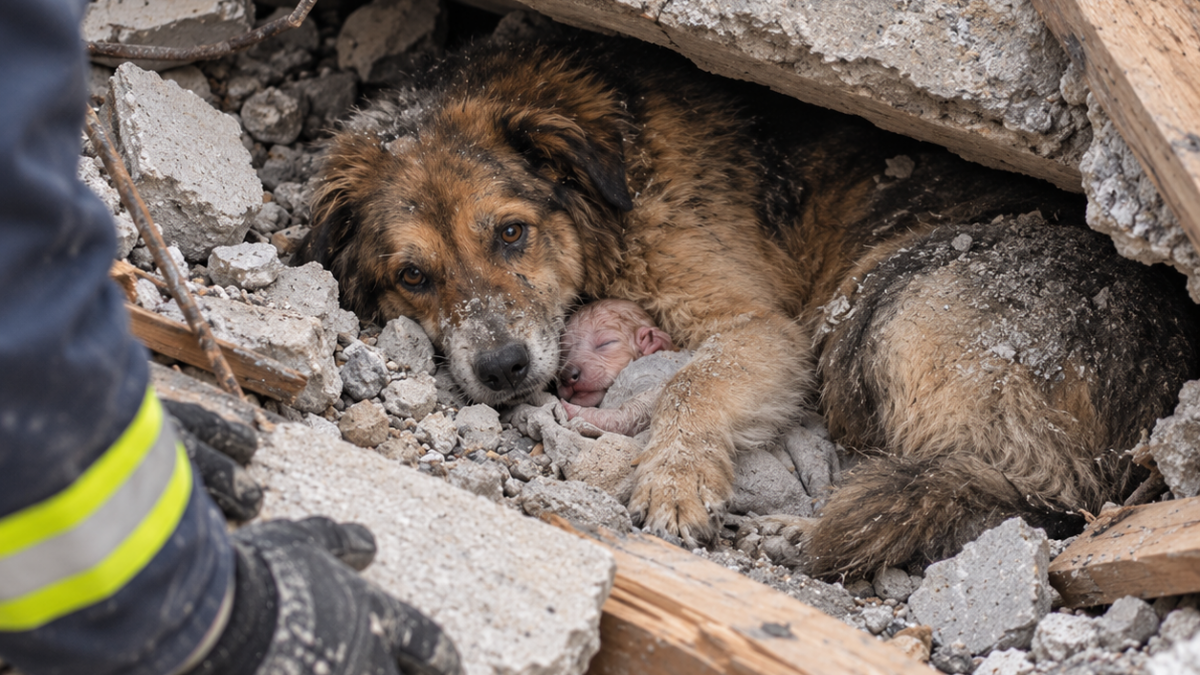
A concrete slab hung above the cavity at an angle, supported partly by broken furniture and one fractured wooden beam.
That same beam was pinning the dog’s hindquarters.
If we pulled the wrong piece away, the entire pocket could close.
Our structural engineer crawled as close as he safely could.
“Nobody touches that beam.”
“Can we lift it?”
“Not yet.”
The medic beside me looked into the opening.
“Can you reach the child?”
“Barely.”
“Airway?”
“Can’t see enough.”
The dog’s body covered most of him.
Or her.
At that moment we didn’t even know.
All I could see was one tiny hand and the edge of a small blue sleeve.
I called softly into the void.
“Hey, little one.”
No answer.
I tried again.
“Can you hear me?”
A sound came back.
So faint I almost thought I’d imagined it.
A little cry.
The entire team reacted.
“Child’s responsive,” I said.
The medic exhaled.
“Good.”
The dog heard the cry too.
His head moved.
He twisted as much as the beam allowed and lowered his muzzle toward the child.
Then he licked something I couldn’t see.
“Jesus,” one of the firefighters whispered behind me.
The dog wasn’t simply lying there.
Even trapped.
Even injured.
He was still checking the baby.
I reached toward him slowly.
“Buddy.”
His cloudy, dust-filled eyes found movement but didn’t seem able to focus properly.
“You’re doing good.”
I held my gloved hand near his nose.
He sniffed.
Then the low warning came again.
Weak.
But clear.
The child was his.
At least in that moment.
His job was to protect him.
“I’m not taking him away to hurt him.”
The dog obviously couldn’t understand the sentence.
But tone matters.
So does patience.
I kept speaking.
“My name’s Daniel. I’m getting both of you out.”
Maybe I was speaking more to myself.
Rescuers shouldn’t make promises we can’t control.
That day I made one anyway.
The dog’s head lowered.
I moved my hand closer.
He flinched.
Stopped.
Sniffed again.
Then something unexpected happened.
He pressed the front of his nose against my glove.
One second.
Then two.
I didn’t move.
“That’s it.”
The medic said quietly, “Try touching his shoulder.”
I did.
The dog’s muscles tightened beneath my hand.
No bite.
No growl.
I stroked once.
Then again.
“You’ve done enough.”
His eyes closed.
His head dropped.
For one terrifying second, I thought we’d lost him.
“Dog?”
I touched his neck.
Heartbeat.
Weak but there.
“Still with us.”
Now we needed access.
The structural crew brought in small supports.
Hydraulic lifting equipment was positioned several feet away so pressure could be controlled.
Every movement took time.
That was the worst part.
Knowing a baby was alive less than six feet from you and still having to move slowly.
People imagine rescues as frantic.
Sometimes they are.
But the most dangerous rescues can feel painfully calm.
Measure.
Brace.
Check.
Move half an inch.
Stop.
Listen.
Check again.
The child cried several times.
Each cry was weaker than the one before.
The medic looked at me.
“We need to move.”
“I know.”
“Cold exposure is becoming a problem.”
“I know.”
The dog was cold too.
I could feel it even through my glove.
His ears were icy.
His fur held moisture.
Dust clung to his nose and eyelids.
His ribs moved shallowly.
“How long can he stay pinned?”
The medic shook his head.
“He’s already stayed pinned too long.”
Not helpful.
But true.
We finally created enough support to remove a smaller piece of furniture beside them.
The void widened.
I pushed my shoulders inside.
Now I could see the child.
A little boy.
Maybe one year old.
Maybe younger.
It was impossible to judge under the dust.
His face was streaked gray.
One side of his forehead had a shallow cut.
He was wearing pajamas.
The dog had curled around him so completely that the boy’s torso was protected between the dog’s chest and the remains of a couch.
Above them, pieces of plaster and small rocks rested on the dog’s back.
His fur had caught the debris that otherwise would have landed on the child.
I swallowed hard.
“Baby’s visible.”
The medic moved beside me.
“Breathing?”
“Yes.”
“Chest moving evenly?”
“Looks shallow.”
“Can you touch his neck?”
I reached.
The dog lifted his head again.
“Easy.”
He watched my hand.
I stopped before touching the child.
“Buddy.”
No growl this time.
I slipped two fingers carefully toward the boy’s neck.
Pulse.
Fast.
“Got a pulse.”
“Good.”
The boy made a tiny sound.
The dog’s nose touched his cheek.
Then the child moved his hand.
His fingers caught in the dog’s fur.
Nobody spoke for a few seconds.
There are scenes you remember visually.
Others stay with you as feelings.
That little hand holding dirty fur became both.
The boy had probably spent almost twelve hours in darkness.
He couldn’t understand collapsed buildings.
He couldn’t understand rescue crews.
He couldn’t understand why the world had suddenly become freezing, loud, and terrifying.
But he’d had one familiar thing.
The dog.
And he was still holding on.
We decided to remove the child first.
That meant somehow getting the dog to release the protective curl he’d maintained for half a day.
Except the dog couldn’t stand.
His hindquarters remained pinned.
I touched his shoulder again.
“We need your kid.”
His ear moved.
The medic whispered, “Can you slide the baby?”
“Maybe.”
There was a narrow opening between the dog’s front legs.
I reached toward the child.
The dog lifted his head.
Again.
Even weaker.
I paused.
“Please.”
I don’t know why that word came out.
But it did.
“Please let me help him.”
The dog looked toward my voice.
His head stayed raised for several seconds.
Then, slowly, he moved one front leg.
Only a few inches.
It was enough.
The medic behind me whispered, “That’s our opening.”
I slid my arms underneath the child.
He whimpered.
The dog became alert again.
“It’s okay.”
I brought the baby’s body slowly toward me.
The little hand refused to release the fur.
His fingers tightened.
For one second, we were stuck.
“Come on, little guy.”
I gently opened his fingers.
The dog licked his hand.
Then the child’s grip released.
I pulled him toward me.
The moment his body emerged from the pocket, the medical team took him.
Blanket.
Oxygen.
Assessment.
Everything happened at once.
The boy cried.
Not loudly.
But enough.
That cry traveled through the entire rescue site.
People outside the barrier heard it.
Someone began cheering.
Then others.
I stayed in the cavity.
Because the dog was still there.
And the moment the child disappeared, something changed in him.
His head dropped.
His body went completely limp.
“Dog’s crashing!”
The cheering outside continued.
Inside the rubble, our second rescue had just become a race.
I pressed my hand against the dog’s neck.
Heartbeat.
Faint.
Too faint.
“Come on.”
His eyes did not open.
The medic who remained beside me checked him as much as the space allowed.
“He’s hypothermic.”
“Anything else?”
“Probably shock. Crush injury. Dehydration.”
“We need the beam off.”
The engineer heard us.
“We’re working.”
“Work faster.”
He looked at me.
I regretted it immediately.
Not because I didn’t mean it.
Because everybody was already doing everything possible.
He said calmly, “If we rush, we bury him and maybe you.”
I nodded.
“Sorry.”
The next minutes felt longer than the previous twelve hours.
We placed another brace.
Then another.
The hydraulic system took weight gradually.
Wood groaned.
Everyone froze.
Dust fell from above.
“Hold!”
Nothing moved.
“Continue.”
The beam lifted a fraction.
I slid my hand beneath the dog’s hip.
Still pinned.
“More.”
Another fraction.
“Check structure.”
Pause.
“Stable.”
“More.”
Finally, enough.
“He’s free.”
I pulled.
Nothing.
The dog was heavier than he looked, and his body had been wedged in place.
Another rescuer crawled beside me.
Together we eased him backward.
His hind legs dragged.
One looked wrong.
Potential fracture.
Maybe worse.
But he was out.
We slid him onto a rescue board.
The medical crew for animals had not yet reached us, so one of our paramedics did what he could.
Blankets.
Warm packs placed carefully.
Oxygen nearby.
“Pulse?”
“Still there.”
I knelt beside him.
“Hey.”
Nothing.
I rubbed the fur between his ears.
“You don’t get to quit now.”
The baby was already being carried toward an ambulance.
I could see the small oxygen mask.
One tiny arm moved beneath a blanket.
His crying had become stronger.
Good.
“Your boy made it.”
The dog’s ear twitched.
I stared.
“Did you see that?”
The medic looked.
“Say it again.”
I leaned down.
“He’s alive.”
The dog’s eyelids moved.
Barely.
The medic smiled despite everything.
“Maybe he’s hearing you.”
“He’s alive,” I repeated. “You did it.”
The dog exhaled.
His body relaxed beneath the blanket.
We carried him out.
People behind the barriers didn’t cheer at first because many didn’t understand what they were seeing.
Then someone shouted.
“It’s the dog!”
A sound rose through the crowd.
Applause.
Crying.
People calling encouragement.
I normally dislike when rescue scenes become spectacles.
That day I understood.
Those people had been standing in the cold for hours watching us carry tragedy out of a collapsed building.
They needed one more living thing.
So did we.
The dog was transferred to a veterinary emergency team.
I wanted to go with him.
I couldn’t.
There were still people missing.
That is one of the cruelest parts of rescue work.
You can share the most intense fifteen minutes of another living creature’s existence and then be forced to turn around and continue digging.
I watched the van leave.
Then my commander touched my shoulder.
“Daniel.”
I knew.
“Yeah.”
“We’ve got another void.”
I stood.
Went back to work.
For hours, I didn’t know whether the dog survived.
I also didn’t know whether the baby survived beyond the ambulance.
There wasn’t time to check.
The building demanded everything.
We found more people.
Some alive.
Some not.
Those are the parts no one makes beautiful stories about.
By midnight, my clothes were stiff with dust.
My hands hurt.
My throat burned.
Every muscle in my body felt like it belonged to somebody else.
We were rotating crews when one of the paramedics approached me.
“The baby from your void?”
My stomach tightened.
“Yeah?”
“Stable.”
I closed my eyes.
“Stable?”
“Hospital says hypothermia, dehydration, some minor injuries. No major crush trauma identified so far.”
I sat down on a broken curb.
“Thank God.”
The paramedic continued.
“His mother was found alive in another section earlier.”
I stared at him.
“What?”
“Different rescue team.”
“Does she know?”
“They told her.”
I felt something release inside my chest.
“Father?”
The paramedic’s expression changed.
“Still missing.”
Hope and grief can exist within the same sentence.
That day taught me that repeatedly.
“And the dog?”
“I don’t know.”
The answer bothered me more than it logically should have.
“Can you find out?”
“I’ll try.”
It was another three hours before I heard anything.
By then, I was sitting inside a temporary command tent drinking coffee that tasted like warm dirt.
A phone was passed to me.
“Veterinary clinic.”
I answered.
“This is Daniel.”
A woman said, “Were you part of the team that brought in the reddish-brown dog?”
“Yes.”
“He’s alive.”
I gripped the phone harder.
“How bad?”
“Bad.”
Of course.
“But alive.”
“Yes.”
“What injuries?”
“Severe hypothermia, dehydration, bruising, multiple lacerations, a fractured hind leg, and significant muscle damage where he was pinned. His bloodwork also suggests prolonged stress and poor perfusion.”
I understood maybe half of the technical details.
“Will he make it?”
“We can’t promise that yet.”
There it was.
The sentence rescuers hate.
No promises.
“Is he awake?”
“Intermittently.”
“Does he have a name?”
“Not yet.”
I thought about the child holding his fur.
“He probably does. We just don’t know it.”
The veterinarian paused.
“We’ll keep him warm and manage his pain. Surgery may be needed for the leg once he’s stable enough.”
“Please call if anything changes.”
“Are you family?”
The question surprised me.
“No.”
“Owner?”
“No.”
“Then—”
“I pulled him out.”
Silence.
Then her voice softened.
“Okay.”
I gave her my number.
“Thank you.”
After the call, my commander looked at me.
“Dog alive?”
“Yeah.”
He nodded.
“Good.”
That was all.
Among rescuers, “good” can carry a lot.
We worked through the night.
By morning, the partial collapse had become national news.
Camera crews arrived.
Reporters gathered behind barriers.
People began asking about the dog and baby.
Someone had taken a photograph of us carrying the dog out.
Another image showed the child’s ambulance.
I avoided the cameras.
My job wasn’t to tell the story.
At least I didn’t think it was.
Then I met the child’s mother.
Her name was Elena.
She had a broken arm, stitches along her temple, and a blanket around her shoulders when hospital staff wheeled her into a family area two days after the collapse.
I had gone there because investigators wanted clarification about where we’d found the child.
A nurse stopped me.
“Are you Daniel?”
“Yes.”
“There’s someone who wants to meet you.”
I assumed another official.
Then Elena looked up.
The moment she saw my uniform, she started crying.
I stopped.
She tried to stand.
A nurse told her not to.
“You’re one of them?”
I nodded.
“I was part of the team.”
“My son?”
“Noah?”
She nodded quickly.
The baby finally had a name.
Noah.
“He was alive when we got him out.”
“I know.”
She covered her mouth.
“I know. They told me.”
I didn’t know what to say.
She reached for my hand.
I gave it to her.
“Thank you.”
I shook my head.
“There were a lot of us.”
“They said you found him.”
“I found the dog.”
Her face changed.
“Bruno.”
So that was his name.
“Bruno?”
“Our dog.”
She cried harder.
“Is he alive?”
I hesitated.
She noticed.
“Oh God.”
“No. He’s alive.”
Her shoulders dropped.
“He’s alive?”
“Last I heard, yes. He’s at an emergency veterinary hospital.”
She closed her eyes.
“Bruno.”
The way she said his name told me everything.
Not pet.
Family.
I sat beside her.
“Was he always protective of Noah?”
She gave a broken laugh.
“From the day we brought Noah home.”
She wiped her face.
“Bruno slept outside his crib.”
I smiled.
“That sounds about right.”
“He followed me everywhere when I was pregnant. After Noah was born, he followed him.”
Her expression changed as memory returned.
“When the building started shaking…”
I waited.
She looked toward the wall.
“I was in the kitchen. My husband was near the bedroom. Noah was in his crib.”
Her breathing became shallow.
“You don’t have to tell me.”
“No. I need to.”
I stayed quiet.
“There was this sound. Not like thunder. Like the whole building cracked open.”
Her hand trembled.
“Bruno ran toward Noah.”
I felt the hairs rise along my arms.
“Not toward the door?”
She shook her head.
“Toward the crib.”
Then the floor collapsed.
Elena remembered falling.
Concrete.
Darkness.
Nothing after that until rescuers reached her.
“What happened to my husband?” she asked.
I didn’t know.
That was the hardest answer.
“They’re still searching.”
She nodded.
Tears returned.
Then she looked at me again.
“Bruno got to Noah.”
“Yes.”
She pressed both hands to her face.
“He got to him.”
I remembered the cavity.
The dog curled over the baby.
The plaster covering his back.
The freezing fur.
“Yes.”
Elena cried for a long time.
I sat beside her.
No speech would have improved the moment.
Eventually, she whispered, “Can I see Bruno?”
“I don’t know if he’s stable enough.”
“I need him to know Noah is alive.”
That sentence stayed with me.
I called the veterinary clinic from the hallway.
The veterinarian remembered me.
“He’s stable enough for surgery now.”
“What surgery?”
“The leg.”
My stomach tightened.
“Can it be saved?”
“We believe so, but there’s significant damage. We’ll repair the fracture and assess tissue viability.”
“His owner wants to see him.”
“We’re limiting contact.”
“She survived the collapse.”
Silence.
“His owner?”
“Yes. Her baby is the child he protected.”
Another pause.
“When?”
“Whenever you can allow it.”
They arranged a brief visit before surgery.
I offered to drive Elena, but the hospital organized transportation.
She arrived in a wheelchair.
Her injured arm was secured.
Her face still carried bruising and cuts.
When Bruno heard her voice from the treatment room, he reacted before he saw her.
Or smelled her.
His head lifted sharply.
Elena started crying.
“Bruno.”
His tail hit the blanket.
Once.
Twice.
Then harder.
The veterinarian smiled.
“That’s the most energy we’ve seen from him.”
Elena reached him.
Bruno tried to stand.
Three people stopped him.
“No, no, no,” Elena whispered. “Stay down.”
He whined.
She buried her face against his neck.
“I’m here.”
Bruno licked her chin.
She laughed and cried simultaneously.
Then she pulled out her phone.
On the screen was a photograph taken that morning.
Noah.
Awake.
Wrapped in a hospital blanket.
Elena held it near Bruno even though the dog obviously couldn’t understand the image.
“He’s okay.”
Bruno stared at her voice.
“Noah’s okay.”
His tail moved.
She placed the phone down and touched his face.
“You saved him.”
The room went completely quiet.
Even the veterinarian looked away.
Elena pressed her forehead against Bruno’s.
“You saved my baby.”
Bruno closed his eyes.
For the first time since we’d pulled him from the rubble, he looked peaceful.
That afternoon, he went into surgery.
The repair took hours.
The veterinary surgeon stabilized the fracture, removed damaged tissue, cleaned wounds, and warned Elena that the next several days would be critical.
Infection was a concern.
Blood flow was a concern.
His temperature was stable now, but his body had been under enormous stress.
Elena refused to go home.
Not that she had a home to go to.
The building remained sealed.
Everything she’d owned was either buried, destroyed, or inaccessible.
Her husband was still missing.
Her baby remained hospitalized.
Her dog was in surgery.
She sat in the veterinary waiting room with one good arm wrapped around herself.
I stayed longer than I should have.
At some point she said, “You can go.”
“I know.”
“You must have family.”
“I do.”
“They’re waiting.”
“They know where I am.”
She looked at me.
“Why are you staying?”
I thought about the answer.
Because I’d seen Bruno under the rubble.
Because I’d felt his frozen nose against my glove.
Because I’d watched him move his leg so we could reach Noah.
Because walking away before knowing whether he survived felt impossible.
Instead I said, “I want to.”
She nodded.
Nothing more.
Near midnight, the surgeon came out.
Bruno had survived.
The leg had been repaired.
Blood flow remained acceptable.
No amputation.
Elena closed her eyes and whispered something I couldn’t hear.
Then she asked, “Can I see him?”
“Briefly.”
Bruno was sedated.
He didn’t wake.
Elena sat beside him anyway.
“I’m still here.”
Her voice shook.
“Noah’s still here.”
She paused.
“And you better stay too.”
The next morning brought the news none of us wanted.
Elena’s husband, Adrian, had been found.
He had not survived.
I received the call from another member of my team.
I didn’t tell Elena.
That wasn’t my job.
Hospital staff did.
I wasn’t there.
Later, she told me she remembered almost nothing from that day.
Grief had blurred it.
For several days, Noah and Bruno became the only two things that pulled her through the hours.
Noah improved quickly.
Children sometimes seem impossibly fragile until you witness how determined their bodies can be.
His temperature normalized.
The cut on his forehead healed.
Doctors monitored him for complications.
None developed.
Four days after the rescue, Elena was allowed to hold him properly.
She sent the veterinary clinic a photograph.
Someone showed it to Bruno.
Again, meaningless visually.
But they played a recording of Noah making little sounds.
Bruno woke immediately.
His head turned toward the phone.
Then he whined.
The veterinarian called me.
“You need to hear this.”
She played the recording.
Baby noises.
Then Bruno’s soft whimper.
I laughed.
“He’s looking for him.”
“Looks like it.”
“How’s the leg?”
“Better than we expected.”
“Really?”
“Don’t get excited yet.”
Too late.
“He’ll need weeks of restricted movement and rehabilitation.”
“So?”
“So he has a long recovery.”
“But he has one.”
“Yes.”
That word became precious.
Recovery.
Not survival.
Recovery.
Bruno had moved into the next chapter.
A week after the collapse, Noah was discharged.
Elena had temporary housing arranged through relatives.
She couldn’t take Bruno yet because he still needed intensive veterinary care.
The separation bothered both of them.
Elena visited daily.
Sometimes with Noah once doctors said short visits were safe.
The first reunion between Bruno and the baby almost broke everyone in the clinic.
Noah was carried in.
Bruno was lying inside a padded recovery pen.
The second he heard the baby’s voice, he tried to stand.
“Easy,” the veterinarian said.
Bruno ignored her.
Elena lowered Noah carefully.
Not close enough for pressure on Bruno’s injuries.
Just within reach.
Noah stretched one hand toward him.
Bruno pushed his muzzle forward.
The baby’s fingers disappeared into the fur around his face.
Exactly as they had beneath the rubble.
Except this time there was light.
Heat.
Clean blankets.
No concrete above them.
No darkness.
Bruno licked Noah’s fingers.
The baby laughed.
It was the first time I’d heard him laugh.
Elena began crying.
So did one of the veterinary nurses.
I pretended I had dust in my eye.
Nobody believed me.
“You two already survived the dramatic part,” Elena whispered. “Can you please be boring now?”
Bruno licked the baby’s hand again.
Noah laughed.
That became the sound we all wanted.
Boring took time.
Bruno developed an infection near one of his wounds ten days later.
His temperature rose.
Appetite disappeared.
The clinic called Elena.
She called me.
“He’s sick.”
I was at work.
“What happened?”
“They said infection.”
“Are they treating it?”
“Yes.”
Her voice cracked.
“I can’t lose him too.”
That sentence hit harder than anything.
I drove to the clinic after shift.
Bruno looked miserable.
Head down.
Breathing faster.
IV line taped to one leg.
Elena sat beside him.
Noah was with relatives.
“I told him he’s not allowed,” she said.
I pulled up a chair.
“Good.”
She almost smiled.
“Think he’ll listen?”
“No.”
That got a tiny laugh.
We sat.
The veterinarian adjusted antibiotics.
Cultures were taken.
The wound was cleaned.
For forty-eight hours, Bruno didn’t improve much.
Then, on the third morning, he ate.
Half a bowl.
The nurse sent Elena a video.
Bruno sniffing food.
Taking a bite.
Another.
Elena forwarded it to me with two words.
**He’s eating.**
I watched the video three times.
Sometimes survival is dramatic.
Sometimes it is a dog eating breakfast.
The infection responded.
His fever fell.
The leg continued healing.
Two weeks became three.
Three became five.
Bruno learned to put weight on the injured limb.
At first he resisted.
Physical therapy frustrated him.
He wanted to move faster than his body allowed.
“Relatable,” I told him once.
The therapist laughed.
Bruno glared at me.
At least I interpreted it as a glare.
“Don’t blame me.”
Step.
Pause.
Treat.
Step.
Pause.
Treat.
He figured out quickly that rehabilitation involved food.
After that, motivation improved considerably.
Noah’s health returned completely.
Elena did not.
Not in the same way.
Her physical injuries healed.
Her grief didn’t.
That took a different shape.
She had survived.
Her child had survived.
Her dog had survived.
Her husband had not.
People often don’t know what to say to someone carrying both gratitude and devastation.
They tell them to focus on what they still have.
As though love works like accounting.
Elena never accepted that.
She loved Noah.
She loved Bruno.
She missed Adrian.
All three truths existed together.
The rescue didn’t erase the loss.
It only prevented more of it.
Two months after the collapse, Bruno finally went home.
Not to the old apartment.
That building was eventually declared unsafe.
Elena moved temporarily into a small house belonging to her sister.
There was a fenced yard.
One level.
No stairs.
Perfect for rehabilitation.
I helped carry Bruno’s bed inside.
Elena watched me.
“You’re aware you’re not actually related to us, right?”
I put the bed down.
“I’ve been trying to escape for two months.”
She laughed.
It was a real laugh.
Rare then.
Bruno heard it and wagged.
Noah sat in a playpen nearby.
He saw Bruno.
His entire face changed.
He reached both hands up.
“Bu!”
Elena froze.
I looked at her.
“Was that—”
“He’s been making that sound for days.”
Noah pointed.
“Bu!”
Elena covered her mouth.
“Bruno.”
“Bu!”
Bruno walked slowly toward the playpen.
Limping.
But walking.
Noah bounced.
“Bu!”
Elena cried.
I didn’t mention it.
Some tears deserve privacy even in a room full of people.
Bruno stopped beside Noah.
The child pressed his face against the mesh.
Bruno rested his head beside him.
Home.
Different walls.
Different furniture.
One person missing forever.
But home anyway.
Rebuilding lives after disaster isn’t inspirational most days.
It is exhausting.
Insurance paperwork.
Temporary housing.
Replacement documents.
Medical appointments.
Funeral arrangements.
Therapy.
Legal questions.
Investigations.
Phone calls.
Forms.
More forms.
People asking you to describe the worst morning of your life repeatedly.
Elena endured all of it.
Bruno stayed close.
He had his own therapy schedule.
Some days he limped badly.
Others he surprised everyone.
One afternoon, three months after the collapse, I visited.
Bruno met me at the door.
Actually met me.
He walked from the living room.
No sling.
No assistance.
“Look at you.”
His tail wagged.
I crouched.
“You remember me?”
He shoved his head into my chest.
Elena called from the kitchen.
“He remembers everybody with snacks.”
“I didn’t bring snacks.”
Bruno immediately walked away.
Elena laughed.
“See?”
“Unbelievable.”
Noah crawled across the floor after Bruno.
The dog slowed automatically.
Not because anyone had trained him.
Because that was Bruno.
Noah pulled himself upright using the couch.
Wobbled.
Elena moved closer.
Bruno stopped beside him.
Noah put one hand on the dog’s back.
“Careful,” Elena said.
The boy took one step.
Then another.
Using Bruno for balance.
My throat tightened.
Months earlier, Bruno had used his body to keep the child alive.
Now the child was using Bruno’s body to learn how to walk.
Elena noticed my expression.
“Don’t.”
“What?”
“If you start crying, I’ll start.”
“I’m not crying.”
“You rescue guys are terrible liars.”
Noah took another step.
Bruno stood completely still.
The boy laughed.
I looked away.
The investigation into the collapse continued for months.
Engineers examined structural damage.
Authorities questioned maintenance records.
People wanted answers.
Families wanted accountability.
Elena wanted answers too.
But she rarely talked about revenge.
One reporter asked her whether she was angry.
She answered, “I’m angry that my husband is gone. I’m angry that my son almost died. But anger doesn’t rebuild a life.”
That sentence was printed everywhere.
People praised her strength.
She hated that.
“I’m tired of being called strong,” she told me.
“What would you prefer?”
“Rich.”
I laughed so hard I nearly spilled coffee.
She smiled.
“Or rested.”
“More realistic.”
“No. Rich might be easier.”
Humor returned slowly.
That mattered.
So did normal annoyances.
Noah became a toddler.
Toddler Noah had almost no interest in the dramatic story of his survival.
He cared about crackers.
Shoes.
Opening cabinets.
Throwing objects.
And Bruno.
Especially Bruno.
“Bu” became “Buno.”
Then eventually “Bruno.”
The dog tolerated everything within reason.
Noah was taught early that Bruno wasn’t furniture.
No climbing.
No pulling.
Gentle hands.
One afternoon Noah dropped a piece of chicken.
Bruno ate it before it reached the floor.
Noah stared.
Then screamed with laughter.
He dropped another.
Bruno ate that too.
Elena caught them.
“No.”
Noah froze.
Bruno froze.
Both looked guilty.
I happened to be visiting.
I said, “Which one are you talking to?”
“Both.”
Noah held another piece.
Bruno stared.
“Noah.”
The child smiled.
Dropped it.
Bruno caught it.
Elena closed her eyes.
“I survived a building collapse for this.”
“Apparently.”
Bruno’s leg never became perfect.
Cold weather made him stiff.
A scar ran along his side where the beam had pinned him.
Another scar crossed one shoulder.
The fur on parts of his back grew in unevenly.
He carried the building on his body.
Noah carried almost no visible marks.
That felt appropriate somehow.
Bruno had taken the impact.
Literally.
Doctors believed the cavity itself had been a remarkable accident of physics.
Furniture.
Broken structural elements.
The angle of the slab.
Everything had formed a pocket just large enough to prevent total crushing.
But the space did nothing about temperature.
Nothing about falling debris.
Nothing about comfort.
Bruno had.
When photographs of the rescue circulated, people called him a hero.
Awards followed.
A local animal welfare organization gave him a medal.
The fire department invited Elena and Bruno to a ceremony.
I warned her.
“He’s going to eat something.”
“He has manners.”
“No, he doesn’t.”
“He has some.”
Bruno behaved beautifully for the first ten minutes.
Then he stole a sausage from a buffet table.
I saw it happen.
He looked directly at me while doing it.
“Bruno.”
Too late.
The sausage vanished.
Elena whispered, “Don’t tell anyone.”
“He just committed theft in front of thirty firefighters.”
“They’ve seen worse.”
Bruno received his medal.
Noah tried to eat the ribbon.
The photograph became one of my favorites.
Hero dog.
Ceremonial medal.
Toddler attempting to destroy ceremony.
Elena laughing.
For once, tragedy wasn’t visible in the frame.
Only what came after.
People sometimes asked me whether Bruno really understood that he was protecting Noah under the rubble.
I don’t know.
Anyone claiming certainty about an animal’s exact thoughts is probably telling you more than they can know.
But I know what I saw.
Bruno could have tried to crawl away from the child.
He didn’t.
He could have positioned himself differently.
He didn’t.
His body covered Noah.
His back carried falling debris.
His warmth surrounded the baby.
When we approached the child, Bruno tried to stop us despite barely having enough strength to raise his head.
When Noah cried, Bruno responded.
When we pulled Noah away, Bruno collapsed.
Call it instinct.
Call it attachment.
Call it loyalty.
Call it whatever you like.
Noah was alive underneath him.
That was enough for me.
A year after the collapse, the city held a memorial for those who died.
Adrian’s name was among them.
Elena attended with Noah and Bruno.
I stood farther back with other rescuers.
Bruno was stronger then.
Still reddish-brown.
Gray beginning around his muzzle.
Noah held Elena’s hand.
At some point, the boy saw me.
“Dan!”
He let go and ran.
Elena called, “Noah!”
I crouched.
He slammed into me.
“Hey, buddy.”
He pointed toward Bruno.
“Buno!”
“I see him.”
Bruno walked over.
I scratched his neck.
A reporter nearby recognized him.
“That’s the dog.”
People turned.
Elena’s expression tightened.
She had become protective of Bruno in a different way.
She didn’t want him turned into a spectacle every time they left home.
But an older man approached.
He didn’t have a camera.
He knelt slowly.
“Is it okay if I pet him?”
Elena nodded.
The man touched Bruno’s shoulder.
“My wife didn’t make it out.”
Everything changed.
Elena stepped closer.
“I’m sorry.”
The man’s eyes filled.
“I’ve seen the picture of him with your boy.”
Elena said nothing.
“It helps.”
She looked confused.
He struggled to explain.
“Knowing somebody came out.”
That was something none of us had considered.
Bruno’s survival had become symbolic to people who had lost everything.
Not because one rescue canceled another death.
It didn’t.
But disaster creates a hunger for proof that the outcome wasn’t total.
Bruno was proof.
So was Noah.
The man hugged Elena.
Then walked away.
She stood silently.
Later she said to me, “I used to hate people calling him a miracle.”
“Why?”
“Because Adrian died.”
I nodded.
“I thought if I called something a miracle, it meant I was supposed to be grateful enough not to be angry.”
She looked at Bruno.
“Now I think maybe both can be true.”
“Probably.”
“I can hate what happened.”
“Yes.”
“And still be grateful they lived.”
“Yes.”
She sighed.
“Life would be easier if emotions took turns.”
“No chance.”
“Very rude design.”
We both laughed.
Years passed.
Noah grew.
Bruno aged.
Their relationship changed but never weakened.
When Noah was four, Bruno stopped sleeping beside his bed and started sleeping in the hallway between Noah’s room and Elena’s.
Still guarding both.
When Noah was five, he learned the story.
Not all of it.
Just enough.
“There was an accident when you were a baby.”
“Building fell?”
“Yes.”
“Bruno found me?”
Elena looked at me.
I happened to be there.
“No,” she said gently. “Bruno was already with you.”
“Then Daniel found us?”
“Daniel and his team.”
Noah thought.
“Bruno saved me?”
Elena’s face changed.
“Yes.”
Noah looked at Bruno.
The dog was sleeping.
He went over.
Kneeling beside him, Noah wrapped both arms around his neck.
“Thanks, Bruno.”
The dog opened one eye.
Then went back to sleep.
Noah frowned.
“He doesn’t care.”
I laughed.
“He knows.”
“How?”
“Because he’s a dog.”
That explanation satisfied a five-year-old better than it should have.
At school, Noah eventually drew a picture of his family.
Elena.
Himself.
Bruno.
And Adrian.
He knew his father from photographs and stories.
In the picture, Adrian stood beside Bruno.
No building.
No rubble.
Just four stick figures beneath a giant sun.
Elena put it on the refrigerator.
For months, nobody was allowed to remove it.
Bruno’s health began declining when Noah was seven.
Nothing dramatic at first.
Arthritis.
Slower mornings.
Longer naps.
The leg injured in the collapse became particularly stiff.
Veterinarians managed his pain.
Noah became part of the routine.
He helped fill the water bowl.
Carried Bruno’s blanket.
Sat beside him during appointments.
One afternoon, I arrived and found Noah lying on the floor next to Bruno.
Both asleep.
Noah’s hand rested on the dog’s side.
For a moment, the scene resembled the rubble.
Only reversed.
Warm room.
Soft carpet.
Sunlight.
No danger.
I took a photograph.
Elena saw.
“Send me that.”
I did.
She stared at it.
Then whispered, “Same position.”
“I know.”
Her eyes filled.
Bruno had spent one terrible night protecting Noah.
Noah spent the rest of Bruno’s life loving him back.
That felt fair.
When Bruno was around eleven or twelve—we never knew his exact age—his hind leg deteriorated significantly.
The same leg.
Veterinarians recommended more aggressive pain management.
Swimming therapy helped for a while.
Bruno hated the pool.
Absolutely hated it.
A heroic dog afraid of a rehabilitation pool.
Noah found this hilarious.
“Come on, Bruno!”
Bruno stared at him like betrayal had occurred.
The therapist supported his body.
Bruno paddled.
Noah cheered.
Bruno reached the edge and attempted to climb out immediately.
“Again.”
Bruno turned away.
“He’s done,” I said.
Noah laughed.
“Coward.”
Elena said, “That coward kept you alive under a building.”
Noah shrugged.
“Still hates water.”
Fair.
The therapy strengthened him.
He got another good year.
Then age won ground again.
Bruno stopped climbing onto the couch.
A ramp appeared.
Then another beside Elena’s bed.
Noah built a cardboard sign.
**BRUNO’S BRIDGE.**
The ramp stayed even after Bruno forgot why it existed.
One winter morning, I received a call from Elena.
Her voice told me before her words did.
“It’s time.”
I was silent.
“Are you sure?”
“The vet came yesterday.”
I closed my eyes.
“Okay.”
“Can you come?”
“Yes.”
Bruno was in the living room when I arrived.
Blankets beneath him.
Fireplace on.
Noah sat beside him.
He was nine now.
Old enough to understand exactly what was happening.
His face was swollen from crying.
I sat opposite him.
“Hey.”
He shook his head.
No words.
Bruno lifted his head at my voice.
Barely.
I moved closer.
“Hey, hero.”
His tail tapped once.
Elena cried.
“Don’t call him that. He gets arrogant.”
I laughed through tears.
Bruno’s breathing was slow.
His body had become thin.
His eyes were clear enough, but tired.
Very tired.
The veterinarian arrived at the house later.
We decided home was right.
No final clinic.
No metal table.
No strange room.
Bruno had spent enough of his life surviving hard places.
He would leave from a soft one.
Before the veterinarian began, Noah crawled closer.
He put his face against Bruno’s neck.
“Mom said you saved me.”
Elena turned away.
Noah continued.
“I don’t remember.”
Bruno breathed.
“But I know.”
His voice broke.
“Thanks.”
I stared at the floor.
The veterinarian wiped her eyes.
Noah wrapped his arms around Bruno.
“I love you.”
Bruno moved his nose against the boy’s hair.
Weak.
But deliberate.
Noah started sobbing.
Elena pulled him close but didn’t separate them.
For several minutes, nobody rushed.
Then the veterinarian asked quietly, “Ready?”
No.
Nobody was.
But yes.
The medication was given.
Bruno relaxed.
Noah kept one hand on him.
Elena kept another.
I rested mine on Bruno’s shoulder near the old scar.
His breathing slowed.
One breath.
Another.
Then stillness.
The room remained quiet.
Not empty.
Just quiet.
Noah whispered, “He’s not hurting?”
The veterinarian shook her head.
“No.”
“Can he see Dad?”
Elena closed her eyes.
She answered carefully.
“I hope so.”
Noah nodded.
“Then Dad can take care of him.”
Elena broke down.
So did I.
There was no shame left in it.
Bruno was cremated.
Elena kept his ashes in a wooden box near Adrian’s photograph.
Noah placed the rescue medal beside it.
For a while, the house seemed wrong without the sound of Bruno moving.
Empty corners become loud after a dog dies.
Noah stopped leaving food beneath the table.
Then one evening Elena found him putting a piece of chicken on the floor.
“What are you doing?”
He shrugged.
“Forgot.”
They both cried.
Then laughed.
Grief is strange.
Months later, Noah asked to visit the fire station.
Not for a ceremony.
Just to see us.
He had grown tall.
Hard to reconcile with the tiny hand I’d seen beneath Bruno’s body.
I showed him some rescue equipment.
He asked a thousand questions.
Then he asked the one I’d expected eventually.
“Were you scared?”
“When?”
“When you found me.”
I thought.
“Yes.”
“Really?”
“Really.”
“But you’re a rescuer.”
“Rescuers get scared.”
“What if Bruno bit you?”
I laughed.
“He almost tried.”
Noah smiled.
“Why?”
“He thought I was taking you.”
“Did you tell him?”
“I tried.”
“What did you say?”
I remembered the exact words.
“That I was getting both of you out.”
Noah looked down.
“And you did.”
“Yeah.”
He looked at me.
“Thanks.”
“You already thanked me.”
“When?”
“About a thousand times.”
“Thanks again.”
I put a hand on his shoulder.
“Okay.”
Then he asked, “Do you still think about him under there?”
Every day.
Not literally every day anymore.
But often.
“Yes.”
“Me too.”
“You don’t remember it.”
“No.”
He pointed to his chest.
“But I still think about it.”
I understood.
Some memories are inherited.
Photographs.
Stories.
Scars other people carry for you.
Bruno became part of Noah’s identity without Noah possessing a single conscious memory of the rescue.
As a teenager, Noah volunteered with an animal rescue group.
Elena blamed me.
“This is your fault.”
“How?”
“He says he wants to help dogs because Bruno helped him.”
“Sounds like Bruno’s fault.”
“Bruno is dead. You’re available.”
“Unfair.”
Noah’s first foster dog was terrified of men.
He spent weeks sitting on the floor ignoring her until she finally approached him.
I visited one afternoon.
The dog was asleep beside his leg.
“You’ve got patience.”
Noah shrugged.
“Mom says Bruno waited twelve hours.”
That wasn’t technically what happened.
But stories become symbols.
“Close enough.”
He eventually helped place that dog with a family.
Then fostered another.
And another.
He never tried to save them all.
I made sure of that.
“You can’t.”
“I know.”
“You’ll burn out.”
“I know.”
“Help the one in front of you.”
He looked at me.
“Like you did?”
“Like Bruno did.”
That answer silenced both of us.
The tenth anniversary of the collapse brought reporters again.
Memorial pieces.
Old photographs.
Interviews.
Elena declined most requests.
Noah agreed to one.
He was old enough to decide.
The interviewer asked, “What does Bruno mean to you?”
Noah thought for a long time.
Then said, “He gave me a life I don’t remember him saving.”
The reporter paused.
Noah continued.
“I got birthdays because he stayed.”
“School?”
“Because he stayed.”
“My mom?”
He swallowed.
“Because he stayed with me long enough for rescuers to find us.”
Then he said something I never forgot.
“People say he lost twelve hours under that building. I think he bought me the rest of my life.”
That became the headline.
I disliked headlines.
I liked that one.
The building site eventually became a memorial garden.
Trees.
Benches.
Names.
A plaque listed those lost.
Adrian among them.
There was another small plaque near the edge.
Not official at first.
Residents paid for it.
It showed the outline of a dog curled around a child.
Underneath:
**FOR BRUNO — WHO STAYED.**
Elena cried when she saw it.
Noah ran his fingers over the letters.
I stood behind them.
The dog who had once been invisible under thousands of pounds of concrete now had strangers leaving flowers near his name.
One winter, snow fell over the memorial.
I visited alone.
The garden was almost empty.
Snow collected on the bench.
On Adrian’s name.
On Bruno’s plaque.
I brushed the white layer away with my glove.
For a second, I was back inside the cavity.
Cold air.
Dust.
Tiny hand.
Reddish-brown fur.
A dog who couldn’t lift his head but still tried to stop me from reaching the child beneath him.
People often ask whether rescue work changes you.
Yes.
But not always in the ways you expect.
Bruno didn’t teach me that dogs can be loyal.
Everybody knows that phrase.
He taught me what loyalty looks like when nobody is watching.
No reward.
No applause.
No medal.
No guarantee anyone is coming.
Just darkness.
Cold.
Pain.
A child who needs warmth.
And a dog deciding, in whatever way dogs decide such things, that he will stay.
That was Bruno’s revenge on the disaster.
Not anger.
Not punishment.
Not some dramatic confrontation.
The building took Adrian.
It took homes.
It took years of peace from families.
It tried to take Noah too.
Bruno refused to give him up.
And every year Noah grew older became another answer.
First steps.
First day of school.
First lost tooth.
First bicycle.
First foster dog.
Birthdays Bruno had purchased with twelve hours of his own strength.
That was the ending I eventually learned to accept.
Not a perfect ending.
Those don’t exist after tragedies like that.
Adrian did not come home.
Elena never became the person she had been before dawn that morning.
Bruno grew old and died.
But Noah lived.
Bruno lived long enough to watch him grow.
Elena rebuilt a home.
Love remained larger than the rubble.
Sometimes that is as close to victory as life gives us.
Years after the collapse, Noah asked me one last question about that morning.
We were standing beside Bruno’s memorial plaque.
“Did he look scared?”
I thought carefully.
When I first saw Bruno, he was exhausted.
Injured.
Cold.
His eyes barely open.
But scared?
Maybe.
Still, fear wasn’t the thing I remembered.
“No.”
Noah looked surprised.
“What did he look like?”
I stared at the bronze outline.
“Determined.”
“Even when he couldn’t move?”
“Especially then.”
Noah smiled faintly.
“Sounds like him.”
I laughed.
“You barely remember him.”
“I remember enough.”
He put one hand over Bruno’s name.
So did I.
And suddenly I was back at the very beginning.
Twelve hours of digging.
Hope almost gone.
A commander preparing to move our team.
A narrow crack.
A dirty paw.
One tiny movement.
The difference between walking away and looking closer.
We thought we’d found a dying dog beneath the rubble.
What we’d actually found was the reason a child was still alive.
Bruno hadn’t been waiting for us to make him a hero.
He already was one.
We were simply lucky enough to arrive before he ran out of strength.
And if I could return to that moment—if I could crawl into that dark cavity one more time and speak to the exhausted dog who didn’t know whether the strangers reaching toward his baby could be trusted—I wouldn’t tell him to be brave.
He already was.
I wouldn’t tell him help was coming.
We were already there.
I would tell him only this:
“You can let go now.”
“The boy is safe.”
“You did your job.”
And this time, when his tired head finally dropped against the rubble, I would understand exactly what that meant.
Not surrender.
Trust.
Bruno had spent almost twelve hours refusing to let the world take Noah.
When we arrived, he finally allowed someone else to protect them both.
That is how I remember him.
Not beneath concrete.
Not injured.
Not dying.
But years later, standing in Elena’s yard while Noah learned to walk with one hand resting against his back.
Bruno limping patiently.
Noah wobbling beside him.
Sunlight across both of them.
No dust.
No cold.
No falling stones.
Only a child taking another step into the life his dog had saved.
And Bruno staying beside him.
Just as he always had.