PART 2: We Followed a Dying Bark Into the Forest—What Was Chained to That Tree Changed All Five of Us
The bark was so weak that four of us nearly convinced ourselves we had imagined it.
Then it came again from somewhere far below the forest road, broken and desperate, and Luc raised his fist for all five motorcycles to stop.
What waited beneath those trees would follow us long after the engines went silent.
We were riding through the Jura that afternoon with no destination that mattered.
Just five friends, five motorcycles, and one of those narrow forest roads that seems determined to disappear into the mountains.
Luc rode in front.
He was the tallest of us by far, well over six feet, broad enough that strangers often stepped aside when he entered a room.
Pascal rode behind him.
Tattooed arms.
A scar cutting through one eyebrow.
The kind of man people sometimes judged before he’d spoken a word.
Thierry was bigger still.
He’d worked nightclub security when he was younger and had never completely lost the appearance.
Then there were Rémi and me.
None of us looked like the people you’d choose first to approach a terrified animal.
That became important later.
Luc suddenly lifted his left hand.
Fist closed.
Stop.
Brakes grabbed gravel.
Engines idled.
“What?” Pascal shouted through his helmet.
Luc raised a finger.
Listen.
We killed the engines.
The silence arrived instantly.
No motorcycles.
No traffic.
No houses.
Only fir trees shifting in the wind and water somewhere far below the road.
For several seconds, I heard nothing.
Then—
A bark.
If you could call it that.
It sounded less like an animal barking and more like air being forced through something exhausted.
One rough note.
Then silence.
Pascal removed his helmet.
“You heard that?”
Thierry was already looking down the slope.
“Dog?”
The sound came again.
Fainter.
Luc walked to the edge of the road.
The forest fell sharply away beneath us.
Thick trees.
Wet stones.
Fern.
No obvious trail.
“Down there,” he said.
Rémi looked at our bikes.
“You want to climb down?”
Luc was already removing his gloves.
That answered the question.
We left the motorcycles on the roadside and started descending.
The slope was steeper than it looked.
Boots slid on wet needles.
Branches caught our jackets.
More than once, I had to grab a tree to stop myself from falling.
Every thirty or forty seconds, the sound came again.
One bark.
Sometimes two.
Each weaker than the last.
Pascal stopped once.
“Whatever it is, it’s not moving.”
I didn’t like that observation.
We kept going.
The sound became easier to locate as we descended.
Then suddenly it stopped.
Completely.
Luc moved faster.
“Careful,” I called.
He ignored me.
We pushed through a row of young firs and entered a small clearing.
Pascal was the first to freeze.
I stepped beside him.
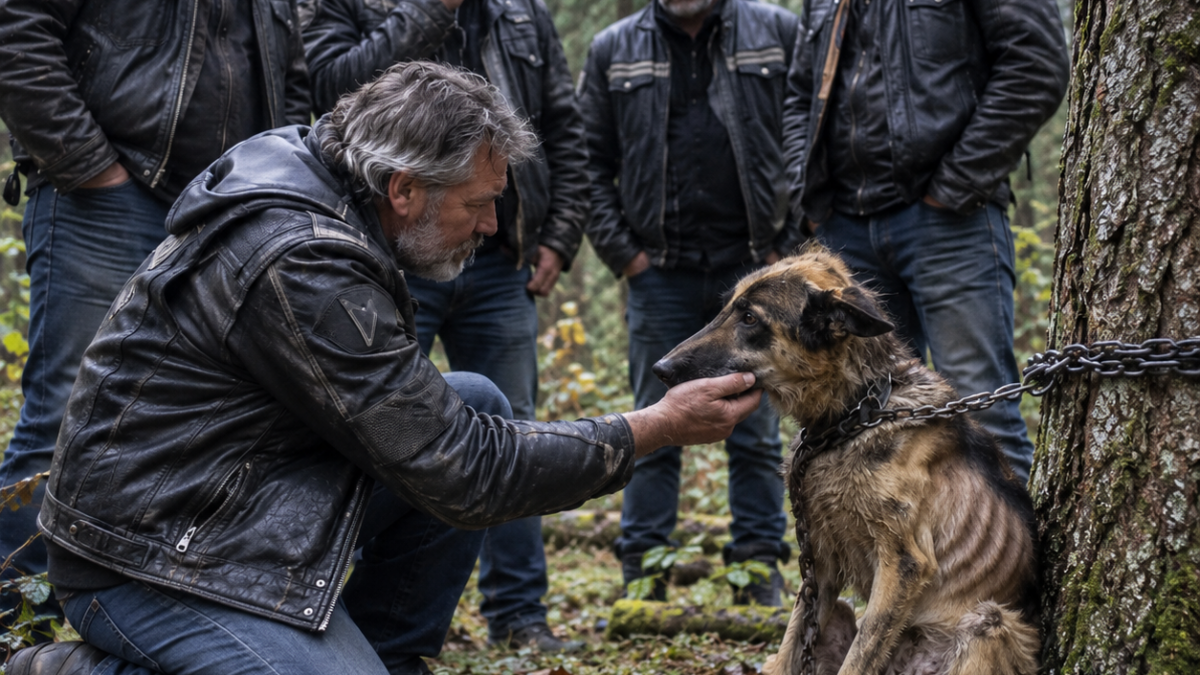
At the center of the clearing stood an old pine.
A thick metal chain had been wrapped twice around its trunk.
The other end disappeared beneath something lying in the dirt.
Nobody spoke.
For one terrible second, I thought we’d arrived too late.
Then the shape moved.
A head lifted.
Only a few inches.
German Shepherd.
Female.
Or what was left of one.
Her body seemed to have collapsed inward around her bones.
Her black-and-tan coat was patchy and dull.
Her hips showed sharply beneath the skin.
Around the tree, the ground had been worn into a perfect bare circle.
No grass.
No plants.
Just dirt.
Exactly as far as the chain allowed her to walk.
She had paced that circle so many times she’d erased the forest floor beneath her feet.
Luc crouched several yards away.
The dog looked at him.
She didn’t retreat.
Didn’t bare her teeth.
Didn’t growl.
Maybe she didn’t have the strength.
She opened her mouth and produced the same broken bark we’d heard from the road.
Luc’s face changed.
I’d known him fifteen years.
I’d seen him break bones in a motorcycle crash without making that expression.
He removed one glove.
Slowly reached forward.
“Easy, sweetheart.”
The dog watched his hand.
Then she gathered what little strength she had left and pushed her forehead against his fingers.
Pascal turned away.
Thierry walked several steps toward the trees and swore under his breath.
I stayed where I was.
Because something beside the dog’s stomach had caught my attention.
At first, I thought it was leaves.
Then one of the small shapes moved.
Just once.
I stepped closer.
And when I finally understood what was lying in the dirt beside her, every bit of anger I’d felt became something much colder.
This wasn’t only an abandoned dog anymore.
And none of us were prepared for what we had just found.
PART 2
There were puppies.
Three of them.
So small that at first they barely looked real.
They were pressed together in a shallow depression beside the shepherd’s belly, half-covered by pine needles and damp dirt.
One was moving.
The second made a faint squeaking sound.
The third lay still enough that I felt my stomach turn.
“Oh, God.”
Luc looked toward me.
“What?”
I pointed.
His eyes followed my hand.
For a second, he said nothing.
Then he shifted closer to the dog.
She lifted her head immediately.
Not aggressive.
Protective.
Even in that condition.
“Easy,” Luc whispered. “We’re not touching them yet.”
Pascal came back.
The moment he saw the puppies, his whole expression hardened.
“She gave birth here?”
Thierry turned.
“What?”
Pascal pointed toward the tree.
The chain.
The puppies.
The ground.
Nobody needed an explanation.
Somebody had chained a heavily pregnant dog to a tree in the middle of the forest.
And she’d delivered her litter alone.
“How many?” Rémi asked.
“Three here.”
I looked around the clearing.
Something told me there might have been more.
I hated myself for thinking it.
Luc moved his hand along the dog’s neck.
There was an old leather collar beneath the chain.
Too tight.
The hair beneath it had rubbed away.
“Water,” he said.
Pascal immediately reached for his backpack.
We carried bottles on long rides.
Not enough for a rescue operation.
Enough to start.
I found the plastic cap from one of our small food containers and poured water into it.
The shepherd smelled it before she saw it.
She tried to rise.
Her front legs pushed.
Her back legs trembled.
She collapsed.
“Don’t,” Luc whispered.
He moved the water closer.
She drank while lying down.
Slow at first.
Then desperately.
“Careful,” Rémi said. “Don’t let her drink too fast.”
None of us were veterinarians.
But all five of us understood the danger of an animal this dehydrated.
Pascal pulled out his phone.
“No signal.”
“Higher up,” Thierry said.
“I’ll go.”
Rémi was already moving.
He climbed back toward the road while the rest of us remained in the clearing.
I took off my leather jacket and laid it on the dirt.
Not under the dog.
She was too frightened to move.
Beside her.
Something cleaner than the ground.
Pascal looked at me.
“That jacket cost you a fortune.”
“I’ll survive.”
The shepherd drank again.
Then looked toward the puppies.
One had begun crawling weakly against her stomach.
The smallest still hadn’t moved.
I couldn’t stop staring at it.
“Luc.”
“I know.”
“Do you think—”
“I don’t know.”
He didn’t want me to finish.
Neither did I.
Thierry walked around the clearing.
I knew what he was doing.
Looking.
Searching for food.
Water.
A bag.
Anything that could explain how long she’d been there.
He found an empty plastic bottle about ten feet from the tree.
Then an old metal bowl.
Bone dry.
Farther away, beyond the dog’s reach, lay an opened sack of cheap kibble.
Empty.
Thierry kicked dirt over it.
“Someone left food.”
Pascal looked at him.
“Maybe when they chained her.”
“Or somebody tried to feed her afterward.”
“We don’t know.”
Thierry’s jaw tightened.
“I know enough.”
Luc looked at him.
“No.”
Thierry stared.
“No what?”
“No deciding the whole story before we know it.”
“She is chained to a tree.”
“I can see that.”
“With newborn puppies.”
“I can see that too.”
“Then what exactly are we waiting to learn?”
Luc didn’t raise his voice.
He never needed to.
“Enough to make sure the person responsible can’t explain this away later.”
That shut all of us up.
Luc had spent several years working with a volunteer rescue group after his sister adopted a neglected Mastiff.
He knew something the rest of us were learning in real time.
Anger helps you move.
Evidence helps you win.
“Take pictures,” he said.
I understood.
Not for social media.
Not for drama.
For whoever came next.
We photographed everything.
The chain around the tree.
The collar.
The bare circle of dirt.
The bowl.
The empty bag.
The condition of the dog.
The puppies.
We were careful.
No touching anything unnecessarily.
No moving objects.
Pascal used his boot to mark where the bowl sat so nobody would accidentally step on it.
Then the shepherd tried to stand again.
This time she managed.
Barely.
Her body shook.
She took one step toward the puppies.
Then another.
Luc remained low.
“Good girl.”
She sniffed each pup.
One.
Two.
Then the still one.
She nudged it.
Nothing.
Again.
Nothing.
She licked the tiny body.
Long.
Slow.
I looked away.
Pascal didn’t.
He watched with his lips pressed together.
“Come on,” he whispered.
The mother nudged the puppy again.
Still nothing.
Luc finally said, “Don’t move it yet.”
The shepherd lowered herself around all three.
Protecting them.
Even the one that might already have been gone.
That image did something to us.
Five grown men.
Leather jackets.
Motorcycles waiting above.
And none of us could look directly at one another.
Rémi returned about fifteen minutes later.
“Got through.”
“To who?”
“Gendarmes and an animal rescue group in the next town. Rescue is sending a van. Gendarmes say don’t cut the chain unless she’s in immediate danger.”
Thierry stared at him.
“She’s in immediate danger.”
“I told them that.”
“And?”
“They said if she can wait ten minutes, wait. They want to see the scene.”
Luc nodded.
“Good.”
Thierry didn’t.
But he accepted it.
We waited.
Those ten minutes felt longer than the entire ride.
The shepherd kept glancing between us and the puppies.
I started talking quietly.
No idea why.
Maybe because silence felt wrong.
“You did good.”
Her ears twitched.
“You kept them alive.”
One ear moved again.
“At least two.”
I stopped.
I shouldn’t have said that.
The shepherd placed her head over the smallest puppy.
Luc looked at me.
I swallowed.
“Sorry.”
Rain began.
Not heavy.
A cold mountain drizzle.
Pascal removed his jacket too.
We held both jackets between us to create a crude cover over the dog and puppies without crowding them.
Thierry laughed once.
Not because anything was funny.
“If anybody from the club saw this…”
“Five idiots holding jackets over a dog?”
“Exactly.”
Luc didn’t smile.
“Hold your side higher.”
Eventually, voices came from above.
Then branches breaking.
Two gendarmes entered the clearing with a woman carrying medical bags.
Behind them came another man from the rescue organization with a transport stretcher.
The woman stopped when she saw the shepherd.
“Oh, no.”
Her name was Claire.
She’d been fostering and rescuing animals in the region for more than a decade.
She crouched.
“Who approached her?”
Luc raised a hand.
“Me.”
“Any aggression?”
“None.”
Claire glanced at the puppies.
“How long have you been here?”
“Maybe thirty-five minutes.”
“Water?”
“Small amounts.”
“Good.”
She put on gloves.
Moved closer.
The shepherd watched.
Claire stopped.
No rush.
No dominance.
No grabbing.
She sat down in the mud.
For several minutes, she simply talked.
“Hello, mama.”
The dog didn’t move.
Claire looked at Luc.
“Keep your hand where it is.”
Luc had his fingers resting on the ground near the dog’s muzzle.
Claire slowly touched the shepherd’s shoulder.
No reaction.
Then neck.
Ribs.
Abdomen.
The dog was too thin.
Claire’s face said that before her words did.
“She needs a vet now.”
One of the gendarmes photographed the chain.
“How do we get her free?”
Thierry reached into his motorcycle toolkit bag.
“I’ve got bolt cutters.”
The gendarme looked at him.
“You carry bolt cutters on a ride?”
Thierry shrugged.
“You’d be surprised.”
For the first time since we’d entered the clearing, somebody almost smiled.
Claire pointed.
“Cut the chain away from her neck.”
Thierry moved carefully.
The shepherd flinched at the metal sound.
Luc kept one hand near her face.
“Easy.”
Thierry positioned the jaws around one link.
Squeezed.
Nothing.
Again.
Metal groaned.
Third time.
Snap.
The broken chain fell away.
The shepherd jerked.
Tried to stand.
Collapsed.
Luc held still.
“It’s okay.”
Claire gently loosened the old collar.
Beneath it, the skin was raw.
One gendarme muttered something I won’t repeat.
The collar came off.
For the first time in however long, the shepherd wasn’t attached to the tree.
She didn’t seem to understand.
She remained inside the bare circle.
That destroyed me in a different way.
The chain was gone.
But she didn’t leave the space it had taught her to live in.
Claire noticed too.
“She’ll learn.”
I looked at her.
“What?”
“That the world is bigger again.”
The puppies had to be moved first.
Claire examined them.
The first male was cold but responsive.
The second female was smaller and weaker.
The third—
Claire touched it.
Checked.
Waited.
Then looked down.
“I’m sorry.”
Nobody answered.
The mother watched.
Claire wrapped the tiny body in a towel.
She didn’t take it away immediately.
Instead, she held it near the shepherd.
The mother sniffed.
Licked once.
Then turned toward the two living puppies.
I don’t know what dogs understand about death.
I won’t pretend.
But something about allowing her that moment felt important.
The two surviving puppies were placed in a warmed transport box.
Immediately the mother became restless.
She tried to rise.
Luc touched her cheek.
“They’re coming with us.”
Claire looked at him.
“You’re going to have to help me move her.”
Between Luc and Thierry, they lifted her onto the stretcher.
Even then, she weighed shockingly little.
A German Shepherd her size should’ve been close to seventy pounds.
Claire guessed she was barely forty-five.
The mother tried to look toward the puppy box.
I picked it up.
“Here.”
I kept it within sight.
Her body relaxed slightly.
We started climbing.
That climb nearly killed us.
The stretcher.
Puppies.
Mud.
Steep slope.
Every few meters, somebody slipped.
But nobody complained.
At the road, motorcycles stood exactly where we’d left them.
The rescue van had arrived.
Claire loaded the mother first.
Then the puppies.
Before she closed the doors, Luc asked:
“Where are you taking her?”
“Veterinary hospital in Lons-le-Saunier.”
“We’re coming.”
Claire looked at five motorcycles.
“All of you?”
“Yes.”
Thierry nodded.
“You won’t get rid of us now.”
One gendarme stepped forward.
“We’ll need statements.”
“Take them at the clinic.”
He looked at us.
Then at the dog.
“Fine.”
We followed the van down the mountain.
Five motorcycles.
One rescue vehicle.
No one rode fast.
At the clinic, we waited outside the treatment room while the staff worked.
The first update came twenty minutes later.
Severe dehydration.
Extreme malnutrition.
Anemia.
Skin infection.
Pressure wounds around the neck.
Paw injuries from repetitive pacing.
Recently postpartum.
Milk production present but limited.
The puppies were hypothermic.
The smaller female was dangerously weak.
The veterinarian, Dr. Morel, looked exhausted before he’d even finished explaining.
“How long could she have been out there?” I asked.
“Impossible to know exactly.”
“Days?”
“At least.”
“A week?”
“Possible.”
“Longer?”
He looked at the photos Claire had shown him.
“With some access to water? Possibly.”
Pascal cursed quietly.
“And the puppies?”
“One male is stronger. The female is critical.”
“The one that died…”
Dr. Morel looked at us.
“I can’t tell you whether it was stillborn or died after birth without examination.”
None of us asked for more.
“What are her chances?” Luc asked.
“The mother?”
“Yes.”
“If she responds to fluids, nutrition, treatment, good.”
“And the puppies?”
“The male has a reasonable chance.”
“The female?”
He paused.
“We watch hour by hour.”
That became the rhythm.
Hour by hour.
The mother didn’t have a name.
Her microchip scan changed that.
She had one.
Registered nine years earlier.
Female German Shepherd.
Name:
**Naya.**
Luc repeated it softly.
“Naya.”
The dog, lying behind the treatment-room glass, lifted one ear.
We all looked at each other.
“She knows it,” Pascal said.
Maybe.
Maybe it was tone.
But from then on, she wasn’t the dog from the tree.
She was Naya.
The microchip also gave authorities something else.
An owner.
A man named Gilles Mercier.
Local address.
Less than twenty kilometers from the forest.
The gendarme standing with us wrote down the information.
“Don’t contact him.”
Thierry laughed without humor.
“Wasn’t planning to send flowers.”
“I mean it.”
Luc looked at Thierry.
“He means it.”
“I heard him.”
The gendarmes left to follow up.
We remained.
Naya received IV fluids.
Antibiotics.
Pain medication.
Careful calories.
The puppies received warming support and supplemental milk.
Around midnight, Claire told us to go home.
Nobody moved.
“You can’t all sleep here.”
Pascal said, “Watch us.”
The receptionist eventually found us chairs.
Thierry slept sitting upright.
Rémi used his jacket as a pillow.
I woke twice because Pascal was snoring.
Luc didn’t sleep at all.
He sat near the treatment-room door.
At three in the morning, Dr. Morel came out.
“The little female took formula.”
Luc stood.
“How much?”
“Enough.”
“And Naya?”
“Stable.”
That word became beautiful.
Stable.
Not healed.
Not safe forever.
Stable.
At six, the male puppy cried loud enough that we heard him through the door.
Pascal smiled.
“That one’s going to be trouble.”
Claire arrived with coffee.
She handed Luc a cup.
“You stayed.”
“All of us.”
She shook her head.
“Of course.”
By eight, Naya had eaten several spoonfuls of soft food.
By ten, she stood with assistance.
By noon, she was reunited with the puppies.
The smaller female found her mother and tried to nurse.
Naya cleaned both of them.
Watching her do that in clean blankets beneath warm lights after seeing her in the dirt felt unreal.
“What do we call them?” Rémi asked.
Claire looked at us.
“You found them.”
“That seems dangerous.”
Pascal pointed at the male.
“Turbo.”
“No,” all four of us said.
Thierry suggested “Harley.”
Also rejected.
Eventually, Claire chose simple names.
The male became **Sacha**.
The female became **Lumi**, short for lumière.
Light.
Nobody argued.
For two days, Naya improved.
Then the past came walking through the clinic door.
Gilles Mercier arrived on the third afternoon.
I knew who he was before anyone said his name.
Something in the way Claire’s face changed.
The man was maybe fifty.
Work jacket.
Mud on his boots.
Angry before anyone had spoken to him.
“I’ve been told you have my dog.”
The receptionist stood.
“Sir, please lower your voice.”
“She’s chipped to me.”
Claire came from the hallway.
“Mr. Mercier?”
“Yes.”
“The gendarmes have been trying to reach you.”
“I’ve been working.”
“Then you should speak with them.”
“I’ll speak after I get my dog.”
My hands tightened.
Pascal saw it.
So did Luc.
Luc shifted slightly in front of me.
Not dramatic.
Just enough.
Mercier noticed us.
“Who are they?”
Claire said, “The people who found Naya.”
His eyes moved across us.
Five leather jackets.
Five motorcycles outside.
His confidence changed a little.
Not enough.
“She ran away.”
Thierry made a sound in his throat.
Luc looked at him.
Thierry stopped.
Claire remained calm.
“When?”
“What?”
“When did Naya run away?”
“About two months ago.”
I looked at Luc.
Two months?
Naya’s condition had deteriorated badly, but two months chained in that clearing without regular water would’ve been nearly impossible.
Claire asked, “Did you report her missing?”
“No.”
“Contact shelters?”
“No.”
“Post online?”
“I don’t use that stuff.”
“Call the police?”
“For a dog?”
Thierry took one step forward.
Luc put out an arm.
No words.
Just stop.
Mercier saw.
“What is this?”
Claire said, “Naya was found chained to a tree.”
The man’s expression didn’t change quickly enough.
A fraction of a second.
Recognition.
Then confusion performed afterward.
“Chained?”
“Yes.”
“With newborn puppies.”
“What puppies?”
Claire stared at him.
Mercier shrugged.
“She wasn’t pregnant when she ran.”
That sentence would matter later.
At the time, all I heard was blood rushing in my ears.
Claire asked, “Are you sure?”
“Yes.”
“When exactly did she disappear?”
“I told you. Two months.”
“Was she spayed?”
“No.”
“Did you own another dog?”
Mercier’s face hardened.
“Why does that matter?”
“Because authorities are investigating.”
“I want my dog.”
Claire’s voice changed.
“No.”
One word.
Mercier stared.
“You can’t keep property from the legal owner.”
“She’s under veterinary care and subject to an animal-welfare investigation.”
“She’s my dog.”
Luc finally spoke.
“Then where were you?”
The room went silent.
Mercier looked at him.
“What?”
Luc didn’t move.
“Your dog was chained to a tree, forty pounds underweight, after giving birth in the dirt.”
Mercier’s jaw tightened.
“She ran away.”
Luc’s voice stayed level.
“You said that.”
“Then what do you want?”
“An explanation that doesn’t insult everyone in this room.”
Mercier stepped toward him.
Thierry moved.
Pascal moved.
I moved.
Luc didn’t.
Claire raised her voice.
“Enough.”
Everyone stopped.
She pointed toward the entrance.
“Mr. Mercier, leave. The gendarmes will contact you.”
“You can’t—”
The door opened.
Two gendarmes entered.
Perfect timing.
Mercier’s face changed.
One officer said:
“Mr. Mercier. We’d like to speak with you.”
He pointed at Naya’s treatment hallway.
“That’s my dog.”
The officer answered:
“That is precisely what we’re trying to establish.”
They took him outside.
Nobody followed.
That required discipline.
Especially from Thierry.
He stood beside the window watching Mercier argue with the officers.
“He chained her.”
Luc said nothing.
“You know he did.”
“We suspect.”
“Stop talking like a lawyer.”
Luc turned.
“Do you want him punished?”
“Yes.”
“Then let them prove it.”
Thierry stared.
Luc stepped closer.
“You touch him, he becomes the victim.”
Silence.
“That helps Naya how?”
Thierry looked away.
It was the right question.
Anger makes revenge feel immediate.
Justice is slower.
Slower hurts.
But it lasts longer.
The investigation unfolded over several weeks.
Naya stayed in foster care with Claire after leaving the clinic.
Sacha and Lumi remained with her.
We visited constantly.
Probably too often.
Naya bonded with Luc first.
That surprised nobody.
The first time he entered Claire’s garden, Naya stood from her blanket.
Walked toward him.
Slowly.
Then pressed her head against his leg.
Same gesture as the forest.
Only stronger now.
Luc looked down.
“Hello, girl.”
Pascal whispered to me:
“He’s done.”
“What?”
“That’s his dog.”
Luc heard.
“No.”
Pascal smiled.
“Sure.”
Naya gained weight.
Five pounds.
Then ten.
Her coat began filling in.
The raw skin around her neck healed.
The circle-walking habit took longer.
Even without a chain, she’d sometimes walk in tight circles when anxious.
Claire explained it carefully.
“Repetitive behavior.”
“From being tied?” I asked.
“Likely.”
“Will it stop?”
“Maybe.”
Naya would circle.
Then notice open space.
Stop.
Eventually walk straight.
Every time she did, I remembered Claire’s words in the forest.
She’ll learn the world is bigger again.
Sacha grew quickly.
Big paws.
Loud voice.
Absolute confidence.
Lumi remained smaller.
But fierce.
The puppy we thought might not survive became the first to climb out of the puppy pen.
Twice.
Pascal renamed her “Bandit” privately.
Claire refused.
The legal case grew stronger too.
The microchip established ownership.
Veterinary records from a local clinic showed Naya had belonged to Mercier for years.
More importantly, a trail camera belonging to forestry workers had captured a vehicle entering the restricted road twelve days before we found her.
Same make and model as Mercier’s truck.
Another image showed it leaving twenty-three minutes later.
One animal shape could be seen in the back during the arrival image.
Not clear enough alone.
Then investigators found a hardware-store receipt.
Heavy chain.
Large swivel clip.
Purchased with Mercier’s bank card two days before the trail-camera footage.
That still didn’t prove everything.
But evidence kept stacking.
A neighbor gave a statement.
She said she’d seen Naya heavily pregnant at Mercier’s property approximately two weeks before he claimed the dog had “run away.”
Another neighbor reported hearing Mercier complain that he “wasn’t dealing with another litter.”
Then authorities inspected his property.
They found another dog.
Male shepherd mix.
Thin.
Living in an outdoor enclosure without adequate shelter.
Not as bad as Naya.
Bad enough.
He was removed pending investigation.
That changed Thierry.
When we heard, he stopped talking about what he’d like to do to Mercier.
He just said:
“Good.”
Because another dog was out.
That mattered more than rage.
The male shepherd’s name was Rex.
He was fostered by another rescue.
Healthy after treatment.
Eventually adopted.
Lives branching from one discovery.
Naya kept healing.
About six weeks after the forest, Claire removed the last bandage from a wound near her neck.
“Done.”
Naya shook herself.
Then immediately walked to Luc.
Claire smiled.
“Still not your dog?”
Luc glared at all of us.
“She’s in foster care.”
Pascal said, “Of course.”
“She needs a permanent home.”
“Yes.”
“I travel.”
“You stopped traveling every weekend.”
“I have a small garden.”
“Naya thinks it’s fine.”
Luc sighed.
Naya placed one paw on his boot.
That ended the argument.
He submitted the adoption application three days later.
When Claire approved it, we celebrated at our clubhouse.
No loud party.
Naya still disliked sudden noise.
So five men who owned motorcycles and routinely argued over exhaust systems sat quietly in a garage eating pizza while a German Shepherd slept on a padded bed beside Luc.
Life is strange.
Sacha and Lumi were adopted when they were old enough.
Sacha went to a family with a large fenced property and two teenagers.
Lumi went to a veterinary nurse who had helped care for her during those first critical days.
Claire cried at both adoptions.
Pascal denied crying.
No one believed him.
Naya stayed with Luc.
The first weeks were difficult.
Home can be safe and still feel unfamiliar.
Naya followed him everywhere.
Bathroom.
Kitchen.
Garage.
Garden.
If Luc disappeared behind a closed door, she sometimes panicked.
Scratch.
Whine.
Circle.
So Luc stopped closing doors when he could.
He worked with a trainer.
Short absences.
Return.
Reward.
Again.
Again.
The goal wasn’t to teach Naya that people never leave.
That would be a lie.
The goal was to teach her that leaving did not always mean abandonment.
Two minutes.
Luc returns.
Five minutes.
Returns.
Ten.
Returns.
Naya learned.
Slowly.
One evening, we met at Luc’s house before a ride.
Engines off because of Naya.
Pascal entered first.
Then me.
Thierry.
Rémi.
Naya greeted us cautiously.
She knew all of us.
But groups still made her nervous.
Then Thierry knelt.
This enormous former nightclub bouncer sat on the floor with a dried liver treat in his palm.
Naya approached.
Took it.
Thierry smiled.
“Remember me?”
Naya sniffed his jacket.
Then licked his scarred eyebrow.
We laughed.
He didn’t.
His eyes had filled.
“Don’t.”
Pascal said, “Nobody said anything.”
“You were going to.”
“We were.”
Naya leaned against Thierry.
He closed his eyes.
For months, he’d carried anger like fuel.
Naya didn’t need it anymore.
Maybe neither did he.
The court hearing came almost five months after the rescue.
We attended.
All five.
Not because we expected drama.
Because we wanted the case to be real all the way to the end.
Mercier’s lawyer argued the evidence did not prove he had intended to kill Naya.
The prosecution didn’t need to prove that exact intent for the cruelty charges they were pursuing.
They presented the chain.
Photographs.
Veterinary reports.
Trail-camera images.
Receipt.
Witness statements.
The condition of Rex.
Mercier maintained that he’d taken Naya into the forest temporarily because she kept escaping his property.
That explanation created more problems for him.
His own words placed him there.
His lawyer tried to redirect.
He said Mercier had intended to return.
The prosecutor asked:
“With food?”
There had been no usable food.
“With adequate water?”
None.
“With shelter?”
No.
“With veterinary assistance despite the animal being heavily pregnant?”
No.
The prosecutor displayed a photograph of the bare circle around the tree.
Then one of Naya’s neck.
Then the puppies.
I didn’t look at the last photograph.
Luc did.
Mercier kept his eyes down.
The prosecutor asked one final question:
“If the defendant intended to return promptly, why did he tell investigators the dog had disappeared two months earlier?”
Silence.
That lie mattered.
The court didn’t give us the dramatic revenge movie ending people imagine.
No one threw Mercier into a dungeon.
No giant sentence magically matched suffering.
Real justice is often less theatrical.
He received a criminal conviction for animal cruelty and abandonment-related offenses.
A significant fine.
A suspended custodial sentence with conditions.
Mandatory payment toward veterinary and rescue expenses.
And most importantly to us:
A multi-year prohibition on owning or keeping animals, with authorities retaining power to inspect compliance.
Rex was permanently removed.
Naya was legally transferred.
Mercier lost any claim to her.
That mattered.
When the judge confirmed it, Luc’s shoulders dropped.
I hadn’t realized how tense he was.
Outside the courthouse, Thierry looked disappointed.
“That felt too easy.”
Luc asked, “Easy for who?”
“For him.”
Luc shook his head.
“Don’t build your peace around whether he suffers enough.”
Thierry stared.
“What am I supposed to build it around?”
Luc pulled out his phone.
Showed him a photograph Claire had sent that morning.
Lumi sleeping upside down on a couch.
Sacha carrying a shoe.
Rex in his new home.
Naya in Luc’s garden.
Four dogs.
Alive.
Safe.
Luc said:
“That.”
Thierry looked at the screen.
Then nodded.
That became our version of revenge.
Not pain returned for pain.
Control removed from the person who had abused it.
Four lives moved beyond his reach.
Mercier had chained Naya to one tree.
He didn’t get to decide where her story ended.
That was enough.
Or eventually, it became enough.
Naya changed over the next year.
The first thing that disappeared was the urgency around food.
At Luc’s house, she’d eat too fast.
Almost choking.
He bought a slow feeder.
Then fed smaller meals.
Months later, Naya began leaving food in the bowl.
The first time, Luc called Claire.
“She didn’t finish breakfast.”
“Is she sick?”
“No.”
“Energy?”
“Normal.”
“Temperature?”
“Normal.”
Claire laughed.
“Maybe she’s full.”
Luc went silent.
Full.
Naya had reached a point where she trusted more food would come later.
Think about what that means for an animal who once had none.
Leaving food behind became one of the strangest signs of healing.
Sleep changed too.
At first, Naya slept curled tightly.
Head up at every noise.
Later, on her side.
Then one afternoon we arrived and found her completely upside down in the grass.
Four paws in the air.
Luc whispered:
“Don’t wake her.”
We stood near the gate.
Five bikers afraid to make noise because one dog was sleeping badly enough to look dead and safely enough not to care.
Pascal took a picture.
Naya woke.
Looked at us.
Tail wag.
No panic.
That photograph eventually hung in our clubhouse.
Not the tree.
Not the chain.
Naya asleep on her back.
Because we didn’t want the worst thing done to her to become her permanent identity.
People love before-and-after rescue photos.
They show impact.
But sometimes the “before” image traps an animal forever as a victim.
Naya became much more interesting than what happened to her.
She loved cheese.
Hated vacuum cleaners.
Tolerated rain.
Despised getting her paws wet in puddles despite surviving outdoors.
Stole Luc’s gloves.
Only the left one.
We never understood why.
She liked motorcycle jackets.
Probably because they smelled like us.
When the five of us arrived, she’d inspect each jacket pocket for treats.
Pascal always carried some.
Thierry pretended he didn’t.
Naya knew better.
She became especially attached to Thierry.
That amused everybody.
The largest, roughest-looking one.
Maybe because he was the most careful.
He never approached directly.
Never leaned over her.
Never hugged unless she initiated.
Naya noticed.
Animals often recognize gentleness more accurately than humans do.
Two years after the rescue, Luc started taking Naya on short trips.
Not on the motorcycle.
We weren’t idiots.
Car.
Mountain lakes.
Quiet walking paths.
Cabins.
The first forest trip was difficult.
We debated whether to do it at all.
Would the smell of pine frighten her?
The sound?
The terrain?
The trainer advised allowing her to choose.
So Luc drove to a public woodland near his home.
Opened the car.
Naya stepped out.
Stopped.
Pine trees.
Wet earth.
Birds.
Luc didn’t pull.
Didn’t encourage.
He waited.
Naya sniffed.
Then walked forward.
Ten feet.
Twenty.
She stopped at a tree.
Luc’s heart nearly stopped too.
Naya sniffed the trunk.
Then lifted her leg slightly—she had an odd habit of marking like a male dog sometimes—and urinated beside it.
Luc started laughing.
The forest had once been a prison.
Naya had returned as a tourist with bathroom privileges.
She walked nearly a mile that afternoon.
No circles.
No freezing.
When they came home, Luc sent one message to our group:
**She owned the forest today.**
Thierry replied:
**Good.**
The puppies grew.
We had reunions when possible.
Sacha became huge.
Almost ninety pounds.
All legs and enthusiasm.
Lumi remained smaller and smarter.
At the first reunion, Sacha rushed toward Naya.
Naya corrected him immediately.
One sharp bark.
He stopped.
Pascal laughed.
“Still his mother.”
Maybe.
Or just an adult dog telling a teenage idiot to behave.
Either explanation worked.
Lumi approached more carefully.
Naya sniffed her.
Their tails moved.
Then they ran.
Watching all three together did something strange.
It erased the forest and brought it back at the same time.
I remembered two tiny bodies beside Naya.
One dead.
Two barely alive.
Now Sacha could nearly knock Thierry over.
Lumi had completed advanced obedience training.
Naya chased them both across a fenced field.
Life had expanded far beyond that bare circle.
Claire came to one reunion.
She stood beside me.
“Do you ever think about the third puppy?”
I knew exactly who she meant.
“Yes.”
“Me too.”
We never named that puppy.
At first, that bothered me.
Later, I thought maybe a name wasn’t necessary for a life to matter.
That tiny body was part of the story.
Not as a tool for sadness.
As truth.
We didn’t save everyone.
Rescue rarely gives you perfection.
Sometimes people arrive too late for one life and just in time for another.
Both facts can coexist.
I looked at Naya running with Sacha and Lumi.
“Two made it.”
Claire nodded.
“And she did.”
That mattered too.
Our motorcycle group changed because of Naya.
We’d always done charity rides occasionally.
Toy drives.
Hospital fundraisers.
Veterans’ events.
After Naya, animal rescue became ours.
We started an annual ride.
Not named after her at first.
Luc hated making her into a mascot.
Eventually Claire convinced him.
**Naya’s Ride.**
Funds went toward emergency veterinary bills, foster supplies, microchip clinics, and transport.
The first year, sixty-three bikes came.
Second year, more than a hundred.
By year four, local police had to help manage traffic.
Naya attended from a quiet enclosure away from the engines.
We always started motorcycles down the road so the noise wouldn’t overwhelm her.
People knew her story.
Some wanted photos.
Luc allowed them only if Naya approached.
No forcing.
She wasn’t a prop.
She’d spent enough of life without choice.
At the fourth ride, an older woman approached Luc.
She carried a photograph.
German Shepherd.
Gray muzzle.
“She looks like Naya.”
Luc smiled.
“Beautiful dog.”
The woman nodded.
“We adopted her at eleven.”
“How old now?”
“Fourteen.”
“Good.”
The woman showed another photo.
Dog asleep on a couch.
“I saw Naya’s story after my husband wanted a younger dog.”
Luc looked at her.
“And?”
“We changed our minds.”
She touched Naya’s shoulder gently.
“This girl helped another old shepherd get a home.”
Luc told us later.
He pretended it didn’t affect him.
We didn’t pretend to believe him.
The annual ride raised enough money one year to pay for surgery on a dog hit by a car.
Another year it funded emergency boarding for animals whose owners were hospitalized.
Another helped a woman fleeing domestic violence place her dog safely while she entered temporary housing.
Naya knew none of this.
Of course.
She wanted treats.
That’s the thing about meaning.
The life at the center of a story doesn’t need to understand all the consequences.
Naya lived.
Other doors opened.
That was enough.
Years passed.
Her muzzle grayed.
The veterinarian estimated she had been five or six when we found her.
By the time she was ten or eleven, arthritis began affecting her hips.
Luc installed rugs.
A ramp.
Orthopedic beds.
At one point, Pascal visited and counted four beds.
“You have one dog.”
“She moves.”
“She is not migrating across Europe.”
“She likes options.”
Naya walked past carrying Luc’s left glove.
Pascal pointed.
“She also likes theft.”
Luc said nothing.
Naya dropped the glove on her favorite bed.
Case closed.
Age softened her.
Not emotionally.
Physically.
She walked slower.
Slept more.
But the fear that had once defined her never returned in the same way.
Thunderstorms still bothered her.
Metal chain sounds always made her uncomfortable.
Luc eventually removed chain-style decorations from his garage because even the clink caused her ears to pin back.
That memory lived somewhere deep.
Trauma doesn’t always disappear.
Sometimes life simply grows around it.
Naya could hear chain and feel fear.
Then look at Luc.
Look at the house.
Look at the open door.
And stay.
Safety didn’t erase memory.
It gave memory competition.
That’s a lesson I carried into my own life.
We all did.
Thierry, surprisingly, became the most involved in rescue.
He began transporting large dogs other volunteers struggled to handle.
Not because he was physically intimidating.
Because he had patience.
Someone joked about it at a fundraiser.
“You?”
Thierry smiled.
“Dogs don’t care about tattoos.”
True.
Pascal fostered twice.
Failed once.
He adopted a senior Boxer named Gus.
Rémi helped the rescue repair fencing.
I handled social media and fundraising.
Luc had Naya.
One weak bark changed five lives.
We’d gone into the forest because we heard something.
We came out tied to a community none of us expected.
Sometimes people asked whether we regretted not confronting Mercier outside the clinic.
Thierry used to answer that one.
“Ten years ago? Maybe.”
Then he’d point toward the rescue booth.
“But if I’d punched him, maybe the story would’ve become about five bikers attacking a man.”
He’d shrug.
“Instead it’s about Naya.”
Exactly.
Revenge is emotionally seductive because it promises balance.
You hurt something I love.
I hurt you.
Now the scale is even.
But pain doesn’t actually work like a scale.
Mercier suffering wouldn’t make the dead puppy live.
Wouldn’t remove Naya’s scars.
Wouldn’t restore the days she spent chained.
What mattered was stopping access.
Protecting the living.
Making sure another animal wasn’t trapped in the same pattern.
Justice did that imperfectly.
Rescue did the rest.
Naya herself did the most.
She kept living.
One autumn, nearly six years after we found her, we returned to the Jura road.
Not with Naya.
Just the five of us.
Motorcycles again.
Same route.
Different men.
We stopped where Luc had raised his fist years earlier.
The forest looked identical.
That bothered me.
Places don’t carry memory visibly.
Trees grow.
Rain falls.
Road continues.
You can experience the worst day of your life somewhere and return years later to find moss has covered the evidence.
We shut off the engines.
Silence.
Pascal looked down the slope.
“No barking.”
“No,” Luc said.
We climbed down.
Why?
I’m still not completely sure.
Maybe to prove we could.
Maybe to see.
The clearing was harder to find.
Vegetation had returned.
The pine remained.
The chain was gone.
Evidence had been removed years earlier.
The bare circle wasn’t bare anymore.
Grass.
Fern.
Small plants.
The forest had reclaimed it.
Thierry stood near the tree.
“This is it?”
“Yes.”
He walked around.
“It looks smaller.”
Everything from trauma looks smaller when you return with time between you and it.
I stood where Naya had been.
At least where I thought.
Luc touched the tree once.
Then stepped away.
Pascal said:
“We should leave.”
Nobody disagreed.
Before climbing back, Rémi pulled something from his pocket.
A small metal tag.
Not a memorial plaque.
Nothing dramatic.
A simple dog tag engraved:
**NAYA — SAFE**
He looked embarrassed.
“I thought…”
Luc took it.
For a moment, we debated leaving it on the tree.
Then Luc shook his head.
“No.”
Rémi looked disappointed.
“Why?”
“She doesn’t belong here.”
Luc put the tag in his pocket.
“She belongs home.”
He was right.
We left nothing.
No flowers.
No sign.
No shrine.
The forest didn’t own her story.
Luc later attached the tag to Naya’s collar.
Years continued.
Sacha died before Naya.
That was hard.
Cancer at eight.
His family did everything.
When Luc heard, he sat beside Naya for an hour.
Did she know?
No idea.
Lumi lived longer.
Healthy.
Spoiled.
Loved.
The loss reminded us that surviving the beginning doesn’t guarantee a long life.
Nothing does.
But Sacha got eight years.
Eight birthdays.
Eight summers.
A family.
A teenage boy who grew into a man and still cried while holding his head at the end.
That was a full life.
Not because it lasted forever.
Because it became his.
The puppy beside the tree had no future we could see.
Sacha got one.
That was the victory.
Naya’s final years were peaceful.
Not perfect.
Peaceful.
Arthritis.
Hearing loss.
A benign tumor removed from her shoulder.
A mild heart murmur.
Normal senior-dog things.
Think about the beauty of that.
She became old enough for ordinary aging to matter.
The dog we thought might die before sunset got gray.
Slow.
Stubborn.
She had regular bloodwork.
Prescription food.
A preferred blanket.
She hated one specific mail carrier for reasons nobody understood.
She still stole Luc’s left glove occasionally.
Never the right.
Consistency matters.
One winter afternoon, I arrived at Luc’s house.
Naya was lying near the fireplace.
She lifted her head when I entered.
Tail thumped once.
I sat beside her.
“You remember me?”
She sniffed my hand.
Then went back to sleep.
“I’ll take that.”
Luc brought coffee.
We sat quietly.
After a while, he said:
“She isn’t doing well.”
I looked at him.
“What happened?”
“Nothing dramatic.”
That was almost worse.
She was eating less.
Struggling to stand.
Breathing harder after short walks.
Blood tests showed kidney disease progressing.
Medication helped.
Fluids helped.
Then helped less.
Luc had been tracking good days and bad.
There were still good ones.
Then fewer.
“What does the vet say?”
“That we’re close.”
I looked at Naya.
The phrase sounded impossible.
We had spent years knowing this day existed.
Still impossible.
“Does Claire know?”
“Yes.”
“The guys?”
“Not yet.”
I nodded.
Luc stared into his coffee.
“I saved her once.”
I knew what he meant.
“You all did.”
“That’s not what I mean.”
He looked at Naya.
“How do you know when saving becomes holding?”
No answer is clean.
I said:
“You ask what she needs, not what you need.”
Luc closed his eyes.
“That’s cruel.”
“I know.”
He laughed once.
“You’ve become wise.”
“No. I’ve watched enough dogs.”
Naya woke.
Tried to stand.
Her back legs slipped.
Luc immediately helped.
She walked toward the kitchen.
Food?
No.
Water.
Drank.
Then came back.
She lowered herself beside Luc’s feet.
He rested one hand on her neck.
That image took me back to the tree.
Same man’s hand.
Same dog’s head.
Everything between.
Luc whispered:
“I know.”
I left them alone.
The following week, Naya improved slightly.
Enough to make everybody question everything.
She ate chicken.
Walked into the garden.
Barked at Pascal.
Stole the glove.
Hope returned.
Then the next decline came.
Harder.
Luc called.
“Tomorrow.”
One word.
We understood.
The five of us gathered at his house that evening.
No motorcycles.
Too loud.
Cars.
Naya lay in the living room.
Claire came.
So did Lumi’s owner, without Lumi because travel would stress both dogs.
We ate together.
Talked.
Laughed more than expected.
Naya received pieces of chicken she absolutely should not have eaten medically.
At that point, rules changed.
Thierry sat on the floor.
Naya rested her head on his thigh.
He cried openly.
No pretending.
Pascal said nothing.
Rémi gave Luc a small box.
Inside was Naya’s first collar.
The one from the tree.
After the court case, authorities had released evidence that wasn’t needed.
Luc had never wanted to see it.
Rémi had kept it sealed.
Luc looked at the worn leather.
Raw history.
“What do I do with this?”
Rémi said:
“Whatever you want.”
Luc stared.
Then walked to the fireplace.
We all understood before he did it.
He held the collar over the flames.
Pascal said softly:
“You sure?”
Luc nodded.
The leather darkened.
Caught.
Burned.
The old collar curled into itself.
No ceremony.
No speech.
Naya slept.
I watched the object that had once connected her to the chain disappear.
That was the closest thing to symbolic revenge we ever needed.
Not against Mercier.
Against ownership without love.
Against the idea that the collar represented a claim stronger than care.
It burned.
Naya remained.
Luc kept the tag.
**NAYA — SAFE.**
The veterinarian came to the house the next morning.
Clear sky.
Cold.
Naya had spent twenty minutes in the garden earlier.
She lay on her favorite bed near the window.
Luc sat beside her.
We stood back.
This was his goodbye first.
The vet examined her.
Then looked at Luc.
He nodded.
There was no dramatic collapse.
No emergency.
That was a gift.
Luc fed Naya cheese.
She ate.
Of course.
Pascal laughed through tears.
“Typical.”
Naya looked toward him.
Tail moved once.
The vet gave the sedative.
Luc placed both hands around Naya’s face.
Her eyes softened.
He whispered:
“You don’t have to stay inside the circle anymore.”
That sentence broke all of us.
The world was silent.
No motorcycles.
No forest.
No chain.
Just home.
Luc continued.
“You can go anywhere you want.”
Naya’s head lowered into his lap.
The second medication went in.
Her breathing slowed.
Then stopped.
Luc remained completely still.
One hand on her head.
Five seconds.
Ten.
A minute.
Finally he leaned down.
Kissed her forehead.
“Good girl.”
Claire turned away.
Thierry covered his face.
Pascal cried.
Rémi cried.
I cried.
Nobody cared.
The five men who had once descended a mountain because of one weak bark stood in a quiet living room as the dog who made that bark left us more than eight years later.
Eight years.
That number mattered.
The vet had once told us she might not survive the week.
She got eight years.
A home.
Puppies who grew up.
Trips.
Forest walks.
A fundraiser named after her.
Cheese.
Stolen gloves.
Grass.
Fireplaces.
Sleep without chains.
After Naya died, Luc didn’t speak much for weeks.
He stopped riding temporarily.
That worried us.
Then one Saturday morning, our group chat lit up.
**Ride tomorrow. Same time.**
Pascal responded:
**Where?**
Luc:
**Anywhere.**
We met.
Five motorcycles.
Like before.
But Luc had attached Naya’s SAFE tag to the inside of his jacket.
Not outside.
Not for people to see.
For him.
We rode.
No destination.
Sometimes healing looks suspiciously like returning to ordinary things.
Naya’s Ride continued every year.
Luc considered renaming it.
Nobody allowed that.
The event grew.
Funds saved more animals.
The story became local legend.
And like all legends, details started changing.
Some people said we’d heard Naya from a kilometer away.
False.
Some said there were six bikers.
Wrong.
One article claimed Thierry carried Naya up the mountain alone.
Absolutely not.
His back still complains about the stretcher.
Another version said all the puppies survived.
We corrected that one whenever we could.
Because truth matters.
One puppy didn’t.
That life mattered too.
We don’t honor rescue by pretending every ending is perfect.
We honor it by telling the truth about what was saved and what couldn’t be.
Naya’s story was powerful enough without polishing away pain.
Years later, Lumi attended Naya’s Ride as a senior dog.
Gray around the muzzle.
Slow.
Her owner brought her in a wagon for part of the event.
Luc knelt beside her.
For a second, Lumi’s face looked so much like Naya’s that none of us spoke.
Same eyes.
Different life.
Lumi had never known the tree.
Never known hunger.
Never worn a chain.
She’d slept in a home from the time she was old enough to leave her mother.
That was Naya’s legacy in the most literal sense.
A daughter whose life began beside suffering but did not belong to it.
Luc touched Lumi’s head.
“Your mother was tougher than all of us.”
Lumi licked him.
Pascal said:
“And smarter.”
Thierry added:
“Not difficult.”
We laughed.
The ride began.
Engines roared farther down the road, away from the dogs.
People cheered.
I stood beside Luc.
“You ever think about that first bark?”
“All the time.”
“What if we hadn’t stopped?”
He looked at me.
We both knew better than to answer.
Alternative endings are dangerous places to live.
Maybe another hiker would’ve passed.
Maybe forestry workers.
Maybe rescue would’ve come the next day.
Maybe not.
We don’t know.
What we know is:
We stopped.
That’s enough.
The lesson isn’t that five bikers were heroes.
We weren’t.
We were five men who heard something and decided to investigate.
The important part is how ordinary that decision was.
Turn off engine.
Listen.
Walk downhill.
Call someone.
Give water.
Stay.
None of those actions required heroism.
They required attention.
Naya’s rescue became dramatic because the situation was dramatic.
But the first action was small.
We listened twice.
That stays with me.
How many suffering animals disappear because the first sound is dismissed?
How many people?
How many situations?
You don’t have to solve everything you notice.
Sometimes you can’t.
But noticing is where every rescue begins.
Naya’s bark was almost gone.
She had probably called many times before we reached the road.
Maybe louder.
Maybe for hours.
Maybe days.
By the time we heard her, she was conserving energy.
One broken sound every thirty or forty seconds.
Still calling.
Why?
Instinct?
Puppies?
Fear?
Hope?
We gave her that name only later.
But maybe she already had some.
Enough for one more bark.
Then another.
Then five engines stopped.
I still own the motorcycle from that day.
Older now.
Scratched.
Different exhaust.
Same machine.
Sometimes when I shut it off in a quiet place, the sudden silence brings me back.
Fir trees.
Wet dirt.
Luc’s raised fist.
That sound.
Then the clearing.
For years, the first image that came after was the chain.
Now it isn’t.
Time changed that.
Now I see Naya in Luc’s garden.
Older.
Thicker coat.
Tail raised.
Running badly after Lumi.
Or asleep upside down in grass.
Or carrying the left glove.
Memory can be retrained too.
The worst image doesn’t have to remain first forever.
That may be Naya’s final lesson.
The tree was real.
The chain was real.
The dead puppy was real.
Mercier was real.
So were the courtroom and the scars.
But they didn’t own every page after.
Pain is part of a life.
It doesn’t automatically become the title.
Naya’s title, if I got to choose it now, wouldn’t mention what was done to her.
It would be simpler.
**Naya lived.**
She lived long enough to trust.
Long enough to leave food in her bowl.
Long enough to sleep deeply.
Long enough to return to a forest without fear.
Long enough to become old.
Long enough to be loved so completely that five men cried when she died.
Mercier once reduced her world to the radius of a chain.
Naya eventually had more world than she could use.
A house.
Garden.
Road trips.
Mountains.
People.
Choice.
That was the revenge.
He had made her walk the same bare circle until the grass disappeared.
Years later, she walked wherever she wanted.
Stopped whenever she wanted.
Turned back when she wanted.
Stayed home when she wanted.
Freedom became so ordinary she stopped noticing it.
There is no better answer to a chain than that.
The punishment mattered.
The animal ban mattered.
The conviction mattered.
Rex’s removal mattered.
But none of those things moved me as much as watching Naya stand in Luc’s garden with the gate open while he carried groceries inside.
The gate was open.
Naya could’ve left.
She didn’t.
Not because she was trapped.
Because she was home.
Choice.
That single difference contained her entire recovery.
People sometimes say rescued dogs are grateful.
I don’t like that word much.
Gratitude makes it sound like they owe us something.
Naya owed us nothing.
She didn’t need to thank five bikers for finding her.
She had already paid enough for human failure.
What she gave us wasn’t gratitude.
It was trust.
Different.
More valuable.
Trust cannot be demanded.
It must be earned repeatedly.
Luc earned it.
Claire earned it.
The vet staff earned it.
We earned pieces of it.
And once Naya trusted, she gave that trust with astonishing generosity considering what had happened before.
That’s what broke me most.
Not that humans had hurt her.
That after all of it, she still allowed humans close.
Maybe dogs are reckless optimists.
Or maybe connection is simply too necessary to abandon forever.
Whatever the reason, Naya tried again.
So did we.
The last photograph of the original five of us with Naya was taken on her final Naya’s Ride.
She was already slow.
Luc sat beside her.
Pascal stood behind him.
Thierry crouched awkwardly because his knees were bad.
Rémi held the event banner.
I was on the other side.
Naya in the center.
Someone joked:
“The only respectable one in the picture.”
Correct.
The photo hangs beside the sleeping one in our clubhouse.
Underneath, a small plaque reads:
**WE HEARD HER.
SHE CHANGED US.**
Nothing about chains.
Nothing about abuse.
Nothing about Mercier.
He doesn’t get space on the wall.
That’s another kind of justice.
He once controlled where Naya could move.
He does not control how she is remembered.
We do.
And we remember the dog.
Not the man.
We remember her weak bark.
Her head pressing into Luc’s fingers.
Her puppies.
Her first full meal.
Her first run.
Her first forest walk.
Her stolen glove.
Her gray muzzle.
Her final morning.
We remember everything cruelty failed to erase.
If there is such a thing as a satisfying ending to a story that began with an animal chained to a tree, I think that’s it.
Not that suffering was undone.
It wasn’t.
You can’t undo it.
The puppy who died stayed dead.
The scars remained.
Fear left traces.
But suffering stopped getting new chapters.
That is what rescue can do.
Draw a line.
Before.
After.
Before the line:
Chain.
Dirt.
Hunger.
Three newborn puppies.
A dying bark.
After:
Water.
Hands.
Vet care.
Sacha.
Lumi.
Home.
Conviction.
Freedom.
Years.
Love.
Old age.
Peace.
The line doesn’t erase before.
It changes what comes next.
Five motorcycles happened to stop at the line.
Nothing more mystical than that.
And nothing less important.
Sometimes people ask which of us saved Naya.
Luc because she trusted him first?
Claire because she knew how to handle her?
The vet?
The gendarmes?
The prosecutor?
All of us?
None of us alone.
That’s the real answer.
Rescue isn’t a single heroic moment.
It’s a relay.
One person notices.
Another calls.
Another transports.
Another treats.
Another fosters.
Another adopts.
Another investigates.
Another testifies.
Another donates.
Another shows up again next week.
Naya survived because enough people carried one small piece.
She carried the hardest piece.
Staying alive until we arrived.
I think about that whenever I hear someone say:
“I couldn’t do rescue. It would break my heart.”
Maybe.
Sometimes it does.
But hearts are strange.
They break and still make room.
Pascal adopted Gus.
Thierry became a transporter.
Rémi rebuilt kennels.
Luc gave Naya a home.
I still volunteer at events.
None of that existed before the forest.
Naya’s suffering was not “worth it” because good things came after.
I hate that interpretation.
No suffering becomes justified by the lessons others learn from it.
But once suffering happens, we get to decide whether it ends only as suffering.
We made something useful from what followed.
That’s different.
I hope that’s enough.
Years after Naya’s death, I drove through the Jura alone.
Not on the motorcycle.
Winter.
Snow at higher elevations.
I passed the turnoff to that old forest road.
For the first time, I didn’t feel the urge to stop.
I smiled instead.
Naya wasn’t there.
That realization finally felt peaceful.
She wasn’t in the clearing.
Wasn’t in the tree.
Wasn’t in the chain.
Wasn’t even in the photograph at the clubhouse.
Not really.
She was in the habits she left behind.
The annual ride.
The rescue bills paid.
The dogs transported.
The way Thierry now stops whenever he sees an animal alone near a road.
The way Pascal keeps treats in every jacket.
The way Luc still can’t throw away a left glove without laughing.
The way all five of us listen more carefully when the engines go quiet.
That’s where Naya stayed.
Not in suffering.
In attention.
Maybe that is the best memorial.
Not sadness.
Changed behavior.
One day, you hear something because an old experience taught you to listen.
You stop.
And somebody else gets an after.
That is how rescue stories should continue.
Not forever on screens.
In choices.
The forest became small in my rearview mirror.
I kept driving.
For once, I didn’t look back.
Naya had spent too much of her life trapped in one place.
She deserved a story that moved forward.
And it did.
All the way home.