PART 2: Twenty-Five Stray Dogs Waited at the Same Abandoned Bus Stop Every Morning—Then I Checked My Security Camera
PART 2
The old man pulled out metal bowls.
Not one.
Several.
He arranged them carefully beneath the shelter, setting them far enough apart that the dogs wouldn’t crowd each other.
Then he opened a bottle of water.
Daniel leaned closer to the screen.
“He brought water.”
I nodded.
The man filled the bowls slowly.
One of the dogs approached before he had finished.
The old man lifted one hand.
Not sharply.
Just a small gesture.
The dog stopped.
I looked at Daniel.
“Did you see that?”
“He knows them.”
Or they knew him.
Maybe both.
The man reached into the second shopping bag and pulled out dog food.
Not restaurant leftovers.
Not bones.
Not garbage.
Actual dog food.
He poured portions into the bowls.
Three dogs waited.
The black female with the white paw was one of them.
I recognized her immediately.
She had lived around our block for months.
Normally she ate as though another dog might steal every bite.
On the video, she waited.
The old man pointed toward one bowl.
She moved forward.
The others remained back.
“Look at that,” Daniel whispered.
The black dog ate.
The elderly man crouched beside her.
He did not touch her at first.
He simply watched.
When she finished enough to step away, he moved another bowl toward the brown dog with the torn ear.
Then the third.
No fighting.
No rushing.
No chaos.
He stayed for nearly forty minutes.
When the dogs had finished, he refilled the water.
Collected empty food packaging.
Wiped one bowl with a cloth.
Packed everything into the bags.
Then walked away in the direction he had come.
I checked the next day.
4:51 a.m.
He returned.
Four dogs this time.
The morning after that, five.
Then six.
We jumped forward through the footage.
July 25.
Seven dogs.
July 30.
Nine.
August 3.
Eleven.
August 7.
Thirteen.
August 12.
Sixteen.
Every morning, nearly the same routine.
The old man arrived before sunrise.
Sometimes he carried two shopping bags.
Sometimes a small cart.
Once he brought what looked like cooked rice mixed with dog food in separate containers.
He always had water.
Always enough bowls.
Always the same quiet patience.
If one large dog tried to push ahead, he redirected it gently.
If a smaller dog hesitated near the edge of the group, he brought food closer.
One morning, a frightened puppy refused to approach.
The old man sat on the curb for almost ten minutes.
He placed food a few feet in front of himself.
Then waited.
The puppy moved forward.
Stopped.
Moved again.
The old man didn’t reach.
Eventually the puppy ate.
Daniel and I watched the footage in silence.
Then he said, “We’ve been looking at those dogs every morning.”
I nodded.
“And he’s been here before any of us opened.”
“Yes.”
“Every day?”
“Looks like it.”
Daniel sat back.
“Who is he?”
That became the question.
Not the dogs anymore.
The dogs suddenly made perfect sense.
They had a routine.
They had learned that before the city woke up, one person came to that broken shelter and made sure they ate.
The mystery was the man.
I replayed part of the footage.
His face was visible only occasionally.
Older.
Deep lines.
Gray stubble.
Slow walk.
He favored one knee when he bent.
He never looked toward the shop camera.
Not once.
He wasn’t performing for anybody.
That detail stayed with me.
People act differently when they know they are being watched.
The old man behaved like someone who expected the street to remain empty.
He wanted no audience.
I checked audio, but the camera captured very little from across the road.
Cars.
Wind.
Occasional barking.
Once, when a dog pushed another aside, I could hear the man’s voice faintly.
“Easy.”
That was it.
One word.
The next morning, I arrived at the shop before five.
Daniel was already there.
“You couldn’t sleep either?”
“No.”
Neither could I.
We kept the lights off and waited inside.
4:45.
Nothing.
4:50.
A dog appeared.
The black female.
She walked beneath the shelter and sat.
4:53.
The old yellow dog came from the alley.
4:56.
Three more.
Then footsteps.
I moved toward the window.
An elderly man appeared at the intersection carrying two bags.
Same jacket.
Same boots.
Same knitted cap.
There he was.
Not recorded.
Not history.
Ten yards across the road.
Daniel whispered, “Go talk to him.”
“You go.”
“You own the camera.”
“What does that have to do with anything?”
“You discovered him.”
“That doesn’t make him mine.”
Another dog trotted toward the shelter.
The old man set down the bags.
I reached for the door.
“Fine.”
The bell above the entrance nearly betrayed us.
It made a sharp little ring.
The old man looked toward the shop.
For the first time.
He saw me.
I raised a hand.
“Morning.”
He froze.
Not frightened exactly.
But cautious.
“Morning,” he answered.
I crossed the road.
Daniel stayed behind me.
The dogs recognized us.
The black female wagged but remained near the bowls.
The old man looked between us.
“Shop closed?”
“Still closed.”
He nodded.
I felt suddenly ridiculous.
What was I supposed to say?
Hello, sir, we’ve been watching you secretly feed twenty dogs?
Instead, I pointed toward the bags.
“Need help?”
“No.”
His answer was polite but immediate.
“I’m fine.”
He lifted one bag.
It was obviously heavy.
“You sure?”
“I’ve got it.”
Daniel walked closer.
“We’ve been wondering why all the dogs gather here.”
The man glanced toward the animals.
Then back at us.
“They’re hungry.”
Simple.
That was his explanation.
Daniel smiled.
“We figured that part out.”
The old man poured water.
I watched his hands.
They shook slightly.
Not enough to spill much.
Enough for me to notice.
“How long have you been feeding them?”
He shrugged.
“A while.”
“Since July?”
His hands stopped.
Only for a second.
Then he looked at me carefully.
“How do you know?”
I pointed across the road.
“Camera.”
His eyes followed my gesture to the shop.
The security camera was visible above the entrance.
His expression changed.
Embarrassment.
That surprised me.
Not pride.
Not pleasure at being noticed.
Embarrassment.
“Oh.”
“We weren’t trying to spy on you.”
He gave me a look that suggested that was exactly what we had done.
Daniel cleared his throat.
“We were trying to understand the dogs.”
The old man went back to pouring food.
“They understood before you did.”
Daniel laughed.
I did too.
The old man almost smiled.
That was our first conversation.
It lasted maybe five minutes.
We asked his name.
He avoided the question.
“People call me whatever they like.”
“Where do you live?”
“A little way.”
“Do you come on foot?”
“Most days.”
“Why here?”
“The roof.”
He pointed above us.
The rusty bus shelter.
“Keeps the bowls dry when it rains.”
Then he handed a small portion of food toward the frightened puppy.
The puppy approached.
His attention left us completely.
The conversation was over.
I recognized that even before he said, “You should open your shop.”
It was not rude.
It was dismissal.
We went back across the street.
Daniel looked at me.
“Well.”
“Well what?”
“We know exactly nothing.”
“We know he has a sense of humor.”
“We don’t know his name.”
“No.”
“Where he lives.”
“No.”
“Why he does this.”
“He said they’re hungry.”
Daniel looked back at the shelter.
“That can’t be the entire answer.”
Maybe it could have been.
But curiosity had already taken hold.
Over the next several days, I began arriving early.
Not every morning.
I had a business to run and needed sleep.
But often enough.
The old man tolerated me.
That was the right word.
He did not invite conversation.
He did not reject help once I learned not to make a big production out of offering it.
The first time I brought a large water container, he looked at it.
“What’s that?”
“Water.”
“I can see that.”
“For the dogs.”
“They have water.”
“You carried it.”
“So?”
“So today I carried it.”
He stared at me.
Then moved one empty bowl toward my feet.
That was permission.
I filled it.
The next morning, Daniel brought a bag of food.
The old man looked at him.
“No.”
Daniel stopped.
“What?”
“No.”
“It’s dog food.”
“I know.”
“You’re buying food yourself.”
“Yes.”
“Why can’t I?”
The man shook his head.
Daniel looked offended.
I tried not to laugh.
“You accepted his water,” Daniel said, pointing at me.
“Water is water.”
“And dog food is dog food.”
“No.”
“What?”
The old man inspected the bag.
“Wrong kind.”
Daniel looked at me.
I lost the fight and laughed.
“What’s wrong with it?”
“Too rich for some of them.”
The man pointed at two older dogs.
“They get sick.”
Then he pointed at another.
“That one eats too fast.”
He had learned them individually.
That changed everything.
The dogs were not simply a group to him.
They were specific lives.
Specific stomachs.
Specific fears.
Specific habits.
The black female got a little more because she was nursing somewhere, though none of us knew where the puppies were.
The yellow dog needed softer food.
The frightened puppy ate away from the group.
A large brindle male looked intimidating but backed away whenever humans moved too quickly.
The old man knew all of it.
“How?” I asked one morning.
“How what?”
“How do you know which dog needs what?”
“Watch.”
That was his answer.
Watch.
So I did.
The black female finished and immediately searched for more.
But if you looked closely, you saw her ribs.
The yellow male chewed carefully on one side.
The brindle dog waited behind the others despite being the largest.
The puppy jumped whenever a motorcycle passed.
Information was everywhere.
We just had not been paying attention.
By August 18, the group had reached its largest size.
I counted twenty-five.
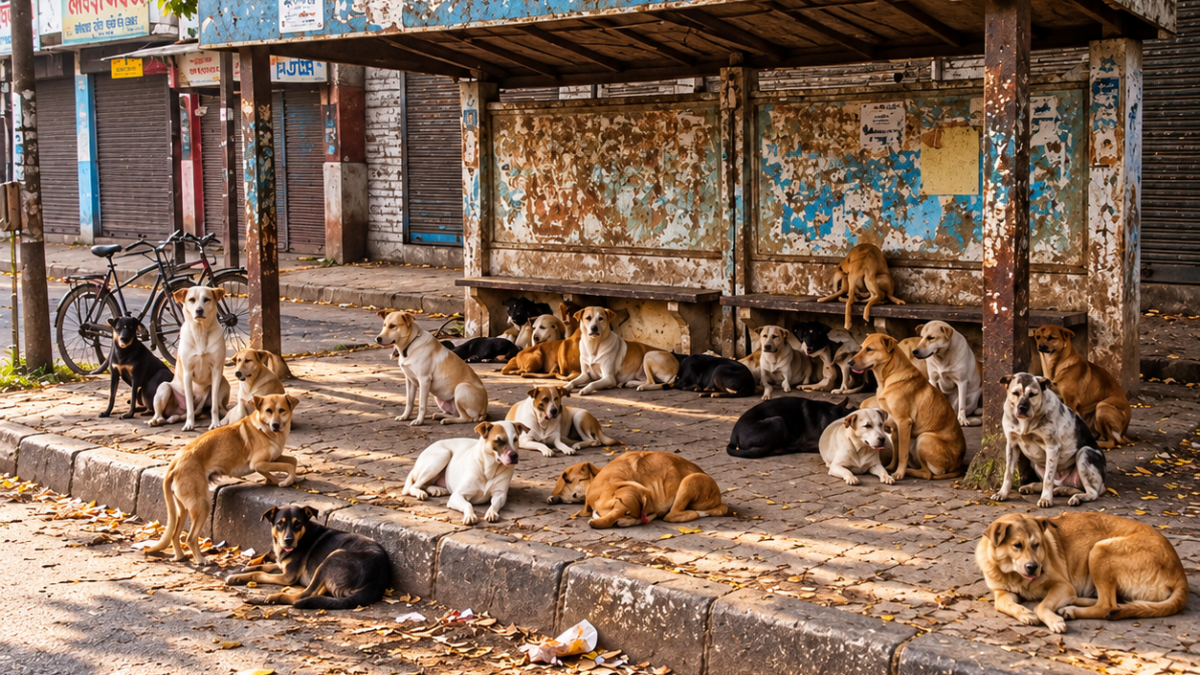
The bus shelter looked absurd.
Dogs under the roof.
Dogs beside the bench.
Dogs in the grass.
Dogs lying along the curb.
Every size.
Every color.
Some clearly street-born.
Others looked as though they might once have belonged to homes.
The old man arrived with more food than usual.
I helped arrange bowls.
Daniel filled water.
For the first time, the three of us worked almost like a team.
I asked the question I had already asked several times.
“Tell me your name.”
The old man smiled slightly.
“Why?”
“So I can stop calling you ‘the old man’ in my head.”
“Call me old man.”
“That’s rude.”
“Only if I’m young.”
Daniel laughed.
The man scratched the yellow dog behind one ear.
I tried another approach.
“Do you have family?”
He looked at me.
The smile disappeared.
I knew immediately I had gone somewhere he didn’t want me to go.
I raised both hands.
“Sorry.”
He nodded.
For several minutes, only bowls and dogs made noise.
Then, unexpectedly, he spoke.
“I had a dog.”
I waited.
He did not continue.
“What kind?”
“Brown.”
I smiled.
“Very specific.”
That brought the faintest smile back.
“She was ugly.”
“I doubt that.”
“She was.”
Daniel sat on the edge of the bench.
“What was her name?”
The man stood slowly.
“Mina.”
That was the first personal detail he ever gave us.
A dog named Mina.
“Is she—”
He looked at me.
I stopped.
“Sorry.”
He nodded.
“She died.”
“How long ago?”
“A while.”
Again.
A while.
The phrase covered everything he didn’t want examined.
He picked up an empty bowl.
One of the dogs pushed against his knee.
The old man steadied himself.
“She used to wait for me at a bus stop.”
Daniel and I both became still.
“This bus stop?” I asked.
“No.”
“Where?”
He ignored the question.
I looked at the shelter differently.
Suddenly, the location felt less random.
Mina had waited for him somewhere.
Now twenty-five dogs waited here.
But the old man had already closed the door.
He packed his bags.
“I’ll see you tomorrow,” I said.
He looked at me strangely.
Then nodded.
“Tomorrow.”
Those were the last words I ever heard him say.
The next morning, I arrived at 4:45.
The black female came.
Then the yellow dog.
Then others.
Five o’clock.
No old man.
5:10.
Nothing.
Daniel arrived.
“He late?”
“Apparently.”
We waited.
5:30.
The dogs waited too.
That was the part that hurt.
They knew his schedule better than we did.
Every pair of footsteps turned heads.
A bicycle passed.
Several tails lifted.
A man crossed the road.
The frightened puppy stood.
Then sat again.
6:00.
My shop needed opening.
Daniel looked at me.
“What do we do?”
I looked at twenty-three dogs under the shelter.
“We feed them.”
We used the food we had.
Not enough of the exact kinds.
But enough to make the morning work.
The dogs ate.
Some seemed confused.
They kept looking beyond us.
Down the road.
Toward the intersection.
The old man never appeared.
I told myself it was one day.
Maybe his knee hurt.
Maybe he had overslept.
Maybe family needed him.
Maybe he simply wanted a morning off after walking heavy bags across the neighborhood for weeks.
The next day, he was absent again.
Then the next.
By the fourth morning, I stopped pretending I wasn’t worried.
Daniel and I started asking around.
We showed a still image from the camera.
Not publicly at first.
Just shop owners.
Cafés.
The pharmacy.
Apartment security guards.
“Know him?”
“No.”
“Seen him?”
“Maybe.”
“Does he live near here?”
“Don’t think so.”
One woman at a café studied the image.
“He looks familiar.”
My pulse jumped.
“From where?”
“I’ve seen him walking.”
“Which direction?”
She pointed toward a road leading north.
“When?”
“Early sometimes.”
“Does he come inside?”
“No.”
“Do you know where he lives?”
She shook her head.
Another dead end.
We followed the road.
Asked people.
Nothing.
That felt impossible.
A person exists somewhere.
Sleeps somewhere.
Buys food somewhere.
Speaks to someone.
Yet the old man seemed to belong to the spaces between ordinary life.
Footpaths before sunrise.
A bus stop no one used.
A road people crossed without remembering faces.
The dogs kept returning.
That made everything harder.
The first week after his disappearance, almost the entire group still arrived.
They would gather before sunrise.
Wait.
We fed them.
They ate.
Then many stayed.
Some remained until midmorning.
A few returned to the road repeatedly and looked down it.
Daniel stopped making jokes.
One morning he stood beside me watching the yellow dog.
“You think they know?”
“Know what?”
“That he’s not coming.”
I looked at the dogs.
“No.”
Neither did we.
For another week, they waited.
I reviewed the security footage repeatedly.
August 18.
His last morning.
Was there something I had missed?
He moved more slowly than usual.
Maybe.
Or maybe I only saw that because I knew it was the last recording.
He rested one hand on the bench when standing.
Had he always done that?
Sometimes.
He looked down the road before leaving.
Had he done that before?
Yes.
Nothing obvious.
No farewell.
No dramatic gesture.
No moment where a camera could tell me, This is the end.
He simply packed the bowls and walked away.
That was one of the hardest things to accept.
Important endings rarely announce themselves.
Sometimes somebody says, “Tomorrow.”
Then there is no tomorrow with them.
The dogs had no way to understand that.
At least we could speculate.
They only waited.
By early September, the numbers began to decline.
Twenty-five became nineteen.
Then sixteen.
Some dogs stopped coming every day.
They found other food sources.
Other territories.
Other routines.
I was glad.
And strangely sad.
Every dog that failed to appear felt like the old man’s little morning community breaking apart.
The frightened puppy stayed.
So did the black female.
The yellow dog.
The brindle male.
Others came intermittently.
We continued leaving water.
Several shop owners began contributing food.
Not because we were replacing the old man.
We couldn’t.
But because once you see twenty hungry dogs as individual animals, it becomes difficult to return to pretending they are scenery.
That was one of his legacies, though none of us called it that yet.
Daniel bought the correct dog food after being humiliated about his first choice.
He walked into my shop with two bags.
I looked at the label.
“Approved?”
“I researched.”
“Impressive.”
“The old man insulted my food.”
“He educated you.”
“He insulted me educationally.”
I laughed.
We stored food behind my counter.
Another shop added bowls.
Someone donated a large water container.
One customer offered flea treatment through a local rescue group.
That created a new problem.
Feeding street dogs is simple compared with properly coordinating veterinary care, sterilization, and adoption.
We contacted a legitimate rescue organization.
They sent volunteers to assess the dogs.
Some could potentially be adopted.
Some were too fearful initially.
Some needed medical care.
The black female led volunteers to four puppies behind an abandoned building.
That discovery nearly made me cry.
No wonder the old man had been giving her more food.
He had known.
Of course he had known.
The puppies were taken into care with their mother.
The frightened puppy from the bus stop entered foster care.
The yellow senior dog had dental disease and arthritis.
He received treatment.
The brindle male turned out to be one of the gentlest dogs the volunteers had ever handled once they earned his trust.
One by one, the anonymous group became names.
Luna.
Patch.
Old Joe.
Bruno.
Milo.
Pepper.
Names turned the dogs into stories.
Stories turned indifference into responsibility.
The neighborhood changed.
Not completely.
Not magically.
Some residents still complained.
One morning, a man entered my shop angry.
“You’re attracting more dogs.”
“We’re working with a rescue group.”
“I don’t want them outside my property.”
“They aren’t on your property.”
“They wander.”
“Yes.”
“Stop feeding them.”
I looked at him.
Months earlier, maybe I would have agreed that stopping food would make the problem disappear.
Now I knew better.
Hunger does not make dogs vanish.
It makes them desperate.
“We’re sterilizing them and placing the adoptable ones.”
“I don’t care.”
“I do.”
That surprised both of us.
I had never thought of myself as an animal rescuer.
I owned a shop.
I sold household goods and snacks.
Then an elderly stranger walked into the frame of my security camera.
Now I had dog food behind the counter and a rescue volunteer’s number in my favorites.
The man left angry.
Daniel came in afterward.
“What happened?”
“I’ve apparently become unreasonable.”
“You were always unreasonable.”
“Thanks.”
“No problem.”
We kept going.
The rescue group eventually managed to sterilize several neighborhood strays.
Some went into foster homes.
A few were adopted.
Others remained community dogs with monitored feeding and veterinary support.
The bus stop became less crowded.
At first, that felt like losing something.
Then I realized empty space could mean success.
A dog missing from the morning group might be sleeping on somebody’s couch.
That was better than twenty-five animals waiting for breakfast beside a road.
The old man had fed them.
We were trying to finish what kindness alone could not.
Food saves a morning.
Sterilization prevents another generation from being born into the same struggle.
Medical care saves suffering.
Adoption, when possible, changes the entire structure of a life.
I wished he could see it.
That thought became painful over time.
Where was he?
We still had no answer.
Then, nearly two months after he disappeared, someone walked into my shop carrying a phone.
A woman in her late forties.
“I think I know your man.”
My heart jumped.
“What man?”
“The one people have been asking about. The dog man.”
By then, word had spread farther than I intended.
Someone had shared a still frame locally.
Not to make him famous.
To identify him.
I stepped from behind the counter.
“You know him?”
“I think so.”
She showed me a photograph.
An elderly man standing beside a small garden.
Gray jacket.
Same face.
Same posture.
Older photograph, maybe.
But him.
“That’s him.”
My voice sounded strange.
“Who is he?”
She hesitated.
That hesitation scared me.
“His name was Elias.”
Was.
I heard the word before anything else.
“Was?”
She looked down.
“He was my father’s neighbor.”
I gripped the counter.
“Was?”
Daniel had entered during the conversation.
He stopped beside me.
The woman continued.
“He died in August.”
Silence.
The street noise outside suddenly felt too loud.
A motorcycle.
Someone closing a car door.
A customer talking on a phone.
I stared at her.
“What date?”
She checked something.
“August twentieth.”
Two days after his final appearance.
I sat down.
Daniel leaned against a shelf.
The woman looked between us.
“I’m sorry.”
“What happened?”
“Heart problem, I think. He had been sick.”
I thought of his hands shaking.
The knee.
The way he rested against the bench.
His slow walk.
The heavy bags.
“Did his family know he was feeding the dogs?”
“I don’t know. He didn’t have much family left.”
“Did he live alone?”
“Yes.”
I swallowed.
“Did he have a dog named Mina?”
The woman’s expression changed.
“You did know him.”
“Barely.”
She nodded.
“Yes. Years ago.”
“What happened to her?”
“She died.”
That part we knew.
But now somebody could complete the story.
I asked the woman to sit.
Her name was Rachel.
She had known Elias through her father, who lived several neighborhoods away.
She remembered Mina because Elias had treated the dog like a child.
“Where did he get her?” I asked.
Rachel thought.
“I think she was a stray.”
Of course.
“Do you know about the bus stop?”
“What bus stop?”
I explained.
The dogs.
The camera.
The food.
The mornings.
Rachel covered her mouth.
“He was doing that?”
“Every day.”
She looked close to tears.
“I didn’t know.”
“Neither did anybody.”
Daniel asked, “Did Mina really wait for him at a bus stop?”
Rachel nodded slowly.
“After his wife died, Elias still worked for a few years. Mina would walk part of the way with him in the mornings. Sometimes she’d wait near the stop when he came back.”
I looked down.
The old man’s one personal story suddenly had shape.
“His wife died?”
“Long before Mina.”
“Children?”
“One son, but he lives far away. They weren’t close.”
I did not ask why.
Not every silence belongs to strangers.
Rachel stared at the security still on my counter.
“He always loved animals.”
“Why didn’t he tell anyone his name?”
She smiled sadly.
“That sounds like him.”
The question that had driven us for months suddenly had an answer.
Elias.
His name was Elias.
He had lived.
Loved a dog.
Lost her.
Walked to an old shelter before sunrise and quietly fed animals nobody else was paying much attention to.
Then he died.
No mystery conspiracy.
No secret fortune.
No hidden organization.
Just an elderly man whose kindness had been almost completely private.
I should have felt satisfied finally knowing.
Instead, I felt angry.
Not at Elias.
At the timing.
Two days.
He disappeared on August 18.
Died August 20.
Had he been hospitalized on the nineteenth?
Was the eighteenth his last ordinary morning?
Had he known he was unwell?
Had his “tomorrow” been sincere?
Rachel didn’t know.
Neither would we.
Daniel asked the question I couldn’t.
“Where was he buried?”
A week later, several of us visited.
Rachel came.
Daniel.
Me.
Two rescue volunteers.
No dogs.
We considered bringing one, then decided against it.
Elias had never asked for ceremony.
A crowd at the cemetery already felt like more attention than he would have wanted.
His grave was simple.
Name.
Dates.
Nothing about dogs.
Nothing about twenty-five animals waiting beside an abandoned bus stop.
I stood there longer than expected.
Daniel placed a small metal dog bowl beside the flowers.
I looked at him.
“You brought a bowl?”
He shrugged.
“Water is water.”
I laughed despite myself.
It was exactly the kind of ridiculous private joke Elias would have refused to acknowledge.
Rachel smiled through tears.
“What does that mean?”
“Long story.”
We told her.
The wrong dog food.
Elias rejecting Daniel’s donation.
His standards.
Rachel laughed.
“That definitely sounds like him.”
We stayed for perhaps twenty minutes.
Before leaving, I looked at the name again.
Elias.
For weeks I had watched dogs wait for someone whose name I didn’t know.
Now I knew the name and couldn’t tell him what happened afterward.
That seemed unfair.
So I said it anyway.
Quietly.
“The black mother and her puppies are safe.”
Daniel looked at me but didn’t interrupt.
“The frightened puppy got fostered.”
I continued.
“The old yellow dog got his teeth fixed.”
Rachel started crying again.
“The brindle one has a home application.”
I felt stupid.
And not stupid at all.
“You started something.”
The cemetery stayed quiet.
“You probably didn’t mean to.”
That part made me smile.
“But you did.”
Then we left.
Back at the neighborhood, the old bus stop remained.
Same rust.
Same cracked concrete.
Same broken bench.
But I could never see it as abandoned again.
Too much had happened there.
The rescue group suggested replacing it with a proper community feeding station away from traffic.
That made sense.
We arranged permission.
Installed covered water.
Created controlled feeding times.
No piles of random scraps.
No food left overnight.
Medical tracking where possible.
Neighbors volunteered.
A local veterinarian agreed to discounted services for the program.
The bus stop slowly returned to being mostly empty.
But we left one small metal bowl beneath the bench.
Not always filled.
Just there.
Daniel suggested a plaque.
I refused initially.
“He didn’t want attention.”
“It doesn’t need to be dramatic.”
“Then what?”
We debated for weeks.
Eventually, a small plate appeared on the side of the shelter.
No photograph.
No grand biography.
Just:
FOR ELIAS, WHO CAME BEFORE SUNRISE.
I stared at it the first morning after it was installed.
Daniel stood beside me.
“Too much?”
“No.”
“Too little?”
“No.”
“Then stop staring.”
I did not stop.
People began asking about it.
That was when the story changed again.
A customer would point.
“Who was Elias?”
I would explain.
Not the exaggerated version.
Not a saint.
Not an angel.
Not some mythical hero.
An older man.
A gray jacket.
Heavy grocery bags.
Early mornings.
Food.
Water.
Patience.
Dogs.
That was enough.
Something unexpected happened.
Other people started helping.
A teenager brought unopened dog food.
An older woman donated towels.
A delivery driver left a bag of treats once a month.
A family asked to foster.
A café agreed to keep a water bowl outside during hot weather.
One shopkeeper who used to chase the dogs away started calling the rescue group whenever he saw an injured one.
Nobody became perfect.
But the neighborhood became more attentive.
Elias had spent weeks working before sunrise because perhaps he assumed nobody else would help.
After his death, dozens did.
That was the reversal I wished he could have seen.
The work no longer belonged to one tired old man carrying heavy bags in the dark.
One morning, Daniel and I stood outside before opening.
Only three dogs were beneath the shelter.
The same number as when everything began.
One familiar.
Two new.
Daniel pointed.
“Look familiar?”
“The black one?”
“No. The situation.”
Three dogs.
Cracked concrete.
Morning.
I smiled.
“You feeding them?”
“No.”
“Somebody is.”
Daniel laughed.
This time we knew.
A rescue volunteer was coming at six.
The dogs would be checked.
Fed.
One had an injured paw.
Another was wearing what looked like the remains of a collar.
We had a system now.
That felt like the real ending.
Not that stray dogs never appeared again.
They did.
Not that suffering vanished.
It didn’t.
But nobody had to be the only person quietly solving it before sunrise.
Years later, I still kept the original footage.
I almost deleted it several times.
Storage space.
New security system.
Old files.
But I kept copies.
Not because I enjoyed watching them.
Because every time I saw Elias on that screen, I noticed something new.
One morning, he gave the best food portion to the thinnest dog.
Another, he sat beside Old Joe while the dog ate slowly.
Once, he carried a tiny puppy under the shelter because rain had started.
Another day, he arrived late—5:12 instead of before five—and the dogs practically surrounded him.
His face on that recording made me laugh.
He pretended to be irritated.
But I could see him smiling.
The dogs knew.
That was probably why they waited so faithfully after he vanished.
Routine explains behavior.
Food explains a lot.
But not all of it.
Some of those dogs had other ways to find scraps.
Several shopkeepers fed them occasionally.
Yet they still came before sunrise.
They had learned more than the arrival of food.
They had learned the arrival of Elias.
Maybe the difference sounds sentimental.
It wasn’t.
A street dog learns reliability because reliability is survival.
A person who shows up every morning becomes part of the animal’s map.
At 4:50, Elias existed.
Until suddenly he didn’t.
The dogs kept coming because yesterday had taught them tomorrow.
That was the part I never forgot.
One summer morning, much later, I saw Old Joe beneath the shelter.
He had eventually been adopted by an older couple but lived nearby.
They sometimes walked him past the old neighborhood.
He moved slowly.
Gray around the muzzle.
His owner paused near the bench.
Old Joe stopped.
Sniffed.
Then walked beneath the roof.
I froze behind the shop window.
The man holding his leash let him stand there.
Old Joe looked down the road.
Only for a moment.
Then back toward his owner.
I crossed outside.
“Morning.”
The man smiled.
“He always wants to stop here.”
“Does he?”
“Every time.”
I crouched carefully.
“Hey, old man.”
Joe sniffed my hand.
His tail moved.
The owner looked at the plaque.
“Was he one of the dogs?”
“Yes.”
“Did Elias feed him?”
“Every morning.”
The man scratched Joe’s back.
“We owe that guy.”
I shook my head.
“No.”
He looked at me.
“I think Elias would have said the dog owes nobody.”
We both smiled.
Joe eventually continued his walk.
He did not remain waiting.
That mattered to me.
Whatever memory had brought him under the shelter, he had somewhere else to go now.
Home.
That was better.
The frightened tan puppy was adopted too.
His family named him Sammy.
I received a photograph about a year later.
Sammy asleep beside a little boy.
I recognized him only because of one ear that folded strangely.
He looked clean.
Healthy.
Completely unconcerned about whether breakfast would arrive.
The black female, Luna, stayed with a foster family after her puppies were weaned.
All four puppies found homes.
Bruno, the brindle male, was adopted by a mechanic who claimed he only wanted a watchdog.
Within three weeks, someone sent us a photograph of Bruno sleeping in the man’s bed.
Daniel printed that one.
He taped it behind my counter.
“Watchdog.”
“Very threatening.”
We laughed.
Every one of those lives had once converged under a rusty roof because an elderly stranger came before dawn with shopping bags.
That fact remained astonishing.
People sometimes asked whether Elias had “saved twenty-five dogs.”
Not exactly.
He fed them.
He gave water.
He gave them reliability.
Some disappeared before we could help.
Some likely continued living on the streets elsewhere.
We could not turn the real story into a perfect one.
But enough of those dogs entered medical care, foster care, sterilization programs, or permanent homes that I stopped worrying about whether the ending was impressive enough.
It was real.
Real endings are uneven.
Some lives transform dramatically.
Some simply improve.
Some disappear beyond the edge of what you can know.
Elias understood that, I think.
He never demanded a complete solution before doing one useful thing.
A dog was hungry.
He fed it.
Tomorrow, again.
Maybe that was his entire philosophy.
I used to believe meaningful kindness required scale.
Money.
Organizations.
Recognition.
A carefully designed plan.
Elias carried shopping bags.
That was his infrastructure.
He had bowls.
Food.
Water.
A bench.
And time.
Then other people added the things he couldn’t.
Veterinary care.
Sterilization.
Foster homes.
Adoption networks.
None of us individually did enough.
Together, enough began to happen.
One morning, Rachel returned to the neighborhood.
She stood outside my shop looking at the plaque.
“You really did this.”
“Daniel’s idea.”
Daniel shouted from his doorway, “He fought me for a month.”
Rachel smiled.
She touched the plaque.
FOR ELIAS, WHO CAME BEFORE SUNRISE.
“He’d hate it.”
“I know.”
“That makes me like it more.”
“Same.”
She looked at the bus stop.
“Dad’s neighbor. The mysterious dog man.”
“You knew him before us.”
“Not really.”
That sentence stayed with me.
You can live near somebody for years and still know only the public outline.
A greeting.
A jacket.
A house.
A dog.
Meanwhile, before dawn, that person may be carrying food across neighborhoods for animals nobody else sees.
People are larger than our knowledge of them.
So are dogs.
So are small acts.
Rachel handed me something.
A photograph.
Elias and Mina.
He was younger.
Not young.
But stronger.
Standing beside a brown mixed-breed dog whose ears were much too large for her face.
“She really was ugly,” I said.
Rachel laughed.
“She was adorable.”
“I’m quoting him.”
In the photograph, Elias had one hand on Mina’s head.
He wasn’t smiling at the camera.
He was looking down at her.
Mina was looking up.
I turned the picture over.
Rachel had written their names on the back.
ELIAS & MINA.
I framed it inside the shop.
Not outside.
The plaque belonged to the neighborhood.
The photograph felt more private.
A reminder of where the mystery had started long before July 20.
A stray dog named Mina.
A man who loved her.
A bus stop.
Loss.
Then another shelter.
More strays.
Maybe Elias had been trying to honor Mina.
Maybe feeding the dogs made old mornings feel less empty.
Maybe he simply saw hungry animals and couldn’t ignore them.
We would never know.
For once, I was comfortable with that.
Some mysteries deserve to remain partly unsolved.
Knowing everything can shrink a story.
Not knowing leaves room for the truth that kindness does not always need explanation.
The last major change came when the city finally decided to remove the old bus stop.
The shelter had become structurally unsafe.
Rust.
Loose roofing.
Concrete damage.
Someone from the local office came to inspect it.
“We’re taking it down.”
I stared.
“When?”
“Probably next month.”
Daniel came over after the inspector left.
“They can’t.”
“It’s unsafe.”
“So fix it.”
“It’s an unused bus stop.”
“It has history.”
I laughed.
“You’re sentimental.”
“So are you.”
He was right.
The idea of the shelter disappearing bothered me far more than it should have.
But we couldn’t keep a dangerous structure standing because of memory.
That would have been the opposite of what the whole story had taught us.
Care means responding to what is real.
So we asked to save the plaque.
The city agreed.
Before demolition, I removed it myself.
The metal roof came down.
The broken bench.
The posts.
Within hours, the place where twenty-five dogs once waited looked like an empty patch of concrete.
I stood there after the workers left.
It felt wrong.
Daniel joined me.
“Looks terrible.”
“Looks empty.”
“What are we doing with the plaque?”
I pointed toward the controlled community feeding area we had established farther from traffic.
“We move it.”
So we did.
The plaque went onto a small covered station where fresh water and carefully managed food were provided.
FOR ELIAS, WHO CAME BEFORE SUNRISE.
That felt better.
Memory moved with the work.
Not with the rust.
The old shelter had done its job.
So had Elias.
We did not need to preserve decay to preserve meaning.
Months later, I realized something else.
The dogs no longer gathered there before dawn.
Of course they didn’t.
The feeding routine had changed.
Many of the original dogs were gone to homes.
Others had territories elsewhere.
New community dogs used the station at controlled times.
The mysterious morning congregation had ended.
If someone moved into the neighborhood then, they would never know.
They would walk past the ordinary stretch of pavement without imagining twenty-five dogs facing the road.
That thought once made me sad.
Then I understood that some good things are supposed to end.
A rescue is successful when the emergency disappears.
An empty shelter can be a victory.
The final dog from that original group who regularly remained in the area was Pepper, a small white female with brown markings.
She was extremely wary of indoor spaces and never adjusted to foster care despite careful attempts.
The rescue group eventually returned her under a monitored community-dog program after sterilization and medical treatment.
Pepper became ours collectively.
No single owner.
But many caretakers.
She slept behind Daniel’s store sometimes.
Waited outside the bakery on cold mornings.
Stopped at my shop around noon.
She knew exactly which humans were useful.
One afternoon, Pepper entered my shop for the first time.
Just two feet.
Then stopped.
I stayed behind the counter.
“Hi.”
She watched.
I placed a treat on the floor.
Pepper took it.
Then left.
Daniel saw from outside.
“Progress.”
“Two feet.”
“Still counts.”
The next week she came four feet.
Months later, during a thunderstorm, Pepper came all the way inside.
She lay near the door.
I did not approach.
Rain hammered the street.
I looked down at her.
“You know, somebody would have liked this.”
Pepper put her head on her paws.
Maybe she would never become a house dog.
That was okay.
Good outcomes are individual.
Elias had understood that too.
He never forced the shy dogs to act like the confident ones.
He brought food to where they could manage.
Help met them where they were.
Pepper taught us to do the same.
Years after August 2024, people still occasionally brought up the story.
The details changed depending on who told it.
That annoyed me.
“Wasn’t there a homeless man who fed fifty dogs?”
“No.”
“I heard he lived at the bus stop.”
“He didn’t.”
“Someone said the dogs waited there after he died for months.”
“Some waited for weeks. The group slowly declined.”
“Did he leave money to the rescue?”
“No.”
“Did anyone ever know his real name?”
“Yes.”
“Did he feed them because his wife died?”
“We don’t know exactly why.”
Reality is apparently not dramatic enough for people.
They add.
Polish.
Exaggerate.
I became protective of the simple version.
His name was Elias.
He fed stray dogs before sunrise.
He did it quietly.
The dogs learned to wait.
He died.
The neighborhood learned what he had been doing and continued helping in ways he could not.
That story needed nothing else.
One person once asked me, “So what’s the lesson?”
I hated the question.
Stories about kindness often get forced into slogans.
Be kind.
Dogs are loyal.
Heroes walk among us.
All true enough.
All smaller than what happened.
I said, “I don’t know.”
The person looked disappointed.
Then I thought about the original footage.
Three dogs.
An old man.
Metal bowls.
I changed my answer.
“Maybe pay attention.”
“To what?”
“Whatever everybody else has learned to walk past.”
That was all.
Because that was what Elias did.
And eventually, because of him, so did we.
The very last time I watched the August 18 footage, I noticed something I had somehow missed.
Elias finished packing.
Most dogs had eaten.
He lifted the two bags.
Started walking away.
Then stopped.
He turned around.
Old Joe was still lying under the bench.
Elias went back.
He put down both bags.
Bent slowly, one hand braced against his knee.
He scratched the old dog behind the ear.
Maybe five seconds.
Then he stood.
Walked away.
That tiny moment destroyed me more than anything dramatic could have.
He had been sick.
Two days from death, though perhaps he didn’t know it.
The bags were heavy.
His knee hurt.
He had finished the work.
He could have left.
But an old dog remained beneath the bench.
So Elias went back.
Five seconds.
No audience.
No recognition.
No expectation that anybody would ever know.
Except the camera did.
And years later, so did I.
I paused the footage with his hand resting on Joe’s head.
Daniel happened to enter the shop.
“What are you doing?”
“Watching.”
“The old video?”
“Yes.”
He came behind the counter.
I played the five seconds.
Daniel went quiet.
Then he said, “That old man.”
I nodded.
“That old man.”
We didn’t need more words.
Outside, the neighborhood moved normally.
People bought groceries.
Cars passed.
A delivery truck blocked half the road.
Pepper slept near Daniel’s doorway.
Nobody waited beneath the old bus stop because the old bus stop was gone.
The mystery had ended long ago.
The man had a name.
The dogs had explanations.
The security camera had told us what happened.
But the part that stayed with me wasn’t the mystery.
It was the timing.
Elias came when nobody was watching.
The dogs came because they knew he would.
Then, when he could no longer come, other people finally learned to show up.
That was the real transformation.
Not of the dogs.
Of us.
Before Elias, I knew there were strays in the neighborhood.
After Elias, I knew Luna.
Old Joe.
Bruno.
Sammy.
Pepper.
I knew which dog needed soft food.
Which one feared motorcycles.
Which one tolerated touch.
Which one didn’t.
Which had puppies.
Which needed a vet.
Knowing changed responsibility.
Once a life becomes specific, ignoring it gets harder.
Elias had known that before the rest of us.
One early morning, long after the old shelter was removed, I opened the shop before sunrise.
Habit.
The street was quiet.
The new feeding station stood farther down the block.
A volunteer had not arrived yet.
Pepper came around the corner.
She stopped outside.
I stepped onto the sidewalk.
“Morning.”
Tail movement.
I picked up a small container.
Pepper followed me toward the station.
For some reason, halfway there, I looked at the time.
4:49 a.m.
Almost exactly when Elias used to appear.
I smiled.
Pepper walked beside me.
Not too close.
Never too close.
At the station, I filled fresh water.
Measured food.
Set it down.
Pepper waited.
I pointed.
“Go ahead.”
She ate.
The street slowly brightened.
I thought about Elias walking the same kind of morning with two heavy bags.
I was older than I had been when the story began.
Not as old as him.
But old enough to understand how routines become a life.
I sat nearby while Pepper ate.
No camera mattered anymore.
No mystery.
No crowd.
Just one dog.
One bowl.
One quiet morning.
When Pepper finished, she looked toward me.
Then trotted away.
I collected the bowl.
And for the first time, I understood why Elias had never given us a grand explanation.
Why do you come here?
They’re hungry.
He had told us everything the first morning.
We were the ones who thought kindness needed a secret.
It didn’t.
Sometimes a dog is hungry.
Sometimes someone notices.
Sometimes that person returns tomorrow.
And sometimes enough tomorrows can change an entire neighborhood.
Sometimes a dog is hungry.
Sometimes someone notices.
Sometimes that person returns tomorrow.
And sometimes enough tomorrows can change an entire neighborhood.
I understood that more clearly as the years passed.
At first, I had thought Elias’s story belonged to the dogs.
Then I thought it belonged to him.
Eventually, I realized it belonged to all of us who had been standing nearby without truly seeing what was happening.
The old bus stop had been there long before I opened my shop.
The dogs had been there too.
Maybe not the same dogs, but always some version of them.
A thin brown dog sleeping behind a trash bin.
A nursing mother crossing the road at dawn.
A limping male waiting outside the bakery.
A frightened puppy disappearing whenever anyone came too close.
I had noticed them in the same way people notice cracks in a sidewalk.
They existed.
They were part of the neighborhood.
But I had rarely wondered where they went at night.
Who fed them when the restaurants closed.
What happened when they were injured.
Whether they had puppies somewhere.
Whether they disappeared because someone adopted them or because something worse happened.
Elias had noticed those things.
Not because he possessed some extraordinary gift.
Because he slowed down enough to look.
That was the difference.
After his death, I found myself looking more carefully at everything.
Not only dogs.
People too.
The older man who came into my shop every Tuesday and bought the same small loaf of bread.
The woman who always counted coins before paying.
The teenager who waited outside school with food for a neighborhood cat.
The sanitation worker who left water behind my building during the hottest weeks.
There were small lives happening everywhere.
Most of them invisible unless somebody paid attention.
One morning, a boy came into my shop carrying a cardboard box.
He looked about twelve.
Maybe thirteen.
He placed it carefully on the floor.
“What’s in there?”
He looked nervous.
“A dog.”
I immediately came around the counter.
“A dog?”
“Puppy.”
He opened one flap.
A tiny black face looked up.
The puppy was dusty but alert.
No obvious severe injuries.
“Where did you find him?”
“Behind the apartment buildings.”
“Is his mother there?”
“I don’t know.”
“Other puppies?”
He shook his head.
“I saw him yesterday too.”
That detail mattered.
“You left him yesterday?”
His face changed.
“I didn’t know what to do.”
There it was.
The same guilt I had seen in the taxi driver who stopped for Phoenix.
The same guilt Marissa carried over Cloe.
The same guilt people always invent around the moment before they finally act.
I crouched.
“You came back today.”
The boy nodded.
“Good.”
He looked relieved.
I called the rescue group.
They arrived later that morning.
The puppy was examined.
Healthy enough.
Underweight, but not critical.
No identification.
No mother found nearby despite a search.
He went into foster care.
Before the volunteer left, the boy asked, “Can I know what happens to him?”
“Of course.”
He came back almost every day for updates.
Two weeks later, I showed him a photograph.
The puppy had been named Scout.
He was sleeping beside another foster dog.
The boy smiled.
“He looks different.”
“He’s gained weight.”
“Will someone adopt him?”
“Probably.”
He stared at the photograph.
Then at the plaque for Elias.
“Was that man the one with all the dogs?”
“Yes.”
“My mom told me.”
I nodded.
“He used to feed them.”
The boy became quiet.
Then he said, “I think I saw him once.”
That surprised me.
“When?”
“I don’t know. Long time ago. Early.”
“What was he doing?”
“Walking.”
I smiled.
“That sounds like him.”
The boy looked again at Scout’s picture.
“Maybe I’ll help dogs when I’m older.”
“You helped one now.”
He thought about that.
Then left.
I stood behind the counter for a while after he was gone.
That was when I understood Elias’s influence had moved beyond the people who actually knew him.
A child who might not even remember seeing his face had grown up in a neighborhood where helping a stray animal had become something people did.
That mattered.
The culture had changed.
Not perfectly.
Never perfectly.
There were still arguments.
One shop owner complained when Pepper slept too close to his entrance.
A resident called about barking.
Someone left inappropriate food beside the feeding station.
Another person tried to move one of the bowls because he thought it looked messy.
Community care sounds beautiful until actual people have to negotiate it.
Then it becomes meetings.
Schedules.
Rules.
Cleaning.
Money.
Veterinary bills.
Disagreements.
That was another lesson Elias never had to explain to us.
Kindness requires maintenance.
It is easy to feel emotional for five minutes.
It is harder to clean bowls every morning for three years.
We created a simple schedule.
Monday, Daniel checked water.
Tuesday, I handled food.
Wednesday, one of the rescue volunteers came.
Thursday, the bakery owner.
Friday, a retired teacher named Mrs. Reed.
Weekends rotated.
It was not complicated.
That was why it worked.
Mrs. Reed became unexpectedly serious about the job.
The first week, she came into my shop holding a notebook.
“I need the dogs’ names.”
I stared.
“Their names?”
“Yes.”
“Why?”
“How am I supposed to track who eats?”
I pointed toward the feeding station.
“They’re dogs.”
She looked offended.
“I know what they are.”
I found paper.
We made a list.
Pepper.
A new brown male we called Archie.
A small female named Rosie.
Occasional visitors.
Physical descriptions.
Known medical history where applicable.
Within a month, Mrs. Reed’s notebook contained more organized information than our rescue records.
Daniel saw it.
“This is becoming a government agency.”
Mrs. Reed looked at him.
“Maybe if you people had organized yourselves sooner, one old man wouldn’t have had to carry twenty pounds of dog food alone.”
Daniel stopped joking.
She had that effect.
After she left, he leaned toward me.
“I’m scared of her.”
“Good.”
“Do you think Elias would like her?”
“He’d probably reject her dog food first.”
Daniel laughed.
The feeding station became a place people stopped by even when no dogs were there.
Some read the plaque.
Some left donations.
A few left notes.
Most were simple.
THANK YOU.
FOR THE DOGS.
IN MEMORY OF MY MAX.
FOR ELIAS.
One note was written in a child’s handwriting.
I HELPED A DOG TODAY.
I kept that one.
Not publicly.
Inside the shop, beside the photograph of Elias and Mina.
The story continued moving outward.
A local school invited someone from the rescue group to speak to students about street animals.
They asked me to come.
I said no.
Then Daniel volunteered me anyway.
“You talk constantly in the shop.”
“That’s different.”
“You’ve told this story fifty times.”
“To customers.”
“Children are small customers.”
“That is not how children work.”
I went.
The classroom had a projector.
Someone put a still frame from my security camera on the screen.
Elias at the bus stop.
Bags in both hands.
Three dogs waiting.
Seeing it that large made my chest tighten.
A teacher asked me, “What made you check the camera?”
I thought about it.
“The dogs.”
The children laughed.
“No, really.”
“One morning there were too many dogs.”
“How many?”
“Eventually twenty-five.”
A girl in the front row raised her hand.
“Were you scared?”
“Of the dogs?”
She nodded.
“Not really. Confused.”
“Why did they wait there?”
“Because they learned somebody came every morning.”
“Did he love them?”
I stopped.
“I think so.”
“Did they love him?”
That question was harder.
Dogs do not write explanations.
We interpret behavior.
Waiting.
Tail wagging.
Following.
Trust.
“I think they trusted him.”
The girl seemed satisfied.
Another boy asked, “Why didn’t he tell people what he was doing?”
I looked at Elias frozen on the screen.
“I don’t know.”
A third child said, “Maybe he didn’t think it was special.”
The room went quiet.
I looked at him.
That possibility had never occurred to me so clearly.
Maybe Elias truly believed feeding hungry dogs was too ordinary to discuss.
Maybe that was why he had looked embarrassed when I mentioned the camera.
To us, the footage was remarkable.
To him, perhaps it was breakfast.
That thought changed the way I told the story afterward.
I stopped emphasizing how unusual Elias was.
Not because he wasn’t remarkable.
Because putting him too far above everyone else gave people an excuse.
If Elias was a hero, then ordinary people could admire him without imitating him.
If Elias was simply a man who saw hungry dogs and fed them, the responsibility came closer.
After the school visit, the teacher emailed me.
Several students wanted to organize a small donation drive.
I thought maybe they would collect a few cans of food.
They filled the back of a van.
Food.
Blankets.
Towels.
Bowls.
Leashes.
Cleaning supplies.
One child donated three dollars in coins inside an envelope.
On the front he had written:
FOR DOGS WHO ARE WAITING.
That one almost got me.
We sent everything through the rescue organization.
I imagined Elias seeing the pile.
He probably would have complained that some of the food was the wrong kind.
That made me smile.
The neighborhood continued changing around us.
Businesses closed.
New ones opened.
The bakery changed owners.
Daniel developed knee problems and started arriving later.
I teased him.
“You’re turning into Elias.”
He pointed at me.
“Don’t.”
“What?”
“Make me sentimental.”
“Too late.”
He began using a stool outside the hardware store.
Pepper would sit nearby.
One morning, I saw him sharing a piece of plain cooked chicken with her.
I crossed the street.
“Wrong kind of food?”
He gave me a look.
“Go away.”
I laughed.
Elias had left his mark on Daniel in ways he would never admit.
Pepper grew older too.
White appeared around her muzzle.
She moved more slowly.
The first time I saw her hesitate before stepping onto the curb, I felt a familiar fear.
We had her checked.
Arthritis.
Manageable.
Nothing catastrophic.
Treatment helped.
We adjusted.
A softer sleeping place appeared behind Daniel’s store.
Nobody admitted putting it there.
Probably Daniel.
Maybe Mrs. Reed.
Pepper started using it.
One rainy morning, I found her curled there under a blanket.
I stood beside Daniel.
“Your dog.”
“She’s not my dog.”
“She sleeps behind your shop.”
“She sleeps wherever she wants.”
“You give her chicken.”
“Allegedly.”
“You pay for medication.”
“That proves nothing.”
Pepper lifted her head at his voice.
Tail.
I smiled.
“Definitely not your dog.”
Daniel ignored me.
Some endings happen without paperwork.
Pepper remained a community dog technically.
Emotionally, she belonged to Daniel.
He belonged to her too.
When Pepper eventually became too old to stay comfortably outside, Daniel did something nobody expected.
He took her home.
Not dramatically.
No announcement.
One afternoon, she simply stopped appearing behind the store.
“Where’s Pepper?”
“At my house.”
I stared.
“You took her?”
“It’s cold.”
“You took her home.”
“She needs somewhere warmer.”
“You adopted Pepper.”
“No.”
“You absolutely adopted Pepper.”
He pointed toward a box of screws on the counter.
“I’m busy.”
I laughed for the rest of the day.
A week later, he showed me a photograph without comment.
Pepper asleep on his couch.
Blanket.
Pillow.
Completely comfortable.
“You hate dogs,” I said.
“I never said that.”
“You complained about them for years.”
“I complained about twenty-five dogs.”
“Now you have one.”
“Exactly. Significant reduction.”
I laughed.
It was one of the most satisfying conclusions in the entire story.
The man who had once stood beside me wondering why stray dogs crowded an old bus stop now arranged furniture around an aging street dog.
Elias would have enjoyed that.
Or pretended not to.
Years continued.
The security camera that captured the original footage eventually failed.
The technician replacing it asked whether I wanted the old hard drive.
“Yes.”
“You know most people throw these away?”
“I know.”
“It probably isn’t useful.”
“It is.”
He shrugged.
I kept it.
By then I had several digital backups.
Still, throwing the original drive away felt wrong.
That old piece of hardware had recorded something nobody intended to preserve.
Without it, Elias might have remained completely anonymous.
The dogs would still have known him.
We would not.
Sometimes technology remembers what communities fail to notice.
That idea stayed with me.
One evening, after closing, I watched the earliest footage again.
July 20.
Three dogs.
Elias.
The date displayed in one corner.
The camera quality was poor.
His face blurred whenever he moved too quickly.
But his routine was already established.
Bowls.
Water.
Food.
Wait.
Clean.
Leave.
I wondered whether July 20 was really the first morning.
Probably not.
It was simply the oldest recording we had.
Maybe Elias had been doing it weeks earlier.
Months.
Maybe at another location before that.
The true beginning might have been somewhere no camera watched.
That felt appropriate.
Kindness rarely begins at the moment somebody documents it.
It usually starts privately.
The same became true for the people Elias influenced.
I once learned that Mrs. Reed had been paying part of the veterinary bill for Archie.
She never told us.
The rescue coordinator mentioned it by accident.
I confronted her.
“Why didn’t you say something?”
Mrs. Reed looked confused.
“Why would I?”
I almost laughed.
There it was again.
“Nothing.”
“What?”
“You sound like someone.”
She went back to her notebook.
Another time, a young delivery driver started refilling water on extremely hot afternoons.
Nobody asked him.
He just did it.
A café employee began saving clean containers for the rescue.
A resident who had initially complained about barking paid for one dog’s sterilization.
None of them put their names on plaques.
That was when I finally understood Elias’s real legacy.
It was not that everyone remembered him.
It was that some people began behaving like him.
Quietly.
Without waiting to be asked.
That was better than memory.
The plaque eventually became scratched.
Weather faded the lettering.
Daniel suggested replacing it.
I resisted.
“I like the old one.”
“You can barely read it.”
“That’s the point.”
“That makes no sense.”
“It has history.”
“History should be readable.”
Mrs. Reed agreed with Daniel.
Two against one.
We replaced it.
I kept the original inside the shop.
The new plaque used the same words.
FOR ELIAS, WHO CAME BEFORE SUNRISE.
Nothing else.
No dates.
No explanation.
People still asked.
We still told them.
One morning, a young woman stood reading it for a long time.
Then she came inside.
“Who was Elias?”
I told the story.
She listened quietly.
When I finished, she said, “My father used to feed cats behind his factory.”
I smiled.
“Did anyone know?”
“No.”
“Sounds familiar.”
She nodded.
“He died last year.”
“I’m sorry.”
She looked toward the feeding station.
“Maybe I should do something like this.”
“You don’t have to copy it.”
“What do you mean?”
“Do whatever needs doing where you are.”
She thought about that.
Then left.
A month later, a box arrived at the rescue organization from her workplace.
Cat food.
Apparently, feral cats behind the factory had found their own Elias.
Stories travel in strange directions.
People often ask whether I wish Elias had lived long enough to see what his actions started.
Of course I do.
I imagine bringing him to the feeding station.
Showing him photographs.
Luna with her puppies safe.
Sammy sleeping beside a child.
Bruno on a mechanic’s bed.
Old Joe walking with his family.
Pepper on Daniel’s couch.
I imagine telling him schoolchildren collected food.
That Mrs. Reed keeps records.
That shopkeepers coordinate water.
That stray numbers dropped because sterilization actually happened.
That injured dogs get reported faster.
I imagine him listening.
Then I imagine him saying something irritatingly simple.
“Good.”
That would probably be all.
Maybe he would ask whether the water bowls were clean.
Maybe he would criticize our food choice.
Maybe he would leave before anybody thanked him.
I like that version.
Not because I know it is true.
Because it fits the man I met.
There was never any revenge in this story in the ordinary sense.
No villain was publicly humiliated.
No cruel owner was brought to justice.
No dramatic confrontation ended with applause.
For a while, I thought that made the story less satisfying.
Then I realized the payback was spread everywhere.
The indifference of the neighborhood lost.
The habit of looking away lost.
The idea that “someone else will handle it” lost.
A broken bus stop became the place where responsibility started.
A man who wanted no recognition became the reason dozens of people noticed what they had ignored.
The dogs who once depended on one pair of tired hands became part of a network of care.
That was the reversal.
Elias had been invisible.
His actions became impossible to erase.
Even after the bus stop disappeared.
Even after the dogs scattered.
Even after years passed.
I experienced that personally one winter morning.
A dog appeared outside my shop.
Large.
Dirty.
No collar.
One paw held slightly off the ground.
Years earlier, I might have watched him for a few hours.
Maybe left water.
Maybe assumed he belonged somewhere.
This time, I was outside before I had fully thought about it.
“Hey.”
The dog backed away.
“Okay.”
I stopped.
Called the rescue group.
Placed food at a distance.
Waited.
The dog ate.
Later, they scanned him.
Microchip.
He had an owner.
He had escaped two days earlier.
His family had been searching desperately.
That afternoon, a woman arrived crying.
The dog nearly pulled her over.
She hugged him.
I stood beside the door watching.
“Thank you,” she said.
I almost answered normally.
You’re welcome.
Instead, I looked toward Elias’s plaque.
“Someone taught me to check.”
The woman followed my eyes.
She read the words.
“Who’s Elias?”
I smiled.
“Long story.”
After she left with her dog, I sat behind the counter.
For the first time, Elias’s influence felt completely personal.
Not sentimental.
Behavioral.
Years after his death, he had indirectly helped reunite a lost dog with its family because I had learned not to assume a stray was someone else’s problem.
That was astonishing.
One human action can echo much farther than the person ever sees.
We usually think consequences belong to mistakes.
One bad decision leads to another.
Elias taught me kindness has consequences too.
Good ones.
Delayed ones.
Invisible ones.
A bowl placed under a bus stop can affect a child years later.
A man feeding strays can influence a shopkeeper to scan a lost dog.
A camera clip can convince a neighborhood to build a program.
One person rarely knows the full reach of what they do.
That means small goodness deserves more respect.
You may never know where it lands.
Near the anniversary of Elias’s death, Rachel brought his old knitted cap to the shop.
I recognized it immediately.
Gray.
Worn.
The same one from the footage.
“Where did you get that?”
“His son.”
I looked up.
“You found him?”
“He came back to handle some things after his death. I told him about the dogs.”
“What did he say?”
Rachel hesitated.
“He didn’t know.”
Of course he didn’t.
“Does he want the cap?”
“No.”
I touched the fabric.
It felt strange holding something I had seen dozens of times on a screen.
“Why bring it here?”
“I thought maybe it belongs with the photograph.”
I almost said no.
The shop wasn’t a museum.
Elias would hate that.
Then I looked at the framed photograph of him and Mina.
The cap did not need display.
I folded it.
Placed it in the drawer beneath the photograph.
Private.
Quiet.
That felt right.
Rachel told me something else that day.
“His son cried when I showed him the footage.”
I didn’t ask about their relationship.
That was theirs.
But I asked, “Why?”
“He said he didn’t know his father was still doing things like that.”
“Still?”
Rachel nodded.
“Apparently Elias used to bring injured animals home when his son was young.”
I smiled.
“Of course.”
“He’d complain every time.”
“Also of course.”
“He’d say, ‘This is the last one.’”
I laughed.
Mina might not have been the beginning either.
Perhaps she had simply been one chapter in a much longer pattern.
That made Elias feel less mysterious and more real.
Kindness had been a habit.
Not a sudden project.
That comforted me.
Years after the camera first caught him, I no longer thought of Elias primarily as the unknown man.
He became someone familiar.
Not because I learned all his history.
I didn’t.
But because repeated actions reveal character better than explanations.
He showed up.
He noticed weaker dogs.
He controlled stronger ones without cruelty.
He remembered dietary needs.
He carried water.
He cleaned up afterward.
He returned.
That was who he was in the part of his life we witnessed.
Enough.
One final morning remains clearer than all the others.
It was summer.
Very early.
I arrived before anyone else.
The sky had only started lightening.
The feeding station was empty.
I checked water.
Cleaned one bowl.
Measured food.
No dogs yet.
Then I heard nails against pavement.
Not Pepper.
She was living with Daniel by then.
A young brown stray appeared.
Thin but not starving.
Cautious.
He stopped about twenty feet away.
I put the bowl down.
Backed away.
The dog watched me.
I sat on the low wall nearby.
For ten minutes, neither of us moved much.
Then he approached.
One step.
Pause.
Another.
His eyes stayed on me.
I looked slightly away.
Less threatening.
He reached the bowl.
Ate.
I watched without touching him.
Halfway through, I remembered the footage of Elias with the frightened puppy.
Sit.
Wait.
Let the dog decide.
I had copied his body language without realizing it.
The dog finished.
Drank water.
Then stood near me for a moment.
Not close enough to touch.
Close enough to consider it.
I said quietly, “That’s fine.”
His ears moved.
Then he walked away.
Later, the rescue volunteers returned.
They found him again.
Eventually he entered foster care.
But that morning, none of that had happened yet.
It was just me.
A stray dog.
Food.
Water.
Sunrise.
I looked at the plaque.
FOR ELIAS, WHO CAME BEFORE SUNRISE.
And I finally understood that the words were no longer only about him.
They had become an instruction.
Come before the world gets busy.
Notice who is waiting.
Do what you can.
Then do it again tomorrow.
I opened the shop at the usual time.
Customers arrived.
Traffic increased.
The street became loud.
Normal life swallowed the quiet morning.
But I carried that moment all day.
Years earlier, I had watched Elias through a security camera because I did not understand why dogs gathered at a broken bus shelter.
Now I didn’t need a camera.
I understood the dogs.
I understood the bowls.
I understood the waiting.
Most importantly, I finally understood him.
Not completely.
Nobody understands another person completely.
But enough.
Why did he come every morning?
Because they were hungry.
Why did he make sure the weak ones ate?
Because they were there.
Why did he keep returning?
Because yesterday’s kindness creates tomorrow’s responsibility.
Once you feed a hungry dog today, you know hunger will return tomorrow.
Once you truly see suffering, pretending not to see it becomes harder.
Elias never explained any of that.
He simply carried the bags.
Years later, I still occasionally arrive before sunrise.
Not every day.
My knees complain now too.
Daniel makes fun of me.
Mrs. Reed still believes everyone is incompetent.
The rescue organization has newer volunteers who never met any of the original dogs.
The neighborhood has changed.
The old bus shelter exists only in photographs.
But there is always fresh water at the station.
There is food when needed.
There are phone numbers posted for injured animals.
There are people watching.
That is what remains.
Not the mystery.
Not the camera.
Not even the plaque.
Attention.
One morning, a little girl walking to school stopped beside the station.
Her mother waited several feet away.
The girl read the plaque slowly.
“Who’s Elias?”
Her mother said, “I don’t know.”
I was unlocking my shop.
I almost walked over.
Almost told the whole story.
Then I stopped.
The girl looked at the empty bowls.
She saw the water.
She saw a small photograph the rescue group had placed nearby showing some adopted dogs.
Then she asked her mother, “Did he help them?”
Her mother read the plaque again.
“I think so.”
The girl nodded.
They continued walking.
I smiled.
That was enough.
Elias did not need everyone to know every detail.
Maybe he never had.
His name was there.
The work was still happening.
Dogs were still being helped.
People still asked questions.
Sometimes curiosity is the first step toward care.
That was how it began for me.
Why are all those dogs waiting?
I thought I was solving a mystery.
Instead, I discovered a responsibility.
And years later, whenever I fill a water bowl before sunrise, I still sometimes look down the road without meaning to.
For half a second, I imagine an old man in a faded gray jacket coming around the corner with two heavy shopping bags.
He never does.
But the dogs still get fed.
And I think that would have been enough for him.
[END OF STORY]