PART 2: They Tied a Blind Senior Cat to a Tree and Walked Away—He Kept Waiting for Them in the Rain
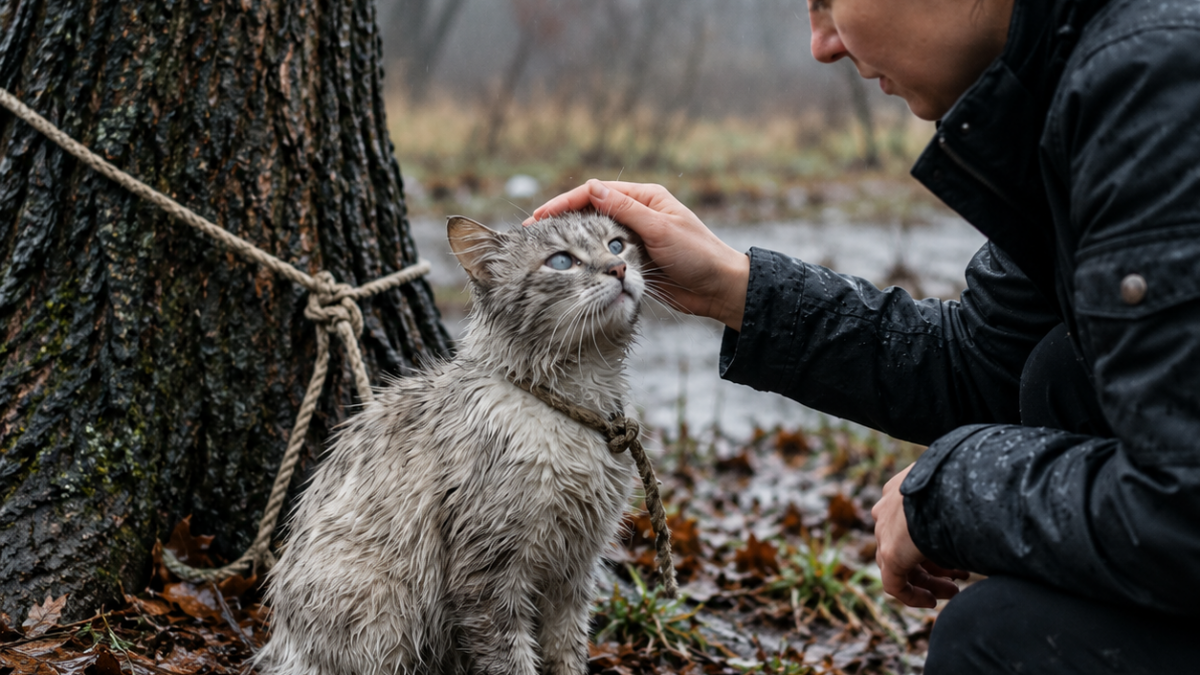
PART 2
The veterinarian asked me to sit down.
I didn’t want to.
Sitting felt too passive.
But my clothes were wet, my hands were cold, and the old cat was somewhere behind a closed door being warmed slowly beneath blankets.
So I sat.
“What does the chip say?”
“We’re contacting the registry.”
“Can you see the owner’s name?”
“Not yet. The clinic gets the identification number, then we verify registration information.”
I looked toward the treatment room.
“Do people really do this?”
The veterinarian knew exactly what I meant.
“Abandon animals?”
“Tie a blind one to a tree.”
Her expression hardened.
“Unfortunately, people do many things that are hard to understand.”
I rubbed my hands together.
“Could he have gotten tied there somehow?”
“No.”
Her answer was immediate.
“The line was attached intentionally.”
“I know.”
“You’re asking because you’d prefer another explanation.”
She was right.
I wanted an accident.
A misunderstanding.
Anything except the obvious.
Maybe an elderly person had become ill and someone else had made a terrible decision.
Maybe the cat had been stolen.
Maybe someone had found him wandering and tied him there temporarily.
But the cold facts kept returning.
No food.
No water.
Cold rain.
Blind.
Thin.
Tightly secured.
Nothing about it looked temporary.
A technician came through the doors.
“He ate a little.”
I stood immediately.
“Already?”
“Only a small amount.”
“That’s good?”
“For him, yes.”
“Can I see him?”
“In a few minutes.”
She smiled.
“He seems to like people.”
That sentence made me angry all over again.
Of course he liked people.
That was part of the tragedy.
Whoever had abandoned him hadn’t left behind a feral cat who wanted nothing to do with humans.
They had left a cat who trusted them.
A cat who purred when I picked him up.
A cat who probably spent hours listening for familiar footsteps.
I pictured him beside the tree.
Rain.
Wind.
Cars somewhere beyond the park.
Every sound could have been them coming back.
Every sound wasn’t.
A few minutes later, they let me into the treatment area.
The cat was inside a kennel lined with warm blankets.
An IV catheter was taped to one front leg.
His fur looked even worse beneath bright clinic lights.
Matted along his sides.
Mud around the paws.
Bones beneath everything.
But he was warmer.
I crouched.
“Hey.”
His head turned directly toward my voice.
Then he stood.
The veterinarian said, “Careful. He’s still weak.”
The cat moved toward the front of the kennel.
He found my fingers through the bars.
Rubbed his cheek against them.
Started purring.
“You’re ridiculous,” I whispered.
His purr became louder.
The veterinarian smiled.
“That’s a good sign.”
“How old is he?”
“Difficult to say exactly without records. Probably thirteen or older.”
“And his eyes?”
She became more serious.
“He’s completely blind as far as we can tell.”
“Can it be fixed?”
“Probably not. The important question is whether the eyes are painful.”
I looked at them.
Both were cloudy.
One looked slightly larger.
“What would make them painful?”
“Glaucoma is one possibility. Chronic inflammation. Several conditions. We’re checking pressure.”
“If they’re painful?”
“Medication first, depending on the cause. If an eye is permanently blind and remains severely painful despite treatment, removal can sometimes be the kindest option.”
I stared at her.
“Removing his eye?”
“Potentially.”
He rubbed harder against my hand.
I swallowed.
“He’s already lost his sight.”
“I know.”
“He was abandoned.”
“I know.”
“And now he might lose an eye.”
She nodded slowly.
“Sometimes what sounds like another loss is actually relief from pain.”
I remembered that sentence later.
At the time, I hated it.
The receptionist entered.
“We reached the chip registry.”
My heart jumped.
“And?”
She held a paper.
“The cat’s registered name is Toby.”
The cat’s ears moved.
I looked at him.
“Toby?”
His head turned instantly.
Every person in the room froze.
I said it again.
“Toby.”
He meowed.
Not weakly this time.
Clearly.
The receptionist whispered, “Well, that’s definitely his name.”
Something inside me twisted.
This wasn’t an unnamed stray.
Toby.
He knew his name.
He had lived somewhere long enough to learn it.
Somebody had said it thousands of times.
Toby, dinner.
Toby, get down.
Toby, come here.
Toby, good boy.
Toby.
And then one day, somebody tied Toby to a tree.
“Who owns him?”
The receptionist hesitated.
“The registration is to a couple. The contact information may be outdated.”
“Did you call?”
“Both listed numbers.”
“And?”
“One disconnected. The other went to voicemail.”
“What did you leave?”
“A message that their microchipped cat had been found and they should contact the clinic.”
I felt my stomach tighten.
“Don’t tell them where he is.”
Everyone looked at me.
I immediately realized how that sounded.
“I mean… until animal control knows what happened.”
The veterinarian nodded.
“Agreed.”
“I found him tied to a tree. If that’s his owner—”
“We’re documenting everything.”
The veterinarian had already photographed the cord marks around his neck.
The rope itself was in a bag.
I had brought it with us without even thinking about evidence.
Animal control arrived the next morning.
An investigator named Marcus interviewed me.
He asked simple questions.
Where exactly?
What time?
How was the cord tied?
Was Toby wearing a collar?
Had I touched anything else?
Had anyone been nearby?
I answered everything.
Then I asked the question I cared about.
“Did the owners call back?”
Marcus looked at the veterinarian.
She shook her head.
“No.”
“Maybe they haven’t heard the message.”
“Maybe.”
He said it without conviction.
“What do you do now?”
“We try the address connected to the microchip.”
I leaned forward.
“Can I come?”
“No.”
“Why?”
“Because you’re a witness, not an investigator.”
“I’m the person who found him.”
“Exactly.”
He closed his notebook.
“And right now, Toby needs somebody calm around him more than he needs somebody getting arrested for arguing on a porch.”
I stared.
“I wasn’t planning to argue.”
Marcus raised one eyebrow.
I sighed.
“Fine.”
The registered address was only four miles from the park.
Marcus told me that much later.
At first, he told me almost nothing.
That was frustrating.
I went to work.
Or tried.
Every hour, I checked my phone.
At lunch, the clinic called.
I answered before the first ring finished.
“Toby?”
The veterinarian laughed slightly.
“Yes.”
“What’s wrong?”
“Nothing new. I thought you’d want an update.”
“Sorry.”
“He’s warmer. Bloodwork shows dehydration and some kidney stress, but not the catastrophic levels we were worried about.”
“Can kidneys recover?”
“Sometimes values improve with hydration if dehydration is the main cause. We’ll repeat bloodwork.”
“And his eyes?”
Silence.
My stomach tightened.
“What?”
“The left eye pressure is very high.”
“Painful?”
“Almost certainly.”
I closed my eyes.
“And the right?”
“Blind but currently less concerning.”
“So what happens?”
“We’ve started medication.”
“Will it work?”
“We’ll know over the next day or two.”
I hated every answer that involved waiting.
“Is he eating?”
“Yes.”
“Good.”
“Actually, he’s eating extremely well.”
I smiled.
“That’s very good.”
“Don’t celebrate too much. If we let him decide, he’d eat the entire hospital.”
“Let him.”
“No.”
“He’s thirteen and someone starved him.”
“Which is exactly why his stomach needs careful refeeding.”
Logic.
Annoying but correct.
“Can I visit tonight?”
“Yes.”
Toby recognized my footsteps before I spoke.
I didn’t know that until the technician told me.
“He lifts his head whenever you come down the hall.”
“Maybe he recognizes everybody.”
“No. He knows you.”
That hit harder than it should have after two days.
I entered.
“Toby.”
His tail moved.
Cats don’t wag like dogs.
But the end flicked upward, and he pushed himself to standing.
I opened the kennel with permission.
He stepped into my arms.
Not gracefully.
He placed one paw on my chest.
Then climbed.
A fourteen-year-old blind cat who had almost frozen beneath a tree apparently believed I was furniture.
I held him.
“You’re a lot warmer.”
His head pressed against my chin.
Purr.
I sat in a chair.
Toby curled in my lap.
He slept.
For nearly an hour.
That night, Marcus called.
“We contacted the registered owners.”
I stood.
“And?”
“They don’t live at the chip address anymore.”
“Did the new people know them?”
“Yes.”
“What happened to Toby?”
“I’m still working on it.”
“Marcus.”
“Don’t.”
“What?”
“Do the thing where you demand information I can’t give you.”
I walked into my kitchen.
“What can you give me?”
“The couple moved about six months ago.”
“Toby was with them?”
“We believe so.”
“Believe?”
“A former neighbor remembers him.”
My anger sharpened.
“Blind?”
“Yes.”
“Old?”
“Yes.”
“So that’s him.”
“Likely.”
“Did the neighbor know where they moved?”
“Yes.”
“Did you go?”
Silence.
“You did.”
“I’ll call you when I have something I can actually discuss.”
He hung up.
I stared at my phone.
Toby remained hospitalized another three days.
His kidney values improved.
His appetite improved.
His temperature stabilized.
But his left eye pressure did not.
The drops lowered it briefly.
Then it rose again.
The veterinarian showed me the numbers.
I understood none of them except that high was bad.
“He’s probably been dealing with this for a while,” she said.
“How do you know?”
“The enlargement and chronic changes.”
“So he was blind and in pain before they left him.”
“Yes.”
I felt sick.
“Would he have cried?”
“Not necessarily.”
“How would an owner know?”
“Squinting. Rubbing the face. Behavioral changes. Less activity. Appetite changes. Sometimes nothing dramatic.”
I remembered Toby sitting under the tree.
Silent.
Old animals often suffer quietly.
That doesn’t mean they aren’t suffering.
The veterinarian recommended removing the left eye.
I asked every question I could think of.
Risks.
Pain.
Recovery.
Quality of life.
Whether surgery was worth it for an old cat with kidney concerns.
She answered each one.
Finally, I asked, “If he were yours?”
“I’d do it.”
“Because?”
“Because that eye can’t see and is hurting him. Age isn’t a disease. His other issues are manageable right now.”
I looked at Toby.
He was licking gravy from a plate with tremendous concentration.
“Does he know he’s old?”
“No.”
“That’s something.”
Surgery was scheduled.
I signed temporary treatment authorization as the finder working with animal control and the rescue organization that had agreed to assume medical responsibility if ownership was legally surrendered or voided.
Paperwork entered the story.
So much paperwork.
Real rescue isn’t only blankets and tears.
It’s signatures.
Invoices.
Consent forms.
Chain of custody.
Emails.
Calls.
Records.
People making sure kindness survives bureaucracy.
Toby went into surgery at nine in the morning.
At 10:30, Marcus called.
I almost didn’t answer because I thought it might be the vet.
“Hello?”
“We have video.”
I stopped.
“Video of what?”
“The park.”
My heart pounded.
“I thought there weren’t cameras.”
“City maintenance camera near the service entrance. It doesn’t cover the tree directly.”
“But?”
“It covers the parking area.”
I sat down slowly.
“Tell me.”
“A vehicle arrived approximately six hours before you found Toby.”
“Six hours?”
“That’s the current estimate.”
Cold rain for six hours.
Blind.
No shelter.
Marcus continued.
“A man exited carrying what appears to be an animal carrier.”
“What happened?”
“He walked toward the area where you found Toby.”
“With the carrier?”
“Yes.”
“Then?”
“He came back nine minutes later.”
“Without it?”
“With the carrier.”
I didn’t understand.
“Then Toby wasn’t in the carrier?”
“We believe Toby was carried separately when he went in. Empty carrier when he came back.”
I stood again.
“Can you identify him?”
“We have a vehicle plate.”
My anger became something sharper.
“Is it the owner?”
“I can’t confirm details yet.”
“You already know.”
“I said I can’t confirm.”
“Marcus.”
He sighed.
“The vehicle is registered to the man listed on Toby’s microchip.”
I closed my eyes.
There it was.
No lost cat.
No misunderstanding.
No stranger.
The man whose phone number had once been attached to Toby’s identification had driven a blind senior cat to a park.
Carried him toward a tree.
Returned alone.
Then left.
“Did you talk to him?”
“Yes.”
“What did he say?”
“Initially, that Toby had been missing for weeks.”
I laughed once.
It sounded ugly.
“And after the video?”
“We haven’t confronted him with everything yet.”
“He lied.”
“Yes.”
“Are you charging him?”
“We’re building the case.”
“What else do you need?”
“A full statement. Veterinary records. Confirmation from witnesses that the cat was in their care. Anything establishing intent and condition before abandonment.”
“He was tied to a tree.”
“I know.”
“You have video.”
“I know.”
“He was registered to the man.”
“I know.”
Marcus’s voice remained calm.
That made me angrier.
Then I realized why.
He needed calm.
Anger doesn’t make evidence stronger.
“Sorry.”
“You don’t need to apologize.”
“What can I do?”
“Take care of Toby.”
“I’m not even sure he’s legally mine to take care of.”
“Right now, he’s in protective custody through the rescue.”
“That sounds ridiculous for a cat.”
“It means nobody can simply walk into the clinic and take him.”
That mattered.
Because two hours later, someone tried.
I was in the veterinary waiting room when the front door opened.
A man and a woman entered.
Mid-fifties.
Expensive rain jackets.
Tense faces.
The receptionist looked up.
“Can I help you?”
The woman said, “We’re here for Toby.”
Every muscle in my body tightened.
I knew before anyone told me.
The man from the video.
The owners.
The woman spotted me.
“Are you the one who found him?”
I didn’t answer immediately.
Marcus had told me not to confront them.
My entire nervous system ignored that advice.
“Yes.”
The woman sighed as though inconvenienced.
“Thank God. We’ve been worried sick.”
I stared at her.
“Really?”
The receptionist stood.
“Ma’am—”
The man cut in.
“Our cat went missing.”
I looked at him.
“You tied him to a tree.”
His face changed.
Not guilt.
Calculation.
“I don’t know what you’re talking about.”
“There’s video.”
The woman looked at him.
That was interesting.
Only for half a second.
Then she said, “Video of what?”
I stood.
My heart was hammering.
“Toby was found tied to a tree in cold rain. Blind. Dehydrated. Underweight.”
The man pointed at me.
“You don’t know anything about our cat.”
I took one step forward.
The receptionist said my name.
Warning.
I stopped.
The clinic manager appeared.
Then Marcus came through the treatment-area doors.
I hadn’t known he was there.
Maybe the clinic had called animal control when the owners said they were coming.
Good.
Marcus looked at the couple.
“You were instructed to contact my office.”
The man’s voice changed.
“We just want our cat back.”
Marcus nodded.
“Then we should talk.”
“He belongs to us.”
“That’s one of the things we’re establishing.”
The woman looked toward the back.
“Is he okay?”
That was the first question either of them had asked about Toby’s condition.
I hated myself for noticing.
The veterinarian came out.
“Toby is in surgery.”
The woman gasped.
“Surgery? What did you do?”
The veterinarian remained calm.
“He has severe glaucoma in his left eye. The eye was blind and painful. Medical treatment did not sufficiently control the pressure.”
The man said, “You removed his eye without permission?”
Marcus stepped between the conversation.
“The cat is under protective veterinary care.”
“He’s ours!”
The man raised his voice.
From somewhere behind the treatment door came a faint sound.
A cat meowing.
Not Toby.
Probably another patient.
Still, the woman flinched.
I wondered whether Toby would recognize their voices.
I hoped he wouldn’t have to hear them.
Marcus directed the couple into another room.
The man glared at me as he passed.
I said nothing.
That was harder than anything I’d done all week.
The woman stopped beside me.
For one second, I thought she might apologize.
Instead she whispered, “You don’t understand how difficult he became.”
I stared.
“What?”
Marcus said her name.
But she’d already started.
“He was peeing outside the box. Walking into things. Crying at night. We tried.”
My anger disappeared.
Not because I forgave her.
Because the sentence revealed everything.
“You tried what?”
She looked away.
“Toby was almost fifteen.”
“Then he needed you.”
“You weren’t there.”
“No.”
I lowered my voice.
“But I was there after you left.”
Her eyes filled.
That surprised me.
“We couldn’t sleep. My husband lost his job. We were moving into a smaller place. Toby was sick all the time.”
“Then surrender him.”
“No shelters wanted an old blind cat.”
“Did you call them?”
Silence.
“Did you?”
Marcus stepped closer.
“That’s enough.”
The woman whispered, “We thought someone would find him.”
That sentence almost made me lose whatever restraint remained.
“In a nearly empty park?”
She began crying.
“Someone did.”
The words came out before I could stop them.
“Six hours later.”
Marcus put a hand up.
“Stop.”
I did.
Because Toby was still in surgery.
Because yelling would not make his recovery easier.
Because the most important thing in that building was not the people who had failed him.
It was the old cat fighting to wake up.
The surgery went well.
The damaged eye was removed.
When I saw Toby afterward, my stomach dropped.
One side of his face was shaved.
The eyelid stitched closed.
He was groggy.
Small.
Old.
Vulnerable.
I crouched beside the recovery kennel.
“Toby.”
His head moved.
The tail lifted once.
Then he tried to stand.
“No.”
The technician laughed.
“He heard you.”
I opened the kennel enough to put my hand inside.
Toby found it.
Pressed his face against my wrist.
The side without surgery.
“You don’t need that eye anymore.”
He purred weakly.
“You’re still handsome.”
Another purr.
The veterinarian said, “He’s already more comfortable.”
“So fast?”
“The pressure pain is gone.”
I thought about the people outside.
People who had described him as difficult.
Walking into things.
Crying.
Not using the litter box.
How much of that had been blindness?
Pain?
Age?
Fear?
Medical problems they hadn’t treated?
Maybe not all.
Old animals do become harder.
They need more.
That is the contract.
We take them when they’re young and entertaining.
They stay when we’re tired and inconvenient.
Then one day they become the tired, inconvenient ones.
We stay.
That should be the deal.
Toby had upheld his side for fourteen years.
His people had decided the contract expired when he became difficult.
I stayed with him until the clinic closed.
Before leaving, Marcus found me.
“They surrendered ownership.”
I looked up.
“What?”
“The couple signed.”
“Voluntarily?”
“After legal consultation.”
“So Toby can’t go back?”
“No.”
I sat down.
I hadn’t realized how much fear I’d been holding until it disappeared.
“Is he the rescue’s now?”
“Yes.”
“Can I foster him?”
Marcus smiled.
“Already arranged.”
I narrowed my eyes.
“What?”
“The rescue coordinator said you’d ask.”
“That’s presumptuous.”
“Is it wrong?”
“No.”
“Then go home.”
Toby came home with me four days later.
I had never lived with a blind cat.
I spent the previous nights researching until my eyes hurt.
Keep furniture stable.
Use texture cues.
Talk before touching.
Block unsafe stairs.
Avoid clutter.
Keep food and water in consistent locations.
Use scent and sound.
Let him map the environment.
Don’t carry him everywhere.
Blind doesn’t mean helpless.
I bought three beds.
Two litter boxes.
A heated mat.
Raised food bowls.
A fountain.
Different textured rugs.
A ridiculous amount of supplies.
My sister saw the receipt.
“Are you opening a cat retirement facility?”
“Maybe.”
“He needs all this?”
“No.”
“Then why?”
“I don’t know.”
She looked at me.
“You love him.”
“I’ve known him twelve days.”
“You bought orthopedic pet stairs.”
“They were on sale.”
She laughed until she cried.
The first hour at home was difficult.
I placed Toby in a small quiet room.
Opened the carrier.
Waited.
He stayed inside.
“Toby.”
His ears moved.
“It’s me.”
He stepped forward.
One paw.
Another.
His whiskers worked constantly.
He bumped the carrier door.
Stopped.
Changed direction.
I resisted the urge to guide him.
The veterinarian had warned me.
Let him learn.
He found the rug near his water bowl.
Sniffed.
Drank.
Then walked directly into the side of a chair.
I winced.
Toby didn’t.
He backed up.
Turned.
Tried another direction.
That was my first lesson.
I was more upset by his blindness than he was.
To Toby, blindness was already reality.
He wasn’t waiting to become sighted.
He was solving the room.
By the second day, he knew where the litter box was.
By the third, water.
By the fourth, he discovered the heated bed.
That became his.
Immediately.
No negotiation.
Toby stepped onto it.
Circled.
Lowered himself.
Then made a sound that was almost a sigh.
I smiled.
“Good?”
Purr.
“That’s what I thought.”
At night, he cried.
The woman had mentioned that.
I understood now.
He would wake in unfamiliar darkness—which meant nothing visually, but the house sounded different at night.
Pipes.
Refrigerator.
Cars outside.
He’d stand and call.
“Mrrrow.”
I would answer from the bedroom.
“Toby.”
Silence.
Then footsteps.
Slow.
Tap.
Tap.
Whiskers brushing walls.
“Toby.”
Another meow.
The first three nights, I slept on the floor beside him.
The fourth, he followed my voice into the bedroom.
He found the small ramp to the bed because I had placed a textured rug beneath it.
Step.
Pause.
Step.
He reached the mattress.
Sniffed.
Then climbed onto my chest.
Fourteen pounds of elderly cat.
“Okay.”
He sat directly on my lungs.
“Not ideal.”
Purr.
“Toby.”
More purring.
I moved him beside me.
He returned.
I gave up.
That became our routine.
His recovery from surgery was surprisingly smooth.
Once the incision healed, he became more active.
The veterinarian had been right.
The painful eye was gone.
Toby seemed younger without it.
Not physically.
His legs were still stiff.
He still moved slowly.
But he explored.
He demanded food.
He began grooming himself more.
One morning, I heard a crash in the kitchen.
I ran.
Toby stood beside a fallen plastic container.
“How?”
Meow.
“You can’t even see the counter.”
Apparently vision had never been required for crime.
He learned the apartment by memory.
The hallway had eight steps from bedroom to rug.
The living room opened left.
Sofa edge there.
He used whiskers, scent, sound, and remarkable spatial memory.
If I moved a chair, Toby found it.
Then I got judged.
At least I felt judged.
One evening, I left a grocery bag in his route.
Toby bumped it.
Stopped.
Sat.
Meowed loudly.
I came running.
“What?”
Meow.
“It’s a bag.”
Meow.
“I’ll move it.”
Silence.
My sister laughed.
“He’s trained you.”
“Apparently.”
“Blind cat, sighted servant.”
Correct.
His bloodwork continued improving.
He gained weight.
Not quickly.
Gradually.
His coat changed.
Good food.
Regular grooming.
Warmth.
Medication for arthritis.
Dental work once he was strong enough.
He began looking less like the abandoned cat beneath the tree and more like somebody’s retired king.
Toby had rules.
Breakfast by seven.
He accepted 7:05 under protest.
Anything later required formal complaint.
Warm bed must remain plugged in.
Window opened slightly on mild days so he could smell outside.
Chicken outranked all other foods.
Vacuum cleaner was evil.
My sister was acceptable.
Marcus was suspicious because he smelled like dogs.
The veterinarian was unforgivable because she touched his feet.
Life became normal.
The investigation did not.
I received updates because I was the finder and a witness.
The park video mattered.
So did Toby’s microchip.
Former neighbors gave statements.
One neighbor remembered the couple discussing moving.
Another remembered the husband complaining that Toby “kept making messes.”
A woman from the building told investigators she’d offered to help find a rescue.
The couple had declined.
“He’s our responsibility,” they’d told her.
Two weeks later, they moved.
Toby disappeared at the same time.
That testimony made me angrier than the video.
They had been offered help.
Not perfect help.
Not immediate adoption.
But a path.
They chose the tree.
The husband eventually admitted tying Toby there.
His explanation changed repeatedly.
First, Toby had run away.
Then he had been “relocated.”
Then they’d intended to return.
Then the final version:
He believed someone would find Toby quickly because people walked through the park.
In freezing rain.
Late afternoon.
Far from the main path.
Tied behind bushes.
Marcus told me this over coffee.
I stared at him.
“He thought someone would find him.”
“That’s the statement.”
“Then why tie him where he couldn’t reach the path?”
Marcus said nothing.
“Why behind bushes?”
Nothing.
“Why no sign? No note? No food?”
“I know.”
“Why not the shelter?”
“They claim they’d been told shelters were full.”
“By who?”
“No record.”
I laughed bitterly.
“Toby waited six hours.”
“At least six.”
“What if I hadn’t taken the shortcut?”
Marcus looked at me.
“Someone else might have found him.”
“That’s not an answer.”
“No.”
I hated that he was honest.
There are questions that cannot be answered without imagining the worst.
So I stopped asking.
The case moved toward court.
I didn’t attend every proceeding.
I had Toby to care for.
He did not care about legal strategy.
He cared that arthritis medicine came hidden in the correct brand of food.
Priorities.
One morning, a local reporter called.
I had no idea how she got my number.
“Would you be willing to talk about Toby?”
“No.”
“Can I ask why?”
“Because he’s an old cat, not content.”
Pause.
“We’re covering the cruelty case.”
“Cover the case.”
“We’d like to show his recovery.”
I looked at Toby.
He was asleep upside down on the heated bed.
One paw in the air.
His stitched eye had healed into a smooth closed line beneath growing fur.
“You can use the rescue’s approved photo.”
“Would you speak on camera?”
“No.”
I hung up.
My sister said I was too harsh.
Maybe.
But Toby didn’t owe anyone inspiration.
He’d already paid enough.
Still, the story spread.
Blind senior cat tied to tree.
Found in cold rain.
Owners charged.
People became angry.
Good.
Then some people became ugly.
Threats toward the former owners appeared online.
Not good.
I told the rescue to post something simple.
Accountability matters.
Threats don’t help animals.
The case would be handled legally.
Toby was safe.
That was enough.
Revenge fantasies are easy from a distance.
Living with Toby changed mine.
At first, I wanted the people who left him to hurt.
I imagined them cold.
Alone.
Afraid.
Then Toby would climb onto my lap.
Warm.
Fed.
Purring.
And the anger would become less useful.
What did punishment do for Toby in that moment?
Nothing.
He needed his medicine.
His heated bed.
His predictable room.
Love is practical.
Anger rarely is.
That didn’t mean consequences were unnecessary.
They were.
Because accountability protects future animals.
But I stopped wanting suffering for suffering’s sake.
The court date came in early spring.
I had to testify.
I wore a shirt Toby had shed fur on despite my best efforts.
Appropriate.
The courtroom was smaller than television teaches you to expect.
No dramatic music.
No shouting lawyers.
Paper.
Questions.
Dates.
Photographs.
I described the park.
The weather.
The sound.
The rope.
Toby’s condition.
“Did the animal attempt to leave the location?”
“He couldn’t.”
“Why?”
“He was tied to the tree.”
“Did he have access to food?”
“No.”
“Water?”
“No.”
“Shelter?”
“No.”
“Could he see?”
“No.”
“How do you know?”
“He didn’t track movement, and veterinary examination confirmed complete blindness.”
The attorney asked whether I personally saw the defendants leave Toby.
“No.”
“Then you cannot say who tied him.”
“I did not see it happen.”
Simple.
No embellishment.
Evidence didn’t need my anger.
The video followed.
I saw it properly for the first time.
Dark SUV.
Park service entrance.
Man exits.
Opens rear door.
Reaches inside.
His body blocks the camera partly.
Then he walks away carrying Toby.
Even from a distance, I recognized the old cat’s shape.
Maybe imagination.
Maybe not.
Nine minutes later, the man returned with an empty carrier.
He got into the vehicle.
Drove away.
That was it.
No dramatic pause.
No backward glance visible from the camera.
Just departure.
The prosecutor showed veterinary photographs.
I looked down.
I hated seeing them.
Toby wet.
Matted.
Collar line.
Mud.
Clouded eyes.
His former owner looked away too.
Good.
Not because I wanted guilt.
Because looking away had already caused enough.
At a later stage, the woman testified.
Her voice shook.
She said Toby had been hers since he was a kitten.
Fourteen years.
Fourteen.
He slept with their daughter when she was young.
He sat in the kitchen every morning.
He had once disappeared inside a couch during a move and kept everyone searching for hours.
She smiled while describing it.
Then the smile vanished.
Over the last two years, Toby lost his vision.
Started crying at night.
Missed the litter box.
Needed medication.
The couple’s finances deteriorated.
They moved to a smaller rental that required additional pet fees.
Her husband became angry.
She became overwhelmed.
“Did you seek veterinary care?”
“Sometimes.”
“Did you contact rescues?”
“I looked online.”
“Did you call?”
She hesitated.
“One.”
“Did they refuse Toby?”
“They said they had a wait list.”
“Did you join it?”
“No.”
“Why?”
Silence.
“Did a neighbor offer help?”
“Yes.”
“Did you accept?”
“No.”
“Why?”
Long silence.
“I was ashamed.”
That answer hit differently.
Shame.
A dangerous emotion when it stops people asking for help.
“Did you know your husband intended to leave Toby in the park?”
She cried.
“Yes.”
My stomach dropped.
She had always implied he decided.
“Did you object?”
“Yes.”
“Did you stop him?”
“No.”
“Did you go with him?”
Another pause.
“Yes.”
The courtroom felt smaller.
“Why?”
She wiped her face.
“I told myself someone would find him.”
I closed my eyes.
There it was again.
Someone.
The invisible person cruel decisions depend on.
Someone will find him.
Someone will feed him.
Someone will take responsibility.
Someone.
Apparently I had been “someone.”
I didn’t feel heroic.
I felt late.
The husband spoke later through a plea agreement.
He admitted abandonment and cruelty-related conduct.
He claimed he hadn’t intended Toby to die.
That mattered legally.
Emotionally, intent only went so far.
You don’t need to want death to create lethal danger.
The outcome included probation, significant fines, restitution toward veterinary care, mandatory education/community-service requirements, and restrictions on possessing animals during the court-ordered period.
Some people online said it wasn’t enough.
Part of me agreed.
Then I went home.
Toby was waiting near the door.
He knew the sound of my key.
“Mrrrow.”
I crouched.
“Hey.”
He walked toward me.
Found my knee.
Rubbed.
I picked him up.
“You won.”
He purred.
Then bit my shirt because dinner was late.
That was the real verdict.
The people who had treated him as a burden no longer controlled anything about his life.
They didn’t decide when he ate.
Where he slept.
Whether medication was worth paying for.
Whether blindness made him inconvenient.
Whether old age reduced his value.
They had given up those rights.
Toby had lost them.
Then gained something better.
A home where nobody viewed care as temporary.
The rescue organization eventually asked if I was ready to finalize his adoption.
I acted offended.
“He’s already mine.”
The coordinator laughed.
“Legally, he’s ours.”
“Rude.”
“Would you like the paperwork?”
“Yes.”
“You could also continue fostering.”
“No.”
Immediate.
No hesitation.
She laughed harder.
“That answers that.”
Adoption day happened almost five months after I found him.
Toby wore nothing special.
No bow tie.
No costume.
He hated clothing.
I signed forms while he sat inside a carrier loudly insulting everyone.
The coordinator said, “He has strong opinions.”
“He learned them from me.”
“Any concerns?”
“Yes.”
“Medical?”
“No. He snores.”
She stared.
“That’s your concern?”
“It’s loud.”
Toby meowed.
“See?”
We took a photograph.
I held him.
He faced the wrong direction because, obviously, cameras meant nothing to him.
I loved that.
The official adoption picture showed me smiling at the camera while Toby stared toward a wall.
Perfect.
At home, nothing changed.
That was how I knew adoption was right.
No adjustment.
No transition.
He was already home.
The paper simply caught up.
Toby’s favorite place became the living-room window.
He couldn’t see outside.
Still, he loved it.
I installed a wide padded shelf.
He sat there for hours.
Wind through the screen.
Bird sounds.
Cars.
People talking.
Leaves moving.
His nose constantly worked.
Blind didn’t mean the world was dark in the way sighted people imagine.
The world was sound.
Smell.
Texture.
Warmth.
Vibration.
Routine.
Toby knew when rain was coming before I did.
He knew my sister’s car from another vehicle.
He knew the difference between opening a tuna can and opening beans.
That ability bordered on supernatural.
He knew when I was sad.
Or maybe he simply liked laps more when people sat still.
Either way, he appeared.
One evening, months after court, I came home furious after a terrible day.
Nothing to do with Toby.
Work.
Money.
Life.
I dropped my keys.
Sat on the couch.
Put both hands over my face.
Toby was sleeping in his window spot.
His ears moved.
A minute later:
Tap.
Tap.
Tap.
He crossed the room.
Bumped my shoe.
Found my leg.
Climbed onto me.
No dramatic gesture.
Just weight.
Warmth.
Purr.
I scratched his head.
“You know, you’re expensive.”
Purr.
“High maintenance.”
More purring.
“Walk into walls.”
His paw touched my chin.
I laughed.
“Okay.”
I thought about the phrase his former owner had used.
He became difficult.
Maybe.
Toby was difficult sometimes.
Medication.
Veterinary bills.
Night crying early on.
Occasional litter-box accidents when arthritis flared.
He required ramps.
Consistent furniture placement.
Patience.
So what?
People become difficult too.
Children.
Parents.
Partners.
Ourselves.
Need is not betrayal.
The day somebody depends on you most is not automatically the day your obligation disappears.
That became the center of Toby’s story for me.
Not blindness.
Not abandonment.
Commitment.
What do you do when the creature who trusted you becomes inconvenient?
You adapt.
Or ask for help.
You don’t tie him to a tree.
Toby turned fifteen.
Estimated birthday.
The microchip registration had a date.
I celebrated.
He received chicken.
A new blanket.
A cardboard box he loved more than the expensive blanket.
My sister bought a toy with a bell.
Toby located it immediately.
For thirty minutes, he attacked the sound.
Then slept for three hours.
Senior athletics.
That winter, arthritis worsened.
He became hesitant on cold mornings.
The veterinarian adjusted medication.
We added rugs everywhere.
My apartment began looking like a strange patchwork map.
Each texture meant something.
Rough mat near litter box.
Soft rug near bed.
Runner through hallway.
Rubber mat under bowls.
Toby navigated them confidently.
Visitors had rules.
Do not move chairs.
Do not leave bags in hallways.
Say his name before touching.
If he is sleeping, don’t startle him.
If he yells for food, ignore him until actual meal time.
Nobody followed the last rule.
Especially my sister.
“You are ruining him.”
“He’s fifteen.”
“He’ll live to twenty because you keep feeding him.”
“Good.”
Fair.
A year after adoption, Marcus visited.
Not officially.
He was nearby and asked if he could see Toby.
“Prepare for disappointment.”
“Why?”
“He doesn’t care about you.”
Marcus entered.
“Toby.”
Toby lifted his head.
Sniffed.
Walked toward him.
Marcus crouched.
Toby rubbed against his hand.
I frowned.
“Traitor.”
Marcus laughed.
“Animals like me.”
“You work animal control.”
“Exactly.”
“You also smell like six dogs.”
“Apparently that’s attractive.”
Toby climbed partly into his lap.
Marcus looked at me.
“He looks completely different.”
I studied Toby.
Marcus was right.
Weight.
Coat.
Posture.
The empty eye socket had healed long ago, covered naturally by fur around the closed lid.
His remaining blind eye was stable.
His muscles were better.
He looked old.
But healthy old.
Not abandoned old.
“Do you ever see cases like his again?” I asked.
“Too many.”
“Does it get easier?”
“No.”
“Then how do you keep doing it?”
Marcus scratched Toby’s neck.
“You don’t make it about whether it feels easy.”
That stayed with me.
Toby became known at the clinic.
Not famous.
Infamous.
He hated temperature checks.
Tolerated blood pressure.
Loved one technician named Sarah because she bribed him shamelessly.
The veterinarian checked his kidneys every few months.
Chronic disease emerged slowly.
Manageable at first.
Special food.
More water.
Monitoring.
I felt panic.
“Is he dying?”
The vet stared at me.
“He’s sixteen.”
“That’s not an answer.”
“Everyone is dying technically.”
“Terrible bedside manner.”
She smiled.
“His kidney disease is early. We’re managing it.”
“How long?”
“No one knows.”
I hated that answer less than before.
Toby had taught me to live with uncertainty.
He didn’t know how much time he had.
Neither did I.
So we handled what existed.
Today.
Eat.
Drink.
Medicine.
Purr.
Repeat.
At night, he still sometimes called.
Not because he was lost anymore.
I think he simply wanted confirmation.
“Mrrrow.”
“Toby.”
Silence.
Then he slept.
Sometimes I wondered whether the park remained somewhere inside him.
Cats remember places.
Sounds.
Fear.
I couldn’t know.
But once, during a thunderstorm, Toby woke suddenly and began pacing.
Rain hit the windows hard.
Wind bent branches.
He cried.
Low.
Broken.
Similar to the sound I’d heard the first day.
I got onto the floor.
“Toby.”
He stopped.
Turned toward me.
“You’re inside.”
He came closer.
“No tree.”
He touched my hand.
“No rope.”
He climbed into my lap.
“You’re home.”
His purr started.
I sat there until the storm passed.
That was the only revenge I ever needed against the night he was abandoned.
Every storm afterward happened inside.
Every cold night ended on a heated bed.
Every hunger ended at a bowl.
Every cry received an answer.
The original park eventually changed.
The old bench was removed.
Bushes trimmed.
New lights installed after the case drew attention to safety gaps.
A small sign warned against abandoning animals and listed shelter and rescue numbers.
Marcus sent me a photograph.
“You did this?”
“City did.”
“Because of Toby?”
“Partly.”
I looked at the sign.
**Need help caring for an animal? Call before abandoning. Options exist.**
I liked that.
Not because it excused cruelty.
Because prevention mattered.
If one overwhelmed person called instead of leaving an animal, good.
Toby didn’t care.
He was asleep.
I showed him the picture.
“Your legacy.”
Snore.
“Very moving.”
Snore.
His former owners disappeared from my life.
Mostly.
Then, nearly two years after the case, the woman sent a letter through the rescue.
They asked whether I wanted it.
My first answer was no.
Then curiosity won.
The letter was three pages.
I read it at my kitchen table.
She apologized.
Not elegantly.
Not perfectly.
She wrote about shame.
Financial problems.
Her husband’s anger.
Her own cowardice.
She admitted Toby had trusted her.
She said that fact kept her awake.
She didn’t ask for forgiveness.
She asked one question.
**Is he okay?**
I looked across the room.
Toby was asleep in sunlight.
His paws twitched.
I didn’t answer immediately.
For days, the letter stayed in a drawer.
Part of me thought she had no right.
Another part remembered what Marcus had once told me.
Anger doesn’t make evidence stronger.
Maybe anger didn’t make healing stronger either.
Eventually, I wrote back through the rescue.
One sentence.
**Toby is safe, comfortable, loved, and still enjoys chicken more than anything else.**
Nothing more.
She didn’t need photographs.
She didn’t need access.
She didn’t need emotional absolution.
But she could know he survived.
That was enough for me.
Maybe too kind.
Maybe not.
Toby was unaffected.
He continued running the household.
At seventeen, he slowed significantly.
He slept almost eighteen hours a day.
Mealtime remained non-negotiable.
He still found chicken across impossible distances.
He still climbed onto my chest.
He still complained if doors were closed.
But his body became fragile.
Kidney disease advanced.
Weight began dropping despite appetite support.
We added fluids under the skin.
I learned to administer them.
The first time, I was terrified.
The vet demonstrated.
Pinch skin.
Needle.
Fluids.
Toby objected loudly.
“I know.”
Meow.
“I’m sorry.”
Meow.
“You’re being dramatic.”
The technician laughed.
“That’s good. Quiet sick cats worry us.”
Toby was never quiet.
Even at home, he announced displeasure.
I considered every complaint a gift.
The cat I’d found barely meowing beneath rain now screamed about medical care.
Progress.
At seventeen and a half, he developed high blood pressure.
Medication.
Then nausea.
Medication.
Then appetite fluctuations.
I became the person I’d once criticized emotionally.
Worried.
Exhausted.
Watching every behavior.
Was he suffering?
Was I keeping him because I couldn’t let go?
Or was he still enjoying life?
The veterinarian taught me to look for specifics.
Food interest.
Grooming.
Comfort.
Mobility.
Social behavior.
More good days than bad.
For months, good won.
Toby sat in sunlight.
Purrrr.
Ate chicken.
Purrrr.
Slept on my chest.
Purrrr.
Yelled at doors.
Very alive.
One spring afternoon, I took him outside in a secure harness.
Not to the park.
Never there.
My sister’s enclosed garden.
Toby had always loved outdoor smells through windows.
I placed him on warm grass.
He froze.
Nose working.
Birds.
Soil.
Flowers.
Wind.
Then he took one step.
Another.
Found the edge of a sunny patch.
Lay down.
I sat beside him.
“You like it?”
Purr.
He stayed for twenty minutes.
That became a ritual.
Warm days.
Garden.
Sun.
Toby.
No rope.
No tree holding him captive.
He could move anywhere inside the enclosed space.
Mostly he chose one spot and refused to move.
Cats appreciate freedom by ignoring it.
My sister took a picture of us.
Me sitting cross-legged.
Toby beside me.
His blind face pointed toward the sun.
That photograph became my favorite.
Not the adoption picture.
Not the first clinic recovery photo.
That one.
Because nothing in it looked like rescue.
Just life.
Ordinary.
Peaceful.
Earned.
The following winter was harder.
Toby’s kidneys declined sharply.
One morning he refused chicken.
That scared me.
“Toby.”
He sniffed.
Turned away.
I tried another food.
No.
Tuna.
No.
Treat.
Nothing.
We went to the clinic.
Bloodwork confirmed what I feared.
Kidney values much worse.
Dehydration despite treatment.
Anemia.
The veterinarian admitted him for fluids.
I sat in the car afterward and cried.
Not elegant crying.
Ugly.
Angry.
I wanted to bargain.
You already had him tied to a tree.
You already took his sight.
His eye.
His youth.
Leave me more time.
Life does not bargain.
Toby improved after hospitalization.
Enough to come home.
He ate again.
Not much.
But enough.
We got another two months.
Two months sounds small.
It wasn’t.
Sixty mornings.
Sixty evenings.
Warm beds.
Chicken.
Window air.
My sister’s voice.
Purring.
Time becomes enormous when you know it’s limited.
One evening, Toby couldn’t find the bedroom route.
He knew it better than anything.
He walked into the wall.
Stopped.
Turned.
Went the wrong direction.
“Toby.”
His ears moved.
I called again.
He found me.
I carried him to bed.
That night he didn’t sleep on my chest.
He rested beside me.
I kept one hand on him.
His breathing was slow.
At three in the morning, he meowed.
Weakly.
I woke.
“I’m here.”
He stopped.
That was when I knew.
Not because of the sound alone.
Because something had changed.
He wasn’t calling for location.
He was asking for reassurance.
And for the first time, my reassurance couldn’t fix the body carrying him.
The veterinarian came to my apartment the next afternoon.
I asked for home euthanasia.
I couldn’t take Toby into another clinic if I could avoid it.
His final place should be familiar.
Warm.
His bed.
His smells.
My voice.
My sister came.
Marcus asked if I wanted him there.
I said yes.
He arrived quietly.
Toby lay on the heated bed beneath the window.
Spring light fell across his fur.
Almost eighteen years old.
Maybe more.
The veterinarian sat beside him.
“No rush.”
I laughed through tears.
“Everyone says that during the thing you most want to delay forever.”
She didn’t answer.
No answer existed.
I picked Toby up.
Placed him in my lap.
He was so light again.
That hurt.
It took me back to the park.
Wet fur.
Bones.
Cold paws.
But this time he was warm.
His fur was clean.
No rope.
No mud.
No fear.
I pressed my face against his head.
“You really made this difficult.”
Toby purred.
Faint.
My sister laughed and cried.
“Of course he did.”
I scratched beneath his chin.
“You remember when I found you?”
He obviously didn’t answer.
“Probably not the way I do.”
Purr.
“You were tied to that stupid tree.”
My voice broke.
“You thought I was somebody else.”
Marcus looked away.
“I wasn’t.”
Toby’s paw rested against my wrist.
“But I stayed.”
The veterinarian waited.
I cried into his fur.
“You stayed too.”
When I finally nodded, she gave the sedative.
Toby relaxed.
His body softened against me.
He continued purring.
Then the purr slowed.
Stopped.
The second medication followed after he was fully asleep.
I kept saying his name.
Not because he needed to know who he was.
Because I needed him to hear a voice that wasn’t leaving.
“Toby.”
Breath.
“Toby.”
Breath.
“Toby.”
Stillness.
The veterinarian listened.
Then looked at me.
“He’s gone.”
I knew.
Still, hearing it destroyed something.
I held him.
No one rushed.
Outside, a car passed.
Birds moved in the tree near the window.
Somewhere in the apartment building, somebody dropped something.
Life continued with offensive normality.
Toby didn’t.
My sister put one hand on my shoulder.
Marcus stood near the door.
The investigator who had once told me not to confront people on a porch was crying.
I noticed.
Said nothing.
Afterward, Toby was cremated.
I kept his ashes in a simple wooden box.
No elaborate memorial.
His collar beside it.
The microchip number printed on his records inside a drawer.
That chip had once connected him to the people who abandoned him.
Now it was only part of paperwork.
It didn’t define ownership anymore.
Love did.
For weeks, I still heard him.
Not literally.
Habit.
At seven in the morning, I expected the meow.
When I opened chicken, I looked down.
When I moved a chair, I remembered the rule.
Don’t move furniture.
Then I remembered why the rule no longer mattered.
That hurt every time.
Eventually, I moved the chair.
Then cried.
Grief is ridiculous.
Months later, the rescue asked whether they could use Toby’s story in a program supporting senior and special-needs cats.
I hesitated.
Then agreed with conditions.
No sensational photographs as the main image.
No treating him as helpless.
No framing him only through what happened at the tree.
Use the garden photo.
Blind cat in sunlight.
Peaceful.
Their campaign read:
**Old Doesn’t Mean Finished. Blind Doesn’t Mean Broken.**
I liked that.
Several senior cats were adopted during the program.
One was nineteen.
Another had one eye.
One needed daily medication.
A woman who adopted an elderly blind cat emailed the rescue.
“I saw Toby’s story and realized I was afraid of something I hadn’t even tried.”
They forwarded it to me.
I read it three times.
That was Toby’s revenge too.
Not against the people who left him.
Against the idea that old animals become disposable.
He contradicted it simply by being worth loving.
Because he was.
Expensive.
Inconvenient.
Loud.
Sometimes messy.
Blind.
Medicated.
Stubborn.
Worth loving.
Every single day.
A year after Toby died, I walked through the park again.
I had avoided it.
No dramatic reason.
I simply didn’t want to see the tree.
But eventually, I went.
The weather was cold.
Not raining.
The old bench was gone.
The bushes had been trimmed.
New lights.
The informational sign stood near the entrance.
I knew the tree immediately.
I hated that.
Same trunk.
Same rough bark.
The world had not marked it as special.
I approached.
Touched the place where I remembered the rope being tied.
Nothing remained.
Of course.
I stood there longer than expected.
I thought about the first sound.
That broken meow.
Almost nothing.
If I’d worn headphones, I might not have heard it.
If I’d taken the main road, I wouldn’t have passed.
If rain had become heavier.
If.
If.
If.
Survival stories are full of terrifying accidents.
I stopped thinking about them.
Toby survived because, at the moment he needed someone, someone heard him.
After that, everything was choices.
The veterinarian chose to care.
Marcus chose to investigate.
Neighbors chose to speak.
The rescue chose to take responsibility.
I chose to bring him home.
Toby chose chicken whenever possible.
Everyone contributed differently.
I sat on the ground beside the tree.
Cold seeped through my jeans.
Immediately unpleasant.
Six hours.
Toby had sat there six hours.
Maybe longer.
I lasted three minutes before standing.
That put things into perspective.
Before leaving, I noticed something near the sign.
A small weatherproof box had been installed by a local rescue group.
Inside were laminated cards.
**If you can no longer care for your pet, call these numbers before abandoning.**
Shelters.
Rescues.
Veterinary support.
Pet food assistance.
Temporary foster programs.
No judgment.
Just options.
I took one card.
Not because I needed it.
Because I wanted proof that something had changed.
Back home, I placed it beside Toby’s box.
Then I laughed.
“You’d hate this sentimental nonsense.”
Silence.
I missed his complaint.
Years have passed now.
I eventually adopted another cat.
Not immediately.
For a long time, I thought doing so would feel like replacing Toby.
Then I remembered what I’d learned.
Love isn’t a single parking space.
Another animal doesn’t evict the one who came before.
The new cat was younger.
Sighted.
Completely different.
Still, the first time he slept in Toby’s old heated bed, I cried.
Then I let him.
Beds are for living animals.
Memories don’t need furniture.
Sometimes people ask me whether I ever forgave Toby’s former owners.
I don’t know.
Forgiveness is a big word.
I stopped thinking about them enough to need an answer.
What they did remained wrong.
Their hardship explained pressure.
It did not justify cruelty.
They had options.
They refused them.
A blind senior cat paid the price.
The court handled their responsibility.
My job was Toby.
And Toby had a better ending than the beginning suggested.
That’s the part that matters most.
He didn’t die tied to a tree.
He didn’t spend his final years wondering why nobody came back.
He did not remain “the abandoned blind cat.”
He became Toby.
My alarm clock.
My lap heater.
My furniture inspector.
The loudest critic of delayed breakfast in the city.
The animal who taught me that blindness is not the tragedy people assume it is.
Abandonment was.
Pain was.
Being treated as disposable was.
Blindness?
Toby handled blindness better than most people handle a weak Wi-Fi signal.
He mapped the apartment.
Found sunlight.
Stole food.
Bossed me around.
Loved people.
Lived.
When I think about his former owners now, I don’t picture the courtroom.
I picture the moment the woman whispered:
“We thought someone would find him.”
She was right.
Someone did.
But that doesn’t excuse leaving him.
It only explains why Toby’s story continued.
They expected “someone” to become responsible for the life they no longer wanted to carry.
I became that someone.
At first by accident.
Then by choice.
Every day afterward, by choice.
That’s the part people sometimes miss about rescue.
The dramatic moment is short.
Untying the rope took minutes.
The real rescue was everything after.
The midnight cries.
Eye surgery.
Kidney medication.
Fluids.
Rugs.
Litter accidents.
Vet appointments.
Fear.
Expense.
Warm beds.
Chicken.
Holding him at the end.
Love is not the moment you pick an animal up.
Love is what you keep doing after everyone stops watching.
Toby taught me that.
And if there was revenge in his story, it wasn’t that his former owners stood in court.
It wasn’t the fines.
It wasn’t probation.
It wasn’t losing the right to simply walk back into a clinic and reclaim him.
The real revenge was quieter.
A cold tree became a heated bed.
A rope became an adoption collar.
A bowl that didn’t exist became breakfast every morning.
A cat nobody wanted to manage became the center of my home.
The people who thought his age made him too difficult missed his best years.
They missed the sound he made when sunlight warmed his back.
They missed the ridiculous way he searched for chicken.
They missed him learning the apartment.
They missed him purring through storms.
They missed the garden.
They missed seventeen.
They missed eighteen.
They missed the privilege of being the person he called for in the dark.
That was their consequence too.
Toby trusted people again.
Just not them.
His last years did not belong to abandonment.
They belonged to warmth.
They belonged to the window.
To my sister.
To Marcus’s dog-smelling jacket.
To a veterinarian who saved him from a painful eye.
To a rescue that signed his paperwork.
To my lap.
To chicken.
Mostly chicken.
And on the final afternoon of his life, when he lay warm against me and heard his name again and again, there was no tree.
No cord.
No cold rain.
No footsteps disappearing.
Only people staying.
That is how his story ends for me.
Not with the man walking back toward an SUV.
Not with Toby waiting.
Not with betrayal.
It ends with an old blind cat asleep against my chest, completely certain that when he called out, someone would answer.
I wish I could go back to that first rainy afternoon for only one minute.
I would kneel beside the tree again.
I would loosen the rope.
I would feel him collapse against me.
And before carrying him away, I would whisper something I didn’t know enough to promise at the time.
“You can stop waiting for them.”
“They’re not coming back.”
“But you’re not going to be alone.”
Then I would pick him up.
And this time, when he started purring against my chest, I would understand exactly what that sound would come to mean.
Not gratitude.
Not forgiveness.
Trust.
The people he had loved walked away without looking back.
Toby spent the rest of his life proving that their decision was never a measure of his worth.
He was old.
He was blind.
He needed help.
And he was worth every single difficult day.
Every bill.
Every sleepless night.
Every medicine dose.
Every rug.
Every tear.
Every goodbye.
They left him beside a tree because they thought his life had become too hard to carry.
I carried him home.
And I would do it again.