PART 2: They Shut the Bus Doors on a Soaked Mother Dog and Her Puppies—Then Everyone Saw Who Came Back for Them
PART 2
I had a small package of food with me.
It wasn’t much.
Certainly not enough for a nursing mother who looked as though she had been surviving on scraps for days, maybe longer.
But the moment I opened it, she smelled it.
Her nose lifted.
Her ears moved forward.
For the first time since I had been watching her, hunger overpowered fear.
She took one step toward me.
Then stopped.
I placed some food on the ground.
She stared at it.
“Go ahead.”
She looked at me.
Then at her puppies.
Then back at the food.
I slid it farther away from myself.
“You can have it.”
She approached slowly.
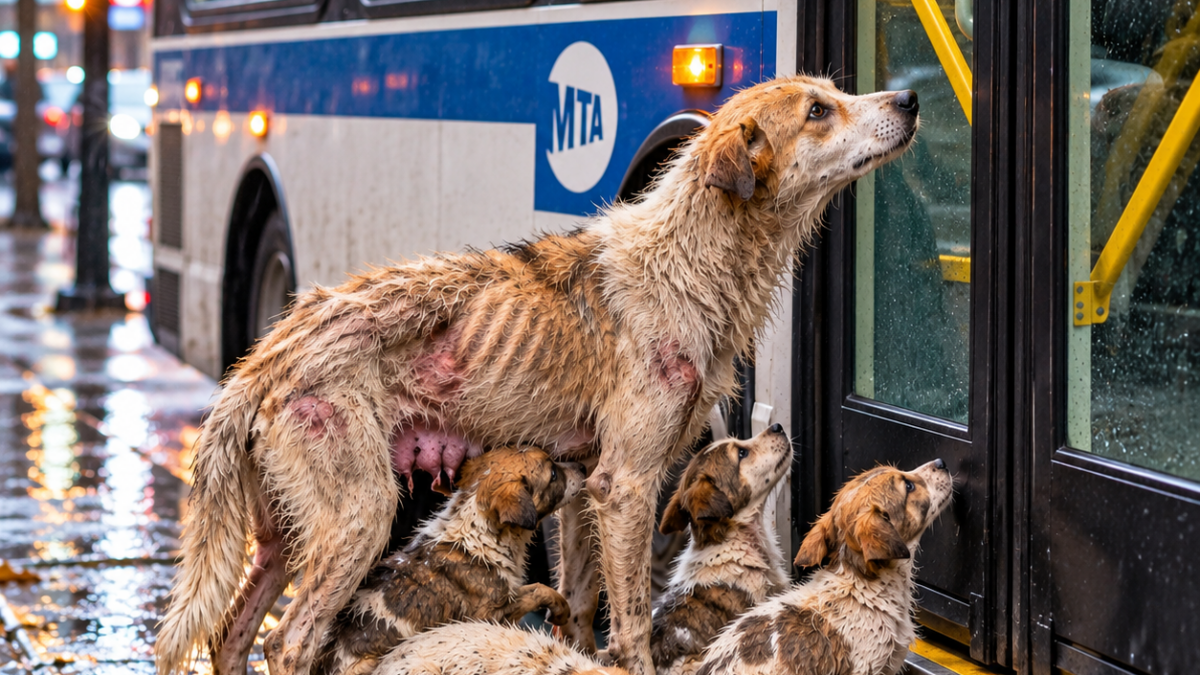
Her paws made tiny splashes in the water collecting along the curb.
When she reached the food, she didn’t eat immediately.
She sniffed.
Looked over her shoulder.
Checked the puppies.
Only then did she take the first bite.
After that, restraint disappeared.
She ate so quickly I became worried she might choke.
“Slow down.”
She couldn’t.
Every bite vanished almost before she had swallowed the previous one.
I put out a little more.
Again, gone.
One puppy wandered toward the food.
The mother paused.
The puppy sniffed at what remained.
Instead of pushing it away, she stepped back.
That stopped me.
She was starving.
I could see every rib.
Her hip bones stood out beneath wet fur.
Yet the moment one of her babies wanted food, she gave up the little she had.
I opened the rest.
“There’s enough.”
There wasn’t.
But I said it anyway.
I spread the food between them.
The puppies were young but old enough to nibble soft food.
Soon five tiny bodies were clustered around what I had placed down.
Their mother watched.
Only when she seemed certain they were eating did she return to her portion.
Rain continued falling.
People continued passing.
Some glanced over.
A few slowed.
Nobody stopped.
That bothered me more now than it had before.
Because once you actually look at an animal in that condition, it’s impossible to pretend you don’t know what you’re seeing.
They were hungry.
They were wet.
They had nowhere safe to go.
It was obvious.
I pulled out my phone.
I called someone I trusted in local rescue.
“I found a mother with five puppies.”
“Where?”
I gave the location.
“Condition?”
“Mother’s thin. All of them soaked. Puppies look weak, but they’re moving.”
“Injuries?”
“Nothing obvious from here.”
“Can you contain them?”
I looked at the mother.
She was still watching me carefully.
“I think so.”
“Do it. We’re coming.”
I ended the call.
The mother dog had finished eating.
She licked the wet pavement where the food had been.
That image made me angrier than I expected.
She was licking rainwater from concrete because even the smell of food mattered.
I took off my jacket.
It wouldn’t keep all of them dry, but I spread it on the ground beneath the shelter.
The puppies hesitated.
Their mother sniffed it.
Then one puppy climbed onto the fabric.
Another followed.
Soon all five had crowded onto it.
The mother remained beside them.
“You can lie down.”
She didn’t.
She watched the road.
Every approaching person caught her attention.
Maybe she still expected someone else.
Maybe she had been begging there long before I arrived.
I asked a nearby vendor whether he’d seen them before.
The man nodded.
“Since morning.”
“All day?”
“Maybe earlier.”
“Did anyone feed them?”
He shrugged.
“Some people gave small things.”
“Do they belong to someone?”
“Don’t know.”
“Have you seen them before today?”
“The mother sometimes comes around.”
That answer opened more questions.
“Where does she sleep?”
Another shrug.
“Somewhere behind the old buildings, maybe.”
I looked at her again.
She was nursing five puppies somewhere around those streets.
That meant she had probably been moving back and forth between wherever she had hidden them and places where she could search for food.
Every calorie she found had to support not just her body, but theirs.
No wonder she looked exhausted.
The bus stop wasn’t random.
It made perfect sense.
People gathered there.
People carried food.
People came and went.
She had learned that humans meant possibility.
A dropped piece of bread.
A bit of meat.
Something edible in a trash can.
She wasn’t standing there because she trusted people.
She was standing there because desperation had made avoiding them impossible.
Another bus arrived.
This time I was already beside her.
Passengers stepped down.
Several stared at the family.
One teenage boy stopped.
“Are they yours?”
“No.”
“What happened?”
“I don’t know yet.”
He looked at the mother.
“She looks really skinny.”
“She is.”
He hesitated, then opened his backpack.
He pulled out part of a sandwich.
“Can I give her this?”
I checked what it was.
“Just a little.”
He tore off a piece and placed it several feet from her.
She ate it immediately.
The boy smiled.
Then his expression changed.
“Why are they out here?”
“That’s what I’m trying to figure out.”
His bus was preparing to leave.
He looked back toward it.
Then at the dog.
“I wish I could help more.”
“You already did.”
He ran for the bus.
That single act mattered.
Not because the food changed everything.
It didn’t.
Because after watching adult after adult step around the family, seeing someone young enough to still be wearing a school backpack stop without being asked reminded me that indifference isn’t inevitable.
People choose it.
Kindness is also a choice.
The rescue vehicle arrived twenty minutes later.
The mother tensed immediately.
Two people stepped out carrying crates and blankets.
“Easy,” I told them. “She’s nervous but hasn’t shown aggression.”
“How many pups?”
“Five.”
One rescuer counted.
“One, two, three, four, five.”
“Check around anyway.”
We searched beneath benches.
Behind the shelter.
Along the wall.
No others.
The mother watched everything.
When we lifted the first puppy, she stepped forward quickly.
“It’s okay.”
She sniffed the rescuer’s arm.
The puppy squeaked.
The mother’s entire body went rigid.
“Keep the baby where she can see.”
We did.
The puppy was placed carefully inside a crate lined with dry towels.
One by one, the others followed.
The mother looked between the crate and us.
When all five were inside, we opened a second, larger carrier for her.
She refused.
I didn’t blame her.
A dark box held by strangers probably didn’t look like rescue.
It looked like another trap.
I crouched near the entrance.
“Your babies are in there.”
She looked toward the puppy crate.
A small nose poked through the opening.
One puppy whined.
The mother stepped closer.
“Come on.”
She sniffed the carrier.
Backed away.
Tried again.
Then finally placed one front paw inside.
The rescuer beside me whispered, “Don’t move.”
Second paw.
She stretched her neck toward the puppies.
Then climbed in.
We closed the door gently.
For the first time since I had seen her, she was out of the rain.
I stood up.
My knees ached from crouching.
My clothes were wet.
I couldn’t stop staring at the bus shelter.
The whole rescue had happened in full view of everyone.
That was what stayed with me.
If the family had been hidden deep in an abandoned building, I could understand how suffering might go unnoticed.
But this wasn’t hidden suffering.
This was suffering surrounded by witnesses.
And there is a difference.
At the clinic, we learned just how depleted the mother was.
She was severely underweight.
Dehydrated.
Her skin had small sores.
Her paws were irritated from spending so much time on wet, dirty ground.
Fortunately, there were no major fractures or obvious traumatic injuries.
The puppies were cold and undernourished but stable.
That was the good news.
The difficult part was understanding how long the mother had been living this way.
The veterinarian ran a hand gently along her side.
“She’s been feeding these puppies at her own expense.”
I looked at her ribs.
“What does that mean?”
“Her body has been using everything it has.”
“Will she recover?”
“With food, rest and treatment, there’s a good chance.”
“And the puppies?”
“They need monitoring. But right now, they’re stronger than she is.”
Of course they were.
She had given them everything.
I looked at the mother.
We decided to call her Grace.
Not because she looked graceful.
At that moment, she looked like exhaustion with four legs.
We called her Grace because even starving, she had stepped away from food when her puppy approached.
That deserved a name.
Grace and her puppies were placed together in a warm area.
Dry blankets replaced concrete.
Fresh water replaced puddles.
Measured meals replaced whatever scraps Grace had managed to find.
At first, she didn’t sleep.
She lay down, but her eyes remained open.
Whenever someone entered, her head lifted.
Whenever a puppy moved, she checked it.
When food appeared, she ate fast.
Too fast.
We had to divide her meals.
Small amounts.
Regular intervals.
The first time a bowl was removed before she had eaten herself sick, Grace panicked.
She stood.
Looked at the empty place.
Then toward the person carrying the bowl away.
Her body moved after them.
“She thinks it’s gone,” I said.
“It’ll come back.”
“I know that.”
Grace didn’t.
That was the problem.
We humans understand schedules.
Breakfast.
Lunch.
Dinner.
Tomorrow.
Dogs surviving on the street understand opportunity.
Food now might be the only food.
So when the next meal arrived, I made sure I was there.
The bowl was placed down.
Grace ate.
Then looked around.
Another portion came several hours later.
Then another.
The next day, the pattern repeated.
Slowly, a strange thing happened.
She stopped behaving as though each meal might be her last.
She still ate enthusiastically.
But the panic eased.
By the end of the first week, she could finish eating and lie down instead of searching the floor for crumbs.
That may sound small.
It wasn’t.
Trust isn’t always about petting.
Sometimes trust is knowing the bowl will return.
The puppies changed quickly.
Warmth and nutrition turned them from shivering little shapes into noisy troublemakers.
Within days, the quiet treatment area became full of tiny barks and clumsy wrestling.
One puppy seemed obsessed with climbing over everyone.
Another was always first to find food.
A third wanted nothing more than to sleep against Grace’s neck.
Watching them play made it easier to forget where they had come from.
Then I’d look at Grace.
Her body still carried the evidence.
The hollows around her hips.
The rough coat.
The tired eyes.
Recovery was happening, but slowly.
One afternoon, I sat beside her while the puppies wrestled with a towel.
“You did all that,” I whispered.
Grace looked toward them.
One puppy fell backward.
Another climbed onto its stomach.
“You kept them alive.”
She rested her head down.
“Now it’s our turn.”
We began asking around the neighborhood.
Not to create a villain.
To understand whether Grace had an owner.
Several people recognized her.
Some had seen her searching garbage.
Some had seen her near the bus stop.
One woman remembered Grace appearing pregnant weeks earlier.
“Did she belong to anyone?”
“I don’t think so.”
“Did anyone feed her?”
“Sometimes.”
“Where did she have the puppies?”
The woman pointed toward a row of old buildings.
We followed the direction later.
Behind one structure, beneath broken boards and discarded material, we found what was probably the place Grace had used as a den.
It was barely shelter.
The ground was damp.
There were pieces of torn fabric.
Plastic.
Old cardboard.
I stood there imagining Grace giving birth alone.
No clean blanket.
No warm room.
No bowl of water nearby.
Just a narrow space hidden from rain as best she could manage.
Then, once the puppies needed more milk, she would have been forced to leave them and search for food.
That’s what had brought her to the bus stop.
Hunger had driven her into public view.
And public view had still almost failed her.
Word about Grace spread locally after people learned she had been rescued.
That created an uncomfortable reaction.
Some people who had been at the bus stop began insisting they hadn’t seen her.
Others said they assumed someone else would help.
One man told me, “There are stray dogs everywhere. You can’t help all of them.”
I understood the practical truth behind that sentence.
Resources are limited.
No individual can rescue every animal.
But that wasn’t what bothered me.
Grace hadn’t needed every person.
She had needed one.
One person to call.
One person to bring food.
One person to say, “This isn’t normal.”
That’s different from being asked to save the whole world.
Still, I didn’t argue.
There was no point humiliating strangers.
Grace didn’t need anger from me.
She needed care.
And something else was happening that mattered more.
People who had ignored her were beginning to ask about her.
“How is the dog?”
“Are the puppies okay?”
“What happened to them?”
At first, those questions irritated me.
Where was this curiosity when she was standing in front of you?
But I learned to let that anger go.
Because shame can either make people defensive or make them change.
I preferred change.
So I answered.
“She’s gaining weight.”
“The puppies are stable.”
“They’ll eventually need homes.”
Some of those people began bringing supplies.
Blankets.
Food.
Puppy pads.
One woman who admitted she had seen Grace at the bus stop brought an entire bag of dog food.
“I should have done something that day,” she said quietly.
I didn’t tell her she was a bad person.
I didn’t need to.
She already understood.
“You’re doing something now.”
She nodded.
That became the first small piece of justice.
Not punishment.
Awareness.
Grace’s condition improved steadily.
Her coat became healthier.
The sores on her skin healed.
Her eyes changed most dramatically.
Fear didn’t disappear completely, but constant vigilance faded.
One morning, I entered her room and she didn’t lift her head.
I froze.
For a second, I panicked.
Then I realized she was asleep.
Really asleep.
Not resting with one ear listening.
Not half awake.
Her eyes were closed.
Her body was relaxed.
Five puppies lay scattered around her.
One had somehow ended up upside down.
Another slept with its nose buried beneath Grace’s tail.
I didn’t wake them.
That was the first time I thought Grace understood she was safe.
The puppies eventually reached the age when they needed more independence.
They ate on their own.
They explored constantly.
They developed personalities big enough to fill the room.
And then came the part every foster family understands.
Adoption.
The first application arrived for the boldest puppy.
A family visited.
They sat on the floor.
The puppy immediately climbed into one person’s lap and attempted to chew a shoelace.
“Well,” I said, “apparently the decision has been made.”
Everyone laughed.
The adoption was approved.
When the puppy left, I watched Grace.
She noticed.
Of course she did.
She sniffed the area.
Looked toward the door.
Then returned to the others.
Four remained.
A week later, another puppy found a home.
Then another.
The room grew quieter.
Grace grew stronger.
It was almost as though her body had waited until the puppies no longer needed so much from her before reclaiming what it had lost.
Her weight improved noticeably.
Her ribs became less visible.
She began enjoying walks.
The first time I took her outside after she was strong enough, rain had started again.
Not heavy rain.
Just drizzle.
Grace stepped through the doorway.
Then stopped.
Her body stiffened.
I wondered whether the sound reminded her of the bus stop.
Maybe I was imagining it.
Still, I didn’t pull.
“We can stay here.”
She looked out.
Rain tapped against the pavement.
Cars moved past in the distance.
For several seconds, she stood completely still.
Then she stepped forward.
One paw.
Then another.
We walked only a short distance.
When she returned inside, I felt more emotional than the moment deserved.
But trauma often hides inside ordinary conditions.
A smell.
A sound.
A type of weather.
Grace couldn’t tell me what she remembered.
All I could do was make sure this rain ended differently.
When the fourth puppy was adopted, only one remained.
The smallest.
The same puppy I remembered seeing tucked beneath Grace at the bus stop.
That one seemed especially attached to her.
Wherever Grace rested, the puppy followed.
Whenever Grace stood, the puppy looked up.
I worried separation would be difficult.
Then a family came to meet him.
They brought an older dog.
Calm.
Gentle.
Patient.
The puppy approached cautiously.
The older dog sniffed.
The puppy bounced backward.
Then returned.
Within fifteen minutes, they were following each other around.
I knew.
“This is it.”
The family smiled.
Grace watched from behind a gate.
When it was time for the puppy to leave, I carried him over to her.
She sniffed his face.
The puppy licked her mouth.
Then he squirmed toward the people waiting.
That hurt in the best possible way.
He wasn’t frightened to go.
Grace had done her job so well that her babies were ready to leave her.
I whispered near her ear.
“All five.”
She watched the door close.
“All safe.”
For the first time since rescue, Grace had no puppies depending on her.
Just herself.
That raised a question none of us had wanted to discuss too early.
What about Grace?
Puppies are adopted quickly.
Adult mothers often wait.
Especially mothers who are shy.
Grace was gentle but cautious.
She did not rush into strangers’ arms.
She needed time.
And that meant people who came wanting instant affection sometimes passed her by.
I watched potential adopters meet her.
“She’s beautiful.”
“She’s sweet.”
“She’s a little quiet.”
Then they would meet another dog who jumped happily into their lap.
Grace stayed.
Days became weeks.
That old anger returned.
She had spent so long fighting to keep five puppies alive.
Every one of them had a home.
Why was she still waiting?
Then one afternoon, a woman named Claire arrived.
She didn’t ask to see the youngest dog.
She didn’t ask which dog was friendliest.
She said, “I heard you have a mother dog whose puppies were all adopted.”
I looked at her.
“Grace.”
“Can I meet her?”
Grace came into the room.
She stopped when she saw Claire.
Claire didn’t reach for her.
Didn’t call repeatedly.
Didn’t slap her legs or make noises.
She simply sat down.
Grace watched.
A minute passed.
Then two.
Claire spoke to me instead.
“What does she like?”
“Food.”
Claire smiled.
“That’s manageable.”
“Quiet people.”
“Also manageable.”
“She needs time.”
“I have time.”
Grace took a step toward her.
Claire continued ignoring her.
Another step.
Grace sniffed her shoe.
Claire didn’t move.
Then Grace sniffed her hand.
Claire slowly opened her fingers.
Grace stayed.
Five minutes later, she was sitting beside her.
Not touching.
Just beside her.
Claire looked at me.
“That’s enough for me.”
“What do you mean?”
“I mean if this is all she ever gives me, that’s enough.”
I felt my throat tighten.
Most people adopt dogs hoping for affection.
Claire was offering safety without demanding repayment.
Grace moved closer.
Her shoulder touched Claire’s knee.
Claire smiled but didn’t reach for her.
Grace leaned harder.
That was the moment.
Not dramatic.
Not loud.
No music.
No applause.
A dog who had once stood outside a bus begging strangers to notice her leaned into one person who had asked nothing from her.
The adoption process took several days.
We checked the home.
Discussed Grace’s needs.
Talked about decompression.
Food security.
Routine.
Fear.
Everything looked right.
On the day Grace left, rain was falling again.
Of course it was.
I almost laughed when I saw the weather.
Grace walked toward the exit on a leash.
Months earlier, I had watched her stand soaked beside a bus while people stepped around her.
Now she wore a collar with her name on it.
A woman waited outside holding an umbrella.
Not for herself.
For Grace.
Claire crouched.
“Come on, girl.”
Grace hesitated at the doorway.
Rain tapped on the ground.
I felt the memory return all at once.
Cold pavement.
Closed bus doors.
Five puppies shivering.
The mother lowering her head.
Then Claire did something simple.
She stepped back into the rain.
She held the umbrella over Grace.
Her own shoulder immediately got wet.
Grace looked up at her.
Then walked forward.
I couldn’t speak for a second.
Claire noticed my expression.
“You okay?”
“Yeah.”
I laughed quietly.
“This weather just feels familiar.”
Grace climbed into the car.
There was a blanket across the back seat.
A water bowl.
A bag of supplies.
No puppies.
No hunger.
No bus pulling away.
Before Claire closed the door, I leaned in.
“Be good.”
Grace licked my fingers.
“Actually, don’t. You’ve earned some trouble.”
Claire laughed.
Then they left.
That should have been the ending.
It was already enough.
But several months later, something happened that gave me the kind of satisfaction I hadn’t expected.
The rescue organization was invited to a local community event near the same bus station.
The purpose was simple.
Free basic veterinary checks.
Food donations.
Information about spaying and neutering.
Contacts for reporting injured or abandoned animals.
Claire asked if she could bring Grace.
“Absolutely.”
When they arrived, I almost didn’t recognize her.
Grace had gained healthy weight.
Her coat was full and clean.
Her posture was completely different.
She walked with her head up.
Her tail moved gently behind her.
Claire held the leash loosely.
Then Grace saw me.
She stopped.
For one second, I wondered if she remembered.
Then she ran toward me.
Not frightened.
Not desperate.
Happy.
She leaned against my legs.
I crouched.
“Look at you.”
Claire smiled.
“She’s spoiled.”
“Good.”
“Extremely spoiled.”
“Even better.”
People nearby started noticing her.
One man stared.
Then came closer.
“Is that the dog from the bus stop?”
I looked at him.
“You remember her?”
He looked embarrassed.
“Yes.”
More people gathered.
Someone else recognized her.
Then another.
Word spread through the small crowd.
That’s Grace.
The mother dog.
The one with the puppies.
All her puppies were adopted.
She has a home too.
Several people who had been there that rainy afternoon stood only a few feet away.
I recognized the woman who had once waved her umbrella near one of the puppies.
She stared at Grace.
Then at Claire.
“She looks completely different.”
“She is different,” I said.
The woman crouched.
Grace stayed near Claire.
“Can I pet her?”
“Let her choose.”
The woman held out a hand.
Grace sniffed.
Then allowed a brief touch.
The woman’s eyes became wet.
“I saw her that day.”
I said nothing.
“I didn’t help.”
Still, I said nothing.
She looked toward me.
“I thought somebody else would.”
That sentence.
Somebody else.
Maybe the most dangerous phrase in a crowd.
I finally answered.
“Someone eventually did.”
She nodded.
“I know.”
Grace leaned back against Claire.
The woman looked down.
“I’m sorry.”
Grace had no use for apologies.
Dogs don’t need guilt from people.
They need changed behavior.
So when the woman asked what the rescue needed, I told her.
Food.
Blankets.
People willing to report injured animals.
Foster homes.
She signed up to volunteer at future feeding events.
That was better than shame.
Then the bus arrived.
The same route.
Possibly even the same driver—I couldn’t be sure.
Doors opened.
Passengers stepped down.
Grace looked toward it.
Claire watched her.
For a moment, the scene felt almost identical to the first day.
Rain had even started lightly.
But everything important had changed.
Grace wasn’t begging.
She wasn’t starving.
There were no puppies shivering beneath her.
She wasn’t watching strangers for scraps.
She stood beside the person who had chosen her.
Claire reached into her pocket.
“Treat?”
Grace sat immediately.
People laughed.
Claire gave her one.
The bus driver looked down.
“That’s a well-fed dog.”
“You have no idea,” I said.
The doors closed.
The bus left.
Grace didn’t watch it.
She was too busy checking Claire’s pocket for another treat.
That was the revenge I had wanted without understanding it.
Not cruelty returned with cruelty.
Not people suffering because Grace had suffered.
Something much more satisfying.
Grace becoming completely uninterested in the world that had once ignored her.
Months earlier, she had stared through those bus windows hoping someone inside might help.
Now a bus could leave without her even noticing.
She had everything she needed standing beside her.
And the people who once looked away?
They noticed now.
They saw the healthy coat.
The bright eyes.
The name tag.
The woman carrying treats.
They saw what compassion had done.
They saw what their indifference had nearly lost.
No accusation I could have shouted at that bus stop would have made the point more clearly.
Grace was the evidence.
Her life was the answer.
Her puppies continued sending their own updates.
One grew into a large, clumsy dog who loved sleeping on top of his owner despite being far too big for it.
One became obsessed with tennis balls.
Another slept every night beside the family’s child.
The smallest puppy—the one who had stayed with Grace longest—became inseparable from the older dog in his new home.
Five puppies.
Five homes.
Five different lives.
Sometimes Claire brought Grace to events.
Each time, someone asked about the puppies.
Each time, I got to answer the same way.
“All adopted.”
“And Grace?”
I’d point.
Usually she was standing beside Claire.
Sometimes demanding food.
Sometimes lying beneath a table.
Sometimes allowing a stranger to scratch beneath her chin.
“She’s home too.”
Eventually, the story stopped feeling like a tragedy.
The first part would always hurt.
A hungry mother.
Cold rain.
People behind glass.
Closed doors.
But suffering is only the beginning of a rescue story if someone intervenes.
The ending belongs to everything that happens after.
Meals.
Warmth.
Treatment.
Sleep.
Trust.
Adoption.
Ordinary life.
Years later, what I remember most isn’t even the bus.
It’s Grace giving up food for her puppy.
She was starving.
Her entire body showed it.
But when one baby approached the food I had placed down, she stepped away.
That moment told me who she was before we ever gave her a name.
She had almost nothing.
She still tried to give it away.
Humans sometimes congratulate ourselves for rescuing animals.
But animals like Grace have a strange way of exposing us.
She was hungry and still generous.
Afraid and still protective.
Exhausted and still standing between danger and her puppies.
Meanwhile, people with dry clothes and full stomachs couldn’t spare five minutes.
That comparison stayed with me.
It changed how I looked at suffering in public spaces.
We often think emergencies announce themselves dramatically.
Someone screams.
Blood.
Fire.
An accident.
But many emergencies are quiet.
A dog standing in rain.
A person sitting alone.
An animal too thin.
A puppy shivering.
Something can be urgent without making noise.
Grace never barked at the bus.
She never chased anyone.
She never attacked the door.
She simply stood there.
And because she asked quietly, people found it easy not to answer.
I became more careful after that.
When something makes me look twice, I look a third time.
Not because every situation requires rescue.
But because somebody else’s life can change during the few seconds we spend deciding whether something is “our problem.”
Grace became someone’s problem.
Then everyone’s success.
Claire sent me a photograph on the anniversary of the rescue.
Rain was falling outside her house.
Grace was lying on a couch beside a window.
Wrapped in a blanket.
Her head rested on a pillow.
I laughed when I saw it.
The caption read:
“She refuses to go outside when it rains unless absolutely necessary.”
I replied:
“Smart girl.”
Then I stared at the photograph.
On the first rainy day I knew her, Grace had no choice.
She stood outside because hunger forced her there.
Now she had a choice.
She could look at rain through glass from the warm side.
That detail mattered.
People talk about rescue as saving an animal’s life.
Sometimes that’s exactly what it is.
But rescue also gives something less obvious.
Choice.
Where to sleep.
When to rest.
Whether to go outside.
Which toy to carry.
Which person to sit beside.
For an animal who once survived entirely according to circumstance, choice is freedom.
Grace had freedom.
Her puppies had freedom.
The bus stop eventually changed too.
A small sign appeared nearby with contact information for local animal services and rescue groups.
Food and water bowls were placed in a protected corner during especially hot or cold periods.
Volunteers occasionally checked the area.
Was that all because of Grace?
Probably not.
Communities change for many reasons.
But I know her story contributed.
People remembered.
And memory can become infrastructure if enough people decide not to repeat the same mistake.
One evening, months after the community event, the teenage boy who had given Grace part of his sandwich contacted the rescue.
He wanted to volunteer.
I remembered him instantly.
“The school backpack?”
He laughed.
“Yeah.”
“You were one of the only people who stopped that day.”
“I couldn’t take them home.”
“You didn’t need to.”
He became a regular volunteer.
Eventually, he helped transport another injured dog to the clinic.
That is how kindness grows.
Not always through enormous gestures.
One person gives a hungry dog part of lunch.
Months later, that person carries another dog to safety.
Grace never knew any of that.
She didn’t need to.
Her job was finished.
Survive.
Raise the puppies.
Learn to trust.
Go home.
She did all four.
The last time I visited Claire, Grace met me at the door.
She barked once.
I stopped.
“Excuse me?”
Claire laughed from inside.
“She thinks she owns the place.”
Grace barked again.
“Apparently.”
Then she recognized me.
Her entire body softened.
Tail moving.
She approached.
I knelt.
She leaned into me.
There was more weight behind that lean now.
Healthy weight.
I could no longer feel sharp ribs beneath my hands.
“You’re heavy.”
Claire called from the kitchen.
“Don’t tell her that.”
“She used to weigh almost nothing.”
“I know.”
We both became quiet for a moment.
Grace moved toward the kitchen.
Probably because food was involved.
I followed.
Her bowl sat beside the wall.
Full water.
Food stored nearby.
A bed occupied one corner.
Another bed sat in the living room.
“Why does she have two?”
Claire looked offended.
“Three.”
“Three?”
“There’s one upstairs.”
I stared at Grace.
“You’ve become ridiculous.”
Grace sat beside the cabinet containing treats.
Claire pointed at her.
“See?”
“What?”
“She’s emotionally neglected.”
I laughed.
Grace pawed at the floor.
Claire gave her a treat.
I remembered that wet pavement again.
The licking.
Searching for crumbs after the food was gone.
Now she had trained a human to produce snacks on command.
That was justice.
Before I left, Claire showed me pictures of Grace’s puppies she had saved from the rescue updates.
“They all look good.”
“They are.”
“Do you think she would recognize them?”
“I don’t know.”
Dogs remember through scent in ways we don’t fully understand.
Maybe she would.
Maybe not.
But that wasn’t important.
Mothers aren’t supposed to keep their children beside them forever.
She had gotten them through the part when they needed her most.
Other people took over after that.
Claire walked me to the door.
Grace followed.
Rain had started.
Of course.
I stepped outside.
Grace stopped at the threshold.
I turned.
“Coming?”
She looked at the rain.
Then at me.
Then backed into the house.
Claire laughed.
“Absolutely not.”
I smiled.
“Good choice.”
Grace disappeared toward the living room.
I stood beneath the porch for a moment listening to rain hit the roof.
There had been a time when I thought the most powerful part of Grace’s story was how people ignored her.
I was wrong.
The most powerful part was that their indifference didn’t become her destiny.
That’s an important distinction.
Cruelty feels permanent when you’re witnessing it.
Neglect feels final.
A closed door looks like an ending.
But sometimes somebody crosses the street.
Sometimes a bowl appears.
Sometimes a phone call gets answered.
Sometimes a frightened mother walks into a carrier because her babies are inside.
And suddenly the ending changes.
Grace didn’t know anyone was coming when the bus pulled away.
She didn’t know there was a clinic.
She didn’t know Claire existed.
She didn’t know five families were waiting somewhere in the future for puppies they hadn’t met yet.
All she knew was rain.
Hunger.
Her babies.
And another closed door.
If I could somehow return to that moment and explain the future to her, she wouldn’t understand the words.
So maybe I would just sit beside her.
Put the food down.
And wait.
Because rescue doesn’t always begin with a dramatic promise.
Sometimes it begins with the simplest sentence in the world.
“I see you.”
That is what Grace had been asking for.
Not money.
Not applause.
Not a crowd.
Recognition.
Someone to look at her suffering and decide it was real.
We did.
And once she was seen, everything became possible.
Food.
Treatment.
Safety.
Five adoptions.
One adoption for her.
A couch.
Three beds.
A woman with treats.
A life where rain was something she could refuse.
The people inside that first bus probably forgot the moment within hours.
Maybe some never thought about it again.
But I did.
I still do.
Because it taught me how easily suffering becomes invisible when everybody assumes somebody else will respond.
And it taught me the opposite too.
One person responding can be enough to break that pattern.
One.
Grace had waited all day for one.
Eventually, she got more than one.
She got veterinarians.
Fosters.
Adopters.
Volunteers.
Donors.
A family.
A community that remembered her.
Maybe that’s the final irony.
The dog people couldn’t spare five minutes for eventually became the dog they couldn’t stop talking about.
The mother nobody opened a bus door for ended up opening something much larger.
Eyes.
The next time an injured dog appeared near that station, someone called immediately.
I know because I received the message.
“There’s a dog near the bus stop. I don’t know if it’s serious, but I remembered Grace.”
That sentence meant everything.
I remembered Grace.
The new dog had only a minor paw injury.
Nothing like what we feared.
But someone noticed.
Someone called.
They didn’t wait for someone else.
That’s how Grace’s story continued long after she had gone home.
Not through sadness.
Through changed behavior.
If you want revenge against indifference, that’s the best version I know.
Make people care next time.
Make them recognize what they once ignored.
Make the sight of a hungry animal trigger action instead of excuses.
Grace did that without ever understanding she had.
Her final victory wasn’t that people felt guilty.
It was that another animal didn’t have to wait as long as she did.
Years can pass, and I suspect every time rain falls heavily I will still remember her.
A soaked body.
Five puppies.
Bus lights disappearing.
Her head lowering.
Then another image follows.
Grace on Claire’s couch.
Dry.
Fed.
Safe.
The puppies scattered across five homes.
The smallest asleep beside his older canine brother.
The teenage boy volunteering.
The woman from the bus stop carrying bags of donated food.
Another injured dog receiving help because somebody remembered.
One terrible afternoon became the reason several better afternoons existed later.
That doesn’t excuse what happened.
Nothing erases the hours Grace stood there.
Nothing makes it acceptable that people looked through glass and turned away.
But a satisfying ending doesn’t require pretending the beginning was less painful.
It requires making sure pain isn’t the final chapter.
Grace’s final chapter was not the bus stop.
It wasn’t hunger.
It wasn’t rain.
It wasn’t rejection.
It was home.
The last photograph Claire sent me showed Grace asleep on her back with all four legs in the air.
Her belly exposed.
Completely defenseless.
Completely unconcerned.
Dogs only sleep like that when they feel safe enough to stop protecting themselves.
I stared at the picture for a long time.
Then I thought of the mother who once stood over five puppies because she couldn’t afford to relax.
The contrast was almost unbelievable.
Same dog.
Different world.
That is why I no longer describe Grace as the dog everyone ignored.
That gives those people too much ownership over her story.
She is Grace.
The mother who kept five puppies alive.
The dog who survived hunger.
The dog who learned that bowls refill.
The dog who raised her babies until all five found homes.
The dog who eventually found one of her own.
The dog who taught a bus stop what looking away can cost.
And the dog who now refuses to step into the rain unless somebody makes a very convincing argument.
That’s the ending she deserved.
Not revenge through suffering.
Revenge through abundance.
She once searched the pavement for crumbs.
Now she has more treats than she needs.
She once slept wherever she could keep five babies dry.
Now she has three beds and still prefers the couch.
She once watched strangers disappear behind closing doors.
Now somebody opens the front door and calls her name when they come home.
She once stood in the rain hoping one person would notice.
Now she never has to wonder whether someone is coming back.
Someone always does.
And somewhere in five other homes, the puppies who once huddled beneath her in the cold have people coming back for them too.
Five doors.
Five families.
Five full bowls.
Five warm sleeping places.
And one mother finally allowed to stop surviving.
If there is a more satisfying answer to the people who walked past her, I don’t know what it is.
They closed a door.
Life opened six others.
And this time, Grace and every one of her babies were on the warm side.