PART 2: They Sent Dogs Into the Ruins When Hope Was Fading—Then One Bark Made Everyone Stop
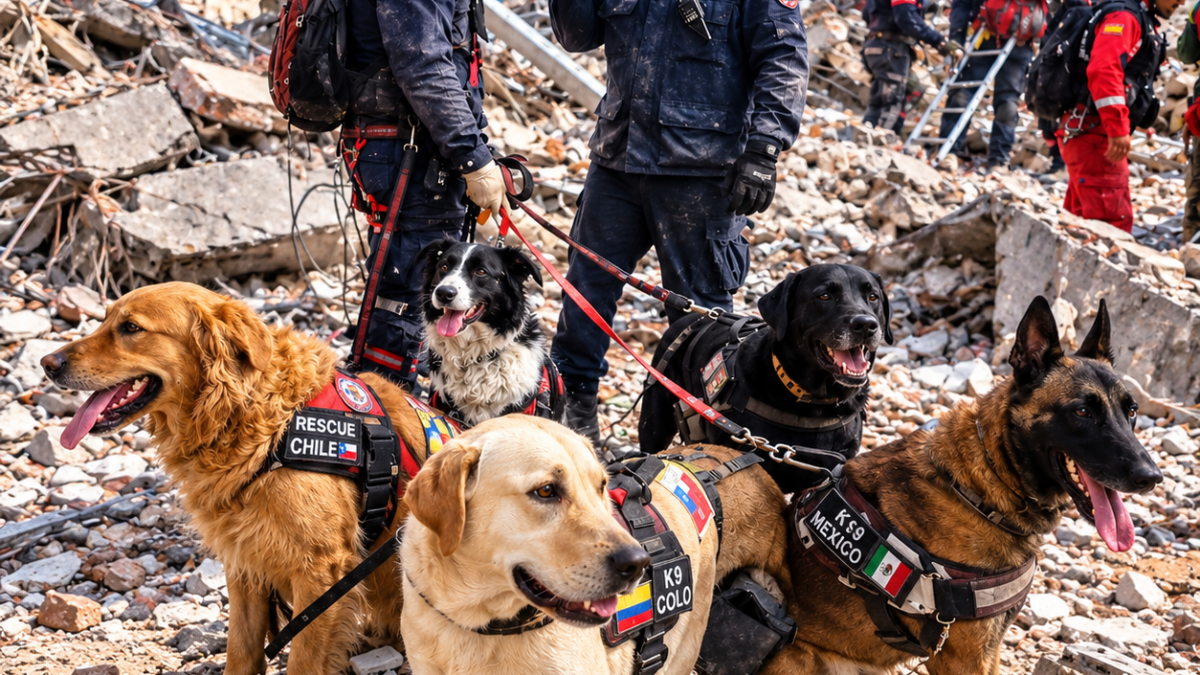
PART 2
The first bark was sharp.
Then another came.
And another.
The sound cut through everything.
Generators.
Radios.
Shouting.
Metal tools.
For one second, nobody near me moved.
If you had never worked around a trained search dog, you might have thought the barking meant fear.
It didn’t.
A trained alert can mean something very different.
It can mean:
Come here.
Check this place.
There may be someone below me.
The handler immediately moved toward the opening.
“Mark it!”
Someone placed a bright marker near the location.
Another rescuer called for technical equipment.
A structural specialist approached from the side.
No one celebrated.
Not yet.
A dog can indicate odor.
What happens next belongs to the entire team.
Listening devices were brought forward.
Crews examined the slabs.
Engineers studied where loads were resting.
Every movement had to be calculated.
A rescue made too aggressively could turn unstable rubble into a grave.
That was the terrible contradiction of earthquake work.
You had to hurry.
And you could not hurry.
THE FIRST LESSON THE RUBBLE TAUGHT ME
I used to think rescue looked like strength.
Men and women lifting concrete.
Machines cutting steel.
Hands pulling survivors toward daylight.
After several hours in Venezuela, I understood that rescue was more often about restraint.
Wait.
Listen.
Check.
Move one piece.
Stop.
Listen again.
One rescuer held his ear near a narrow opening.
Another signaled everyone to shut down equipment.
Generators went silent.
People stopped speaking.
Even those standing twenty yards away seemed to understand.
Nothing.
Then—
a sound.
So faint I wasn’t sure I had heard it.
A metallic tap.
Someone whispered, “Again.”
Silence.
Tap.
Tap.
The atmosphere changed instantly.
The dog’s alert had given us a location.
Now something underneath the concrete was answering.
“Possible live victim,” a rescuer said into the radio.
Nobody cheered.
There was too much work ahead.
But shoulders straightened.
People moved differently.
Hope changes posture.
TWENTY MINUTES AT A TIME
One misconception people have about search dogs is that they run through rubble for hours without stopping.
They can’t.
The environment is brutal.
Heat.
Dust.
Sharp metal.
Broken glass.
Unstable footing.
A search may last only minutes before the dog is rotated out, cooled, watered, checked, and allowed to recover.
I watched Orly return from one deployment.
His tongue hung far from his mouth.
His chest moved rapidly.
His handler immediately guided him toward shade.
Water.
Paw check.
Eyes.
Breathing.
Body temperature.
Everything mattered.
Someone offered the dog a toy.
Orly grabbed it.
Instant transformation.
For several seconds, he looked like a dog in a backyard.
Not a highly trained search specialist working in one of the most dangerous environments on Earth.
Then I noticed his handler watching him.
Not casually.
Constantly.
A dog’s willingness to work can sometimes exceed what is safe for the dog.
That makes the human responsible for knowing when enough is enough.
A handler has to recognize heat stress before enthusiasm hides it.
Pain before drive conceals it.
Fatigue before loyalty pushes the dog one search too far.
The dog trusts the human.
The human must deserve it.
ORLY AND BALAM
I learned that Orly and Balam were brothers.
That fact stayed with me because they behaved differently.
Balam seemed more deliberate.
Orly carried a restless energy that made him appear as though the next assignment could not arrive quickly enough.
But both changed when given a search command.
The rubble became the entire universe.
Their father, Athos, had also served as a rescue dog.
That gave their presence another layer of meaning.
A legacy continuing on four paws.
There was something deeply human in the way rescuers spoke about these dogs.
Not equipment.
Not assets.
Partners.
Family.
“He knows when we’re working,” one rescuer told me.
“How?”
“He knows everything.”
I laughed.
The man did not.
“He knows the uniform. The bag. The way I move when we get a call.”
He scratched the dog’s neck.
“And I know him.”
The dog looked up.
That small glance seemed to contain an entire language.
KENAI
Kenai was younger than Orly and Balam.
Four years old.
A Border Collie with the restless brightness of an animal that seemed to regard every challenge as something worth investigating.
Someone described him to me as mischievous.
I saw evidence of that during rest periods.
A glove disappeared.
Kenai had it.
A strap needed moving.
Kenai believed it belonged to him.
A rescuer tried to retrieve something from the ground.
Kenai reached it first.
Everyone laughed.
Then the harness went back on.
The comedian vanished.
Working dog.
Focus.
Search.
That contrast became one of my favorite things about the canine teams.
They did not carry tragedy every second.
Humans did.
We looked at collapsed buildings and saw apartments.
Bedrooms.
Families.
Deaths.
The dogs saw a task.
That innocence was strangely protective.
They did not understand casualty numbers.
They did not understand politics.
They did not know why buildings had fallen.
They understood scent.
Reward.
Trust.
Work.
Find.
Sometimes that simplicity was exactly what the rescue site needed.
DASTAN FROM COLOMBIA
Dastan moved differently.
Belgian Malinois often seem built from springs and determination.
At eight years old, he had years of training behind him.
The Colombian team arrived with the professional calm of people who knew exactly how dangerous these structures were.
I watched Dastan stand beside his handler while a reconnaissance team mapped part of a collapse.
His ears moved constantly.
His nose lifted.
His handler waited.
No unnecessary command.
No repeated encouragement.
Then the signal came.
Dastan moved.
People sometimes imagine a rescue dog follows a visible path.
There was no path.
There were slabs.
Holes.
Twisted steel.
Furniture crushed into shapes furniture should never take.
Dastan stepped onto a section of concrete angled steeply downward.
His handler followed at a safer distance.
Then the dog stopped.
Sniffed.
Changed direction.
Moved again.
The handler did not redirect him.
That is another form of trust.
Humans tend to believe leadership means controlling every step.
With a search dog, leadership sometimes means knowing when to get out of the dog’s way.
WHEN AFTERSHOCKS COME
The first major aftershock I felt in the rescue zone lasted only seconds.
It felt longer.
Someone shouted.
“Move!”
The ground shifted.
Metal creaked.
Concrete made a low grinding sound that I can still hear when I think about those days.
Handlers called dogs.
Rescuers backed away from unstable sections.
Everyone moved toward predetermined safety areas.
Then we waited.
A cloud of dust lifted from one damaged structure.
Someone counted heads.
Another checked radio traffic.
One dog barked from excitement.
A handler placed both hands against his dog’s sides, checking him.
Safe.
The aftershock ended.
Nobody spoke for several seconds.
Then one rescuer looked back toward the building.
“We go again?”
The team leader checked the structure.
Engineers moved first.
The answer eventually came.
“Yes.”
That was the rhythm.
Danger.
Assessment.
Return.
Nobody was fearless.
Fearlessness would have been dangerous.
They simply understood that fear and duty can occupy the same body at the same time.
KAYRA
Kayra arrived with the Peruvian team.
Her relationship with her handler was the kind you notice even in a crowded disaster zone.
She tracked him constantly.
Not nervously.
Professionally.
Where are we going?
What is next?
Are we working?
Her specialty was searching by airborne scent.
Human odor does not travel through ruins in neat lines.
It moves through cracks.
Voids.
Ventilation paths.
Temperature differences.
A victim may be meters away from where odor reaches the surface.
That is why dogs can become invaluable.
Humans see concrete.
A trained nose reads an invisible map.
One night, Kayra worked near what had once been a multistory building.
Calling it a building felt wrong.
Most of the floors had compressed into an enormous fractured mass.
Search lights created hard white shadows.
Rescuers moved carefully.
Kayra worked.
Stopped.
Moved.
Returned.
Then became intensely interested in one location.
Her handler watched.
She alerted.
Everything changed.
THE WOMAN BENEATH THE BUILDING
Reports later credited Kayra with helping locate a woman who had remained trapped for days.
At the scene, we did not have the luxury of knowing how the story would end.
There was only a potential live find.
The dog had done the first impossible thing.
She had told humans where to look.
Now humans had to reach the person.
A technical rescue through collapsed floors can take hours.
You cannot simply dig straight down.
Remove the wrong slab and another section may shift.
Cut the wrong piece of rebar and a load path can change.
Teams tunneled carefully.
They shored voids.
Cut openings.
Moved debris in small increments.
Monitored the structure.
Kayra waited away from the active work area.
Every now and then, her handler went back to her.
Water.
Touch.
A quiet word.
I wondered whether she understood.
Probably not in the way we did.
She did not know a woman was trapped beneath tons of debris.
She knew she had completed the task asked of her.
And somewhere inside that building, a stranger’s chances had just improved because a dog had refused to ignore a scent no human could detect.
Hours later, the survivor came out.
Alive.
There are sounds you never forget.
A family hearing that someone has been found alive is one of them.
It is not a normal cheer.
It comes from somewhere deeper.
People cry and laugh at the same time.
Rescuers who have been working without sleep suddenly find enough energy to smile.
Someone touches the dog’s head.
“Good girl.”
Two words.
They seem absurdly small.
BLADE
The Panamanian teams brought their own canine specialists.
Among them was Blade.
By then, the rescue zone had become almost international territory.
Spanish blended with different accents.
Radio procedures had to be coordinated.
Team designations mattered because twenty people saying “over here” in different areas is useless.
Yet canine operations remained beautifully simple.
Handler.
Dog.
Search sector.
Alert.
Verification.
Repeat.
Blade climbed across debris under the harsh sun.
His paws touched surfaces that could cut.
Handlers examined feet constantly.
Protective gear helps where practical, but it can also affect movement and scent work.
Every decision balanced safety with function.
I watched Blade disappear behind a fractured wall.
His handler moved sideways to keep visual contact.
Lost it.
Moved again.
Found him.
The dog was sniffing a seam between two slabs.
Seconds later, he moved on.
No alert.
That mattered too.
Search dogs do not exist only to produce dramatic discoveries.
They clear areas.
They help teams prioritize.
A negative search can redirect scarce human resources elsewhere.
Every pass has value.
MALI
Mali became another name people spoke with affection.
You could tell when civilians learned the dogs’ names.
They stopped saying, “the rescue dogs.”
They said:
“Has Mali gone out?”
“Where is Tsunami?”
“Was that Kayra?”
“Is Halley resting?”
Names create intimacy.
That may be why the dogs became symbols so quickly.
A statistic is difficult to hold emotionally.
Thousands of responders.
Hundreds of buildings.
More than a hundred dogs.
Those numbers are enormous.
But a dog named Mali?
A dog named Halley?
A dog named Dastan?
People can carry those names.
TSUNAMI
Then there was Tsunami.
The name would have sounded almost ironic anywhere else.
At a disaster site, it felt unforgettable.
He had his own history.
A rescued dog who had become a rescuer.
By the time of the Venezuela mission, this was reported to be his final deployment before retirement.
Think about that.
A dog once needing someone to save him had spent years being trained to search for strangers.
Now, near the end of his career, he was walking over ruins looking for life.
Reports credited him with an extraordinary number of finds during the response.
People began drawing him.
Posting tributes.
Sharing photographs.
But at the work site, he was still simply a dog beside his handler.
The attention meant nothing to him.
The assignment did.
That is perhaps the purest part of canine rescue.
No dog enters rubble for recognition.
No dog knows a photograph has gone viral.
No dog cares whether a government official says his name.
Work.
Reward.
Handler.
Find.
That is enough.
THE FIRST SEVENTY-TWO HOURS
Every rescuer knows the importance of the early window after structural collapse.
The first seventy-two hours are often spoken about as critical.
But the phrase can become dangerous if people misunderstand it.
Critical does not mean impossible afterward.
People have survived far longer in protected voids.
So when the third day passed, nobody packed up.
The atmosphere changed.
Families became more frightened.
Rescuers became more exhausted.
But dogs still went in.
Day four.
Search.
Day five.
Search.
Every time a dog entered rubble, a family somewhere could still believe.
THE ARGUMENT WITH TIME
By the sixth day, time felt like an enemy.
Not a person.
Not something you could shout at.
A pressure.
Water becomes a problem.
Injuries worsen.
Temperatures matter.
Air pockets matter.
Medical conditions matter.
Each hour changes survival probability.
That creates a strange form of anger.
You look at a collapsed building and think:
You have already taken enough.
Give someone back.
That became our revenge.
Not against a human being.
Against certainty.
Against the idea that the ruins had already won.
Every survivor brought out alive was an answer.
No.
Not this one.
Not yet.
HALLEY
Halley was five.
Another Border Collie from the Mexican Red Cross team.
Her handler, like all good handlers, read tiny things most of us would miss.
Speed.
Breathing.
Tail position.
Changes in search pattern.
Commitment to an odor source.
We were deep into the response when Halley entered a search area around a heavily collapsed structure.
The building had come down in a way that created multiple layers.
Searchers had already worked for days.
The probability of finding someone alive felt painfully small.
But probability is not a verdict.
Halley searched.
At first, nothing looked unusual.
She moved across a slab.
Dropped lower.
Returned.
Changed angle.
Her handler watched.
Halley approached one area again.
Stopped.
Scented.
Moved away.
Returned.
That second return mattered.
The handler shifted position.
Halley worked the odor.
Then alerted.
The radio call went out.
Possible live indication.
Another dog was used for confirmation.
The second canine showed interest.
Two independent noses.
Now everyone moved.
ONE HUNDRED EIGHTY HOURS
By the time a human being has spent roughly 180 hours beneath a collapsed building, hope becomes something almost dangerous to touch.
You want to believe.
You are afraid to believe.
Reports later said Halley and another dog helped identify a man who was ultimately found alive after around 180 hours beneath the rubble.
At the time, we knew only this:
There might be someone down there.
The rescue team began working.
Hours passed.
Concrete came out piece by piece.
Dust coated everyone.
A rescuer crawled into a narrow opening and came back out.
“Void continues.”
Someone asked, “Any response?”
“Not yet.”
Work resumed.
A listening device went inside.
Silence.
Then something faint.
The team leader raised a fist.
Stop.
Everyone froze.
The operator adjusted the equipment.
Again.
Someone spoke toward the opening.
“If you can hear us, make any sound.”
Nothing.
Five seconds.
Ten.
Then—
tap.
A rescuer beside me closed his eyes.
“Again.”
Tap.
I saw a handler kneeling next to Halley several yards away.
His hand rested against her chest.
She looked toward the work site.
Completely unaware that a human life might depend on what she had smelled.
THE LONGEST NIGHT
That extraction became one of those operations where clocks stop meaning much.
We measured time by progress.
Opening widened.
Support installed.
Rebar cut.
Debris removed.
Medical team moved closer.
Search camera inserted.
Nothing.
Advance.
Stop.
Listen.
Advance.
Every person had a task.
The dogs’ task was finished for the moment.
Now came engineering.
Medicine.
Patience.
I saw rescuers rotate out.
Drink.
Sit for five minutes.
Return.
One man removed his helmet and stared at the ground.
“You okay?”
He nodded.
Then shook his head.
Then nodded again.
“I’m fine.”
Nobody was fine.
That was not required.
Only functional.
A VOICE
At some point, the communication became more certain.
A voice.
Weak.
Human.
Alive.
The news moved through the team without anyone officially announcing it.
Faces changed.
A medic prepared equipment.
Someone requested additional shoring.
The opening had to be made large enough for extraction without destabilizing the void.
One rescuer whispered:
“Hold on, brother.”
Not to anyone beside him.
To the man below.
HALLEY WAITED
Halley rested beneath a shade area.
I sat nearby for a moment.
She looked at me.
I had spent hours watching adults make decisions where mistakes could kill people.
Then I looked at this dog.
Her paws were dusty.
There was dirt around her nose.
She appeared perfectly content to rest.
“You have no idea what you did, do you?”
Her ears moved.
I smiled.
“Probably better.”
Her handler returned.
Halley stood instantly.
Tail moving.
There it was again.
The entire relationship reduced to something pure.
You came back.
I’m ready.
WHEN THE SURVIVOR CAME OUT
The final extraction took patience that felt almost unbearable.
Then activity increased.
Medical personnel moved forward.
Someone shouted for space.
A stretcher appeared.
People backed away.
I could not see the void from where I stood.
Only rescuers.
Then the stretcher.
Then a human body.
Alive.
The reaction was immediate.
Some people applauded.
Others shouted.
One rescuer turned away and covered his face.
A woman behind the perimeter began crying so loudly that everyone nearby heard her.
I looked toward Halley.
Her handler crouched beside her.
He touched her face with both hands.
“Good girl.”
Again.
Those two tiny words.
Good girl.
One hundred eighty hours.
Tons of concrete.
International teams.
Cutting equipment.
Engineering calculations.
Medical preparation.
And before much of that could begin, a dog had put her nose toward the rubble and said, in the only language she had:
Here.
THAT WAS THE REVENGE
I remembered the user’s favorite kind of story ending—the moment where someone who caused suffering finally pays.
But earthquakes do not stand trial.
Concrete does not apologize.
Time cannot be punished.
So our revenge had to look different.
The building had collapsed.
We opened it.
The darkness had hidden a man.
A dog found him.
Time had tried to make us stop.
We continued.
Despair told families not to hope.
A stretcher came out carrying someone alive.
That was enough.
That was more than enough.
WHAT THE DOGS NEVER SAW
The dogs did not see the families waiting outside hospitals.
They did not see people sleeping on sidewalks because they feared damaged buildings.
They did not understand why strangers hugged handlers.
They did not know their photographs were spreading across social media.
They did not know newspapers were writing their names.
That innocence protected them from the emotional weight humans carried.
But they did absorb our stress.
Dogs read bodies.
Voices.
Tension.
Handlers had to manage themselves because the animal beside them was always watching.
One handler told me:
“If I’m nervous, he knows.”
“So you don’t get nervous?”
He laughed.
“No. I get nervous.”
He looked at his dog.
“I just don’t lie to him with my body.”
That sentence stayed with me.
Trust does not require pretending danger isn’t real.
It requires consistency inside danger.
THE HANDLER’S JOB
People praised the dogs.
Rightly.
But the handlers were easy to overlook.
A search dog does not arrive fully formed.
Training begins young.
Socialization.
Obedience.
Environmental exposure.
Dark rooms.
Ladders.
Unstable surfaces.
Noise.
Crowds.
Confined spaces.
Search games.
Reward systems.
Scent work.
Repeated again.
And again.
And again.
The handler learns the dog.
The dog learns the handler.
By the time they enter a disaster zone, the two operate almost like one nervous system divided between two bodies.
A tail change can become information.
A pause can matter.
A second pass can matter.
A glance can matter.
The public sees a bark.
The handler has been reading everything that happened before it.
REST
One of the most moving images I saw was not a search.
It was rest.
Balam lay on his side beneath a temporary shelter.
His handler sat beside him.
One hand rested lightly on the dog’s ribs.
Both were asleep.
Around them, people moved constantly.
Radios.
Boots.
Equipment.
But the pair remained still.
I took no photograph.
Some moments should simply exist.
The same dog who would later run across unstable concrete was dreaming with one paw stretched toward the man who trusted him with lives.
Heroism looked very quiet then.
THE INTERNATIONAL CAMP
At night, the staging area felt like a temporary country made entirely of rescuers.
Different flags.
Different equipment.
Different food.
Different languages.
Same exhaustion.
A Colombian responder shared water with someone from another team.
A Mexican handler compared notes with another canine specialist.
Peruvians prepared gear.
Panamanian rescuers checked equipment.
Veterinary staff examined paws.
Someone always seemed to be cleaning a dog.
Dust entered everything.
Ears.
Coats.
Harness buckles.
Pads.
Eyes.
Search work does not end when the dog leaves the rubble.
Recovery is part of the mission.
VETERINARY CARE
The Mexican Red Cross team traveled with veterinary support.
That matters more than most people realize.
Dogs cannot tell you:
My paw hurts.
I inhaled too much dust.
I’m overheating.
My shoulder feels wrong.
A trained veterinary professional checks what drive might conceal.
The heat in La Guaira could be punishing.
High humidity made cooling more difficult.
Work periods had to be controlled.
One more search always seems tempting.
One more building.
One more section.
One more chance.
But a dog injured because humans pushed too far helps nobody.
Protection is part of partnership.
WHEN SEARCH BECOMES RECOVERY
There is a moment in large disasters that every rescue team dreads.
Authorities eventually transition from searching primarily for survivors toward recovery.
The language changes.
So does the mood.
Some international teams begin preparing to leave.
Equipment is inventoried.
Search sectors are closed.
Dogs complete final assignments.
Nobody feels finished.
Because families remain.
Some questions remain unanswered.
The absence of a live find can hurt almost as much as confirmed loss.
Still, rescue work has limits.
Teams cannot stay forever.
KAYRA’S LAST SEARCH
Before the Peruvian contingent returned home, Kayra completed her work.
She had arrived as one dog among more than a hundred.
She left having helped prove why one dog matters.
At the airport back home, people applauded her.
She did not understand applause.
Maybe she thought it was noise.
Maybe she searched for her handler.
Maybe she hoped someone had food.
That is the strange mismatch between human ceremony and canine motivation.
We build monuments.
They want the person they trust.
DASTAN GOES HOME
For Dastan, the Venezuela deployment was reported as his first international humanitarian mission with the Bogotá team.
Eight years of preparation.
Then a real catastrophe outside his country.
He returned not as a symbol to himself, but as the same dog.
That humility is built into animals.
Humans say:
International hero.
Veteran rescuer.
Symbol of solidarity.
Dastan probably thought:
Where is my handler?
Are we working?
Is there a reward?
Sometimes I think humanity benefits from heroes who don’t know they are heroes.
TSUNAMI’S RETIREMENT
Tsunami’s mission carried another emotional ending.
This was expected to be his final deployment.
A dog once rescued himself now closing his operational career after searching through disaster zones for others.
If you wanted a perfect circle, there it was.
Saved.
Trained.
Trusted.
Deployed.
Saving others.
Then retirement.
No speeches from him.
No memoir.
No understanding of how many strangers knew his name.
Just a harness eventually hung up for the last time.
There is dignity in that.
WHAT HAPPENS AFTER THE HARNESS
Good rescue organizations think beyond deployment.
Working dogs age.
Joints change.
Stamina drops.
Reaction times change.
Eventually, the ethical decision is retirement.
That can be difficult for handlers.
The working relationship may have defined years of daily life.
Suddenly there are no disaster deployments.
No operational searches.
No calls in the night.
The dog becomes what people might call “just a pet.”
There is nothing “just” about it.
After spending a life searching for strangers, a soft bed and an ordinary old age are rewards worthy of any hero.
ORLY AND BALAM’S LEGACY
Orly and Balam carried another story home.
They were sons of Athos, himself remembered for rescue work.
Their presence in Venezuela turned family history into continuation.
Not because dogs understand legacy.
Humans do.
We need stories that connect courage across time.
A father dog serves.
His sons serve.
Different disaster.
Different rubble.
Same purpose.
Find life.
THE NUMBERS
At one stage, the international deployment included more than 1,600 foreign personnel and over 100 dogs.
Later reports put the canine number at 137.
Those numbers are remarkable.
But they also hide the detail.
One hundred thirty-seven dogs means:
137 sets of paws inspected.
137 relationships with handlers.
137 animals needing hydration.
Rest.
Transport.
Food.
Veterinary care.
137 noses moving through different pieces of rubble.
137 chances to detect something machines might miss.
Numbers become real when you imagine each dog individually.
THE BARK
People often ask what a rescue dog’s bark sounds like when it finds someone.
There is no universal answer.
Training systems differ.
Dogs differ.
But after Venezuela, I stopped hearing barking as simply noise.
Sometimes a bark is information.
Sometimes it is the bridge between invisible scent and human action.
Sometimes it begins an excavation.
Sometimes it gives a family permission to hope for another hour.
A dog’s bark may last one second.
The consequences can last a lifetime.
THE CHILDREN
Not every dramatic rescue belonged to the dogs named in the original story.
International teams throughout Venezuela found survivors in extraordinary circumstances.
Children were brought out.
Adults were found.
People survived periods beneath debris that seemed impossible.
The dogs were part of a broader system.
That distinction matters.
No dog single-handedly “rescues” a trapped person from tons of concrete.
The dog locates.
The handler interprets.
Technical teams stabilize.
Rescuers dig.
Engineers protect.
Medics treat.
Logistics teams support.
Every life saved belongs to a chain.
Remove one link and the ending may change.
WHY DOGS?
Technology has become extraordinary.
Cameras.
Acoustic sensors.
Drones.
Imaging.
Robotic systems.
But scent remains a biological technology humans cannot easily replace.
A dog’s nose works in three-dimensional odor landscapes we barely perceive.
Human scent moves through cracks.
Air pockets.
Broken pipes.
Ventilation paths.
A dog can cover an area rapidly and tell rescuers where to concentrate.
Machines and dogs are not rivals.
The best rescue operations use everything available.
Technology confirms.
Dogs guide.
Humans decide.
A HAND ON A HARNESS
Late one evening, I watched a handler prepare for another search.
He knelt.
Checked the harness.
Ran his fingers along each strap.
Looked at paws.
Touched the dog’s shoulders.
Then he pressed his forehead briefly against the dog’s forehead.
Maybe it was routine.
Maybe encouragement.
Maybe prayer.
Then he stood.
“Ready?”
The dog’s entire body changed.
Ready.
They walked toward the ruins together.
I realized that this was the image I would remember more than collapsed buildings.
Not destruction.
Partnership.
NO BORDERS
A Colombian dog did not search only for Colombians.
A Mexican dog did not care whether the scent beneath the rubble belonged to a Mexican.
Kayra did not ask for nationality.
Blade did not ask which flag flew over the building.
Halley did not need to know the politics of the country where she was working.
Scent meant human.
That was enough.
There is something almost embarrassingly simple about that.
Humans spend enormous energy drawing lines.
Dogs crossed them without noticing.
THE FAMILY AT THE BARRIER
One afternoon, a family waited behind a rescue perimeter.
Mother.
Two adult sons.
An elderly man.
They had a relative missing inside a collapsed building.
A dog team went in.
The family watched the dog’s every movement.
The mother clasped her hands.
When the dog paused, she leaned forward.
When the dog moved on, her shoulders dropped.
I realized the animal had become the center of their universe.
The dog had no idea.
That level of responsibility would crush a human psychologically.
For the dog, it remained a search game built over years.
That is one reason canine work is so powerful.
The dog’s motivation stays clean.
FALSE ALERTS AND DISCIPLINE
Search work also requires humility.
Not every behavior is a confirmed find.
Handlers must avoid seeing what they desperately want to see.
That is difficult after days of tragedy.
Hope can create bias.
Professional teams use trained indication behavior, repeat searches, second dogs, technical confirmation, and structured procedures.
A dog’s nose is extraordinary.
A rescue system must still verify.
The goal is not a heroic headline.
The goal is accuracy.
ONE MORE BUILDING
At the end of a brutal shift, I heard someone say:
“One more.”
The handler looked exhausted.
The dog had rested.
The new sector had not been cleared.
The handler considered it.
Then shook his head.
“Different team.”
At first, I thought he was giving up.
Then I understood.
The dog needed recovery.
Heroism is not pushing until collapse.
Sometimes professionalism means stopping.
Another canine team rotated in.
Fresh dog.
Fresh handler.
The search continued.
That is how large-scale rescue survives.
No single hero.
A system of people and animals carrying one another.
THE DOG WHO FOUND NOTHING
I want to tell you about a dog whose name I never learned.
He searched an apartment collapse for nearly fifteen minutes.
Nothing.
No alert.
His handler brought him out.
Water.
Rest.
Later, technical crews confirmed that sector held no accessible live victims.
No news camera came.
Nobody applauded.
No viral post celebrated him.
But because he searched that area, another team could move elsewhere.
Heroism does not require a discovery.
Sometimes the job is eliminating uncertainty.
THE HANDLER WHO CRIED
A survivor extraction happened several blocks away one evening.
I saw one of the handlers after.
He sat alone.
His dog lay beside him.
The man’s face was wet.
I did not know whether the tears came from relief, exhaustion, grief, or all three.
The dog placed its head on his knee.
He stroked its ears.
No words.
We talk about dogs saving strangers.
Sometimes they also save the rescuers standing beside them.
Not physically.
Emotionally.
After seeing things nobody should have to see, a warm living animal leaning against your leg can remind you that not everything in the world is broken.
THE SMELL OF DUST
Weeks later, after leaving the disaster zone, I opened a bag and smelled concrete dust.
Immediately I was back there.
Search lights.
Radios.
Dogs.
I wondered what triggers memory for them.
A harness?
A certain beep?
The smell of broken concrete?
A helmet?
Training field dust?
Dogs remember through associations humans only partly understand.
I hoped their strongest association remained the one handlers had spent years building.
Search.
Find.
Reward.
Safe return.
WHAT HALLEY COULD NEVER KNOW
Halley could never understand “180 hours.”
She did not understand that finding a survivor after so long would inspire people far outside Venezuela.
She didn’t know reporters would tell her story.
She did not know strangers would see her photograph and cry.
Maybe that is what makes it beautiful.
She did the work without needing to know the meaning humans would give it.
She smelled something.
She told her handler.
The humans listened.
A man lived.
MY LAST DAY
On my last morning in the rescue area, the light was almost beautiful.
That felt offensive at first.
How could the sky be clear over a place with so much grief?
Then I saw Kenai outside the staging area.
He was playing.
Actually playing.
For a moment, he chased something his handler threw.
Returned.
Dropped it.
Tail moving.
Another throw.
I watched him and understood something.
Life does not wait for grief to finish.
It insists on appearing inside it.
A dog plays beside ruins.
A rescued child asks for water.
A family hugs.
A responder laughs at a stupid joke after twenty hours awake.
Hope is often inappropriate.
That is why it survives.
THE FLIGHTS HOME
One by one, international teams eventually returned home.
Mexico.
Colombia.
Peru.
Panama.
Others.
At airports, people applauded.
Dogs walked beside handlers.
Some looked alert.
Some looked tired.
Some seemed confused by attention.
The world wanted heroes.
The dogs wanted routine.
Food.
Rest.
Their humans.
Perhaps that is the best kind of hero.
AFTER VENEZUELA
For the handlers, returning home does not erase what happened.
Equipment is cleaned.
Reports filed.
Dogs examined.
Lessons reviewed.
Training eventually resumes.
Because another disaster will happen somewhere.
Nobody knows where.
Another earthquake.
Landslide.
Collapsed building.
Explosion.
Missing person.
The dogs will not understand the geography.
The handler will open the gear bag.
The dog will recognize it.
Ready.
THE REAL PRICE OF A WAGGING TAIL
People saw photographs of tails wagging and sometimes assumed the dogs were fearless.
A wagging tail does not mean the environment is safe.
It means the relationship is strong enough for the dog to work inside uncertainty.
Years stand behind that wag.
Early training.
Daily practice.
Veterinary care.
Failure.
Correction.
Games.
Travel.
Noise exposure.
Trust.
The final image lasts seconds.
The preparation lasts a lifetime.
EVERY BARK
During the mission, I learned to stop dismissing small sounds.
A scrape.
Tap.
Whimper.
Bark.
One sound can change an entire rescue plan.
The world above the rubble can be enormous and chaotic.
The world below may be one dark pocket with a single person waiting.
A dog’s job is to connect those worlds.
THE HEROES WHO DON’T UNDERSTAND THANK YOU
If you could gather Orly, Balam, Kenai, Halley, Dastan, Kayra, Blade, Mali, Tsunami and every other canine responder into one place and explain what people think of them, I doubt they would understand.
“Hero” is a human word.
So is “international solidarity.”
So is “sacrifice.”
Dogs understand other things.
Voice.
Touch.
Scent.
Work.
Home.
Trust.
Maybe those words are enough.
THE ONLY REVENGE THAT MATTERED
For days, destruction seemed to have the advantage.
Buildings fell in seconds.
Rescue took hours.
Sometimes days.
That imbalance can make you furious.
It is easier to destroy than rebuild.
Easier to bury than extract.
Easier for tragedy to happen than for hundreds of people to undo it.
But rescue does something powerful.
It refuses to accept destruction as the final author.
A building falls.
Rescuers arrive.
Concrete covers a human scent.
A dog finds it.
Darkness hides a survivor.
Lights enter.
A void becomes a tunnel.
A trapped person becomes a patient.
A missing name becomes someone found.
That was our revenge.
We could not reverse the earthquake.
But every person brought back alive was something the earthquake did not get to keep.
THE LAST BARK I REMEMBER
I cannot tell you exactly which dog made the last alert I personally heard before leaving.
Maybe that is appropriate.
Because the story was never one dog.
It was all of them.
I was walking away from a search sector when barking echoed from behind me.
I turned automatically.
Rescuers moved.
A handler raised an arm.
A team leader redirected personnel.
Same sequence I had watched again and again.
But this time I stood still for a second.
A few days earlier, barking had been ordinary to me.
Now I heard possibility.
I heard training.
I heard trust.
I heard thousands of hours compressed into several seconds.
Most of all, I heard one message:
Look here.
YEARS OF TRAINING FOR ONE MOMENT
A rescue dog may train for years for an alert lasting seconds.
Think about that.
Morning after morning.
Exercise after exercise.
Hidden person.
Find.
Reward.
Again.
Different surface.
Find.
Again.
Noise.
Find.
Darkness.
Find.
Height.
Find.
Unstable platform.
Find.
Crowd.
Find.
Smoke.
Find.
Then one day the training is no longer a game.
The rubble is real.
The missing person is real.
The danger is real.
And the dog does exactly what humans spent years teaching.
That is why handlers cried.
Not because the dog performed a trick.
Because preparation met the one moment it had been built for.
COMPASSION WITHOUT PASSPORTS
The multinational response taught me another lesson.
Governments argue.
Countries disagree.
Borders harden.
Politics become complicated.
Then a building falls on a family.
Suddenly the relevant question becomes simple.
Who can help?
Mexico sends rescuers.
Colombia sends rescuers.
Peru sends rescuers.
Panama sends rescuers.
Teams arrive from across the world.
Dogs step off aircraft and begin working for people they will never know.
Compassion becomes practical.
Harness.
Helmet.
Leash.
Search.
WHAT A DOG SEES
I sometimes tried to imagine the disaster through a dog’s senses.
We saw a collapsed tower.
The dog smelled hundreds of things.
Dust.
People who had walked there before.
Food.
Water.
Concrete.
Other dogs.
Rescuers.
Maybe fear.
Maybe blood.
Somewhere inside all of it—
human scent emerging from a void.
The dog’s ability is not magic.
It is biology plus training.
But standing there, magic felt like a reasonable word.
ORLY RESTING HIS HEAD
On one of the final days, I saw Orly place his head against his handler’s leg.
No command.
No reward.
Just contact.
The handler kept talking with another rescuer while his hand automatically moved down to the dog’s neck.
That unconscious touch told me almost everything about their relationship.
The dog was not a tool stored between missions.
Their lives were connected.
That is why the term “binomio”—the dog-handler pair—matters.
You do not send a nose into rubble.
You send a relationship.
BALAM’S EYES
Balam had the kind of gaze that made people stop.
Focused.
Intelligent.
He watched movements around him.
But the strongest attention always returned to his person.
That is another thing rescue dogs teach.
In chaos, know where your anchor is.
For Balam, it was his handler.
For the handler, sometimes it was Balam.
KENAI’S MISCHIEF AGAIN
Before the team left, Kenai stole something.
Again.
Someone laughed.
“Hero?”
The handler shook his head.
“Criminal.”
Kenai ran two steps farther away.
For the first time in days, several exhausted rescuers laughed together.
That mattered too.
He had spent the mission searching for people.
In that moment, he rescued five adults from despair for perhaps thirty seconds.
Nobody wrote that in the mission report.
DASTAN’S FIRST INTERNATIONAL MISSION
When Dastan returned to Bogotá, reports celebrated his participation.
Eight years old.
First international humanitarian deployment with his unit.
I imagined him returning to familiar ground.
Familiar voices.
Familiar smells.
Maybe he slept deeply.
Maybe the next morning he woke expecting work.
Dogs do not write chapters in their lives.
Humans do that for them.
Venezuela became one chapter in Dastan’s story.
For someone he helped locate—or someone whose search area he helped clear—it could have been everything.
KAYRA’S APPLAUSE
When Kayra returned to Peru, she received public recognition.
Later she appeared before crowds who applauded her.
Think of the contrast.
Days earlier:
Dust.
Collapsed concrete.
Heat.
Darkness.
Now:
People standing safely.
Smiling.
Clapping.
Kayra simply being Kayra.
Humans need ceremonies.
Dogs remind us that the deed mattered before the applause existed.
BLADE AND THE OTHERS
Blade returned with Panamanian responders.
So did the other canine teams working beside him.
Their names may never become as globally recognized as the most viral dogs.
That does not change their value.
A search dog does not become important only when a camera notices.
There were dogs in Venezuela whose names most people will never learn.
They still searched.
Still climbed.
Still rested.
Still trusted.
Still served.
This story belongs to them too.
MALI AND THE NAMES WE KEEP
Mali’s name circulated among people following the rescues.
That is what stories do after disasters.
They identify a few faces.
A few dogs.
A few moments.
Those symbols carry the weight of thousands.
When I say Mali, I also think of every unnamed dog lying under a shade tent waiting for another search.
When I say Halley, I think of every handler staring at rubble and trusting a nose better than their own senses.
When I say Tsunami, I think of every rescue animal that later became a rescuer.
One name can carry many.
A HERO’S RETIREMENT
There is something satisfying about imagining Tsunami’s harness hanging unused someday.
Not because the work no longer matters.
Because he did enough.
Retirement for a rescue dog should be gloriously ordinary.
Slow mornings.
Favorite sleeping place.
Good food.
Walks without rubble.
No sirens.
No aircraft.
No collapsing structures.
A hero does not need to die working to prove devotion.
Sometimes the happiest ending is simply getting old.
THE PEOPLE BENEATH THE NUMBERS
Disaster statistics can numb us.
Thousands injured.
Hundreds dead.
Dozens missing.
Hundreds of buildings.
But search dogs operate against statistics.
They search for individuals.
One scent.
One location.
One human.
That may be one of the most important moral truths of rescue.
A thousand victims is overwhelming.
One person under this slab is a task.
Start there.
WHEN A FAMILY HEARS “ALIVE”
There are words people remember forever.
“We found someone.”
“There is a response.”
“They’re alive.”
After hours or days without information, those words alter a family permanently.
A rescue dog may be several steps removed from the final announcement.
But sometimes the path begins with paws stopping on concrete.
Nose down.
Head up.
Bark.
THE EARTHQUAKE WON MANY BATTLES
It would be dishonest to pretend every search ended happily.
It didn’t.
Rescuers found loss.
Families received terrible answers.
Dogs alerted to locations where humans could no longer save anyone.
Teams carried emotional burdens home.
The earthquake took far too much.
But tragedy is not made more meaningful by pretending everything ends well.
The victories matter precisely because loss was real.
Every survivor was not proof that everything was okay.
It was proof that something could still be saved.
HOPE DOES NOT REQUIRE DENIAL
This is why the dogs became symbols.
Not because they erased grief.
They worked inside it.
Hope is not saying:
Nothing terrible happened.
Hope is saying:
Something terrible happened, and we are still looking.
That is a much stronger kind of hope.
THE HARNESS COMES OFF
At the end of a shift, a handler would remove the harness.
The dog’s posture softened.
Working identity temporarily disappeared.
There was something ceremonial about it.
Job finished.
For now.
The dog drank.
Ate.
Slept.
Then hours later, the harness returned.
Ready again.
Humans often struggle to put work down.
Dogs may be better at it.
Harness on.
Work.
Harness off.
Rest.
Perhaps rescuers could learn from them.
THE CHILD WHO PET A RESCUE DOG
Near the end of the operation, I saw a child approach one canine team after permission was given.
The child touched the dog’s shoulder carefully.
The dog stood still.
The child’s mother began crying.
I did not know their story.
Maybe they had lost someone.
Maybe someone had been rescued.
Maybe they were simply overwhelmed.
The child whispered something to the dog.
I couldn’t hear it.
The dog licked the child’s hand.
That scene contained everything.
Loss.
Trust.
Gentleness.
Life continuing.
NOT EVERY HERO WEARS A UNIFORM
The phrase can become cliché.
But in Venezuela it was literal.
Some heroes wore helmets.
Some medical gloves.
Some firefighter gear.
Some Red Cross insignia.
Some wore harnesses.
And some had nothing on their feet except dust.
THE STORY I WOULD TELL
If someone asked me years from now what I remembered about the earthquakes, I could describe the destruction.
But I would rather tell them about the sound after a canine alert.
The way hundreds of exhausted people could suddenly move with purpose.
I would tell them about dogs sleeping beside handlers.
About muddy paws.
About water bowls lined beside equipment.
About a veterinarian checking pads.
About Kenai stealing something at the worst possible time.
About Kayra working through rubble.
About Dastan following scent through chaos.
About Blade disappearing behind concrete.
About Tsunami on a final mission.
About Halley.
Especially Halley.
HALLEY’S ANSWER TO THE RUINS
The earthquake said:
Too late.
Halley searched.
The rubble said:
No one is there.
Halley returned to the scent.
Time said:
One hundred eighty hours.
Halley alerted.
Humans listened.
And somewhere beneath everything, a man was still alive.
That is the ending I carry.
HOME AGAIN
When the Mexican team finally returned, Orly, Balam, Kenai and Halley went home with their handlers.
The mission ended.
The training did not.
There would be ordinary days again.
Veterinary checks.
Exercises.
Rest.
Maybe toys.
Maybe stolen gloves.
Maybe sleeping at someone’s feet.
But somewhere in Venezuela, people would remember hearing a dog bark above the place where they had been trapped.
A survivor may spend the rest of his life knowing that before rescuers could see him, before cameras could reach him, before hands could touch him—
a dog knew he was there.
THE FINAL REVENGE
You asked for a satisfying revenge.
This is the only revenge this story needs.
The earthquake tried to turn homes into graves.
The dogs turned ruins back into places where life could still be found.
The concrete tried to hide people.
Their noses exposed the hiding places.
Time tried to convince rescuers that continuing was pointless.
The teams kept searching.
Borders tried to divide the world into countries.
Rescuers arrived from everywhere.
And every time a survivor emerged alive, destruction lost something it believed it had already taken.
No villain needed punishment.
The victory was enough.
YEARS FROM NOW
Orly will grow older.
Balam will slow down.
Kenai’s face will gray.
Halley will someday wear her harness for the last time.
Dastan will retire.
Kayra will become an older dog.
Blade will sleep more.
The working years of every rescue dog eventually end.
I hope their handlers remember to tell them nothing.
Dogs do not need speeches.
Give them soft beds.
Good food.
Long walks.
Scratch the place behind the ears they like best.
Let them sleep.
They already know the only thing they ever needed to know.
Their person is there.
BECAUSE THEY CAME
Somewhere, a family got another birthday.
Another dinner.
Another argument.
Another ordinary morning.
Because rescuers came.
Because handlers trusted their dogs.
Because a dog trusted its training.
Because a nose found a scent.
Because someone heard a bark and believed it.
Heroism is sometimes that simple.
And that complicated.
THE LAST IMAGE
If I could choose one image to represent the entire mission, it would not be a collapsed tower.
It would not be a helicopter.
It would not be a line of rescuers.
It would be a dog standing on broken concrete.
Dust covering his paws.
Harness strapped around his chest.
Handler waiting several feet behind.
The dog pauses.
Raises his nose.
Listens to a world humans cannot smell.
Then moves forward.
Because somewhere ahead there may still be someone alive.
That is what Orly did.
What Balam did.
What Kenai did.
What Halley did.
What Dastan did.
What Kayra did.
What Blade did.
What Mali did.
What Tsunami did.
What more than a hundred rescue dogs did beside teams from around the world.
They went where people could not.
They searched when hope was becoming painful.
They climbed across places that might collapse beneath them.
And when they found the scent they had spent their entire lives learning to recognize, they did not ask who the person was.
They did not ask what language they spoke.
They did not ask what country they came from.
They simply called their human.
Come here.
Someone is here.
EPILOGUE
People sometimes say dogs are man’s best friend.
After Venezuela, that phrase felt too small.
A friend sits beside you when you are hurting.
These dogs crawled into broken buildings to find people they had never met.
A friend recognizes your face.
These dogs searched for strangers they could not see.
A friend may comfort you when the worst thing has already happened.
These dogs sometimes arrived before the worst thing became final.
That is different.
That is extraordinary.
So when I think about Venezuela, I remember the rescuers.
I remember the families.
I remember the survivors.
And I remember paws.
Dusty paws moving across concrete.
One after another.
Never knowing that people around the world would someday learn their names.
Orly.
Balam.
Kenai.
Halley.
Dastan.
Kayra.
Blade.
Mali.
Tsunami.
And all the others whose names never reached a headline.
They did not need to know they were heroes.
They only needed someone to say:
“Search.”
And they went.
Into the dust.
Into the darkness.
Into spaces where humans could not safely follow.
Searching for one thing.
Life.
Sometimes they found nothing.
Sometimes they found loss.
But sometimes—
against hours of silence,
against impossible weight,
against every calculation telling exhausted rescuers not to expect a miracle—
a dog stopped.
Turned.
Barked.
And the entire world around him started moving again.
That is why I will never hear a rescue dog’s bark the same way.
Because somewhere beneath Venezuela’s ruins, there were people who could not reach daylight on their own.
And before the machines found them,
before the rescuers touched them,
before their families could hold them again,
a four-legged stranger passed above the darkness—
and refused to keep walking.