PART 2: They Returned Them After Three Days—So I Made a Promise No One Expected Me to Keep The family brought Reddy and Blue back with their brand-new collars still around their necks, like they had not just broken two hearts but wanted proof they had tried. And when I saw those two dogs standing behind the same cold shelter door, still watching the entrance for people who were never coming back, I remembered exactly what it felt like to wait for someone who had already chosen to leave. Reddy was wearing the green collar. Blue was wearing the orange one. That was the first thing I noticed, and for some reason, that made it worse. Not the concrete floor. Not the metal kennel door. Not the fluorescent shelter lights buzzing above them like nothing sacred had happened. The collars. Three days earlier, I had helped buckle those collars around their necks while a smiling family promised they were taking them home forever. The mother had knelt down, pressed her cheek against Reddy’s golden head, and said, “You boys are going to have the best backyard.” The father had laughed when Blue leaned against his leg. The two kids had argued happily over who would hold which leash. I had believed them. Maybe that was my mistake. When they drove away that Friday afternoon, Reddy had his nose pressed to the SUV window, and Blue sat beside him, quiet and serious, as if he already understood that happiness was something you should accept carefully because it might be taken back. I stood in the parking lot until the SUV disappeared past the gas station at the corner, and I whispered, “Go be happy, boys.” By Monday morning, they were back. Same kennel. Same door. Same two dogs. Only now, they looked confused in a way that made my chest hurt. Reddy stood at the front of the kennel, his ears lifted every time footsteps passed the hallway. Blue lay behind him with his chin on his paws, but his eyes were fixed on the shelter entrance. Neither of them barked. Neither of them jumped. They weren’t acting wild. They weren’t being difficult. They were waiting. I turned to our supervisor, Denise, who was standing with a clipboard pressed against her chest. “What happened?” Her face tightened the way it did when she had already had a hard conversation and didn’t want another one. “They returned them last night.” “I can see that,” I said, sharper than I meant to. “Why?” She looked through the kennel bars at Reddy and Blue, then back at me. “They said the dogs were too difficult.” For a second, I thought I had misheard her. “Too difficult?” “Too much energy. They weren’t listening. The kids got overwhelmed. They said it wasn’t the right fit.” I stared at the dogs. Three days. That was all they had been given. After six months in our shelter, six months of waiting behind one metal door while families walked by and said they were beautiful but too much, Reddy and Blue had finally been chosen together. They had climbed into that SUV wearing new collars and carrying every hope I had been afraid to name. And after seventy-two hours, they were back on concrete. I opened the kennel door slowly. Reddy came to me first. He smelled my hand, pressed his nose into my palm for one second, then turned away and went back to the door. Blue did not move until I sat on the floor. Then he lifted his head and looked at me, not asking for comfort, not expecting anything. That look was worse than crying. I had seen dogs panic when they were returned. I had seen them bark until their voices went hoarse, throw themselves against kennel doors, scratch at floors, refuse food, or curl up so tightly they seemed to disappear inside themselves. Reddy and Blue did none of that. They just watched the entrance. As if the family might realize there had been a mistake. As if the mother might rush back in with tears in her eyes and say, “We’re sorry, boys. We didn’t mean it.” As if love was a door that could still open if they waited long enough. I sat beside them until the concrete numbed my legs. Reddy lowered himself beside Blue. Blue leaned into him. Their backs touched, the way they always slept at night. Bonded pairs did that. They made one body out of two. One heartbeat out of fear. One small family where the world had failed to provide one. And sitting there beside them, I was eight years old again. I was back in my mother’s living room, sitting near the front window with my knees pulled to my chest, watching the road for my father’s truck. He had left on a Thursday evening. He had crouched in front of me, smelled like motor oil and winter air, and said, “I’ll be back soon, Josh. You be good for your mom.” I believed him. For three days, I watched that window. Then a week. Then a month. After a while, my mother stopped telling me to move away from the glass. She would just set a sandwich beside me and touch my hair before walking back to the kitchen. I learned something in that window no child should learn. Some people leave in a way that keeps you waiting long after they are gone. Reddy and Blue were waiting like that. I could see it. I could feel it. That morning, while the shelter woke up around us and other dogs began barking for breakfast, I put one hand on Reddy’s neck and the other on Blue’s shoulder. “I’m sorry,” I whispered. Reddy’s tail moved once against the floor. Not joy. Recognition. Like he knew apology when he heard it but no longer trusted what came after. I stayed in that kennel until Denise came back down the hall and stopped outside the door. “Josh,” she said softly, “we need to clean.” I nodded, but I didn’t get up right away. I looked at Reddy’s green collar and Blue’s orange one. They looked too bright in that gray kennel, like leftover decorations from a party that had ended badly. Then I made a promise I had no business making. “You’re not going to keep waiting for people who already walked away,” I said. “Not anymore.” At twenty-one years old, finishing my last year of college, working mornings at a feed store, nights at a diner, and volunteering at the municipal shelter three days a week, I had no house, no yard, no savings worth mentioning, and no reason to believe I could change much of anything. But grief and anger can make a person bold before they make him wise. I looked at those two dogs and said it again, quieter this time. “I’ll find you somewhere safe. Both of you. Together.” Blue blinked slowly. Reddy leaned his weight against my knee. That was all the answer I got. PART 2 I started volunteering at the shelter when I was eighteen, two weeks after getting my driver’s license. At first, I thought it would be simple. Show up. Walk dogs. Wash bowls. Carry food. Clean kennels. Help people meet animals. Do good. Go home. That was the idea. Nobody warned me that shelters do not end at the door. You leave with hair on your clothes, scratches on your arms, and faces in your head. You remember the old hound who pressed himself against the kennel bars just to feel a hand. You remember the trembling terrier found in a ditch after a storm. You remember the cats surrendered in laundry baskets, the puppies born under porches, the senior dogs whose owners died and whose families said, “We can’t take him.” You learn how many ways people can say no to responsibility and still sound reasonable. “He’s too old.” “She sheds too much.” “We’re moving.” “Our new baby is allergic.” “He takes too much work.” “We just don’t have time.” The animals never understand the explanations. They only understand the door closing. Reddy and Blue had come in together on a rainy Wednesday in April. Animal control found them near the county road that ran behind an abandoned trailer park. Reddy was pacing beside a drainage ditch, barking at every passing truck. Blue was down in the ditch, unable to climb out because one of his back legs had been caught in old wire. Reddy could have left him. He didn’t. He stayed. By the time Officer Landry arrived, Reddy was soaked, hoarse, and frantic, running between the road and the ditch like he was trying to drag help out of the world by force. Blue’s leg was cut but not broken. He let us clean it, but only while Reddy stood where he could see him. The first night, we put them in separate kennels because that was policy during intake. That lasted eight minutes. Reddy barked until his voice cracked. Blue pressed himself into the far corner and trembled so hard his water bowl shook. Denise stood there with her arms crossed, trying to look practical, then said, “Put them together.” The moment the divider opened, Reddy rushed to Blue, sniffed his face, then lay down in front of him like a guard. Blue rested his chin across Reddy’s back. Nobody argued after that. They were listed as Labrador mixes, around three years old, healthy except for Blue’s healing leg and both dogs being underweight. Reddy was gold with darker ears and expressive brown eyes that made it impossible to miss what he was feeling. Blue was silver-gray, leaner, quieter, and careful in every movement. Reddy met the world first. Blue studied it from behind him. Most visitors loved them for about thirty seconds. Then they asked the question. “Do they have to go together?” Denise always answered honestly. “Yes. They’re bonded. Separating them would be extremely hard on both.” People would nod, make sad faces, tell us how sweet that was, then move on to the next kennel. That was how six months passed. Reddy learned the shelter schedule. He knew breakfast came after the first big round of barking. He knew Denise carried the medicine cart at nine. He knew I came on Tuesdays, Thursdays, and Saturdays. He knew which volunteers gave treats and which ones only talked about giving treats. Blue learned too, but quietly. He knew when the hallway was too loud and when to retreat. He knew Reddy would step between him and strangers. He knew exactly how far my hand would reach before I let him decide the rest. I loved them before I admitted it. That is the danger of shelter work. You tell yourself you are helping, not attaching. You tell yourself the goal is goodbye. You repeat it like scripture. Goodbye means they found a home. Goodbye means this worked. Goodbye is the happy ending. But some animals make goodbye feel like loss no matter how happy it is supposed to be. The Friday they were adopted, I thought I was ready for it. The family came in after lunch. The mother’s name was Karen Mayfield, the father was Paul, and their children were a girl around ten and a boy around seven. They wore clean sneakers and careful smiles. Their SUV outside looked new enough to still smell like the dealership. “We’re interested in adopting two dogs,” Karen told Denise at the desk. “We thought it might be nice for them to have each other.” I was restocking leashes nearby when I heard that. I turned so fast I dropped three collars on the floor. Denise looked at me once, a warning not to get too excited. I got excited anyway. We brought the Mayfields to the meet-and-greet yard behind the shelter. Reddy trotted in first carrying his battered rope toy, the one missing half its knot. Blue followed close behind, head low, eyes watchful. The little boy crouched down immediately. “Can I pet them?” “Let them come to you,” I said. To my surprise, Reddy went straight to him and dropped the rope toy at his feet. The boy laughed. Blue stood near the fence for a minute, then walked over to the girl and allowed her to touch the top of his head. Karen pressed her hands to her chest. “Oh, Paul,” she said. “Look at them.” Paul smiled. “They’re good-looking dogs.” “They’re more than that,” I said, unable to stop myself. “They’re loyal. They’re gentle once they trust you. Reddy has more energy, but Blue balances him. They do best with patience and routine.” Karen nodded earnestly. “We can give them that.” I wanted to believe her so badly that I ignored the way Paul checked his watch twice. They spent almost forty minutes in the yard. Reddy played fetch with the boy. Blue sat near the girl and eventually leaned his shoulder against her knee. Karen took pictures. Paul asked about food, vet records, vaccines, leash manners. Denise went through everything carefully. “They will need time to adjust,” she said. “A shelter is not a normal environment, and a home will be new. The first few days can be confusing. They may pace. They may have accidents. They may test boundaries. That does not mean anything is wrong. It means they need structure.” Karen nodded again. “We understand.” Paul said, “We’ve had dogs before.” That sentence always worried me a little. Sometimes it meant experience. Sometimes it meant a person thought every dog should behave like the one they remembered from ten years ago. Still, the adoption moved forward. At the front desk, Karen noticed the collar display. “They should leave with something new,” she said. She picked green for Reddy because it looked good against his golden coat. The little girl chose orange for Blue because she said it made him look brave. I buckled the collars myself. Reddy kept licking my chin. Blue stood still as stone, but when I finished, he pressed his forehead briefly against my chest. I nearly lost it right there. “Be good,” I whispered to him. Then I corrected myself. “No. Be loved.” Outside, we helped them into the SUV. Reddy jumped in first. Blue hesitated, and for one strange second, he looked back at the shelter as if memorizing it. Then Reddy turned around and touched his nose to Blue’s face. Blue climbed in. Karen closed the back hatch gently. “Thank you,” she said. “We’ll take good care of them.” I nodded because I couldn’t speak. That weekend, I imagined them everywhere. Running through grass. Sleeping in a family room. Learning the sounds of a refrigerator, a mailbox, children coming home from school. I imagined Blue discovering a soft bed and Reddy dropping that rope toy in the father’s lap until Paul finally laughed and threw it. I needed that happy ending. Maybe more than they did. Because if Reddy and Blue could wait and finally be chosen, maybe waiting did not always end the way my childhood had. Then Monday came. After I found them back in the kennel, something in me shifted. I still cleaned. Still fed. Still walked dogs. Still answered visitors politely. But beneath every ordinary task, anger moved like a low fire. Around noon, I went to the front desk and pulled their return paperwork. Denise saw me. “Josh.” “I just want to read it.” “You already know what it says.” “I want to read their words.” She hesitated, then handed me the form. Reason for return: Too difficult to manage. Jumping. Pulling. Barking at night. Children scared. Not a good fit. Under additional comments, Karen had written: We feel they need a more experienced home. Three days. They had taken two shelter dogs into a brand-new environment, with children, new smells, new rules, new expectations, and then decided in three days that the dogs were the problem. I folded the paper and set it down. Denise watched me carefully. “You can be angry,” she said. “But don’t let it make you careless.” “I made them a promise.” Her expression softened, but only a little. “You make promises too easily.” “Maybe people break them too easily.” She looked toward the kennels. “That may be true. But truth doesn’t pay adoption fees, rent, vet bills, or training costs.” “I’ll figure it out.” “Josh.” “What?” She lowered her voice. “We’re over capacity.” I went still. “How over?” “Seven dogs over. Intake hasn’t slowed. We have three cruelty cases coming from the county tomorrow, and animal control called about a litter found behind the grocery store.” I knew what she was saying before she said it. “No.” “I haven’t made any decisions.” “You’re thinking about separating them.” “I’m thinking about keeping them alive and adoptable.” “They are adoptable together.” “For the right home, yes. But the right home hasn’t come in six months. The one family willing to try brought them back in three days.” “That doesn’t mean they failed.” “No,” Denise said. “It means people will see that return on their record and hesitate even more.” I looked down the hallway. Reddy was standing again. Watching us. As if he knew his future was being discussed in words he could not understand. “Give me time,” I said. Denise rubbed her forehead. She was tired. We all were. People like to imagine shelter workers as cold when they make hard decisions, but the truth is uglier. Most of them care too much and have too little space to prove it. “How much time?” “Two weeks.” “Josh—” “Two weeks. I’ll promote them. I’ll talk to rescues. I’ll raise money. I’ll find a foster who can take both.” “And if you don’t?” I hated her for asking. I hated that she had to. “I will,” I said. Denise studied me for a long moment. “Ten days.” “Denise—” “Ten days before we revisit options. That’s all I can honestly give you.” I wanted to argue, but arguing would not create kennels. So I nodded. “Ten days.” That night, I went home to the apartment I shared with two other college students and made a plan at our kitchen table. Our apartment did not allow dogs. Even if it had, Reddy and Blue needed more than a third-floor walk-up with three exhausted people and a landlord who already hated us because Tyler kept burning popcorn. So fostering them myself was impossible. Adopting them was impossible. Paying for private boarding was almost impossible. But “almost” was not the same as no. I made a list. Local rescues. Trainers. Farm families. Veterans’ groups. Retired couples. Former adopters. College professors with land. Anyone I could think of. Then I made a post for the shelter page. I did not write, Two bonded dogs returned for being too difficult. That sounded like a warning label. I wrote the truth instead. Reddy and Blue waited six months for a home together. They were adopted Friday and returned Monday after struggling to adjust in a new environment. They are confused, heartbroken, and still looking for someone who understands that dogs need more than three days to feel safe. They are bonded, loyal, gentle, and must stay together. They need patience, structure, and a home that will not give up on them. I added pictures. Reddy carrying his rope toy. Blue leaning against him. The two of them sleeping back-to-back. Then I stared at the last line for a long time before typing it. I promised them I would help find the home they deserved. I posted it before I could lose courage. By morning, it had been shared more than a hundred times. By noon, it had more comments than anything our shelter had ever posted. Some were kind. Poor babies. They deserve better. I wish I could take them. Some were useless. People are awful. This broke my heart. Praying. And some were cruel in the casual way people become when a screen stands between them and consequence. Maybe they really are difficult. Not everyone can handle two big dogs. The family probably had a good reason. This is why shelters should not guilt people. I read every comment even though I knew better. Denise found me in the break room, jaw clenched, phone in my hand. “Stop,” she said. “I’m fine.” “You look like you want to fight someone in a parking lot.” “I might.” “Then stop reading.” I set the phone down. “The post is working.” “It’s getting attention,” she said. “That is not the same as working.” She was right. By the third day, we had thirty-seven messages. Twenty-two were from people who had not read the part about keeping them together. Seven wanted us to ship the dogs to another state with no references. Four had unfenced yards and toddlers. Three wanted “outside dogs.” One man wrote, I’ll take the gray one only. I deleted that message before I trusted myself to answer. The shelter remained full. Reddy and Blue remained in the kennel. The green and orange collars stayed around their necks because nobody had the heart to remove them. On Thursday, Blue stopped eating breakfast. That scared me more than the return had. Reddy nudged the bowl toward him, then looked up at me. “Come on, buddy,” I whispered. Blue turned his face away. Marisol, one of our kennel techs, knelt beside me. “He ate last night?” “Half.” She looked at his gums, then at me. “It might be stress.” “It is stress.” I sat with them during my lunch break and hand-fed Blue pieces of boiled chicken from the medical fridge. He took three bites, then stopped. Reddy refused to eat until Blue did, so I had two worried dogs and one knot in my stomach that would not loosen. That evening, I called the Mayfield family. Denise told me not to. I did it anyway. Karen answered on the fourth ring. “Hello?” “Mrs. Mayfield, this is Joshua from the shelter.” Silence. “Oh,” she said. “Hi.” “I’m calling about Reddy and Blue.” Another pause. “Are they okay?” I looked through the office window at the kennel hallway. “They’re struggling.” Her breath caught slightly. “I’m sorry.” I believed she meant it. That made me angrier, not less. “I wanted to understand what happened.” She was quiet long enough that I thought she might hang up. Then she said, “We wanted it to work.” “What happened?” “They were restless. Reddy kept pacing. Blue wouldn’t come into the kitchen. The kids were excited, and Reddy jumped on them twice. Paul got frustrated. Then Saturday night, they barked for hours.” “They had just left the shelter,” I said carefully. “They didn’t know where they were.” “I know.” “Did you call us? A trainer? Anyone?” “No.” “Why not?” Her voice thinned. “Because Paul said if it was already that hard, it would only get worse.” I closed my eyes. “Mrs. Mayfield, they waited six months.” “I know.” “They trusted you.” “I know.” The words came out as a whisper. For a moment, neither of us spoke. Then she said, “My daughter cried all night after we returned them.” I wanted to say, Good. I didn’t. Instead, I said, “They’re still watching the door.” She made a small sound. “I’m sorry,” she said again. Sorry was not enough, but it was all she had. Before we hung up, she asked, “Will they find someone?” I looked at Reddy and Blue through the glass. “I’m going to make sure they do.” After the call, I sat alone in the office until the motion lights clicked off in the hallway. That was when my phone buzzed. A message had come through the shelter page. My name is Margaret Cole. I saw your post about Reddy and Blue. I may not be the person you’re looking for, but I own twelve acres outside of Briar Creek and have experience with large dogs. My husband passed last year. Our old dog passed in June. The house has been too quiet. I would like to meet them if you think it’s worth discussing. I read it once. Then again. Then I called Denise. She answered with the voice of someone who had been asleep for ten minutes and resented returning to earth. “What?” “Check the shelter messages.” “Josh, unless the building is on fire—” “Margaret Cole.” She went quiet. “You know her?” “Everyone knows Margaret Cole.” “I don’t.” “She and her husband ran Cole Ridge Farm. Took in retired working dogs, fostered for rescue groups years ago. Good people. Her husband, Henry, died last winter.” I sat up straighter. “So this is good?” “This is worth a call,” Denise said. “Not a celebration. A call.” But I could hear it in her voice. Hope. Thin, cautious, but there. Margaret came to the shelter Saturday morning. She arrived in an old blue pickup with hay in the bed and mud on the tires. She was in her late sixties, maybe early seventies, with silver hair braided at the nape of her neck and hands that looked like they had fixed more things than most people had owned. She wore jeans, a canvas jacket, and boots that had seen weather. She did not rush to the kennels. That was the first thing I liked about her. Too many people came in wanting dogs to perform affection immediately, as if fear could be switched off for their convenience. Margaret stood in the lobby, listened while Denise explained everything, then asked questions that mattered. “How do they do with storms?” “Unknown,” Denise said. “Food guarding?” “Not with people. Some mild anxiety around meals since the return.” “Leash reactivity?” “Reddy pulls when excited. Blue freezes when overwhelmed.” “Children?” I answered that one. “Gentle, but they need calm introductions. A busy home with excited kids is probably not right for them.” Margaret nodded. “I don’t have children in the house. My granddaughter visits on Sundays. She’s fifteen and quieter than most adults.” Then she looked toward the kennel hall. “May I see them?” We brought Reddy and Blue into the meet-and-greet yard. Reddy noticed Margaret first. He trotted toward her, rope toy in his mouth, then stopped a few feet away. Blue stayed behind him, studying her. Margaret lowered herself onto the bench. She did not call them. She did not pat her knees. She simply rested her hands in her lap and waited. Reddy looked confused by that. He took one step closer. Margaret looked at him, but not too directly. “You’ve had a hard week, haven’t you?” she said. Her voice was low and plain. Reddy’s ears softened. Blue moved closer, just enough to stand beside Reddy. Margaret stayed still. Ten minutes passed. Then fifteen. The shelter yard was quiet except for traffic beyond the fence and the faint barking of dogs inside. Reddy eventually set the rope toy near Margaret’s boot. She picked it up slowly and tossed it underhand a few feet. Reddy ran after it, returned, and dropped it again. Blue watched. On the third throw, Blue followed Reddy halfway. I looked at Denise. Her face gave away nothing, but her eyes were softer. Margaret stayed almost an hour. Before she left, she said, “I like them.” My heart jumped. Then she added, “But liking them is not enough.” I respected her for that, even while it hurt. “I would need to prepare,” she said. “Repair part of my fence. Set up a quiet room. Speak with my veterinarian. And I would want a trainer involved from the start.” “We can help with that,” I said too quickly. Denise glanced at me. Margaret noticed. “How old are you, Joshua?” “Twenty-one.” “You look like a man trying to carry something with his heart that his arms can’t hold yet.” I did not know what to say. She looked back at Reddy and Blue. “I’m not saying no. But I won’t make a promise to them until I know I can keep it.” That sentence went through me like a blade. Because it was exactly what the Mayfields had not understood. Promises were not feelings. They were work. Margaret left without adopting them. Reddy watched her truck pull away. Blue leaned into him. I told myself this was still good. But by Monday, nothing was decided, and Denise’s ten-day clock was running out. The shelter took in the three cruelty-case dogs from the county. Then the grocery store puppies. Then a senior beagle found wandering near the highway. Every kennel filled. Temporary crates lined the laundry room. Staff moved through the halls with the tense efficiency of people trying not to say the word crisis. On Tuesday afternoon, Denise called me into her office. I knew before I sat down. “We need to discuss Reddy and Blue.” “No.” “You don’t know what I’m going to say.” “Yes, I do.” She folded her hands on the desk. “Margaret is a strong possibility, but she is not ready. We do not have a signed foster or adoption hold. We cannot keep operating on hope.” “She said she’s preparing.” “And if her fence repair takes three weeks?” “I’ll pay for boarding.” “With what money?” I had no answer. Denise’s voice softened. “I’m not your enemy.” “I know.” “I love them too.” That nearly broke me, because I knew she did. She had sat with Blue after the return. She had brought Reddy a new rope toy from her own paycheck. She had fought harder for dogs than most people ever saw. But she had a shelter full of animals and only so many kennels. “What are you proposing?” I asked. “There is a rescue two counties over willing to take Blue.” I stood up. “No.” “Josh—” “No. Absolutely not.” “They specialize in shy dogs.” “They’re bonded.” “I know.” “Then why would you even say it?” “Because Blue may have a better chance there.” “Without Reddy, he shuts down.” “He might adjust.” “Or he might break.” Denise looked exhausted. “And what happens if keeping them together means they wait another six months? A year? What happens if no one takes both?” “Margaret might.” “Might is not placement.” The office felt too small. I heard myself say, “You promised me ten days.” “And you have two left.” “Then give me the two days.” She leaned back. “I am. But Josh, if there is no firm plan by then, I have to consider what gives each dog the best chance.” I walked out before I said something I could not take back. That night, I did something I had avoided for years. I called my father. I had his number because my mother gave it to me when I turned eighteen. She did not tell me to call. She just wrote it on a slip of paper and said, “Whatever you decide, decide from peace, not anger.” I had carried that number in my wallet for three years and never used it. Now I sat in my truck outside the diner after my shift, smelling like coffee and fryer oil, staring at the numbers glowing on my phone. I did not know why I was calling him. Maybe because seeing Reddy and Blue returned had dragged that old wound open. Maybe because I needed to hear the voice of someone who had left and survived being the person who left. Maybe because part of me still wanted an explanation, even after all these years. He answered on the second ring. “Hello?” His voice was older, rougher, but I knew it immediately. My throat tightened. “Dad.” Silence. Then a breath. “Josh?” I closed my eyes. “Yeah.” “My God. Josh.” I almost hung up. Instead, I gripped the steering wheel and stared at the dark windshield. “I don’t have much time,” I said, though I had nowhere to be. “I just need to ask you something.” “Okay.” “When you left, did you know you weren’t coming back?” The silence that followed was long enough to answer. Finally, he said, “Not at first.” “That’s not an answer.” “No,” he said quietly. “I suppose it isn’t.” I waited. He exhaled. “I told myself I’d come back when I got steady. Then when I didn’t get steady, I told myself you were better off without me showing up half-broken. After a while, shame became easier than repair.” The words landed hard. I had imagined excuses. Cruelty. Indifference. Another family. A clean villain. Shame was messier. “So you just let me wait?” His voice cracked slightly. “Yes.” I looked out across the empty parking lot. A stray plastic bag moved along the curb in the wind. “I was eight.” “I know.” “I watched the window.” “I know.” “No, you don’t,” I said, and my voice broke before I could stop it. “You don’t know what it does to someone to keep believing the door is going to open.” He said nothing. For the first time in my life, I heard my father cry. Not loudly. Not dramatically. Just a broken breath on the other end of the line. “I’m sorry,” he said. I thought sorry would make me angry. It didn’t. It made me tired. “There are these dogs,” I said. I laughed once because it sounded ridiculous. Years of silence, and I was talking about dogs. But then I told him everything. Reddy and Blue. The ditch. The shelter. The adoption. The return. The collars. The way they watched the door. The possibility they might be separated because nobody had room for both. My father listened. When I finished, he said, “What do you need?” I almost said nothing. Pride rose in me fast and bitter. Then I thought of Blue not eating. Reddy standing guard. Margaret’s fence. Denise’s two days. “Money,” I said. “For fence repair. Maybe training. Maybe temporary boarding. I don’t even know.” “How much?” “I wasn’t asking you to—” “How much, Josh?” I pressed my thumb and finger against my eyes. “I don’t know. A thousand maybe. Fifteen hundred.” “I can send two.” I went still. “You don’t have to do that.” “I know.” “This doesn’t fix anything.” “I know that too.” I swallowed. “Then why?” His answer was quiet. “Because maybe I can help you keep a promise, even if I broke mine.” I sat there for a long time after we hung up. The next morning, two thousand dollars landed in my account. I stared at it in the feed store break room until my manager asked if I had seen a ghost. I had, in a way. Not the ghost of the father I wanted. The ghost of the man who failed me, trying late to do one decent thing. I called Margaret on my lunch break. “I can help with the fence,” I said. “The shelter can help with training contacts. I can bring them out for visits first. We can do this slowly.” She listened without interrupting. When I finished, she said, “Where did you get money for fence repair?” “Someone owed me,” I said. It was not exactly true. It was not exactly a lie. Margaret was quiet. Then she said, “Bring them tomorrow.” The next day was cold and bright. I drove the shelter van with Denise in the passenger seat and Reddy and Blue secured in the back. Reddy whined for the first ten minutes, then settled when Blue pressed against him. Blue watched the world through the window, ears pinned but eyes alert. Cole Ridge Farm sat twelve miles outside town, at the end of a gravel road lined with bare maples and old fence posts. The house was white with green shutters. The barn was red but weathered. A pasture rolled behind it, bordered by woods on one side and a creek on the other. It looked lived-in, not polished. Safe, but not soft in a fake way. Margaret was waiting by the gate. She had repaired the fence. I noticed that before anything else. New boards lined the weak section near the barn. Fresh wire ran along the lower gap where a nervous dog might squeeze through. Two water bowls sat near the porch. A dog bed was visible through the mudroom door. She had not just thought about them. She had prepared for them. Reddy jumped down first and sniffed the gravel. Blue followed slowly. Margaret did not approach. She let them take in the yard, the porch, the barn, the wind. “Quiet place,” Denise said. Margaret nodded. “Too quiet lately.” We walked the perimeter together. Reddy pulled ahead, excited by every smell. Blue stayed close to me at first, then began drifting toward Margaret. She carried treats but did not bribe him. She simply dropped one near her boot when he came close and kept walking. After twenty minutes, Blue touched his nose to her hand. Margaret froze. Then she smiled. Not big. Not for us. For him. “Hello, Blue,” she said. Reddy found an old tennis ball near the porch and brought it to her like he had lived there for years. Denise looked at me. I looked away because my eyes were burning again. But one visit was not a home. We all knew that. So we did three more visits. Then an overnight. The first overnight, I barely slept. I kept my phone beside my pillow, waiting for Margaret to call and say it was too much. She did call at 7:12 the next morning. My heart stopped when I saw her name. “How bad?” I answered. She chuckled. “Well, Reddy stole one of my slippers and Blue slept in the hallway instead of the mudroom.” “That’s it?” “Reddy also tried to climb into my lap during the evening news.” “He’s seventy pounds.” “Yes. He seemed unaware.” I sat down on the edge of my bed. “So it went okay?” There was a pause. Then Margaret said, “They looked for you at bedtime.” That hurt. “They did?” “Reddy paced by the door. Blue wouldn’t settle until I sat on the floor with him. Took about an hour.” “I can come get them.” “I didn’t say that.” I held my breath. “I said they missed you. That’s different from failing.” I closed my eyes. Margaret understood. That was the moment I began to believe. The second overnight went better. The third, Reddy slept beside Margaret’s bed and Blue slept in the open doorway where he could see both his brother and the hall. Then came the trial week. Denise approved it with paperwork so detailed it looked like a mortgage. Margaret signed every page. I delivered food, beds, medical records, toys, and the battered rope Reddy had carried through six months of waiting. When I loaded the boys into the van that morning, I felt the old contradiction of shelter goodbye. Hope and grief. Relief and fear. Love and letting go. At the farm, Reddy jumped out like he had somewhere important to be. Blue followed, still cautious but no longer frozen. Margaret stood on the porch with both hands tucked into her jacket pockets. “Well,” she said, “come on then.” Reddy ran to her. Blue walked. That was Blue’s way. He never rushed trust. He offered it like something handmade, slowly and with care. I stayed two hours, helping set up the feeding station and walking the fence one more time. Then Denise texted me from the shelter. Let them start without you. I hated that she was right. I knelt in the yard. Reddy came first, tail sweeping hard enough to move leaves. He pressed his forehead into my chest. I held his face in both hands. “You be good,” I whispered. Then I shook my head. “No. Be happy.” Blue stood a few feet away. I waited. He came when he was ready. He leaned against me, full weight, silent and heavy with trust. That nearly undid me. “I kept my promise,” I whispered into his fur. “I think I did.” When I stood, Margaret was watching from the porch. “I’ll call if there’s trouble,” she said. “I know.” “And if there isn’t.” I nodded. “Yeah. Call then too.” Driving away from Cole Ridge Farm was harder than watching the Mayfields leave the shelter, because this time I knew exactly what was at stake. In the rearview mirror, Reddy stood beside Margaret near the porch. Blue stood beside Reddy. Neither chased the van. Neither panicked. They watched me go, but they did not look abandoned. That difference mattered. The first day passed with three updates. Reddy explored the barn. Blue found the mudroom bed. Both ate dinner. The second day, Margaret sent a photo of them sleeping on a braided rug near the stove, backs touching. I stared at that picture for ten minutes. On the third day, I waited for dread to rise. Three days had been the place where everything broke last time. By afternoon, I could not focus in class. My professor was talking about American literature, but all I could think was: This is when they came back. This is when the door opened. This is when the collars were still on. At 4:38, Margaret sent a video. In it, Reddy ran across the pasture with the old tennis ball in his mouth. Blue chased him, not fast, not wild, but free enough that his ears lifted in the wind. Margaret laughed behind the camera. Her message said: Day three. Still difficult. Still staying. I put my head down on the library table and cried where no one could see my face. The trial week became two. Then three. Reddy learned not to jump on Margaret by sitting on his own feet when excited, which looked ridiculous but worked. Blue learned the kitchen was safe, then the living room, then the porch. They barked at the mail carrier exactly once before Margaret informed them that Mr. Alvarez had been delivering mail to Cole Ridge for twenty-six years and would not be harassed by amateurs. They accepted this. Mostly. A trainer named Carla came every Thursday. She taught Margaret how to build routines and taught me, during visits, how not to let my emotions confuse the dogs. That was humbling. “You love them,” Carla said one afternoon as Reddy leaned against my legs. “Yes.” “Then stop making every goodbye feel like a funeral.” I stared at her. She shrugged. “They read you. If you act like leaving is tragic, they’ll believe it is.” So I practiced leaving calmly. It felt dishonest at first. Then I realized calm was not the opposite of love. Sometimes it was proof of it. The adoption became official on a Sunday in late November. Margaret asked if we could do it at the farm instead of the shelter. Denise agreed. I brought the paperwork. Marisol brought dog treats. Carla came with training notes. Even Officer Landry stopped by in uniform, pretending he was “just in the area,” though Cole Ridge was nowhere near his route. Margaret’s granddaughter, Sophie, made a small sign and taped it to the porch rail. WELCOME HOME REDDY & BLUE The boys had no idea they were the guests of honor. Reddy was focused on convincing Officer Landry to throw the tennis ball. Blue sat beside Margaret’s chair, calm but watchful. Denise handed Margaret the adoption papers. Before signing, Margaret looked at me. “Are you sure?” The question startled me. “I’m not the one adopting them.” “No,” she said. “But you’re the one who loved them first.” I looked at Reddy. Then Blue. Then at the green and orange collars still around their necks. We had talked about replacing them. Margaret had even bought new ones, sturdy leather, brown for Reddy and dark blue for Blue. But she had not put them on yet. “I thought those collars would always remind me of them being returned,” I said. Margaret waited. “But maybe they don’t have to mean that.” Blue looked up at me. “Maybe they can mean they left that place and survived it.” Margaret nodded. Then she signed. Just like that, the waiting ended. No music. No miracle light. No grand speech. Just ink on paper, two dogs in a yard, and a promise finally landing somewhere solid. Afterward, Margaret removed the green and orange collars. She did not throw them away. She hung them on a nail inside the mudroom, beside the new leather leashes. “Why keep them?” Sophie asked. Margaret looked at the collars for a long moment. “To remember that returning someone is not the end of their story.” Reddy bumped her hand with his nose. Blue leaned against her leg. I had to step outside. The air was cold enough to steady me. I stood near the pasture fence, watching the late sun turn the grass gold. A few minutes later, Denise came out and stood beside me. “You did good,” she said. I laughed under my breath. “You sound surprised.” “I’m always surprised when stubbornness becomes useful.” I wiped my face with my sleeve. “Do you think they’ll be okay?” Denise leaned her arms on the fence. “No dog gets a guarantee. No person either.” “That’s comforting.” “It’s honest.” We watched Reddy run after the ball. Blue chased him halfway, then returned to Margaret’s side. Denise said, “They have what they need. That’s all any of us can fight for.” A week later, my father came to the shelter. He called first. I almost told him not to. Then I thought about promises, broken and repaired, and how some gates stay closed because nobody wants to touch the latch. So I said he could come. He arrived on a Wednesday afternoon in an old truck with faded paint. He looked smaller than I remembered, though that may have been because I was no longer eight. His hair had gone mostly gray. His hands shook slightly when he took off his cap. For a second, we just stood in the parking lot. “Josh,” he said. “Hey.” He looked at the shelter building. “So this is where they were?” “Yeah.” We walked inside. I showed him the kennel where Reddy and Blue had waited. It was occupied now by a nervous shepherd mix named Daisy. She barked once, then retreated. My father gripped the kennel bars lightly. “They were in here six months?” “Yeah.” “And then back again after three days?” I nodded. He looked down. “I understand why that got to you.” I almost made a sharp remark. Something like, Do you? But I was tired of using pain as proof. So I said, “It did.” We walked the hallway. I introduced him to Denise. She looked him over with the terrifying politeness of a woman who knew more than she said. Then she put him to work carrying donated food from the lobby to storage. He did it without complaint. Afterward, we sat outside on the curb. He handed me a folded envelope. “What’s this?” “Money for the shelter.” “You already sent money.” “That was for the dogs. This is for whoever comes next.” I did not open it. “You don’t have to buy your way back.” “I know.” “Do you?” He looked at me then. “I can’t get back what I missed. I know that. I’m not asking you to call me every Sunday or pretend I didn’t hurt you. I just…” He stopped, searching for words. “I want to stop being the kind of man who leaves every good thing because he’s ashamed he might ruin it.” That was the first honest thing I had ever heard him say about himself. I looked out at the road. “I don’t know what I want from you.” “That’s fair.” “I’m still angry.” “You should be.” “I don’t trust you.” “I wouldn’t either.” That made me laugh once, unexpectedly. He smiled a little, then looked away. We sat in silence for a while. Not fixed. Not healed. But not pretending. Before he left, he asked, “Could I see them someday? Reddy and Blue?” I thought about it. “They’re not mine anymore.” “No,” he said. “I suppose that’s the point.” A month passed. Then two. Winter settled in. The shelter stayed full, then emptied a little, then filled again. That is shelter life. Joy and heartbreak share the same hallway. One dog goes home. Two more arrive. A cat finds a family. A senior dog is surrendered. A volunteer cries in the laundry room, then wipes her face and goes back to work because bowls still need washing. Reddy and Blue became the shelter’s favorite update. Margaret sent pictures every week. Reddy lying upside down on the porch with no dignity. Blue sitting in a patch of sun near the stove. Both dogs following Margaret through the pasture. Both dogs covered in mud after discovering the creek. Both dogs wearing ridiculous red bandanas at Christmas because Sophie insisted. The post announcing their adoption went viral locally. People loved the happy ending. They shared it, commented on it, and wrote things like, Faith in humanity restored. I understood the sentiment. But I also knew humanity had not been restored by a single happy ending. Humanity was restored in pieces. By Denise giving me ten days when she did not have space. By Margaret refusing to make a promise before she could keep it. By a trainer showing up every Thursday. By my father sending money he could not use to erase the past. By two dogs continuing to trust after being given reasons not to. In March, Margaret invited me to Cole Ridge for Reddy and Blue’s “homecoming day.” “It has been four months,” she said on the phone. “Sophie says that counts as an anniversary.” “Does it?” “In this house, apparently.” I drove out after my shift. The farm looked different in early spring. The trees had small green buds. The pasture was soft from rain. The creek ran higher than before. Reddy met my truck halfway down the drive, barking like a fool, while Blue stood on the porch beside Margaret, tail moving slowly. I got out and braced myself just before Reddy crashed into my legs. “Hello to you too,” I said, laughing. Blue came down the steps at his own pace. When he reached me, he pressed his head against my hip. Still quiet. Still careful. Still Blue. Margaret had made coffee. Sophie had baked a crooked cake with peanut butter frosting for humans and little dog-safe treats shaped like bones for the boys. My father was there too, which Margaret had asked permission for before inviting him. He looked nervous. So did I. Reddy solved that by dropping a slobbery tennis ball into his lap. My father looked at me. “What do I do?” “Throw it.” He did. Reddy chased it like forgiveness was simple. It was not. But it was something. Later, after supper, Margaret took us to the mudroom. The green and orange collars still hung on the nail. Below them were the leather collars Reddy and Blue now wore every day, worn soft with use. Margaret touched the orange collar lightly. “I thought about putting these away,” she said. “But I like seeing them there.” “Why?” my father asked. She looked at him, then at me. “Because some things should remind us. Not to punish us. To keep us honest.” No one spoke for a moment. Blue leaned against my father’s leg. My father looked down, startled. “He doesn’t usually do that with new people,” Margaret said. My father’s face shifted. Carefully, like he was afraid of doing it wrong, he lowered his hand and touched Blue’s head. Blue stayed. I watched them and felt something inside me loosen—not disappear, not heal all at once, but loosen. That evening, as the sun dropped behind the pasture, I walked alone to the fence line. Reddy and Blue followed me. Reddy ran ahead, nose to the ground. Blue stayed close. I leaned on the fence and looked back at the house. Margaret stood on the porch talking with Denise. Sophie was laughing at something Marisol said. My father sat on the steps, throwing the tennis ball again and again because Reddy had apparently decided he was useful. Blue pressed his shoulder against my leg. “You did all right,” I told him. He looked up at me. “No,” I said. “You did better than all right.” Reddy came racing back, dropped the ball at my feet, and shook mud onto my jeans. I groaned. He looked delighted. From the porch, Margaret called, “That means he loves you.” “I liked his old way better,” I called back. Everyone laughed. Blue wagged his tail. It was a small sound, that laughter, carried across a farm at dusk. Nothing dramatic. Nothing that would make headlines. But I thought about the Monday morning when Reddy and Blue had stood behind the kennel door in those bright collars, waiting for people who had already chosen to leave them. They were not waiting anymore. That was the ending I had wanted for them. But it was also the beginning they deserved. When I left that night, Reddy and Blue walked me to my truck. Reddy tried to climb in, because Reddy believed all open doors were invitations. Blue stood beside him, calm and steady. I knelt in the gravel and held both their faces. “You’re home,” I said. This time, saying goodbye did not feel like abandonment. It felt like proof. Reddy licked my cheek. Blue touched his nose to my chin. Then Margaret called them from the porch. “Boys.” Reddy turned first. Blue followed. They ran back toward the lighted house together, shoulder to shoulder, green fields opening around them, no metal door ahead, no concrete floor beneath them, no family waiting to return them because love had become inconvenient. Just a porch. A warm room. A woman who had prepared before she promised. And two dogs who had finally learned that some doors close because you are safe inside. I watched until they disappeared into the house. Then I got into my truck and sat there for a minute with both hands on the wheel. My phone buzzed. It was a message from Margaret. A photo. Reddy and Blue were already on the rug by the stove, backs touching, eyes half-closed. Below it, she had written: Still difficult. Still loved. Still staying. I saved that picture. For a long time, whenever life disappointed me, whenever someone broke their word, whenever old memories pulled me back toward that window where I had waited as a boy, I looked at it. Not because it erased what happened. Nothing good works that way. I looked because it reminded me that being returned is not the same as being unwanted forever. That a broken promise does not get the final word unless no one makes a better one. That some hearts need more than three days. And that sometimes, if someone stays long enough, waits gently enough, and refuses to separate what love has already joined together, even the ones left watching the door can finally turn away from it and go home.
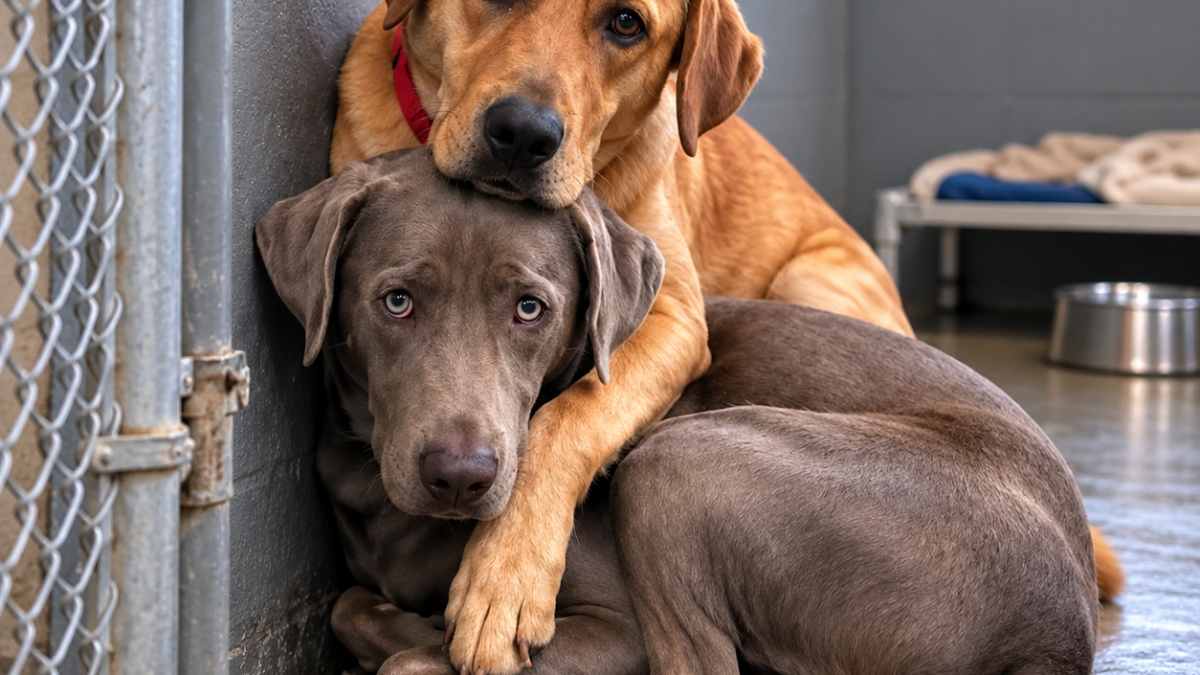
They Returned Them After Three Days—So I Made a Promise No One Expected Me to Keep
The family brought Reddy and Blue back with their brand-new collars still around their necks, like they had not just broken two hearts but wanted proof they had tried.
And when I saw those two dogs standing behind the same cold shelter door, still watching the entrance for people who were never coming back, I remembered exactly what it felt like to wait for someone who had already chosen to leave.
Reddy was wearing the green collar.
Blue was wearing the orange one.
That was the first thing I noticed, and for some reason, that made it worse.
Not the concrete floor. Not the metal kennel door. Not the fluorescent shelter lights buzzing above them like nothing sacred had happened. The collars.
Three days earlier, I had helped buckle those collars around their necks while a smiling family promised they were taking them home forever. The mother had knelt down, pressed her cheek against Reddy’s golden head, and said, “You boys are going to have the best backyard.” The father had laughed when Blue leaned against his leg. The two kids had argued happily over who would hold which leash.
I had believed them.
Maybe that was my mistake.
When they drove away that Friday afternoon, Reddy had his nose pressed to the SUV window, and Blue sat beside him, quiet and serious, as if he already understood that happiness was something you should accept carefully because it might be taken back. I stood in the parking lot until the SUV disappeared past the gas station at the corner, and I whispered, “Go be happy, boys.”
By Monday morning, they were back.
Same kennel.
Same door.
Same two dogs.
Only now, they looked confused in a way that made my chest hurt.
Reddy stood at the front of the kennel, his ears lifted every time footsteps passed the hallway. Blue lay behind him with his chin on his paws, but his eyes were fixed on the shelter entrance. Neither of them barked. Neither of them jumped. They weren’t acting wild. They weren’t being difficult.
They were waiting.
I turned to our supervisor, Denise, who was standing with a clipboard pressed against her chest.
“What happened?”
Her face tightened the way it did when she had already had a hard conversation and didn’t want another one.
“They returned them last night.”
“I can see that,” I said, sharper than I meant to. “Why?”
She looked through the kennel bars at Reddy and Blue, then back at me.
“They said the dogs were too difficult.”
For a second, I thought I had misheard her.
“Too difficult?”
“Too much energy. They weren’t listening. The kids got overwhelmed. They said it wasn’t the right fit.”
I stared at the dogs.
Three days.
That was all they had been given.
After six months in our shelter, six months of waiting behind one metal door while families walked by and said they were beautiful but too much, Reddy and Blue had finally been chosen together. They had climbed into that SUV wearing new collars and carrying every hope I had been afraid to name.
And after seventy-two hours, they were back on concrete.
I opened the kennel door slowly.
Reddy came to me first. He smelled my hand, pressed his nose into my palm for one second, then turned away and went back to the door. Blue did not move until I sat on the floor. Then he lifted his head and looked at me, not asking for comfort, not expecting anything.
That look was worse than crying.
I had seen dogs panic when they were returned. I had seen them bark until their voices went hoarse, throw themselves against kennel doors, scratch at floors, refuse food, or curl up so tightly they seemed to disappear inside themselves.
Reddy and Blue did none of that.
They just watched the entrance.
As if the family might realize there had been a mistake.
As if the mother might rush back in with tears in her eyes and say, “We’re sorry, boys. We didn’t mean it.”
As if love was a door that could still open if they waited long enough.
I sat beside them until the concrete numbed my legs.
Reddy lowered himself beside Blue. Blue leaned into him. Their backs touched, the way they always slept at night. Bonded pairs did that. They made one body out of two. One heartbeat out of fear. One small family where the world had failed to provide one.
And sitting there beside them, I was eight years old again.
I was back in my mother’s living room, sitting near the front window with my knees pulled to my chest, watching the road for my father’s truck.
He had left on a Thursday evening.
He had crouched in front of me, smelled like motor oil and winter air, and said, “I’ll be back soon, Josh. You be good for your mom.”
I believed him.
For three days, I watched that window.
Then a week.
Then a month.
After a while, my mother stopped telling me to move away from the glass. She would just set a sandwich beside me and touch my hair before walking back to the kitchen.
I learned something in that window no child should learn.
Some people leave in a way that keeps you waiting long after they are gone.
Reddy and Blue were waiting like that.
I could see it.
I could feel it.
That morning, while the shelter woke up around us and other dogs began barking for breakfast, I put one hand on Reddy’s neck and the other on Blue’s shoulder.
“I’m sorry,” I whispered.
Reddy’s tail moved once against the floor.
Not joy.
Recognition.
Like he knew apology when he heard it but no longer trusted what came after.
I stayed in that kennel until Denise came back down the hall and stopped outside the door.
“Josh,” she said softly, “we need to clean.”
I nodded, but I didn’t get up right away.
I looked at Reddy’s green collar and Blue’s orange one. They looked too bright in that gray kennel, like leftover decorations from a party that had ended badly.
Then I made a promise I had no business making.
“You’re not going to keep waiting for people who already walked away,” I said. “Not anymore.”
At twenty-one years old, finishing my last year of college, working mornings at a feed store, nights at a diner, and volunteering at the municipal shelter three days a week, I had no house, no yard, no savings worth mentioning, and no reason to believe I could change much of anything.
But grief and anger can make a person bold before they make him wise.
I looked at those two dogs and said it again, quieter this time.
“I’ll find you somewhere safe. Both of you. Together.”
Blue blinked slowly.
Reddy leaned his weight against my knee.
That was all the answer I got.
PART 2
I started volunteering at the shelter when I was eighteen, two weeks after getting my driver’s license.
At first, I thought it would be simple.
Show up. Walk dogs. Wash bowls. Carry food. Clean kennels. Help people meet animals. Do good. Go home.
That was the idea.
Nobody warned me that shelters do not end at the door.
You leave with hair on your clothes, scratches on your arms, and faces in your head. You remember the old hound who pressed himself against the kennel bars just to feel a hand. You remember the trembling terrier found in a ditch after a storm. You remember the cats surrendered in laundry baskets, the puppies born under porches, the senior dogs whose owners died and whose families said, “We can’t take him.”
You learn how many ways people can say no to responsibility and still sound reasonable.
“He’s too old.”
“She sheds too much.”
“We’re moving.”
“Our new baby is allergic.”
“He takes too much work.”
“We just don’t have time.”
The animals never understand the explanations. They only understand the door closing.
Reddy and Blue had come in together on a rainy Wednesday in April.
Animal control found them near the county road that ran behind an abandoned trailer park. Reddy was pacing beside a drainage ditch, barking at every passing truck. Blue was down in the ditch, unable to climb out because one of his back legs had been caught in old wire. Reddy could have left him. He didn’t.
He stayed.
By the time Officer Landry arrived, Reddy was soaked, hoarse, and frantic, running between the road and the ditch like he was trying to drag help out of the world by force.
Blue’s leg was cut but not broken. He let us clean it, but only while Reddy stood where he could see him. The first night, we put them in separate kennels because that was policy during intake.
That lasted eight minutes.
Reddy barked until his voice cracked. Blue pressed himself into the far corner and trembled so hard his water bowl shook. Denise stood there with her arms crossed, trying to look practical, then said, “Put them together.”
The moment the divider opened, Reddy rushed to Blue, sniffed his face, then lay down in front of him like a guard. Blue rested his chin across Reddy’s back.
Nobody argued after that.
They were listed as Labrador mixes, around three years old, healthy except for Blue’s healing leg and both dogs being underweight. Reddy was gold with darker ears and expressive brown eyes that made it impossible to miss what he was feeling. Blue was silver-gray, leaner, quieter, and careful in every movement. Reddy met the world first. Blue studied it from behind him.
Most visitors loved them for about thirty seconds.
Then they asked the question.
“Do they have to go together?”
Denise always answered honestly. “Yes. They’re bonded. Separating them would be extremely hard on both.”
People would nod, make sad faces, tell us how sweet that was, then move on to the next kennel.
That was how six months passed.
Reddy learned the shelter schedule. He knew breakfast came after the first big round of barking. He knew Denise carried the medicine cart at nine. He knew I came on Tuesdays, Thursdays, and Saturdays. He knew which volunteers gave treats and which ones only talked about giving treats. Blue learned too, but quietly. He knew when the hallway was too loud and when to retreat. He knew Reddy would step between him and strangers. He knew exactly how far my hand would reach before I let him decide the rest.
I loved them before I admitted it.
That is the danger of shelter work. You tell yourself you are helping, not attaching. You tell yourself the goal is goodbye. You repeat it like scripture.
Goodbye means they found a home.
Goodbye means this worked.
Goodbye is the happy ending.
But some animals make goodbye feel like loss no matter how happy it is supposed to be.
The Friday they were adopted, I thought I was ready for it.
The family came in after lunch. The mother’s name was Karen Mayfield, the father was Paul, and their children were a girl around ten and a boy around seven. They wore clean sneakers and careful smiles. Their SUV outside looked new enough to still smell like the dealership.
“We’re interested in adopting two dogs,” Karen told Denise at the desk. “We thought it might be nice for them to have each other.”
I was restocking leashes nearby when I heard that. I turned so fast I dropped three collars on the floor.
Denise looked at me once, a warning not to get too excited.
I got excited anyway.
We brought the Mayfields to the meet-and-greet yard behind the shelter. Reddy trotted in first carrying his battered rope toy, the one missing half its knot. Blue followed close behind, head low, eyes watchful.
The little boy crouched down immediately.
“Can I pet them?”
“Let them come to you,” I said.
To my surprise, Reddy went straight to him and dropped the rope toy at his feet. The boy laughed. Blue stood near the fence for a minute, then walked over to the girl and allowed her to touch the top of his head.
Karen pressed her hands to her chest.
“Oh, Paul,” she said. “Look at them.”
Paul smiled. “They’re good-looking dogs.”
“They’re more than that,” I said, unable to stop myself. “They’re loyal. They’re gentle once they trust you. Reddy has more energy, but Blue balances him. They do best with patience and routine.”
Karen nodded earnestly.
“We can give them that.”
I wanted to believe her so badly that I ignored the way Paul checked his watch twice.
They spent almost forty minutes in the yard. Reddy played fetch with the boy. Blue sat near the girl and eventually leaned his shoulder against her knee. Karen took pictures. Paul asked about food, vet records, vaccines, leash manners.
Denise went through everything carefully.
“They will need time to adjust,” she said. “A shelter is not a normal environment, and a home will be new. The first few days can be confusing. They may pace. They may have accidents. They may test boundaries. That does not mean anything is wrong. It means they need structure.”
Karen nodded again.
“We understand.”
Paul said, “We’ve had dogs before.”
That sentence always worried me a little. Sometimes it meant experience. Sometimes it meant a person thought every dog should behave like the one they remembered from ten years ago.
Still, the adoption moved forward.
At the front desk, Karen noticed the collar display.
“They should leave with something new,” she said.
She picked green for Reddy because it looked good against his golden coat. The little girl chose orange for Blue because she said it made him look brave.
I buckled the collars myself.
Reddy kept licking my chin. Blue stood still as stone, but when I finished, he pressed his forehead briefly against my chest.
I nearly lost it right there.
“Be good,” I whispered to him.
Then I corrected myself.
“No. Be loved.”
Outside, we helped them into the SUV.
Reddy jumped in first.
Blue hesitated, and for one strange second, he looked back at the shelter as if memorizing it.
Then Reddy turned around and touched his nose to Blue’s face.
Blue climbed in.
Karen closed the back hatch gently.
“Thank you,” she said. “We’ll take good care of them.”
I nodded because I couldn’t speak.
That weekend, I imagined them everywhere.
Running through grass. Sleeping in a family room. Learning the sounds of a refrigerator, a mailbox, children coming home from school. I imagined Blue discovering a soft bed and Reddy dropping that rope toy in the father’s lap until Paul finally laughed and threw it.
I needed that happy ending.
Maybe more than they did.
Because if Reddy and Blue could wait and finally be chosen, maybe waiting did not always end the way my childhood had.
Then Monday came.
After I found them back in the kennel, something in me shifted.
I still cleaned. Still fed. Still walked dogs. Still answered visitors politely. But beneath every ordinary task, anger moved like a low fire.
Around noon, I went to the front desk and pulled their return paperwork.
Denise saw me.
“Josh.”
“I just want to read it.”
“You already know what it says.”
“I want to read their words.”
She hesitated, then handed me the form.
Reason for return: Too difficult to manage. Jumping. Pulling. Barking at night. Children scared. Not a good fit.
Under additional comments, Karen had written: We feel they need a more experienced home.
Three days.
They had taken two shelter dogs into a brand-new environment, with children, new smells, new rules, new expectations, and then decided in three days that the dogs were the problem.
I folded the paper and set it down.
Denise watched me carefully.
“You can be angry,” she said. “But don’t let it make you careless.”
“I made them a promise.”
Her expression softened, but only a little.
“You make promises too easily.”
“Maybe people break them too easily.”
She looked toward the kennels.
“That may be true. But truth doesn’t pay adoption fees, rent, vet bills, or training costs.”
“I’ll figure it out.”
“Josh.”
“What?”
She lowered her voice. “We’re over capacity.”
I went still.
“How over?”
“Seven dogs over. Intake hasn’t slowed. We have three cruelty cases coming from the county tomorrow, and animal control called about a litter found behind the grocery store.”
I knew what she was saying before she said it.
“No.”
“I haven’t made any decisions.”
“You’re thinking about separating them.”
“I’m thinking about keeping them alive and adoptable.”
“They are adoptable together.”
“For the right home, yes. But the right home hasn’t come in six months. The one family willing to try brought them back in three days.”
“That doesn’t mean they failed.”
“No,” Denise said. “It means people will see that return on their record and hesitate even more.”
I looked down the hallway.
Reddy was standing again.
Watching us.
As if he knew his future was being discussed in words he could not understand.
“Give me time,” I said.
Denise rubbed her forehead. She was tired. We all were. People like to imagine shelter workers as cold when they make hard decisions, but the truth is uglier. Most of them care too much and have too little space to prove it.
“How much time?”
“Two weeks.”
“Josh—”
“Two weeks. I’ll promote them. I’ll talk to rescues. I’ll raise money. I’ll find a foster who can take both.”
“And if you don’t?”
I hated her for asking.
I hated that she had to.
“I will,” I said.
Denise studied me for a long moment.
“Ten days.”
“Denise—”
“Ten days before we revisit options. That’s all I can honestly give you.”
I wanted to argue, but arguing would not create kennels.
So I nodded.
“Ten days.”
That night, I went home to the apartment I shared with two other college students and made a plan at our kitchen table.
Our apartment did not allow dogs. Even if it had, Reddy and Blue needed more than a third-floor walk-up with three exhausted people and a landlord who already hated us because Tyler kept burning popcorn.
So fostering them myself was impossible.
Adopting them was impossible.
Paying for private boarding was almost impossible.
But “almost” was not the same as no.
I made a list.
Local rescues.
Trainers.
Farm families.
Veterans’ groups.
Retired couples.
Former adopters.
College professors with land.
Anyone I could think of.
Then I made a post for the shelter page.
I did not write, Two bonded dogs returned for being too difficult.
That sounded like a warning label.
I wrote the truth instead.
Reddy and Blue waited six months for a home together. They were adopted Friday and returned Monday after struggling to adjust in a new environment. They are confused, heartbroken, and still looking for someone who understands that dogs need more than three days to feel safe. They are bonded, loyal, gentle, and must stay together. They need patience, structure, and a home that will not give up on them.
I added pictures.
Reddy carrying his rope toy.
Blue leaning against him.
The two of them sleeping back-to-back.
Then I stared at the last line for a long time before typing it.
I promised them I would help find the home they deserved.
I posted it before I could lose courage.
By morning, it had been shared more than a hundred times.
By noon, it had more comments than anything our shelter had ever posted.
Some were kind.
Poor babies.
They deserve better.
I wish I could take them.
Some were useless.
People are awful.
This broke my heart.
Praying.
And some were cruel in the casual way people become when a screen stands between them and consequence.
Maybe they really are difficult.
Not everyone can handle two big dogs.
The family probably had a good reason.
This is why shelters should not guilt people.
I read every comment even though I knew better.
Denise found me in the break room, jaw clenched, phone in my hand.
“Stop,” she said.
“I’m fine.”
“You look like you want to fight someone in a parking lot.”
“I might.”
“Then stop reading.”
I set the phone down.
“The post is working.”
“It’s getting attention,” she said. “That is not the same as working.”
She was right.
By the third day, we had thirty-seven messages.
Twenty-two were from people who had not read the part about keeping them together.
Seven wanted us to ship the dogs to another state with no references.
Four had unfenced yards and toddlers.
Three wanted “outside dogs.”
One man wrote, I’ll take the gray one only.
I deleted that message before I trusted myself to answer.
The shelter remained full.
Reddy and Blue remained in the kennel.
The green and orange collars stayed around their necks because nobody had the heart to remove them.
On Thursday, Blue stopped eating breakfast.
That scared me more than the return had.
Reddy nudged the bowl toward him, then looked up at me.
“Come on, buddy,” I whispered.
Blue turned his face away.
Marisol, one of our kennel techs, knelt beside me.
“He ate last night?”
“Half.”
She looked at his gums, then at me.
“It might be stress.”
“It is stress.”
I sat with them during my lunch break and hand-fed Blue pieces of boiled chicken from the medical fridge. He took three bites, then stopped. Reddy refused to eat until Blue did, so I had two worried dogs and one knot in my stomach that would not loosen.
That evening, I called the Mayfield family.
Denise told me not to.
I did it anyway.
Karen answered on the fourth ring.
“Hello?”
“Mrs. Mayfield, this is Joshua from the shelter.”
Silence.
“Oh,” she said. “Hi.”
“I’m calling about Reddy and Blue.”
Another pause.
“Are they okay?”
I looked through the office window at the kennel hallway.
“They’re struggling.”
Her breath caught slightly. “I’m sorry.”
I believed she meant it.
That made me angrier, not less.
“I wanted to understand what happened.”
She was quiet long enough that I thought she might hang up.
Then she said, “We wanted it to work.”
“What happened?”
“They were restless. Reddy kept pacing. Blue wouldn’t come into the kitchen. The kids were excited, and Reddy jumped on them twice. Paul got frustrated. Then Saturday night, they barked for hours.”
“They had just left the shelter,” I said carefully. “They didn’t know where they were.”
“I know.”
“Did you call us? A trainer? Anyone?”
“No.”
“Why not?”
Her voice thinned. “Because Paul said if it was already that hard, it would only get worse.”
I closed my eyes.
“Mrs. Mayfield, they waited six months.”
“I know.”
“They trusted you.”
“I know.”
The words came out as a whisper.
For a moment, neither of us spoke.
Then she said, “My daughter cried all night after we returned them.”
I wanted to say, Good.
I didn’t.
Instead, I said, “They’re still watching the door.”
She made a small sound.
“I’m sorry,” she said again.
Sorry was not enough, but it was all she had.
Before we hung up, she asked, “Will they find someone?”
I looked at Reddy and Blue through the glass.
“I’m going to make sure they do.”
After the call, I sat alone in the office until the motion lights clicked off in the hallway.
That was when my phone buzzed.
A message had come through the shelter page.
My name is Margaret Cole. I saw your post about Reddy and Blue. I may not be the person you’re looking for, but I own twelve acres outside of Briar Creek and have experience with large dogs. My husband passed last year. Our old dog passed in June. The house has been too quiet. I would like to meet them if you think it’s worth discussing.
I read it once.
Then again.
Then I called Denise.
She answered with the voice of someone who had been asleep for ten minutes and resented returning to earth.
“What?”
“Check the shelter messages.”
“Josh, unless the building is on fire—”
“Margaret Cole.”
She went quiet.
“You know her?”
“Everyone knows Margaret Cole.”
“I don’t.”
“She and her husband ran Cole Ridge Farm. Took in retired working dogs, fostered for rescue groups years ago. Good people. Her husband, Henry, died last winter.”
I sat up straighter.
“So this is good?”
“This is worth a call,” Denise said. “Not a celebration. A call.”
But I could hear it in her voice.
Hope.
Thin, cautious, but there.
Margaret came to the shelter Saturday morning.
She arrived in an old blue pickup with hay in the bed and mud on the tires. She was in her late sixties, maybe early seventies, with silver hair braided at the nape of her neck and hands that looked like they had fixed more things than most people had owned. She wore jeans, a canvas jacket, and boots that had seen weather.
She did not rush to the kennels.
That was the first thing I liked about her.
Too many people came in wanting dogs to perform affection immediately, as if fear could be switched off for their convenience. Margaret stood in the lobby, listened while Denise explained everything, then asked questions that mattered.
“How do they do with storms?”
“Unknown,” Denise said.
“Food guarding?”
“Not with people. Some mild anxiety around meals since the return.”
“Leash reactivity?”
“Reddy pulls when excited. Blue freezes when overwhelmed.”
“Children?”
I answered that one.
“Gentle, but they need calm introductions. A busy home with excited kids is probably not right for them.”
Margaret nodded.
“I don’t have children in the house. My granddaughter visits on Sundays. She’s fifteen and quieter than most adults.”
Then she looked toward the kennel hall.
“May I see them?”
We brought Reddy and Blue into the meet-and-greet yard.
Reddy noticed Margaret first. He trotted toward her, rope toy in his mouth, then stopped a few feet away. Blue stayed behind him, studying her.
Margaret lowered herself onto the bench.
She did not call them.
She did not pat her knees.
She simply rested her hands in her lap and waited.
Reddy looked confused by that.
He took one step closer.
Margaret looked at him, but not too directly.
“You’ve had a hard week, haven’t you?” she said.
Her voice was low and plain.
Reddy’s ears softened.
Blue moved closer, just enough to stand beside Reddy.
Margaret stayed still.
Ten minutes passed.
Then fifteen.
The shelter yard was quiet except for traffic beyond the fence and the faint barking of dogs inside. Reddy eventually set the rope toy near Margaret’s boot. She picked it up slowly and tossed it underhand a few feet.
Reddy ran after it, returned, and dropped it again.
Blue watched.
On the third throw, Blue followed Reddy halfway.
I looked at Denise.
Her face gave away nothing, but her eyes were softer.
Margaret stayed almost an hour.
Before she left, she said, “I like them.”
My heart jumped.
Then she added, “But liking them is not enough.”
I respected her for that, even while it hurt.
“I would need to prepare,” she said. “Repair part of my fence. Set up a quiet room. Speak with my veterinarian. And I would want a trainer involved from the start.”
“We can help with that,” I said too quickly.
Denise glanced at me.
Margaret noticed.
“How old are you, Joshua?”
“Twenty-one.”
“You look like a man trying to carry something with his heart that his arms can’t hold yet.”
I did not know what to say.
She looked back at Reddy and Blue.
“I’m not saying no. But I won’t make a promise to them until I know I can keep it.”
That sentence went through me like a blade.
Because it was exactly what the Mayfields had not understood.
Promises were not feelings.
They were work.
Margaret left without adopting them.
Reddy watched her truck pull away.
Blue leaned into him.
I told myself this was still good.
But by Monday, nothing was decided, and Denise’s ten-day clock was running out.
The shelter took in the three cruelty-case dogs from the county. Then the grocery store puppies. Then a senior beagle found wandering near the highway. Every kennel filled. Temporary crates lined the laundry room. Staff moved through the halls with the tense efficiency of people trying not to say the word crisis.
On Tuesday afternoon, Denise called me into her office.
I knew before I sat down.
“We need to discuss Reddy and Blue.”
“No.”
“You don’t know what I’m going to say.”
“Yes, I do.”
She folded her hands on the desk.
“Margaret is a strong possibility, but she is not ready. We do not have a signed foster or adoption hold. We cannot keep operating on hope.”
“She said she’s preparing.”
“And if her fence repair takes three weeks?”
“I’ll pay for boarding.”
“With what money?”
I had no answer.
Denise’s voice softened.
“I’m not your enemy.”
“I know.”
“I love them too.”
That nearly broke me, because I knew she did.
She had sat with Blue after the return. She had brought Reddy a new rope toy from her own paycheck. She had fought harder for dogs than most people ever saw.
But she had a shelter full of animals and only so many kennels.
“What are you proposing?” I asked.
“There is a rescue two counties over willing to take Blue.”
I stood up.
“No.”
“Josh—”
“No. Absolutely not.”
“They specialize in shy dogs.”
“They’re bonded.”
“I know.”
“Then why would you even say it?”
“Because Blue may have a better chance there.”
“Without Reddy, he shuts down.”
“He might adjust.”
“Or he might break.”
Denise looked exhausted.
“And what happens if keeping them together means they wait another six months? A year? What happens if no one takes both?”
“Margaret might.”
“Might is not placement.”
The office felt too small.
I heard myself say, “You promised me ten days.”
“And you have two left.”
“Then give me the two days.”
She leaned back.
“I am. But Josh, if there is no firm plan by then, I have to consider what gives each dog the best chance.”
I walked out before I said something I could not take back.
That night, I did something I had avoided for years.
I called my father.
I had his number because my mother gave it to me when I turned eighteen. She did not tell me to call. She just wrote it on a slip of paper and said, “Whatever you decide, decide from peace, not anger.”
I had carried that number in my wallet for three years and never used it.
Now I sat in my truck outside the diner after my shift, smelling like coffee and fryer oil, staring at the numbers glowing on my phone.
I did not know why I was calling him.
Maybe because seeing Reddy and Blue returned had dragged that old wound open. Maybe because I needed to hear the voice of someone who had left and survived being the person who left. Maybe because part of me still wanted an explanation, even after all these years.
He answered on the second ring.
“Hello?”
His voice was older, rougher, but I knew it immediately.
My throat tightened.
“Dad.”
Silence.
Then a breath.
“Josh?”
I closed my eyes.
“Yeah.”
“My God. Josh.”
I almost hung up.
Instead, I gripped the steering wheel and stared at the dark windshield.
“I don’t have much time,” I said, though I had nowhere to be. “I just need to ask you something.”
“Okay.”
“When you left, did you know you weren’t coming back?”
The silence that followed was long enough to answer.
Finally, he said, “Not at first.”
“That’s not an answer.”
“No,” he said quietly. “I suppose it isn’t.”
I waited.
He exhaled.
“I told myself I’d come back when I got steady. Then when I didn’t get steady, I told myself you were better off without me showing up half-broken. After a while, shame became easier than repair.”
The words landed hard.
I had imagined excuses. Cruelty. Indifference. Another family. A clean villain.
Shame was messier.
“So you just let me wait?”
His voice cracked slightly.
“Yes.”
I looked out across the empty parking lot.
A stray plastic bag moved along the curb in the wind.
“I was eight.”
“I know.”
“I watched the window.”
“I know.”
“No, you don’t,” I said, and my voice broke before I could stop it. “You don’t know what it does to someone to keep believing the door is going to open.”
He said nothing.
For the first time in my life, I heard my father cry.
Not loudly. Not dramatically. Just a broken breath on the other end of the line.
“I’m sorry,” he said.
I thought sorry would make me angry.
It didn’t.
It made me tired.
“There are these dogs,” I said.
I laughed once because it sounded ridiculous. Years of silence, and I was talking about dogs.
But then I told him everything.
Reddy and Blue. The ditch. The shelter. The adoption. The return. The collars. The way they watched the door. The possibility they might be separated because nobody had room for both.
My father listened.
When I finished, he said, “What do you need?”
I almost said nothing.
Pride rose in me fast and bitter.
Then I thought of Blue not eating. Reddy standing guard. Margaret’s fence. Denise’s two days.
“Money,” I said. “For fence repair. Maybe training. Maybe temporary boarding. I don’t even know.”
“How much?”
“I wasn’t asking you to—”
“How much, Josh?”
I pressed my thumb and finger against my eyes.
“I don’t know. A thousand maybe. Fifteen hundred.”
“I can send two.”
I went still.
“You don’t have to do that.”
“I know.”
“This doesn’t fix anything.”
“I know that too.”
I swallowed.
“Then why?”
His answer was quiet.
“Because maybe I can help you keep a promise, even if I broke mine.”
I sat there for a long time after we hung up.
The next morning, two thousand dollars landed in my account.
I stared at it in the feed store break room until my manager asked if I had seen a ghost.
I had, in a way.
Not the ghost of the father I wanted.
The ghost of the man who failed me, trying late to do one decent thing.
I called Margaret on my lunch break.
“I can help with the fence,” I said. “The shelter can help with training contacts. I can bring them out for visits first. We can do this slowly.”
She listened without interrupting.
When I finished, she said, “Where did you get money for fence repair?”
“Someone owed me,” I said.
It was not exactly true.
It was not exactly a lie.
Margaret was quiet.
Then she said, “Bring them tomorrow.”
The next day was cold and bright.
I drove the shelter van with Denise in the passenger seat and Reddy and Blue secured in the back. Reddy whined for the first ten minutes, then settled when Blue pressed against him. Blue watched the world through the window, ears pinned but eyes alert.
Cole Ridge Farm sat twelve miles outside town, at the end of a gravel road lined with bare maples and old fence posts. The house was white with green shutters. The barn was red but weathered. A pasture rolled behind it, bordered by woods on one side and a creek on the other. It looked lived-in, not polished. Safe, but not soft in a fake way.
Margaret was waiting by the gate.
She had repaired the fence.
I noticed that before anything else.
New boards lined the weak section near the barn. Fresh wire ran along the lower gap where a nervous dog might squeeze through. Two water bowls sat near the porch. A dog bed was visible through the mudroom door.
She had not just thought about them.
She had prepared for them.
Reddy jumped down first and sniffed the gravel. Blue followed slowly. Margaret did not approach. She let them take in the yard, the porch, the barn, the wind.
“Quiet place,” Denise said.
Margaret nodded.
“Too quiet lately.”
We walked the perimeter together. Reddy pulled ahead, excited by every smell. Blue stayed close to me at first, then began drifting toward Margaret. She carried treats but did not bribe him. She simply dropped one near her boot when he came close and kept walking.
After twenty minutes, Blue touched his nose to her hand.
Margaret froze.
Then she smiled.
Not big.
Not for us.
For him.
“Hello, Blue,” she said.
Reddy found an old tennis ball near the porch and brought it to her like he had lived there for years.
Denise looked at me.
I looked away because my eyes were burning again.
But one visit was not a home.
We all knew that.
So we did three more visits.
Then an overnight.
The first overnight, I barely slept. I kept my phone beside my pillow, waiting for Margaret to call and say it was too much.
She did call at 7:12 the next morning.
My heart stopped when I saw her name.
“How bad?” I answered.
She chuckled.
“Well, Reddy stole one of my slippers and Blue slept in the hallway instead of the mudroom.”
“That’s it?”
“Reddy also tried to climb into my lap during the evening news.”
“He’s seventy pounds.”
“Yes. He seemed unaware.”
I sat down on the edge of my bed.
“So it went okay?”
There was a pause.
Then Margaret said, “They looked for you at bedtime.”
That hurt.
“They did?”
“Reddy paced by the door. Blue wouldn’t settle until I sat on the floor with him. Took about an hour.”
“I can come get them.”
“I didn’t say that.”
I held my breath.
“I said they missed you. That’s different from failing.”
I closed my eyes.
Margaret understood.
That was the moment I began to believe.
The second overnight went better.
The third, Reddy slept beside Margaret’s bed and Blue slept in the open doorway where he could see both his brother and the hall.
Then came the trial week.
Denise approved it with paperwork so detailed it looked like a mortgage. Margaret signed every page. I delivered food, beds, medical records, toys, and the battered rope Reddy had carried through six months of waiting.
When I loaded the boys into the van that morning, I felt the old contradiction of shelter goodbye.
Hope and grief.
Relief and fear.
Love and letting go.
At the farm, Reddy jumped out like he had somewhere important to be. Blue followed, still cautious but no longer frozen. Margaret stood on the porch with both hands tucked into her jacket pockets.
“Well,” she said, “come on then.”
Reddy ran to her.
Blue walked.
That was Blue’s way. He never rushed trust. He offered it like something handmade, slowly and with care.
I stayed two hours, helping set up the feeding station and walking the fence one more time. Then Denise texted me from the shelter.
Let them start without you.
I hated that she was right.
I knelt in the yard.
Reddy came first, tail sweeping hard enough to move leaves. He pressed his forehead into my chest. I held his face in both hands.
“You be good,” I whispered.
Then I shook my head.
“No. Be happy.”
Blue stood a few feet away.
I waited.
He came when he was ready.
He leaned against me, full weight, silent and heavy with trust.
That nearly undid me.
“I kept my promise,” I whispered into his fur. “I think I did.”
When I stood, Margaret was watching from the porch.
“I’ll call if there’s trouble,” she said.
“I know.”
“And if there isn’t.”
I nodded.
“Yeah. Call then too.”
Driving away from Cole Ridge Farm was harder than watching the Mayfields leave the shelter, because this time I knew exactly what was at stake.
In the rearview mirror, Reddy stood beside Margaret near the porch.
Blue stood beside Reddy.
Neither chased the van.
Neither panicked.
They watched me go, but they did not look abandoned.
That difference mattered.
The first day passed with three updates.
Reddy explored the barn.
Blue found the mudroom bed.
Both ate dinner.
The second day, Margaret sent a photo of them sleeping on a braided rug near the stove, backs touching.
I stared at that picture for ten minutes.
On the third day, I waited for dread to rise.
Three days had been the place where everything broke last time.
By afternoon, I could not focus in class. My professor was talking about American literature, but all I could think was: This is when they came back. This is when the door opened. This is when the collars were still on.
At 4:38, Margaret sent a video.
In it, Reddy ran across the pasture with the old tennis ball in his mouth. Blue chased him, not fast, not wild, but free enough that his ears lifted in the wind. Margaret laughed behind the camera.
Her message said: Day three. Still difficult. Still staying.
I put my head down on the library table and cried where no one could see my face.
The trial week became two.
Then three.
Reddy learned not to jump on Margaret by sitting on his own feet when excited, which looked ridiculous but worked. Blue learned the kitchen was safe, then the living room, then the porch. They barked at the mail carrier exactly once before Margaret informed them that Mr. Alvarez had been delivering mail to Cole Ridge for twenty-six years and would not be harassed by amateurs.
They accepted this.
Mostly.
A trainer named Carla came every Thursday. She taught Margaret how to build routines and taught me, during visits, how not to let my emotions confuse the dogs. That was humbling.
“You love them,” Carla said one afternoon as Reddy leaned against my legs.
“Yes.”
“Then stop making every goodbye feel like a funeral.”
I stared at her.
She shrugged.
“They read you. If you act like leaving is tragic, they’ll believe it is.”
So I practiced leaving calmly.
It felt dishonest at first.
Then I realized calm was not the opposite of love.
Sometimes it was proof of it.
The adoption became official on a Sunday in late November.
Margaret asked if we could do it at the farm instead of the shelter. Denise agreed. I brought the paperwork. Marisol brought dog treats. Carla came with training notes. Even Officer Landry stopped by in uniform, pretending he was “just in the area,” though Cole Ridge was nowhere near his route.
Margaret’s granddaughter, Sophie, made a small sign and taped it to the porch rail.
WELCOME HOME REDDY & BLUE
The boys had no idea they were the guests of honor. Reddy was focused on convincing Officer Landry to throw the tennis ball. Blue sat beside Margaret’s chair, calm but watchful.
Denise handed Margaret the adoption papers.
Before signing, Margaret looked at me.
“Are you sure?”
The question startled me.
“I’m not the one adopting them.”
“No,” she said. “But you’re the one who loved them first.”
I looked at Reddy.
Then Blue.
Then at the green and orange collars still around their necks.
We had talked about replacing them. Margaret had even bought new ones, sturdy leather, brown for Reddy and dark blue for Blue.
But she had not put them on yet.
“I thought those collars would always remind me of them being returned,” I said.
Margaret waited.
“But maybe they don’t have to mean that.”
Blue looked up at me.
“Maybe they can mean they left that place and survived it.”
Margaret nodded.
Then she signed.
Just like that, the waiting ended.
No music. No miracle light. No grand speech.
Just ink on paper, two dogs in a yard, and a promise finally landing somewhere solid.
Afterward, Margaret removed the green and orange collars.
She did not throw them away.
She hung them on a nail inside the mudroom, beside the new leather leashes.
“Why keep them?” Sophie asked.
Margaret looked at the collars for a long moment.
“To remember that returning someone is not the end of their story.”
Reddy bumped her hand with his nose.
Blue leaned against her leg.
I had to step outside.
The air was cold enough to steady me.
I stood near the pasture fence, watching the late sun turn the grass gold. A few minutes later, Denise came out and stood beside me.
“You did good,” she said.
I laughed under my breath.
“You sound surprised.”
“I’m always surprised when stubbornness becomes useful.”
I wiped my face with my sleeve.
“Do you think they’ll be okay?”
Denise leaned her arms on the fence.
“No dog gets a guarantee. No person either.”
“That’s comforting.”
“It’s honest.”
We watched Reddy run after the ball. Blue chased him halfway, then returned to Margaret’s side.
Denise said, “They have what they need. That’s all any of us can fight for.”
A week later, my father came to the shelter.
He called first.
I almost told him not to.
Then I thought about promises, broken and repaired, and how some gates stay closed because nobody wants to touch the latch.
So I said he could come.
He arrived on a Wednesday afternoon in an old truck with faded paint. He looked smaller than I remembered, though that may have been because I was no longer eight. His hair had gone mostly gray. His hands shook slightly when he took off his cap.
For a second, we just stood in the parking lot.
“Josh,” he said.
“Hey.”
He looked at the shelter building.
“So this is where they were?”
“Yeah.”
We walked inside.
I showed him the kennel where Reddy and Blue had waited. It was occupied now by a nervous shepherd mix named Daisy. She barked once, then retreated.
My father gripped the kennel bars lightly.
“They were in here six months?”
“Yeah.”
“And then back again after three days?”
I nodded.
He looked down.
“I understand why that got to you.”
I almost made a sharp remark.
Something like, Do you?
But I was tired of using pain as proof.
So I said, “It did.”
We walked the hallway. I introduced him to Denise. She looked him over with the terrifying politeness of a woman who knew more than she said. Then she put him to work carrying donated food from the lobby to storage.
He did it without complaint.
Afterward, we sat outside on the curb.
He handed me a folded envelope.
“What’s this?”
“Money for the shelter.”
“You already sent money.”
“That was for the dogs. This is for whoever comes next.”
I did not open it.
“You don’t have to buy your way back.”
“I know.”
“Do you?”
He looked at me then.
“I can’t get back what I missed. I know that. I’m not asking you to call me every Sunday or pretend I didn’t hurt you. I just…” He stopped, searching for words. “I want to stop being the kind of man who leaves every good thing because he’s ashamed he might ruin it.”
That was the first honest thing I had ever heard him say about himself.
I looked out at the road.
“I don’t know what I want from you.”
“That’s fair.”
“I’m still angry.”
“You should be.”
“I don’t trust you.”
“I wouldn’t either.”
That made me laugh once, unexpectedly.
He smiled a little, then looked away.
We sat in silence for a while.
Not fixed.
Not healed.
But not pretending.
Before he left, he asked, “Could I see them someday? Reddy and Blue?”
I thought about it.
“They’re not mine anymore.”
“No,” he said. “I suppose that’s the point.”
A month passed.
Then two.
Winter settled in.
The shelter stayed full, then emptied a little, then filled again. That is shelter life. Joy and heartbreak share the same hallway. One dog goes home. Two more arrive. A cat finds a family. A senior dog is surrendered. A volunteer cries in the laundry room, then wipes her face and goes back to work because bowls still need washing.
Reddy and Blue became the shelter’s favorite update.
Margaret sent pictures every week.
Reddy lying upside down on the porch with no dignity.
Blue sitting in a patch of sun near the stove.
Both dogs following Margaret through the pasture.
Both dogs covered in mud after discovering the creek.
Both dogs wearing ridiculous red bandanas at Christmas because Sophie insisted.
The post announcing their adoption went viral locally. People loved the happy ending. They shared it, commented on it, and wrote things like, Faith in humanity restored.
I understood the sentiment.
But I also knew humanity had not been restored by a single happy ending.
Humanity was restored in pieces.
By Denise giving me ten days when she did not have space.
By Margaret refusing to make a promise before she could keep it.
By a trainer showing up every Thursday.
By my father sending money he could not use to erase the past.
By two dogs continuing to trust after being given reasons not to.
In March, Margaret invited me to Cole Ridge for Reddy and Blue’s “homecoming day.”
“It has been four months,” she said on the phone. “Sophie says that counts as an anniversary.”
“Does it?”
“In this house, apparently.”
I drove out after my shift.
The farm looked different in early spring. The trees had small green buds. The pasture was soft from rain. The creek ran higher than before. Reddy met my truck halfway down the drive, barking like a fool, while Blue stood on the porch beside Margaret, tail moving slowly.
I got out and braced myself just before Reddy crashed into my legs.
“Hello to you too,” I said, laughing.
Blue came down the steps at his own pace. When he reached me, he pressed his head against my hip.
Still quiet.
Still careful.
Still Blue.
Margaret had made coffee. Sophie had baked a crooked cake with peanut butter frosting for humans and little dog-safe treats shaped like bones for the boys. My father was there too, which Margaret had asked permission for before inviting him.
He looked nervous.
So did I.
Reddy solved that by dropping a slobbery tennis ball into his lap.
My father looked at me.
“What do I do?”
“Throw it.”
He did.
Reddy chased it like forgiveness was simple.
It was not.
But it was something.
Later, after supper, Margaret took us to the mudroom.
The green and orange collars still hung on the nail. Below them were the leather collars Reddy and Blue now wore every day, worn soft with use.
Margaret touched the orange collar lightly.
“I thought about putting these away,” she said. “But I like seeing them there.”
“Why?” my father asked.
She looked at him, then at me.
“Because some things should remind us. Not to punish us. To keep us honest.”
No one spoke for a moment.
Blue leaned against my father’s leg.
My father looked down, startled.
“He doesn’t usually do that with new people,” Margaret said.
My father’s face shifted.
Carefully, like he was afraid of doing it wrong, he lowered his hand and touched Blue’s head.
Blue stayed.
I watched them and felt something inside me loosen—not disappear, not heal all at once, but loosen.
That evening, as the sun dropped behind the pasture, I walked alone to the fence line. Reddy and Blue followed me. Reddy ran ahead, nose to the ground. Blue stayed close.
I leaned on the fence and looked back at the house.
Margaret stood on the porch talking with Denise. Sophie was laughing at something Marisol said. My father sat on the steps, throwing the tennis ball again and again because Reddy had apparently decided he was useful.
Blue pressed his shoulder against my leg.
“You did all right,” I told him.
He looked up at me.
“No,” I said. “You did better than all right.”
Reddy came racing back, dropped the ball at my feet, and shook mud onto my jeans.
I groaned.
He looked delighted.
From the porch, Margaret called, “That means he loves you.”
“I liked his old way better,” I called back.
Everyone laughed.
Blue wagged his tail.
It was a small sound, that laughter, carried across a farm at dusk. Nothing dramatic. Nothing that would make headlines. But I thought about the Monday morning when Reddy and Blue had stood behind the kennel door in those bright collars, waiting for people who had already chosen to leave them.
They were not waiting anymore.
That was the ending I had wanted for them.
But it was also the beginning they deserved.
When I left that night, Reddy and Blue walked me to my truck. Reddy tried to climb in, because Reddy believed all open doors were invitations. Blue stood beside him, calm and steady.
I knelt in the gravel and held both their faces.
“You’re home,” I said.
This time, saying goodbye did not feel like abandonment.
It felt like proof.
Reddy licked my cheek. Blue touched his nose to my chin.
Then Margaret called them from the porch.
“Boys.”
Reddy turned first.
Blue followed.
They ran back toward the lighted house together, shoulder to shoulder, green fields opening around them, no metal door ahead, no concrete floor beneath them, no family waiting to return them because love had become inconvenient.
Just a porch.
A warm room.
A woman who had prepared before she promised.
And two dogs who had finally learned that some doors close because you are safe inside.
I watched until they disappeared into the house.
Then I got into my truck and sat there for a minute with both hands on the wheel.
My phone buzzed.
It was a message from Margaret.
A photo.
Reddy and Blue were already on the rug by the stove, backs touching, eyes half-closed.
Below it, she had written:
Still difficult. Still loved. Still staying.
I saved that picture.
For a long time, whenever life disappointed me, whenever someone broke their word, whenever old memories pulled me back toward that window where I had waited as a boy, I looked at it.
Not because it erased what happened.
Nothing good works that way.
I looked because it reminded me that being returned is not the same as being unwanted forever.
That a broken promise does not get the final word unless no one makes a better one.
That some hearts need more than three days.
And that sometimes, if someone stays long enough, waits gently enough, and refuses to separate what love has already joined together, even the ones left watching the door can finally turn away from it and go home.