PART 2: They Ordered Me to Evacuate—Then I Saw My K-9 Partner Trapped in the Rising Flood
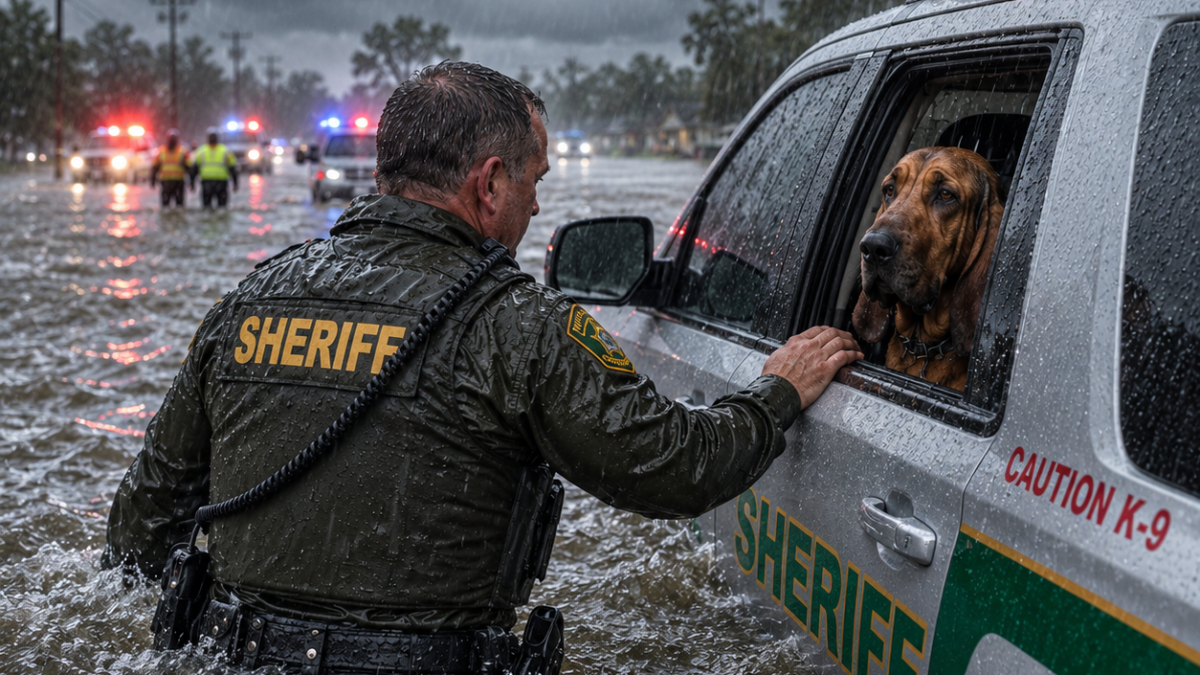
PART 2
“Marcus!”
I heard Lieutenant Daniels shouting behind me.
I didn’t stop.
“Marcus, the canal is overtopping!”
I stepped into the water.
Cold.
Hard-moving.
Much faster than it looked.
At ankle depth, it seemed manageable.
At my shins, I felt the current.
At my knees, I understood why they were yelling.
Floodwater doesn’t behave like swimming-pool water.
It doesn’t sit still and wait for you.
It moves.
It hides holes.
Curbs.
Storm drains.
Broken pavement.
Branches.
Metal.
Anything that can cut, trip, trap, or drag you.
I knew that.
I’d been trained for it.
I’d warned civilians about it for years.
And I kept moving anyway.
“Marcus!”
Another voice.
“Come back!”
I looked toward the SUV.
Scout was standing now.
I could see him clearly through the rear window.
His body was angled toward me.
He wasn’t barking.
That was Scout.
He rarely barked when he was working or uncertain.
He watched.
Processed.
Waited for me.
That trust was worse than panic.
If he’d been throwing himself at the kennel door, maybe adrenaline would’ve taken over differently.
Instead, he just stood there.
Certain.
Marcus is coming.
The thought hit me so hard I almost stumbled.
“I’m coming, buddy.”
He couldn’t hear me through the storm.
I said it anyway.
The water reached my thighs.
A branch slammed into my left leg.
I nearly went down.
I threw both arms out and caught my balance.
Behind me, deputies were moving toward the edge of the flood.
Someone had found a rope.
I heard Daniels again.
“Get a line on him!”
Too late.
I was already too far.
By the time I reached the SUV, the water was close to my waist.
The current pushed against the vehicle hard enough to make it rock slightly.
That scared me.
A parked police SUV is heavy.
If water is moving it, conditions are already far past safe.
I grabbed the rear handle.
Locked.
“Damn it.”
I fumbled for my keys.
My hands were shaking from cold and adrenaline.
The first key slipped.
The second time I got it.
The lock clicked.
I pulled.
The door resisted because of the water pressure.
I pulled harder.
Nothing.
“Come on!”
Scout moved inside the kennel.
I braced one boot against the bumper and yanked.
The door opened six inches.
Water rushed into the rear compartment.
Scout backed up instinctively.
“It’s okay!”
I forced the door farther.
Another surge hit my legs.
The SUV rocked.
For the first time, I thought:
This might be a very bad idea.
Then I looked at Scout.
No.
Bad or not, it was the idea we had.
I reached the kennel latch.
My fingers slipped.
Again.
Got it.
The kennel opened.
Scout stepped toward me.
For one second, we just looked at each other.
He was drenched from the water blowing through the vents.
His ears were flattened.
His eyes locked onto mine.
“Come on.”
Scout was trained to wait for command.
Even then.
Even with water entering the vehicle.
He waited.
“Up.”
He moved.
I grabbed under his chest.
Seventy pounds doesn’t sound impossible until you’re standing waist-deep in moving floodwater wearing boots, body armor, a duty belt, and soaked clothing.
Then seventy pounds becomes a refrigerator with legs.
Scout climbed against me.
His front paws went over my shoulder.
I wrapped one arm beneath his rear end and the other around his chest.
“Got you.”
He licked the side of my face.
That almost made me lose it.
“Yeah. Yeah. I know.”
I turned toward the station.
It looked farther away than before.
Much farther.
The current had strengthened.
Debris floated between us and the pavement.
Deputies were standing at the edge.
Someone shouted something I couldn’t make out.
Scout shifted.
“Don’t.”
He froze.
“Good boy.”
I took one step.
The bottom disappeared.
My right foot dropped into what was probably a drainage dip.
Water surged almost to my chest.
Scout tightened against me.
I threw my weight backward and found pavement again.
My heart hammered.
“Easy.”
I’m still not sure whether I was talking to him or myself.
I moved sideways instead of straight.
Short steps.
Testing every place before putting weight down.
The water pushed from my right.
Scout’s weight pulled me left.
Every instinct told me to move faster.
Training told me exactly the opposite.
I went slowly.
One step.
Then another.
A piece of wood hit my hip.
Something scraped across my boot.
Lightning flashed.
Thunder arrived almost immediately.
Scout flinched.
“Stay with me.”
His chin rested against my shoulder.
I could feel him breathing near my ear.
Behind us, the SUV alarm suddenly started blaring.
I looked back.
Water had reached the doors.
The hazard lights flashed weakly.
The vehicle moved again.
Not much.
Enough.
I turned forward.
No more looking back.
Halfway.
Maybe.
The water was close to my ribs now.
I didn’t understand how it had risen that fast.
That is the thing about flash flooding.
You think you have time because you had time ten seconds ago.
Then you don’t.
“Marcus!”
I finally understood the shouting.
“Rope!”
Daniels and three other deputies had moved as far into the water as they safely could.
They had tied themselves into a rough human chain.
One deputy held the end of a rescue line.
He threw.
It landed several feet short.
I couldn’t bend to grab it without risking Scout.
“Again!”
The deputy pulled it back.
Threw harder.
This time it struck my chest.
I trapped it between Scout and my arm.
“Got it!”
A firefighter from the evacuation crew entered the chain.
They began pulling the line taut.
“Wrap it!”
“I can’t!”
Both arms were supporting Scout.
“Just keep tension!”
I held the rope against my forearm and moved.
Step.
Water.
Pressure.
Scout.
Rope.
Nothing else existed.
A floating trash can slammed into my back.
My knees buckled.
Scout slipped.
For one horrifying second, half his body dropped into the water.
I grabbed his harness.
He kicked instinctively.
“Scout!”
He looked at me.
“Up!”
He pushed.
I hauled him back against my chest.
People on shore shouted.
My legs shook.
“I’ve got you.”
Another step.
“I’ve got you.”
Another.
“I’ve got you.”
Maybe I needed to hear it.
The current weakened slightly as I approached higher pavement.
The water fell from chest to waist.
Then thighs.
Someone grabbed my vest.
Another pair of hands took Scout’s harness.
I refused to let go.
“Marcus!”
“I’ve got him.”
“We’ve got him too!”
It took me a second.
Then I let them take some of his weight.
Scout landed on dry pavement.
Immediately turned.
Immediately tried to come back to me.
I climbed out.
My right leg gave way.
I hit one knee.
Scout shoved his head against my chest.
The entire parking lot seemed to explode.
People shouting.
Laughing.
Swearing.
Somebody clapping.
One firefighter yelled, “You crazy son of a—”
Daniels cut him off.
“Medic!”
“I’m fine.”
Daniels grabbed the front of my vest.
“You are absolutely not fine.”
Scout licked my chin.
“I got him.”
“Yes,” Daniels said. “We all watched your idiotic ass get him.”
“I thought someone unloaded him.”
“So did everyone.”
That ended the anger.
For one second, Daniels just stared at me.
Then at Scout.
His face changed.
“That one’s on all of us.”
“No.”
“Yes.”
I looked toward the SUV.
Only the roof and top half of the windows were clearly visible now.
Another ten minutes.
Maybe less.
Scout wouldn’t have had time.
That thought made my stomach turn.
I put both hands on him.
His body was cold.
But responsive.
Alert.
Alive.
“Medical tent,” I said.
“For you too.”
“Scout first.”
Daniels closed his eyes.
“Of course.”
The emergency veterinarian working with animal control checked him inside a transport truck.
No major injuries.
Mild hypothermia.
Stress.
A small cut on one paw.
That was it.
I had bruising along one leg, a scraped hip, strained lower back, and a lecture from nearly every person in the department.
Scout got blankets.
Scout got warm fluids.
Scout got half a turkey sandwich from a firefighter who claimed he “needed calories.”
I received exactly zero turkey sandwiches.
“That’s favoritism,” I told the firefighter.
He looked at Scout.
“Earn some floppy ears.”
Scout ate the rest of the sandwich.
Within an hour, we were moved to temporary emergency operations at a high school farther inland.
The storm continued through the night.
I sat on the gymnasium floor with Scout beside me.
People moved constantly.
Radios.
Cots.
Wet boots.
Families.
Emergency crews.
Scout finally slept.
He had his head across my leg.
I kept touching him.
Not because he needed reassurance.
I did.
Every few minutes, I’d feel his ribs rise.
Fall.
Rise.
Fall.
Alive.
Daniels sat beside me sometime after midnight.
For a while, neither of us spoke.
Then he said, “You know that was stupid.”
“Yes.”
“Extremely stupid.”
“Yes.”
“Possibly career-ending levels of stupid if the sheriff wants to make an example out of you.”
I looked at him.
“Is he?”
“No.”
“Then why mention it?”
“Because I haven’t finished being angry.”
“Fair.”
He rubbed his face.
“You scared everybody.”
“I know.”
“You scared me.”
That surprised me.
Daniels wasn’t emotional.
He was the kind of supervisor who could watch a patrol car burn and complain mainly about the paperwork.
“I couldn’t leave him.”
“I know.”
“He would’ve drowned.”
“I know.”
“Then what was I supposed to do?”
He looked at Scout.
“That is the problem.”
I waited.
“There wasn’t a good answer.”
Exactly.
People later asked me why I ran back.
They expected something complicated.
Training.
Duty.
K-9 bond.
Heroism.
Adrenaline.
It wasn’t any of those things.
Or maybe it was all of them.
But in the moment, my thought was simple.
Scout is there.
I’m here.
That needs to change.
Nothing more.
The next morning, our K-9 SUV was found about seventy yards from where I’d parked it.
Floodwater had moved it.
The vehicle was ruined.
Mud inside.
Electrical system destroyed.
Kennel damaged.
When they sent me a photograph, I had to sit down.
Scout was eating from a plastic bowl beside me.
I looked at the crushed rear compartment.
The kennel door had bent.
I imagined him inside.
Waiting.
I closed the photo.
Scout pushed his nose against my arm.
“Don’t.”
He pushed again.
“You’re fine.”
He wanted part of my breakfast.
Of course.
I gave him a piece of egg.
Life with dogs is helpful that way.
They don’t let you stay cinematic for long.
By the third day, the rain finally eased.
The damage across the parish was worse than anything we’d expected.
Homes destroyed.
Vehicles swept away.
Roads gone.
Families displaced.
People missing.
There was no time to become famous.
Scout and I returned to work.
Not immediately in the field.
My back needed a few days.
Scout’s paw needed to heal.
But the department was overwhelmed, so we worked where we could.
At the temporary operations center, Scout became unofficial therapy for children evacuated from flooded neighborhoods.
They sat beside him.
Pulled his ears gently.
Asked whether he was a police dog.
“Search-and-rescue.”
“Does he catch bad guys?”
“Mostly he catches smells.”
One boy stared at Scout seriously.
“What does that mean?”
“I don’t actually know.”
Scout licked the kid’s face.
The boy laughed for the first time since arriving.
That mattered more than any interview.
The first reporter called four days after the flood.
I refused.
Then a photograph appeared online.
I hadn’t known anyone took it.
A firefighter had snapped it from near the human chain.
In the photo, I was coming through the water.
Scout in my arms.
My uniform soaked.
Rain streaking across the image.
The sheriff’s office reposted it as part of a flood-response update.
Then local news shared it.
Then regional news.
The caption called me a hero.
I hated that.
Not because I was pretending to be humble.
Because the word distorted the story.
People hear hero and imagine fearlessness.
There was nothing fearless about me that day.
I was terrified.
If anything, fear was part of why I moved.
I knew exactly what happened if I didn’t.
Eventually, the sheriff ordered me to do one interview.
“You represent the department.”
“I represent bad risk management.”
“You represent the department badly, but you’re still going.”
The reporter met us outside the temporary station.
Scout immediately tried to steal the foam cover off her microphone.
Good start.
She laughed.
“He seems traumatized.”
“Deeply.”
Scout sat on my boot.
She asked the predictable questions.
“How high was the water?”
“I don’t know exactly.”
“Were you afraid?”
“Yes.”
“Did you think you might be swept away?”
“Yes.”
“Why did you go back?”
I looked at Scout.
His ears hung almost to the ground.
He was watching a pigeon.
“I didn’t save a dog.”
The reporter tilted her head.
“I brought my partner home.”
Apparently that became the quote everyone used.
People printed it.
Posted it.
Put it over photographs.
I never thought it was especially clever.
It was simply accurate.
Scout had been beside me through situations where anybody else would’ve been allowed to stay behind.
I’d sent him into woods at night because I trusted him.
Across unstable ground.
Into storm damage.
Through places where I didn’t know what waited ahead.
He had never understood risk the way humans did.
He understood the command.
Find.
Track.
Stay.
Come.
Trust.
If I expected him to follow me into danger because we were partners, then partnership had to mean something when danger reached him.
The floodwater receded.
The station took months to repair.
Several deputies lost homes.
Two firefighters lost vehicles.
Dozens of families stayed in temporary housing.
Normal didn’t return all at once.
It arrived in pieces.
Road reopened.
School reopened.
Power restored.
Store cleaned.
Station wall rebuilt.
File cabinets replaced.
Scout and I were issued another vehicle.
He refused to get in the first time.
That worried me.
Scout had never been afraid of vehicles.
He stopped at the open rear door.
Sniffed.
Backed away.
“Come on.”
Nothing.
I placed a treat inside.
Scout leaned forward.
Stopped.
My stomach tightened.
“Hey.”
He looked at me.
“You’re okay.”
I hated the words as soon as I said them.
You’re okay is what people say when they need the world to be simpler.
Scout wasn’t okay with the vehicle.
That was real.
I called our trainer.
She came out the next morning.
“No forcing.”
“I know.”
“Do you?”
“Yes.”
She raised an eyebrow.
“I’m capable of learning.”
“Historical evidence is mixed.”
Fair.
We rebuilt the vehicle association from the beginning.
Door open.
Treat.
No closing.
Walk away.
Again.
Then front paws.
Treat.
Back out.
Again.
Then full body inside.
Out.
Again.
Two days.
Three.
Four.
By the end of the week, Scout entered on his own.
The first time I closed the kennel door, he stiffened.
I opened it immediately.
Another day.
More repetitions.
Eventually the vehicle became a vehicle again.
Not water.
Not waiting.
Not abandonment.
That process taught me something I hadn’t understood during the rescue.
Scout had trusted me in the flood.
Trust didn’t mean he felt nothing afterward.
The body remembers danger even when the mind—human or canine—knows the danger has passed.
For a while, heavy rain bothered him.
Not drizzle.
Hard rain.
The kind that hammered roofs.
When storms came, Scout stayed closer to me.
Once, he followed me into the bathroom.
“You’re a Bloodhound.”
He sat.
“You’re supposed to be brave.”
He lowered his head onto my boot.
I sat beside him.
“Fine.”
Thunder rolled.
“We’ll be brave tomorrow.”
That was partnership too.
Not pretending fear didn’t exist.
Staying while it did.
Several weeks after the flood, life was finally becoming boring again.
Boring is underrated.
Patrol.
Training.
Paperwork.
Scout stealing food.
The station smelled like new drywall.
The K-9 room had fresh flooring.
Someone hung the flood photograph in the hallway.
I objected.
Nobody cared.
Then, on a cold evening in late fall, dispatch called.
“Possible missing vulnerable adult.”
I was packing equipment into the SUV.
Scout lifted his head.
Dispatch continued.
“Seventy-nine-year-old female. Early-stage dementia. Last seen approximately three hours ago. Residence near Cypress Ridge Road.”
I looked at Scout.
“Work.”
His entire body changed.
Any uncertainty about vehicles disappeared the moment the job became clear.
He jumped into the kennel.
We drove.
Her name was Eleanor Briggs.
She lived with her daughter on five acres near a heavily wooded area outside town.
The family believed she’d stepped outside while her daughter was in the shower.
The back gate had been found open.
No coat.
No phone.
Temperatures were dropping toward the thirties.
Sunset in less than an hour.
Bad combination.
When Scout and I arrived, search teams were already deployed.
Fire department.
Volunteers.
Two deputies on ATVs.
Neighbors.
Eleanor’s daughter met us near the driveway.
“My mom doesn’t walk far.”
Everybody says that.
Sometimes they’re right.
Sometimes fear makes distance impossible to imagine.
“What was she wearing?”
“Blue sweater. Gray pants. House shoes.”
“Anything she carries regularly?”
Her daughter handed me a cardigan.
“She wears this almost every day.”
I let Scout smell it.
His nostrils flared.
He pulled back.
Sniffed again.
Then looked toward the yard.
“Got it?”
Scout moved.
“Let’s go.”
Eleanor’s daughter grabbed my arm.
“Please.”
I turned.
She was crying.
“Please find her.”
I had heard that sentence before.
Dozens of times.
You never promise.
Search-and-rescue handlers learn not to promise outcomes.
You promise effort.
“We’ll do everything we can.”
Scout pulled toward the rear gate.
We went.
The first section was easy.
Soft ground.
Clear footprints.
Scout moved quickly.
I kept the long line loose.
“Track.”
He followed the edge of the yard.
Then into a field.
Then toward woods.
A firefighter called from behind.
“We already swept that side.”
“Scout hasn’t.”
They followed.
Inside the tree line, the ground changed.
Leaves.
Roots.
Mud.
The trail wasn’t visible to me.
Scout didn’t care.
Nose down.
Move.
Stop.
Recheck.
Move.
He turned left where the search team had gone right.
One volunteer muttered, “There’s nothing out there.”
I ignored him.
Scout pulled harder.
“Let him work.”
Twenty minutes.
Then thirty.
The light faded.
Temperatures dropped.
We crossed a shallow creek.
Scout paused.
Circled.
Lost scent.
Found it again.
The firefighter behind me said, “How sure are you?”
“About what?”
“That he’s on her.”
I looked at Scout.
“Enough.”
Scout moved deeper into the woods.
Then suddenly stopped.
Head up.
Different behavior.
Air scent.
I felt adrenaline rise.
“Scout?”
He pulled hard.
We went over a small ridge.
Down into a depression.
Then Scout barked.
Once.
Scout almost never barked on track.
I ran.
“Eleanor!”
Nothing.
Scout barked again.
We rounded a fallen tree.
There she was.
Curled beside the trunk.
Blue sweater.
Gray pants.
No shoes anymore.
One had fallen somewhere.
The other was beside her.
“Ma’am!”
I dropped beside her.
Her eyes opened.
Confused.
Cold.
Alive.
Very alive.
“Are you Eleanor?”
She stared at Scout.
Then smiled weakly.
“That’s a big dog.”
I laughed.
“Yeah.”
We wrapped her in an emergency blanket.
Called medics.
The firefighter checked her pulse.
“Cold, but stable.”
Scout sat beside her.
Eleanor reached out.
Touched one of his ears.
“Did you find me?”
Scout licked her hand.
“Yeah,” I said. “He did.”
Forty minutes.
That’s how long Scout had needed after deployment.
Search teams had been out for hours.
That isn’t criticism.
Humans search differently.
We look at geography.
Likelihood.
Paths.
Clearings.
Scout followed one thing.
Her.
The medics later said Eleanor’s core temperature was dangerously low.
Another few hours could’ve changed everything.
I tried not to think about that.
But everyone else did.
The department posted another photograph.
Scout beside the ambulance.
Mud everywhere.
Ears filthy.
Tongue out.
This time, the caption called him a hero.
That I agreed with.
The story connected to the flood almost immediately.
Local news ran the two photographs side by side.
**DEPUTY SAVED HIS K-9 IN FLOOD—WEEKS LATER THE DOG SAVED A LIFE**
I hated the headline.
Loved the truth beneath it.
Daniels printed the article.
Taped it beside the flood photo.
I walked past.
Stopped.
Looked at him.
“Really?”
“Symmetry.”
“You’re becoming sentimental.”
“Don’t repeat that.”
Scout sniffed the paper.
Then sneezed on it.
“That’s his review.”
The town organized a small ceremony for the search team and Scout.
I didn’t want to go.
The sheriff informed me that wanting had become irrelevant.
Eleanor came.
That changed everything.
She arrived with her daughter.
Walking slowly.
Warm coat.
Clear-eyed.
Alive.
When she saw Scout, she smiled.
“There’s my boy.”
Scout recognized her scent before anything else.
His tail started moving.
Eleanor approached me first.
I held out my hand.
She ignored it.
Walked straight past.
Then knelt as far as her knees allowed and wrapped both arms around Scout’s neck.
“Thank you for finding me.”
The room laughed.
So did I.
Scout licked her cheek.
Eleanor looked at him.
“You have terrible breath.”
More laughter.
She turned to me afterward.
“I suppose you helped.”
“Mostly drove.”
She smiled.
Her daughter hugged me.
Hard.
Then whispered, “We were starting to think we wouldn’t find her before dark.”
I looked at Scout.
“Neither was he.”
That wasn’t technically true.
Dogs don’t think like that.
Scout followed scent.
No narrative.
No heroism.
But maybe that’s what made it pure.
He didn’t know Eleanor.
Didn’t know the crowd.
Didn’t know he’d be praised.
Didn’t understand headlines.
Someone was missing.
We gave him scent.
He found her.
Simple.
The simplicity reminded me of the flood.
Your partner is trapped.
Go get him.
A person is missing.
Find her.
Humans complicate loyalty because we understand consequences.
Dogs often make it look easier because they understand connection.
After the ceremony, Eleanor sat beside Scout for nearly an hour.
People took photographs.
Scout eventually rested his head in her lap.
She stroked his forehead.
I stood across the room.
Daniels came beside me.
“Thinking?”
“Dangerous hobby.”
He nodded toward Scout.
“Worth swimming for?”
“I didn’t swim.”
“You were chest-deep.”
“Technical distinction.”
“Still stupid.”
“Still worth it.”
Daniels was quiet.
Then said, “Yeah.”
That was the closest he ever came to admitting it.
The years after that became a collection of cases.
Some dramatic.
Most not.
Scout found a missing seven-year-old who’d wandered from a campsite.
Located a hunter with a broken ankle.
Tracked a burglary suspect through wet fields.
Helped find a man disoriented after a car accident.
Found evidence hidden in brush.
Spent hundreds of hours training for calls that never came.
That’s the part people don’t photograph.
K-9 work is repetition.
Harness.
Scent.
Track.
Reward.
Again.
Again.
Again.
Heat.
Cold.
Dark.
Rain.
Empty buildings.
Fields.
Parking lots.
Success.
Failure.
The dog doesn’t know which training trail is practice and which scent belongs to someone’s missing father.
You have to treat every one seriously enough that the real day looks familiar.
Scout loved work.
The harness came out and he transformed.
At home, he was ridiculous.
At work, focused.
I adopted him fully after his retirement paperwork years later.
Technically he’d always lived with me.
Department K-9s usually do.
But there’s something strange about the day a dog stops being equipment on a municipal inventory list.
I signed forms.
Scout became legally mine.
I looked at the paperwork.
“So that’s it?”
The K-9 supervisor nodded.
“Congratulations.”
“I already feed him.”
“Now you feed him without reimbursement.”
“That feels less like congratulations.”
Scout stole a pen from the desk.
The supervisor pointed.
“Also damages are yours.”
“Fantastic.”
Retirement was harder on Scout than I expected.
He woke at the same time.
Waited by the door.
Watched me put on my uniform.
The first week, I went to work without him.
His face at the window almost broke me.
When I came home, he inspected my pants for other dogs.
Jealous.
Offended.
Retired.
We built new routines.
Morning walk.
Short scent games.
Food puzzles.
Trips to the sheriff’s office.
He became the department’s unofficial old man.
New K-9 handlers came to meet him.
Most knew the flood story.
I hated when they treated him like a legend.
Scout preferred treats to reverence.
One recruit stood under the framed photograph and asked me:
“Did you really go into chest-high floodwater for him?”
“Apparently.”
“What were you thinking?”
“Not much.”
“Seriously.”
I looked at the photo.
Older now.
Sun-faded slightly.
Me younger.
Scout younger.
Water everywhere.
Then I told him the answer I’d come to understand over the years.
“The danger had already made the decision expensive.”
He frowned.
“What does that mean?”
“It means sometimes people think courage is deciding whether something matters enough to risk yourself.”
I looked at Scout sleeping nearby.
“But Scout already mattered before the water rose.”
The recruit waited.
“So the flood didn’t create the loyalty. It just revealed it.”
That line spread around the department too.
People love lines.
Scout loved naps.
As he aged, his muzzle grayed.
Bloodhound ears remain ridiculous at every age.
His hips stiffened.
He slept more.
Search-and-rescue dogs spend their bodies hard.
Years of running rough terrain eventually collect payment.
We managed arthritis.
Supplements.
Medication.
Shorter walks.
He still tracked smells around the house.
If I hid treats, he’d find them.
If my wife—by then there was a wife in the story too—left groceries on the floor, he’d identify every edible item without opening the bags.
He loved our daughter when she was born.
That surprised nobody.
Bloodhounds can be clumsy.
Scout became careful around her.
He’d lie beside the crib.
Later beside her play mat.
She learned to stand using his shoulder.
I discouraged that.
Scout allowed it.
When she became old enough to speak, “Scout” came before “Deputy.”
Professionally humiliating.
Personally perfect.
She grew up hearing the flood story.
Not from me.
From everybody else.
Teachers.
Neighbors.
Deputies.
By age six, she could point to the office photograph and say, “Daddy carried Scout through the water.”
One day she asked:
“Were you scared?”
“Yes.”
“Then why’d you go?”
“Because he was scared too.”
She thought about that.
Then said, “So you both were scared.”
“Probably.”
“But you went anyway.”
“Yeah.”
She smiled.
“That’s what brave is.”
Children occasionally explain your life better than adults.
I didn’t correct her.
Years after Scout retired, another major storm hit the parish.
Not as bad.
But enough rain to bring memories back.
Sirens.
Emergency messages.
Flood watches.
I stood at the kitchen window.
Scout was old now.
Thirteen.
Maybe fourteen.
We weren’t exactly sure because his earliest records were imperfect.
Rain hammered the roof.
He woke from his bed.
Looked toward me.
Then walked over.
Slowly.
He pressed against my leg.
I rested a hand on his back.
“You remember?”
He looked up.
Maybe.
Maybe not.
Dogs remember associations.
Sounds.
Smells.
Bodies remember more than stories.
I sat on the floor.
Scout lowered himself beside me.
We listened to rain.
No deployment.
No vehicle.
No water rising around him.
Just home.
My daughter came into the room with a blanket.
“What are you doing?”
“Storm meeting.”
She sat beside us.
Covered Scout.
He sighed.
For a moment, I saw the parking lot again.
The water.
The SUV.
His face behind the glass.
Then my daughter’s hand rested on his ear.
The memory changed.
That is something time can do.
It doesn’t erase.
It adds.
Enough safe rainstorms can stand beside the dangerous one.
Enough mornings after can make the worst afternoon stop feeling like the only important one.
Scout lived long enough to become ordinary.
I consider that one of our greatest victories.
He became an old dog who stole food.
Snored.
Needed help into the truck.
Got annoyed by young dogs.
Followed my daughter around because she dropped snacks.
Barked at the mail carrier despite years of professional discipline.
People still wanted photographs with him.
Scout increasingly looked offended by fans.
“Retired,” I would say.
As though he understood labor law.
Eleanor Briggs visited the station every year around the anniversary of her rescue.
At first for ceremonies.
Later simply because she wanted to see Scout.
She brought him treats.
Too many.
I objected.
She ignored me.
“He saved my life.”
“He’s overweight.”
“Hero weight.”
“That’s not a medical category.”
She fed him anyway.
Eleanor and Scout aged together.
That became unexpectedly meaningful.
The first year, she knelt to hug him.
The third year, she bent.
The fifth, she sat in a chair and Scout put his head in her lap.
The seventh, both of them moved carefully toward each other.
Her daughter drove her.
I helped Scout stand.
Eleanor scratched beneath his chin.
“Look at us.”
I smiled.
“What?”
“Old.”
Scout sneezed.
She laughed.
“Rude.”
That photograph is one of my favorites.
Not the flood.
Not the search.
Scout’s white muzzle resting across Eleanor’s knee.
Her hand on his head.
Two lives that continued because one dog followed a scent.
And maybe because years earlier, one deputy followed his partner into floodwater.
I tried not to connect those events too neatly.
Real life isn’t a moral equation.
Saving Scout didn’t earn Eleanor’s rescue from the universe.
Good deeds don’t purchase future good outcomes.
People do the right thing and still lose.
Dogs get saved and never get the chance to save anyone else.
But emotionally, I couldn’t ignore the circle.
If I had listened to people shouting at me to stay back, Scout likely would’ve died.
Weeks later, Eleanor might still have been found by another team.
Or maybe not.
We’ll never know.
That’s the point.
Lives create consequences beyond what we can predict.
You save someone because that life matters now.
You don’t know what that life may touch later.
Scout touched hundreds.
Maybe thousands.
Missing people.
Families.
Children at shelters.
Deputies who learned from him.
My daughter.
Eleanor.
Me.
Especially me.
As Scout entered his final year, his health changed quickly.
The hips first.
Then appetite.
Then breathing.
Our veterinarian found heart disease.
Manageable for a while.
Medication helped.
Then less.
I knew where the road was going.
K-9 handlers spend entire careers making decisions under pressure.
This was the one I wanted no authority over.
When do you stop?
When is love helping?
When does love become refusing to accept what the body already knows?
The vet gave me the framework.
Good days.
Bad days.
Pain.
Appetite.
Mobility.
Interest.
Comfort.
We tracked them.
Scout still had good days.
He’d wake hungry.
Walk to the mailbox.
Sniff every blade of grass as though retirement hadn’t reduced his jurisdiction.
Then bad days.
Hard to stand.
Didn’t finish breakfast.
Slept most of the afternoon.
My daughter started helping.
She was older now.
Old enough to understand.
One evening, she sat beside Scout’s bed.
“Is he dying?”
The word stayed in the room.
I sat down.
“Yes.”
“When?”
“I don’t know.”
She started crying.
Scout lifted his head.
She hugged him carefully.
“He saved that lady.”
“Yes.”
“And you saved him.”
“Yes.”
“So who saves him now?”
That question almost destroyed me.
I looked at Scout.
His tired eyes.
Gray face.
Slow breathing.
Then back at my daughter.
“We make sure he doesn’t hurt.”
She wiped her face.
“That’s saving him?”
“Sometimes.”
She leaned against me.
I wished I had another answer.
There wasn’t one.
Scout’s final public visit was to the sheriff’s office.
Not planned as final.
Life rarely labels moments that way.
He walked slowly down the hallway.
Deputies came out of offices.
Older ones knew him.
Younger ones knew the story.
Scout received enough treats to violate several veterinary recommendations.
We stopped under the flood photograph.
He looked nothing like the dog in it anymore.
Same ears.
Same nose.
Different body.
Old.
I touched the frame.
A new recruit asked, “Is that really him?”
I smiled.
“Used to be.”
Scout sat.
The recruit knelt.
“Good boy.”
Scout accepted the compliment with professional indifference.
Then Eleanor arrived.
Her daughter had arranged it without telling me.
Eleanor was using a walker now.
She saw Scout.
Stopped.
Her face crumpled immediately.
“Oh, sweetheart.”
We brought a chair.
Scout walked to her.
Slowly.
He rested his head in her lap.
Exactly as he had years before.
Eleanor stroked his white muzzle.
“You found me.”
Scout closed his eyes.
She looked at me.
“You kept him all this time?”
“Couldn’t get rid of him.”
She smiled through tears.
“Liar.”
Completely.
They sat together for twenty minutes.
Nobody took photographs at first.
Then Eleanor’s daughter quietly took one.
Later she sent it to me.
Scout’s head on Eleanor.
The flood photograph visible on the wall behind them.
Beginning.
Middle.
End.
All in one frame.
Scout declined quickly afterward.
Within two months, walking became difficult even with medication.
He still ate.
Then ate less.
One morning, he didn’t want breakfast.
Not even bacon.
That frightened me more than any floodwater.
Scout had never rejected bacon.
My wife looked at me.
I looked at her.
We both knew.
The vet came to the house.
Scout hated clinics near the end.
I wasn’t taking him somewhere he didn’t want to be if we didn’t have to.
He examined him on his bed.
Listened.
Checked gums.
Watched breathing.
Then sat beside me.
“You’ve given him time.”
I stared at the floor.
“Can medication buy more?”
“Some.”
“Good time?”
He didn’t answer immediately.
That’s how you know.
I rubbed Scout’s ear.
Those ridiculous ears.
I had touched them thousands of times.
Cleaned them.
Checked them for ticks.
Used them as jokes.
Now I memorized the texture.
My daughter sat on the other side.
She knew what was happening.
Scout’s head rested near her leg.
“Can we wait until tomorrow?” she asked.
The vet looked at me.
I asked, “Is he suffering?”
“Not severely right this second.”
“Tomorrow?”
“Reasonable.”
We took the day.
Not because Scout knew.
Because we needed it.
My daughter fed him pieces of chicken.
We carried him into the backyard.
He lay in the sun.
Sniffed the air.
A neighbor stopped by.
Daniels came.
Older too.
Retired.
He sat beside Scout.
“You still look stupid.”
Scout slept.
Daniels looked at me.
“You okay?”
“No.”
“Yeah.”
We sat.
After a while he said, “I thought you were going to die in that water.”
I looked at him.
“You never said that.”
“I yelled it.”
“You yelled mostly profanity.”
“Contained meaning.”
I laughed once.
He touched Scout’s back.
“Worth it.”
I couldn’t speak.
Daniels left before sunset.
That night, Scout slept beside my daughter’s bed.
She insisted.
At three in the morning, I checked on them.
She was asleep.
One hand hanging over the mattress.
Scout’s nose touched her fingers.
I stood in the doorway.
For years, I’d told the flood story as a story about partnership.
That night I understood the partnership hadn’t ended with me.
Scout had become part of a family.
That’s what saving him had eventually meant.
Not one more deployment.
Not Eleanor.
Not headlines.
Breakfasts.
Birthdays.
A child growing up.
Storms from inside a safe house.
Ordinary years.
Those are the things you can’t predict when you’re standing in floodwater.
The next morning was clear.
Almost insultingly beautiful.
Blue sky.
No wind.
Scout couldn’t stand without help.
I carried him outside.
The weight felt familiar.
Different.
He was lighter now.
Much lighter than the seventy pounds I’d hauled through water years earlier.
My daughter opened the back door.
We placed his bed on the porch.
Sun reached him.
The vet arrived around ten.
Scout knew him.
No fear.
No clinic smell.
No metal table.
Just home.
Daniels came back.
So did two old K-9 officers.
Eleanor couldn’t travel that morning, but her daughter sent a voice message.
I played it near Scout.
Eleanor’s voice, weak but clear:
“Good boy, Scout. Thank you for finding me.”
My daughter broke down.
So did I.
I sat beside Scout.
Placed one hand on his chest.
The same place I’d held him against me in the flood.
His heart beat slowly.
I whispered:
“You remember the water?”
His eyes opened slightly.
“I told you I had you.”
My voice broke.
“I still do.”
The veterinarian gave the first medication.
Scout relaxed.
His breathing slowed.
My daughter kissed his head.
My wife held her.
I kept one hand on him.
The second injection came.
Scout exhaled.
Long.
Soft.
And didn’t breathe again.
For several seconds, everything stayed completely still.
No sirens.
No rain.
No applause.
No radio.
Nothing heroic.
Just grief.
I rested my forehead against Scout’s.
“Good boy.”
The words felt too small.
How many times had I said them?
Training.
Searches.
Cars.
Flood.
Eleanor.
Home.
Thousands.
Still the only words that fit.
Good boy.
Daniels turned away.
One of the K-9 officers walked into the yard.
My daughter held one of Scout’s ears.
“He’s not scared now?”
“No.”
“He’s not hurting?”
“No.”
She nodded.
Then whispered, “Okay.”
I wish acceptance came that easily for adults.
It didn’t for me.
For months after Scout died, I still expected him.
The sound of nails.
The weight near the couch.
The vehicle routine.
At work, I would turn toward the K-9 area before remembering.
The flood photograph became harder to look at.
For years it had meant:
I got him.
After his death, it meant:
I couldn’t keep him forever.
Those are different truths.
Both real.
Eventually, the department held a memorial.
Not huge.
K-9 unit.
Search-and-rescue volunteers.
Fire department.
Eleanor’s family.
People from cases I barely remembered.
A father whose child Scout had found at a campsite.
A hunter Scout had tracked.
A woman whose husband Scout located after a vehicle crash.
Faces connected by one dog.
That overwhelmed me.
I’d known Scout’s case file numbers.
Not the shape of the lives afterward.
People marry.
Recover.
Have children.
Celebrate birthdays.
Go back to work.
Grow old.
Search-and-rescue work ends at “located.”
Life continues after the report closes.
Eleanor spoke last.
She stood with help.
Walked to the front.
Looked at Scout’s photograph.
Then at me.
“When that dog found me,” she said, “I was cold enough that I had stopped thinking clearly.”
The room was silent.
“I remember hearing something in the leaves.”
She smiled.
“I thought it might be a deer.”
A few people laughed.
“Then that enormous nose appeared.”
More laughter.
She wiped her eyes.
“I didn’t know then that he almost wasn’t there to find me.”
I looked down.
“Marcus saved Scout in a flood.”
She paused.
“Scout later saved me.”
Then she shook her head.
“But I don’t think that’s the whole story.”
She looked at my daughter sitting beside me.
“Sometimes a life is saved once.”
Her voice trembled.
“And then that life keeps saving people in ways nobody notices.”
That was the line that finally broke me.
Not the flood.
Not the funeral.
That.
Because she was right.
Scout saved people with his nose.
Yes.
But also with presence.
Children in evacuation shelters.
Deputies on bad shifts.
My daughter during thunderstorms.
Me after calls that went badly.
Handlers talk about their dogs like tools sometimes because police culture makes emotion awkward.
You say “asset.”
“Deployment.”
“Unit.”
“Certified K-9.”
That language is useful administratively.
It is useless emotionally.
Scout was work.
And family.
Those truths never conflicted.
After the memorial, the sheriff asked whether I wanted the flood photograph.
The station was being renovated again.
New frames.
New hallway.
I almost said no.
Then my daughter said:
“Take it.”
So I did.
It hangs in my house now.
Not centered.
Not shrine-like.
In the hallway near Scout’s collar.
Below it is the photograph of him with Eleanor years later.
Flood.
Rescue.
Old age.
Two images.
One life.
New deputies still hear the story.
It became part of department folklore.
Probably exaggerated now.
Maybe the water gets higher every year.
Maybe eventually people will say I swam through a hurricane carrying Scout one-handed while wrestling an alligator.
Louisiana storytelling has no regulatory oversight.
But I hope the important part stays accurate.
I did not run back because I believed I was brave.
I ran back because I had left my partner.
That’s all.
And Scout did not find Eleanor because he owed me for saving him.
Dogs don’t keep moral accounts.
He found her because that was his job, his training, and his gift.
The meaning came afterward.
Humans build meaning because we need the chaos to connect.
Maybe that’s okay.
If there’s one connection worth keeping, it’s this:
Loyalty only means something when it costs you something.
Scout’s loyalty cost him effort.
Fear.
Risk.
Years of work.
Mine cost me one walk into floodwater.
Not equal.
I still think I got the better deal.
Years later, my daughter wrote an essay for school about Scout.
She didn’t tell me.
Her teacher sent it home.
The title was:
**The Dog My Dad Carried**
I expected the flood story.
It started there.
Then it moved to Eleanor.
Then retirement.
Then storms.
Then Scout sleeping beside her bed.
The last paragraph said:
*Everyone says my dad saved Scout. My dad says Scout saved other people. I think they kept saving each other for years.*
I read that paragraph three times.
Then folded the paper and put it with Scout’s collar.
That’s the ending I prefer.
Not the flood.
Not even the missing woman.
A child understanding something I took years to learn.
Partnership isn’t one dramatic act.
It’s accumulation.
You show up.
Again.
Again.
Again.
One day the cost is paperwork.
One day it’s training in heat.
One day it’s getting out of bed when you’re tired.
One day it’s walking into dangerous water.
Most loyalty is boring.
Until suddenly it isn’t.
People still occasionally send me the famous flood photograph.
“Is this you?”
Yes.
“Is that Scout?”
Yes.
“You’re a hero.”
No.
At least not in the way they mean.
I was a deputy who made a mistake in chaos.
Scout was left in the vehicle.
I saw him.
I went back.
The department helped bring us out.
That is the factual version.
The emotional version is simpler.
He would’ve come for me if he could.
So I went for him.
Four years of partnership had already answered the question.
The flood only made me say the answer out loud.
The last time I visited Eleanor, she was in assisted living.
My daughter came with me.
Eleanor’s health had declined.
Memory came and went.
On the table beside her bed was a photograph.
Scout.
Not me.
Of course.
He was sitting beside her ambulance after the rescue.
I pointed.
“Do you know him?”
She looked at the picture for a long time.
Then smiled.
“My dog?”
I swallowed.
“Not exactly.”
She touched the glass.
“He found me.”
“Yes.”
That memory remained.
Maybe because fear leaves deep marks.
Maybe because Scout’s face was impossible to forget.
She looked at me.
“You took care of him?”
“I tried.”
“Good.”
Then she said something I still think about.
“Somebody has to take care of the ones who take care of everybody else.”
I don’t know if she understood exactly what she was saying.
It doesn’t matter.
The words were true.
Search dogs.
Police dogs.
Service dogs.
Working dogs.
People see the uniform.
Harness.
Badge.
Training.
They see what the animal does for us.
The relationship has to go the other direction too.
Feed them.
Rest them.
Retire them when it’s time.
Listen when they’re afraid.
Protect them from unnecessary risk.
Carry them when their legs can’t make it.
Stay when the work is finished.
That is the responsibility.
Scout gave me four working years before the flood.
More after.
Then retirement.
Then old age.
I got to repay a tiny portion of what he gave.
Sometimes, when hard rain wakes me at night, I still see the parking lot.
Lightning.
Water.
The SUV.
Scout behind glass.
For a moment, my body remembers before my mind does.
Heart racing.
Muscles tight.
Then I look around.
House.
Dry floor.
My wife sleeping.
My daughter older now.
No Scout.
That part still hurts.
But the memory no longer ends at the vehicle.
I let it continue.
The door opens.
Scout comes into my arms.
The rope reaches us.
Hands pull.
Pavement.
Blanket.
Turkey sandwich.
Years.
Eleanor.
Retirement.
My daughter.
Sunlight on the porch.
The story keeps moving.
That’s important.
Trauma tries to freeze memory at the worst frame.
Healing adds frames afterward.
Scout taught me that without ever knowing the word.
So if someone asks me now what the photograph means, I don’t say courage.
I don’t say heroism.
I say:
“That’s the day I almost lost my partner.”
Then I show them the second picture.
Scout old.
Head in Eleanor’s lap.
And I say:
“This is why I’m glad I didn’t.”
Because the meaning of saving a life isn’t always visible on the day you save it.
Sometimes it appears weeks later in a dark patch of woods.
Sometimes years later beside a child’s bed.
Sometimes in an old woman’s photograph.
Sometimes in a department full of young handlers learning that the dog at the other end of the leash isn’t disposable equipment.
Sometimes the payoff is simply time.
More mornings.
More work.
More people.
More love.
More ordinary days.
The flood wanted to reduce Scout’s life to one trapped vehicle.
It didn’t get to.
He got out.
He worked.
He found Eleanor.
He grew old.
He retired.
He became family in every possible meaning of the word.
And when his final day came, he wasn’t surrounded by rising water.
He wasn’t waiting behind glass.
He wasn’t wondering whether I remembered him.
My hand was on him.
My daughter was beside him.
The people he loved were there.
He left from home.
Safe.
After spending his life finding people who were lost, Scout never had to wonder where his own people were.
We were right there.
Exactly where partners are supposed to be.
And if I had to step into that water again knowing everything that came after—the fear, the pain, the years, the goodbye—I would still go.
Every time.
Because Scout spent his life bringing people home.
On the day the flood came, it was my turn.
And I wasn’t leaving without him.