PART 2: They Left Tiny Dona With a Swollen Face and Broken Paw—But Her Fight Made Them Answer
PART 2
The emergency room doors closed behind Dona, and suddenly there was nothing for me to do except wait.
That is one of the cruelest parts of rescue.
People imagine you are always moving—running, carrying, driving, saving. But sometimes rescue means sitting on a plastic chair in a clinic hallway with blood on your sleeve, staring at a closed door while doctors fight a battle you cannot join.
I sat there with my elbows on my knees, hands pressed together so tightly my knuckles ached.
Valentina came out after twenty minutes with a small bag in her hands.
Fleas.
Ticks.
Removed from Dona’s body.
I stared at the bag, horrified by how many there were.
“She’s covered,” Valentina said quietly. “We’re treating her carefully. She’s too weak for anything harsh.”
“How long was she out there?”
Valentina shook her head. “Long enough.”
I hated that answer because it was the only one anyone had.
Long enough for her face to swell with infection.
Long enough for the wound to fill with pus.
Long enough for a broken paw to go untreated.
Long enough for fleas and ticks to make a home on her body.
Long enough for an eight-pound puppy to stop believing help would come.
After the first exam, Dr. Morales stepped into the hallway. She was small, serious, and direct in the way emergency veterinarians become after years of delivering bad news gently.
“She’s clinically stable right now,” she said.
I almost collapsed from relief.
“Right now,” she repeated, and the relief stopped halfway through my chest.
“What does that mean?”
“It means her heart is beating, her temperature is manageable, and she’s responsive to pain and touch. But she is in very poor condition. Severe dehydration. Infection in the facial tissue. Possible abscess. The paw is fractured. She is underweight, full of parasites, and her gastrointestinal tract is not behaving normally.”
“She hasn’t eaten?”
“She won’t touch food or water.”
I looked through the small window in the emergency door.
Dona was lying on her side, barely moving.
“What are her chances?”
Dr. Morales did not answer quickly.
That pause scared me.
“With aggressive care, she has a chance,” she said. “But puppies this weak can crash fast.”
A chance.
That word again.
In rescue, a chance is both mercy and torture.
It means there is still something to fight for.
It also means nothing is guaranteed.
They ran bloodwork. They gave fluids. They administered medication for pain, infection, nausea, and parasites. They cleaned around her wounds as much as her body could tolerate. They X-rayed the fractured paw and confirmed what we feared: it was broken, likely from being stepped on, struck, or hit while she was already too weak to protect herself.
Nobody said that last part out loud at first.
But we all thought it.
Puppies do not fracture paws by lying quietly under blankets.
Something happened to her.
Something or someone.
We left the clinic close to one in the morning because the first doctor believed she was stable enough for monitored home care until the next set of diagnostics. I carried Dona wrapped in a towel against my chest. She weighed almost nothing. Her body felt warm but fragile, like a candle flame cupped between two hands.
In the car, she did not lift her head.
Not once.
At home, I prepared a quiet corner beside my bed. Fresh blankets. A heating pad under half the bedding so she could move away if she got too warm. Water. The soft food the clinic sent. Medication lined up with alarms on my phone.
I placed her down carefully.
She did not sniff the blankets.
She did not explore.
She did not even seem to notice she was somewhere new.
She simply lay there, eyes half-open, breathing shallowly.
“Dona,” I whispered.
Her eyes moved toward me.
“I’m here.”
That first night nearly broke me.
Every few hours, she vomited dark brown liquid onto the blankets. Each time, I changed the bedding, cleaned her mouth, checked her breathing, and wondered whether I should rush her back immediately. The clinic had warned me vomiting could happen, but knowing something and watching it happen to a puppy who had nothing left to lose are different things.
At 2:40 a.m., she vomited again.
At 4:15, again.
At 5:30, she tried to lift her head and failed.
I sat beside her on the floor in the dark, one hand near her body but not on her, afraid that even touch might be too much.
“You can rest,” I whispered. “But please don’t leave.”
That was not a fair thing to ask.
She had every reason to be tired.
But I asked anyway.
By morning, I knew we could not keep doing this at home.
Her body needed more than medication and prayers.
It needed constant care.
I called Valentina before the clinic officially opened.
“She’s still vomiting,” I said. “Dark fluid. She won’t drink. She won’t eat. I don’t like her breathing.”
“Bring her in now,” Valentina said.
No hesitation.
No “wait and see.”
Just come.
At the clinic, Dona was admitted for more tests. Ultrasound. X-rays. Repeat bloodwork. Cytology from the infected swelling. More fluids.
I stood near the intake desk, exhausted and shaking.
“I can’t lose her because I didn’t push hard enough,” I told Valentina.
She reached across the counter and squeezed my hand.
“We’ll push.”
And she did.
I watched her speak to Dr. Morales, then to the technical director, then to the hospitalization team. She did not raise her voice. She did not demand special treatment. She simply made sure no one underestimated how fragile Dona was.
That is the kind of advocate sick animals need.
Not someone loud for attention.
Someone persistent for survival.
Finally, they admitted Dona properly.
When they told me she would stay on fluids around the clock, I nearly cried with relief.
Not because the danger was over.
Because now she would not be alone with it.
The tests revealed how serious everything was.
Severe dehydration.
Acute gastritis.
Aggressive inflammation in the digestive tract.
Her stomach and intestines were irritated enough that even small amounts of food could trigger vomiting. Her body needed nutrition, but her system could barely tolerate it. The infection in her head was deeper than it looked from the outside, with pockets of pus trapped beneath swollen tissue.
When Dr. Morales drained the wound the first time, I thought I was prepared.
I was not.
The amount of pus that came out of that tiny puppy’s face made the room spin around me.
It kept coming.
Thick.
Foul.
Endless.
Valentina glanced at me.
“Sit down,” she said.
“I’m okay.”
“You’re not.”
She was right.
I sat.
Dona did not cry during the draining.
That was worse.
Her body trembled, but she made no sound. She had become so used to pain that even relief looked like another thing to endure.
I stared at her little face and felt anger rise so strongly I could barely breathe.
How long had she carried that infection?
How many hours had she lain somewhere with pressure building inside her head?
How many people had walked past a puppy with a swollen face and a broken paw?
How many had told themselves they could not get involved?
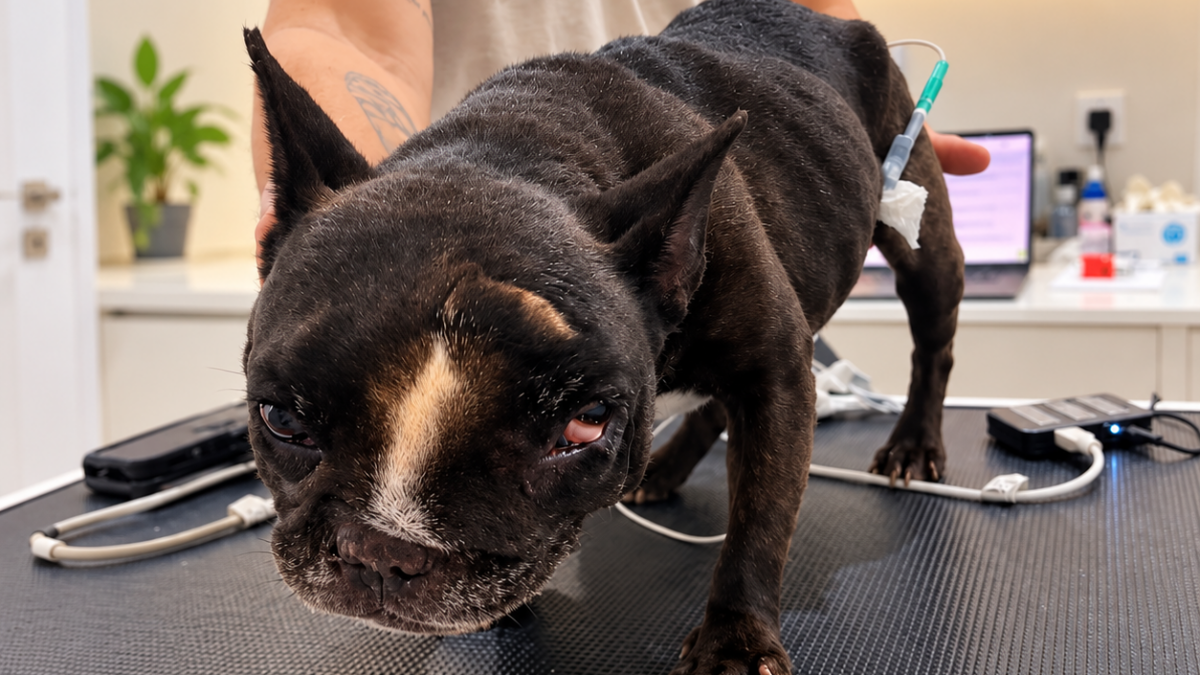
After the procedure, Dona lay wrapped in clean blankets with an IV line running into her leg. Her fractured paw was supported. Her body had been treated for parasites. Her face, though still swollen, looked a little less tight.
I stood beside her kennel.
“You’re still here,” I whispered.
Her eyes moved toward my voice.
That was enough for me to keep standing.
The bills started growing immediately.
Emergency exam.
Blood tests.
X-rays.
Ultrasound.
Hospitalization.
IV fluids.
Antibiotics.
Pain medication.
Anti-nausea injections.
Cytology.
Wound drainage.
Fracture care.
Every line on the estimate was another reason some people give up.
I stared at the numbers until they stopped looking real.
I had paid rescue bills before. I had sold things, skipped things, asked friends, begged creditors, stretched every dollar until it screamed. But Dona’s case was already bigger than what I could carry alone.
For a while, pride tried to stop me from admitting that.
Then I looked at her.
Eight pounds.
Swollen face.
Broken paw.
A body still deciding whether life was worth the effort.
Pride became irrelevant.
So I asked for help.
I wrote her story carefully. No exaggeration. No gore for attention. No dramatic claims we could not prove. Just the truth: a tiny puppy found collapsed outside, severely underweight, dehydrated, infected, vomiting, fractured, hospitalized, and fighting.
I included one photo of her wrapped in a blanket, eyes tired but open.
People began responding almost immediately.
Small donations.
Messages.
Prayers.
Offers to bring food.
One woman donated five dollars and wrote, “It’s all I have today. Please tell her she matters.”
I read that one aloud beside Dona’s kennel.
“Someone says you matter,” I whispered.
Her little tail moved.
Barely.
At first, I thought I imagined it.
Then Valentina, standing behind me, said, “Did you see that?”
We both froze.
“Dona,” I said softly.
Her tail trembled again.
Not a real wag yet.
Not joy.
Not energy.
But a response.
A signal.
Somewhere inside that exhausted body, she had heard kindness and answered it.
Valentina wiped her eyes.
“I’m going to pretend I’m not crying at work.”
“You’re failing.”
“I know.”
For two days, tiny moments kept us alive.
Dona tracking familiar voices around the room.
Dona resting her head into Valentina’s palm.
Dona accepting a drop of liquid nutrition.
Dona sleeping for thirty minutes without vomiting.
Dona’s tail trembling when I said her name.
The clinic staff fell in love with her quickly.
They always do with the quiet ones.
The ones who do not demand space in your heart but somehow take it anyway.
A technician named Ruben called her “little moon” because of the pale swelling in her face and the way her eyes seemed to glow when she looked up from the blankets. Another tech, Celia, sang to her during late-night checks. Dr. Morales pretended to remain professionally detached, then spent her lunch break researching the best soft nutrition options for puppies with severe gastritis.
Dona had a team now.
That mattered.
But love did not stop the setbacks.
On the fifth day, my phone rang before sunrise.
I knew before answering that something was wrong.
It was Valentina.
“Dona had a seizure.”
For one second, I could not speak.
“Is she alive?”
“Yes. She’s alive. She’s being monitored.”
I was already pulling on shoes.
“What happened?”
“She seized briefly. The doctors are checking glucose, electrolytes, everything. Her hematocrit has dropped. White blood cell count is higher.”
Higher.
Dropping.
Seizure.
The words slammed into me one by one.
When I reached the clinic, Dona was lying in oxygen support, weaker than the day before. Her eyes opened when she heard me, but they looked distant.
Dr. Morales met me outside the treatment room.
“We’re concerned,” she said.
I nodded because if I tried to speak, I knew I would break.
“The infection may be more extensive than we thought. The gastrointestinal inflammation is severe. She’s still vomiting almost everything. Cytology did not show obvious tumor cells, which is good, but we cannot rule out deeper tissue involvement, a hidden abscess pocket, bone involvement, or something else driving this inflammation.”
“What does she need?”
“A CT scan. Tomography. It will give us a clearer look at the head, facial tissues, sinuses, and deeper structures. But she would need sedation.”
I looked through the window at Dona.
Sedation.
Her body already looked like it was negotiating with death.
The thought of putting her under terrified me.
“What happens if we don’t do it?”
Dr. Morales was quiet.
“We may keep treating blindly. If there is a deeper pocket of infection, a foreign body, damaged bone, or another source, we might miss it until it is too late.”
Too late.
Those words followed Dona everywhere.
Found too late.
Treated too late.
Almost admitted too late.
Almost diagnosed too late.
I pressed my hand against the wall to steady myself.
“Can she survive sedation?”
“We will do everything to make it as safe as possible. But there is risk.”
There was always risk.
Risk if we did it.
Risk if we waited.
Risk if we fed her.
Risk if we did not.
Dona was so fragile that every path had danger on it.
I went into the treatment room and stood beside her.
Her shaved IV leg looked impossibly small. Her fractured paw was supported. Her face still drained slowly through the wound site, though the fluid was clearer than before. Her body smelled of medicine now instead of street dirt and pus.
“Dona,” I whispered.
Her eyes found mine.
“I don’t know what the right choice is.”
Her tail did not move this time.
She was too tired.
“I wish you could tell me.”
She blinked slowly.
I took that as permission because I needed something to hold onto.
“We’ll do the scan,” I told Dr. Morales.
The technical director came to speak with me before the procedure. His name was Dr. Castillo, and he had already approved discounts on Dona’s hospitalization after seeing how quickly the donations were being swallowed by the cost of care.
“We’ll reduce what we can,” he said. “No one is giving up because of money today.”
I nearly cried again.
“Thank you.”
He looked through the glass at Dona.
“She’s fighting harder than most adult dogs would.”
“I don’t know how.”
“Sometimes they wait until they know someone is fighting with them.”
The scan happened that afternoon.
I spent the entire procedure in the waiting area, hands clasped, eyes locked on the hallway door.
Every time someone came out, my heart stopped.
Every minute stretched.
I imagined every possible bad result.
Cancer.
Bone infection too advanced.
A hidden injury.
Brain involvement.
Something we could not fix.
At some point, Valentina sat beside me.
“She’s not alone in there,” she said.
“I know.”
“She has Dr. Morales. Dr. Castillo. Anesthesia monitoring. Ruben is assisting.”
“I know.”
“You still look like you’re going to pass out.”
“That also seems accurate.”
She smiled sadly.
Then she handed me a small paper cup of water.
“Drink. Dona needs you upright.”
That did it.
I laughed once through tears and drank.
When Dr. Morales finally came out, I stood too fast.
“She’s awake,” she said immediately.
My knees weakened.
“She’s awake?”
“Yes. She handled sedation better than we feared.”
“What did the scan show?”
Dr. Morales exhaled.
“There is a deep abscess pocket along the swollen side of her face. No obvious tumor. No clear evidence of a mass. That is good news. There is inflammation near the bone, but we do not see catastrophic destruction. We also found what appears to be a small foreign body fragment lodged deep in the infected tissue.”
“A foreign body?”
“Possibly a splinter, thorn, small piece of debris, maybe from trauma. It could have triggered or worsened the infection.”
“So she needs surgery?”
“A minor but delicate procedure to open, clean, remove the fragment if possible, and place proper drainage. Combined with antibiotics and supportive care, this gives her a better chance.”
A better chance.
Not certainty.
But better.
I covered my face.
For the first time in days, the fear loosened enough for hope to enter.
The procedure was done that evening.
They removed a small dark fragment from the infected tissue. It looked insignificant in the tray—tiny, almost nothing.
But that little piece of debris had helped poison her face.
That detail made me furious.
Not at the fragment.
At the life that allowed a puppy to be injured, infected, ignored, and left until a small wound became a life-threatening emergency.
The drainage improved after that.
Slowly, but clearly.
The thick pus became thinner.
Then clearer.
The swelling softened.
Dona’s temperature stabilized.
Her white blood cell count remained high at first, then finally stopped climbing.
Her hematocrit was watched closely. She remained anemic and fragile, but she did not crash again that night.
And most importantly, after forty-eight hours of careful liquid nutrition and upright feeding, Dona stopped vomiting.
Forty-eight hours.
No dark brown liquid.
No shaking body.
No fresh panic.
Just a tiny puppy sleeping under warm blankets while nourishment stayed inside her.
The entire clinic celebrated.
Quietly, because Dona needed calm.
But celebrated.
Ruben did a silent fist pump in the hallway.
Celia whispered, “That’s my little moon.”
Valentina leaned against the wall and closed her eyes like she had been holding her breath for a week.
I stood beside Dona’s kennel and cried openly.
Dr. Morales handed me tissues without comment.
“She’s not out of the woods,” she said.
“I know.”
“But this is the first time I feel like she’s walking toward us instead of away.”
That sentence became the turning point of Dona’s story.
Walking toward us.
The next morning, Dona lifted her head when I came in.
Not much.
But on her own.
“Hi, baby,” I said.
Her tail moved beneath the blanket.
This time, it was more than a tremble.
It was a small, weak wag.
Valentina gasped from behind me.
“Do it again,” she whispered.
Dona did not.
Because puppies, like dogs everywhere, enjoy making humans work for emotional closure.
But once was enough.
After that, progress came in tiny, stubborn pieces.
Liquid nutrition.
Then soft food thinned with broth.
Then a few shreds of chicken I cooked myself and brought in a labeled container.
The first time Dona ate chicken from Valentina’s fingers, every person in the treatment room pretended not to stare.
Dona chewed slowly.
Swallowed.
Waited.
No vomiting.
I covered my mouth.
Valentina whispered, “Good girl.”
Dona leaned toward her hand, searching for another piece.
That second bite felt like victory.
Her paw needed time. The fracture was stabilized, and because she was so small and medically fragile, the orthopedic plan had to be conservative at first. Splinting. Rest. Pain control. Follow-up imaging. No running. No jumping. No puppy chaos, which seemed darkly funny because Dona had not yet shown us she remembered how to be a puppy at all.
Her face continued healing, though the swelling took time. The drainage site had to be cleaned gently. Medication schedules remained strict. She still needed fluids. Still needed monitoring. Still needed help holding her body upright after feeding.
But she began participating in her own survival.
That was the miracle.
Not that doctors fixed her.
They did.
Not that donors helped pay.
They did.
Not that medications worked.
They did.
The miracle was that Dona began choosing to stay.
One afternoon, I arrived and found her sitting up.
Only for a few seconds.
But sitting.
Her head wobbled slightly from weakness. Her fractured paw was protected. Her face still looked uneven. She was still painfully thin.
But she was sitting.
“Dona,” I whispered.
Her ears lifted.
I knelt outside the kennel.
“You’re showing off now?”
Her tail wagged twice.
Ruben walked by and stopped.
“She’s been waiting for you,” he said.
“For me?”
He nodded. “She reacts when she hears your voice in the lobby.”
I did not know what to do with that.
Love from a recovering animal feels like a gift you are not sure you deserve.
Especially when that animal has every reason to distrust humans.
I thought of the person who left her outside.
The person who saw her paw twist, her face swell, her body weaken.
The person who either caused her pain or watched it worsen and did nothing.
Dona had known that side of humanity first.
And still, when I spoke, she lifted her head.
That same week, we learned something that changed the emotional weight of the case.
A woman from the neighborhood where Dona had been found contacted us after seeing her photo. Her name was Inés. She worked at a small corner store near the empty lot.
“I saw that puppy before,” she told me over the phone.
My hand tightened around the phone.
“When?”
“Maybe two weeks before she was rescued. She was with a man. Not on a leash. She was limping already.”
My heart began pounding.
“Did you know him?”
“No. But he came around sometimes. Sold scrap metal. He had other puppies once.”
“Other puppies?”
“Yes. In a crate in the back of a truck. I thought he was selling them.”
I closed my eyes.
Of course.
Cruelty often comes with a pattern.
“What happened the day Dona was found?”
Inés hesitated.
“There is a camera outside the store. It points toward the lot. It may have seen something.”
Within hours, animal welfare officers had the footage.
I was not allowed to see all of it at first, but Officer Ramos summarized enough.
A truck stopped near the empty lot late at night.
A man got out.
He placed something near the wall.
Small.
Wrapped in a dirty blanket.
Then he drove away.
By morning, a passerby found Dona collapsed there.
The footage was grainy. The plate was partially visible. Enough for investigators to work with, not enough for immediate certainty.
But the story became clearer.
Dona had not simply wandered until her body failed.
Someone left her.
Maybe because her infection smelled.
Maybe because her fractured paw made her unsellable.
Maybe because a sick puppy cost money instead of making money.
The thought made me cold.
When I told Valentina, she stood silent for a long time.
Then she said, “She was trash to him.”
I looked at Dona through the glass.
She was asleep with her head resting on a folded towel.
“No,” I said. “She was evidence.”
Valentina turned to me.
“Evidence that he should never touch another animal.”
Officer Ramos and his team traced the truck to a man named Rafael Cruz. He denied everything at first.
He said he did not own puppies.
Then he said he had transported dogs for a friend.
Then he said the puppy had already been sick when someone gave her to him.
Then he said he left her near the lot because he thought someone would find her.
Cowards always think “someone” is a plan.
Someone will find her.
Someone will help.
Someone will carry the cost of the suffering I refuse to face.
Animal welfare officers visited his property three days later.
They found more dogs.
Not dozens, but enough.
Two adult females in poor condition.
Four puppies with parasites.
Dirty crates.
No proper records.
No veterinary care.
No clean living area.
None were as critical as Dona, but all needed help.
They were removed.
That was the first real justice Dona gave the world.
Her suffering did not end with her rescue.
It opened a door for the others.
When Officer Ramos told me, I went straight to the clinic and sat beside Dona’s kennel.
“You did that,” I whispered.
She blinked at me sleepily.
“You helped them.”
Her tail moved once.
Maybe she did not understand.
Maybe that was okay.
Dona did not need to understand justice to deserve it.
The legal process moved slowly.
Too slowly.
Rafael claimed poverty. Ignorance. Bad luck. He said he had not meant for Dona to suffer. He said she “went downhill fast.” He said he planned to get help.
The footage told a different story.
The veterinary reports told a different story.
Dona’s body told a different story.
Neglect had a timeline.
Infection had a timeline.
Starvation had a timeline.
A fractured paw left untreated had a timeline.
Pain wrote records even when people lied.
The clinic prepared medical documentation. Dr. Morales wrote a statement explaining Dona’s condition: severe dehydration, infected facial abscess, fractured paw, anemia, acute gastritis, heavy parasite burden, repeated vomiting, seizure, prolonged suffering inconsistent with a sudden overnight illness.
The other dogs’ reports were added.
The footage was added.
Inés gave a statement.
The case moved forward.
I wanted a dramatic confrontation.
I admit that.
I wanted Rafael to see Dona’s swollen face from the first day. I wanted him to hear how she vomited through the night. I wanted him to watch Valentina hold her upright after feedings. I wanted him to see the tiny fragment removed from her infected tissue and understand that her pain had weight.
But court is rarely dramatic in the way anger wants it to be.
It is paperwork.
Dates.
Statements.
Continuances.
Evidence.
Careful words.
Still, the day finally came.
Dona was not there.
I would never have brought her.
By then, she had improved enough to leave the hospital for foster recovery with me, but she was still fragile, still healing, still too small for the ugliness of a courtroom.
I attended with Dr. Morales, Officer Ramos, and Inés.
Rafael sat across the room in a clean shirt, looking more annoyed than ashamed.
That made my anger sharpen.
The prosecutor presented the evidence.
The footage.
The veterinary records.
The condition of the other dogs.
The lack of care.
The abandonment.
Rafael’s attorney tried to argue that he was overwhelmed, that he lacked resources, that he did not intend harm.
Dr. Morales testified calmly.
“Regardless of intent,” she said, “Dona suffered significantly. Her injuries and infection required urgent medical care long before she was abandoned. She would likely have died without intervention.”
The room went quiet.
The judge looked at the photographs.
Not the worst ones.
Just enough.
Dona under the dirty blanket.
Dona’s swollen face.
Dona’s fractured paw.
Dona weighing eight pounds when she should have weighed nearly twice that.
I watched Rafael.
For the first time, his expression shifted.
Maybe shame.
Maybe fear.
Maybe only the realization that the suffering he had tried to leave in the dark was now being described under fluorescent lights in front of a judge.
The sentence was not perfect.
It never is.
He was convicted of animal neglect and abandonment. He was fined, ordered to pay restitution toward Dona’s care and the care of the other dogs, required to complete monitored community service with animal welfare education, and banned from breeding, selling, or owning animals for a legally defined period. The surviving dogs removed from his property were transferred to rescues.
Was that enough?
No.
Nothing could give Dona back the nights she spent half-dead, hurting, and alone.
Nothing could erase the infection from her memory.
Nothing could make her paw unbroken in the moment she needed help.
But when the judge said, “A sick animal is not a disposable object,” I felt something inside me settle.
Not heal.
Settle.
Because Dona’s pain had been named correctly.
And that matters.
After court, Inés hugged me outside.
“I keep thinking I should have called sooner,” she said.
I heard guilt in her voice, the same guilt that always attaches itself to people who finally act.
“You helped identify him,” I said.
“But I saw her limping before.”
“You also came forward.”
She cried quietly.
I let her.
Then I said the only thing that felt true.
“Next time, you’ll call sooner.”
She nodded.
“I will.”
That was another piece of Dona’s justice.
People learned.
Back at home, Dona was asleep in a small bed beside my couch.
She had been released from the clinic after three exhausting weeks of hospitalization and follow-up care. Bringing her home felt like carrying glass.
Her medications came with a chart taped to my refrigerator.
Antibiotics.
Gastroprotectants.
Pain medication.
Anti-nausea support if needed.
Nutritional schedule.
Paw care.
Drainage-site cleaning.
Recheck appointments.
Weight tracking.
No running.
No jumping.
No rough play.
Again, this seemed ironic, because Dona still moved like a puppy who did not know whether the world allowed her to be alive.
At first, she slept almost constantly.
Healing consumed all her energy.
I fed her small meals, held her upright afterward, and waited with fear in my throat for vomiting that, slowly, stopped coming. I cleaned her face gently, praising her through every moment. I checked her fractured paw, monitored swelling, changed bedding, and celebrated every ounce gained.
Eight pounds became eight and a half.
Then nine.
Then ten.
The first time she reached ten pounds, I sent the clinic a photo of the scale.
Valentina responded with twelve crying emojis and the words:
MY GIRL.
Dona began recognizing the house.
The kitchen meant food.
The couch meant quiet.
The soft crate meant sleep.
My footsteps meant someone was coming back.
At night, she still whimpered sometimes. Not loudly. Tiny sounds from a body remembering pain. I slept on the floor beside her bed more nights than I care to admit.
One night, around 3:00 a.m., she woke trembling.
I placed my hand near her, not on her.
“You’re here,” I whispered. “You’re safe.”
She crawled forward slowly until her face rested against my wrist.
The swollen side had healed enough that the shape of her puppy face was returning. Still uneven. Still tender. But hers again.
I cried silently in the dark.
She fell asleep with her chin on my hand.
That became our ritual for a while.
She would wake.
I would whisper.
She would find my hand.
The world would prove, one more time, that pain was not coming back in that moment.
Recovery was not smooth.
There were setbacks.
A day when she refused breakfast and I panicked.
A recheck where inflammation markers were still higher than we wanted.
A night when she vomited once and I sat on the bathroom floor shaking while waiting to see if it would happen again.
A paw X-ray that showed healing, but slower than hoped.
A drainage site that closed, then reopened slightly, then finally healed properly.
Progress does not move like a straight line.
It moves like a frightened puppy learning that forward is safe.
Dona’s personality appeared in pieces.
First, curiosity.
She began watching my movements with interest instead of exhaustion. When I opened the refrigerator, her ears lifted. When I crinkled a bag, she raised her head. When I sat on the floor, she looked at my lap like maybe, one day, it might belong to her.
Then came opinion.
She did not like one medication and became very dramatic about it.
She preferred chicken warmed slightly, not cold.
She believed blankets should be arranged in a nest, not placed flat like a medical bed.
She objected to thermometers with her entire soul.
Good.
Opinion meant she wanted something.
Wanting something meant life had become bigger than survival.
Then came play.
The first toy she noticed was a tiny yellow duck Valentina had sent home from the clinic. It squeaked when pressed. At first, Dona stared at it with deep suspicion.
I squeezed it gently.
Squeak.
She flinched.
I placed it down and backed away.
For two days, she ignored it.
On the third day, I found it moved from the rug to her bed.
On the fourth, I saw her nose it.
On the fifth, while I was pretending not to watch, she placed one paw on it.
Squeak.
Dona jumped backward like the duck had insulted her ancestors.
Then she barked.
One small, raspy bark.
I froze.
She stared at the duck.
Then barked again.
I started laughing and crying at the same time.
She looked offended by my emotional instability, picked up the duck in her mouth, and carried it into her bed.
That was the day the puppy came back.
Not fully.
Not all at once.
But enough.
A week later, she wagged when Valentina visited.
A real wag.
Valentina dropped to the floor and whispered, “Dona.”
Dona walked to her slowly, still careful with the healing paw, and pressed her little head into Valentina’s hands.
Valentina sobbed openly.
“I’m sorry,” she said.
“For what?” I asked.
“For everything she went through before us.”
That was the thing.
Everyone who loved Dona carried some version of apology.
Even though we were not the ones who hurt her.
Love does that sometimes.
It apologizes on behalf of the world.
Months passed.
Dona gained weight.
Her coat filled in.
Her eyes cleared.
The fleas and ticks became a memory. The swollen face became a scarred but beautiful little face, one side slightly different if you knew where to look. Her paw healed enough for short walks, then longer ones, though we continued monitoring her carefully.
She discovered sunlight.
She would find any patch of it on the floor and collapse dramatically into it, belly exposed, paws loose, eyes closing with complete satisfaction.
She discovered shoes.
Not to chew.
To sleep beside.
She discovered that the couch was better if she climbed onto my chest and placed her entire body across my neck like a scarf.
She discovered the beach.
I had promised her that in the clinic.
One day, she would walk on the beach.
The first time I took her, I kept it quiet. Early morning. No crowds. No dogs rushing her. Just a wide stretch of sand, the sound of waves, and Dona in a soft harness, standing at the edge of a world bigger than any pain she had known.
At first, she froze.
The wind moved through her fur.
The waves rolled in and out.
She looked at the sand under her paws, then at me.
“It’s okay,” I said. “This is yours too.”
She took one step.
Then another.
Her healed paw pressed into wet sand, leaving a small print.
Then another.
And another.
Soon there was a tiny line of puppy footprints beside mine.
I looked back at them and felt something in me break open.
There had been a night when I was afraid she would not live until morning.
Now she was leaving footprints at the edge of the ocean.
Dona sniffed a shell.
Sneezed.
Then, for no reason except joy, she hopped sideways.
A tiny, clumsy, ridiculous hop.
I laughed so hard I had to sit down in the sand.
She came to me immediately, worried.
“I’m okay,” I told her. “You’re just perfect.”
She climbed into my lap, damp paws and all, and licked my chin.
That was the ending I had promised her before I knew whether she could survive.
The case against Rafael eventually faded from daily conversation, as cases do. He served his penalties. Paid what the court forced him to pay, though not enough. Stayed away from animals because officers checked. The rescued adult females were rehabilitated. The puppies found on his property were treated and placed through rescue partners.
One of them, a brown male with white feet, was adopted by Inés.
She named him Luz.
Light.
When she sent me his adoption photo, I looked at Dona curled beside the yellow duck and whispered, “You started that.”
Dona wagged in her sleep.
The most satisfying revenge was not Rafael’s fine.
It was not his public embarrassment.
It was not the court order banning him from owning animals.
Those things mattered.
But the deeper revenge was that Dona lived loudly.
She grew.
She played.
She demanded forehead scratches.
She barked at her duck.
She walked on the beach.
She became the reason other dogs were removed before they became another tragedy.
She turned the evidence of cruelty into a chain of rescue.
Rafael had left her in a blanket near a wall because he thought a sick puppy was worthless.
Dona became priceless.
That was justice.
I officially adopted her six months after the morning I first saw her photo.
Everyone knew it was going to happen before I admitted it.
Valentina started calling me “Dona’s mom” in front of clients.
Dr. Morales wrote “foster failure pending” on her chart.
Ruben asked if he should update her file or keep pretending I was objective.
I lasted longer than expected, mostly because I told myself Dona deserved a perfect home.
Then one evening, she climbed onto my lap, placed her little scarred face against my chest, and fell asleep with the yellow duck tucked beneath her paw.
My house went quiet around us.
Her breathing was steady.
Her body was warm and solid.
Alive.
I looked down and realized something simple.
She was already home.
The adoption paperwork was signed the next week.
Dona was deeply unimpressed by the legal importance of the moment.
She tried to eat the corner of the form.
Valentina said it counted as a signature.
We celebrated with a tiny bit of chicken, a new blanket, and a beach trip the following weekend.
On the one-year anniversary of her rescue, I brought Dona back to the clinic.
Not because she was sick.
Because she was alive.
The staff gathered in the lobby when we walked in. Dona wore a pink harness and carried her yellow duck, now filthy from love and repaired twice. Her body was strong. Her coat was shiny. Her face still carried a faint unevenness, but it looked like character now, not suffering.
Valentina knelt first.
Dona ran to her.
Ran.
Not fast like a big dog.
Not graceful.
But running.
Valentina caught her carefully and started crying before Dona even reached her lap.
“My girl,” she whispered.
Dona licked her face.
Ruben came out next, then Celia, then Dr. Morales, then Dr. Castillo. Everyone touched her gently, admired her weight, praised her healed paw, and pretended not to be emotional.
Dr. Morales examined her and shook her head.
“I remember when I wasn’t sure she would survive sedation,” she said.
“I remember every second of that day.”
“And now look at her.”
Dona was trying to steal treats from Ruben’s pocket.
“Yes,” I said. “Very inspiring.”
Dr. Morales laughed.
Before we left, Valentina handed me a small printed photo.
It was from one of Dona’s worst clinic days. She was wrapped in blankets, IV line in place, eyes barely open. Beside it, Valentina had placed a newer photo of Dona on the beach, ears lifted, paws in the sand, duck nearby.
On the bottom, she had written:
She stayed.
I kept that photo on my refrigerator.
Not to remember the pain alone.
To remember the distance between then and now.
People often say Dona is lucky.
I understand what they mean.
She was lucky someone found her.
Lucky Valentina pushed for hospitalization.
Lucky the CT scan found the deeper abscess.
Lucky donors helped.
Lucky the sedation went safely.
Lucky the infection responded.
Lucky the court removed the other dogs.
But I do not like making her survival sound like luck.
Too many people worked too hard for it.
And Dona fought too hard for it.
Luck did not hold her upright after feedings.
Luck did not drain the infection.
Luck did not pay the bills.
Luck did not sit beside her through vomiting, seizures, fear, and pain.
Love did.
Medicine did.
Persistence did.
Evidence did.
Community did.
And Dona did.
Tiny, broken, eight-pound Dona, who looked at the world with empty eyes and somehow found her way back to joy.
Today, she is no longer the puppy from the first photo.
She is still small, but solid now. Her body carries strength. Her healed paw works well enough for beach walks and dramatic living room zoomies, though I still stop her when she gets too wild. Her face has a faint scar where the infection once tried to take over, but it only makes her more herself.
She sleeps in a warm bed.
Sometimes mine.
Usually mine.
She eats with enthusiasm and checks her bowl afterward in case food has magically reappeared.
She greets Valentina like a celebrity.
She mistrusts thermometers forever.
She carries her yellow duck from room to room and becomes deeply offended if it is moved without permission.
She loves forehead scratches.
Still.
That detail always gets me.
After all the pain in her face, after the draining, the swelling, the infection, the procedures, she still leans into a gentle hand on her forehead as if kindness there means the most.
Sometimes, when she does that, I think about the first day.
The photo.
The dirty blankets.
The twisted paw.
The fleas.
The ticks.
The empty eyes.
I think about how close we came to losing her before we ever knew who she could be.
Then I look at her now, pushing her head under my hand, demanding love like it is her birthright.
And I know she is right.
It is.
Dona’s story did not end with survival.
Survival was only the first door.
Behind it came healing.
Behind healing came trust.
Behind trust came joy.
Behind joy came justice.
And behind justice came a life so ordinary and beautiful that sometimes it still knocks the breath out of me.
Morning meals.
Soft blankets.
Medication no longer needed.
Beach sand between healed toes.
A duck toy squeaking from another room.
Tiny paws racing down the hallway.
A scarred face resting against my chest at night.
That is what Rafael did not understand.
He thought he was throwing away a dying puppy.
He was wrong.
He threw away a witness.
He threw away a fighter.
He threw away the little soul who would expose him, save others, and become loved by more people than he could ever imagine.
The best revenge was never that he was punished.
The best revenge was that Dona lived long enough to be happy.
Truly happy.
Not just stable.
Not just saved.
Happy.
And every time she runs across the sand with her yellow duck in her mouth, every time Valentina cries because Dona remembers her, every time Inés sends a photo of Luz sleeping safely in his new home, every time another rescued dog from that property gets adopted, I think the same thing:
Dona won.
Not because the beginning stopped hurting.
It will always hurt.
But because the beginning did not get to decide the ending.
She was found with a swollen face, a fractured paw, a starving body, and a spirit so exhausted it looked like she no longer wanted to live.
But she stayed.
One breath at a time.
One meal at a time.
One terrifying test at a time.
One tiny wag at a time.
And now, when she falls asleep pressed against me, warm and safe and impossibly alive, I remember the promise I made beside her kennel.
You will never be alone again.
I have kept that promise.
And Dona, in her own small way, kept one too.
She promised the world that the puppy inside all that suffering was still there.
Then she came back to prove it.
Today, Dona is no longer the puppy from that first photo.
Sometimes I still open it, though I know I probably should not.
I keep it buried deep in a folder on my phone, far away from the newer pictures of her on the beach, sleeping in my bed, stealing socks, and carrying her yellow duck through the house like a trophy. I do not look at the old photo often. I do not need to. It is already burned into me.
The dirty blankets.
The swollen face.
The twisted little paw.
The fleas.
The ticks.
The eyes that looked as if they had already given up on the world before the world had even given her a real chance.
When I look at that picture now, I do not see only pain anymore.
I see the beginning of a fight none of us knew we were about to join.
I see the moment before Valentina refused to let Dona be overlooked. Before Dr. Morales stood beside that tiny body and chose careful truth over false comfort. Before strangers sent five dollars, ten dollars, twenty dollars, not because they knew Dona, but because they believed a puppy that broken still deserved a future.
I see the moment before the scan.
Before the surgery.
Before the forty-eight hours without vomiting.
Before the first tail wag.
Before the beach.
Before the court.
Before the yellow duck.
Before Dona learned that hands could touch her swollen face and bring healing instead of harm.
The first photo still hurts.
But it no longer owns the story.
Dona does.
She is still small, but no longer fragile in the same way. Her ribs no longer press sharply against her skin. Her coat has grown back soft and shiny, with a few uneven patches where the infection and parasites once left their mark. Her healed paw is not perfect. On cold mornings, she sometimes holds it up for a second before putting weight on it, and if she plays too hard, I make her rest even when she argues with me in tiny dramatic huffs.
But that paw carries her.
Across my kitchen.
Across the yard.
Across the sand.
Across every day she was never supposed to have.
Her face still carries a faint scar where the abscess once opened. One side is just slightly different if you know what to look for. Most people do not notice right away. They only see a bright-eyed little dog with a serious expression and a yellow duck in her mouth.
But I notice.
I notice every time she turns toward the light.
I notice every time she presses her forehead into my palm and closes her eyes.
And every time, I remember the first days at the clinic, when her face was so swollen and painful that I was afraid touching her would hurt her more.
Now she demands forehead scratches.
Not politely.
Dona is not polite about love anymore.
She climbs into my lap as if she has paid rent. She wedges her head under my hand if I stop petting her too soon. She stares at me with deep disappointment when dinner is even three minutes late. She has opinions about blankets, chicken temperature, visitors, thunder, and whether or not the yellow duck requires emergency rescue from under the couch.
That is one of the strangest gifts of her recovery.
Her opinions.
At first, all we wanted was for her to survive. Then we wanted her to eat. Then to stop vomiting. Then to lift her head. Then to wag. Then to walk.
We did not know we were also waiting for her to become bossy.
But she did.
And I love every second of it.
The yellow duck is her favorite possession in the world. Valentina gave it to her when she came home from the clinic, back when Dona was still unsure whether toys were safe. The duck used to be bright yellow and clean. Now it is faded, flattened, and repaired in three places. One wing is stitched with white thread because I could not find yellow. The squeaker still works, though not reliably.
Dona does not care.
Every morning, she finds it before breakfast.
Every evening, she carries it to bed.
When someone new visits, she brings it out slowly and stands at a careful distance, as if deciding whether they are worthy of meeting it. Some people think she is offering it to them.
She is not.
Dona does not give away the duck.
She presents it.
There is a difference.
Valentina understands this better than anyone.
When she visits, she always sits on the floor and waits. Dona disappears into the bedroom, retrieves the duck, and trots back with her head high. Then she places it near Valentina’s knee, just out of reach, and waits for the proper praise.
“Oh, Dona,” Valentina always says, with the exact amount of emotion required. “That is the most beautiful duck I have ever seen.”
Only then does Dona wag.
Valentina still cries sometimes when she sees her.
Not every time anymore.
But often.
The first few months, she cried openly. Dona would climb into her lap, licking her chin, completely unconcerned by human tears. Valentina would hold her gently and whisper, “You stayed, baby. You stayed.”
Now the tears come more quietly.
A hand over her mouth when Dona runs.
A deep breath when Dona rolls onto her back in the sun.
A sudden silence when Dona rests her once-swollen face against Valentina’s palm.
One afternoon, Valentina told me, “I used to dream about her dying.”
I looked at her.
She was sitting on my living room floor, Dona half-asleep against her leg.
“At the clinic?” I asked.
She nodded.
“During those days when she kept vomiting, I would go home and still hear the alarm machines. I kept thinking I’d come in the next morning and she’d be gone.”
I knew that fear too well.
“I did the same thing,” I said.
Valentina stroked Dona’s ear.
“And now look at her. She acts like she owns us.”
“She does.”
Valentina laughed through her tears.
“She absolutely does.”
Dona lifted her head at the sound of laughter, decided no food was involved, and went back to sleep.
That ordinary little moment felt like a miracle.
Not the loud kind.
The kind you only recognize after surviving the worst days.
The beach became Dona’s place.
I had promised it to her when she was still in the hospital, back when the promise felt almost foolish. I told her she would walk on the beach one day. I told her she would feel sand beneath her paws and wind in her fur. I told her she would have a life bigger than clinic walls, IV lines, drains, medications, and fear.
At the time, I did not know if she would live long enough to see it.
Now, every time we go, I remember that promise.
The first beach walk was quiet and cautious. Dona stepped carefully, sniffing the sand like it might be alive. The ocean scared her at first. She did not understand why the water kept coming toward her and then running away. She watched the waves with deep suspicion, ears lifted, body tense.
Then a small wave rolled in and touched her front paws.
She jumped backward.
Then barked at it.
One sharp little bark.
I laughed so hard I cried.
The ocean, unimpressed, came back again.
Dona barked again.
By the third visit, she had decided the ocean was not an enemy, only rude. By the fifth, she chased foam along the shoreline, always careful with her healed paw, always glancing back to make sure I was still there.
That is one habit she has not fully lost.
She checks.
On walks, at the clinic, in the yard, at the beach. She looks back, not with panic like before, but with the quiet need to confirm that the person who loves her has not disappeared.
Every time she looks back, I answer.
“I’m here.”
Sometimes I say it out loud.
Sometimes I just smile.
She understands either way.
One morning, several months after her adoption, we went to the beach at sunrise. The sky was pink and gold, and the sand was cold beneath my shoes. Dona wore her soft harness and carried the yellow duck from the car all the way to the waterline. I tried to take it before it got wet.
She refused.
So the duck came too.
She stood at the edge of the waves with that ridiculous toy in her mouth, scarred face turned toward the wind, healed paw planted firmly in the sand.
For a second, I saw both versions of her at once.
The puppy under the dirty blankets.
And the dog in front of me.
The body that had almost stopped.
And the body that had chosen to run.
I crouched beside her.
“You made it,” I whispered.
She dropped the duck at my feet, shook sand onto my pants, and sneezed.
It was not a dramatic response.
But it was very Dona.
The case against Rafael became part of her history, but not the center of her life.
I had to learn that.
At first, I held onto the legal updates like they were medicine. Every court date. Every document. Every officer’s message. Every step that proved someone was finally naming what had been done to her.
I wanted the punishment to feel equal to the pain.
It never did.
No fine looked large enough.
No ban looked long enough.
No order of restitution could account for the nights she lay outside infected and starving.
No courtroom sentence could give her back the first months of puppyhood.
When Rafael was convicted of neglect and abandonment, I expected to feel relief so strong it would close something inside me.
It did not.
It helped.
But it did not close the wound.
What helped more was seeing the other dogs from his property survive.
The two adult females recovered slowly with a rescue partner. One of them, a thin tan dog with tired eyes, was eventually adopted by a retired couple who had experience with breeding survivors. They named her Sol. Sun. The other, darker and more timid, went to a foster who understood that motherhood had been forced on her too many times. She learned to sleep on a couch and stopped hiding food in corners after several months.
The puppies were treated for parasites, vaccinated, fed properly, and placed into homes where no one saw them as merchandise.
And Luz—the brown puppy with white feet—went home with Inés.
Inés sent me updates constantly at first.
Luz sleeping in a laundry basket.
Luz stealing a slipper.
Luz wearing a blue bandana.
Luz at the vet, looking deeply betrayed by a thermometer.
Luz curled in her lap while she watched TV.
Every photo felt like another answer to Rafael.
He had treated them as disposable.
Now people were arranging their living rooms around them.
That was justice too.
Not the kind written only in court records.
The kind that grows legs, learns its name, and sleeps safely through the night.
Inés and I became friends because of Dona.
Maybe grief and guilt brought us together at first. She carried guilt for not calling sooner when she saw Dona limping. I carried the memory of Dona’s first photo like a stone under my ribs. We both understood how easily suffering can hide in ordinary places.
But over time, our friendship became about more than that.
We took Dona and Luz on slow walks together.
At first, Dona was not sure what to do with Luz. He was younger, clumsier, and far too enthusiastic for her taste. He bounced. He bowed. He tried to lick her face. Dona gave him a look so cold that even I felt judged.
Luz did not notice.
He loved her immediately.
Dona tolerated him.
Then, one day, he brought her a stick.
A terrible stick. Too large, dirty, and not at all impressive.
He dropped it at her feet with great pride.
Dona stared at the stick.
Then at Luz.
Then, very slowly, she picked it up and carried it away.
Luz looked thrilled.
From that day on, they were friends.
Dona would never admit it.
But she began looking for him when we reached the park.
Luz became part of the revenge too.
Not because he understood Rafael or the court or the terrible system he had been born into.
Because he lived.
Because Dona lived.
Because every dog removed from that property became proof that cruelty had lost control of the ending.
A year after Dona’s rescue, the clinic held a small gathering.
They did not call it a party at first. Dr. Morales said, “It’s just a checkup anniversary.” Valentina called it “Dona Day” and refused to apologize. Ruben brought a tiny banner. Celia made a little sign that said, “She Stayed.”
Dona arrived wearing her pink harness and carrying the yellow duck.
The lobby changed when she entered.
People who had seen her on the worst days stopped what they were doing. The receptionist covered her mouth. A technician came out from the back and whispered, “Is that really her?”
It was.
It was Dona.
Not the body on the blanket.
Not the puppy who could not keep food down.
Not the swollen face behind the oxygen door.
Dona.
Strong enough to walk in on her own.
Healthy enough to bark once when Ruben took too long finding treats.
Bold enough to parade the duck in front of every person who had once cleaned wounds, checked fluids, held her upright, and worried she would not survive the night.
Dr. Morales examined her last.
She listened to Dona’s heart. Checked her healed paw. Looked at the scar on her face. Felt her belly. Watched her walk. Then she sat back on her heels, and for a moment she did not say anything.
That scared me automatically.
“What?” I asked.
Dr. Morales smiled.
“I was just remembering.”
I knew what she meant.
So was I.
“She looks good,” she said finally. “Really good.”
Dona tried to climb into her lap.
Dr. Morales laughed.
“This is highly unprofessional.”
Valentina, already crying, said, “Let her.”
So Dr. Morales sat on the floor in her white coat while Dona settled halfway across her knees like a queen accepting tribute.
That photo became one of my favorites.
Not because it was dramatic.
Because it was ordinary in the most extraordinary way.
A vet.
A healed dog.
A lap.
A life that almost ended, continuing.
Before we left, Valentina handed me a framed picture.
On the left was Dona during hospitalization, wrapped in blankets, IV line taped to her leg, face swollen, eyes exhausted.
On the right was Dona on the beach, yellow duck beside her, ears lifted in the wind.
Underneath, Valentina had written:
The beginning did not win.
I could not speak for several minutes.
It still hangs in my hallway.
Visitors stop and look at it. Some ask what happened. Some already know. Some cry before I finish telling them.
Dona usually appears during the story, carrying the duck, as if she knows she is the main character and wants proper recognition.
People ask if she remembers.
I always answer carefully.
Dogs remember differently than we do.
I do not know if Dona remembers Rafael. I do not know if she remembers the lot, the truck, the exact night she was left in that blanket. I do not know if she remembers the pain the way I remember seeing it.
But her body remembers some things.
She still gets nervous when she smells strong infection at the clinic. She still freezes if a stranger reaches too fast toward her head. She still trembles during certain kinds of handling, even though she trusts us. She still hates being too cold. She still panics if she vomits, as if her body remembers that vomiting once meant danger.
But she also remembers kindness.
She remembers Valentina’s voice.
She remembers Dr. Morales’s hands.
She remembers my footsteps.
She remembers that after medicine comes chicken.
She remembers that beach mornings mean freedom.
She remembers the duck.
She remembers enough safety now to sleep deeply.
That is what matters most to me.
The first time Dona slept through a thunderstorm, I cried.
Not because storms were part of her original trauma, at least not that I know of. But before, any loud noise made her body tense. She would lift her head, eyes wide, paw tucked, waiting for something bad to follow.
That night, thunder rolled over the house, low and heavy.
I looked over immediately.
Dona was in her bed, yellow duck under her chin.
She opened one eye.
Listened.
Then went back to sleep.
That was healing.
Not forgetting danger exists.
Believing it is not always coming for you.
I sat there in the dark, listening to the rain, and thought about all the people who helped get her to that moment.
The passerby who found her.
The person who sent the first photo.
Valentina.
Dr. Morales.
Dr. Castillo.
Ruben.
Celia.
The donors.
Inés.
Officer Ramos.
The judge who named the neglect correctly.
Every person who chose to do one piece.
Dona survived because no single person had to be enough.
That is something I tell people now when they say rescue feels overwhelming.
You do not always have to do everything.
Stop.
Call.
Drive.
Donate.
Share.
Foster.
Document.
Testify.
Adopt.
Repair the duck.
Hold the bowl.
Sit through the night.
Every piece matters.
Every piece became part of Dona’s life.
Her story also changed the way people in that neighborhood responded to suffering.
After Rafael’s case, Officer Ramos worked with local rescues to run an outreach day near the same corner store where Inés had seen Dona. They handed out information about low-cost veterinary care, spay and neuter programs, parasite treatment, and how to report neglect before an animal collapsed.
Some people came because they needed help.
Some came because they were curious.
Some came because shame had moved through the neighborhood after Dona’s story spread.
Good.
Shame can destroy if it turns into hiding.
But it can also become action if people decide they do not want to be the ones who looked away.
Inés spoke at that outreach day.
She held Luz in her arms, though he was getting too big for it, and told people she had once waited too long to call about a limping puppy.
“I thought someone else would help,” she said. “Someone else almost didn’t.”
That sentence stayed with everyone.
Someone else almost didn’t.
After that event, three neglected dogs and one injured cat were reported within a month. Not because people suddenly became perfect. Because they knew what to look for. Because they had numbers to call. Because Dona’s suffering had made indifference harder.
That is another kind of revenge.
Cruelty depends on silence.
Dona made people speak sooner.
The most emotional update came almost eighteen months after Dona’s rescue.
Officer Ramos called me and asked if I was sitting down.
That is never a comforting beginning.
“What happened?” I asked.
“Rafael tried to take in two puppies from someone outside town.”
My stomach dropped.
“He’s banned.”
“Yes,” Ramos said. “And because of the prior order, we were able to intervene quickly. The puppies are safe. He is facing additional penalties.”
I closed my eyes.
For a moment, I felt pure rage.
Then I looked across the room.
Dona was asleep on the couch, paws twitching, duck nearby.
The system had worked faster this time.
Because Dona’s case existed.
Because the court order existed.
Because the record existed.
Because someone checked.
That did not erase what happened to her.
But it protected two puppies from becoming another Dona.
When I told Valentina, she said, “She’s still saving them.”
She was right.
Dona’s life kept reaching beyond itself.
That is the part Rafael never could have imagined.
The puppy he left near a wall became a record, a warning, a reason for officers to act, a reason for neighbors to call, a reason for donors to give, a reason for clinic staff to keep fighting past exhaustion.
He had thrown her away because he thought she had no value.
Her value multiplied.
The best revenge is not always seeing the person who hurt you suffer.
Sometimes the best revenge is becoming the reason their cruelty stops working.
Dona did that.
Not by understanding it.
By living.
By turning into evidence of what love can rebuild.
Today, when people meet Dona, they often say, “She’s so happy.”
And she is.
But her happiness is not simple.
It is earned.
It exists alongside scars, memories, medical charts, and hard days. It exists because we protect it. Because we learned what frightens her. Because we honor what she survived without forcing her to perform recovery for anyone.
She does not have to be brave all the time.
She does not have to love every stranger.
She does not have to prove anything.
If she wants to hide behind my legs at the vet, she can.
If she wants to bark at the thermometer, honestly, I understand.
If she wants forehead scratches before bed, she gets them.
If she wants the duck placed beside her bowl while she eats, I place it there.
People sometimes laugh at that.
I do not.
The duck is not just a toy anymore.
It is the opposite of the dirty blanket.
It is the thing she carries now not because she is alone, but because she is safe enough to care about something.
That difference matters.
On the second anniversary of her rescue, we went back to the beach.
Valentina came.
So did Inés and Luz.
Even Dr. Morales came for a short while, claiming she was “nearby,” which none of us believed because the beach was forty minutes from the clinic.
We stood together near the water while Dona and Luz wandered at the end of their leashes. Dona carried the yellow duck for the first few minutes, then dropped it on the sand to investigate a shell.
Luz immediately tried to steal it.
Dona corrected him with one sharp bark.
He backed away, delighted.
Valentina laughed so hard she had to wipe her eyes.
“She has become such a little tyrant,” she said.
“Yes,” Dr. Morales replied. “Medically, that is an excellent outcome.”
We walked slowly along the shoreline.
Dona’s footprints appeared beside mine again, deeper now, steadier. No twisted paw. No collapse. No weakness dragging her down. Just small marks in wet sand, one after another, proof of a body that had chosen forward.
At one point, she ran.
Not far.
Not recklessly.
Just a sudden burst of joy.
A little dash across the sand with her ears bouncing and the duck in her mouth.
Everyone stopped.
No one said anything.
We just watched.
Because we all knew.
We all remembered the puppy who could not lift her head.
Dona reached the end of the leash, turned back, and stared at us as if asking why we were being weird.
I crouched and opened my arms.
She ran back into them.
Sand hit my knees. The duck hit my chest. Her body, warm and strong, pressed against me.
I held her and breathed in the smell of salt, dog fur, and sun-warmed happiness.
“You won,” I whispered.
Dona licked my chin.
Maybe she did not know what I meant.
Maybe she did.
Either way, it was true.
She won.
Not because the past vanished.
Not because the people who hurt her gave back what they stole.
Not because justice was perfect.
She won because the ending belonged to her.
She won because her body healed enough to run.
She won because she sleeps without fear most nights.
She won because her name is spoken with love in a clinic that once feared losing her.
She won because Luz is alive.
Because Sol is safe.
Because the other dogs were removed.
Because Rafael cannot hide behind “I didn’t know” anymore.
Because neighbors call sooner.
Because Valentina gets to cry happy tears now.
Because Dr. Morales gets to see a patient she thought might die steal treats from Ruben’s pocket.
Because I get to wake up every morning with Dona’s small body pressed against my side, offended if I move too early.
That is not a small victory.
That is everything.
Sometimes, late at night, when the house is quiet, I still think about the version of Dona who almost disappeared before we knew her.
I think about how close the world came to losing her as if she had never mattered.
A sick puppy under a dirty blanket.
A swollen face.
A broken paw.
A body no one wanted to pay for.
A life almost reduced to suffering.
Then I hear the soft squeak of the yellow duck from the bedroom.
Or Dona sighing in her sleep.
Or her paws twitching in a dream.
And I remember that the story did not end there.
It ended here.
In a warm house.
With a full bowl.
With beach sand still sometimes hidden in the seams of her harness.
With clinic staff who still ask for updates.
With a framed photo in my hallway that says, The beginning did not win.
With a little dog who once looked like she no longer wanted to live, now demanding more life every single day.
More chicken.
More walks.
More forehead scratches.
More sun patches.
More duck repairs.
More beach mornings.
More love.
And I give it to her.
All of it.
As much as I can.
For as long as I can.
Because on the first day, when I looked at that photo, I thought I was seeing a puppy at the end of her story.
I was wrong.
I was seeing the moment before the beginning fought back.
Dona stayed.
Dona healed.
Dona exposed the man who threw her away.
Dona saved others.
Dona came home.
And now, every time she runs toward me with that ridiculous yellow duck in her mouth, she proves the one truth that made every bill, every sleepless night, every fear, every tear, every court date, and every impossible decision worth it.
They broke her body.
They crushed her spirit.
They left her like she was nothing.
But they did not get to write her final page.
Dona did.
And she wrote it in footprints across the sand.