PART 2: They Left Her to Di3 Behind an Abandoned Warehouse—Then She Used Her Last Strength to Tell Me She Wasn’t Ready to Go
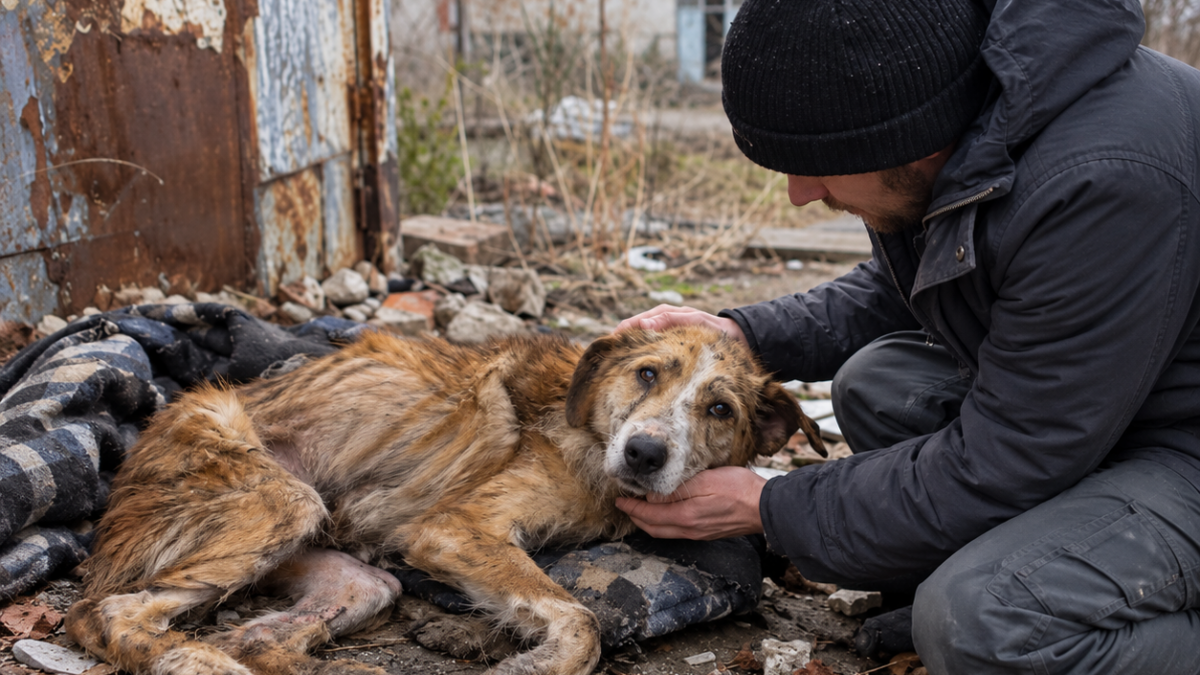
PART 2
The rescue van stopped hard enough that gravel scattered beneath its tires.
Two women and a man jumped out carrying blankets, a stretcher, a medical bag, and a transport crate.
“Over here!”
They ran toward us.
One of the women slowed when she saw the dog.
Her expression changed instantly.
“How long has she been like this?”
“I don’t know.”
“Did you move her?”
“No.”
“Good.”
She knelt beside the dog and checked her gums.
Another rescuer put a hand near her chest.
“She’s cold.”
“Very.”
“Pulse is weak.”
They worked quickly but carefully.
A thermal blanket was placed over my jacket.
The dog barely reacted.
The man looked at the ring around her neck.
“That’s a collar injury.”
“I thought so.”
“Old one.”
“How old?”
“Long enough.”
He didn’t elaborate.
He didn’t need to.
The woman nearest the dog’s head looked at me.
“Has she tried to stand?”
“She tried to crawl away when I first approached.”
“Anything else?”
I looked at my wrist.
“She put her paw on me.”
The rescuer smiled for half a second.
“Then she’s still in there.”
They slid a rigid stretcher beside her.
The dog became frightened when unfamiliar hands touched her.
Her head came up.
One leg twitched.
“Easy, sweetheart.”
The team moved in synchronized motions, keeping her spine as stable as possible while lifting her.
She weighed far less than a dog her size should have.
One rescuer muttered, “My God.”
I heard it.
So did everyone else.
Once she was secured, they carried her toward the van.
I followed.
“Where are you taking her?”
“Emergency clinic.”
“Can I come?”
The woman looked at me.
“Are you the owner?”
“No.”
“Finder?”
“Yes.”
“Then follow us if you want.”
I did.
I didn’t even go back for anything.
Mud covered my pants.
My shirt was soaked through where the dog had rested against me.
My jacket was wrapped around her.
None of that mattered.
The drive to the clinic took twenty-three minutes.
I know because I watched the clock the whole way.
At every red light, I could see the rescue van ahead.
At every turn, I imagined it pulling over because she’d stopped breathing.
It didn’t.
We reached the clinic just after eight.
The stretcher disappeared through the doors.
I followed until someone gently blocked me.
“We need space.”
“Is she alive?”
“Yes.”
“Can I wait?”
“Of course.”
The doors closed.
Suddenly there was nothing to do.
That was when the shaking started.
Not hers.
Mine.
I sat down.
My hands were covered with dried mud and dog hair.
On my wrist, exactly where her paw had rested, there was a dirty print.
I stared at it.
Twenty minutes passed.
Then thirty.
A veterinarian finally came out.
“You’re the person who found her?”
I stood immediately.
“Yes.”
“Do you know anything about her history?”
“Nothing.”
“Any idea who owns her?”
“No.”
He nodded.
“We’re calling her Jane Doe for the moment.”
“How bad is she?”
The veterinarian exhaled.
“Very bad.”
Those two words felt heavier than I expected.
“She is severely emaciated and dehydrated. Her body temperature is low. She’s anemic. There are pressure sores and multiple wounds on her legs. We also have evidence of prolonged restraint around the neck.”
“The collar mark?”
“Yes.”
“Is she going to live?”
He didn’t answer immediately.
I hated that pause.
“We don’t know.”
“What are you doing?”
“Warm fluids, controlled rewarming, pain relief, blood work, imaging, nutritional support when she’s stable enough. We have to go slowly.”
“Why?”
“Because an animal this starved cannot simply be given a huge meal and expected to recover. Her body chemistry is fragile. Refeeding too aggressively can be dangerous.”
I had never heard of that.
My first instinct had been to imagine giving her an enormous bowl of food.
“Can I see her?”
“Not yet.”
“Later?”
“If she’s stable.”
He started to walk away.
“Doctor?”
He stopped.
“That place where I found her—could she have walked there herself?”
He thought about it.
“Not in her current condition.”
My stomach tightened.
“So somebody put her there?”
“I can’t tell you that medically.”
“But she couldn’t have walked far.”
“Not now.”
That answer stayed with me.
Not now.
Maybe she had been stronger when she arrived.
Maybe she’d wandered there days earlier.
Maybe.
But the area bothered me.
There was no reason for a severely weakened dog to cross open industrial land, weave behind a warehouse, and collapse in exactly the most isolated corner available.
I returned to the abandoned property later that afternoon.
I told myself I was only looking for clues that might help identify her.
A collar.
A bowl.
A tag.
Something.
The wind had dried parts of the ground.
Her body-shaped impression was still visible in the mud.
My jacket was gone with the rescuers.
The torn rags remained.
I searched carefully.
Behind an old sheet of metal, I found a length of frayed nylon rope.
One end was cut.
The other had a rusted metal clip.
I stared at it.
Maybe it had nothing to do with her.
The warehouse was full of discarded material.
But the rope looked like the kind used as an improvised tether.
I photographed it.
Didn’t touch it.
Then I saw something else.
Tire tracks.
Fresh enough to stand out in the mud.
They came from the old service entrance, curved behind the warehouse, and stopped roughly twenty yards from where she’d been lying.
Vehicles could have used the area for all sorts of reasons.
Scrap scavengers.
Workers.
Teenagers.
People dumping garbage illegally.
Again, not proof.
But my unease grew.
I called the rescue.
“I went back.”
“You probably shouldn’t disturb anything if this becomes a neglect investigation.”
“I didn’t.”
“What did you see?”
I explained.
The rope.
The tire marks.
There was silence.
“Send photographs.”
I did.
“Do you think someone dumped her there?”
“We don’t know.”
Everyone kept saying that.
We don’t know.
I wanted someone to know.
Someone had to know.
That evening, the clinic called.
The dog’s temperature was improving.
She had not died.
That sentence alone felt enormous.
“Has she eaten?”
“Not yet.”
“Is that bad?”
“She’s receiving support. We need to manage her carefully.”
“Can I visit?”
“Briefly.”
I drove back.
The dog looked both better and worse under bright clinical lights.
Better because she was clean enough that I could see her face.
Worse because the dirt had hidden how thin she really was.
They had clipped some fur around the injuries.
The groove around her neck was even more obvious.
A broad, raw-looking ring where years of pressure had altered the skin and hair.
She lay beneath warm blankets.
An IV line ran into one leg.
When I entered, her eyes opened.
I stayed near the doorway.
“It’s me.”
Her ears moved.
I stepped closer.
Her gaze followed.
“Remember the idiot sitting in the mud with you?”
Her tail moved.
Just once.
A tiny tap beneath the blanket.
I froze.
The technician beside me smiled.
“She hasn’t done that for anyone else today.”
I sat next to the kennel.
“Don’t make me special. You’ll ruin my reputation.”
The dog continued watching me.
I put my fingers near the bars.
She sniffed them.
Then rested her nose against my knuckles.
That was when I knew I was in trouble.
Not medically.
Emotionally.
I had found dogs before.
Helped strays.
Called animal services.
But this was different.
This dog had put her head on my knee believing, maybe, that she had reached the end.
Now she was still here.
I needed to see what happened next.
The rescue decided to name her Hope.
I thought the name was dangerously optimistic.
Then I saw her eat for the first time.
It happened the next morning.
A veterinary technician offered a tiny portion of specially prepared food.
Hope sniffed.
Turned away.
My heart sank.
“She’s not interested?”
“Give her a second.”
Hope sniffed again.
Her tongue touched the food.
One lick.
Then another.
She took a small bite.
Chewed slowly.
Swallowed.
Everyone in the room pretended not to react.
She ate another.
Then she looked for more.
The technician laughed.
“Okay, that’s enough for now.”
Hope’s head followed the dish.
For the first time, she looked offended.
I almost cried from relief.
“That’s a good sign, right?”
“A very good one.”
Recovery began in increments so small that, outside rescue work, nobody would consider them victories.
She kept her temperature stable for twelve hours.
Victory.
She ate another controlled meal.
Victory.
Her blood values improved slightly.
Victory.
She lifted her head without trembling.
Victory.
She slept through several hours without waking in panic.
Victory.
Then we discovered another problem.
Hope couldn’t stand.
Not properly.
When the staff supported her, her legs shook and folded.
Her muscles had wasted so severely that even though there was no major spinal fracture, she had almost no strength left.
The veterinarian explained that starvation doesn’t only remove fat.
The body consumes muscle.
Eventually, it starts sacrificing everything it can to stay alive.
Hope’s body had been surviving by dismantling itself.
I looked at her legs.
“What do we do?”
“Nutrition. Time. Rehabilitation. Treat the wounds. Build strength slowly.”
“Can she walk again?”
“Probably.”
Probably.
Another word I learned to both love and hate.
For the first week, Hope remained hospitalized.
I visited every day.
Sometimes twice.
I brought no treats because her diet had to be controlled.
Instead, I brought something less exciting.
My voice.
She began recognizing the sound of my footsteps in the hallway.
At least I convinced myself she did.
One afternoon, I approached her kennel and found her asleep.
I whispered, “Hey, girl.”
Her eyes opened.
Tail.
Tap.
Tap.
The technician laughed.
“You’re officially her person.”
“No.”
“Yes.”
“I found her.”
“Exactly.”
“I can’t adopt every dog I find.”
“I didn’t say anything about adoption.”
“You were thinking it.”
“I absolutely was.”
I ignored her.
Hope did not.
She pushed her head toward my hand.
The investigation into her past began quietly.
The rescue scanned her for a microchip.
Nothing.
They posted carefully worded notices.
**Found: adult female dog.**
No graphic photographs.
No accusation.
Anyone with legitimate proof of ownership could contact the authorities.
For three days, nobody did.
Then a message arrived.
A woman said Hope looked like a dog named Daisy that had lived at a property several miles away.
The rescue contacted her privately.
She sent an old photograph.
When I saw it, I nearly dropped the phone.
The dog in the picture was magnificent.
Large.
Strong.
Deep reddish-gray coat.
Healthy chest.
Bright eyes.
A wide black collar around her neck.
It was Hope.
Or at least it looked exactly like her.
The woman explained that she had lived near the property two years earlier.
The dog was usually kept tied outside.
“Always?”
“Most of the time.”
“Did you know the owner?”
“Only casually.”
“Was the dog thin then?”
“Not like this. But I worried about her.”
“Why?”
“She was outside in every kind of weather.”
My stomach tightened.
“Did you ever report it?”
A pause.
“Once.”
“What happened?”
“I don’t know. I moved a few months later.”
The rescue forwarded everything to animal welfare investigators.
The photograph gave them something we hadn’t had before.
A possible identity.
Daisy.
I visited Hope that evening.
She was doing supported standing exercises.
Two people held a sling beneath her abdomen.
Her front paws pressed into a padded mat.
Her rear legs trembled.
“Come on, girl.”
The rehabilitation technician shifted slightly.
“Good.”
Hope held herself for three seconds.
Then four.
Her left hind leg buckled.
They lowered her.
I crouched near her face.
“Daisy?”
Her ears moved.
Hope looked straight at me.
The technician noticed.
“Try it again.”
“Daisy.”
Her head lifted.
My skin prickled.
Again.
“Daisy?”
Tail movement.
Not proof.
Dogs respond to tone.
But it was enough to make my throat tighten.
“That was your name, wasn’t it?”
Hope—or Daisy—pressed her nose toward me.
I told the investigators.
They asked me not to contact anyone connected to the former property.
I didn’t.
I wanted to.
Especially after we learned more.
Neighbors remembered Daisy.
Some remembered the chain.
One man had photographs from a neighborhood dispute over a broken fence. Daisy appeared in the background.
Tied to a stake.
A heavy collar around her neck.
The date was nearly eighteen months earlier.
Another witness said the dog had gradually disappeared from view.
“How long ago?”
“Couple months.”
“Did you ask?”
“The owner said she was sick.”
“What happened after?”
“I don’t know.”
Those three words again.
I don’t know.
Except now, ignorance felt different.
Too many people had seen pieces.
A tether.
A thinning dog.
A dog suddenly gone.
No single person saw the whole story.
That is how neglect can survive in plain sight.
Everybody owns only one fragment.
Nobody believes they own enough to act.
The investigators located the person believed to have owned Daisy.
I wasn’t present.
I heard the account later.
At first, he denied the dog was his.
Then he said he had given her away.
Then he said she had run away.
Those versions did not fit together.
Investigators asked for veterinary records.
None.
Licensing records.
Old.
Photographs.
Few.
Then they showed him the image from the neighbor.
Daisy tied outside.
The man changed his story again.
He said she had become ill and disappeared.
“When?”
His answer roughly matched the period when neighbors stopped seeing her.
Investigators asked how a dog too weak to walk had traveled several miles to an abandoned warehouse.
He said he didn’t know.
That phrase was becoming almost comical.
Except nothing about the case was funny.
They checked cameras near industrial roads.
Most had no useful angle.
One business kept footage for only seven days.
Too late.
Another camera captured a vehicle entering the old service road around midnight several nights before I found Hope.
The image was poor.
No readable plate.
But the vehicle type resembled one registered to the former owner.
Resembled.
Not proved.
I had to keep reminding myself of the difference.
Suspicion feels satisfying.
Evidence is slower.
Meanwhile, Hope didn’t care about any of it.
She had more immediate problems.
Standing.
Eating.
Sleeping.
Trusting.
On day nine, she tried to stand without the sling.
It happened because she wanted my sandwich.
I was sitting on the floor outside the rehabilitation area eating lunch.
Hope was resting on a padded mat.
“Don’t even look at me.”
She looked directly at me.
“This isn’t for you.”
Her nose lifted.
“Absolutely not.”
I took another bite.
Hope shifted her front legs beneath herself.
I didn’t notice at first.
Then she pushed.
Her shoulders rose.
Her rear legs shook.
“Hey.”
The technician across the room stopped.
Hope continued pushing.
For one second, her whole body lifted.
No sling.
No hands.
Just Hope.
She stood.
Her legs quivered so violently that I dropped my sandwich.
“Don’t move.”
The technician whispered, “She’s doing it.”
Three seconds.
Four.
Five.
Then Hope collapsed onto the mat.
I crawled toward her.
“You’re insane.”
She looked at the sandwich on the floor.
The technician burst out laughing.
“She did it for turkey.”
“I can’t believe this.”
Hope sniffed the air.
“You’re not getting the sandwich.”
Tail wag.
“Fine. Maybe a veterinarian-approved piece later.”
That five-second stand changed everything.
Not medically overnight.
Hope was still weak.
But psychologically—for us—it destroyed the image of the dog who could only lie in the mud.
Her body had answered.
There was more left.
Over the following two weeks, she learned to stand longer.
Five seconds became ten.
Ten became thirty.
Then came steps.
The first one was ugly.
Her front leg moved.
Her rear paw dragged.
The other back leg crossed awkwardly.
She nearly fell.
We caught her.
“Again?”
The technician looked at Hope.
Hope looked at the food.
“Again.”
She took two steps.
Then three.
One afternoon, she crossed half the rehabilitation room.
I walked backward in front of her.
“Come on.”
She followed.
Her legs trembled.
“That’s it.”
Step.
Pause.
Step.
Her eyes stayed on mine.
Then she reached me.
I knelt.
She leaned her whole weight against my chest.
This time she was heavy enough that I almost fell backward.
I laughed.
“You’re getting inconvenient.”
Tail wag.
That was the first real wag.
Not a tap.
Not a twitch.
A full, sweeping wag.
Everyone saw it.
One of the staff members wiped her eyes.
Hope had been in care three weeks.
The investigation took longer.
The deep scar around her neck became a crucial part of the veterinary report.
The doctor documented chronic pressure injury consistent with prolonged tethering by an improperly fitted collar or restraint.
Her emaciation was not the result of one missed meal.
Her muscle loss represented extended neglect.
The wounds on her feet suggested prolonged exposure to rough, wet ground.
Her anemia and nutritional deficiencies were severe.
Nobody could prove every detail of her past.
But her body carried a timeline.
Not dates.
Consequences.
The investigators returned to the former owner’s property with authorization.
What they found made the case darker.
A chain attached near an old shed.
A weathered plastic doghouse.
No proper insulated shelter.
Bowls that were dirty and dry.
The worn collar hook matched the approximate width of the scar around Hope’s neck.
Still, matching dimensions aren’t magic proof.
The case had to be built carefully.
Then came the discovery that changed it.
An old veterinary clinic had a record under the name Daisy.
One visit.
Nearly three years earlier.
Vaccinations.
Weight.
Photograph.
Owner information.
The dog in the clinic photograph had a distinctive patch of darker fur near the right shoulder.
Hope had the same patch.
The rescue veterinarian compared the images.
Same sex.
Same approximate age.
Same coloration.
Same unique markings.
Now investigators had stronger identification.
Daisy had a documented owner.
The former owner could no longer credibly claim she had never been his.
His next explanation was that he had “rehomed” her.
To whom?
He couldn’t provide a name.
Phone number?
No.
Address?
No.
When?
His answer changed.
Investigators asked whether he had made any social media post.
No.
Text messages?
None produced.
Witnesses had seen Daisy at the property after the date he claimed she had been rehomed.
His story was collapsing.
I learned those details from the rescue coordinator, who warned me repeatedly not to post anything publicly.
I understood.
“You think I’m going to show up at his house?”
“I know you’re angry.”
“Angry doesn’t mean stupid.”
She looked at me.
“Promise.”
“I promise.”
And I kept it.
But there were nights when I imagined that confrontation.
I imagined carrying the first photograph of Hope into his yard.
Showing him her ribs.
The neck scar.
The mud.
Asking him how a dog becomes that thin under someone’s watch.
Asking him whether he knew how cold she was when I found her.
Whether he understood that I had begged her not to die with her head on my knee.
I wanted him to look at her.
Then I realized something.
That fantasy wasn’t for Hope.
It was for me.
Hope never asked for confrontation.
Hope asked for breakfast.
Walks.
A soft bed.
My hand under her chin.
That became important later.
At four weeks, Hope left the hospital.
Not for adoption.
For foster care.
Mine.
The rescue coordinator handed me medication, feeding instructions, rehabilitation exercises, wound-care notes, and a look that said she had expected this from the first week.
“Don’t.”
She smiled.
“I said nothing.”
“You were thinking it.”
“Obviously.”
Hope stood beside me in a harness.
She was still thin.
Still weak.
But she stood.
I looked down.
“You ready?”
Tail wag.
We walked toward my car.
Slowly.
The distance from the clinic door to the parking lot could not have been more than sixty feet.
It took several minutes.
Hope stopped twice.
Her hind legs shook.
I offered the support sling.
She glared at it.
“Don’t be proud.”
She took another step.
Then another.
Eventually, she reached the car.
The first time I had transported her, she had been unable to lift her own head.
Now she was stubbornly refusing assistance.
Progress sometimes looks a lot like bad manners.
At home, Hope froze at the doorway.
She stared inside.
Warm floor.
Lights.
A bed near the wall.
Water.
No chain.
No dirt.
No warehouse.
“Come on.”
She didn’t move.
I stepped inside.
Hope remained outside.
I sat on the floor.
No pulling.
No forcing.
Five minutes passed.
Then she put one paw across the threshold.
Stopped.
Another.
Her body entered slowly.
She sniffed the floor.
The wall.
The bed.
When she saw the dog bed, she walked around it.
Wouldn’t step inside.
Instead, she lay on the bare floor beside it.
That broke my heart in a way I didn’t expect.
A soft bed was so unfamiliar that the hard floor felt safer.
I left her there.
An hour later, I came back.
One front paw was on the bed.
By evening, half her body was inside.
At midnight, she was curled entirely on it.
I took a photograph.
The rescue coordinator replied:
**Told you.**
I wrote:
**Go to sleep.**
Hope’s first month with me was full of strange discoveries.
Stairs terrified her.
Doors closing made her jump.
Metal chains jingling somewhere outside caused her to freeze.
If I reached suddenly toward her neck, she ducked.
The collar mark explained that.
I stopped using a collar entirely for a while and relied on a carefully fitted harness.
She ate every meal as though somebody might take the bowl away.
At first, she’d finish and immediately search the floor.
Then check the kitchen.
Then return to the empty bowl.
I divided her meals.
Routine.
Same times.
Same place.
No one disturbed her.
After two weeks, the panic around food began easing.
One night, she left three pieces in the bowl.
I stared.
Hope walked away.
I called the rescue coordinator.
“She left food.”
“Is she sick?”
“No. She ate almost everything.”
“Then what’s wrong?”
“Nothing.”
Silence.
“Oh.”
“Exactly.”
Leaving food meant she believed another meal was coming.
For a dog who had nearly starved to death, that was trust.
Not dramatic trust.
Better.
Practical trust.
Tomorrow exists.
The investigation eventually became public when charges were filed.
I won’t pretend the process looked like television.
There was no dramatic raid with dozens of police cars.
No villain screaming from a porch.
No perfect confession.
Paperwork.
Photographs.
Veterinary documentation.
Witness statements.
Property records.
Timeline discrepancies.
Security footage.
A formal allegation that the former owner had failed to provide adequate care and had abandoned the dog.
The former owner denied deliberately leaving her behind the warehouse.
His attorney argued that somebody else could have taken her.
That part could not be proven beyond every question.
The poor video never showed a clear plate.
No camera captured the dog being physically removed from the vehicle.
So the abandonment allegation became the hardest part.
That frustrated me.
The evidence of neglect was far stronger.
Veterinary records identified Daisy as his dog.
Neighbors described prolonged tethering.
Photographs documented the chain and collar.
His own inconsistent statements damaged his credibility.
The medical condition showed long-term deprivation.
The case became less about proving exactly who placed Hope behind the warehouse and more about proving what had happened before she got there.
At first, I hated that.
I wanted everything answered.
Who drove her there?
Who put her on the ground?
Was she conscious?
Did she watch the vehicle leave?
How many hours did she spend alone?
No one could tell me.
Then Hope reminded me that unanswered questions don’t stop healing.
She began walking farther every day.
At first, down my hallway.
Then to the mailbox.
Then halfway around the block.
The first time we reached the end of the street, she stopped.
A truck passed.
Hope crouched.
I felt the leash tighten.
I didn’t pull.
“It’s okay.”
She watched the truck disappear.
Then looked at me.
“Your choice.”
I waited.
Hope stepped forward.
We continued.
I started letting her choose routes whenever possible.
Left or right.
Fast or slow.
Stop or continue.
Choice matters more to rescued animals than people realize.
A dog that has spent years tethered learns that the world ends at the length of a chain.
Hope was learning that movement belonged to her.
One morning, she chose the longer route.
Then another.
Her muscles returned.
Slowly.
The sharp ridge of her spine softened beneath new weight.
Her coat changed too.
What I had thought was dull gray-brown became a beautiful reddish sable.
The dark shoulder patch from the old veterinary photo became clearly visible.
Her eyes changed most.
When I found her, they looked like somebody had turned the lights off behind them.
Now she watched everything.
Squirrels.
Cars.
Neighbors.
My refrigerator.
Especially my refrigerator.
“You’re becoming nosy.”
Tail wag.
“That’s good.”
She became friends with an elderly woman three houses down who kept dog biscuits near her door.
Hope learned this after exactly one visit.
From that point forward, every walk mysteriously curved toward the woman’s house.
“I know what you’re doing.”
Hope pulled gently.
“You have no shame.”
The woman opened the door.
“There she is!”
Hope wagged so hard her back end moved.
Traitor.
The woman gave her a treat.
Then another.
“She was starved,” I said. “You’re undoing my portion control.”
“Nonsense.”
Hope agreed.
Those ordinary moments mattered more than the legal updates.
Still, the case remained in the background.
The former owner eventually entered a plea on several neglect-related counts rather than take every allegation to a contested trial.
There were fines.
Probationary conditions.
Restrictions on animal ownership.
The details were less spectacular than some people wanted.
When local social media learned about Hope’s case, comments exploded.
“He should starve.”
“Tie him outside.”
“Put him behind the warehouse.”
I understood the anger.
I deleted those comments from the rescue page whenever I could.
Cruelty copied back onto a human being is not justice.
It is simply more cruelty.
Accountability mattered.
So did preventing him from owning another animal under the same conditions.
That was enough.
Or I thought it was.
Then something happened outside the courthouse that tested me.
I had been asked to provide a short statement about finding Hope.
Nothing dramatic.
Dates.
Location.
Condition.
What she could and couldn’t do.
I attended one hearing.
As I walked out afterward, I saw the former owner.
I recognized him from a photograph.
He was standing near the steps speaking with someone.
For a few seconds, all the discipline I’d practiced disappeared.
I saw the neck scar.
The ribs.
The mud.
Her head collapsing onto my knee.
I started walking toward him.
The rescue coordinator caught my arm.
“Don’t.”
“I just want to ask one question.”
“No.”
“One.”
“What question?”
I didn’t know.
That stopped me.
What could I ask that mattered?
Why?
Would any answer satisfy me?
No.
If he said he was overwhelmed, I’d be angry.
If he denied it, I’d be angry.
If he apologized, I’d doubt him.
If he laughed, I’d lose control.
There was no answer I wanted.
I looked across the steps.
He noticed me.
Our eyes met.
He knew who I was.
The man who found the dog.
I knew he knew.
For half a second, I expected him to look away.
He didn’t.
Neither did I.
Then my phone buzzed.
A message from the foster sitter watching Hope.
A photograph.
Hope lying upside down across my couch with her legs in the air.
Caption:
**Your dying dog stole my pillow.**
I stared at the picture.
Then laughed.
Actually laughed.
On courthouse steps.
The rescue coordinator looked confused.
I showed her.
She smiled.
“Go home.”
I did.
That was the confrontation.
No shouting.
No speech.
No cinematic revenge.
Just a man standing on one side of the courthouse while the dog he had failed was at home stealing pillows.
That was enough.
Hope continued improving.
By the fourth month, she could trot.
The first time it happened, I wasn’t ready.
We were in a fenced field used by the rescue for rehabilitation.
I unclipped a long training line while keeping her in a secure area.
Hope sniffed.
Walked.
Then something caught her attention.
A volunteer rolled a soft ball several feet across the grass.
Hope watched it.
For weeks, she had shown no interest in toys.
Food, yes.
People, cautiously.
Toys seemed pointless to her.
The ball rolled.
Hope’s head turned.
She took two fast steps.
Stopped.
The volunteer rolled it again.
Hope moved.
Three steps.
Then four.
Suddenly she was trotting.
I shouted.
“Hope!”
She accelerated.
Not a run.
Not quite.
But close.
Her tail rose.
The back legs that once couldn’t push her body through mud now drove her across grass.
She reached the ball.
Sniffed it.
Walked away.
Everyone laughed.
The ball itself was apparently disappointing.
The movement wasn’t.
I crouched.
Hope trotted back toward me.
She hit my chest hard enough to push me backward.
“There she is.”
I wrapped my arms around her.
“You’re back.”
Maybe that was the wrong phrase.
Back implied she had returned to who she’d been before.
I didn’t know that dog.
The healthy Daisy from the old photograph belonged to another chapter.
Hope was becoming someone new.
Not back.
Forward.
Several families eventually expressed interest in adopting her.
That should have made me happy.
Instead, I found flaws in all of them.
One had too many stairs.
Another worked long hours.
One had a loud household.
Another had two large energetic dogs.
Some concerns were legitimate.
Some were probably excuses.
The rescue coordinator finally confronted me.
“You know what you’re doing.”
“What?”
“Rejecting everybody.”
“I’m evaluating.”
“You’re sabotaging.”
“She’s traumatized.”
“Yes.”
“She needs stability.”
“Yes.”
“Quiet.”
“Yes.”
“Someone who understands her.”
She stared at me.
“What?”
“You just described your house.”
I looked away.
“No.”
“Why not?”
“I foster.”
“You accidentally foster-failed.”
“That’s not a verb.”
“It is here.”
I looked at Hope.
She was asleep under my desk.
The dog who wouldn’t use a bed now had three.
She still preferred wherever I was.
“I didn’t plan this.”
“Nobody plans foster failure.”
“I travel for work sometimes.”
“We have sitters.”
“She might need more than I can—”
Hope woke, stood, walked over, and placed one paw on my knee.
The rescue coordinator burst out laughing.
“That’s obscene.”
“What?”
“The timing.”
Hope leaned against me.
I looked down.
That paw.
The same gesture.
My wrist behind the warehouse.
My chest in the clinic.
My knee now.
Maybe it had become her habit.
Maybe mine.
I sighed.
“Fine.”
“Fine what?”
“Send me the adoption application.”
She clapped once.
I pointed.
“Don’t.”
“Too late.”
Hope became legally mine six months after I found her.
Or maybe I became hers.
The paperwork didn’t change much.
She slept in the same bed.
Walked the same routes.
Manipulated the same elderly neighbor for biscuits.
But signing my name did something to me.
It closed one door.
She was not waiting anymore.
Nobody would come decide she belonged somewhere else.
Home wasn’t temporary.
That evening, I gave her a new tag.
Not a neck collar.
A tag attached safely to her harness.
**HOPE**
My phone number.
I showed it to her.
“You have an address now.”
She tried to eat the tag.
“Very touching.”
The scar around her neck never disappeared completely.
Fur grew across much of it.
But if you knew where to look, you could feel the band of damaged tissue beneath.
I hated it at first.
I wanted every trace of the past gone.
Then one veterinarian said something that changed my perspective.
“A scar isn’t ongoing injury.”
I looked at her.
“What?”
“The wound is healed. The scar is just evidence that healing happened.”
I thought about that for a long time.
Evidence that healing happened.
Hope didn’t need to become physically untouched by her past for recovery to count.
Neither did I.
The scar stayed.
Her life changed.
A year after her rescue, the abandoned warehouse was finally scheduled for demolition.
I found out through a local notice.
For days, I thought about returning.
Not with Hope.
Never.
Then I changed my mind.
On the morning before demolition, I drove there with her.
I parked near the front, far from the isolated back area.
Hope recognized nothing at first.
She jumped from the car wearing her harness.
Healthy.
Strong.
Nearly seventy pounds now.
Her coat shone in the morning light.
Tail moving.
We walked slowly around the edge of the property.
As we approached the back, her behavior changed.
Her nose lowered.
She sniffed intensely.
Then stopped.
The wind moved through the broken walls.
Exactly like that first morning.
Hope froze.
I did too.
Her ears went back.
“Do you remember?”
Stupid question.
Of course she couldn’t answer.
She took one step backward.
I immediately turned.
“We can leave.”
I would not drag her toward the place for my own need for closure.
But Hope didn’t follow me.
She stood.
Sniffed.
Then walked forward.
Her choice.
I let the leash stay loose.
We reached the patch of ground where I’d found her.
It looked smaller.
Nothing dramatic marked it.
Mud.
Weeds.
Broken brick.
A rusted beam.
The place where I had been certain she might die now looked insultingly ordinary.
Hope sniffed the ground.
Then looked at me.
I crouched.
“Yeah.”
She stepped closer.
Placed one paw on my thigh.
There it was.
I scratched behind her ear.
“We’re not staying.”
I stood.
Hope turned with me.
We walked away.
No dramatic backward glance.
No trembling collapse.
No need to conquer the place.
She simply left.
Under her own power.
I realized halfway back to the car that I was crying.
Not because the warehouse had won some symbolic battle.
Because it hadn’t.
That place had been the worst location in Hope’s life.
Now it was only somewhere she could choose to walk away from.
The next morning, demolition equipment arrived.
Within days, parts of the building were gone.
A local reporter covering the redevelopment mentioned Hope’s story.
People remembered.
Donations came to the rescue.
The old property owner—unrelated to Hope’s former owner—agreed to let the rescue place a temporary donation collection point near the redevelopment office.
Someone suggested naming the new access path “Hope Lane.”
I thought that was too much.
Then they did it anyway.
Not officially.
Just a small sign near the rescue collection area.
**HOPE’S CORNER — FOOD & BLANKET DONATIONS FOR LOCAL ANIMALS**
The location where she had almost vanished became somewhere people brought supplies.
I appreciated the irony.
Hope didn’t.
She cared about biscuits.
The legal case ended without the explosive punishment some people wanted.
The former owner was restricted from owning animals for a significant period under the court’s order, required to pay penalties and costs, and subjected to compliance conditions.
Some readers online called that too lenient.
Others said it was enough.
I stopped reading.
The outcome I cared about had four paws.
And she was busy stealing a dish towel.
One evening, almost eighteen months after the rescue, I came home later than usual.
Hope met me at the door.
Not cautiously.
Not silently.
She barked.
A full, deep bark.
Then another.
“Excuse me?”
Tail wagging.
“You have become extremely demanding.”
She leaned against me.
I dropped my bag.
Hope placed both front paws briefly against my chest.
Her weight nearly knocked me over.
I laughed.
“Remember when one paw was all you had?”
She licked my chin.
“I do.”
I sat on the floor.
Hope climbed halfway into my lap despite being far too large.
I didn’t move her.
For a long time, I had thought the greatest revenge would be forcing the person who hurt her to understand her pain.
I no longer believed that.
Understanding cannot be forced.
Remorse cannot be ordered by a court.
Punishment has a purpose, especially when it protects future animals, but punishment does not heal the one already harmed.
Hope healed somewhere else.
In meals arriving on schedule.
In walks with no chain at the end.
In doors she could walk through.
In a bed she eventually learned belonged to her.
In neighbors who knew her name.
In a veterinarian who celebrated weight gain.
In rehabilitation staff who cheered five seconds of standing.
In the first ball she chased and immediately decided was boring.
In the paw she kept putting on me.
That was her answer.
Several months later, an unexpected letter arrived through the rescue organization.
It was from a relative of the former owner.
I almost threw it away unopened.
The coordinator told me she’d read it first.
“No threats.”
“What does it say?”
“You should decide whether you want to know.”
I took it home.
Waited two days.
Then opened it.
The writer was an adult daughter who no longer lived with her father.
She remembered Daisy.
She wrote that Daisy had originally belonged to her as a teenager.
When she moved away for school, her father kept the dog.
At first, he sent photographs.
Then fewer.
When she asked, he always said Daisy was fine.
Later, he said Daisy had “gotten old.”
The daughter believed him.
When she saw the news story, she recognized the dark patch on Hope’s shoulder immediately.
She said she had cried for hours.
Then came the sentence that stopped me.
**I thought she died years ago.**
I had to put the letter down.
The daughter explained that she had repeatedly asked what happened to Daisy.
Her father eventually told her the dog had become sick and died.
No grave.
No veterinary record.
No proof.
She had accepted it because she lived hundreds of miles away and because trusting a parent is easier than imagining the alternative.
Now she knew Daisy had survived.
She did not ask for the dog back.
That mattered.
She wrote:
**I have no right to ask anything from her. I only want you to know there was a time when she was loved. Before I left, she slept in my room every night. She loved carrots, hated baths, and would steal socks and hide them behind the couch. If she is happy now, please don’t disturb her life for me.**
I read that paragraph three times.
Carrots.
Baths.
Socks.
Hope had a history before the chain.
Before starvation.
Before the warehouse.
A version of Daisy who slept beside a teenager.
I looked across the room.
Hope was lying beside the couch.
One of my socks was between her paws.
I stared.
“No way.”
Hope looked up.
The letter shook in my hand.
I laughed and cried at the same time.
“Socks?”
She grabbed it and walked away.
That detail destroyed something inside me.
Not in a bad way.
For the first time, I could imagine her life as more than two extremes.
Not simply abused dog and rescued dog.
She had once been someone’s beloved pet.
Something happened after that girl left.
A household changed.
Care deteriorated.
Neglect took over.
Hope’s life contained loss before I ever saw her.
I wrote back through the rescue.
I told the daughter Hope was alive.
Healthy.
Walking.
Running.
Stealing food.
Stealing socks.
I attached no graphic photographs.
Just one recent image.
Hope sitting in sunlight.
The response came a week later.
One sentence.
**That’s my Daisy.**
I didn’t know what to do with that.
For days, I wondered whether they should meet.
The daughter had explicitly said she didn’t want to disturb Hope.
Still, I thought she deserved closure.
Then the decision came from a simpler place.
What would be good for Hope?
Not me.
Not the daughter.
Hope.
We spoke with a behavior specialist.
Dogs can retain scent memory for years.
A reunion could be joyful.
Or confusing.
Or stressful.
There was no guarantee.
If we did it, the meeting should be quiet and allow Hope to choose.
The daughter agreed.
She drove several hours.
We met in a neutral fenced garden at the rescue.
I arrived first with Hope.
She sniffed.
Walked.
Nothing unusual.
Then the daughter entered through the far gate.
Hope looked up.
The woman stopped.
Her hands covered her mouth.
I watched Hope.
No reaction for two seconds.
Then three.
The daughter whispered:
“Daisy.”
Hope froze.
Every muscle changed.
Her ears lifted.
Head tilted.
The woman didn’t move.
“Daisy girl.”
Hope took one step.
Stopped.
Sniffed the air.
Then something happened I had never seen her do.
She whined.
A high, broken sound.
The daughter started crying.
Hope moved faster.
Walk.
Trot.
Then run.
She crossed the garden.
The woman dropped to her knees.
Hope hit her so hard they nearly both went backward.
The sound that came out of the daughter was half laugh, half sob.
“Daisy!”
Hope jumped.
Licked her face.
Whined.
Circled.
Jumped again.
Her tail blurred.
I stood twenty feet away and cried like an idiot.
There was no doubt.
She remembered.
Maybe the name.
Maybe the scent.
Maybe the person.
Probably all of it.
For fifteen minutes, Hope became another dog.
Younger somehow.
She pushed her head into the woman’s chest.
Rolled partly onto her side.
Pawed at her hands.
The daughter kept saying, “I’m sorry.”
Over and over.
“I’m so sorry.”
Eventually, I stepped closer.
Hope turned.
Saw me.
Ran toward me.
Touched my hand.
Then ran back to the daughter.
No conflict.
No choosing.
Her past and present occupied the same garden.
That moment taught me something I hadn’t expected.
Rescue stories often need a villain and a hero because our minds like clean shapes.
But real lives are messier.
The same home can contain love at one time and neglect later.
One person can leave believing an animal is safe.
Another can fail that animal.
A dog can remember good things from before terrible ones.
Hope wasn’t only a survivor of cruelty.
She was also a carrier of love.
Somebody had loved her before me.
That didn’t make what followed acceptable.
It made her story larger.
The daughter never asked to reclaim Hope.
Before leaving, she crouched and held Hope’s face gently.
“You stay with him.”
She glanced at me.
“She’s yours.”
I shook my head.
“She’s hers.”
We both laughed.
Hope didn’t care.
She had found a fallen leaf and was chewing it.
The daughter visited twice more over the following year.
Each time, Hope recognized her.
Each time, they spent a few hours together.
Then Hope came home with me without hesitation.
It became something beautiful instead of threatening.
Hope regained part of her old life without losing the new one.
The daughter gave me copies of childhood photographs.
Daisy sleeping beneath a Christmas tree.
Daisy wearing a ridiculous birthday hat.
Daisy beside a teenage girl on a couch.
Daisy stealing a carrot from a kitchen bowl.
I framed one.
Not the prettiest.
The one where she was standing in a yard, healthy and young, looking directly at the camera.
I placed it beside a photograph from her first anniversary with me.
Same eyes.
Different life.
That pair of images mattered more than the terrible rescue photograph.
They proved the warehouse was never her whole identity.
It was an interruption.
A catastrophic one.
But not the beginning.
Not the ending.
Two years after I found Hope, the rescue organized an adoption event near the redeveloped warehouse site.
The old ruins were gone.
In their place stood a small logistics building, a paved access road, landscaping, lights, and a public sidewalk.
The dark forgotten corner no longer existed.
Hope came with me.
She wore a bright harness.
No collar around the scar.
People recognized her from local stories.
Some wanted to pet her.
I let Hope decide.
She accepted scratches from a few.
Ignored others.
One little boy asked:
“Was she really dying?”
I looked at Hope.
She was trying to steal a snack from a volunteer.
“Yes.”
“How did she get better?”
That question deserved a better answer than “we rescued her.”
“Lots of people helped.”
“Like doctors?”
“Doctors. Rescue workers. People who donated food. People who helped her exercise.”
“And you?”
“I found her.”
The boy considered this.
“Did she know you saved her?”
I smiled.
“I don’t know.”
Hope walked over and placed a paw on my shoe.
The boy’s eyes widened.
“I think she knows.”
Maybe.
Or maybe I smelled like snacks.
Both were possible.
By the end of the event, three dogs had adoption applications.
A box overflowed with donated blankets.
Someone brought bags of food.
The rescue coordinator stood beside me looking at the crowd.
“Remember this place?”
“I’ve tried not to.”
“You came back anyway.”
“Hope made me.”
She looked at the dog.
Hope was asleep beneath a table.
“She doesn’t seem emotionally invested.”
“No.”
Perfect.
That is what recovery should do.
Make the location irrelevant.
That evening, we drove home.
Hope slept across the back seat.
At a red light, I looked at her in the mirror.
For a second, the old image returned.
Mud.
Bones.
Half-open eyes.
Then Hope snored.
Loudly.
I laughed.
Memory defeated by snoring.
Good.
As Hope grew older, the long-term effects of starvation became something we monitored.
Her joints needed support.
The old hind-leg injury sometimes bothered her after long walks.
We adjusted.
Shorter routes.
More frequent checkups.
A ramp into the car once jumping became less comfortable.
None of it felt tragic.
Aging was a privilege.
That phrase sounds sentimental until you rescue an animal who nearly didn’t get another afternoon.
Hope got years.
Every gray hair around her muzzle felt like evidence.
She was allowed to become old.
At seven in the morning on one anniversary of her rescue, I found her asleep beside my bed.
I sat on the floor.
She opened one eye.
“Do you know what day it is?”
Nothing.
“Of course not.”
Tail thump.
“Years ago, you ruined my jacket.”
Tail thump.
“You also ruined my schedule.”
Another.
“And my ability to foster responsibly.”
Hope rolled onto her back.
I rubbed her chest.
The scar around her neck was almost impossible to see now.
I could still feel it beneath the fur.
Evidence that healing happened.
I thought about the former owner less and less.
That surprised me.
For a while, anger had felt morally necessary.
If I stopped being angry, did that mean I was excusing him?
No.
Eventually I understood that memory and rage are not the same.
I could remember exactly what happened.
Support accountability.
Protect animals.
Tell Hope’s story.
And still refuse to spend my life emotionally tied to the person who failed her.
That was freedom too.
Mine.
Hope never needed to learn that lesson.
She was ahead of me.
She did not wake up angry.
She woke up hungry.
There is wisdom in that.
One winter morning, years after her rescue, snow covered the yard.
Hope had never liked bad weather much after the warehouse.
Rain especially.
Snow was different.
She stepped outside cautiously.
Sniffed.
One paw into the snow.
Then another.
She looked at me.
“What?”
She jumped.
A clumsy older-dog bounce.
Then again.
Suddenly she was running small circles.
Not fast.
Not the young dog from rehabilitation.
But joyful.
Snow kicked behind her paws.
I filmed.
Hope stopped.
Looked at me.
Ran toward the camera.
The video shook when she collided with my legs.
I kept it.
Sometimes people asked for the “most emotional” video of Hope.
They expected hospital footage.
First steps.
The reunion with her original girl.
I always thought of the snow video.
Because nothing bad happened.
No context was required.
Just a dog playing.
Ordinary joy is the final stage of rescue.
When the story no longer needs explaining.
Years later, Hope’s former owner’s restriction period came up for review.
The rescue coordinator mentioned it.
My body reacted before my mind did.
Old anger.
“What happens?”
“Authorities review compliance and applicable rules.”
“Can he own another dog?”
“I don’t know yet.”
Those words.
I don’t know.
I laughed bitterly.
Hope was sleeping beside me.
I looked at her.
“Can we submit something?”
“The veterinary history is already part of the record.”
“I want them to remember.”
“They will.”
Ultimately, additional conditions remained in place.
I won’t dramatize the legal specifics because they vary and because that was never the real ending.
What mattered was that Hope’s documented suffering remained part of the record.
Her pain was not invisible anymore.
That was important to me.
The warehouse had hidden her.
Evidence made her seen.
A year later, Hope’s original girl sent me a message.
Her father had died.
I stared at the screen.
I expected a rush of satisfaction.
None came.
No revenge.
No closure.
Just a strange sadness.
Not for him exactly.
For the waste.
A human life capable of caring for a dog properly and choosing not to.
A relationship with a daughter damaged by lies.
An animal nearly destroyed.
What had any of it achieved?
Nothing.
Cruelty is often spectacularly pointless.
I looked at Hope.
She was asleep.
I replied to the daughter:
**I’m sorry.**
Because I was.
People contain contradictions.
Grief doesn’t ask permission from anger.
She thanked me.
We never discussed her father again.
Hope lived.
That was enough.
As she entered her senior years, she slowed.
The dog who had once needed rehabilitation for starvation now needed gentle exercise for arthritis.
We returned to some of the same movements.
Supported stretches.
Controlled steps.
Warm compresses.
The rehabilitation technician from years earlier still worked at the clinic.
She laughed the first time Hope returned.
“Back again?”
Hope wagged.
“This time she’s old.”
“That’s a much better diagnosis.”
Exactly.
Aging.
Better diagnosis.
On one visit, Hope struggled to rise from a slippery floor.
I felt a flash of panic so intense that the old warehouse appeared in my mind.
Then the technician placed a mat beneath her.
Hope stood.
Normal senior weakness.
Not collapse.
Trauma trains humans too.
We learn fear.
Every wobble becomes the past returning.
I had to relearn the difference.
Hope was not dying behind a warehouse.
She was an elderly dog with arthritis.
The ordinary explanation was a gift.
We put more rugs in the house.
Added ramps.
Changed walks.
Hope adapted.
She still stole socks.
Less often.
Mostly because bending down to hide them had become difficult.
One evening, I found a sock beside her bed.
Not hidden.
Just resting under one paw.
“You’ve lost your edge.”
Hope sighed.
I sat beside her.
She placed the paw on my wrist.
I froze.
After all those years, the gesture could still transport me back to the mud.
Her paw was heavier now.
Warm.
Old.
Safe.
I put my other hand over it.
“I’ve got you.”
Same words.
Different meaning.
The first time, it had been a promise about the next few minutes.
Now it meant everything between us.
Meals.
Walks.
Doctors.
Court dates.
Snow.
Socks.
A reunion.
A home.
Years.
Eventually, the day came when Hope could no longer climb onto my bed even with the ramp.
I moved my mattress lower.
People laughed when I told them.
I didn’t care.
She had spent enough of her life adjusting to human decisions.
I could adjust something for her.
Her original girl visited.
Now an adult with a family of her own.
She sat beside Hope on the floor.
“Daisy.”
Hope’s tail moved.
Slowly.
Still recognition.
They stayed like that for an hour.
Before leaving, she whispered something into Hope’s ear.
I didn’t ask.
Some words belong to the people who need to say them.
After she left, Hope slept for most of the afternoon.
I watched her breathing.
Not because I feared every breath anymore.
Because I knew time was changing.
We had once fought desperately to make sure she got more time.
Now she had gotten it.
A lot.
Enough to become gray.
Enough to slow down.
Enough for the abandoned warehouse to be demolished, rebuilt, and nearly forgotten.
Enough for the teenager who once loved Daisy to grow into an adult.
Enough for my own life to rearrange itself around her.
That’s what rescue had given us.
Not immortality.
Time.
I used to think a satisfying ending meant an animal lives forever in the story.
No.
A satisfying ending means the years after rescue become larger than the moment of rescue.
Hope achieved that long before she became old.
The warehouse became a paragraph.
Home became chapters.
On her final birthday with me, I gave her carrots.
The daughter had told me about them years earlier.
Hope still loved them.
I held one piece.
She took it carefully.
Crunch.
Another.
“Some things don’t change.”
Tail movement.
I gave her a sock too.
Clean.
Folded.
She put her paw over it.
Perfect.
I took a photograph.
The dog in the image had a white muzzle.
Cloudier eyes.
A body softened by age.
No visible ribs.
No chain.
No mud.
No fear.
Behind her was a couch she’d destroyed slightly over the years.
Beside her was a water bowl.
On the rug lay three toys she rarely used anymore.
It was not a dramatic photograph.
It became my favorite.
Months later, when Hope’s health finally began failing in a way that treatment could not reverse, the veterinarian spoke gently.
We had managed arthritis.
Then kidney changes.
Then appetite loss.
Age accumulates.
One day, she refused breakfast.
That had never happened.
I knew before the blood results.
The veterinarian sat across from me.
“We can support her.”
“For how long?”
“I can’t tell you.”
“Is she hurting?”
“Not severely right now. But we need to watch quality of life closely.”
I looked at Hope.
She was lying on the blanket beside my chair.
Her eyes followed me.
Same eyes.
Older.
Not empty.
Never empty again.
I took her home.
For several weeks, she rallied.
Ate.
Walked.
Stole half a piece of bread.
I celebrated the theft.
Then came the morning she couldn’t stand without help.
I lifted her.
She leaned against me.
Her head rested near my chest.
The past returned completely.
Cold warehouse.
Mud.
Her head on my knee.
“Hey.”
Hope looked at me.
“No.”
I almost said, Don’t sleep.
The same desperate sentence.
Then I stopped.
She wasn’t that dog anymore.
She had already fought.
For years.
She didn’t owe me another battle simply because I was afraid to lose her.
I sat on the floor.
Hope lowered her head into my lap.
Exactly as she had the first morning.
I stroked her.
“You remember what I told you?”
Her breathing was slow.
“I said I had you.”
Her paw moved.
Not much.
It slid across the blanket and touched my wrist.
I broke.
There are moments when coincidence feels too precise to survive emotionally.
I covered her paw with my hand.
“I still do.”
We went to the clinic later that day.
The original rehabilitation technician came in to say goodbye.
The veterinarian who had treated Hope during her rescue had retired, but he heard and called.
Her original girl joined us by video because she couldn’t arrive in time.
Hope was surrounded by voices that had once fought to keep her alive.
Now we fought for something different.
Peace.
I held her.
No warehouse.
No cold wind.
No empty industrial yard.
Warm blanket.
My arms.
People who knew her name.
Her real names.
Daisy.
Hope.
Both.
She went quietly.
Her paw stayed against my wrist until it couldn’t anymore.
For a long time afterward, I hated how perfectly the story had circled back.
The paw at the beginning.
The paw at the end.
People told me it was beautiful.
I didn’t want beautiful.
I wanted my dog.
Grief is selfish that way.
Then time did what it does.
Not erase.
Soften.
Months later, I returned to the redevelopment site.
Not because I wanted to.
Because the rescue had installed a permanent plaque near the donation collection point.
I expected something sentimental.
Instead, it was simple.
**HOPE’S CORNER**
**In recognition of a dog found here in critical condition and of every person who chooses to stop when an animal needs help.**
Below it was a line:
**Being noticed saved her life. Being loved gave it back.**
I stood there for a long time.
Then I laughed.
Hope would have hated the attention.
Unless there were snacks.
The rescue coordinator stood beside me.
“You okay?”
“No.”
“Good answer.”
We looked at the plaque.
“Do you regret stopping that morning?”
I stared at her.
“That’s a stupid question.”
She smiled.
“I know.”
A family arrived carrying bags of dog food for the donation bin.
A little girl asked who Hope was.
Her father read the plaque aloud.
The girl looked at a photograph attached nearby.
Not Hope dying.
Hope running through snow.
Good choice.
“She’s pretty.”
“She was.”
“Where is she now?”
I looked at the father.
He hesitated.
I answered.
“She got very old.”
The girl nodded as though this were excellent news.
And it was.
That was the revenge.
That was the victory.
That was the ending people had wanted all along without knowing how to name it.
Hope got old.
The person who neglected her had once reduced her world to a chain.
Hope’s world eventually became years wide.
The person who may have believed she was disposable became less important with every birthday she reached.
The warehouse where she was supposed to disappear no longer existed.
The scar remained, but the wound closed.
The court file eventually became an archive.
The online outrage faded.
Hope kept living long after everybody stopped talking about the case.
That was her triumph.
Not that somebody suffered because she had suffered.
That would have changed nothing.
Her triumph was abundance after deprivation.
Choice after restraint.
Warmth after cold.
A home after abandonment.
Food after starvation.
Hands that healed after hands had failed.
Years after somebody had treated her as though hours were all she had left.
I still have the jacket.
The one I put over her that morning.
The rescue staff returned it after the hospital stabilized her.
I never wore it again.
Mud stains remained near one sleeve.
Eventually, I washed it.
Most disappeared.
One faint mark stayed.
For years it hung in my closet.
After Hope died, I almost threw it away.
Instead, I folded it and placed it in a box with her harness, the old photographs, her adoption papers, and the first veterinary report.
Not because I want to remember her dying.
Because that’s where our life began.
Sometimes I open that box.
I see the report:
**Severe emaciation. Hypothermia. Dehydration. Chronic neck injury. Guarded prognosis.**
Guarded prognosis.
I smile at those words now.
The prognosis didn’t know Hope.
She stood.
Walked.
Trotted.
Ran.
Stole socks.
Remembered a girl from years before.
Chased snow.
Manipulated neighbors.
Aged.
Lived.
That is the problem with first reports.
They describe the animal in front of you.
Not the future inside them.
When I found Hope, I saw a dog almost at the end.
I was wrong.
I had found her near the beginning of the longest part of her story.
That realization changed every rescue I participated in afterward.
When someone says, “She looks too far gone,” I remember Hope.
When a starving animal can’t stand, I remember five seconds for a sandwich.
When a frightened dog refuses a bed, I remember one paw eventually reaching onto the mattress.
When someone says one call won’t matter, I remember a forgotten industrial yard and the phone call I made there.
And when anger threatens to become the entire story, I remember the courthouse photograph.
Hope upside down on my couch.
Pillow stolen.
Completely uninterested in revenge.
She had the right idea.
Justice protected other animals.
Love protected her.
They were not the same job.
Both mattered.
But only one filled the rest of her life.
People often say I saved Hope.
I don’t argue anymore, but the sentence still feels incomplete.
I happened to be the person who turned around when I saw her chest move.
That was all.
Volunteers came.
Veterinarians worked.
Technicians rebuilt her strength.
Investigators documented what happened.
Witnesses spoke.
Donors paid for treatment.
A daughter from her past gave us pieces of who Daisy had once been.
An elderly neighbor supplied too many biscuits.
Hope herself did the hardest work.
She kept breathing.
Then eating.
Then standing.
Then choosing.
Maybe rescue isn’t one heroic act.
Maybe it’s a chain.
One person notices.
Another answers.
Another treats.
Another documents.
Another fosters.
Another adopts.
And if enough people refuse to drop the chain, an animal reaches the other side.
Hope did.
The dog I found behind that warehouse was almost invisible.
Not because nobody cared.
Because nobody knew she was there.
Isolation had nearly killed her as completely as starvation.
That is why the location still matters to me.
Whoever brought her there—if someone did—chose a place designed for disappearance.
No homes.
No regular traffic.
No workers.
No reason for anyone to pass.
Yet I did.
By accident.
A blocked road.
A shortcut.
A glance.
Her chest lifting once.
Sometimes survival turns on things so small they frighten me.
Five minutes later, she might have been gone.
If I hadn’t looked back, maybe no one would have found her until it was too late.
But I did look.
That’s the part I can control now.
Look again.
When something seems wrong, look again.
When an animal is lying where it shouldn’t be, look again.
When everyone says somebody else probably handled it, look again.
Hope’s entire second life began because someone looked twice.
Years after she died, I drove past the site on another October morning.
Cold.
Gray.
Almost exactly like the first day.
The new building was busy.
Trucks moved in and out.
Workers crossed the lot.
Lights shone through windows.
Nothing abandoned anymore.
I stopped near the donation point.
Someone had left a bag of food.
Another person had left blankets.
A handwritten note sat beneath them:
**For the next Hope.**
I stood there with my hands in my pockets.
The wind was sharp.
For a moment, I could feel the weight of her head on my knee again.
I could see that exhausted face.
The eyes that contained almost nothing but surrender.
Then the paw.
That impossible little movement.
The touch on my wrist.
At the time, I thought she was asking me not to leave.
Maybe I was wrong.
Maybe she wasn’t asking anything.
Maybe it was only reflex.
It doesn’t matter.
I stayed.
She stayed too.
Long enough for the rescuers.
Long enough for the clinic.
Long enough for one meal.
One stand.
One step.
One home.
Then years.
That is how I choose to remember her.
Not as the dog somebody abandoned.
Not as the skeleton behind a warehouse.
Not even as the evidence photograph from a neglect case.
Those descriptions belong to what people did to her.
They don’t belong to who she became.
Hope was stubborn.
Food obsessed.
Suspicious of baths.
Terrible around socks.
Excellent at manipulating elderly women.
Unimpressed by toys unless food was hidden inside them.
Afraid of chains.
Eventually tolerant of rain.
Completely ridiculous in snow.
She remembered people who loved her.
She learned new people could love her too.
She grew old.
She died with a name, a home, and a hand beneath her paw.
That is her story.
And when I think about the person who failed her, I no longer imagine revenge.
I imagine irrelevance.
Because that’s what eventually happened.
He became a small part of her past.
Hope became everything else.
Someone had reduced her to bones and scars.
She answered with years.
Someone had confined her world to the length of a tether.
She answered by walking wherever she chose.
Someone had allowed her to go hungry.
She answered by becoming the dog who could hear a cheese wrapper from three rooms away.
Someone had left her where nobody was supposed to find her.
She answered by becoming impossible for an entire community to forget.
And the abandoned warehouse meant to hide her suffering eventually disappeared completely.
Hope did not.
Her photograph remained.
Her plaque remained.
Her story changed what people did when they saw the next animal in trouble.
Her life continued inside every bag of food left beneath that sign.
That was better than revenge.
It was consequence.
It was memory.
It was change.
Most of all, it was proof.
Proof that the worst thing ever done to an animal does not have to become the most important thing about that animal.
Proof that survival can become ordinary life.
Proof that ordinary life can become old age.
And proof that sometimes a creature lying half-dead in the mud isn’t waiting for a hero.
She’s simply waiting for one person to stop.
I stopped.
Hope lifted her paw.
And neither of our lives was ever the same again.