PART 2: They Found Him Crushed and Blind Beside an Abandoned Building—But at 4 A.M., Feniks Made One Choice No One Expected
They Found Him Crushed and Blind Beside an Abandoned Building—But at 4 A.M., Feniks Made One Choice No One Expected
Nobody believed the broken dog beside that abandoned wall would survive the night, and the worst part was that he could no longer see the hands trying to save him.
But at four in the morning, when every machine around him was still fighting for his life, Feniks did something so small that the nurse froze in the doorway and whispered, “He’s still choosing to live.”
I found him behind the old brick textile building just after sunset, in the part of town people only drove through when they had nowhere better to be.
The building had been empty for years. Its windows were boarded with warped plywood. Weeds pushed through cracks in the pavement. Rusted metal doors hung crooked on their hinges, and every wall seemed to carry the smell of rain, dust, and things people wanted forgotten.
That was where someone told us a dog was lying.
Not barking.
Not running.
Just lying there.
At first, I thought we were too late.
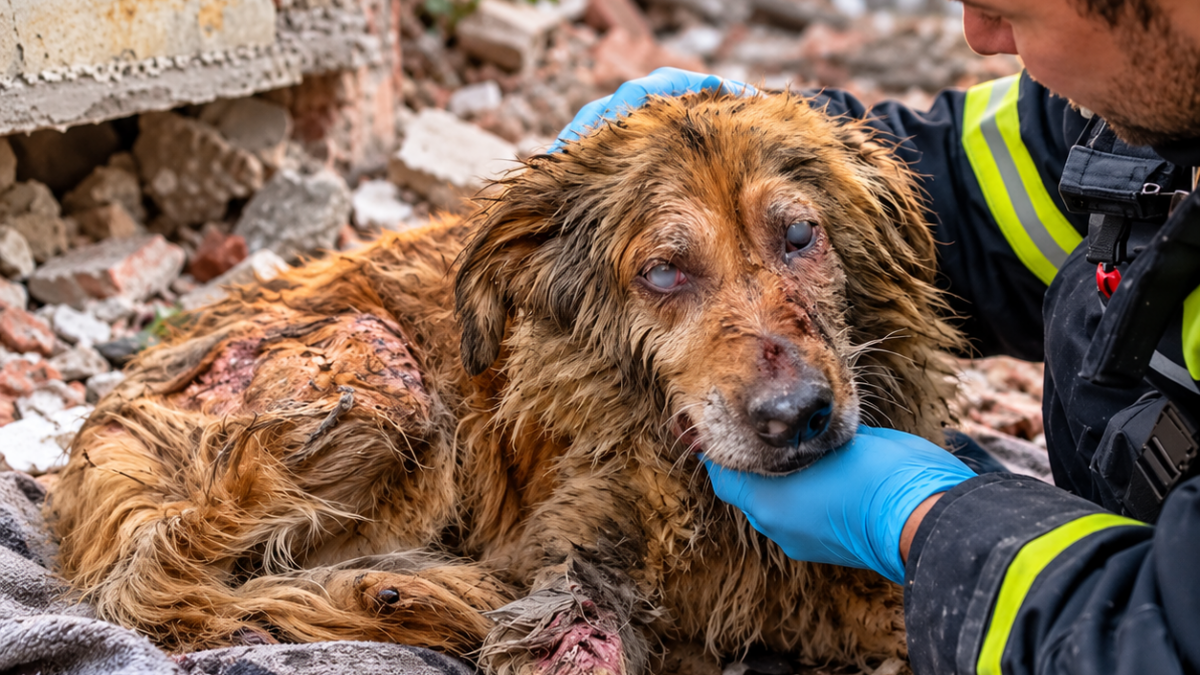
My flashlight caught a shape near the back wall, half in shadow, half in a stripe of dirty evening light. He was a large dog, maybe a shepherd mix, though it was hard to tell beneath the dust, blood, and swelling. His body was twisted unnaturally against the concrete. One back leg bent the wrong way. His muzzle was badly swollen. His fur was clotted dark in several places. Every breath came so shallow that I had to stare at his ribs to see if they moved at all.
Behind me, Elena whispered, “Is he breathing?”
Nobody answered.
I crouched a few feet away, not touching him yet. Injured animals can bite from terror, and this dog had every reason to be terrified.
“Hey, buddy,” I said softly. “We’re here.”
His ears did not move.
His eyes were open, but they did not follow the flashlight.
I moved the beam slowly from left to right.
Nothing.
No blink.
No flinch.
No reaction.
That was when my stomach dropped.
“He can’t see,” I said.
Elena covered her mouth.
The dog moved his head only slightly, as if trying to understand the world by sound alone. He did not know where we were. He did not know whether our hands meant help or more pain. He only knew he was broken, alone, and trapped inside a darkness that had come without warning.
“Careful,” Marcus said behind me. “Don’t touch him fast.”
I nodded.
My hands were steady because rescue work teaches you to make them steady, even when everything inside you is shaking.
I slid my jacket off and placed it near his nose.
“Smell that,” I whispered. “That’s me. I’m not going to hurt you.”
For a few seconds, nothing happened.
Then the dog made a sound.
A low, weak moan.
It was the first sign that he still had enough strength to answer the world.
Elena began crying silently.
Marcus exhaled and said, “He’s alive.”
We named him later.
But in that moment, he was not Feniks yet.
He was just a dying dog beside a forgotten building, surrounded by three people who did not know if love, medicine, or God himself would be enough.
We worked slowly.
Marcus stabilized his head and shoulders. Elena unfolded the stretcher. I kept talking, low and steady, because if he could not see us, then our voices were the only light we could give him.
“You’re not alone,” I said. “Stay with us. Just stay with us.”
When we lifted him, his body went rigid. A broken cry tore out of him and echoed off the abandoned walls.
“I know,” Elena whispered. “I know, baby, I know.”
We carried him to the van like we were carrying glass that could still feel pain.
The whole ride to the clinic, I sat beside him in the back with one hand near his shoulder, not pressing, just close enough that he could sense I had not left. His breathing faded twice. Both times, I leaned close, terrified I would feel nothing.
“Come on,” I whispered. “Don’t you dare leave now. Not after we found you.”
His paw twitched once.
PART 2
That tiny movement felt like an argument.
The emergency clinic doors opened before we reached them. Dr. Harris and two technicians were already waiting because Elena had called ahead. They took one look at the dog and moved with the kind of speed that comes only from experience and dread.
“Possible pelvic fracture,” Dr. Harris said. “Severe cranial trauma. Facial swelling. Shock. Get fluids started. Pain control now. I need radiographs as soon as he’s stable.”
They asked me what happened.
I had no answer.
Only guesses.
A vehicle.
A fall.
A beating.
Something heavy.
Something cruel.
Something that had left him crushed beside a wall with older wounds beneath the new ones.
That was the part that changed the room.
Older wounds.
When they shaved patches of dirty fur to clean him, they found scars. Some healed badly. Some recent. A few small round burns along one hip. Old abrasions near his neck. Skin rubbed raw where a tight collar or rope might have been.
Dr. Harris looked at them and said nothing for several seconds.
Then he muttered, “This wasn’t his first bad day.”
The room went quiet.
There is a special kind of rage that enters a clinic when an animal arrives broken by accident. But there is another, darker kind when the body tells you suffering had visited before.
The first kind asks, How do we save him?
The second asks, Who did this?
But Feniks could not wait for justice.
He needed blood pressure.
Warmth.
Pain medicine.
Oxygen.
Fluids.
A chance.
The X-rays were bad.
Fractures in the pelvis. A badly damaged back leg. Ribs bruised but not all broken. Head trauma severe enough to explain the swelling, disorientation, and blindness. Eye injuries that might be temporary or might not be. Dehydration. Blood loss. Infection risk.
Dr. Harris finally came into the hallway where I stood with Elena and Marcus.
His scrubs were stained. His glasses sat low on his nose. He looked tired in the way people look when truth has given them nothing gentle to say.
“He’s critical,” he told us. “Very critical.”
Elena hugged herself. “Can he survive?”
“If we stabilize him through the night, we can talk about surgery and long-term treatment. But right now, I can’t promise anything.”
“What about his eyes?” I asked.
Dr. Harris looked back through the glass at the treatment room.
“We don’t know. He isn’t responding to light. There’s trauma and swelling. Some vision loss may be from pressure. Some may be permanent.”
Permanent.
The word sat there like a closed door.
“And if he survives?” Marcus asked.
Dr. Harris took a slow breath.
“Then recovery will be long. Expensive. Painful. He may never see again. He may need help walking. He may carry neurological damage. I need you to understand what we’re facing.”
I did understand.
That was the problem.
I understood enough to be afraid.
Our rescue barely had funds left after two parvo cases, a hoarding seizure, and a litter of puppies found in a drainage pipe. We owed the clinic money already. Foster homes were full. Volunteers were exhausted. Every week, another animal came to us with a need larger than our resources.
And now this dog lay under machines, asking for a miracle we could not afford but could not refuse.
Elena looked at me.
I looked through the glass.
The dog lay almost motionless beneath a warming blanket, IV line taped to his leg, oxygen near his swollen muzzle. His eyes were still open, unfocused and empty of sight. But his chest moved.
Barely.
Still, it moved.
“Do everything you can tonight,” I said.
Dr. Harris held my gaze.
“You know what that means.”
“Yes.”
“And tomorrow?”
“If he reaches tomorrow, we’ll face tomorrow.”
That was all any of us could promise.
At two in the morning, I was still at the clinic.
Elena had fallen asleep in a plastic chair, her hands tucked under her chin like a child. Marcus had gone to file the incident report and check the abandoned building for cameras, though we all knew the old factory had probably not recorded anything but dust for years.
I sat near the recovery room door, drinking terrible vending machine coffee and listening to the machines.
Beep.
Pause.
Beep.
Pause.
Every sound felt like a question.
Around three, Dr. Harris came out and told me Feniks was still unstable but holding.
Holding.
It was not hope, exactly.
But it was not goodbye.
At 4:07 a.m., a nurse named Riley stepped into the recovery room to check his fluids.
I watched through the glass.
She adjusted the line, wrote something on his chart, then leaned closer.
She stopped.
At first, I thought something had gone wrong.
I stood so fast the coffee spilled over my hand.
Riley turned toward the door, eyes wide.
“Daniel,” she whispered. “Come here.”
I pushed into the room.
“What is it?”
She pointed.
Feniks had moved his front paw.
Not randomly.
Not from a seizure.
His paw had shifted slowly across the blanket until it touched the edge of Riley’s sleeve.
He was barely conscious. Blind. Broken. Drugged. Fighting for each breath.
But he had reached for the person beside him.
Riley covered her mouth.
“He was trying to find me,” she whispered.
I knelt beside the table.
“Hey,” I said, voice breaking. “Hey, boy.”
His ear twitched.
Then his paw moved again.
This time toward my voice.
I placed two fingers gently beneath it.
He did not pull away.
His paw rested on my hand with almost no weight at all.
But it was enough.
That was the moment I named him.
“Feniks,” I whispered.
Riley looked at me.
“Phoenix?”
“Feniks,” I said. “Because if he comes back from this, he deserves a name that remembers the fire.”
The dog’s paw tightened once.
Or maybe I imagined it.
I didn’t care.
By sunrise, the whole clinic knew his name.
Feniks.
The dog who reached out in the dark.
The next forty-eight hours were a fight.
His blood pressure dropped twice. His fever rose. His pain had to be controlled carefully because too much medication could weaken his already fragile breathing. He refused food at first, then accepted a little slurry from a syringe. He panicked once when a tray clattered in the next room, thrashing weakly until I put my hands near his face and repeated his name over and over.
“Feniks. Feniks. It’s us. You’re safe.”
Safe.
I said it even though I knew safety is not a word you can give to a dog simply because you want to.
Safety must be proven.
Meal by meal.
Touch by touch.
Night by night.
Marcus found no camera footage from the building, but he found tire marks near the back lot and a length of blue rope caught on a rusted fence. The rope had short tan hairs stuck in the fibers. Feniks had raw marks around his neck. We bagged it and turned it over to animal control.
On the third day, a woman called the rescue after seeing Feniks’s intake photo online.
Her name was Carla Dean, and she lived three blocks from the abandoned building.
“I think I’ve seen that dog,” she said.
My grip tightened on the phone.
“Where?”
“There’s a house on Mercer Street. White porch. Chain-link fence. Man named Greg Lasker lives there. I don’t know if it’s the same dog, but he had a shepherd mix tied out back. Thin thing. I heard yelping some nights.”
My blood went cold.
“Did you report it?”
She was quiet.
“I should have.”
“Did you?”
“No.”
I wanted to be angry at her.
Part of me was.
But fear keeps many people silent, and shame makes them call too late. Late was still better than never.
“Will you give a statement now?” I asked.
Another silence.
Then, softly, “Yes.”
Animal control visited Greg Lasker that afternoon.
He denied owning a dog.
That was his first mistake.
The neighbors remembered the dog. A mail carrier remembered the dog. A child had once taken a picture of the dog through the fence because he looked sad, and his mother still had it on her phone.
The dog in that picture was thinner, uninjured, standing beside a rusted water bowl with a blue rope around his neck.
Feniks.
Before the crushing.
Before the blindness.
Before someone left him to die.
When animal control searched Lasker’s yard, they found blood traces near the side gate and marks in the dirt consistent with something heavy being dragged. In the garage, they found a dented metal tool chest with tan fur caught along one edge.
Lasker claimed the dog had run away.
Then he claimed he had given the dog to a man whose name he could not remember.
Then he said it was only a stray he fed sometimes.
Lies breed fast when truth gets close.
But not all of them survive.
Feniks survived his first surgery on day five.
Dr. Harris repaired what he could in the damaged leg and stabilized part of his pelvis. The operation took hours. I sat in the waiting room with Elena on one side and Marcus on the other. None of us spoke much. We had all spent too many days around rescue work to fill fear with empty words.
When Dr. Harris finally came out, he pulled off his surgical cap.
“He made it through.”
Elena burst into tears.
Marcus put both hands over his face.
I just sat there, unable to move.
“He’s not out of danger,” Dr. Harris warned. “But he made it through surgery.”
For Feniks, that was a victory large enough to stand inside.
His vision did not return.
Days passed.
Then a week.
Then two.
The swelling in his face improved. The bruises faded. His breathing strengthened. He began eating softened food from a bowl if someone touched the rim first so he could locate it. He learned our voices.
Riley meant medication and gentle humming.
Dr. Harris meant exams and cold hands.
Elena meant soft blankets.
Marcus meant quiet jokes.
I meant sitting on the floor until he fell asleep.
He began turning his head when I entered.
Not seeing me.
Knowing me.
That distinction humbled me.
One afternoon, I came into the recovery room and found his tail moving.
Only once.
A small thump against the blanket.
I stopped in the doorway.
“Did he just—”
Riley grinned. “He heard your truck.”
“My truck?”
“It rattles like a shopping cart full of bricks.”
Feniks thumped his tail again.
I laughed for the first time in days.
“Good boy,” I whispered.
He lifted his head toward my voice.
But healing, like rescue, is never a straight climb.
There were setbacks.
A wound infection.
A night of vomiting.
A morning when he refused to lift his head and Dr. Harris worried about internal complications.
There were bills that made my stomach hurt.
There were online comments from people asking why we were spending so much on one broken dog when others needed help too.
That question is not entirely cruel.
It is also not entirely fair.
Rescue work lives inside impossible math. Every dollar spent here cannot be spent there. Every kennel filled means another animal waits. Every miracle has a cost.
But Feniks was not an equation.
He was a living being who had placed his paw on a nurse’s sleeve at four in the morning and asked the world not to quit first.
So we didn’t.
We held a fundraiser.
Elena wrote his story.
Marcus posted photos, carefully chosen so they told the truth without turning his suffering into spectacle. Riley recorded a short video of Feniks learning to follow her voice across a padded mat. Donations came in five dollars, ten dollars, twenty. A retired teacher sent thirty-two dollars in coins wrapped in paper because she said Feniks reminded her of her old blind dog. A little boy mailed a drawing of Feniks with wings.
On the back, in crooked letters, he wrote: He is brave in the dark.
I taped that drawing above Feniks’s kennel.
When he was strong enough, we moved him from the clinic to a rehabilitation foster.
That foster was supposed to be temporary.
That was what I told everyone.
It was also what I told myself.
My house was small. My work hours were irregular. I had never cared for a blind dog with orthopedic injuries. I knew the practical reasons against taking him.
I ignored them all.
The first night I brought Feniks home, he stood frozen in my living room for almost ten minutes.
He wore a support harness around his body. His back leg was weak. His shaved patches made him look uneven and fragile. His cloudy eyes stared at nothing. Every unfamiliar smell and sound pressed against him at once.
I sat on the floor six feet away.
“No rush,” I said.
His ears moved.
I had spent two days preparing the house. Rugs taped down so he would not slip. Corners padded. Baby gates blocking stairs. Water bowl in a fixed place. Bed against the wall. Wind chimes near the back door so he could orient himself by sound.
Still, he trembled.
I wanted to go to him.
I did not.
Fear needs space to discover it is not being chased.
So I sat there and talked.
I told him about the house. About the creaky refrigerator. About the neighbor’s windmill that squeaked in strong weather. About the old oak outside the bedroom window. About my mother, who had raised me to believe animals knew the truth about people before people did.
Feniks listened.
Then, after a long while, he took one step.
Then another.
He bumped gently into the couch and froze.
“That’s the couch,” I said. “Rude piece of furniture. We’ll teach it manners.”
His tail moved.
Barely.
I smiled.
By midnight, he had found his bed.
By two in the morning, he was asleep.
By three, he woke crying.
I found him struggling to stand, disoriented and panicked, turning his head toward a darkness that never ended.
“I’m here,” I said.
He quieted when he heard my voice.
I lay down on the floor beside his bed.
He stretched one paw until it touched my arm.
We slept that way until dawn.
The case against Greg Lasker built slowly.
Too slowly for my anger.
The authorities charged him with animal cruelty, abandonment, and obstruction. His lawyer claimed Feniks had been hit by an unknown vehicle after running away. He claimed the old wounds were from “street life.” He claimed the blue rope proved nothing. He claimed people were emotional because the dog was blind.
Emotional.
That word has been used for years to dismiss people who still have enough conscience to react.
I attended every hearing.
So did Elena, Marcus, Riley, Dr. Harris, and half the rescue community.
Feniks did not attend. He was healing, and I refused to turn him into evidence in a room full of strangers unless absolutely necessary.
But his photographs were there.
His medical records.
The neighbor’s statement.
The child’s picture.
The rope.
The fur.
The blood traces.
And eventually, one more witness.
Carla Dean’s teenage son, Miles.
He had seen Lasker dragging Feniks by the blue rope the night before he was found.
Miles had been taking out the trash. He heard a yelp, looked through a gap in the fence, and saw Lasker pulling the dog toward the garage. Later, he heard a heavy crash and Lasker shouting. Miles had been too scared to tell his mother at first because Lasker had threatened neighborhood kids before.
In court, Miles’s hands shook as he testified.
Lasker stared at him the whole time.
The judge noticed.
“Mr. Lasker,” she said sharply, “you will look at your attorney, the floor, or me. You will not intimidate a child from that table.”
Lasker looked away.
That moment mattered.
Not legally, maybe.
But morally.
Bullies shrink when someone with authority names what they are doing.
When I testified, Lasker’s lawyer tried to make the case about money.
“Mr. Cole, your rescue raised thousands of dollars using this dog’s story, correct?”
“Yes.”
“And attention to this case benefited your organization?”
“It helped pay his medical bills.”
“But public sympathy increased after accusing my client.”
I looked at him.
“Public sympathy increased after people saw what had been done to the dog.”
He adjusted his papers.
“You cannot personally say my client caused the injuries.”
“No.”
“So you don’t know what happened.”
I thought of Feniks beside the wall. His blind eyes. His broken body. His paw searching for a human hand in the dark.
“I know what happened after,” I said.
The lawyer frowned. “That wasn’t my question.”
“It’s my answer.”
The judge allowed it.
I continued.
“I know he was found dying beside an abandoned building. I know he had old wounds and new ones. I know he had marks consistent with the rope found at Mr. Lasker’s property. I know witnesses placed that dog in his yard and saw him being dragged. I know he lied about owning him. And I know that after everything people did to him, that dog still reached for us.”
The courtroom was silent.
“That tells me Feniks was never the dangerous one in this story.”
Lasker pled guilty before the trial finished.
Like many cruel men, he feared certainty more than guilt.
His sentence included jail time, probation, mandatory mental health evaluation, restitution, and a lifetime ban on owning animals. Some people said it was not enough.
They were right.
It was not enough to give Feniks back his sight.
Not enough to erase pain from his body.
Not enough to make his nightmares stop.
But it was something.
And something mattered.
The day after sentencing, I took Feniks to the park.
Not the busy one downtown.
A quiet one near the river with wide walking paths, soft grass, and old trees that dropped leaves like whispers. He moved slowly in his harness, nose working constantly, ears turning toward every bird, bicycle, and distant laugh.
He trusted my voice by then.
“Step.”
He lifted his paw over a curb.
“Easy.”
He slowed.
“Left.”
He turned.
We had built a language out of small words.
At the edge of the river, I stopped.
Water moved over stones below us. Feniks lifted his head, smelling mud, leaves, wind, and sunlight.
He could not see the river.
But he heard it.
His ears relaxed.
His mouth opened slightly.
For the first time since I had found him, he looked peaceful.
I sat on the grass beside him.
“You made it,” I said.
He leaned his shoulder against mine.
“No,” I corrected softly. “We made it.”
Months passed.
Feniks became stronger.
Not normal.
I stopped caring about normal.
Normal is a word people use when they want healing to look convenient.
Feniks walked with a slight limp. His back leg tired easily. His vision never returned beyond perhaps faint shadows. He startled at sudden metal sounds. He disliked closed garages. He panicked if a rope dragged across concrete.
But he learned joy.
He learned the sound of my truck in the driveway.
He learned the route from his bed to the water bowl.
He learned that Elena kept treats in her left pocket.
He learned that Marcus pretended not to love him and failed every time.
He learned that Riley’s voice meant safety.
He learned that Dr. Harris, though suspiciously fond of thermometers, could be trusted.
He learned the backyard by scent and sound. The wind chimes by the door. The lavender near the fence. The rough bark of the oak tree. The warm patch of afternoon sun on the porch boards.
He learned how to play again.
That happened in winter.
A soft toy had been lying near his bed for weeks. He ignored it completely. Then one evening, while I was reading bills at the kitchen table and pretending not to worry about them, I heard a small squeak.
I looked up.
Feniks froze with the toy between his paws.
Another squeak.
His ears lifted.
I smiled but stayed quiet.
He pressed it again.
Squeak.
His tail began to move.
Then he picked up the toy, turned toward my chair, and bumped into the table leg.
I stood too fast.
He dropped the toy.
“It’s okay,” I said quickly. “You’re okay.”
For a moment, he seemed embarrassed.
Then I got down on the floor and pushed the toy gently toward him.
“Again.”
He sniffed it.
Pressed it.
Squeak.
I laughed.
Feniks wagged his tail hard enough to hit the cabinet.
That was the sound of victory in my house.
Not applause.
Not headlines.
A blind dog squeaking a toy because he had discovered fun still existed.
On the one-year anniversary of his rescue, we brought Feniks back to the clinic.
Not because he needed treatment.
Because the people who saved him needed to see what survival looked like when it had fur, scars, cloudy eyes, and a tail that would not stop wagging.
Riley met us in the lobby.
She cried before she touched him.
Feniks recognized her voice immediately. He pulled toward her, limping but determined. She knelt, and he placed his paw on her sleeve.
The same way he had at four in the morning.
Riley broke down completely.
“Oh, Fen,” she whispered. “You remember.”
Of course he remembered.
Bodies remember pain.
But they remember kindness too.
Dr. Harris came out next. He crouched in front of Feniks and let him smell his hands.
“Well,” he said gruffly, “you look better than the last time you scared the life out of me.”
Feniks licked his chin.
The whole waiting room applauded softly.
Feniks startled, then leaned back against my legs.
I placed a hand on his chest.
“It’s okay,” I whispered. “They’re happy you’re here.”
And he was.
That evening, we held a small gathering at the rescue. Nothing fancy. Coffee. Folding chairs. Store-bought cake. A banner Elena made that said FENIKS DAY, which Marcus claimed was embarrassing while taking more photos than anyone else.
A few donors came. Volunteers. Neighbors. Miles and his mother. Even the little boy who drew Feniks with wings showed up carrying another picture.
This one showed Feniks standing under a huge sun.
The boy handed it to me shyly.
“I didn’t draw wings this time,” he said.
“I see that.”
“My mom said he doesn’t need them anymore.”
I looked at the drawing.
Feniks, blind and scarred and standing tall under a yellow sky.
“No,” I said. “I don’t think he does.”
Later, when the crowd thinned, Miles approached Feniks.
He was still a nervous kid, tall and awkward, carrying guilt he did not deserve.
“Can I pet him?” he asked.
“Let him smell you first.”
Miles knelt and held out his hand.
Feniks sniffed.
Then stepped forward and pressed his head against the boy’s chest.
Miles closed his eyes.
“I’m sorry,” he whispered. “I should have helped sooner.”
I crouched beside him.
“You helped when you were ready.”
“I was scared.”
“I know.”
Feniks leaned harder against him.
Miles began to cry silently.
I let him.
Sometimes forgiveness comes from the ones who have the least reason to give it.
That night, Feniks slept deeply.
No nightmares.
No crying.
Just the heavy sleep of a dog who had been loved by many hands and had finally spent a day being celebrated not for what happened to him, but for who he had become.
I stood in the doorway of my bedroom watching him.
His bed was beside mine. His paws twitched occasionally. His cloudy eyes were closed. The scars on his face caught the moonlight.
I thought about the abandoned building.
How close he had been to disappearing there.
How many people had passed that place without looking.
How easy it is for suffering to hide in corners everyone has decided are ugly enough to ignore.
Feniks shifted in his sleep and sighed.
I whispered his name.
His tail thumped once without waking.
That was enough.
Years from now, people might remember Feniks as the blind dog who survived being crushed.
That would be true.
But not complete.
He was also the dog who reached for a nurse at four in the morning.
The dog who learned a house by sound.
The dog who taught frightened children that telling the truth mattered.
The dog who made a tired rescue team fight past exhaustion.
The dog who walked through darkness without bitterness.
The dog who reminded every person who met him that broken is not the same as finished.
And for me, he became something even more personal.
He became the answer to a question I had been carrying long before I found him beside that wall.
How much suffering can a living thing endure and still choose trust?
Feniks answered every day.
When he placed his paw on my arm.
When he followed my voice into unfamiliar rooms.
When he leaned into hands that had not earned his faith but were willing to work for it.
When he slept without seeing who guarded the door.
The last scene people always ask about is not the courtroom or the surgery or even the night he reached out in the clinic.
It happened much later, on an ordinary spring morning.
I had opened the back door to let sunlight into the kitchen. The wind chimes moved softly. Birds argued in the oak tree. Feniks stood at the threshold, nose lifted, feeling the day before stepping into it.
For months, he had waited for my command.
Step.
Easy.
Left.
Forward.
That morning, I said nothing.
He stood there a moment longer.
Then he walked out on his own.
Slowly.
Carefully.
But without fear.
Across the porch.
Down the ramp.
Into the yard.
He stopped in the warm grass, lifted his scarred face toward the sun he could not see, and wagged his tail.
I stayed in the doorway with tears running down my face.
Feniks did not need to see the light to know he was standing in it.
And maybe that was the miracle we had been waiting for all along.