PART 2: They Dumped Two Terrified Sisters on a Street Corner—What Happened When Someone Tried to Separate Them Broke Me
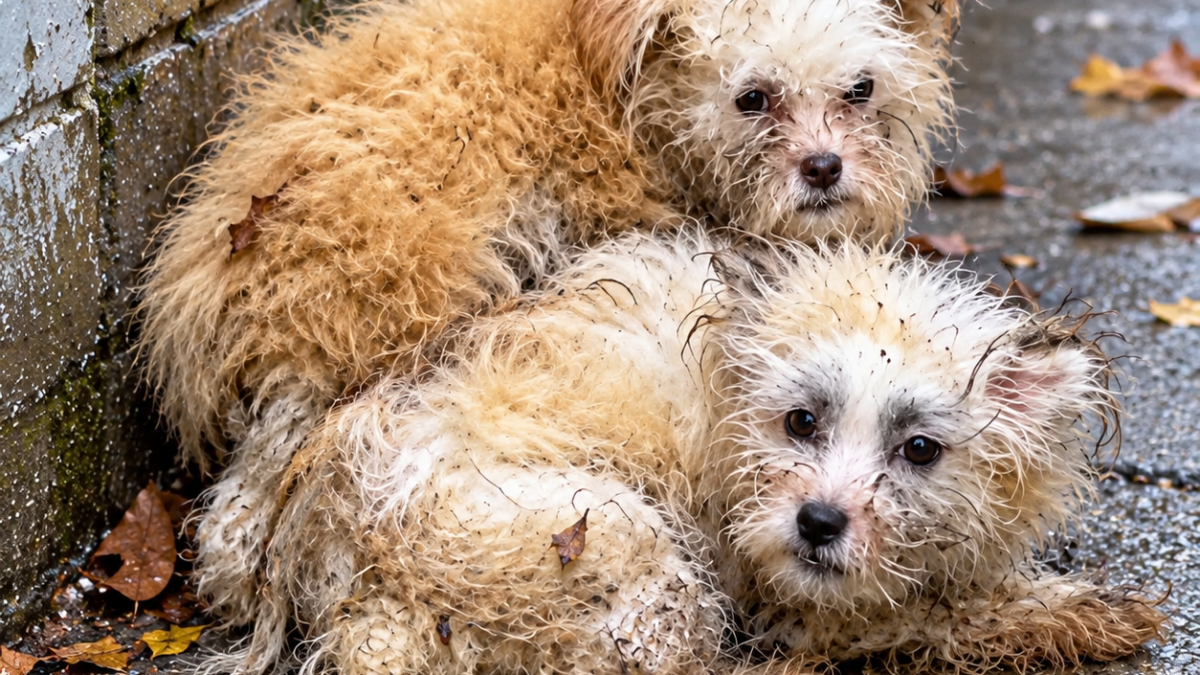
PART 2
During the drive, I kept looking at them in the rearview mirror.
They barely moved.
Vida sat toward the back of the carrier.
Danka was pressed so tightly against her side that their tangled coats seemed joined.
I hadn’t named them yet.
Those names came at the clinic.
For now, they were simply “the girls.”
Every stoplight gave me another chance to study them.
Neither barked.
Neither scratched at the carrier.
Neither showed the restless behavior I often saw in frightened dogs.
Instead, they remained unnaturally still.
That worried me.
Fear can look loud.
It can look like barking, snapping or desperately trying to escape.
But sometimes the deepest fear looks like surrender.
An animal stops fighting because fighting has never changed the outcome.
That was what I saw in those two dogs.
At the veterinary clinic, a technician met us at the entrance.
“What happened to them?”
“I don’t know.”
She looked through the carrier door.
“Oh my God.”
“Yeah.”
“How long have they been like this?”
“I wish I knew.”
We carried the entire carrier inside rather than pulling them out in the lobby.
I didn’t want strangers surrounding them.
Inside an examination room, we opened the door.
Neither moved.
The veterinarian crouched several feet away.
“Hi, girls.”
No response.
She looked at me.
“They’re shut down.”
“That’s what I’m afraid of.”
We let them sit.
A technician brought water.
Vida eventually drank.
Danka copied her.
Everything they did seemed connected.
Vida stood.
Danka stood.
Vida stepped forward.
Danka followed.
If one stopped, the other stopped.
The veterinarian noticed.
“Bonded.”
“Very.”
“Probably all they had.”
That sentence hit hard.
Probably all they had.
No warm bed.
No safe hands.
No dependable food.
No person they trusted.
Just each other.
The physical examination had to happen slowly.
We started with Vida.
When the veterinarian reached toward her, Vida lowered herself.
The moaning began again.
The veterinarian stopped.
“We’re not going to force this.”
She placed a towel on the table, then we lifted Vida carefully.
Danka became frantic.
Not aggressive.
Panicked.
She tried to follow.
“Keep her where Vida can see her,” I said.
The technician moved Danka closer.
Immediately, both dogs calmed slightly.
The examination revealed what we already suspected.
Underweight.
Poor coat condition.
Skin irritation.
Overgrown nails.
Evidence of prolonged neglect.
Then came the mats.
The veterinarian tried separating one section with her fingers.
It barely moved.
“These are tight.”
“How tight?”
“Skin-tight in places.”
I looked at Vida.
“Does it hurt?”
The doctor nodded.
“Imagine someone pulling your hair constantly. Every time she moves, those mats tug on her skin.”
My stomach turned.
“And both of them are like this?”
“We’ll know more once we shave them.”
There was no saving the coats.
Sometimes people imagine groomers can patiently brush through extreme matting.
But there comes a point where brushing is cruelty.
Every pull hurts.
Every knot holds dirt and moisture against the skin.
The humane option is removal.
So that was what we did.
We started with Vida.
The clippers buzzed.
She trembled.
The first strip of fur came away.
Beneath it was pale, irritated skin.
Then another.
And another.
Some sections came off in thick pieces.
Not loose fur.
Almost solid shells.
At one point, the technician held up a mat larger than her hand.
“This is unbelievable.”
The veterinarian shook her head.
“This didn’t happen in a week.”
I looked at Vida.
She had closed her eyes.
“She’s lived like this for a long time.”
No one answered.
We all knew.
The more fur we removed, the smaller she became.
That was the shocking part.
Underneath all the neglected coat was a fragile little dog.
Thin legs.
Narrow body.
Delicate face.
Her appearance had made her seem larger.
Once the mats disappeared, she looked almost vulnerable enough to break.
Danka watched from the carrier.
When Vida returned, Danka sniffed her frantically.
For a moment I wondered whether she recognized her.
Then she began licking Vida’s face.
Vida leaned into her.
“All right,” I whispered. “Your turn.”
Danka’s grooming was harder.
She was more sensitive around her abdomen.
Every time the clippers passed near her lower body, she tensed.
At first we blamed irritated skin.
Then she cried out.
The veterinarian immediately stopped.
“What was that?”
We tried again, gently.
Danka reacted a second time.
The doctor placed a hand carefully against her abdomen.
Danka whimpered.
Her muscles tightened.
“That’s pain.”
My attention sharpened.
“From the mats?”
“I don’t think so.”
The grooming continued only after we changed positions and avoided unnecessary pressure.
Once the last heavy pieces of fur came away, we saw the same transformation.
A small dog emerged from beneath the neglect.
Danka’s skin was irritated too.
Her ribs were visible.
But something about her posture bothered the veterinarian.
She kept adjusting her body.
She appeared unable to get comfortable.
“Has she urinated since you found her?”
“I don’t know.”
“We need to watch that.”
After the shaving, both dogs were bathed.
Warm water ran brown.
Then darker.
Then gradually clear.
Vida stood stiffly at first.
When the water touched her back, she tried to crouch.
But the technician kept one hand beneath her chest.
“You’re okay.”
Warm water.
Gentle shampoo.
No pulling.
No shouting.
No pain.
Vida slowly stopped trembling.
Danka took longer.
Her eyes remained fixed on every hand.
Every movement.
Every towel.
But when she was finally wrapped in something soft and warm, her head lowered.
She rested.
I stared at them.
They looked completely different.
Not because they were suddenly beautiful.
They had always been beautiful.
Now we could finally see them.
Two tiny faces.
Two pairs of dark eyes.
Two fragile bodies that had been hidden beneath neglect for who knew how long.
Vida was medically stable.
She needed nutrition, rest and continued monitoring.
Danka worried us.
We placed absorbent pads in a quiet kennel.
Hours passed.
Vida urinated.
Danka tried.
Nothing.
Later, she tried again.
She strained.
Then cried.
The veterinarian’s expression changed immediately.
“We need imaging.”
“What do you think?”
“Could be infection. Could be obstruction. Could be stones.”
“Is that serious?”
“It can be.”
They took Danka away for an ultrasound and X-rays.
Vida remained behind.
That was the first time I saw the sisters truly separated.
Vida paced.
She went to the kennel door.
Returned to the blanket.
Went back to the door.
Again.
Again.
I sat beside the kennel.
“She’s coming back.”
Vida stared at me.
For the first time since I found her, she approached the front voluntarily.
I didn’t touch her.
I simply sat there.
“You’ve kept each other alive this long, haven’t you?”
She sniffed through the bars.
Then we heard footsteps.
Danka was carried back.
Vida began moving so fast that her paws slid on the blanket.
The technician smiled despite the tension.
“They really are sisters.”
The veterinarian didn’t smile.
She placed the images on a screen.
I stood.
“What did you find?”
She pointed.
A pale oval shape sat inside Danka’s bladder.
Even without medical training, I could tell it was large.
“What is that?”
“A bladder stone.”
“How big?”
She measured it.
Then looked at me.
“Close to the size of a quail egg.”
I stared at Danka.
She was tiny.
The comparison didn’t make sense.
“That was inside her?”
“Yes.”
“How long?”
“Impossible to know.”
“Days?”
“Likely much longer.”
I felt sick.
Every time she urinated.
Every time she tried to sleep.
Every step.
Every hour on the street.
Pain.
And because she had learned not to trust people, she had suffered silently.
“What do we do?”
“Surgery.”
“When?”
“As soon as she’s stable enough.”
I looked toward the kennel.
Vida and Danka were pressed together again.
Danka rested her chin across Vida’s back.
For the first time, our promise became complicated.
You stay together.
Danka needed surgery.
Vida couldn’t go with her.
The following morning, the surgical team prepared.
I arrived early.
Vida and Danka were together in a recovery enclosure.
When a technician entered with a leash for Danka, Vida instantly stood.
Danka backed away.
“We’ll make it quick,” the technician said softly.
I crouched.
“Danka.”
She looked at me.
Her fear had changed since the street.
Back then, she had surrendered before being touched.
Now she still feared hands, but she watched them first.
That was progress.
Small.
But real.
The technician clipped the leash.
Danka stepped out.
Vida tried to follow.
The kennel door closed.
Vida scratched once.
Danka turned.
The sound she made was different from the frightened moan on the street.
Higher.
Desperate.
She wanted her sister.
“I know.”
I knelt beside her.
“I know.”
Vida whined from behind the door.
Danka pulled toward her.
The technician looked at me.
“This is difficult.”
“Can Vida stay near pre-op until Danka is sedated?”
She thought about it.
“I’ll ask.”
The veterinary team agreed.
Vida was moved into a carrier nearby.
Not touching.
But visible.
Danka kept her eyes on her sister.
When the sedative began taking effect, her body relaxed.
Vida remained the last thing she looked at.
Then Danka was taken through the surgical doors.
Vida and I were left behind.
The operation lasted longer than I wanted it to.
Every minute became heavier.
I had been involved in rescue long enough to know that surgery always carries risks.
There are things you can control.
Sterile equipment.
Medication.
Monitoring.
Experienced doctors.
And then there are things you can’t.
A body has to tolerate anesthesia.
A heart has to keep beating.
A patient has to wake up.
Vida seemed to sense the absence.
She refused food.
I offered chicken.
Nothing.
Wet food.
Nothing.
She simply curled into the towel where Danka had been sitting earlier.
“You really don’t know how to be alone, do you?”
Vida lifted her eyes.
I sat on the floor.
“I don’t blame you.”
I thought about what bonded animals do for each other in terrible environments.
They share warmth.
They alert each other to danger.
They sleep touching because physical contact means someone is still there.
Perhaps Vida and Danka had survived by creating the only family they were allowed to have.
Then a door opened.
The veterinarian appeared.
I stood too quickly.
“Well?”
“She’s okay.”
I exhaled.
I hadn’t realized I was holding my breath.
“The stone is out.”
“Everything went well?”
“Yes.”
The doctor removed her mask.
“It was large. She must have been extremely uncomfortable.”
She showed me a photograph.
The stone looked enormous next to the surgical instruments.
I stared.
“That came out of that little dog?”
“Yes.”
I felt anger rise.
Not explosive anger.
Something colder.
A dog doesn’t develop a problem like that and become that neglected overnight.
There had been signs.
Pain.
Straining.
Changes in behavior.
Someone had either missed them for a very long time or noticed and ignored them.
Then eventually both dogs were dumped.
I looked at Vida.
She was asleep against the kennel wall.
“They left her suffering.”
The doctor didn’t answer.
She didn’t need to.
Danka spent the night under observation.
Vida stayed at the clinic too.
Technically, she could have gone into foster care.
Emotionally, I couldn’t do that to either of them.
So we arranged their kennels where they could see one another.
The next morning, Danka was awake.
Groggy.
Sore.
Confused.
When Vida was brought closer, something beautiful happened.
Vida sniffed through the barrier.
Danka lifted her head.
Her tail moved once.
Vida’s started moving immediately.
The nurses laughed.
“There she is.”
Later, once the doctor approved a controlled reunion, we placed them together.
Danka walked slowly.
Vida rushed toward her, then seemed to understand that something was different.
She stopped.
Sniffed Danka carefully.
Then licked her face.
Danka leaned into her.
No jumping.
No chaos.
Just contact.
Sister beside sister.
Their whole world restored.
That should have been the happy ending.
For a while, I believed it was.
But rescue is rarely that simple.
Saving an animal from immediate danger is often only the first step.
The harder question comes later.
What happens next?
Vida and Danka could not remain at the clinic.
They needed a foster home.
Eventually, they needed adoption.
And there was one condition none of us were willing to compromise.
They had to stay together.
That complicated everything.
One small traumatized dog can be difficult to place.
Two?
Two dogs with fear.
Two dogs needing patience.
Two dogs who had never learned normal household routines.
Two dogs who became distressed when separated.
Potential adopters loved the photos.
They loved the story.
Then they heard the reality.
Both dogs.
Together.
No splitting them.
Some people disappeared immediately.
Others asked questions.
“Could I adopt Vida and someone else take Danka?”
No.
“What if they live nearby?”
No.
“What if we try separating them slowly?”
No.
Every time someone suggested it, I pictured Vida pacing the kennel while Danka was in surgery.
I pictured Danka pulling toward her sister.
I remembered the promise in the car.
You stay together.
We were not breaking it.
A foster volunteer named Ana opened her home temporarily.
The first day there revealed how much emotional healing remained.
The house was quiet.
No other pets.
Fenced yard.
Soft beds in several rooms.
Vida and Danka still chose the corner behind the sofa.
Ana sent me a photo.
Two tiny faces peeking out.
“Not eating much,” she wrote.
I visited that evening.
I sat on the opposite side of the room.
“Hey, girls.”
Vida’s ears moved.
Danka remained hidden.
Ana whispered, “I haven’t been able to touch them since this morning.”
“Don’t try.”
“I feel terrible.”
“You’re doing exactly what they need.”
“Which is?”
“Nothing.”
She looked at me.
“Nothing?”
“Food. Water. Routine. Let them watch you.”
That became the foundation.
Ana stopped reaching for them.
Instead, she existed around them.
She made coffee.
Read books.
Watched television.
Folded laundry.
Every movement taught the dogs something.
A person could stand up without kicking them.
A person could walk past without grabbing.
A hand could reach for a cup instead of a frightened body.
A door could close without trapping them in pain.
Three days later, Vida came out while Ana sat on the floor.
She didn’t touch her.
Vida sniffed her knee.
Retreated.
Returned.
Danka watched.
The next day, Danka came closer too.
A week later, Ana texted me.
“YOU ARE NOT GOING TO BELIEVE THIS.”
There was a photo.
Vida asleep with her head against Ana’s ankle.
Danka curled beside Vida.
I smiled for the rest of the day.
Trust was arriving.
Not dramatically.
In inches.
One evening, Ana called.
“Can you come over?”
Her voice sounded strange.
“Something wrong?”
“No. I just think you should see this.”
I drove over.
When I entered, both dogs ran.
Not toward me.
Away.
Old habits.
I sat.
Waited.
Vida recognized my scent first.
She approached.
Then Danka.
Ana remained on the couch.
“Watch.”
She slowly lowered her hand.
Vida looked at it.
Months earlier, that gesture would have made her flatten herself to the ground.
Now she stepped forward.
Ana touched her chin.
Vida remained standing.
Then Danka approached.
Ana stroked her head.
No moaning.
No surrender.
No shaking.
I looked away.
Ana noticed.
“You crying?”
“No.”
“You are.”
“Dust.”
“You’re indoors.”
“Very aggressive indoor dust.”
She laughed.
Then Vida surprised both of us.
She climbed onto Ana’s lap.
Not gracefully.
She half-jumped, half-crawled.
Ana froze.
“Oh my God.”
“Don’t move.”
“I’m not moving.”
Vida turned twice.
Then settled.
Danka stared.
Five seconds later, she tried to climb up too.
Ana ended up with both dogs piled across her legs.
Her eyes filled.
“I was scared they’d never learn this.”
I shook my head.
“They already knew how to love.”
“What?”
“They just needed to learn that loving us wouldn’t hurt.”
The weeks became months.
Danka recovered fully from surgery.
Follow-up imaging looked good.
Her pain disappeared.
Both dogs gained weight.
Their skin improved.
New fur grew.
Soft.
Clean.
Healthy.
The transformations in their faces were even more dramatic.
Fear had changed the way they carried their entire bodies.
At the street corner, their heads stayed low.
Their ears stayed back.
Their movements were hesitant.
Now Vida sometimes trotted through the house with her tail raised.
Danka learned to throw toys.
Not fetch.
Throw.
She would grab a soft toy, jerk her head and launch it several feet.
Then stare at Ana as if expecting applause.
Ana always applauded.
“Very impressive.”
Vida discovered blankets.
Specifically, she discovered stealing them.
If Ana left a blanket on the couch, Vida dragged it to the floor.
If Danka was lying on it, Vida still tried.
Their personalities emerged.
Vida was slightly bolder.
Danka was more observant.
Vida investigated first.
Danka waited.
Then copied.
They were still deeply bonded.
If Vida went into another room, Danka eventually followed.
If Danka went outside, Vida watched the door.
But the bond was no longer desperation.
They were beginning to understand that separation for five minutes did not mean abandonment.
That mattered.
We posted their adoption profile.
The photos were beautiful.
Two little sisters sitting side by side.
Their new coats growing in.
Bright eyes.
Clean faces.
The description was direct.
BONDED PAIR.
MUST BE ADOPTED TOGETHER.
PATIENT HOME REQUIRED.
Then came the inquiries.
Some promising.
Some not.
One man wanted “the quieter one.”
A family liked Vida but thought Danka’s medical history might become expensive.
Another person wanted both but worked twelve-hour shifts and planned to leave them alone most of the day.
We declined.
Each rejection made me anxious.
Not because I regretted it.
Because every day without an adopter raised the same fear.
What if nobody came?
Ana loved them.
But she fostered because her situation didn’t allow permanent adoption.
At some point, the girls needed a forever home.
Then Marijana saw their story.
Her message was different.
She didn’t begin by asking which dog was easier.
She didn’t ask whether we would separate them.
Her first sentence was:
“I understand they are a family.”
I read it twice.
She continued.
“I would like to meet both of them, and I would only consider adoption if they remain together.”
I forwarded the message to Ana.
She replied almost immediately.
“WHEN?”
We arranged a meeting.
I warned Marijana before she arrived.
“They may not approach you.”
“That’s fine.”
“They may hide.”
“That’s fine.”
“They’re affectionate once they trust you, but that may take time.”
“That’s fine too.”
I studied her.
“Why two traumatized dogs?”
She smiled.
“Because they need one home, not two.”
Simple.
No dramatic speech.
No savior language.
They need one home, not two.
When she entered Ana’s living room, Vida and Danka disappeared behind the sofa.
Marijana didn’t even look disappointed.
She sat on the floor.
“Should I call them?”
“No.”
“Good.”
She placed her hands in her lap.
For fifteen minutes, we talked about feeding.
Medical history.
Danka’s surgery.
Fear responses.
Walks.
Grooming.
House-training.
Then Vida’s face appeared around the sofa.
Marijana saw her.
She didn’t move.
Vida stepped out.
Danka remained hidden.
Marijana continued talking as though nothing had happened.
Vida approached her shoe.
Sniffed.
Retreated.
Returned.
Then Marijana did something I’ll never forget.
She turned her hand palm-down and placed it on the floor beside her.
Not toward Vida.
Just available.
Vida stared at it.
One minute passed.
Then Vida stepped forward.
Sniffed.
Nothing happened.
She moved closer.
Her nose touched Marijana’s fingers.
Marijana didn’t grab.
Didn’t pet.
Didn’t rush.
Vida stayed.
Behind her, Danka appeared.
Ana whispered, “There she is.”
Danka approached Vida.
Then Marijana.
She sniffed the same hand.
The sisters stood side by side.
Marijana’s eyes filled with tears.
But she still didn’t touch them.
I knew then.
This woman understood.
Trust isn’t something frightened animals owe us.
It’s something we earn.
Marijana visited several more times.
Each visit became easier.
On the third, Vida allowed her to pet her.
On the fourth, Danka climbed beside her.
On the fifth, both dogs fell asleep near her.
The adoption was approved.
Then came the hardest part.
Leaving Ana.
Foster care creates a strange kind of heartbreak.
You spend weeks or months teaching an animal that you are safe.
Then, once they finally believe you, you put them in somebody else’s car.
Ana cried the morning we packed their things.
“So much for not getting attached.”
I handed her a bag of toys.
“You knew the rules.”
“I hate the rules.”
“So does everyone.”
Vida sensed something.
She followed Ana through the house.
Danka followed Vida.
Marijana arrived with two beds already placed in the back seat.
She had purchased matching harnesses.
Not identical colors.
“I thought they should each have their own,” she said.
Ana laughed through tears.
“That’s ridiculous.”
“Too much?”
“No. Perfect.”
We loaded their food.
Medication records.
Blankets.
Toys.
Then the dogs.
Vida hesitated at the car.
Danka stood beside her.
Marijana crouched.
“No hurry.”
Vida sniffed the step.
Then climbed in.
Danka followed.
Of course she did.
Ana leaned through the door.
“Be good.”
Vida licked her chin.
Ana broke down.
Danka pressed against her.
For several seconds, none of us spoke.
Then Ana stepped away.
Marijana closed the door.
I hugged Ana.
“They’re going home.”
“I know.”
“That’s the whole point.”
“I know.”
“It still hurts.”
“I know.”
Marijana drove slowly.
I followed in my vehicle because I wanted to help with the transition.
Her house was quiet.
A small fenced yard.
Soft rugs.
A gated area where the dogs could decompress.
No overwhelming crowd waiting to greet them.
No balloons.
No excited children.
No pressure.
Exactly right.
When we opened the car door, Vida looked outside.
Danka looked at Vida.
Vida jumped down.
Danka followed.
They walked toward the house together.
Marijana opened the door.
Vida stopped at the threshold.
I could see the uncertainty return.
New place.
New smells.
Another door.
Another human.
We waited.
Marijana knelt several feet inside.
“You can take as long as you want.”
Vida lifted one paw.
Placed it across the threshold.
Then another.
Danka stayed close enough that their shoulders touched.
Vida entered.
Danka entered.
The door closed softly behind them.
Nothing bad happened.
That was how their new life began.
The first hour was quiet.
They explored one room.
Then another.
Danka discovered the water bowl.
Vida found one of the beds.
Neither used it.
Naturally, they both chose the rug beside the couch instead.
Marijana sat on the floor.
I stayed only long enough to make sure everyone was comfortable.
As I prepared to leave, I looked at the two dogs.
For months, my greatest fear had been that we would save their bodies only to fail their bond.
Instead, they were together.
Safe.
Loved.
Before I walked out, Marijana asked me something.
“Do you think they know this is permanent?”
I looked at Vida.
She was watching me.
“No.”
Marijana’s face fell slightly.
“Not yet.”
I smiled.
“But one day they will.”
That process took time.
The first week brought challenges.
Vida followed Marijana from room to room.
Danka panicked if Vida disappeared around a corner.
Both dogs startled when cupboards closed.
One morning, Marijana reached too quickly toward Vida’s harness.
Vida dropped to the floor.
The old moan returned.
Marijana froze.
Her heart broke.
She called me afterward.
“I ruined everything.”
“No.”
“She was terrified.”
“I know.”
“I thought she trusted me.”
“She does.”
“Then why did she do that?”
“Because trust doesn’t erase memory.”
There was silence.
“What should I do?”
“What you did before.”
“Wait?”
“Yes.”
So she waited.
Healing moved unevenly.
Two steps forward.
One step back.
Some days the sisters looked like normal happy dogs.
Other days something small triggered their past.
A raised voice outside.
A broom falling.
A hand moving too fast.
A man wearing heavy boots.
We never knew exactly what had happened to them.
Sometimes not knowing felt worse.
The imagination fills gaps brutally.
But I eventually stopped trying to reconstruct every terrible moment.
The girls did not need us to solve their past.
They needed us to protect their future.
Marijana became extraordinary at that.
She learned their signals.
If Danka’s ears shifted back, she slowed down.
If Vida froze, she gave space.
When visitors came, nobody was allowed to reach over their heads.
Guests sat.
Waited.
Let the dogs choose.
Month by month, the fear faded.
Then came the videos.
The first one Marijana sent me lasted eleven seconds.
I watched it six times.
Vida was running through the hallway.
Running.
Not fleeing.
Playing.
Danka chased her.
They raced into the living room, circled the couch and disappeared.
Marijana laughed behind the camera.
A second later, both dogs came flying back into view.
Vida jumped onto a cushion.
Danka launched herself beside her.
They wrestled.
Tail wagging.
Mouths open.
Eyes bright.
I paused the video.
The image froze on Danka.
She looked ridiculous.
And happy.
I compared it to the first photo from the street.
I couldn’t reconcile the two.
One dog had pressed herself to pavement and moaned before a hand touched her.
The other was upside down on a couch attacking her sister’s ear.
Same dog.
Different life.
That was when I understood something about rescue.
We often say we “change” animals.
But sometimes the happier animal was always there.
Fear simply buried her.
Vida had always been playful.
Danka had always been silly.
Neglect had not created their personalities.
It had suppressed them.
Safety allowed them to return.
Months after the adoption, I visited.
The front door opened.
I expected hesitation.
Instead, Vida barked.
Then she recognized me.
Her entire body changed.
She ran forward.
Danka followed.
I crouched.
“You remember me?”
Vida climbed against my knees.
Danka licked my wrist.
Marijana laughed.
“I think they do.”
The house looked lived-in now.
Toys everywhere.
Blankets on furniture.
Dog beds ignored in favor of human furniture.
Photos on the wall.
One showed the sisters wearing little jackets.
Another showed Danka asleep with her face buried in Vida’s side.
Then I noticed two framed pictures near the hallway.
The first was their intake photograph.
Dirty.
Matted.
Terrified.
The second was recent.
Both dogs sitting in sunlight.
Healthy coats.
Bright eyes.
Matching expressions that seemed almost like smiles.
I stood staring.
Marijana came beside me.
“I almost didn’t hang the first one.”
“Why?”
“Because I hate seeing them like that.”
I nodded.
“Me too.”
“But then I thought…”
She paused.
“What?”
“They survived that.”
I looked at her.
“So it belongs to them too.”
Exactly.
Their past was not something to celebrate.
But neither was it something to erase.
Those dogs had endured something.
They had survived.
The photograph was proof.
Not of what had been done to them.
Of what had failed to destroy them.
The most satisfying moment came nearly a year after I first found them.
We were invited to participate in a small rescue awareness event.
Marijana hesitated.
She didn’t want the dogs overwhelmed.
So we agreed to arrive early.
No crowd.
No noise.
Just a quiet walk near the event area.
That morning, I met them in the parking lot.
I almost laughed when I saw Vida.
She walked like she owned the world.
Tail up.
Harness on.
Danka moved beside her.
Neither dog had the thick neglected coat anymore.
Their fur was soft and carefully maintained.
Their bodies were healthy.
Danka had no pain.
Vida had become slightly rounder than ideal because Marijana apparently interpreted “treat” as a constitutional right.
“You’re spoiling them.”
Marijana looked offended.
“They suffered.”
“That excuse stopped working six months ago.”
Vida looked at me hopefully.
“No.”
Marijana handed her a treat.
I stared at her.
“What?”
“Emotional recovery.”
“Emotional calories.”
We laughed.
Then we began walking.
A few blocks away was the street where they had been found.
I hadn’t planned to go there.
Neither had Marijana.
We simply realized where we were.
She stopped.
“That’s the place?”
I nodded.
Vida and Danka continued sniffing.
Marijana looked down.
“Do you think they remember?”
“I don’t know.”
The corner looked ordinary.
That bothered me.
Places where terrible things happen rarely look terrible afterward.
Cars passed.
A bicycle leaned against a fence.
Somebody watered flowers from a balcony.
Life had continued.
Yet months earlier, two terrified little dogs had been sitting there waiting for someone to notice.
I crouched.
Vida approached.
She sniffed my hand.
No flinch.
Danka joined her.
I looked at the pavement where they had once lowered themselves in surrender.
For months I had imagined what I would do if the person who abandoned them ever appeared.
I had imagined anger.
Confrontation.
Questions.
How could you?
How long did you watch them suffer?
Why didn’t you get Danka help?
Why did you allow their coats to become cages around their bodies?
Why did you teach them that hands hurt?
I wanted answers.
I wanted consequences.
I wanted whoever had done it to see what they had nearly destroyed.
But standing there with Vida leaning against my leg and Danka pulling toward Marijana because she had spotted a pigeon, something inside me shifted.
The person who abandoned them had already lost something.
They had lost these dogs.
They had lost the chance to know how funny Danka was.
They had lost Vida’s habit of curling beside your feet.
They had lost the way the sisters exploded into joyful circles after dinner.
They had lost the trust these dogs were eventually capable of giving.
And they would never get it back.
That was their punishment.
Someone had treated Vida and Danka as disposable.
Marijana treated them as family.
Someone had allowed Danka to suffer in silence.
Marijana noticed if she skipped one meal.
Someone had left them on pavement.
Now they slept on blankets so soft they sometimes refused to get up in the morning.
Someone had made them fear hands.
Now they pushed their heads beneath Marijana’s palms asking to be touched.
I looked at the corner.
Then at the girls.
That was revenge.
Not pain returned for pain.
Something stronger.
A life so full of love that everything done to them became powerless.
Still, there was one final piece of justice I didn’t expect.
A local animal welfare officer contacted us after seeing the rescue documentation.
Because of the extreme matting, untreated medical condition and abandonment, they wanted photographs and veterinary reports in case the dogs’ previous caretaker could ever be identified.
We provided everything.
The stone.
The skin condition.
The weight.
The coat.
The behavior.
All of it.
The officer looked through the file.
“This wasn’t accidental neglect.”
I waited.
“What do you mean?”
“Dogs don’t reach this condition because somebody forgets one grooming appointment.”
I knew that.
Hearing someone say it officially felt different.
“If we identify whoever had them?”
“Then the evidence matters.”
“Could there be consequences?”
“Yes.”
The case didn’t magically produce an owner overnight.
No dramatic arrest followed.
Real life rarely delivers justice that neatly.
But the record existed.
Their suffering had been documented.
It could no longer be dismissed as “two dirty stray dogs.”
There was evidence.
There were medical records.
There were photographs.
There were professionals willing to say:
This took time.
Someone failed them.
That mattered to me.
Because Vida and Danka couldn’t testify.
They couldn’t tell us where they had lived.
They couldn’t say who ignored Danka’s pain.
Their bodies had been the testimony.
And for once, someone had written it down.
Yet the greatest justice was still waiting at home.
A year after adoption, Marijana sent me a photo on the anniversary of the rescue.
Vida and Danka were asleep on a large bed.
Vida’s head rested on a pillow.
Danka was under a blanket.
Under the photograph, Marijana wrote:
“They snored through the anniversary.”
I laughed.
That felt perfect.
Trauma had once controlled every second of their lives.
Now they had forgotten the date.
Why would dogs celebrate the day suffering ended?
They were too busy living.
The second year brought even more change.
Danka became obsessed with walks.
The same dog who once froze when a person reached for her now ran toward Marijana when she saw the harness.
Vida preferred food.
Always food.
Marijana learned she had to spell certain words.
T-R-E-A-T.
W-A-L-K.
C-H-I-C-K-E-N.
Eventually, Vida learned the spelling too.
“You created a monster,” I told her.
“You started it.”
“I rescued her.”
“You introduced chicken.”
Fair point.
Their coats grew back fully.
Regular grooming became part of their routine.
The first few appointments were done at home with a patient groomer.
No restraints unless absolutely necessary.
Slow introductions.
Tools shown before they were used.
Treats.
Breaks.
The sound of clippers initially made both dogs tense.
Then gradually, the association changed.
Clippers meant grooming.
Grooming meant treats.
Hands meant affection.
Baths meant warm towels.
Nothing hurt.
One afternoon, the groomer sent me a video.
Danka stood calmly while her face was trimmed.
I watched the clip and remembered the clinic.
Her trembling body.
Her eyes tracking every movement.
The painful stone still inside her.
Now she looked bored.
Boredom is underrated.
For a traumatized animal, boredom can be victory.
No danger.
No panic.
Nothing remarkable happening.
Just an ordinary Tuesday.
As the sisters aged, their bond evolved.
They were still inseparable.
But no longer dependent in the desperate way they had once been.
Vida could stay with Marijana while Danka attended a veterinary appointment.
Danka could nap in another room.
They had learned something enormous.
People returned.
Sisters returned.
Home remained.
Love did not vanish because a door closed.
One evening, I received another call.
Danka had been taken to the vet for a routine urinary check.
Given her history, everyone remained cautious.
Her results were good.
No new stones.
No obstruction.
Healthy.
When she returned home, Vida greeted her at the door.
The reunion lasted approximately eight seconds.
Then Vida became interested in the treat bag.
Marijana laughed.
“I think their separation anxiety is officially cured.”
I smiled.
“They finally believe there will always be a next time.”
That sentence stayed with me.
Always a next time.
Dogs who have been abandoned don’t know that.
When food disappears, maybe it never returns.
When a person leaves, maybe they’re gone forever.
When a sister goes through a door, maybe she won’t come back.
Security is the knowledge that there will be another meal.
Another morning.
Another walk.
Another reunion.
Vida and Danka finally had that knowledge.
Years after I found them, I was invited to Marijana’s home for their adoption anniversary.
Nothing elaborate.
Dinner.
Cake for the humans.
Dog-safe treats for the girls.
Ana came too.
The moment Vida saw her former foster mother, she ran across the room.
Ana dropped to her knees.
“Oh, you remember me!”
Vida covered her face in kisses.
Danka joined.
Within seconds Ana was laughing and crying.
“You little monsters.”
Marijana watched.
“She remembers you.”
Ana hugged Vida.
“I remember her too.”
Later we sat together looking at old photographs.
The street.
The clinic.
The shaved coats.
Danka after surgery.
The first foster-home photos.
Then the adoption day.
Ana shook her head.
“I still hate that first picture.”
“So do I,” Marijana said.
I looked toward the couch.
Vida was asleep upside down.
Danka had stolen a cushion.
“But look at them now.”
Everyone became quiet.
There are transformations too large for words.
Sometimes you simply sit in front of the evidence.
After dinner, I stepped outside.
Marijana followed.
“You know what I think about sometimes?” she asked.
“What?”
“What if you hadn’t stopped?”
I looked through the window.
Vida shifted in her sleep.
Danka remained curled nearby.
“I think about it too.”
“What would have happened?”
“I don’t know.”
That was the truth.
Danka’s stone could have caused a complete obstruction.
Infection.
Kidney damage.
Worse.
Vida was underweight and vulnerable.
Cars.
Cold.
Disease.
Predators.
Cruel people.
Anything could have happened.
Marijana wrapped her arms around herself.
“That scares me.”
“Me too.”
She looked through the window again.
“I’m glad you stopped.”
I shook my head.
“I’m glad they held on long enough for someone to.”
That distinction mattered.
People called rescuers heroes.
I never liked that.
The heroic part belonged to the animals.
Vida and Danka had endured things we didn’t understand.
They had survived pain without knowing relief was coming.
They had remained together.
They had kept breathing.
All we did was arrive before it was too late.
A few months later, the rescue organization redesigned some of its educational materials.
Vida and Danka’s story became part of a campaign about neglect.
One photograph showed them at intake.
Another showed them years later.
Underneath was a simple message:
NEGLECT DOESN’T ALWAYS LOOK LIKE VIOLENCE.
Sometimes it looks like untreated pain.
Sometimes it looks like overgrown fur.
Sometimes it looks like fear when a hand reaches down.
That message reached people.
Groomers shared it.
Veterinary clinics shared it.
Rescue groups shared it.
We began receiving calls from people who had seen an animal in bad condition and decided not to assume someone else would help.
One dog.
Then another.
A cat.
A senior terrier.
A litter of puppies.
I started realizing that Vida and Danka’s story had stretched beyond their own lives.
The suffering they survived became information.
Information became action.
Action saved animals.
There was justice in that too.
The person who neglected them had tried, intentionally or not, to reduce their world to fear.
Instead, their lives became evidence that fear can be undone.
Years passed.
Vida’s muzzle became lighter.
Danka slowed slightly.
Nothing unusual.
Age.
Their favorite activities changed.
Less wild chasing through hallways.
More sunlight.
More naps.
More carefully supervised snacks because both girls had become very skilled at manipulating Marijana.
I visited one afternoon and found them sleeping side by side on a blanket in the yard.
Vida opened one eye.
Danka didn’t move.
I sat nearby.
Marijana brought coffee.
“They’re getting old.”
“So are we.”
“Speak for yourself.”
I smiled.
Vida got up slowly and walked toward me.
I placed my hand beside her.
Years earlier, I had done the same thing on a street corner.
Back then, she had collapsed.
Now she pushed her forehead firmly beneath my palm.
Pet me.
I did.
She closed her eyes.
Danka eventually wandered over too.
Marijana looked at them.
“I still can’t believe they were afraid of hands.”
I ran my fingers gently behind Vida’s ears.
“Bodies remember.”
“So do they ever completely forget?”
I thought about it.
“I don’t think healing requires forgetting.”
She waited.
“I think healing means the good memories become louder.”
Vida sighed and lay across my foot.
Danka curled beside her.
There were thousands of good memories now.
Meals.
Blankets.
Walks.
Veterinary visits ending safely.
Grooming.
Visitors.
Sunlight.
Christmas mornings.
Rainy afternoons indoors.
Ana’s visits.
My visits.
Marijana’s voice.
Her hands.
Her smell.
Her home.
The street corner was becoming one page inside a much larger book.
That is what we had wanted all along.
Not to erase the past.
To make it small.
One spring morning, Marijana called me excitedly.
“You need to come over.”
“Why?”
“I’m not telling you.”
“Is everyone okay?”
“Yes.”
“Then you’re making this unnecessarily dramatic.”
“Come.”
I drove over.
She met me outside.
Vida and Danka were in the yard.
“What?”
Marijana pointed toward a small figure near the fence.
A foster puppy.
Tiny.
Terrified.
Recently rescued.
I looked at her.
“You’re fostering now?”
“Temporarily.”
“That is how everyone gets trapped.”
“I learned from you.”
The puppy remained uncertain around people.
But not around dogs.
Vida approached first.
Slowly.
The puppy retreated.
Vida stopped.
Waited.
Danka followed.
Then something happened that felt almost impossible.
Vida lowered herself.
Not from fear.
From gentleness.
She made herself smaller.
The puppy sniffed her.
Danka stood nearby.
Minutes later, all three dogs were sitting within a few feet of one another.
Marijana’s eyes filled.
“They’re helping her.”
I nodded.
Dogs understand things we can’t explain.
That frightened puppy watched Vida and Danka approach humans.
Watched them accept food.
Watched them sleep peacefully.
Watched them trust.
Over the following weeks, she copied them.
Just as Danka had once copied Vida.
Vida approached.
Danka followed.
Now the puppy followed both.
A chain of trust.
The neglected dogs became teachers.
That may have been my favorite chapter of all.
The foster puppy was eventually adopted.
Another came later.
Then another.
Vida and Danka were never professional therapy dogs.
They had no certificates.
No special training.
But frightened foster dogs seemed to understand them.
Stay near these two.
They know which humans are safe.
Marijana kept fostering occasionally.
The sisters remained permanent.
Non-negotiable.
“They’re management,” she joked.
Years earlier, people had wondered whether anyone would accept two traumatized dogs together.
Now Marijana couldn’t imagine a house without either one.
That unanswered question from the clinic had been resolved completely.
Would anyone adopt both?
Yes.
Not reluctantly.
Not as a sacrifice.
Someone would choose both.
Years after their rescue, we returned one last time to the street corner.
Not because I believed they needed closure.
I think I did.
Marijana came with me.
Vida and Danka walked slowly now.
Older.
Confident.
Their leashes hung loose.
The corner had changed.
A new shop occupied one building.
Different cars parked nearby.
Trees had grown.
The exact patch of pavement was still there.
I stood on it.
“That’s where?”
Marijana asked.
“Yes.”
She became quiet.
Vida sniffed around.
Danka found something interesting near a plant.
Neither showed fear.
Perhaps they remembered.
Perhaps they didn’t.
I realized it didn’t matter.
I knelt.
Vida came to me.
Danka joined.
Two sisters.
Still together.
That was the promise.
Not that nothing frightening would ever happen again.
Not that life would be perfect.
Just that they would not face it alone.
I looked at Marijana.
“She wouldn’t let me touch her here.”
“Vida?”
“Both.”
I extended my hand.
Vida immediately pushed her nose into it.
Danka demanded attention next.
Marijana laughed.
“They’ve changed their policy.”
I smiled.
Then I looked at the place where I had first lifted them.
For years, I had carried anger toward whoever had abandoned them.
Some of that anger remained.
Cruelty should make us angry.
Neglect should make us angry.
An animal suffering silently should never become normal.
But revenge had become something different to me.
I no longer imagined finding the person responsible and demanding that they look at photographs.
I imagined something better.
I imagined them somehow seeing Vida and Danka now.
Seeing their soft coats.
Seeing Danka running without pain.
Seeing Vida begging shamelessly for food.
Seeing the two sisters curled against Marijana.
Seeing how quickly they came when she called their names.
Seeing how completely they trusted her hands.
And understanding one unbearable truth:
They had thrown away something precious.
That was punishment enough.
Because Marijana received everything they had failed to value.
Their trust.
Their loyalty.
Their ridiculous habits.
Their affection.
Their whole lives.
The past owner, whoever they were, had left two frightened dogs on a street.
Marijana got two daughters.
Vida and Danka got a mother.
And the street corner got nothing but a memory.
That felt fair.
Before leaving, Marijana crouched between them.
Vida leaned against one leg.
Danka against the other.
“You girls ready to go home?”
Both looked up.
Home.
A simple word.
Once, they had no idea what it meant.
Now they understood perfectly.
Home was where food appeared every day.
Home was where hands touched gently.
Home was where doors opened again.
Home was where Danka had healed after surgery.
Home was where Vida learned to climb onto laps.
Home was blankets.
Beds.
Sunlight.
Toys.
Safety.
Home was Marijana.
And home included each other.
We started walking.
I stayed a few feet behind them.
Marijana in the middle.
Vida on one side.
Danka on the other.
I remembered carrying those same two dogs toward my vehicle because they were too frightened and weak to understand that I was helping.
Now they walked under their own strength.
Their bodies were older.
But they were free.
At the corner, Marijana looked back.
“You coming?”
I nodded.
“In a second.”
I took one last look at the pavement.
Then I turned away.
I never needed to return again.
The story was no longer there.
It was walking home in front of me.
Years ago, Vida and Danka had lowered their bodies when I reached toward them because someone had taught them that hands brought pain.
Today, if Marijana stops petting them too soon, they push their noses underneath those same hands and demand more.
Danka once carried a bladder stone nearly the size of a quail egg while suffering in silence.
Today, she races toward her food bowl as if starvation is scheduled every evening at six.
Vida once watched every movement with terrified eyes.
Today, she falls asleep so deeply on the couch that sometimes Marijana has to check whether she heard the front door.
And the two sisters everyone feared would be too difficult to adopt?
They were never separated.
Not for adoption.
Not for convenience.
Not because keeping them together required more work.
They had spent the worst part of their lives holding onto each other.
We refused to make survival cost them the only family they already had.
When I think about Vida and Danka now, I don’t picture the street first anymore.
I picture a sunny room.
Two old dogs asleep together.
One blanket.
Four paws touching.
Marijana nearby.
Nothing dramatic happening.
No emergency.
No surgery.
No fear.
Just an ordinary afternoon.
And maybe that is the most satisfying ending rescue can ever give.
People often expect rescued animals to repay us somehow.
With loyalty.
Gratitude.
Affection.
But Vida and Danka owed us nothing.
They had already paid enough.
Their reward was not becoming “good dogs.”
They had always been good.
Their reward was finally being allowed to live without earning their safety.
They no longer had to prove they deserved food.
They no longer had to surrender when a hand reached toward them.
They no longer had to wonder whether the person beside them would disappear.
They no longer had to survive.
They could simply live.
And whoever abandoned them?
That person never got to know the dogs they became.
Never saw Vida discover couches.
Never heard Danka bark at her own reflection.
Never watched them race through the hallway.
Never felt two warm bodies press against their legs during a storm.
Never experienced the trust they once believed no human deserved.
Someone discarded two frightened, tangled little animals because they saw them as burdens.
We saw sisters.
Marijana saw family.
And in the end, Vida and Danka gave their love to the people who stayed.
That was their justice.
That was their revenge.
Not becoming cruel.
Not becoming broken.
Not allowing the worst human they knew to decide what they would believe about every human afterward.
They survived long enough to discover gentle hands.
Then they spent the rest of their lives running toward them.
The last photograph I have of Vida and Danka together is simple.
No dramatic background.
No rescue uniforms.
No veterinary clinic.
No street.
They are lying on Marijana’s bed.
Vida is asleep.
Danka’s eyes are half open.
Their paws touch in the middle.
Marijana’s hand rests gently across both of them.
When I look at that photograph, I always remember the first time I reached out.
Two bodies falling flat.
Two terrified faces.
That heartbreaking moan.
And I wish I could speak to those two little dogs from that day.
I would kneel beside them without touching.
I would tell them:
I know you’re scared.
I know somebody taught you that hands hurt.
I know you think being touched means surrender.
But you haven’t met all of us yet.
There is a veterinarian you haven’t met who will take away Danka’s pain.
There is a foster mother who will sit on the floor for hours without forcing you to come closer.
There is a woman named Marijana who will see two traumatized dogs and refuse to choose between them.
There is a house waiting.
Two beds you probably won’t use.
Blankets you will steal.
Toys you will fight over.
Meals that will arrive every single day.
There are hands waiting that will never hit you.
Only hold you.
Only groom you.
Only comfort you.
There are years ahead when nobody will abandon you on another street corner.
There will be mornings when you wake up and your biggest problem is whether breakfast arrives thirty seconds late.
There will be evenings when you fall asleep beside each other without listening for danger.
There will be a day when someone reaches toward you and you don’t lower your body.
You’ll move closer.
And there will come a time when the past is still part of your story—but it is no longer the largest part.
So hold on.
Just a little longer.
Because the hands coming toward you this time are not going to hurt you.
They are coming to take you home.
And this time, both of you are going together.
Always.