PART 2: They Dumped Their Pit Bull Before Christmas Vacation—Then Came Back Too Late
PART 2
I had held hundreds of leashes in that shelter.
Some dogs pulled toward the kennel row, overwhelmed by noise and smell. Some froze at the doorway. Some barked. Some spun in anxious circles. Some looked back once at the lobby, then focused on whatever came next.
Chance did none of that.
He stood at the window.
Still.
Silent.
Waiting.
The lights from the Christmas decorations outside reflected in the glass around his face. A plastic wreath hung on the shelter door. Someone had placed a small tree near the donation bin, covered in paper ornaments with dogs’ names written on them.
Chance’s name was not on that tree yet.
A volunteer named Marissa walked behind the counter, saw him, and stopped.
“What happened?”
“Owner surrender,” I said quietly.
She looked toward the parking lot. “The family in sweaters?”
I nodded.
Her face fell.
“Oh no.”
That was all she said.
Oh no.
Because anyone who had worked in rescue long enough knew that dogs like Chance did not break loudly at first. They broke by waiting too patiently.
I touched his shoulder.
“Come on, buddy.”
He did not move.
I gave the leash the softest pressure.
His body resisted for one second, not out of disobedience, but disbelief. Then he walked with me down the hallway.
The kennel area was loud that afternoon. It was always loud near the holidays. More surrenders. More strays. More people traveling. More excuses wrapped in festive paper.
Dogs barked from both sides as we passed.
Chance flinched, but he did not react. He stayed close to my leg, head low, looking up every few steps as if asking where his family had gone.
I had no answer I could give him.
We placed him in a clean kennel with a raised bed, fresh water, blankets, and food. I removed his leash gently.
He stood in the middle of the kennel and stared at the door.
“His name is Chance?” Marissa asked.
“That’s what the little girl said.”
Chance’s ears shifted at the sound of his name.
“Chance,” I said.
He looked at me.
My chest tightened.
He knew his name. Of course he did. That meant somebody had said it with love once. Maybe thousands of times.
Chance, come here.
Chance, sit.
Chance, good boy.
Chance, want a treat?
Chance, let’s go for a ride.
Chance, Merry Christmas.
And then, one day, Chance, stay here while we leave.
Marissa placed a soft toy near his bed. “He looks confused.”
“He is.”
“Do you think they’ll come back?”
I looked at the surrender form in my hand.
Permanent transfer of ownership.
No reclaim rights unless approved by shelter management.
Signed.
Dated.
Witnessed by me.
“No,” I said. “They gave him up.”
Marissa swallowed.
“He doesn’t know that.”
No.
He did not.
For the rest of the evening, Chance stayed at the front of his kennel.
Every time footsteps passed, his tail moved.
Every time the hallway door opened, he lifted his head.
Every time a family came through for adoption visits, his whole body leaned forward.
And every single time, it was not them.
At closing, I went back to check on him. His food bowl was untouched.
“That’s normal,” I told myself.
It was not unusual for dogs to skip the first meal in a shelter. Stress does that. New smells, strange sounds, metal doors, other dogs, unfamiliar hands. Even confident dogs need time.
Chance was sitting with his nose nearly touching the kennel bars.
Waiting.
I crouched.
“Hey, boy.”
His tail gave one hopeful sweep.
I opened the kennel just enough to slide in a treat.
He sniffed it, then looked past me toward the hallway.
“They’re not here,” I whispered.
He stared at me.
I hated myself for saying it.
“They’re not here.”
He looked down the hallway again.
I closed the kennel and stood there longer than I should have.
Shelter workers are warned about this. Not officially in a handbook, but by experience. Do not fall apart over every surrender. Do not attach too quickly. Do not carry every heartbreak home or you will drown in them.
But some dogs choose you without meaning to.
Chance chose me by waiting at that door like faith itself had a heartbeat.
That night, I drove home past houses covered in Christmas lights. Inflatable snowmen leaned in front yards. Families carried shopping bags from cars. Children pressed faces to windows.
Everywhere, people were preparing to celebrate being together.
And Chance was in kennel twelve, waiting for a family on a plane to Mexico.
I slept badly.
The next morning, he was still at the front of the kennel.
His food remained untouched.
“He didn’t eat overnight,” Marissa said.
“I’ll try wet food.”
We warmed some canned food and mixed it with a little chicken. Chance sniffed it, then turned away.
Not sick.
Not nauseated.
Just uninterested in anything that was not the door.
On the second day, his tail still wagged when people passed.
Slower now.
But it wagged.
A couple came in looking for a medium-sized dog. They paused in front of him.
“Oh, he’s handsome,” the woman said.
Chance stood.
His eyes brightened.
The man read the kennel card.
“Pit bull,” he said.
The woman hesitated.
Chance took one step closer, gentle and hopeful.
The man shook his head. “Let’s keep looking.”
They moved on.
Chance watched them disappear down the row.
Then he sat again.
I added a note to his card:
**Gentle. Owner surrender. Good with handling. Very stressed. Needs patient adopter.**
It felt like trying to summarize a shattered heart on a piece of paper.
By the third day, he had started sleeping in short bursts near the front of the kennel. The moment the hallway door clicked, he woke. If footsteps came close, his ears lifted. If they passed, he lowered his head again.
I kept hoping anger would make it easier.
Anger at the father.
Anger at the mother.
Anger at every person who thinks a dog can be paused like a subscription and resumed after vacation.
But anger did not feed Chance. It did not make him sleep. It did not explain betrayal in a language he could understand.
On the fourth day, something changed.
I came in early and found him at the back of the kennel.
His face was turned toward the wall.
The food bowl was still full.
“Chance?”
No response.
I opened the kennel and stepped inside.
Usually, he would at least look toward the door.
This time, he did not.
I sat on the edge of his bed.
“Buddy.”
His eyes moved slightly, but his head stayed down.
That scared me more than the crying would have.
Marissa stood behind me.
“He was like that when I got here.”
I reached out slowly and touched his shoulder.
He did not flinch.
He did not lean in.
He gave me nothing.
That was the beginning of the nine days that stayed with me.
By the fifth day, Chance had stopped eating completely.
We tried everything.
Chicken.
Rice.
Warm broth.
Peanut butter.
Hand feeding.
Quiet room.
Different bowls.
No bowls.
Nothing.
He drank a little, enough to keep us from panic, but food did not matter to him.
The shelter veterinarian examined him.
Heart sounded normal.
Temperature normal.
Gums okay.
No obvious pain.
Bloodwork acceptable.
“Medically, I don’t see a reason,” she said.
I looked through the window of the exam room at Chance lying on the floor, head down.
“So what is it?”
She sighed.
“He’s grieving.”
People use that word lightly sometimes.
Grieving.
As if it is only sadness.
But grief is physical. It sits in the stomach. It drains strength from muscle. It changes sleep, appetite, posture, response. In humans, we understand that heartbreak can make someone stop eating.
In dogs, some people still call it behavior.
Chance was not misbehaving.
He was mourning a family that had chosen a vacation over him.
On the sixth day, the shelter director, Angela, pulled me into her office.
“We need to talk about him.”
My stomach dropped.
“No.”
“I didn’t say anything yet.”
“You were going to.”
She removed her glasses and rubbed her eyes.
“You know our situation. We’re over capacity. He isn’t eating. He’s deteriorating. We can move him to medical hold, but we need a plan.”
“He needs time.”
“He may not have time if he keeps refusing food.”
“We can foster him.”
“With who?”
I opened my mouth.
Closed it.
My apartment did not allow large dogs. I already had two cats, one elderly terrier, and no yard. Marissa had three foster puppies. Marcus had a reactive dog at home. Every experienced foster was full.
Angela’s face softened.
“I’m not giving up on him,” she said. “But hope is not a plan.”
I hated that sentence because it was true.
“What are you asking me to do?”
“I’m asking you to help me find a way before his body follows his heart.”
That night, I posted about him on the shelter’s page.
No blame.
No names.
No photos of the family.
Just Chance.
A gray-and-white pit bull sitting in the back of his kennel, head low, eyes turned away.
The caption said:
**Chance was surrendered before Christmas and is struggling deeply in the shelter. He is gentle, heartbroken, and in urgent need of a patient foster or adopter who understands that healing may begin with simply staying.**
The post spread fast.
People reacted with anger first.
Then sadness.
Then the comments started.
“How could they?”
“Name and shame the family.”
“They should never own another dog.”
“I’d take him if I didn’t have three dogs already.”
“Poor baby.”
I read the comments sitting in my car after closing, too tired to go home.
The anger felt good for about three minutes.
Then it felt useless.
Chance did not need a thousand strangers furious on his behalf.
He needed one person to show up.
By the seventh day, he had lost visible weight.
His collar fit looser.
His eyes were duller.
He still lifted his head when children’s voices passed the hallway, and that almost broke me more than anything else. Some part of him was listening for Ethan and the little girl.
The kids had loved him.
I believed that.
Maybe that was what made it worse.
The adults had made the decision, but the children had left pieces of themselves in that lobby too.
On the eighth day, a woman came to meet him after seeing the post. She had good intentions, but she rushed.
“Oh, you poor thing,” she said, stepping into the kennel too quickly. “Come here, baby.”
Chance pressed himself into the corner.
She reached for him.
He turned his face away.
“He’s shut down,” I said gently. “He needs space.”
The woman’s eyes filled with tears. “I don’t think I can handle this.”
I nodded.
It was better that she knew.
Not every kind person is the right person.
After she left, Chance stayed in the corner.
I closed my eyes.
“Come on, buddy,” I whispered. “Please.”
He did not look at me.
By the ninth day, Angela called another meeting.
This time, the veterinarian joined us.
Chance had lost too much weight. He was weak. He was not responding to normal stress-reduction methods. If he continued to refuse food, we would need more aggressive medical support, and even then, shelter stress might keep undoing every small gain.
“We need to get him out of the kennel environment,” the vet said.
“I know,” Angela replied.
“Today if possible.”
“I know.”
Everyone looked at me because I was the one who had been with him from the beginning.
I felt anger rise again, but this time it was not only for the family.
It was for the system that left us trying to perform miracles with no space, no money, and too many broken animals.
“I’ll stay tonight,” I said.
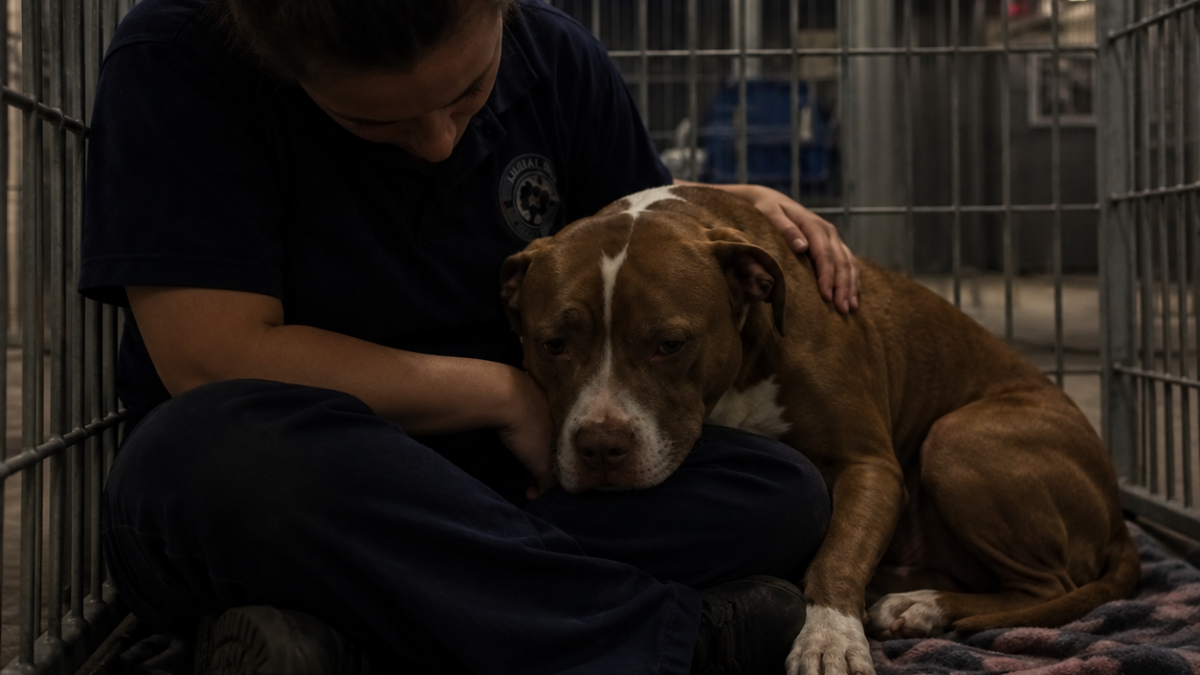
Angela frowned. “What?”
“After closing. I’ll sit with him.”
“That’s not a foster plan.”
“No. But it’s what I can do tonight.”
She looked like she wanted to refuse.
Then she looked through the office window toward kennel row.
“All right,” she said softly. “But you cannot sleep in there.”
“I won’t.”
That was a lie.
After closing, the shelter became a different place.
The daytime noise faded. No adopters. No phones ringing. No lobby conversations. Only the hum of the heater, the occasional bark, the metal sounds of dogs shifting in kennels.
I unlocked Chance’s door and stepped inside with a blanket, a paper cup of water, and a bowl of warm chicken I did not expect him to eat.
He was in the back corner, facing the wall.
I sat down on the cold concrete floor several feet away.
I did not touch him.
I did not say his name.
I did not beg him to eat.
I just stayed.
For the first hour, nothing happened.
My legs went numb.
My back ached.
The chicken cooled.
Chance breathed quietly.
Around ten o’clock, a dog barked in the next room, and Chance flinched. I stayed still.
Around eleven, a cleaning cart rolled somewhere down the hall. His ears moved. Still, he did not turn.
At midnight, I whispered for the first time.
“I know you waited for them.”
No movement.
“I know you thought they were coming back.”
His ear twitched.
“They should have.”
The words hurt as they came out.
“They should have come back for you.”
For a long time, nothing changed.
Then, sometime after one in the morning, Chance shifted.
Just a little.
A tiny adjustment of his front paw.
I did not react.
A few minutes later, he turned his head slightly, just enough to see me from the corner of his eye.
Checking.
Seeing if I was still there.
I was.
I kept my gaze low, my body still.
“Yeah,” I whispered. “I’m still here.”
He looked at me for maybe three seconds.
Then he turned back toward the wall.
But the next breath he took sounded different.
Not healed.
Not hopeful.
Just less alone.
I came back the next night.
And the night after that.
Three nights on cold concrete beside a dog who had been abandoned in Christmas sweaters.
I spoke very little. When I did, I said the same things.
“I’m still here.”
“I’ll come back.”
“You don’t have to believe me yet.”
On the third night, just after midnight, he moved again.
This time he turned all the way around.
Slowly.
Painfully.
Like even hope required strength.
He looked at me across the kennel.
His eyes were dull, but no longer empty.
I slid the bowl of warm chicken a few inches closer, then looked away.
For several minutes, nothing happened.
Then I heard it.
A small sound.
Soft.
Wet.
I looked down.
Chance had stretched his neck toward the bowl and taken one piece of chicken.
One.
Then another.
I had to bite my lip to keep from crying out.
If I celebrated too hard, I might scare him.
So I sat there on the concrete floor, tears running silently down my face, while Chance ate five small pieces of chicken and then rested his head again.
Five pieces.
That was all.
It felt like Christmas.
The next morning, he stood.
Weak.
Unsteady.
But standing.
Marissa walked into the kennel row, saw him on his feet, and froze.
“Chance?”
His tail moved once.
She covered her mouth.
“Oh my God.”
I laughed because if I didn’t, I would sob.
“Don’t make a big deal,” I whispered. “He’s being casual.”
Chance took one step toward the kennel door.
Then another.
When I opened it, he did not rush out. He simply stood there with his head low, breathing in the hallway air like he had forgotten there was a world beyond the wall.
We took him to the quiet room.
He ate a small breakfast.
Then a little more that afternoon.
Angela stood in the doorway, arms crossed, eyes wet.
“You stubborn woman,” she said to me.
“Is that an official performance review?”
“It might be.”
Chance lay on a blanket near my feet. He had not leaned into me yet. He had not wagged fully. He had not become magically whole.
But he was facing the room.
Not the wall.
That mattered.
Two days later, a man named Daniel came to meet him.
I almost dismissed him too quickly.
He was tall, quiet, maybe in his forties, wearing an old winter coat and work boots with salt stains. He had filled out an application before visiting. No young children. One previous dog, a senior boxer mix who had died six months earlier. Fenced yard. Experience with anxious dogs. Vet reference excellent.
Still, I was protective.
When he arrived, I warned him before he entered the room.
“He’s not going to run up to you.”
Daniel nodded. “I didn’t expect him to.”
“He may ignore you.”
“That’s okay.”
“He may not want touch.”
“Then I won’t touch him.”
Good answer.
We went into the quiet room where Chance was lying on a blanket. He lifted his head but did not stand.
Daniel did not walk toward him.
He sat on the floor near the opposite wall.
No baby talk.
No reaching.
No pitying sounds.
He simply sat.
Chance watched him.
For ten minutes, nothing happened.
Daniel looked at me and said softly, “My old dog, Cooper, didn’t like people reaching over his head. Took me two years before he let my brother pet him.”
I relaxed slightly.
“What happened to Cooper?”
“Cancer,” he said. “Fourteen years old. He was bossy until the end.”
A faint smile crossed his face, then disappeared.
“I miss having someone to come home to.”
Chance’s ears moved.
Daniel reached into his coat pocket slowly and pulled out a small bag.
“May I?”
“What is it?”
“Plain chicken.”
I almost laughed.
“Apparently that’s his weakness.”
Daniel placed one piece on the floor halfway between them, then leaned back.
Chance looked at the chicken.
Then at Daniel.
Then at me.
“Nobody’s rushing you,” I said.
It took four minutes for him to stand.
Another two to take one step.
Then he walked forward, took the chicken, and retreated.
Daniel did not move.
“Good boy,” he said quietly.
Chance stopped.
Not because of the words.
Because of the tone.
He looked at Daniel for a long moment.
Then he took one step closer.
By the end of the visit, Chance was lying three feet from Daniel’s boot.
Not touching.
But near.
For Chance, near was enormous.
After Daniel left, Angela came to my desk.
“What do you think?”
“I think I hate that I like him.”
She smiled.
“Good.”
We scheduled another visit.
Then another.
Each time, Daniel did the same thing.
He arrived quietly.
Sat down.
Let Chance decide.
On the third visit, Chance touched his nose to Daniel’s hand.
Daniel’s eyes filled with tears, but he did not move.
“Hi,” he whispered.
Chance stepped back.
Then came forward again.
That was the first time I thought he might choose someone.
But shelter stories love to test hope.
The following Monday, the family came back.
I was at the front desk when the door opened and cold air swept in. I looked up, expecting a donor or an adopter.
Instead, I saw the father.
Tan from vacation.
Clean jacket.
Sunglasses on his head again.
The mother stood behind him. Ethan and his sister were with her, both quieter than before. No matching sweaters this time.
My entire body went rigid.
The father walked up to the counter.
“We’re here for our dog.”
I stared at him.
“Excuse me?”
“Our pit bull. Chance. We dropped him off before our trip.”
Dropped him off.
As if the shelter had been a parking lot.
I kept my voice even. “You surrendered Chance. Permanently.”
He sighed. “Yeah, there was confusion about that. We’re back now.”
“No confusion. You signed the surrender form. I explained it to you clearly.”
The mother looked at the floor.
Ethan’s eyes were red before anyone had raised a voice.
The little girl whispered, “Is he okay?”
That question almost softened me.
Almost.
“He is alive,” I said.
The father frowned. “What does that mean?”
“It means he stopped eating after you left. He spent days waiting for you. Then he shut down.”
The mother covered her mouth.
Ethan began crying silently.
The father’s face tightened.
“Look, I don’t need a lecture. We had travel plans. Now we’re back. We’ll take him home.”
“He is not yours to take.”
His expression changed.
Men like that are often calm until they hear no.
“I signed paperwork because you told me I had to.”
“I told you what surrender meant. You signed anyway.”
“I want to speak to your manager.”
“Gladly.”
Angela came out of her office two minutes later. She had the form in her hand.
The father repeated himself, louder this time.
Angela listened without interrupting.
Then she placed the form on the counter and turned it toward him.
“This is your signature,” she said. “This is your wife’s signature. This is the line that states you permanently transferred ownership. This is the line that states the animal may be placed for adoption.”
The father glanced at it.
“We didn’t read all that.”
“You were told verbally.”
“I thought you’d hold him.”
Angela’s voice stayed calm, but I heard the steel in it.
“We are not a boarding facility. Your dog was surrendered. He is now under our care.”
“He’s our family dog.”
That was when Ethan spoke.
“No, he’s not.”
Everyone turned.
The boy’s face was pale, his hands clenched at his sides.
His father stared at him. “Ethan.”
“You left him.”
“Enough.”
“You said we’d get another one.”
The lobby went silent.
The little girl started crying.
The father’s jaw tightened. “Go wait in the car.”
“No.”
It was a small word.
But it landed hard.
Ethan looked at Angela.
“Did he really stop eating?”
Angela’s expression softened.
“Yes.”
“Because of us?”
I wanted to protect him from the answer.
But he deserved the truth his father had tried to avoid.
“Yes,” I said gently. “He was grieving.”
Ethan looked at his mother.
She was crying now.
“Mom,” he whispered. “We did that?”
She covered her face.
The father slammed his hand on the counter.
“This is ridiculous. You’re manipulating my kids.”
Angela stepped forward.
“Sir, lower your voice.”
“I paid for that dog. We raised him.”
“And then you surrendered him.”
“We made a mistake.”
For one second, the room went completely still.
A mistake.
There it was.
The word everyone reaches for when the consequence finally feels real.
Angela did not blink.
“Chance nearly starved himself from heartbreak because of your mistake.”
The father looked away first.
I had never seen anything more satisfying.
Not because he suffered.
Because he finally had to stand inside the truth he had created.
The mother spoke then, barely above a whisper.
“Can we see him?”
I hesitated.
Every protective instinct in me said no.
Chance had only just begun eating. He had only just turned back toward the world. If he saw them and they left again, it could destroy the fragile progress he had made.
Angela looked at me.
I shook my head once.
Angela understood.
“No,” she said. “Not today.”
The mother sobbed.
The father looked furious. “You can’t refuse.”
“We can,” Angela said. “And we are.”
Ethan stepped closer to the counter.
“Is someone good adopting him?”
His father snapped, “Ethan.”
The boy ignored him.
“Please,” he said to me. “Is he going somewhere good?”
My anger cracked then.
Not for the adults.
For him.
“He met someone kind,” I said. “Someone patient.”
Ethan wiped his face with his sleeve.
“Will he stay?”
“I think so.”
The little girl whispered, “Can you tell him we’re sorry?”
I swallowed.
“I can tell him you loved him.”
That was the truest thing I could offer.
The father grabbed the form from the counter, then shoved it back.
“This isn’t over.”
Angela’s eyes hardened.
“It is.”
They left with less confidence than they had entered.
This time, Chance did not watch them go.
He was in the quiet room with Marissa, eating chicken from a paper plate.
And for that, I was grateful.
The family’s return changed everything.
Not publicly at first. We did not post their names. We did not shame the children. We did not turn one father’s cruelty into a social media circus that would punish two kids who had already been hurt.
But internally, it lit a fire under all of us.
Angela updated our surrender counseling policy. Holiday surrenders would receive additional screening and resource referrals. We created emergency boarding lists, low-cost pet care contacts, temporary foster networks, and a script that made one thing painfully clear:
A shelter surrender is not vacation boarding.
Chance became the reason we said that sentence more firmly.
Daniel’s final adoption visit happened two days after the family came back.
I worried Chance might sense my tension. Dogs are experts at reading the emotional weather of a room.
But when Daniel entered, Chance lifted his head.
His tail moved.
Not a full wag.
But more than once.
Daniel sat in his usual spot.
“I brought something,” he said.
He pulled out a red plaid blanket.
“My old dog liked this one. I washed it. If that’s weird, you can say no.”
It was not weird.
It was exactly right.
He placed the blanket on the floor between them.
Chance sniffed it.
Then, after a long moment, he stepped onto it and lay down.
Daniel looked at me, eyes shining.
“He can keep it either way,” he said.
I nodded.
Chance rested his head on the blanket.
Then he looked at Daniel.
And sighed.
Not the exhausted sigh of a dog giving up.
The deep, heavy sigh of a dog letting one piece of weight fall off his body.
Daniel’s adoption was approved three days later.
I should have been happy without complication.
I was happy.
But I was also afraid.
Afraid Chance would think he was being abandoned again when he left the shelter.
Afraid the car ride would confuse him.
Afraid that after all those nights on the kennel floor, he would believe I was now the one walking away.
On adoption day, Daniel arrived with a new collar, a leash, treats, and a nervousness that made me trust him more.
People who understand the seriousness of adoption should be a little nervous.
Angela reviewed everything.
Medical notes.
Feeding schedule.
Stress signs.
Transition plan.
No overwhelming introductions.
No holiday parties.
No off-leash risks.
No forcing affection.
Daniel listened to every word.
Then came the moment to bring Chance out.
He walked down the hallway slowly, wearing the new collar. His body looked better than it had a week earlier, but he was still thinner than he should have been. His eyes were cautious.
When he saw Daniel, his tail wagged.
A real wag.
Small.
But real.
Daniel crouched.
“Hey, Chance.”
Chance walked to him.
Not all the way at first.
He stopped two feet away.
Daniel waited.
Chance took the last steps himself.
Then he pressed his head into Daniel’s chest.
Daniel closed his eyes.
“I’ve got you,” he whispered.
I turned away because shelter workers are supposed to be professional, and I was failing badly.
When it was time to leave, Chance looked back at me.
That look nearly undid me.
I crouched and touched his face.
“You’re not being left,” I told him. “You’re going home.”
His eyes stayed on mine.
“Daniel will come back. He’s the kind who comes back.”
I hoped with everything in me that I was right.
Chance got into Daniel’s car slowly. The red plaid blanket was spread across the back seat. He sniffed it, circled once, and lay down.
Daniel closed the door gently.
Before he got into the driver’s seat, he looked at me.
“I’ll send updates.”
“You better.”
He smiled.
“I mean it,” I said.
“I know.”
Then they drove away.
I stood in the parking lot until the car disappeared.
For a terrible second, I understood Chance in a new way.
Watching someone leave can feel like being abandoned even when you know better.
Marissa came outside and stood beside me.
“You okay?”
“No.”
“Me neither.”
We went back inside.
Kennel twelve was empty.
For the first time in days, it did not feel like failure.
It felt like a door had opened.
The first update came that night.
A photo.
Chance lying on the red plaid blanket in Daniel’s living room, eyes open, head lifted, body tense but present.
The message said:
He ate half his dinner. Then he checked the front door for ten minutes. I sat with him. We’re taking it slow.
I cried over that photo longer than I want to admit.
The next morning, another update.
He slept by the door, but he let me move his bed closer to the couch.
Then another.
He followed me to the kitchen today.
Then:
He wagged when I came back from taking out the trash.
That one stopped me.
Daniel had left the room.
Then returned.
And Chance had seen it.
Return is how trust is rebuilt.
Not with promises.
With repetition.
Again and again.
I leave.
I come back.
I leave.
I come back.
You are safe.
I come back.
Christmas came quietly at the shelter.
We were overworked, understaffed, and emotionally bruised, as usual. Dogs still barked. Cats still knocked things off shelves. The donation tree filled with paper ornaments. Volunteers brought cookies. Someone played holiday music until Angela threatened to throw the speaker into the parking lot.
But this Christmas felt different because Chance was not in kennel twelve.
Daniel sent a photo that morning.
Chance was sitting beside a small Christmas tree in Daniel’s living room. He wore no costume, no sweater, nothing silly. Just his collar. A toy lay between his paws. His eyes looked cautious but softer.
The message said:
Merry Christmas. He opened one gift and then took a nap on the wrapping paper. I think that counts as festive.
I showed the photo to Marissa.
She pressed her hand over her heart.
“He looks better.”
“He does.”
“Do you think he knows?”
“That he’s safe?”
“Yeah.”
I looked at the photo again.
Chance’s body was not fully relaxed yet. He still had healing to do. But he was not facing a wall. He was not watching a shelter door for people who would not return.
“I think he’s learning.”
Two weeks later, Daniel brought Chance back for a check-in visit.
The moment they walked through the shelter doors, every person at the front desk froze.
Chance froze too.
For one awful second, I thought we had made a mistake.
His body stiffened. His ears lowered. His eyes moved toward kennel row.
He remembered.
Of course he remembered.
Daniel knelt immediately.
“We’re not staying,” he said.
Chance looked at him.
Daniel held the leash loosely.
“We’re just visiting. Then we go home.”
Home.
Chance’s ears lifted at that word.
He looked at me.
I crouched a few feet away.
“Hi, buddy.”
His tail moved.
Then he walked toward me and pressed his head against my shoulder.
I hugged him carefully, trying not to cry into his fur.
“You look so good.”
He had gained weight. His coat shone. His eyes were brighter. The hollowness was gone from his face, though a trace of caution still lived there.
Daniel stood back, letting him greet us at his own pace.
Angela came out of her office.
“Well,” she said, voice thick, “look who remembered us.”
Chance wagged.
Then, after greeting everyone, he walked back to Daniel and leaned against his leg.
That was the moment.
Not the adoption photo.
Not the paperwork.
That.
Chance had returned to the shelter and chosen to stand beside the person who brought him home.
He knew who he belonged with now.
I looked at Daniel.
He understood too.
His eyes filled.
“He waits by the door when I leave for work,” he said. “But now when I come home, he brings me a toy.”
I laughed.
“What toy?”
“A ridiculous squeaky hamburger.”
“Perfect.”
“He sleeps in my room now. Not at the door.”
I swallowed.
“That’s big.”
“I know.”
Chance looked up at him like the conversation had gone on long enough without snacks.
Daniel reached into his pocket.
“See?” he said. “He has priorities now.”
That visit healed something in me.
Shelter work is full of goodbyes. Some hurt because you never know what happens next. But Chance walked back out with Daniel that day not as a surrendered dog leaving one more place behind.
He left as someone’s dog.
Again.
Only this time, the someone deserved him.
The old family did not disappear completely.
In January, the mother called.
I recognized her voice before she said her name.
“Is Chance adopted?” she asked.
“Yes.”
Silence.
“Is he okay?”
I looked at the update photo Daniel had sent that morning. Chance asleep upside down on the couch, one paw hanging in the air.
“He is doing well.”
She inhaled shakily.
“My son asks about him every day.”
“I’m sorry.”
“I know we don’t have a right to ask anything.”
I did not answer.
She continued, “My husband thought… he thought because we paid the surrender fee, it was like boarding. I know you explained it. I know. I should have stopped it.”
There it was.
Not enough.
But honest.
“Yes,” I said. “You should have.”
She began crying quietly.
“He won’t let us get another dog.”
“Your son?”
“Yes. He said if we can leave one, we don’t deserve another.”
I closed my eyes.
Ethan.
That boy had understood more than both adults.
“He’s not wrong,” I said.
The mother did not argue.
“I know.”
I thought that would be the end of the call, but she surprised me.
“Can I donate his old things? Chance’s bed, his bowls, his toys. Ethan wants them to go to dogs who need them.”
I hesitated.
Part of me wanted to refuse anything from them.
But rescue cannot afford pride that costs animals comfort.
“Yes,” I said. “You can bring them.”
She came two days later without her husband.
Ethan came with her.
He carried a large dog bed in both arms. His sister carried a box of toys. The mother carried bags of food and blankets.
Ethan looked older than he had before the vacation.
Not physically.
In the way guilt can age a child when adults make choices they cannot fix.
“Is he happy?” he asked me.
“Yes.”
“With the man?”
“Yes.”
“Does he still wait?”
I paused.
“Sometimes. But now someone comes back.”
His face crumpled.
I led him to the donation room so he would not cry in the lobby.
He placed the bed down carefully.
“He used to sleep on this,” he said.
I touched the edge of it.
“We’ll give it to a dog who needs softness.”
He nodded.
“My dad said we might get a puppy in the spring.”
My entire body tightened.
“And?”
“I said no.”
I looked at him.
He stared at the bed.
“I told him dogs aren’t replacements.”
I had no words for a moment.
Then I said, “That’s a good thing to know.”
He wiped his face quickly.
“Can you tell Chance I’m sorry?”
“I can’t tell him in words he’ll understand.”
“I know.”
“But I can tell you something.”
He looked up.
“He knew you loved him.”
That broke him.
He covered his face and sobbed in the donation room while his mother stood in the doorway crying silently.
I let him cry.
Some lessons hurt.
Some should.
But unlike his father, Ethan let the pain make him kinder.
Months passed.
Chance became less of a shelter story and more of a dog living a life.
Daniel sent updates faithfully.
Chance sleeping on the couch.
Chance carrying the squeaky hamburger.
Chance watching squirrels with intense moral concern.
Chance lying in a patch of sunlight.
Chance sitting by the door at 5:15 p.m., waiting for Daniel to return from work.
That last one made people sad until Daniel sent the follow-up video.
The door opened.
Chance grabbed the hamburger.
His whole body wagged.
He did not cry.
He did not panic.
He did not look past Daniel for someone else.
He ran to the man who came home.
Again and again.
That was the difference.
Waiting is not always tragic.
Waiting becomes safe when the person returns.
In the spring, Angela asked if Daniel and Chance would attend our new holiday surrender prevention fundraiser. We were building a temporary boarding assistance fund for families in crisis—real crisis, not vacations disguised as emergencies. The fund would help with short-term boarding, pet food, medical support, and counseling before surrender became the only option.
Daniel agreed, but only if Chance was comfortable.
By then, Chance had become confident enough for calm public events. Not crowded festivals. Not chaos. But small gatherings where people respected space.
The event was called Home Means Staying.
I loved that title.
We held it in the shelter parking lot on a cool April afternoon. There were booths for foster sign-ups, boarding resources, microchip checks, low-cost vet clinics, and adoption counseling.
Chance arrived with Daniel wearing a blue bandana.
He looked incredible.
Strong.
Healthy.
Bright-eyed.
Still gentle.
Still himself.
Marissa saw him and immediately started crying.
“You cry every time,” I told her.
“I’m consistent.”
Chance greeted her with the polite dignity of a dog who had overcome everyone’s nonsense.
Then he saw me.
His tail wagged hard.
He walked over, pressed his head into my stomach, and gave the deep sigh I remembered from Daniel’s plaid blanket.
“Hi, buddy,” I whispered. “Look at you.”
Daniel smiled. “He knows he’s handsome.”
“He has always been handsome.”
“Now he believes it.”
That sentence stayed with me.
Now he believes it.
During the event, Daniel spoke briefly about adopting a shut-down dog. He was not dramatic. He did not attack the family. He talked about patience. About sitting on the floor. About leaving and returning. About how trust came in inches, not leaps.
Then Angela asked if I wanted to say something.
I had not planned to.
But Chance was sitting beside Daniel, relaxed and calm, the sun touching the gray in his coat.
So I stepped forward.
“Last Christmas,” I began, “Chance was surrendered at this shelter by the family he trusted most. He waited for them. Then he stopped eating. Then he turned his face to the wall.”
The crowd quieted.
“I want to be clear about something. This is not a story about a bad dog. It is not even only a story about bad people. It is a story about what happens when humans forget that love is not ownership.”
Chance leaned against Daniel’s leg.
“A dog does not understand convenience. He does not understand that flights are expensive or boarding is full or plans are complicated. He understands who holds the leash. He understands who walks away. And if we are lucky enough to be trusted by a dog, then we are responsible for what that trust costs.”
I saw Ethan near the back of the crowd.
I had not known he was coming.
His mother stood beside him. His father was not there.
Ethan’s eyes were fixed on Chance.
I continued.
“Chance survived because someone stayed with him when he had stopped believing anyone would. He healed because Daniel did not demand trust. He earned it. And today, Chance waits by the door not because he has been abandoned, but because he knows someone is coming home.”
The applause was soft at first.
Then stronger.
Chance wagged, startled but pleased.
Daniel placed a hand on his back.
Afterward, Ethan approached slowly with his mother.
I saw Daniel notice them. I stepped closer.
“You okay?” I asked quietly.
Daniel nodded. “Is that the boy?”
“Yes.”
Chance saw Ethan.
His ears lifted.
For a moment, nobody moved.
Ethan’s face twisted with emotion.
“Can I say hi?” he asked Daniel, not me.
That mattered.
Daniel looked at Chance, then at Ethan.
“Sit down first,” he said gently. “Let him decide.”
Ethan sat on the pavement several feet away.
His hands shook.
Chance looked at Daniel.
Daniel kept the leash loose.
“It’s okay,” he said softly. “Your choice.”
Chance walked forward slowly.
He sniffed Ethan’s shoes.
Then his hands.
Then his sleeve.
Ethan began crying, but he did not grab him.
“I’m sorry,” he whispered. “I’m so sorry, Chance.”
Chance stood there for a few seconds.
Then he licked Ethan’s cheek once.
The boy broke completely.
I looked away, not because I was embarrassed, but because that moment did not belong to me.
It belonged to a child who had lost his dog because of adults and a dog who still had enough softness to offer one small kiss.
Then Chance turned and walked back to Daniel.
That was important too.
He could greet the past.
But he chose the present.
Ethan saw it.
His mother saw it.
Daniel saw it.
And I felt something inside me settle.
That was the revenge.
Not the father being humiliated.
Not the family suffering forever.
Not cruelty returned.
The revenge was Chance walking back to the man who stayed.
The revenge was Ethan learning the truth young enough to become better than his father.
The revenge was a shelter policy that would save future dogs from being treated like holiday baggage.
The revenge was Chance alive, loved, and no longer waiting for people who had chosen to leave.
Later that day, Ethan’s mother handed Angela an envelope.
Angela opened it after they left.
Inside was a donation to the emergency boarding assistance fund.
There was also a note in Ethan’s handwriting:
**For dogs whose families need help before they make the wrong choice. Please use this for them. I’m sorry, Chance.**
Angela read it aloud in her office.
Nobody spoke for a long time.
Then Marissa said, “That kid is going to be okay.”
I hoped she was right.
The father never apologized.
Not to me.
Not to the shelter.
Not to Daniel.
Maybe he apologized at home. Maybe he did not. Some people would rather lose respect than admit harm.
But he did not get another dog that spring.
Or that year.
I know because Ethan’s mother told Angela later that Ethan had made the whole family volunteer twice a month before he would even discuss another pet.
That made me smile.
The boy who had been forced to release the leash had found a way to hold his family accountable.
Chance, meanwhile, grew into the kind of happiness that looks boring to people who do not understand rescue.
He had routines.
He had a favorite window.
He had a yard where he patrolled the fence like a serious security officer, though the only threat he ever identified was a suspicious squirrel.
He had Daniel’s old plaid blanket, now washed so many times it had begun to fade.
He had the squeaky hamburger, replaced twice because love is hard on plush food.
He had a bed in the living room that he ignored in favor of the couch.
He had a person who came home.
Always.
One evening, almost a year after the surrender, Daniel invited me to visit.
I found Chance at the front window when I arrived. For a split second, seeing him there made my chest tighten.
Then Daniel’s truck turned into the driveway behind me.
Chance’s entire body changed.
His tail started wagging. He grabbed the hamburger from the floor. He bounced once, then ran to the door.
Not frantic.
Joyful.
Daniel opened the door.
Chance pushed the toy into his hand, wagging so hard his back feet slipped on the rug.
Daniel laughed.
“I was gone twelve minutes,” he said.
Chance acted as if twelve minutes was a historic hardship.
I stood in the hallway watching them and felt tears rise.
This was the image I wanted to keep.
Not kennel twelve.
Not the father pulling the leash from Ethan’s hands.
Not Chance facing the wall.
This.
A dog waiting at a door because waiting no longer meant abandonment.
After dinner, Chance climbed onto the couch between us, apparently certain the visit was for him. Daniel showed me photos from the past year. Chance at the lake. Chance asleep in the passenger seat. Chance wearing a party hat for exactly three seconds before removing it with great dignity. Chance sitting beside Daniel’s mother, who had declared him her granddog and spoiled him accordingly.
“He’s not the same dog,” Daniel said.
I stroked Chance’s head.
“No,” I said. “He is. He just feels safe enough to show it now.”
Daniel nodded.
“He still has moments. If I pack a suitcase, he gets anxious.”
“That makes sense.”
“So I started putting the suitcase out days early, giving him treats around it. And I never leave without someone he knows staying with him.”
I looked at him.
That was love.
Not the easy kind.
Not the Christmas card kind.
The practical kind.
The kind that learns the shape of an old wound and makes room around it.
Chance sighed and rested his head on my knee.
“Do you ever regret adopting him?” I asked.
Daniel looked genuinely offended.
“Regret?” he said. “He judges my cooking, steals my blanket, and snores like a motorcycle. He’s perfect.”
Chance opened one eye, as if agreeing.
I laughed.
That night, before I left, Daniel gave me a framed photo.
It showed Chance in the yard, sunlight on his face, the squeaky hamburger at his feet. His eyes were bright. His body was strong. His ears were relaxed.
On the back, Daniel had written:
**Thank you for staying until he could believe someone else would.**
I sat in my car and cried before driving home.
Shelter work is full of losses that never make sense.
Dogs surrendered for moving.
For babies.
For allergies.
For landlords.
For behavior nobody tried to understand.
For age.
For illness.
For inconvenience.
For vacations.
You learn to keep going because stopping does not help the next animal through the door.
But Chance changed me.
Not because his story was the saddest I had ever seen. It was not.
I had seen worse injuries, worse cruelty, worse physical neglect.
Chance changed me because his wound was invisible until it nearly killed him.
His body had been fine.
His heart had not.
And too often, people only take suffering seriously when they can see blood.
Chance taught me to look harder at the quiet dogs.
The ones facing the wall.
The ones not eating.
The ones still listening for footsteps that will never come.
The ones people call “fine” because they are not making noise.
The next Christmas, we placed a special ornament on the shelter tree.
Not an adoption card.
Not an intake tag.
A small red paper heart with Chance’s name on it.
Under his name, Angela wrote:
**Loved. Home. Stayed for.**
Daniel brought him to the shelter that afternoon with a bag of donated blankets and a ridiculous holiday collar covered in tiny bells. Chance tolerated the collar with the expression of a dog enduring human foolishness for charity.
Marissa cried again.
Obviously.
We took a photo of him beside the tree.
Then Daniel walked him toward the door.
Chance paused.
He looked back down the hallway toward kennel row.
My breath caught.
For a moment, I wondered what memory had surfaced.
Then he looked up at Daniel.
Daniel smiled.
“Ready to go home?”
Chance wagged.
And walked out with him.
No hesitation.
No looking for the old family.
No waiting for the wrong people.
Just trust in the person holding his leash now.
Outside, snow had begun falling lightly over the parking lot. Daniel opened the car door, and Chance jumped into the back seat onto his plaid blanket. The squeaky hamburger was already waiting there.
Before Daniel drove away, he rolled down the window.
“Merry Christmas,” he called.
Chance stuck his head out just enough for the cold air to ruffle his ears.
“Merry Christmas, buddy,” I said.
He wagged.
Then they left.
This time, watching the taillights disappear did not hurt.
Because I knew where they were going.
Home.
And I knew Daniel would not leave him there alone.
Years from now, people may forget the details.
They may forget the matching sweaters.
The Mexico trip.
The father’s impatience.
The boy crying in the lobby.
The nine days Chance refused to eat.
They may forget the cold kennel floor where I sat because I did not know what else to do.
But I will not forget.
I will remember the exact moment Chance turned his face from the wall.
I will remember the first piece of chicken.
The first full wag.
The first time he leaned into Daniel.
The day the old family came back and learned love cannot be reclaimed like lost luggage.
The day Ethan sat on the pavement and said sorry.
The day Chance kissed him once, then chose to return to the man who had earned him.
That was the ending he deserved.
Not a perfect one.
Perfect would have been never being left at all.
But a true one.
A loyal dog was betrayed.
He broke.
Someone stayed.
Someone else came.
And slowly, painfully, beautifully, Chance learned that one family’s failure was not the end of his story.
Now he waits by the door every evening.
Not with panic.
Not with a hollow stomach.
Not with his face turned toward a shelter hallway.
He waits with a toy in his mouth and his tail ready to move.
Because the engine he hears outside belongs to Daniel.
The footsteps on the porch belong to Daniel.
The key in the lock belongs to Daniel.
And every single time, the door opens.
Every single time, the person he loves comes back.
That is what healed him.
That is what answered the people who left.
That is what made all those cold nights on the shelter floor worth it.
Chance was not replaced.
He was not forgotten.
He was not the dog someone left before vacation anymore.
He was home.
Loved.
Chosen.
And finally waiting for someone who always returned.