PART 2: They Dumped an Old Dog at the Boat Ramp—Then His Trust Became Their Punishment
PART 2
For several seconds, I forgot about everything else.
The river.
The parking lot.
My own dog waiting in the car.
The stranger standing near the ramp.
All I could feel was the old dog trembling against me.
His body was warm from the pavement and tight with fear. Every few breaths, he made that same wounded sound, as if something inside him had cracked the moment the car disappeared.
I had heard scared dogs before.
I had heard dogs cry at vet clinics, dogs bark in shelters, dogs whine during thunderstorms.
This was different.
This was confusion.
This was betrayal still fresh enough that he had not even figured out how to be afraid of the next thing.
He only knew the people he had arrived with were gone.
I looked toward the park exit again, hoping for the impossible.
Nothing.
The car was gone.
The dog pressed his head harder into my leg.
“I’m sorry,” I whispered, even though I was not the one who had left him. “I’m so sorry.”
The man near the boat ramp walked closer but stopped a careful distance away.
“Did somebody just dump him?” he asked.
“I think so.”
“You saw the car?”
“Yes.”
“Did you get the plate?”
The question hit me like a fist.
I looked at him.
“No.”
I hated myself the second I said it.
No.
I had not gotten the license plate.
I had seen the door open. I had seen the dog step out. I had seen the car reverse and speed away. But in those first few seconds, my mind had been too busy trying to explain it away. Maybe the dog had jumped out. Maybe the driver was turning around. Maybe it was a mistake.
By the time I understood it was abandonment, the vehicle was too far gone.
The man shook his head. Not at me exactly, but at the situation.
“People are disgusting.”
The dog flinched at the sharpness in his voice.
I lifted one hand slightly.
“Softly,” I said. “He’s scared.”
The man’s expression changed.
“Sorry.”
He crouched too, slower this time.
“Hey, buddy.”
The old dog looked at him but stayed glued to me.
Because I already had Cooper in my car, I needed help. I could not put an unknown frightened dog beside my own dog, especially not in a small back seat. Even gentle dogs can panic in close spaces when they do not understand what is happening.
Another car pulled into the parking area a few minutes later.
A woman stepped out carrying a water bottle and a folded towel. She saw us almost immediately.
“Is everything okay?”
“No,” I said. “Someone just abandoned this dog. I need to get him to a vet, but I have my dog in my car. Can you help?”
She did not hesitate.
“What do you need me to do?”
That question nearly made me cry.
In rescue moments, there are two kinds of people.
The ones who ask, “Is it safe?”
And the ones who ask, “How can I help?”
Both questions can be reasonable. But on that day, with an old dog shaking against my knees, I was grateful for the second kind.
Her name was Lila. She had an old blanket in her trunk and a calm voice that immediately made me trust her. I grabbed Cooper’s spare leash from my car and came back slowly.
The old dog watched the leash with worried eyes.
“I know,” I said. “I know you don’t understand.”
He lowered his head.
“I’m not leaving you here.”
The moment the leash slipped over his neck, his body stiffened. Maybe he thought it meant he was being handed over again. Maybe he thought it meant another car, another door, another stranger deciding where he belonged.
I kept my hand on his shoulder.
“Easy. We’re going somewhere safe.”
He did not resist.
That almost hurt more than if he had.
A dog who still fights believes something can change.
This dog moved like he had already learned humans make decisions and he must survive them.
Lila spread the blanket across the back seat of her car. The old dog looked inside, then looked toward the park exit again.
The same road.
The same direction.
Still waiting.
My throat tightened.
“He’s looking for them,” Lila said softly.
“I know.”
We helped him into the car. His joints seemed stiff, and he climbed slowly, front paws first, then hind legs with a little boost. Once inside, he did not pace. He did not bark. He sat low on the blanket, head down, eyes moving between my face and the windshield.
I followed in my car with Cooper.
During the drive, I watched Lila’s car ahead of me so closely that my hands cramped around the steering wheel. At every red light, I could see the old dog’s head lift slightly in her back seat.
Not excited.
Not curious.
Checking.
Making sure the humans in front had not vanished too.
At the veterinary clinic, the receptionist looked up and smiled automatically, then saw our faces.
“What happened?”
“Abandoned at the park,” I said. “We saw it happen.”
The old dog stood close to my leg, his shoulder pressed against me.
“Any injuries?”
“Not obvious. He’s terrified. Older. Fleas.”
“We’ll get him into a room.”
In the exam room, he surprised everyone.
He allowed the vet tech to scan him for a microchip.
Nothing.
She scanned again.
Still nothing.
No chip.
No collar.
No tag.
No identification.
No easy way to find his past.
The veterinarian, Dr. Harris, came in with a quiet kindness I immediately appreciated. She did not tower over him. She crouched first, spoke softly, and let him sniff the back of her hand.
“Well, hello, sir,” she said. “You’ve had a terrible day, haven’t you?”
The dog looked at her, then leaned into my leg.
Dr. Harris examined him carefully.
Ears.
Teeth.
Eyes.
Joints.
Belly.
Paws.
Skin.
She found fleas and some mild irritation from scratching, but no major wounds. His teeth were worn. His muzzle was gray. His hips were stiff when he shifted his weight.
“I’d estimate he’s around ten,” she said.
“Ten?”
“Roughly. Maybe a little younger, maybe a little older. But he’s definitely a senior.”
Senior.
That word made what had happened feel even crueler.
A puppy might be abandoned by someone careless and impulsive.
But a ten-year-old dog means history.
Years of meals.
Years of walks.
Years of hearing his name.
Years of sleeping somewhere familiar.
Years of trusting the sound of one particular car.
Then one day, that same car drove him to a park and left him on the pavement.
“How is he otherwise?” Lila asked.
“Physically, better than I feared,” Dr. Harris said. “He needs flea treatment, vaccines, and bloodwork to be safe. His joints may need support. But I don’t see anything catastrophic.”
She paused and looked at him.
“Emotionally, though…”
She did not finish.
She did not have to.
The old dog stood pressed against me, eyes fixed on the door every time someone passed in the hallway.
Dr. Harris sighed.
“He isn’t dangerous,” she said. “He’s devastated.”
That sentence stayed with me.
After the exam, I filed a found-dog report. I called animal control. I contacted the park office and gave them the time, location, and description of the vehicle as best I could.
Dark sedan.
Maybe gray or black.
Near the boat ramp.
Passenger door.
No plate.
Every detail felt too weak.
Too incomplete.
The officer on the phone was polite but honest.
“Without a license plate or camera footage, it may be hard to identify them.”
“I know.”
“We’ll check whether the park cameras caught anything.”
“Thank you.”
But I could hear what he was not saying.
It might not change anything.
I thought that would make me feel helpless.
Instead, it made me angry.
Maybe I could not find the person who left him.
But I could make sure their choice did not become invisible.
When it was time to leave the clinic, I looked at the old dog sitting beside me.
He looked exhausted now. Fear drains the body. So does hope when it keeps getting disappointed.
Lila touched his head gently.
“What are you going to do?”
I should have said I would contact rescues. I should have said I would foster him only until a placement opened. I should have said I already had a dog, and this was complicated.
Instead, I looked at him and said the truth.
“I’m taking him home.”
Lila smiled through tired eyes.
“I thought so.”
On the ride home, he sat in my back seat because Cooper was now in the front with a harness clip and an offended expression. Cooper kept glancing over his shoulder at the newcomer, curious but not pushy.
The old dog lay low on the blanket, his eyes half-open.
Every time I slowed down, he lifted his head.
Every time I turned, he looked toward the window.
Maybe he thought we were going back to the park.
Maybe he thought every car ride ended in loss now.
When we reached my house, I opened the back door and waited.
He did not move.
“It’s okay,” I said. “This is not the park.”
He looked past me at the driveway, the porch, the closed front door.
I could almost see the thought inside him.
A door can open.
A door can close.
A door can take everything.
I clipped the leash gently and gave him time. After nearly two minutes, he climbed down.
Inside, I had already decided to keep him separated from my other dogs at first. Cooper was friendly, and my two older dogs were gentle, but this dog did not need a welcoming committee. He needed quiet.
I set up my office for him.
A soft bed beneath the table.
Fresh water.
A bowl of food.
A blanket.
A few toys, though I doubted he would understand them yet.
He walked into the room slowly and sniffed the bed. Then the table. Then the wall. Then he lowered himself carefully under the table as if he had found the smallest, safest corner in the world.
He tucked his paws beneath him and looked out at me.
I sat on the floor several feet away.
“I don’t know your name,” I said.
His ears moved.
“I’m going to call you Harbor for now.”
It felt right.
A dog abandoned by the boat ramp.
A dog left where land met water.
A dog who needed a safe place to come in from the storm.
“Harbor,” I repeated softly.
He blinked.
That was enough.
The first night, Harbor barely moved.
He drank water when I was not watching. He ate a few bites of food after I turned off the office light and sat in the hallway where he could hear me but not feel watched. Every hour or so, I heard him shift under the table.
At midnight, a car passed outside.
Harbor scrambled up so fast his nails slipped on the floor. He ran to the office window and pushed his nose against the glass.
The car kept going.
Harbor stood there until it disappeared.
Then he returned under the table.
At 2:00 a.m., another car passed.
Same thing.
At 4:00 a.m., a truck.
Same thing.
By sunrise, I understood.
He was still waiting.
Not at the park anymore.
Not on the pavement.
But inside my office, under my roof, with food and water and a soft bed.
Still waiting for the car that left him.
I made coffee the next morning with Harbor sleeping under the table and Cooper sitting beside me in the kitchen, watching my face.
“I know,” I told Cooper. “This is a lot.”
Cooper wagged once.
My other dogs, June and Rusty, knew something was happening. They sniffed under the office door and occasionally peeked in when I opened it, but they were surprisingly respectful. June, an elderly beagle mix with no interest in drama, glanced at Harbor once and then walked away as if to say, He can join the household when he is ready. Rusty, a small terrier with a large opinion of himself, was more curious, but even he seemed to sense that pushing would be wrong.
For the first few days, Harbor lived mostly under the table.
That became his safe spot.
I did not force him out.
I did not drag him into the living room.
I did not introduce him to everyone because I wanted a cute video.
I let him decide when the world could get bigger.
He went outside on leash, did his business quickly, and pulled back toward the house. But once inside, he hesitated at the office doorway like he needed permission to return to his hiding place.
“You can go,” I said every time.
And he did.
At first, he did not wag.
He did not play.
He did not ask for affection.
But he watched everything.
He watched me bring food.
He watched me leave and come back.
He watched Cooper lie down outside the office doorway without crossing the threshold.
He watched June nap in the hallway.
He watched Rusty peek around the corner, then retreat dramatically as if he had important business elsewhere.
Dogs heal through patterns.
A bowl appears.
A hand stays gentle.
A door opens.
A person returns.
A strange dog does not attack.
A night passes.
Then another.
Nothing terrible happens.
On the third day, Harbor ate while I was in the room.
It was only half the bowl, and he kept glancing at me between bites, but he ate.
I sat on the floor pretending to read emails on my phone while quietly feeling like I had won a war.
“Good boy,” I said softly when he finished.
His tail moved once against the table leg.
One small thump.
I froze.
He looked embarrassed by his own tail.
I smiled.
“That was allowed.”
He lowered his head, but I saw it.
The first sign that somewhere beneath the fear, Harbor had not given up completely.
That same afternoon, animal control called.
The park camera had caught part of the incident.
My heart pounded so hard I had to sit down.
“Did you get the plate?”
The officer sighed.
“No. The angle is bad, and the plate is unreadable. But it does show the vehicle stopping, the passenger door opening, the dog exiting, and the vehicle leaving.”
“So it proves abandonment.”
“It strongly supports your report.”
“Can you identify the vehicle?”
“We’re trying, but I don’t want to overpromise.”
I looked toward Harbor under the table.
He was sleeping with his chin on his paws.
“What happens if you can’t?”
“At minimum, the park can use it to justify better cameras and signage. We can keep the case open. If someone recognizes the car from the clip, maybe we get more.”
“Can the public see it?”
“We’d have to review what can be released.”
After the call, I sat there for a long time.
A blurry car.
An unreadable plate.
A crime almost documented enough to matter.
Almost.
That word made me sick.
Almost caught.
Almost accountable.
Almost justice.
But then Harbor sighed in his sleep, and I reminded myself that justice had more than one shape.
One shape was finding the person who dumped him.
Another shape was making sure Harbor never slept outside again.
I posted his story that evening.
Not the video.
Not accusations I could not prove.
Just what I had seen.
I wrote about the boat ramp. The door opening. The car speeding away. The old dog crouched low to the pavement. The way he cried when I asked if he needed help. The vet visit. No microchip. Ten years old. Fleas, but otherwise physically okay. Gentle. Terrified. Sleeping under my office table because that was where he felt safe.
I included one photo.
Harbor on his soft bed beneath the table, eyes tired, head resting on the blanket, looking out as if he still did not know whether safety was permanent.
The post spread faster than I expected.
People were angry.
Of course they were.
“How could someone do this?”
“Find the car.”
“Release the footage.”
“I hope whoever dumped him sees this.”
But the comments that mattered most were quieter.
“My senior dog was dumped too. Thank you for stopping.”
“He looks like he was loved once. That makes it hurt more.”
“Please tell him he is safe now.”
I read that one aloud to Harbor.
“Someone says you’re safe now.”
He looked at me from under the table.
“I know. You don’t believe internet strangers yet.”
His tail moved.
Maybe because of my voice.
Maybe because of the word safe.
Maybe because I was holding chicken.
Healing does not always care why it begins.
The next day, a reporter from a small local news page contacted me. I almost said no immediately. I did not want Harbor turned into a sad headline. He had already been treated like something disposable; I would not make him entertainment.
But then the park office called.
They had received dozens of messages after my post. They were reviewing camera placement at the boat ramp. They wanted to install signs warning that animal abandonment was a crime and providing numbers for surrender resources and emergency help.
“We don’t want this happening again,” the manager said.
I looked at Harbor, who was now sleeping half under the table and half out, as if his body wanted safety and curiosity at the same time.
“Then say that publicly,” I told him.
So I agreed to one interview.
No dramatic reenactment.
No showing Harbor’s hiding place in a way that would scare him.
No close-up of him looking terrified.
The reporter, named Elise, came to the house and sat on the floor of my hallway for forty minutes before Harbor even peeked out.
She did not rush him.
That earned my respect.
When he finally came to the office doorway, Elise lowered her eyes and placed a treat gently on the floor halfway between them.
Harbor looked at me.
“Your choice,” I said.
He took the treat and retreated.
Elise smiled softly.
“That’s brave,” she said.
The story went out the next morning.
The headline read:
Senior Dog Abandoned at Riverside Boat Ramp Now Recovering in Foster Home
I read it three times, checking for anything unfair or exaggerated. It was clean. Honest. It focused on abandonment prevention, the need for microchips, and the fact that senior dogs often struggle after sudden separation.
At the end, the article included the park’s announcement: new cameras, clearer signs, and an animal welfare contact board near the boat ramp.
That was the first piece of revenge.
Not loud.
Not cruel.
But real.
The person who dumped Harbor had tried to make him disappear in a quiet corner of a public park.
Instead, that same park was changing because of him.
A week later, Harbor left the office on his own.
I was in the kitchen cutting chicken for dinner when I heard nails click softly behind me.
I turned slowly.
There he was.
Standing at the edge of the kitchen, eyes cautious, body low, but not hiding.
Cooper lifted his head from his bed.
June opened one eye.
Rusty, unfortunately, gasped in terrier language, which is to say he barked once like the king had arrived.
Harbor froze.
“Rusty,” I warned.
Rusty looked offended but quieted.
Cooper, sweet Cooper, stood up, picked up a tennis ball, and dropped it gently in the space between them.
Harbor stared at the ball.
Then at Cooper.
Then at me.
As if asking whether this yellow fool was serious.
“Yes,” I said. “He believes tennis balls solve emotional distress.”
Cooper wagged.
Harbor did not pick up the ball.
But he did not run back to the office either.
That was enough.
Over the next few days, the house became his little by little.
First the kitchen doorway.
Then the hallway.
Then the living room rug.
Then the corner near the couch.
He still slept under the office table at night. That was fine. Safe places are not cages when a dog chooses them.
I added another bed there, softer than the first one, and placed one blanket near the living room in case he decided to try it.
He ignored the living room blanket for three days.
Then one evening, while I watched TV, he walked over, circled twice, and lay down on it with the heavy sigh of a dog making a major real estate decision.
I did not move.
Cooper looked at him.
June looked at him.
Rusty looked at him.
Everyone understood the importance of not ruining it.
Harbor slept there for twenty minutes.
Then returned to the office.
Progress.
Not a miracle.
Not a transformation montage.
Progress.
The first time he leaned into my hand on purpose, I cried.
I had been sitting at my desk, answering messages, when he came out from under the table and stood beside my chair. I thought he needed to go outside.
Instead, he pushed his head beneath my hand.
Just once.
A quiet request.
I placed my palm on his head, careful and slow.
He closed his eyes.
That was when the tears came.
“You’re still in there,” I whispered.
His tail thumped once.
“Yes,” I said. “I see you.”
His vet follow-up went well. Fleas were gone. Skin irritation improving. Bloodwork showed the usual senior concerns but nothing alarming. Dr. Harris checked his joints and recommended supplements.
“He’s lucky,” she said.
I looked at him standing quietly beside me.
“No,” I said. “I’m lucky I was there.”
She smiled.
“Both can be true.”
As Harbor settled, the case remained open but thin.
The vehicle had not been identified.
No one came forward to claim him.
No missing report matched him.
No shelter records fit.
That bothered me more than I expected.
There was something awful about not knowing his old name. I could call him Harbor, and he was learning it, but somewhere in his history there had been another sound that made his ears lift. Another name said before meals, before walks, before bedtime.
Had he been loved?
I thought yes.
That made it worse.
He knew how to live in a house. He understood couches were not for chewing. He waited at doorways. He took treats gently. He did not guard food. He allowed handling. He seemed used to people moving around him.
Someone had lived with this dog.
Someone had watched him grow gray.
Someone had known his habits.
And then someone, whether that same person or another, opened a car door at a boat ramp and left him.
One afternoon, about three weeks after the abandonment, I received an anonymous message.
No profile photo.
No real name.
Just a line that made my heart pound.
“You don’t know why he was left.”
I stared at the screen.
My first instinct was anger.
My second was strategy.
I typed carefully.
“Then explain it.”
The reply came several minutes later.
“Not everyone has money for old dogs.”
I looked across the room.
Harbor was asleep on the living room blanket, Cooper’s tennis ball tucked near his front paw. He had not chosen it intentionally, I was pretty sure, but Cooper looked proud anyway.
I wrote back:
“There are shelters, rescues, vets, animal control, neighbors, surrender programs, and emergency resources. Leaving a senior dog alone at a boat ramp is not a financial plan. It is abandonment.”
The person replied:
“Easy for you to judge.”
I felt heat rise in my face.
“Yes,” I wrote. “It is easy to judge leaving a frightened old dog on pavement and driving away.”
No response came.
The account disappeared by morning.
I did not know if it was the person who dumped Harbor.
Maybe it was.
Maybe it was someone who knew them.
Maybe it was just a stranger defending cruelty because they did not want to look too closely at their own choices.
But something about that message stayed with me.
Not everyone has money for old dogs.
Maybe that was true.
Vet care is expensive. Senior dogs cost more. Life can collapse around people in ways outsiders do not see.
But poverty did not open that car door and speed away.
Shame did.
Cowardice did.
The belief that an old dog’s terror was easier to face for five seconds than a hard conversation with a shelter worker.
That was what I could not forgive.
The park installed new signs a month later.
I took Harbor there early in the morning before many people arrived.
I did not take him to the exact boat ramp at first. We walked near the upper trail, far enough away that the river smell was softer and the parking lot mostly hidden.
He moved slowly, sniffing the grass.
Cooper came with us, calm for once, as if even he understood this was not a normal walk.
When Harbor heard a car door slam in the distance, he froze.
His body dropped slightly.
I stopped with him.
“We can leave,” I said.
He looked toward the sound.
Then back at me.
I kept the leash loose.
“Your choice.”
He stood there for a long moment.
Then he took one step forward.
Not toward the car.
Toward me.
I crouched, and he pressed his head against my chest.
I held him gently.
“That’s it,” I whispered. “You don’t have to wait for the wrong car anymore.”
We did not stay long.
Ten minutes.
Maybe twelve.
Then home.
That evening, he slept on the living room blanket instead of under the table.
Another small victory.
The news story had brought adoption inquiries, but I ignored most of them at first.
Not officially.
I read them.
Some were kind but unrealistic.
Some wanted him because the story made them cry.
Some had never owned a senior dog.
Some had three young dogs and thought Harbor would “learn to play again fast.”
Maybe he would one day.
But not because someone demanded a happy ending on their timeline.
I told myself I was fostering until the right person came.
Then Harbor started waiting for me.
Not the way he had waited for the car.
This was different.
When I left for the grocery store, he lay on the office bed. When I returned, he came to the hallway, tail wagging softly.
When I took Cooper out separately, Harbor watched from the window, then met me at the door.
When I went to work in another room, he followed after a few minutes and settled nearby.
One night, he climbed halfway onto the couch.
Just his front half.
His back legs remained on the floor because he seemed uncertain whether senior dignity allowed full couch participation.
I patted the cushion.
“You can come up.”
He looked at me.
Then at Cooper, who was already upside down on the other end like a shameless creature.
Harbor carefully climbed the rest of the way up and lay beside me.
His head rested on my knee.
I did not breathe normally for at least thirty seconds.
That was when I knew.
Not in a dramatic lightning-bolt way.
In the quiet way truth sometimes arrives.
He had already chosen.
I was just catching up.
The adoption paperwork went through the rescue partner helping with his case. Technically, because I had reported him and fostered him during the stray hold, we followed the proper waiting period. No owner came. No microchip match appeared. No claim was made.
When the time came, I signed.
Harbor became mine.
I expected to feel triumphant.
Instead, I felt humbled.
An old dog had trusted me with the broken pieces someone else left behind.
That is not ownership.
That is responsibility.
I took a photo of him that day in the office where he had first hidden under the table. He was lying halfway out from beneath it now, head on the bed, eyes soft.
The caption I posted was simple:
Harbor is home. He was left at the boat ramp, but that is not where his story ends.
The response was overwhelming.
People cried.
People celebrated.
The park shared the post along with a reminder about safe surrender resources.
Animal control commented that the investigation remained open and abandonment was illegal.
The anonymous account never returned.
But I hoped whoever left him saw it.
I hoped they saw his soft bed.
His clean coat.
His gray muzzle resting peacefully on a blanket.
I hoped they saw that the dog they thought they could discard had become wanted by thousands of people.
Most of all, I hoped it hurt.
Not because I wanted them destroyed.
Because I wanted the truth to reach the part of them that had stayed silent while they drove away.
Two months after the abandonment, the park held a small animal welfare event near the river.
Microchip checks.
Senior pet resources.
Low-cost vaccine information.
Emergency surrender contacts.
A sign at the boat ramp now read:
Do not abandon animals. Help is available. Call before you leave them behind.
Below it were phone numbers.
The park manager invited Harbor, but I hesitated.
I did not want to make him a symbol if it hurt him.
So we practiced slowly.
Short visits.
Quiet mornings.
Distance from the ramp.
Then closer.
Then a walk past the parking lot.
He improved each time. Not perfectly. But he recovered faster. The place did not own him the way it had that first day.
On the morning of the event, I let him decide.
I opened the car door at the park and watched his body.
He sniffed the air.
His ears moved.
For a moment, he looked toward the boat ramp.
Then he looked back at me and stepped down.
“All right,” I said softly. “We’ll go slow.”
People recognized him.
A woman near the microchip table covered her mouth.
“That’s him?”
I nodded.
“He looks so much better.”
Harbor stood close to me, but his tail moved when she crouched calmly and offered the back of her hand.
He sniffed.
Accepted one treat.
Then leaned lightly against my leg.
Progress does not always look like running into strangers’ arms.
Sometimes it looks like staying present when the past is nearby.
The park manager spoke briefly about the new cameras and signs. Animal control explained abandonment laws. Dr. Harris talked about senior dogs and the importance of microchips.
Then, unexpectedly, they asked me to say something.
I had not prepared.
I looked down at Harbor.
He was watching a duck near the river with mild concern.
That helped.
I stepped forward with his leash in my hand.
“I saw Harbor abandoned right over there,” I began, pointing toward the boat ramp. “A car stopped. A door opened. He stepped out. The car left.”
The crowd went quiet.
“He did not understand. That is the part I wish people would remember. Dogs do not understand our excuses. They do not understand money problems, moving problems, shame, fear, or inconvenience. They understand the person they trust driving away.”
Harbor leaned against me.
“When I asked if he needed help, he cried and came to me. That is what I still think about. He had just been betrayed by a human being, and his first choice was to trust another one.”
My voice thickened.
“That kind of trust should make us better people.”
I looked toward the sign.
“We may never know who left him. I may never get a license plate or a name. But Harbor’s story already changed this park. There are cameras now. There are signs now. There are phone numbers now. And maybe the next person who feels desperate will call before they do something they cannot undo.”
I looked down at Harbor.
He was looking up at me now.
“But the biggest justice is this: he is no longer waiting at the boat ramp. He is no longer sleeping under my office table because fear is the only thing he knows. He is home. He is loved. And whoever left him failed to make him unwanted.”
People applauded softly.
Harbor startled at first, then relaxed when I touched his shoulder.
A little girl came up afterward with her mother.
“Can I give him a treat?” she asked.
I explained how to offer it gently.
She held it out with a flat palm.
Harbor sniffed, then took it with careful lips.
“He’s nice,” she said.
“Yes,” I replied. “He always was.”
Near the end of the event, the man who had been at the boat ramp the day Harbor was abandoned came over.
I recognized him immediately.
He looked at Harbor, then at me.
“I’ve thought about that day a lot,” he said.
“Me too.”
“I was angry, but I didn’t do much.”
“You stayed.”
“You did more.”
“Everybody always thinks that,” I said. “That someone else did more. The point is doing something.”
He nodded.
Then he handed me a folded envelope.
“What’s this?”
“Donation for senior dog care. Not much.”
I opened it later.
Inside was a note:
For the next old dog somebody gives up on.
That was another piece of justice.
Harbor’s abandonment had created help for another dog he would never meet.
On the drive home, Harbor fell asleep in the back seat beside Cooper.
His head rested on the blanket.
His body was relaxed.
When we passed the road where the abandoning car had once disappeared, he did not lift his head.
He slept through it.
I cried quietly all the way home.
Months passed.
Harbor became beautifully ordinary.
He learned the sound of the treat jar.
He decided the office table was still his official headquarters, but no longer his hiding place.
He and Cooper developed a friendship based mostly on shared naps and silent judgment of squirrels.
June tolerated him.
Rusty eventually accepted him after realizing Harbor had no interest in challenging his imaginary authority.
Harbor loved warm laundry.
He hated rain.
He enjoyed slow walks and sniffing every mailbox as if reading neighborhood news.
He never became a wild, playful puppy, because he was not one.
He was an old dog with stiff joints, a soft heart, and a deep appreciation for quiet routines.
That was enough.
More than enough.
Sometimes, he still startled at sudden car doors.
Sometimes, if I packed a bag, he watched me too closely.
So I learned to explain everything out loud.
“I’m going to the store. I’ll come back.”
“I’m taking Cooper to the vet. I’ll come back.”
“I’m going outside with the trash. I’ll come back.”
Did he understand the words?
Maybe not all of them.
But he understood the pattern.
I left.
I returned.
Again.
Again.
Again.
Trust is not rebuilt by one grand gesture.
It is rebuilt by repetition.
One evening, I came home from a long day and found him not at the window, not by the door, not under the table.
For one terrifying second, my heart stopped.
“Harbor?”
No answer.
I rushed into the living room.
He was asleep on the couch.
On his back.
All four paws slightly curled.
Mouth open.
Snoring.
Cooper was asleep on the floor below him, tennis ball between his paws.
Harbor had not been waiting.
He had not been watching the street.
He had not been afraid the door meant forever.
He had slept through my absence because some deep part of him finally believed I would return.
I sat on the floor and cried.
Harbor woke up, looked at me, and slowly rolled back onto his side as if my emotions were disrupting his nap.
“That’s fair,” I said, wiping my face. “I’m being dramatic.”
He stretched, slid off the couch with old-man difficulty, and came to rest his head against my shoulder.
That was his comfort style.
Quiet.
Heavy.
Present.
A year after the day at the park, I took Harbor back to the river just after sunrise.
Not for an event.
Not for cameras.
Just us.
Cooper came too, because Cooper believed every meaningful moment required a tennis ball.
The river was calm. The boat ramp was empty. The new sign stood near the parking area, weathered now but still clear. The camera above the ramp pointed toward the place where Harbor had been left.
I parked in a different spot from that day.
I opened the door.
Harbor stepped down slowly.
He sniffed the morning air.
No panic.
No trembling.
No crouching low to disappear.
We walked to the edge of the ramp.
The pavement looked ordinary.
That almost offended me.
How could a place look ordinary after holding such a terrible moment?
But places do not remember the way bodies do.
Harbor stopped near the spot where I thought he had crouched that day.
He sniffed once.
Then turned toward the grass.
Cooper dropped his ball at my feet.
Of course.
I threw it.
Cooper ran, thrilled.
Harbor watched him, then looked at me.
His tail moved.
Not wildly.
Not like Cooper’s.
Just a soft, steady wag.
I crouched beside him and placed my hand on his gray muzzle.
“A year ago, you were waiting for the wrong car,” I said.
He leaned into my palm.
“Now you came back in mine.”
He looked toward the river.
Then he did something I never expected.
He walked away from the ramp and toward the trail.
No hesitation.
No looking back.
Ready to go.
That was the ending I had wanted for him.
Not revenge in the ugly sense.
Not revenge that turned pain into more pain.
The real revenge was that the place where he was abandoned no longer controlled him.
The person who left him did not get the final image.
I did.
And this was it:
An old dog walking away from the boat ramp with his head up, his body safe, and his person following.
When people ask if we ever found the driver, I tell them the truth.
No.
We never got the license plate.
We never found the name.
We never heard the explanation.
Maybe they were overwhelmed.
Maybe they were ashamed.
Maybe they thought an old dog with fleas and gray on his muzzle was too much trouble.
Maybe they told themselves someone kind would find him and that made it easier to drive away.
Whatever story they used to sleep that night, I hope Harbor’s face found them anyway.
I hope they saw the news story.
I hope they saw the park signs.
I hope they saw his adoption post.
I hope they learned that he did not vanish.
That he was not forgotten.
That the old dog they left at the river became the reason strangers donated, cameras went up, signs were installed, and senior dogs got help.
But more than that, I hope they understand what they lost.
They lost the gentle dog who takes treats carefully even when excited.
The dog who follows me from room to room like a quiet shadow.
The dog who presses his head against my chest when I have had a hard day.
The dog who learned to sleep through my leaving because I taught him I would come back.
They left behind a burden.
I found a blessing.
That is the truth of Harbor’s story.
He was abandoned at a park.
He was terrified.
He cried into a stranger’s legs because his heart had just been broken and he still somehow believed a human hand might help him.
He had no chip.
No tag.
No name I could know.
But he had trust.
Bruised, shaken, nearly ruined trust.
And he gave it to me.
So I kept showing up.
For vet bills.
For vaccines.
For flea treatment.
For slow walks.
For nervous nights.
For the office table that became his safe place.
For every car that passed until he no longer ran to the window.
For every small sign that he was becoming himself again.
And now, when people come to my house, they do not see the abandoned dog from the boat ramp.
They see Harbor.
Gray-faced.
Gentle.
A little stiff in the hips.
Deeply serious about dinner.
Curled on the couch like he has always belonged there.
Which, in a way, he has.
Maybe not from the beginning.
But from the moment he pressed his shaking body against my legs and asked, without words, if I would be different from the person who left him.
I was there when someone abandoned him.
But I was also there when he chose to trust again.
And every day since, I have tried to deserve that choice.
That is his ending.
Not the car driving away.
Not the empty boat ramp.
Not the fear.
Home.
Safety.
A full bowl.
A soft bed.
A person who comes back.
And an old dog who no longer has to wonder why he was left behind, because he is finally too loved to be lost.
Today, Titan is old.
Older than anyone at the shelter thought he would ever be allowed to become.
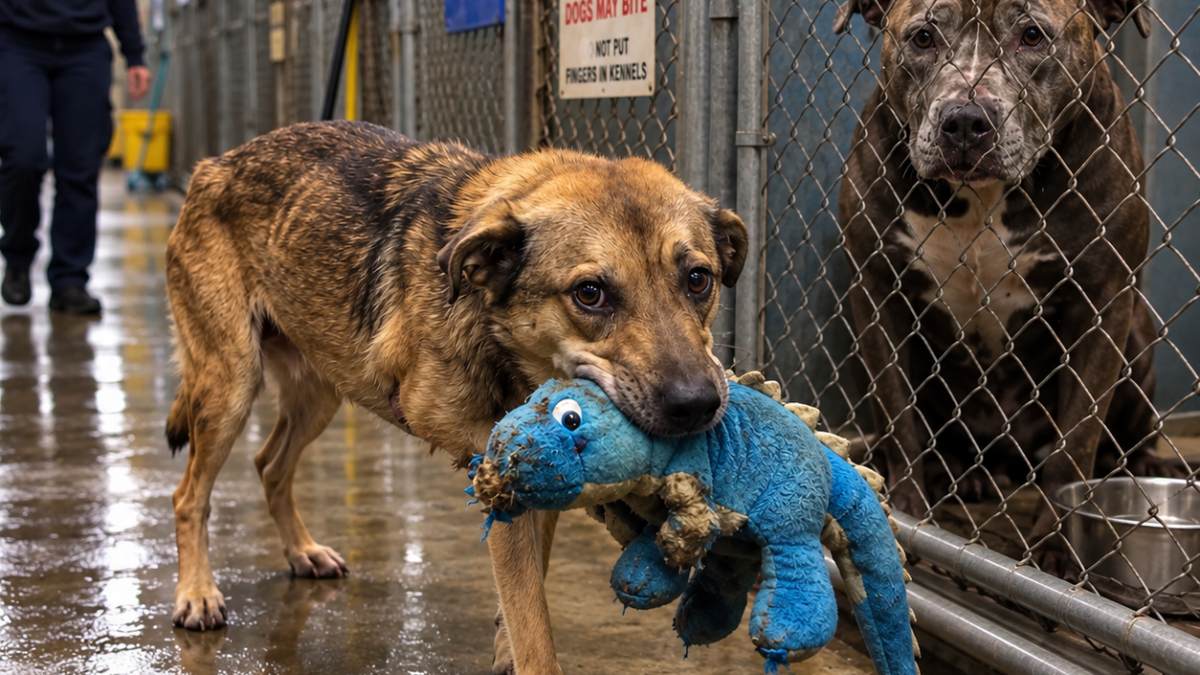
His muzzle, once steel-gray around the edges, has turned almost completely white. His legs are slower now. Some mornings, his hips need a few extra seconds before they remember how to carry him. When the weather turns cold, Lena warms his blanket in the dryer before bedtime and rubs his shoulders with both hands until his eyes close from relief.
He is still seventy pounds of blue-nosed Pit Bull, broad-headed and scarred, but time has softened the hard lines of him. His body no longer looks like a warning. It looks like a history.
The scars across his shoulders are still there. The little notch in one ear is still there. The thick calluses on his elbows from old concrete floors are still there too.
And Micah’s Bunny is still there.
The blue rabbit has survived more than any stuffed toy should reasonably survive. Lena has repaired it so many times that it is no longer just fabric and thread. It is patience. It is grief. It is memory stitched back together again and again.
One ear remains crooked no matter how carefully she fixes it. The blue fabric has faded into a soft gray-blue, the color of winter sky before snow. The stuffing has been replaced in places, but Lena was careful never to make it look new. Titan would not have wanted new. New would have smelled wrong, felt wrong, meant wrong.
The words on the belly are still protected beneath a clear stitched patch.
Micah’s Bunny.
Sometimes, when the light hits the patch just right, the letters look almost fresh. Other times, they look like something discovered in an old box after years of being forgotten.
But Titan never forgets.
Every night, before bed, he performs the same ritual.
He walks slowly from the living room to the corner where the rabbit rests during the day. He lowers his head, takes it gently in his mouth, and carries it to his blanket. He does not chew it. He does not shake it. He does not treat it like a toy.
He carries it like a responsibility.
Then he turns in a slow circle, eases his old body down with a sigh, places the rabbit between his front paws, and rests his chin beside it.
Only then does he sleep.
The first few months after Lena brought him home, he could not sleep without it touching his chest. If the rabbit slipped even a few inches away during the night, he woke in a panic, searching with his nose and paws until he found it again. Lena learned to wake at the first sound of his distress.
“I’m here,” she would whisper in the dark. “It’s here too.”
Then she would place the rabbit back against him.
Over time, the panic changed.
Not disappeared.
Grief never disappears the way people want it to. It changes shape. It learns to breathe differently.
Now Titan can sleep if the rabbit is nearby instead of pressed against him. Sometimes it rests beside his blanket. Sometimes Lena places it on the little shelf beneath Micah’s photo, and Titan checks it once before lying down.
But on difficult nights, stormy nights, anniversary nights, nights when something in the air feels too much like the past, Titan still carries it to bed and holds it like the world might slip away again if he loosens his grip.
Lena understands.
She has her own version of Micah’s Bunny.
A small box beneath her bed.
Inside are Micah’s hospital bracelet, a dinosaur sticker book with half the stickers missing, a blue knit hat he wore during treatment, and a birthday card he made for her with uneven letters and too many hearts.
She does not open the box every day.
But she knows where it is.
Titan knows where his rabbit is too.
That is how they live together now.
Not by pretending the loss never happened.
By making room for it without letting it swallow the entire house.
Rusty still visits when his arthritis allows.
He is older now too, and somehow more stubborn. His remaining front leg is stiff in the mornings, and his back legs wobble when he gets too excited. I bought him a padded harness to help him in and out of the car, but he acts deeply offended whenever I use it, as if dignity is more important than gravity.
The moment we turn onto Lena’s street, Rusty lifts his head.
He knows.
I do not know whether it is the smell of the neighborhood, the turns in the road, or some map dogs carry in their bones. But he always knows.
By the time we park in front of Lena’s apartment, Rusty is already trying to stand, impatient with my human slowness.
“Wait,” I tell him every time. “You are eighty years old in dog math and missing a leg. Give me three seconds.”
He never gives me three seconds.
Lena opens the door before I knock.
And behind her, Titan is always there.
The transformation that happens to that old Pit Bull when he sees Rusty is one of the purest things I have ever witnessed.
His tail starts first.
A slow thump.
Then faster.
Then his whole body joins in, shoulders wiggling, paws shifting, eyes brightening until the old dog who once shook behind a red warning tag becomes almost puppy-like with joy.
He always brings the rabbit.
Always.
He picks it up from wherever it is and carries it to Rusty as if reporting, once again, that he kept it safe.
Rusty sniffs it with great seriousness, like a retired inspector examining important evidence. Then, more often than not, he steps on it, sits beside it, or accidentally lies halfway across it because he has never been graceful a day in his life.
Titan forgives him every time.
Maybe because Rusty earned that right the night he walked toward Kennel 42.
Sometimes they lie together in Lena’s living room, two old dogs surrounded by all the things that prove they were not easy, not young, not convenient, and still completely worth loving.
Titan with Micah’s Bunny.
Rusty with his three legs and cloudy eyes.
Lena on the couch with tea cooling in her hands.
Me on the floor because somehow, despite being a grown woman, I always end up sitting with the dogs.
There are evenings when none of us talks much.
We just sit there.
The room is warm. The heater hums. Titan snores softly. Rusty twitches in his sleep. Lena looks at Micah’s photo on the shelf and smiles in a way that still carries sadness, but no longer only sadness.
That is healing too.
Not forgetting.
Not “moving on.”
Just reaching the point where remembering does not always cut the skin open.
The shelter changed after Titan.
At first, everyone thought the changes would fade. Shelters are busy places. Overworked places. Places where good intentions run out of time before they run out of animals needing help. New policies can look strong on paper and then disappear under the pressure of barking dogs, short staffing, emergency intakes, and too many decisions made too fast.
But Allison did not let Titan become a sad story people told for a few weeks and then forgot.
She made sure his story became structure.
The Comfort Item Protocol stayed.
Every animal surrendered with a personal item now has that item photographed at intake. The photo goes into the file. The item gets a label, a storage note, and handling instructions. If the animal panics when it is removed, that panic is not written down as simple aggression until someone asks why.
Every surrender form now has a section that cannot be skipped:
Does this animal have an attachment object?
Does it belong to a child, deceased owner, former home, or traumatic event?
What happens if the object is removed?
Can it be cleaned safely?
Should it remain with the animal at all times?
At first, some staff complained.
More paperwork.
More steps.
More things to remember.
Then a senior hound named Betsy came in after her owner entered hospice. She had a plaid scarf in her mouth. Under the old system, someone would have tossed it into laundry, washed away the scent, and returned it later if they remembered.
Under the new system, the scarf stayed with her.
Betsy cried for two days, but she did not shut down. She ate with the scarf beside her bowl. She slept with it under her chin. When her owner’s daughter came to visit before adoption, she saw the scarf and broke down crying because it had belonged to her father.
Another dog, a nervous shepherd mix named Apollo, arrived with a cracked plastic food bowl. It looked worthless. Old. Scratched. The kind of thing staff might have replaced immediately with stainless steel.
But his file said he had eaten from that bowl since puppyhood.
So it stayed.
Apollo guarded it for three days, then relaxed when he realized no one was taking it.
A little terrier came in with a baby blanket. A cat came in with a sweatshirt. A frightened husky came in with a child’s slipper, and nobody laughed because Titan had taught everyone that grief can choose strange containers.
The shelter started calling those things “anchors.”
Not toys.
Not belongings.
Anchors.
Objects that kept an animal from drifting completely away from everything familiar.
Titan’s Bunny became the reason staff asked better questions.
And Rusty became the reason they listened longer for the answer.
A sign still hangs outside the rehab room.
THE RUSTY RULE: LOOK TWICE BEFORE YOU LABEL.
Visitors sometimes ask about it.
Volunteers tell the story in pieces, careful not to turn Micah’s death into a performance. They say there was once a dog everyone thought was too dangerous, and another dog saw that he was grieving. They say a stuffed rabbit changed a death sentence. They say labels can be useful, but they should never become a cage around the truth.
Every time I pass that sign, I still feel something catch in my throat.
I was maintenance.
I still am, in many ways.
I still mop floors, haul laundry, clean drains, and refill dispensers. But after Titan, people stopped treating night shift observations like background noise. Allison added a section to behavior reviews for overnight notes.
Does the dog settle after midnight?
Does the dog sleep?
Does the dog cry when the building is quiet?
Does the dog guard only when staff approach, or does it guard even when alone?
Does the dog respond differently to other dogs than to people?
Does the dog change when a comfort item is present?
The first time I saw “overnight observations” printed on an official assessment form, I stared at it until the words blurred.
Rusty was lying beside my mop bucket, snoring like a broken engine.
“You did that,” I told him.
He opened one eye, decided I had no food, and went back to sleep.
Fame did not change him.
Snacks might have.
Dave changed too.
Not all at once.
Men like Dave do not become soft overnight. He had spent too many years making hard calls, too many years bracing himself against bites, failures, public anger, and the quiet exhaustion of animal welfare work. He had survived by building walls inside himself and calling them professionalism.
Titan cracked one of those walls.
At first, Dave only followed the new protocol because Allison required it. He checked forms, labeled items, documented comfort objects, and muttered under his breath the entire time.
Then one evening, I found him in the laundry room holding a child’s blanket that had come in with a frightened black Lab.
He was not washing it.
He was reading the label.
Owner deceased. Blanket from owner’s bed. Do not remove unless necessary.
Dave looked up when he saw me.
“Dog won’t stop crying when this leaves the kennel,” he said.
“So don’t take it.”
“It smells terrible.”
“Then clean around it. Spot-clean one corner at a time. Let him see it.”
He sighed.
“Titan ruined all of us.”
“No,” I said. “Titan fixed something.”
Dave did not answer.
But he carried the blanket back instead of throwing it into the washer.
That was change.
Not dramatic.
Not beautiful enough for a movie.
But real.
Later, I saw him sitting outside the Lab’s kennel, waiting while the dog ate with one paw resting on the blanket.
Dave did not see me watching.
I let him have the moment.
The best accountability is not humiliation.
It is transformation that keeps happening when no one is clapping.
Lena also changed, though she would never describe it that way.
For months after Titan came home, she spoke of herself like someone who had barely earned forgiveness. She kept saying, “I should have done more,” and “I should have found another way,” and “Micah trusted me.”
Grief makes a courtroom inside the mind, and the judge is never kind.
Titan helped quiet that judge.
Not by forgetting.
By needing her in the present.
He needed walks. Meals. Medication. Routines. Vet visits. Slow introductions. Nail trims. Warm blankets. A calm voice during storms. Someone to repair the rabbit when the seams loosened. Someone to laugh when he stole half a pancake off her plate and looked shocked that gravity had betrayed him.
Living animals pull grieving people forward because they need things.
Not someday.
Now.
And Titan needed Lena now.
So she got up.
Again and again.
At first for him.
Then, slowly, for herself too.
She started working part-time at a children’s library. She told me once that the first week nearly broke her because every small voice reminded her of Micah. But then a little boy asked for a dinosaur book, and instead of running to the bathroom to cry, Lena sat beside him and helped him choose one.
“I told him my son loved dinosaurs,” she said.
“How did that feel?”
She thought about it.
“Like saying his name kept him alive for one more minute.”
After that, she started saying Micah’s name more often.
At the shelter.
At the park.
At home.
Not constantly, not as a wound she forced open, but as a truth.
Micah existed.
Micah loved Titan.
Titan loved Micah.
Love like that deserved to be spoken.
One spring afternoon, Lena asked if Rusty and I would come with her to visit Micah’s grave.
I said yes before I had time to be afraid of saying the wrong thing.
The cemetery was quiet, the grass bright after rain. Titan walked slowly beside Lena, Micah’s Bunny in his mouth. Rusty limped beside me, stopping every few feet to smell things with the intense seriousness of an old dog investigating eternity.
Micah’s headstone was small.
Too small.
That was the first thought that hit me, and I hated it.
A child’s grave looks wrong in a way the mind cannot soften. The dates were carved beneath his name, and between them was a little engraved dinosaur.
Lena knelt.
Titan lowered himself beside her without being asked.
For a long time, she did not speak.
Then she placed one hand on Titan’s back and the other on the stone.
“Hi, baby,” she whispered. “Look who I brought.”
Titan placed the rabbit gently in front of the headstone.
My throat closed.
Rusty stood quietly for once, no sniffing, no wandering, no old-man stubbornness. He simply stood beside Titan like he understood this was not a place for foolishness.
Lena cried.
Not the frantic crying from that night at the shelter.
Not the kind that sounded like she was falling through the floor.
This was different.
This was sorrow with somewhere to go.
“I kept him,” she whispered. “I’m sorry it took me so long, but I kept him.”
Titan leaned against her side.
She stroked his head.
“He kept your bunny safe.”
The wind moved through the trees.
For a moment, everything felt painfully still.
Then Titan picked up the rabbit and turned back toward Lena, pressing it into her hands.
She laughed through tears.
“You’re right,” she said. “We take him with us.”
That day, I understood something I had not understood before.
Titan was not clinging to the bunny because he was trapped in the past.
He carried it because love had given him a job.
Keep this safe.
Keep him near.
Remember.
And he had done that job with the loyalty only dogs seem capable of offering without bitterness.
Near the end of Rusty’s life, Titan became gentle with him in a way that made me ache.
Rusty’s body started failing slowly. First the stairs became harder. Then getting into the car. Then standing after naps. He still wanted to come to the shelter, still wanted to visit Titan, still wanted to supervise my work as if I might forget how to mop without his guidance.
But some nights, he could not make the full rounds.
So Titan came to him.
Lena would bring him to the shelter lobby after hours, when the building was quiet and the floors still smelled of bleach. Rusty would be lying on his towel near the front desk, and Titan would walk in with the rabbit, tail wagging softly.
He never pounced.
Never overwhelmed him.
He would lower himself carefully beside Rusty, place the bunny between them, and rest his head down.
Two old dogs.
One saved by the other.
Both tired now.
Both loved.
One night, Rusty did not sniff the rabbit.
He only rested his chin on it.
Titan stayed completely still.
Lena and I looked at each other but said nothing.
A few weeks later, Rusty passed away in his sleep at home.
He was on his favorite towel.
Beside my bed.
Three legs tucked awkwardly under him like always.
Peaceful.
Quiet.
Old.
I found him before sunrise.
For a few seconds, I forgot how to breathe.
Then I sat on the floor beside him and placed my hand on his side, even though I already knew.
There is no preparing for the absence of a dog who taught you how to see better.
Lena came that afternoon with Titan.
I had not asked her to. I think grief called grief.
Titan entered my house slowly. He looked around for Rusty with the same searching confusion I had seen in so many dogs at the shelter. His nose moved over the towel, the bed, the doorway.
Then he found Rusty’s collar on the table.
He sniffed it once and made a soft sound.
Lena covered her mouth.
Titan carried Micah’s Bunny to Rusty’s towel and placed it there.
Then he lay beside it.
I broke then.
Fully.
Not pretty.
Not quiet.
Lena sat on the floor beside me and held my hand while Titan stayed with Rusty’s towel and the rabbit that had once saved him.
After Rusty died, I wondered if visiting Titan would hurt too much.
It did.
At first.
Everything did.
The empty passenger seat. The silent mop bucket. The towel by the supply closet. The way people said they were sorry and I knew they meant it, but I also knew sorry could not put his tag back on his collar.
But Titan helped.
Because the first time I visited Lena without Rusty, Titan came to the door with Micah’s Bunny in his mouth. He looked behind me.
Waited.
Looked again.
Then, slowly, he stepped forward and pressed the rabbit into my hand.
Not dropped it at my feet.
Pressed it into my hand.
Like an offering.
Like he had decided I needed the anchor now.
I sank to my knees and held that old blue rabbit against my chest.
“I miss him too,” I whispered.
Titan leaned his heavy head against my shoulder.
That was how grief moved again.
From Micah to Titan.
From Titan to Rusty.
From Rusty back to me.
Not ending.
Changing hands.
Changing shape.
Continuing.
Months later, Allison added Rusty’s photo beside the Rusty Rule sign. Not the famous one near Kennel 42. A new one.
Rusty standing in the shelter hallway with his ears crooked, his three-legged stance uneven, his cloudy eyes looking somewhere beyond the camera.
Under it, she placed a small plaque:
Rusty taught us that behavior is a question before it is an answer.
I stood in front of that plaque for a long time.
Dave stood beside me.
Neither of us spoke.
Then he said, “Good dog.”
I nodded.
“The best.”
Titan still visits the shelter, but now he is part of training.
Not as a demonstration animal. Lena would never allow that, and neither would I. He comes when he feels well, when the building is quiet, when the staff needs to remember why the protocols matter.
New volunteers meet him in the lobby.
They see an old Pit Bull with a blue rabbit and kind eyes.
Then Allison tells them what his file once said.
Extreme aggression.
Euthanasia scheduled.
Unadoptable.
Killer.
The volunteers always look shocked.
Good.
They should.
Shock is useful if it becomes humility.
Allison explains that Titan’s behavior was real. His fear was real. The risk was real. But the first interpretation was incomplete.
Then she tells them about Micah.
About the rabbit.
About Lena’s phone call.
About Rusty pressing his nose to the wire.
And she always ends with the same sentence:
“Never reduce an animal to the loudest thing it does when it is afraid.”
That sentence has saved more dogs than we can count.
Not all stories end like Titan’s.
I need to be honest about that.
Some dogs are dangerous in ways love cannot safely undo.
Some trauma is too deep for ordinary homes.
Some decisions remain heartbreaking even when they are responsible.
Titan did not teach us to ignore danger.
He taught us to ask better questions before deciding danger was the whole truth.
That difference matters.
It is the difference between fear and wisdom.
Between procedure and justice.
Between a red tag and a second chance.
Now, when I walk past Kennel 42, I still pause.
The kennel has housed many dogs since Titan.
A loud young shepherd who barked at every shadow.
A terrified mama dog who hid behind her water bowl.
A senior boxer surrendered after his owner entered a nursing home.
A skinny hound found near the highway.
A puppy who chewed three beds in two nights and looked proud of himself.
Kennel 42 is just a kennel again.
Concrete.
Chain-link.
A latch.
A drain in the floor.
But to me, it will always be the place where a condemned dog handed the truth to a three-legged mutt under the door.
It will always be the place where the wrong label almost became a death sentence.
It will always be the place where I learned that sometimes the most important part of rescue is not bravery.
It is curiosity.
The willingness to ask:
What am I missing?
What is this dog protecting?
What happened before this moment?
Who loved him?
Who did he lose?
What does he still carry?
Titan carried Micah’s Bunny.
Rusty carried wisdom.
Lena carried grief.
I carried a mop and almost walked past the truth.
That is the part I never let myself forget.
Because if Rusty had listened to me when I told him to come back, Titan would have died.
If I had followed protocol without question, Titan would have died.
If Lena had not answered the phone, Titan would have died.
If Allison had protected the shelter’s pride instead of admitting the mistake, Titan would have died.
So many thin threads held him above the dark.
A rabbit.
A phone number.
A three-legged dog.
A woman who drove two hours in the middle of the night.
A director willing to remove a red tag before sunrise.
People call that a miracle.
Maybe it was.
But miracles, in rescue, often look like someone choosing not to look away when looking closer might cost them something.
Today, Titan sleeps in a warm apartment.
Micah’s photo is on the shelf.
Rusty’s photo is beside it now too, because Lena insisted.
Micah’s Bunny rests under Titan’s chin on the nights he needs it, and on better nights, it waits beside him.
Lena says Titan dreams more softly now.
His paws twitch, but he does not wake crying as often.
Sometimes, when he dreams, his tail moves.
I like to imagine he is running somewhere without concrete floors.
Somewhere Micah is laughing.
Somewhere Rusty has all four legs again, or maybe still three because Rusty would not care either way.
Somewhere nobody wears red warning tags.
Somewhere no one mistakes grief for evil.
But then Titan wakes up in the real world.
This world.
The one that failed him and then tried to do better.
He lifts his white muzzle, checks for the rabbit, listens for Lena moving in the kitchen, and sighs because breakfast is late by his standards.
He is not a symbol to himself.
He is a dog.
An old dog who loves pancakes, warm blankets, short walks, Lena’s voice, and a blue rabbit that smells like every life he has survived.
That is enough.
More than enough.
And if you ask me what justice looked like for Titan, I will not say it looked like punishment.
No one went to prison.
No villain was dragged into the light.
No dramatic courtroom scene delivered perfect closure.
Justice looked like a red tag being removed at 4:00 in the morning.
Justice looked like a shelter rewriting a report.
Justice looked like Dave admitting he was wrong.
Justice looked like Marcy learning to ask before reaching.
Justice looked like a comfort item protocol that saved the next grieving dog.
Justice looked like Lena signing adoption papers with shaking hands.
Justice looked like Titan stepping into sunlight with Micah’s Bunny in his mouth.
Justice looked like Rusty’s name on the wall, teaching people long after his little body was gone.
And most of all, justice looked like an old Pit Bull, once called a vicious killer, growing old enough to need help standing up after naps.
That is the kind of ending people forget to pray for.
Not dramatic.
Not perfect.
Just time.
Time to heal.
Time to be understood.
Time to love and be loved after everyone thought the story was already over.
Titan was scheduled to die at eight o’clock that morning.
Instead, he lived long enough to become proof.
Proof that fear can wear the face of aggression.
Proof that grief can sound like a growl.
Proof that a toy can be testimony.
Proof that old dogs know things people miss.
Proof that no living soul should be reduced to the worst moment of its pain.
And every time I see Titan rest his white muzzle beside that old blue rabbit, I remember the truth Rusty found before any of us:
Sometimes the thing everyone calls dangerous is really just heartbreak begging not to lose one more thing.
And sometimes, if someone is brave enough to look closer, the condemned get to come home.