PART 2: They Declared My Search Dog Dead After the Avalanche—14 Days Later, a Photo Came Into the Station
PART 2
Atlas’s kennel was at the far end of the working-dog wing.
I walked there after leaving Grant’s office.
Every other dog reacted to my footsteps.
Ranger stood.
Milo barked once.
Koda pressed against his kennel gate.
Atlas’s space remained silent.
That silence hurt more than the avalanche.
His water bowl sat beside the wall.
His blanket was folded in the corner.
And near the kennel door was a faded yellow tennis ball.
His favorite.
I crouched and picked it up.
Atlas had probably owned fifty tennis balls in his life.
He destroyed most of them within days.
But that one had survived almost a year.
The felt was torn.
One side was permanently dented.
I squeezed it.
Nothing.
The squeaker had died months earlier.
Atlas loved it anyway.
I set it back exactly where it had been.
Then I took his water bowl to the sink.
Rinsed it.
Filled it with fresh water.
A young volunteer named Eli watched from the doorway.
He was nineteen.
New to the station.
He had been with us only three months.
He hesitated before speaking.
“Nathan?”
“Yeah?”
“Do you want me to clean the kennel?”
“No.”
“I meant just the floor.”
“No.”
He nodded.
I could see the question on his face.
I wasn’t angry at him.
“Leave everything.”
“For how long?”
I looked at the empty bed.
“Until he comes back.”
Eli lowered his eyes.
“Yes, sir.”
I hated the sympathy.
Not because he meant anything wrong by it.
Because sympathy is what people give you when they think hope has become delusion.
By Day Three, I was hearing that tone everywhere.
People spoke more softly around me.
Conversations stopped when I entered rooms.
Somebody removed Atlas’s name from the active search-dog roster.
I put it back.
Grant found me doing it.
“Nathan.”
“He’s still active.”
“He’s missing.”
“Then write missing beside his name.”
“That roster is for operational teams.”
“He is an operational dog.”
“Not right now.”
I turned.
“Then neither am I.”
Grant stared.
“What does that mean?”
“You take him off, take me off.”
“That’s ridiculous.”
“So leave his name alone.”
For a moment, I thought he might order me out.
Instead, he rubbed his face.
“You need sleep.”
“I need maps.”
“Nathan—”
“The avalanche carried debris farther east than the first estimates.”
“We know.”
“No. The debris field did. That doesn’t tell us where a dog went if he stayed above part of the slide or got pushed laterally.”
“Laterally where?”
“I’m working on it.”
He sighed.
“You’re trying to solve this like a search mission.”
“It is a search mission.”
“It’s a recovery now.”
I stepped closer.
“No body means no recovery.”
Grant didn’t argue after that.
Maybe because he knew he wouldn’t win.
Maybe because, despite everything, a small part of him wasn’t completely sure either.
I spent that night in the mapping room.
Satellite images.
Topographic overlays.
Avalanche runout models.
Drainage channels.
Timber breaks.
Old forestry roads.
I marked everything.
Atlas had disappeared in a secondary collapse below a ridge line approximately eleven miles from the station.
The first search had focused on the main deposition zone.
That made sense if Atlas had been buried.
But what if he hadn’t?
What if the snow had carried him?
What if he had been thrown toward one of the drainage corridors?
What would an injured dog do?
Find shelter.
Find water.
Move downhill.
Eventually search for people.
Atlas wasn’t a wild animal.
He was trained to seek human scent.
Movement.
Structures.
Roads.
Anything familiar.
I circled three valleys east and south of the slide.
At 2:00 a.m., Marcus Reed, one of our senior handlers, walked in carrying coffee.
“You look terrible.”
“Thanks.”
He handed me a cup.
“What are you doing?”
“Trying to think like Atlas.”
“That sounds dangerous.”
I almost smiled.
He leaned over the maps.
“You think he came out of the slide?”
“I think we don’t know he didn’t.”
Marcus studied the terrain.
“If he got pushed into Miller drainage…”
“He could reach timber.”
“Eventually.”
“And water.”
“If his legs worked.”
I didn’t answer.
Marcus regretted the sentence immediately.
“Sorry.”
“No. You’re right.”
Atlas could have survived the initial avalanche and died twenty feet away.
Could have broken his spine.
Could have bled internally.
Could have been buried in a secondary pocket.
Could have survived for a day and frozen.
There were a hundred ways this ended badly.
I knew every one.
But uncertainty cuts both directions.
If I couldn’t prove he lived, they couldn’t prove he died.
That was enough.
For me, anyway.
On Day Four, we took two snowmobiles into the lower drainage.
Marcus came with me.
Grant technically didn’t approve the mission.
He also didn’t stop us.
Visibility was poor.
We searched old logging access roads and tree wells.
I called Atlas until my throat burned.
Nothing.
We found deer tracks.
Coyote tracks.
A torn glove.
A broken ski pole from some older incident.
No dog.
Day Five brought another storm.
We couldn’t access the mountain.
I drove forestry roads instead.
Stopped at ranger stations.
Gas stations.
Cabins.
Showed people Atlas’s photograph.
“Black-and-white Border Collie.”
“About sixty pounds.”
“Red search collar.”
“Possibly injured.”
A woman at a rural grocery store pinned the flyer beside the register.
A logger took three copies.
A school bus driver promised to watch the roadside.
I gave out my personal number.
Station number.
Dispatch number.
Anything.
That evening, I returned to Station 14.
Filled Atlas’s water bowl.
Checked his kennel.
Went home.
My wife had been gone for six years.
Cancer.
Atlas had come into my life not long afterward.
People assumed I had gotten him because I needed companionship.
That wasn’t exactly true.
Atlas had already been selected as a working prospect.
I was assigned to train him.
At first, I didn’t want a dog living with me.
I wanted work to stay work.
He destroyed that boundary within three days.
The first night I brought him home, he refused the expensive dog bed and slept across the doorway to my bedroom.
The second night, same thing.
By the end of the week, I stopped pretending he was temporary.
He learned my routines faster than I learned his.
5:15 a.m.—alarm.
5:17—Atlas’s nose against my hand.
5:20—coffee.
5:35—training walk.
He knew the sound of rescue gear being loaded.
Knew the difference between my hiking boots and duty boots.
Knew when a radio call meant business.
And somehow knew when I was having a bad night without me saying anything.
After my wife died, I had learned to hide grief from people.
Atlas never cared about hiding.
If I sat awake at 3:00 a.m., he sat with me.
No questions.
No advice.
No pity.
Just presence.
On Day Six, Grant officially reassigned most of the search teams.
He told me privately before the morning briefing.
“I’m reducing manpower.”
“I expected that.”
“We have two active missing-person cases.”
“They need the teams.”
“Yes.”
“I’m not arguing.”
That surprised him.
“I’ll keep searching on my own time.”
“Nathan.”
“What?”
“If you get hurt looking for him, I have to send people after you.”
“I know the mountains.”
“So did Atlas.”
The words hit hard.
Grant closed his eyes.
“That came out wrong.”
“No.”
I stared through the operations window.
“It came out exactly right.”
He lowered his voice.
“I lost a dog twenty years ago.”
I turned.
Grant had never told me that.
“Search dog?”
“German Shepherd. Boone.”
“What happened?”
“River rescue. Spring runoff.”
I said nothing.
“He got swept.”
“Did you find him?”
“Three days later.”
I knew what he meant.
“I’m sorry.”
Grant nodded.
“After that, I learned there’s a point where hope becomes dangerous.”
“And I learned Atlas.”
He looked at me.
For once, there was no frustration.
Just two men who loved dogs differently because grief had taught us different lessons.
“I won’t stop you from searching,” he said.
“But I won’t send teams into unacceptable risk.”
“I wouldn’t ask you to.”
“And when this ends…”
“It hasn’t ended.”
Grant gave a tired smile.
“No. I suppose not.”
Day Seven.
No sign.
Day Eight.
Nothing.
The avalanche report was updated.
Probability of survival was listed as effectively negligible.
I read it.
Folded it.
Added it to the first report in my jacket.
By then, the papers were soft around the edges.
I carried them everywhere.
Maybe because I wanted to stay angry.
Anger was easier than fear.
Fear whispered questions when the station got quiet.
What if Atlas had been waiting somewhere while I searched the wrong valley?
What if he had heard helicopters but couldn’t move?
What if he was trapped beneath branches?
What if he had survived the avalanche only to die slowly because I failed to find him?
Those thoughts came at night.
I fought them with maps.
Day Nine.
A report came from a hunting cabin six miles south.
Black-and-white animal seen near the treeline.
Marcus and I drove out.
Coyote.
Day Ten.
Dog tracks near a riverbank.
Too small.
Day Eleven.
A farmer reported barking near his barn.
Golden Retriever.
I thanked him anyway.
Day Twelve.
Nothing.
That evening, I stood in Atlas’s kennel holding his tennis ball.
Eli appeared.
He didn’t say anything.
He just sat outside the gate.
After several minutes, I spoke.
“They think I’m crazy.”
Eli looked toward me.
“Some do.”
“Thanks.”
“You asked.”
I laughed once.
He smiled.
Then he became serious.
“My dad was missing in Afghanistan for eight days.”
I looked at him.
“I didn’t know.”
“He came back.”
“Alive?”
“Yeah.”
Eli nodded.
“Everyone told my mom not to assume anything. She said the same thing you keep saying.”
“What?”
“Not until I know.”
I looked down at the ball.
“Your dad was a person.”
“So?”
“A trained soldier.”
“So is Atlas, basically.”
I smiled despite myself.
Eli shrugged.
“I don’t know if your dog’s alive.”
There it was.
Not false hope.
Not pity.
“I just don’t think wanting proof makes you crazy.”
“Thank you.”
He stood.
“For what?”
“For saying ‘I don’t know.’”
Most people had stopped saying that.
They said Atlas was gone.
Dead.
Lost.
Finished.
Eli gave me the only answer the evidence actually supported.
We didn’t know.
Day Thirteen arrived with clear skies.
For the first time since the avalanche, helicopters could fly extended routes.
I convinced Grant to authorize one final aerial survey of the eastern drainage.
He agreed under one condition.
“This is the last dedicated flight.”
I hated the words.
But I nodded.
We flew three hours.
Nothing.
White valleys.
Black timber.
Frozen rivers.
No Atlas.
When we landed, Grant met me near the pad.
He didn’t ask.
My face told him.
That night, I went home earlier than usual.
The house was silent.
Atlas’s food bin stood near the pantry.
His second leash hung by the door.
There was dog hair beneath the couch.
I had never cleaned it.
I sat on the floor.
For the first time in thirteen days, I allowed myself to imagine he might truly be gone.
I pictured the avalanche.
The white cloud swallowing him.
I heard my own voice screaming his name.
My chest tightened until breathing hurt.
I pressed both hands against my face.
“I’m sorry, buddy.”
The words came out before I could stop them.
“I’m sorry.”
Then I got angry at myself.
I stood.
“No.”
Atlas had never stopped a search because something looked hopeless.
Neither would I.
I slept three hours.
At 5:42 a.m. on Day Fourteen, my phone rang.
Unknown number.
I almost ignored it.
Then answered.
“Cole.”
“Is this Nathan Cole from Mountain Rescue?”
“Yes.”
“My name’s Ray Danner. I work forestry east of Coldwater Ridge.”
I was instantly awake.
“What happened?”
“We saw a dog.”
My heart began pounding.
“What kind?”
“Black-and-white. Medium sized. Pretty rough shape.”
“Where?”
“Old ranger cabin past Dry Creek access.”
That was nearly twelve miles from the avalanche zone.
Too far.
Impossible.
Maybe.
“What did he look like?”
“Thin. Limping.”
I gripped the phone harder.
“Did he have a collar?”
“Couldn’t tell. He wouldn’t let us close.”
“Did you get a photo?”
“My partner did.”
“Send it.”
I gave him my number.
The next thirty seconds lasted an hour.
My phone vibrated.
Image received.
I opened it.
A black-and-white dog stood near a line of trees.
Head low.
Coat filthy.
Ribs visible even through winter fur.
One hind leg barely touching the ground.
The image was grainy.
Distance.
Poor light.
Most people would have needed a better picture.
I didn’t.
There was a black patch over the left eye.
A white streak cutting unevenly across the muzzle.
A notch in the right ear from a training accident years earlier.
And the stance.
Atlas always carried more weight over his right shoulder when tired.
My hands started shaking.
“Atlas.”
Ray was still on the phone.
“That him?”
I couldn’t answer for a second.
Then:
“Yes.”
I was already moving.
“Yes. That’s him.”
I called dispatch.
No greeting.
“Get Grant.”
“What?”
“GET GRANT.”
Thirty seconds later, Grant came on.
“Nathan?”
“He’s alive.”
Silence.
“What?”
“Atlas is alive.”
“Nathan—”
“I have a photo.”
Another silence.
“Send it.”
I did.
Ten seconds.
Then Grant said one word.
“Jesus.”
Within five minutes, Station 14 exploded into motion.
People who had quietly accepted Atlas’s death ran through hallways grabbing gear.
Maps came out.
Vehicles started.
Radios activated.
Eli nearly collided with me at the equipment cage.
“They found him?”
“Yes.”
His face broke into a grin.
“I knew it.”
“No, you didn’t.”
“Fine. I hoped it.”
“Better.”
Grant walked into operations holding the photograph.
He looked at me.
Then at the folded report sticking from my jacket pocket.
He shook his head once.
“You impossible son of a—”
“Where are we inserting?”
“Forestry access here.”
He pointed at the map.
“Ground teams from north and west. Helicopter standing by but tree cover is heavy.”
“I’m going.”
“I assumed.”
“Marcus too.”
“Already suited up.”
Nobody mentioned the previous reassignment.
Nobody mentioned presumed dead.
Not yet.
We drove east.
The forestry crew waited near a closed service road.
Ray met us.
“You Nathan?”
“Yes.”
He pointed toward the trees.
“Saw him here around 5:20. He came out near the cabin, sniffed around, then disappeared when we approached.”
“Did he run?”
“Sort of.”
“What does that mean?”
“He tried.”
That terrified me.
“How bad?”
“Bad enough.”
I showed him Atlas’s tennis ball.
“Any chance he saw something like this?”
Ray shook his head.
“No.”
I put the ball in my pocket.
We followed tracks.
The snow was uneven.
One set of paw prints.
Three normal impressions.
One shallow drag.
Three normal.
Drag.
Atlas was favoring a hind leg.
There were small blood spots in places.
Marcus crouched.
“Pads.”
I nodded.
We moved faster.
The trail entered thick timber.
Atlas had been walking along lower terrain.
Exactly what we predicted.
Water.
Shelter.
Reduced wind.
He had survived by making smart decisions.
Or instinctive ones.
Probably both.
The tracks disappeared near exposed rock.
We spread out.
“Atlas!”
My voice echoed.
Nothing.
Again.
“ATLAS!”
Marcus called from farther downslope.
No response.
We searched for an hour.
Then two.
Found scat.
Fresh enough.
Atlas was close.
I radioed the team.
“Hold vehicle movement. No sirens. No unnecessary noise.”
An injured dog in survival mode might avoid strangers.
Atlas knew rescue uniforms.
But two weeks alone changes behavior.
Pain changes behavior.
Hunger changes behavior.
We had to let him choose.
At 11:17, one of the team members found fur caught on a branch.
Black.
White.
I held it.
Fresh.
We continued.
At noon, snow started again.
Light.
But increasing.
My fear sharpened.
Not another storm.
Not now.
We reached a narrow valley.
Rock wall on one side.
Dense fir on the other.
A partially frozen stream ran through the center.
Marcus stopped.
“Look.”
Across the water were prints.
We followed.
They led toward an overhang beneath exposed rock.
Dark opening.
Protected from wind.
My heart slammed against my ribs.
I approached slowly.
“Atlas?”
Nothing.
I crouched.
“Buddy?”
A sound.
So quiet I almost missed it.
A low whine.
My knees nearly gave out.
“Atlas.”
Movement in the shadow.
Then two eyes.
He stepped forward.
I stopped breathing.
There he was.
Or what two weeks in the mountains had left of him.
His coat was tangled with ice and mud.
His ribs showed.
Blood darkened one side of his chest.
Parts of both ears looked frostbitten.
His rear leg trembled.
His paw pads were raw.
But his eyes—
His eyes were Atlas.
He stared at me.
For half a second, neither of us moved.
Then his ears lifted.
“Nathan,” Marcus whispered.
I held out my hand.
“Come on, buddy.”
Atlas tried to step.
His rear leg buckled.
He caught himself.
I moved instinctively.
Marcus grabbed my shoulder.
“Let him come.”
He was right.
An injured animal can panic even with the person he loves.
So I waited.
Atlas took another step.
Then another.
His nose worked.
Scent.
Recognition.
His tail moved.
Barely.
One weak sweep.
Then another.
I couldn’t see through the tears anymore.
“Yeah.”
My voice broke.
“It’s me.”
Atlas started toward me faster.
Too fast.
His leg failed again.
This time I caught him.
He collapsed against my chest.
I wrapped both arms around him.
And that dog—
That stubborn, impossible dog—
made a sound I had never heard from him before.
Half whine.
Half sigh.
Then he buried his face against my neck.
I dropped completely to the snow.
“I’ve got you.”
My hands shook as I touched him.
“I’ve got you.”
Marcus turned away.
I heard him swear softly.
Atlas tried licking my face.
His tongue barely reached.
“You idiot.”
I was crying.
Laughing.
Angry.
Relieved.
Everything.
“You absolute idiot.”
His tail hit the snow.
Once.
Twice.
I pressed my forehead against his.
“Fourteen days.”
Atlas closed his eyes.
“You made me look insane for fourteen days.”
Another weak tail movement.
Marcus crouched beside us.
“Medical team’s coming.”
I nodded.
Atlas’s body was cold.
Too cold.
His pulse was fast.
He had cuts along his chest.
One smelled infected.
His gums were pale.
He needed fluids.
Antibiotics.
Pain control.
Heat.
Everything.
But he was alive.
That word became sacred.
Alive.
The veterinary rescue team reached us twenty minutes later.
Atlas refused the stretcher at first.
Not violently.
He simply kept trying to stay against me.
“It’s okay.”
I held his face.
“These are our people.”
His eyes followed mine.
“You know the job.”
We loaded him.
I kept one hand on his shoulder the entire way to the helicopter.
Grant met us at the extraction point.
He saw Atlas.
Stopped.
No words.
Atlas lifted his head.
Grant crouched.
“Son of a bitch.”
Atlas’s tail moved.
Grant laughed and covered his mouth.
He looked at me.
“I was wrong.”
I stared at him.
For fourteen days, I had imagined that moment.
I thought I would feel victorious.
Smug.
Maybe angry.
Instead, I was too tired.
“He’s alive.”
Grant nodded.
“That’s enough.”
“No.”
He looked at me.
I smiled.
“It’s more than enough.”
The flight back to Station 14 felt unreal.
Atlas lay beneath thermal blankets.
IV running.
Veterinarian beside him.
I sat on the floor of the helicopter.
One hand against his neck.
Every few minutes, his eyes opened.
Checked for me.
Closed again.
“You can sleep.”
I leaned closer.
“You finally found me.”
The veterinarian corrected me.
“You found him.”
I looked at Atlas.
“No.”
I understood something then.
“We met in the middle.”
News reached the station before we did.
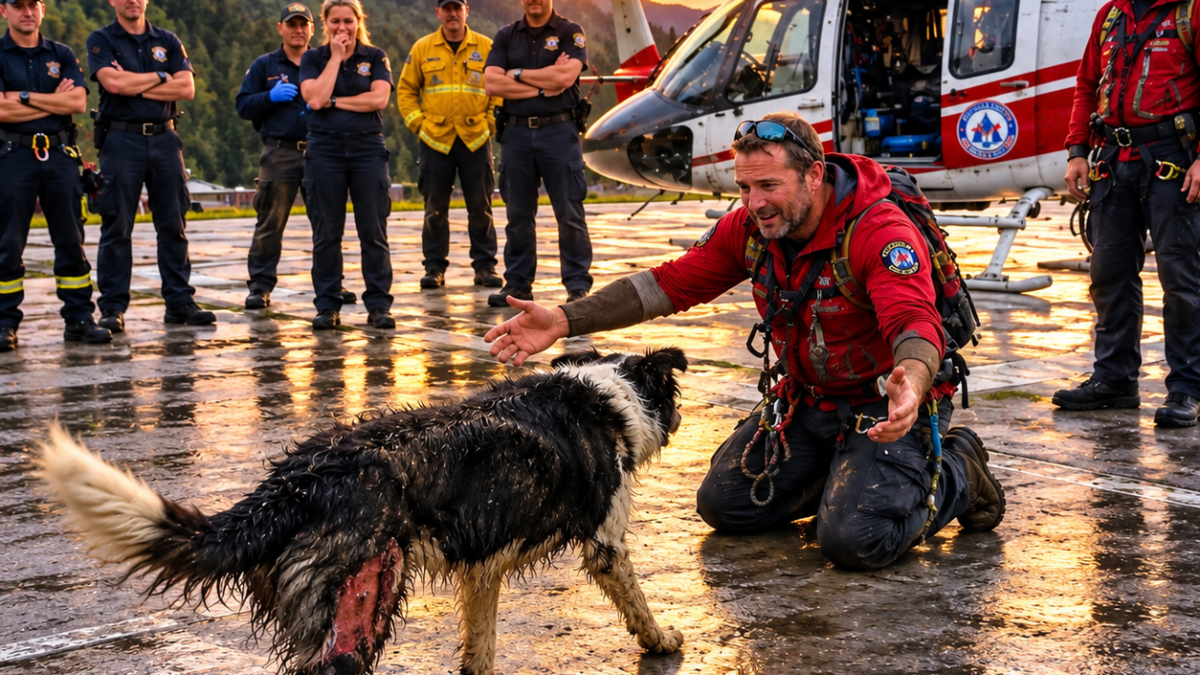
When the helicopter landed shortly after sunset, I saw people outside.
Dozens.
Volunteers.
Handlers.
Dispatch staff.
Maintenance crew.
People who weren’t even scheduled.
Everyone.
The door opened.
The veterinarian stepped down.
Then we helped Atlas stand.
She wanted him carried.
Atlas disagreed.
Of course.
“Let him try,” I said.
He stepped down slowly.
The entire crowd went silent.
Atlas scanned faces.
Marcus.
Eli.
Grant.
Handlers.
Volunteers.
Then me.
His ears lifted.
I had walked several yards away so the medical staff had room.
Atlas pulled gently against the support sling.
The vet looked at me.
“He wants you.”
I knelt.
“Come on.”
Atlas walked.
Painfully.
One step.
Another.
The crowd opened.
Nobody reached for him.
Nobody called.
They understood.
This part belonged to Atlas.
Halfway to me, his leg weakened.
He kept going.
“Easy.”
He ignored me.
Same old dog.
When he reached me, he leaned his entire weight against my legs.
I wrapped him up.
Someone behind me started crying.
Then someone else.
I didn’t care who saw me.
I buried my face in Atlas’s neck.
“You came home.”
He exhaled.
That was the moment the report inside my jacket stopped mattering.
But I wasn’t finished with it.
Atlas spent the next several hours in the station’s veterinary treatment room before transfer to a specialist clinic.
Dehydration.
Severe weight loss.
Soft-tissue trauma.
Deep abrasions.
Torn paw pads.
Frostbite.
Infection.
Rear-leg injury.
But no spinal fracture.
No catastrophic organ damage.
The veterinarian stared at his bloodwork.
“He shouldn’t look this good.”
I laughed.
“He looks terrible.”
“You know what I mean.”
“How close?”
She hesitated.
“Nathan.”
“How close?”
She glanced through the glass.
Atlas slept beneath heated blankets.
“A few more days out there?”
She didn’t finish.
She didn’t need to.
I sat beside him until nearly midnight.
Then walked outside.
Snow had stopped.
Behind the station was an old metal barrel used for burning damaged paper records and untreated wood from training exercises.
Grant was outside smoking.
He had quit six months earlier.
Apparently tonight had defeated his discipline.
I reached inside my jacket.
Pulled out the report.
Fourteen days of folds.
Creases.
Sweat.
Snow.
MISSING AND PRESUMED DECEASED.
Grant looked at it.
I held out my hand.
“Lighter.”
He almost smiled.
“You sure?”
“I’ve never been more sure of anything.”
He handed it over.
I lit the corner.
Flame curled across the paper.
The words blackened first.
Presumed.
Deceased.
I dropped it into the barrel.
Grant stood beside me.
Neither spoke until nothing remained but ash.
Then he said:
“You kept this the whole time?”
“Yeah.”
“Why?”
“I was waiting to correct the record.”
He nodded.
“You were right.”
I looked toward the recovery room.
“No.”
“What?”
“I was stubborn.”
“Nathan—”
“I didn’t know.”
That mattered.
I turned toward him.
“I believed.”
Grant was quiet.
“Different thing.”
“Maybe.”
“It matters.”
He flicked his cigarette into a metal can.
“For what it’s worth, I’m glad you didn’t sign.”
“So am I.”
Atlas transferred to a veterinary surgical center the next morning.
His rear leg had ligament damage but no major fracture.
The infected wounds needed aggressive treatment.
His paws worried the doctors most.
Some tissue had been damaged badly by frozen terrain.
One veterinarian told me:
“He probably kept moving when every step hurt.”
I looked at Atlas.
“That sounds like him.”
“But why?”
Nobody could answer that medically.
Food had clearly been scarce.
Based on his digestive contents and later investigation, he had probably eaten small rodents, vegetation and whatever scraps he found near forestry structures.
He drank from streams.
Sheltered beneath rock.
Possibly slept inside the abandoned ranger cabin for at least one night.
His path was reconstructed from sightings, paw prints and terrain.
The avalanche likely carried him nearly two miles from the primary search area.
Not twelve.
Two.
But after recovering from the initial shock, Atlas moved.
And moved.
And kept moving.
Following drainage corridors.
Wildlife paths.
Low valleys.
Occasional human scent.
Eventually traveling nearly twelve miles from the avalanche zone.
Some reporters later described it as Atlas “trying to get home.”
We couldn’t prove that.
Dogs don’t explain motives.
But I knew his training.
Atlas searched toward human activity.
Toward familiar scents.
Toward structures.
Toward roads.
Toward us.
Call that training.
Call it instinct.
Call it love.
I never cared which.
During the first week of hospitalization, I slept in a chair beside his enclosure whenever staff allowed me.
Atlas hated the clinic.
He tolerated the people.
But every time I left, he became restless.
So I stayed.
One night, the veterinarian found me asleep sitting upright.
“You know we have hotels.”
“I know.”
“He’s sedated.”
“I know.”
“He won’t know you left.”
I opened one eye.
“I will.”
She stopped arguing.
Atlas’s recovery was slow.
He had lost almost seventeen pounds.
For a Border Collie his size, that was enormous.
His body had burned everything available to keep moving and stay warm.
The pads of his feet had to heal layer by layer.
For weeks, he wore protective booties.
He hated them.
The first time we put all four on, he lifted his feet one at a time like the floor had become lava.
I laughed so hard I nearly fell over.
The veterinarian frowned.
“He’s adjusting.”
“He looks ridiculous.”
Atlas glared at me.
“Sorry, buddy.”
He turned his head away.
“Don’t be dramatic.”
He remained offended for twenty minutes.
That was the first moment I truly believed he would recover.
Not because of the medical numbers.
Because Atlas had enough energy to be irritated.
By Week Three, he could walk short distances.
By Week Five, the infection was gone.
By Week Seven, his coat began looking like his again.
The damaged parts of his ears healed with small permanent changes.
One edge remained slightly uneven.
I loved it.
A scar from the mountain that failed to keep him.
The station raised money for his care.
I hated asking.
Grant did it without telling me.
Donations came from people Atlas had helped rescue.
One check arrived from a family whose daughter Atlas found four years earlier.
She had wandered away from a campground at age six.
Atlas found her asleep beneath a fallen tree after midnight.
The note said:
He brought our girl home. Help us bring him home too.
I read it alone.
Then again.
Then I cried.
A former climber sent money.
A hunter.
A teacher.
Families.
Strangers.
Children mailed tennis balls.
Dozens of them.
Blue.
Green.
Orange.
Yellow.
Atlas ignored every one.
He wanted his destroyed yellow ball from the station.
I brought it.
He put his head on top of it and slept.
“Unbelievable.”
The nurse smiled.
“That old thing?”
“Apparently sentimental value.”
“Dogs have sentimental value?”
I looked at Atlas.
“Some do.”
Meanwhile, the station conducted an internal review of the avalanche response.
I didn’t ask for one.
Standard procedure required it.
But Grant came to me one evening with a draft.
“We’re changing the search model.”
“How?”
“Expanded drift radius for working dogs caught near secondary slides.”
I looked at him.
“That’s because of Atlas?”
“Partly.”
He placed the document down.
“We treated his disappearance too much like a buried-subject scenario.”
“He was mobile.”
“Exactly.”
“You didn’t know that.”
“No.”
“Neither did I.”
“But we should’ve modeled it earlier.”
Grant tapped another paragraph.
“And we’re changing language in canine loss reports.”
I read it.
Missing.
Status pending evidence.
Presumed deceased designation required expanded review if remains are not recovered.
I looked up.
“You did this?”
“Committee did.”
“Because I was obnoxious?”
“That was cited informally.”
I smiled.
Grant leaned back.
“You wanted revenge on the paperwork?”
“I never said revenge.”
“You burned a government form in a barrel while smiling.”
“Fair.”
He smiled too.
“Now the paperwork lost.”
That mattered more than I expected.
Atlas had changed procedure.
The next search dog who vanished wouldn’t necessarily be written off in twelve hours.
The next handler might receive more time.
More modeling.
More uncertainty.
Not endless risk.
Not blind hope.
But a wider question before closure.
That was Atlas.
Even when the mission was supposedly his own survival, he ended up helping somebody else.
Three months after the avalanche, the lead veterinarian called me into a consultation room.
Atlas lay beside my chair.
His coat had returned.
Weight nearly normal.
Paw pads healed.
Rear leg functional.
But not perfect.
The veterinarian looked at me carefully.
I knew.
“He can’t return.”
She nodded.
“To full search duty?”
“To operational wilderness rescue.”
I looked at Atlas.
He was chewing the ruined tennis ball.
“Because of the leg?”
“Partly. Also cumulative age and trauma.”
“He’s nine.”
“Exactly.”
“He’d work tomorrow if I let him.”
“I know.”
“That’s the problem.”
She smiled gently.
“Working dogs rarely retire themselves.”
I stared at him.
For five years, Atlas had been beside me on every serious mission.
The idea of entering a search without him felt wrong.
Like going onto the mountain without boots.
“I can keep him active in demonstrations?”
“Yes.”
“Training?”
“Light.”
“Station visits?”
“Absolutely.”
“No backcountry deployments.”
“No.”
I nodded.
Atlas looked at me.
“Congratulations.”
His ears lifted.
“You’re unemployed.”
He wagged his tail.
“Of course you’re happy.”
I wasn’t.
Not yet.
Retiring Atlas meant accepting that something had ended.
I was better at fighting endings than accepting them.
The station planned a ceremony for spring.
I objected.
Grant ignored me.
“You don’t get a vote.”
“He’s my dog.”
“He belongs to the station too.”
“No, he doesn’t.”
“Emotionally.”
“Still no.”
“We already invited people.”
“What people?”
Grant looked suspiciously pleased.
“You’ll see.”
The ceremony was held on a clear April afternoon.
Snow still capped the peaks, but the valley had begun turning green.
I arrived with Atlas wearing his search vest for the last time.
He knew the vest.
The moment I picked it up at home, his whole body changed.
Alert.
Ready.
He ran to the door.
My chest tightened.
“Not a mission.”
Tail wag.
“Don’t look at me like that.”
More wagging.
At the station, nearly two hundred people were waiting.
I stopped the truck.
“What did they do?”
Atlas barked once.
“I agree.”
Former rescue survivors stood near the front.
Families.
Children.
Volunteers.
Local firefighters.
Forestry workers.
The crew who had photographed Atlas near the ranger cabin.
Ray saw us and waved.
Atlas recognized him.
Or maybe simply smelled someone familiar from that final day.
A little girl approached me.
I recognized her after a moment.
Mia Carter.
Atlas had found her during that campground search years earlier.
She was ten now.
She held a tennis ball.
Blue.
“Is this for him?”
She nodded.
“He saved me.”
Her mother stood behind her crying already.
I crouched.
“He had some help.”
Mia shook her head.
“My mom says he found me.”
I looked at Atlas.
“Yeah.”
I swallowed.
“He did.”
She offered him the ball.
Atlas sniffed it.
Then looked at me.
“Be polite.”
He took it.
Mia smiled.
Then Atlas immediately dropped it and went back to his old yellow one.
I covered my face.
“Sorry.”
Mia laughed.
“It’s okay.”
Grant gave a speech.
Too long.
Marcus gave a speech.
Embarrassing.
The veterinarian spoke.
The forestry team spoke.
Then Grant called me forward.
I hated public speaking.
Atlas stood beside me.
His vest displayed the rescue insignia.
Search-and-rescue certification patches.
Years of work reduced to fabric symbols.
Grant held a framed display.
Inside was Atlas’s official search vest replica, photographs and service record.
“Atlas participated in seventy-three operational searches,” Grant said.
I hadn’t realized anyone had counted.
“Contributed directly to twenty-six confirmed live finds.”
The crowd applauded.
I looked down.
Atlas was distracted by a child eating crackers.
Perfect.
Grant continued.
“He served with distinction through severe weather, wildfire evacuations, mountain incidents and wilderness operations.”
Then Grant paused.
“And once, apparently, conducted a fourteen-day solo search for his handler.”
People laughed.
I did too.
Grant looked at me.
“Come say something.”
“No.”
The crowd laughed harder.
He handed me the microphone anyway.
I stared at it.
Then at Atlas.
Then the people.
“I had a speech.”
I hadn’t.
“Atlas ate it.”
More laughter.
I took a breath.
“The report said he was presumed dead.”
The crowd quieted.
“A lot of people have asked why I refused to sign it.”
I looked toward Grant.
He nodded.
“I wish I could tell you it was because I had some brilliant insight.”
I shook my head.
“I didn’t.”
“I didn’t know Atlas was alive.”
People listened.
“I just knew I didn’t know he was dead.”
That distinction had become important to me.
“And when you work beside a dog like this long enough, you learn to respect what you don’t know.”
Atlas sat.
I rested my hand on his head.
“He has found people I thought were impossible to find.”
“He has followed trails I couldn’t see.”
“He has worked when I wanted to stop.”
“So when everyone told me he was gone, I had one problem.”
I smiled.
“Atlas had spent five years teaching me not to give up too early.”
Several people were crying.
I continued.
“The truth is, I didn’t save him.”
I looked at Ray.
“At least not alone.”
“Forestry spotted him.”
“Teams tracked him.”
“Veterinarians rebuilt him.”
“People donated.”
“Volunteers worked.”
I looked down at Atlas.
“And Atlas kept walking.”
My voice caught.
“For fourteen days.”
Silence.
Then applause.
Not cheering.
Something deeper.
People stood.
Atlas leaned against my leg.
I crouched beside him.
“You hear that?”
His tail moved.
“They finally admit you’re stubborn.”
After the ceremony, Grant handed me Atlas’s formal retirement certificate.
I read it.
RETIRED WITH HONOR.
I smiled.
“Better paperwork.”
Grant laughed.
“Sign this one.”
I did.
That was the first official document about Atlas I signed after the avalanche.
He spent retirement badly.
By badly, I mean he had absolutely no respect for the concept.
The first month, every time my rescue pager sounded, he sprinted to the door.
I had to leave him behind.
The first time nearly broke me.
He stood by the truck.
Vestless.
Confused.
“Stay.”
Atlas stared.
“Stay.”
His ears lowered.
I drove away.
I made it two miles before pulling over.
Not because I intended to go back.
Because I couldn’t see the road through tears.
Operational life without Atlas was strange.
I worked with younger dogs.
Good dogs.
Excellent dogs.
None were Atlas.
That wasn’t their fault.
Every partnership is different.
At home, he adjusted slowly.
He learned that morning walks could be for no reason.
He learned tennis balls could be chased without being reward objects.
He learned fireplaces.
That became his religion.
During winter, he slept so close to the hearth I repeatedly moved him back.
“You survived two weeks freezing to death and now you’re trying to cook yourself.”
He ignored me.
He discovered backyard squirrels.
Failed to catch every one.
He considered this an ongoing mission.
Sometimes I took him to Station 14.
The moment we turned onto the access road, he stood in the back seat.
He knew.
The staff treated him like royalty.
Eli, no longer quite so new, kept treats in his desk.
“You’re ruining him.”
“He deserves it.”
“He already believes that.”
Visitors asked to meet Atlas.
Kids especially.
His story had spread farther than I expected.
Local newspapers called him “The Dog Who Came Back.”
I hated the headline.
Atlas didn’t.
Mostly because headlines meant people carrying snacks.
One afternoon, Grant and I watched him steal half a sandwich from a volunteer.
“Elite search-and-rescue professional,” Grant said.
“Retired.”
“Clearly.”
Atlas swallowed the evidence.
The avalanche itself remained part of station training.
Every new handler studied the case.
Not as mythology.
As operations.
What went wrong?
What assumptions were made?
How did terrain affect likely drift?
How can a working dog behave differently from a human subject after separation?
When does survival probability justify continued deployment?
When does risk outweigh hope?
Hard questions.
Necessary questions.
I sometimes sat in the back during those sessions.
One instructor told a class:
“The lesson is not ‘never give up.’”
I liked that.
Blind persistence gets rescuers killed.
He continued:
“The lesson is: don’t confuse low probability with zero probability, and don’t let administrative certainty exceed the evidence.”
That was exactly right.
Atlas’s story wasn’t proof that everyone missing in terrible conditions survives.
They don’t.
I had recovered too many bodies to pretend otherwise.
It was proof that certainty must be earned.
And sometimes the mountain is hiding something from you.
A year after Atlas disappeared, we returned to the general area.
Not the exact avalanche field.
His leg wasn’t strong enough for that terrain.
We stopped at a lower overlook.
Snow covered the distant slope.
Atlas stood beside me.
He watched the mountains.
I wondered whether he remembered.
Probably.
Dogs remember places through scent differently than we do.
But the air was wrong for that season.
Maybe the memory was mine.
I sat on a fallen log.
Atlas leaned against me.
“You know what everybody says?”
He looked up.
“They say I saved you.”
Tail wag.
“They’re wrong.”
He sneezed.
“Exactly.”
I looked toward the ridge.
“For fourteen days, I kept looking for you.”
Atlas rested his head on my knee.
“But you kept looking for me too, didn’t you?”
No answer.
Of course.
I scratched behind his damaged ear.
The edge had healed unevenly.
A permanent reminder.
“We’re even.”
Atlas eventually slowed.
Age always wins.
That’s the part nobody wants in rescue stories.
We want survival to mean forever.
It never does.
At eleven, Atlas’s arthritis worsened.
At twelve, he stopped jumping into the truck without help.
I bought a ramp.
He refused it.
Naturally.
We spent three weeks training him to use something that existed solely for his comfort.
“Search seventy-three operations, survive avalanche, defeated by aluminum ramp.”
He glared at me.
Eventually, chicken solved the dispute.
At thirteen, his muzzle was mostly gray.
His hearing faded slightly.
But his nose remained astonishing.
I could hide a tennis ball anywhere in the house.
Atlas found it.
One afternoon, Eli—now a full rescue technician—visited with his five-year-old daughter.
She hid Atlas’s ball behind a couch cushion.
Atlas watched her.
She covered his eyes with both hands.
“No peeking!”
Atlas tolerated this humiliation.
She ran away.
“Okay!”
I released him.
He walked directly to the couch.
Pulled out the ball.
The child screamed with delight.
“That’s cheating!”
I laughed.
“No. That’s Atlas.”
Eli looked at me.
“You ever think about that morning?”
“Every day.”
“The report?”
“Sometimes.”
“You really burned it?”
“Grant was there.”
“I know. He tells everyone.”
“Of course he does.”
Eli smiled.
“I remember filling the water bowl.”
I looked at him.
“You noticed?”
“Everyone noticed.”
“Why didn’t anyone say anything?”
He became quiet.
“Because we thought you were grieving.”
“I was.”
“We just didn’t know which thing you were grieving yet.”
That sentence stayed with me.
Sometimes grief arrives before certainty.
Sometimes hope and grief occupy the same room.
For fourteen days, I had mourned Atlas while refusing to admit he was dead.
Those feelings were not contradictory.
They were human.
Atlas had never needed to understand them.
He only needed to keep moving.
Two years after his retirement, Station 14 received a call about a missing seven-year-old boy.
The child had wandered away from a family campsite.
Dense forest.
Cold night approaching.
I was no longer field team leader by then.
I had moved into training and coordination.
But the case sounded painfully familiar.
A young dog named Nova deployed with her handler.
Hours passed.
No find.
Weather worsened.
At 11:40 p.m., the command team debated suspending until morning.
Visibility was terrible.
Terrain dangerous.
I listened.
Then asked:
“What does the dog say?”
Nova’s handler looked confused.
“What?”
“Is she still working?”
“Yes.”
“Focused?”
“Yes.”
“Any loss of scent?”
“Intermittent, but she keeps pulling northwest.”
I looked at the risk officer.
“Can we safely extend thirty minutes?”
He studied the map.
“Along the current corridor, yes.”
“Then give the dog thirty.”
Twenty-two minutes later, Nova found the boy.
Cold.
Scared.
Alive.
When the team returned, I drove home after midnight.
Atlas was asleep near the fireplace.
I sat beside him.
“You know what you did tonight?”
He opened one eye.
“Nothing.”
I smiled.
“But you taught me something years ago.”
Atlas stretched.
I rested a hand on his side.
“Sometimes they know before we do.”
He went back to sleep.
That became his legacy.
Not surviving.
Trust.
Trust the evidence.
Trust training.
Trust the dog.
Trust uncertainty enough not to pretend it is certainty.
And trust that hope does not need to become recklessness to remain hope.
There was another piece of the story few people knew.
Months after Atlas came home, I received an anonymous envelope at the station.
Inside was a photocopy of the original presumed-dead report.
Someone had written across it in red marker:
GOOD THING YOU’RE BAD AT FOLLOWING ORDERS.
No name.
I immediately suspected Marcus.
He denied it.
Grant denied it while smiling suspiciously.
Eli claimed innocence.
I never found out.
I framed it.
It hangs in my garage.
Next to Atlas’s old collar.
Sometimes people ask why I kept a copy after burning the original.
Because the paper stopped hurting.
Once Atlas came home, those words lost authority.
Presumed dead.
They became almost funny.
A reminder that official language can be wrong.
That experienced people can be wrong.
That I can be wrong.
And that sometimes the most satisfying response to being written off is simply walking back through the door.
Atlas did that better than anyone.
The forestry crew that first photographed him became part of our extended rescue family.
Every year around the avalanche anniversary, Ray sent me a message:
Still got that stubborn dog?
I replied with a photo.
Atlas by the fire.
Atlas in the yard.
Atlas sleeping.
Atlas stealing food.
One year I sent a picture of him wearing birthday glasses.
Ray replied:
We should’ve left him in the woods.
I knew he was joking.
Atlas would have been offended.
At fourteen, Atlas began having trouble standing on cold mornings.
The veterinarian adjusted medication.
We placed rugs across hardwood floors.
I moved my mattress downstairs so he wouldn’t try climbing steps to sleep near me.
Friends told me I was rearranging my life around a dog.
“Yes.”
They waited for more explanation.
There wasn’t one.
Atlas had rearranged his life around me for years.
Now it was my turn.
He still carried the yellow ball occasionally.
Mostly from room to room.
The felt was almost gone.
I had repaired a split with veterinary-safe adhesive twice.
It looked terrible.
Perfect.
One evening, snow began falling outside.
Heavy.
Silent.
Atlas stood by the window.
My stomach tightened unexpectedly.
Even after all those years, snow could pull me backward.
Avalanche.
Radio static.
Empty slope.
Paperwork.
Atlas leaned against my leg.
I laughed softly.
“Wrong snow.”
He looked up.
“This one stays outside.”
We sat near the fire.
I realized then that we had been given years I once believed were impossible.
Years after presumed dead.
Years after Day Fourteen.
Everything beyond that helicopter landing felt like stolen time.
Good stolen time.
Atlas died at home the following summer.
Old age.
Nothing dramatic.
No mountain.
No emergency.
No desperate search.
His body simply reached the end.
I knew several days beforehand.
The veterinarian told me gently.
“He’s tired.”
I understood.
I had spent my entire career asking living beings to keep fighting.
Sometimes love means asking the opposite.
Atlas lay near the fireplace.
His favorite place.
The yellow tennis ball beside him.
Grant came.
Marcus came.
Eli came.
Not all at once.
Atlas never liked crowds.
They said goodbye quietly.
Grant sat on the floor.
Atlas placed one paw against his boot.
Grant laughed through tears.
“You really made me look like an idiot, you know that?”
Atlas breathed slowly.
Grant looked at me.
“He did.”
“Good.”
Before leaving, Grant touched Atlas’s head.
“Best correction I ever had to make.”
After everyone left, it was just us.
Like the beginning.
Like the years after my wife.
Like all those quiet nights when neither of us needed words.
I lay on the floor beside him.
“Remember the avalanche?”
His eyes opened slightly.
“Yeah. Stupid question.”
I touched the damaged edge of his ear.
“I spent fourteen days telling everybody you were coming home.”
Atlas breathed.
“And you made me right.”
I swallowed.
“Thank you.”
His eyes remained on me.
“For coming back.”
The veterinarian arrived near sunset.
Atlas never became afraid.
He had known her for years.
She sat beside us.
We talked.
Waited.
There was no rush.
When the time came, I placed the old yellow ball beneath his chin.
The same way he liked to sleep.
I held him.
“You don’t have to find me this time.”
My voice broke.
“I’m right here.”
Atlas relaxed.
And the dog who had refused to disappear on a frozen mountain left quietly beside a fire.
Home.
Exactly where he belonged.
For several weeks afterward, I continued waking at 5:15.
Habit.
I would reach down instinctively.
No nose against my hand.
I hated mornings.
The station offered me time off.
I refused too much of it.
Work had carried me through grief before.
It did again.
Atlas’s kennel had long since been reassigned.
Other dogs slept there.
That felt right.
I didn’t need an empty space preserved anymore.
His vest remained framed in the station lobby.
Under it was a photograph taken the day he returned.
Atlas walking across the landing zone toward me.
Thin.
Injured.
Head up.
Beneath the photograph was a plaque.
ATLAS
SEARCH AND RESCUE K9
73 OPERATIONS
26 LIVE FINDS
14 DAYS MISSING
ONE FINAL RETURN HOME
Grant had chosen the wording.
I made him change the last line.
Originally it said:
RESCUED AFTER FOURTEEN DAYS.
I crossed it out.
He protested.
“What’s wrong with that?”
“It isn’t accurate.”
“We found him.”
“At the end.”
“Nathan.”
I pointed at the photograph.
“Look at him.”
Atlas was walking toward me under his own power.
After avalanche.
Injury.
Hunger.
Cold.
Twelve miles of terrain.
“He spent fourteen days finding his way back.”
Grant understood.
The final plaque read:
AFTER FOURTEEN DAYS, ATLAS FOUND HIS WAY HOME.
Better.
Years later, new volunteers still ask about him.
Some assume the story has grown with retelling.
“Was it really fourteen days?”
Yes.
“Was he really twelve miles away?”
Approximately.
“Did Nathan really refuse to sign the death report?”
Yes.
“Did he actually burn it?”
Also yes.
That part usually makes them laugh.
Then they ask me what I learned.
They expect something inspirational.
“Never give up.”
“Believe in miracles.”
“Dogs are amazing.”
All true in certain contexts.
But rescue work deserves more precision than slogans.
So I tell them this:
“Do not confuse probability with certainty.”
If conditions make survival unlikely, respect that.
If risk becomes unacceptable, pull your team.
If evidence says stop, stop.
But never write certainty where you only have an assumption.
Then I tell them:
“Know your partner.”
A search dog is not equipment.
Not a sensor with fur.
You learn how he thinks.
How he moves when tired.
How he responds to fear.
How he solves problems.
How he seeks shelter.
How he searches.
Atlas survived partly because he was Atlas.
Another dog might not have.
Another incident might end differently.
Knowing him didn’t make me psychic.
But it gave me enough doubt to keep asking questions.
Finally, I tell them:
“Coming home is a skill too.”
Every search dog is trained to find.
Atlas spent his career finding strangers.
A lost child.
A trapped climber.
A freezing hiker.
He followed scent until someone else got to go home.
Then the mountain took him.
For fourteen days, he became the missing one.
And somehow, through injury, hunger, freezing nights and miles of unfamiliar terrain, Atlas did what he had practiced his whole life.
He searched.
Not for a victim.
Not for a trail marker.
Not for a command.
For us.
For home.
The people who signed the recommendation declaring him gone weren’t bad people.
They were professionals making the best decision they could from ugly evidence.
I never hated them.
But I will admit something.
There was one moment of revenge.
A small one.
The morning after Atlas returned, I walked through Station 14 toward the clinic.
People stopped me.
Smiled.
Touched my shoulder.
Some looked embarrassed.
One administrator who had pushed hardest for the status change approached.
He cleared his throat.
“Nathan.”
“Morning.”
“I owe you an apology.”
“No.”
He blinked.
“No?”
“You owe Atlas one.”
He looked through the clinic window.
Atlas was asleep under blankets.
The administrator stood there for several seconds.
Then entered quietly.
He crouched several feet from the bed.
“I’m sorry, boy.”
Atlas opened one eye.
The man waited.
Atlas stood slowly.
Walked over.
Sniffed him.
Then stole the glove from his coat pocket.
The administrator stared.
I laughed.
Atlas carried the glove back to his bed.
“Does he do that?”
“No.”
“What do I do?”
I folded my arms.
“Apparently he’s collecting damages.”
That story spread through the station in ten minutes.
For weeks, whenever anyone mentioned the presumed-dead report, someone added:
“And Atlas took Peterson’s glove.”
The glove was eventually returned.
Covered in drool.
Justice served.
But the real revenge came later.
Every person who had written him off watched him heal.
Every person who believed he would never walk into Station 14 again saw him wander through the doors in retirement, stealing food and demanding scratches.
Every form that had tried to reduce him to a status became irrelevant.
Every assumption became a story we told new recruits about humility.
And Atlas?
He cared about none of it.
That may be the best part.
Dogs do not spend their lives trying to prove people wrong.
They simply live.
The proof follows.
After Atlas died, Ray from forestry visited the station.
We stood beneath his framed vest.
Ray looked at the photograph.
“You know what bothered me about the first day we saw him?”
“What?”
“He was moving toward the cabin.”
“So?”
“There wasn’t food there.”
I frowned.
“Water?”
“Stream was closer.”
“Shelter?”
“He’d already passed a better overhang.”
I looked at him.
“What are you saying?”
Ray pointed toward the old ranger cabin marked in the background of another photograph.
“That cabin had a radio repeater.”
My chest tightened.
“Human scent?”
“Maintenance crews used it three weeks before the avalanche.”
I stared at the picture.
Atlas had bypassed easier shelter.
Water.
Possibly wildlife routes.
And approached a structure carrying older human scent.
Training.
Instinct.
Homeward behavior.
Again, we would never know.
Ray smiled.
“Maybe he heard something.”
“What?”
“Forestry radio traffic.”
“From inside?”
“Repeater sometimes made noise when transmitting.”
I imagined Atlas.
Thin.
Injured.
Walking through snow.
Hearing a faint electronic voice from a cabin.
People.
Radio.
Work.
Home.
My throat tightened.
“He might’ve gone there because it sounded familiar.”
“Maybe.”
There it was again.
Maybe.
Not certainty.
But this time I loved the word.
Because maybe is where hope lives.
The final chapter of Atlas’s story happened years after he was gone.
Station 14 received a call about another working dog lost during a landslide response.
Different state.
Different agency.
A Labrador named Sable.
Her handler contacted us because somebody had remembered Atlas’s case.
They wanted our drift modeling.
Behavioral notes.
Procedures.
Grant was retired.
I was nearly there.
But we sent everything.
Maps.
Protocols.
Recommendations.
Expand drainage searches.
Check human structures.
Leave scent stations.
Coordinate forestry crews.
Avoid assuming burial without evidence.
Three days later, Sable was found alive near an equipment shed five miles from the slide.
When her handler called me, he was crying too hard to speak at first.
Finally he said:
“They told me about Atlas.”
I looked at the framed photo on my office wall.
“I’m glad.”
“He saved her.”
“No.”
I smiled.
“Sable saved herself.”
He laughed through tears.
“You sound exactly like they said you would.”
“Who?”
“Everyone.”
I leaned back.
“Then tell Sable something for me.”
“What?”
“Good work.”
That night, I drove home.
I still had Atlas’s old tennis ball.
It sat on the mantle.
Yellow felt almost gone.
Dent on one side.
Useless to anyone else.
Priceless to me.
I took it down.
Held it.
And thought about a black-and-white dog walking through snow.
For years people called his survival impossible.
It wasn’t.
Impossible things don’t happen.
Unlikely things do.
Atlas was an unlikely thing.
A dog swept from a mountain.
A partner written off.
A heartbeat still moving through temperatures that should have stopped it.
A body injured badly enough to make each mile absurd.
A nose searching for people.
A mind trained not to quit.
And somewhere inside all of that—
something pulling him forward.
People ask me whether Atlas knew I was searching.
I don’t know.
Whether he was consciously trying to reach Station 14.
I don’t know.
Whether he understood the direction home.
I don’t know.
But I know what happened when the helicopter door opened.
Atlas saw dozens of people.
He searched the crowd.
Then he found me.
His ears lifted.
His tail moved.
And he walked.
No hesitation.
No confusion.
Straight toward me.
That is the answer I keep.
Not because it proves some supernatural bond.
Because it proves something simpler.
After fourteen days of pain, hunger and cold, Atlas still knew where he belonged.
With me.
And I knew the same thing.
That is why I never signed the report.
Not because I knew he was alive.
I didn’t.
Not because I was braver than everyone else.
I wasn’t.
Not because hope guarantees happy endings.
It doesn’t.
I refused because Atlas had earned one final thing from me after years of bringing strangers home.
He had earned the right not to be abandoned while there was still a question.
So I kept his kennel.
Filled his bowl.
Left his leash on the hook.
Studied maps.
Drove roads.
Called his name into valleys.
And carried that folded report against my chest until the day he came walking back.
People later told me I had extraordinary faith.
Maybe.
But if you had known Atlas, you would understand.
He spent his whole life refusing to stop when someone was missing.
When it was finally his turn to disappear, I simply returned the favor.
And that is the truth behind the famous avalanche rescue.
It wasn’t the day we proved everyone wrong.
It wasn’t the day I burned a report.
It wasn’t even the day a helicopter brought an injured Border Collie back to Station 14.
The real story began years earlier, every time Atlas followed a scent farther than anyone expected.
Every time he worked another ten minutes.
Every time he refused to leave a trail unfinished.
He had been teaching me his rules all along.
Stay focused.
Keep searching.
Don’t decide the ending before you reach it.
Fourteen days after the avalanche, Atlas followed those rules one last time.
So did I.
That is why when people say,
“You rescued Atlas,”
I still correct them.
No.
We found him.
There is a difference.
Atlas survived the avalanche.
Atlas survived the cold.
Atlas crossed miles of frozen wilderness.
Atlas kept moving when walking must have hurt.
Atlas found water.
Shelter.
Human scent.
A ranger cabin.
And eventually, us.
A rescue is what happened after we reached him.
But the journey back?
That belonged entirely to Atlas.
He found us.
He found me.
He found home.
And after everything he had done during his life, I suppose none of us should have been surprised.
Finding people was always what Atlas did best.