PART 2: They Chased an Injured Dog Out of the Park—Months Later, He Walked Back In Beside Me
PART 2
I didn’t know his name then.
To me, he was simply the little dog I had pulled out from beneath a car.
The name “Lolo” came later.
That first night, names felt unimportant.
Survival came first.
I put him carefully on the passenger seat of my car with my jacket beneath him. The moment I started the engine, he tried to stand.
His injured leg folded under him almost immediately.
“Easy.”
I reached across and steadied him.
He looked at me with the same uncertain expression he had given me beneath the car.
I could almost read the question in his eyes.
Where are you taking me?
I wished I could explain.
Instead, I rested my hand against his chest.
“Somewhere dry.”
That was the only promise I was prepared to make.
The drive home took fifteen minutes.
He spent most of it curled against the door.
Every time another vehicle passed, headlights swept across his face and his ears twitched.
Once, when I stopped at a red light, he suddenly raised his head and stared outside.
A man carrying an umbrella walked past.
Lolo shrank into the seat.
That small movement told me more than I wanted to know.
Someone had frightened him before.
Maybe many people had.
I wondered how long he had been living that way.
Days?
Weeks?
Months?
There was no collar.
No identification.
No sign that anyone was looking for him.
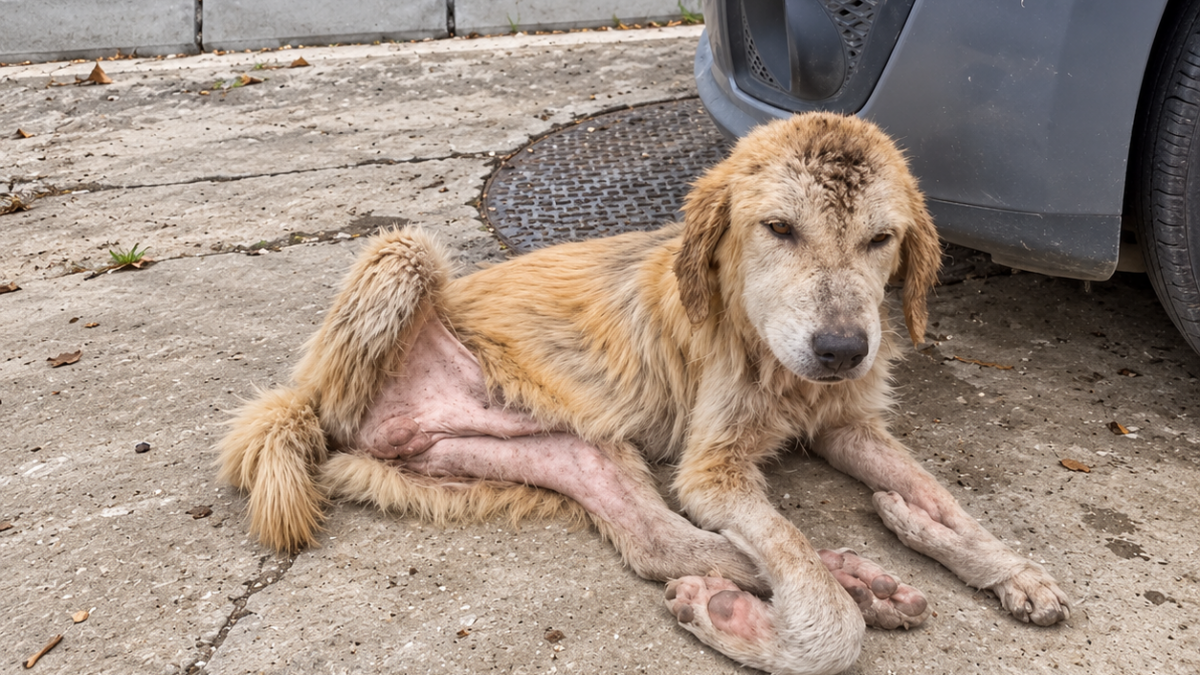
Only bones beneath wet fur and a leg that clearly hurt every time he moved.
When we arrived at my house, I carried him inside.
My living room was warm.
I remember the expression on his face when the heat reached him.
He didn’t suddenly become happy.
He didn’t bounce around.
Dogs who have been surviving on the street don’t always understand safety immediately.
He simply stood there on three legs, looking around.
A couch.
A rug.
A lamp.
A ceiling.
Things that were ordinary to me seemed almost suspicious to him.
I put a bowl of water on the floor.
He drank so fast that I had to pull it away for a moment.
“Slow down.”
He stared at the bowl.
“I’m giving it back. Just breathe.”
After a minute, I returned it.
Then I made him a small meal.
I wanted to fill his bowl completely.
Every instinct told me to feed him until his stomach was round.
But I knew a severely malnourished dog could become sick if he ate too much too quickly.
So I gave him a small portion.
He finished it in seconds.
Then he licked the bowl.
And kept licking.
The sound stayed with me.
There is something deeply painful about watching a hungry animal lick an empty bowl after the food is gone.
Not because he enjoyed the taste.
Because his body was still asking for more.
I sat on the floor beside him.
“That’s all for now.”
He looked at me.
Then at the bowl.
Then back at me.
“I know.”
He lowered himself carefully to the rug.
For the first time, I noticed how exhausted he really was.
His eyes struggled to remain open.
I grabbed a towel and began drying him.
At first, he flinched every time my hand passed near his injured hip.
So I moved more slowly.
“Okay. I won’t touch there.”
He watched me.
I dried his neck.
His back.
His front legs.
When I reached his ears, he closed his eyes.
For a few seconds, he seemed to forget that he was supposed to be afraid.
That was the first moment I felt him relax.
I decided against giving him a full bath until I knew more about his injuries.
Instead, I cleaned him gently with warm water and towels.
Underneath the dirt, his fur was lighter than I expected.
He was a handsome little dog.
He had simply been buried beneath neglect.
When I finished, I folded an old blanket near the couch.
“That’s yours.”
Lolo sniffed it.
Then he ignored it completely and lay down beside my feet.
I smiled.
“All right.”
I didn’t know whether I would keep him.
I kept telling myself that.
I would get him examined.
I would find out whether he had an owner.
I would contact rescuers.
I would do whatever was responsible.
But I wasn’t adopting a dog.
That was what I told myself while sitting awake at two in the morning because every time Lolo whimpered in his sleep, I reached down to make sure he was breathing.
The next morning, I called a veterinary clinic.
They told me to bring him in immediately.
The ride there was different from the night before.
Lolo was still nervous, but instead of hiding against the door, he sat closer to me.
At one point, while I was stopped in traffic, he rested his chin on my arm.
That was the moment I gave him his name.
“Lolo,” I said.
His ear twitched.
“Yeah. I think that fits.”
He looked up.
And just like that, he became Lolo.
At the clinic, the veterinarian’s expression became serious almost immediately.
She ran her hands carefully over his body.
“Very underweight.”
“I figured.”
“Dehydrated too.”
Then she examined the leg.
Lolo cried out.
My stomach dropped.
The doctor stopped immediately.
“That’s not a recent bruise.”
“What do you think happened?”
“We need imaging.”
They took him away for X-rays.
I sat alone in the examination room for what felt like an hour.
It was probably twenty minutes.
When the veterinarian returned, she placed the X-ray on the screen.
Even I could see something was wrong.
She pointed toward the femur.
“There’s a serious injury here.”
“Broken?”
“Yes.”
The word landed heavily.
“How long?”
“Hard to say exactly. But he’s been compensating for it. He’s been walking injured.”
I stared at the image.
I pictured him beneath the car.
Dragging that leg.
Running—or trying to run—whenever somebody shouted at him.
“How does he fix it?”
“Surgery.”
“When?”
She hesitated.
“That’s the problem.”
I looked at her.
“He’s too weak right now.”
I felt my chest tighten.
“So what are you saying?”
“I’m saying we build him up first. Nutrition. Hydration. Rest. Pain control. We get his body strong enough to tolerate anesthesia and surgery.”
“And if we don’t?”
She met my eyes.
“The leg will continue causing pain, and depending on how it heals incorrectly, he could have permanent mobility problems.”
There was no decision to make.
“When do we start?”
The veterinarian smiled slightly.
“We already have.”
That was the beginning of Lolo’s recovery.
It was also the beginning of something I hadn’t expected.
Anger.
Not at Lolo.
At everyone who had seen him before me.
I understood that not every person could take home a stray.
I understood people had families, jobs, expenses and fears.
But I couldn’t understand chasing him.
I couldn’t understand looking at a dog whose bones were visible and whose leg was clearly injured and deciding the biggest problem was that he was standing too close to your park bench.
For the next several days, that thought stayed with me.
Lolo came home with medication and strict instructions.
Small meals.
Limited movement.
No jumping.
No stairs.
Keep him warm.
Monitor his breathing.
Watch his appetite.
Return immediately if anything changed.
I turned my living room into a recovery area.
Blankets.
Water.
Food.
A low bed.
I blocked access to the staircase.
At night, I slept on the couch.
The first few nights were difficult.
Lolo had nightmares.
At least, that’s what I believe they were.
He would begin twitching in his sleep.
Then his paws would move.
Sometimes he whimpered.
Once he woke suddenly and tried to run.
His injured leg gave way.
I caught him before he hit the floor.
“Lolo!”
He panicked.
For several seconds, he didn’t seem to recognize me.
Then he smelled my hand.
His breathing slowed.
“You’re home.”
I said it again.
“You’re home.”
I wasn’t sure whether I was reassuring him or myself.
During the day, he followed me everywhere he could.
Kitchen.
Living room.
Hallway.
Bathroom door.
If I disappeared for too long, he became restless.
The dog who had been chased away repeatedly now seemed terrified that the one person who had let him stay might disappear.
So I started talking to him.
Constantly.
“I’m getting coffee.”
His ears moved.
“I’ll be back in thirty seconds.”
When I took out the trash, I told him.
When I showered, I told him.
When I checked the mail, I told him.
It sounds ridiculous until you’ve watched an abandoned animal panic because a door closed between you.
Little by little, he began believing that I came back.
His appetite improved first.
Then his eyes.
They became brighter.
His coat began to look healthier.
He gained weight.
Not quickly.
But steadily.
Every few days at the clinic, the scale showed another small increase.
Six ounces.
Nine ounces.
Half a pound.
Numbers most people wouldn’t celebrate.
I celebrated all of them.
“Look at you,” I told him after one appointment. “You’re practically becoming expensive to feed.”
His tail wagged.
By then, his tail was wagging often.
The doctor noticed too.
“He seems attached to you.”
“He’s temporary.”
She looked at me.
“Of course.”
“I mean it.”
“Sure.”
“I’m helping him recover.”
“Mhm.”
“Then we’ll figure out adoption.”
She smiled.
“Absolutely.”
I hated that smile.
Because she knew.
Everybody knew before I did.
Three weeks after I found him, the veterinarian said the words I had been waiting for.
“He’s strong enough.”
I stared at her.
“For surgery?”
She nodded.
My relief lasted approximately three seconds.
Then fear replaced it.
“What are the risks?”
She explained them carefully.
Anesthesia.
Infection.
Healing complications.
The usual surgical risks.
His previous malnutrition added concerns, although his blood work looked much better.
She seemed optimistic.
I was terrified.
The morning of the surgery, I wasn’t allowed to feed him.
Lolo considered this a betrayal of historic proportions.
He followed me into the kitchen and stared at the place where his bowl normally appeared.
“Not today.”
He looked at me.
“Doctor’s orders.”
He stared harder.
“Don’t blame me.”
He sat down.
His expression could have made a priest confess.
“I know. I’m terrible.”
At the clinic, the technician came to take him.
Lolo refused to move.
Not aggressively.
He simply planted himself against my leg.
The technician smiled.
“He’ll be okay.”
I nodded.
But when she took the leash, Lolo looked back at me.
His body lowered.
His eyes widened.
I suddenly understood what he thought.
He believed I was leaving him.
I crouched.
“Hey.”
He pulled toward me.
I held his face gently.
“I’m coming back.”
His body trembled.
“I always come back now, remember?”
The technician gave me another minute.
I kissed the top of his head.
“You’re not getting rid of me that easily.”
Then they took him through the door.
And I sat in my car afterward with both hands on the steering wheel, unable to turn the key.
Hours later, the clinic called.
The surgery was successful.
I closed my eyes.
“Successful?”
“Yes.”
“You’re sure?”
“He’s waking up now.”
I laughed.
Then, unexpectedly, I started crying.
Not dramatic sobbing.
Just tears I hadn’t known I was holding back.
The veterinarian kept talking.
Lolo would remain at the clinic for observation.
His movement had to be restricted.
Recovery would take time.
Physical rehabilitation would matter.
There was still a long road ahead.
But the bone had been repaired.
For the first time since I saw him beneath that car, Lolo had a real chance to walk without pain.
When I visited him, he looked miserable.
There was a shaved area on his leg.
Bandaging.
A sleepy expression.
He lifted his head when he heard my voice.
“Hey, buddy.”
His tail tapped once against the bedding.
That tiny movement almost destroyed me.
I sat beside him.
“You did it.”
He tried to move closer.
“No, no. Stay.”
He ignored me.
Naturally.
I leaned forward so he didn’t have to move.
He pressed his nose against my hand.
The technician watching us smiled.
“He’s been waiting for you.”
I looked at Lolo.
“Yeah?”
“He reacts every time someone comes through the door.”
I swallowed.
That night, I went home alone.
The house felt wrong.
His blanket was there.
His bowl.
The towel I had used after finding him.
A chew toy he had recently discovered.
But no Lolo.
That was the night I stopped lying to myself.
He wasn’t temporary.
He wasn’t a rescue dog I was preparing for someone else.
He was my dog.
I just hadn’t told him yet.
Lolo stayed at the clinic until the doctors felt comfortable sending him home.
When I arrived to collect him, I brought a new collar.
Blue.
Simple.
Nothing expensive.
But attached to it was a small tag.
LOLO.
And beneath his name:
MARTIN.
MY HOME.
MY NUMBER.
The receptionist read it and smiled.
“So you’re keeping him.”
I looked through the glass toward the treatment area.
“Yes.”
She grinned.
“Thought so.”
When they brought him out, he recognized me immediately.
He tried to hurry.
The technician stopped him.
“Easy, Lolo.”
His tail was moving so violently that his whole rear end shook.
I knelt.
“This is embarrassing.”
He licked my chin.
“Absolutely no dignity.”
He licked me again.
I attached the collar.
Then I turned the tag so his name faced forward.
“There.”
He sniffed my hand.
“You officially belong somewhere.”
The word belong hit me harder than I expected.
Because Lolo had spent so long being treated like he didn’t.
He didn’t belong in the park.
He didn’t belong near the shops.
He didn’t belong under the shelter.
He didn’t belong beside the cars.
Go away.
Move.
Get out.
Now a small piece of metal around his neck said something different.
You belong with me.
Recovery from surgery wasn’t cinematic.
There was no moment when Lolo suddenly leaped up and ran across a field.
Healing was slow.
Frustrating.
Sometimes frightening.
There were days he seemed stronger.
Then there were days he appeared tired.
The doctor had given me exercises.
Gentle range-of-motion work.
Short supported standing sessions.
Later, carefully controlled walking.
Lolo hated being restricted.
Once he started feeling better, he thought that meant he had been medically cleared to become an athlete.
He had not.
One afternoon I caught him preparing to jump onto the couch.
“Don’t even think about it.”
He froze.
One paw raised.
We stared at each other.
“Lolo.”
He glanced at the couch.
“No.”
He looked at me.
“No.”
He attempted the jump anyway.
I caught him around the middle.
“You maniac.”
His tail wagged.
“You just had your femur repaired!”
More tail wagging.
“You have absolutely no respect for modern medicine.”
He licked my nose.
I put him down.
That became our routine.
He tried to become invincible.
I tried to prevent him from destroying thousands of dollars of orthopedic work.
Weeks passed.
Then came the day the doctor told us to increase his walks.
Five minutes.
Slow.
Flat ground.
No pulling.
No running.
I bought him a harness.
The first time I clipped the leash onto it, he stared at the front door.
Then at me.
“You ready?”
His tail began moving.
The moment the door opened, he stepped outside.
I expected hesitation.
Instead, he stopped in the sunlight.
The air was cool.
Dry.
The rain from the day I found him felt like a memory from another lifetime.
Lolo lifted his nose.
He smelled everything.
Grass.
Trees.
Cars.
Food from someone’s kitchen.
Another dog somewhere down the block.
Then he took one step.
His repaired leg touched the ground.
Another.
Then another.
I watched so carefully that I nearly forgot to breathe.
There was still stiffness.
There was still weakness.
But he was using it.
The leg that had once dangled painfully as he crawled from beneath cars was carrying him.
“Good boy.”
He glanced back at me.
“Good boy, Lolo.”
His tail lifted.
We walked to the end of the driveway.
That was all the doctor had allowed.
To anyone else, it would have looked like the most boring walk in history.
To me, it felt like crossing a finish line.
Over the following month, the walks became longer.
Five minutes became ten.
Ten became fifteen.
His muscles developed.
His gait improved.
He stopped looking fragile.
His ribs disappeared beneath healthy weight.
His coat became soft and bright.
People who met him had difficulty believing he was the same animal in the photos I had taken the first evening.
Then something happened I hadn’t expected.
One Saturday morning, while we were walking several blocks from home, Lolo stopped.
Ahead of us was a familiar road.
I recognized it immediately.
So did he.
The park.
The place where I had found him.
I hadn’t intentionally brought him there.
Our walks had gradually expanded, and without thinking, I had chosen a route that curved around the neighborhood.
Now we were only a block away.
Lolo stood completely still.
His tail lowered.
I felt tension move through the leash.
I knelt beside him.
“We don’t have to go.”
He stared toward the park.
A bus passed.
People moved beneath the trees.
The same covered entrance stood on the far side.
For several seconds, Lolo did nothing.
Then he stepped forward.
“Are you sure?”
Another step.
I followed.
As we approached, I felt anger returning.
Memories rose with every footstep.
The rain.
The shouting.
The man saying, “Don’t feed that dog.”
The stranger yelling at Lolo to leave.
His body flinching.
I wanted to hate everyone there.
But Lolo didn’t seem interested in revenge.
He was interested in smells.
A tree.
A patch of grass.
A sandwich wrapper.
Apparently recovery had not improved his culinary standards.
I laughed.
“Seriously?”
His tail wagged.
Then I heard someone behind us.
“Is that the same dog?”
I turned.
The man from the covered entrance was standing there.
For a second, I didn’t recognize him.
Then I did.
His eyes moved from me to Lolo.
“No way.”
Lolo stood beside my leg.
The man came closer.
“That’s him?”
“Yes.”
He stared.
“He looks completely different.”
“He almost is.”
“What happened to his leg?”
“Broken femur.”
The man’s expression changed.
“Broken?”
“Yes.”
“I knew he limped, but…”
I waited.
He didn’t finish.
A woman nearby overheard us.
“Was he the stray that used to hide around here?”
I looked at her.
“He was.”
“Oh.”
That single word contained discomfort.
Recognition.
Maybe guilt.
She glanced at Lolo.
“We thought he might bite somebody.”
“He never tried to bite anyone.”
She folded her arms.
“Well, people didn’t know.”
“No.”
I kept my voice calm.
“They didn’t.”
She seemed relieved that I wasn’t arguing.
Then I continued.
“They just knew he was starving, soaking wet and unable to use one leg.”
Her expression tightened.
The man looked at the ground.
I hadn’t planned that sentence.
But once I said it, I didn’t regret it.
“I’m not saying every person here should have taken him home,” I added. “But someone could have made a phone call.”
The woman said nothing.
Lolo leaned against my leg.
I rubbed his neck.
The man cleared his throat.
“I probably could have.”
I looked at him.
He was still watching Lolo.
“I saw him for days.”
That surprised me.
“How many?”
“Maybe four. Five.”
Five days.
Five days of rain.
Five days of an injured dog trying to survive.
The anger in me sharpened.
“You saw him for five days?”
He nodded.
“I thought someone else would handle it.”
There it was.
The sentence that explains more suffering in this world than cruelty ever could.
I thought someone else would handle it.
I looked around the park.
Dozens of people.
Dozens of phones.
Dozens of cars.
And one injured dog hiding underneath them.
Nobody needed to be evil.
They only needed to believe responsibility belonged to somebody else.
The man crouched slightly.
“Can I pet him?”
I almost said no.
Then I looked at Lolo.
He was watching the man.
No growling.
No fear.
Just curiosity.
I loosened the leash.
“If he comes to you.”
The man extended his hand.
Lolo sniffed it.
Then, unbelievably, he stepped closer.
The man scratched under his chin.
His eyes filled.
“I’m sorry, little guy.”
Lolo licked his hand.
I had to look away.
That was Lolo.
He had every reason to distrust people.
Instead, he kept offering them another chance.
A few days later, something else happened.
The woman I had spoken to at the park contacted me.
I had no idea how she found me at first.
Apparently, someone had taken a photo of Lolo during our visit and posted it in a neighborhood group.
She sent me a message.
I almost ignored it.
Then I read it.
She apologized.
Not perfectly.
Not elegantly.
But sincerely.
She admitted she had been one of the people who complained about the stray dog hanging around the park.
She had worried about children.
She had assumed somebody would eventually collect him.
She had never stopped to consider how badly he was injured.
Then she wrote something that caught my attention.
“I keep thinking about what you said. Someone could have made a phone call.”
I stared at that line.
She asked whether there were local rescue organizations the park could contact in the future.
That became the beginning of something bigger.
Not dramatic.
Not revenge in the way movies tell it.
Nobody went to jail.
Nobody lost everything.
Nobody was publicly humiliated.
But people changed.
And sometimes, for people who refused to look at suffering, being forced to finally see it is its own kind of reckoning.
The neighborhood association contacted a rescue group.
A simple protocol was established.
If an injured or vulnerable stray animal appeared around the park, staff members would call for help rather than simply trying to drive the animal away.
A small notice was posted near the entrance.
INJURED OR LOST ANIMAL?
DO NOT CHASE.
CONTACT LOCAL RESCUE SERVICES.
The first time I saw that notice, I stood beneath it with Lolo beside me.
I laughed quietly.
“You caused policy reform.”
Lolo sniffed a garbage can.
“Try to stay humble.”
But our story wasn’t finished.
Not even close.
Because physical healing turned out to be the easy part.
The deeper wounds appeared later.
Three months after his surgery, Lolo could walk almost normally.
His veterinarian was thrilled.
His weight was healthy.
His blood work was good.
His coat had become glossy.
He had graduated from short rehabilitation walks to normal daily exercise.
But certain sounds still terrified him.
Shouting.
Metal striking pavement.
A car engine starting nearby.
And rain.
Rain was the worst.
The first serious storm after his recovery arrived late one evening.
I was making dinner when thunder rolled outside.
Rain slammed against the windows.
I heard scrambling behind me.
“Lolo?”
He wasn’t in the kitchen.
I checked the living room.
Nothing.
Bedroom.
Nothing.
Then I saw the edge of his tail beneath my desk.
He had squeezed himself into the smallest space he could find.
Exactly the way he had hidden underneath cars.
I sat on the floor.
“Hey.”
His eyes were wide.
Another thunderclap sounded.
He pressed himself deeper against the wall.
My heart sank.
He wasn’t remembering my house.
He was remembering the street.
Cold.
Water.
Engines.
Feet walking past him.
Voices telling him to leave.
I crawled partly under the desk.
“I’m here.”
He wouldn’t come out.
“That’s okay.”
So I stayed.
For nearly forty minutes, I sat on the floor beside the desk.
I didn’t pull him.
I didn’t force him.
I simply kept one hand where he could smell it.
Eventually, his nose touched my fingers.
Then his head emerged.
I scratched beneath his chin.
“You don’t have to hide from rain anymore.”
Another thunderclap.
He flinched.
“But if you want to hide, I’ll hide with you.”
That became our rule.
Recovery happened on Lolo’s schedule.
Not mine.
Sometimes progress looked like walking a mile.
Sometimes progress looked like staying in the living room during a storm.
Sometimes progress meant allowing a stranger to touch him.
Sometimes it meant sleeping through the night.
I stopped measuring healing only by his leg.
Months passed.
Lolo transformed into the dog he had probably always been before hunger and pain took over.
He was affectionate.
Ridiculously affectionate.
If I sat down, he wanted contact.
A paw on my knee.
His body against my foot.
His head in my lap.
He developed an obsession with squeaky toys.
The louder, the better.
One toy sounded like an injured duck being tortured.
Naturally, it became his favorite.
He would squeak it at six in the morning.
“Lolo.”
Squeak.
“No.”
Squeak.
“It’s six.”
Squeak.
“I saved your life.”
Squeak.
“This is how you repay me?”
Tail wag.
He also discovered couches.
Despite my best efforts during rehabilitation, the couch eventually became his kingdom.
He took the center cushion.
I got whatever remained.
At night, he slept beside my bed.
Except when he decided the bed itself had enough room for both of us.
His definition of “enough room” was questionable.
One morning I woke up with his rear end against my face.
I pushed him.
“This arrangement needs review.”
He groaned without opening his eyes.
A dog who once slept beneath cars was now annoyed because I disturbed him in a mattress he didn’t pay for.
That felt like victory.
Then came the day I received an unexpected call from the clinic.
One of the technicians had been telling Lolo’s story to a volunteer from a rescue organization.
They were hosting an event at the same park where I found him.
Education.
Adoption.
Vaccination information.
Animal rescue contacts.
They wanted to know whether Lolo and I would attend.
I almost said no.
I didn’t want to turn him into a spectacle.
He didn’t owe anybody inspiration.
He had already survived enough.
But then they explained the purpose.
They wanted people to understand what to do when they encountered an injured stray.
Don’t chase.
Don’t corner.
Don’t assume someone else has called.
Contact help.
Offer water if safe.
Create distance.
Let trained people intervene.
Lolo’s story could make those lessons real.
I looked at him sleeping upside down on my couch.
“Congratulations,” I said.
One eye opened.
“You have a speaking engagement.”
He yawned.
“I’ll handle the speaking.”
The morning of the event was bright.
No rain.
That mattered to me more than it probably should have.
I put on Lolo’s harness.
His blue identification tag was scratched now.
Used.
Real.
He had gained enough confidence that walking into the park no longer made him freeze.
He trotted beside me.
Head high.
Tail moving.
People noticed him.
Some knew his story.
Others didn’t.
A few approached carefully.
Lolo accepted nearly all the attention with shameless enthusiasm.
Then I saw someone near the far edge of the event.
The person who had shouted at him the day I found him.
I recognized the face immediately.
For a moment, anger rushed back through me so quickly that I stopped walking.
Lolo looked up.
The person recognized us too.
Their expression changed.
They began to turn away.
I could have let them.
Part of me wanted to.
Another part wanted them to look.
Not at me.
At Lolo.
So I walked over.
“Excuse me.”
They stopped.
Lolo stood beside me.
I watched recognition settle completely.
“That’s the dog.”
“Yes.”
They stared at his leg.
“He’s walking.”
“He had surgery.”
The person swallowed.
“I didn’t know it was that bad.”
“You saw him dragging the leg.”
“I thought maybe he’d hurt his paw.”
“You yelled at him.”
Their face flushed.
“I was worried he’d get underneath the cars.”
“He was underneath the cars because people kept chasing him.”
Silence.
I could hear voices from the event behind us.
Children laughing.
Dogs barking.
Someone speaking through a small microphone.
The person looked at Lolo.
“I feel terrible.”
For months, I had imagined what I might say if I ever saw them again.
I imagined anger.
Accusation.
Maybe satisfaction.
But standing there, none of that felt important.
I pointed toward Lolo.
“Feeling terrible doesn’t help the next dog.”
They looked at me.
“Helping the next one does.”
That sentence seemed to land.
I told them about the rescue number.
The new park procedure.
What to do if they saw an injured animal.
They listened.
Really listened.
Then Lolo did something that almost made me laugh.
He walked up and sniffed their shoe.
The person froze.
Slowly, they crouched.
“Can I?”
I nodded.
They touched his shoulder.
Lolo’s tail wagged.
Their eyes filled with tears.
“I’m sorry.”
Lolo licked their hand.
Again.
No grudge.
No punishment.
No revenge.
Just another chance.
I realized then that Lolo had done something I hadn’t.
He had moved on.
I had spent months carrying anger on behalf of a dog who was busy learning joy.
That didn’t mean what happened to him was acceptable.
It didn’t mean people shouldn’t be held accountable.
It meant Lolo refused to let the worst days of his life define every day afterward.
I wanted to learn that from him.
The event raised enough awareness that several people signed up to volunteer.
The park collected food and supplies for local rescuers.
The woman who had messaged me became one of the volunteers.
And the person who once shouted at Lolo eventually began helping transport injured strays to a clinic.
That was the strangest part of the story.
The people I had wanted to punish became people Lolo helped change.
Months after the event, I received a photograph.
A small brown dog wrapped in a blanket in the back seat of a car.
The message underneath said:
“Found injured near the park. We called immediately. He’s at the clinic now.”
I stared at the photo.
Then I looked at Lolo.
He was asleep beside me.
One leg twitching in a dream.
I reached down and touched his head.
“You did that.”
His eyes opened.
“You’ll never know it.”
He yawned.
“But you did.”
The small brown dog survived.
He eventually found a home.
Then another stray was helped.
Then another.
Nobody built a statue of Lolo.
Nobody wrote his name across the park entrance.
But a dog who had once been chased away changed what happened to the dogs who came after him.
That seemed better.
A year after I found him, I took Lolo back to the exact parking area where our story started.
Not because I wanted to recreate his suffering.
I wanted something for myself.
Closure, maybe.
The silver sedan was gone.
Different cars occupied the spaces.
The covered entrance had been repainted.
Everything looked smaller than I remembered.
Memory has a way of enlarging places where something important happened.
I walked Lolo toward the space where I first saw his eyes beneath the car.
He sniffed the pavement.
No fear.
No hesitation.
Nothing.
I crouched.
“Do you remember?”
He sniffed a nearby tire.
“I do.”
He looked at me.
That was when the full distance between those two moments hit me.
Then:
A skeletal dog.
Soaked.
Shivering.
Broken femur.
No collar.
No home.
No protection.
Now:
Healthy weight.
Strong leg.
Blue collar.
Identification tag.
Harness.
Home waiting ten minutes away.
And someone at the other end of his leash.
I sat on the curb.
Lolo climbed partly into my lap despite being far too large for it now.
“You know,” I whispered, “I thought I rescued you.”
He rested his chin on my shoulder.
The truth was more complicated.
Before Lolo, I had become good at moving through life without becoming involved.
I noticed things.
I felt bad.
Then I kept walking.
Just like everyone else.
The day I saw him, something forced me to stop.
Maybe it was his eyes.
Maybe it was the rain.
Maybe it was the way he licked my fingers despite everything people had done.
Whatever it was, taking him home changed the way I looked at suffering.
You can always tell yourself someone else will help.
Someone else will call.
Someone else will stop.
Until one day you realize everybody standing around is thinking exactly the same thing.
Lolo taught me that sometimes the difference between abandonment and rescue is one person deciding, “No. This one is my responsibility now.”
I thought that lesson was the ending.
It wasn’t.
About eighteen months after I found Lolo, the veterinarian asked me to bring him in for a long-term follow-up.
His X-rays looked excellent.
The repaired bone had healed.
His muscle mass had returned.
His gait was almost completely normal.
She moved his leg gently.
Lolo looked mildly offended.
“He’s doing beautifully,” she said.
I smiled.
“So no restrictions?”
“Within reason.”
I looked at Lolo.
“Did you hear that?”
She laughed.
“I said within reason.”
“He has never operated within reason.”
Lolo wagged his tail.
Before we left, the veterinarian pulled up his original records.
Then she showed me his first photograph.
I hadn’t seen it in a long time.
I almost didn’t recognize him.
His eyes looked enormous because his face was so thin.
His fur was dull.
His body seemed folded around pain.
I looked down at the dog standing beside me.
“Wow.”
The doctor nodded.
“People forget quickly.”
“I didn’t realize how bad he looked.”
“You were seeing him every day. Change happens gradually.”
I kept staring at the photo.
“How close was he?”
She understood my question.
“To dying?”
I nodded.
She paused.
“He was in trouble.”
“How much trouble?”
“Severe malnutrition, dehydration, untreated orthopedic trauma, prolonged exposure. Another infection, another injury, several more weeks without consistent nutrition…”
She stopped.
“He was running out of margin.”
I swallowed.
Lolo nudged my hand.
I scratched his ear.
“So I really was lucky.”
The veterinarian smiled.
“He was too.”
We walked home instead of driving.
It was farther than our usual route, but Lolo had the strength now.
At a crosswalk, we waited beside a mother and a little boy.
The boy looked at Lolo.
“Can I pet your dog?”
“If your mom says it’s okay.”
She nodded.
The boy approached.
Lolo sat automatically.
He had learned that sitting increased the probability of receiving affection.
It was one of his strongest skills.
The boy stroked his head.
“What’s his name?”
“Lolo.”
“Was he always your dog?”
I looked down at him.
“No.”
“Where did you get him?”
I pointed toward the neighborhood behind us.
“I found him.”
The boy seemed amazed.
“Like treasure?”
I laughed.
“Yeah.”
His mother smiled.
“Pretty much.”
The boy hugged Lolo around the neck.
Lolo leaned into him.
I looked away for a second because my eyes had unexpectedly filled.
Like treasure.
That was exactly right.
People had walked past him as though he were garbage.
But value doesn’t disappear just because nobody recognizes it.
Lolo had always been Lolo.
He had always been affectionate.
Always been gentle.
Always been capable of trust.
His life had value while he was clean and healthy beside me.
And it had exactly the same value when he was soaked, starving and hidden beneath a car.
Only his circumstances had changed.
I wish more people understood that.
The second anniversary of the day I found him arrived with rain.
Heavy rain.
Almost identical to the storm from that first afternoon.
I expected Lolo to hide.
Instead, he stood at the glass door and watched.
His ears twitched at the thunder.
But he didn’t run.
I sat nearby.
“You okay?”
He turned toward me.
Then he picked up his horrible squeaky duck.
Squeak.
I laughed.
“I’ll take that as a yes.”
I opened the door to the covered porch.
Rain fell beyond the roof.
Lolo hesitated.
Then he walked outside and sat beside me.
We stayed dry beneath the awning.
He watched the water.
No trembling.
No hiding.
After a while, I realized I was crying.
Not because I was sad.
Because there was something extraordinary about watching an animal discover that the thing which once meant danger no longer controlled him.
Rain used to mean cold.
Hunger.
Cars.
Being unwanted.
Now rain meant sitting beside me beneath a roof.
Home was only a few feet behind him.
His food bowl was full.
His bed was warm.
His name was on a tag around his neck.
I rested my hand on his back.
“You made it.”
He leaned into me.
“You actually made it.”
Years have passed since then.
Lolo is older now.
A little gray around the muzzle.
A little slower in the morning.
He sometimes stretches his repaired leg before getting up after a long nap.
The veterinarian says that’s normal.
He still loves walks.
Still loves strangers.
Still believes every visitor to my house has arrived specifically to see him.
He has never developed modesty.
His blue identification tag was replaced twice because the lettering wore down.
I kept the original.
It sits in a drawer beside the first photograph I ever took of him.
Sometimes I look at them together.
The photograph shows a dog who had almost nothing.
The tag shows the first thing that was truly his.
A name.
An address.
A person.
One afternoon, years after our first meeting, Lolo and I passed the park again.
Several dogs were playing on the grass.
Near the entrance was a water station installed for animals.
Next to it was the notice telling people what to do if they encountered a lost or injured animal.
A volunteer from the neighborhood rescue group recognized us.
“Martin!”
I waved.
She crouched as Lolo approached.
“There’s the celebrity.”
“Don’t encourage him.”
She scratched his chest.
“Do you know how many dogs have been helped because of what happened here?”
I shook my head.
“Twenty-three that we’ve documented.”
I stared at her.
“Twenty-three?”
“Lost dogs, injured strays, abandoned puppies. Not all serious cases. But twenty-three animals where someone called instead of chasing them away.”
I looked down at Lolo.
He was busy attempting to convince her that he had not eaten in months.
Twenty-three.
A dog whom nobody wanted near the park had changed the fate of twenty-three animals.
That was the revenge I had once wanted without understanding it.
Not suffering.
Not humiliation.
Not ruining anybody’s life.
Something better.
Transformation.
Every person who had once treated Lolo as an inconvenience now had to walk past a sign created because ignoring him had been wrong.
Every rescued animal became proof.
Every volunteer phone call became proof.
Every dog carried safely into a clinic instead of chased into traffic became proof.
Lolo had won.
Not by hurting anyone.
By surviving long enough to make them change.
The volunteer handed me a folded piece of paper.
“What’s this?”
“Something we’re adding to the information board.”
I opened it.
There was a photograph.
Lolo.
Healthy.
Standing beside me.
Underneath were a few lines:
LOLO’S STORY
Found injured and malnourished near this park.
One person stopped.
One call can save a life.
I stared at it for a long time.
“You okay?” she asked.
“Yeah.”
I cleared my throat.
“Can you change one thing?”
“Sure.”
I pointed to the sentence.
“One person stopped.”
She waited.
“Make it: ‘Someone finally stopped.’”
She looked at me.
Then she understood.
Because that was the real story.
Not that I was special.
Not that I was a hero.
I was simply the person who finally stopped walking.
She nodded.
“I like that better.”
The new sign went up a week later.
The first time I brought Lolo to see it, he ignored his photograph completely.
He urinated on a bush nearby.
I stared at him.
“Your legacy means nothing to you.”
He looked extremely pleased with himself.
I laughed so hard I had to sit down.
That was another lesson Lolo taught me.
Humans turn survival into stories.
Dogs turn survival into Tuesday.
They don’t spend years explaining who hurt them.
They don’t build identities around being abandoned.
Once safety becomes real, they get busy living.
Eating breakfast.
Smelling grass.
Chasing toys.
Sleeping in sunlight.
Loving whoever is kind enough to stay.
I think that’s why watching Lolo heal changed me so deeply.
He never needed the people who rejected him to suffer.
He only needed them to stop doing it to the next dog.
And they did.
Eventually.
One autumn evening, I took Lolo on one of our slower walks.
His age had begun to show.
Nothing serious.
Just time.
He stopped beneath a large tree near the park.
Leaves covered the ground.
I sat on a bench.
Lolo climbed up beside me with more effort than he once needed.
I helped his back end.
“Don’t get proud.”
He settled against me.
People passed.
Some recognized him.
Some didn’t.
That seemed appropriate.
Lolo didn’t need everyone to know his story.
I knew.
He knew me.
That was enough.
Across the parking lot, a small stray-looking dog appeared near a trash can.
Before I could even stand, a woman walking nearby stopped.
She crouched several yards away.
She didn’t chase the dog.
She didn’t shout.
She pulled out her phone.
Then she walked toward the rescue information sign.
I watched her make a call.
My throat tightened.
Lolo lifted his head.
“You see that?”
He followed my gaze.
The woman remained at a safe distance from the stray while waiting for help.
Twenty minutes later, a rescue vehicle arrived.
The dog was carefully secured.
No shouting.
No running into traffic.
No hiding beneath cars.
Just help.
I looked at Lolo.
“That one was because of you.”
He rested his head on my leg.
I scratched behind his ears.
The old scar from his surgery was almost impossible to see beneath his fur now.
But I knew exactly where it was.
I knew every inch of that leg.
I remembered the X-ray.
The bandages.
The first step.
The first walk.
I remembered him beneath that car.
Sometimes I wish I could go back to that afternoon.
Not to change anything.
Just to kneel beside the version of Lolo who believed his world consisted of cold pavement, hunger and people telling him to disappear.
I would tell him:
Hold on.
A warm house exists.
You just haven’t seen it yet.
There is a food bowl with your name beside it.
There is a blue collar waiting for you.
There is a couch you will eventually steal.
There is a ridiculous squeaky duck you will torment me with every morning.
There are walks ahead of you.
Sunlight.
Grass.
Children asking to pet you.
People learning from what happened to you.
There is an old man you will become someday, gray around the muzzle and spoiled beyond reason.
And there is someone coming through this rain who will finally stop.
You only need to hold on a little longer.
Of course, I couldn’t tell him any of that then.
All I could do was crouch in the rain with a piece of chicken.
Sometimes rescue begins that simply.
A hungry dog.
An open hand.
A decision not to walk away.
I used to think Lolo’s happiest moment would be the day his surgery succeeded.
Then I thought it would be his first real walk.
Then his first run.
Then the day his fear of storms began to fade.
I was wrong every time.
His happiest moment was never one moment.
It was thousands of ordinary ones.
Breakfast arriving every morning.
Hearing my key in the door.
Sleeping without keeping one eye open.
Walking without pain.
Being touched without flinching.
Knowing rain couldn’t take his home away.
Knowing that when somebody said his name, it was because they wanted him closer.
That is what rescue really gave him.
Not simply survival.
Certainty.
Years earlier, Lolo had hidden beneath cars because he needed something above him.
Anything.
Metal.
A chassis.
A few inches of darkness.
Somewhere people couldn’t easily reach him.
Now, when storms come, he sleeps beside my chair.
Sometimes he doesn’t even wake up.
And whenever I look down at him, I remember the stranger who once said:
“He doesn’t belong here.”
They were right about one thing.
Lolo didn’t belong beneath that car.
He belonged exactly where he is now.
At home.
With me.
And on one of our final long walks through that park, Lolo passed the same stretch of pavement where people once chased him away.
Nobody shouted.
Nobody told him to leave.
A few people stopped to say hello.
One child knelt and wrapped both arms around his neck.
Lolo closed his eyes and leaned into the hug.
I stood behind him holding the leash.
The leash was loose.
His repaired hind leg was planted firmly on the ground.
His tail was wagging.
Then he looked back at me.
That expression was enough.
Years earlier, I had carried him away from that place because he could barely walk.
Now he was walking out beside me.
Not searching for somewhere to hide.
Not wondering where his next meal would come from.
Not approaching strangers hoping one of them might finally let him stay.
This time, he already knew exactly where he was going.
Home.
And as we crossed the street together, I realized Lolo had gotten the only revenge that ever truly mattered.
He survived the people who treated him like he was worthless.
He became deeply loved.
And because he survived, the place that once chased him away learned how to save the next dog instead.
Lolo never had to prove that he deserved a home.
He always did.
The rest of us simply had to learn how to see it.