PART 2: They Chained Her Until She Tried to Disappear—Months Later, Her Silence Helped a Little Boy Find His Voice Again
PART 2
1. The One Thing She Refused to Leave Behind
At first, I thought she was trying to bite me.
Her head jerked upward, and her teeth caught the loose fabric of my sleeve. Sophie froze. Julien took an instinctive step toward us.
“Claire, careful.”
But there was no pressure in the dog’s jaws.
She wasn’t attacking.
She was pulling.
Her injured body twisted inside the blanket, and she stretched her muzzle toward the broken kennel, refusing to release my sleeve even though the movement clearly hurt her.
“Wait,” I told Sophie. “Put her down for a second.”
We lowered the blanket.
The dog immediately turned toward the kennel and began pawing weakly at the dirt beside its entrance.
Her breathing quickened.
I looked at Sophie.
“There’s something under there.”
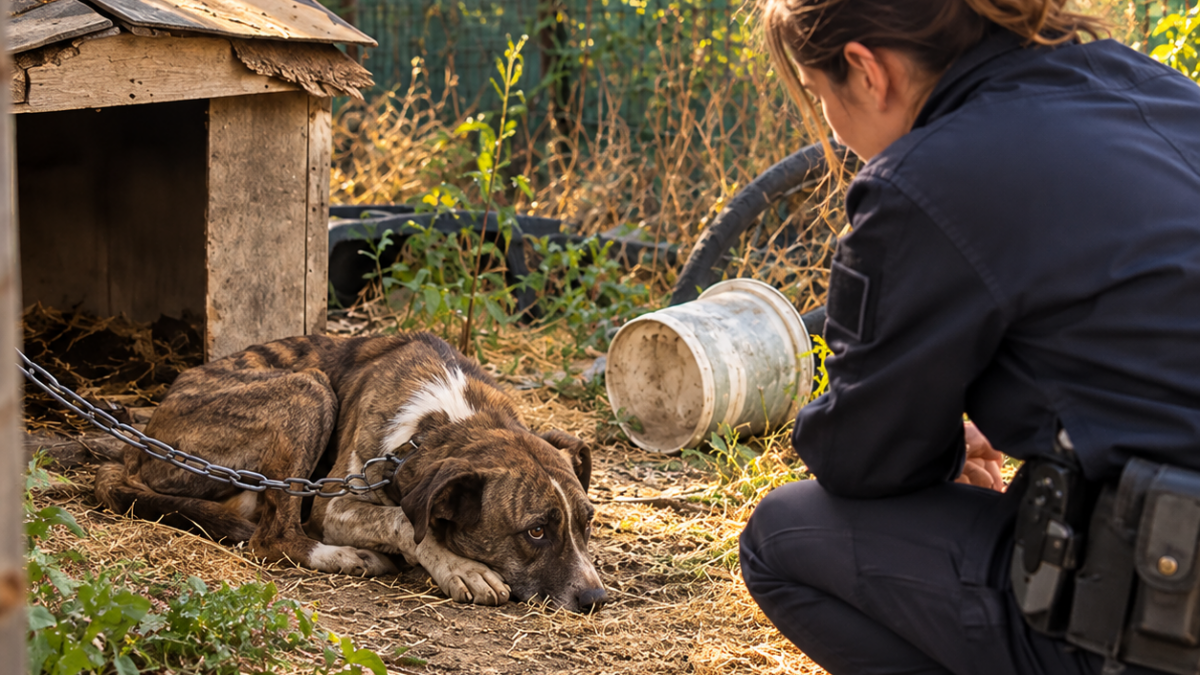
The kennel was little more than four warped boards nailed together. The roof had collapsed, leaving one wall leaning against the fence. I moved a loose piece of wood aside and found a shallow depression in the dirt.
Inside it was a small blue plastic dinosaur.
One of its horns had broken off. Its paint was worn. Someone had scratched a crooked letter G into its underside.
It looked like the kind of toy a child might carry everywhere until the plastic became smooth from being held.
I picked it up.
The dog stopped struggling.
For the first time since we entered the yard, her eyes followed something with unmistakable interest.
I held the dinosaur where she could see it.
“Is this what you wanted?”
Her nose moved toward my hand.
She touched the toy once, very gently.
Then her head sank onto the blanket.
None of us spoke.
I had rescued animals that refused to leave behind their puppies, their blankets, or the places where they had last seen their owners. But this dog had nearly exhausted what little strength she possessed to make certain we didn’t leave a broken child’s toy in the dirt.
I photographed where we had found it and placed it in a clean evidence bag.
I couldn’t explain why it mattered.
I only knew that it did.
When we lifted her again, she made no attempt to resist.
Sophie settled beside her in the transport van while I climbed into the front passenger seat. Julien would follow after documenting the property and arranging for the scene to be secured.
As we pulled away, I looked back through the partition.
The dog was curled inside the blanket, her nose resting against the fabric. Sophie had placed a hand near her, not touching her, just letting her know someone was there.
For several blocks, the dog kept her eyes open.
Then, as the houses slipped past the windows, she fell asleep.
I remember feeling relief.
I also remember being afraid of what would happen when she woke up.
Animals who have survived prolonged abuse sometimes find a new environment frightening even when that environment is safe. The smells are unfamiliar. The voices are unfamiliar. Every movement might mean another threat.
I knew we could cut a chain in seconds.
I had no idea how long it might take to remove the fear that chain had taught her.
At the veterinary emergency clinic, Dr. Élise Garnier was waiting when we arrived.
She took one look at the dog and called for a second veterinary nurse.
“We need fluids, pain relief, and radiographs,” she said. “And move slowly. She’s terrified.”
The dog allowed herself to be transferred to an examination table. She didn’t growl when they examined her swollen leg. She didn’t struggle when they carefully checked the wound beneath her collar.
She simply shut her eyes.
I stood near the door, watching her.
“She’s being very good,” one of the nurses murmured.
Dr. Garnier looked up.
“No,” she said quietly. “She’s being very afraid.”
The distinction struck me harder than I expected.
All evening, I had been grateful that the dog wasn’t fighting us.
But maybe she had stopped fighting because fighting had never changed anything.
When the veterinarian began cleaning the infected skin around her neck, I stepped outside.
I had kept myself composed through the rescue. My job required it. I had asked the right questions, followed the necessary procedures, and made sure we documented what we found.
Standing alone in that hallway, I finally let myself feel angry.
Not the sudden anger that makes people shout or slam doors.
Something colder.
Someone had owned this dog.
Someone had put that collar around her neck.
Someone had fastened that chain short enough to keep her from water and shade.
And someone had walked away knowing she could not save herself.
I looked at the bag containing the blue dinosaur.
The letter G was still visible beneath the clinic lights.
For reasons I couldn’t yet explain, I found myself wondering not only who had hurt the dog.
I wondered who had loved her before that happened.
2. The Name We Didn’t Know
The medical examination lasted almost three hours.
By the time Dr. Garnier came into the waiting room, it was well past midnight. She carried a folder against her chest and wore the tired expression of someone who had spent the evening trying not to show how upset she was.
“She’s stable,” she said.
I stood immediately.
“But?”
“There’s quite a lot going on.”
We sat at a small table near the reception desk.
The dog was severely dehydrated and underweight. Her front leg had an old fracture that had healed badly, leaving her with chronic pain and limited movement. There were scars across her back, irritation beneath her collar, and signs of repeated pressure injuries where the chain had rubbed against her neck.
Dr. Garnier turned one of the radiographs toward me.
“The fracture isn’t recent,” she explained. “She’s been compensating for it for some time. That has affected her shoulder and the way she walks.”
“Can you fix it?”
“We can improve her comfort. We may be able to improve her mobility. But I can’t promise she’ll ever walk normally.”
I looked at the dark shapes on the image.
I wasn’t a veterinarian. The details meant very little to me.
But I understood the difference between an injury that had just happened and an injury someone had allowed an animal to live with.
“How old is she?”
“Perhaps five or six. That’s an estimate.”
Five or six years.
I wondered how much of that time she had spent trying to make herself invisible.
“There’s something else,” Dr. Garnier said.
She lowered her voice.
“She barely responds to ordinary verbal cues, but she reacts intensely to certain metallic sounds and sudden movements. It’s consistent with a strong fear response. We’ll need to observe her over time.”
“Can she bark?”
“Physically, I haven’t found anything that would clearly prevent it. But whether she feels safe enough to vocalize is another question.”
I thought of Mrs. Lambert saying that the dog had cried for hours before falling silent.
Dr. Garnier closed the folder.
“Don’t confuse her silence with comfort, Claire.”
I nodded.
“Can I see her?”
“She needs rest. Just a few minutes.”
The dog lay in a clean kennel with an IV line secured to her leg. A soft protective collar had replaced the cruel leather one, and thick blankets covered the floor beneath her.
Her eyes opened when I approached.
I stopped a few feet away.
“Hey, sweetheart. Remember me?”
She looked at me without lifting her head.
I sat on the floor beside the kennel.
“You’re not going back there.”
She didn’t understand the words, of course.
Or perhaps she understood the tone better than I realized.
For a long time, I simply stayed beside her.
I didn’t reach through the bars. I didn’t ask her to come closer.
Eventually, her breathing slowed.
I left only when the nurse reminded me that the dog needed uninterrupted rest.
Outside, the night air was cool.
I called Julien.
“Any news about the property?”
“Some. The landlord gave us the tenant’s name. Marc Vasseur. Forty-one. He’s been renting that house for nearly three years.”
“Has anyone contacted him?”
“We’re working through the proper channels. The property owner says Marc told him he’d be away for a few days.”
“Did he mention the dog?”
“No.”
Julien paused.
“Claire, Mrs. Lambert gave me something interesting before I left.”
“What?”
“An audio recording. She started recording the sounds at night because she couldn’t sleep.”
I felt my stomach tighten.
“Does it show anything?”
“It’s audio only. But there’s a man’s voice in the background.”
“What does he say?”
Julien hesitated.
“I’ll play it for you tomorrow. Better that we preserve the original recording properly.”
I understood.
A recorded voice could be important evidence, especially if it was combined with veterinary findings and witness testimony.
Still, I found it difficult to sleep that night.
I kept thinking about the dog on the examination table.
About the cable hanging beside the back door.
About the broken dinosaur.
And about the way she had pulled my sleeve, not to protect herself, but to make sure I didn’t leave something behind.
The next morning, I visited the clinic before my shift.
The dog was awake.
She had eaten a small portion of food and had managed to stand with assistance.
Dr. Garnier met me at the kennel.
“We scanned her for a microchip.”
I looked up.
“And?”
“She has one.”
A small surge of hope went through me.
“Do we have a name?”
“The registered owner’s details appear to be outdated, and we’re verifying them. But the animal’s name is listed.”
She checked the record.
“Lune.”
“Lune?”
“French for moon.”
I looked through the kennel door.
The dog was watching us.
“Lune,” I said softly.
One ear moved.
I repeated it.
“Lune.”
Her head lifted a fraction.
Dr. Garnier smiled.
“I think she remembers that.”
I crouched beside the kennel.
“Hello, Lune.”
Her tail didn’t wag.
She didn’t come closer.
But she kept looking at me.
For the first time, I wasn’t speaking to an unnamed animal abandoned behind a fence.
I was speaking to Lune.
And somewhere, I thought, there might still be someone who remembered her by that name.
3. The Sounds Behind the Fence
Mrs. Lambert called me two days later.
She wanted to know if Lune was alive.
When I told her the dog had survived and was receiving treatment, she began to cry.
“Oh, thank God,” she whispered. “I thought I’d waited too long.”
I drove to her house that afternoon.
Her garden was full of roses, lavender, and terracotta pots. Everything was watered and carefully maintained. A small porcelain dog stood beside the front steps.
She invited me inside and made coffee, although neither of us seemed interested in drinking it.
“I heard her for months,” she admitted.
I sat across from her at the kitchen table.
“Tell me what you heard.”
“At first, barking. Normal barking. Then sometimes a child laughing. It sounded like they were playing.”
“A child?”
She nodded.
“A little boy. I saw him a few times with a woman. He always carried a backpack with pictures of planets on it.”
The little blue dinosaur came immediately to mind.
“Do you know his name?”
“I heard the woman call him Gabriel once.”
I wrote it down.
“Did they live next door?”
“For a while. Yes.”
“What happened to them?”
Mrs. Lambert folded her hands.
“I don’t know. The woman stopped coming outside. The boy stopped playing in the garden. There were arguments. One night, I heard something break.”
She stared into her untouched coffee.
“After that, the boy was gone.”
“And the dog?”
“She stayed.”
Mrs. Lambert’s expression changed.
“She used to have a little red ball. The boy would throw it, and she’d bring it back. She wasn’t frightened then. She’d bark when he laughed, and sometimes she’d jump so high I thought she’d go over the fence.”
I tried to picture the dog I had rescued doing those things.
It was almost impossible.
“When did the crying begin?”
“Not right away. First there was shouting. The man would come home late. Sometimes I’d hear him yelling in the yard.”
She swallowed.
“Then I heard the dog crying.”
“Do you remember anything he said?”
Mrs. Lambert nodded slowly.
“He kept saying, ‘Stay down.’ Over and over. Sometimes he called her a stupid animal.”
I kept my expression neutral, although my hands had tightened around my pen.
“Did you ever see him hurt her?”
“Not directly. The fence is too high. I tried to speak to him once. He told me to mind my own business.”
She went to a kitchen drawer and returned with her phone.
“I started recording because I was frightened. I thought if something happened, somebody should know.”
She played a short recording.
For several seconds, I heard only wind and distant traffic.
Then a sharp metallic sound.
A dog’s frightened cry.
And a man shouting.
“Get down!”
Something struck the ground.
The recording ended.
Mrs. Lambert looked at me.
“I should have called the police that night.”
“You couldn’t see what was happening,” I said. “But your recording may help us establish what was going on.”
“I keep hearing that sound.”
She pressed a hand against her mouth.
“I keep thinking about her alone in that yard.”
I waited until she had composed herself.
“Mrs. Lambert, did the little boy have any toys he played with outside?”
She looked surprised.
“Yes. Dinosaurs. He used to line them up along the terrace.”
I took a photograph of the toy from my phone. The original had been documented and stored properly.
“Have you ever seen this one?”
Her face changed.
“Oh.”
She leaned closer.
“That’s his.”
“Are you certain?”
“I can’t swear to it in court, if that’s what you mean. But he had a blue dinosaur just like that. One day, the dog was carrying it in her mouth, and the little boy chased her around the garden, laughing.”
She smiled at the memory.
Then the smile disappeared.
“The man came outside. I remember that because the boy stopped laughing immediately.”
“What happened?”
“He shouted something. I couldn’t hear the words. The child picked up his toy and went inside.”
She looked at the photograph again.
“Is that what you found?”
I nodded.
“In the dog’s kennel.”
Mrs. Lambert stared at me.
For a while, neither of us spoke.
Finally, she said, “She kept it.”
I looked toward the kitchen window, beyond which I could see the high fence surrounding the neighboring property.
“Yes,” I said.
“She kept it.”
As I drove away, I found myself thinking about that garden before it became a place of fear.
A boy laughing.
A brindle dog running after a ball.
A woman calling them inside.
I was beginning to understand something that made the cruelty feel even more deliberate.
Lune had not always been a frightened dog.
Someone had turned her into one.
4. The Man Who Wanted Her Back
Marc Vasseur appeared at our office four days after the rescue.
I recognized him from the photograph attached to the case file: tall, broad-shouldered, with closely cropped dark hair and an expression that seemed permanently impatient.
He wore a clean white shirt and carried a folder under one arm.
He didn’t look worried.
He looked offended.
“I understand you took my dog,” he told Julien.
I was standing near the records desk when I heard his voice.
Julien invited him into an interview room.
Marc glanced at me.
“Were you the woman who went into my garden?”
“Yes.”
“Without asking me?”
“We entered under the authorization obtained for the animal’s protection.”
He gave a short, humorless laugh.
“Protection? From what?”
I held his gaze.
“From the conditions in which we found her.”
His expression hardened.
“You people have no idea how difficult that animal is.”
I didn’t answer.
“She tears things apart. She doesn’t listen. She bites.”
“Did she bite you?” Julien asked.
Marc hesitated.
“She’s aggressive.”
“That wasn’t my question.”
Marc dropped into a chair.
“Look, the dog was outside because she couldn’t behave in the house. I was working. I was going to sort things out when I got back.”
“Her water was out of reach,” I said.
“She knocks her bucket over.”
“Her shelter had no roof.”
“It broke during a storm.”
“Her collar was cutting into her neck.”
Marc leaned back.
“Dogs get scratches.”
I felt a familiar anger rising.
But I knew better than to argue emotionally with someone giving a statement. We had photographs, a veterinary report, and recordings. His explanations would be documented and assessed against the evidence.
Julien continued questioning him.
Marc insisted Lune belonged to him. He said the chain had been necessary because she was destructive and that any injuries were the result of her own behavior.
Then he said something that stayed with me.
“I want her back. She’s mine.”
There was no concern for her condition.
No question about whether she could walk.
He didn’t ask if she was eating.
He didn’t even use her name.
Instead, he demanded to know which shelter was holding her and threatened to file a complaint against everyone involved.
Julien explained that the dog was being held under an animal-protection procedure and that decisions about custody would depend on the investigation and the relevant authorities.
Marc became visibly angry.
“You can’t just take someone’s property.”
I had remained quiet for several minutes.
Now I leaned forward.
“Do you know what happened when we tried to carry her out of your yard?”
He stared at me.
“She was so frightened she couldn’t stand,” I continued. “But she used the little strength she had left to make us retrieve a child’s toy from her kennel.”
Something changed in his expression.
It happened quickly.
A narrowing of the eyes.
A slight tightening around his mouth.
Then he looked away.
“A toy?”
“A blue dinosaur.”
He gave a dismissive shrug.
“There’s junk all over that garden.”
“Who did it belong to?”
“I don’t know.”
“Did a child live in that house?”
Marc looked at Julien.
“Are we talking about a dog, or are you going to interrogate me about my family?”
Julien calmly returned to the questions he was authorized to ask.
Marc refused to discuss the child.
But his reaction had given me another reason to follow up on what Mrs. Lambert had told us.
After he left, Julien closed the interview-room door.
“Well,” he said.
I looked at him.
“You saw that too?”
“The dinosaur?”
I nodded.
“He knew something.”
“Maybe. But we need evidence, Claire. Not just his expression.”
He was right.
I went back through the photographs from the yard, paying particular attention to the kennel, the collar, the back door, and the evidence we had collected.
Then I opened the veterinary report again.
Every injury had been described.
Every scar documented.
There was enough to pursue the cruelty investigation, but the picture of what had happened inside that house was still incomplete.
Later that evening, I visited Lune.
She was recovering slowly. The swelling in her injured leg had improved, and she could stand for short periods. Dr. Garnier had developed a treatment plan for her chronic pain, but surgery would require careful consideration once she was stronger.
I sat beside her kennel.
“Your old owner came today,” I told her.
Her eyes remained on my face.
“He says he wants you back.”
I couldn’t explain to her that legal investigations took time.
I couldn’t promise what a judge would decide before the necessary evidence had been considered.
But I could promise one thing.
“We’re going to do everything we’re allowed to do to keep you safe.”
Lune shifted on her blanket.
Very slowly, she stretched her nose toward the bars.
I put my hand near them.
She sniffed my fingers.
Then she touched the tip of my index finger with her nose.
It lasted perhaps two seconds.
Afterward, she retreated to the back of the kennel.
I remained perfectly still.
For that dog, two seconds of voluntary contact were worth more than a hundred forced embraces.
As I stood to leave, my phone rang.
It was Sophie.
“Claire, I’ve been checking the ownership records and the information from the landlord,” she said. “There’s something you need to know.”
“What is it?”
“Marc wasn’t the only adult living in that house.”
“I know. Mrs. Lambert saw a woman and a child.”
“We found a possible name for the woman. Nadia Vasseur. She’s separated from Marc.”
“And the little boy?”
“Gabriel. Nine years old.”
I looked back at Lune.
“Do we know where they are?”
“Not yet. But there’s an indication Nadia has been working with a family-support service. We need to go through the proper contact process.”
Sophie paused.
“Claire, I think there may be a lot more to this than animal neglect.”
I watched Lune curl into herself on the blanket.
“I think so too.”
5. The Mother Who Had Been Trying to Save Them
I met Nadia Vasseur eleven days after the rescue.
The meeting took place in a quiet office at a family-support organization. An assigned caseworker had contacted her with her permission, and Nadia had agreed to speak with us after learning that a brindle dog named Lune had been removed from Marc’s property.
She was thirty-four, with tired brown eyes and shoulder-length hair tied into a loose ponytail.
She arrived carrying a folder.
The first thing she asked was whether the dog was alive.
“Yes,” I told her. “She’s receiving veterinary care.”
Nadia covered her mouth.
For several seconds, she couldn’t speak.
Then she lowered her hand.
“Is she hurt badly?”
I explained what Dr. Garnier had found.
Nadia listened without interrupting.
When I mentioned the old injury to Lune’s front leg, her face crumpled.
“I knew about that.”
I waited.
“Marc said she’d fallen down the steps. That was almost a year ago.”
“Did a veterinarian examine her?”
“I wanted to take her. He wouldn’t let me.”
She looked down at the folder.
“He controlled the money. He kept the car keys. If I tried to do something without asking, there were consequences.”
Her voice was calm, but her fingers gripped the edges of the folder so tightly that the paper bent.
I didn’t press her to explain the consequences.
We had arranged the meeting to discuss Lune, and Nadia deserved control over how much of her own experience she shared.
“Can you tell me how Lune came into your family?” I asked.
Nadia managed a small smile.
“She was Gabriel’s birthday present.”
She opened the folder and slid a photograph across the table.
A younger Lune stood in the middle of a sunlit living room. Her brindle coat was glossy, and her white chest looked almost impossibly clean.
Beside her was a little boy with dark curls and a gap between his front teeth.
He had both arms wrapped around her neck.
Lune’s mouth was open in the unmistakable expression of a happy dog.
I looked at the photograph for a long moment.
“She looks different,” I said.
“She was different.”
Nadia’s smile faded.
“She was never an aggressive dog. She loved everyone. She’d follow Gabriel everywhere, even into the bathroom. If he was doing homework, she’d sleep beside his chair. If he was sick, she’d refuse to leave his bed.”
She turned the photograph toward herself.
“We called her his shadow.”
“What happened?”
Nadia was quiet for a while.
“Marc wasn’t always like he became. Or maybe I didn’t understand what I was seeing at first. He lost his job, started drinking more, and got angry about everything.”
She stopped and corrected herself.
“That isn’t an excuse. Plenty of people lose jobs without hurting their families.”
I nodded.
“He began by shouting. Then he broke things. He would apologize afterward, promise it wouldn’t happen again, and act kind for a few days.”
Her eyes moved toward the window.
“Eventually, the apologies stopped.”
I asked whether she wanted to take a break.
“No,” she said. “I need you to understand.”
She told me that Lune had become increasingly protective of Gabriel during arguments.
Not aggressive.
Protective.
If Marc shouted at the boy, Lune would move between them.
If Gabriel cried, she would press against his legs.
Sometimes she stood so close to him that he had to step around her to walk.
“Marc hated that,” Nadia whispered.
“He said the dog was teaching Gabriel to disrespect him.”
I looked down at the photograph.
“What happened to her leg?”
Nadia took a breath.
“One night, Marc was angry because Gabriel had spilled juice on the carpet. He grabbed our son’s arm. Lune got between them.”
She paused.
“Marc shoved her away. She fell against the edge of a step. Afterward, she wouldn’t put weight on her front leg.”
I felt my throat tighten.
“He refused to let me take her to the veterinarian. He said if I spent money on that dog, I’d regret it.”
Nadia looked straight at me.
“I should have found another way.”
“You were trying to keep yourself and your child safe,” I replied. “What happened to Lune was Marc’s responsibility.”
Tears filled her eyes.
“I know that when I say it about Gabriel. It’s harder when I think about the dog.”
I let her sit with that.
Then I asked about the separation.
Six weeks earlier, Nadia had left with Gabriel after a particularly frightening incident. With help from a friend and a family-support service, she had arranged temporary accommodation and begun the process of securing legal protection.
Lune had remained behind.
Nadia said Marc refused to let her take the dog and threatened to retaliate if she returned.
“He knew how much Gabriel loved her,” she said.
“Did you report those threats?”
“Yes. I gave messages to my caseworker and my lawyer. Some of them mention Lune.”
She pushed several printed pages toward me.
One message read:
You walked out. You don’t get to decide what stays in my house.
Another was worse.
Come back for the dog and see what happens.
I didn’t touch the pages until Nadia had agreed that copies could be shared through the proper investigative process.
“Gabriel knows Lune is missing?” I asked.
Nadia nodded.
“He asks about her.”
“How?”
For the first time, she looked away.
“He writes.”
I waited.
“Gabriel hasn’t spoken since the night we left.”
The room seemed to become very still.
“He can speak physically,” she added quickly. “His doctors have checked. He’s seeing a therapist. He understands everything. He communicates by writing and drawing. Sometimes he’ll nod. But he hasn’t said a word to me in weeks.”
I looked again at the photograph of the boy embracing Lune.
“Was he speaking before you left?”
“All the time. You couldn’t get him to stop.”
She gave a small, broken laugh.
“He asked a thousand questions a day. Why birds can fly. Whether the moon is closer than the sun. Why dogs dream.”
She wiped her eyes.
“Then one night he stopped.”
I thought of the silent dog in the clinic.
Two lives damaged by the same house.
One still afraid of every unfamiliar sound.
The other unable, for the moment, to make any sound at all.
“Does Gabriel know Lune is alive?” I asked.
“No. I didn’t want to tell him until I knew for certain.”
I took a recent photograph from the clinic.
Lune was lying on a clean blanket, her head resting on her paws.
Nadia stared at it.
Her shoulders began to shake.
“That’s our girl.”
I didn’t interrupt.
She traced the outline of Lune’s face without touching the screen.
“Gabriel used to tell her all his secrets.”
I looked at the boy’s photograph.
Then at the dog.
And a thought began to take shape.
Not a plan to make Gabriel speak.
Not a promise that a dog could cure what had happened to him.
Something simpler.
Perhaps these two frightened creatures deserved the chance to see each other again.
6. The Boy Who Communicated Without Words
Before anyone arranged a reunion, I met with Gabriel’s therapist.
Her name was Camille Bernard. She was a child psychologist who worked with children affected by traumatic experiences.
She listened carefully while I explained what we knew about Lune.
When I finished, she leaned back in her chair.
“I think seeing the dog could be meaningful for Gabriel,” she said. “But we have to be very careful about our expectations.”
“I understand.”
“Do you?”
Her tone wasn’t unkind.
I considered the question.
“I think so.”
She folded her hands.
“People sometimes see a child who has stopped speaking and become desperate to hear words again. They offer rewards. They ask questions. They encourage the child to say just one thing.”
“That sounds harmless.”
“Sometimes it isn’t. If a child is already frightened, pressure can make speaking feel even more dangerous.”
I thought about the way Lune had buried her face in the dirt when I first approached.
“What would you suggest?”
“Let Gabriel decide whether he wants to see her. Give him a clear way to say yes or no. And if they meet, don’t make the reunion into a performance.”
I smiled faintly.
“Lune wouldn’t enjoy that either.”
“Exactly.”
Camille wanted to know whether Lune had shown any aggression, whether her pain was controlled, and whether she could tolerate a quiet indoor environment.
I explained that Dr. Garnier was still assessing her recovery and that Sophie would supervise any interaction.
Camille nodded.
“Good. We can plan something when the veterinary team agrees she’s ready.”
The first time I saw Gabriel, he was sitting beside his mother in the waiting room.
He wore a navy sweater and sneakers with bright green laces.
A small notebook rested on his knees.
He was thinner than in the birthday photograph, and the bright, unguarded grin was gone.
But I recognized his eyes.
He looked up when I entered.
“Hello, Gabriel. I’m Claire.”
He studied me.
“I’m one of the people who found Lune.”
His hands tightened around the notebook.
I sat in a chair across from him, leaving plenty of space.
“She’s safe right now. She’s getting medicine for her leg. The veterinarian says she’s improving.”
Gabriel looked at his mother.
Nadia nodded.
“It’s true, sweetheart.”
He opened his notebook.
For a moment, he just held his pencil.
Then he wrote three words.
Is she scared?
I looked at the page.
“Yes,” I answered. “Sometimes. But we’re helping her learn that the frightening things are over.”
He stared at the writing.
Then he wrote another question.
Does she eat?
“Yes. She likes chicken. She’s very polite about taking treats, even though I think she’d happily eat every piece in the building.”
A faint movement crossed his face.
It wasn’t quite a smile.
But it was the closest I had seen.
He wrote again.
Does she remember me?
That question hurt.
I didn’t know what I could promise.
“Dogs remember people in different ways,” I said. “Smells are especially important to them. I can’t tell you exactly what she’ll do, but I think she’d recognize someone who made her feel safe.”
Gabriel lowered his pencil.
For a long time, he didn’t move.
Then he turned to a clean page.
He drew a dog with a white chest and a boy standing beside her.
Above them, he drew a crescent moon.
I looked at Nadia.
Her eyes were wet.
“He used to draw that all the time,” she whispered.
Gabriel kept drawing.
He added a tiny blue dinosaur near the dog’s feet.
I felt a sudden pressure in my chest.
“Gabriel,” I said gently, “when we found Lune, she wanted us to take something with her.”
He looked up sharply.
“A toy,” I continued. “A blue dinosaur with a broken horn.”
His pencil slipped from his fingers.
Nadia stared at me.
“What?”
“We found it beside her kennel. She wouldn’t let us leave until we picked it up.”
Gabriel’s face changed.
His eyes widened, and his lips parted.
For one brief second, I thought he might speak.
Instead, he snatched up the pencil.
His hand shook as he wrote.
Captain Blue.
He underlined the words twice.
I smiled.
“That’s his name?”
Gabriel nodded.
Then, beneath the drawing, he wrote another sentence.
I gave him to her.
Nadia put a hand against her chest.
I asked if he wanted to tell me more by writing.
He hesitated.
Then he shook his head.
“That’s okay,” I said immediately. “You don’t have to.”
He looked at me as though he was waiting for me to insist.
I didn’t.
We spent the rest of the visit looking at photographs of Lune’s recovery.
Before I left, Gabriel tore the drawing from his notebook.
He held it out to me.
“For Lune?” I asked.
He nodded.
I took the paper carefully.
“I’ll show it to her.”
When I reached the door, I heard Nadia say something behind me.
Not to me.
To her son.
“You did a brave thing today.”
Gabriel said nothing.
But he moved closer to his mother and leaned against her side.
That evening, I carried the drawing into Lune’s room.
I placed it where she could see it, safely out of reach.
“Someone remembers you,” I told her.
She stared at the paper.
I knew she couldn’t understand the drawing the way a person would.
But I wished she could.
I wished I could tell her that the child she had loved was alive.
That he was safe.
That he had drawn her under a moon because, somewhere inside his frightened little world, he had never stopped thinking about her.
And that if everything went well, she might see him again.
7. Learning That a Door Could Stay Open
Lune spent the next several weeks recovering at the clinic before moving into a carefully supervised foster placement.
That placement was my house.
It wasn’t a decision I made casually.
I had fostered injured animals before, and Sophie knew my home had a quiet spare room and a secure garden. The organization handling Lune’s care approved the arrangement, with the understanding that her treatment and legal status remained under their supervision.
I collected her on a cloudy Saturday morning.
Dr. Garnier gave me medication instructions, a rehabilitation schedule, and a list of warning signs to watch for.
“Don’t expect her to become a different dog overnight,” she said.
“I don’t.”
“She may make progress and then become frightened again by something that seems harmless.”
“I know.”
“And Claire?”
I looked up.
“Remember to look after yourself too. These cases can get inside your head.”
I promised I would.
I wasn’t entirely certain I could keep that promise.
The first afternoon at home, Lune refused to leave her travel crate.
I had prepared the spare room with a thick orthopedic bed, water, food, and a few soft toys. The curtains were partly closed so the light wouldn’t be harsh.
The crate door stood open.
For nearly six hours, she remained inside.
I made tea. I read a book. I sat on the floor and answered emails.
Sometimes I talked to her.
Mostly I stayed quiet.
At seven that evening, I heard the faint scrape of her paws.
I looked up.
Lune was standing just outside the crate.
She stared at the doorway.
Beyond it lay the hallway, the kitchen, and the living room.
She could explore the entire house.
There were no chains.
No one was waiting to punish her.
But freedom was unfamiliar territory.
She took one step.
Then another.
When the refrigerator motor started, she scrambled backward into the crate.
I pretended not to notice.
The next morning, she came out again.
By the fourth day, she could walk as far as the hallway before retreating.
By the end of the week, she had discovered the kitchen.
She liked the smell of chicken.
She disliked the sound of cupboard doors.
She was terrified of my keys.
The first time they fell from my hand onto the tile floor, Lune threw herself beneath the table and began shaking so violently that I thought she might injure her healing leg.
I sat down several feet away.
“It’s just the keys,” I said softly.
She pressed her head against the floor.
I didn’t reach for her.
Instead, I slowly picked up the keys and placed them in a drawer.
Then I stayed where I was until her breathing settled.
After that, I became more careful.
I left my keys on a padded shelf. I avoided sudden metallic noises. I announced my movements when entering a room.
But I also worked with Sophie on a gradual plan to help Lune feel safer around ordinary household sounds.
We started with sounds so soft she barely noticed them.
A spoon touching a towel-covered bowl.
A door closing gently.
Keys moving inside a cloth bag.
Whenever she remained relaxed, she received a treat.
Whenever she looked frightened, we stopped.
It was slow work.
Sometimes we seemed to make no progress at all.
Then, one afternoon, something extraordinary happened.
I was sitting on the living-room floor, reading a report, when Lune walked into the room on her own.
She crossed the rug.
Stopped beside me.
And lay down.
Not across the room.
Not in the doorway where she could escape quickly.
Beside me.
I continued reading, afraid that even looking at her might break the moment.
After a few minutes, I felt something warm against my ankle.
Her nose.
I lowered my hand.
Lune sniffed it.
Then she rested her chin on my foot.
I stared at the page in front of me, unable to read a single word.
For months, someone had taught this dog that human hands brought pain.
Now she had chosen to rest beside one.
There was no dramatic music.
No miracle.
Only a frightened animal taking a small chance.
It was enough.
Her physical recovery was less straightforward.
Her damaged leg remained painful, especially in damp weather. Dr. Garnier recommended a specialist assessment, and the rescue organization approved the treatment plan.
Lune underwent a procedure intended to improve the comfort and function of her injured limb, followed by carefully monitored rehabilitation.
The first days afterward were difficult.
She was tired, uncomfortable, and frightened by the protective collar she had to wear.
One evening, after refusing food and hiding beneath her blanket, she looked so defeated that I sat beside her bed and cried.
Not loudly.
I didn’t want to frighten her.
But I couldn’t stop thinking about everything she had survived.
I felt angry that the person who caused so much suffering could walk away while she endured the pain of recovery.
I wanted him to experience one moment of the helplessness he had forced on her.
Instead, I sat beside her, watched her breathing, and reminded myself that making Marc suffer wouldn’t heal her leg.
Getting her through the night would.
The following morning, Lune ate breakfast.
Three days later, she wagged her tail when she saw Sophie.
It was only one slow movement.
But Sophie stopped in the doorway as though she’d witnessed something remarkable.
“Did you see that?”
“I did.”
“She wagged.”
“I know.”
Sophie grinned.
“She’s coming back.”
I looked down at Lune.
Her body was still thin.
Her leg still needed treatment.
She still startled when a car door slammed outside.
But when Sophie knelt, Lune took two careful steps toward her.
And for the first time, I began to believe that the dog behind the fence hadn’t disappeared completely.
Somewhere beneath the fear, she was still there.
8. The First Reunion
We arranged the reunion almost two months after the rescue.
By then, Dr. Garnier was satisfied that Lune could tolerate a brief, quiet visit. Camille had prepared Gabriel carefully, and Nadia had agreed that a familiar dog might offer comfort without putting pressure on him to speak.
We chose a private room at the family-support center.
There would be no cameras.
No crowd.
No audience waiting for an emotional reaction.
Just Lune, Gabriel, Nadia, Camille, Sophie, and me.
I arrived early.
Lune entered the room cautiously, sniffed the furniture, and settled on a thick mat beside my chair.
She wore a comfortable harness instead of a collar.
The harness was soft gray, with a small embroidered crescent moon.
When the door opened, Gabriel stood in the hallway.
He saw Lune.
Then he stopped.
For several seconds, he didn’t move.
Lune raised her head.
Her ears shifted forward.
She sniffed the air.
I watched her body carefully, ready to intervene if she showed signs of distress.
Instead, she stood.
Not quickly.
Her injured leg still limited her movements.
But she stood.
Gabriel took one step into the room.
Lune stared at him.
Then something happened that I had never seen her do.
Her tail began to move.
Once.
Twice.
Faster.
She took three uneven steps toward the boy.
Gabriel dropped to his knees.
Lune reached him and pressed her muzzle against his chest.
He wrapped his arms loosely around her shoulders, careful not to hurt her.
And then he began to cry.
It wasn’t the kind of crying that asks for attention.
It sounded like something that had been held inside a person for far too long.
His shoulders shook.
His face disappeared into Lune’s fur.
Lune stood quietly, leaning against him.
Nadia covered her mouth.
Camille moved a tissue box closer but didn’t interrupt.
I remained beside the door, feeling tears slide down my own cheeks.
Gabriel had not spoken.
Lune had not barked.
Neither needed to.
After a while, the boy loosened his arms.
Lune lowered herself onto the mat beside him.
He sat cross-legged, one hand resting on her shoulder.
For almost twenty minutes, they simply stayed together.
Gabriel occasionally stroked her fur.
Lune watched him.
When a car horn sounded outside, both startled.
I saw Gabriel’s hand tighten.
Lune lowered her head.
Then Gabriel looked at her.
He slowly relaxed his fingers.
Lune took a breath and settled again.
I realized I was watching two frightened beings learn from each other.
Neither was asking the other to be brave.
They were simply discovering that fear could pass without anything terrible following it.
Eventually, Camille brought Gabriel’s notebook.
“If there’s anything you’d like us to know, you can write it,” she said.
Gabriel considered the page.
Then he wrote:
Her leg still hurts.
I nodded.
“Sometimes. She’s getting treatment. The veterinarian thinks she’s improving.”
Gabriel reached into his backpack.
He took out a small blanket covered with stars.
Nadia explained that it had once been his favorite bedtime blanket.
He placed it beside Lune.
She sniffed it.
Then she lay down on top of one corner.
Gabriel’s mouth curved into a small smile.
I had seen that expression in the old birthday photograph.
For a moment, he looked like the child he had been before fear became part of his daily life.
He wrote something else.
Can she keep it?
“Of course,” I said.
He looked at Lune.
Then he turned the page and wrote:
She always slept beside my bed.
Nadia sat beside him.
“I remember.”
His pencil moved again.
She watched the door.
Nadia’s face changed.
Gabriel stared at the words.
Camille spoke gently.
“Would you like to tell us more about that, Gabriel? You can write, draw, or leave it for another day.”
He hesitated.
Then he closed the notebook.
Camille nodded.
“Another day is fine.”
We didn’t mention it again.
But when the visit ended, Gabriel did something that made me realize how important that choice had been.
He walked to the door.
Stopped.
Turned back.
Then returned to Lune and pressed his forehead gently against hers.
His lips moved.
No sound came out.
But Lune closed her eyes.
I stood there wondering what he had wanted to say.
I would find out months later.
And when I did, those silent seconds would take on a meaning none of us could have imagined that afternoon.
9. The Complaint That Almost Sent Her Back
Recovery was not the only battle we were fighting.
Marc Vasseur had hired a lawyer.
His attorney submitted a formal complaint challenging the circumstances of Lune’s removal and disputing the allegations of cruelty.
Marc claimed he had been unfairly targeted by an overzealous animal-protection team.
He said Lune had always been difficult.
He denied causing her injuries.
He insisted that the dog had been properly cared for until a temporary absence caused an unfortunate misunderstanding.
Then he began demanding her return.
The legal process was separate from Lune’s rehabilitation, but it affected everything.
As a foster caregiver, I could not treat her as my own dog. Her long-term placement depended on the outcome of the custody and cruelty proceedings.
Sophie explained the situation to me one morning at the clinic.
“His lawyer is emphasizing ownership,” she said.
“What about the veterinary findings?”
“Those are part of the evidence. But Marc is challenging the interpretation.”
I shook my head.
“Her collar was embedded in her skin.”
“I know.”
“She couldn’t reach water.”
“I know.”
“He left her chained beside a kennel without a roof.”
Sophie took a breath.
“Claire, I know exactly what we found. I was there. But we still have to prove the allegations through the proper process.”
I looked through the window toward the treatment room.
Lune was standing beside a veterinary nurse, accepting a small treat.
Her tail moved slowly.
The thought of someone forcing her back into that yard made me physically ill.
“What happens if he wins?”
Sophie hesitated.
“We’re doing everything legally available to prevent that. The prosecutor has the reports, photographs, witness statement, and veterinary documentation.”
I looked at her.
“And Nadia’s messages?”
“They’ve been submitted through her legal representative.”
I sat down.
For the first time since the rescue, I felt genuinely afraid that doing everything right might still not be enough.
That afternoon, I received a copy of Marc’s written account.
Reading it was almost unbearable.
He described himself as a responsible owner who had been overwhelmed by personal problems.
He claimed Lune had injured herself while struggling against the chain.
He suggested Nadia was using the dog to punish him over their separation.
And he wrote that the animal had always been fearful because of her temperament.
I read that sentence three times.
Always been fearful.
I thought about the photograph of Lune running beside Gabriel.
The red ball.
The birthday party.
The boy with his arms wrapped around her neck.
Then I thought about the marks on her back.
The cable by the door.
The way she’d buried her face in the dirt when my keys made a noise.
There was a difference between a frightened dog and a dog someone had frightened repeatedly.
Marc wanted everyone to forget that difference.
A week later, the situation became more serious.
Marc posted a public message accusing the rescue service of stealing his dog.
He included a photograph of Lune from several years earlier, when she was healthy and smiling beside a garden fence.
He wrote that strangers had entered his property and taken a beloved family pet while he was away.
He also suggested that the authorities had been manipulated by his estranged wife.
The post spread locally.
Most people knew nothing about the investigation.
Some questioned the rescue.
A few contacted our office demanding explanations.
We could not release confidential information simply to defend ourselves online.
That made the lies even more frustrating.
One afternoon, Julien found me staring at my phone.
“Stop reading it,” he said.
I looked up.
“He’s telling everyone we stole her.”
“I know.”
“He’s calling Nadia a liar.”
“I know.”
“He’s using an old photograph of Lune to make it look like she was perfectly healthy.”
Julien pulled out a chair.
“Then let the records show what happened. Don’t give him a mistake he can use against you.”
I put my phone face down.
He was right.
Marc wanted anger.
He wanted public arguments.
He wanted someone involved in the investigation to say something careless, something his lawyer could use to undermine the case.
I refused to give him that.
But the post had consequences.
Nadia became frightened again.
She called Camille after seeing messages from people who believed Marc’s version.
Gabriel noticed her distress and began sleeping badly.
For several nights, he refused to leave his notebook anywhere out of reach.
At school, he became more withdrawn.
During one of his visits with Lune, he sat with his back against the wall instead of beside her.
Lune walked toward him.
He didn’t look up.
She settled near his feet.
After a few minutes, he reached down and touched her ear.
Camille didn’t ask what was wrong.
Neither did I.
Later, Nadia told us Gabriel had drawn a picture of a tall man standing behind a locked door.
On the other side were a small boy and a dog.
Both had their mouths covered.
I looked at that drawing for a long time.
Marc’s cruelty had already taken enough from those two.
Now, even from a distance, he was finding ways to make them afraid again.
And I began to understand that protecting Lune would require more than keeping her physically away from him.
We would have to make certain that his version of the story was not the one the authorities believed.
10. The Evidence He Didn’t Know Existed
The breakthrough came from the person who had first called us.
Mrs. Lambert.
She appeared at our office one rainy Tuesday carrying an old tablet and a cloth shopping bag.
She looked embarrassed.
“I think I’ve remembered something important.”
I invited her into a meeting room.
She placed the tablet on the table.
“My grandson helped me install a little security camera last spring. It points toward my driveway because someone kept stealing packages.”
I leaned forward.
“Can it see the neighboring property?”
“Only part of the path outside the side gate.”
“Does it record?”
“Yes. But I didn’t know how to find the recordings.”
She opened the shopping bag and took out a notebook.
“My grandson visited on Sunday. He showed me how to look through the saved clips. Some of the older recordings are gone, but there were several from the week before you found Lune.”
My pulse quickened.
“Have you watched them?”
She nodded.
Then she began to cry.
I waited while she wiped her eyes.
“I’m sorry,” she said. “I thought I’d be stronger than this.”
“You don’t need to apologize.”
She placed the tablet between us.
The first recording showed an ordinary evening.
Mrs. Lambert’s driveway.
A strip of pavement.
The neighboring side gate.
Marc entered the frame carrying a bag.
The date and time were clearly displayed.
He unlocked the gate and disappeared inside.
For a while, nothing happened.
Then the audio picked up shouting.
A metallic rattling sound followed.
Something struck the fence.
Mrs. Lambert paused the video.
“I couldn’t watch all of it,” she whispered.
I looked at her.
“Would you like me to have Julien review it instead?”
She nodded.
We preserved the available recordings and arranged for the relevant investigators to examine them properly.
I watched only the portions necessary for my work.
In one clip, Marc came out of the side gate holding the same dark cable we had photographed beside the rear door.
In another, he stood near the gate while a dog cried somewhere beyond the fence.
He shouted.
The exact words were unclear, but the tone was unmistakable.
A third recording, from two nights before the rescue, showed him leaving the property.
He carried a suitcase.
He locked the side gate.
He walked away.
The footage did not show him returning before our intervention.
Investigators would have to verify the recording dates, establish how the files had been stored, and assess what the footage actually proved.
But combined with the condition of the yard, it gave the timeline a significance Marc’s statement had tried to erase.
He had claimed an unexpected absence.
The evidence suggested he had left knowing Lune was confined outside.
There was no indication of someone arranging to feed her, check her injuries, or refill her water.
The dog could not reach shade.
She could not escape the chain.
And by the time we found her, she had been reduced to drinking while lying on the ground.
Mrs. Lambert watched my face.
“Will it help?”
“Yes,” I said. “I believe it will.”
She looked down at her hands.
“I kept thinking the recording might have caught something terrible. I was afraid to look.”
I understood more than she knew.
Sometimes evidence is frightening because it turns suspicion into something we can no longer avoid.
“You’ve done something important,” I told her.
She nodded slowly.
Then she asked about Lune.
I showed her a recent photograph.
Lune was standing in my garden, wearing her gray harness. Her injured leg was still slightly turned outward, but her posture was relaxed.
The photograph had been taken just as she sniffed a patch of lavender.
Mrs. Lambert smiled through her tears.
“She looks like a dog again.”
I understood what she meant.
Not that Lune had ever stopped being a dog.
But that she was beginning to do ordinary dog things.
Sniffing flowers.
Watching birds.
Walking across grass because she wanted to, not because a chain allowed her only a few steps.
Mrs. Lambert touched the edge of the tablet.
“You know, Claire, when I called that night, I thought she might already be dead.”
“She was very close to needing far more intensive emergency care,” I said.
The old woman closed her eyes.
“I nearly didn’t call. I thought perhaps the man would return. Perhaps it wasn’t my business.”
She looked at me.
“I won’t make that mistake again.”
I walked her to the door.
Before she left, she stopped.
“Can I ask you something?”
“Of course.”
“Does Lune still remember the garden?”
I thought about the way the dog reacted to keys and metal.
“Yes. I think parts of it stay with her.”
Mrs. Lambert sighed.
“Then I hope one day she remembers the garden before all that happened.”
I watched her walk toward her car.
That was something I wanted too.
Not for Lune to forget what had happened.
I knew trauma didn’t work that way.
I wanted the good memories to become stronger than the bad ones.
And I wanted Marc to discover that the silence he had forced on a dog and a family would not prevent the evidence from speaking.
11. The Secret in Gabriel’s Notebook
The weeks that followed brought small changes in Gabriel.
He began attending school more regularly.
He still didn’t speak, but he started participating in activities using written answers and gestures.
His teacher arranged for him to sit near a classmate who understood that quiet didn’t mean unfriendly.
Camille continued working with him.
Nadia said he was sleeping better, although certain noises still frightened him.
And every Thursday afternoon, he visited Lune.
Those visits became something both seemed to anticipate.
Lune recognized the room and would begin watching the door after we settled her on the mat.
Gabriel always entered quietly.
He never rushed toward her.
He had learned to let her come to him.
Sometimes he brushed her fur with a soft grooming mitt.
Sometimes he read silently while she slept beside him.
Once, he brought a small puzzle and spent almost the entire visit assembling it on the floor.
Lune lay close enough that her tail occasionally knocked a piece out of place.
Gabriel would pick it up and give her a look of exaggerated annoyance.
She would blink at him.
He would smile.
I began to see the relationship becoming something more than a reminder of their past.
They were making new memories together.
One afternoon, Camille asked Gabriel whether he wanted to make a list of things that helped him feel safe.
He agreed.
He wrote:
Mom.
My room.
The blanket.
Then he added:
Lune breathing.
Camille read the last words.
“Can you tell me what that means?”
Gabriel considered the page.
He placed his hand on Lune’s side.
Her ribs moved slowly beneath his palm.
He wrote:
When she breathes slowly, I know she isn’t scared.
Camille nodded.
“And how does that make you feel?”
Gabriel wrote:
Better.
For several moments, we watched the dog’s chest rise and fall.
It was such a simple thing.
A breathing animal.
A child sitting beside her.
Yet for both of them, calm had once seemed impossible.
Later in the session, Camille offered Gabriel an opportunity to draw anything he wished.
He chose a black pencil.
He drew the old house.
The fence.
The back door.
A dog beside a kennel.
Then he drew a small boy behind a window.
The boy had his hands over his ears.
I felt a cold sensation move through me.
Camille didn’t ask him to explain immediately.
She waited.
Gabriel took a red pencil.
He drew a line between the boy and the dog.
Then he wrote:
I could hear her.
Nadia pressed a tissue against her eyes.
Camille spoke gently.
“That sounds like it was frightening.”
Gabriel nodded.
He wrote another sentence.
He said she was bad.
His pencil stopped.
For several seconds, he stared at the paper.
Then he wrote:
She wasn’t bad.
Camille answered quietly.
“No. Being frightened doesn’t make someone bad.”
Gabriel looked at Lune.
The dog was resting beside him.
He reached out and stroked the white fur on her chest.
Then he turned the page.
His writing became uneven.
She got hurt because of me.
Nadia made a small sound.
I looked at Camille.
The psychologist remained calm.
“Gabriel,” she said, “you are not responsible for what an adult chose to do.”
He shook his head hard.
He wrote:
She stood in front of me.
Nadia began crying openly.
Gabriel looked startled.
Camille gently reassured him that his mother was upset about what had happened, not angry with him.
Nadia moved closer.
“Sweetheart,” she whispered, “Lune loved you. She wanted to protect you. But Marc was responsible for hurting her.”
Gabriel stared down at the page.
His eyes filled with tears.
For the first time, he reached toward his mother before she reached toward him.
Nadia held his hand.
I stepped into the hallway.
I hadn’t realized how badly I needed air.
The drawing confirmed something we had begun to suspect.
Gabriel had witnessed at least part of Lune’s mistreatment.
But what struck me most was not the new information about Marc.
It was the guilt the child had been carrying.
He believed Lune’s suffering was connected to his own existence.
As though needing protection had somehow made him responsible for what happened to the dog who loved him.
I stood beside a window for several minutes, trying to understand how a nine-year-old could be burdened with a thought that heavy.
When Camille joined me, I asked whether Gabriel’s writing could help the investigation.
“Possibly,” she said. “But any formal disclosure has to be handled by appropriately trained professionals. We must not turn these sessions into interrogations.”
“I don’t want that.”
“I know. And his recovery can’t depend on whether he provides evidence.”
I looked through the glass panel toward the room.
Gabriel was lying on his side beside Lune, his head resting on the star-patterned blanket.
Lune’s nose touched his sleeve.
“What can we do?” I asked.
“Keep giving him what he didn’t have in that house.”
“What’s that?”
“Safety. Predictability. The right to say no.”
I watched him slowly close his eyes.
“And time,” Camille added.
Time.
It was the one thing I could not give back to either of them.
But perhaps I could help make what came next different from what had come before.
12. A Letter to the Dog
The first letter arrived in November.
Nadia handed it to me after a Thursday visit.
“Gabriel wrote this last night,” she said. “He wants you to read it to Lune when you’re home.”
The envelope was decorated with crooked stars.
On the front, in careful handwriting, were the words:
For Lune. From Gabriel.
I opened it after dinner.
Lune was asleep beside the couch, her bad leg stretched out on the rug.
I sat on the floor near her and unfolded the paper.
The letter was short.
Dear Lune,
I am sorry I didn’t come back for you.
I wanted to.
I was scared.
I put Captain Blue under your house so you would have something that belonged to me.
I thought if you had him, you would know I still loved you.
I didn’t forget you.
Please don’t think I forgot you.
Love, Gabriel.
I stopped reading.
Lune opened her eyes.
She looked at me.
I tried again, but my voice broke.
I folded the letter and sat with it in my lap.
There were moments in my work when I could maintain a professional distance from what I had seen.
This wasn’t one of them.
For weeks, I had imagined that Lune had kept the dinosaur because it carried Gabriel’s scent.
Now I knew the boy had hidden it with her.
Perhaps he had done so during one of the last moments he was allowed near the kennel.
Perhaps he had already understood that he was leaving.
Perhaps he had been trying, in the only way available to him, to tell his dog that the separation wasn’t her fault.
I looked at Lune.
She had fought against pain and exhaustion to make sure we took that toy.
Not because the plastic itself mattered.
Because it was one of the last things Gabriel had given her.
I placed the letter on the low table.
Then I moved beside Lune.
“Your boy didn’t forget you,” I whispered.
She lifted her head.
“He was trying to find his way back.”
Lune studied me for a moment.
Then she laid her head in my lap.
I stayed there until my legs went numb.
The next morning, I called Nadia.
“I read the letter.”
She was quiet.
“Was it too much?”
“No,” I said. “It was beautiful.”
Nadia exhaled.
“He cried while writing it.”
“I imagine he did.”
“He asked me three times whether Lune would understand.”
I looked toward the living room, where Lune was investigating a new chew toy.
“What did you tell him?”
“That dogs understand more than we think.”
I smiled.
“I believe that.”
Nadia paused.
“Claire, can I ask you something?”
“Of course.”
“Do you think there’s any chance Lune could live with us again?”
I looked at the dog.
There were so many things to consider.
Her ongoing medical care.
Gabriel’s recovery.
Nadia’s housing.
The unresolved legal proceedings.
And whether returning to her former family, even a loving one, would be the best choice for Lune.
“I think it’s something we should explore seriously,” I said. “But we need to make sure it’s right for all three of you.”
“I know.”
Nadia’s voice shook.
“Gabriel keeps drawing her bed beside his.”
I closed my eyes.
“I know how much she means to him.”
“He’s started laughing again,” Nadia whispered. “Not every day. But sometimes.”
I smiled.
“That’s wonderful.”
“Yesterday, he laughed because I burned toast.”
“That sounds reasonable.”
Nadia laughed softly.
Then she became serious.
“He still doesn’t speak.”
“I know.”
“Sometimes I worry that he never will.”
I chose my words carefully.
“Camille is helping him, and he’s communicating with you in other ways. I wouldn’t measure every good day by whether he speaks.”
There was a long pause.
“You’re right,” Nadia said.
I could hear dishes moving in the background.
Then she added, “I just miss his voice.”
That sentence stayed with me.
A mother missing something as ordinary as hearing her child say good morning.
I had been so focused on Lune’s silence that I hadn’t fully understood how painful Gabriel’s silence was for Nadia.
Not because she loved him less when he didn’t speak.
But because she remembered the child who used to ask endless questions.
She remembered his laughter spilling down the hallway.
She remembered him calling for Lune from the garden.
And every quiet morning reminded her of what had changed.
I wanted that boy to feel safe enough to speak again.
But more than that, I wanted him to understand that he was loved whether he spoke or not.
13. The Night Lune Finally Chose to Play
Winter arrived early that year.
Cold rain settled over Toulouse, and the afternoons became dark before I finished work.
Lune disliked the wet weather.
Her injured leg stiffened on damp mornings, and she sometimes needed extra time to stand.
But she loved watching the rain from the living-room window.
I had placed a thick cushion beside the glass, where she could look into the garden.
She would lie there for hours, following birds and falling leaves with her eyes.
One evening, I noticed something unusual.
She was staring at a soft red ball that had been lying in the corner for weeks.
It was part of a collection of toys donated by the rescue organization.
Lune had shown no interest in it before.
Now she kept glancing between the ball and me.
I was sitting on the rug with a cup of tea.
“What is it, girl?”
She looked at the ball again.
I reached for it slowly.
She didn’t retreat.
I rolled it a few inches across the carpet.
Lune watched.
The ball stopped near her paws.
She sniffed it.
Then she pushed it gently with her nose.
It rolled back toward me.
I stared at it.
“Well,” I whispered. “Would you look at that?”
I rolled it again.
She pushed it back.
We repeated the game four times.
On the fifth, her tail began to wag.
Not cautiously.
Not once or twice.
A real wag, sweeping from side to side.
I laughed.
And Lune startled.
Her body stiffened.
The tail stopped.
My heart sank.
“Sorry, sweetheart,” I said softly. “That was a happy sound.”
She stared at me.
I took a slow breath and smiled.
After a moment, her ears relaxed.
I rolled the ball again.
This time, she pushed it back immediately.
By the end of the week, she was initiating the game herself.
She would pick up the ball, carry it toward me, and drop it near my feet.
Sometimes she missed.
Sometimes it rolled under the couch.
Sometimes she simply lay beside it and waited.
It didn’t matter.
Every time she brought me that ball, I thought of Mrs. Lambert describing the dog who had once played in the garden with Gabriel.
For the first time, I could see that younger Lune clearly.
She hadn’t been erased.
She had been waiting for a place where it was safe to return.
I recorded a short video of Lune playing and sent it to Nadia through our approved contact arrangement.
The next afternoon, Gabriel arrived for his visit carrying a red ball of his own.
He held it up for Lune.
She sniffed it.
Then she picked it up and dropped it at his feet.
Gabriel’s eyes widened.
He looked at me.
I nodded.
“She remembers that game.”
He rolled the ball.
Lune followed it with her eyes, then took a few careful steps to retrieve it.
Gabriel smiled.
He rolled it again.
After several minutes, he began laughing.
It was a soft laugh at first.
Then a real one.
The sound startled Lune, just as mine had.
She froze.
Gabriel stopped immediately.
He lowered himself to the floor.
Then he held out the ball, waiting.
Lune watched him.
After a few seconds, she stepped closer.
Gabriel smiled again.
She nudged the ball toward him.
He laughed once more.
This time, Lune didn’t flinch.
Her tail began to wag.
I looked at Nadia.
Tears were streaming down her face.
But she was smiling.
Camille quietly moved a box of tissues toward her.
We let the game continue until Lune grew tired.
Then Gabriel sat beside her and opened his notebook.
He wrote:
She likes laughing now.
I read the sentence.
“Yes,” I said. “I think she does.”
He looked down at Lune.
Then he added:
Me too.
I looked toward Camille.
She was smiling.
I couldn’t remember the last time four simple words had made me feel so hopeful.
But the most important moment came after the visit.
As Gabriel was putting on his coat, Lune lifted her head from the mat.
She made a small sound.
Not a bark.
Not quite a whine.
A soft, questioning noise.
Gabriel turned.
Lune’s ears were forward.
Her tail moved against the floor.
He walked back and knelt beside her.
She touched his cheek with her nose.
Gabriel closed his eyes.
For a few seconds, his lips moved.
No voice came.
But this time, he didn’t look frightened by the attempt.
He simply stroked Lune’s head and smiled.
I watched them and understood something I had been missing.
Gabriel wasn’t failing every day he remained silent.
He was learning that he could try without being punished.
And Lune was learning the very same thing.
14. The Day Marc Tried to Frighten Us Again
The next major development came in January.
The investigation had advanced significantly. The recordings, veterinary findings, witness statements, ownership records, and messages supplied by Nadia were being reviewed as part of the proceedings.
Marc’s lawyer continued to challenge the allegations.
But his attempts to portray the rescue as an unjustified seizure were becoming harder to sustain.
Then Marc made a mistake.
He came to our office.
Not for a scheduled interview.
Not with his attorney.
He arrived shortly before closing, visibly angry, and demanded to speak to the person responsible for taking Lune.
The receptionist asked him to wait.
He refused.
I was coming down the hallway when I heard him raising his voice.
“You tell that woman I’m not leaving until I get an answer.”
I stopped.
Marc turned toward me.
“There she is.”
Julien appeared behind the reception desk.
“Mr. Vasseur, lower your voice.”
Marc ignored him.
“You think you’ve won, don’t you?”
I kept my tone even.
“Any questions about the proceedings should go through the appropriate channels.”
He laughed.
“That’s what everyone keeps telling me. Channels. Procedures. Lawyers. Meanwhile, you’ve got my dog.”
“Her care is being managed by the organization responsible for her placement.”
“Where is she?”
I didn’t answer.
Marc stepped closer.
“Tell me where she is.”
Julien moved between us.
“That’s enough.”
Marc pointed at me.
“You think you’re some kind of hero because you dragged a dog out of a yard?”
I held his gaze.
“No.”
“Then why won’t you leave this alone?”
“Because an animal was found in circumstances that required intervention, and the evidence has to be investigated.”
His face reddened.
“You believe everything Nadia says.”
I said nothing.
Marc’s voice dropped.
“You don’t know what that woman is capable of.”
Julien instructed him to step back.
Marc looked toward the security camera above the reception desk.
For a moment, I thought he might calm down.
Instead, he smiled.
It was an unpleasant expression.
“She always liked making people feel sorry for her.”
“Mr. Vasseur,” Julien said, “you need to leave.”
Marc leaned forward.
“Tell her she can’t hide forever.”
The room went silent.
Julien’s expression changed.
“What did you say?”
Marc straightened.
“Nothing.”
“You made a statement that could be interpreted as a threat. It’s being documented.”
Marc tried to laugh it off.
But the moment had passed.
Julien arranged for the incident to be handled according to procedure, and the security recording was preserved.
Marc left without obtaining any information about Lune’s location.
I remained near the hallway until the front door closed.
My hands were cold.
Julien turned to me.
“You okay?”
“Yes.”
He looked unconvinced.
“Claire.”
I exhaled.
“I’m angry.”
“I know.”
“He couldn’t even pretend to care about the dog.”
Julien leaned against the desk.
“His behavior is being documented. Let that matter more than what he wanted you to feel.”
I knew he was right.
But I had seen the expression on Marc’s face when he mentioned Nadia.
It wasn’t the anger of a man who wanted an animal returned because he loved her.
It was the anger of a man who could no longer control the people and things he believed belonged to him.
Later, I learned that Nadia’s lawyer had been informed of the incident so it could be assessed alongside the existing safety concerns.
Her protective arrangements remained in place.
The caseworker also reviewed the family’s safety plan.
Gabriel was not told the details.
There was no reason to make a frightened child carry another adult threat.
That evening, I went home earlier than usual.
Lune was asleep beside the window.
I sat on the rug.
She lifted her head, sniffed the air, and walked toward me.
I hadn’t realized how tense I was until she placed her chin on my knee.
I stroked her shoulder.
“Your old owner came looking for you today.”
She blinked.
“He didn’t find you.”
Her tail moved.
I looked at her.
“You know what? I don’t think he ever understood you.”
Lune settled beside me.
“He thought making you afraid meant you belonged to him.”
I ran my fingers gently through the fur behind her ears.
“But you were never his to break.”
Outside, rain tapped against the windows.
Lune closed her eyes.
And for the first time that day, I felt my breathing begin to slow.
15. The Hearing That Changed Everything
The first major custody hearing took place several weeks later.
Lune remained in her approved foster placement while the court considered the evidence and the requests concerning her custody.
I attended in connection with my professional role.
Sophie was there.
Dr. Garnier had submitted her veterinary findings.
Nadia’s legal representative was present for the matters affecting her interests.
Marc arrived with his lawyer.
He wore a dark suit and carried himself with the same confidence I’d seen in our interview room.
When his eyes met mine, he smiled.
It was a small, deliberate smile.
I looked away.
I wasn’t there to win a personal argument.
I was there because of what we had found in that yard.
Marc’s lawyer argued that his client had been subjected to an excessive intervention.
He described Lune as a difficult animal with preexisting behavioral problems.
He questioned whether some of the injuries might have resulted from ordinary accidents or from the dog’s attempts to escape confinement.
He insisted that Marc’s absence had been temporary.
Listening to those explanations was difficult.
They made Lune sound like the cause of her own suffering.
But the evidence was more precise than the explanations.
The veterinary report documented the injuries, their likely age, and the neglect associated with Lune’s condition when rescued.
The photographs showed the short chain, inaccessible water, damaged kennel, and irritated neck.
The recording from Mrs. Lambert’s camera helped establish the timeline of Marc’s departure.
The audio evidence supported the account of frightening activity at the property.
And Nadia’s messages raised serious questions about whether Marc had knowingly used the dog as a means of intimidation and control.
I was asked to describe what I personally observed.
I told the court about the fence.
The chain.
The empty bucket.
The broken shelter.
The dog’s physical condition.
The way she reacted when my equipment made a metallic sound.
I was careful not to claim I had witnessed events I had not seen.
When asked whether Lune had been aggressive toward us, I answered truthfully.
“No. She was extremely frightened.”
Marc’s lawyer questioned me about the rescue.
“Officer Morel, you agree that a frightened dog can behave unpredictably?”
“Yes.”
“And you agree that some animals are naturally timid?”
“Yes.”
“So the dog’s behavior alone doesn’t establish that my client abused her.”
“No,” I answered. “Her behavior alone does not establish who caused her injuries. That is why we documented the physical conditions and obtained veterinary evidence.”
The lawyer paused.
I continued only when asked.
My job was not to argue.
It was to explain what I had seen.
Dr. Garnier’s report was central.
It described Lune’s medical condition and why the pattern of injuries could not reasonably be dismissed as a single recent accident.
Her old fracture, chronic pain, scar tissue, and severe dehydration told a story that Marc’s account failed to explain.
The court did not decide every outstanding criminal allegation that day.
But the custody decision was significant.
The request to return Lune to Marc was rejected.
Her protected placement would continue while the remaining proceedings moved forward.
When I heard the decision, I felt a sudden weakness in my knees.
I had spent months imagining someone arriving at my house with an order requiring me to hand her back.
Now that immediate threat had been removed.
Sophie touched my arm.
“She’s staying safe.”
I nodded.
Across the room, Marc was speaking sharply to his lawyer.
He looked furious.
For once, his anger didn’t change what happened next.
I stepped into the hallway.
Nadia was waiting there with her caseworker.
She looked at my face.
“Claire?”
I smiled.
“Lune isn’t going back to him.”
Nadia closed her eyes.
Her shoulders dropped.
Then she began to cry.
Not with the panic I’d seen when we first met.
With relief.
I wanted to tell her everything would be all right.
But her own proceedings were still ongoing, and Lune’s final legal status had not yet been settled.
So I told her only what I knew.
“One important part is settled for now. He can’t take her back through this request.”
Nadia nodded.
“I’ll tell Gabriel.”
I hesitated.
“Let him know she is safe. He deserves to hear that.”
That afternoon, I drove straight to the foster house.
Lune met me near the kitchen.
She had learned the sound of my car.
When I opened the door, she approached with her tail moving.
I knelt.
“Hey, Moon Girl.”
She sniffed my coat.
I placed a hand gently against her shoulder.
“Something good happened today.”
She tilted her head.
“You don’t have to go back.”
Lune blinked.
Then she picked up her red ball and dropped it at my feet.
I laughed softly.
“All right. I suppose that is more interesting than court.”
I rolled the ball across the rug.
She followed it.
Outside, the January sky was gray.
The house smelled of tea and warm bread.
And for the first time since I had brought her home, I could play with Lune without the fear that someone might soon demand she be returned to the place where we found her.
16. The First Word
Gabriel spoke again on a Thursday afternoon in February.
There was no dramatic emergency.
No dangerous confrontation.
No last-minute rescue.
The first word came during an ordinary visit, in a quiet room where nobody was waiting for a miracle.
That morning, Lune had been reluctant to walk.
Cold weather had made her damaged leg stiff, and she had slept poorly.
I called Dr. Garnier, followed the agreed treatment instructions, and allowed her extra rest before traveling.
By the time we arrived at the support center, she seemed comfortable enough for a short visit.
Gabriel noticed the limp immediately.
He knelt beside her mat.
Lune lowered herself carefully.
Gabriel opened his notebook.
Is she hurting?
“A little today,” I answered. “The cold bothers her leg. But she’s getting the care she needs.”
He looked worried.
I sat beside him.
“Would you rather we let her rest?”
He shook his head.
Then he wrote:
I can be quiet.
I smiled.
“She likes that.”
Gabriel sat against the wall with his star-patterned blanket over his knees.
Lune rested beside him.
For a long time, nothing happened.
Camille and Nadia spoke quietly near the window.
I reviewed a rehabilitation note.
Gabriel stroked Lune’s shoulder.
Then a door closed in the hallway.
It wasn’t especially loud.
But the sound was sharp.
Lune flinched.
Her body tightened.
She lowered her head and tried to push her face beneath the blanket.
I recognized the movement instantly.
It was the same desperate attempt to hide I had seen behind the fence.
My heart contracted.
Gabriel saw it too.
He moved closer, then stopped, giving Lune space.
He placed one hand on the floor where she could see it.
She kept her head down.
I was about to speak when Gabriel leaned forward.
His lips moved.
At first, I thought he was breathing.
Then I heard something.
So soft I wasn’t sure it was real.
“Lune.”
My pen stopped moving.
Nadia turned.
Gabriel didn’t look at us.
His eyes remained on the dog.
He swallowed.
Then he spoke again.
“It’s okay.”
I felt every muscle in my body become still.
His voice was thin and rough from disuse, almost a whisper.
But it was a voice.
Gabriel placed his hand near Lune’s muzzle.
She sniffed him.
He waited.
Then he whispered the words I will remember for the rest of my life.
“You don’t have to hide anymore.”
Lune lifted her head.
Her eyes met his.
For several seconds, they simply looked at each other.
Then she moved forward and rested her chin on his knee.
Gabriel began to cry.
Nadia covered her mouth.
I could see her fighting the urge to rush toward him.
Camille gently touched her arm.
“Let him have the moment,” she whispered.
Gabriel stroked Lune’s head.
“You’re safe,” he said.
This time his voice was clearer.
Lune’s tail moved once.
He smiled through his tears.
“I’m here.”
Nadia made a small sound.
Gabriel turned toward her.
For a moment, fear flickered across his face.
He had heard himself speak.
He knew we had heard him.
I worried that our reactions might make him retreat.
Camille remained calm.
“Thank you for telling Lune that,” she said gently.
There was no cheering.
No applause.
No demand for another sentence.
Gabriel looked back at the dog.
He placed his palm against her white chest.
For several minutes, nobody spoke.
Then Nadia slowly sat beside him.
Gabriel leaned against her shoulder.
She wrapped an arm around him.
I looked away.
It was their moment.
A mother holding her child.
A little boy who had found enough safety to let his voice return.
And a dog who had made that moment possible not by performing a trick or forcing him to speak, but by offering the same quiet companionship she had offered him long before the cruelty began.
When the visit ended, Gabriel was tired.
He didn’t speak again that afternoon.
We didn’t ask him to.
But as I helped Lune into the car, Nadia walked beside me.
Her face was wet.
“I heard him,” she whispered.
I nodded.
“I know.”
“I haven’t heard him say a word in months.”
She pressed her hand against her chest.
“I almost forgot what his voice sounded like.”
I looked through the car window.
Lune was resting on her blanket.
“Nadia,” I said, “he was never gone.”
Her lips trembled.
“He was still there. He just needed time.”
She looked toward the center, where Gabriel stood beside Camille.
He raised one hand.
Nadia waved back.
And then she smiled.
A smile that held grief and relief and hope all at once.
Later that evening, after Lune was asleep, I sat at my kitchen table and cried.
I thought of the first night in the yard.
The dry earth.
The chain.
The trembling dog trying to bury her face because she believed being invisible might keep her alive.
I had promised her she didn’t need to hide anymore.
Months later, Gabriel had spoken those same words to her.
And somehow, by reassuring the dog he loved, he had found a way to reassure himself.
17. What Gabriel Finally Wanted Us to Know
Gabriel’s speech did not return all at once.
Some days, he spoke a few words to Nadia.
Other days, he returned to his notebook.
At school, he remained mostly silent for several more weeks.
Camille helped the family understand that his progress might not be steady.
A difficult day didn’t erase a good one.
A quiet morning didn’t mean he had lost the ability to speak again.
There was no deadline.
No test he had to pass.
The most important thing was that Gabriel knew he could communicate without fear.
But something changed after the afternoon with Lune.
He began using his voice when he wanted to.
Not because adults asked him to demonstrate that he could.
Because he had something to say.
At first, it was simple.
“Water.”
“Mom.”
“Good night.”
Then, one evening, Nadia called me.
I could hear her trying to remain calm.
“Claire, Gabriel told me something.”
I sat down.
“Is he all right?”
“Yes. He’s with Camille now. He’s safe.”
“What happened?”
“He asked me if Marc could hear us through the walls.”
I closed my eyes.
Nadia continued.
“I told him no. I told him we were in our own home, that Marc didn’t know where we lived, and that people were helping keep us safe.”
“What did Gabriel say?”
“He told me he used to stay quiet because when Marc was angry, every sound seemed to make things worse.”
I stared at the table.
“He said sometimes Marc would shout at Lune when she barked. Gabriel started believing that if neither of them made noise, Marc might leave them alone.”
Nadia’s voice broke.
“He thought being quiet could protect her.”
I could barely speak.
“And now?”
“Now he’s beginning to understand that it wasn’t his job to stop Marc.”
I looked toward the living room.
Lune was asleep, her injured leg stretched comfortably beside the rug.
“That’s important.”
“I know.”
Nadia took a breath.
“There’s more.”
I waited.
“Gabriel told me about the day he hid Captain Blue.”
I sat very still.
“He said Marc had been shouting at Lune for staying near him. He told Gabriel to go inside.”
Nadia paused.
“Gabriel went to the kennel first. He put the dinosaur under the broken boards because he wanted Lune to have something familiar.”
I closed my eyes.
“He told her he’d come back.”
I pressed a hand against my mouth.
“But the next day, we had to leave. There wasn’t time to get her.”
Nadia began crying.
“He thought he’d broken his promise.”
I looked through the window at the dark garden.
For months, I had thought about the way Lune stretched toward that toy when we lifted her.
Now the gesture made terrible, beautiful sense.
The little boy had left her something familiar.
And she had refused to leave it behind.
“Nadia,” I said, “please tell Gabriel something for me.”
“What?”
“Tell him Lune didn’t think he forgot her.”
Nadia was quiet.
“Tell him she kept his dinosaur safe.”
I could hear her crying softly.
“And tell him that when we finally carried her away, she made sure it came with us.”
The next afternoon, Gabriel asked to speak with me.
Not during a formal interview.
Not about legal evidence.
He simply wanted to talk.
With Camille’s guidance, we arranged a brief conversation during his usual visit.
Gabriel sat beside Lune.
He held his notebook, but this time it remained closed.
“Claire?”
Hearing him say my name nearly undid me.
I smiled.
“Yes?”
He looked at Lune.
“Did she really keep Captain Blue?”
“She did.”
“Even when she was hurt?”
“Yes.”
He swallowed.
“Why?”
I thought carefully.
“Maybe because it smelled like you. Maybe because you gave it to her. We can’t know exactly what she was thinking.”
Gabriel nodded.
Then he asked another question.
“Was she waiting for me?”
I looked down at Lune.
She was resting against his leg.
“I think she missed you very much.”
His eyes filled with tears.
“I tried to help her.”
“I know.”
“I couldn’t.”
I leaned forward.
“Gabriel, you were a child in a frightening situation. It wasn’t your responsibility to stop an adult from hurting anyone.”
He stared at his hands.
“Lune tried to stop him.”
“Yes,” I said gently. “She tried to protect you.”
Gabriel’s lips trembled.
“He hurt her because she stood in front of me.”
I felt tears rise.
Before I could answer, Camille spoke.
“Gabriel, Marc made those choices. Lune didn’t deserve to be hurt, and neither did you.”
He looked at the dog.
Then he touched her white chest.
“I’m sorry,” he whispered.
Lune moved closer.
Gabriel wrapped one arm loosely around her.
He pressed his cheek against her fur.
For a while, he cried.
Then he lifted his head.
“Can I tell you something?”
“Of course.”
He looked directly at me.
“I thought if I spoke, he’d find us.”
My heart hurt.
“Gabriel,” I said, “you speaking doesn’t give Marc any power over you.”
He nodded.
“I know that now.”
His voice was still small.
But there was something different in it.
Something steady.
“I want to talk.”
I smiled.
“Then you can.”
He looked at his mother.
“Mom?”
Nadia leaned toward him.
“Yes, sweetheart?”
He took a breath.
“I want Lune to come home.”
Nadia closed her eyes.
Then she reached for his hand.
“We’re working on that.”
Gabriel looked at me.
“Will she?”
I glanced at Camille, then at Nadia.
“We’re going to make sure any home she goes to is safe and right for her,” I said. “And we know how much you love each other.”
Gabriel nodded.
He seemed to accept that answer.
Then he smiled.
“She’s my best friend.”
I looked at the dog.
Lune was watching him with her ears relaxed and her tail resting against the floor.
“I think,” I said, “she feels the same way.”
18. The Day Marc Finally Lost Control
The criminal trial took place the following spring.
By then, Lune had been out of the yard for more than eight months.
Her recovery had not been perfect. She still needed medication and regular veterinary care, and she sometimes woke from sleep frightened by a sound I couldn’t identify.
But she could walk through my garden without hesitation.
She could play with her red ball.
She could sleep with her belly exposed, something she had never dared to do during her first weeks in foster care.
Gabriel was speaking more frequently.
Nadia had secured a stable home and continued working with her legal and family-support team.
Their lives were moving forward.
Marc’s trial, however, brought the past back into sharp focus.
I knew the hearing would be difficult.
For months, he had insisted he was the victim.
He had challenged the rescue, blamed Nadia, and described Lune as an uncontrollable animal whose behavior justified keeping her chained.
Now those claims would be examined against the evidence.
I arrived at the courthouse early.
Nadia was already there with her lawyer.
She wore a simple navy dress and held a small photograph of Gabriel inside her handbag.
Her hands were shaking.
“Are you all right?” I asked.
She gave a nervous smile.
“Ask me again when it’s over.”
I sat beside her.
“You don’t have to face him alone.”
She looked at me.
“I know.”
Then she added quietly, “That’s something I didn’t know a year ago.”
Marc entered the courtroom several minutes later.
He looked thinner than he had during our first interview.
His expression was guarded.
He avoided looking at Nadia.
But when he saw me, his jaw tightened.
I felt the old anger stir.
Then I remembered Lune sleeping on her cushion that morning.
The dog who had once buried her face in the dirt now spent her mornings watching birds and waiting for breakfast.
Marc had not taken that from her.
He never would again.
The prosecution presented the case carefully.
The photographs from the garden showed the conditions in which we found Lune.
The veterinary evidence documented her severe neglect, chronic injuries, and suffering.
The recordings supported the account of abusive treatment and helped establish when Marc had left the property.
The messages to Nadia showed the threats he had made concerning Lune.
And the witness statements described the deterioration from a healthy family dog into an animal terrified of approaching humans.
Marc’s attorney argued that the evidence did not prove every injury had been deliberately inflicted.
That was true in a narrow sense.
We hadn’t witnessed everything that happened during the years Lune lived with him.
But the prosecution didn’t need to invent events that nobody had seen.
There was already substantial evidence of serious mistreatment.
Dr. Garnier’s findings were particularly difficult to dispute.
She explained how the old fracture had affected Lune’s mobility, how prolonged pressure had injured the skin beneath the collar, and how severe dehydration had placed her at risk.
She also described the difference between an animal with a minor injury and one whose suffering had gone untreated over an extended period.
Marc stared at the table.
Then the prosecutor discussed the chain.
The photographs showed its length.
The distance to the water bucket had been measured.
The position of the kennel and the available shade had been documented.
There was no reasonable dispute about what the dog could physically reach.
Marc claimed he had intended to return earlier.
The recordings established when he left.
The messages and other evidence undermined his attempts to portray the situation as a harmless misunderstanding.
At one point, he was questioned about why Lune had been chained so tightly.
“Because she wouldn’t behave,” he said.
The prosecutor asked what he meant.
Marc shifted in his chair.
“She was always getting in the way.”
“In the way of what?”
He hesitated.
“Everything.”
There was a pause.
The prosecutor asked whether he had sought veterinary care for her injured leg.
Marc said he hadn’t considered it necessary.
The prosecutor referred to the medical findings.
Marc became irritated.
“She’s a dog,” he snapped. “You’re acting like she’s a person.”
The courtroom went quiet.
I looked at Nadia.
Her face had gone pale.
But she remained still.
The prosecutor didn’t raise his voice.
He continued asking questions about the animal’s suffering and the owner’s responsibilities.
And I realized something.
Marc had spent months trying to present himself as a reasonable man wronged by an excessive rescue operation.
Yet when confronted with what Lune had endured, he couldn’t conceal his contempt for her.
He had never believed her pain mattered.
That was why he had left her in the yard.
That was why he had refused treatment.
That was why he had called her difficult rather than frightened.
He hadn’t simply failed to understand her suffering.
He had decided it wasn’t important.
When Nadia gave her evidence, her voice shook at first.
She explained Lune’s relationship with Gabriel.
She described the dog’s old injury, the restrictions Marc placed on obtaining treatment, and the threats made after she and Gabriel left.
She didn’t exaggerate.
She didn’t attempt to turn every painful memory into evidence of something more serious.
She answered the questions she was asked.
And when she finished, she looked toward Marc.
For a moment, I thought she might say something directly to him.
She didn’t.
She simply turned away.
That seemed to unsettle him more than any accusation.
The court ultimately found Marc guilty of serious animal cruelty and related offenses established by the evidence before it.
The sentence included a term of imprisonment, financial penalties and restitution, and a prohibition on keeping animals.
The decision also permanently removed Lune from his ownership.
Other proceedings concerning Nadia and Gabriel’s safety remained subject to their own legal processes, but the protective measures separating them from Marc continued.
When the judge finished announcing the decision, Marc stared straight ahead.
For several seconds, he didn’t move.
Then he leaned toward his attorney, speaking rapidly.
His lawyer answered in a low voice.
Marc shook his head.
For the first time since I’d met him, he seemed to understand that anger would not change the immediate outcome.
He had demanded his dog back.
He had accused us of stealing her.
He had blamed Nadia for the injuries documented by the veterinarian.
He had tried to make himself the victim.
Now the court had formally rejected that story.
I should have felt triumphant.
Instead, I felt tired.
The sentence would not give Lune back the years she had lost.
It would not erase the pain in her leg.
It would not remove every frightening memory from Gabriel’s mind.
But it mattered.
Marc had been held accountable.
He could no longer claim a legal right to reclaim Lune.
And the people he had tried to frighten into silence had been heard.
Outside the courtroom, Nadia stopped beside me.
For a while, we stood without speaking.
Then she asked, “Is it really over?”
“The cruelty case has reached a judgment,” I said. “There may still be legal steps to complete, but the decision about Lune is clear.”
Nadia covered her face.
She cried quietly.
I stayed beside her.
After a few minutes, she lowered her hands.
“I used to think he would always win.”
I looked at her.
“He didn’t win today.”
She nodded.
Then she took a breath.
“I want to go home to my son.”
I smiled.
“That’s a good place to go.”
As we separated outside the courthouse, Julien caught up with me.
He had been there for the relevant proceedings.
“Well?” he asked.
I looked toward the building.
“I kept waiting to feel happy.”
“And?”
“I feel relieved.”
He nodded.
“Sometimes relief is enough.”
I thought about that on the drive home.
By the time I pulled into my driveway, the sun was beginning to set.
Lune was waiting behind the living-room window.
She saw my car and stood.
When I opened the front door, she approached with her tail wagging.
I knelt and put my arms loosely around her.
She leaned into me.
I buried my face in her warm fur.
“He can’t take you back,” I whispered.
Lune sighed.
Then she licked my hand.
She had no idea what had happened in the courtroom.
She didn’t know about the sentence.
She didn’t understand the legal decision that had ended Marc’s claim over her.
But she knew the door was open.
She knew she could walk away from it.
And she knew the person kneeling in front of her wasn’t going to hurt her.
For Lune, that was freedom.
For me, it was justice.
19. The Goodbye That Almost Broke My Heart
The next stage was both the happiest and the hardest part of the entire experience.
Lune was ready for permanent placement.
The organization responsible for her care had completed the necessary legal steps, and her veterinary team believed she could live safely outside a specialized foster arrangement.
There was one family who wanted her more than anyone.
Nadia and Gabriel.
They had moved into a small ground-floor home with a secure garden.
Nadia had arranged her work schedule to accommodate Gabriel’s needs and Lune’s medical appointments.
The house had no steep stairs.
There was room for Lune’s orthopedic bed.
The garden was fenced.
And most importantly, both Nadia and Gabriel understood that Lune would require patience and ongoing care.
The adoption team reviewed the home, the family’s circumstances, and Lune’s well-being.
Camille continued supporting Gabriel.
Dr. Garnier remained involved in planning Lune’s future treatment.
Nothing was rushed.
I had promised myself I would be happy when Lune found a permanent home.
And I was.
But the night before she left, I sat on my living-room floor and cried.
Lune had been with me for months.
She knew the sound of my car.
She followed me into the kitchen every morning.
She had a favorite corner beside the window and a ridiculous habit of stealing one slipper from my bedroom and carrying it to her bed.
She didn’t chew it.
She simply liked having it near her.
I had grown accustomed to the quiet weight of her presence.
The way she looked up when I walked into a room.
The little sigh she made before falling asleep.
The gentle tap of her tail against the floor when I said her name.
I loved that dog.
I wanted her to stay.
But I also knew what happened whenever Gabriel entered the room.
Lune’s entire expression changed.
She looked at him as though he was the center of her world.
And Gabriel looked at her the same way.
Some bonds survive things that should have destroyed them.
Theirs was one of those bonds.
On the morning of the adoption, I packed Lune’s belongings into two large bags.
Her medication.
Her harness.
Her blankets.
Her red ball.
Her favorite chew toy.
A folder containing medical instructions.
And Gabriel’s letters.
I had kept every one.
The first letter, written when he could not speak.
A drawing of Lune beneath the moon.
A picture of a house with an open door.
A page covered in stars.
I placed them carefully inside a folder marked with her name.
Then I looked at the small blue dinosaur on the table.
Captain Blue.
It had been released from evidence after the relevant proceedings.
The broken horn was still missing.
The scratched letter G remained visible beneath its body.
I picked it up.
For months, that toy had been one of the most painful reminders of Lune’s past.
Now it was going home with her.
I placed it in the bag beside the letters.
Lune watched me from the rug.
“Ready, sweetheart?”
She tilted her head.
I smiled through tears.
“Let’s take you home.”
Nadia opened the front door before I reached it.
Gabriel stood behind her.
He was wearing a blue sweater decorated with a small rocket.
When he saw Lune, his face lit up.
“Lune!”
She pulled gently toward him.
I loosened the leash.
He knelt.
Lune walked straight into his arms.
Gabriel laughed.
“Hi, girl.”
He pressed his cheek against her head.
“I missed you.”
Nadia stood beside them, crying.
I set the bags inside.
We spent the next hour helping Lune explore the house at her own pace.
She sniffed the kitchen.
Investigated the living room.
Found her water bowl.
Walked to the open garden door, looked outside, and then returned to Gabriel.
He followed her with a smile.
Her new bed had been placed beside the couch.
A second smaller bed waited in Gabriel’s bedroom.
I noticed a drawing taped to the wall above it.
A brindle dog.
A little boy.
A blue dinosaur.
And a crescent moon.
Underneath, Gabriel had written:
WELCOME HOME, LUNE.
I looked at Nadia.
She smiled.
“He made it himself.”
Gabriel came into the room carrying the red ball.
“Claire, do you think she’ll remember where I sleep?”
I knelt beside him.
“I think she’ll find you.”
He nodded thoughtfully.
Then he looked at me.
“Are you sad?”
The question caught me off guard.
I considered pretending.
Instead, I answered honestly.
“A little.”
“Because she’s leaving?”
“Yes.”
Gabriel looked at Lune.
Then back at me.
“You can visit.”
I smiled.
“Thank you.”
He thought for a moment.
“You helped her when I couldn’t.”
I felt tears rise.
“Gabriel, you helped her too.”
He shook his head.
“I wasn’t there.”
I reached for the folder containing his letters.
“Do you remember Captain Blue?”
His eyes widened.
I took the dinosaur from the bag.
He stared at it.
For several seconds, he didn’t move.
Then he reached out.
His fingers closed around the small blue toy.
He turned it over.
The broken horn.
The worn paint.
The crooked letter G.
Everything was exactly as he remembered.
“You found him,” he whispered.
I nodded.
“Lune made sure we did.”
Gabriel looked at the dog.
She was sitting beside his bed.
He walked toward her and knelt.
“Thank you for keeping him.”
Lune sniffed the dinosaur.
Then she touched Gabriel’s hand with her nose.
He began to cry.
Nadia moved toward him, but he shook his head gently.
He wasn’t upset in the way he had been before.
He was overwhelmed.
He set Captain Blue on the shelf beside his bed.
Then he sat beside Lune and stroked her fur.
“I thought I’d never see you again.”
His voice trembled.
“But you’re here.”
Lune rested her chin on his knee.
Gabriel smiled through his tears.
“And I’m here.”
I stood in the doorway, watching them.
For the first time, those words felt complete.
The boy was home.
The dog was home.
And neither had to wait for someone to return to a frightening yard.
When I finally prepared to leave, Gabriel walked me to the front door.
“Claire?”
“Yes?”
“Can I tell you something?”
“Anything.”
He glanced toward the hallway, where Lune was resting.
“When Dad was angry, I thought being quiet would make him stop.”
I crouched so we were at eye level.
“I remember.”
“But Lune was quiet too,” he continued. “And he still hurt her.”
I swallowed.
Gabriel looked at me with an expression far older than his years.
“So I know now it wasn’t because of something we said.”
I felt tears slide down my cheeks.
“No, sweetheart. It never was.”
He nodded.
Then he stepped forward and hugged me.
I held him gently.
“Thank you for finding her,” he whispered.
I closed my eyes.
“Thank you for never forgetting her.”
When I stepped outside, Nadia followed me onto the porch.
She hugged me.
Neither of us spoke for a while.
Then she said, “You gave us our family back.”
I shook my head.
“You did the hard part, Nadia. You got Gabriel to safety. You kept going.”
She looked toward the house.
Through the window, we could see Gabriel sitting on the floor beside Lune.
He was talking to her.
I couldn’t hear the words.
But I could see his mouth moving.
He was telling her a story.
Nadia smiled.
“He talks to her constantly now.”
I laughed softly.
“Does she listen?”
“Every word.”
I looked at the pair through the glass.
“Of course she does.”
When I drove away, I cried.
I cried because I would miss her.
I cried because she was safe.
And I cried because, for the first time since I had found her, I was leaving Lune somewhere I knew she truly wanted to be.
20. One Year Later, She Finally Barked for Joy
I visited Lune regularly after the adoption.
At first, I worried that moving into another home might unsettle her.
But Nadia kept me updated.
Lune adjusted well.
She slept beside Gabriel’s bed.
She enjoyed the secure garden.
She continued her veterinary care and rehabilitation exercises.
Her injured leg still troubled her in cold weather, but she could move comfortably enough to enjoy short walks and gentle games.
She had discovered that kitchen floors were good places to wait for accidental crumbs.
She liked lying in patches of sunlight.
And she had developed an extraordinary talent for knowing when Gabriel was about to come home from school.
According to Nadia, Lune would begin watching the window several minutes before he arrived.
Then she would wait by the door.
When Gabriel came inside, she greeted him with a wagging tail and a joyful wiggle of her entire body.
She still rarely barked.
But nobody minded.
Gabriel had plenty to say for both of them.
He talked about school.
About the books he was reading.
About the stars.
About his friends.
He had started participating more in class, although he still sometimes preferred writing when he felt overwhelmed.
Camille continued helping him process what had happened.
Progress remained uneven, but the frightening house no longer defined every part of his life.
He had begun making plans.
Real plans.
The kind children make when they believe the future belongs to them.
One afternoon, I arrived at Nadia’s home and found Gabriel sitting in the garden with a book about space.
Lune lay beside him.
He looked up.
“Claire!”
I smiled.
“Hey, astronaut.”
He laughed.
“I’m not an astronaut yet.”
“Good to know.”
He ran over and hugged me.
Lune followed at a slower pace.
When she reached me, she wagged her tail and pressed her head against my leg.
I knelt.
“Hello, Moon Girl.”
She sniffed my coat.
Then she licked my hand.
Her fur had grown thick and glossy.
Her white chest looked bright.
The old scars were still there, but they were partly hidden beneath healthy fur.
I ran my hand gently down her shoulder.
“You look wonderful.”
Gabriel grinned.
“She stole Mom’s slipper yesterday.”
I laughed.
“She used to steal mine.”
“I know. Mom says it’s your fault.”
“That sounds fair.”
We sat in the garden while Nadia brought lemonade.
The afternoon was warm.
Bees moved between the lavender plants.
Lune stretched out on the grass.
There were no chains.
No broken furniture.
No overturned bucket.
Only a dog resting in the sun.
Gabriel showed me a drawing he had made at school.
It was a picture of his family.
Nadia stood in the center.
Gabriel was beside her.
Lune sat at their feet.
Above them was a large yellow sun.
I looked at the drawing.
“It’s beautiful.”
Gabriel smiled.
“My teacher said we could draw people who make us feel safe.”
I looked at Lune.
She was watching a butterfly.
“And you drew your mom and Lune.”
He nodded.
Then he pointed to a smaller figure near the side of the picture.
“And you.”
I stared at it.
A woman with brown hair stood beside a car.
In one hand, she held a red leash.
I swallowed.
“Gabriel.”
He grinned.
“You’re part of it too.”
I couldn’t speak for a moment.
I had spent months helping a child find his voice.
Now I was the one struggling for words.
“Thank you,” I finally whispered.
He smiled.
Then he returned to his book.
Later that afternoon, Mrs. Lambert came over.
Nadia had invited her.
The elderly woman carried a little basket of homemade biscuits and wore the same garden clogs I’d seen the night we first met.
When Lune noticed her, she approached cautiously.
Mrs. Lambert knelt.
“Hello, beautiful girl.”
Lune sniffed her hand.
Then she wagged.
Mrs. Lambert began crying.
“Oh, look at you.”
She stroked Lune’s shoulder.
“I remember when you used to play next door.”
Lune leaned against her.
Mrs. Lambert laughed through her tears.
“And now you’re playing again.”
We sat together in the garden.
For a while, we talked about ordinary things.
The weather.
The flowers.
Gabriel’s school.
Lune’s favorite treats.
Mrs. Lambert told us she’d adopted an older cat from a local shelter.
Gabriel asked whether the cat liked dogs.
“Not particularly,” she admitted.
He laughed.
Then he asked whether he could visit the cat someday.
“Of course,” she said.
I watched them and thought about how different the world looked from the night of the rescue.
Mrs. Lambert had once stood at her gate frightened by the sudden silence behind the fence.
Now she was sitting in a sunny garden, smiling at the same dog.
Nadia had once been terrified that Marc would find her.
Now she was talking comfortably with friends.
Gabriel had once believed speaking could bring danger.
Now he was asking questions faster than anyone could answer them.
And Lune?
Lune was asleep on the grass, completely unconcerned with our conversation.
Until Gabriel stood.
He picked up the red ball.
“Lune!”
Her ears lifted.
He rolled the ball across the garden.
She scrambled to her feet and followed it.
Her injured leg gave her an uneven gait, but she moved with enthusiasm.
She caught the ball near the lavender.
Then she turned.
Gabriel clapped.
“Good girl!”
Lune lifted her head.
And barked.
A single, clear, excited bark.
Everyone froze.
Gabriel stared at her.
Then he burst out laughing.
“Lune!”
She barked again.
This time, she wagged her tail so hard that her entire body moved.
Gabriel laughed louder.
I covered my mouth.
Mrs. Lambert began crying.
Nadia looked at me with tears streaming down her cheeks.
“Did you hear that?”
I nodded.
I couldn’t have answered if I’d tried.
Gabriel rolled the ball again.
Lune chased it.
And when she returned, she barked once more.
There was no fear in the sound.
No pleading.
No pain.
She was simply excited.
A dog asking for another game.
Gabriel knelt in the grass.
Lune dropped the ball at his feet.
He wrapped his arms gently around her neck.
“You’re so silly,” he laughed.
Lune licked his cheek.
He fell backward onto the grass, still laughing.
She stood over him, tail wagging.
And for one perfect moment, it felt as though the years of fear had loosened their grip on both of them.
I knew that life wasn’t that simple.
One happy afternoon couldn’t erase everything they had survived.
Lune would always need extra care.
Gabriel might still struggle with painful memories.
Nadia would continue rebuilding the parts of her life that had been damaged.
But recovery didn’t have to mean forgetting.
Sometimes it meant being able to live a joyful day without the past controlling every moment.
I looked at the boy laughing beneath the afternoon sun.
Then at the dog standing beside him.
Neither was trying to disappear.
Neither was afraid of being heard.
And I remembered the first night in the backyard.
The chain scraping the ground.
The empty bucket.
The trembling body pressed into the dirt.
The dog who had learned that silence and invisibility were her only defenses.
I had thought cutting that chain would be the beginning of her freedom.
I was right.
But I hadn’t understood how much farther that freedom could reach.
It had reached a little boy who believed his voice was dangerous.
It had reached a mother who had spent years living in fear.
It had reached an elderly neighbor who regretted not calling sooner.
And, in ways I still struggled to explain, it had reached me.
I had gone into that garden expecting to save one dog.
I hadn’t known she would help save a family.
Epilogue — The Promise We Finally Kept
A few months later, on Gabriel’s tenth birthday, I received a letter.
It arrived in a white envelope covered in drawings of stars.
Inside was a photograph.
Gabriel stood beside Lune in their garden.
He had one arm around her shoulders.
She was sitting proudly beside him, her white chest bright against her brindle coat.
In his other hand, he held Captain Blue.
The little plastic dinosaur still had one broken horn.
Gabriel had refused to replace it.
He told Nadia that the broken horn was part of Captain Blue’s story.
On the back of the photograph, he had written:
Dear Claire,
Mom says I can write whatever I want in this letter.
I wanted to tell you that Lune is doing really good.
She sleeps beside my bed every night. Sometimes she snores.
She still gets scared when things fall, but I tell her what made the noise, and then we sit together until she feels better.
I get scared sometimes too.
When that happens, she sits with me.
I think we help each other.
I remember when I couldn’t talk. I thought if I stayed quiet enough, nothing bad would happen.
Now I know that wasn’t true.
My teacher says I have a good reading voice. I’m going to read a story at school next week.
Mom is coming to listen.
Lune can’t come to school, but I’m going to tell her the story when I get home.
Thank you for finding her.
Thank you for bringing Captain Blue.
And thank you for not making me talk before I was ready.
Love, Gabriel.
I read the letter three times.
Then I placed it beside the first photograph I had ever taken of Lune.
The one from the clinic.
She was thin, frightened, and curled on a blanket.
Her eyes were open, but her face showed no expectation that anything good was about to happen.
Beside it, I placed Gabriel’s birthday photograph.
The difference was extraordinary.
Not because Lune looked perfect.
Her leg was still damaged.
Her scars had not vanished.
Her past would always be part of her.
But in the second photograph, she was leaning against a boy who loved her.
Her eyes were soft.
Her ears were relaxed.
And her tail was blurred because it had been moving when the picture was taken.
I looked at those two photographs for a long time.
Then I opened the drawer where I kept a small piece of metal.
It was one of the links from Lune’s chain.
Sophie had given it to me after the evidence was released, knowing that I wanted to remember the rescue.
For months, I hadn’t known what to do with it.
Now I took it to a local metalworker.
I asked him to flatten it and mount it on a small wooden plaque.
Beneath the piece of metal, I had a sentence engraved.
This chain ended here.
I placed the plaque inside my office, where I could see it every day.
Not as a reminder of Marc.
He had taken enough space in our lives.
I kept it to remind myself of the dog who had survived him.
The dog who had been too frightened to raise her head.
The dog who had held on to a little boy’s broken toy.
The dog who had slowly learned to trust a hand, a room, a home, and eventually an entire family again.
A few days after Gabriel’s birthday, Nadia sent me a short video.
It showed Gabriel standing at the front of his classroom.
He held a book in both hands.
His voice was a little nervous, but it was clear.
He read slowly.
Sometimes he paused to find his place.
His teacher smiled encouragingly.
And when he finished, the other children applauded.
Gabriel smiled.
Then he looked toward his mother.
Nadia was crying.
He gave her a tiny wave.
I watched the video again.
And again.
Then I called Nadia.
She answered almost immediately.
“Did you see it?”
“I did.”
Her voice trembled.
“He was so nervous this morning. He almost changed his mind.”
“What happened?”
“He sat with Lune before school. He told her he was afraid everyone would look at him.”
I smiled.
“What did she do?”
“She rested her head on his knee.”
Nadia laughed softly.
“And Gabriel said, ‘I know. I can do it scared.’”
I closed my eyes.
I thought about the dog who once believed fear meant she had to disappear.
And the boy who once believed silence could keep everyone safe.
Now he understood that being afraid didn’t mean he had to surrender his voice.
Nadia continued.
“After school, he came home and read the whole story to Lune again.”
“Did she listen?”
“Until the very end.”
We both laughed.
Then Nadia became quiet.
“Claire?”
“Yes?”
“Thank you.”
I looked toward the plaque on my wall.
“You’ve thanked me enough.”
“I don’t think I ever could.”
I smiled.
“Then thank Gabriel for me. Tell him I’m proud of him.”
“I will.”
“And give Lune a kiss.”
“She’ll probably demand chicken.”
“That sounds like her.”
After we hung up, I sat beside the window for a long time.
Outside, the afternoon sun was beginning to set.
Somewhere across Toulouse, a little boy was probably lying on the floor with his dog, telling her about his day.
And somewhere in that house was a small blue dinosaur with a broken horn.
A toy that had once lain buried in the dirt beside a roofless kennel.
A toy a frightened dog had refused to abandon.
I often think about what might have happened if Mrs. Lambert hadn’t made that call.
If Julien hadn’t obtained authorization to open the gate.
If Sophie hadn’t helped cut the chain.
If Dr. Garnier hadn’t fought so hard for Lune’s recovery.
If Nadia hadn’t found the courage to leave.
If Gabriel hadn’t been given the time and support he needed.
There were so many moments when the outcome might have been different.
But they weren’t.
Marc had faced consequences for his cruelty.
Lune had been permanently removed from his control.
Nadia and Gabriel had built a safe life.
And the dog who once tried to disappear into the dirt was now sleeping beside the child who loved her.
I don’t believe every wounded animal can heal another wounded person.
I don’t believe love alone erases trauma.
I had watched Lune receive months of medical care, rehabilitation, and patient attention. I had watched Gabriel work with a skilled therapist and a mother determined to protect him.
Their recovery required real help.
But I also witnessed something I will never forget.
A little boy who couldn’t find his voice looked at a frightened dog and recognized a fear he understood.
He didn’t demand that she stop being afraid.
He didn’t ask her to perform.
He sat beside her.
He waited.
And when she tried to bury her face beneath a blanket, he found the words to tell her she was safe.
Those words became the beginning of his own return.
Sometimes I visit them in the evening.
Gabriel will be sitting on the couch with a book.
Nadia will be making dinner.
And Lune will be curled at their feet.
When I arrive, she’ll come to the door with her tail wagging.
She’ll sniff my hand, lean against my leg, and then hurry back to Gabriel.
I always smile when she does.
Because that is exactly where she belongs.
The last time I visited, Gabriel walked me to the gate.
Lune stood beside him.
He looked up at me.
“Claire, do you remember when you found her?”
“Of course.”
“Was she really that scared?”
I looked at Lune.
She was standing in the warm evening light, watching a bird on the garden fence.
“Yes,” I said softly. “She was.”
Gabriel was quiet for a moment.
Then he reached down and stroked her head.
“She isn’t anymore.”
I watched Lune lean into his hand.
“No,” I said. “Not the way she used to be.”
He smiled.
“Neither am I.”
I felt my throat tighten.
Then Gabriel did something wonderfully ordinary.
He picked up the red ball and threw it across the garden.
Lune ran after it.
She caught it, turned around, and barked happily.
Gabriel laughed.
And as I stood there listening to them, I understood that the most satisfying ending to this story was not Marc losing in court.
It was not the sentence.
It was not the chain finally being cut.
Those things mattered.
Justice mattered.
But the greatest victory was standing in front of me.
A boy who was no longer afraid to speak.
A dog who was no longer afraid to make a sound.
And a family who no longer had to ask permission to feel safe.
Marc had once used fear to silence them both. In the end, he lost the right to control their lives, while the dog he tried to break helped the little boy he had frightened find his voice again.
The man who kept Lune chained would never own her again. The child who loved her would never have to leave her behind again.
And whenever I remember that terrible evening in the backyard, I no longer see only the frightened dog with her face pressed into the dirt.
I see Lune running across a sunny garden with a red ball in her mouth.
I hear Gabriel calling her name.
I hear her answering with a joyful bark.
And I remember that sometimes, after everything cruel has finally been taken away, the most extraordinary sound in the world is simply the sound of two survivors playing together.
THE END.