PART 2: They Called Two Starving Dogs “Ugly”—Then the Truth Made Everyone Look Away
PART 2
That first night, I did not go home.
The clinic staff told me I could leave, that they would call if anything changed, but I could not make my feet move toward the door. I sat in a plastic chair outside the treatment room with a paper cup of coffee cooling in my hands.
Every few minutes, I heard movement inside.
A tray being pushed.
Water running.
A quiet instruction from one nurse to another.
Then, sometimes, a soft whimper.
Each time, my body tensed.
The veterinarian, Dr. Han, came out close to midnight. He looked exhausted, but his voice stayed calm.
“They are stable for now,” he said.
“For now?”
He nodded. “The next few days are important. Their bodies are weak. We need to treat the skin infection, the mites, the anemia, and the digestive damage. They have eaten things they should never have swallowed.”
“Will they live?”
He did not answer right away.
That silence hurt more than any answer could have.
“We are going to fight for them,” he said finally.
I looked through the small window in the treatment room door.
Geumdong was lying on a soft blanket, his head resting low, eyes half-open. Eundong was curled beside him, still trembling even in sleep. They had been placed in separate spaces at first, but the staff quickly realized they became more frightened when separated. So the blankets were pushed close enough for them to smell each other.
Two dogs, barely a year old, already carrying the kind of exhaustion that should belong to old souls.
“Can I see them?” I asked.
“For a minute. Quietly.”
I washed my hands, put on gloves, and stepped inside.
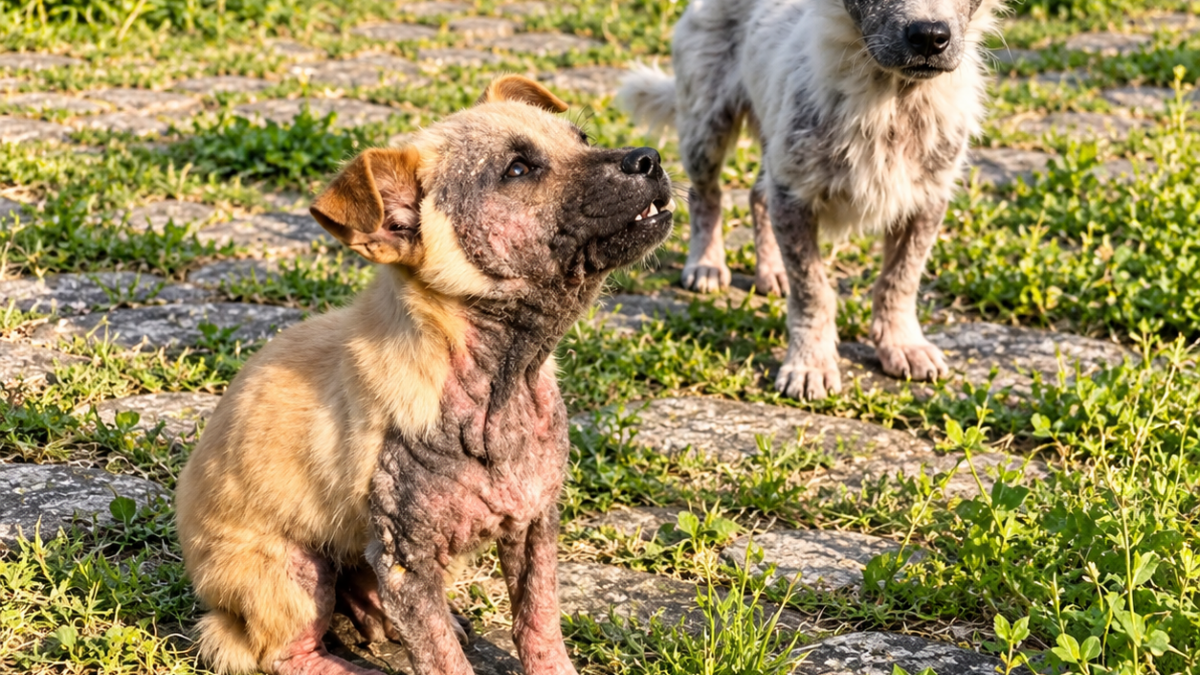
The room was warm. Machines hummed softly. Under the bright clinic lights, their suffering looked even worse than it had in the grass. Their skin was red and scaly. Their legs were swollen. Their coats were patchy and thin.
I wanted to cry, but I forced myself to breathe slowly.
Animals can feel panic.
I knelt near the blankets.
“Hi, boys,” I whispered. “You made it through the first part.”
Geumdong lifted his eyes.
Eundong pressed closer to him.
“I know,” I said softly. “People have not been kind to you.”
Geumdong’s nose twitched. He seemed to recognize my voice from the park. Or maybe he recognized the smell of food on my hands. Either way, he did not try to move away.
That small trust felt enormous.
Eundong would not look at me.
He kept his face turned toward the wall, his body tight and ready, as if escape were still possible.
I did not reach for him.
“I won’t touch you,” I said. “Not until you’re ready.”
I stayed only a minute, but before I left, Geumdong shifted his paw. It moved barely an inch across the blanket, but it landed against Eundong’s leg.
Even sick, even weak, he was still trying to comfort his brother.
Outside, I leaned against the hallway wall and covered my mouth.
That was when Mina, one of the rescuers, walked over with her phone in her hand.
“You need to see this,” she said.
I wiped my eyes. “What?”
“The post is spreading.”
She showed me the screen.
The original photo was still there. The caption was still there too.
“Look at these ugly dogs. The park needs to do something about this.”
My stomach tightened.
The comments had changed.
Some people were laughing. Some were disgusted. A few asked why nobody helped them. One person wrote, “I saw them last weekend. One of them kept following our group. So annoying.”
Another wrote, “They were eating trash behind the tents.”
Then another comment caught my eye.
“They belong to no one. They’ve been there forever. Somebody should remove them.”
Remove them.
Not rescue them.
Not feed them.
Remove them.
Mina watched my face.
“Don’t read more,” she said.
But I already had.
My sadness sharpened again.
“Who posted it?” I asked.
“A man named Daryl Kang,” Mina said. “He runs a local camping page. He organizes weekend trips out there.”
I looked at the name. His profile picture showed him standing in front of a campfire, smiling, holding a metal cup in the air like he owned the wilderness behind him.
“He saw them,” I said. “He was close enough to take that picture.”
“Yes.”
“And he did nothing.”
Mina’s expression hardened. “Worse than nothing.”
I looked back toward the treatment room.
Through the window, I could see Geumdong’s side rising and falling slowly. Eundong was hidden behind him.
“Save everything,” I said.
Mina understood immediately.
Screenshots.
Names.
Dates.
Comments.
Photos.
If people could use the internet to humiliate starving animals, then we could use it to tell the truth.
But I did not want to post in anger that night. Anger moves fast, and I wanted something stronger.
Evidence.
The next morning, Dr. Han gave us permission to take careful photos for medical records. Not sensational photos. Not cruel angles. Just the truth. Their swollen paws. Their cracked skin. The infected patches. The shaved areas where the staff had cleaned wounds. The X-ray showing stones and plastic inside bodies that should have been full of puppy energy, not garbage.
I wrote down every fact.
Approximate age: one year.
Condition: severe malnutrition, anemia, skin inflammation, Demodex mites, digestive obstruction risk from foreign material.
Behavior: fearful but not aggressive.
Location found: public camping area near the park.
Estimated time seen wandering: two months.
Then I stared at the sentence I had copied from Daryl Kang’s post.
“Look at these ugly dogs.”
I wanted to throw my phone across the room.
Instead, I opened a blank document and began to write.
I did not call him names.
I did not threaten him.
I did not exaggerate.
I told the truth.
I wrote about two young dogs who had begged campers for leftover food and been chased away. I wrote about how one had eaten grass and swallowed plastic because hunger had broken through every natural instinct. I wrote about their swollen paws, their infected skin, their anemia.
Then I wrote:
Someone saw them suffering and called them ugly. We saw them suffering and called them Eundong and Geumdong.
Mina read it over my shoulder.
“That line,” she said quietly. “Keep that line.”
We posted the rescue update from the organization’s page at noon.
Within an hour, it had more attention than anything we had ever shared.
By evening, thousands of people had seen it.
Messages began flooding in.
“How can I help?”
“Are they safe?”
“Can I donate for their treatment?”
“Who called them ugly?”
That last question appeared again and again.
We did not have to answer.
People found the original post themselves.
By the next morning, Daryl Kang had deleted it.
But the internet has a long memory when cruelty is caught clearly enough.
Screenshots kept circulating.
His camping group went quiet.
Then came his first message.
It arrived through the rescue page, short and irritated.
“You need to take my name out of this. I didn’t do anything wrong. I only posted what I saw.”
I read it twice.
Then I replied from the official account.
“You saw two starving, injured dogs and chose public mockery instead of calling for help. We have not tagged you, but we will not lie about how this began.”
His answer came less than a minute later.
“They’re just stray dogs.”
I sat back in my chair.
Just stray dogs.
Two words that explained everything.
Not lost.
Not suffering.
Not terrified.
Just stray dogs.
As if being unwanted made pain less real.
Mina, standing beside me, looked ready to explode.
“Let me answer him,” she said.
“No,” I replied. “He wants anger. We’ll give him records.”
So we sent him a list of local animal welfare contacts, emergency rescue numbers, and the basic legal duty to report animals in severe distress.
He did not respond.
But later that night, he posted again.
This time on his own profile.
“People are overreacting. I never hurt those dogs. These rescue pages are twisting things for attention.”
That post was a mistake.
Because people who had seen the dogs at the campsite began replying.
One woman wrote, “I was there three weeks ago. They were limping then.”
Another wrote, “I saw your group chasing them away from the food table.”
A father commented, “My daughter cried because one of the dogs was eating from a trash bag.”
Then someone uploaded a short video.
It showed Geumdong standing near a camping table while people laughed in the background. A man’s voice, not fully visible, said, “Get out of here, ugly thing,” and someone clapped loudly to scare him away.
Geumdong flinched and backed off.
Behind him, barely visible in the grass, Eundong watched.
I played the video once.
Then I could not play it again.
The room felt too small.
Mina whispered, “That’s him.”
I looked at her.
“The voice?”
She nodded. “That is Daryl.”
We sent the video to the local animal welfare officer along with our medical report.
That was when the story changed.
Until then, it had been a rescue story.
Now it became a question the whole community had to answer.
How many people had seen two dying dogs and decided their suffering was not their problem?
For the next week, Eundong and Geumdong fought through treatment.
Geumdong improved first.
His fever broke on the third day. His appetite returned with such intensity that nurses had to feed him small measured meals throughout the day. Too much food too quickly could harm him, so every portion was careful.
He did not understand that.
Each time a bowl appeared, his whole body leaned toward it.
“You’ll get more,” I promised him one afternoon.
He stared at me as if promises were a language he had never learned.
Then, slowly, he ate.
Not as desperately as the first day.
But still fast enough to remind me that hunger leaves memories in the body.
Eundong was different.
He ate when no one watched.
If a person stood too close, he froze. If a door closed loudly, he ducked. If someone reached toward him, he turned his face away and pressed himself into the corner.
But he never snapped.
Not once.
Fear filled him completely, but there was no cruelty in him.
I spent hours sitting outside his kennel with my back against the wall, reading messages aloud from people who had donated to his care.
“Dear Eundong and Geumdong,” I read softly one evening, “you are beautiful boys. Please get better.”
Geumdong lifted his head at my voice.
Eundong kept his eyes on the floor.
Another message said, “I’m sorry humans failed you.”
I stopped reading for a second.
“That makes two of us,” I whispered.
Dr. Han walked past and paused.
“You’re here again,” he said.
“I know.”
“You should rest.”
“I can’t.”
He looked toward the kennel. “They will need time. Especially Eundong.”
“I know that too.”
Dr. Han folded his arms, his expression thoughtful. “Some animals recover physically before they recover emotionally. Some never fully forget. But dogs are remarkable. Give them safety long enough, and sometimes they decide the world might still be worth trusting.”
I looked at Eundong.
He was pretending not to hear us, but one ear had shifted toward my voice.
“How long is long enough?” I asked.
“As long as it takes.”
That became my answer for everything.
When people asked when they would look better, I said, “As long as it takes.”
When people asked when they could be adopted, I said, “As long as it takes.”
When reporters asked whether we had a dramatic transformation photo yet, I said no.
I refused to turn their recovery into entertainment.
They had already been photographed at their worst by someone who wanted laughter. I would not exploit their healing for applause.
But I did keep documenting their progress.
Quietly.
The first time Geumdong wagged his tail, I almost missed it.
A nurse named Yuri came in carrying fresh towels. Geumdong was lying on his side, sleepy after a medicated bath. Yuri hummed under her breath as she folded the blanket beside him.
His tail moved once.
Just once.
A small, uncertain tap against the towel.
Yuri froze.
“Did you see that?” she whispered.
I looked up from my chair.
“What?”
She pointed.
“His tail.”
We both stared.
For a moment, nothing happened.
Then Yuri said gently, “Hi, handsome.”
Tap.
This time I saw it.
One tiny movement.
It was not a full wag. It was not joy yet. It was the first fragile sign that somewhere under the pain, Geumdong still had room for happiness.
Yuri covered her mouth.
I laughed and cried at the same time.
“You heard that?” I told him. “She called you handsome.”
Tap.
From the corner, Eundong watched.
He did not move his tail.
But he watched.
That mattered too.
A few days later, Geumdong began leaning into touch. Carefully at first, as if he expected kindness to turn into pain. Then with more confidence. When someone scratched the one safe area near his shoulder, his eyes softened, and his whole body seemed to exhale.
Eundong still refused hands.
So I offered him something else.
Choice.
Every day, I sat near his kennel and placed a small treat a few feet away. Then I looked down, not at him.
At first, he waited until I left.
Then he waited until I turned my back.
Then one afternoon, after nearly two weeks, I felt movement beside my shoe.
I did not look.
I barely breathed.
Eundong stepped out, took the treat, and retreated.
It took every bit of strength I had not to react.
Inside, my heart was shouting.
Outside, I stayed still.
“Good boy,” I whispered.
He stopped.
For one second, he looked at me.
Then he went back to Geumdong.
That night, I slept for the first time without dreaming of the park.
Meanwhile, the pressure on Daryl grew.
The camping page lost sponsors. Families began asking why the group had ignored injured animals for weeks. The park office received calls. Animal welfare officers requested statements from people who had seen the dogs.
Daryl tried to defend himself again.
He claimed he had “no idea the dogs were sick.”
Nobody believed him after the video.
Then he claimed he had “tried to call someone.”
No records supported that.
Then he claimed rescues were “using him as a villain.”
That part almost made me laugh.
He had made himself one when he chose the caption.
But I did not want revenge in the way people usually mean it. I did not want him hurt. I did not want screaming at his door, threats, or hatred that would poison everything we were trying to build.
I wanted accountability.
I wanted him to stand in front of the suffering he had mocked and understand that cruelty has a cost.
The opportunity came sooner than I expected.
Three weeks after the rescue, the park office announced a community meeting about stray animal response and campground safety.
Daryl attended.
So did we.
I walked into the small public hall carrying a folder of medical records and printed photos. Mina came beside me. Dr. Han joined us after clinic hours, still in his work shoes, his hair damp from rushing over.
The room was packed.
Campers. Park staff. Local residents. Volunteers. A few reporters.
Daryl sat near the back, arms crossed, jaw tight. He wore a clean jacket and an expression that said he had already decided he was the victim.
The park director opened the meeting stiffly.
“We are here to discuss recent concerns involving two stray dogs found near the campground,” he said.
Someone in the audience said, “You mean the dogs everyone ignored?”
A murmur spread.
The director cleared his throat. “We are reviewing procedures.”
When it was my turn to speak, I stood at the front with the folder in my hands.
My voice shook at first.
Then I looked down at the first photo.
Geumdong in the grass, eyes tired, body broken.
The shaking stopped.
“My name is Claire,” I began. “I work with the rescue team that helped bring Eundong and Geumdong to the clinic. I am not here to attack anyone. I am here to make sure nobody can say they did not know.”
The room quieted.
I held up the medical summary.
“These dogs were not simply dirty. They were not simply inconvenient. They were severely malnourished and anemic. Their skin was infected. They had Demodex mites. Some areas were so damaged that touching them could cause bleeding. X-rays showed stones and plastic inside their intestines.”
A woman near the front gasped.
I looked toward the back of the room.
Daryl stared at the floor.
“They were about one year old,” I continued. “That means they were barely more than puppies.”
I placed the first printed photo on the table.
Then the second.
Then the third.
No dramatic music. No manipulation.
Just evidence.
“People saw them begging for food,” I said. “People saw them limping. People saw them eating trash. And at least one person took a photo and called them ugly.”
Daryl’s head lifted.
I did not say his name.
I did not need to.
Everyone knew.
“This is what I want to say clearly,” I continued. “A starving animal is not ugly. A sick animal is not ugly. A frightened animal who has been failed by people is not ugly.”
My voice hardened.
“What is ugly is seeing suffering and turning it into a joke.”
For several seconds, no one spoke.
Then an older man stood up.
“I was there one weekend,” he said. “I saw those dogs. I thought someone else would call.”
His voice cracked.
“I’m sorry.”
A woman beside him nodded, crying quietly.
“My son wanted to feed them. I told him not to go near strays. I should have called someone.”
One by one, people began admitting what they had seen.
Not all of them were cruel.
Some had been afraid.
Some had assumed another person had already acted.
Some did not know who to contact.
That was painful, but it was honest.
Then Mina stood.
“Fear is understandable,” she said. “Not knowing what to do is understandable. But mocking suffering is a choice.”
Every eye moved to the back.
Daryl pushed his chair back and stood.
“This has gone far enough,” he said. “I didn’t abuse those dogs.”
Dr. Han spoke before I could.
“Neglect is not always one person holding the chain,” he said. “Sometimes it is a circle of people watching an animal deteriorate and deciding not to act.”
Daryl’s face reddened.
“I posted the photo so the park would handle it.”
I opened my folder and removed a screenshot.
“You wrote, ‘Look at these ugly dogs.’ You did not tag the park office. You did not list a rescue number. You did not ask for help.”
His mouth tightened.
Someone in the audience said, “Just apologize.”
But he did not.
Not then.
Instead, he grabbed his jacket and walked out.
For a moment, I thought that was the end.
It was not.
The next morning, the local paper published the story.
The headline was simple:
“Starving Dogs Mocked Online Now Recovering After Rescue.”
They included our rescue statement, Dr. Han’s medical explanation, and information on how to report animals in distress. They did not publish graphic photos, only one image of Geumdong wrapped in a towel after treatment, his eyes tired but safe.
That article reached more people than Daryl’s cruel post ever had.
Donations came in from strangers.
A school class sent handmade cards.
One child drew two brown dogs under a sun and wrote, “You are not ugly. You are loved.”
I taped that card near their recovery room.
Geumdong sniffed it.
Eundong tried to eat the corner.
“You already ate plastic,” I told him gently, pulling it back. “Let’s not eat art.”
For the first time, I thought his eyes looked less empty.
Weeks passed.
Their bodies changed slowly.
The swelling in their paws began to go down. Their skin, once red and cracked, started healing in uneven patches. Soft new fur appeared like a promise. Geumdong’s coat came back first, warm and fluffy in places. Eundong’s took longer, but when it grew, it was softer than I expected.
Their personalities emerged with their fur.
Geumdong was sweet, affectionate, and dramatic about baths. He would lean into every hand that touched him but look deeply betrayed whenever medicated shampoo appeared.
“You survived hunger, mites, and anemia,” Yuri told him once while rinsing his back. “You can survive shampoo.”
Geumdong sighed like an old man.
Eundong watched from a towel pile, suspicious but interested.
He became clever.
Too clever.
He learned which nurses carried treats. He learned the sound of the food cart. He learned that if he placed one paw outside the kennel and looked tragic, someone would whisper, “Just one more snack.”
But trust still came slowly.
He would approach, take a treat, and retreat. Then one day he did not retreat quite as far. Another day he sat beside my chair, still not touching me, but close enough that I could feel his warmth near my leg.
I let him decide.
Always.
Then came the day I will never forget.
I was sitting on the clinic floor answering messages when Eundong walked over, lowered his head, and rested his chin on my knee.
I froze.
My phone screen went dark in my hand.
Geumdong, from his blanket, opened one eye as if to say, Finally.
Slowly, carefully, I lowered my hand. I did not place it on Eundong’s head. I held it still near his shoulder, giving him time to move away.
He did not.
So I touched him with two fingers.
His body tensed.
I stopped.
He stayed.
Then, inch by inch, he relaxed.
I stroked the safe patch of fur near his neck.
His eyes closed.
A sound came out of me that was almost a sob.
“There you are,” I whispered. “There you are, sweet boy.”
From that day on, Eundong changed.
Not all at once.
Healing never works like that.
He still flinched at sudden noises. He still hated nets. He still hid behind Geumdong when strangers entered too quickly.
But he had crossed a bridge.
He had decided one human hand might be safe.
And once he decided that, he became brave in tiny, beautiful ways.
He took treats from children during a controlled visit. He sniffed a toy and then pounced backward when it squeaked. He followed Geumdong into the playroom and discovered soft beds.
The first time he rolled onto his back on a blanket, all four paws in the air, the entire clinic staff gathered silently at the door.
Nobody wanted to disturb him.
Nobody even breathed loudly.
Eundong, the dog who had cried when a rescue net touched him because he thought his life was ending, was sleeping belly-up in a warm room.
Safe enough to be vulnerable.
That was our victory.
Not the public outrage.
Not the news article.
Not Daryl losing his camping sponsors.
This.
A dog sleeping without fear.
Still, the accountability was not over.
The animal welfare office completed its review. There was not enough evidence to charge one person with direct abuse before the rescue. The dogs had no registered owner. No witness could prove who had abandoned them or how they arrived at the park.
That part hurt.
I wanted the original person who left them there to be found. I wanted a name, a face, a courtroom, a sentence that felt equal to their suffering.
But real life does not always give that kind of clean justice.
So we focused on the justice we could create.
The park adopted a new emergency response policy for injured or stray animals. Every campground information board received rescue contact numbers. Staff were trained to report animals in distress. Campers were told not to chase, harass, or feed animals unsafe scraps, but to call for help immediately.
And Daryl?
His camping group never recovered.
People withdrew. Sponsors left. Families refused to attend trips organized by someone who had turned suffering into a joke. Eventually, he posted a video apology.
I watched it alone.
He sat in his car, looking uncomfortable.
“I want to apologize for the words I used about the two dogs found at the park,” he said. “I didn’t understand how sick they were.”
I paused the video.
That old anger rose again.
He had understood enough.
He had seen swollen paws. Cracked skin. Thin bodies. Fear.
But I pressed play.
“I should have called for help,” he continued. “I was wrong.”
His voice changed then. Just slightly.
“I’ve been ordered to complete community service with an animal welfare program. I know some people will say I’m only doing this because of the backlash. Maybe at first that was true. But I saw the medical photos. I saw what happened to them. And I’m sorry.”
I watched his face.
For the first time, he did not look angry.
He looked ashamed.
That did not erase what he had done.
But shame, when it turns into responsibility, can become useful.
His community service began at a shelter outside our district. Not ours. That was intentional. Eundong and Geumdong did not need his presence near them.
For six weeks, he cleaned kennels, carried food, washed bowls, and assisted staff under supervision. He was not allowed to handle frightened animals without training.
A shelter worker later told me he was quiet at first. Defensive. Embarrassed.
Then one day, an old dog with mange leaned against his boot.
Daryl stood completely still and asked, “Does it hurt them?”
The worker said, “Yes.”
He looked down at the dog.
After that, he stopped complaining.
I did not forgive him right away.
Maybe forgiveness was not mine to give.
But I accepted that the best revenge was not destroying him.
The best revenge was forcing him to see clearly.
Forcing him to clean the bowls of animals like the ones he had mocked.
Forcing him to understand that the word “ugly” had never belonged to two starving dogs.
It had belonged to the part of him that looked away.
By the time Eundong and Geumdong were medically cleared for foster care, they were almost unrecognizable from the photo that started everything.
Their fur had grown back thick and soft. Geumdong’s face looked rounder, brighter, full of warmth. Eundong still carried caution in his eyes, but now curiosity lived there too.
We arranged a small photo session in the clinic garden.
Nothing fancy.
Just sunlight, clean blankets, and two dogs who had earned every soft thing in the world.
Geumdong immediately sat in the flower bed.
“Not there,” I laughed, moving him gently.
He wagged his tail.
Eundong sniffed the grass, then looked up sharply when a bird moved in the hedge.
“It’s okay,” I said. “Just a bird.”
He considered that.
Then he sneezed.
The photographer, a volunteer named Alice, lowered her camera and smiled.
“They’re beautiful,” she said.
I looked at them.
Beautiful did not feel like a strong enough word.
They were survivors.
They were brothers.
They were proof that cruelty is loud, but kindness can be louder if enough people refuse to stay silent.
We posted their transformation photos that evening.
I stared at the caption for a long time before writing it.
Finally, I typed:
Weeks ago, someone called Eundong and Geumdong ugly. Today, we want you to see what safety, food, medicine, and love can reveal.
Then I added their photos.
Geumdong leaning into Yuri’s hand, eyes half-closed with joy.
Eundong standing in sunlight, new fur glowing, his body no longer folded in fear.
The response was overwhelming.
People cried.
People donated.
People asked to adopt them.
But adoption was complicated.
The rescue team had originally hoped they could be adopted together. They had survived together, slept together, healed together. Separating them felt cruel.
But bonded pairs are harder to place.
Some adopters wanted Geumdong only because he was friendly. Others asked for Eundong only because they were moved by his fear. A few people liked the story more than the responsibility.
Mina and I reviewed applications carefully.
Too carefully, some people said.
But I did not care.
These dogs had already been failed by rushed decisions.
They deserved a home, not another risk.
One application came from a retired couple named Mark and Elena.
They lived outside the city in a quiet house with a fenced yard. They had experience with rescue dogs and had recently lost their senior dog to cancer. Their application was thoughtful, detailed, and honest.
Under the question, “Why do you want to adopt Eundong and Geumdong?” Elena wrote:
Because they should not have to lose each other after losing everything else.
I read that sentence three times.
Then I called her.
She answered softly. “Hello?”
“Hi, this is Claire from the rescue. I’m calling about Eundong and Geumdong.”
There was a sharp inhale.
“Oh,” she said. “Mark, it’s them.”
I heard movement, then a man’s voice in the background.
“Put it on speaker.”
I smiled.
The first meeting was arranged at the clinic.
Elena brought no loud excitement, no squealing, no sudden movements. She entered slowly, sat on the floor, and let the dogs decide.
Geumdong approached first, of course.
He sniffed her hands, then leaned against her knee as if they had known each other for years.
Elena’s eyes filled with tears.
“Hello, sweetheart,” she whispered.
Mark sat a few feet away, holding a treat on his open palm. He did not reach for Eundong. He did not stare at him directly.
Smart man.
Eundong stayed behind me at first.
Then behind Geumdong.
Then beside Geumdong.
Then he stretched his neck forward and sniffed the air near Mark’s hand.
Mark looked at the floor and said, “Take your time, buddy.”
Buddy.
The word landed gently.
Eundong took the treat.
Then he backed away.
Mark did not move.
Five minutes later, Eundong came back.
This time, after taking the treat, he stayed.
Elena began crying silently.
Mark pretended not to, but his glasses fogged.
I knew then.
Not with certainty. Adoption requires checks, visits, patience. But something in the room had shifted.
Eundong and Geumdong were no longer being chosen because of pity.
They were being respected.
The home visit confirmed everything.
The fence was secure. The house was calm. There were soft beds in multiple rooms, water bowls already set out, and a quiet corner prepared for decompression. Elena had written down medication schedules even though the dogs no longer needed most of them.
“We know love won’t fix everything overnight,” she said.
That sentence mattered.
Too many people think love is magic.
It is not.
Love is work.
Love is patience when a dog hides under the table.
Love is cleaning an accident without anger.
Love is leaving the leash by the door for weeks before a frightened animal trusts walks.
Love is understanding that survival leaves echoes.
The adoption was approved.
On their last morning at the clinic, everyone acted normal and failed completely.
Yuri cried while packing their food.
Dr. Han gave a formal medical summary with red eyes.
Mina kept pretending she had allergies.
I held it together until Geumdong walked up to me and placed both paws on my knees.
“Oh, don’t do that,” I whispered.
He wagged his tail.
Eundong stood beside him, watching my face carefully.
I knelt in front of them.
“You don’t know this,” I said, “but you changed a lot of people.”
Geumdong licked my chin.
Eundong leaned forward and pressed his forehead against my shoulder.
That was when I broke.
I hugged him lightly, careful not to hold too tightly.
“You brave, beautiful boy,” I whispered. “You did it.”
The drive to Mark and Elena’s house was quiet. Geumdong looked out the window. Eundong lay against him, nervous but not panicking. When we arrived, Elena opened the front door and stepped back.
No crowd.
No shouting.
No big celebration.
Just a warm house waiting.
The dogs entered slowly.
Geumdong sniffed the first bed and immediately climbed onto it.
Mark laughed. “I guess that one’s yours.”
Eundong explored the room in careful circles. He checked the door, the windows, the bowls, the hallway. Then he returned to Geumdong.
Elena sat on the sofa, hands folded.
“You’re safe here,” she said.
Eundong looked at her.
Then, to everyone’s surprise, he walked over and lay down at her feet.
No one moved.
No one wanted to ruin it.
After a while, Mark whispered, “Welcome home.”
I left before sunset.
In the car, I sat for several minutes with my hands on the steering wheel.
Rescue is strange that way.
You fight so hard to save them, then the happiest ending is the one where they no longer need you.
My phone buzzed before I even pulled away.
Elena had sent a photo.
Geumdong was asleep on the bed.
Eundong was beside him, his head resting across Geumdong’s back.
The message said:
They are home.
I cried all the way back to the city.
Months passed.
Their updates became the best part of my week.
Geumdong discovered pillows and decided every pillow in the house belonged to him. He gained weight, grew a glossy coat, and developed the habit of greeting guests with a toy in his mouth.
Eundong took longer.
For the first month, he avoided the kitchen if pans clattered. He refused to walk past trash bags. Plastic bags scared him most of all. The sound made his body drop low, eyes wide, memory pulling him back to whatever hunger had taught him.
Mark and Elena never forced him.
They let him watch from a distance.
They used soft voices.
They celebrated tiny victories.
One day, he walked past a trash bag without freezing.
Elena sent me a video with the caption:
Today he chose courage.
Another week, Eundong wagged his tail when Mark came home.
Then he brought Elena one of Geumdong’s toys.
Then he began sleeping in the living room instead of hiding in the quiet corner.
Healing did not erase the past.
But it made the future bigger.
The final piece of the story came almost a year after the rescue.
The park invited us to a public animal safety event. The new signs had been installed for months. Reports of injured strays were being handled faster. Local schools were teaching children what to do if they saw an animal in distress.
Mark and Elena asked if bringing Eundong and Geumdong would be too much.
I hesitated.
The park was where their suffering had unfolded. I did not want to force them near old fear.
But Elena said, “We’ll only come if they’re comfortable. We can leave anytime.”
So we tried.
That morning, when their car pulled into the park entrance, my heart started pounding.
I saw Geumdong first.
He jumped out wearing a blue harness, tail wagging like the world had never disappointed him.
Then Eundong stepped down.
He paused.
His nose lifted.
For a second, the old fear crossed his face.
I saw it.
The memory of grass, hunger, smoke, shouting, plastic, stones, and empty days.
Mark crouched beside him.
“We can go home,” he said.
Eundong leaned against his leg.
Then Geumdong bumped him with his shoulder.
And together, they walked forward.
I had to turn away.
Not because I was sad.
Because I was watching a miracle with four paws.
People gathered quietly as they entered the event area. Some recognized them immediately. A few covered their mouths. One little girl held up the drawing she had made months ago—the one that said, “You are not ugly. You are loved.”
Elena knelt so the girl could show it to them.
Geumdong sniffed it.
Eundong, thankfully, did not try to eat it this time.
Then I saw Daryl.
He stood near the edge of the crowd, wearing a volunteer vest from the shelter where he had completed his service hours. He looked older somehow. Smaller. Not physically, but in the way pride looks when it has been forced to kneel.
My body tightened.
Mina, standing beside me, noticed.
“You okay?” she asked.
“I don’t know yet.”
Daryl did not come close to the dogs. He did not try to make the moment about himself.
He waited until Mark and Elena had moved toward the shade with them. Then he approached me.
“Claire,” he said.
I looked at him.
For a moment, all I could hear was that video.
Get out of here, ugly thing.
He swallowed.
“I’m not here to ask you to forgive me.”
“Good,” I said.
He accepted that.
“I just wanted to tell you I still volunteer twice a month.”
I said nothing.
“At first it was because I had to,” he continued. “Now it isn’t.”
Across the grass, Geumdong rolled onto his back while a group of children laughed. Eundong stood beside Elena, cautious but calm.
Daryl looked at them, and his face changed.
“I thought stray meant nobody’s responsibility,” he said quietly. “I was wrong.”
I followed his gaze.
“Yes,” I said. “You were.”
He nodded.
“I’m sorry for what I called them.”
The apology was late.
Too late for the nights they had slept hungry in the grass.
Too late for the stones and plastic in their intestines.
Too late for the fear that still lived somewhere inside Eundong when a loud noise cracked the air.
But not useless.
No true accountability can change the past.
It can only change what a person does next.
“Don’t say it to me,” I told him.
He looked confused.
I nodded toward the field.
“Say it by what you do for the next animal nobody wants to see.”
His eyes lowered.
“I will.”
Then he walked away.
That was the revenge.
Not shouting.
Not humiliation.
Not cruelty returned for cruelty.
The revenge was this:
The dogs he had mocked were now loved by an entire community.
The photo he had posted to shame them had become the beginning of their rescue.
The word he had used to reduce them had followed him until he was forced to become better or be remembered only for the worst thing he had done.
And Eundong and Geumdong?
They did not care about any of it.
They cared about the grass under their paws, the clean water bowl near the shade, the treats in Elena’s pocket, and the fact that when the sun grew warm, Mark spread a blanket for them under a tree.
Geumdong fell asleep first.
Eundong stayed sitting for a while, watching people move around the park.
No one chased him.
No one laughed.
No one threw stones or clapped him away from food.
A little boy walked past with his mother and whispered, “Mom, are those the famous dogs?”
His mother smiled. “Yes. Those are the brave ones.”
The brave ones.
I liked that much better.
Eundong’s ears twitched at the sound of the boy’s voice. He looked toward him, then back at Elena. She touched his shoulder gently.
“You’re okay,” she said.
And he believed her.
Near the end of the event, the park director asked me to say a few words. I almost refused. The day did not belong to me.
But Mark nodded.
Elena smiled.
So I stood in front of the small crowd with Eundong and Geumdong resting behind me in the shade.
“A year ago,” I said, “two starving dogs were found near this park. Many people saw them. Some were afraid. Some did not know what to do. Some looked away. One person called them ugly.”
The crowd grew still.
“But the truth is, they were never ugly. They were hungry. They were sick. They were scared. And they were waiting for someone to see them clearly.”
I turned slightly and looked at them.
Geumdong was asleep with one ear flipped inside out.
Eundong was awake, eyes soft, body relaxed beside his brother.
“They survived because people finally chose action over judgment,” I continued. “They healed because kindness became stronger than shame. And they are here today because a family looked at two wounded dogs and saw not damage, but worth.”
My voice thickened.
“So please remember this. The next time you see an animal suffering, do not wait for someone else to care first. Make the call. Ask for help. Be the reason the story changes.”
No one clapped right away.
For a second, silence held us.
Then the applause came.
Soft at first, then full.
Geumdong woke up startled and barked once.
Everyone laughed.
Eundong stood, pressed himself against Elena’s leg, then relaxed when she placed her hand on his back.
After the event, as the crowd thinned, I walked with Mark and Elena toward their car.
“Do you ever regret taking both?” I asked.
Mark looked genuinely offended.
“Regret?” he said. “Geumdong supervises my breakfast every morning, and Eundong escorts Elena from room to room like a tiny security guard. We are very well managed.”
Elena laughed. “They rescued us more than we rescued them.”
It is a sentence people say often.
Sometimes it sounds sentimental.
That day, it sounded true.
Before they left, I crouched to say goodbye.
Geumdong leaned into my chest with his usual full-body enthusiasm. Eundong waited behind him, then stepped forward and touched his nose to my hand.
That was his way.
Quiet.
Careful.
Real.
“You look good,” I told him.
His tail moved once.
Then again.
A small wag, but no longer uncertain.
I watched their car drive away until it disappeared beyond the park road.
The same road where they had once wandered hungry.
The same park where people had once looked at them and seen a problem.
Now they left as beloved dogs, with full bellies, soft fur, and a family waiting to take them home.
That night, I opened the old screenshot again.
The original photo.
The caption.
“Look at these ugly dogs.”
For a long time, I stared at it.
Then I opened the newest photo Elena had sent.
Geumdong was sleeping upside down on the sofa, paws in the air. Eundong was curled beside him with his head resting on a pillow, his eyes half-closed in peace.
I placed the two images side by side.
Before and after.
Cruelty and healing.
Ignorance and truth.
The world had called them ugly when they were at their weakest.
But love had answered slowly, patiently, every day, until the lie could no longer survive.
I deleted the old screenshot from my phone.
Not because I wanted to forget.
I would never forget.
I deleted it because Eundong and Geumdong were no longer that picture.
They were not the starving dogs in the grass.
They were not the cruel caption.
They were not the laughter, the stones, the plastic, the fear, or the weeks of being unwanted.
They were Geumdong, who wagged his tail in his sleep.
They were Eundong, who had learned that hands could be gentle.
They were brothers.
They were survivors.
They were home.
And in the end, the most satisfying revenge was not that the person who mocked them was exposed.
It was that the whole world finally saw what he had been too blind to see.
They had always been beautiful.