PART 2: They Called the Paralyzed Shelter Dog Useless—Four Years Later, He Made the Whole Room Stand Up
They Called the Paralyzed Shelter Dog Useless—Four Years Later, He Made the Whole Room Stand Up
The little dog had spent four years in the same corner of the shelter, watching every other dog leave before him.
People called him useless because his back legs barely worked, but they never noticed what he was still doing with the only strength he had left.
Then one afternoon, the man who had left him broken walked back through our doors—and the dog everyone had given up on finally became the reason the truth came out.
[FACEBOOK CAPTION — 700–800 WORDS]
I first saw him in the oldest room of the shelter, where the paint peeled near the ceiling and the winter air always seemed to find its way under the door.
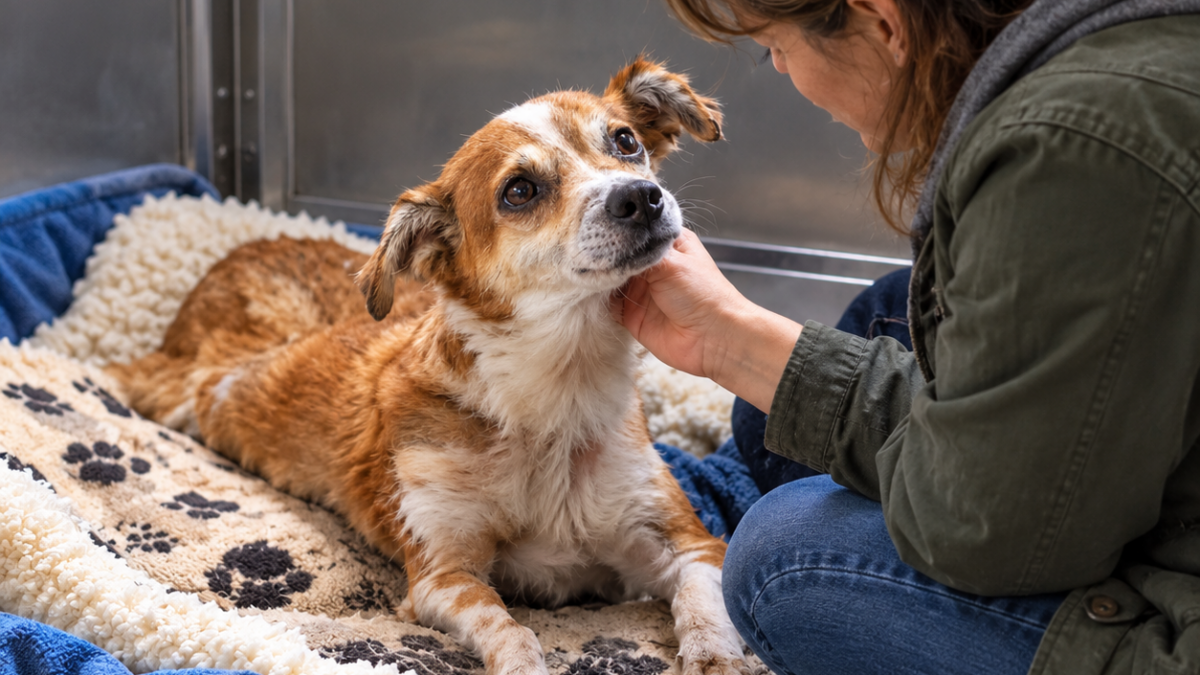
He was lying on a thin blue blanket in the far corner, a small white-and-rust-colored dog with a narrow face, tired brown eyes, and front paws stretched out in front of him like he was waiting for someone who had forgotten to come back. His back legs rested strangely behind him, too still, too loose, as if they belonged to a body that no longer listened.
His name on the intake card was Milo.
But most people did not call him that.
They called him “the little disabled one.”
Some called him “the corner dog.”
And one man, standing right beside me on my first week as a volunteer, looked into that room and said, “Honestly, he’s useless.”
The word hit me harder than I expected.
Milo lifted his head at the sound of voices. His body trembled slightly, not with fear exactly, but with the effort of simply holding himself up. He looked at us with such quiet attention that for one strange second, I felt ashamed to be standing.
“How long has he been here?” I asked.
The staff member beside me, Denise, sighed like she had answered that question too many times.
“Four years.”
I thought I had misheard her.
“Four years?”
She nodded.
“He was found near an abandoned house outside town. Tiny thing back then. Filthy, starving, lying beside the concrete steps. Couldn’t even stand. The vet said it was tetanus. Advanced. His muscles were locked in spasms. Every movement hurt him.”
I looked back at Milo.
Four years.
Four winters.
Four summers.
Four years of people walking past his corner while puppies went home, seniors went home, sick dogs went home, dogs with scars and missing eyes and gray faces went home.
But Milo stayed.
Denise folded her arms. “In the beginning, everybody hoped he’d recover. We did therapy, massage, medications, turning him every few hours so he wouldn’t get sores. Sometimes he tried. He’d lift his head. Tighten his front legs. Look at you like he was asking for help.”
Her voice softened for the first time.
“But his body just wouldn’t follow.”
Behind us, the shelter continued its usual noise. Dogs barking. Bowls clanging. A family laughing in the adoption hall because a beagle puppy had climbed into a laundry basket. Life moving loudly around a dog who could barely move at all.
I crouched near Milo’s blanket.
Not too close.
His eyes followed me.
“Hey, buddy,” I whispered.
His tail did not wag. Maybe he could not make it wag. Maybe he had learned not to waste energy on hope.
But his eyes stayed on mine.
That was what I noticed first.
Not the legs.
Not the trembling.
The eyes.
They were not empty.
They were waiting.
A few days later, I watched a couple come through the shelter looking for a quiet dog. The woman paused at Milo’s room.
“Oh,” she said softly. “What about him?”
Before I could answer, another employee said, “He can’t walk. He’s been here forever.”
The woman’s face changed.
Pity came first.
Then discomfort.
Then escape.
They moved on.
Milo watched them go.
I do not know whether dogs understand rejection the way people do, but I know this: he turned his face toward the wall afterward and did not lift his head again until dinner.
That night, I could not sleep.
The word kept coming back.
Useless.
The next morning, I arrived early, before the public doors opened. Milo was awake, lying on his side, watching dust move through a strip of sunlight across the floor.
I stepped inside with a clean towel and sat beside him.
“I don’t believe them,” I said.
His ear twitched.
“I don’t know what you can do yet. But I don’t believe you’re useless.”
For the first time since I had met him, Milo moved one front paw toward me.
Only an inch.
But it was enough to make my throat tighten.
Then Denise appeared in the doorway with his old medical folder in her hands, her face pale.
“You need to see this,” she said.
PART 2
I knew from the look on Denise’s face that whatever she had found was not good.
She was not dramatic by nature. Denise had worked at the shelter for nine years, long enough to develop the kind of dry, practical hardness people mistake for not caring. She could clean wounds without flinching, separate fighting dogs without shouting, and talk to adopters with a calm smile even when her eyes told a different story.
But that morning, standing in the doorway of Milo’s room with the old folder pressed to her chest, she looked shaken.
“What is it?” I asked.
She glanced down the hall before stepping inside.
Milo watched her.
That was another thing about him. He watched everything. He did not have the body to chase sounds or rush toward doors, so his eyes did the moving for him. They followed footsteps, hands, voices, shadows. Nothing passed through that old room without being measured.
Denise lowered herself carefully onto the chair near the wall.
“I was cleaning out the archived files,” she said. “The original intake paperwork was mixed in with some old clinic records. I never saw the full notes before. Back then, I wasn’t the one assigned to him.”
I sat straighter.
“And?”
She opened the folder.
Inside were yellowing papers, vet notes, old photographs, treatment charts, and a small envelope marked with the date Milo had been found.
Denise handed me the first photo.
I did not want to look at it.
But I did.
The puppy in that picture barely resembled the dog lying beside me.
He was smaller then, almost unbearably small. His fur was matted with dirt and leaves. His body was stiff, legs stretched at strange angles. His eyes were open, but his face carried a frozen, desperate pain that made my chest tighten.
He was lying beside a cracked concrete step outside an abandoned house.
There were autumn leaves around him.
One had stuck to his shoulder.
Behind him, the door of the house was half boarded.
The photo looked like the beginning of a ghost story.
“He was just a baby,” I whispered.
“Maybe six months old,” Denise said. “Maybe younger.”
I read the first clinic note.
Severe tetanus suspected. Generalized muscle rigidity. Pain response high. Unable to stand. Dehydrated. Malnourished. Prognosis guarded to poor.
The next page.
Patient survived first night. Spasms continue. Handling must be minimal and slow. Staff advised low stimulation.
The next.
Possible puncture injury under left rear paw. Old wound. Infection likely entry point.
I stopped.
“Puncture injury?”
Denise nodded grimly.
“That is not the part that bothers me most.”
She pulled out a smaller sheet, folded twice.
“This was in the envelope.”
It was a short statement from the animal control officer who had picked him up.
Found near abandoned property formerly used by transient workers and illegal dog handlers. Neighbor reports hearing puppies crying from site weeks earlier. No animals present when property inspected except one small dog lying beside front steps. Signs of makeshift pen behind house.
Illegal dog handlers.
I read the line again.
My stomach turned.
“What does that mean?” I asked, though I already had an idea.
Denise took the paper back gently.
“It means nobody knew exactly where he came from. But there were rumors. Backyard breeding. Dogs being moved around. Puppies sold out of cars. A man named Victor Hale was questioned twice back then.”
“Questioned?”
“Never charged.”
“Why not?”
“No proof. No witnesses willing to testify. Property was cleaned out before animal control got there.”
I looked at Milo.
He had lowered his head onto his paws, but his eyes were still open.
“Do we know Victor did this to him?”
“No,” Denise said. “We know Milo was found where Victor had been seen. We know there were signs of other animals there. We know Milo had a puncture wound that likely led to tetanus. We know Victor disappeared from town for years.”
The hall outside filled with barking as the morning feeding began.
I felt anger rise through me slowly, like heat beneath a closed door.
“And now?”
Denise hesitated.
“He came back.”
I looked up.
“What?”
“He’s on the shelter board now.”
For a second, I thought I had misunderstood her.
“The man connected to the place where Milo was found is on the board?”
“Not officially connected,” she said. “That’s the problem. Nothing was ever proven. He donated money last year through his contracting company. Paid for the roof repairs. The director wanted community sponsors. Victor Hale became useful.”
Useful.
There was that word again.
I looked at Milo’s thin body, his useless back legs, his trembling effort just to hold his head up.
Then I looked at the folder in Denise’s hands.
“Does Victor know Milo is here?”
“I don’t know.”
“When is the next board visit?”
Denise closed the folder.
“Tomorrow.”
The next morning, the shelter smelled of bleach, wet fur, and nervous people.
Board visits did that. The staff cleaned things that were already clean. Volunteers were told to smile. Kennels were straightened. Donation signs were polished. The director, Marsha Ellery, wore her good blazer and spoke in the careful voice she used whenever money entered the building.
I did not like Marsha.
That was unfair, perhaps. She had kept the shelter open through hard years, bad budgets, and winter heating bills that nearly broke us. She knew grant language, donor dinners, county contracts, and the exact expression to wear when asking wealthy people for checks.
But she saw animals in categories.
Adoptable.
Difficult.
Long-term.
Medical hold.
Cost concern.
And Milo, to her, was less a dog than a line item that had gone on too long.
I had heard her say once, not cruelly but coldly, “We have to be realistic.”
Realistic.
Another dangerous word.
At ten o’clock, three board members walked through the front entrance. I recognized two from photos near the office. The third man I knew before anyone said his name.
Victor Hale looked like a man who had spent years learning how to appear respectable.
He was in his early fifties, broad-shouldered, with a clean haircut, polished boots, and a tan work jacket that probably cost more than my monthly rent. His smile was easy. Too easy. He shook hands with Marsha, complimented the fresh paint, and made a little joke about dogs barking louder than city council meetings.
Everyone laughed.
I did not.
Denise stood beside me at the laundry counter. Her face had gone tight.
“That’s him,” she murmured.
Victor’s eyes traveled down the hall.
Past kennel one.
Past kennel two.
Past the puppy room.
Past the adoption photos.
Then he stopped.
He was looking toward Milo’s room.
Something changed in his face.
Only for a moment.
But I saw it.
Recognition.
Then it was gone.
He smiled again and said something to Marsha about expanding the facility.
I moved before I fully decided to.
Milo was lying in his corner when I entered. I had brushed his fur that morning, cleaned his blanket, and placed a small towel under his chest so he could keep his head up more easily. He looked fragile but alert.
I crouched beside him.
“Company today,” I whispered.
His eyes shifted toward the door.
Victor appeared there a minute later with Marsha and the two other board members.
“This is our long-term medical room,” Marsha said briskly. “We keep special-needs animals here when they require quieter care.”
Victor stepped inside.
Milo’s body reacted before anything else happened.
His front legs stiffened.
His head lifted.
The trembling started deep in his shoulders and moved through his whole body.
I placed one hand near him but did not touch.
Victor looked down.
“Well,” he said lightly, “this one’s still here?”
Still.
The word landed like a slap.
Denise, standing behind Marsha, went white.
“You know him?” I asked.
Victor’s eyes moved to me.
His smile stayed.
“I’ve seen a lot of dogs, miss.”
“My name is Hannah.”
“Hannah, then.” He looked back at Milo. “Hard to forget one like that.”
Milo tried to move.
It was the most heartbreaking thing I had ever seen.
His front paws dug into the blanket. His chest lifted an inch. His back legs dragged behind him, useless, stiff, trembling. His face turned toward Victor, not with affection and not with curiosity.
Fear.
Recognition.
A low sound came from him.
Not a growl.
A cry held behind the teeth.
Marsha frowned. “He’s usually quiet.”
“He is quiet,” I said, unable to keep the anger out of my voice. “Unless something scares him.”
Victor gave a small laugh.
“Dogs like that scare easy. You can’t read too much into it.”
“Dogs like what?”
His smile thinned.
“Damaged.”
Milo’s front paws slipped.
His chest dropped back onto the towel.
For a second, the room seemed too small for all the things nobody was saying.
Then one of the board members, a retired teacher named Mrs. Ralston, stepped closer to Milo’s chart on the wall.
“How long has this dog been here?” she asked.
Marsha answered quickly. “A number of years.”
“Four,” I said.
Marsha shot me a warning look.
Mrs. Ralston turned. “Four years?”
“Yes.”
Victor shrugged. “That’s a lot of resources for one animal.”
Denise made a sound behind me.
I stood slowly.
“He survived tetanus as a puppy,” I said. “He’s disabled because nobody helped him when he needed it.”
Victor looked at me.
“Careful,” Marsha said softly.
But something in me had crossed a line I could not uncross.
“No,” I said. “I think careful is how dogs like Milo spend four years in corners while people call them useless.”
Silence.
Marsha’s face flushed. “Hannah, step into the hallway.”
Victor smiled, but his jaw was tight.
Milo trembled on the blanket.
And in that moment, I knew two things with absolute certainty.
First, Victor Hale knew that dog.
Second, Milo had just recognized the man who left him broken.
I did step into the hallway, but not because Marsha told me to.
I stepped out because I was afraid if I stayed one more second, I would say something that could not be taken back in front of the wrong people.
Denise followed me.
My hands were shaking.
“You saw that,” I said.
“I saw.”
“He knew him.”
“Yes.”
“What do we do?”
Denise looked toward the office, where Marsha’s polished donor voice had resumed.
Then she looked back at me.
“We find proof.”
Proof is an ugly word when pain is obvious.
Milo’s body was proof to me.
His fear was proof.
The old photographs were proof.
But the world does not move on what a wounded animal’s eyes say. The world wants papers, names, dates, statements, signatures, photographs with time stamps, bills, witnesses.
So we started there.
Denise knew where old files were stored. I knew how to be stubborn. Between us, that was enough to begin.
We stayed late that night, long after the shelter closed. The dogs settled one by one into the tired sounds of evening. A shepherd sighed in kennel five. Someone’s water bowl clinked. Rain touched the roof in soft, uncertain taps.
In the storage room behind the office, Denise pulled out boxes labeled by year.
“Marsha will fire us if she catches us,” I said.
“She’ll scold us first,” Denise replied. “She enjoys warming up.”
We sorted through intake sheets, maintenance records, donor logs, old incident reports, animal control notices, and archived emails printed for reasons nobody remembered.
At midnight, we found the first thread.
A complaint from a neighbor near the abandoned property.
Multiple dogs heard crying behind former Miller house. White pickup seen late nights. Man identified by neighbor as V. Hale.
Two weeks later, a follow-up note.
Property appeared vacated before inspection. No animals found on site. Evidence of makeshift enclosure behind residence. Case inactive pending new information.
The date was three days before Milo was found.
I stared at the paper.
“He cleared the place out,” I said.
Denise’s voice was grim.
“And left Milo behind.”
“Or thought he was dead.”
Neither of us spoke after that.
The thought sat between us like something rotten.
We copied everything.
The next day, I contacted the animal control officer whose name was on the original report. His name was Paul Grady. He was retired now, living two counties over, but his phone number was listed in an old staff directory.
When he answered, his voice sounded like gravel and suspicion.
“Who is this?”
“My name is Hannah Mercer. I volunteer at Maple Ridge Shelter. I’m calling about a dog found four years ago near the old Miller property.”
Silence.
Then: “Small white-and-red pup?”
My throat tightened.
“You remember him?”
“I remember every one I couldn’t help enough.”
That was when I knew he would talk.
Paul came to the shelter three days later.
He was older than I expected, with a cane, a weathered face, and eyes that still missed nothing. He did not want coffee. He did not want small talk.
“Show me the dog,” he said.
I took him to Milo’s room.
Milo was awake, head resting on his paws.
Paul stopped in the doorway.
“Oh, little man,” he whispered.
The change in his voice told me everything.
He remembered.
Milo watched him, cautious but not terrified.
Paul lowered himself slowly into the chair.
“I carried you in my jacket,” he said. “You were stiff as a board. I thought we’d lose you before we made the clinic.”
Milo blinked.
Paul wiped one hand over his mouth.
“I filed three reports on that place,” he told us. “Three. I knew Hale was running dogs through there. Puppies mostly. Sick ones disappeared. Females moved before inspection. But every time I got close, someone tipped him off.”
“Who?” Denise asked.
Paul looked toward the office.
“I had my guesses.”
My stomach tightened.
“Are you saying someone from the shelter warned him?”
“I’m saying he had friends. People who thought a contractor with money and county connections was more useful than a man complaining about dogs nobody saw.”
Useful.
Again.
I hated that word now.
Paul agreed to write a statement. He also gave us the name of the neighbor who had reported the crying. Her name was Linda Carver.
Linda still lived near the old property.
She answered the door holding a mug of tea and wearing a cardigan with loose threads at the cuffs. When I told her why I was there, her face closed first with fear, then opened with grief.
“I wondered what happened to that puppy,” she said.
“You saw him?”
Her eyes filled.
“I saw a man carry him once. By the scruff. Like he was trash. The puppy wasn’t moving right even then.”
“Was the man Victor Hale?”
She nodded.
“I told animal control. But by the time they came, the dogs were gone.”
“Would you be willing to say that now?”
She looked past me toward the old Miller house down the road.
It had been renovated since then. New siding. New windows. No sign of what had happened behind it except the stubborn memory of one woman who had heard puppies crying in the dark.
“I should have said more back then,” she whispered.
“You said what you knew.”
“I was afraid.”
“We all are,” I said. “At first.”
Linda gave a written statement.
So did Paul.
Denise found the old complaint records.
I photographed Milo’s scars with the vet present.
And all the while, Milo kept living his quiet life in the corner.
But something had changed.
Maybe in him.
Maybe in us.
I began spending every morning with him before the shelter opened. At first, I only sat beside him and talked. I told him about the weather. About the ridiculous terrier in kennel eight who stole blankets. About Denise’s terrible coffee. About how Marsha pretended not to like the shelter cat, even though she fed him turkey from her sandwich when she thought no one was watching.
Milo listened.
One day, he pushed his front paw onto my shoe.
It took visible effort.
His paw trembled there, thin and warm.
I did not touch him right away.
I let him rest his choice on me.
After a minute, I whispered, “I know you’re still in there.”
His tail moved.
Barely.
But it moved.
I saw it.
So did Denise.
After that, we called a rehabilitation specialist.
Her name was Dr. Elena Marsh, and she did not speak in false hope. She examined Milo gently, moving his legs, checking reflexes, watching his breathing, testing muscle tone, pressure response, pain response, strength in his shoulders and chest.
Milo endured it with the tired patience of a dog who had been handled for years without expecting much to change.
At the end, Dr. Marsh sat back on her heels.
“He will never walk normally.”
I had known that, but hearing it still hurt.
“Can he walk at all?” I asked.
“Maybe not in the way you mean.”
“What does that mean?”
“It means his back legs may never support him. But his front end is stronger than you think. He has some control. With conditioning, pain management, physical therapy, and the right cart, he may be able to move independently.”
Independently.
The word seemed to lift the air in the room.
Denise covered her mouth.
I looked at Milo.
He looked back at me.
“You hear that?” I whispered. “She thinks you’re not done.”
Dr. Marsh did not smile, exactly, but her eyes softened.
“No,” she said. “He is definitely not done.”
The cart cost money.
Of course it did.
Everything that could help Milo cost money.
Marsha refused at first.
“We cannot spend hundreds of dollars on experimental equipment for a long-term unadoptable dog,” she said in her office, her voice tight.
“He’s not unadoptable,” I said.
“Hannah.”
“No. He isn’t.”
“He has been here four years.”
“Because people keep saying that.”
She leaned back in her chair.
“You are new here.”
“I know.”
“You have no idea what it takes to keep this place running.”
“You’re right,” I said. “I don’t. But I know what it looks like when an animal has been filed under impossible because nobody wants the discomfort of trying again.”
Her face hardened.
Denise, standing beside me, spoke before Marsha could answer.
“I’ll pay for half.”
I turned.
“What?”
Denise did not look at me.
“I said I’ll pay for half.”
“You can’t afford that.”
“I didn’t ask you.”
The room went quiet.
Marsha looked from Denise to me, then closed her eyes.
“This is reckless.”
“No,” Denise said. “Reckless was letting him become furniture.”
That sentence struck harder than any shouting could have.
Marsha opened her eyes.
For a moment, I saw something like shame.
Then she sighed.
“I will approve a fundraiser.”
“No pity language,” I said immediately.
Marsha’s eyebrows rose.
“I beg your pardon?”
“No ‘poor Milo.’ No ‘helpless.’ No photos where he looks half-dead. We tell the truth, but we don’t turn him into misery for money.”
Denise looked at me like she wanted to hug me and slap me at the same time.
Marsha studied us.
Then she said, “Fine.”
The fundraiser title was simple.
MILO’S WHEELS.
I wrote the description myself.
Milo has spent four years watching the world from one corner. We think he deserves to move through it.
People responded.
Not everyone, but enough.
Five dollars from a college student.
Twenty from a grandmother.
A hundred from a local mechanic who wrote, “No dog is useless.”
That one made Denise cry in the supply closet.
A class of third graders sent crayon drawings of Milo with wheels. One drew him flying through the sky like a superhero with clouds under his cart. We taped that picture near his bed.
Victor Hale did not like the fundraiser.
We knew because Marsha got a call from him two days after it went public.
She came out of her office pale and angry.
“What did he say?” I asked.
“He says the shelter should be careful about implying negligence or past abuse connected to unnamed local businesses.”
I almost laughed.
“He recognized himself in a story that didn’t name him?”
Denise muttered, “Guilty men answer questions nobody asked.”
Marsha rubbed her forehead.
“He threatened to pull his donation.”
“Let him.”
Marsha looked at me.
This time, she did not scold.
Maybe she was tired.
Maybe she was changing.
Maybe Milo was not the only one learning to move after being stuck.
“We may lose the county expansion grant if he pushes back,” she said.
“Then let the county explain why a donor’s comfort matters more than the animal he may have abandoned.”
Denise nodded.
Marsha looked toward Milo’s room.
For once, she did not have a practical answer ready.
The cart arrived on a Thursday.
It was bright blue, lightweight, with soft straps and adjustable wheels. I had imagined feeling joy when I saw it, but instead I felt terrified.
What if he hated it?
What if it hurt?
What if we had raised hope only to place another disappointment on his tired body?
Dr. Marsh came to fit it.
We moved slowly. Milo trembled while we lifted him, but not from fear alone. Effort, confusion, old pain, new sensation. Denise held his head and murmured to him. I supported his chest. Dr. Marsh adjusted straps with steady hands.
“There,” she said finally. “Do not expect too much today. Standing is enough.”
Standing.
For the first time in four years, Milo’s body was upright.
His front paws touched the floor.
The cart held his back end.
His head lifted.
The room stopped breathing.
Milo looked confused.
Then he looked startled.
Then he looked at me.
I knelt in front of him, tears already running down my face.
“Hi,” I whispered.
His ears moved forward.
He took one front step.
The wheels rolled.
He froze.
Nobody cheered.
Nobody clapped.
We had learned that big human emotion could frighten a dog who had survived too much.
So we stayed quiet.
Milo took another step.
Then another.
Three steps.
Four.
Then his front legs shook, and Dr. Marsh said, “That’s enough.”
But Milo did not want enough.
He lifted his head toward the doorway.
The doorway he had only ever been carried through.
I moved backward slowly.
“Come on,” I whispered. “Only if you want to.”
Milo stepped again.
The wheels followed.
Denise made a sound like a broken laugh.
Milo reached the doorway.
Stopped.
Looked into the hall.
For four years, the world had passed him by from that corner.
Now the hall was in front of him.
Open.
Waiting.
He took one more step.
His wheels crossed the threshold.
That was when Denise turned away and sobbed into both hands.
I had thought the big moment would be Milo walking.
I was wrong.
The big moment was Milo realizing he could choose where to go.
He tired quickly, of course. That first session lasted less than three minutes. But after we removed the cart and settled him back on his blanket, something about his face was different.
He was exhausted.
But awake in a new way.
The next day, he took eight steps.
The day after that, twelve.
By the end of the second week, he could move from his blanket to the doorway.
By the end of the month, he reached the hall.
People began coming by to see him.
Not in a circus way. We controlled that carefully. But volunteers who had walked past him for years now stopped with treats, soft words, towels, questions.
Milo became visible.
That was beautiful.
And infuriating.
Because he had always been there.
The investigation into Victor Hale grew quietly.
Paul Grady sent old reports to a friend still working in animal control. Linda Carver gave a formal statement. Two more people came forward after Milo’s fundraiser spread online. One had bought a sick puppy from a man matching Victor’s description years ago. Another had worked briefly for Victor and remembered cages behind the old property.
None of it was easy.
Victor had money, lawyers, and reputation. He framed everything as a smear campaign by emotional shelter volunteers. He claimed he loved animals. He claimed he donated generously. He claimed people were punishing him for success.
Then he made one mistake.
He came to the shelter alone.
It was late afternoon. Rain had turned the parking lot dark. Most of the staff were in the back. I was cleaning Milo’s cart near the laundry sink when I heard Victor’s voice in the hall.
“Where’s the dog?”
My body went cold.
Milo was in his cart near the doorway of his room, supervised by Denise. He had been practicing turns.
I stepped into the hall.
Victor stood near the entrance to the medical wing, water on his jacket, face set hard.
“You need to leave,” I said.
“I’m on the board.”
“Not for long.”
His eyes narrowed.
“You have no idea what you’re playing with.”
Denise moved closer to Milo.
Milo saw Victor.
The old fear came through him instantly.
His front legs stiffened. His head lowered. His breathing changed. But this time, he was not lying helpless in the corner.
He was standing in his blue cart.
Victor’s gaze dropped to the wheels.
He gave a humorless laugh.
“Well, look at that,” he said. “You people really will waste money on anything.”
Milo trembled.
I stepped between them.
“Do not talk about him.”
Victor leaned closer.
“You think that animal proves something? He was half-dead when I saw him. Would have been kinder to let nature finish.”
The hallway went silent.
He realized too late what he had said.
Denise’s eyes went wide.
I felt all the blood drain from my face.
“When you saw him?” I said.
Victor’s mouth tightened.
“I meant the photos.”
“No,” Denise said quietly. “You said when you saw him.”
Victor stepped back.
And then Megan appeared from the office hallway holding her phone.
“I got that,” she said.
Victor turned.
“What?”
Megan’s hands were shaking, but her voice was steady.
“I got every word.”
Victor’s polished face finally cracked.
“You recorded me without permission.”
“You walked into a private medical wing after being told not to harass staff,” Megan said. “Smile for the lawyer.”
Victor stormed out.
This time, he did not look confident.
That recording changed everything.
Not alone.
But enough.
With the recording, old reports, witness statements, and Milo’s medical history, animal control reopened the case. Local news picked it up after the board suspended Victor pending review. Then county officials wanted to know why a shelter donor had been linked to old animal neglect complaints. Then people who had been quiet before suddenly found courage.
That is how public shame works sometimes.
It arrives late.
But when it comes, it brings company.
Victor was not charged with everything I believed he had done. The law rarely reaches the full shape of cruelty.
But he was charged with animal neglect tied to the abandoned property, obstruction related to the old investigation, and illegal breeding violations from records discovered after warrants were served at two storage buildings he still owned.
Several dogs were found.
Alive.
That was the part that mattered most.
Three females in poor condition.
Two young dogs with untreated skin infections.
A litter of puppies in a shed that smelled of urine and rust.
They came to our shelter and two others nearby.
When I saw the first carrier arrive, I thought of Milo as a puppy beside the concrete step, waiting with leaves stuck to his dirty fur.
This time, they were not left behind.
Victor Hale resigned from the board.
His company logo came down from the donor wall.
Marsha removed it herself.
I stood nearby while she did it.
The plaque left a pale rectangle on the wall.
Marsha looked at the empty space.
“I should have asked more questions,” she said.
“Yes,” I answered.
She flinched slightly, but she did not argue.
After a moment, she nodded.
“Yes,” she said. “I should have.”
That was the closest thing to an apology I expected from her.
It was enough to begin.
But the best revenge was not Victor’s humiliation.
It was not the news article.
It was not the court hearing, where he sat stiff in an expensive suit while Paul Grady testified about carrying a dying puppy in his jacket. It was not Linda Carver finally saying in a public room that she had heard puppies crying and nobody had listened hard enough.
The best revenge came three months later, at the shelter’s adoption event.
Milo was not supposed to be the center of it.
We had brought him out only for a short session in his cart, planning to let him greet a few trusted volunteers before taking him back to rest. He wore a soft green harness and a small bandana the third graders had made for him. It said, in uneven letters:
NOT USELESS.
I had objected at first.
It felt too direct.
Denise loved it.
“He earned direct,” she said.
So Milo wore it.
By then, he had grown stronger through his chest and shoulders. He would never move fast. He would never run through fields like other dogs. But he could travel down the hall in his cart, turn toward voices he liked, and decide when he was tired.
That day, the lobby was full.
Families. Volunteers. Reporters, unfortunately. County officials trying to look compassionate. Marsha giving careful interviews near the donation table. The rescued dogs from Victor’s property had all been placed in foster or medical care, and people were calling it a victory.
I stood beside Milo near the side of the room, one hand on his harness strap.
Then a little boy approached.
He was maybe eight, with dark curls and a serious face. His mother hovered behind him, nervous but kind.
“Can I say hi?” he asked.
I looked at Milo.
His ears were relaxed.
“Yes,” I said. “But slowly. Let him sniff you first.”
The boy crouched.
Not too close.
He held out his hand low.
Milo leaned forward and sniffed his fingers.
Then, with great effort, Milo moved one front paw and placed it on the boy’s shoe.
The boy’s eyes widened.
“He picked me,” he whispered.
His mother covered her mouth.
I looked at Denise across the room.
She saw.
The boy’s name was Ethan.
He had spina bifida and used braces on his legs. That was not the first thing I noticed about him, but it became part of the conversation because children are sometimes braver than adults about naming what is true.
“He has wheels like me,” Ethan said.
Milo looked up at him.
“Yes,” I said softly. “He does.”
Ethan visited Milo every week after that.
He did not come to adopt him at first. His mother, Rachel, was cautious. She worked long shifts as a nurse. Their apartment had space but not much. Milo needed care, lifting, cleaning, therapy, patience. Rachel understood responsibility too well to be swept away by emotion.
So she visited.
She asked questions.
Hard ones.
Good ones.
What if he got sores?
What if his condition worsened?
What if he could not be left alone long?
What if Ethan became attached and Milo died sooner than a healthier dog?
I answered honestly.
“Yes, that could happen.”
“Yes, he will need work.”
“Yes, loving him may hurt.”
Rachel looked through the glass one afternoon at Ethan sitting beside Milo’s blanket, reading him a book about astronauts.
“My son knows loving can hurt,” she said. “He also knows what it feels like when people look at equipment before they look at you.”
I did not speak.
Inside the room, Ethan turned a page and showed Milo a picture of the moon.
Milo rested his chin on the boy’s ankle brace.
The adoption took six more weeks.
During that time, Ethan learned Milo’s care routine. He learned how to check the cart straps, how to offer water, how to place towels, how to brush gently around Milo’s hips, how to watch for tiredness. Rachel learned lifting techniques from Dr. Marsh. Their landlord approved the dog. Volunteers built a small ramp for their front step.
On Milo’s last morning at the shelter, I arrived before sunrise.
He was awake.
Of course he was.
He lay on his blanket in the old corner, the place where he had spent four years being overlooked.
But now the room was different.
There were drawings on the wall. A soft bed beside the blanket. His blue cart near the door. A basket with medical supplies packed for Rachel. A file folder thick with instructions. A little green bandana folded on top.
I sat beside him.
“You’re going home today,” I said.
Milo blinked.
His tail moved.
It moved more easily now.
“I need you to understand something.” My voice broke before I finished the sentence. “You were never useless.”
He placed his paw on my hand.
The same paw he had once moved only an inch.
I lowered my forehead to the blanket beside him and cried.
Denise found us there fifteen minutes later.
She sat on the other side of him.
Milo looked between us as if mildly concerned by the emotional weakness of humans.
“He’s going to think we’re ridiculous,” Denise said.
“He already does.”
She stroked his ear.
“I wasted years,” she whispered.
“No.”
“I walked past him too many times.”
“We all did.”
She closed her eyes.
“He was here.”
“Yes,” I said. “He was here.”
That was the hardest truth.
Milo had not become worthy when he got wheels.
He had not become worthy when the news cared.
He had not become worthy when Ethan chose him.
He had always been worthy.
We were the ones who took too long to see it.
Rachel and Ethan arrived at ten.
Ethan wore a blue jacket and the most solemn expression I had ever seen on a child. He carried a small sign he had made for their apartment door.
WELCOME HOME, MILO.
The letters were crooked. There were stars around the words. In the corner, he had drawn two sets of wheels—one for himself, one for Milo.
We fitted Milo into his cart one last time in the shelter.
He stood.
Steady.
The lobby filled quietly as staff and volunteers gathered, pretending they were just passing through.
Marsha stood near the office door.
Her eyes were wet.
Milo looked down the hallway.
Four years earlier, he had entered that shelter unable to lift himself.
Now he rolled toward the front door.
Slowly.
One step.
Wheels.
Another step.
Wheels.
Ethan walked beside him, one hand on his own walker, the other hovering near Milo but not pulling.
“You got it,” Ethan whispered. “We’re going together.”
At the front door, Milo paused.
Sunlight fell across the threshold.
For a moment, nobody moved.
Then Milo crossed it.
Outside, the morning air was cool and bright.
Ethan laughed.
Not because it was funny.
Because joy needed somewhere to go.
Milo lifted his face toward the sun.
His nose twitched.
His ears moved.
Then he took three more steps, wheels softly clicking over the sidewalk, and stopped beside Ethan as if that was where he had always meant to be.
The shelter behind us was silent.
Then Denise began clapping.
One person joined.
Then another.
Soon the whole entryway filled with applause.
Milo did not understand applause.
He only understood that Ethan was beside him, Rachel was kneeling in front of him, and the open car door did not mean abandonment.
It meant home.
Milo lived with Ethan and Rachel for five years.
Five years.
Longer than anyone expected.
Long enough to become a fixture in their neighborhood. Long enough to learn the route to the park. Long enough to develop a deep personal grudge against the mailman, who adored him anyway. Long enough to sleep beside Ethan during surgeries, bad pain days, school disappointments, and the ordinary heartbreaks of growing up.
He became stronger in some ways and weaker in others.
His front legs grew powerful. His back end remained frail. Some days he did not want the cart. Some days he preferred his bed near the window. Some days pain visited, and Rachel adjusted medication while Ethan lay beside him doing homework on the floor.
Milo attended Ethan’s school presentation about rescue dogs and disability.
He rolled into the classroom wearing his green bandana.
A child asked, “Can he run?”
Ethan said, “Not like other dogs.”
Another child asked, “Is he sad?”
Ethan looked at Milo, who was sniffing a lunchbox under a desk with great purpose.
“No,” Ethan said. “He’s busy.”
That became one of my favorite updates.
Milo was busy.
Busy living.
Busy being loved.
Busy proving every person who had called him useless wrong without ever needing to understand the insult.
Victor Hale served probation, paid fines, lost contracts, and never regained his place on any board that mattered. Some people said he got off too easily. They were right.
But every time Milo rolled through the park beside Ethan, every time another disabled dog got a chance because donors remembered Milo, every time the shelter approved medical equipment instead of quietly giving up, Victor lost again.
Revenge did not look like shouting.
It looked like a little dog in a blue cart, moving forward.
After Milo’s adoption, Maple Ridge changed its policies.
No long-term animal could remain unseen in a back room. Every special-needs dog had a review plan, enrichment schedule, public profile, therapy assessment, and adoption strategy. Marsha created the policy herself.
To her credit, she named it Milo’s Rule.
No animal becomes invisible because care is difficult.
The first time I saw that sentence printed on the staff board, I had to step outside.
Denise followed me.
“You okay?”
“No.”
“Good no or bad no?”
I looked through the side window, where a new volunteer was sitting with a blind senior dog in the sun.
“Necessary no.”
She understood.
Years passed.
I remained at the shelter longer than I planned. People often do when a place breaks and remakes them. Denise retired, then came back twice a week because retirement bored her and her husband complained she was reorganizing the spice cabinet alphabetically. Marsha softened at the edges and became better at asking, “What does this animal need?” before asking, “What can we afford?” Megan eventually became medical coordinator. Paul Grady died the winter after Milo’s adoption, and we placed his old animal control badge in a shadow box near the intake room.
Linda Carver adopted one of the females rescued from Victor’s property.
“She heard them when no one else did,” I told people.
Linda always shook her head.
“Not soon enough.”
But the dog slept beside her every night, and sometimes grace is not about being early enough. Sometimes it is about answering when the second chance comes.
Milo grew old.
His face turned white around the muzzle. His front legs weakened. The cart sessions grew shorter. Ethan, no longer a little boy but a teenager with a deeper voice and the same serious eyes, carried Milo more often than Milo rolled.
The last time they visited the shelter, Milo was wrapped in a soft blanket in Ethan’s arms.
I met them in the lobby.
For a moment, I saw both versions of him at once.
The trembling puppy in the old photograph.
The forgotten dog on the blue blanket.
The brave little body in the cart.
The beloved old soul carried against the chest of the boy who had chosen him.
Ethan was sixteen then.
Tall, thin, awkward in the way kind teenagers often are because they have not yet learned how to hide their hearts.
“He wanted to come,” Ethan said.
I looked at Rachel.
She nodded, eyes already wet.
We took Milo to his old room.
It was not his room anymore. It had been painted years before. The corner where his blanket once lay now held a low bed for another recovering dog. The walls were warmer. The light better. Drawings from children covered a bulletin board.
But Milo knew.
I believe that.
When Ethan lowered him gently onto a clean blanket, Milo lifted his head and looked toward the corner.
Then toward the doorway.
Then at me.
I sat on the floor beside him.
“Hi, buddy,” I whispered.
His cloudy eyes blinked.
His paw moved.
Not far.
Just enough to touch my knee.
I cried immediately.
Denise, who had insisted she was only stopping by to drop off towels, cried harder.
Milo stayed awake for twenty minutes.
Long enough for Marsha to come in and kneel stiffly beside him.
“I was wrong about you,” she said quietly.
Milo, being Milo, did not hold grudges.
He merely rested his chin on Ethan’s hand.
Before they left, Ethan asked if he could take Milo to the front door.
So we did.
Not in the cart this time.
In Ethan’s arms.
At the threshold, Ethan paused.
“I used to think he was lucky we adopted him,” he said.
Rachel touched his back.
Ethan looked down at Milo.
“But I think maybe we were the ones waiting.”
No one answered.
There was nothing to add.
Milo died two weeks later at home, in his sleep, on a thick blanket beside Ethan’s bed.
Rachel called me before sunrise.
I drove over with Denise.
Ethan met us at the door.
He did not cry at first. He had the stunned, pale look of someone standing at the edge of a world that had changed while he slept.
Milo lay peacefully, small and still, his white face soft, his body finally free of effort.
His cart stood nearby.
Ethan had placed the green bandana over it.
“I don’t know what to do with his wheels,” he said.
His voice broke on the last word.
I put my arm around him.
“Not today.”
We buried Milo under a young oak tree behind Rachel’s apartment building, with the landlord’s permission and half the neighborhood watching from a respectful distance.
The mailman came.
So did Ethan’s teacher.
So did three children from the neighborhood who had grown up waving to Milo on his walks.
Denise placed one of the third graders’ old drawings in a sealed pouch beside him—the one where Milo flew like a superhero over the clouds.
Ethan placed the sign he had made years earlier.
WELCOME HOME, MILO.
The paper was faded now.
The stars barely visible.
But the words remained.
At the shelter, we created a small memorial near the medical wing.
Not sad.
Not pitiful.
Milo would have hated pity, if he had wasted energy on such things.
We mounted a photograph of him in his blue cart beside Ethan, both of them in sunlight, both moving forward.
Under it, Marsha placed the words from Milo’s Rule:
NO ANIMAL BECOMES INVISIBLE BECAUSE CARE IS DIFFICULT.
People stopped there often.
New volunteers read it on their first day.
Children pointed at the wheels and asked questions.
Some adults cried without explaining why.
I understood.
Milo’s story did that.
It found the part of people that had been overlooked, dismissed, underestimated, left in corners, called too much work, too broken, too late.
And then it showed them a little dog who had spent four years on a thin blanket and still had enough life inside him to move one paw toward the person who finally believed he was not done.
If you ask me what justice looked like in the end, I will tell you it was not the court record.
It was not Victor Hale’s ruined reputation, though I am not noble enough to pretend that did not satisfy me.
It was not the donor plaque coming down.
It was not the news calling Milo “the dog who exposed a secret.”
Justice was quieter.
Justice was Milo standing in his cart for the first time while nobody dared breathe too loudly.
Justice was the word useless disappearing from the shelter.
Justice was Ethan whispering, “We’re going together,” as they crossed into the sunlight.
Justice was a disabled dog teaching an entire building that worth is not measured by what a body can do.
Justice was every animal after him who got a second look, a therapy plan, a fundraiser, a ramp, a cart, a chance.
And revenge?
Yes.
There was revenge.
But not the kind people imagine.
Milo did not bite the man who abandoned him.
He did not bark in court.
He did not understand donor boards, legal charges, reputation, guilt, or public disgrace.
His revenge was better.
He lived.
He lived after being left beside a concrete step.
He lived after tetanus locked his body in pain.
He lived after four years of being ignored.
He lived after people called him useless.
He lived long enough to roll past the man who thought he should have died.
He lived long enough to be chosen by a boy who saw wheels not as tragedy, but as recognition.
He lived long enough to turn one shelter’s shame into a rule that saved others.
That was the ending he deserved.
Not perfect.
Not painless.
But full.
The last time I visited Ethan, years after Milo was gone, he was preparing to leave for college. He had chosen veterinary rehabilitation as his field of study.
On his desk was a framed photo of Milo.
The blue cart.
The green bandana.
The sunlight.
“I don’t know if I can do it,” Ethan admitted.
“Do what?”
“Help animals like him. What if I can’t save them all?”
I looked at the photo.
“You won’t.”
He swallowed.
“That’s supposed to help?”
“No. It’s supposed to be true.”
He gave a sad laugh.
I touched the frame gently.
“You don’t do this work because you can save them all. You do it because Milo was here. Because someone has to notice the one in the corner. Because sometimes saving one changes the rules for the next hundred.”
Ethan looked at Milo’s picture for a long time.
Then he nodded.
Outside his window, the oak tree behind the building moved in the wind.
Milo’s tree.
Strong now.
Leafy.
Alive with birds.
That is how I remember him most.
Not as the helpless puppy in the intake photo.
Not as the forgotten dog on the thin blanket.
Not even as the little fighter in the blue cart.
I remember him under that oak, in the shape of all he left behind.
A boy’s future.
A shelter’s conscience.
A rule on a wall.
A word erased.
A hundred doors opened.
A hundred animals seen.
And somewhere in the middle of it all, a small white-and-rust-colored dog with trembling legs and patient eyes, still moving forward, one impossible inch at a time.