PART 2: They Abandoned Him When He Got Sick—Then Came Back After He Became the Dog Everyone Wanted
—
PART 2
For the first few days, everything seemed to move in the right direction.
Not quickly.
But enough.
Chester accepted small amounts of food.
He drank.
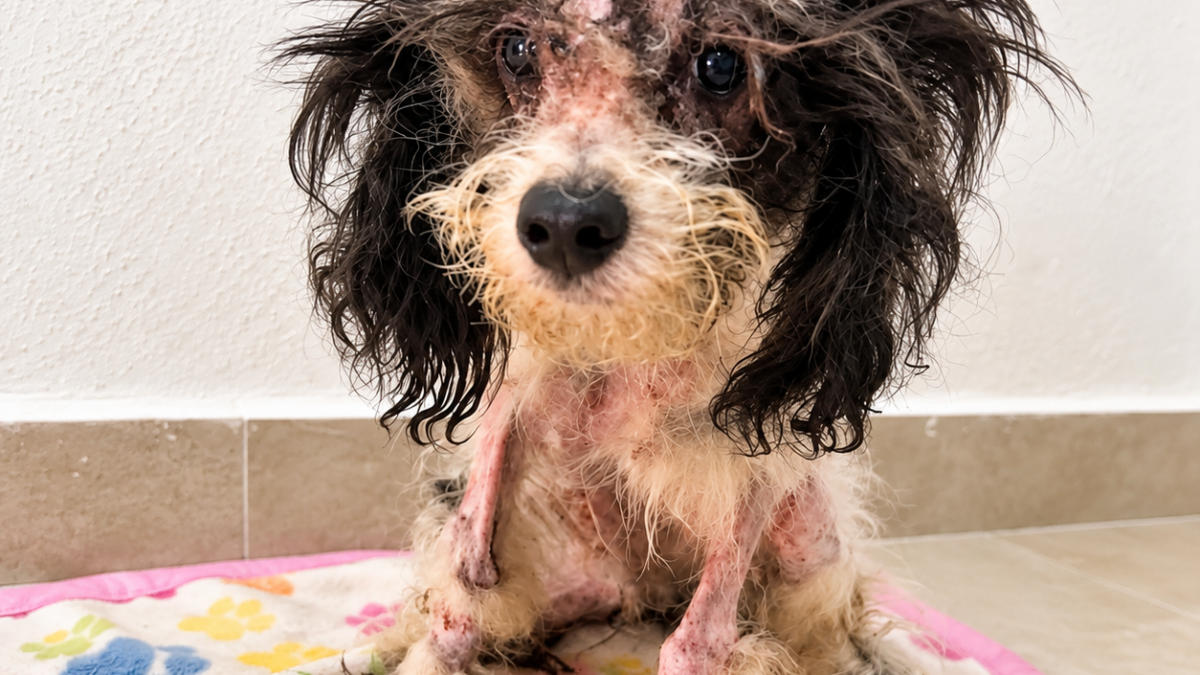
His wounds were cleaned every day.
He received treatment for the parasites attacking his already weakened body.
We started medication for the infections affecting his skin.
The clinic staff learned his personality in tiny fragments.
He liked having a blanket tucked around his body.
He disliked cold metal examination tables.
He watched everyone carefully whenever food was prepared.
And whenever I entered the room, his eyes followed me.
At first, I thought that meant he trusted me.
Later, I realized he was simply checking whether I was going to leave.
That realization changed the way I behaved around him.
Whenever I walked away, I told him.
“I’m getting your medicine.”
Or, “I’m coming back after lunch.”
It probably sounded ridiculous.
But Chester listened.
Sometimes his ears moved when he heard my voice.
Sometimes they didn’t.
I kept talking anyway.
On the fourth morning, I entered the clinic and found him standing.
Actually standing.
All four feet beneath him.
His legs trembled, but he had gotten up without assistance.
“There he is,” I said.
His tail moved once.
One of the technicians looked at me.
“Did you see that?”
“I saw it.”
I crouched.
“Do that again.”
Chester stared at me.
His tail didn’t move.
The technician laughed.
“Apparently you get one.”
“I’ll take it.”
I would have taken anything.
A tail movement.
A better appetite.
An extra few ounces on the scale.
Every small change felt enormous because we had seen how close he had come to having nothing left.
But on the sixth day, his progress slowed.
He ate less.
His energy dropped.
By the end of the week, he seemed almost as weak as when I had found him.
I stood beside the veterinarian as she reviewed his chart.
“We’re treating the parasites,” I said. “His infections are improving. Why is he getting worse?”
“I don’t know yet.”
Those words terrified me.
Veterinarians are used to uncertainty.
Rescuers are forced to become used to it.
But there is nothing easy about watching an animal deteriorate while you wait for an answer hidden somewhere in bloodwork, imaging or a laboratory several miles away.
We changed medications.
Adjusted his food.
Repeated tests.
Chester kept losing strength.
One afternoon, he refused an entire meal.
I warmed it slightly.
Nothing.
I added a little chicken.
Nothing.
I sat on the floor and held a piece near his nose.
“Please.”
He turned away.
I hated myself for saying the next words.
“Chester, you have to eat.”
As though he didn’t know.
As though he had chosen any of this.
I set the food down and rubbed my hands across my face.
The veterinarian walked in.
“He’s still refusing?”
I shook my head.
She sat beside me.
For several minutes, neither of us spoke.
Finally I asked the question every rescuer fears.
“Are we losing him?”
She didn’t answer immediately.
That was almost worse than hearing yes.
“We’re missing something,” she said.
“What?”
“I don’t know.”
I looked through the kennel door.
Chester was asleep.
His breathing was shallow but steady.
“We find it.”
“We’re trying.”
“No.”
I turned toward her.
“We find it.”
She studied me for a moment.
Then nodded.
“We find it.”
### The Diagnosis
The answer came two days later.
I was driving when the veterinarian called.
Her first words were, “Pull over somewhere safe.”
My heart started pounding.
“Is Chester alive?”
“Yes.”
I exhaled so hard my chest hurt.
“What happened?”
“We have the lab results.”
I pulled into a parking area.
“Tell me.”
“His glucose levels and additional testing are consistent with diabetes. He is insulin-dependent.”
For several seconds, I said nothing.
Diabetes.
It wasn’t what I had expected.
I knew dogs could develop diabetes, but I had never imagined that disease hiding underneath everything else Chester was fighting.
“So this is why he isn’t improving?”
“It explains a lot.”
“Can we treat it?”
“Yes.”
That single word changed the entire conversation.
Yes.
Not maybe.
Not we’ll see.
Yes.
The veterinarian continued explaining how diabetes affected the body, why Chester had struggled to gain weight, why his energy had disappeared and why treating the obvious problems had not been enough.
I barely heard half of it.
One sentence kept repeating in my head.
We can treat it.
When I arrived at the clinic, Chester was lying beneath his blanket.
I opened the kennel.
“We figured you out.”
He blinked.
“You’ve been making everybody crazy.”
His tail moved weakly.
I laughed.
“Yeah, yeah. Very funny.”
The treatment plan changed immediately.
His food would need to be carefully controlled.
Meals would follow a consistent schedule.
His blood glucose would need close monitoring.
And Chester would require insulin.
Not for a week.
Not until he looked better.
For life.
I remember staring at the insulin syringe during his first injection.
The needle was tiny.
The responsibility felt enormous.
The veterinarian showed me exactly how to measure the dose.
“You cannot guess with this.”
“I won’t.”
“Meals and insulin need to stay coordinated.”
“They will.”
“If he doesn’t eat, we need to know before giving his normal dose.”
“I understand.”
She made me demonstrate the procedure back to her.
Measure.
Check.
Gently lift the skin.
Insert.
Inject.
Remove.
Praise.
Chester barely reacted.
“There,” I whispered. “Your first one.”
He looked at me as though I had interrupted his nap for no good reason.
The veterinarian smiled.
“He may feel very different once his body starts using glucose properly again.”
“How long?”
“We watch him day by day.”
So that was what we did.
### Fifteen Days
There was no dramatic miracle the next morning.
Chester did not suddenly leap out of his kennel.
His fur did not instantly return.
His wounds did not disappear.
Healing rarely behaves the way people want it to.
On the second day of insulin, he ate slightly better.
On the third, he stood longer.
On the fifth, he walked down the clinic hallway without needing to stop.
On the seventh, he wagged his tail when I entered.
Twice.
“Two?” I said. “We’re getting generous.”
On the ninth day, he barked at me.
One sharp little bark.
I stared at him.
The technician leaned around the doorway.
“Was that Chester?”
“He just yelled at me.”
She grinned.
“That’s excellent.”
“What do you mean excellent?”
“He has enough energy to complain.”
I looked at Chester.
He barked again.
The technician laughed.
“What does he want?”
I glanced toward the food preparation area.
“Based on the direction of his nose? Dinner.”
We had never been so happy to hear a dog demand food.
By the fifteenth day after starting insulin, the difference was undeniable.
His appetite was back.
Not perfectly.
But consistently.
His eyes were brighter.
He walked with more confidence.
His body no longer looked as though gravity itself was too heavy.
One afternoon, I opened his kennel and clipped on a leash.
“Want to go outside?”
He stared at the doorway.
Then took three steps.
We moved slowly through the clinic.
When the outside door opened, Chester stopped.
Sunlight touched his face.
For a moment, he looked uncertain.
Then he walked forward.
His paws reached grass.
He sniffed.
I gave him the entire length of the leash.
“Take your time.”
He smelled one patch.
Then another.
Then another.
His tail began moving.
A bird flew across the yard.
Chester watched it.
A car passed.
His ears lifted.
The world was becoming interesting again.
That mattered.
Sick animals often shrink until their universe contains nothing except pain, food, medication and sleep.
Chester was beginning to notice life outside his own body.
### What We Learned About His Past
While Chester grew stronger, I kept trying to understand what had happened before I found him.
The person who recognized him eventually agreed to meet me.
We sat in a small café not far from the neighborhood where Chester had once lived.
She looked nervous.
“I don’t want trouble,” she said.
“I’m not asking you to cause trouble. I just want to understand.”
She stirred her coffee without drinking it.
“I used to see him outside their house.”
“How old was he?”
“Still young. Maybe not a tiny puppy, but young.”
“Was he healthy?”
“At first.”
My stomach tightened.
“What happened?”
“He started losing weight. Then his coat looked bad.”
“Did anyone say anything?”
“People asked.”
“And?”
“They said they were handling it.”
I looked out the window.
Apparently “handling it” eventually meant abandonment.
“Did you see them dump him?”
“No.”
“Then how do you know?”
She hesitated.
“The owner told someone they couldn’t deal with his medical problems anymore. Then the dog disappeared.”
“How long before I found him?”
“A few weeks, maybe more.”
I stared at her.
A few weeks.
Chester had spent weeks trying to survive while his untreated diabetes worsened.
Without enough nutrition.
Without insulin.
With parasites.
With infected skin.
Walking.
Searching.
Waiting.
“Do they know he’s alive?” I asked.
“I don’t know.”
“They will eventually.”
She looked worried.
“What happens then?”
“I don’t know.”
At that point, I meant it.
### Leaving the Hospital
Chester remained under close veterinary supervision until his blood sugar became more stable.
By the time he was ready to leave, I had a notebook full of instructions.
Meal times.
Amounts.
Medication.
Insulin doses.
Symptoms of low blood sugar.
Symptoms of high blood sugar.
Emergency contacts.
Monitoring schedules.
Follow-up appointments.
I read everything until I could recite half of it from memory.
The day we brought him home, I prepared his meals more carefully than I had ever prepared my own.
Chester watched me from the doorway.
“You realize my entire schedule belongs to you now?”
His tail wagged.
“Exactly. No gratitude.”
He followed me into the kitchen.
That alone felt miraculous.
Weeks earlier, he had struggled to stand.
Now he was following the smell of dinner.
I placed his bowl down.
He ate every bite.
Then looked at me.
“No.”
His tail wagged.
“You had the measured amount.”
He licked the empty bowl.
“You can negotiate with the veterinarian.”
He stared at me.
I stared back.
“This face probably worked on your previous people.”
The thought stopped me.
Previous people.
I hated imagining him looking at them the same way.
Waiting for food.
Waiting for kindness.
Waiting for help when his body began failing.
I crouched beside him.
“Sorry.”
Chester stepped closer.
Then, for the first time, rested his head against my chest.
I wrapped one arm around him.
“No more looking backward.”
Of course, life rarely obeys promises like that.
### Learning the Routine
Managing Chester’s diabetes became part medicine, part discipline and part trust.
Breakfast at the same time.
Insulin.
Observation.
Exercise.
Dinner.
Insulin.
More observation.
We learned the subtle signals.
If he seemed unusually tired, we checked him.
If his appetite changed, we paid attention.
If something simply felt wrong, we called the clinic.
At first, I worried about everything.
A longer nap made me nervous.
Drinking more water made me reach for the phone.
One missed bite of food felt like an emergency.
The veterinarian finally laughed during one appointment.
“You need to breathe.”
“I’m breathing.”
“Not enough.”
I looked at Chester.
“He almost died.”
“I know.”
“I don’t want to miss anything.”
“You won’t. But he also needs to be a dog.”
That sentence stayed with me.
Chester needed medical management.
He did not need to spend the rest of his life wrapped in fear because I was terrified of losing him.
So we began expanding his world.
Short walks.
Longer walks.
Quiet yards.
New people.
Other dogs.
At first, he approached everything carefully.
Then something changed.
He realized experiences could be good.
### The Pool
The swimming pool was an accident.
We were visiting a foster family who had a fenced backyard with a small pool.
I had no intention of letting Chester swim.
He had other ideas.
He saw the water and stopped.
His ears lifted.
“Don’t even think about it.”
Chester walked closer.
“No.”
He looked at me.
Then at the pool.
“Absolutely not.”
He walked to the edge.
I reached for his leash.
Too late.
Splash.
“Chester!”
For one terrifying second, my heart stopped.
Then his head came above the surface.
His front paws began paddling.
One of the foster dogs jumped in beside him.
And Chester—
the dog who had barely moved when I found him—
started swimming.
Not struggling.
Swimming.
His tail moved in the water.
He followed the other dog.
Turned.
Came back.
Then tried to climb out and immediately turn around to go back in.
I laughed so hard I almost cried.
“You’re unbelievable.”
Chester shook water all over me.
“Thank you.”
He trotted toward the edge again.
That day we discovered something that would become one of his greatest joys.
Water.
Whenever Chester saw the pool after that, his entire body changed.
His posture lifted.
His tail accelerated.
He sometimes made a strange excited sound that seemed to come from somewhere between a bark and a squeal.
Eventually, swimming became part of his exercise routine when appropriate.
Low-impact.
Fun.
Something that belonged to the life we were building instead of the illness we were fighting.
The first video I recorded of him swimming made the veterinary technician cry.
She watched it twice.
“That can’t be the same dog.”
“It is.”
“He looks ridiculous.”
“He is ridiculous.”
We both smiled.
That was the first time I realized Chester was no longer merely surviving.
He was becoming happy.
### Then the Message Arrived
It happened nearly three months after his rescue.
My phone buzzed while I was preparing his evening meal.
I glanced at the screen.
Unknown number.
The message contained only one sentence.
**I heard you have my dog.**
I stopped moving.
Chester was sitting near my feet, watching his food.
Another message appeared.
**His name isn’t Chester.**
My stomach tightened.
I set the phone down.
Then picked it up again.
**Who is this?**
The reply came quickly.
The name matched what I had been told.
His former owner.
I looked at Chester.
He had no idea his past had just entered the room again.
The next message arrived.
**I want him back.**
I actually laughed.
Not because anything was funny.
Because sometimes anger is so absurd that laughter is the only reaction available.
I typed one response.
**You abandoned him while he was seriously ill.**
The typing indicator appeared.
Stopped.
Appeared again.
**That’s not what happened.**
I stared at the words.
Then another message.
**We couldn’t find him.**
That contradicted what I had been told.
I didn’t argue.
I sent the screenshots to the rescue coordinator.
Then I contacted the person who had identified Chester.
Within an hour, we had several messages and witness accounts indicating the former owners had known the dog was ill before he disappeared.
Still, I worried.
Ownership disputes involving animals can become complicated.
And Chester had no idea he was at the center of one.
### “You Fixed Him”
Two days later, the former owner called.
I did not want to answer.
The rescue coordinator suggested I keep all communication documented, so I did.
“Hello.”
“You have my dog.”
“I have Chester.”
“That’s not his name.”
“It is now.”
“You can’t just rename someone’s dog.”
“You also can’t abandon a sick dog.”
“I told you that’s not what happened.”
“What happened?”
Silence.
Then he said, “He got out.”
“While severely ill?”
“Yes.”
“And no one reported him missing?”
More silence.
“We looked.”
“How?”
He became irritated.
“I don’t have to explain myself to you.”
“You called me.”
“I want him back.”
I looked at Chester sleeping beside the couch.
His coat had started returning in thick patches.
His weight had improved.
The open wounds were gone.
“You didn’t want him when he needed insulin.”
“You don’t know what happened.”
“I know exactly what condition he was in.”
“He looks fine now.”
There it was.
Not thank God he survived.
Not is he healthy?
Not does he still need treatment?
He looks fine now.
I felt my fingers tighten around the phone.
“He looks fine because people have spent months keeping him alive.”
“I saw the pictures.”
Of course he had.
Someone had shared Chester’s transformation online.
The broken little dog no one wanted had become beautiful.
“You fixed him.”
I closed my eyes.
Fixed him.
Like a car.
Like a broken appliance.
Like something that became desirable only after somebody else paid the cost.
“He has diabetes,” I said. “He will need lifelong management.”
“I can handle that.”
“You couldn’t handle it before.”
“That’s your version.”
“No. That’s Chester’s medical record.”
His voice changed.
“You think you can steal somebody’s dog because you paid some vet bills?”
“I didn’t steal him.”
“I can come get him.”
“No, you cannot.”
“He knows me.”
I looked at Chester.
Maybe he did.
Dogs remember voices.
Smells.
Places.
Fear.
I didn’t know what memories remained inside him.
But I knew something else.
“You abandoned your responsibility before you lost possession.”
The call ended badly.
The message that arrived five minutes later was worse.
**You’ll regret making this difficult.**
I forwarded it immediately.
### The First Real Setback
Stress has a way of arriving at the worst moment.
A few days after the former owner contacted us, Chester’s glucose became unstable.
His appetite dipped.
He vomited once.
I panicked.
The veterinary team adjusted his treatment and monitored him closely.
The episode was manageable, but it reminded me how fragile stability could be.
I sat beside Chester on the floor late that evening.
He leaned against my leg.
“I need you to stop scaring me.”
His eyes closed.
“You have one job.”
His tail moved.
“Stay alive.”
He sighed.
I rubbed his chest.
I thought about the man who wanted him back.
Did he understand this part?
Did he understand the alarms?
The measured meals?
The syringes?
The possibility of hypoglycemia?
The appointments?
The constant observation?
Did he understand that loving Chester meant accepting responsibility every single day, not just admiring him once his fur had grown back?
I already knew the answer.
### Chester Chose Joy
As the weeks passed, his glucose stabilized again.
His coat thickened.
His body filled out.
And his personality exploded.
He was mischievous.
We had never seen that coming.
One morning, I found him standing in the kitchen with an entire roll of paper towels in his mouth.
“Chester.”
He froze.
“Drop it.”
His eyes shifted toward the hallway.
“Don’t.”
He ran.
Paper towels unrolled behind him like a white flag of chaos.
I chased him through the house.
Another dog joined because apparently we were now playing a game.
By the time I caught Chester, the floor looked as though a tiny hurricane had passed through.
He dropped the cardboard tube at my feet.
Then wagged.
“You almost died.”
Wag.
“I gave you insulin this morning.”
Wag.
“I have spent more money keeping you alive than I want to think about.”
Wag.
“And this is your gratitude?”
He licked my chin.
I started laughing.
There are worse problems than cleaning paper towels from the floor.
A lot worse.
### A Different Kind of Revenge
At first, whenever I thought about Chester’s former owner, I imagined confrontation.
I imagined forcing him to look at the photographs from the day Chester was found.
I imagined asking him how anyone could watch a dog deteriorate and decide abandonment was easier than treatment.
I wanted him to feel ashamed.
Then Chester started changing my definition of revenge.
Every pound he gained felt like revenge.
Every patch of fur that returned felt like revenge.
Every morning he woke up excited for breakfast felt like revenge.
The first time he learned to fetch a ball?
Revenge.
The first time he climbed onto my bed without asking?
Revenge.
Every insulin injection that kept him alive was a quiet refusal to accept the ending someone else had chosen for him.
Chester did not need anyone destroyed.
He needed his life restored.
And slowly, that became enough for me.
At least until the former owner appeared in person.
### The Man at the Gate
It was early evening when my dogs began barking.
I looked through the front window.
A man stood outside the gate.
I recognized him from photographs.
My stomach went cold.
Chester came running toward the noise.
I stopped him before he reached the door.
“Stay.”
He looked confused.
I called the rescue coordinator and then contacted the authorities because the previous messages had already made us concerned.
I stepped outside but remained behind the locked gate.
The man raised his hands.
“I’m not here to cause trouble.”
“You were told not to come here.”
“I just want to see my dog.”
“He isn’t your dog.”
His expression tightened.
“You don’t get to decide that.”
“I didn’t. Your decision to abandon him did.”
“You keep saying abandoned.”
“Because that’s what happened.”
He stepped closer.
“He got sick. We didn’t know what was wrong.”
“So you took him to a veterinarian?”
He said nothing.
“You asked a rescue for help?”
Silence.
“You surrendered him somewhere safe?”
His jaw tightened.
“No.”
“You left him.”
“We had problems.”
“So did Chester.”
“You think I don’t feel bad?”
I looked at him.
For the first time, I noticed something unexpected.
He did look uncomfortable.
Maybe even ashamed.
But regret after consequences is not the same as compassion before them.
“He almost died.”
“I know.”
“No. You know now.”
I moved closer to the gate.
“You weren’t there when he stopped eating. You weren’t there when we couldn’t understand why he was getting weaker even though we were treating everything we could see. You weren’t there when the lab results came back. You weren’t there learning how much insulin to give him. You weren’t there at two in the morning wondering whether his glucose was dropping. You weren’t there.”
He looked away.
“I can do that now.”
Those words made me angrier than anything else he had said.
“Now?”
He looked back at me.
“Now that he’s healthy?”
“He was my dog.”
“He was your responsibility.”
The gate separated us.
Behind me, I heard Chester bark.
The man’s face changed.
He stepped closer.
“That’s him.”
Chester barked again.
Then I heard his paws against the floor inside.
The man called out the old name.
Chester stopped barking.
For several seconds, there was silence.
Then Chester made a sound I had almost never heard from him.
A low growl.
The man froze.
I turned.
Chester stood behind the screen door.
His body was rigid.
His tail was low.
The playful dog who jumped into swimming pools and stole paper towels was gone.
For a moment, I saw the frightened animal from the side of the road again.
I went inside immediately.
“Koda—”
I stopped myself.
Wrong rescue story, wrong dog.
“Chester.”
His eyes were fixed on the man.
I crouched beside him.
“You don’t have to see him.”
Chester backed away from the door.
The man outside called again.
Chester retreated farther.
That was the answer.
I closed the inner curtain so Chester could no longer see him.
Then I returned outside.
“He remembers you,” the man said.
“Yes.”
“You see?”
I stared at him.
“Yes. I see exactly what remembering you does to him.”
The expression left his face.
“He’s scared.”
“He always was nervous.”
“No.”
I shook my head.
“This is different.”
The man said nothing.
I continued.
“You wanted proof that he knows you? There it is.”
A vehicle pulled up behind him.
Help had arrived.
The man looked at the vehicle, then back at me.
“You’ve turned him against me.”
I almost laughed.
“I taught him how to swim.”
“What?”
“I taught him where his food comes from. I taught him that an insulin syringe doesn’t mean pain. I taught him that beds are safe. Other dogs taught him how to play. Nobody taught him to be afraid of you.”
He looked toward the house.
“That part came before us.”
He left that evening without seeing Chester again.
But the conflict was not finished.
### The Proof
Because the former owner continued disputing the circumstances of Chester’s disappearance, we gathered everything.
Medical records.
Initial photographs.
Witness statements.
Messages.
Dates.
The condition documented by veterinarians.
Statements from people who knew Chester had been ill while still with his former household.
Records showing no meaningful effort to report or recover him during the period he wandered.
The threatening messages sent only after his transformation became visible.
I hated turning Chester’s life into a file.
Page after page documenting the worst weeks of his existence.
But evidence matters when someone tries to rewrite the past.
Eventually, there was a formal review of ownership and abandonment circumstances.
I attended.
The former owner attended.
So did members of the rescue.
Chester stayed home.
He had already endured enough.
The former owner repeated that Chester had escaped.
Then one witness described a conversation that had taken place before Chester disappeared.
According to her statement, someone in the household had said they could not afford to keep dealing with “a sick dog.”
The room became quiet.
The former owner denied saying it.
Then another message was produced.
A screenshot.
Short.
Cruel.
Sent during the period Chester had been ill.
**If he doesn’t get better we’re going to have to get rid of him.**
I stared at the screen.
Get rid of him.
Three words.
That was what Chester had been reduced to.
Not a frightened young dog.
Not a living animal dependent on them.
A problem to get rid of.
The former owner claimed the message had been written out of frustration.
Maybe it had.
But Chester had eventually disappeared.
And nobody had provided convincing evidence that they had searched for him.
The rescue coordinator spoke next.
She described Chester’s condition.
The veterinarian described his untreated diabetes.
She explained how serious insulin-dependent diabetes could become without treatment.
She described the malnutrition, parasites and skin disease.
Then she said something I will never forget.
“By the time Chester came to us, his body was failing from multiple problems. But the diabetes was particularly important because without diagnosis and insulin, he would not simply have recovered on his own.”
The person reviewing the case asked, “How long would he have survived?”
The veterinarian paused.
“There is no responsible way to give an exact timeline.”
Then she added:
“But he needed intervention when he received it.”
I knew what that meant.
Another week.
Another stretch of road.
Another person who didn’t stop.
And Chester’s story might have ended before anyone ever learned his name.
### The Decision
In the end, the decision recognized Chester as having been abandoned and transferred into rescue care under the documented circumstances.
His former owner’s claim failed.
He could not simply walk back into Chester’s life because the difficult part had already been paid for by everyone else.
When I received the final confirmation, I read it in my kitchen.
Chester was beside me.
He had just finished dinner.
He was waiting for insulin.
I sat down on the floor.
He walked over.
“We’re done.”
He sniffed my face.
“You’re staying.”
Tail wag.
“Legally.”
Another wag.
“You have no idea what I’m talking about.”
He licked my nose.
I laughed.
Then I cried.
I held him carefully while he leaned his weight against me.
The dog who had once wandered without a single person beside him now had people willing to fight paperwork, schedules, medical costs and legal arguments just to make sure nobody could discard him twice.
That was the moment I finally understood what rescue really meant.
Taking Chester off the street had been only the first step.
Keeping the promise was the rescue.
### The Life After Survival
Once the dispute ended, our lives became wonderfully ordinary.
That might have been the greatest gift.
There were no more threatening messages.
No more wondering whether someone would appear.
No more preparing evidence.
We could focus on Chester.
He became increasingly confident.
He learned the sound of the insulin supplies and would sometimes walk to his usual spot before I called him.
“Look at you.”
He sat.
“Professional diabetic.”
His tail thumped.
I gave the injection.
He immediately looked toward the treat container.
“Of course.”
He had figured out the system.
Needle first.
Reward second.
Within months, Chester treated insulin as nothing more significant than having his collar clipped on.
His diabetes was still serious.
We never became careless.
But serious did not mean miserable.
That distinction mattered.
People sometimes hear “lifelong illness” and imagine endless suffering.
Chester’s life proved otherwise.
His illness required management.
It did not define the value of his days.
### The Family
Eventually, we began discussing something I had avoided for months.
Adoption.
The first time the rescue coordinator mentioned it, I almost became defensive.
“He’s not ready.”
She looked at Chester, who was currently asleep upside down on the couch.
“He looks pretty ready.”
“His diabetes.”
“We’ll find someone experienced.”
“His routine.”
“They’ll learn.”
“He needs swimming.”
She stared at me.
“That is not medically mandatory.”
“He disagrees.”
Chester opened one eye.
The coordinator smiled.
“You’ve gotten attached.”
“Obviously.”
“Are you adopting him?”
I looked at Chester.
That would have been the simplest emotional choice.
But rescue is not always about keeping every animal you love.
Sometimes another home can give them even more.
We agreed to look carefully.
Not for any family.
The right family.
They needed to understand diabetes.
They needed consistency.
Patience.
Financial readiness for lifelong care.
And Chester needed to choose them too.
Several applications looked good on paper.
One family seemed perfect until we discussed the strict feeding schedule.
Another loved him but hesitated when they learned insulin was permanent.
I didn’t blame them.
It was better to admit uncertainty before adoption than abandon him later.
Then we met a family with two dogs, a young couple and eventually a baby who would become one of Chester’s favorite people in the world.
The woman sat on the floor when she met him.
She didn’t call him repeatedly.
She didn’t force affection.
She let Chester approach.
He sniffed her hand.
Then walked away.
Five minutes later, he returned.
This time he sat beside her.
Her husband smiled.
“Is that good?”
I nodded.
“Very.”
During the conversation, she asked detailed questions.
“What time does he eat?”
“What does low glucose look like for him?”
“What meter do you use?”
“What happens if he refuses breakfast?”
“What veterinary specialists does he see?”
I stared at her.
She noticed.
“Am I asking too much?”
“No.”
I smiled.
“You’re asking exactly enough.”
Then she said something that decided almost everything for me.
“We don’t care that he needs insulin. We care whether we can give it correctly.”
That was the difference.
His former owners had seen the illness and thought about what it would cost them.
This family saw the illness and asked what Chester needed.
### The Trial Stay
We arranged a gradual transition.
The first visit at their home lasted only a few hours.
Chester explored every room.
He met their dogs.
One was older and calm.
The other wanted to play immediately.
Chester seemed uncertain at first.
Then the playful dog ran into the yard.
Chester followed.
Within minutes they were chasing each other.
Then he discovered something.
Their pool.
“Oh no,” I said.
His new potential family looked confused.
“What?”
Chester launched himself into the water.
Splash.
The woman burst out laughing.
“Does he do that?”
“Constantly.”
Her husband looked at Chester swimming in circles.
“I think he likes it here.”
Chester climbed out, shook himself directly beside us and soaked everyone.
The woman wiped water from her face.
“I definitely think he likes it here.”
For the first time, I began believing this might really be his home.
### Letting Go
The adoption day was harder than the rescue day in a different way.
When I found Chester, I had acted without hesitation.
He needed help.
There was no decision.
Adoption required me to willingly walk away from a dog I loved.
I packed his insulin.
Food.
Medical records.
Favorite blanket.
Three toys.
Then four.
Then five.
The coordinator removed two.
“You can visit him.”
“I know.”
“He has a family.”
“I know.”
“You’re putting the entire house into this bag.”
“I’m preparing.”
“You packed two identical tennis balls.”
“He has preferences.”
“They are literally identical.”
“Not to Chester.”
She gave up.
When we arrived, Chester recognized the house immediately.
He pulled toward the gate.
That helped.
His new family came outside.
The other dogs barked from the yard.
Chester’s tail went wild.
I knelt.
“Okay.”
He looked at me.
“You have a job.”
He licked my cheek.
“You’re going to let them love you.”
Another lick.
“And you are absolutely not allowed to scare them the way you scared me.”
He tried to climb into my lap.
I wrapped my arms around him.
For several seconds, I could not speak.
Then I whispered, “Nobody is leaving you this time.”
His new mom crouched beside us.
“We won’t.”
I looked at her.
I believed her.
That made walking away possible.
Not easy.
Possible.
### Chester’s New Job
The updates began almost immediately.
First, a photograph of Chester sleeping beside one of his canine brothers.
Then a video of him in the pool.
Then another picture showing him waiting patiently before his insulin injection.
Then came an image I stared at for a long time.
Chester was lying beside the family’s baby.
Not touching.
Just watching.
His head rested on his paws.
His eyes followed the child carefully.
Apparently, Chester had decided the baby belonged to him.
Whenever the baby cried, Chester went to find the mother.
When the baby slept, Chester often rested nearby.
If someone unfamiliar approached the stroller during walks, Chester watched closely.
Not aggressive.
Protective.
Alert.
The dog who had once needed everyone to protect him now believed he had someone of his own to protect.
I saved that photograph.
### A Year Later
One year after Chester’s rescue, we organized a visit.
When I arrived, he was in the backyard.
His new mom opened the gate.
“Chester!”
He turned.
For one second, he stared.
Then he ran.
I barely had time to brace myself before he crashed into my legs.
“You remember me!”
His entire body wagged.
He jumped.
Licked my face.
Ran in a circle.
Then ran toward the pool.
“Of course.”
His mom laughed.
“He’s been waiting for someone to swim with.”
“I am not getting in.”
Chester stood at the edge.
“You can forget it.”
He barked.
“No.”
Another bark.
His mom folded her arms.
“He usually gets what he wants.”
“I know. I helped create this problem.”
Ten minutes later, my pants were wet to the knees.
Chester was delighted.
We sat in the yard afterward.
His coat was thick and glossy.
His weight was healthy.
His eyes were bright.
His diabetes remained controlled.
His family knew every detail of his routine.
They spoke about injections the same way other people talked about feeding breakfast.
Normal.
Manageable.
Part of loving him.
I watched Chester walk over to the baby, now older and sitting on a blanket.
The child touched his ear.
Chester lay down carefully beside him.
His mom smiled.
“They’re best friends.”
I looked away for a moment because emotion rose too quickly.
“What?”
“Nothing.”
She knew.
### The Former Owner Saw Him Again
I had assumed the story with Chester’s former owner was finished.
Then, during a community event where the rescue had been invited to speak about special-needs animals, Chester’s family agreed to bring him.
He became the unofficial star.
People wanted to meet the dog who had survived untreated diabetes and severe neglect.
Chester wanted to meet anyone holding food.
Halfway through the afternoon, I noticed a man standing beyond the small crowd.
I recognized him immediately.
Chester’s former owner.
For a moment, anger returned so fast it surprised me.
He did not approach.
He simply watched.
Chester was beside his new family.
Healthy.
Happy.
Wearing a bright bandana.
A child was scratching his neck.
His canine brother was lying nearby.
The former owner looked at him for a long time.
Then his eyes met mine.
I walked toward him.
Not because I wanted a fight.
Because some stories need an ending.
“You shouldn’t be here if you plan to cause trouble.”
“I’m not.”
He looked toward Chester.
“I heard about the event.”
I said nothing.
“He looks good.”
“Yes.”
A pause.
“Really good.”
“Yes.”
He swallowed.
“I didn’t know he was that sick.”
My anger returned.
“You knew he was sick.”
“I didn’t know about the diabetes.”
“Neither did we at first.”
He looked down.
“We couldn’t afford all that.”
“You could have surrendered him safely.”
He didn’t answer.
“You could have asked for help.”
Still nothing.
“You could have given him a chance.”
He stared toward Chester again.
“I made a mistake.”
There are moments people imagine will feel satisfying.
An apology from someone who caused suffering should feel good.
This one didn’t.
It felt late.
Far too late.
“I know,” I said.
“Does he…?”
He stopped.
“Does he what?”
“Does he remember?”
I looked toward Chester.
“I think so.”
The man nodded slowly.
“Can I see him?”
Every protective instinct in me said no.
But Chester wasn’t mine anymore, and his family deserved that decision.
I walked back and explained quietly.
His new mom looked toward the man.
Then at Chester.
“What do you think?”
I appreciated that she asked the question as though Chester’s feelings mattered.
We agreed not to force contact.
The man could stand several yards away.
Chester would decide.
The former owner approached slowly.
He stopped at the distance we established.
Then said the old name.
Chester’s ears moved.
His body became still.
His tail lowered.
The former owner crouched.
“Hey.”
Chester took one step backward.
His new mom immediately placed a hand beside his shoulder.
Not restraining.
Reassuring.
The man called him again.
Chester looked at him.
Then Chester turned around.
He walked directly to his new family.
He sat beside the baby stroller.
And he stayed there.
Nobody spoke.
There was no barking.
No dramatic attack.
No cinematic confrontation.
Chester simply chose.
The former owner stood slowly.
His face had changed.
He finally understood something no argument had managed to teach him.
Ownership on paper does not create loyalty forever.
Care does.
Safety does.
Showing up does.
He looked at me.
“He doesn’t want anything to do with me.”
I didn’t answer.
There was nothing I needed to add.
Chester had already said it.
### The Most Satisfying Revenge
For months, I had imagined what justice should look like.
I had imagined punishment.
Fines.
Public shame.
Consequences.
Some of those things happened through the proper process.
But none of them gave me the satisfaction I expected.
The moment that finally did was quiet.
Chester choosing his new family.
The man who had once decided Chester was too sick, too difficult or too expensive had returned after seeing a beautiful, healthy dog.
And Chester walked away from him.
Not because anyone trained him to hate.
Not because we encouraged fear.
Because he knew where home was.
That was the only revenge his story ever needed.
The person who had abandoned him no longer had the power to define his worth.
### Another Medical Scare
Life with a diabetic dog does not become perfect simply because the emotional story reaches a satisfying point.
About eighteen months after Chester’s rescue, his family noticed he seemed unusually quiet one morning.
He ate only part of breakfast.
They immediately followed the plan we had practiced countless times.
No guessing.
No blindly giving the usual medication and hoping.
They checked him.
Contacted the veterinarian.
Brought him in.
His glucose required adjustment.
He stayed under observation.
I received the message and immediately drove to the clinic.
When I entered, Chester lifted his head.
“You again?”
His tail wagged.
His mom laughed.
“He’s annoyed because he missed pool time.”
“Good.”
I rubbed his chest.
“Stay annoyed.”
The episode was handled quickly because his family recognized the signs early.
That was the difference between then and now.
The disease had not disappeared.
The neglect had.
Chester would never again become critically ill while someone stood nearby and decided his suffering was inconvenient.
### Growing Older
Years passed.
Chester’s muzzle began showing tiny traces of gray.
He remained enthusiastic about swimming.
He remained greedy.
He remained convinced that every person who entered the kitchen had come there specifically to feed him.
His relationship with the child grew.
The baby became a toddler.
The toddler became a little boy.
Chester followed him through the house.
The boy learned early that Chester’s medicine was important.
At meal times, he would announce, “Chester needs his shot!”
Sometimes long before the actual scheduled time.
His parents would laugh.
“Not yet.”
The boy became fascinated with helping measure Chester’s food.
Never the insulin itself.
That stayed with the adults.
But he could scoop the food.
Set down the bowl.
Tell Chester to wait.
Then proudly say, “Okay!”
Chester adored him.
One afternoon, I watched the two of them sitting beside the pool.
The boy had one arm around Chester’s neck.
Chester leaned against him.
I remembered finding that skeletal dog beside the road.
If someone had shown me this image on that first day, I’m not sure I would have believed it.
### What Illness Means
Chester changed the way many people around us thought about special-needs animals.
A diagnosis can sound frightening.
Diabetes.
Kidney disease.
Heart conditions.
Blindness.
Mobility issues.
Medication schedules.
People sometimes hear those words and imagine the end.
But a diagnosis is information.
What comes next depends on the condition, treatment options and the individual animal.
For Chester, diabetes required lifelong insulin.
It also required consistency.
But between the injections were ordinary hours.
Swimming.
Napping.
Stealing socks.
Chasing balls.
Watching over a child.
Arguing about food.
Sleeping upside down.
Being loved.
That was his life.
The disease occupied minutes of each day.
Love filled the rest.
### The Road Where I Found Him
Several years after the rescue, I drove past the place where I had first seen Chester.
I hadn’t intended to.
It was simply the fastest route.
For a moment, I saw the memory so clearly that I almost pulled over.
Thin body.
Missing fur.
Head lowered.
One step.
Another.
Another.
I wondered how many people had passed him before I stopped.
Then I reminded myself that guilt about strangers who might have missed him served no purpose.
Someone eventually stopped.
That had been enough.
I drove to Chester’s house afterward.
He greeted me at the gate.
Older.
Heavier.
Still beautiful.
Still Chester.
We walked through the backyard together.
When he saw the pool, he immediately accelerated.
“Your joints are older.”
He ignored me.
“Please pretend you’ve gained wisdom.”
Splash.
I sighed.
His family laughed.
Some things never change.
### The Promise
That evening, I sat beside Chester while his family prepared dinner.
He rested his head on my knee.
“You remember the first promise?”
His eyes half closed.
“I told you nobody would leave you because you were difficult to love.”
His tail tapped the floor.
I looked around.
His family.
His canine brothers.
The child calling his name from the kitchen.
Insulin waiting in its proper place.
A schedule on the refrigerator.
Photographs covering the wall.
Chester swimming.
Chester sleeping beside the baby.
Chester wearing a birthday hat.
Chester stealing a stuffed animal.
Chester surrounded by everything he had once lost.
The promise had been kept.
Not because his life became easy.
Because when it became difficult, people stayed.
### The Last Conversation About His Former Owner
Someone once asked me whether I had forgiven the person who abandoned Chester.
I thought about the question for a long time.
Forgiveness is complicated.
I don’t believe rescue requires pretending cruelty never happened.
And I don’t believe healing means removing accountability.
What happened to Chester was wrong.
He was dependent on people.
He became ill.
Instead of making sure he reached help safely, they allowed him to end up alone and dangerously sick.
Nothing about his beautiful life afterward changes that.
But I also stopped carrying the anger every day.
Chester didn’t need me angry forever.
He needed me present.
Eventually, I stopped thinking about his former owner unless someone asked.
That may have been the final consequence for him.
He became irrelevant to Chester’s life.
The man who once had the power to abandon him became nothing more than a small part of a much larger story.
Chester moved on.
So did we.
### Chester’s Birthday
Because nobody knew Chester’s exact birthday, his family celebrated the anniversary of his rescue instead.
They called it his second birthday.
The day his second life began.
Every year, he received a dog-safe treat approved for his dietary needs.
Every year, someone bought him another toy even though he already had too many.
Every year, he went swimming if the weather allowed.
On one anniversary, the little boy helped decorate a sign.
The letters were uneven.
**WE LOVE YOU CHESTER**
Chester attempted to eat one corner.
His mom pulled it away.
“You are the least sentimental creature I know.”
I laughed.
“He’s sentimental about food.”
That afternoon, I looked through old photographs.
The first image.
The clinic.
The shaved fur.
The wounds.
The hollow body.
Then another image from fifteen days after insulin.
Then the pool.
Then his adoption.
Then the baby.
The transformation still felt impossible.
### The Ending He Almost Never Had
One night, years after his rescue, Chester’s family sent me a photograph.
He was asleep on the couch.
His head rested in the little boy’s lap.
One of his canine brothers was curled beside him.
The television glowed in the background.
Nothing dramatic.
Nothing extraordinary.
I stared at it longer than almost any rescue photograph I had ever received.
Because ordinary was the miracle.
Chester had almost died without ever knowing what ordinary safety felt like.
He could have disappeared on that road without a name.
Instead, he became part of a family’s routine.
Breakfast.
Insulin.
School mornings.
Afternoon naps.
Pool days.
Veterinary appointments.
Birthdays.
Bedtime.
Years.
That was what had been stolen from him when he was abandoned.
And that was what we had given back.
Time.
### The Last Lesson Chester Taught Me
People often say rescue animals are grateful.
I don’t know whether gratitude is the right word.
Chester didn’t owe us gratitude.
He had done nothing wrong.
He didn’t need to repay anyone for saving him.
What I saw instead was trust.
Slowly built.
Repeatedly tested.
Eventually secure.
Chester learned that humans could be predictable.
Breakfast arrived.
Medicine arrived.
His people returned home.
The door opened.
The family stayed.
That kind of trust is not dramatic.
It is built through thousands of ordinary promises kept.
And that, more than medicine, changed the expression in his eyes.
### One More Swim
The last time I visited before writing down his story, Chester walked more slowly than the reckless young dog who once launched himself into the pool.
Age had begun catching up with him.
His family had placed steps near the shallow end so he could enter more safely.
I watched him approach the water.
“Maybe today we just lie in the shade?”
Chester looked at me.
Then at the pool.
I laughed.
“Why do I bother?”
He stepped carefully down.
The water reached his chest.
Then he began paddling.
Slower than before.
But happy.
The little boy, older now, stood beside the pool cheering.
“Go, Chester!”
Chester swam toward him.
For a second, I saw every version of that dog at once.
The abandoned animal walking along the road.
The silent patient beneath the clinic lights.
The dog refusing food.
The first insulin injection.
The returning appetite.
The first tail wag.
The first leap into water.
The frightened reaction when his old owner appeared.
The confident dog choosing his new family.
The guardian beside a baby.
The older dog still refusing to surrender his favorite joy.
Chester reached the steps and climbed out.
He shook water across all of us.
The boy screamed with laughter.
I wiped my face.
“Still rude.”
Chester wagged.
Some victories stay exactly the same.
### The Real Ending
Chester was abandoned because he became sick.
That is where his story could have ended.
A dog walking alone until his body could no longer carry him.
A nameless casualty of someone else’s unwillingness to care.
Instead, someone stopped.
Then another person helped.
Then a veterinarian kept looking when the first treatments weren’t enough.
A laboratory provided the answer.
Insulin gave his body what it had been missing.
Patience gave him time.
A family gave him permanence.
Chester did not receive a magical cure.
He received something better.
A manageable illness inside a life worth living.
The people who once abandoned him had looked at his sickness and decided it made him too difficult.
His new family looked at the same diagnosis and built their routine around keeping him healthy.
That difference was his entire second chance.
### And About Revenge
If there is one part of Chester’s story people always ask about, it is what happened to the people who abandoned him.
They expect me to describe some dramatic punishment.
They want to hear that life destroyed them.
That they lost everything.
That someone made them suffer exactly the way Chester suffered.
But that isn’t the ending I want for this story.
Because revenge was never the best part.
Chester was.
The real revenge was that the dog they considered too broken became someone else’s treasure.
The dog they believed was too difficult became the center of a family.
The animal they left when he was sick lived long enough to become a child’s protector.
The dog whose treatment seemed like too much responsibility became so loved that several people learned his medical schedule by heart.
The dog they walked away from was surrounded by people who would rearrange their entire day before missing a single insulin injection.
And when someone from his past returned after the hard work was finished, Chester was given something he had not had before.
A choice.
He chose the people who stayed.
That was enough.
### Home
At the end of every long day, Chester has the same routine.
Dinner.
Medication.
Insulin.
A short walk.
Then he finds his favorite place to sleep.
Sometimes it is beside his canine brothers.
Sometimes near the boy.
Sometimes stretched across the couch as though he personally pays the mortgage.
His family checks him before bed.
Water.
Comfort.
Everything normal.
Everything safe.
Then the lights go out.
Chester sleeps.
No road beneath him.
No hunger.
No untreated disease draining the strength from his body.
No wondering whether anyone will stop.
No wondering whether the people he loves will disappear because caring for him became inconvenient.
He knows where breakfast will come from.
He knows who will give his insulin.
He knows which door leads to the backyard.
He knows where the pool is.
He knows which child will throw the ball too many times.
Most importantly, he knows exactly where home is.
There was a time when Chester wandered through the world because someone decided illness made him disposable.
Today, his family sees that same illness for what it actually is.
A condition that requires care.
Nothing more.
It never made Chester less loyal.
Less playful.
Less loving.
Less worthy.
The day I found him, I thought I was rescuing a sick dog.
Years later, I understand that Chester’s story was about something larger.
It was about what love looks like when caring becomes inconvenient.
Anyone can love a healthy dog racing through a yard.
Anyone can smile at the beautiful coat, the wagging tail and the happy face.
The real test comes when the diagnosis arrives.
When medicine is permanent.
When schedules change.
When treatment costs money.
When the dog who once made life easier suddenly needs life made easier for him.
Chester had already experienced one answer to that test.
He was abandoned.
Then he found people who gave him another.
They stayed.
And that is why, whenever I watch him walk toward the pool with his tail wagging, I no longer see the dog someone discarded.
I see the dog who survived them.
I see the dog who outlived the decision they made about his worth.
I see the dog who turned a lifelong diagnosis into thousands of ordinary, joyful days.
Most of all, I see Chester.
Not the diabetic dog.
Not the abandoned dog.
Not the rescue case.
Just Chester.
Loved.
Safe.
Home.
And after everything he went through, that was the only ending he ever deserved.