PART 2: The Pit Bull Who Stopped Our Garbage Truck—What He Was Guarding Inside That Dumped Sofa Broke Every One of Us
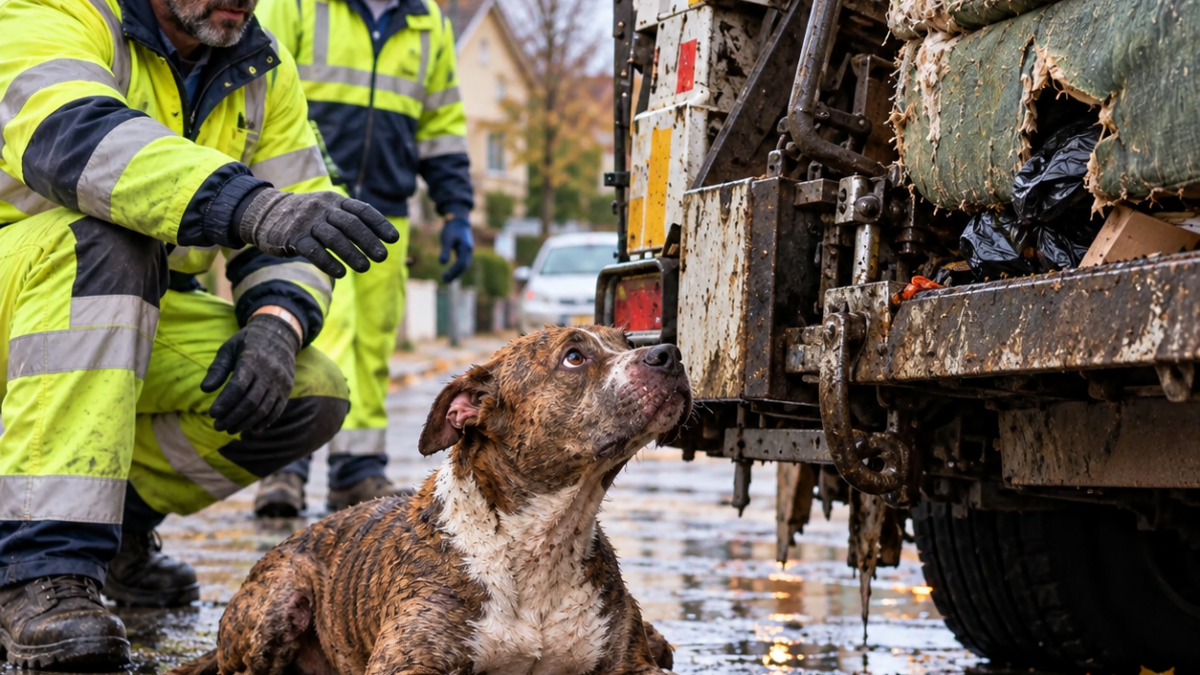
The Pit Bull Who Stopped Our Garbage Truck—What He Was Guarding Inside That Dumped Sofa Broke Every One of Us
The pit bull threw himself in front of my garbage truck like he had already decided his life was worth less than whatever was hidden in that old couch.
At first, I thought he was dangerous, then I thought he was desperate, but by the time I heard the sound coming from inside the cushions, I realized that dog had been begging us to listen from the very beginning.
And when we finally found out who had dumped that couch on the curb, I made sure the whole neighborhood learned exactly what kind of person he was.
[FACEBOOK CAPTION — 700–800 WORDS]
The first thing he did was steal our lifting strap.
My partner, Malik, had just slid the black nylon band under an old sofa someone had dumped on the curb in a quiet suburb outside the city. Rain was misting over the windshield, turning the streetlights pale even though it was barely past dawn. We had more than a hundred stops left on our route, and that couch was already soaked, sagging, and heavy with water.
Malik bent down to grab the second strap.
That was when a brindle pit bull shot out from behind a hedge.
He was thin, but not weak. Mud streaked his legs. His ribs showed under his coat. A wide white patch covered his chest, and one ear folded strangely to the side. He grabbed the first strap in his teeth and pulled backward with everything he had.
“Hey!” Malik shouted. “Drop it!”
The dog dragged the strap several feet down the sidewalk, then stopped.
He did not run away with it.
He did not chew it.
He simply dropped it, turned back toward us, and stared.
From the driver’s seat, I leaned over the steering wheel and looked through the wet glass.
“Maybe he wants to play,” I called.
Malik gave me a look. “With a lifting strap? At six in the morning?”
He went to pick it up.
The dog did not try to take it again.
Instead, he raced to the sofa, shoved his shoulder against the torn lower side, and pushed.
Once.
Twice.
Three times.
The couch moved maybe half an inch.
The dog stopped, panting hard.
Malik and I looked at each other.
“That’s weird,” he said.
We saw strays all the time on collection routes. Some barked at the truck. Some chased the tires. Some dug through trash bags. We could not stop every time a dog acted strange.
So Malik strapped the couch.
The mechanical arm began to lift.
The pit bull barked.
Not at us.
At the couch.
Then he ran behind the truck and jumped toward the emergency stop bar.
His front paws missed by inches.
“Cut it!” I screamed.
Malik killed the lift.
The couch dropped back with a wet thud.
The dog backed away, chest heaving.
“Go on!” Malik clapped his hands. “Get out of here!”
The pit bull retreated two steps.
Malik tried again.
The arm lifted.
The dog looked at Malik.
Then at me.
Then he did something I will remember for the rest of my life.
He sprinted in front of the truck and lay down directly in front of my left tire.
I slammed the brake so hard the seat belt knocked the breath out of me.
For one terrible second, all I could see was his white chest rising and falling against the wet pavement.
His eyes were not on the wheel.
They were on the couch.
Across the street, an elderly woman stood behind her screen door, one hand pressed to her chest. Later, we would learn her name was Madeleine Moreau, and she had seen more than we had. She had watched that pit bull stay beside the dumped couch most of the night. Every time another dog came near, he drove it away. Every time a tiny cry came from inside, he pressed his nose to the ripped fabric.
But in that moment, Malik and I did not know any of that.
All we knew was that a pit bull was blocking our truck like his body was the last barrier between that sofa and death.
I climbed down with a catch pole in one hand, not because I wanted to hurt him, but because I did not know what he would do.
He could have run.
He didn’t.
He went straight back to the couch.
Then he scratched once under the seat cushion.
Something moved inside.
Malik froze.
“Claire,” he whispered. “Did you hear that?”
I crouched beside the torn fabric.
The pit bull sniffed the small utility knife clipped to my work vest. Then he touched the handle with his nose.
After that, he pressed his muzzle against the tear in the sofa.
I will never claim he knew what a knife was.
But he understood one thing.
It was in my hand.
And my hand could open things.
I cut into the wet upholstery.
A tiny gray paw appeared between two chunks of dirty foam.
Then a sound rose from deep inside the couch, so weak and broken that Malik dropped to his knees beside me.
And before I could pull the fabric open any farther, something inside that sofa shifted again.
That was when the pit bull began to whimper.
PART 2
I cut faster after that, but not carelessly.
The fabric was thick, soaked, and rotten at the seams. Rain had seeped through the cushions, making the foam heavy and sour-smelling. My knife dragged through layers of upholstery, stuffing, staples, and something sticky that clung to the blade.
The pit bull stood close enough that I could feel his breath against my wrist.
Malik kept one hand near his collar, though the dog had no collar to grab. “Easy, boy,” he kept whispering. “Easy. We’re trying.”
The dog did not snap.
He did not growl.
He trembled.
That was the first time I realized he was not guarding the couch from us.
He was trying to make us understand it.
I cut a wider opening and pulled the foam apart.
A tiny gray kitten slid forward, no bigger than my palm.
For a second, none of us moved.
The kitten’s eyes were crusted shut. Its fur was damp and cold. Its mouth opened, but almost no sound came out. One thin paw flexed once against the air, then fell against my glove.
“Oh my God,” Malik breathed.
The pit bull shoved his nose toward the kitten, then jerked back as if afraid he might hurt it.
I lifted the kitten gently and tucked it inside my jacket against my chest. It was so cold I could barely feel it move.
Then the sound came again.
Not one cry.
Several.
Malik stared at the couch. “There’s more.”
I ripped open the side seam while Malik pulled cushion foam away piece by piece. The pit bull circled us, frantic now, nails scraping the wet sidewalk. Every time we found another kitten, he pressed close, sniffed, then backed off, letting us work.
The second kitten was black with a white chin.
The third was orange.
The fourth was wedged deeper under a wooden brace, its back leg caught in a loop of torn lining.
That one was barely moving.
“Don’t pull,” Malik warned.
“I’m not.”
My hands shook so badly I had to stop for one second and breathe.
I drove a garbage truck for a living. I had lifted mattresses soaked with things I did not want to identify. I had cleaned spoiled food from compactor jams, pulled raccoons out of bins, and seen enough dumped furniture to know people could be careless in a thousand ordinary ways.
But this was not careless.
Somebody had left living babies inside a couch.
Somebody had put that couch on a curb and walked away.
The pit bull whined again.
I looked at him.
His white chest was splattered with mud. His muzzle was scratched. There was a small line of dried blood above his nose, probably from trying to tear the sofa open before we arrived.
“You found them,” I whispered.
He stared at the opening.
“No,” I corrected softly. “You protected them.”
We freed the fourth kitten slowly. It made one weak sound when I lifted it, and the pit bull wagged his tail once.
Only once.
Like he did not have energy to spare for joy.
Across the street, Madeleine Moreau came out with a bath towel clutched to her chest.
She was in her seventies, small, silver-haired, wearing slippers and a raincoat thrown over a nightgown. She looked at the kittens, then at the dog, and her face crumpled.
“I knew there was something in there,” she said.
I turned toward her. “You saw this?”
“I saw the couch after midnight. A white van dropped it. Two men. They left fast.” Her voice shook. “Then that dog came. He stayed with it all night. I thought maybe he belonged to them, but he kept scratching at the side. I heard crying once, but I thought maybe it was him.”
Malik looked down the street. “Did you get a plate?”
Madeleine’s eyes changed.
“I have a camera.”
That was when the story became more than a rescue.
That was when it became a case.
But first, we had to keep the kittens alive.
I called dispatch and said, “We need animal control and emergency vet support at our location. Now.”
The dispatcher began with the usual tone. “Is there an aggressive dog?”
I looked at the pit bull, who had lowered himself near my boots, head still pointed toward the torn sofa.
“No,” I said. “There’s a hero dog.”
Animal control arrived twelve minutes later.
Those twelve minutes felt like a full morning.
We wrapped the kittens in towels and tucked them into the cab with the heat blasting. Malik took off his sweatshirt and made a little nest on the passenger seat. I held the weakest kitten against my chest, rubbing gently with two fingers, whispering nonsense because I did not know what else to do.
The pit bull refused to leave the truck.
He jumped up twice, trying to see inside.
“Can we let him look?” Malik asked.
The animal control officer, a woman named Dana Ruiz, studied him carefully.
“Slowly,” she said.
She held out a slip lead.
The dog lowered his head at the sight of it.
Not aggressively.
Fearfully.
Dana stopped at once.
“Okay,” she said. “No slip lead yet.”
She crouched, turned sideways, and placed the leash on the ground instead of reaching with it.
The pit bull watched her.
“He’s been through something,” she murmured.
“That makes six of them,” Malik said.
Dana looked toward the cab. “Six?”
“Four kittens,” I said. “Me and him.”
Malik pointed at the dog.
The pit bull climbed onto the truck step and peered through the open door.
The kittens made faint, miserable little sounds from the warm pile of towels.
The dog’s whole body softened.
He did not try to grab them. He did not jump in. He only pressed his nose near the edge of the seat and breathed them in like he needed proof.
The weakest kitten moved.
The pit bull wagged again.
This time twice.
“Do we know his name?” Dana asked.
“No.”
Malik looked at the dog’s wide chest and scarred shoulders.
“He looks like a Tank.”
I shook my head.
“That dog just stopped a garbage truck with his body. He’s not Tank.”
Dana glanced at me. “What would you call him?”
The pit bull looked up at me, rainwater dripping from his whiskers.
“Atlas,” I said.
Malik raised an eyebrow.
“The one who carried the world?”
I looked at the kittens.
“Close enough.”
Dana took the kittens to the emergency vet, and Atlas followed her van with his eyes until it turned the corner.
Then he looked back at the torn couch.
As if there might still be something inside.
We searched it again.
Every cushion.
Every hollow space.
Every torn strip of lining.
No more kittens.
But we found something else.
A piece of duct tape stuck underneath the wooden frame, folded over on itself. Written on it in black marker was a number.
Not a full address.
Just “27B.”
Malik frowned. “Storage unit?”
“Apartment?”
Madeleine, still standing under her rain hood, went pale.
“There’s a building two streets over,” she said. “Old duplexes. Unit 27B.”
I looked at the couch again.
The rain had darkened the fabric, but on one cushion I could now see a faint pattern of cigarette burns and a long tear patched badly with gray tape.
Madeleine swallowed.
“I’ve seen that couch before.”
“Where?”
“At 27B.”
The police came after that.
Not fast.
Not dramatically.
But they came.
Officer Grant Lewis arrived with a notebook and the resigned expression of someone expecting a messy neighborhood complaint. Then he saw the torn sofa, the blood on Atlas’s muzzle, my soaked uniform, Malik’s sweatshirt in the truck cab covered in kitten fur, and Madeleine holding her raincoat closed with both hands.
His expression changed.
“Start from the beginning,” he said.
So we did.
I told him about the strap.
Malik told him about Atlas trying to hit the emergency stop bar.
Madeleine told him about the white van at midnight, the two men, and the dog staying all night in the rain.
Then she invited us across the street to see the camera footage.
Her house smelled like coffee, lavender soap, and old wood. On her kitchen table sat a laptop that looked newer than everything else in the room.
“My grandson installed the cameras after someone stole my garden tools,” she said, clicking with careful fingers. “I told him I didn’t need all this technology. I suppose I was wrong.”
The footage was grainy but clear enough.
At 12:43 a.m., a white panel van rolled to the curb.
Two men got out.
One wore a baseball cap low over his face. The other had a dark hoodie and a limp. They dragged the sofa from the back of the van and dumped it hard onto the sidewalk.
Even through the silent footage, the cruelty of the movement was obvious.
They knew it was heavy.
They knew something was inside.
One of them kicked the side of the couch.
The image made my hands curl into fists.
Then, from the shadows near the hedge, Atlas appeared.
He barked at them.
The man in the hoodie swung at him with something long—maybe a stick, maybe a broken piece of furniture.
Atlas jumped back.
The man kicked toward him.
Madeleine gasped behind us.
The two men got in the van and drove away.
Atlas did not chase them.
He went straight to the sofa.
On the screen, he sniffed it, circled it, scratched at the side, then lay down beside it in the rain.
For the rest of the night, the camera caught him again and again.
Standing guard.
Pushing at the couch.
Driving away a stray cat.
Pressing his nose to the torn fabric.
Lying down with his body against the opening like he was trying to keep warmth inside.
Nobody spoke.
Even Officer Lewis, who had probably seen worse than we had, rubbed one hand across his jaw and looked away.
Madeleine whispered, “That poor dog.”
I looked at the screen, at Atlas lying in the rain beside a couch full of dying kittens.
“No,” I said. “That good dog.”
The emergency vet called at 10:18 a.m.
All four kittens were alive.
Barely, but alive.
The weakest one, the little orange, was in critical condition. The gray kitten had mild hypothermia. The black-and-white had an eye infection. The fourth, a tabby with the trapped leg, might have nerve damage but had a chance.
A chance.
That word carried me through the rest of the route.
Because yes, we finished the route.
People always ask that part when I tell the story.
“How could you keep working?”
Because life does not pause cleanly for heartbreak. Trash still had to be collected. Streets still had to be cleared. People would call if we missed their bins. Malik and I drove the rest of that day with the smell of wet sofa still in our clothes and the image of that tiny gray paw burned into our minds.
Atlas went with Dana.
He resisted the truck at first.
Not because he wanted to fight.
Because the kittens had gone one way and the sofa another, and he did not know which duty mattered most.
Dana waited.
She offered chicken from her pocket.
Atlas ignored it.
Then I walked over and crouched in front of him.
“They’re at the vet,” I said, feeling ridiculous and completely serious at the same time. “You did your job. Let them help you now.”
He stared at me.
Dogs do not understand sentences the way we wish they did.
But they understand tone.
They understand the end of urgency.
They understand when a human finally stops dismissing them.
Atlas stepped into the animal control van.
Before the door closed, he looked at the garbage truck.
Then at me.
I lifted one hand.
“See you soon, boy.”
I meant it.
I did not know how much I meant it yet.
That night, I could not sleep.
I kept thinking about the couch.
About the tape marked 27B.
About the van.
About Atlas trying to reach the emergency stop bar.
Not barking at us.
Not attacking us.
Trying to stop a machine.
At 3:11 a.m., I sat up in bed and searched missing dog posts on my phone.
Brindle pit bull. White chest. Folded ear.
I found him in less than twenty minutes.
A post from three months earlier.
MISSING: BRUNO. Brindle pit mix. Male. White chest. Left ear folds. Gentle but nervous. Last seen near East Quarry Road. Belongs to my brother, currently deployed. Please call if found.
There was a phone number.
My heart started pounding.
Bruno.
Not Atlas.
Bruno.
I called the number first thing in the morning.
A woman answered on the fourth ring, voice thick with sleep and worry.
“Hello?”
“My name is Claire Bennett. I work for city sanitation. This may sound strange, but I think I found the dog from your missing post.”
There was silence.
Then she whispered, “Bruno?”
“He’s alive.”
A sound came through the phone that was half sob, half prayer.
Her name was Rachel Hale—not related to anyone in the case, thank God—and Bruno belonged to her younger brother, Daniel, a Marine reservist who had been overseas when Bruno disappeared from her fenced yard during a storm. She had searched for weeks. Put up flyers. Posted online. Called shelters. Checked roads.
No one had found him.
Until he found the couch.
Rachel met us at animal control that afternoon.
She brought a faded blue collar and a photo of Bruno lying beside a man in uniform, his head on the man’s boot.
The dog in the kennel lifted his head when he heard her voice.
“Bruno?” she whispered.
His body froze.
Then his tail began to move.
Not once.
Not twice.
Wildly.
He pushed himself up, whining, paws scrabbling against the floor.
Rachel dropped to her knees before Dana could warn her to move slow.
Bruno pressed his whole body against the kennel gate.
“Oh my God,” Rachel sobbed. “Oh my God, baby, I’m sorry. I’m so sorry.”
When they opened the gate, Bruno nearly knocked her over.
He climbed into her lap like a dog half his size, licking her chin, crying in a broken, high sound that made everyone in the room turn away to hide their faces.
I stood with my back against the wall, unable to speak.
Malik sniffed loudly beside me.
“You crying?” I asked.
“No,” he said. “Allergies.”
“You don’t have allergies.”
“I got them this morning.”
Bruno was not a stray.
He was a lost dog who had spent three months surviving on whatever the streets gave him, and somehow, after hunger, rain, fear, and loneliness, he still chose to protect smaller lives.
Rachel wanted to take him home immediately.
Dana said gently, “We need to finish documenting his condition. He has cuts, weight loss, and we need to connect him to the kitten case as a witness.”
Rachel blinked. “A witness?”
I said, “A hero.”
Bruno leaned against Rachel’s legs, but his eyes kept moving toward the clinic hallway.
The kittens were not there, but he knew.
Rachel followed his gaze.
“What happened?” she asked.
So we told her.
By the time we finished, she was crying again, but differently this time. Pride can break a person open just as easily as grief.
“My brother always said Bruno had a soft spot for anything small,” she said. “He once carried a baby rabbit in his mouth and set it on Daniel’s pillow.”
Malik smiled through wet eyes.
“That tracks.”
Daniel came home two weeks later on emergency leave after Rachel called him.
By then, the kittens had names.
The gray one was Pebble.
The black-and-white was Socks.
The orange one, the weakest, was Flicker because he nearly went out twice and came back both times.
The tabby with the injured leg was Button.
The vet clinic had them in an incubator at first, then warming cages, then a foster setup with round-the-clock bottle feeding. Their eyes opened slowly. Their cries got louder. Their little bellies rounded after meals. Button’s leg improved. Flicker became the loudest.
Bruno visited them after he was cleared medically.
We did it carefully.
Rachel held his leash. Dana supervised. The vet tech carried one kitten at a time in a towel.
Bruno lay down the moment he saw them.
Flat on the floor.
As if making himself small.
Pebble was placed near his front paws.
The kitten wobbled, blind and ridiculous, then pushed its tiny face into Bruno’s white chest.
Bruno stopped breathing for a second.
Then he began to lick the top of Pebble’s head with such tenderness that Rachel covered her mouth.
“He knew,” she whispered.
“Yes,” I said. “He knew.”
The investigation moved faster after Daniel came home.
Not because he was military.
Because he was relentless.
He took one look at Madeleine’s footage, one look at Bruno’s injured muzzle, one look at the kittens in their warming box, and said, “Somebody is going to answer for this.”
I respected that.
But I also worried.
Anger is useful only if you can aim it.
Daniel wanted names.
Officer Lewis had one lead: 27B.
The building two streets over had been rented to a man named Evan Rollins. The same man had a white panel van registered to a small junk removal business that had been fined twice for illegal dumping.
When Officer Lewis and animal control went to 27B, nobody answered.
The landlord let them in with a warrant two days later.
Inside, they found pet food receipts, empty kitten formula cans, dirty towels, and a torn cushion cover matching the dumped sofa. They also found a phone bill in Evan Rollins’s name and a handwritten note with addresses for “pickup jobs.”
But the real break came from Malik.
He remembered the duct tape.
“Why write 27B under the sofa?” he asked one evening while we sat in the truck eating gas station sandwiches. “If it was theirs, they already knew where it came from.”
I thought about it.
“Maybe it wasn’t for them.”
“Exactly.”
“For movers?”
“For customers.”
We dug through illegal dumping reports in that area.
Three other furniture items had been dumped in the last month.
A mattress.
A recliner.
A broken dresser.
All had markings underneath.
14A.
9C.
31.
Officer Lewis connected the dots.
Evan Rollins had been running an unlicensed junk removal service. People paid him to haul away trash. Instead of taking it to the landfill, he dumped it around neighborhoods before dawn.
But that did not answer why kittens were inside the couch.
The answer came from Evan’s ex-girlfriend, Tara.
She contacted police after seeing a news story about Bruno.
She said Evan and his cousin had cleaned out a rental unit where a cat had given birth inside a sofa. The tenant had abandoned the unit. Evan did not want to deal with the kittens, and the mother cat escaped during the cleanup. Tara said she begged him to take the babies to a shelter.
He said, “They’re not my problem.”
Then he loaded the couch into the van.
With the kittens still inside.
When Tara threatened to report him, he laughed and said garbage day would handle it.
Garbage day.
That meant me.
That meant Malik.
That meant our truck was supposed to crush the evidence.
The thought made me physically sick.
Evan Rollins and his cousin, Travis Pike, were arrested two days later.
Animal cruelty.
Illegal dumping.
Operating without proper waste disposal permits.
Falsifying disposal records.
A list of charges that sounded formal and dry compared to what they had actually done.
They had sentenced four kittens to be crushed alive.
And they had kicked the dog trying to stop them.
The court hearing drew half the neighborhood.
Madeleine came in a blue coat, sitting straight-backed in the second row.
Rachel came with Bruno, who was allowed in the courthouse lobby but not the courtroom, so Daniel waited outside with him during the first part and switched with her later.
Malik came in his cleanest shirt.
I wore my work boots.
I wanted Evan to see them.
He did.
When I testified, his eyes dropped to my boots, then away.
The prosecutor asked me to describe what happened.
I told the court about the strap.
About Bruno blocking the tire.
About the gray paw in the foam.
About the sound inside the couch.
About realizing that if Bruno had not stopped us, our truck would have compacted that sofa in less than a minute.
Evan stared at the table.
Travis looked bored until Madeleine’s footage played.
The courtroom watched Bruno lying in the rain beside the couch.
They watched the men dump it.
They watched Travis swing at him.
They watched Bruno return to the sofa instead of running away.
By the end, even the judge’s face had changed.
The defense tried to say the men did not know the kittens were inside.
Then Tara testified.
“They knew,” she said, voice shaking. “I heard them. I told them. Evan said, ‘It’ll be gone in the morning.’”
The prosecutor asked, “What did you understand that to mean?”
Tara looked at Evan.
“That the garbage truck would take it.”
Evan’s lawyer objected.
The judge overruled.
Tara continued.
“He said if the kittens were too stupid to crawl out, that wasn’t his problem.”
A sound moved through the courtroom.
Not loud.
Worse.
Disgust.
Evan finally looked up.
For the first time, he seemed to understand that this was not a neighborhood complaint anymore. This was not a fine he could shrug off. This was a room full of people imagining those kittens in the compactor.
The judge sentenced both men to jail time, probation, fines, restitution to the vet clinic, community service under supervision, and a long ban on owning or handling animals. Evan’s junk removal business was shut down. His van was impounded. His illegal dumping cases reopened, and more fines followed.
Was it enough?
No.
It never is.
But the best part came afterward.
The judge allowed Bruno into the courtroom after sentencing for a brief recognition from animal control. It was not something I expected. It was not theatrical. Just a simple certificate for “extraordinary animal bravery.”
Daniel walked him in.
Bruno looked confused by the polished floors and serious faces.
His blue collar had been cleaned. His coat looked healthier. He had gained weight. The cuts on his nose had healed, though one small scar remained.
The judge leaned forward.
“This dog saved four lives,” she said.
I looked at Evan.
He was standing near the side with a deputy beside him, wrists cuffed, jaw tight, face red.
Bruno did not look at him.
Not once.
That was the revenge I liked best.
Evan had thrown away lives he thought did not matter.
Bruno saved them.
Evan stood there in cuffs.
Bruno stood in sunlight from the courthouse window, surrounded by people who loved him.
After sentencing, the story spread everywhere.
The city sanitation department gave Malik and me a commendation, though we both said the real credit belonged to Bruno. The shelter used donations from the case to start an emergency response fund for animals found in dumped furniture, sealed boxes, abandoned vehicles, and trash piles.
The program was named Bruno’s Watch.
Malik pretended that did not make him emotional.
It absolutely did.
Madeleine became a local legend because her camera caught the truth. Her grandson installed two more cameras for neighbors free of charge. She started keeping a bowl of clean water near her front steps “for any good dog on night duty,” as she put it.
The kittens grew.
Pebble became soft and round, with a habit of sleeping on top of shoes.
Socks turned bossy.
Button’s leg healed almost completely, though he kept a slight wobble that made him look like he was walking to music only he could hear.
Flicker, the kitten we almost lost, became the loudest living creature I have ever met.
All four were fostered together at first.
Then came the question no one wanted to ask.
Could they stay together?
Usually, with kittens, the answer is no. Four together is a lot. But this story had already ignored usual things.
Rachel and Daniel adopted Bruno back officially, of course. He had always been theirs.
But Daniel also adopted Pebble.
He said Bruno needed “one of his babies.”
Bruno chose Pebble anyway.
During visits, Pebble always crawled into the white patch on his chest and fell asleep there.
Madeleine adopted Socks, claiming she needed “a watchdog with opinions.”
Malik adopted Button after pretending for three weeks that he was only helping with transport.
Flicker came home with me.
I did not plan that.
That is what everyone says right before an animal moves in and takes over.
Flicker was still tiny when I first brought him home to foster for a weekend. He screamed at my lamp, attacked my shoelaces, fell asleep inside my work cap, and bit my finger with the confidence of a tiger.
By Sunday night, I knew he was not leaving.
I sent Malik a photo of Flicker sleeping on my chest.
He replied: Garbage route got you a cat.
I wrote back: Garbage route got us a miracle.
Months later, we held a small gathering on the same street where the couch had been dumped.
Not a ceremony exactly.
Just neighbors, the sanitation crew, animal control, Madeleine, Rachel, Daniel, Malik, me, and Bruno standing proudly in the middle of it all.
The city placed a small sign near the curb.
ILLEGAL DUMPING IS A CRIME. ANIMAL ABANDONMENT IS A CRIME. REPORT IT.
That was official.
Madeleine taped a second handwritten sign in her window.
BRUNO SAW YOU ONCE. WE ALL WILL NEXT TIME.
That one was better.
Bruno stood beside Daniel, calm and dignified until Pebble, now bigger and carried in a soft pet sling, reached one paw toward him.
Bruno immediately stopped being dignified.
He licked Pebble’s face.
The crowd laughed.
I stood near the curb, looking at the exact spot where he had lain in front of my tire.
The pavement was dry that day.
No rain.
No couch.
No tiny cries.
Still, I could see it all.
His body on the wet road.
His eyes locked on the sofa.
The message we almost missed.
Malik came to stand beside me.
“You thinking what I’m thinking?” he asked.
“That we were seconds away from living with something we could never undo?”
He nodded.
“Yeah.”
I swallowed.
“Bruno stopped us.”
“He saved us too,” Malik said.
He was right.
That dog did not only save the kittens.
He saved us from becoming part of someone else’s cruelty without ever knowing it.
After that, our route changed.
Not officially.
Not on the map.
But Malik and I changed.
We checked dumped furniture more carefully. We listened before loading. We taught new crew members to pause if an animal seemed fixated on trash. We carried gloves, a flashlight, a small pry tool, and emergency numbers taped inside the cab.
At first, other workers teased us.
“Claire’s checking couches for secret cats.”
“Malik’s running a rescue route.”
Then one of those workers found a litter of newborn mice in a sealed box and moved them safely instead of crushing it.
Another found a trapped raccoon in an overturned bin and called wildlife rescue.
A third stopped for a dog circling a taped cardboard box and found two abandoned rabbits inside.
The teasing stopped.
Bruno’s Watch became more than a fund.
It became a habit.
Listen before you lift.
Look before you crush.
Trust the animal trying to tell you something.
That was the rule.
A year after the rescue, Bruno rode with Daniel in the city parade.
He wore a blue bandana that said GOOD BOY in white letters. Daniel hated the attention, but Rachel insisted, and Bruno seemed mostly interested in dropped popcorn.
Madeleine waved from a folding chair.
Malik held Button in a carrier despite claiming cats were “not his brand.”
I had Flicker in a harness, which he hated with the fury of a small orange criminal.
When Bruno passed, people clapped.
He did not know why.
That made it better.
Heroes do not need to understand applause.
They only need to keep doing what love tells them to do.
Years later, when Bruno’s muzzle turned gray and Pebble became a fat, calm cat who still slept against his chest, Daniel told me something I never forgot.
We were sitting in his backyard while Bruno snored in the shade. Pebble was draped across him like a blanket.
Daniel said, “When I was deployed, I used to worry Bruno would forget me.”
I looked at the sleeping dog.
“He didn’t.”
“No,” Daniel said. “But I think I underestimated him. I thought of him as my dog. My comfort. My responsibility. Then he disappeared and spent months surviving. And after all that, he still had room in him to protect something smaller.”
He leaned back in his chair.
“That’s not training. That’s character.”
I thought about Evan Rollins, who had seen helpless life as trash.
Then I looked at Bruno, who had seen helpless life inside trash and decided it was worth dying for.
“Some creatures tell you exactly who they are when nobody is rewarding them,” I said.
Daniel nodded.
“And some people do too.”
Bruno lived to be fourteen.
On his last day, the kittens he saved were no longer kittens.
Pebble was curled beside him.
Socks had come with Madeleine in a carrier and sat like royalty on a blanket.
Button arrived with Malik, who cried before he even got through the door.
Flicker came with me and, for once in his loud little life, stayed quiet.
Daniel sat on the floor with Bruno’s head in his lap.
Rachel held his paw.
Madeleine whispered, “Good dog,” over and over, as if each repetition could build him a bridge.
Bruno’s breathing slowed.
His eyes moved once toward Pebble.
Then toward Daniel.
Then he rested.
No fear.
No rain.
No truck.
No desperate couch to guard.
Just the people and animals who knew what he had done.
Afterward, Daniel buried him under the maple tree in the backyard, wrapped in the blue parade bandana. Pebble sat by the back door watching until the last shovel of dirt fell.
Malik placed a small black lifting strap near the grave.
The same kind Bruno had stolen from us that morning.
I placed a worn utility knife beside it, closed and safe.
Madeleine brought a stone she had painted with careful white letters.
BRUNO
HE WOULD NOT LET US LOOK AWAY.
That was the truth.
The city later named the emergency animal response fund permanently after him. The shelter hung his photo in the intake room: Bruno standing in front of the garbage truck, white chest bright, one ear folded, eyes serious.
Under it, the plaque reads:
LISTEN WHEN AN ANIMAL INSISTS.
Every new sanitation worker sees it during training now.
So do animal control officers.
So do volunteers.
Sometimes school groups come through, and someone tells the story of the pit bull who stopped a garbage truck because there were kittens hidden in a couch.
Children always ask the same question.
“How did he know?”
I always answer the same way.
“I don’t know exactly. But he knew enough.”
He knew life was inside.
He knew the truck was danger.
He knew humans were not understanding fast enough.
He knew his body could stop us, even if only for a second.
And sometimes one second is the distance between tragedy and miracle.
I still drive that route.
The street looks ordinary now. Same hedges. Same wet curbs after rain. Same trash bins lined up on collection days. Madeleine’s house has new flowers by the steps, and the water bowl remains there, though she says it is “just practical.”
Every time I pass the spot where the couch was dumped, I slow down.
Not enough to bother traffic.
Just enough to remember.
The strap in Bruno’s teeth.
The bark at the sofa.
The leap toward the emergency bar.
The weight of the brake against my foot.
The tiny gray paw appearing through the foam.
The sound that changed everything.
People like to say animals cannot speak.
I disagree.
They speak constantly.
With their bodies.
Their eyes.
Their refusal to leave.
Their strange behavior we dismiss because we are busy, tired, late, practical, human.
That morning, Bruno spoke louder than any person on that street.
And thank God, just in time, we finally listened.
The revenge was not cruel.
It did not need to be.
The men who treated life like garbage lost their freedom, their business, their names, and the comfort of being unseen.
The kittens grew up loved.
The dog they kicked became a city hero.
And every garbage truck in our district now carries a rule written because of him:
Before you lift, listen.
That is Bruno’s legacy.
Not the arrest.
Not the applause.
Not even the plaque.
His legacy is the pause before the machine starts.
The second look.
The worker who hears a faint cry and stops.
The animal who refuses to move and is believed.
The life hidden inside what someone else threw away.
And whenever I think of him, I do not picture him old beneath the maple tree, though I am grateful he reached that peace.
I picture him in the rain.
Thin, muddy, exhausted, and brave beyond reason.
Lying in front of my left tire, white chest heaving, eyes fixed on the couch, telling us with everything he had left:
Not this.
Not today.
Not while I’m still here.